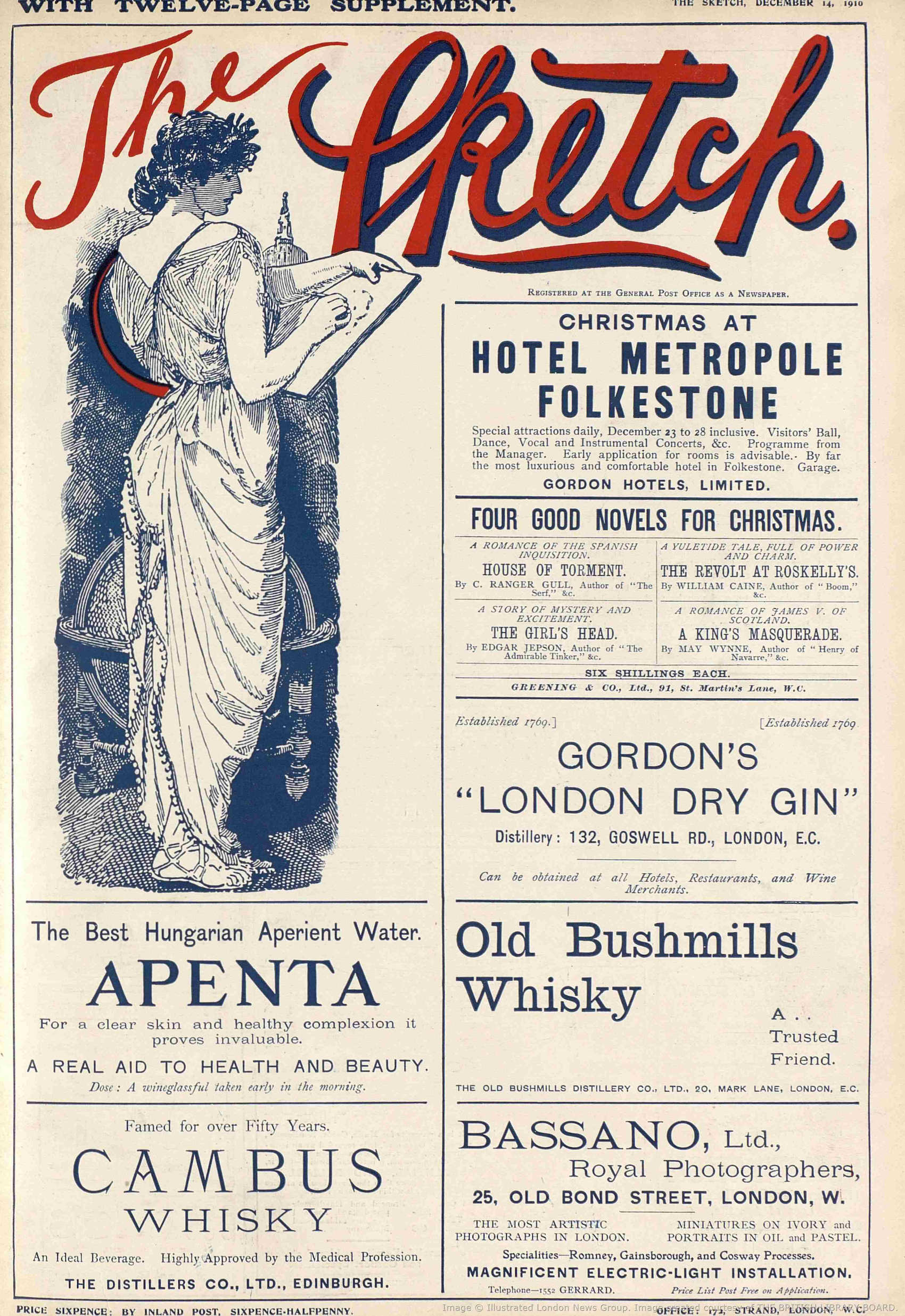
The Sketch, December 14, 1910, cover. Notice May Wynne’s book advertised immediately below Caine’s.
a Failure-at-the-Bar. Though no fustilug, he was stouter even than [his companion] St. John, and rejoiced in an abundance of hair, which by reason of a thin knack for verse-making and a strong dislike to the ministrations of the barber, he grew to an unwarrantable length. His nose was pug, his chin pointed and peculiar, and his front teeth were projecting. He wore spectacles, the rims of which were of a metal which resembled gold very closely, and he bit his nails. He was, over and above all this, enormously a favourite with women, for his wealth was vast (C: 20).Quilliam reappears as the popular author, modeled on William Le Queux, of a light novel being read by Miss Ethel Waugh, the President of the Womanhood Suffrage League in The Victim and the Votery:
Meanwhile she was at home to nobody, and followed the fortunes of one of Mr. William Le Quilliam’s cosmopolitan heroines with absorbed delight. The calamities which overtook the unfortunate young woman (the one treading on the heels of the other to do it) left Miss Waugh unmoved. She had perfect confidence in Mr. Le Quilliam. All would yet be well, however black things might look for the girl just at present. The bells of the old Saxon-Gothic church at Bunstead Tutbury would ring out in the last chapter (VV: 124).As for the first name: Four of Caine’s books — The Wife Who Came Alive (1919), The Strangeness of Noel Carton (1920), The Author of “Trixie”, and Lady Sheba’s Last Stunt — were published by Herbert Jenkins, and the bells of the Grafton Square Congregational Church in Clapham, London, rang out for two of Caine’s three sisters and their respective Herberts, both Welsh MPs. On Tuesday, August 1, 1893, Hannah the eldest married John Herbert Roberts, the Liberal representative for the Western Division of Denbighshire, Wales, and on Thursday, July 8, 1897, Ruth the youngest married John Herbert Lewis, “the radical member for the Flint District.” Then there’s the Herbert mentioned in close proximity to Caine by Graham (quoted in the previous chapter), A. P. Herbert, who, like Caine, was called to the bar before switching to literature, and who, unlike Caine’s friend George Calderon (another former barrister), survived the Third Battle of Krithia in Gallipoli and went on to become a far better known author than either… Yet something more than nominal coincidence and onomastic metathesis — William Jenkins ⇌ Herbert Caine — links the real author William Caine alias W. Quilliam published by Herbert Jenkins (who was also a writer) to the fictional author Herbert Quain invented by Jorge Luis Borges. For instance, at the end of 1939, Quain
publicó Statements: acaso el más original de sus libros, sin duda el menos alabado y el más secreto. Quain solía argumentar que los lectores eran una especie ya extinta. No hay europeo (razonaba) que no sea un escritor, en potencia o en acto | published Statements: perhaps the most original of his books, doubtless the least praised and most secret. Quain used to argue that readers were a species already extinct. There is no European (he would reason) who is not a writer, in potential or in act (Borges 1941: 48).As noted in § 2, Caine’s The Author of “Trixie” starts out with a variant of Quain’s maxim: “Every man and woman has one novel in them.” Caine evolves the entire novel out of that maxim. Likewise, Borges could be said to have evolved, via a sort of Roussellian procédé, Quain’s qualifier, “en potencia o en acto,” out of the overheard utterer of Caine’s maxim, the Bishop of Pontefract — even more so when “en acto” is translated as “in fact.” And while Caine’s Archdeacon Roach puts the Bishop of Pontefract’s “theory to the test,” as the publisher’s blurb reproduced in § 1 states, by authoring his Trixie, Borges’s Quain drafts the eight stories of his Statements both to demonstrate his axiom for the benefit of “esos ‘imperfectos escritores,’ cuyo nombre es legión” who are incapable of achieving literature’s highest form of happiness, invention, and “to avenge himself” for the spurious fame and unaccustomed success which his previous work had earned him:
La fama divulgó que The secret mirror era una comedia freudiana; esa interpretación propicia (y falaz) determinó su éxito. Desgraciadamente, ya Quain había cumplido los cuarenta años; estaba aclimatado en el fracaso y no se resignaba con dulzura a un cambio de régimen. Resolvió desquitarse. A fines de 1939 publicó Statements: acaso el más original de sus libros, sin duda el menos alabado y el más secreto. Quain solía argumentar que los lectores eran una especie ya extinta. No hay europeo (razonaba) que no sea un escritor, en potencia o en acto. Afirmaba también que de las diversas felicidades que puede ministrar la literatura, la más alta era la invención. Ya que no todos son capaces de esa felicidad, muchos habrán de contentarse con simulacros. Para esos “imperfectos escritores,” cuyo nombre es legión, Quain redactó los ocho relatos del libro Statements | Fame proclaimed that The secret mirror was a Freudian comedy; this favorable (and fallacious) interpretation determined its success. Unfortunately, Quain had already turned forty; he was accustomed to failure and could not easily resign himself to a change of regimen. He resolved to avenge himself. Towards the end of 1939 he published Statements: perhaps the most original of his books, doubtless the least praised and most secret. Quain used to argue that readers were a species already extinct. There is no European (he would reason) who is not a writer, in potential or in act. He also affirmed that of the diverse satisfactions which literature can provide, the highest was invention, Since not everyone is capable of this happiness, many must content themselves with simulacra. For those “imperfect writers,” whose name is legion, Quain drafted the eight stories of the book Statements (Borges 1941: 48).Similarly, and conversely, the Le Queux-esque narrator (I’m thinking in particular of The Death-Doctor from 1912) of what is perhaps Caine’s most inventive and successful (and least understood) novel, The Strangeness of Noel Carton, puts into practice a variant of Quain’s axiom precisely in order to achieve a success which will allow him to change his regimen and thus avenge himself on, and escape from, the wife he resents and despises:
The result of my cogitations took the form presently of my slapping my hand on the table, jumping up and saying aloud; “I’ll do it.” I expect I looked devilish dramatic as I did this. Of course, what I had resolved to do was to write a novel. I’d show her. And it would be something to do. They say everybody can write one novel.Furthermore, and keeping to the revenge/success theme, Stephen Graham noted in his memoir, Part of the Wonderful Scene, that the author of The Author of “Trixie”And who knows? if I write one, I might write two or three and more still. I might make money enough to get out of this. I don’t care if there is a scandal. I’d leave her to-morrow if I had two beans to rub together. It’s she that insists on keeping me about the house. It’s not a bit respectable to have one’s husband at large (SNC-HJ: 16; SNC-P: 11–12).
had two uncles, members of Parliament, who regarded his literary career as something not to be mentioned. His books were hidden in a skeleton cupboard. Those uncles and other disapproving relatives diminished Billie’s sales. Not that he minded, though he had his revenge by telling how a literary snob wrote anonymously a vulgar romance and gloated over its success, but suffered the tortures of the damned by not being able to admit to his friends that he was the author (Graham 1964: 72)Those “uncles,” of course, were actually Caine’s brothers-in-law John Herbert Roberts and John Herbert Lewis; Graham’s mistake is understandable, since Roberts was ten, and Lewis almost fifteen, years older than Caine. But back to Quain and the work which earned him the success he sought revenge for, “la comedia heroica en dos actos The secret mirror,” which Borges summarizes as follows:
El primer acto (el más extenso) ocurre en la casa de campo del general Wynd, C.I.E., cerca de Melton Mowbray. El invisible centro de la trama es Miss Ulrica Wynd, la hija mayor del general. A través de algún diálogo la entrevemos, amazona y altiva; sospechamos que no suele visitar la literatura; los periódicos anuncian su compromiso con el duque de Rutland; los periódicos desmienten el compromiso. La venera un autor dramático, Wilfred Quarles; ella le ha deparado alguna vez un distraído beso. Los personajes son de vasta fortuna y de antigua sangre; los afectos, nobles aunque vehementes; el diálogo parece vacilar entre la mera vanilocuencia de Bulwer-Lytton y los epigramas de Wilde o de Mr. Philip Guedalla. Hay un ruiseñor y una noche; hay un duelo secreto en una terraza. (Casi del todo imperceptibles, hay alguna curiosa contradicción, hay pormenores sórdidos). Los personajes del primer acto reaparecen en el segundo — con otros nombres. El “autor dramático” Wilfred Quarles es un comisionista de Liverpool; su verdadero nombre, John William Quigley. Miss Wynd existe; Quigley nunca la ha visto, pero morbosamente colecciona retratos suyos del Tatler o del Sketch. Quigley es autor del primer acto. La inverosímil o improbable “casa de campo” es la pensión judeo-irlandesa en que vive, transfigurada y magnificada por él… | The first act (the longest) takes place in the country house of General Wynd, C.I.E., near Melton Mowbray. The invisible center of the plot is Miss Ulrica Wynd, the general’s eldest daughter. Through a bit of dialogue we catch a glimpse of her, Amazon and arrogant [or: an arrogant horsewoman; or: imposing and haughty]; we suspect that she is not wont to frequent literature; the newspapers announce her engagement to the Duke of Rutland; the newspapers deny the engagement. A playwright, Wilfred Quarles, reveres her; she has conceded him once a distracted kiss. The characters are of vast fortune and ancient lineage [or: blood]; the emotions, noble yet vehement; the dialogue seems to vacillate between the mere vaniloquence of Bulwer-Lytton and the epigrams of Wilde or Mr. Philip Guedalla. There is a nightingale and a night; there is a secret duel on a terrace. (Almost totally imperceptible, there is some curious contradiction, there are sordid details). The characters of the first act reappear in the second — with other names. The “playwright” Wilfred Quarles is a commission agent from Liverpool; his real name, John William Quigley. Miss Wynd exists; Quigley has never seen her, but he morbidly collects portraits of her from The Tatler or The Sketch. Quigley is the author of the first act. The unlikely or improbable “country house” is the Jewish-Irish boarding house in which he lives, transfigured and magnified by him… (Borges 1941: 47–48).The announcement of Miss Ulrica Wynd’s engagement to the Duke of Rutland reminds me of a phrase from the piece I reproduced in lieu of a preface (§ 0) from Caine’s posthumous Smoke Rings:
“What, Mr. Caine,” I inquired, “is your name?”Caine also mentions Rutlandshire at least three times in relation to an arrogant boorish character named Reginald Hindlip in The Revolt at Roskelly’s (1910):“Anson Berkley,” he replied, “but of course that’s only the name I write under. My real name is Llewellyn Solomons. Ours is the Rutlandshire branch, you know” (SR: 125).
It pained Benson to feel on anything but the best of terms with Hindlip, who was one of the Rutlandshire Hindlips (RR-G: 8; RR-P: 2).Melton Mowbray, the town in Leicestershire near which General Wynd has his country house in Quain’s The secret mirror, is renowned for its pies made from uncured pork. In addition to being twice mentioned in the autobiographical “Christmas Fare” (quoted in § 2), Caine also mentions the eponymous victual in a chapter of The Glutton’s Mirror entitled “The Apéritif:”
“I beg your pardon,” said Elizabeth, as she stumbled over the foot which Hindlip had not troubled to take out of her path. Hindlip wore the stoutest of golfing boots, and Elizabeth’s were of glacé kid. But during Elizabeth’s absence the loud, cheerful conversation of Mrs. Day and the ruddy old man had goaded Hindlip into a condition bordering on frenzy. The light touch of the girl’s foot assumed for him the proportions of an assault. With a contorted face and in a voice which he strove to make sarcastic, but only succeeded in making insolent, he said, “Oh, pray don’t mention it.” Elizabeth mistook the note in his voice for sheer anguish. “Oh, dear,” she cried as she sat down. “I am afraid I must have hurt you awfully. Was it a corn?”
“I have no corns,” said Hindlip violently. This, indeed, was a circumstance on which he prided himself, for, it is a characteristic of the Rutlandshire Hindlips to have very small feet which makes it unnecessary for them to have corns (RR-G: 33; RR-P: 31–32).
Apologetically now, I sing the Plebs’ Hop; not because the bounding of bounders is a spectacle that attracts the likes of you and me, but because the main current of our story carries us this evening into the drawing-room, among inferior people, rather than upstairs into the General’s private apartment where the Rutlandshire Hindlips and others sit at bridge (RR-G: 178; RR-P: 199).
Germans require no aids to appetite. Food makes no difference to them. It is as if they breathed it. At any moment of the day or night a German is ready for a ten course meal particularly after he has finished one. If they drink aperitifs at all it is merely to be in the fashion. I should say that a Melton Mowbray pie is the sort of aperitif that a German would appreciate (GM: 24).This conjunction of two mirrors — Quain’s secret and Caine’s glutton’s — each with their mention of Melton Mowbray, reminds me of the opening sentences of a piece Borges published in Sur a year before he published his “Examen,” “Tlön, Uqbar, Orbis Tertius:”
Debo a la conjunción de un espejo y de una enciclopedia el descubrimiento de Uqbar. El espejo inquietaba el fondo de un corredor en una quinta de la calle Gaona, en Ramos Mejía; la enciclopedia falazmente se llama The Anglo-American Cyclopaedia (New York, 1917) y es una reimpresión literal, pero también morosa, de la Encyclopaedia Britannica de 1902. El hecho se produjo hará unos cinco años. Bioy Casares había cenado conmigo esa noche y nos demoró una vasta polémica sobre la ejecución de una novela en primera persona, cuyo narrador omitiera o desfigurara los hechos e incurriera en diversas contradicciones, que permitieran a unos pocos lectores — a muy pocos lectores — la adivinación de una realidad atroz o banal. Desde el fondo remoto del corredor, el espejo nos acechaba. Descubrimos (en la alta noche ese descubrimiento es inevitable) que los espejos tienen algo monstruoso | I owe the discovery of Uqbar to the conjunction of a mirror and an encyclopedia. The mirror disturbed the depths of a hallway in a country house in Calle Gaona, in Ramos Mejía; the encyclopedia is fallaciously called The Anglo-American Cyclopaedia (New York, 1917) and is a literal reprint, but also erroneous, of the Encyclopaedia Britannica of 1902. The incident took place some five years ago. Bioy Casares had been dining with me and we were kept up late by a vast polemic about the execution of a first-person novel whose narrator would omit or disfigure the facts and run into various contradictions so that just a few readers — very few readers — would be able to divine its atrocious or banal reality. From the distant depths of the corridor the mirror was stalking us. We discovered (late at night this discovery is inevitable) that there’s something monstrous about mirrors (Borges 1940a: 30).That monstrous mirror stalking the depths of a hallway in a country house reminds me in turn of a story in Caine’s collection, The Fan (March 1917), involving haggis, a haunted country house, mirrors — the vehicles of the ghost’s haunting — and a woman who has the idea to exorcise the ghost using distorting mirrors; there will also be a Quain-esque concatenation of “sprigs of nobility” living in “common lodging-houses.” By the way, Borges’s Anglo-American Cyclopaedia — “a literal reprint, but also erroneous, of the Encyclopaedia Britannica of 1902” — also reminds me that Caine’s novel Three’s a Crowd, published in Boston and New York in November 1917, was subtitled “An Anglo-American Comedy” and republished two years later in London, with its own errors (and corrections) in re the original (and sans subtitle), as The Wife Who Came Alive. But on to the story from The Fan, “The Rout of Sir John,” which recounts the history of Mr. Hendrie, a Scotsman from Glasgow who became a millionaire by making haggis in Shadwell, East London, and selling it to the English (cf. Caine’s chapter on haggis in The Glutton’s Mirror, partially reproduced in § 2):
You (who have never eaten haggis) will say that I lie. “The taste for haggis,” you will say, “could never spread in London to any considerable degree. We English abhor the horrid thing. Why, we refuse so much as to try it. In short, you lie.”Mr. Hendrie had a daughter, Christina, his sole heiress, for whom he wished to acquire a titled husband:First I would remind you that in Elizabeth’s day people said much the same about tobacco.
Secondly I challenge you to go to Shadwell and ask the first person you meet to direct you to Hendrie’s factory — (“Where the haggises come from,” you may add) — and if he doesn’t know, I will cheerfully accept your opinion of me. After all, an author has no right to resent an imputation of this kind (F: 211–212).
To obtain a titled son-in-law a millionaire haggis-maker must get out of Shadwell into more refined air. There are no doubt many sprigs of nobility in Shadwell, but living, as they do, mostly in common lodging-houses, they are not exactly eligible as partners in the reversion to millions — though they would be the last to admit it.Mr. Hendrie acquired Dacre Grange in Hertfordshire at a bargain price, heedless of the secret it concealed — the house had been on the market for the past 90 years, bought and sold repeatedly because it was haunted by Sir John Dacre, dissipated gambler and fifth baronet of his line. One night about a hundred years before Mr. Hendrie bought the estate, Sir John was caught cheating at cards with his equally dissipated friend, Mr. Thomas Coode, “a Devonshire gentleman, whose own estates at Totnes were in very much the same plight as Sir John’s in Hertfordshire” (F: 215).A country house, pheasants and the entertainment on a large scale of the impecunious well-born became therefore the necessities of Mr. Hendrie’s immediate future.
A country house means the writing of a large cheque. Pheasants mean a considerable annual expenditure. The entertainment on a large scale of the unmoneyed nobility means anything you please. But Mr. Hendrie did not shrink. He set his hand to the plough, resolved never to look back until the bells of St. George’s should proclaim Christina a Lady.
The first requisite was the country house. That once obtained and filled suitably and indiscriminately with modern conveniences, the treasures of art and sound vintages, its covers once furnished with pheasants — the needy blue-blooded would follow of themselves (F: 213).
Sir John returned to Dacre Grange that night, and when the bailiffs arrived next day in search of him (the news of his downfall had been the signal for a rush by half the tradesmen in St. James’s) they were met with the news that the unfortunate gentleman had destroyed himself. A razor applied firmly to his carotid artery, had solved all his difficulties for Sir John.Mr. Hendrie gives an architect carte blanche to renovate the place. “An army of painters, plumbers, masons, carpenters, decorators, joiners, paper-hangers, gardeners, and other scourges of society was turned into the Grange and its grounds. The neighbourhood rubbed its hands, scenting the coming of gold” (F: 214). The renovations are “completed on schedule time, thousands of pheasants were let loose in the covers, and the first instalment of unportioned scions descended upon the grange in every variety of motor-car” (F: 219). It is the dressing-hour before dinner. Mr. Harry Shaw, a commoner who is secretly engaged to Christina and has been invited only because Christina has assured her father that he is the finest shot in England, is on the point of asking Mr. Hendrie for his daughter’s hand in marriage. However:Mr. Coode had posted down to Totnes and blown out his brains in his own picture gallery. So ended the earthly career of these two unhappy gentlemen. The mortagees of Dacre Grange entered into possession.
The house was sold at a good price. It was sold again for less. It was sold a third time, the price still declining. It began to be sold too often. People asked, “Why this regular traffic in Dacre Grange? What’s the matter with the place?”
Presently the secret transpired. The matter with Dacre Grange was nothing more or less than Sir John. He had been buried comfortably at a cross-roads with a stake driven through his body, but in spite of this precaution his spirit had refused to rest. Sir John had always been impatient of restraint. Either the stake had not been driven in firmly enough, or his will had proved too powerful for it. Whatever the cause, Sir John had not stayed at the cross-roads. Worse, he was back in Dacre Grange, declining to go at any price. Worse still, he had invented a detestable amusement for himself. In that house for man, woman or child to look in a mirror was the cue for Sir John. He would come up behind his victim, very silently — an easy matter for a disembodied spirit — and the self-admirer would be turned temporarily to stone by the spectacle of a dark evil head, with blazing eyes and its throat laid open, grinning at him immediately behind his shoulder.
He made the place, in fact, impossible. No one could live there, for no respectable human being can pass a day without regarding himself or herself in a mirror of some kind — and to look in a mirror at Dacre Grange was to court heart failure or insanity.
The secret once out, the Grange became a drug in the market.
Nobody would have it at any figure, and had not Mr. Hendrie come along with his appetite for a bargain and his ignorance of Hertfordshire local traditions, it is odds that it would have fallen to pieces about the ears of its only inhabitant (F: 215–217).
In the middle of his sentence a shriek shattered the peace of the dressing-hour, a door on the gallery was dragged open, and there emerged in a delicious déshabille which consorted ill with her blanched face and glaring eyes, Lady Trixie Campion, the most illustrious example of sang pur qui n’a pas le sou which the house-party could boast. With her right hand she clutched a mirror, with her left a yard of delicate golden hair. She was followed, at a hardly respectful distance, by her maid, in an equal state of terror, but more prepared to meet the public gaze. The two women flung themselves against the gallery railing and remained there with open mouths from which words declined to issue.In quick succession the other guests, in various states of undress, emerge terrorized from their rooms. (Christina is spared because, instead of bothering to dress for dinner, she “had been writing a note in the library” [F: 222].) They order their cars, and leave. The servants, too, give notice and leave. Mr. Hendrie is intent on staying the night — until he looks in a mirror:“Maircy me!” cried Mr. Hendrie. “What’s happened?” (F: 220–221).
The next morning in London, Harry poses his question to Mr. Hendrie, only to be rejected. This was expected by both Harry and Christina, and as they are on their way to the registrar’s office to get married anyway, they pass the restaurant on the corner of Hendrie’s factory“Christina, my dear,” said Mr. Hendrie in a feeble voice, “I think we’ll no bide here the nicht. There’s none to serve us and it’s a great queer hoose for just you and me. Gey and queer. Man, Shaw,” he cried, clutching Harry by the wrist, “will ye swear to me yon was no a trick ye played me?”
“I have played no trick on you, Mr. Hendrie.”
“It’s hoarible,” said the other. “Its eyes glowing an’ its throat — Ah-h-h —” his voice died away in a shuddering gasp. “Come, Christina,” he went on. “Tak’ your cloak and let’s be gaun hame. I’ll no stay the nicht, onywey” (F: 226).
where, at popular prices, the Hendrie haggis, the Hendrie mutton-pie, the Hendrie minced collops and other Hendrie specialities were retailed to the denizens of Shadwell.As the two girls are beginning to insult each other and on the verge of fighting (a duel of sorts, though hardly secret), Harry makes peace by offering to buy them a dozen sausage rolls.On either side of the entrance was a large mirror — the one concave, the other convex.
Above the one was written, “Before eating Hendrie’s haggis.” Above the other was written, “After eating Hendrie’s haggis.”
Into the “Before” glass two little girls were gazing, fascinated by the horridly cadaverous appearance which they presented, their faces drawn out a foot in length, their jaws piteously elongated and narrowed, their eyes sunk in deep hollow sockets, their round straw hats reduced to the size of doll’s headgear (F: 227–228).
The dénouement is best expressed by Sir John himself. A gale is roaring on a wet night, and Sir John, having abandoned his house earlier in the evening, is stopping by Totnes Hall to visit his friend Coode before proceeding across the Channel to France.“Crikey!” said Ethel, and cut a step on the pavement.
“May we tike ’ome what we can’t eat?” asked Maud. “Little Ferdy could do in one or two, I lay a dollar.”
“I think,” said Harry, “it would be best to take one or two home to little Ferdy. Look,” he drew them in front of the “After” mirror, “this is what you’ll be like when you come out. Are you afraid?”
They regarded their bloated, oily reflections without a tremor.
“Afride!” echoed Maud with fine scorn. “Give us ’arf a chanst, guv’nor. If we c’n stand lookin’ like bloomin’ ghostesses before, we ain’t going to mind looking balmy arfter, not ’arf.”
“Not ’arf,” said Ethel, as she moved through the doorway.
“Ah!” cried Christina.
“What’s the matter?” asked Harry.
“Ghosts!” said Christina.
“Ghosts?” he asked.
“I mean,” she said, “how would a few of these things do at Dacre Grange?” and she laid a hand on the “After” mirror. He gazed at her in mute admiration.
“Let me see to the wants of our guests,” he said, “and then I think I’ll go and interview your father again” (F: 229–230).
Thus, just as Ulrica Wynd is “the invisible center of the plot” of Quain’s The secret mirror, the first act of which takes place in her father’s country house near Melton Mowbray, it is the “feminine malignity” of Christina Hendrie, only daughter and sole heiress of the Haggis King, which is the source of the plot to use distorting mirrors, mirrors that make the wicked benevolent, the wretched monstrously content, to effect the only weapon — ridicule — capable of routing Sir John from the country house of Dacre Grange. Which brings me by a commodius vicus of recirculation back to The Revolt at Roskelly’s, whose General is named Major-General Robert Wemyss-Wanklin; unlike Quain’s General Wynd, however, he is not a Companion of the Order of the Indian Empire (C.I.E.), though Caine’s father, W. S. Caine, M.P., could be considered to have been a sort of anti-C.I.E. in that his “sympathies,” according to the Dictionary of National Biography, were “engaged” by “the native population of India”“Towards four o’clock there arrived at the Grange a van covered with wooden boxes, and accompanied by the young man whom [sic], as I have told you, alone remained after the flight of guests, to support the intolerable Scotchman and console his daughter behind his back. Shortly afterwards a mechanically driven carriage deposited the Scotchman himself and the daughter at the porch.
“The driver of the van unloaded it of its contents, but resolutely declined to enter the Grange. The moment his duty was accomplished he whipped up his horses and vanished down the drive.
“The two men carried the cases into the hall and unpacked them without delay. The Scotchman was obviously nervous and could not refrain from glancing at times over his shoulder. I watched them from the gallery and was astonished to discover that the cases contained nothing but mirrors of every description of bigness.”
“Mirrors?” cried Coode.
“Mirrors,” said Dacre. “I awaited developments. The two men proceeded to unship the great cheval glass which stands over the hall fireplace. Where it had been they hung one of those which they had brought. It occurred to me then that these idiots believed that it was the Grange mirrors that were haunted and that their remedy was to supply others.”
“Idiots, indeed,” said Coode.
“Wait,” said Sir John. “There was more method in their madness than you suppose. Very willing to spare them the unnecessary trouble of remirroring the whole house, I stepped up behind them, where they stood in front of the new glass as if challenging me to an exhibition. I assumed my most diabolical expression, pulled my stock well down to disclose my poor throat to its best advantage, and insinuated my head between those of my intruders. With a strangled cry the Scotchman darted away. But the young man held his ground and so did I.”
The last words were pronounced in a despairing voice, pregnant with significance.
“Yes?” said Coode, breahtlessly.
“I was rooted, positively rooted to the spot,” continued Sir John. “Conceive, if you can, Coode, my chagrin and horror at finding in the glass a totally unexpected image. Where my long thin well-born nose should have been, figure to yourself the broad, squat pug of an Ethiopian savage. In place of my hollow cheeks, two bulging cushions of flesh displayed themselves. My thin bloodless wicked lips were agrin with benevolence, and my eyes, my eyes which should shine with a ghastly glare as of the Pit itself, my eyes, Tom, beamed back at me with a kindness and geniality that was absolutely devilish. Over all this hateful travesty of my countenance was spread — yes, spread is the word, an expression of cow-like content and peace, of ineffable and monstrous satiety which sickened me, Tom, sickened me. Another second and I should have lost my reason. One look was enough. I fled, followed by the mocking laughter of the cowardly traitor and his unspeakable sweetheart.
“I was quite bouleversé by this horrid experience and sought my favourite walk in the Long Wood in a state of pitiable qualm. For some hours I stayed there pacing about in the hope of stilling the nervous tremors which continually took me. At length I rose shakily and tottered indoors.
“My first thought was for a mirror, and repairing to the library I placed myself in front of its only glass. I was prepared for any degree of pallor, for hollow cheeks, for sunken eyes. These are my stock in trade and any increase in the wretchedness of my appearance could only have rejoiced me.”
He paused. “And —?” said Coode.
“Tom, the vision was repeated.”
“Good Gad!” cried Coode.
“You may well cry out,” said the unhappy Dacre. “Yes, Tom, this mirror rendered the same detestable reflection. Again I saw those vacant, happy eyes, those smug oily cheeks, that foolish, smiling mouth, that infernal look of beastly, satisfied appetite. Like one possessed I rushed from room to room in my frenzy. The same tale was repeated everywhere. Tom, there is not a mirror in the house which this odious sausage-stuffer has not made impossible to me. My mind is resolved. The Grange is no home for me. Ridicule is the only weapon I can feel. I go, Tom,” he spoke slowly, sadly, inexorably, “I go from England to-night. Farewell.”
“One moment,” said Coode, “if I cannot prevail on you to stay, satisfy my mind on one point.”
“What is that?”
“There was a girl, you said. What of her? The father smiles on her affair?”
“You incorrigible sentimentalist,” said Dacre with a wan smile. “You can see nothing but the petticoat. But set your mind at rest. She will be happy.”
“How so?”
“Because I learned from a conversation which I surprised between her and the miscreant Shaw, that if his plan succeeded in driving me away, his reward was to be her hand. I can wish them no worse fortune than that they should be united.”
“I will wager,” said Coode, “that it is she who imagined the mirrors. There is a feminine malignity about it —” (F: 233–237).
and he criticised severely British methods of government, especially the encouragement for fiscal purposes of the liquor and opium trade. In 1890 he visited India as a delegate to the Indian National Congress at Calcutta, and contributed to the ‘Pall Mall Gazette’ a series of letters called ‘Young India’ which ably advocated large measures of self-government. He sat on the royal commission of 1895–6 on the administration of Indian expenditure, and signed the minority report recommending a diminution of civil and military expenditure (Woods 1912: 291).In addition to the alliterative coincidence linking the generals Wynd and Wemyss-Wanklin, there is also the sonic similarity between the first name of Wynd’s eldest daughter, Ulrica, and the family name, Walker, of the tall young woman, “with a lovely coloring and a wealth of auburn hair,” whose engagement and marriage to the “playwright” William Caine, aka Quilliam, was (as noted in § 3) announced in several newspapers in 1907. After that marriage, furthermore, Caine/Quilliam would go on to plagiarize in advance the “distraído beso” which Quain’s Ulrica Wynd concedes to Wilfred Quarles by spinning Old Enough to Know Better (November 1911) from a nexus of “distracted kisses” conceded by the very visible center of the plot, Emily Snyder, daughter of a retired music hall strongman turned publican, to various of her admirers, including the protagonist (who also happens to be a writer) Ridley Carpenter (see § 8). But let me return to Borges’s summary of Quain’s The secret mirror, specifically its characters “of vast fortune and ancient lineage” and its dialogue which “seems to vacillate between the mere vaniloquence of Bulwer-Lytton and the epigrams of Wilde or Mr. Philip Guedalla.” The bits about Rutlandshire quoted above, as well as Mr. Hendrie’s obsession with finding a titled husband for his daughter, already touch on the former topic, as does the selection from The Confectioners where it is noted that William Quilliam was “enormously a favourite with women, for his wealth was vast.” Moreover, the fun Caine has with conceits of wealth and nobility ramify throughout much of his work, as will become evident further on. As for the mere vaniloquence of Bulwer-Lytton and the epigrams of Wilde or Mr. Philip Guedalla — I have no acquaintance with the former, but slight with the middle, and, again, none at all with the latter. Yet it seems to me that the career of Guedalla, Caine’s junior by fifteen and a half years, could be said to be a “secret mirror” of the elder’s: both were educated at Balliol College, Oxford; both were called to the Bar (at the Inner Temple for Guedalla; at the Middle for Caine); both practiced as barristers (ten years for Guedalla; seven for Caine) before switching to literature (Who’s Who 1945: 1135). Moreover, as a real author intruding into one of Borges’s “notes upon imaginary books” (Borges 1962: 15–16), Guedalla makes an earlier appearance in “El acercamiento a Almotásim,” written in 1935 and first published in 1936:
Philip Guedalla escribe que la novela The approach to Al-Mu’tasim del abogado Mir Bahadur Alí, de Bombay, “es una combinación algo incómoda (a rather uncomfortable combination) de esos poemas alegóricas de Islam que raras veces dejan de interesar a su traductor y de aquellas novelas policiales que inevitablemente superan a John H. Watson y perfeccionan el horror de la vida humana en las pensiones más irreprochables de Brighton” (Borges 1936/1953: 135).Borges provides a publishing history for his imaginary book:
La editio princeps del Acercamiento a Almotásim apareció en Bombay, a fines de 1932. El papel era casi papel de diario; la cubierta anunciaba al comprador que se trataba de la primer novela policial escrita por un nativo de Bombay City. En pocos meses, el público agotó cuatro impresiones de mil ejemplares cada una. La Bombay Quarterly Review, la Bombay Gazette, la Calcutta Review, la Hindustan Review (de Alahabad [sic]) y el Calcutta Englishman, dispensaron su ditirambo. Entonces Bahadur publicó una edición ilustrada que tituló The conversation with the man called Al-Mu’tasim y que subtituló hermosamente: A game with shiftin [sic] mirrors (Un juego con espejos que se desplazan). Esa edición es la que acaba de reproducir en Londres Vítor Gollancz, con prólogo de Dorothy L. Sayers y con omisión — quizá misericordiosa — de las ilustraciones (Borges 1936/1953: 136).Need I point out that “A game with shifting mirrors” would make a rather apt subtitle for Caine’s story “The Rout of Sir John,” and that the first “native of Bombay City” (indeed, of India tout court) to become a British MP — Dadabhai Naoroji — was not just a colleague, but also a friend of Caine’s father who attended his daughter Hannah’s marriage to John Herbert Roberts? Furthermore, at the funeral of Caine’s father, a wreath was sent “by the British committee of the Indian National Congress, ‘with deepest sympathy and heartfelt regrets for the loss of India’s friend,’” and
The secretary of the Bombay Presidency Association (Indian National Congress) telegraphs that the death of Mr. Caine is grievously deplored by the association as that of a strenuous friend of India and a zealous worker in the promotion of the interests of that country (“Funeral of Mr. W. S. Caine,” The Times, Friday, March 20, 1903, p. 5).As for epigrams: The biographer of Caine’s father heads each of his chapters with a quote; that with which he opens chapter IV, “Temperance Reformer” (Newton 1907: 25) is from Bulwer-Lytton: “The prudent man may direct a state, but it is the enthusiast who regenerates it.” And in chapter XXXI of An Angler at Large, “Of the Names of Pictures,” Caine expresses his wonderment at how, for instance, landscape painters always seem to find the perfect snippet of borrowed verse with which to title their pictures (AL: 203). Caine himself cannot seem to match his own paintings with the 20 or 30 pieces of poetry he knows, and if this comparison causes him “to form a low estimate of my own education,” he continues,
what kind of a figure do I cut beside certain lady and other novelists, who find an apt quotation not merely to head each book that they write, but to serve as keynote to each chapter of each book that they write, and not merely from the limited source of English verse, but from the boundless ocean of a World’s Literature. Such a range of knowledge is unbearable for the contemplation of a small spirit like mine. I can only grovel before it as before a mystery. The fact that to-day everybody is competent to write a novel, and does, is often adduced in proof of the high standard of modern education. But surely this is nothing to the learning indicated by these novelists’ chapter-headings. And their prodigality! Here is a first chapter four thousand words long which is concerned with the meeting of the hero and heroine in a railway carriage. Nothing whatever is established beyond this certainly important fact. Both are described. Paddington Station is also unerringly portrayed, and the destination of the heroine is indicated. But with the exit of the train from the terminus the chapter closes. And with what does it begin? A passage from the Shi King. If I knew what the Shi King was it would be enough for me. I would presume upon no further acquaintance, for I know my own level and I am not man enough for that kind of thing. This lady, however, treats the Shi King with a high hand. Needing an appropriate quotation for her first chapter, she has only to reflect for a moment and her complete knowledge of the Shi King affords her the absolutely right words. For the next stage of her story she borrows from Emerson, for the next from Boulmier (three lines from a virelai), for the next the Book of the Dead serves her turn, and then Epictetus and Gogol and Drummond of Hawthornden and the Saga of Erik the Red (if there is such a Saga), and Voltaire and Heine and Tasso and Montesquieu (assuredly Montesquieu), and Old Play and Anon.Note that here too, in a passage in a book ostensibly about fishing published in December 1911, Caine again plagiarizes in advance Quain’s axiom with his statement, “The fact that to-day everybody is competent to write a novel, and does.” Note, too, that in the imaginary chapter “concerned with the meeting of the hero and heroine in a railway carriage” in an imaginary book he describes, “Paddington Station is also unerringly portrayed” — this may or may not be relevant to my discussion of Quain’s April March below. Caine further parodies the epigrammatical aptitude of those lady and other novelists whose immense learning he grovels before in a novel published seven months before the aforequoted fishing book. In The Devil in Solution he heads each of his chapters with a quotation; for instance, Chapter XVI: “‘Different things delight different people.’ — The Meditations of Marcus Aurelius” (DS: 150). Or Chapter XX: “‘Horse-flesh shall include the flesh of asses and mules.’ — Stone’s Justices’ Manual” (DS: 178). Or Chapter XVIII where, instead of a quotation, there is a parenthetical “See footnote” corresponding to the “Note” which states: “All my research has proved barren of a quotation appropriate to this chapter” (DS: 168).When I think that I compete with such giantesses! (AL: 204–206).
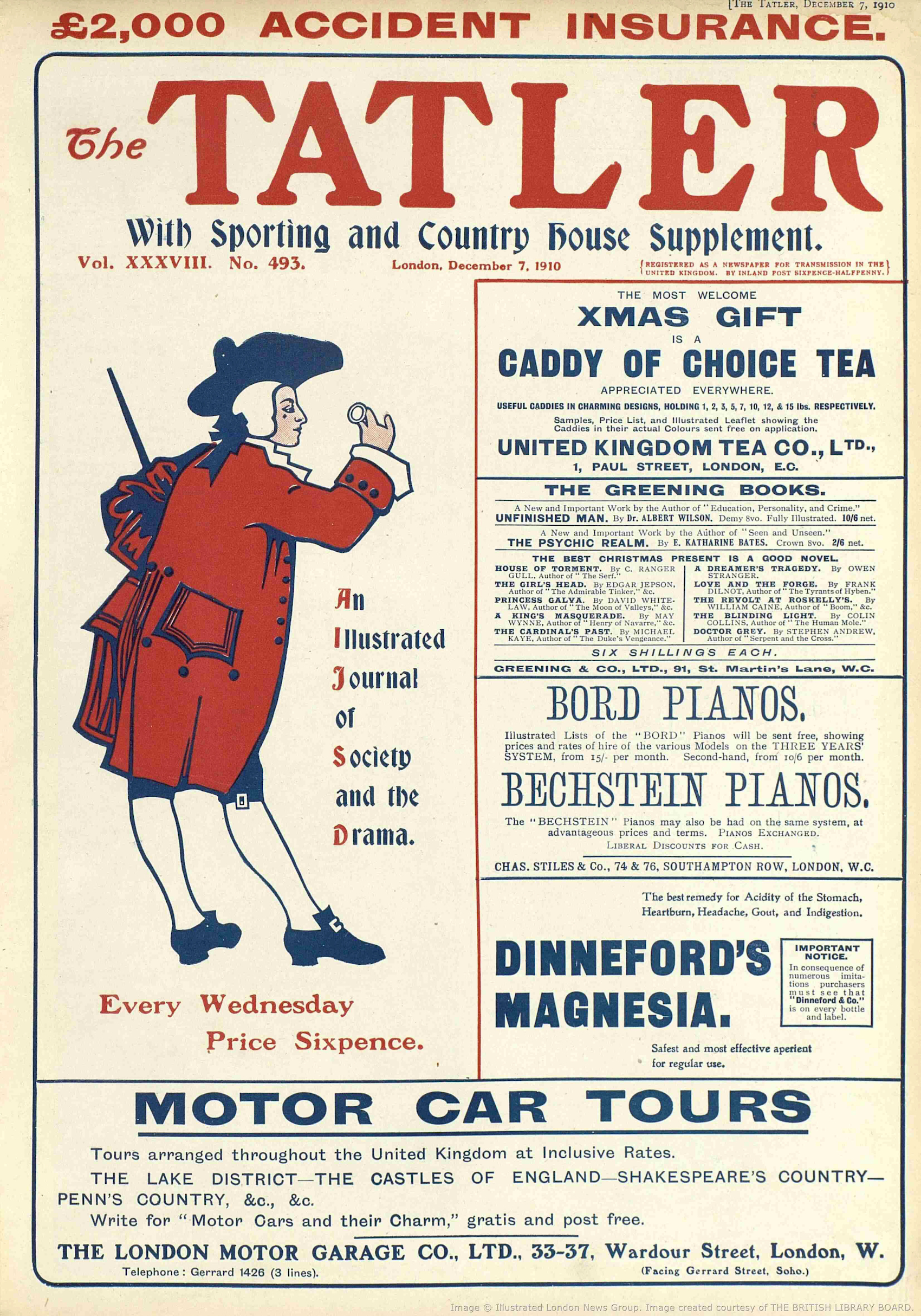
The Tatler, December 7, 1910, cover. Notice in the advertisement “The Greening Books,” May Wynne’s A King’s Masquerade in the column to the left of Caine’s book.
“A King’s Masquerade” by Mary [sic] Wynne (London: Greening and Co., Limited), is another cleverly written romance from an accomplished pen. The many who can recall her “Henry of Navarrea” [sic], “A Maid of Britanny” [sic], and “When Terror Ruled,” will open another volume from the same pen with very sanguine expectations. Nor are they likely to be disappointed. The authoress lays the scene of her new “hostage to fortune,” on the Scotch Borders and among the borderers. The time is the reign of King James, and he himself is the most prominent personality on the animated stage. The curtain rises upon a Scotch lovemaking amid the scenery of a glen. The heroine is the betrothed of a border chieftain, and the daughter of the lord of Braetoun Castle. He is determined she shall wed none other than “Black Scott” of Harden, the villain of the piece. As she detests him “like his sable majesty,” she gives willing ear to her sweetheart’s proposal for an elopement across the border, a hurried marriage, and a return hom after the paternal indignation has softened down. But a spy overhears their plans, and determines to spoil them. Thereupon the plot thickens apace, and the interest both deepens and quickens until the ideal denouement metes out justice all round, and the stirring romance closes with the paternal benediction of King James. The new romance, cannot but maintain, if it may not enhance, the deserved reputation of the clever authoress, as well as enlist for her additional troops of readers and friends.The error- and redundancy-prone, deepening- and quickening-enamored reviewer(s) failed to mention that the masquerade of May (sans r) Wynne’s novel entails “the most prominent personality on the animated stage,” James V of Scotland, disguising himself as a pedlar, and that, just as a double masquerade of sorts occurs in Caine’s novel, Jepson’s consists of a series of masquerades. Or, to use Borges’s terms, “Los personajes del primer acto reaparecen en el segundo — con otros nombres.” In the first half of The Revolt at Roskelly’s, ruddy white-bearded plain Mr. Yule dresses up as Santa Claus for the fancy dress ball he sponsors at the hotel, and, in the second, is revealed to be the Marquess of Bridlington incognito. As for the multiplicity of masquerades in The Girl’s Head: In chapter I, Scotland Yard sends Detective Pardoe — “a tall, lean man, with a big hooked nose, a close cropped moustache, thin, compressed lips, and shrewd eyes under bushy eyebrows” — to inspect the sordid parcel sent to Sir John Messiter (who has “has only been a baronet with four thousand a year for four days”) at his London residence, and, later, in chapter VIII, sent to New Romney to track down the unknown assailant taking potshots at Sir John during his walks in Romney Marsh, Pardoe reappears at Pyechurch Manor, the family home Messiter has inherited from his namesake of a dead cousin, as an American visitor named Marraway, “hunting out the pedigree of [his] family” and dressed “in a very light grey suit and yellow boots, holding in his hand a silver mounted cane, yellow gloves, and a brand new Panama hat.” Paralleling Pardoe’s masquerade is “alguna curiosa contradicción” involving the head gardener at Pyechurch Manor, Greg, whom we first meet in chapter III: “I looked at him curiously. His diction was common enough; but it did not match his intonation — it was the intonation of a cultivated or semi-cultivated man. His looks, however, matched his diction. His grizzled black hair hung half over his ears and low forehead; his grizzled black beard was shaggy and unkempt; his hands were rough and grimy, the nails black and broken. I had fancied that gardeners, head gardeners, were spruce. I set him down as a man who had been trying to improve himself, and had been helped by a good ear to a good intonation; or he might have been a man who had come down in the world, kept his intonation, and lost the rest. I had a fancy that I had seen his face before.” This “curious contradiction,” of course, will eventually be cleared up the antepenultimate chapter of Jepson’s novel where, in the bungalow near Pyechurch Manor where Sir John is dining with the faux Count and Countess de Noyal (who, posing as fellow travelers of Russian revolutionaries, are really petty criminals from Montmartre in the pay of the Czarist secret police), Greg will turn out to be Messiter’s cousin, incognito and still alive (though not for long; the narrator’s masquerade as his “dead” cousin, from the perspective of the mouchards, will also incidentally be quickly resolved):“Love and the Forge,” a tale by Frank Dilnot (London: Greening and Co., Ltd.) is another admirable study of village life by the clever author of “The Tyrants of North Hyben.” The scene is again laid in the island of Hyben, on the Hampshire coast. The characters include Mr. Emblen, the vicar, the local clerk, blacksmiths, the ladies of the Manor House, and other types. The curtain rises upon a fire discovered by the rev. gentleman in a local farm house, and the narrow escape of the inmates. Two of the domestics are only rescued by the timely arrival of the hero, a certain Leicester Fadden who had emigrated many years before, made his pile, and returned to enjoy the fruits of his enterprise and industry. In the emergency he performs prodigies of valour, and becomes the hero of the hour. He falls in love with the heroine, the daughter of the farmer, but is accused of arson by her disappointed admirer, and convicted. But the truth is disclosed at last, and the curtain falls to the pleasant peals of wedding bells. The plot is deftly worked out, and the leading characters limned with a graphic force which shows that Mr. Dilnot has studied his villagers to some purpose, and vignetted them in a manner at once effective and happy. His new story, accordingly, not only arouses the interest of his readers, but quickens and deepens it to the end.
“The Girl’s Head,” by Edgar Jepson (London: Greening and Co., Ltd.), opens with rather a startling discovery. The new successor to an old English baronetcy and estate opens a box delivered to him by parcel-post. He is inexpressibly shocked to find that it contains the head of a beautiful girl, who has evidently been murdered while yet in the very zenith of her youth and beauty. The baronet loses no time in making the most of the few clues at command. It takes him unexpectedly far afield, plunging him into the very centre of a Russian revolutionary conspiracy, with all its indescribable tale of mystery, mutilation and murder. The hero, Sir John Messeter [sic], however, never relaxes his exciting quest until, with the assistance of the London police, he runs down the unscrupulous myrmidons of the Secret Society and consigns them to the fate they have courted and deserve. A charming love tale runs through the graphic detective story, and combines to make it at once absorbing and bright. Mr. Jepson’s new and exciting novel cannot but multiply the golden opinions created by his previous “Admirable Tinker” and “Lady Moggs Intervenes,” and provide another most attractive treat for holiday readers or the winter fireside.
“The Revolt at Roskelly’s” by Wm. Caine (London: Greening and Co., Ltd.), is a new and entertaining tale from the same accomplished pen as “Boom” and “A Prisoner of Spain.” Roskelly’s is a hotel at Mithian, and the story opens with the arrival of many visitors for the Christmas Holidays. The whole is made up of widely different types. It includes a certain Marquis, who is sojourning incognito as plain Mr. Yule, and several little coteries who do not mix, but break into little discordant knots. The author gives a clever sketch of the nondescript life at the hotel, and its mild plots and counter-plots. In the event the real identity of the Marquis is discovered, to the confusion of the snobs and the gratification of the cream of the visitors. The entire “revolt” is most amusing reading, and cannot but provide unalloyed enjoyment for a few leisure hours (“New Publications,” The Leicester Daily Post, Thursday, November 24, 1910, p. 8).
There came the sound of steps in the passage; a strange voice said in French, “Here is your sister’s husband and murderer — Sir John Messiter;” and Sonia came through the door, her pale face drawn with grief, her eyes red and swollen with weeping.Furthermore, the first-person narrator, Sir John Messiter, could be said to “morbidly collect portraits” of the woman he loves in that, at the start of the novel, he takes six photographs of the girl’s head in the box sent, not to him, but to the cousin whose estate and title he had inherited: “Then an idea struck me. I took my camera out of its drawer and set about photographing the face. I wanted a picture of it to have by me to keep my memory of it fresh and exact, though I did not think that her image in my mind would quickly blurr [sic]. There was a spool of unused films already in the camera. I sat the head in a good light, and took six careful photographs of it. Then I put the camera away, and sat down to gazing at the dead face” (ch. I). Later, after taking up residence at Pyechurch Manor,On her heels came Baron Tcherkask, his moonlike face smiling over her shoulder; and after him came the Cossack.
“You!” gasped Sonia, staring at me in blank stupefaction.
And then came a roar from Baron Tcherkask.
“Imbecile! Blockhead! Idiot! What is this? What have you done? Who is this you have caught?” And he had the count by the throat, shaking him like a rat.
He flung him across the room, and turned to me:
“Who are you, in the devil’s name?” he cried. “What are you doing here, speaking with Messiter’s voice, laughing Messiter’s laugh?”
His voice was a furious roar; his eyes were flames of fury; but as he roared and flamed he smiled and smiled.
“I am Sir John Messiter. But who are you, you ill-mannered, noisy hound, brawling and howling like this before these ladies?”
“Sir John Messiter! You? What is this masquerade?” he cried.
“I am Sir John Messiter. My cousin has been dead this two months. But who are you, you brawling hound.”
“Dead! John Messiter dead?” he cried in a voice of anguish, swaying on his feet. “Then he has robbed me again.”
For a breath he shut his eyes and mouth; and a greyness spread over his face.
Then he shook himself, and seemed to recover. His fury had vanished; his smile seemed to spread all over him; and he said in the suavest, almost dulcet tone, “I owe you a thousand apologies — and these ladies — especially these ladies. But I expected to find here and bring to book a desperate scoundrel, a traitor and a murderer — your predecessor, Sir John Messiter —”
The door to the verandah crashed open, as its flimsy lock gave; and Greg stood on the threshold, pistol in hand, glaring with a madman’s wild eyes.
“He is here,” he cried hoarsely. “Very much here, my good Serge. Hands up! All of you!”
The baron and the Cossack and the count jerked up their hands to the imperative compulsion of his tone; and Smirnoff stepped through the door with his pistol also levelled, as I snatched Sonia sharply from the middle of the room, and put her behind me.
The real Sir John, thus suddenly revealed to me, laughed softly, a laugh that made me shiver, and said in a gentle voice, “Why did you murder my wife, Serge? Serge, my bosom friend, why did you murder my wife?” (Edgar Jepson, “The Girl’s Head; Chapter XVII. — The Dinner at the Bungalow,” The Midland Counties Express, Saturday, June 18, 1910, p. 12).
I went down to the terrace and looked over the shining sea, thinking that I was moving very slowly towards a real starting point to the solution of the problem. The image of the dead girl rose in my mind; and as I looked over the sea with unseeing eyes I sighed so heavily that I startled myself. I awoke, suddenly and in a panic, to the knowledge of where I was drifting; I was falling in love with a dead girl whose severed head I had seen for half an hour. It was indeed a disquieting knowledge; and all my reason rose in revolt; I was busy laying up for myself an irremediable, hopeless unhappiness. And I had indulged my brooding on the beautiful face, never dreaming that harm could come of it. Well, it must stop, and at once. I went back to the house, and locked away the photographs of the head, those in the album and the one in the case I carried in my pocket, in the safe in the study. I must keep her image out of my mind; when I walked in the Marsh at night I must no longer dream of her. I soon found that I had set myself no easy task (Edgar Jepson, “The Girl’s Head; Chapter V. — The Shot from the Wood,” North Wilts Guardian, Friday, May 13, 1910, p. 2).A few nights later he becomes disorientated while out walking through a thick mist on Romney Marsh:
I began to fear that it would rise to my face before I found either the village or the accomplished marsh-man. Then there would be nothing to do but sit down and wait till the mist lifted. It would not be warm waiting either.The head turns out to be attached to the body of a living young Russian baroness named Sonia Kolomna, whom Messiter suspects to be related to the murdered girl. Messiter and Sonia take shelter from the cold rising mist in a clump of trees, from which a startled man scurries away when they approach. Both have dreamt about the other before their meeting, but Messiter does not tell why he has dreamt of her:Then 50 or 60 yards away from me I saw a figure coming towards me, or, to be exact, I saw a head moving towards me over the level expanse of the mist. I could not be sure whether it was a boy, or a woman, or a short man. But I quickened my steps; for here was the guide I needed. We drew near to one another, not very quickly. Then when we were still 20 yards apart, I stopped short. My heart hammered at my ribs, my scalp pricked, and the sweat burst out on me.
Floating towards me over the surface of the white sea came the lost head of the murdered girl (ibid., “Chapter VI. — The Head in the Mist,” North Wilts Guardian, Friday, May 20, 1910, p. 2).
“Won’t you sit down? Or is it too cold?” she said. “I want to know about these strange things — why I dreamt of you, and why I frightened you, and why I frightened the man who ran away, and why he was a Cossack — here.”“Those unexplained psychic phenomena about which the world is beginning to puzzle itself with some vigour,” by the way, tie in with the second of the two “headline” titles of the Greening books ad, reviewed by Richard King in the pages of The Tatler:I sat down, but I could not gratify her curiosity about any of the three matters. I did not [k]now why we had dreamt of one another; that was one of those unexplained psychic phenomena about which the world is beginning to puzzle itself with some vigour. I could not on the other hand, tell her that she had scared me and the man in the clump by her likeness to her murdered sister. The dead girl was her sister — I was sure of it. It seemed best to dwell at length on the strange matter of our dreams; and I dwelt on it at length.
“It looks as if we had been meant to meet; and the dream was to warn us. But why were we meant to meet?” she said at last.
“The future will show us,” I said.
She was silent a while, considering, and then she began to talk of the scaring effect she had on those who wandered at night in the Marsh. I asseverated that as far as I was concerned, her pale face had made me take her for a disembodied spirit, and I urged that it was practically certain that it had had the same effect on the man in the clump.
I could see that she was not satisfied. She said rather plaintively, “And do I look such a dreadful ghost as that.”
“This white sea of mist makes everything so eerie,” I said.
“Eerie? What is that?” she said.
“Uncanny — ghostly.”
She was silent a while, plainly in an uneasy pondering.
For my part, I was in a lightness of spirit very near an intoxication. The dead girl’s living presentment had banished the aching craving from my heart. Even so early wild hopes and purposes came thronging.
At last I perceived that I had turned foolish, quite foolish; this was the susceptibility of early youth; and I was a grown man. I broke the silence with a question about Russia (ibid., “Chapter VII. — (Continued) — The Man in the Clump,” North Wilts Guardian, Friday, May 20, 1910, p. 2).
“The Psychic Realm” (Greening), by Katherine Bates, is interesting for the very fact that the subject is interesting, but it will not help the doubter or sceptic very much. Briefly it describes the ideal investigator and the best manner of getting at satisfactory results in psychical research. Certainly few people will quarrel with her concerning the former. “The ideal investigator,” she writes, “must have an unwavering love of truth in the smallest details, an evenly-balanced mind, a keen sense of logic, and a passionate desire for fair play all round, especially towards those who differ from us or who may have wounded our amour propre.” Certainly no sensible people desire to quarrel with the psychical researchers — the genuine ones that is to say. Of the others — by far the larger majority — and those who find a lucrative profession in pandering to the weaknesses of their fellow men and women, the less said the better. Their presence and the futile pieces of evidence upon which they base their claims have done more harm to the serious, genuine searcher after the truth than all the adverse criticism and unbelief in the whole world. Miss Bates’s book is an eloquent plea for the sifting of all these false and unscientific elements and stating clearly and definitely the exact progress which psychical research has made within the last few years. It is a plea which should receive the serious consideration of all those who desire an honest and scientific foundation to a science which, were it once definitely proved, would be of inestimable benefit to humanity. Personally the only thing which does not appeal to me in the psychic realm is the assumption among its votaries that dead people can be brought back to talk. Not from my own point of view do I think the idea horrible but from the point of view of those who, to use a psychic term, “have passed over.” I think the idea that when one has found rest one may at any time be suddenly called up at a tea party to satisfy the curiosity of some remote cousin is most unbeautiful. Miss Bates states that she once called up George Eliot to discuss a matter with her. We should like to have heard George Eliot’s opinion of the incident (Richard King, “With Silent Friends; A Book for Believers,” The Tatler, No. 502, February 8, 1911, p. 154).At the time Emily Katherine Bates’s book was published, Caine’s sister Hannah had been a member of the Society for Psychical Research for four years (see § 10 and § 17). But back to my long digression anent Jepson’s novel: Messiter thus realizes, while listening to Sonia talk about her life in Russia, that the twin sister Olga she speaks of must be the murdered girl whose head was sent to him in London and which he photographed and has been haunted by for the past several days. The mist disperses, and he is able to walk Sonia back to her villa in New Romney, where she invites him to stay for supper:
She left me, to take off her hat; and when she came back we sat down to sup. She was plainly younger than I had taken the dead girl to be, not more than nineteen or twenty. The living, animated face, instinct with the joy of living, seemed to me more beautiful than the face of the dead girl. But once or twice, when she fell grave, I saw that it had that peculiar quality of mournfulness which had so moved my heart in the image which had haunted me.Even after he proposes to Sonia in chapter XI, even after Sonia learns of Olga’s murder in chapter XVII, even during her three months of mourning in the novel’s final chapter:There was no hiding from myself, long before supper was over, that I had fallen head over ears in love with her, or rather that the passion awakened in me by the face of the dead girl was transferred to her living sister (ibid.).
I found Sonia very unhappy indeed, but not suffering from any violent shock at the news of her sister’s death, cruel as that death had been. She had feared too greatly and hoped too little for the confirmation of her fear to prove a shock.Even after setting out for Russia, the narrator never tells Sonia about the head, Olga’s head, that was sent to him (or, rather, his cousin), about “the face of the dead girl” he fell in love with, and then “transferred to her living sister” — perhaps he intends to tell her after the marriage is consummated… Rather Humbertesque, non? (I’m thinking of “that little girl with her seaside limbs and ardent tongue” who “haunted” Humbert Humbert “until at last” he “broke her spell by incarnating her in another” [Nabokov 1958: I, § 4, 17]; I’m thinking of the week or so between Humbert’s finding “no Charlotte in the living room” and his telling Lolita that she can’t call her mother “‘Because your mother is dead’” [ibid.: I, §§ 23–32, 99–143]; I’m thinking also of the thick mist of Romney Marsh and Charlotte’s married name, Haze…) By way of transitioning back to the main theme of this chapter — the coincidences between Quain and Caine — I will enumerate one more coincidence between Quain and Jepson. While there is no secret duel on a terrace in The Girl’s Head, there is a shootout where Tcherkask kills Sir John Messiter aka Greg the Gardener, and the narrator aka Sir John Messiter wounds the Cossack and kills Tcherkask, preceded by much target practice on the part of the narrator, first at a range in Wembley, then at a terrace at Pyechurch Manor:I fancied that she found my presence comforting, and I stayed on, encouraging her to ease her heart by talking to me of her life with her sister. She wished to know where she was buried, and asked me if there were no way of finding out. I told her that Baron Tcherkask had carried that secret to his grave.
She did not return to Russia for a month; she could not bear to return to the homes she had shared with her sister till the edge of the grief was blunted. She has been in Russia two months; and for the last fortnight her letters have been less sad in tone. To-morrow I set out to go to her (ibid., “Chapter XIX. — Hoylake Explains,” North Wilts Guardian, Friday, July 8, 1910, p. 2).
On both afternoons I went down to Wembley, and practised my pistol-shooting; and I began to think that with my placid disposition and steady nerves, I might in time become a trick shot, break glass balls in the air, or like that famous 18th century duellist, whose name I forget, shoot swallows on the wing (Edgar Jepson, “The Girl’s Head; Chapter III. The Sinister Bungalow,” North Wilts Guardian, Friday, April 29, 1910, p. 2).The advertisement for “Four Good Novels for Christmas” by Greening & Co. on the cover of the December 14, 1910, issue of The Sketch (reproduced at the start of this chapter) is sandwiched between an ad for “Christmas at Hotel Metropole, Folkestone” by Gordon Hotels, Limited, and an ad for Gordon’s “London Dry Gin.” The Greening ad consists of two columns, each listing two books. In the left column are House of Torment by C. Ranger Gull and Jepson’s The Girl’s Head (in which, by the way, Messiter’s “man,” i.e., his valet, is named Gordon); in the right, Caine’s The Revolt at Roskelly’s and May Wynne’s A King’s Masquerade. Further down the cover, in the lower right corner, is an ad for Bassano, Ltd., Royal Photographers of Old Bond Street. In § 5 I reproduce two photographs by Bassano of Edith Gordon Walker with her harp, one from the The Penny Illustrated Paper of May 27, 1905, the other from The Illustrated Sporting and Dramatic News of June 17, 1905. From June 12–24, 1905, Miss Gordon Walker stayed at the Metropole Hotel, not, alas, at Folkestone, but at Bexhill. It should now be amply apparent why I’ve taken such pains to spin a skein of coincidences (with Jepson thrown in for context) from the conjunction of novels by William Caine alias Quilliam and Mabel Winifred Knowles alias May Wynne in advertisements on the covers of the very weeklies from which John William Quigley alias Wilfred Quarles morbidly collected portraits of Ulrica Wynd… If not, perhaps some slightly less esoteric coincidences involving details I’ve already noted in previous sections may be helpful: William Caine was born in Liverpool and his father worked for a time as a commercial traveller or commission agent (“comisionista”) in his father’s Liverpool-based metal merchandise firm (Newton 1907: 8, 20), going so far as to pursue his trade while on honeymoon (Newton 1907: 12–13). Likewise, while I have not been able to find images of Miss Edith Gordon Walker in The Sketch or The Tatler, she has already been seen in the pages of The Scrap Book (see § 3), and portraits of her, in various poses, will be gleaned, in subsequent sections, from a variety of other sources.The summer flowers in bloom were few; but they promised to be many; and the rose bushes promised by their buds a thousand roses. The thought came to me that it was a very garden for lovers; and at the thought the image of the murdered girl filled my mind.
At the bottom of the garden rose a terrace of banked earth covered with the same fine turf, about twelve feet above the level of the garden; and coming on to the top of it, I found myself on the sea wall of the Marsh, looking on to the stretch of the sands narrowing under the incoming tide (ibid.).
I took my pistols and 300 cartridges, and went out again into the garden. I had seen that the banked earth of the terrace along the sea wall would make an excellent background for a target (“Chapter IV. The Sojourners at the Bungalow,” North Wilts Guardian, Friday, May 6, 1910, p. 2).
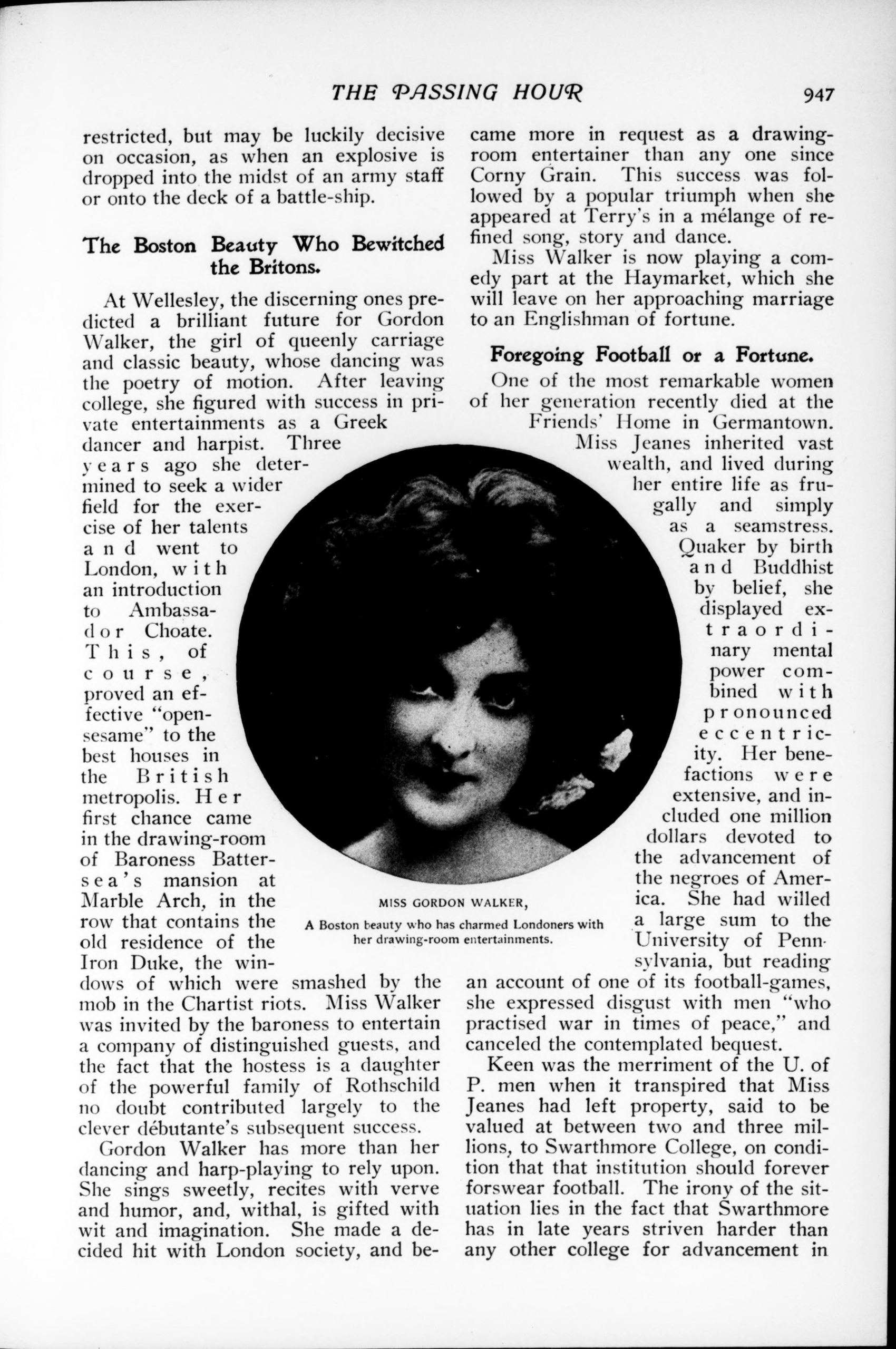
“Miss Gordon Walker, A Boston beauty who has charmed Londoners with her drawing-room entertainments.” Reproduced from Smith’s Magazine, vol. 6, no. 6, March 1908, p. 947.
At Wellesley, the discerning ones predicted a brilliant future for Gordon Walker, the girl of queenly carriage and classic beauty, whose dancing was the poetry of motion. After leaving college, she figured with success in private entertainments as a Greek dancer and harpist. Three years ago she determined to seek a wider field for the exercise of her talents and went to London, with an introduction to Ambassador Choate. This, of course, proved an effective “open-sesame” to the best houses in the British metropolis. Her first chance came in the drawing-room of Baroness Battersea’s mansion at Marble Arch, in the row that contains the old residence of the Iron Duke, the windows of which were smashed by the mob in the Chartist riots. Miss Walker was invited by the baroness to entertain a company of distinguished guests, and the fact that the hostess is a daughter of the powerful family of Rothschild no doubt contributed largely to the clever débutante’s subsequent success.Of course, as mentioned in the previous chapter, by the time the article quoted above appeared in Smith’s Magazine, Miss Gordon Walker had been Mrs. William Caine since July 26, 1907. And she did not leave that “comedy part at the Haymarket” until a little more than two months after her wedding, when the play she was acting in, Michael Morton’s My Wife, closed on September 28, 1907 (see § 10). As for the transfiguration, in Quain’s The secret mirror, of an “improbable ‘country house’” where Miss Ulrica Wynd has distractedly kissed the playwright Wilfred Quarles into “the Jewish-Irish boarding house” where the Liverpudlian commission agent John William Quigley lives, I must return to the phrase with which Borges opens his piece:Gordon Walker has more than her dancing and harp-playing to rely upon. She sings sweetly, recites with verve and humor, and withal, is gifted with wit and imagination. She made a decided hit with London society, and became more in request as a drawing-room entertainer than any one since Corny Grain. This success was followed by a popular triumph when she appeared at Terry’s in a mélange of refined song, story and dance.
Miss Walker is now playing a comedy part at the Haymarket, which she will leave on her approaching marriage to an Englishman of fortune (“The Passing Hour: An Illustrated Chronicle of the World’s Doings; The Boston Beauty Who Bewitched the Britons,” Smith’s Magazine, vol. 6, no. 6, March 1908, p. 947).
Herbert Quain ha muerto en Roscommon | Herbert Quain has died in Roscommon (Borges 1941: 44).Roscommon, the largest town in the Irish county of the same name, makes, as far as I can tell, no appearance in Caine’s works, nor do any other Irish locales. However, the first four letters of the Irish-sounding name of the hotel in his seventh book (from which I’ve already quoted), The Revolt at Roskelly’s, certainly do seem to echo those of the town where Quain died. Furthermore, a glimpse at wiktionary.org reveals that Roscommon (Ros Comáin in Irish) and Roskelly (a common enough name in Cornwall, the setting of Caine’s novel) share a common morphology (though quite different semantics): ros in Irish means ‘wood’ or ‘headland, promontory’; ros in Cornish, ‘heathland’ or ‘rose’. Thus, Saint Coman’s Wood (or Headland) for the real Irish town where Borges’s fictional author died; Kelly’s Heath (or Rose) for the fictional Cornish hotel invented by a real author. À propos: Staying at that same hotel is, by chance, a cousin of Reginald Hindlip, Herbert Bugg, whose behavior in the lounge is one of several small incidents which, together, will instigate the “revolt:”
The devil entered into Herbert Bugg, potato-salesman of Covent Garden Market, who now rose from his chair and, putting out a large red hand, exclaimed heartily and loudly, “’Ullo, Reggie, old man. ’Ow’s yourself and all me other dear cousins in Rutlandshigher?” (RR-G: 58; RR-P: 61).Incidentally, both meanings of the Irish ros underlie the opening of the second chapter of Caine’s other novel of 1910, A Prisoner in Spain:
John Billing, Baedeker in pocket, a sprig of larch in buttonhole — larch of Chibble — strode along the carriage-drive of the Hotel Londres, San Pablo. The hotel is the last house in the town. It is built on a rocky promontory that breaks the crescent of fine sand which fringes the bay. John’s path led him through pine trees. On his left hand he could see the blue water between the stems, and beyond, the island of Santa Brigida, the bay’s natural breakwater, and the two sea-gates that it makes with the two rocky headlands, horns of the crescent, the old fishing town huddling up the cliff by the western sea-gate.There is also, in A Prisoner in Spain, a nightingale of sorts, in that there is a thrush (the thrushes [Turdidae] and the flycatchers [Muscicapidae] being sister clades of the Muscicapoidea): “Inside, on the wall, hung a tiny wooden cage, which contained, with difficulty, a stout thrush. This bird, in spite of its narrow quarters, was giving tongue loudly” (PS: 34). Also, when later that night Billing “strolled in the alleys of the gardens” of a sprawling restaurant on the outskirts of San Pablo called the Venta de los Muleros, “a night-bird gave forth a liquid note” (PS: 146). Furthermore, on the terrace of the Hotel Londres there occur two “secret duels.” One is personal and amatory involving Billing’s good chum Carlos Miguel Quesada (whom Billing calls Quixote) and “his next neighbour and fast friend” (PS: 17), the painter Ann Dicey (all three had spent a fortnight together at Hurst ten years earlier, when Ann was seventeen, and Quesada and Billing were undergraduates at Oxford):At San Pablo you get Southern colour with a vengeance. The water is all sapphire and chrysoprase; the rocks are red and brown and ochre; dark green woods clothe the twin headlands; between them is the golden sand, and above all is the purple splendour of the sky (PS: 25).
What a gossip he and she and Quixote had had comin’ along yesterday in the train. She and Quixote! He rather thought — He shouldn’t be a bit surprised if — Anyhow, his slippin’ away could do no harm. They looked very comfy and happy on the terrace together as he left (PS: 25–26).Curiously, it seems that the reviewer for The Manchester Guardian would have dismissed a passage such as the above as an example of Caine’s “persistent levity of diction,” of his writing “conversationally” in order “to get an effect of lightness and intimacy,” rather than recognize it as an instance of free indirect discourse much less indicative of the author’s intent and much more so of the character’s thoughts… Regardless, Ann’s traveling companion Miss Gwendolen Price (nicknamed the Crampog because “she was so Welsh and so round and went so well with a cup of tea”) also slips away (to write postcards), so that “she and Quesada had the terrace of the Hotel Londres to themselves” (PS: 42). From Quesada’s perspective, his being “comfy and happy on the terrace” with Ann involves an intriguing proximity to the word “sordid:”
Conceive the sordid, foul-mouthed, loose-lived purgatory of bad places and worse people from which he had emerged, and conceive his delight in this fragrance, this wholesomeness, that was Ann.The other “secret duel,” confidential and minatory, is between Billing and the possible swindler Don Hilario and had been preceded a day earlier by a tête-à-tête on the rooftop terrace of the latter’s flat in Casa de Beatriz, where Hilario had, in his own words, “fenced with the man” and “played the disinterested friend” (PS: 104):As he sat there, on the terrace, and chattered amiably to her, he was saying to himself over and over again: “What, now, is the shortest, the very shortest time that a man may wait before he tells an Englishwoman that he loves her?” He felt that his Spanish birth was a handicap. Precipitancy might be fatal. So he schooled himself and held himself in, and checked the great burning words that were always rising to his lips, and substituted those pretty speeches which so greatly distressed poor Ann, or, more wisely (fearing to talk about her), talked about himself (PS: 50).
[…] they drove to the Hotel Londres. There they sought out a bench on the terrace beneath a tree, Hilario being careful to select a seat before which stood a table. He was presently rewarded for his forethought by the advent of an absinthe.There’s even, in Caine’s Spanish novel published in late April 1910, a sort of “distracted kiss” couched in the very terms of Jepson’s title. On an excursion with Quesada, Ann Dicey, the Crampog, and Billing, Mercedes, sitting high up near the edge of a waterfall outside of San Pablo“And now,” he said, with a glance behind him to make certain that the waiter was out of earshot. “And now, Mr Billing, I have a confession to make to you. Yesterday I did not tell you the truth.”
“Indeed,” said John. He had thought as much, but this was not exactly what he had expected. Was the fellow going to throw up the sponge and cast himself upon his mercy? So there was no trunk, no money, no Sebastian…
“To begin with,” said Hilario, as he watered his sugar, “I am the brother of Sebastian Guadarrama. Hilario Guadarrama is my name. And Mercedes is Sebastian’s daughter.” Over the little silver rake upon which the drops were so slowly falling, his eyes observed the Englishman.
“What the devil are you saying?” shouted Billing.
Mercedes the daughter of Sebastian! Mercedes the daughter of an entirely mythical person! Mercedes the daughter…
“Damn you!” he said, “what do you mean?”
“Be calm, Mr Billing. All will be made clear. Give me a few moments. In the light of my statements of yesterday what I have said must seem incomprehensible. But if you will concentrate your mind upon the fact that yesterday I was not telling you quite the truth, you will be in a better position to grasp what I was about to say. To begin with then, let me repeat, that you may get it quite clearly before you, Mercedes is the daughter of my brother Sebastian.”
“It’s a lie,” cried John Billing.
[…]
“Now,” said Hilario, “don’t excite yourself, dear Mr Billing. I tell you that all can be made clear. Let me do this.”
“Go on,” said John, huskily. “But if you are lying I’ll — Go on.” He mastered his inclination to roll Hilario up and down upon the gravel of the terrace, and sat back in his seat, his hands deep in his pockets, a dangerous light in his eye. And he breathed hard through his nose (PS: 185–187).
turned her attention to what was going on below her. It was noteworthy.Billing has just kissed his best female friend because she has just told him the news that she is to marry his best male friend:For, as she looked, Billing suddenly became animated. His hands fell from his chin to the ground, his arms straightened, and thus propped he remained for a second, his face transfigured with joy.
Then he scrambled to his feet, and stepping swiftly to Ann bent over and kissed her.
The girl’s head swam. She clutched the rock, closed her eyes, and leaned back heavily against the boulder that was behind her, as the roar of the water swelled out like the sound of an angry sea (PS: 208–209).
Down below John was saying, “By Gad, Ann, I had to. You don’t mind?”Mercedes, of course, interprets Billing’s exuberant kissing of Ann quite otherwise. A few hours later, lying on a sofa to recuperate from the inevitable twisted ankle she had incurred on the hike back from the waterfall, she reacts to Billing’s precipitous and premature proclamation of his love by“Silly old John,” said Ann. She gave him her hand. “You emotional creature. I didn’t know it was in you to do such a thing.” She turned a sob into a laugh. “But it’s rather frightful when solid earth is moved,” she said. “It must be Spain.”
He hastened to lie down again. He was extraordinarily ashamed of what he had done. But really — a man might be excused for giving himself away a bit at a piece of news like this.
“By Gad!” he said over and over again. “By Gad! You and old Quixote! If this isn’t a good egg. I say, Ann, don’t tell him about — that. He’ll have to call me out, and if he kills me I can’t be best man.” He beat the bare stones with his fist. His joy was exuberant. “You sly things,” he said. “I had my little eye on you, but I never thought it was quite such a case” (PS: 209).
burying her face in her hands. She was sobbing her heart out.But back to the novel Caine published seven months later, the Cornish novel in which the concatenation of Rose and Kelly in the title hints, I like to think, at the “Wellesley marriage” which, during his wife’s college days, united her English professor Katherine Lee Bates with her history professor Katherine Coman [insert emoji that means “Borgesian wink” here], and which may or may not involve Roskelly’s unnamed Manageress and her Assistant Manageress Miss Heale in a more than mere professional or practical union. I also like to think that Borges’s choosing to compare Quain to Philip Guedalla embodies not only the academic and vocational parallels between the latter and Caine, but also the sonic residue, to coin a term, of A Prisoner in Spain’s John Billing and Carlos Quesada and Hilario Guadarrama, as well as Jepson’s The Girl’s Head… But I’m avoiding the obvious question: Borges’s Herbert Quain seems to be Irish; did William Caine have any connection to Ireland? The first Irish connection I chanced upon in Caine’s works occurs in the second chapter, entitled “The Bridge Cipher,” of his first novel (or, for sticklers, serial collection of short stories), Pilkington, and involves, so to speak, Borges’s “ruiseñor y una noche,” his “duelo secreto en una terraza,” as well as “alguna curiosa contradicción” and “pormenores sórdidos.” Holding a navy revolver lent him by one of his tricksterish Outer Temple buddies, Pilkington stakes out the garden of 10 Nightingale Lane (the address had been chosen at random, though Pilkington’s friends led him to believe it was encoded in a secret “thieves’ correspondence” they had deciphered in the Daily Mail; in “reality,” they had invented it and put it in the paper themselves). At 3 a.m. a masked man comes running down the gravel drive from the house of a certain wealthy stockbroker named O’Shaughnessy, holding a bag containing Mrs. O’Shaughnessy’s diamonds (valued at £10,000). The thief, seeing Pilkington’s pistol in his face, stops, and is soon subdued by the pursuant O’Shaughnessy. A policeman arrives, the thief arrested, and Pilkington is treated by the O’Shaughnessys to a supper of lobster, truffled pullet, and champagne, and, three days later, a gift of diamond sleeve-links and pin (P: 34–61). So much for the nightingale and the night, the secret duel on the terrace — what about the curious contradiction and the sordid details? Perhaps in this: Pilkington’s patriotism having been piqued by his friends’ use of stereotypes anent secret Irish terrorists (such as “bloody Fenian[s]” armed with “high explosives” [P: 41]), the sordid truth arrives in the form of an English bricklayer named Joseph Harris bent on robbing the London house of an Irishman of “unblemished reputation” (P: 59; a synecdoche, after all, of English landlords robbing the Emerald Isle of her agrarian wealth). Or perhaps in the setting of Pilkington’s adventure:He fell on his knees and caught her in his arms — no use in holding back now. He was in for it, and it was up to him to pull it off. He acted no longer on reason but on instinct. He enveloped her firmly.
She writhed free from him with a smothered shriek of pain and a hand on her ankle, sat up and said, —
“Keep that for the Señora Dicey.” Her eyes blazed. Never had she been more lovely.
He fell back, sitting on his heels, his hands hanging, his mouth wide open. “Good Lord!” he cried, “what’s that you said?”
“You heard me,” she said. Her voice cut him through. “I know.”
“I’m dashed if you do,” he shouted. “What’s this nonsense? You think Ann and I are —?”
“I know you are. Yes — betrothed.”
“How? Who said so?”
“Never mind who said so. You are.”
“I’m not, I tell you. You little duffer. I’ve known Ann for ever. I couldn’t be engaged to her.”
“You are,” she repeated, but less vehemently. “I saw you.”
“Saw me? Saw me?” he gasped.
“At the fall. I couldn’t help it — I am no spy. But — people do not — kiss — their friends.”
He burst into a roar of laughter. He smote his knees with doubled fists. He was so very much relieved.
She had seen him kissing Ann.
“Me old companion!” he cried, and “Dash my buttons!” he exclaimed. “Oh! That’s particularly fruity. She thought I was in love with Ann.” Then, “She’s jealous!” stabbed through his mind and he gave a loud howl of joy. Mercedes observed these manifestations of the Billing brain-waves with large, indignant eyes.
“You bat!” he cried. “I was congratulating her. She’s engaged to Quesada.”
“Oh,” said Mercedes, really shocked. “Does he know?”
“He? Knows she’s engaged to him? What do you fancy he knows if he doesn’t know that?”
“That you kissed her?” He stared at her in amazement.
“Does he? I don’t know. I dare say. What the deuce does it matter?” She stared back in a sort of horror.
Suddenly he realised what was the matter. He jumped to meet the peril. This must be scotched. His face became grave.
“Mercedes,” he said, “Ann’s my best woman friend, my only one. But we’re about as likely to fall in love with each other as the North and South poles. Quesada’s my best man friend. When Ann told me she was goin’ to marry him I just got up and hugged her. I was so pleased that I had to hug somebody, and she was nearest. That sort of thing is of no account, absolutely, whatever. If Quesada had been there I should have done it just the same, only I should probably have hugged him too. Do you see? Ann and I are English, and under the circumstances a hug was neither here nor there. You’ve got a wrong idea into your silly little skull altogether. It’s wrong. Do you hear? All wrong. Malo!” he cried, falling into Spanish in his extremity, under the belief that it might carry more conviction to her ears (PS: 239–240).
Nightingale Lane, S.W., though it connects the southern ends of Clapham and Wandsworth Commons, sees little traffic during the day, and less after dark. It is, indeed, among the most deserted of suburban thoroughfares. Its houses are occupied by the upper middle classes. These houses are, at the eastern end, of the “eminently desirable” class, square, solid, respectable, standing in their own grounds — having, indeed, no other grounds to stand in. They are approached by carriage drives with two gates, and in the summer they can hardly be seen from the road, so closely are they shrouded by limes, chestnuts, and flowering shrubs. Westward, the road degenerates into semi-detached villas; yes, and shops, sinking as if in shame into a valley where rows of forty pound cottages run in the direction of Clapham Junction, and rises from that Inferno through a new Purgatory of villas, to emerge once more respectable among the red brick and gables of Wandsworth Common (P: 50–51).
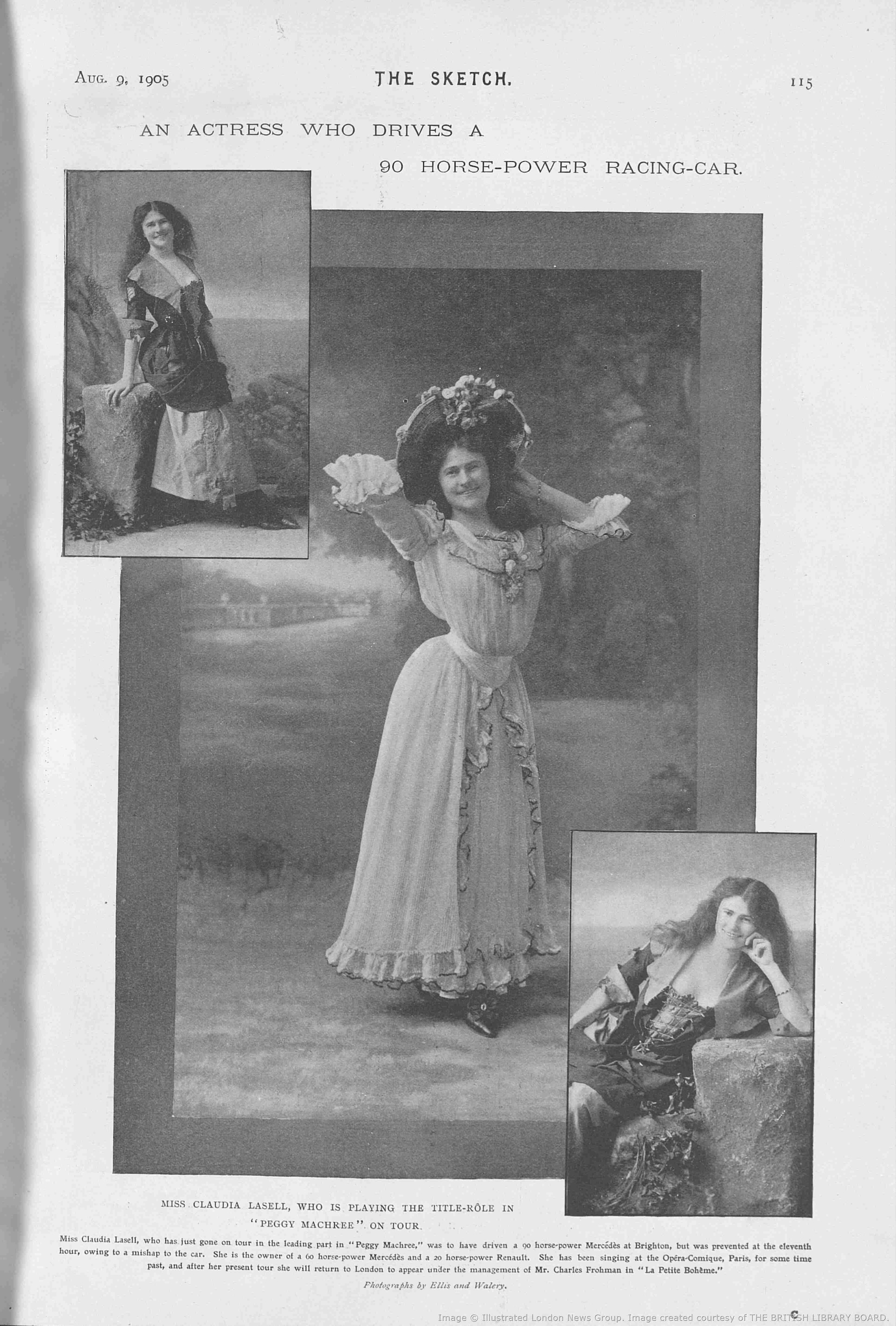
“An Actress Who Drives a 90 Horse-Power Racing-Car. Miss Claudia Lasell, who is playing the title-rôle in ‘Peggy Machree’ on tour. Miss Claudia Lasell, who has just gone on tour in the leading part in ‘Peggy Machree,’ was to have driven a 90 horse-power Mercédès at Brighton, but was prevented at the eleventh hour, owing to a mishap to the car. She is the owner of 60 horse-power Mercédès and a 20 horse-power Renault. She has been singing at the Opéra-Comique, Paris, for some time past, and after her present tour she will return to London to appear under the management of Mr. Charles Frohman in “La Petite Bohème.’ Photographs by Ellis and Walery.” Reproduced from The Sketch, August 9, 1905, p. 115.
“Peggy Machree,” which was produced at Wyndham’s Theatre last December, opens an autumn season of forty weeks at Blackpool on July 31. Charles E. Hamilton, the proprietor of the company, has had the book entirely re-written, new music has been introduced by Clarence Lucas and Henri Hirchmann, the composer of “La Petite Boheme,” and new lyrics written by William Caine. The piece, which is now called a comic opera, has been entirely recast. Peggy will be played by Miss Claudia Lasell, of the Opera Comique, Paris, who begins in this role her first work under a long contract for appearances in England. She will be seen in London at Easter in a new opera. Miss Aida Jenoure returns to musical work in “Peggy Machree,” a part having been written for her. Leslie Stiles plays the part of Barry Trevor, and among the others engaged are Blanche Astley, late of the Gaiety Theatre, Marie Rito, Catherine Carr, Dorothy Garden, Graeme Campbell, Marc Macdermott, John Morley, and Dermot FitzGibbon (“Theatrical Items,” The Echo, Friday, July 14, 1905, p. 4).The original Peggy Machree was written by Patrick Bidwell (penname of Elizabeth Curtis O’Sullivan, wife of American baritone Denis O’Sullivan) with music by the Italian-born Dublin-based composer Michele Esposito (Dibble 2010: 128). Before making its London premiere at a theatre whose name was literally that of Quain’s General Wynd and his daughter with a ham tacked on, the piece — in which “the characters of the first act reappear in the second with other names” — had been tried out during a month-long tour of the provinces in November–December 1904. After a month at Wyndham’s, the original Peggy Machree toured the provinces until the first week of May 1905, finishing up at the King’s Theatre, Hammersmith, before going into a pupal stage to undergo metamorphosis by Caine, Hirchmann, and Lucas. A comparison of the reviews of the piece as it was performed at the Theatre Royal in Newcastle on Monday, November 14, 1904, with Marie Dainton in the title role, and at the Tyne Theatre in the same city on Monday, December 11, 1905, with Claudia Lasell (see her portraits in The Sketch, right; note, just for the fun of it, that a possible anagram of her first name is “Uldicaa” — just how an Anglophone might hear an Hispanophone pronounce Miss Wynd’s first name) heading up the cast, will serve, thus, to highlight some of the differences between the original version and that which eclosed at Blackpool on July 31 to embark on “an autumn season of forty weeks:”
“Peggy Machree” may be regarded as a sign of the times — a sign that the day of musical comedy is nearing an end, and that we are again reverting, by slow but welcome degrees, to a higher form of entertainment in which good music and real humour are really present. That they, after all, are acceptable to the public has been already proved by the success of such productions as the “Duchess of Dantzic” and “Veronique,” to instance two present and opposite examples, and in “Peggy Machree” we have another recruit to a more worthy form of entertainment, where the music is sparkling without being shallow, and the humour is genuine and spontaneous and is not merely a meretricious compound of current slang and topical allusion. If “Peggy Machree” cannot be said to boast a very complicated plot, it does at least possess one that has the virtue of coherence and one which does not outrage the probabilities. And, moreover, the story, even though it is interrupted by songs innumerable, is very closely followed and the auditor, besides being treated to a concourse of sweet sound, has also the pleasure of seeing not a little excellent acting. The central idea of the trifle is that one Lady Margaret O’Driscoll, masquerading as a Peggy Machree — the name indicates that the scene is laid in Ireland, the time is the middle of the eighteenth century — consents, principally, being Irish and irresponsible, for the fun of the thing, to go through a mock form of marriage with a handsome stranger who finds her at her masquerade and falls in with her mad humour. To their present misfortune, however, a real priest hiding from the soldiery performs the ceremony, and the stranger, Barry Trevor by name, in a fit of remorse and wishing to do what he can to make reparation there and then takes the shilling and goes off to the wars, leaving the pseudo Peggy to her own devices. Of course he comes back again — under sufficiently romantic circumstances — and equally, of course, there is a reconciliation and the curtain falls with the two preparing to live happily every afterwards. The story as presented does not leave a great deal of opportunity for the introduction of other characters than the handsome stranger and the madcap Peggy, and the burden and heat of the play fall almost entirely upon Mr. Denis O’Sullivan, as Barry Trevor, and Miss Marie Dainton, who supports the title role. The music, for the most part, is that of well-known Irish airs sometimes adapted to new words, but often enough left, and discreetly, to be sung to the old ones. It is a sheer delight to hear Mr. O’Sullivan’s wonderful voice and infinite capacity for drollery extracting the utmost effect from Lever’s famous “Widow Malone,” or to hear him in more sober mood give “The Lark in the Clear Air” or “The Birds Fly South,” and he sings “O’Driscoll Aboo” with such spirit that the audience would not be denied a second and third repetition. Miss Dainton, too, makes a distinctly good impression, and it is pleasant to find that the vivacity which enabled her to imitate the best artists of the day when she used to fascinate music hall habitues with her clever impersonations is just as much in evidence when she is her natural self. So far as the artistic completeness of the play is concerned, it is perhaps a mistake that such numbers as “Honeymoon Hall” and “The Old Oak Tree” should be introduced. Properly they belong to pantomime, and no doubt pantomime and the barrel organ will ere long claim them for their own; but, as nothing succeeds like success, their reception is perhaps the best vindication of their introduction, and they were certainly received most rapturously. In addition to singing sweetly, Miss Dainton dances daintily and acts throughout with a sparkle and spirit which is altogether admirable, and if “Peggy Machree” may be tersely described as a two part piece its evident acceptability to the audience at the Theatre Royal last night is almost entirely to be ascribed to the two principals. At the same time the chorus is a very capable one, and is very thoroughly trained, and it would be unfair to such players as Miss Ethel Weyburn, Miss Millicent McLaughlin, and Miss Freda Bramleigh to fail to extend a cordial approbation of the manner in which they fulfil what little they are called upon to perform. Mr. Marc Macdermott’s study of a vapid gentleman of the period, too, is clever, and Mr. Graeme Campbell as a dour Scotch retainer exploits a Scotch accent which, if names go for anything, should not be altogether assumed. The play is written by Mr. Patrick Bidwell, and the lyrics arranged by Mr. Michele Esposito, and they have done their work in a manner which accounts for a good deal of the the success which it is fairly safe to prophecy will be attained by “Peggy Machree” (“Local Entertainments; New Musical Play at the Theatre Royal,” The Newcastle Daily Chronicle, Tuesday, November 15, 1904, p. 11).Another indirect literary link between Caine and Ireland occurs in Old Enough to Know Better (November 1911), when Ridley Carpenter tells Mary Massinger, the woman he’s truly in love with, thatSince “Peggy Machree” was last seen in Newcastle as a musical play it has been reconstructed as a comic opera, and it is difficult to say whether it is improved. Those who were charmed with the original version, so full of Irish melody and delightful romance, may regret the change. But the story is much the same. The difference lies in the briskness and brightness with which it is told. Now the stage is always more or less crowded, the action quicker, and there is a swing about the piece that infects the audience. It is an appeal to the popular taste which met last night at the Tyne Theatre with almost general approval. Only lovers of music who heard Mr. Denis O’Sullivan sing so feelingly the Irish airs in the original production, and were not unmindful of the talent of Miss Marie Dainton as “Peggy,” might wish for the play as it was. Even they, however, must have conceded that the “Peggy” of Miss Claudia Lasell was a bright and sparkling performance, and that Mr. Leslie Stiles, who marries in fun only to find that he has tied the knot in earnest, was a handsome, rollicking and humorsome young officer. Both Miss Lasell and Mr. Stiles sang with acceptance. Mr. Milroy Cooper was successful in importing the necessary amount of dry Scotch humour into this lively Irish society, and Miss Madge Avery as the widow he was so wary in marrying was more than a match for all his caution. Miss Adelaide Ross, Miss Dorothy Garden and Miss Blanche Astley all deserve praise for their respective personations, while more than mention should be made of the Sergeant Bampton of Mr. John Morley. The present production has the advantage of a much more powerful chorus and, in addition to the lyrics contributed by Mr. William Caine, there are several interpolated songs which are sung with great success by Miss Lasell (“Local Entertainments; The Tyne Theatre,” The Newcastle Daily Chronicle, Tuesday, December 12, 1905, p. 12).
“It appears,” he said, “that I am engaged to be married.”
Mary went off into a peal of laughter not perfectly mirthful. In silence and misery he watched her recover herself. He had not hoped for laughter. Then he said sadly, “Ah! it’s fun to you, but it’s death to me.”
She laid a hand on his arm and begged him to forgive her. She was very contrite. “I don’t know why I laughed,” she said, truly enough.
“I’m not offended,” he assured her. “If I were not personally concerned I should wallow howling with merriment on the ground. But I’ve noticed that very few people have a strong enough sense of the ludicrous to be amused at their own misfortunes. I never met one, though once I thought I had.” He hesitated before the offered postponement; then cowered away down the line of least resistance. “It was in Ireland,” he went on quickly. “The man I was staying with and I went to bathe in the sea before breakfast. We both wore white sweaters and gray flannel bags. We were both about the same size. He was much the better swimmer — and struck out to sea. I paddled around for a little, came out and dressed. And while I smoked and waited for him the tide came up. But this is all beside the point,” he broke off suddenly. “I am not playing the man.” He began to rise from his seat.
“You shall not stop now,” said Mary, pulling him down again. “I defy you to stop.” Perhaps she, too, was glad of the digression. He sighed his relief.
“Well, there’s very little more,” he said. “The tide came up and carried off the other man’s clothes, and I didn’t notice it until they were gone. So when he got back I told him that his clothes had been washed away. Instead of being angry he began to bellow with laughter, which surprised me and delighted me. I thought, ‘The Irish are well called a humorous people. Now if that had happened to me I shouldn’t see any fun in it at all.’ Then he pointed out that his own beastly initials were on the front of the sweater I was wearing. Of course, I’d got into his things and mine were lost at sea. That, you understand, was the cause of his mirth.”
“And did you laugh?” asked Mary. He had succeeded in making her honestly interested in his adventure.
“Well, yes, I laughed. I couldn’t help it. He looked so funny standing there all rosy and bare and foaming and shoeless on the sharp shingle while I strolled up to breakfast at the house. Oh, yes, I laughed.” He threw back his head and gave himself up to mirth. “His name was Mitchell,” he crowed convulsively, “a fair Antrim man, pink as a shrimp. Oh! he went deliciously with those jaggy grey stones. His father and I played him for half-an-hour after breakfast with a sack on a long string over the cliff.”
He had apparently forgotten his own troubles entirely.
The end of the story, however, brought Mary back to a recollection of them. “But tell me,” she said resolutely, “what’s the matter now? You said something about —” (OEKB 169–171).
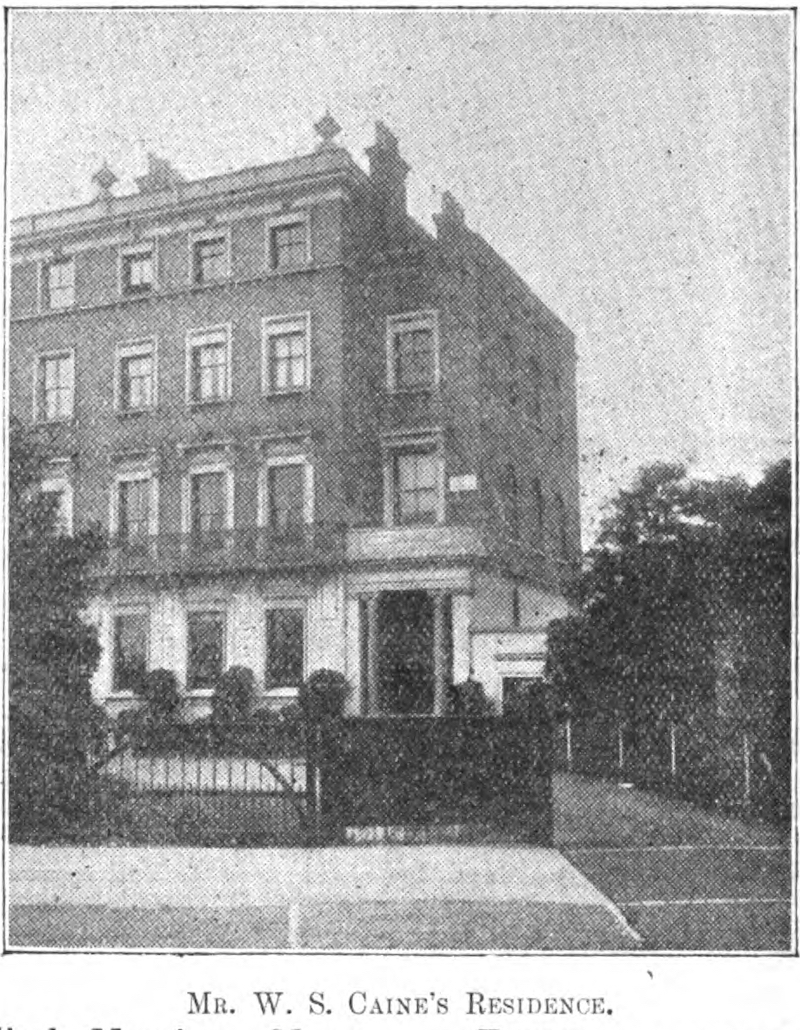
33 North Side (also known as 1, The Terrace), Clapham Common, London. Reproduced from The Abstainer’s Advocate, vol. 9, no. 1, January 1898, p. 6.
What is wanted for Ireland, from a Liberal Unionist point of view, is religious equality made complete, equal educational advantages and privileges with Great Britain, equal Poor Laws with England, localization of jurisdiction carried to the same extent as in England and Scotland, and the assimilation which has been commenced in the Criminal Code to be carried out vigorously and actively on Sir Robert Peel’s principles throughout the whole law, so as to have one law for the United Kingdom, except for specified cases with reasons stated (Hancock 1880: 25).Furthermore, according to Hancock, “The Ulster tenant-right custom should be extended to the rest of Ireland with the like local facilities for dealing with all local interests under it.” Such local facilities could be developed as follows:
If the cumulative voting principle of election be adopted for the existing local authorities, where both property and numbers are represented, with a slight modification authorities could be constituted in every union and town district in Ireland, to which might be intrusted, by order of the Irish Local Government Board, all the powers any local authority has acquired or may acquire in England or Scotland. So that there shall now and hereafter be, without the ruinous cost of private bills, in every district in Ireland, as much local government as there is in a like district in England and Scotland (ibid.).The Irish Times of Monday, December 29, 1879, reproduced, on page 6, extensive extracts from The Fortnightly Review article, and, on page 4, gave “a fair view of Dr. Hancock’s ‘Liberal Unionist’ plan — is this to be the new title of a party? — and there will be abundant opportunity for discussing its points if it really prove to have the character which it seems to assume.” “Liberal Unionist” did indeed become the title of a new party — six years after the The Irish Times’s prescient question — and W. S. Caine, M.P., whose subsequent electoral addresses give evidence that he read Hancock’s paper, played, if not a pivotal, at least a Kinbotesquely critical, that is chimerical, role in its foundation. To wit, in early 1884, “under circumstances which are now obscure, the party whips suggested to Mr. Caine that he should surrender his safe seat at Scarborough, and become candidate for the undivided county of Middlesex at the next election” (Newton 1907: 101). This he did at the general election of 1885, contesting, not the “undivided county of Middlesex,” but one of the seven constituencies into which the county had in the meantime been divided, Tottenham. That is, one year, one month, and one week after his youngest son was born at 1, The Terrace, Clapham Common, and one month and four days after his twelve-year-old eldest son matriculated at the Westminster School as a home boarder, W. S. Caine issued an election address on October 28, 1885, from the Central Committee Room, 5, Pembury Villas, High Road, Tottenham, in which he wrote:
I am in favour of giving to Ireland the widest measure of self-government which is compatible with the union and integrity of the United Kingdom. The Liberal party in the past has done much to remove the deep-rooted sense of injustice which has rankled in the hearts of the Irish people through generations of bad and cruel government. We have granted them Catholic Emancipation, abolished tithes, disestablished an alien Church, and reformed the Land Laws. The only hope of a peaceful and abiding settlement of the Irish difficulty lies in the return to the coming Parliament of a Liberal majority large enough to outvote the now allied forces of the Tory party and the Parnellites. In that event, I have full confidence that the new administration will recognise and satisfy the legitimate aspirations of the Irish people to legislate for themselves on these questions which are purely and solely Irish, not perhaps to the satisfaction of the revolutionary agitators, but certainly to that of the main body of Irishmen. I have always disliked and doubted excessive coercive legislation; but a firm and determined effort should be made to enforce the existing law, and to suppress the cowardly system of boycotting which now disgraces the Nationalist party in Ireland.Returning 319 seats as compared to the 352 seats they had won in 1880, the Liberals returned a plurality, but not a majority. Caine was among the 33 non-returns: the polling in Tottenham which took place during the dull morning and intermittent chilly drizzle throughout the afternoon of December 3 gave the Liberal candidate 3706 votes to the Conservative Joseph Howard’s 4441. Despite losing, the father of the twelve-year-old future author of The Author of “Trixie” was included, with the erroneous parenthetical designation (Tottenham) attached to his name, in “The Irish Electoral Black List” issued by the Irish National League of Great Britain for having voted 132 times (during his four-year stint for Scarborough) “in favour of the Crimes Act in its various stages or the other hostile measures taken by the late Government in the House of Commons.” The black-listed fallax member for Tottenham was soon offered another chance to regain a room in the Houses of Parliament, however, when one of the winners of the 1885 general election, David Duncan, Liberal member for the newly created constituency of Barrow-in-Furness, was “unseated by pork pies.” That is, the unsuccessful Tory candidate for the seat, Henry W. Schneider, petitioned that Duncan and his agent had illegally provided refreshments for the workers on polling day. While Justices Field and Day [!] found Duncan and his colleagues not guilty of corrupt practices, the election result was declared invalid. The father of the future author of The Author of “Trixie” was called in to contest for the vacancy, and on polling day, Tuesday, April 6, 1886, beat the Tory candidate Gainsford Bruce with 3109 votes versus 2174, and was thus among the “great audience” in the House of Commons when, two days later, Prime Minister William Ewart Gladstone “unfolded to the hundreds of listening ears his scheme for the future government of Ireland” (Newton 1907: 146–147). That Thursday in Parliament was, according to The Times, a “scene of unexampled excitement” in which “every available seat had been retained for many hours, and some members had arrived before daylight,” so that
When the Speaker [Arthur Peel, Liberal member for Warwick and Leamington] took the chair at 4 o’clock the House presented an unprecedented appearance. Every seat on the floor and also in the side galleries upstairs was occupied, and on each side of the central gangway some two dozen chairs facing the Speaker had been placed for the accommodation of those who had arrived too late to obtain places on the different benches. But these extra seats by no means met all the requirements. Some hon. members sat on the steps of the Speaker’s chair, others in the gangways, and many stood at the bar. Meanwhile the Strangers’ and the Speaker’s Galleries, the Peers’ Gallery, and the Distinguished Strangers’ Gallery were packed. On the Ambassadors’ bench sat the American Minister, the French Ambassador, and the Greek Minister. Prince Christian and the Duke of Cambridge took up positions over the clock early, and were joined soon after Mr. Gladstone had commenced speaking by the Prince of Wales and Prince Albert Victor. The Peers’ Gallery was far from affording the accommodation required for all the noble lords who sought admission. Lord Spencer, Lord Ripon, Lord Ashbourne, and Lord Halsbury were among those who sought admission. Mr. J[ohn] Morley [Liberal member for Newcastle-upon-Tyne and Chief Secretary for Ireland], who entered the House shortly before half-past 4 o’clock, was greeted with some cheers, which were repeated in louder and more general tones when a few moments later Mr. [John] Bright [Liberal, Birmingham Central] was seen making his way to his corner seat on the second bench below the gangway. Mr. [George] Goschen [Liberal, East], who immediately followed, received a greeting made up of some cheers from the Ministerial and Opposition benches with ironical laughter from the Home Rulers. The reception given to Lord Hartington [aka Spencer Compton Cavendish, Liberal member for Rossendale] was very hearty as he took his corner seat immediately behind the Ministerial bench, next to Sir Henry James [Liberal, Bury], Mr. [Joseph] Chamberlain [Liberal, Birmingham West], and Sir Charles Dilke [Liberal, Chelsea]. The entrance of Sir M[ichael] Hicks-Beach [Conservative member for Bristol West, leader of the Opposition] was the signal for loud Opposition cheers. Just at half-past 4 Mr. Gladstone entered the House and took his place between Mr. J. Morley and Sir W[illiam] Harcourt [Liberal, Derby, Chancellor of the Exchequer], and was received with immense enthusiasm, the Ministerialists and the Home Rulers opposite rising en masse and cheering vociferously for some minutes.
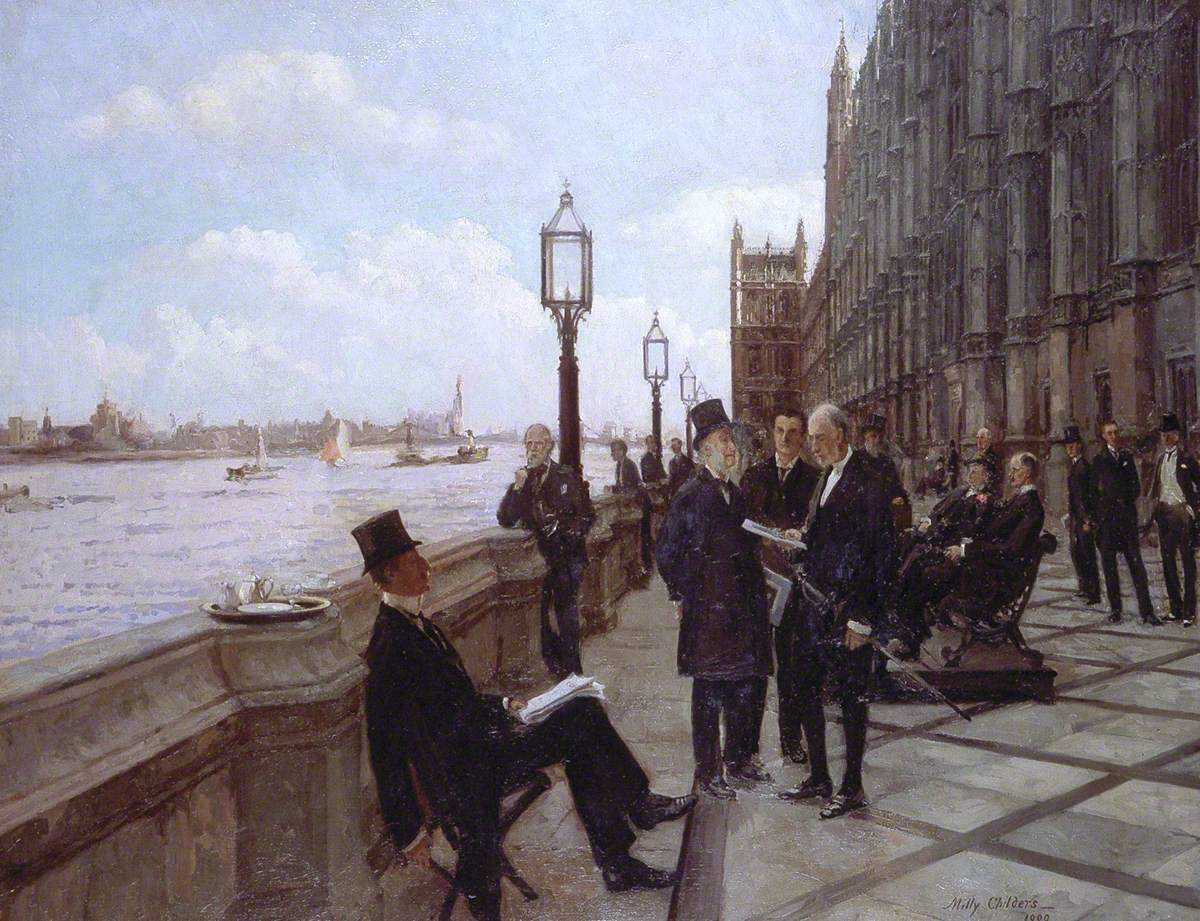
Milly Childers, “The Terrace, 1909.” Reproduced from UK Parliament.
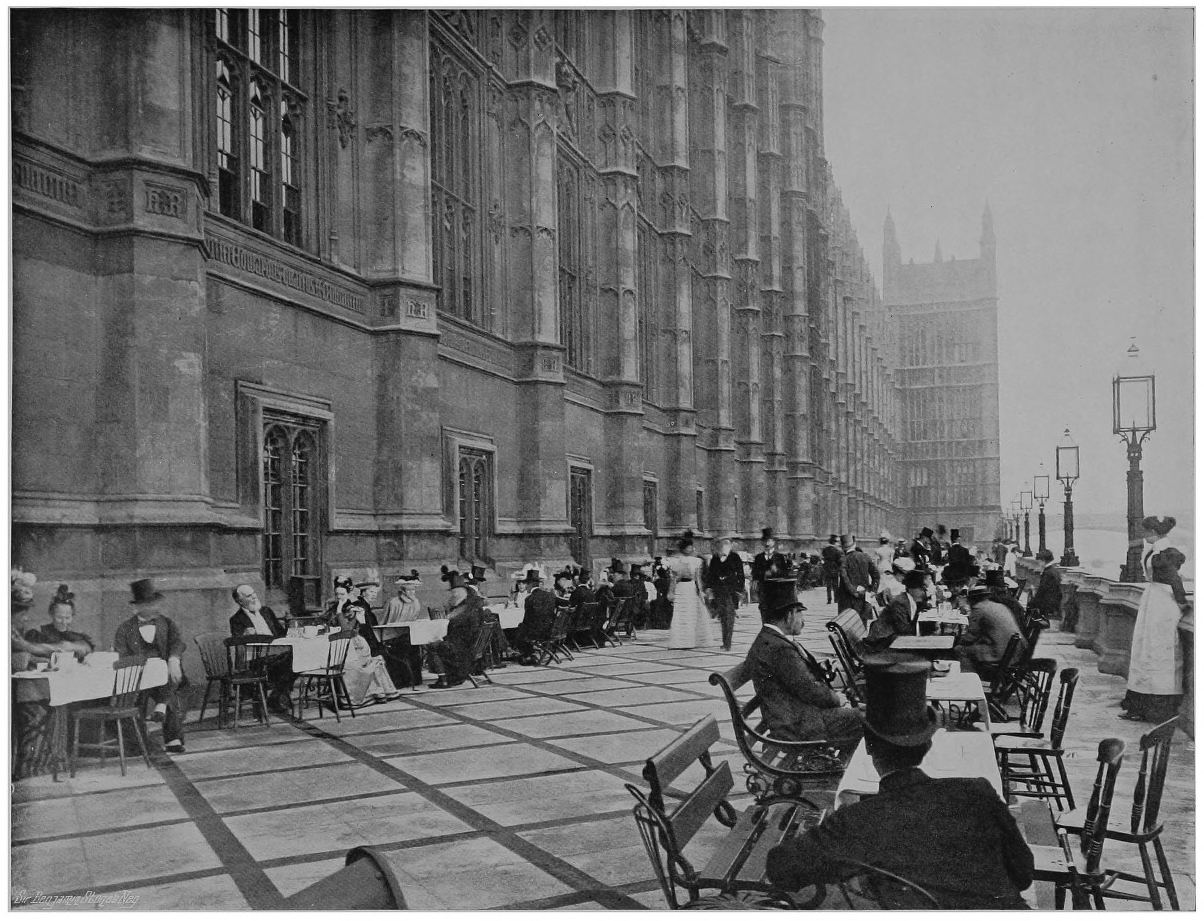
Benjamin Stone, “Tea on the Terrace.” Reproduced from MacDonagh (1906: [15]).
The Terrace, so well known in connection with the social side of Parliamentary life, is unique. No other legislative building in the world is favoured with so fine a possession, at once a thing of beauty and a place of recreation.The father of the future author of The Author of “Trixie” did not take part in the subsequent debate, which lasted until half past midnight and then took up the bulk of business the following day, April 9, and again on Monday the 12th and Tuesday the 13th, on which date the Government of Ireland Bill was read for the first time. Yet even before that, The Times had already, on April 10, declared Gladstone’s Irish Home Rule scheme “decisively condemned by the public opinion of the country,” and went on to state:This splendid lounge and promenade extends the whole length of the river-front of the Palace of Westminster. The waters of the Thames wash its walls. The noble Palace — with its many Gothic windows, its delicate stone carvings, its pinnacles and towers — looks down upon it majestically. Across the broad and fast-flowing river is seen, on the right, the ancient Palace of Lambeth. Far beyond are caught misty glimpses of the Surrey hills. On the left are the spires of the city, with the dome of St. Paul’s looming massively and imposingly in their midst.
Here Members of the House of Commons, escaping from the enervation or boredom of the Chamber, take exercise and enjoy the delicious freshness of the air. On fine summer afternoons, during the season, tables are laid for tea, in the deep, cool shadows of the great Palace. In attendance are smart waitresses in black gowns and white aprons. Crowds of ladies are enjoying the tea and cake and strawberries, and Parliamentary small talk of their hosts; and in turn lending additional charms of colour and animation to the picturesque scene.
But there are legislators who think that “tea on the Terrace” is a function which lowers the dignity of Parliament. For their solace, a part of the Terrace is cut off by a post bearing the warning “For Members only,” and there they ruminate in glum aloofness, undisturbed by the laughter of Beauty and the rustle of her skirts (MacDonagh 1906: [13]).
The arguments to which Mr. Gladstone had recourse are as extraordinary as the propositions he employed them to sustain. […] People who know anything of the history of Ireland must have read with amazement Mr. Gladstone’s assertions concerning the five hundred years’ existence of an independent Irish Parliament. The misrepresentation is absolutely grotesque, since the intermittent Legislature was for the greater part of its existence the creature of English force, for the rest the creature of English gold. Whatever may be thought of that Parliament nothing can be more certain than that it had absolutely nothing in common with any Irish Parliament that can now be called into being. […] In fact, his scheme is an astonishing patchwork of clippings from a variety of more or less successful constitutional experiments, each of which has grown up in obedience to a peculiar set of conditions. Mr. Gladstone’s patchwork combines all their disadvantages, and naturally misses all their benefits. His mass of details, resting on no solid foundation, has the same relation to practical politics that one of Jules Verne’s novels has to serious science. He leaps from one hasty assumption to another, from one provision, founded on nothing but his own dictum, to another equally destitute of material sanction, with as much happy contempt for logic and for fact as if he were merely constructing a private theory of evolution. Even were his aims as admirable as they are mischievous, and disruption as desirable as it is objectionable, this scheme, which is neither solid union nor effective separation, which is neither just to England nor honourable to Ireland, and which is in every part crude, insubstantial, and fantastic, would stand condemned by its inheritent [sic] ineptitude.On April 14, 1886, Gladstone introduced into the House of Commons as pendant to his Home Rule Bill a “Land Purchase Bill, and declared that it was a necessary portion of his scheme, which the two parts must stand or fall together” (Newton 1907: 148). The day before, after the Home Rule Bill was read for the first time, “informal consultations began among the various sections into which the Liberal Party was fast breaking up. The more radical of the objectors to the Bill grouped themselves around Mr. Joseph Chamberlain, with Mr. Caine as unofficial whip and business manager. The Whigs rallied round the Marquis of Hartington” (Newton 1907: 147–148). Subsequently, at a meeting of the Liberal Association and Club at the Central Hall on Dalkeith Street, Barrow, on Wednesday, April 28, W. S. Caine explained to his constituents the “heroic attempt on the part of the Prime Minister to grapple with the Irish difficulty” as well as the three factions into which the Liberal party had begun to splinter — the supporters of Gladstone’s bill; the Whigs, who “have a rooted objection to Home Rule in any form;” and his own faction, the Radicals, who accepted the “principle” of the bill, but not “the methods by which the principles can have effect.” During the course of that explanation, the member for Barrow used language which one of his constituents later characterized as “Mr. Caine’s great bugbear […] a great distrust of the Irish people; he seemed to have no trust in any Irishman.” Indeed, “Mr. Caine’s great bugbear” would be neatly encapsulated by his son twenty years later in the form of Pilkington setting out to encounter with pistol in trembling hand the phantoms of imperialistic prejudice and foil in Nightingale Lane near Clapham Common a purely fictional Fenian plot which revisits, as it were, some “pormenores sórdidos” drawn from some of the father’s subsequent politico-literary iniquities, and his repentance thereof, to wit: While being “willing,” as he reiterated in his Barrow address of April 28, 1886, “to give Ireland the fullest measure of self-government consistent with the maintenance of the Union and the supremacy of [the] Imperial Parliament in every corner of the United Kingdom,” W. S. Caine, M.P., and other members of what was soon to become the Liberal Unionist Party, were against making “any concession to what they regarded as the party of crime” (Newton 1907: 177), that is, the Home Rule Party. Around the time the thirteen-and-a-half-year-old future author of The Author of “Trixie” was starting at (or returning to) the Manor House School, Clapham, The Times published, on March 7, 10, and 14, 1887, a series of articles entitled “Parnellism and Crime” alleging that the “whole organization” of the Home Rule Party “depends upon a system of intimidation carried out by the most brutal means and resting ultimately upon the sanction of murder.” One-penny reprints of the articles became available on St. Patrick’s Day, and not long after, the member for Barrow, “finding that no action was being taken against the Times by those incriminated,” began distributing “a considerable number of them among [his] constituents” (Newton 1907: 207). On April 18, The Times published an article containing, “as documentary evidence which has a most serious bearing on the Parnellite conspiracy,” the facsimile of a letter supposedly signed by the Home Rule leader, Charles Stewart Parnell. In the House of Commons that same day, the member for Cork “rose amid cheers from members below the gangway” to denounce the letter as “a villainous and barefaced forgery,” an “unblushing calumny,” a “precious concoction,” and the signature as “an audacious fabrication” having no resemblance — “except as regards two letters” — to his own “unfortunately […] very cramped hand.” The Parnell Commission investigated The Times’s allegations from September 1888 to November 1889 and in its report published in February 1890 found that the facsimile letter was a forgery by County Meath–born journalist Richard Piggott. This report spurred W. S. Caine to recant, somewhat, his assessment of those who had been “incriminated” by the articles published by The Times. As The Pall Mall Gazette noted,
There is, at any rate, one member of the Unionist faction whose sense of honour and fairplay has not been blunted by party passion. This is Mr. Caine, who having before circulated “Parnellism and Crime” in his constituency, has now circulated a remarkable letter admitting that the Report is a refutation of the pamphlet. We congratulate Mr. Caine. But he must not weary of well-doing. If he is sincerely convinced that the acquittal of Mr. Parnell is “a matter for national congratulation,” he must support the Opposition when they propose to place that national congratulation on record. Mr. Caine’s letter is a distinct sign of grace; but to make his salvation sure he must give, not pious opinions only, but votes.That “remarkable letter,” sent from 1, The Terrace, Clapham Common, and dated February 18, 1890, stated, in part:
Having circulated “Parnellism and Crime” among my constituents — (not the forged letters, as I have been accused of doing) — I now feel it my duty to lay before each of my constituents the result of the Judges’ inquiry into the alleged connection of certain specified members of the Irish Party with crime, and the authenticity of the letters alleged by the Times to have been written by Mr. Parnell and others.Meanwhile, that is, back in the late spring of 1886 when debates on the second reading of Gladstone’s Home Rule bill were on the verge of commencing, it’s possible that the future author of The Author of “Trixie” was one of the many “young sons on the edge of manhood” forced to run a rather Hamlet-esque gauntlet of “pormenores sórdidos” on Clapham Common as reported the following year in the pages of The Pall Mall Gazette by one of the “householders living there,” W. S. Caine, M.P.:[…]
With all sensible and right-minded men, I am profoundly thankful that Mr. Parnell has been able to clear himself so completely and emphatically from the odious charges made against him by the Times; which, but for the appointment of the Commission, he might never have accomplished so satisfactorily. I look upon this as a matter for national congratulation.
I cannot find language strong enough to express my horror of the foul conspiracy to which Mr. Parnell has been subjected, or my opinion of the conduct of the Times in lending itself to these infamous libels on the flimsy evidence furnished to them of their supposed genuineness. Mr. Parnell must be held to have come through the inquiry practically unscathed.
The only comment I will make on the charges in general is that it appears to me that those charges which may be termed as damaging to the personal honour or moral character are disproved, and that those relating to what may be termed political crime have been proved.
On the whole the Irish National Members of Parliament come out of the inquiry much better than I expected, and I am heartily and ungrudgingly glad of it. I think that the objections to Home Rule based upon the personal characters of these gentlemen as individuals must now be taken out of the controversy.
I conclude by informing you that the strong opposition which I have felt compelled to offer to Mr. Gladstone’s Home Rule policy is in no degree lessened by the Report of the Commission, being based on other and far different grounds than the personal character of these gentlemen, who would, if that policy were successful, be called upon to give effect to it.
I have no hesitation in making some fuller statement concerning my charges of corruption and blackmail against the police, and shall be glad if you will let me do so in your columns.The appeals made to the Home Office included, apparently, his description of Clapham Common as being, in 1886,For many years I have taken a warm interest in the welfare of those unhappy women who have drifted into a life of prostitution, and have been successful in helping to bring them back to a life of decency and virtue. A little more than a year ago Clapham Common was the resort of a considerable number of these women, who plied their trade in the well-frequented thoroughfares which cross this open space. Their customers came thither to meet them, and these two classes of people made the common virtually impossible to decent people after dark. Householders living there could not send their servants out on errands without being molested by men, and their young sons on the edge of manhood could not pass any of the thoroughfares without constant solicitation and debasing language being poured into their ears. Appeals were made both to the Home Office and to the police authorities, and although promises were plentiful the evil continued as rampant as ever. I spent several evenings on the common after dark, and as far as possible got to the bottom of the cause why our many complaints had no effect. My past experience of this class of women, gained in Liverpool, where my wife and I took an active part in the management of a home for fallen women, enables me to get from them information with greater ease than other people. I found that there were thirty-two women who got their miserable living after dark on Clapham Common. Each woman appropriated a bench, which are mostly placed under trees, and from this centre sallied forth in search of customers, on a beat carefully marked out, and which was not interfered with by any of her sisterhood. The great majority of these women informed me that they deliberately placed themselves under the patronage of the police by bribing them with sixpence or a shilling a night. I entirely believe them. I am quite sure that if the police had chosen they could on the complaint (oft repeated) of the inhabitants have cleared the whole common in a single night, and kept it clear ever after. We had, however, learned to despair of police assistance, and made up our minds to do our own work. We formed a vigilance committee, and for some weeks a number of gentlemen did the thankless task of spending hours on the common driving away by remonstrance and threats the men who came in search of these women, while at the same time they endeavoured, with some success, to persuade the women to enter a home which was provided for the purpose. It is, however, impossible for private individuals to keep up the work of the police, and during the spring the evil once more increased, though it has never been so bad as it was in the spring of last year (W. S. Caine 1887b: 1).
literally infested by prostitutes of the lowest type. Not only is solicitation openly and offensively practised, but actual fornication is shamelessly committed on the numerous benches (Inwood 2005: 307).As well as his account from 1887
that during a short walk from the Reform Club in Pall Mall to Regent Street he was “accosted by 42 women, chiefly French or Belgians, not merely a nod, a wink or a touch, which one could pass by, but the women walked by his side and spoke in their native tongue, inviting him to go home with them, and see them dance naked on a table &c.” (ibid.).That springtime of prostitution on Clapham Common saw the publication in various newspapers, on April 30, 1886, of a list of “those who have already joined the Liberal Committee for the maintenance of the legislative union between Great Britain and Ireland.” There was as yet no Caine on the list; there was, however, among the names of the non-MP members, an R. Pilkington, as well as, among the 28 MPs, a Wodehouse, specifically Edmond Robert Wodehouse, member for Bath and cousin of the father of the author whose books Caine’s would later be said by Platt to rival “as mirth provokers” (see § 1). Also among the MPs on the list was Baron Ferdinand de Rothschild, member for Aylesbury and cousin of Constance Flower, aka Baroness Battersea in whose mansion at Marble Arch Edith Gordon Walker would have her “first chance” “in the British metropolis” (see above). (Note, by the way, how readily “Marble Arch” decomposes via Roussellian procédé into “April March,” especially if one interposes the Spanish “Abril” between “Arble” and “April”; and recall from § 2 that Constance and Cyril Flower’s “house near the Marble Arch [was] one of the few salons of Gladstonianism.”) By Monday, May 3, 1886, five more Liberal MPs would join the Committee, along with one more the following day, bringing the total to 34. And while, for instance, The Gloucester Chronicle of Saturday, May 8, stated that the Committee “had registered some forty Liberal members of Parliament upon its books,” the list published on Monday, May 10, still set the figure at 34; W. S. Caine, along with Joseph Chamberlain, John Bright, and others, was included in a separate list of the “large number of members who have expressed decided hostility to the Bill as it stands, but some of whom would support the second reading if important modifications were made.” That “decided hostility” took the form of a private meeting of 52 MPs called by W. S. Caine “to consider the action to be taken on Mr Gladstone’s Irish schemes.” Held at Chamberlain’s London residence on Wednesday afternoon, May 12, 1886, the latter
said that nothing short of the withdrawal of the measure could restore the unanimity of the Liberal party. — Among the other speakers was Mr Caine, who said that after a most careful estimate of the opinion of Liberal members of the House of Commons, he had arrived at the conclusion that 102 members of the party had definitely committed themselves to vote against the Irish Government Bill, and that in addition there were 34 Liberal members who had not yet made up their minds either to support or oppose it. Furthermore, the position taken up by the Government on Monday night had caused many Liberals who had up to that moment intended to vote in favour of the second reading to change their minds. In his opinion this process of change would extend very considerably.The “process of change” extended to the Liberal member for Birmingham Central, John Bright, who
was so distressed by his acute difference from his old leader [Gladstone] that he could not bring himself to attend the debates, but remained in the Reform Club, where Mr. Caine reported to him each evening after dinner the progress of events. In the early stages of the controversy Mr. Bright’s tendency was merely to abstain from voting. He would not speak against the Bill, neither would he vote against. But as the temperature of the discussions gradually rose, he steadily moved from that position into the opposing camp, and at last felt it his duty, though with infinite reluctance, to vote against. By this time Mr. Caine was a warm advocate of opposition, no half-way measures would now satisfy him, and he poured his views into Mr. Bright’s ears day by day (Newton 1907: 151–152).Much like those “unhappy women” (in whose welfare the member for Barrow had “for many years […] taken a warm interest”) who poured their “debasing language” into the ears of “young sons on the edge of manhood” in the thoroughfares of Clapham Common — and precisely what I meant earlier by “Kinbotesque.” On May 29, 1886, W. S. Caine, M.P., issued
summonses to both the Radical and the Whig sections of the dissentients, inviting those “who, being in favour of some sort of autonomy for Ireland, disapproved of the Government Bills in their present shape,” to attend a meeting in Committee-room No. 15, on May 31st. […] Fifty-five members accepted the invitation, and Mr. Joseph Chamberlain occupied the chair. In his opening speech the Chairman aimed at impartiality, contenting himself with plainly laying before the meeting the three courses which were open to them (Newton 1907: 153).That is, they could vote for or against the second reading of the bill, or they could abstain from voting by walking out (or not showing up). Several members argued for voting against the second reading, including the member for Barrow who, according to his biographer,
read a letter he had obtained from Bright at the Reform Club. This letter determined the decision of the meeting, and with it the fates of the Bill and the Ministry, and, with them, the course of our political history until the end of the century and beyond. This historic letter, for which one journal offered Mr. Caine £100, he unfortunately destroyed at the meeting, and no copy of it was taken. Two accounts of its contents found currency. One was that, whilst he [that is, Bright] distrusted the proposed compromise — by which, if they supported the second reading, the Bill should be withdrawn, to be reintroduced the next session, amended so as to meet the objections of Lord Hartington and Mr. Chamberlain — he would nevertheless accept the decision of the meeting. The other version was that, after long and anxious thought, whilst not desiring to influence the minds of others, he found that for himself there was only one course — he must vote against second reading.According to contemporary reports of that “fatal conclave in No. 15,” the transmitter of Bright’s fateful message was not the father of the future author of The Author of “Trixie” at all, but rather Joseph Chamberlain, whoThe former account is clearly inconsistent with well-known facts. No remodelling of a Home Rule Bill could conceivably meet the objections of men like Hartington and Bright himself, who were opposed to any scheme of Home Rule.
My own recollections of conversations with Mr. Caine on the subject is clear and emphatic that the second version is the correct one. I understood from him that Mr. Bright wrote the letter with considerable reluctance, and tore up several drafts before he allowed it finally to pass from his hands. Every step he took in this stage of the proceedings was taken with extreme reluctance and great pain. Immediately the letter had left his hands he felt he had burnt his boats, and asked Mr. Caine, subsequently to the meeting, when he heard the report of the proceedings and decision, to give it to Mr. Labouchere for publication. But, as I have said, it was already destroyed. It was reported that Mr. Bright greatly regretted the decision of the meeting. What he regretted was the necessity for such a decision, not the nature of it. Mr. Caine’s recollection was always clear on that point, and never varied (Newton 1907: 154–155; emphasis in original).
concluded his remarks by reading a letter he had received from Mr. John Bright dealing with the political situation. Mr. Bright in his letter regretted that he found it impossible to support the bill in its present shape. While it was his intention to vote against it if a division was pressed, he expressed a hope that some via media might yet be found whereby the division of the party might be avoided, and a dissolution under such circumstances averted. The reading of the letter created a deep impression, and Mr. Bright’s language was loudly cheered.Furthermore, as Chamberlain’s son Austen revealed in 1913,
Mr. John Bright’s letter was addressed to my father and was read by him in its entirety to the meeting. It never was in Mr. Caine’s possession, and he did not destroy it. It is now among my father’s papers.…Indeed, as Chamberlain expressed in a letter he wrote to Bright’s son on January 16, 1899, “Mr Caine appears to me to be very loose in the statements which have been attributed to him. As far as I know he received no letter from your father. Certainly he never read one. The only letter read at the meeting was the one I now send you, and it was read in full from beginning to end” (Trevelyan 1913: 455). That letter, dated May 31, 1886, ended with a P.S. — “If you think it of any use you may read this note to your friends.” — and ran as follows:The statement that Mr. Caine had the letter and destroyed it, and that he only read a part of it to the meeting, has been frequently made.… It is, however, wholly unfounded, and appears to have arisen from some strange forgetfulness on Mr. Caine’s part some years after the events took place.
My Dear Chamberlain, — My present intention is to vote against the Second Reading, not having spoken in the debate. I am not willing to have my view of the Bill or Bills in any doubt. But I am not willing to take the responsibility of advising others as to their course. If they can content themselves with abstaining from the division, I shall be glad. They will render a greater service by preventing the threatened dissolution than by compelling it, if Mr. Gladstone is unwise enough to venture upon it. You will see from this exactly where I am. A small majority for the Bill may be almost as good as its defeat and save the country from the heavy sacrifice of a General Election. I wish I could join you, but I cannot now change the path I have taken from the beginning of this unhappy discussion. […] (Trevelyan 1913: 454–455).The “unhappy discussion” continued on the day after the meeting in Committee Room No. 15 with a debate in the House of Commons which The Pall Mall Gazette described as
simply a duel — an undisguised “no quarter” duel. Mr. Chamberlain opened fire in good form, and the general opinion after he sat down was that he had never made a better or more effective speech. Once only he forgot himself, in taunting Mr. Healy with his “magnificent physique” in return for the latter’s previous allusion to him as a “puny whipster.” This was in extremely bad taste, as was also Mr. Sexton’s equally personal reply. With this exception, however, Mr. Chamberlain spoke with perfect coolness, and a good many of his hits right and left will stick for some time. His announcement that in support of his views about the probability of the efforts of the Church of Rome to impose its will upon the Protestant minority, he would quote from “a pamphlet written by the Prime Minister in 1875;” his remark in reply to howls from the Irish benches, “The House will appreciate these interruptions, which I venture to think do not augur very well for the peace and order of any future Irish Parliament;” his challenge to Mr. Parnell to stand up in Ireland and declare that Mr. Gladstone’s bill was a final settlement; his sympathy with the Irish members who were “always inaccurately reported;” his side-blow expressing doubt of the knowledge of the Irish democracy on the part of the hon. member who sits for an Irish division of Liverpool, because he “does not reside very much in that country himself;” his concluding assurance that he did not complain of the conduct of the Irish members — “it is their method of controversy; nobody has been opposed to them without being covered with virulent abuse — nobody more so than the Prime Minister and Lord Spencer, whom they are now loading with fulsome adulation;” his inquiry whether it was believed also that Mr. Bright was “animated by personal spite” — each one of these shafts went home (“Occasional Notes,” The Pall Mall Gazette, June 2, 1886, p. 3).The ends of Bright’s letter and Chamberlain’s no quarter duel ultimately took effect in the small hours of Tuesday, June 8, 1886, with the defeat of Gladstone’s attempt to remove the “broad and black blot upon the pages of [England’s] history” with regard to Ireland and the formal splitting of the Liberal party into two factions, the Unionist Liberals (or Liberal Unionists) and the Separatist or Gladstonian Liberals. The teeming atmosphere was reminiscent of that which, two months’ earlier, had surrounded W. S. Caine’s induction as member for Barrow:
The scene of the division will be one which will never be forgotten by those who had the privilege of witnessing it. The House was filled from floor to ceiling. The Peers’ Gallery overflowed with members of the Upper House, and beside and behind were serried ranks of spectators in the galleries assigned to Ambassadors and distinguished strangers; while the Speaker’s and Strangers’ Galleries were crammed to suffocation. Members of the House after filling their usual seats below crowded at the bar, and completely filled the side galleries reserved for their use. When Mr. Gladstone sat down at 7 minutes past 1, having spoken nearly on hour and three-quarters, the Speaker immediately put the question, and a tremendous shout went up when he asked those in favour of the Bill to say “Aye.” This was immediately followed by an even louder cry against the Bill. The Speaker had no hesitation in declaring the “Ayes” had it, but the decision was formally challenged, amid cheers, counter-cheers, and cries of “Agreed” from the Irish benches. Then the bells rang, the bar became more crowded than ever, and the Speaker put the question again, with a similar result. Without a moment’s delay the Speaker instructed the “Ayes” to go to the right and the “Noes” to the left, naming as tellers for the former Mr. A. Morley and Mr. Marjoribanks, and for the “Noes” Mr. Brand and Mr. Caine, the hon. member for Barrow’s name being received with ironical cheers by the Irish, the members filed out with extraordinary rapidity, and by a quarter past 1 members began to return to their seats, Sir Charles Dilke leading the Ministerialists. As a large number of Liberals passed the threshold of the “No” lobby they were eagerly watched by the rapidly assembling House.W. S. Caine, along with 92 other Liberals, voted with the Noes. Thus was born the Liberal Unionist Party. Gladstone dissolved Parliament on June 26, a general election was called, and on July 2, 1886, the constituency of Barrow-in-Furness, which, less than two months earlier, had elected a Radical Liberal, returned to Parliament a Liberal Unionist member with the same name. Some four years later, however, when the future author of The Author of “Trixie” was in the middle of the seven months’ vacation between his “Semi” and his “Tertian” years at the University of St. Andrews (for which see “Recollections of a St. Andrews Man”), his father’s Unionism became “somewhat attenuated” under the pressure “some peculiar fad of his own” — total abstinence from alcohol. On June 23, 1890, in protest against government-proposed legislation that would compensate (with taxpayer money) publicans in the event that a municipality failed to renew their liquor licenses, the member for Barrow and chief whip of the Liberal Unionist Party — who in 1886 had been described as “the jolliest of Mr. Chamberlain’s adherents. Big, round-faced, merry, he is the typical teetotaller. The twinkle of his eye alone would put one in a good humour. But when he fights […] he can deliver as good a knock-down blow as anybody in the House of Commons” — decided to throw in the towel. He resigned from Parliament by “taking the Chiltern Hundreds,” an act which precipitated a new election in his constituency. Thus, W. S. Caine, running as an Independent Liberal, contested Barrow for the third time in five years. On Wednesday, July 2, 1890, he lost to the Liberal candidate James Duncan, “the son of an old and valued friend,” as the defeated candidate called him, “who is connected with Barrow by ties and affectionate remembrances in connection with a great injustice;” the son, in other words, of none other than he who, five years earlier, had been “unseated by pork pies.” On Thursday, July 3, he explained that the real reason he vacated his seat (and thus caused the election which he lost) was “not so much because the compensation clauses were introduced as that remedial legislation for Ireland was set aside for a measure foredoomed to certain failure.” By Saturday, July 5, the “‘genial ruffian’ who made himself so busy in defeating” Gladstone’s Home Rule Bill in 1886, had reportedly “written to Mr. Gladstone, stating that he has returned to the Liberal Party, and that he is prepared to accept Home Rule in principle, while reserving his freedom as to details.” And on Monday, July 21, W. S. Caine fully “came out of” the “false position” he had “found himself in” by accepting the invitation to run in the next election as the Liberal candidate for the Eastern Division of Bradford in Yorkshire. Four nights later, at a meeting of the Liberal Two Hundred of that constituency in Mechanics’ Hall, the candidate-to-be stated that, since “Mr. Gladstone had given up many of those features of his scheme” which he and the Liberal Unionists had objected to, it was now the case that, “so far as he personally was concerned, each one of his objections had been removed, and he had been compelled to change his position from hostility to Home Rule proposals to acquiescence in them,” and was thus now “with the Liberal party in all things — (loud cheers) — in Irish questions as well as English questions.” He further jokingly stated that, “With the result of the Barrow election he was quite content. He had struck for freedom, and got it. (Laughter.)” He used that freedom to go off and “rusticate” for a couple months in Holybourne, a village just to the northeast of Alton in Hampshire, where he took “an active part in mission work among the hop-pickers and villagers in that out-of-the-way and picturesque district. Mr. and Mrs. Caine and their daughters have been entertaining the young hop-pickers in connection with the Alton Congregational Hop-Pickers’ Mission, and on Sunday next Mr. Caine is to occupy the pulpit in the little Congregational church in the famous village of Selborne.” What, meanwhile, were his six-year-old son David Howard and his seventeen-year-old son William up to? Gone fishing, perhaps. Of their father’s taking the pulpit in “the famous village of Selborne,” the London correspondent for the Western Mail complained:In another few minutes the space below the bar became inconveniently crowded, but way was made for Mr. Gladstone, who was received with an Irish cheer as he returned from the division lobby. A different reception was given to Mr. Chamberlain by the same group, but he took no notice of it whatever as he passed along in front of the Treasury Bench. A scene of tremendous excitement then took place. It was believed that the Government was beaten, for the Ayes tellers had returned, some seconds before the Noes had finished entering. Mr. Marjoribanks took his seat on the Treasury Bench and had notified to his colleagues that the Ayes numbered 311. Presently Mr. Morley was seen struggling through the bar, and gave the number of Noes to the Clerk. Mr. Morley and Mr. Marjoribanks, without waiting at the table, took up their positions on the left of the gangway, facing the Speaker. The Clerk handed the paper to Mr. Brand, and then the long pent-up excitement culminated with a loud, long, and triumphant cheer from the Unionists. It was in vain that the Speaker rose and beckoned for silence. Cheers succeeded cheers, and the four tellers stood in line waiting for the fatal numbers to be announced. At 26 minutes past 1 silence was temporarily restored, and Mr. Brand, in tones so clear as not to be misunderstood, announced, “Ayes to right, 311; Noes to left, 341.” It would be almost impossible to describe what followed. The rank and file of the Conservative party shouted themselves hoarse with cheering, at the same time waving their hats triumphantly and jumping on their seats in exultation. There was also some cheering on the Liberal benches, but Mr. Chamberlain and Mr. Caine sat immovable, and Ministers apparently accepted their defeat with resignation. The Irish waited patiently for the Conservatives to exhaust their strength, and then, rising en masse, as if by concerted signals, sent up a still louder shout. A voice sang out, “Three cheers for the Grand Old Man.” The whole House seemed to rise at the call, and Liberals and Parnellites vied in applauding the mover of the Bill. The galleries seemed to join in the honour paid to the Prime Minister, for the whole House appeared charged with electricity. […] (“The Division,” The Times, Tuesday, June 8, 1886, p. 9).
Of all spots on this earth why should Mr. W. S. Caine, ex-M.P. and champion political ratter, have pitched his tent in the beautiful little village of Selborne, in Hampshire, I wonder. Perhaps — though if pressed I would admit the idea to be rather a far-fetched one — it is because Gilbert White’s old village, which he immortalised in his Natural History, is hard by the pleasant little town of Alton, where some famous ales are still brewed. But I do not think the good folk of Alton or Selborne want to be reclaimed and sanctified by Mr. Caine. It is a pity the ex-honourable gentleman did not stick to his own part of the country and his own friends instead of invading the village of Selborne, which is in need of neither missionaries nor political carpet-baggers. Selborne is a truly lovely spot — or was before Mr. Caine’s arrival — with wildly-wooded hillsides. It is on the fringe of the Hampshire hop country, and hard by Woolmer, the seat of the Earl of Selborne (“Metropolitan Notes; Selborne and Mr. Caine,” Western Mail, Thursday, September 25, 1890, p. 4).Once finished rusticating in Hampshire, the “ex-M.P. and champion political ratter” travelled to India for the third time, debarking from the Sutlej in Bombay on November 17, 1890. He continued on via Sholapur, Haidarabad, and Madras — which he called “a city of magnificent distances” where “every turn of the road brings some new incident, Madras being an aggregation of some thirty or forty villages, great and small, tied to Blacktown, their capital, by good roads running through cocoa-nut plantations, past blue lakes, and over fine bridges spanning pretty rivers, where hundreds of Dhobies, or washerwomen, are busy knocking the buttons off European shirts” (W. S. Caine 1891: 28) — to Calcutta, where he attended the Sixth Indian National Congress from December 26 to 30. On New Year’s morning, 1891, he traveled from Patna “to Benares in the same carriage as several pious Congressmen, who intended killing two birds with one stone by including a pilgrimage to the holy city in the same railway fare as the Congress. The train was full of pilgrims, and as we slowly crossed the magnificent steel bridge 1,200 yards long, the pride of the ‘Oudh and Rohilkhand,’ the carriage windows were crowded with eager faces to get a first glimpse of what is undoubtedly the most picturesque, as well as the holiest, city in all India. It lies on a lovely sweep of the mighty Ganges, along the crest of a high bank rising 100 ft. above the water. Viewed from the bridge, it presents a panorama of palaces, temples, and mosques, surmounted by domes, pinnacles, and minarets, stretching for nearly three miles” (ibid.: 51). On January 31, he gave a talk in the Bombay Town Hall on “temperance reformation in India,” referring “to the Indian Army as giving a splendid object lesson to the world on temperance reform. It had proved that it was possible for men to do the hardest description of toil under climatic disadvantages without alcoholic stimulants;” after which he set sail aboard the same mailship on which he had arrived two and a half months earlier, the Sutlej, arriving in England on Monday, February 16, 1891. He “paid a visit to the lobby of the House of Commons” the following day; a week later, on Tuesday, February 24, the National Temperance League gave him a public welcome home in Memorial Hall, Farringdon Street; by March the ex-MP was already “throwing an immense amount of energy into his electoral campaign” (Newton 1907: 255); and at the election in Bradford on Monday, July 4, 1892, “favoured by support of the Labour Electoral Union and the Irish National League, two bodies of voters independent of the Liberal Party, the temperance reformer was able to defeat the brewery director [Byron Reed] by 5575 votes to 5373, a majority of 202” (ibid.: 257). After W. S. Caine, M.P., died, nine days short of his 61st birthday, early in the morning on St. Patrick’s Day, 1903, The Liverpool Daily Post noted,
He was really not very inveterate against Irish demands, though taken aback by Mr. Gladstone’s dramatic proposals; and after a time he was one of those Liberals who found that, after all, the general principles and purposes of the party were in their view more important than the avoidance of the one mischief of Irish self-government as they had felt it to be (“News of the Day,” The Liverpool Daily Post, Wednesday, March 18, 1903, p. 4).The news of his death “was received with much regret by his colleagues at the House of Commons,” of which
the Irish members, without distinction of party or creed, wore bunches of shamrock; nor was this sign of Irish patriotism entirely confined to members from the sister island. A good many English members wore the “symbol dear,” and it was noticed that the Irish Solicitor-General, who took his seat for the University of Dublin, had in his buttonhole a very large bunch of shamrock (“From Our London Correspondent,” The Liverpool Daily Post, Wednesday, March 18, 1903, p. 4)So much for the connections — far more complex and extensive than I had expected when I started this chapter — which the better known father and his lesser known son had with the town, the county, and the country where Borges’s invented author Herbert Quain died. Apropos: One manuscript which the fictional publisher of Lady Sheba Sangsue’s fictional Memoirs, Stanley Frodsham Packer, chose not to publish was Mrs. Julia Compton Addleshaw’s Unknown Sons of Famous Fathers “which that lady had recently invited Mr. Packer to bring out in fifteen volumes at, say, £4 4s. each” (LSLS: 27). I will now train the Borgesian lens on the (absence of) “necrological piety” which the press conceded to the lesser known Caine. When Quain died in Roscommon, Borges states,
he comprobado sin asombro que el Suplemento Literario del Times apenas le depara media columna de piedad necrológica, en la que no hay epíteto laudatorio que no esté corregido (o seriamente amonestado) por un adverbio. El Spectator, en su número pertinente, es sin duda menos lacónico y tal vez más cordial, pero equipara el primer libro de Quain — The god of the labyrinth — a uno de Mrs. Agatha Christie y otros a los de Gertrude Stein: evocaciones que nadie juzgará inevitables y que no hubieran alegrado al difunto | I noted without surprise that the Times Literary Supplement barely concedes him half a column of necrological piety, in which there’s no laudatory epithet which is not corrected (or seriously admonished) by an adverb. The Spectator, in its relevant number, is doubtless less laconic and perhaps more cordial, but equates Quain’s first book — The god of the labyrinth — with one of Mrs. Agatha Christie’s and others with those of Gertude Stein: evocations which no one will judge to be inevitable and which would not have pleased the deceased (Borges 1941: 44).Neither the Times Literary Supplement nor the Spectator, as far as I can determine, published a single line, let alone half a column, of “necrological piety” anent Caine.

“A Humorist at Play. The Genial Drawings of William Caine, Writer. William Caine, the witty writer, endeared himself to many. He had another 'sideline' to his good-natured fun — humorous drawings, which are herein described.” Reproduced from The Graphic, September 19, 1925, p. 457.
Someone some day must write a book on the recreations of hard-workers, or, rather, on the secondary work which hard-working men do for fun. For as things stand to-day, all too many people earn their living by forms of work which they have selected or which have been thrust upon them almost by accident; and most men with active minds cherish a secret desire to produce something worth while in some other field for which they may have aptitude or liking. William Caine, whose recent death at the early age of fifty-two, came as a shock to the large circle of his friends and to the wide public who relished his humorous essays and books, had a number of recreations properly so called. On a holiday, for example, he delighted in trout-fishing. But he also had a secondary form of work — the making of humorous sketches — in which he took particular joy.Of the other obituaries I’ve been able to find (they are all collected in Appendix I), only two compare Caine’s work to that of other writers. According to The Oxford Chronicle, “His name figured with increasing frequency in popular illustrated magazines, side by side with those of Mr. Phillips Oppenheim and other ‘best sellers.’” And “Mr. London” of The Daily Graphic said that Caine “was a close friend of A. A. Milne, but never met with his friend’s success.” Caine may be the friend Milne mentions in his essay, “A Hint for Next Christmas:”Three of his drawings of this character are reproduced on this page. He would, I think, have welcomed their presence in this appreciation of his genial talent. For though very few of his drawings have so far been reproduced, it was his intention in the last months before he died to publish a number in various forms, and Messrs. Fisher Unwin have actually at the moment in press a book called “The Glutton’s Mirror,” containing some thirty drawings from his pen.
It was unquestionably the influence of that brilliant caricaturist, H. M. Bateman, that encouraged Caine in his enthusiasm for drawing. For he was a great admirer of Bateman’s work, and the two men were close personal friends. Indeed, that whimsical figure with a round face, pointed nose and spectacles that appears so frequently in Bateman’s drawings was a caricature-portrait of William Caine, and both humorists had the habit of exchanging caricatures of one another in a continuous intercourse and correspondence. Bateman, moreover, it will be remembered, illustrated Caine’s “Bildad the Quill Driver,” and there is quite a hint of Bateman’s technique in such drawings as the “Ideal and the Idealists,” reproduced herewith.
Of Caine’s books, I suppose “Boom” is the most generally known and appreciated, though there is also much real fun in his last publication, “Lady Sheba’s Last Stunt,” with its ingenious idea of a leading member of Society’s “Bright Young People” terrifying her set by a rumour that she is writing her memoirs. Both are typical of Caine’s good-tempered humour and of his literary technique. For humorous writing does, in fact, demand technique, and it is also much harder work than is commonly supposed. There is a technique, for example, even in a thing so simple as Caine’s description of “The Glutton’s Mirror,” to which I have already referred. He described it as a “book for Low-Brows, who like eating and drinking, like to talk about eating and drinking, like to read about eating and drinking, like to dream about eating and drinking… a book to send at Christmas to the ultra-refined whom you desire to vex”; and to produce a steady output of humorous articles and books such as Caine accomplished meant continuous hard work; from this he turned with relief to the lighter exercise of drawing, which provides a pleasure unknown to those who wield the pen or — in the modern equivalent — dictate to a stenographer.
Caine was a man of considerable culture. When he left Oxford he was called to the Bar, but he abandoned it after a few years and devoted himself to journalism and general writing. He was fond of all the arts, and his flat at Hampstead contained a large collection of Bateman’s drawings and a Chinese room adorned with decorative panels by George Sheringham. With [the passing of] William Caine, in a word, we lose a charming and talented personality who looked on the world with humorous wonder and drew it in words and pictures with a smile that was never wry (R. H. W., “A Humorist at Play; The Genial Drawings of William Caine, Writer,” The Graphic, September 19, 1925, p. 457).
And now I am reminded of the ingenuity of a friend of mine, William by name, who arrived at a large country house for Christmas without any present in his bag. He had expected neither to give nor to receive anything, but to his horror he discovered on the 24th that everybody was preparing a Christmas present for him, and that it was taken for granted that he would require a little privacy and brown paper on Christmas Eve for the purpose of addressing his own offerings to others. He had wild thoughts of telegraphing to London for something to be sent down, and spoke to other members of the house-party in order to discover what sort of presents would be suitable.As for the writer with whom the obituarist of The Spectator, according to Borges, equated Quain’s first book, the closest Caine’s work comes to that of Agatha Christie’s — (Borges’s choice of said author, moreover, may be another aspect of his “ingenuidad” [see below] which simultaneously hints at the identity of the Christmas-present-less William in the “large country house” in Milne’s piece and mirrors, that is, looks like but means quite the opposite of, the “ingenuity” which the latter author attributes to his friend; furthermore [if that is the right word to logically connect coincidences], at 4:10 in the afternoon of December 22, 1924, Caine, “the well-known humorous writer,” gave “a talk” over the radio from London on “Buying Christmas Presents” [“Official News and Views; On Christmas Presents,” Radio Times, December 12, 1924, p. 527]; Borges had by then moved back to Buenos Aires from Europe and would not have heard the broadcast) — the closest Caine’s work comes to that of Agatha Christie’s is when he parodies detective, crime, or spy thrillers, as in the sequence from chapter X of The Author of “Trixie” when Chloë and Dunkle consult a private detective named Pankhurst (touched on by de Vries [2016: 141]; quoted in § 1), or in the Holmesesque “Bridge Cipher” chapter from Pilkington delineated above, or when the anti-Semite with a fancy prose style (to paraphrase Humbert Humbert) who narrates The Strangeness of Noel Carton leads an ostensible detective who’s been set on his heels by his wife (so he thinks) on a wild goose chase (SNC-HJ: 256–265; SNC-P: 250–259), or in the absurd story “Those Admiralty Plans” collected in The Fan:“What are you giving our host?” he asked one of them.
“Mary and I are giving him a book,” said John, referring to his wife.
William then approached the youngest son of the house, and discovered that he and his next brother Dick were sharing in this, that, and the other. When he had heard this, William retired to his room and thought profoundly.
He was the first down to breakfast on Christmas morning. All the places at the table were piled high with presents. He looked at John’s place. The top parcel said, “To John and Mary from Charles”. William took out his fountain-pen and added a couple of words to the inscription. It then read, “To John and Mary from Charles and William,” and in William’s opinion looked just as effective as before. He moved on to the next place. “To Angela from Father,” said the top parcel. “And William,” wrote William. At his hostess’ place he hesitated for a moment. The first present there was for “Darling Mother, from her loving children”. It did not seem that an “and William” was quite suitable. But his hostess was not to be deprived of William’s kindly thought; twenty seconds later the handkerchiefs “from John and Mary and William” expressed all the nice things which he was feeling for her. He passed on to the next place.… (Milne 1920: 128–129).
The door of the drawing-room opened and Princess Olga Szczczsz came in followed by Count Krobutkin. She was all sequins and bare flesh; he, all sables and cigar. A well-matched pair.As for Gertrude Stein: Caine and his wife will meet Stein and her famous partner in Wellesley marriage in the next chapter — and I believe he would have been pleased by my characterizing as “Steinian” those passages of his But She Meant Well which indirectly express the perspective of his five-year-old protagonist (see also the passages quoted in § 6, which seem to resemble much less the only book of Stein’s which Caine could conceivably, could possibly have read before he wrote But She Meant Well — Three Lives — and much more a book written seven years after his death, The Autobiography of Alice B. Toklas). For instance:Half-way to the tantalus she halted, wheeled round suddenly, and confronted him, dark, desperate and dangerous. “What new piece of devilry do you require of me now?” she panted, injecting cocaine the while.
The Count wasted no words, for time was short, because Professor Wauchope’s Seals were due for their bit at 9.45.
“You are aware,” he said, “that Lord Frederick Fothergill —”
“Do you mean,” she interrupted, as she sat down, “the second son of the Duke of Gloucestershire?”
“Exactly, Olga. The last year’s President of the Oxford Union Debating Society.”
“And,” she went on, “the present First Lord of the Admiralty?”
“That’s the man,” said Krobutkin, satisfied that at last all possibility of mistake was gone. “You know him.”
“I do,” she said. “Indeed, I am engaged to him.”
“That too I know,” said the Count, and he sat down.
Olga rose. “How?” she cried.
He smiled. “Have I not agents everywhere?” he asked. “Is it not my business to know things, Olga?”
“I suppose,” she said scornfully, “that you read the announcement in yesterday’s ‘Morning Post.’” The Count spread his hands.
“The trusted Secret Agent of Guatarica,” he said, “has little need of such channels of information as you have mentioned. But you are right.”
Olga sat down. “Well?” she said defiantly.
The Count rose, went to the piano, leaned against it, crossed his feet, shot his linen, fixed his eye-glass, and continued.
“A Programme of Shipbuilding,” he said, “for the next ten years has just been settled by the Admiralty, and to Lord Frederick, as First Lord, naturally falls the duty of carrying it down to Portsmouth — and to-night. It is vital to the interests of Guatarica that this Programme be in my hands this evening. Lord Frederick starts in his car for Portsmouth in five minutes, and —”
Olga rose. “I see,” she breathed. “You wish me to take advantage of Lord Frederick’s love for me. You wish me to lure him here so that you may obtain possession of these papers.”
“It is a pleasure,” said Krobutkin, “it is a real pleasure to work with a tool like yourself. But the point is, will you do it?”
“Never,” she cried as she strode about the room. Her breath came in quick pants. Sightless with horror she bumped against the furniture.
The Count drew from his pocket a letter written in ink, now much faded, and suddenly held it before her eyes. She saw it.
“Think again,” he said with a vile laugh, as she started back fumbling in her garter for her cocaine syringe. A moment later she was herself again (F: 249–251).
Hannah, cowering in her bed upstairs in a darkened room, heard the laugh of Mr. Sterne ring out and took heart. She wondered if the weather was clear enough for her to call to her mother, but decided to give it a little more time before she began to ask to be allowed to get up. Yet she thought that she might venture to raise the blind. She had seen her mother do it and it was quite easy. You just pulled the little wooden acorn on the side string and the blind rolled up with a snap that was very amusing. She got out of bed and let the blind go up. Then pulled it down and let it go up again. Then she did all this again. Then she did it again. Then she did it again. Then she did it again. Then she did it again. Then she did it again. Then she did it again. Then she couldn’t do it again because she had broken the spring. So, feeling cold, she got back into bed and wondered what she could do to pass the time (BSMW: 75).By the way, Stein’s The Autobiography of Alice B. Toklas, from which I will quote in the next chapter, was published the same year as Quain’s first book: 1933. Also, it is only on the last page of her book that Stein reveals that she, and not the ostensible narrator Toklas, is the author of the latter’s “autobiography” — a detail which would not have been lost on Borges, who notes that Quain, quite the opposite of Stein, “no se creyó nunca genial | never believed himself to be ingenious [or: a genius].” However, Borges continues,
Percibía con toda lucidez la condición experimental de sus libros: admirables tal vez por lo novedoso y por cierta lacónica probidad, pero no por las virtudes de la pasión. Soy como las odas de Cowley, me escribió desde Longford el seis de marzo de 1939. No pertenezco al arte, sino a la mera historia del arte. No había, para él, disciplina inferior a la historia | He perceived with full lucidity the experimental condition [or: nature] of his books: admirable, perhaps, for their novelty and for a certain laconic probity, but not for the virtues of passion. I am like the odes of Cowley, he wrote me from Longford on the sixth of March, 1939. I do not belong to art, but rather to the mere history of art. For him, there was no discipline inferior to history (Borges 1941: 44).In 1895, Caine received his B.A. from Balliol College, Oxford, with the lowest possible class of honors — fourth — in modern history. (His Balliol classmate Joseph Hilaire Belloc, who, like Lord Frederick Fothergill, was President of the Oxford Union Debating Society [Speaight 1957: 88–90], took first in the same subject.) The experimental condition and novelty of his books may be illustrated by a few gleanings from the press. For instance, in 1907, a reviewer for The Morning Leader wrote that The Confectioners
is a riotous extravaganza on the food adulteration of the future, when chemistry is to make everything. Apart from the story, Messrs. Fairbairn and Caine (we suspect them of being really one, split up for purposes of fiction) have also provided a very pleasing set of prologues, asides, prefaces — but there is no name for this particular novelty. The frontispiece is an effort of genius, and the final chapters a debauch of eloquent nonsense. We take great pleasure in recommending to the public a new humorist (or two humorists) of a high order: there is not a line in the book which is not wholly original or diverting.Of a later book, the Sheffield Daily Telegraph noted in 1909:
A very pleasing novelty in works of fiction is provided by William Cain [sic] in “Boom” (Greening & Co 6s.). He sets out to point out the value of advertisement, not in the ordinary way, but in exaggerated style, and yet he manages to tell a good story, lightened with many touches of humour, quaintly conceived.And in 1920, The Bookman described, slightly inaccurately, The Strangeness of Noel Carton as follows:
Novelty is the chief qualification of this book, which takes the reader behind the scenes, as it were, and shows him how ’twas done. As the author of the book, as well as the author about whom he writes, became considerably involved in their respective efforts, “strangeness” is an appropriate description. Mr. Caine’s idea of halting after each chapter to describe what his author hero has written and what he is about to write, is something new in literature. Just when it begins to become tiresome, Mr. Caine’s author hero allows his leading character to become so linked with his own life that he not only starts writing the novel-within-a-novel in the first person but apparently meets in real life the characters who were figments of his imagination. When Carton and his imaginary characters seem to trade places, the action grows more intricate until the author (Mr. Caine this time) is finally forced to end the matter by — but never mind how! The ending is startling and yet not entirely unexpected. In a unique combination of diary and straight novelistic construction, Mr. Caine has done something for the novel which one Reizenstein once did for the stage in “On Trial” — he has found a new form.As for lack of passion, in 1918 the New York Tribune opened its review of Three’s a Crowd thus:
It is a long time since we have read so thoroughly consistent a character study of that kind of American woman who, pampered and guarded and petted, is after all only a grown-up spoiled child, as William Caine gives us in Doll Brackett. On the very first page we get an impression of her, which the author enlarges upon without passion in a delightfully detached manner. The mother and sister of George, Doll’s fiancé, are calling on Doll and her mother.I will compare the experimental condition of one of Quain’s books, April March, with that of one of Caine’s, The Pursuit of the President, in more detail below. For the moment, Borges’s emphasis on Quain’s modesty, penchant for invention, and striving to surprise seems to have been prefigured by various writers’ characterizations of Caine, e.g.:“Here, in Mrs. Brackett’s suite in the Savoy Hotel, they had large opportunity for improving their knowledge of the girl’s appearance. In the room there were, great and small, eight photographs of her. She was to seen equipped for dancing, walking, dining, bathing, riding, motoring, being presented at court, as a baby, as a child, as a girl, as a young woman; looking down, looking up, looking sideways; with a fan, with a bouquet, with a horse, with her mother. No one who should so much as glance around this small reception room could fail to perceive the importance of Doll. Of course, Mrs. March and Hilda were already quite alive to Doll’s importance, though, perhaps, not in the same way as was Mrs. Brackett. They thought of her as George’s future wife.… Mrs. Brackett thought of George as Doll’s future husband.”
He repetido una modestia de Herbert Quain; naturalmente, esa modestia no agota su pensamiento | I repeated a modesty of Herbert Quain’s; naturally, this modesty does not exhaust his thought (Borges 1941: 44)Ralph Straus mentioned Caine’s modesty in a review of the latter’s The New Foresters:Afirmaba también que de las diversas felicidades que puede ministrar la literatura, la más alta era la invención | He also affirmed that of the diverse satisfactions which literature can provide, the highest was invention (ibid.: 48)
También le parecía que el hecho estético no puede prescindir de algún elemento de asombro y que asombrarse de memoria es difícil […] sé que sus libros anhelan demasiado el asombro | It also seemed to him that the esthetic act cannot do without some element of surprise and that to surprise oneself by rote is difficult […] I know that his books strive too much for surprise (ibid.: 45).
It is Mr. Caine’s custom to paint pictures and to start novels at every available moment. All the same, I for one regret that his modesty should have prevented him from illustrating such an entertaining book with a dozen or so of his own sketches (Ralph Straus, “The Bystander Among the Books; Mr. William Caine in the New Forest,” The Bystander, August 20, 1913, p. 426).Caine’s modesty, according to the first paragraph of a review of Drones in The Nation (London, Saturday, October 6, 1917, pp. 24), did not merely prevent him from illustrating one of his own books; it kept him from becoming better known (note also the emphasis on Caine’s workmanship or “invention”):
We have always believed that Mr. Caine has never received his proper due as a novelist. He has himself partly to blame. He is modest, unaffected, and quiet; he does not go in for breaking the conventions with such a loud pop that a startled world pricks up its ears, and he works upon a sober material. Yet within strictly definable limits and by the easy play of minor rather than powerful qualities, he is really one of the best writers of comedy we possess. His style perfectly comprehends the flourishing little independent kingdom which is the terrain of his work; his dialogue is always fresh and adaptable to the varied circumstances which both summon and release it; he has a copious and happy wit; his construction is sound; his workmanship precisely fits that now antiquated but admirably expository word “invention”; and, last and most striking, he possesses what is by no means common within the leisurely ambit of the modern novel, a very adroit sense of the stage. This eye of his for the dramatic situation is in “Drones” at its most glistening. It is apt, indeed, to get the better of the probabilities and to put a strain upon the consistency and reality of the creatures of his bright fancy which, delighted with Mr. Caine’s expert ingenuity, we are none too anxious to test.I’ve already reproduced in the previous section the obituary of Caine from the The London Mercury; there, my focus was on its error-shimmery first half; here, it is on the modesty and invention referred to in the second:
Caine was a quiet, humorous, modest man with an excellent critical sense, an unusual command over English, a fertile invention, a great gift for refined buffoonery, and considerable powers of observation. Everybody who read his books must have enjoyed them; that he did not become better known was partly due, probably, to the modesty that prevented his attempting the best of which he was capable.Caine’s modesty is also mentioned by Stephen Graham in his foreword to The Glutton’s Mirror (note also the adjective “laconic” as well as the evocation of Caine’s, well, probity):
William Caine was one of the oldest and closest of my own literary friends, and we discussed most of our doings together. To some extent we knew one another’s minds, and I esteemed him as man as much as writer. He had a splendid character, something so real, so sterling, that one feels there were few like him in this respect. All his many friends knew that. He was also sympathetic and understanding, a good listener and a good talker, by no means an egoist. Indeed his personal shyness and modesty might even be accounted a failing. When he would read a story of his own aloud to a friend it would be in such a laconic and diffident manner that one wished to take it from him and read it for him (Graham 1925: 8).Graham also, if you recall from § 1, states that, had Caine “done the same thing over and over all his life he would probably have achieved a fame which he did not covet,” and touches on how Caine
loved to amuse people, and above all, to give them pleasant surprises. It may be said he spent most of his life inventing pleasant surprises for his readers and his friends. And this “Glutton’s Mirror” was to have been one of the surprises of this autumn (Graham 1925: 7).In the “Word from His Wife” which she appended to The Glutton’s Mirror, Caine’s widow echoes Graham:
It gave my husband the greatest possible pleasure to prepare this little surprise for you, and I am sure it would grieve him if you didn’t accept it in the happy, joyous spirit in which he meant it (GM: 6).Moreover, in But She Meant Well, Caine transformed his penchant for “inventing pleasant surprises” and transferred it to his character Hannah Neighbour, the five-year-old “instrument of some perverse and sinister force which delights to turn her good impulses to its own advantage” (BSMW: 102). The windmill which pumps water to the cistern at the top of the house has stopped working. The gardener-coachman Daniel is called in to use the handpump in the scullery to pump water up to the cistern. But since the handpump pumps water directly from the well rather than from the overflow reservoir as the windmill pump does, he must take a break for a few hours after pumping for a while, in order to let the well fill up again. Hannah, who had observed Daniel pumping,
had listened to everything that had been said and repeated and re-repeated concerning the breakdown of the water-supply. She had understood none of the detail of these conversations but had perfectly grasped the great principle which underlay them all.After Daniel knocks off for a few hours, Hannah, unobserved by her mother or anyone else, slips out of the scullery and up the stairs to the bathroom on the first floor, where she plugs the drains in both basin and tub and turns the taps on full. She closes the door upon leaving, and descends the stairs.There was not enough water.
What Mr. and Mrs. Sterne and her mother and Miss Hawkey wanted was more water, plenty of water, heaps of it.
Daniel had pumped for a long time and, so far as Hannah could see, had been unable to get any water for them. She thought Daniel must be very stupid, when all one had to do was to turn a tap. She thought everybody must be very stupid.
She, Hannah, could get water for them. She knew how to do it. She had a plan (BSMW: 145–146).
Hannah decided to say nothing until Daniel came back to pump again in the evening. Then she would tell them what a lot of water she had got for them, all unexpected, up in the bathroom. Then they would all see how stupid Daniel was and how clever Hannah was.Beatrice Oliver, Mrs. Sterne’s younger sister, who had gone off to read her novel once Daniel had started pumping, then had gone off for her second walk of the day, returns from this walk with, much to the chagrin of Hannah, Mr. Rankin in tow, and finds Hannah bowling her hoop. She asks Hannah “how the water was getting on.”The most delightful quality that a kindness can have is surprise. Hannah understood this thoroughly. That is why she had not turned on the scullery tap or the tap of the water-butt which her mother or Miss Hawkey would have seen her do. That would have been to give away her solution of the difficulty too quickly. But if she could suddenly present the house with a whole bathful and basinful of water, that would be a surprise indeed.
Hannah went out through the kitchen on to the drive and began to bowl her hoop in capital spirits (BSMW: 147).
Hannah stopped looking ready to cry and substituted for this expression one of great cunning.Beatrice rushes to the house and finds water cascading down the stairs from the overflowing bathtub and basin. The cistern is also discovered to be dangerously low, thus causing the boiler to be at risk of blowing up. Mr. Sterne, the gentleman poet, is thus forced to tear off his coat, pass through the kitchen and into the scullery, and pump the handpump himself. Meanwhile:“Ah hah!” she said. “I know.”
“What do you know, Hannah?” said Beatrice.
“I’ve made it all right,” said Hannah happily. “Ain’t I a good little girl?”
Beatrice went pale as she heard these dreadful and familiar words. “Hannah,” she said sternly, “tell me what you have done. Tell me at once.”
Hannah thought this sternness had been assumed by Miss Beatrice in order to make her laugh, so she laughed loudly and crowed and said that it was her secret and wouldn’t Miss Beatrice like to know?
Beatrice perceived that her sternness had been a mistake and succeeded in smiling. “Not I,” she said, “keep your old secret, Hannah.”
Hannah was horribly tempted, since Miss Beatrice didn’t want to know her secret, to tell it; but just in time she remembered what a surprise she had prepared for the family and had strength of mind enough to deny herself the lesser immediate pleasure for the sake of the greater one which the future contained. Hannah had much character.
“Wait an’ see,” she cried. “Wait an’ see. It’s to be a s’prise” (BSMW: 148–149).
Far away along the drive Hannah bowled her hoop and glowed with the thought of the surprise which she was soon to give them all (BSMW: 152).And now to reveal the surprise I have been quietly preparing — a comparison of the structure of Quain’s “regressive, ramified novel | novela regresiva, ramificado” (Borges 1941: 45) with that of Caine’s “distraction in five flights,” The Pursuit of the President. As Borges describes it, Quain’s April March consists of thirteen chapters, the first of which recounts “el ambiguo diálogo de unos desconocidos en un andén” (p. 46); the second, third, and fourth, three different possible variants of the day before (la víspera del) said ambiguous dialogue; the remaining nine chapters, three different sets of three different possible variants of the day before the day before said dialogue. Thus, where D = dialogue, V = day before dialogue (víspera del diálogo), and VV = day before day before dialogue (víspera de la víspera del diálogo),
D {V1 {VV1a, VV1b, VV1c}; V2 {VV2a, VV2b, VV2c}; V3 {VV3a, VV3b, VV3c}}.The structure of The Pursuit of the President (PP), consisting of five Flights (F) each made up of three chapters (Ch.), may be represented similarly, thus:
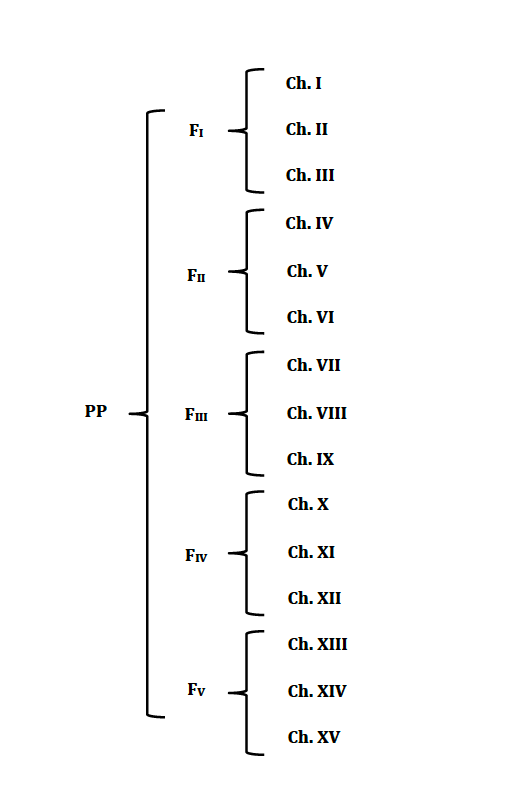
PP {Fi {Ch.I, Ch.II, Ch.III}; Fii {Ch.IV, Ch.V, Ch.VI}; Fiii {Ch.VII, Ch.VIII, Ch.IX}; Fiv {Ch.X, Ch.XI, Ch.XII}; Fv {Ch.XIII, Ch.XIV, Ch.XV}}.Granted, the nodes PP and F in the diagram of Caine’s book are mere empty labels, the content being all contained in the chapters (Ch.), while each node in Quain’s is, according to Borges, a chapter in and of itself, and thus full of content, however imaginary — what it is important to note is the ternary structure of the basal nodes or sets in both books, e.g., Quain’s {V1 {VV1a, VV1b, VV1c}}, and Caine’s {Fi {Ch.I, Ch.II, Ch.III}}. Furthermore, the “experimental condition (or nature)” of Caine’s book may be illustrated by reproducing, first, its table of contents (PP: vii– viii):
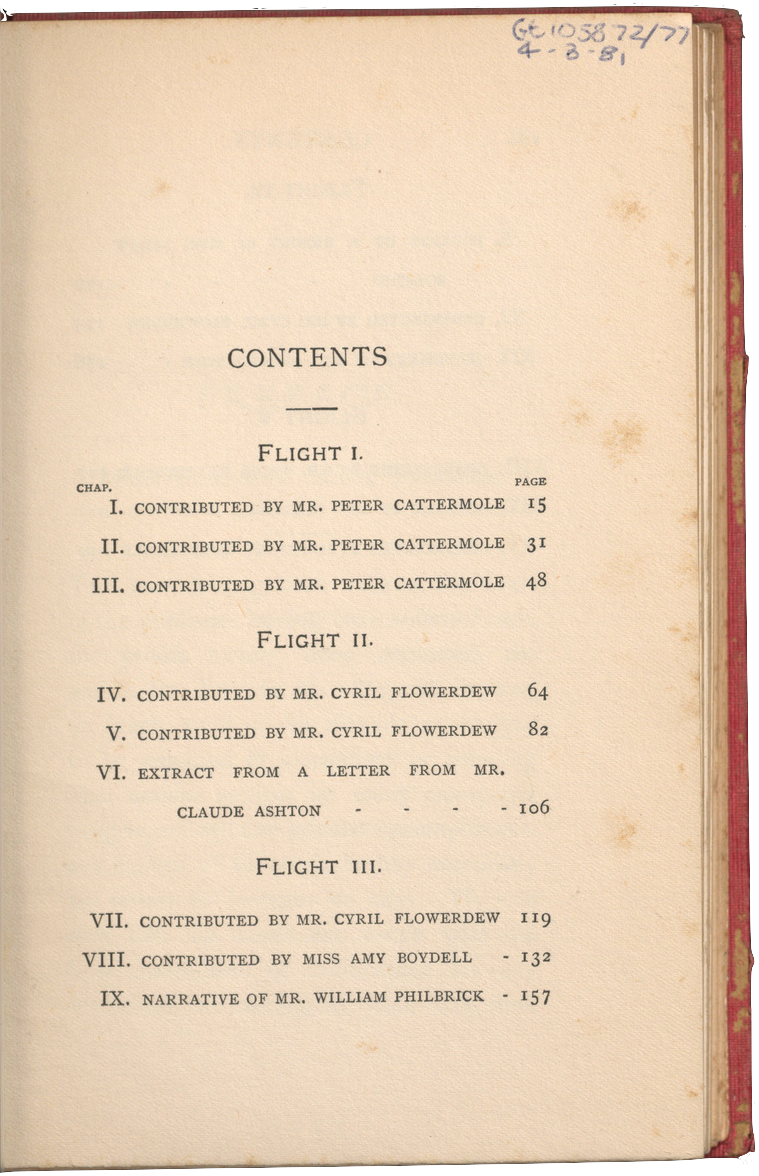
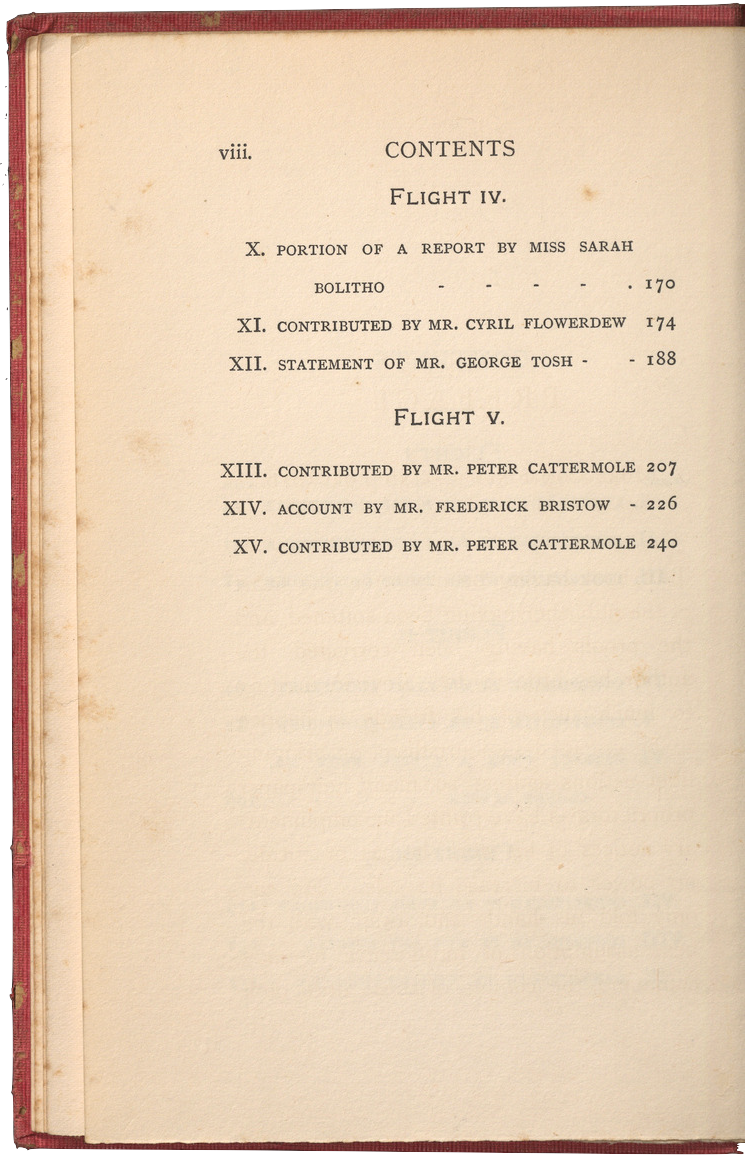
And, second, its “Preface: More Commonly Called Foreword” (PP: 9–14):Flight I.
I. contributed by mr. peter cattermole
II. contributed by mr. peter cattermole
III. contributed by mr. peter cattermole
Flight II.
IV. contributed by mr. cyril flowerdew
V. contributed by mr. cyril flowerdew
VI. extract from a letter from mr. claude ashton
Flight III.
VII. contributed by mr. cyril flowerdew
VIII. contributed by miss amy boydell
IX. narrative of mr. william philbrick
Flight IV.
X. portion of a report by miss sarah bolitho
XI. contributed by mr. cyril flowerdew
XII. statement of mr. george tosh
Flight V.
XIII. contributed by mr. peter cattermole
XIV. account by mr. frederick bristow
XV. contributed by mr. peter cattermole
The book having been written, the heart of the publisher having been softened, and the proofs having been corrected, the author has little to do. Beyond inviting to lunch such of his friends as happen to be engaged in journalism, or bringing libel actions against so many newspaper proprietors as having printed uncomplimentary notices of his work, he has practically no power to increase its sale. He can only fold his hands and await, with the best assumption of indifference he may command, the coming of those little pink slips which will report what men say of him.I’ve already noted that Borges claims that the first chapter of Quain’s April March recounts “el ambiguo diálogo de unos desconocidos en un andén | the ambiguous dialogue of some strangers on a railway platform.” The first chapter of Caine’s The Revolt at Roskelly’s also starts out with a dialogue on a railway platform. Unfortunately for the sake of a possibly neat parallel, however, the characters are not quite unknown to each other, nor is the dialogue very ambiguous:The author, as is well known, does not write for bread, but for Fame, for Art, for the joy of Creation. But even to those of us who nourish the highest ideals, there may come at times (for are we not men?) a craving for a little money, a little comfort, a good dinner, a finer shirt. And so, though we had rather die than own it, the criticisms which the Press-cutting agencies send us are read with an interest that is not wholly contemptuous.
But in the case of this book, the critics, as far as I am concerned, may whet their knives as they please. It is all one to William.
For I say here plainly that, as public acclamation will not cock my tail, so the world’s frown will leave my withers unwrung. This I say partly because I do not mind mixing my metaphors, but more surely because, in respect of this book, the only responsibility I assume is that of placing the contributions of my assistants in proper chronological order and, I think in two cases only, deleting material which did not seem likely to prove acceptable. Like many more famous authors, I have got others to write my book for me, but, unlike them, I am not generous enough to conceal the fact. I do not feel that my name has been before the public so long that I can afford to allow it to be used as a shield for the mistakes of anonymous apprentices.
At the head, therefore, of every chapter will be found the name of the person who has written it.
The advantages of the method of authorship which I have mentioned are obvious, but its drawbacks are not a few. And among these may be noticed the impossibility of persuading the writers to keep to the point. This book purports to describe one particular battle of a glorious campaign, and I have vainly attempted to get my contributors to confine their attention to such of the incidents as came immediately beneath their notice. They have preferred, in many cases, to indulge their verbosity in other directions.
Mr. Flowerdew, for example, has not scrupled to devote several paragraphs to an account of his insipid career at Oxford; which, as it does not seem to have afforded himself any interest, can hardly be expected to excite that of the general public. The emotions, moreover, which Miss Boydell aroused in his bosom, are recorded with merciless fidelity (it is here, chiefly, that the editorial shears have come into action) and his taste in clothes is displayed, surely, more than can be desired.
Mr. Philbrick, again, has found occasion to import into his chapter an expression of some of those contemptuous sentiments which he holds towards every section of our Legislative Assembly. These are merely rude and unnecessary.
Mr. Cattermole has done better, but even he has wasted much space over the progress of his own love-affairs. Happily that nauseous business of love-making does not bulk very large in the volume. But Mr. Cattermole’s share of it is done with despatch, and that is the best that can be said of a matter which is almost wholly extraneous to the development of the main theme.
Miss Bolitho is the only one of them who has dealt faithfully with me, but her telegraphic style makes such painful reading (though she carries us along unswervingly, and at a good pace) that I have been obliged to cut her story much shorter than she originally made it.
Mr. Tosh’s account I have left as it is, though its many faults of spelling and grammatical construction leave me open to the charge of careless editing. The footnote, however, upon page 188 will serve, I hope, to acquit me of this crime.
On the correctness of the French in Chapter XV. Mr. Cattermole has staked his reputation as a linguist. I am bound in fairness to the public to say that this reputation had not previously travelled so far as myself.
William Caine.
London, 1906.
A little wind like steel came out of the northeast and stabbed at the back of Hindlip’s neck. He turned up his great sable collar.Wind : Wynd : May Wynne : Wemiss-Wanklyn : Eric Winstanley (the first character one meets in Caine’s Drones): Walker : Ulrica — I should probably mention here that in subsequent versions of “Examen de la obra de Herbert Quain,” Borges changes Miss Ulrica Wynd, first, to Miss Barbara Wynd in El jardín de senderos que se bifurcan (1941/1942), then to Miss Ulrica Thrale in Ficciones (1944) and all subsequent editions and translations thereof. Likewise, her father, General Wynd, C.I.E., becomes General Thrale, C.I.E. (Fernández Ferrer 2009: 75, 190, 379). Of course, my case — if it is indeed a case at all — does not hang on, for instance, noticing the proximity of May Wynne and William Caine in advertisements on the covers of The Tatler and The Sketch; that is simply an exercise in observation which, if I had started out with the version of “Examen de la obra de Herbert Quain” in Ficciones, I would not have had the pleasure of indulging in. Similarly, at the end of his piece, Borges claims to have “committed the naivety of extracting | cometí la ingenuidad de extraer” from the third story of Quain’s Statements, his own story, Las ruinas circulares. Readers of all versions of “Examen de la obra de Herbert Quain” since El jardín de senderos que se bifurcan (1941/1942) know that the third story of Quain’s Statements is entitled The Rose of Yesterday; in the original, it is Dim swords. What are “dim swords”? I don’t know, but a full text search for “dim swords” in the Internet Archive leads me to a stanza in “The Lay of Yvenec” included in a book entitled Lays of France (Founded on the Lays of Marie):“Come and tread about, Mr. Norton,” said Mrs. Hindlip to George. “We’ve got hours to wait.”
“No,” said Hindlip peevishly. “Twenty minutes. That’s quite enough, Brenda, I should hope.” His wife’s exaggerated way of speaking always irritated Hindlip and, when he was out of temper, he didn’t care who knew it. At the moment he was more than usually out of temper because, an hour earlier, he had lost a sovereign to Benson by a foozle at the last hole. “Confound that club clock!” he said. “Twenty dashed minutes on this rotten little platform! And freezing! And I’m in a perspiration, tearing down here in this heavy coat. It’s enough to kill me.”
“There’s a fire in the waiting room,” said Benson. “Go in there.”
“Stuffy hole,” growled Hindlip. “I’d be poisoned.”
“Well,” Mrs. Hindlip announced. “I’m going to walk. Come on, Mr. Norton.” She departed with George up the platform, stamping her small feet vigorously.
“Energy,” observed Benson jocularly, “thy name is Mrs. Hindlip!” Benson was in a good temper. He liked winning sovereigns.
Hindlip ignored him. “That dashed axle!” he said.
The particular axle that he dashed belonged to his motor-car. By breaking it had forced Hindlip to go to his golf by railway, and (conspiring, no doubt, with the club clock) had now given him twenty minutes to wait, on the draughty platform of Treharrack Station, for the train by which he would get back to St. Mithian. Waiting was among the innumerable things which Hindlip hated more than anything else. Therefore he cursed that axle.
It pained Benson to feel on anything but the best of terms with Hindlip, who was one of the Rutlandshire Hindlips. He provided oil for Hindlip’s wounds.
“I expect,” he said, “the new one will be in this train.”
“I expect it won’t,” said Hindlip.
Undismayed, Benson observed that it was a pleasant change after the muggy weather they’d been having. “It looks like frost,” he said, glancing upwards at the spangled heavens.
“I tell you it is freezing,” said Hindlip.
Benson could have sworn it wasn’t, but it was never his policy to anger men of family. He desisted from his amiabilities and began to hum a little thing of Fragson’s. Presently Hindlip said “Tchah!” violently and strode into the waiting-room. Benson thanked goodness that when he lost a trifle of money he could manage to keep his temper. For a few moments he nursed bitter thoughts against Hindlip. Then he brightened up.
George Norton and Mrs. Hindlip were approaching him, on their return from the signal-cabin. Benson made ready to join their promenade. They came to within ten yards of him. Then they wheeled abruptly round and began their second journey up the platform. Benson began to think hardly of Mrs. Hindlip. He was convinced that he had seen her pull Norton round by the arm.
“Infernal rude, that was,” he thought. “Amazing rude little woman, that. Arrogant little beast she is. Gets it from that mother of hers. A Champney. Insolent lot, that!” (RR-G: 7–9; RR-P: 1–3).
The Lays of France (Founded on the Lays of Marie) was published in London by Ellis and Green in 1872. It is stated on the title page to be “by” Arthur W. E. O’Shaughnessy. The name O’Shaughnessy, naturally, takes me back to “The Bridge Cipher” chapter from Caine’s Pilkington which I delineated above. Furthermore, what is the title of the first lay of the book? “Laustic; or, The Lay of the Nightingale.” This evocative little sidetrack would have been overlooked if I had started out with The Rose of Yesterday. Of course, this title also leads me along an interesting path of coincidence.It was the midnight. His last look
Was fading in the fervid gloom;
And many an aching echo shook
The pauses, moving like a moan;
And dying words’ sad monotone
Lasted about the silent room.
She was alone with all her doom;
But knew not yet she was alone;
For all these things, the looks, the words,
Thronged at her heart, foiling dim swords
That stood inevitable, keeping
A short space charmed with the slow heaping
Of thought, rich with each lingering sound, —
Ere all fell sickened into weeping
And the whole bitterness were found (O’Shaughnessy 1872: 288–289).
The preceding poem would have made an excellent transition to the next section, which largely concerns itself with “The Rose of Arlington,” as Edith Gordon Walker was supposedly called by “her friends and admirers.” Unfortunately for the sake of structure, however, I still have a little more to say about that “ambiguo diálogo de unos desconocidos en un andén.” Like Quain’s April March and Caine’s The Revolt at Roskelly’s, the latter’s But She Meant Well also opens with an atmosphere of turbid strangeness on a railway platform:A ROSE OF YESTERDAY.
They made her Freshman president;
She rowed upon the crew;
She scored the highest at the links;
Was tennis champion too.
She did not, as a Sophomore,
Quite vanish from the scene,
For stories from her pen appeared
In each month's Magazine.
Her first forensic was a joy;
Her second was a dream;
In Calculus she was not coy;
In Greek she was supreme.
Her Senior brain was wont to soar
In deep Philosophy;
Her daily schemes but made her more
Beloved of Faculty.
And when she left these classic halls,
That rang aloud her praise,
She did not doubt that soon her name
Upon the skies would blaze.
But we, who thought this prodigy
Could never fame escape,
Have heard, quite incidentally,
That now she teaches A B C
At Crowville, on the Cape.
Hannah, fast gripping some of her pretty young mother’s fingers, stood by the bookstall. Her large grey eyes were very much opened, for the big railway-station was making a strong impression upon her; never in all her five years had she been in such an exciting place. It puzzled her very much to imagine why everybody had to rush about so violently. The loudness with which they all spoke to one another alarmed her. […]I also still have more to say about Borges’s statement that he “committed the naivety of extracting” one of his stories from one of Quain’s. While the plot or texture (as the word trama may also be translated) of Las ruinas circulares — a man trying to dream, from indistinct generality to specific individuality, a man into being; ultimately discovering, or intuiting, that his own life has been but some other man’s dream — seems more similar to the opening and closing of Raymond Queneau’s first novel, Le Chiendent (1933 — the same year, by the way, that Quain published his first novel, The god of the labyrinth, and Stein published her Autobiography of Alice B. Toklas; note also the onomastico-phonetic similarity of Queneau to Quain and Caine, especially for an Anglo-Hispanophone), than it does to any story of Caine’s I’ve been able to read, there is a story contained in Caine’s 1917 collection, The Fan, which may not be entirely irrelevant. Having rushed “through rain and slush” (F: 125) to the train station from some provincial County Asylum where he’d had Sunday lunch and afternoon tea with his friend Dr. Hume (the person in charge of the establishment), the unnamed first-person narrator (a persona of Caine’s, one assumes) of “A Prolific Genius” is irritated to find that the train he wants has been delayed for forty minutes and soA train, which had been standing not far away from them, began to move, and as Hannah watched it breathlessly a little old gentleman, wearing a top hat and a white waistcoat, came tearing past her, waving his arms and shouting “Stop! Stop!” Hannah drew her mother’s attention to this, because she wished her mother to be as much amused as she was. Several men shouted, “Stand back, there! Stand back!” but the old gentleman took no notice of them, and held on towards the train. Hannah saw a big man in a curious cap and with silver buttons on him stooping down right in the old gentleman’s way; his arms were spread wide apart and he had a terrible look on his face. Next moment the little old gentleman was fast in the arms of the big man and lifted right up from the ground. He ceased to cry “Stop! Stop!” and shouted lots of other things which Hannah didn’t understand, and he struggled dreadfully and his hat fell off and rolled under the train. Some people called, “Well held!” and others, “Hurrah!” and others, “Shame!” and nearly everybody laughed. The old gentleman was one of those who didn’t laugh. Hannah was one of those who did. She was delighted with what had happened and begged her mother to tell him to do it again. She clapped her hands and danced about for glee and the little old gentleman gave her a horrid look as he crammed his hat on his head and went away. A porter had got it for him and it was all spoilt. Hannah asked her mother who the old gentleman was, and her mother said his name was Bill Bailey and a young man standing near laughed and said, “Good old Bill.” Then Hannah’s mother became stiff all over, and she spoke very sharply to no one in particular. Then she stooped down and retied the strings of Hannah’s bonnet. The young man went away. Hannah was sorry; he had looked so friendly. She tried to gaze after him in regret, but her mother jerked her face round and nearly strangled her, and called her a saucy young fool. This puzzled Hannah (BSMW: 9–12).
I went into the waiting room, where I found a fire, and, taking from my pocket the magazine which Hume had given me, I began to look through it in the hope of discovering a story from which I could extract an idea I might myself work up into a story which I might sell to another magazine.The stranger encountered one Sunday evening by the unnamed narrator not exactly on a railway platform, but not far from it, in the station waiting room, proceeds to justify the “gravity” of his “statement” by recounting how he came to be the ghost writer not only for Iglesias, but also for more famous writers; on page 141, for instance, he states: “Sherlock has been one of my most profitable inspirations.” At the end of the story, of course, “the prolific genius” turns out to be an inmate escaped from the asylum nearby:Five minutes later a man came in, shut the door, and sat down by the other side of the fire.
By this time my wrath had died out and I was in the middle of a story. It had already given me an idea, and I wished to know if this was the idea which had been in the mind of its author or not. If not, I thought I saw my way to making a little money.
I was very much annoyed, therefore, when the newcomer said in the voice of one who intends to converse —
“You have there a copy of ‘Mitford’s.’”
I said: “A circumstance, sir, which has not escaped my observation”; and I thought: “That settles you.”
I was wrong. He rose and came up behind me, looked over my shoulder, and announced: “You are reading a story by Iglesias.”
To this I made no reply.
“Are you enjoying it?” he asked amiably.
At the risk of rudeness, I resolved to show this importunate that I did not covet his society.
Therefore I said: “I am enjoying it so much that any alternative to its perusal seems positively nauseous to me.”
This was not quite true, for the story by Iglesias was not in his best vein. But against a bore all weapons are justifiable.
“I am glad,” he said. “You do not ask why?”
“No,” I replied, and turned the page.
“I will tell you,” he said. “It is because I wrote that story.”
This caused me to look at him. I found him shrunken, pale, bearded, much too small for his ulster, not in the least like Iglesias, with whose features I am, like the rest of England, perfectly familiar. Iglesias, moreover, is a man who always fills his clothes exquisitely.
I turned back to “Mitford’s,” to the section devoted to the portraits and biographies of the contributors to the current number. I put my finger under the picture of Iglesias.
It represented a monstrous man with a round, rosy, clean-shaven face, dressed in riding-breeches, gaiters, and a flowing coat of check tweed. Beside him stood his favourite hunter. Underneath was printed: “Mr. Iglesias, who weighs eighteen stone three, is, in more sense than one, a Great Horseman.”
I said: “I cannot understand why I did not recognize you earlier.”
“Oh,” he replied, “I didn’t say that I am Iglesias. I only said that I wrote his story. I write, indeed, all his stories.”
“I suppose,” said I, “that you do not quite realize the gravity of that statement.”
“On the contrary,” said he. “I was never more serious in my life. Let me tell you all about it.”
It occurred to me that I might more readily make money by listening to this original than by continuing to read the story by Iglesias. Therefore I said: “By all means,” and laid Mitford’s on the table.
My companion resumed his seat and began at once (F: 126–128).
At this moment the door opened and Hume appeared.I don’t think I need any more justification than the foregoing to reiterate, and cast, thus, in a slightly different light, what Borges writes in the last paragraph of his study of the work of Herbert Quain:“Brown,” he said sternly, “come back at once.”
I prepared myself for a tragedy. “Be careful, Hume,” I cried. “He’s armed!”
“Tush!” said Hume. “He always says he’s armed. But he isn’t. Are you coming, Brown?” The forms of three males nurses appeared in the doorway behind the doctor.
“Certainly, Dr. Hume,” said Mr. Brown. “Certainly. I suppose you won’t allow me to go up to town?”
“No,” said Hume.
“And I did so want to murder that Arnold Bennett,” said Mr. Brown with a sigh. “He’s been late with his tribute again.”
“It must be for another time, Brown,” said Hume.
“Very good, Dr. Hume.” Mr. Brown rose and passed out into the night.
“Sorry for this,” said Hume. “Hope he hasn’t scared you?”
“Not at all,” said I. “He’s been telling me how he writes the stories of Iglesias. I expect he’s scared you, though.”
“A little,” he confessed, “though he’s as harmless as a bat. So it was Iglesias that betrayed him this evening. When he came to us first it was Grant Allen. But he gives them all a turn.”
“Can you,” I said, “explain this Mr. Brown at all?”
“Magazine stories,” he said. “He read them all the time. Finally he came to the conclusion that anybody can write them. And he tried. He tried for three years. At last one of his things was printed, with the result that you have seen. Well. I must take him down the road. Night, night.” Hume disappeared.
Shortly afterwards the train arrived and carried me from the scene of this adventure.
But what a desirable mania! (F: 143–144).
A fines de 1939 publicó Statements: acaso el más original de sus libros, sin duda el menos alabado y el más secreto. Quain solía argumentar que los lectores eran una especie ya extinta. No hay europeo (razonaba) que no sea un escritor, en potencia o en acto. Afirmaba también que de las diversas felicidades que puede ministrar la literatura, la más alta era la invención. Ya que no todos son capaces de esa felicidad, muchos habrán de contentarse con simulacros. Para esos “imperfectos escritores”, cuyo nombre es legión, Quain redactó los ocho relatos del libro Statements. Cada uno de ellos prefigura o promete un buen argumento, finalmente frustrado por el autor. Alguno — no el mejor — insinúa dos argumentos. El lector, distraído por la vanidad, cree haberlos inventado. Del tercero, Dim swords, yo cometí la ingenuidad de extraer Las ruinas circulares, que vió la luz en el número 75 de Sur | At the end of 1939 he published Statements: perhaps the most original of his books, doubtless the least praised and most secret. Quain used to argue that readers were a species already extinct. There is no European (he would reason) who is not a writer, in potential or in act. He also affirmed that of the diverse satisfactions which literature can provide, the highest was invention. Since not everyone is capable of this satisfaction, many must content themselves with simulacra. For these “imperfect writers,” whose number is legion, Quain drafted the eight stories of the book Statements. Each one of them prefigures or promises a good idea [or: argument; or: plot], in the end frustrated by the author. Some [or: one of them] — not the best — hints at two ideas [or: arguments; or: plots]. The reader, distracted by vanity, thinks he has invented them. From the third, Dim swords, I committed the naivety of extracting The circular ruins, which appeared in issue 75 of Sur (Borges 1941: 48).I wish I could say here that Caine’s The Fan contains the same number of stories as Quain’s Statements, 8; alas, it contains 18. The first eight episodes of Caine’s Pilkington, however, correspond to the book’s first eight chapters; yet, again alas, the ninth and last episode is told over the course of three chapters, for a total of eleven. Yet, perhaps with a bit a of numerological juggling… I wish also I could find an algorithm to link up Quain’s having written to Borges “from Longford on the sixth of March, 1939,” with Caine’s father having been born “at Egremont, in the parish of Wallasey, Cheshire” (Newton 1907: 1) on the twenty-sixth of March, 1842 — but I can’t. So, in other words, do I think that Caine is the invisible center of the plot or texture of Borges’s “examination” of Quain? Rather, what the singular nexus of coincidences as glimpsed and gleaned through the lens of Borges’s Quain is getting at can be simply stated using phrasing I’ve already employed for the cases of Christina Hendrie, daughter of the Haggis King, and Emily Snyder, daughter of a retired music hall strongman, to wit: Just as Miss Ulrica Wynd (or Thrale) is the invisible center of the plot of Quain’s The secret mirror, so too is Mrs. Edith Gordon Caine (née Walker) the relatively visible center (as will become evident in the following chapters) of the textures and plots of an almost invisible author’s, William Caine’s, life and work — and, thus, this project. However, were I to speculate about any sort of “influence” Caine may have had on Borges, I could try to argue that, since Caine was far from being an obscure writer during the years 1910–1925, Borges likely encountered at least a brief notice or two of his works in, say, the Times Literary Supplement, sometime during his sojourn in Geneva (1914–1919) or Spain (1919–1921) or during the late summer of 1923 to the spring of 1924 when he was in London, Geneva, Spain, and Portugal before returning again to Buenos Aires.
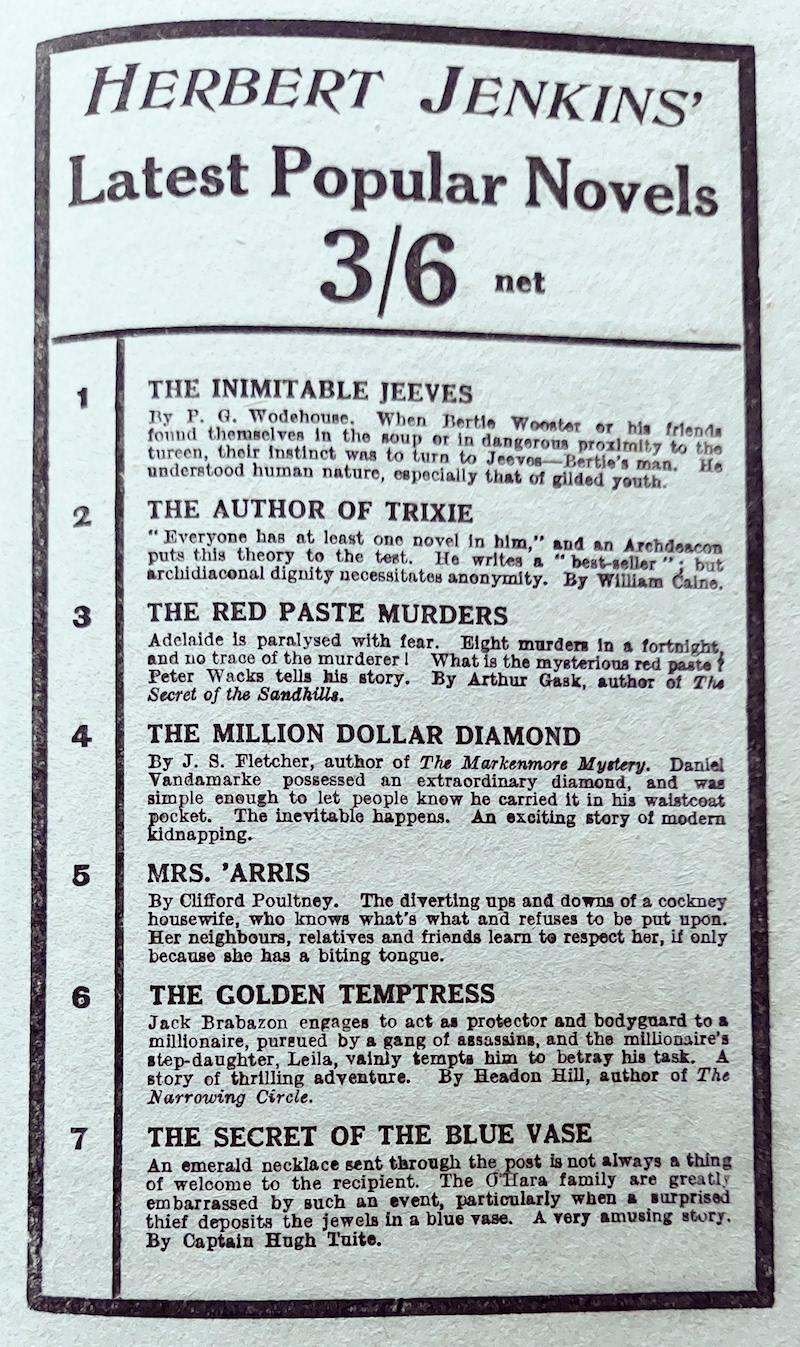
Combien il est difficile — et combien il serait intéressant — quand on étudie un écrivain, de déceler non pas les influences avouées, les grands intercesseurs dont il se réclame, ou qu’on réclamera plus tard pour lui, mais le tout-venant habituel de ses lectures de jeunesse, le tuf dont s’est nourrie au jour le jour, pêle-mêle et au petit bonheur, une adolescence littéraire affamée: premiers Paris des quotidiens, revues désuètes, auteurs ensevelis que faisait alors verdir un instant, comme une ondée, le goût-du-jour, pièces de boulevard, brûlots parisiens, livraisons du Magasin des familles, pamphlets depuis longtemps montés en graine. Le seul écrivain du passé qui nous dise là-dessus par grande exception quelque chose, c’est Stendhal (surtout, il est vrai, pour ses nourritures musicales). La boulimie de lecture caractéristique de l’adolescent, ou de l’étudiant qui va écrire, pareille à celle du ver à soie avant la chrysalide, est telle que la quantité obligatoirement l’emporte sur la qualité: plus impérieux son appétit, plus faible l’écart, pour son goût, entre les nourritures vraiment choisies et celles qui bientôt seront dédaignées lucidement. Qui est destiné à écrire, il y a un moment — moment décisif pour sa formation — où il lit tout, ou presque, et «tout» c’est d’abord ce qu’il a sous la main, ce dont «on parle», ce qui sent encore l’encre fraîche, qui lui fait le même effet qu’au guerrier la poudre. L’œil vorace qui se colle à la page fraîchement imprimée ne dégage nullement, à dix-huit ans, à vingt ans, un paysage littéraire perspectif avec ses premiers et seconds plans, et ses lointains fondus, mais un bariolage, un à plat juxtaposé de couleurs heurtées et violentes, qui toutes accrochent un rétine encore toute neuve.Since the process is unconscious, it does not involve “les influences avouées” by the writer, nor can it be “proved” by any sort of literal historico-critical argument. It can only be hinted at or uncovered by the sort of reading I’m doing here — which, by the way, is exactly the sort that Borges is doing in a piece cognate with his examination of Quain’s opus, “Kafka y sus precursores” — by noticing (inventing, manufacturing) coincidences (correspondences, “rhymes”) between the fictitious books of Quain and the real books of Caine — and even if there’s no way to confirm or refute if these actually are or are not the real traces of Borge’s “boulimie de lecture,” of that “tuf dont s’est nourrie [son] adolescence littéraire affamée,” they are, at least, potentially possible, and, I hope, interesting. And what better way to excuse the extensive quotations therefrom? For instance (to add one more, not quite the last): There is the rhyme involving Iglesias as the rather “heavy horseman” in Caine’s “A Prolific Genius” quoted above and Quain’s Miss Ulrica Wynd as a “haughty horsewoman” (amazona y altiva). What rhymes even better with the latter, however, is the opening of Lady Sheba’s Last Stunt:Ce tout-venant où il a barboté s’évaporera-t-il pour l’écrivain sans laisser de traces? Ce n’est pas sûr, car c’est à ce moment de la crue des eaux printanières, des eaux mêlées, qu’il a aussi essayé, commencé peu ou prou d’écrire: les tics d’époque, dont il a subi la contagion naïvement et sans défense, laisseront une marque sur sa manière d’écrire, remodelés toujours, souvent ennoblis, et parfois, s’il a du génie, sauvés: Proust, dont on soupçonne qu’entre tous les écrivains peut-être il a lu très jeune considérablement plus de médiocre que de bon, est plein de ces rédemptions-là. De telle lectures, profondément incorporées dans les automatismes commençants de la plume, sont peut-être un peu pour la manière d’écrire ce que sont les impressions d’enfance pour la couleur, pour l’orient de la sensibilité: non choisies, souvent banales, toujours reprises et magnifiées par la maîtrise acquise des ressources de la langue, comme les lointains incohérents de l’enfance par la chimie savante du souvenir. Et il y a une énigme de la continuité, du fondu étrange de la littérature d’une période à l’autre par-delà toutes les révolutions et toutes les ruptures qui peut-être s’éclaire là partiellement: par le fait que l’écrivain en formation se nourrit toujours inséparablement, inextricablement, à la fois de la nouveauté pure, qui l’atteint par son extrême pointe, et de ce qui s’écrit et se publie autour de lui au goût du moment: c’est-à-dire de la continuité maintenue avec avant-hier (Gracq 1980: 160–162; italics in original).
Lady Sheba Sangsue leapt into public notice, at the age of seventeen, by damning the skin of the Master of the Quorn. What the miserable man had done is of no importance. It is only material for you to know that he did it out hunting. If he had done it at dinner or while dancing or in the sea, the incident would have passed unnoticed. But when the Master of the Quorn’s skin is damned while he is in the exercise of his masterly functions it makes talk, I promise you.Need I point out that The Prattler, The Looker On and The Brouillon are tongue-in-cheek allusions to The Tatler, The Bystander and The Sketch? Or that “The Morning Terror [aka The Morning Leader] had half a column about her and the Master” just as the Times Literary Supplement had half a column of “necrological piety” about Herbert Quain? By the way, on the recto of a half-page article in The Graphic of November 23, 1912, entitled “The Secret of the Novelist’s Workshop,” published about a month after Caine’s Hoffman’s Chance appeared, there is an image (a painting or retouched photograph) of a haughty young horsewoman of about seventeen, “dressed for fox-chasing,” beneath a panoramic photograph of said activity (see image, above right). Unfortunately, I do not know the page number, and I only have half the page, since the collector (or previous owner) from whom I bought the page for some reason cut the page in half and excised the number (and the British Newspaper Archive does not have digital exemplars of The Graphic for the years 1912 and 1913).Hitherto Lady Sheba had been known to the readers of The Prattler, The Looker On and The Brouillon alone, and to them simply as the third daughter of the Earl of Boyze. For seventeen years her photographs — at first with her mother, then with her sisters and then alone — had appeared pretty regularly in the pages of those periodicals, whose readers had marked, possibly with satisfaction, that the exquisite promise of her childhood was being fulfilled; in other words, that she was turning out a bonny lass.
Now she had obtained a wider public. The Morning Terror had half a column about her and the Master, with a picture of her on the front page, dressed for fox-chasing, seated astride of a monstrous black horse and showing her teeth to the camera. There could be no doubt that it was Lady Sheba because it said so underneath (LSLS: 9–10).
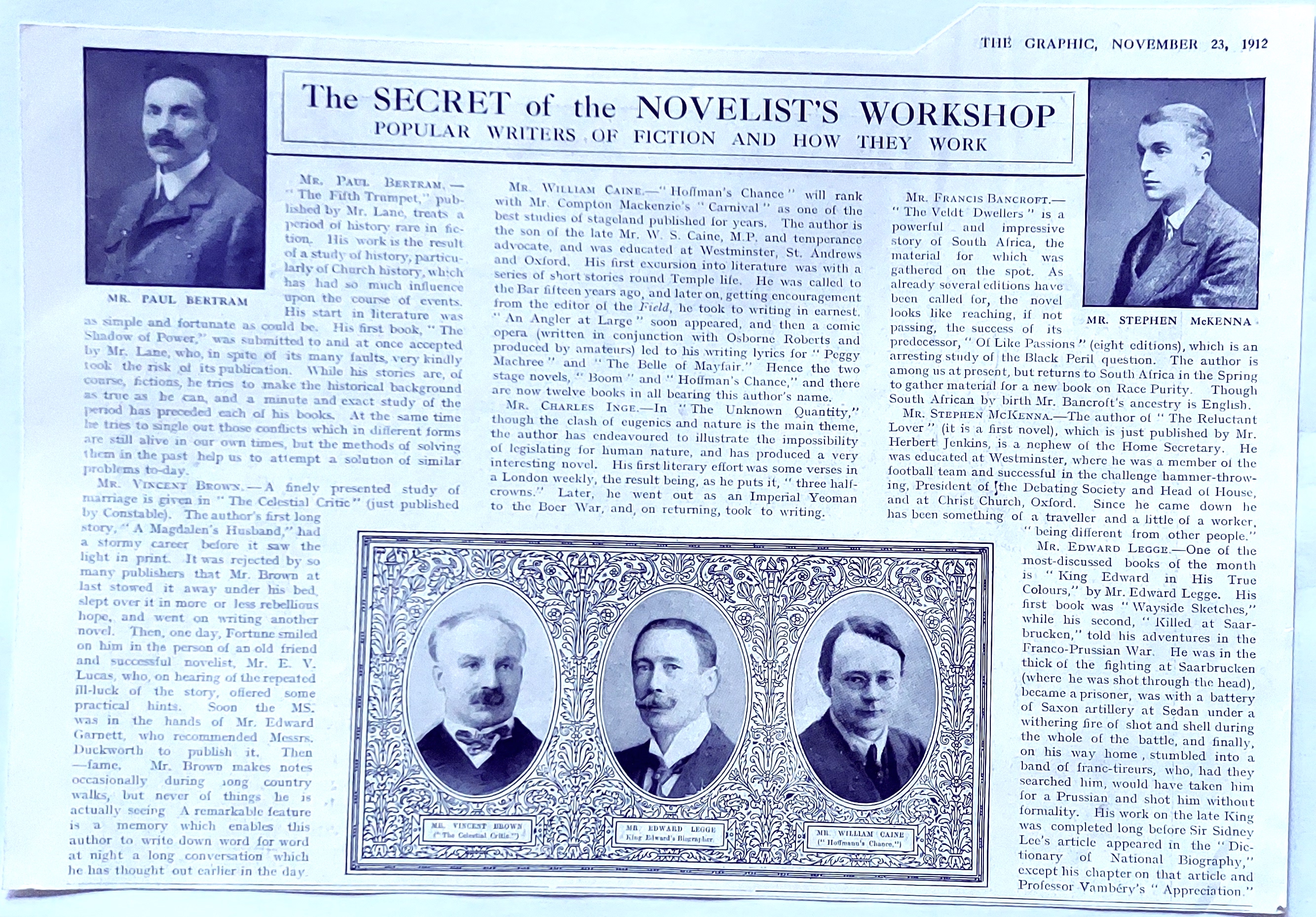
“Hoffman’s Chance” will rank with Mr. Compton Mackenzie’s “Carnival” as one of the best studies of stageland published for years. The author is the son of the late Mr. W. S. Caine, M.P. and temperance advocate, and was educated at Westminster, St. Andrews and Oxford. His first excursion into literature was with a series of short stories round Temple life. He was called to the Bar fifteen years ago, and later on, getting encouragement from the editor of the Field, he took to writing in earnest. “An Angler at Large” soon appeared, and then [sic] a comic opera (written in conjunction with Osborne Roberts and produced by amateurs) led to his writing lyrics for “Peggy Machree” and “The Belle of Mayfair.” Hence the two stage novels, “Boom” and “Hoffman’s Chance,” and there are now twelve books in all bearing the author’s name (“The Secret of the Novelist’s Workshop; Popular Writers of Fiction and How They Work,” The Graphic, November 23, 1912, p. unknown).Despite his German-sounding name, Michael Hoffman of Caine’s novel is an English composer from Lewes, though his father, like Caine’s collaborator on Peggy Machree, Henri Hirchmann, was French. Hirchmann was also Jewish, which brings me to that “Jewish-Irish boarding house” in which Quigley, “author of the first act” of Quain’s The secret mirror, lives, and which he has “transfigured and magnified” into “an unlikely or improbable ‘country house.’” Borges is ambiguous as to whether the boarding house is run by Irish Jews or whether Quain’s Quigley, being one of its inhabitants, is Judeo-Irish. Moreover, in the rest of Borge’s description of Quain’s The secret mirror, or anywhere else in his examen, no reason seems to be given as to why the “pensión” need necessarily be “judeo-irlandesa” — I would think that the most common reading is as some sort of allusion to Joyce’s Ulysses — and the only rhymes I can find for it in Caine are rather slant. For instance, in chapter XXVII of The Devil in Solution, there is a passing joke about the fad for setting novels or plays in boarding houses:
Ultimately everything was arranged. Henley was chosen for the embarkation. The journey down was to be made by motor-car and they were all to start from the Bognors’ hotel at half-past ten.In Three’s a Crowd, April March — I mean, Doll March finds herself with very limited means after leaving her husband, and, accustomed as she is to staying in only the finest hotels, is entirely at a loss as to how to find a hotel in London which she can afford. She is guided by a young woman met by chance (but who is actually an employee of a private detective agency hired to find her) to Lothinga’s Hotel, run by a Jewish woman named Mrs. Lothinga (TC: 410–428). In The Strangeness of Noel Carton, there is the house where the deranged title character lives with his Jewish wife, a wife who becomes, in his drug-addled dreams, an anti-Semitic caricature of a “Jewess” (sic) with whom he lives in “a quite unfamiliar house, with Piranesi prints of Rome thick on the walls of the staircase” (SNC-HJ: 91; SNC-P: 84–85). (Piranesi, by the way, is not only an allusion to Thomas De Quincey, but was also an artist “muy de la dilección borgiana” [Fernández Ferrer 2009: 50; Tschudi 2023]; and as Caine would have learned from early in the First Book of Goethe’s Dichtung and Wahrheit, the latter’s father had decorated one of the antechambers of the family’s house with a series of views of Rome, engraved by a few skillful predecessors of Piranesi [“gestochen von einigen geschickten Vorgängern des Piranese”].) Yet no real boarding house; nothing remotely Irish except Carton’s name, which could also be French as much as English — could indeed be Judeo-English, Judeo-French, Judeo-Irish… Perhaps what’s best is to take Quain’s and Caine’s lead and invent my own pensión judeo-irlandesa en que viven such people as:Venner and Lord Mark (who was accompanied by Harry) drove up to the door at precisely the same moment. Lord Mark, in accordance with a promise previously given, had brought out his large eight-hundred-horse-power Cadby car, which was capable of carrying five persons comfortably. Venner, who meant to secure as much as possible of Lady Cerise’s company during the day, had provided himself with a swift racing machine with accommodation for two only. All three young men sprang out together, but it was Lord Mark who first entered the open door of the hotel. Venner arrived a good second [later] and precipitated himself up the stairs in his rival’s wake. Harry, however, lingered a moment apparently to examine the interior machinery of the racer and then, with a satisfied smile, followed the others into the boarding hou — into the hotel (DS: 233–234).
Claudia Lasell, an American actress trained in Paris playing the lead in an Irish play with music, Peggy Machree, written by another American (or Irish?) woman, Elizabeth Curtis O’Sullivan, posing as an Irishman, Patrick Bidwell, composed by an Italian living in Dublin, Michele Esposito, transformed into a comic opera by an Englishman of distant Manx ancestry, William Caine, with new music by Canadian composer Clarence Lucas and French composer Henri Hirchmann (spelled “Hirschmann” in The Jewish Encyclopedia)…Of course, the obvious reason for Borges’s pensión judeo-irlandesa is that it amalgamates in one house two famously oppressed peoples… Apropos: Around the time Caine and Hirchmann were likely putting the finishing touches on their lyrics for Peggy Machree, an article about the “revival of Jew-baiting in various parts of Russia” appeared in The Penny Illustrated Paper of July 8, 1905. Bearing the dateline, “St. Petersburg, July 1,” and signed “Sergius Volkhovsky,” the article stated that “this concerted outbreak of anti-Semitism” had been going on since the end of April of that year and was “instigated by agitators who came from St. Petersburg and were actively supported by the local authorities,” the chief instigator of the agitators being
General Trepoff, who, although nominally nothing more than Governor General of St. Petersburg, is really the most powerful man in Russia. General Trepoff considers that it is good policy on the part of the Russian Government to encourage active Jew-baiting among the Russian people in order to withdraw popular attention from domestic affairs and from the collapse of the Russian army and navy in the Far East. General Trepoff believes that, if the Russian populace, so to speak, lets off steam by massacring and bludgeoning the Jews, they will be less inclined to be discontented with the conduct of the war and with the domestic policy of the Government.Although mainly detailing the attacks on Jews in Jitomir (capital of the Volhynia Governorate and birthplace of Joseph Conrad), “Murdering Jews to Keep Russian Peasants Busy” also touches on some of the “horrors elsewhere:”
At Kisslowodsk, a village in the vicinity of Wlodawa, in the province of Siedlce, one of the most barbarous crimes was perpetrated. In this village there was only one Jewish family, consisting of father, mother, one girl aged nineteen, and one boy aged seventeen. When anti-Semitic riots began in Wlodawa the inhabitants of Kisslowodsk felt the necessity of arranging their own display of Jew-baiting, and selected their only Jewish family as their natural victims. Hearing rumours of impending attack, this family, named Hirschmann, barricaded itself in its own cottage by placing shutters held by iron bars before the windows, and piling furniture against the doors.Given the details of the above account — “piling furniture against the doors;” “the village butcher exclaimed,” “the idea was received with enthusiasm,” etc. — as well as the fact that the only Kisslowodsk (Kislovodsk) I’ve been able to find is a spa town in the Caucasus, while Wlodawa (Włodawa) and Siedlce lie far to the west on the eastern border of what’s now Poland, it’s possible that Volkhovsky’s report is a combined fictionalized epitome of those “horrors elsewhere.” It’s also possible, however, that Kisslowodsk was indeed a village in the Siedlce Governorate too small to be included on any map, and that, by annihilating “their only Jewish family,” the villagers also annihilated their own chorographical futurity. The immolation of Jews named Hirschmann unfortunately did not stop there. When Peggy Machree as revised by Caine, Hirchmann, and Lucas was playing, September 4–9, 1905, at the Prince’s Theatre in Manchester (where it had played, in its original form, at the Queen’s Theatre, November 21–26, 1904), the front page of the Daily Express of Thursday, September 7, contained a report of the “anti-Semitic riots at Kertch, in the Crimea,” where “the two-year-old son of a Jewish tradesman named Hirschmann” was thrown “into a bonfire made of Hirschmann’s own furniture. The child was burned alive before its parents’ eyes.” Now, Caine never portrayed such gruesomeness in his novels — not uncommonly because chance conspired to avoid it. For instance, in But She Meant Well, when Hannah’s turning on all the taps in the house puts the boiler at risk of blowing up, “the gravest horrors with which the situation was pregnant” are narrowly averted because Reginald Sterne, despite being a poet, is smart enough, and fortunate enough, to act in time. Caine, thus, has “no tragedy to record” (see § 6). He did, however, record, and ridicule, various sorts of prejudices which could be considered the seeds of such outrages, such horrors, culminating, perhaps, in The Strangeness of Noel Carton where, by charting the tragic unravelling of the title character, Caine portrays the intensities of hatred, resentment, warped imagination, and delusional rationalizations driving the bigot to commit murder — haply averted, in the end, thanks to the maid’s screams.Almost all the inhabitants of the village, headed by their elders, and accompanied by women and children, came in a body to bait the Hirschmanns. Finding that their intention of attacking had been betrayed, and that the cottage was already barred, the mob withdrew for a short consultation, in the course of which the village butcher exclaimed, “Let us burn the Jews out!” The idea was received with enthusiasm, and logs of wood and faggots dipped in petroleum were brought and piled against the sides of the wooden structure. The pile was set alight, and in a few minutes the whole cottage was ablaze. The mob stood round the fire, sticks in hand, ready to beat the four Jews to death when they emerged and ran for their lives. The Jews, however, did not appear. Either they preferred to perish in the flames rather than fall into the hands of their persecutors, or the precautions which they had taken to barricade their doors and windows prevented them from escaping the cottage in time. Their charred remains were subsequently found among the ashes.
- At the Grafton Square Congregational Church. — “Marriage of Mr. J. Herbert Roberts, M.P., and Miss Caine,” The Leeds Mercury, Wednesday, August 2, 1893, p. 8; “Marriage of a Welsh M.P.; Roberts–Caine,” Western Mail (Cardiff), Wednesday, August 2, 1893, p. 4.
- Radical member for the Flint District. — “Our London Letter,” The Westminster Gazette, Thursday, July 8, 1897, p. 1. See also “Our London Letter,” The Bristol Times and Mirror, Friday, July 9, 1897, p. 8, where John Herbert Lewis is described as “one of that band of arch-obstructionists emanating from ‘gallant little Wales.’” The marriage is also mentioned in Rees (2015: 109).
- A. P. Herbert; George Calderon. — For Herbert, see Pound (1976); for Calderon, Miles (2018); also, the relevant Wikipedia articles.
- Mr. Harry Shaw. — Curiously, on the flyleaf of the exemplar of The Confectioners housed in the New York Public Library, there is a handwritten dedication by Caine dated “Nov. 1920” (indicating that Caine still had copies on hand of a book published 14 years earlier) which seems to say: “To my esteemed friend Mr. Ralph Shaw, on his departure for the Riviera.” It’s possible, though perhaps not very probable, that Caine’s “esteemed friend” was Ralph Henry Shaw, a poet from Lowell, Massachusetts, who was born in 1860. Just as Caine’s wife was a Daughter of the American Revolution, Ralph H. Shaw was a Son of ditto; hence, a possible connection. More likely, though, is that the author of The First Plymouth Marriage and Other Poems (1907) had no relation whatever to either Caine’s friend who traveled to the Riviera in November 1920 (and eventually donated the book to the NYPL) or to the character of Mr. Harry Shaw, who perhaps pays homage, as it were, to Edith Gordon Walker’s harp teacher, Miss Harriet Shaw, who will be discussed in the next section. Further material for confusion and speculation occurs in the dedication which Caine (or his widow) appended to the posthumous Smoke Rings: “To Mr. Reeves Shaw with grateful thanks.”
- Visited on three more occasions. — William Sproston Caine “first visited India in the winter of 1887–88, during his tour round the world. It deeply impressed him, and he returned to the country in the ensuing winter, accompanied by Mrs. Caine, and on two subsequent occasions he also wintered there. Between whiles he studied Indian Blue-Books, its history, politics, and administration, and strenuously endeavoured to understand the nature of the task we have undertaken in that great sub-continent” (Newton 1907: 234). See also Carroll (1976).
- El acercamiento a Almotásim. — For English translation, see Borges (1962: 37–43). First published in Borges (1936/1953); see Wikipedia entry [https://en.wikipedia.org/wiki/Historia_de_la_eternidad]. Although later included in El jardín de senderos que se bifurcan (1941/1942) and Ficciones (1944), “El acercamiento a Almotásim” has been excluded since 1974 from editions of the latter as published as part of Borges’s Obras completas (Fernández Ferrer 2009: 72; 79; 86; 91; 338–360).
- Disguising himself as a pedlar. — “New Novels,” The Morning Post, Thursday, December 1, 1910, p. 2. The review under “New Novels” in The Southport Guardian (Wednesday, November 30, 1910, p. 10) calls the king’s disguise that of “a beggar or packman.” May Wynne’s real name, by the way, was Mabel Winifred Knowles.
- Dadabhai Naoroji. — See Patel (2020). For Naoroji’s attendance at Hannah Rushton Caine’s wedding, see, e.g., “Marriage of Mr. J. Herbert Roberts, M.P., and Miss Caine,” The Leeds Mercury, Wednesday, August 2, 1893, p. 8; “Marriage of a Welsh M.P.; Roberts—Caine,” Western Mail, Wednesday, August 2, 1893, p. 4; “Wedding of Miss Hannah Rushton Caine,” The Millom Gazette, Saturday, August 5, 1893, p. 5; “Marriage of Mr. J. Herbert Roberts, M.P., & Miss Caine,” Rhyl Record and Advertiser, Saturday, August 5, 1893, p. 4.
- The Boston Beauty Who Bewitched the Britons. — The piece in Smith’s Magazine, sans portrait of Miss Gordon Walker, was picked up by several newspapers in Kansas: “Miss Gordon Walker; The Boston Beauty Who Bewitched the Britons; Niece of T. M. Walker — Young Lady Well Known in Atchison,” The Atchison Daily Champion, Thursday, February 13, 1908, p. 1, and The Atchison Champion, Friday, February 14, 1908, p. 1, both preceded by: “The following account is about a young lady well known in Atchison. She is the niece of T. M. Walker and visited at the Walker Home several years ago. She formed many acquaintances here and those who met her when she visited here were charmed by her many winning ways and impressed with her many accomplishments. The article is taken from Smith’s Magazine.” The piece as it appeared in The Atchison Daily Globe, Thursday, February 13, 1908, p. 4, was preceded by: “About six years ago, Miss Gordon Walker, of Boston, visited her uncle, T. M. Walker, in Atchison, and remained six months. She was very popular with the Atchison young people while here. The March number of Smith’s Magazine, under the head, ‘The Boston Beauty Who Bewitched the Britons,’ says: […]” And that which appeared under the title “Won English Hearts” in Osborne County Farmer, Thursday, February 20, 1908, p. 6, was preceded by: “The following from the Atchison Globe will interest many people in Osborne county: […]”
- Wellesley marriage. — According to the Wikipedia article on the Boston marriage, Bates and Coman “lived together in a Wellesley marriage for 25 years.” Coman was also professor of political economy as well as Dean (Wellesley Legenda 1900: 13–15).
- Irish play with music. — “‘Peggy Machree;’ Irish Play, with Music, at Wyndham’s,” Daily Express (London), Thursday, December 29, 1904, p. 5; “‘Peggy Machree;’ Irish Musical Play at Wyndham’s Theatre,” The Echo (London), Thursday, December 29, 1904, p. 4.
- William Neilson Hancock. — See Ingram (1889); in particular p. 385: “With the Nationalist politics which then strongly attracted many enthusiastic spirits of the student class, Hancock was not in sympathy; and I may add that to the end of his life, whilst intensely patriotic in feeling, he maintained his original attitude, which was that of a resolute supporter of the British connexion on its existing basis. In an article in the Fortnightly Review for January, 1880, by a curious anticipation of a phrase now familiar, he described himself as a ‘Liberal Unionist.’” Neither Newton (1907) nor Cawood (2012) mention Hancock or his Fortnightly Review article.
- Kinbotesquely. — For reasons which will become apparent further on in this chapter, I am thinking of Charles Kinbote’s commentary to line 42 of John Shade’s “Pale Fire:” “By the end of May I could make out the outlines of some of my images in the shape his genius might give them; by mid-June I felt sure at last that he would recreate in a poem the dazzling Zembla burning in my brain. I mesmerized him with it, I saturated him with my vision, I pressed upon him, with a drunkard’s wild generosity, all that I was helpless myself to put into verse. […] At length I knew he was ripe with my Zembla, bursting with suitable rhymes, ready to spurt at the brush of an eyelash. I kept urging him at every opportunity to surmount his habitual sloth and start writing” (Nabokov 1996b: 491–492).
- Matriculated at the Westminster School. — See § 1, note 6. For the birth of David Howard Caine, see “Births,” The Illustrated London News, September 27, 1884, p. 294.
- Election address on October 28, 1885. — “To the Electors of the Tottenham Division of the County of Middlesex,” The Daily News, Saturday, October 31, 1885, p. 4.
- 3706 votes. — “The Election for Tottenham,” The Edmonton and Tottenham Weekly Guardian, Friday, December 4, 1885, p. 3; “The General Election; The Polls; Middlesex,” The Times, Friday, December 4, 1885, p. 10.
- Irish Electoral Black List. — “The Irish Electoral Black List,” The Times, Thursday, December 10, 1885, p. 6.
- Unseated by pork pies. — “Unseated by Pork Pies,” The Liverpool Echo, Wednesday, March 24, 1886, p. 3; “News of the Day,” The Liverpool Daily Post, Wednesday, March 24, 1886, p. 4; The Liverpool Mercury, Wednesday, March 24, 1886, p. 5; “Election Petitions; Barrow-in-Furness; Mr. Duncan Unseated,” The Manchester Guardian, Wednesday, March 24, 1886, p. 5.
- Scene of unexampled excitement. — The Times, Friday, April 9, 1886, p. 9. The quoted block of text which follows, as well as the description of Caine et al. being sworn in and the quotes from Gladstone, correspond to “Parliamentary Intelligence; House of Commons, Thursday, April 8,” ibid., p. 5. That Gladstone spoke for three hours and twenty-five minutes, ibid., p. 7.
- Speech he gave in Barrow on March 29. — “Great Meeting at the Town Hall; Speeches by Mr. W. S. Caine, Mr. D. Duncan, Mr. J. Fell, and Sir James Ramsden,” Barrow Herald, Tuesday, March 30, 1886, p. 3; see also Newton (1907: 144–146).
- Decisively condemned by the public opinion. — The Times, Saturday, April 10, 1886, p. 11.
- Barrow, Wednesday, April 28. — “Mr. Caine at Barrow,” The Times, Thursday, April 29, 1886, p. 10; “Mr. W. S. Caine, M.P., on the Irish Question,” Barrow Herald, Saturday, May 1, 1886, pp. 6–7; “Barrow Liberal Association; Address by Mr. W. S. Caine, M.P.,” The News (Barrow), Saturday, May 1, 1886, pp. 6–7.
- Mr. Caine’s great bugbear. — “The Home Rule Bill; Meeting of the Liberal 400,” Barrow Herald, Saturday, May 15, 1886, p. 6.
- Parnellism and Crime. — “Parnellism and Crime; I. — A Retrospect: Ireland,” The Times, Monday, March 7, 1887, p. 8; The Times, Monday, March 7, 1887, p. 9; “Parnellism and Crime; II. — A Retrospect: America,” The Times, Thursday, March 10, 1887, p. 8; “Parnellism and Crime; III. — A Study in Contemporary Conspiracy,” The Times, Monday, March 14, 1887, p. 8; The Times, Monday, March 14, 1887, p. 9; “Notices,” The Times, Thursday, March 17, 1887, p. 8; “Parnellism and Crime; Mr. Parnell and the Phœnix-Park Murders,” The Times, Monday, April 18, 1887, p. 8; “‘Parnellism and Crime,’” The Times, Monday, April 18, 1887, p. 9; “Parliamentary Intelligence; House of Commons; Criminal Law Amendment (Ireland) Bill,” The Times, Tuesday, April 19, 1887, pp. 8–9. See also Moody (1968) and The Times (1887).
- Parnell Commission. — Parnell Commission (1890: 66); see also Wikipedia articles on the Parnell Commission and Richard Piggott.
- Pall Mall Gazette noted. — “Occasional Notes,” The Pall Mall Gazette, February 21, 1890, p. 2.
- Remarkable letter. — Newton (1907: 207–209). Also, e.g., “Mr. Caine, M.P., and the Parnell Commission,” The Liverpool Daily Post, Friday, February 21, 1890, p. 4; “A Unionist M.P. on the ‘Times;’ Remarkable Letter from Mr. Caine, M.P.; Half of the Unionist Case Abandoned,” The Pall Mall Gazette, February 21, 1890, p. 4; “Mr. Caine, M.P., and the Parnell Commission,” The News (Barrow), Saturday, February 22, 1890, p. 5.
- Liberal Committee for the maintenance of the legislative union. — “The Liberal Unionist Committee,” The Times, Friday, April 30, 1886, p. 8; “The Liberal Unionist Committee,” The St. James’s Gazette, Friday, April 30, 1886, p. 11; “The Liberal Unionist Committee,” The Mail, Friday, April 30, 1886, p. 2; “The Liberal Unionist Committee,” The Echo, Monday, May 3, 1886, p. 4; “The Liberal Unionist Committee,” The St. James’s Gazette, Monday, May 3, 1886, p. 11; The Gloucestershire Chronicle, Saturday, May 8, 1886, p. 4; “Chronicle of the Week; The Liberal Unionist Committee,” The Tablet, May 8, 1886, p. 1; “The Liberal Party and the Home Rule Bill,” The St. James’s Gazette, Monday, May 10, 1886, p. 11; “The Liberal Party and the Home Rule Bill,” The Times, Monday, May 10, 1886, p. 6; “The Political Situation,” The Times, Wednesday, May 12, 1886, p. 5; “The Liberal Unionist Committee,” The St. James’s Gazette, Wednesday, May 12, 1886, p. 10; “The Liberal Unionist Committee,” The Daily Chronicle, Wednesday, May 12, 1886, p. 5; “The Liberal Unionist Committee,” The St. James’s Gazette, Friday, May 14, 1886, p. 11; “The Political Situation,” The Times, Friday, May 14, 1886, p. 10.
- Private meeting of 52 MPs. — “The Private Meeting at Mr. Chamberlain’s,” Barrow Herald, Saturday, May 15, 1886, p. 5. See also Newton (1907: 150–151).
- Fatal conclave in No. 15. — “The Fatal Conclave in No. 15,” The Pall Mall Gazette, June 1, 1886, p. 11. See also, e.g., “The Political Crisis; The Attitude of Mr. Chamberlain and his Supporters; Important Decision,” The Daily News, Tuesday, June 1, 1886, p. 5; The Times, Tuesday, June 1, 1886, p. 11.
- Chamberlain’s son Austen revealed. — O’Brien (1913: 180–181). See also “The Home Rule Cleavage; Mr. Bright and Mr. Chamberlain; To the Editor of The Times,” The Times, Saturday, May 10, 1913, p. 8.
- Broad and black blot. — “Parliamentary Intelligence; House of Commons, Monday, June 7,” The Times, Tuesday, June 8, 1886, p. 9.
- Voted with the Noes. — “The Split in the Liberal Party,” The Times, Wednesday, June 9, 1886, p. 7; Newton (1907: 156).
- Liberal Unionist member. — “The General Election,” Pall Mall Gazette, July 3, 1886, p. 10; see also Newton (1907: 169): “The polling took place at Barrow on July 2nd, when Mr. Caine was re-elected by a majority of 1330.” For the April 1886 election: The Glasgow Herald, Wednesday, April 7, 1886, p. 6: “Mr Caine has been returned, in the Liberal interest, for Barrow-in-Furness by the fine majority of 935 […].” See also, “The Barrow Election; Liberal Victory,” The Manchester Weekly Times, Saturday, April 10, 1886, p. 3.
- Somewhat attenuated; peculiar fad. — The Morning Post, Wednesday, June 25, 1890, p. 6.
- Jolliest of Mr. Chamberlain’s adherents. — The Western Morning News, Friday, June 18, 1886, p. 5.
- Son of an old and valued friend. — “The Barrow Election; Letter from Mr. Caine,” The Huddersfield Examiner, Saturday, July 5, 1890, p. 7.
- Real reason he vacated his seat. — “Mr. Caine on His Defeat,” The Bristol Mercury, Friday, July 4, 1890, p. 8; “The Barrow Election; Mr. Caine on His Defeat,” The Liverpool Mercury, Friday, July 4, 1890, p. 5 [has “doomed” instead of “foredoomed”]; “The Barrow Election; Mr. Caine’s Views,” The Huddersfield Examiner, Saturday, July 5, 1890, p. 7.
- Genial ruffian. — The Kidderminster Shuttle, Saturday, June 12, 1886, p. 5.
- Written to Mr. Gladstone. — “Mr. Caine Returns to Gladstonianism,” The Birmingham Daily Mail, Saturday, July 5, 1890, p. 2; The Standard, Saturday, July 5, 1890, p. 5.
- False position. — “Mr. W. S. Caine and East Bradford,” The Leeds Mercury, Saturday, August 2, 1890, p. 10; “Mr. W. S. Caine to Contest East Bradford,” The Sheffield and Rotherham Independent, Tuesday, July 22, 1890, p. 3; “The Representation of East Bradford; Address by Mr. W. S. Caine,” The Leeds Mercury, Saturday, July 26, 1890, p. 3.
- “Rusticate” in Holybourne. — “Gossip of the Day,” Evening Express (Liverpool), Friday, September 19, 1890, p. 3; “Mr. Caine on His Visit to Bradford,” The Illustrated Weekly Telegraph (Bradford), Saturday, August 2, 1890, p. 3.
- Temperance reformation in India. — “Mr. Caine on Temperance,”The Civil & Military Gazette (Lahore), Tuesday, February 3, 1891, p. 2 “Bombay News,” The Civil & Military Gazette, Wednesday, February 4, 1891, p. 2; “Gossip of the Day,” Evening Express (Liverpool), Wednesday, February 18, 1891, p. 3.
- Paid a visit. — “Parliamentary Notes,” South Wales Echo, Thursday, February 19, 1891, p. 4; “Temperance Work in India; Welcome to Mr. W. S. Caine,” The Western Morning News, Wednesday, February 25, 1891, p. 8; “The National Temperance League,” The Leicester Daily Post, Thursday, February 26, 1891, p. 3.
- To paraphrase Humbert Humbert. — “You can always count on a murderer for a fancy prose style” (Nabokov, Lolita, I, § 1, p. 7).
- Thought of the surprise. — Hannah’s earlier surprises involved suddenly whipping the pony Tommy and “cleaning” Miss Beatrice’s white-topped boots; see § 6.
- Raymond Queneau. — Queneau opens his article “Technique du roman” (first published in Volontés, no. 2, 20 janvier 1938; reprinted in Bâtons, chiffres et lettres in 1950 and subsequent editions) in a manner most Quainian: “Alors que la poésie a été la terre bénie des rhétoriqueurs et des faiseurs de règles, le roman, depuis qu’il existe, a échappé à toute loi. N’importe qui peut pousser devant lui comme un troupeau d’oies un nombre indéterminé de personnages apparemment réels à travers une lande longue d’un nombre indéterminé de pages ou de chapitres. Le résultat, quel qu’il soit, sera toujours un roman” (Queneau 1965: 27).
- “Kafka y sus precursores.” — (Borges 1960: 137–140). See also Le Tellier (2006: 174): “La mémoire de la littérature marche ainsi tout naturellement à reculons, chaque texte venant s’éclairer de la lecture d’autres qui lui sont pourtant postérieures. On retrouve ici chez l’auteur l’imparable principe de réalité du lecteur, dont on ne sache pas qu’il s’impose un programme littéraire, et surtout pas chronologique, et qui va découvrir Rabelais après Flaubert, L’Arioste après Calvino, Proust après Queneau.”
- Spelled “Hirschmann” in The Jewish Encyclopedia. — “French composer; born at Saint-Mandé, department of the Seine, April 30, 1873. He studied under André Gedalge, and, for two years, under J. Massenet at the Paris Conservatoire. His chief works are: ‘Ahasuerus,’ an oratorio (crowned by the French Institute at the Concours Rossini, and performed at the concerts of the Paris Conservatoire Nov., 1892); a suite for orchestra in four parts (presented at the Opéra Jan., 1896); ‘L’Amour à la Bastille,’ comic opera (crowned at the Concours Crescent; performed at the Opéra Comique 1898); ‘Lovelace,’ opera in four acts (Théatre Lyrique, 1898); five ballets: ‘La Favorite’ (1898), ‘Folles Amours’ (1899), ‘Néron’ (1899), ‘Les Sept Péchés Capitaux’ (1899), ‘Les Mille et Une Nuits’ (1899), all produced at the Théatre de l’Olympia in Paris” (Amélie André Gedalge, “Hirschmann, Henri Louis,” in Cyrus Adler, et al., eds., The Jewish Encyclopedia, volume VI, God–Istria. New York and London: Funk and Wagnalls Co., 1904, pp. 421–422). Wikipedia gives Hirschmann’s date of birth as April 30, 1872.
- Revival of Jew-baiting in Russia. — “Murdering Jews to Keep Russian Peasants Busy,” The Penny Illustrated Paper (London), July 8, 1905, p. 8. Near identical variants of the piece, some unsigned, some with the indication “Copyright, 1905, by Curtis Brown,” many with differing datelines, appeared in the North American press the following week; e.g., “Murdering Jews by Thousands,” The Daily Province (Vancouver, British Columbia), Saturday, July 15, 1905, p. 15; “Slaying of Jews Officially Recognized as ‘Sport’ by Russian Government,” The Call (San Francisco), Sunday, July 16, 1905, p. 17 [unsigned; dateline “July 15;” name of incinerated family spelt “Hirshmann” and “Hirschmann”]; “Many Jews Slain in West Russia,” The Chicago Sunday Tribune, July 16, 1905, part III Editorial, pp. 1–2 [unsigned; dateline “July 5”]; “Murdering Jews to Keep Russian Peasants Busy,” The Courier-Journal (Louisville), Sunday Morning, July 16, 1905, p. section 6, p. 3 [unsigned; name of family spelt “Hirchmann” and “Hirschmann”]; “Murdering Jews to Keep Russian Peasants Busy,” The Morning Examiner (Ogden City, Utah), Sunday Morning, July 16, 1905, pp. 9, 15 [copyright; signed “Sergjus Volkhovsky;” name of family spelt “Hirschman”]; “Jew-Baiting Reported in Russian Villages,” The Sunday Star (Washington, DC), July 16, 1905, p. 8 [copyright]; “Murdering Jews to Keep Russian Peasants Busy,” Sunday Plain Dealer (Cleveland), July 16, 1905, Fiction and Feature Magazine Section, p. 5 [dateline “June 28”]. In the late 19th century, Curtis Brown traveled from the US to London as correspondent for the New York Press, and founded, by “stray chance,” a literary agency in 1899 (Brown 1935: 1–4): “Our agency business seems to have been swaddled at 5 Henrietta Street, Covent Garden, where in 1900 my newspaper syndicate had offices in three little rooms at the back of the top floor” (ibid.: 4). On the pogrom in Jitomir, see also: “Nouvelles diverses; Troubles antisémitiques en Russie,” L’Univers Israélite, 60e Année, Nº 35, 19 Mai 1905, pp. 281–282; “Les Troubles de Jitomir,” L’Univers Israélite, 60e Année, Nº 36, 26 Mai 1905, pp. 303–306; “Horrors of Jitomir Massacre,” The Brooklyn Citizen, Sunday, July 9, 1905, p. 14; and Séménoff (1906).
- Spa town in the Caucasus. — That the murder of the Hirschmann family may actually have occurred in said spa town, and that “Sergius Volkhovsky” (or his translater) merely mistook his geography, is hinted at in a phrase in “Tsar and Reforms; Definitely Abandoned,” The Daily Telegraph, Saturday, April 15, 1905, p. 10: “Thus, in Kislovodsk the common people were publicly exhorted to annihilate the ‘internal enemy’” [meaning Jews].
- Anti-Semitic riots at Kertch. — “Baby Burned Alive; Anti-Jewish Outrages in the Crimea,” Daily Express, Thursday, September 7, 1905, p. 1.


