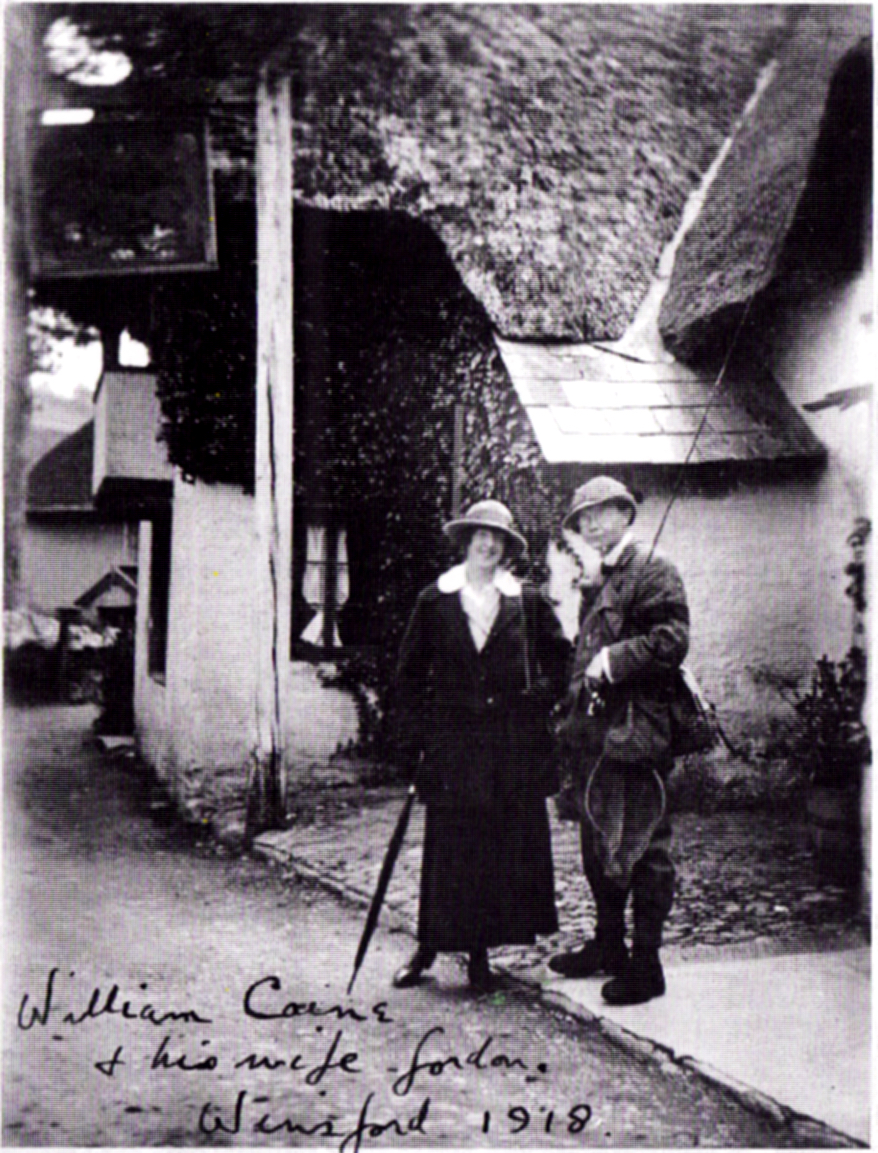
“William Caine & his wife Gordon. Winsford 1918.” Reproduced from Patrick Miles, Calderonia [blog], November 18, 2016, “A letter to the ‘Manchester Guardian’, 12 May 1919.”
Though there was a full moon, there were a lot of clouds scudding across the sky. The night was windy and threatened rain. None had fallen yet but I’d been reading about a quarter of an hour when the first patter of drops on the glass told me that it had begun. I went on reading, but I was rather bored with the story and I was beginning to wonder how much longer it would be before we bolted the President of the Scandals’ Board, when I found that someone was at the door of the car, speaking to me. Looking up I saw that it was Mr. Cattermole. He was dressed in a flannel suit and wore a soft hat and looked altogether nice and disreputable, and I was awfully glad to see him. The intention, which had been forming itself in my mind, of taking a cab home, evaporated, now that I had a man to talk to. The squall had been very sudden and the rain was coming down quite hard now and all the roadway was puddles and the gas lamps shone on the streaming pavements.Peter Cattermole, drawn to the cause for romantic rather than political reasons, retrieves aunt Ethel, the President of the Woman Suffrage League, from the outer lobby of the House of Commons where she had been waiting with her secretary for Peter’s father, Sir John Cattermole, to accede to her demands to bring “our case beneath [his] personal notice” (p. 136): “I told Bolitho to draw up at the door of the House for it was blowing and raining furiously now, and in about five minutes Mr. Cattermole brought my Aunt and little Mr. Flowerdew” (p. 141). Aunty has assigned some members of the cause to keep a lookout for Sir John at various locations in the area, gives Peter a spare mackintosh and tells him to relieve Miss Wincarnis at the gates of Palace Yard, then commands Bolitho “to drive slowly round the pickets:”He said, “My father is taking a bath. He feels safer there.”
I love a man who doesn’t begin talking with a formality. “Has he so little confidence in the police?” I asked.
“He has more in your Aunt’s modesty,” he replied.
“He had better not be too sure,” I said. “There is the spirit of a Corday in Aunt Ethel.”
“Ethel!” he cried. “Is Miss Waugh called Ethel? Ethel is tender and fluffy. Ethel is a flirt. Ethel is out of the question for your aunt.”
“Her parents,” I said, “could not predict her future greatness.”
“True,” he said. “May I come in? I am not like my father; I do not want a bath and I have a message for you.”
As he couldn’t deliver it from the pavement, and it seemed really unkind to keep him out in the rain, I opened the door and saw the back of Bolitho stiffen disapprovingly where she sat on the box in the light of the gas lamp, with water sluicing off her leather coat.
Mr. Cattermole got into the car and I made room for him by my side (The Pursuit of the President, pp. 133–135).
All the streets were deserted by this time for the rain was simply pouring down, but we found Mr. Porchester, who was patrolling the railings of the little garden at the south end of the Houses of Parliament. He was sopping wet, and a little irritable and difficult because he had had no dinner (p. 142).Bolitho quickly drives Aunt Ethel, Mr. Flowerdew, Mr. Lucy, Peter Cattermole, and Amy Boydell to Westminster Bridge whereUnder the Victoria Tower stood a dark shape which resolved itself in the light of our lamps into Mr. Roley. He, more wise than Mr. Porchester, had provided himself with sandwichs, one of which he was munching as we came up; and as he never goes anywhere without an umbrella, he was partially dry (p. 143).
The next station was the Lord’s Entrance, and here Lady Sandys should have been found; but the policeman on duty informed us that the lady who had been hanging about the door since late in the afternoon, had called a cab suddenly some five minutes before and had driven away. […]
“Emilia Sandys is a fair-weather friend, I fear,” said my Aunt, as we went on. “We shall find Mrs. Benjefield in her place.” When we reached the angle of the great building where Richard I.’s statue stands, I could see Mrs. Benjefield, crouching against the little door which is there.
As the acetylene light fell on her she presented a most pitiable sight. Her clothes were almost moulded upon her with the rain and wind, and the water was pouring off the brim of her hat. She had folded up a newspaper lengthwise and had crossed it under her chin to keep the rain from running down the back of her neck; but this must have been useless long ago, as she had evidently not a dry stitch upon her. But she was quite undaunted. She came squashing towards us, and said in a low mysterious voice (it may have been the cold that made her so husky), “That you, Mith Waugh? Nothink hath happened here. But I’m afraid Thandyth hath detherted her potht” (pp. 144–145).
We found Mr. Cattermole at the gate. He looked very big and strong and was smoking a pipe upside down, which made him look rather Bohemian and uncommon. He was shining with the wet, but the mackintosh had protected him, all but his hat. He came up and stood talking, while the rain lashed on to him and fell off his shoulders in perfect cataracts. He reported that his father’s car had left Palace Yard a few minutes before, but Sir John wasn’t in it. My Aunt surmised that this could only mean that Sir John would not attempt to leave the House before midnight. “At which hour,” she said, “the car will probably return for him.”
“And now,” she continued, “there only remains Mr. White, at the Westminster Bridge Station tunnel, and Mr. Lucy, on the Bridge itself.”
Suddenly through the deluge there came round the corner of the railings of Palace Yard the figure of a man, who ran and gesticulated and shouted. He dashed up to the car and halted gasping,
“Tha-ker-tha-ker,” he said and pointed in the direction from which he had come, towards Westminster Bridge (pp. 147–148).
there happened a thing which proved clearly that Providence fought on the side of the Cause. The squall died down as suddenly as it had arisen, the moon shone out, and the whole of the Thames from St. Thomas’ Hospital to the Terrace was flooded with her beams. The night fell quite still.During an era when a well known author believed that “we can speak with our beloved dead,” a recently bereaved widow of a lesser known author — a widow who, unlike Reginald Sterne’s wife in But She Meant Well, seems to have been not only greatly appreciative of her husband’s writings, but also a collaborator of sorts in their making (see §§ 14 and 15) — might very well have been susceptible to thinking that the similarities between a car crashing off a bridge during a rainstorm on the Isle of Man and a car chase involving a bridge and a rainstorm in one of her husband’s early books were signs that the spirit of her dead husband was trying to communicate with her — especially when the car that crashed was driven by her late husband’s namesake, and that late husband was not uncommonly, and erroneously, associated with the Isle of Man. For instance, Stephen Graham, who called Caine “one of the oldest and closest of my own literary friends” (Graham 1925: 8), thought that the author of The Author of “Trixie” had been born on the Isle of Man rather than in Liverpool (Graham 1930: 117). Were Graham’s memories of Caine skewed by memories of reading about, just a few months after the death of his friend, the death of a different William Caine, he with whom I began this section? Or did he perhaps believe that Caine was speaking the genealogical truth rather than engaging in one of his innumerable acts of parodic ventriloquism when, in chapter XI of The Confectioners, William Quilliam, “the Failure-at-the-Bar,” claims from his uncle, the magistrate Mr. Quirk, “the protection which one Manxman invariably accords to another”? (I discuss this episode in § 15.) Or did Graham have in mind Caine’s maternal grandfather Hugh Stowell Brown, who was born in Douglas, Isle of Man, on August 10, 1823 (W. S. Caine 1887: 1)? Yet, by the time Caine was born, Brown had long been in Liverpool, having been minister at the Myrtle Street Baptist Church since August 1847 (W. S. Caine 1887: 77), a position he would remain in until “he died after a few days’ illness from apoplexy on 24 Feb. 1886” (Smith 1901: 301). Likewise, when Caine was twenty years old, his family on his father’s side was described as having been in Liverpool “during quite a century” (Orchard 1893: 225), his father William Sproston Caine having been born across the River Mersey from Liverpool in Egremont, Wallasey, Cheshire (Newton 1907: 1; Woods 1912: 290) to a native of Liverpool, Nathaniel Caine, who was the second son of Thomas Caine, “a Manxman who early in life left the Isle of Man for Liverpool” (Newton 1907: 1) where he became “a successful tradesman, who for many years carried on business in Lord-street, and died in 1814, at the age of 57.” Apropos of which: In “A Word from His Wife” which the widow of the author of The Author of “Trixie” addressed to the “Dear Public” in The Glutton’s Mirror, she wrote:“Yes!” I heard my Aunt say excitedly. “There is a boat by the Terrace and some one is being lowered into it. Put out your lights, Bolitho.”
Our driver obeyed her unquestioningly. “Her’s not to reason why.” She is an impassive and excellent chauffeuse and would drive into the jaws of a police trap if my Aunt told her to do it.
“Follow!” said my Aunt; and the car began to move along the side of the pavement, keeping level with the four figures of Aunty, Mr. Lucy, Mr. Cattermole and little Mr. Flowerdew. They were crouching low and gazing at the water through the openings in the parapet of the bridge, that their presence might not become visible from the river. It was fun! So we crept half way over the bridge; and at this point my Aunt directed Bolitho to cross to the other side of the road, and she and her two [sic] companions transferred themselves to the opposite parapet.
“There he goes,” said my Aunt, and I heard a splash of oars. “He is full of resource,” she said admiringly.
“He’s making tha-ker-tha-ker,” said Mr. Lucy.
“For the Surrey Shore,” said Aunty. “He’ll land at a wharf over there.” In her excitement she rose to her full height and leaned out over the bridge and I heard a startled cry down the river. “He’s seen me,” cried Aunty. I could bear no more and, risking wet feet, I jumped out and joined them. My ankle hurt a little but I had to go. I could see nothing at first, for the light inside the car still blinded me, but following my Aunt’s pointing finger, I made out a dark spot on the water which seemed to be travelling at a good pace towards the warehouses which lie between Waterloo Station and the river. Mr. Cattermole arranged my shawl in silence. The dark spot vanished in the shadows of the bank-side.
“Yes, he’s landing there,” said my Aunt. “We will be in time to meet him as he comes into the street. Quick! Quick! back into the car again.” We all bundled in, Bolitho started the car with a jerk, and Westminster Bridge flowed under our wheels. We whirled round into York Road at about 30 miles an hour, and a policeman yelled, “Where are your lights?” and started after us. Another turn to the left, another to the right and I saw we were in a narrow ill-lit street of tall warehouses.
“He’ll come out here,” said my Aunt. “Why are you slowing down, Bolitho?”
“Light ahead, Miss,” said Bolitho, without turning round.
“So there is,” cried my Aunt, springing to her feet.
“By Jove! it’s the tail light of a car. It’s waiting for him. Hurry! hurry!” But the street was too narrow for Bolitho to hurry, and we advanced at a little above walking pace.
I peered out in front of us, between the backs of Bolitho and Mr. Lucy and I saw a red lamp burning ahead of us. Something passed in front of it; and another; and repassed. This happened twice as we neared the lamp. We were within ten yards of it when suddenly I heard a loud cry:
“Halt! the road is impassable. Halt! or take the consequences.”
Bolitho, true to her chauffeuse’s instinct, put the brakes down hard and we came to a standstill, the car filling the little street with its impatient noise.
“Let me out! let me out!” cried my Aunt. “He is there.”
As she spoke I saw in the dim light which shone from one of the street’s rare gas jets, the figures of two men who carried some long object between them, and there followed the clang of metal on the roadway.
The figures vanished and next moment the car ahead of us began to clatter, which doubled the din in that narrow place. It was frightfully exciting.
My aunt leaped out on to the pavement with a shout. An answering shout came from behind the red lamp. My aunt dashed towards it, but her skirt caught in something that lay on the ground and she came to her knees with a cry of pain.
She [was] answered by a laugh, and I saw a man stand up in the back of the other car and wave his hand derisively, as the red light began to recede. Mr. Cattermole, who had jumped out also, struck a match and relit the acetylenes. I saw my aunt grovelling on the ground.
“The place is strewn with railway sleepers,” she cried.
It was impossible to go on but Mr. Cattermole and Mr. Lucy began to throw the sleepers aside, working furiously. Mr. Flowerdew looked on most gracefully. In a few moments the road was cleared.
“Forward!” cried Aunty, leaping into the car. “Follow him, Bolitho! We shall catch him yet. There he goes, round to the right. Follow! follow!” The men jumped up. Mr. Flowerdew was dragged in by Aunty and Bolitho started the car. It gathered way (pp. 150–155).
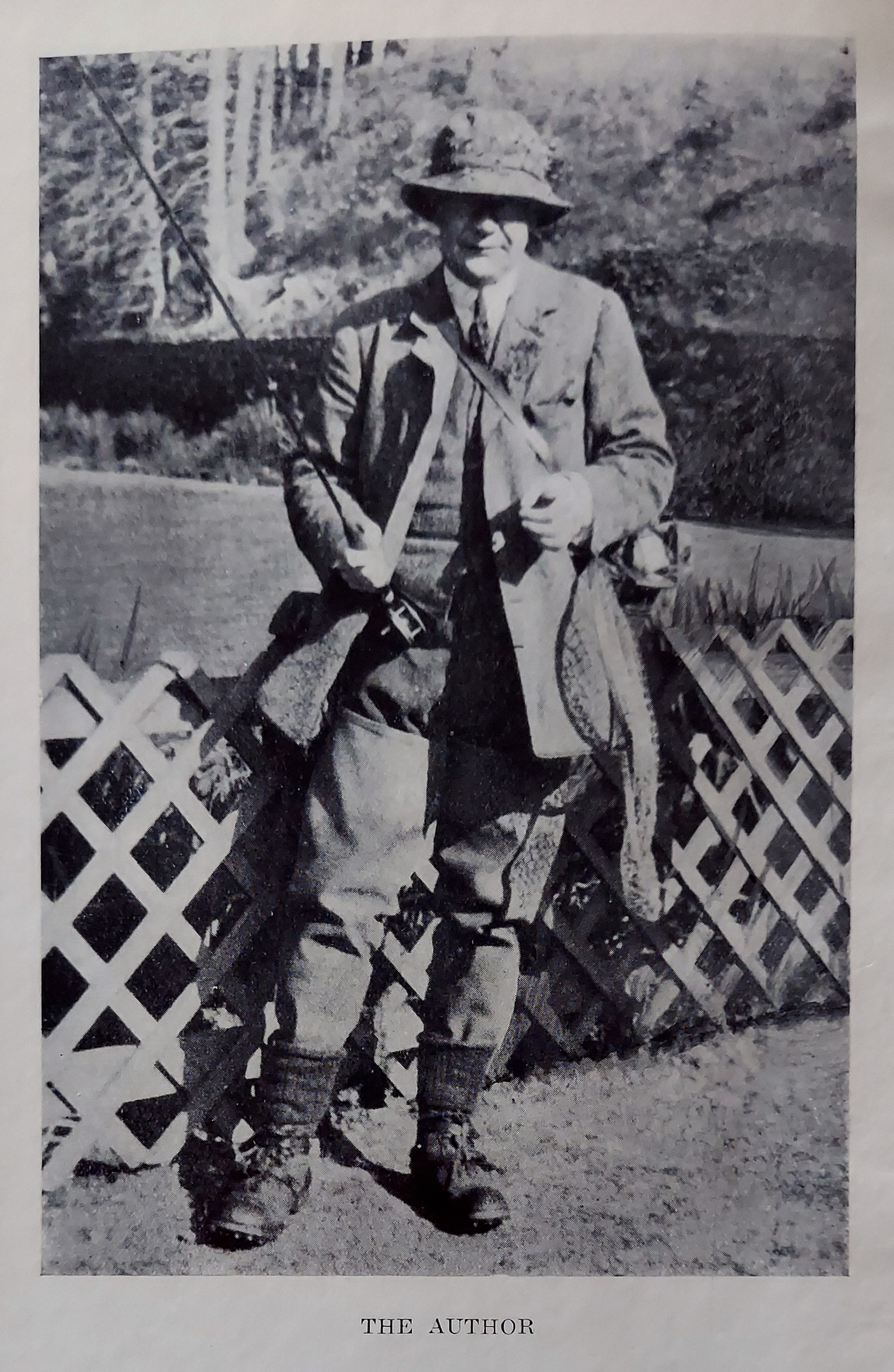
William Caine, the author of The Author of “Trixie”, c. 1925. “He was only fifty-two years old, but when I last saw him, about seven years ago, he looked quite that age or older, and he never enjoyed exactly robust health, in spite of his fondness for the outdoor life, particularly angling. An old friend of his, a well-known angling editor, told me once that of all men with whom he liked to go fishing, Caine was easily the favourite” (The Citizen, Monday, September 7, 1925, p. 4). Image reproduced from the frontispiece of his posthumous collection, Fish, Fishing & Fishermen (1927).
Knowing the fate which would one day overtake him, as it had his father and his grandfather before him, he entrusted his future works to me, all ready and complete… so if you show me you want it, he can still give you many, many little surprises (p. 6).[Death of Caine's grandfather at 69; uncle Howard, at 45; his other uncle, Nathaniel, however, died at the age of 82, in 1926 [Deaths, Liverpool Daily Post, Mon, Jun 21, 1926 ·Page 1; Evening Express (Liverpool), Sat, Jun 19, 1926 ·Page 4]); father, nine days before his 61st birthday: accounts of father's death; followed by Graham quotes]
also bring in: the ship Ethel Caine (built for Caine's uncle Nathaniel in 1874, sank July 21, 1885); Hannah Ethel Branson Neighbour from But She Meant Well; other Ethels (the several associated with Edith Gordon Walker) [?]
In the time of Caine's grandfather Nathaniel Caine, it seems that dancing rooms were associated with prostitution: “Liverpool Life: Past and Present; VI. ‘The Amphi,’ and ‘The Hop,’” The Liverpool Weekly Mercury, Saturday, December 24, 1892, p. 6 | “Liverpool Life: Past and Present; VI. Dancing Rooms for Beginners,” The Liverpool Weekly Mercury Sat, Dec 31, 1892 ·Page 6
Nathaniel Caine was born in Liverpool “about the year 1808 […] and died on the 28th of September, 1877, in the 69th year of his age” (“Liverpool Worthies; Nathaniel Caine,” The Liverpool Mercury, Monday, October 19, 1891, p. 5).
Nathaniel Caine "born October, 1808" ; "had been in failing health for sime time" ; his father Thomas Caine, "was born in Glenwillyn, Kirk Micael, Isle of Man" (“The Late Nathaniel Caine,” The Liverpool Weekly Mercury, Saturday, October 4, 1877, p. 6)
Thomas Caine's second son, Nathaniel Caine died aged 69 (or 68); had three sons : William Sproston Caine; Nathaniel Caine; Howard Thomas Caine
"The Late Nathaniel Caine," Liverpool Mercury, etc. Sat, Oct 06, 1877 ·Page 8 (account of funeral; mentions three sons: W. S.; N.; H. T.; one son-in-law, Mr. W. B. Turner; two daughters, Mrs. H. S. Brown and Mrs. Turner)
Sale of "The Late Mr. Nathaniel Caine's Pictures," Evening Express (Liverpool) Mon, Jun 14, 1880 ·Page 3 | "The Late Mr. Nathaniel Caine's Pictures," Liverpool Daily Post Sat, Jun 13, 1908 ·Page 7
Mary Leyburn: "The Will of the Late Mr. Nathaniel Caine," The Liverpool Weekly Mercury, Sat, Oct 13, 1877 ·Page 4; And a "Mr. H. K. Leyburn, nephew" at funeral of Nathaniel Caine: The Liverpool Weekly Mercury Sat, Oct 06, 1877 ·Page 4; Liverpool Mercury, etc. Sat, Oct 06, 1877 ·Page 8; So: Mr. H. K. Leyburn [or Layborn] was the son of the the sister of the father of the father of the author of The Author of Trixie; that is, the latter's - second cousin? His great-aunt's son
Mary Layborn: "The Late Mr. Nathaniel Caine" Western Daily Press (Bristol) Thu, Oct 18, 1877 ·Page 3; Evening Express (Liverpool) Sat, Oct 13, 1877 ·Page 2; Liverpool Daily Post Sat, Oct 13, 1877 ·Page 5; "Wills and Bequests," The Times Mon, Oct 15, 1877 ·Page 7; The Illustrated London News Sat, Oct 20, 1877 ·Page 22; etc.
Mary Layborn née Caine's husband: Mr. H. K. Layborn [?] or her son [?] [likely the latter] See "Marriage of the Rev. Hugh Stowell Brown's Daughter [Dora]," Liverpool Mercury, Fri, Sep 20, 1878 ·Page 6: at which, it seems, Hannah and Dorothea Caine were bridesmaids; and one of the groomsmen is "Mr. H. K. Layborn" * Mary Layborn née Caine's husband: Mr. D. Layborn [?] one of the groomsmen at the second wedding of Nathaniel Caine: Liverpool Mercury, etc. Wed, Apr 18, 1866 ·Page 5 At The Mayor's Ball: Liverpool Mercury, etc. Thu, Feb 27, 1862 ·Page 5 Along with Mr. N. Caine and the Misses, there are, among the guests, Mr. and Mrs. D. Layborn * "Married" Liverpool Mercury, etc. Fri, May 20, 1842 ·Page 7: Daniel Layborn, Esq., of Eske, near Beverley, married Mary, youngest daughter of the late Thomas Caine [i.e., Nathaniel Caine's sister] Manchester Courier and Lancashire General Advertiser Sat, May 28, 1842 ·Page 6; * Daniel Layborn seems to have been a farmer: "East-Riding Sessions; The Grand Jury" The Yorkshire Herald and the York Herald Sat, Oct 23, 1841 ·Page 4 He won a sweepstakes for "Yearling Hunting Colts" "East Riding" The Yorkshire Herald and the York Herald Sat, Jul 31, 1841 ·Page 3 Elected guardian of Eske: "Beverley" The Hull Packet; and East Riding Times Fri, Apr 20, 1855 ·Page 8 Appointed one of the two overseers of Eske: The Hull Packet; and East Riding Times Fri, Apr 11, 1856 ·Page 8 One of his cows was stolen: "Beverley; Felony" The Hull Packet; and East Riding Times Fri, Jul 23, 1858 ·Page 6 His second daughter, Annie Sproston Layborn, married George Beckitt, on Nov. 17, 1874: The Yorkshire Herald and the York Herald Fri, Nov 20, 1874 ·Page 4; Daniel Layborn died Sept 21 1876, age 82: The Morning Post Tue, Sep 26, 1876 ·Page 7 * Mary Layborn née Caine died June 25, 1887, age 75: Evening Express (Liverpool) Wed, Jun 29, 1887 ·Page 2 * Henry Kirkus Layborn, youngest son of the late Daniel Layborn, married Harriet Mary Paterson, July 19, 1883: "Births, Marriages, and Deaths; Marriages," The Liverpool Mercury, Friday, July 20, 1883, p. 7; Birkenhead News Sat, Jul 21, 1883 ·Page 7; The Pall Mall Gazette Sat, Jul 21, 1883 ·Page 5; The Times Sat, Jul 21, 1883 ·Page 1; * * * W. S. and N. Caine, iron and tinplate merchants, have taken Mr. Daniel Layborn [i.e., the eldest son [?] of the Daniel Layborn who married Mary Caine in 1842 and died in 1876] in partnership: "Miscellaneous" Liverpool Mercury, etc. Mon, Aug 01, 1881 ·Page 8 * Henry Kirkus Layborn seems to have been a solicitor in Liverpool: "Winding Up Notices" The Solicitors' Journal 1896-09-26: Vol 40 Iss 48, p. 784 He [address listed as Rumford Court, Liverppol] also seemed to own an iron screw steamer called the Munroe built in Sunderland in 1877 (Lloyd's Register of Shipping 1879) (Lloyd's Register of Shipping 1881) etc. died November 23, 1915: Liverpool Daily Post Wed, Nov 24, 1915 ·Page 7; Mrs. Henry K. Layborn died July 13, 1936: The Ormskirk Advertiser, etc. Thu, Jul 23, 1936 ·Page 4 * H. K. Layborn and wife attended funeral of Caine's uncle Nathaniel's wife, Mr. and Mrs. Caine in attendance, along with Caine's mother: Liverpool Daily Post Wed, Jan 27, 1915 ·Page 3 ditto for funeral of Caine's cousin Rev. Thomas Caine [third son of his uncle Nathaniel] at age 37 Birkenhead News Sat, Sep 13, 1913 ·Page 4 ditto for funeral of Caine's aunt Phoebe (Mrs. Hugh Stowell Brown): Liverpool Mercury, etc. Sat, Mar 29, 1884 ·Page 7
This Nathaniel Caine seems to have had a sister named Mary (Mrs. Leyburn [or Layborn]) "The Will of the Late Mr. Nathaniel Caine," The Liverpool Weekly Mercury, Sat, Oct 13, 1877 ·Page 4 : "To each of his four daughters he leaves a legacy of £1000, payable at once, and a further sum of £25,000 each, to be increased to £30,000 on the death of his widow. He also leaves his mining shares amongst his children in certain proportions" | "The Late Mr. N. Caine's Estate," Liverpool Mercury, etc. Fri, Aug 17, 1894 ·Page 5 [seems to have had four daughters and three sons (despite piece saying the opposite)?] | "The Late Mr. Nathaniel Caine" Western Daily Press (Bristol) Thu, Oct 18, 1877 ·Page 3
Ad for series of People's Lectures by Dr. Lankester, MD [E. Ray Lankester's father?], committee of which Nathaniel Caine is member of and chair of the lecture on Wines, Spirits and Beers: Liverpool Mercury, etc. Fri, Nov 18, 1859 ·Page 1
Liverpool Mercury, etc. Fri, Oct 15, 1858 ·Page 7 : "Mr. Nathaniel Caine then read his paper On Prostitution: Its Aids and Accessories (paper follows)" (Article on "The National Association for the Promotion of Social Science," starts on previous page; Caine's paper under v. Social Economy, Section II.) Nathaniel Caine also mentioned in next article, "Great Meeting of the Working Classes in the Amphitheatre"
William Sproston Caine: eldest son of Nathaniel Caine (Woods 1912: 290; “Members of the New House of Commons,” The Illustrated London News, May 29, 1880, p. 517); died March 17, 1903 (St. Patrick’s Day), nine days before his 61st birthday; “Mr. Caine was, par excellence, a Liverpool man” (“News of the Day,” The Liverpool Daily Post, Wednesday, March 18, 1903, p. 4);
The news of the death of Mr. Caine was received with much regret by his colleagues at the House of Commons. He had long suffered from heart disease, and during the autumn session he seemed to be a good deal worn out. He took, however, a voyage to South America after Parliament rose, and it seemed to have a beneficial effect. Though he had lost a good deal in weight, he felt better in his general health. Only a few months ago he said to a friend, “I have lived twenty years with heart disease, and I may live for twenty more.” This hope has, unhappily, been very soon destroyed (“From Our London Correspondent,” The Liverpool Daily Post, Wednesday, March 18, 1903, p. 4);
Mr. Caine had suffered for many years from weakness of the heart, and for some months past his general condition of health was less favourable; but the cardiac ailment did not assume an acute form until a few days ago. There was, indeed, so little anticipation of immediate danger that arrangements had been made for the hon. member to leave on Saturday for the South of France; but these plans had to be abandoned on account of somewhat unfavourable symptoms.He left England on November 10th under medical advice for South America, and returned to London early last month but litle improved in health by the voyage.
He was unable to attend the last autumn Session of the House of Commons, and had not felt strong enough for close attendance at Westminster this year. In the debate upon the King’s Speech, however, he made a vigorous speech — his last — in favour of an amendment for the reduction of the Indian Army expenditure.
The news of Mr. Caine’s death was received with sincere regret by every section in the House of Commons, for his geniality, robust convictions, and frank honesty of purpose won him the respect of all parties (“Death of Mr. W. S. Caine, M.P.; A Notable Career; His Liverpool Connections,” The Liverpool Mercury, Wednesday, March 18, 1903, p. 6).
Howard Thomas Caine, Nathaniel Caine's youngest son (W. S. Caine's youngest brother) married September 27, 1887, at St. George's Church, Hanover Square, London, Florence Mary Gray, daughter of the late Robert Alexander Gray; died of heart disease at the age of 45. ("Marriages," Leamington Spa Courier, October 1, 1887, p. 4; "Speen; The Late Mr. Howard Caine," The Newbury Weekly News, Thursday, August 4, 1892, p. 5; "The Counties Week by Week; Speen; Funeral of the Lat Mr. Howard Thomas Caine," The Reading Standard, Friday, August 5, 1892, p. 2; "Deaths," The Berkshire Chronicle, Saturday, August 6, 1892, p. 8)
Another uncle of Caine, his father's brother Nathaniel Caine (second son of Nathaniel Caine) : seems to have died June 17, 1926, at age 82 [?????] [But this Nathaniel Caine of Spital/Wirral is likely NOT W. S. Caine's brother??] — yet obit in Chester Chronicle states that he "succeeded his father as head of the firm of Messrs. W. S. and N. Caine, iron merchants, of Liverpool, but retired from business many years ago"| "A Wirral Sportsman" Death of Mr. Nathaniel Caine, Spital Chester Chronicle, and Cheshire and North Wales General Advertiser Sat, Jun 19, 1926 ·Page 9 | "Fine Old Cheshire Sportsman" Liverpool Daily Post Fri, Jun 18, 1926 ·Page 5 | "Deaths" Liverpool Echo Mon, Jun 21, 1926 ·Page 6 | "Deaths" Evening Express (Liverpool) Sat, Jun 19, 1926 ·Page 4 |
* * * * *
William Sproston Caine's father Nathaniel Caine seems to have remarried in 1866, eleven years before he died: his marriage to Helen Blackburn [?] : "Marriages" Liverpool Mercury, etc. Wed, Apr 18, 1866 ·Page 6 | "Marriage of Nathaniel Caine, Esq.," Liverpool Mercury, etc. Wed, Apr 18, 1866 ·Page 5 (this piece mentions that Hugh Stowell Brown is his son-in-law)
* * * * *
"Failure of an Old Liverpool Firm" under management of Nathaniel Caine, Cheshire Observer Sat, Sep 06, 1879 ·Page 2 | Notice of dissolution of partnership, but continuance of business with same partners [??!!??] Liverpool Daily Post Thu, Aug 22, 1867 ·Page 1 | "Suspension of Messrs. W.S. & N. Caine," Cumberland and Westmorland Herald Sat, Sep 06, 1879 ·Page 5 | "Fraud by Mr. Caine's Cashier," Evening Express (Liverpool) Thu, Dec 18, 1879 ·Page 3 | "The Stoppage of Messrs. Caine: Meeting of Creditors," Evening Express (Liverpool) Wed, Sep 03, 1879 ·Page 4 | "Failure in the Liverpool Iron Trade," Western Mail Sat, Aug 30, 1879 ·Page 4 | "Suspension of Messrs. W. S. & N. Caine," The Birmingham Post Wed, Sep 03, 1879 ·Page 6 | "The Affairs of W.S. & N. Caine," Liverpool Mercury, etc. Wed, Sep 03, 1879 ·Page 8 | "Failure in the Liverpool Iron Trade," Glasgow Daily Mail Mon, Sep 01, 1879 ·Page 6 | "The Suspension of Liverpool Iron Merchants," The Newcastle Daily Journal Mon, Sep 01, 1879 ·Page 3
Death of William Sproston Caine's sister Phoebe (who had married High Stowell Brown) "The Late Mrs. High Stowell Brown" Liverpool Mercury, etc. Wed, Mar 26, 1884 ·Page 6 | "Funeral of Mrs. H. Stowell Brown," Liverpool Mercury, etc. Sat, Mar 29, 1884 ·Page 7
Caine died just five days after his 52nd birthday Caine men dying young; for instance, his uncle Howard died age 45 of heart disease, etc. father at 62 [?] grandfather at 69 ... [relate to Sebastian Knight]
Graham, again, from Glutton's Mirror: "Alas! for fate, which surprise him instead…"
Another author who met the man whom Gertrude Stein described as “a well known humorous english writer” and his wife the former “Wellesley girl who played the harp” (see § 5) at John Lane’s “richly carpeted apartment in Lancaster Gate,” Bayswater, London, was Stephen Graham (1964: 39). In his autobiography, Part of the Wonderful Scene, Graham writes:
I am sorry now that so few of my closest friends ever met one another. That may be due to the fact that my friends did not want to meet other friends. In London we live in groups and cliques. Many men and women live in a series of non-interlocking friendships. They live four or five different lives at the same time. While I became attached to Pan and Maya I started an intimate friendship with the humorous writer William Caine and his wife Gordon, but they could never meet. At the same party at which I met Caine I was introduced to Olga Novikova and a friendship with her began and lasted till she died, but Mme Novikov would never have wanted contact either with Blackwood or Caine. Presently I became a friend with Lord Northcliffe, but I cannot imagine combining him with them.I have already touched on in § 4 Graham’s understandable mistake in thinking that Caine’s brothers-in-law John Herbert Roberts and John Herbert Lewis were his uncles.William Caine must have been drawn to me by personality as he had no interest in Russia and was bored by America. He lived in the London hurly-burly which gave him food for his extravagant wit. We were laughing companions. Because of his name he was called a Manx cat, but he detested Hall Caine who had identified himself with the Isle of Man; he was short of a tail or something, diminutive, gnomish with a laugh like Teddie Roosevelt’s, the pet of cartoonists. H. M. Bateman never tired of caricaturing him, and at one time burlesque drawings of his face figured in scores of commercial advertisements. He was a barrister who, to the disgust of snobbish relatives, discarded law for comic writing. He had two uncles, members of Parliament, who regarded his literary career as something not to be mentioned. His books were hidden in a skeleton cupboard. Those uncles and other disapproving relatives diminished Billie’s sales. Not that he minded, though he had his revenge by telling how a literary snob wrote anonymously a vulgar romance and gloated over its success, but suffered the tortures of the damned by not being able to admit to his friends that he was the author.
He married Gordon, an American musical comedy actress who combined charm, good looks and a superlative gift for cooking. The halibut baked on its plank was a feature of the repasts we enjoyed at their Hampstead home. Caine’s book The Glutton’s Mirror showed his preoccupation with good food. And that was surprising because he had an enlarged heart and his life was limited by diet. He must not eat or exert himself too much, must not dance or run or swim. Did the doctor say he must not laugh? The explosions of mirth outbreaking from his flat face suggested a man who was as robust as Rabelais.
The regime was eventually too much for both of them, and one day ten years after I first met them Gordon announced that Billie was cured and that they were sleeping together. Billie was also taking her to night clubs. Alas, that was too much. Billie fell dead while dancing a tango. Gordon tried, but could not live without him. She threw herself from the window of that room in which we had dined so lavishly and so happily (Graham 1964: 71–73).
night clubs and dancing in Trixie; grandfather Nathaniel Caine's involvement with the The Society for the Suppression of Vicious Practices; association, in Liverpool, of dancing and prostitution…
[Relate this to Edith Gordon Walker's "haunting" by ghost of her husband; as well as the coincidence of American bootlegger named William Caine; and "Highball" Hinkey in Lady Sheba.] [Then Graham quote below; his mistaken belief that Caine was born in Isle of Man, with footnote below in main text; then his discussion of Lady Sheba's Last Stunt (Graham 1930: 114–116)?; then move on to my discussion of ditto;
end with The Author of "Trixie" and its (and other of Caine's) connections with Nabokov; that list of books,
ending of Trixie: "My hat!" is a parody of Carpenter exclaiming, at end of Old Enough, "My Aunt! My sacred Aunt!"
discuss also how Trixie ending is mistranslated in German s
[hinge between Trixie and Lady Sheba?] : expand on: "looking rather Bohemian" from Pursuit of the President quote above; Graham Foreword to Glutton's Mirror: Cane "was one of the most versatile Bohemians of his time"; "Bohemians" from The New Foresters…
Lady Sheba : racehorse named Lady Sheba; Caine's sister, Lady Clwyd : racehorse named Lady Clwyd — the amazona y altiva (arrogant horsewoman) from Borges in § 4 — as well as picture of horsewoman on verso Graphic article on Caine, November 23, 1912.
Lady Sheba's memoir: stolen, then destroyed; perhaps version utterly bland : relate to, end with speculation about what happened to the manuscript of Caine's autobiography mentioned by his widow (§ 10); was her death perhaps not self-inflicted?
End with penultimate paragraph from Graham's Foreword to Glutton's Mirror: "In these days, however, a retiring nature…" [?]
[car crash at high tide : rowing back against tide (i.e., the tide is rising) from moonlit excursion in Save Us from our Friends!] [?]
- News items of the time. — I have pieced together my paragraph about this “other” William Caine from: “Crash Over Bridge. Motor-Lorry Falls Into I.O.M. Harbour. Driver and Girl Dead. Double Tragedy in Heavy Rainstorm.” From Our Own Correspondent. Douglas (I.O.M), Thursday. The Liverpool Echo, Thursday, December 24, 1925, p. 3; “Mistook Light. Lorry in Harbour: I.O.M. Tragedy.” The Shields Daily News, Thursday, December 24, 1925, p. 3; “Mistaken Light. Motor Lorry Plunges Into Harbour.” Northern Daily Mail (Hartlepool), Thursday, December 24, 1925, p. 2; “Women Victims of Road Crashes. Heavy Toll of Life Despite Lessened Motor Car Traffic. Lorry Runs Into Sea.” The Weekly Dispatch (London), Sunday, December 27, 1925, p. 11; “Two Killed in Lorry Accident.” The Leicester Evening Mail, Monday, December 28, 1925, p. 5.
- A well known author believed. — See Conan Doyle (1918; 1919; 1927).
- Nathaniel Caine; Thomas Caine. — “The Late Nathaniel Caine,” The Liverpool Mercury, October 1, 1877, p. 6; “Death of Mr. Nathaniel Caine,” The Liverpool Weekly Courier, Saturday, October 6, 1877, p. 5; “Liverpool Worthies; Nathaniel Caine,” The Liverpool Mercury, Monday, October 19, 1891, p. 5.


