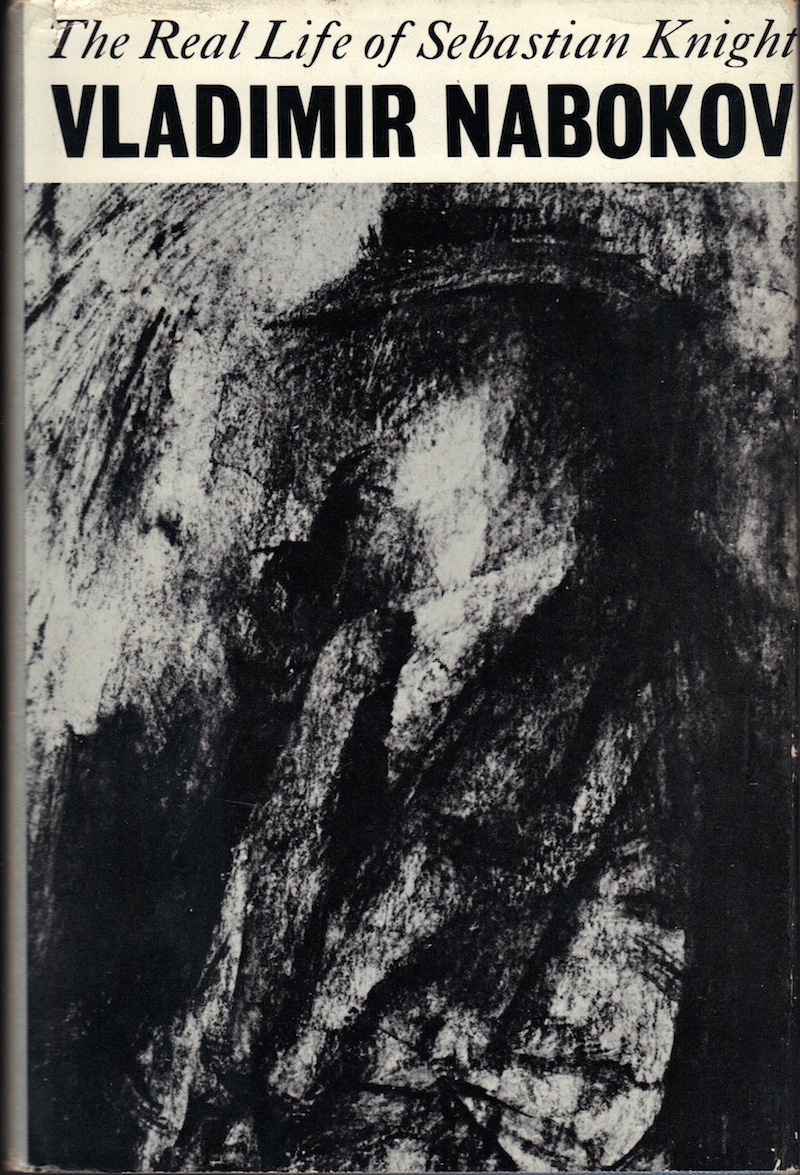
the following sequence which for a moment seemed to form a vague musical phrase, oddly familiar: Hamlet, La morte d’Arthur, The Bridge of San Luis Rey, Doctor Jekyll and Mr. Hyde, South Wind, The Lady with the Dog, Madame Bovary, The Invisible Man, Le Temps Retrouvé, Anglo-Persian Dictionary, The Author of Trixie, Alice in Wonderland, About Buying a Horse, Ulysses, King Lear… (Nabokov 1941, 1968: 41; Nabokov 1996a: 31).I first read Nabokov’s novel in the spring of 1994, finishing the hardback fourth printing of the 1959 New Directions edition on May 21 while sitting on a sun-and-shade dappled bench beneath the wind-buffeted chestnut blossoms of Rittenhouse Square, Philadelphia. It was not until my seventh reading of that book, however, in Tokyo some twenty-eight years later, that I finally took the trouble to answer the question: Who was the author of The Author of “Trixie”? Other readers of Nabokov’s novel, of course, have asked the same question. For instance, Anthony Olcott, in his 1972 article, “The Author’s Special Intention: A Study of The Real Life of Sebastian Knight,” delineated the thematic links between the aforesaid sequence and Nabokov’s book as a whole, yet found himself flummoxed by the eleventh and thirteenth items:
About Buying a Horse and The Author of Trixie do not seem to exist as titles, so their presence in the list is somewhat mystifying. There do exist the titles Buying a Horse, by W. D. Howells, and Trixy, by Elizabeth Stuart Phelps Ward. If in fact these are the titles V. or Nabokov had in mind, correspondences similar to those pointed out for other books could also be manufactured (Olcott 1972: 344).Nabokov, after reading the issue of the Russian Literature Triquarterly where Olcott’s piece was published, sent to Carl R. Proffer, the editor of said RLT, a “short list of some little adjustments” among which was the explanation that
About Buying a Horse is a once famous book by Burnand, editor of Punch; and The Author of Trixie is by Caine (the lesser known Caine) and is about an archbishop (which would have provided Mr Olcott with yet another piece for his mythical chess set) who secretly writes a frivolous novel (Nabokov and Bruccoli 1989: 501).In revising his article for inclusion in A Book of Things about Vladimir Nabokov, edited by Proffer, Olcott used Nabokov’s little adjustment to revise his paragraph accordingly:
About Buying a Horse was written by Sir Francis Cowley Burnand; its chess application is obvious. Caine’s The Author of Trixie is about an archbishop who secretly writes a frivolous novel (thanks, Professor Boldino) (Olcott 1974: 106; italics in original).Why Olcott chose to thank Nabokov obliquely via the name of Pushkin’s estate, Boldino, rather than directly, is anyone’s guess. Speaking of which, I prefer not to follow the trend of identifying the narrator of Nabokov’s novel with the initial, V., since the only time it is used is when the narrator accosts his half-brother Sebastian Knight in a café on the Champs-Elysées at the beginning of chapter 8 and the latter looks up and says, “Oh, hullo, V.” The two of them having spoken both English and Russian in their shared childhood in Saint Petersburg, Sebastian could very well be saying to the narrator, “Oh, hullo, you,” that is, “Oh, hullo, вы [vɨ],” using the formal вы [vɨ] (equivalent to French vous) rather than the informal ты [tɨ], since Sebastian and the narrator are far from intimate. But that is by the by, and all I’ve been able learn thus far is that the author of The Author of Trixie was William Caine, whom Nabokov called, “the lesser known Caine,” with the implied “better known Caine” remaining as equally unknown to me. However, being in Tokyo in May 2022, I was able to do what Anthony Olcott, no matter where he was in 1972, could not: search the internet (and what is my biobibliographical examination of Caine if not a history of such searches, and the manufacturing of correspondences among them?). So I was quickly able to find out, for instance, that the author of The Author of “Trixie” was born in Liverpool eleven days before the author of Le Surmâle was born in Laval (and 124 years after the author of Dichtung und Wahrheit had been born in Frankfurt am Main); that he married, in the year that the author of Le Surmâle died, the American harpist Edith Gordon Walker, a graduate of Wellesley College; that he died suddenly in Belgium of a heart attack at the age of 52 in the same year that Nabokov’s fictional author Sebastian Knight (who also died of a heart attack) published his first novel, The Prismatic Bezel; that the implied “better known Caine” was possibly his father William Sproston Caine, temperance reformer and member of Parliament, or, more likely, Hall Caine, whom I have never read; and that, while many of Caine’s books were available on the Internet Archive, only one — Hoffman’s Chance — of those listed on page 240 of the first volume (A–K) of The Times Literary Supplement Index 1902–1939 was:
Caine, William:Meanwhile, I set about reading those of Caine’s books that were available on the Internet Archive (to which The Author of “Trixie” in the original Herbert Jenkins edition was eventually uploaded on August 16, 2022, with the Tauchnitz reprint uploaded May 29, 2024), starting with Caine’s novel from 1920, The Strangeness of Noel Carton, as well as the TLS review of The Author of “Trixie” where I learned that the “little adjustment” Nabokov suggested and Olcott perpetuated was itself (perhaps intentionally on Nabokov’s part) spurious, as it is not an archbishop “who secretly writes a frivolous novel,” but an archdeacon:
Author of Trixie, The, 752:1923
Brave Little Taylor [sic], The, 824:1923
Drones, 440:1917
Fan, The, 128:1917
Fish, Fishing and Fishermen, 419:1927
Glutton’s Mirror, The, (and illus.), 838:1925
Hoffman’s Chance, 443:1912
Lady Sheba’s Last Stunt, 828:1924
What a Scream, 300:1927
Wife Who Came Alive, The, 236:1919
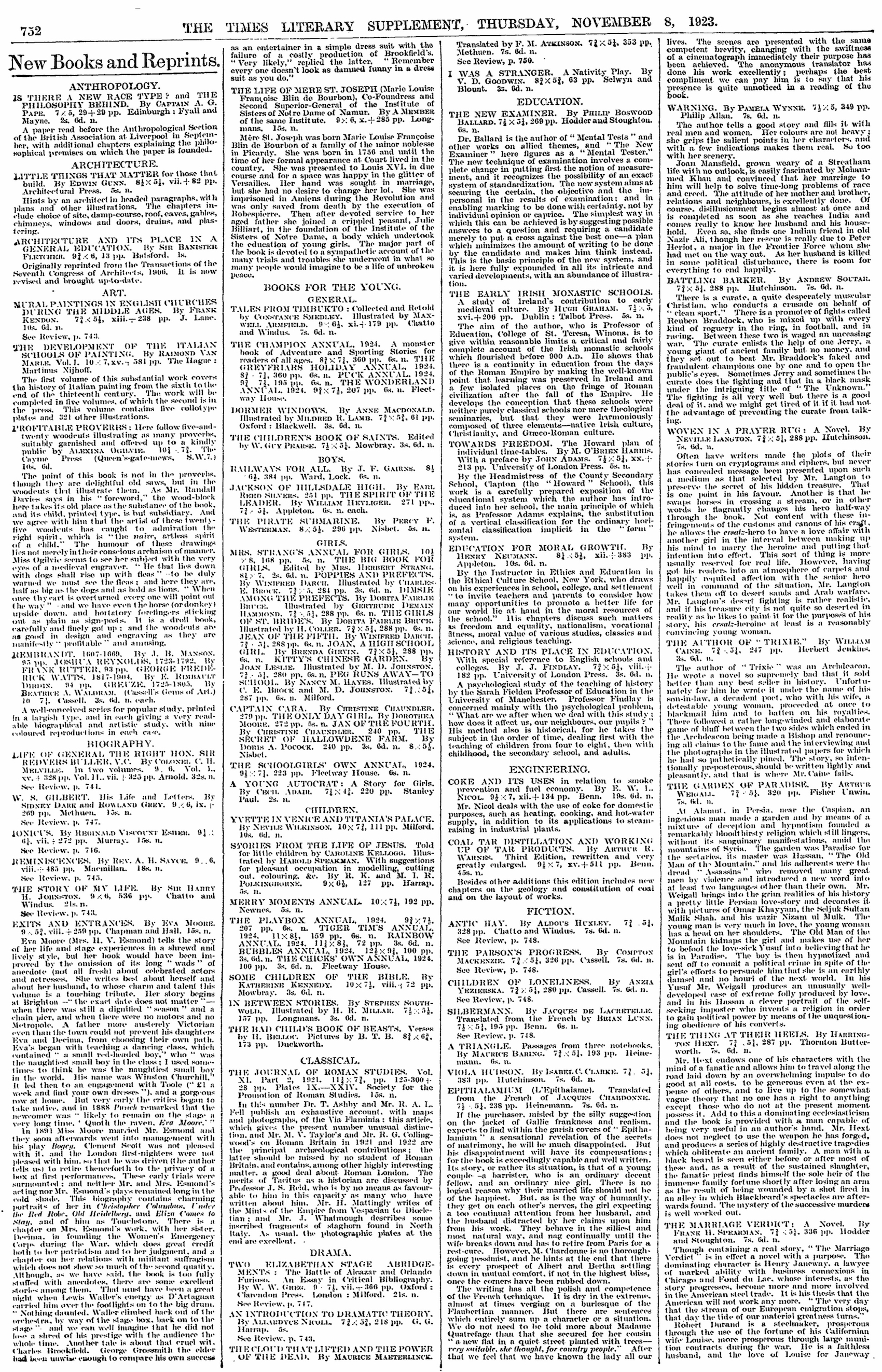
The author of “Trixie” was an Archdeacon. He wrote a novel so supremely bad that it sold better than any best seller in history. Unfortunately for him he wrote it under the name of his son-in-law, a decadent poet, who with his wife, a detestable young woman, proceeded at once to blackmail him and to batten on his royalties. There followed a rather long-winded and elaborate game of bluff between the two sides which ended in the Archdeacon being made a Bishop and renouncing all claims to the fame and the interviewing and the photographs in the illustrated papers for which he had so pathetically pined. The story, so intentionally preposterous, should be written lightly and pleasantly, and that is where Mr. Caine fails (“New Books and Reprints; Fiction,” The Times Literary Supplement, Thursday, November 8, 1923, p. 752.)And, on the night of May 25–26, 2022, I was able to find and order, from various booksellers via abebooks.com, two exemplars of The Author of “Trixie”; one of The Strangeness of Noel Carton (the TLS, by the way, did publish a notice of this novel, but oddly omitted it from its Index); one of his final novel, Lady Sheba’s Last Stunt (1924); and one of his first, Pilkington (1906). I also wondered if any of the stars of the Nabokov critical firmament had shed any light on the subject. For instance, some twenty-two years before I set off in search of the lesser known Caine, Brian Boyd, author of the two volume biography of Nabokov (1990, 1991), had already written:
In a May 24 posting Jeff Edmunds correctly identifies William Caine’s “The Author of Trixie” (1924) and Sir Francis Cowley Burnand’s “About Buying a Horse” (1875) on Sebastian Knight’s bookshelf, and adds: “One wonders what relevance these might have had for Sebastian Knight.” I wonder too about Burnand’s book, unless its Victorian humor seems teeth-grindingly bad to Sebastian, but Caine’s novel is a little masterpiece that all lovers of Nabokov should seek out. Wonderfully deft and wrily self-consciousness [sic] in a way quite surprising for its time or at least (since this was, after all, post-Ulysses) for its time and tone. Once you read it, you’ll see its comic relevance to Sebastian Knight, who could almost have written it (Boyd 2000).
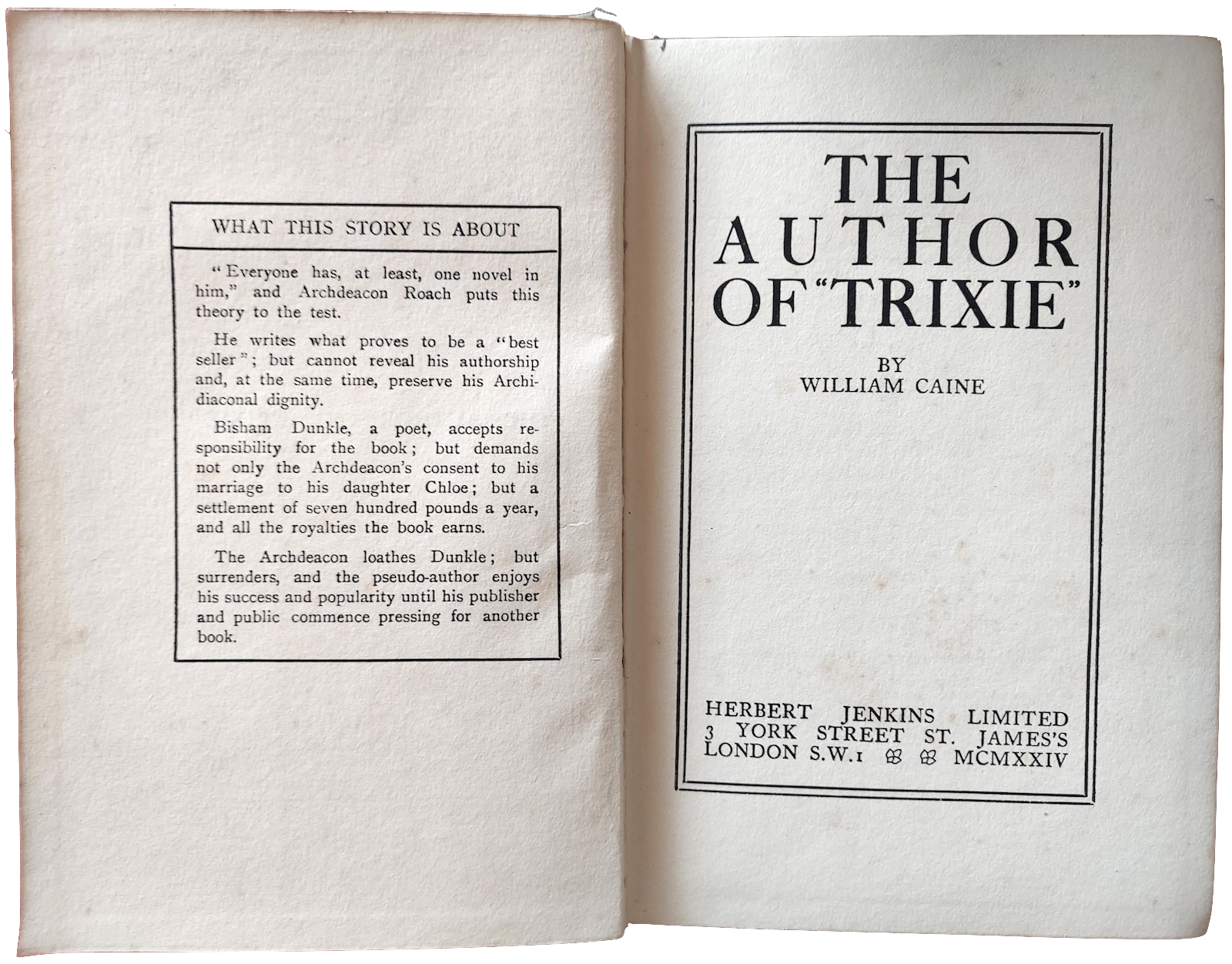
And followed it up with his own rather erroneous synopsis of the remainder of Caine’s novel:WHAT THIS STORY IS ABOUT
“Everyone has, at least, one novel in him,” and [the] Archdeacon Roach puts this theory to the test.
He writes what proves to be a “best seller”; but cannot reveal his authorship and, at the same time, preserve his Archidiaconal dignity [or hope for preferment to a Bishopric].
Bisham Dunkle, a poet, accepts responsibility for the book; but demands not only the Archdeacon’s consent to his marriage to his daughter Chloe; but a settlement of seven hundred pounds a year, and all [of] the royalties the book earns.
The Archdeacon loathes Dunkle; but surrenders, and the pseudo-author enjoys his success and popularity until his publisher and public commence pressing for another book.
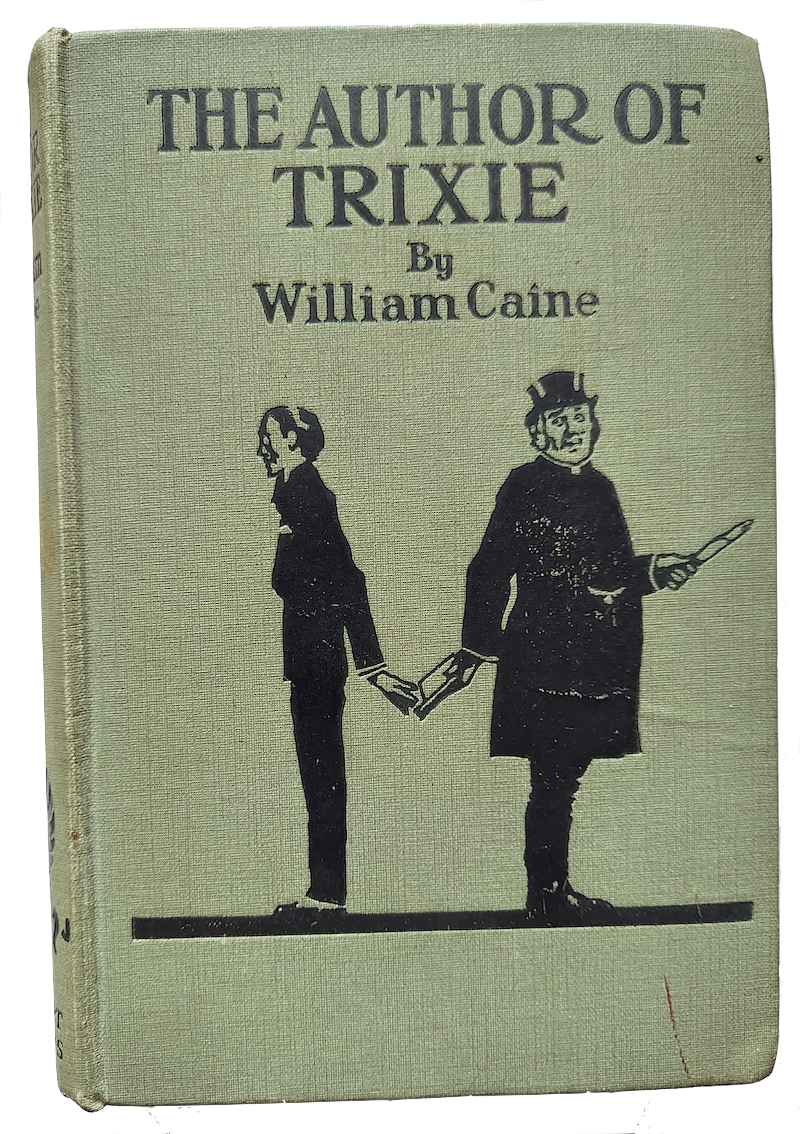
Poetaster Dunkle and Chloe quickly run through their new wealth and scheme to force her father to write a second book to be credited to Dunkle. If he refuses, they will expose him as the author of “Trixie.” The new book is soon ready but the Archdeacon decides that whatever the cost he wants the glory of authorship for both “Trixie” and the new work. The young couple, whose scheming is now taken over by Chloe, an even nastier number than her husband, agree to the author’s demands but plot to steal the manuscript and have the Archbishop hijacked to a three year trip on a South seas whaler (assuming he will cave in ere it happens). Archbishop [sic] and daughter exchange dastardly bluff and counterbluff until the matter is resolved when Trixie’s author is named a bishop and must choose between literary glory and ecclesiastic position. The novel is lightheartedly nasty and all good fun with “a happy ending”. (I am always bemused that the very idea of “a happy ending” is so alien to Russian readers that they use the English term “Hepi end” to describe it.)Judging by the numerous novels advertised at the back of “Trixie” the book’s publisher, Herbert Jenkins Limited, specialized in (very) light fiction — adventure, spy, murder mystery, and social comedy. The only “name” author, I recognize, is P.G. Wodehouse.
Nabokov’s use of Caine’s 1924 novel is instructive in another sense. In my investigations of VN’s readings of contemporary (to him) British literature, I tend to assume that his contact with current stuff largely ended when he returned to the Continent after finishing Cambridge in June 1922. Unless “Trixie” appeared in serial form prior to that date, VN must have read it in Germany. (There was a 1924 German translation, but it seems unlikely VN would have read it.)
As much as I would like to see some deeper thematic tie between “Trixie” and RLSK (and among the entire list of titles), I cannot. Nor do I find Caine’s novel to have much literary merit. It compares very badly with Norman Douglas’ 1917 “South Wind” a comic novel that also appears on Sebastian’s shelf and that Nabokov is known to have admired (Johnson 2003).
The Author of Trixie by William Caine (published in 1924, about forty years after the publication of the first Sherlock Holmes story), is a frivolous tale consisting of nugatory dialogues. In the course of the narrative a private detective is employed to find out whether a Mr. Roache [sic] has committed any misdemeanors during his life. Without any delay at all, the dectective [sic] has a long list with all Mr. Roache’s peccadillos enumerated. This is explained by the sleuth: “since I started this little business of mine . . . I have accumulated data, of one sort or another, relative to not less than sixty-five thousand ladies and gentlemen of position and means” (151–152). Mr. Silbermann seems to fit in a tradition of detectives who have a gift of producing the most unexpected information on whatever subject at the very moment that it is required (de Vries 2016: 141).More disappointing still, Priscilla Meyer dismissed The Author of “Trixie” as mere “college ephemera” (Meyer 2018: 48; see also Meyer & Trousdale 2013: 504), whatever that means. Flash forward a year and a half to December 2023, when I learn that a French translation of The Author of “Trixie” has been published under the typographically confusing title, Qui a écrit Trixie?. Apparently unwittingly on the part of the publisher Aux Feuillantines, the date of publication — October 17, 2023 — of their translation of what they mistakenly call Caine’s “dernier roman” coincides more or less with the centennial of the novel’s original publication — the last week of October 1923. Translator Hervé Lavergne in his Postface charts a path to Caine similar to my own — from list of books in The Real Life of Sebastian Knight, to his traduction of the quote from Boyd I have reproduced above, to buying his own exemplar of Caine’s novel, which he acquired from worldofbooksfr via Amazon for only €8.58.

William Caine, the author of this amusing book, was one of the most versatile Bohemians of his time; a clever novelist, a genius in extravaganza, a gifted sentimental writer. Had he done the same thing over and over all his life he would probably have achieved a fame which he did not covet.Those “natural impressions of a humorous mind” formed the basis of an exhibition which coincided with the publication of The Glutton’s Mirror:This “Glutton’s Mirror” is his first volume of drawings, a collection of burlesques which afforded him infinite amusement in the doing. Their originals were drawn mostly on the backs of menu cards while waiting the tardy service of Parisian dinners. He never studied art unless it was through the eyes of his friend, H. M. Bateman, with whom he was greatly associated. The book is one of natural impressions of a humorous mind (Graham 1925: 7).
The fact that the late William Caine, the novelist and short story-writer, was a humorous draughtsman and sculptor of considerable accomplishment was unknown at his death, even to his intimate friends. For the last three years, however, he had devoted much of his time to working out his whimsical ideas when living in France and Belgium, where most of his later writing was done. An exhibition of some of these original drawings, together with his bronze statuettes, will be opened at the Leicester Galleries on December 5 (The Graphic, November 28, 1925, p. 952).Caine, however, did, in a way, study art long before he met his friend Bateman. At the school he most likely attended both before and after his year or so at the Westminster School (see note 6 below), drawing was “a compulsory subject,” and praised as such by his father:
Mr. W. S. Caine, M.P., in distributing the prizes to the pupils of Manor House School, Clapham, last evening, remarked on the great importance of sound tuition in drawing. Looking back on his own school days he considered that the instruction he received in drawing had been of almost more benefit to him than anything he then learned. He was pleased to note that Mr. Maxwell made drawing a compulsory subject for all the pupils in his school. The object of such teaching was not merely to enable the pupil to draw pictures, but to train the eye to see and the mind to appreciate readily what came before it (“Mr. Mr. W. S. Caine, M.P., on Drawing,” The Pall Mall Gazette, December 19, 1884, p. 9).Lavergne, to get back to his Postface, favorably compares Caine with his far better-known and longer-lived fellow Herbert Jenkins author, P. G. Wodehouse (despite their similarities, Caine’s view of, for instance, the “social hypocrisy, generational conflict, political corruption, carnival of literary vanity, etc.” of the Roaring Twenties was “doubtless more lucid and crueler [sans doute plus lucide et cruel]” than that of Wodehouse); notes how Caine’s “formal inventions recall those of Laurence Sterne;” mentions that his father was a member of Parliament; mistakenly calls the “famous Baptist pastor,” Hugh Stowell Brown, “one of his uncles” — Brown was his mother’s father — and portentously ends with, “Despite these prestigious influences, Caine has slipped into the bog of oblivion [est passé à la trappe], and without the lifeline tossed him by Nabokov — audaciously betting on the intermediary of myself and Amazon [en misant avec audace sur mon truchement et sur celui d’Amazon] — he would perhaps have been swallowed up [disparu] forever” (Lavergne 2023: 183). Caine himself supposedly summed up his career up to January 1918 as follows:
I was called to the bar and practiced for seven years with complete lack of success. This is to be attributed to two causes. First, I can not speak in public, and second, I can not understand law. I did not begin to write seriously until I was thirty, and even then I wrote frivolously. Some of my short stories were collected into a book. It may now be bought second-hand.That book into which “some of [his] short stories were collected” was apparently Pilkington. Given, however, that the “stories” all involve a single character, Pilkington, and are unified by a chronological narrative arch, I believe that Pilkington has as much claim to being called a novel as does, say, Nabokov’s Pnin. Be that as it may, in 1934, P. G. Wodehouse included two stories by Caine in an omnibus collection he edited, A Century of Humour. Those stories are “Spanish Pride” and “The Elegant Ethiopium,” neither of which makes for a very compelling, or even particularly humorous, introduction to Caine; the latter story, even, will likely lead the Caine rookie to think that Nabokov should not have tossed that lifeline after all. Nor does Wodehouse’s biographical blurb serve to dispel the begrudging, dissuasive, almost contemptuous mood with which it seems Caine was included in the anthology:
After leaving Oxford William Caine studied for the Bar, but soon forsook the law for journalism and literature. His work was distinguished for its versatility and warm human sympathy, and he was at his best in a light vein. He was an enthusiastic fisherman and a comic artist of no little skill (Wodehouse 1934: 521).But then again, Wodehouse’s choice is evidence of Wodehouse’s taste, and as an obituary in The Oxford Chronicle put it, Caine’s “main gift was that of a freakish humour, which he was successful in adapting to popular tastes.” Another caveat occurs in a notice penned by someone known as “The Tramp” (whom I’ve already partially quoted in the previous chapter) on the occasion of a posthumous exhibition of Caine’s visual art at the Leicester Galleries:
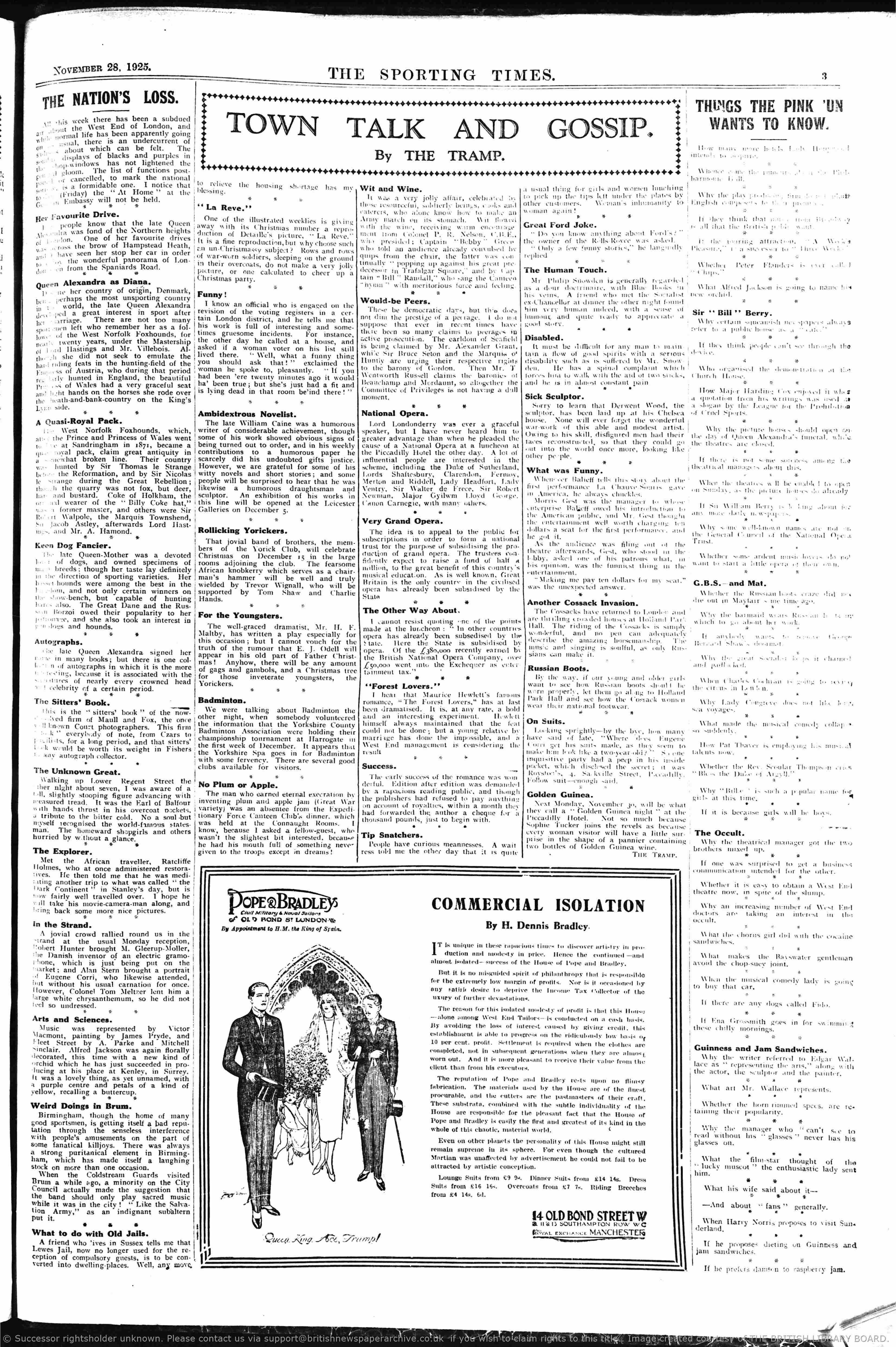
The late William Caine was a humorous writer of considerable achievement, though some of his work showed obvious signs of being turned out to order, and in his weekly contributions to a humorous paper he scarcely did his undoubted gifts justice. However, we are grateful for some of his witty novels and short stories; and some people will be surprised to hear that he was likewise a humorous draughtsman and sculptor. An exhibition of his works in this line will be opened at the Leicester Galleries on December 5 (“Town Talk and Gossip, by The Tramp; Ambidextrous Novelist,” The Sporting Times, November 28, 1925, p. 3).And perhaps the dissuasive contempt I too hastily attributed to Wodehouse was really a manifestation of the “breezy modesty” he apparently shared with Caine. Agnes Platt, in her memoir, Anonymous, 1871–1935, intriguingly but briefly recalled the similarities she saw between Caine and Wodehouse, as well as between the founder of the PEN Club, Catherine Amy Dawson Scott, and the bumbling five-year-old protagonist of one of Caine’s books (which I explore more fully in § 6 and parts of § 4):
I liked Mrs. Dawson Scott, but I had to run away from her myself; she exhausted me. Her exuberant vitality left me limp; I was constantly reminded of the title of William Caine’s hilarious book, But She Meant Well. Given the difference in age, there was decidedly a resemblance between Mrs. Dawson Scott and his small heroine. I grieved at William Caine’s death; charming man and valuable writer, his books, too few in number, rival Wodehouse’s as mirth provokers. Wodehouse too has the same type of breezy modesty (Platt 1936: 299).A year before Nabokov began writing The Real Life of Sebastian Knight in Paris, Coronet, a monthly based in Chicago, published in its June 1938 issue a selection of Caine’s illustrations from the aforementioned Glutton’s Mirror, introducing them thus:
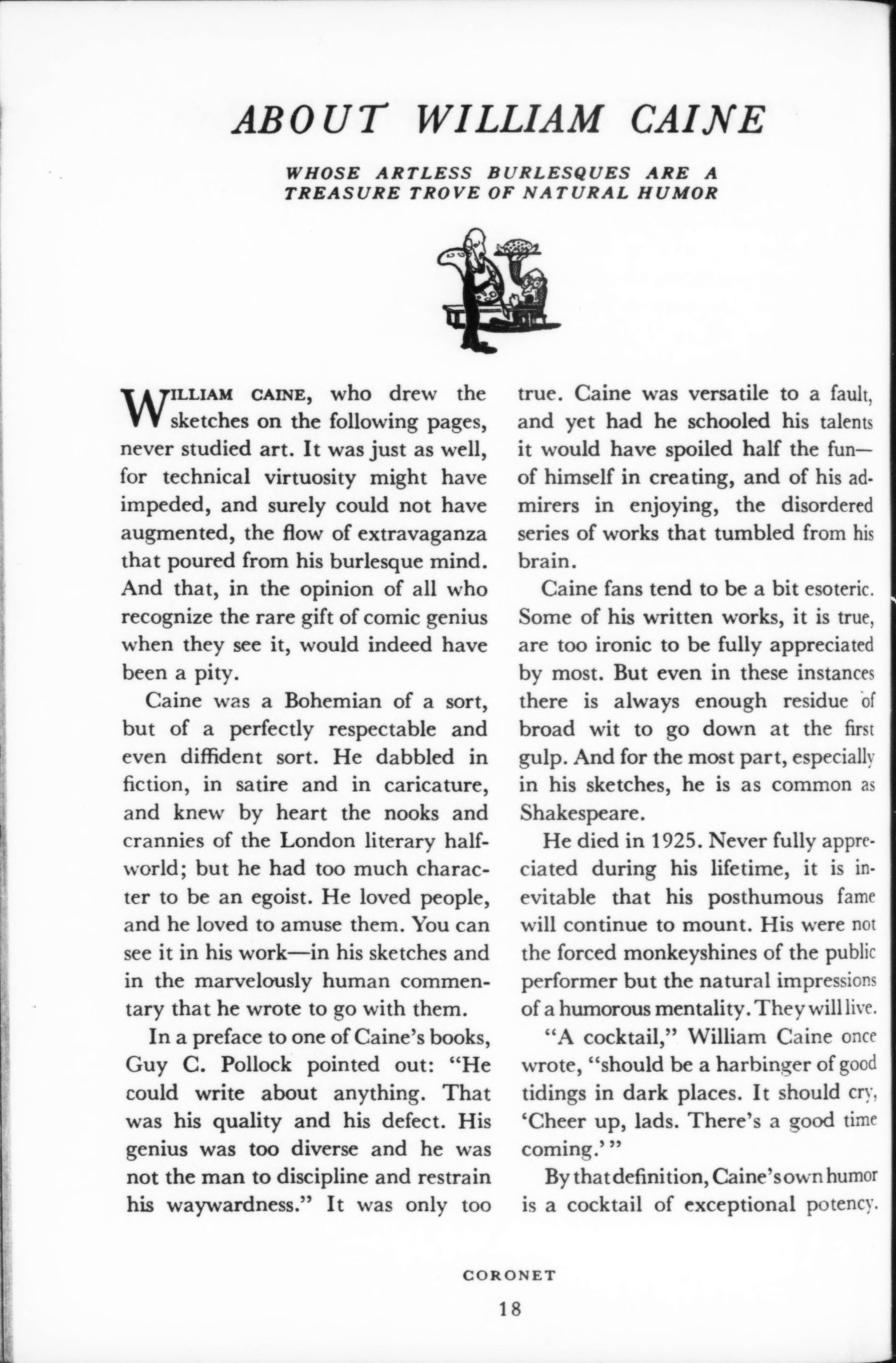
William Caine, who drew the sketches on the following pages, never studied art. It was just as well, for technical virtuosity might have impeded, and surely could not have augmented, the flow of extravaganza that poured from his burlesque mind. And that, in the opinion of all who recognize the rare gift of comic genius when they see it, would indeed have been a pity.Apropos of that “flow of extravaganza that poured from his burlesque mind.” In an essay entitled “Extravaganza,” Stephen Graham wrote:Caine was a Bohemian of a sort, but of a perfectly respectable and even diffident sort. He dabbled in fiction, in satire and in caricature, and knew by heart the nooks and crannies of the London literary half-world; but he had too much character to be an egoist. He loved people, and he loved to amuse them. You can see it in his work — in his sketches and in the marvelously human commentary that he wrote to go with them.
In a preface to one of Caine’s books [the posthumous Fish, Fishing & Fishermen (1927)], Guy C. Pollock pointed out: “He could write about anything. That was his quality and his defect. His genius was too diverse and he was not the man to discipline and restrain his waywardness.” It was only too true. Caine was versatile to a fault, and yet had he schooled his talents it would have spoiled half the fun — of himself in creating, and of his admirers in enjoying, the disordered series of works that tumbled from his brain.
Caine fans tend to be a bit esoteric. Some of his written works, it is true, are too ironic to be fully appreciated by most. But even in these instances there is always enough residue of broad wit to go down at the first gulp. And for the most part, especially in his sketches, he is as common as Shakespeare.
He died in 1925. Never fully appreciated during his lifetime, it is inevitable that his posthumous fame will continue to mount. His were not the forced monkeyshines of the public performer but the natural impressions of a humorous mentality. They will live.
“A cocktail,” William Caine once wrote, “should be a harbinger of good tidings in dark places. It should cry, ‘Cheer up, lads. There’s a good time coming.’”
By that definition, Caine’s own humor is a cocktail of exceptional potency (“About William Caine; Whose artless burlesques are a treasure trove of natural humor,” Coronet, June 1938, p. 18).
Another very amusing extravaganza, and perhaps the cleverest book that William Caine ever wrote, was ‘The Strangeness of Noel Carton.’ It was awarded a critics’ prize, not that that amounted to much, but it showed in a way that it was a literary man’s book and a literary man’s great laugh. A husband who is being kept on a short allowance by his mean rich wife conceives the horrible idea of revenge of writing a novel secretly and putting his wife into it. The unhappy husband is being driven crazy by his wife, and as the writing of his story progresses he gradually goes out of his mind and begins to confuse fiction and truth in a startling but extremely diverting way. Here extravaganza has complete sway. I remember well one of the poor man’s expressions of connubial boredom: ‘I know that she knows and she knows that I know that she knows and I know that she knows that I know that she knows,’ etc.Caine, of course, was not born in the Isle of Man… Nor was Noel Carton’s wife necessarily mean… Nor is the “man-eating temperance” advocate in Great Snakes! the aunt of the “English dude drunkard” in said novel… But let me return to and quote more fully what Priscilla Meyer has written about that list of books in Nabokov’s The Real Life of Sebastian Knight:And what more astonishingly diverting than the account of the husband’s attempted doubling on his tracks to escape at Paddington Station?
Noel Carton ought to live long. Then there is that excruciatingly funny story of an English dude drunkard and his man-eating temperance aunt — Great Snakes.’ I suppose innumerable copies of that literary joke were sold at least in England. Then one ought to mention ‘Boom’ and ‘Bildad the Quill-driver’ and ‘The Author of Trixie,’ all sheer gifts to the educated gloomy, made to drive away their blues.
It is, however, all very English, though I believe Caine was born in the Isle of Man (Graham 1930: 116–117).
The list combines canonical British writers (Shakespeare, Malory), modernist fiction (Joyce), popular authors Nabokov admired (Stevenson, Wells, Carroll), a few major Europeans (Flaubert, Proust), and college ephemera like The Author of Trixie; the list conveys a sense of Sebastian’s university life through literature, and simultaneously creates a miniature history of English fiction (Meyer 2018: 48).And juxtapose it with a short piece Caine published in the London Daily Chronicle in 1924:
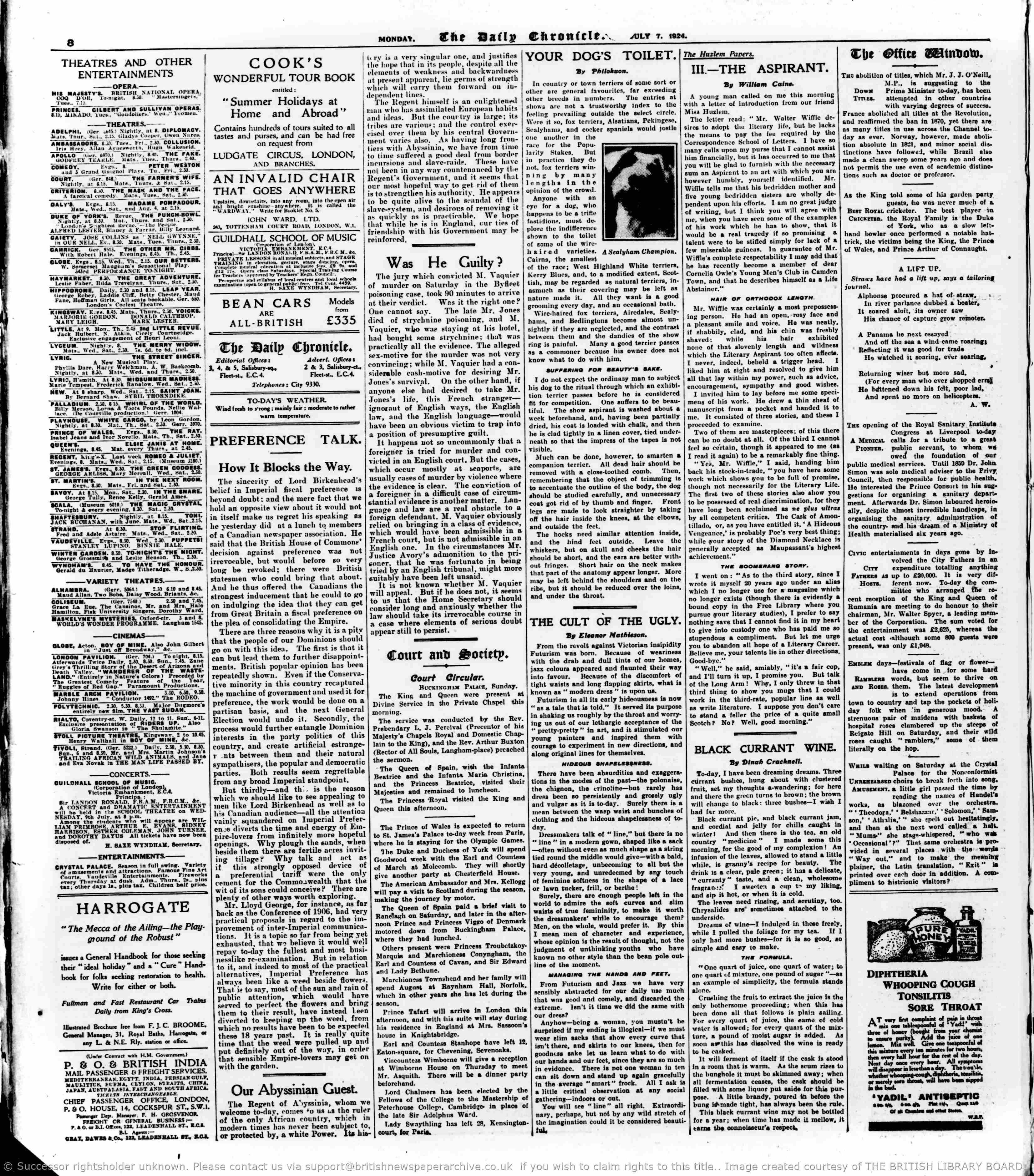
A young man called on me this morning with a letter of introduction from our friend Miss Huzlem.In the same chapter of Nabokov’s novel in which Caine’s novel is mentioned, the narrator writes:The letter read: “Mr. Walter Wiffle desires to adopt the literary life, but he lacks the means to pay the fee required by the Correspondence School of Letters. I have so many calls upon my purse that I cannot assist him financially, but it has occurred to me that you will be glad to furnish with the necessary sum an Aspirant to an art with which you are[,] however humbly, yourself identified. Mr. Wiffle tells me that his bedridden mother and five young bedridden sisters are wholly dependent upon his efforts. I am no great judge of writing, but I think you will agree with me, when you have seen some of the examples of his work which he has to show, that it would be a real tragedy if so promising a talent were to be stifled simply for lack of a few miserable guineas. In guarantee of Mr. Wiffle’s complete respectability I may add that he has recently become a member of dear Cornelia Owle’s Young Men’s Club in Camden Town, and that he describes himself as a Life Abstainer.”
hair of orthodox length.
Mr. Wiffle was certainly a most prepossessing person. He had an open, rosy face and a pleasant smile and voice. He was neatly, if shabbily, clad, and his chin was freshly shaved: while his hair exhibited none of that slovenly length and wildness which the Literary Aspirant too often affects. I never, indeed, beheld a trigger head. I liked him at sight and resolved to give him all that lay within my power, such as advice, encouragement, sympathy and good wishes.
I invited him to lay before me some specimens of his work. He drew a thin sheaf of manuscript from a pocket and handed it to me. It consisted of three stories, and these I proceeded to examine.
Two of them are masterpieces; of this there can be no doubt at all. Of the third I cannot feel so certain, though it appeared to me (as I read it again) to be a remarkably fine thing.
“Yes, Mr. Wiffle,” I said, handing him back his stock-in-trade, “you have here some work which shows you to be full of promise, though not necessarily for the Literary Life. The first two of these stories also show you to be possessed of a real discrimination, for they have long been acclaimed as ne plus ultras by all competent critics. The Cask of Amontillado, or, as you have entitled it, ‘A Hideous Vengeance,’ is probably Poe’s very best thing; while your story of the Diamond Necklace is generally accepted as Maupassant’s highest achievement.”
the boomerang story.
I went on: “As to the third story, since I wrote it myself 20 years ago under an alias which I no longer use for a magazine which no longer exists (though there is evidently a bound copy in the Free Library where you pursue your literary studies), I prefer to say nothing save that I cannot find it in my heart to give into custody one who has paid me so stupendous a compliment. But let me urge you to abandon all hope of a Literary Career. Believe me, your talents lie in other directions. Good-bye.”
“Well,” he said, amiably, “it’s a fair cop, and I’ll turn it up, I promise you. But talk of the Long Arm! Why, I only threw in that third thing to show you mugs that I could work in the third-rate, popular line as well as write literature. I suppose you don’t care to stand a feller the price of a quite small Scotch? No? Well, good morning” (“The Huzlem Papers; III. — The Aspirant,” Daily Chronicle, Monday, July 7, 1924, p. 8).
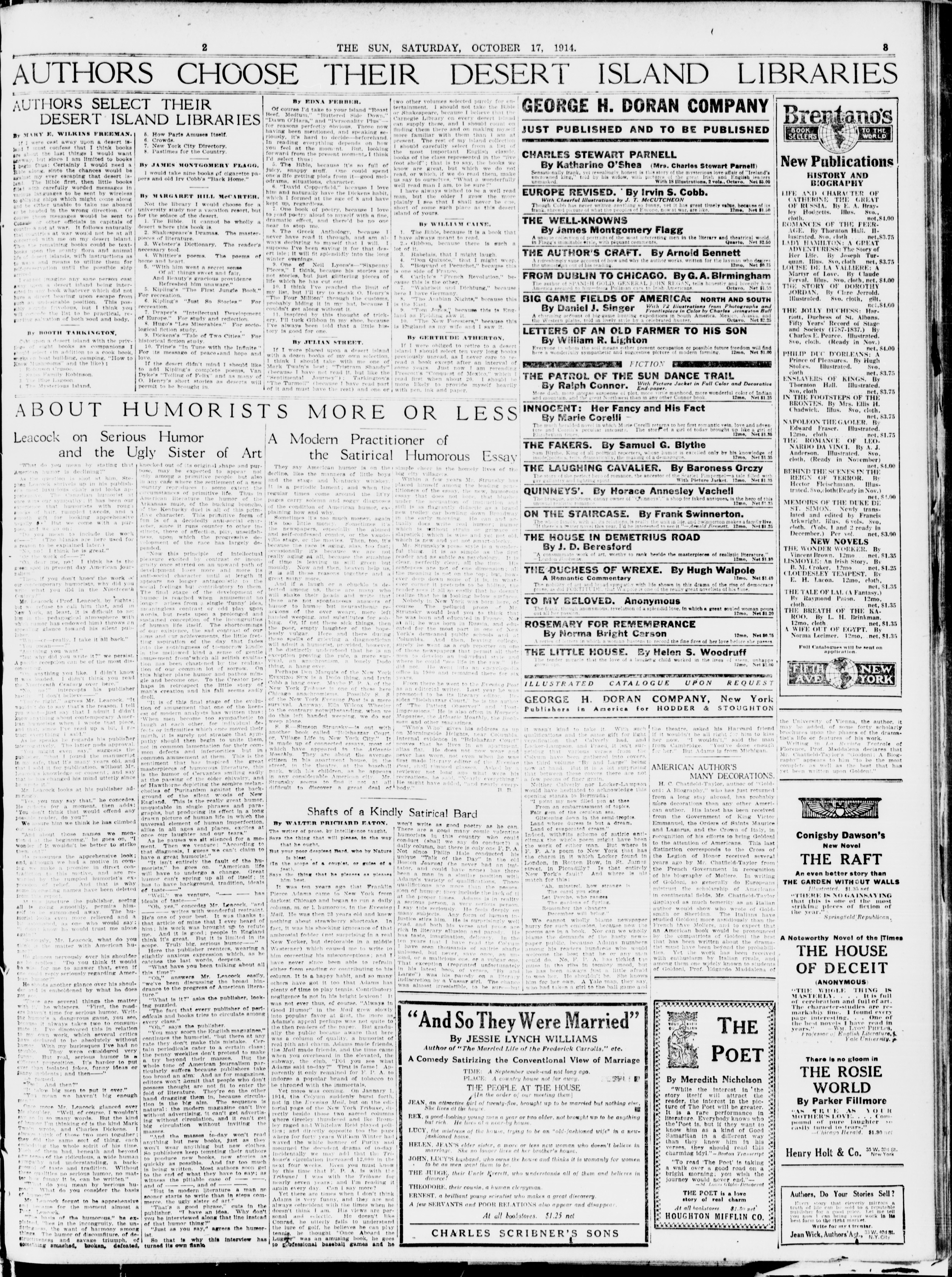
I would never have let him [Sebastian Knight] see the least sentence of this book lest he should wince at the way I manage my miserable English. And wince he would. Nor do I dare imagine his reactions had he learnt that before starting on his biography, his half-brother (whose literary experience had amounted till then to one or two chance English translations required by a motor-firm) had decided to take up a “be-an-author” course buoyantly advertised in an English magazine. Yes, I confess to it, — not that I regret it. The gentleman, who for a reasonable fee was supposed to make a successful writer of my person, — really took the utmost pains to teach me me to be coy and graceful, forcible and crisp, and if I proved a hopeless pupil — although he was far too kind to admit it, — it was because from the very start I had been hypnotised by the perfect glory of a short story which he sent me as a sample of what his pupils could do and sell (Nabokov 1941, 1968: 34–35; Nabokov 1996a: 26).I may, perhaps, in a subsequent chapter, touch on certain elements of that “perfect glory of a short story” and how they may or may not relate to ditto in some works by Caine. For now I would like to start to bring the last quarter or so of this chapter to a close — all the while mulling over a comparison of Nabokov’s “miserable English” and “‘be-an-author’ course” with a “reasonable fee” with Caine’s “Correspondence School of Letters” whose required fee cannot be paid “simply for lack of a few miserable guineas” — with another list of books, to wit: In October 1914, the New York Sun asked authors to choose their desert island libraries. Caine’s list went as follows:
1. The Bible, because it is a book that I have always meant to read.
2. Gibbon, because there is such a lot of it.
3. Rabelais, that I might laugh.
4. “Don Quixote,” that I might weep.
5. “Bouvard et Pecuchet,” because this is one side of France.
6. Carlyle’s “French Revolution,” because this is the other.
7. “Wahrheit und Dichtung,” because here I have Germany.
8. “The Arabian Nights,” because this is the East.
9. “Tom Jones,” because this is England as Fielding saw it.
10. “The New Foresters,” because this is England as my wife and I saw it. (“Authors Choose Their Desert Island Libraries,” The Sun, Saturday, October 17, 1914, sect. 2, p. 3).
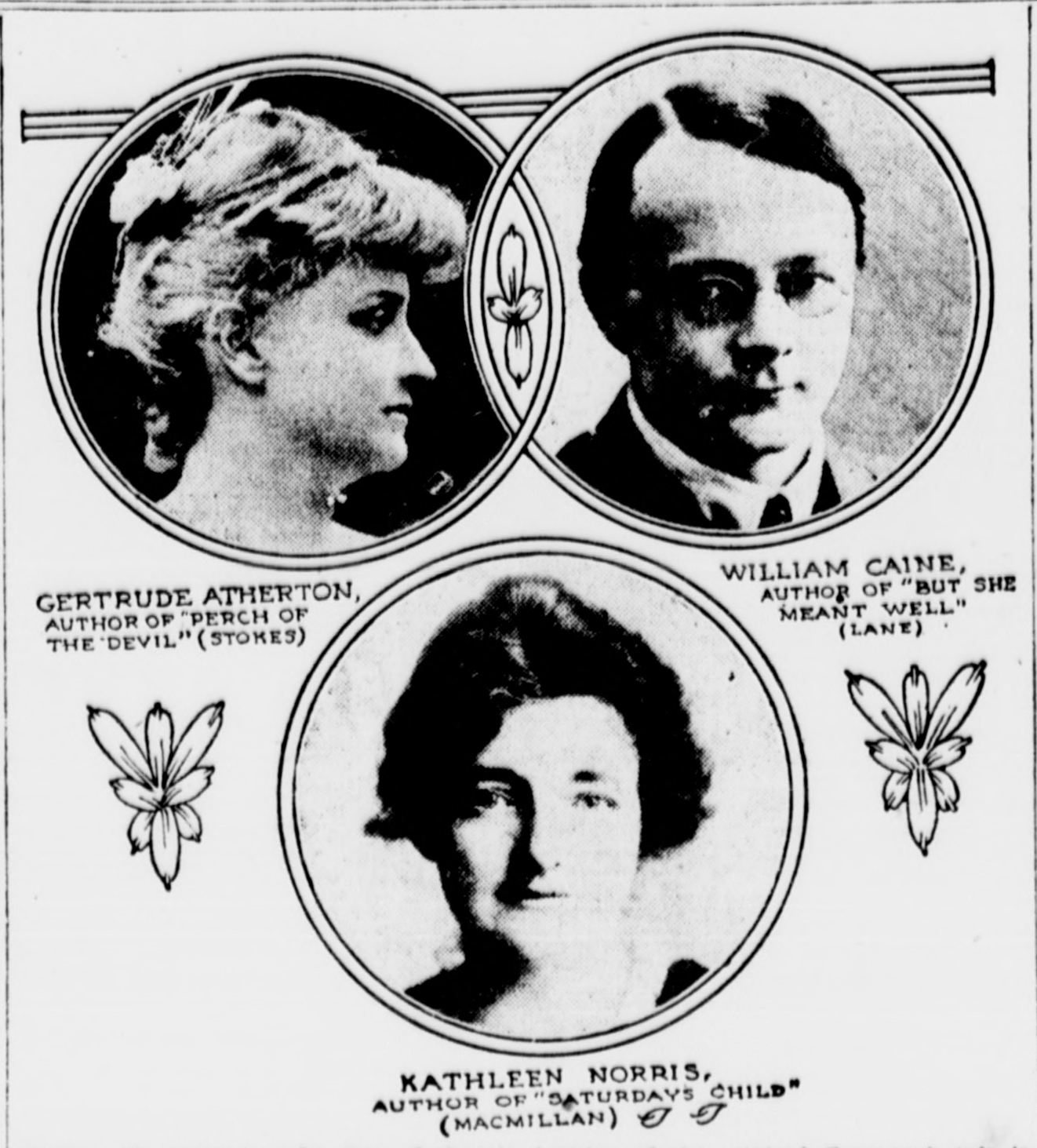
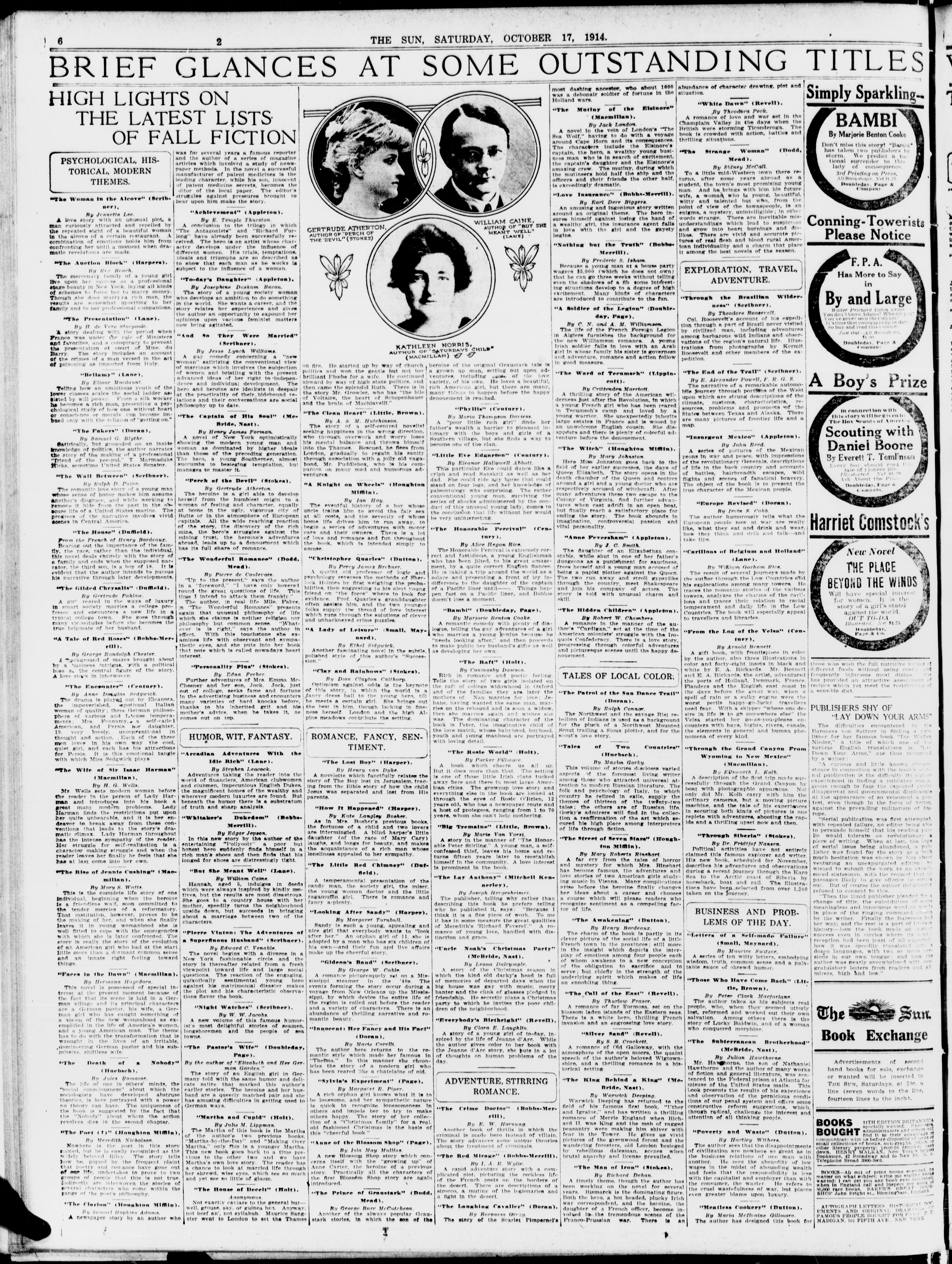
Reproduced from The Sun (New York), Saturday, October 17, 1914, sect. 2, p. 6.
I received a liberal education. I went to two schools and two Universities. I have had in my time four private tutors and two coaches. I am a B.A., Oxon. I stood high among the Fourth Class in the History Honours Schools. I have been treated with disdain by Jowett. I have spent eighteen months in a solicitor’s office. I am a barrister-at-law. I daresay it cost my father a couple of thousand pounds to equip me for the struggle to exist (“An Elastic Problem,” Daily Chronicle, Thursday, May 1, 1924, p. 8).And that, when he was seven to nine years old, his governess Miss Bennett “paid great attention to our arithmetic and French” (Colman n.d.: 11), and that both French and German, in addition to Greek and Latin, seem to have been included in the regular curricula of the two public schools he attended — the Westminster School and the Manor House School, Clapham — I think it is fair to say that the author of The Author of “Trixie” could read French and German, and quite possibly Spanish too. This impression seems to be confirmed by a couple obituaries that mention that Caine “was also something of a scholar.” Also, there is his story, “Un Jeu pour les Fous,” about a Frenchman trying to play curling, written in French and published in Punch in January 1907, and his “English Spoken” published in that same weekly in September 1907 and which requires the ability to at least read French in order to get the punchline, as well as the fact that in 1916 he translated Edmond Carton de Wiart’s article about la Commission de ravitaillement de la Belgique (the Commission for Relief in Belgium), “La ‘C.R.B.,’” for inclusion in A Book of Belgium’s Gratitude (Cammaerts and Davignon 1916: 109–114; Caine’s translation is on pages 115–120). Furthermore, in a way similar to how Priscilla Meyer thinks that the list of books in Nabokov’s novel can give the reader entrée into “Sebastian’s university life through literature,” could the little library Caine would take with him to a desert island shed any light on the development of the author of The Author of “Trixie”? For instance, Caine implied that he had not yet read the Bible, yet Zerubbabel, the name of the “Elegant Ethiopium” in the second story collected in Wodehouse (1934: 532–542), seems to be rather Biblical — and his middle sister Dorothea recounted:
Father also read a good deal of the Bible to us and made many Old Testament characters very living. He had a very pleasant voice and his articulation was perfect. He considered that the Bible was a book about real people, lifelike, not to be treated as sacrosanct, but imperfect in some ways like ourselves. He never read in a “holy voice”. He encouraged us to read good literature when we could understand it, which was early in our young lives, and we read for ourselves the works of Scott, Thackeray, Dickens, Hardy and other standard fiction. We could browse as we liked among the many books in the house, one or two by Ouida and others, which he called “too strong meat” for us, being forbidden till we were older (Colman n.d.: 7–8).Moreover, in one of his earliest published pieces, “Recollections of a St. Andrews Man” (Macmillan’s Magazine, November 1904), Caine belies the very reason he included the Bible in his list (see § 11). Furthermore, why, to invoke another for instance, did Caine choose Flaubert’s posthumously published and lesser known Bouvard et Pécuchet, rather than the more well known Madame Bovary or L’Éducation Sentimentale? Why Goethe’s Dichtung und Wahrheit rather than Faust or Wilhelm Meisters Lehrjahre or Die Wahlverwandtschaften? Obviously for reasons more complex than what either has to say about France or Germany. And I also wonder: Did the metathesis he perpetrated on Goethe’s title reflect Caine’s knowledge that this was how his fellow lawyer-turned-writer often referred to his autobiography — in the opening sentence of which, moreover, he would have learned of their shared birthday? Apropos: Did he, Caine, know that Rabelais was the favorite author of a writer who was born across the Channel in Laval eleven days after he, Caine, was born in Liverpool — Alfred Jarry (who was also, to borrow Wodehouse’s words, “an enthusiastic fisherman”)? And the reason Caine gives for ending his list with an ostensible travelogue, replete with fictional, even fantastic elements, of a tour which he and his wife made with a donkey through the New Forest — “because this is England as my wife and I saw it” — it seems to me that there is perhaps something significant in that “my wife and I.” In any case, Caine’s list, with its understated logic, is a model of lightness, quickness, exactitude, visibility, multiplicity, and perhaps even consistency — three-quarters of a century before Italo Calvino championed these literary virtues in his Six Memos for the Next Millennium. And if there’s one thing — should I call it a thesis? a theme? — I hope to show in this biobibliographical examination of the lesser known Caine, it is that these virtues permeate all his books, from the first, Pilkington (1906), to the last, Lady Sheba’s Last Stunt (1924) (or, if you count the posthumous, The Glutton’s Mirror [1925], or, why not, Smoke Rings [1926]) — and if only — but surely not only — for this reason does the author of The Author of “Trixie” deserve to be rescued from the quagmire of obscurity into which posterity, unjustly or not, has caused him to stumble. Speaking of which, one of the English curiosities which Caine and his wife encountered on their travels with Jack the donkey in the New Forest was a “quag:”
Here is a more adventurous journey which we made from Emery Down; you must certainly attempt it while you are there. I can’t promise you that it will fall out with you exactly as it did with us; but you are sure to be glad you have done it.We took the Minstead Road and held it till it came out on to the heath beyond the gates of Minstead Manor. Here a track led off a little to the left and went over grass till, turning more sharply to the left, it dropped down a short hill and crossed a trickle of water. Here a hill faced us and this we climbed, turning neither to the right nor to the left. We saw presently the fence of the Highland Water Inclosure on our right. We left the first gate alone, but we went through the next one (there were big beeches on our left hand here) and found a grass track which took us right down into fir plantations.
Then down a great green street where, every ten paces, a swarm of harmless midges danced its gay sun-dance, careless of the night, we moved for ever so long in our established procession of three. Right and left of us opened the lesser thoroughfares of the tree-town which we were invading, each as solemn, as quiet, as sun-drenched as the one before. Firs, firs and again firs. For a few yards, in among their close stems, golden gleams, red gleams; beyond lay the shadows and the serried pillars. If a yaffle halloaed it was as much as we heard from the wood people for many minutes at a time. The gentle creaking of the cart, the light dainty tread of the ass’s little feet, served only to make the silence audible. We were too much impressed to sing, even to speak. I for one was glad of my company and not wholly on the usual account. The awe of the forest was upon me.
All at once Jack halted. To such an event I was not, as you can understand, altogether unused, nor for it was I ever unprepared. Mechanically I urged him forwards with club and voice, for his dilatory ways have always the power to dispel any sensation from my bosom that at all approaches the poetical. I smote him on the rump and “H-rrr-rrp!” I cried. Having made his protest the good beast resigned himself to his doom, moved forward, sank, plunged, struggled another step onwards and downwards and came to a complete standstill — bogged. The wheels were in it up to the hubs; Jack to his belly (NF: 98–98).
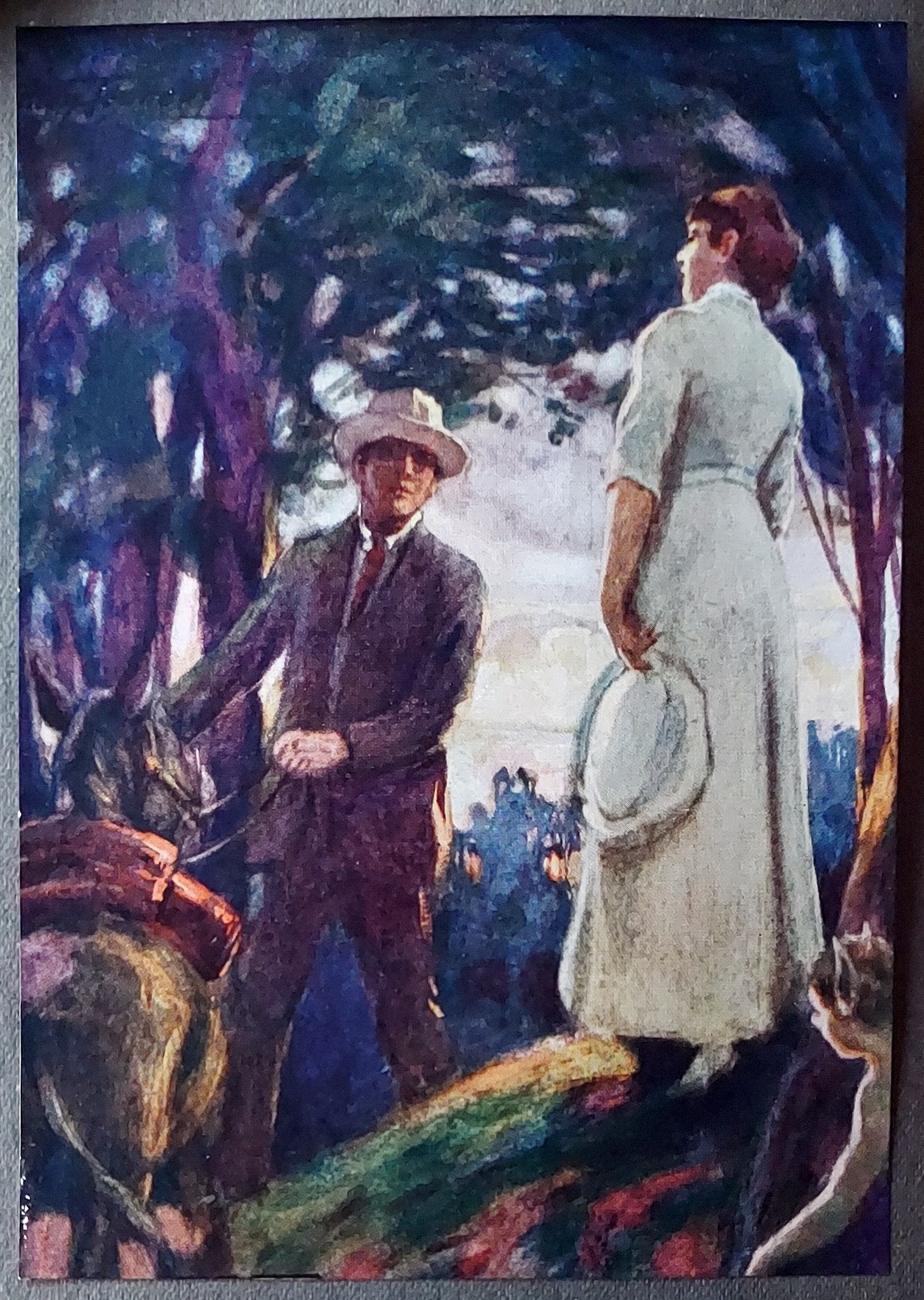
Dudley Tennant’s “coloured frontispiece” for Caine’s The New Foresters (June 1913). Note, in the lower right foreground, Charles, “a young faun, about the size of a six-year-old child.”
When he had eaten his fill he took a squint at the sun, now declining, and said, “’Ee’d best be getting home-along, I rackon. ’Tis a figherish way to the road and then ’tis a smartish step to Emery Down. I’ll just get thate air cart and donkey out fer ’ee, though.”The way Caine and his wife saw England in The New Foresters could perhaps be characterized with the term “magical realism,” or perhaps with the terms H. J. Massingham used to characterized “a number of novelists who refuse to be classified:”“Good!” I said, “and how are you going to do it?”
“Ah,” he said, “but that’s what ’ee musn’ see.”
“And Susan?” I asked.
“Susan nuther,” he replied firmly. “’Tis a wonder I be gwine t’do. So just lay down, then, the two of ’ee, and cover eyes till I say the word. Won’t kape ’ee long.” He grinned and winked and fingered his pipes.
He looked so very important and mysterious and altogether so like a little boy who is going to perform a conjuring-trick with a sixpennorth of apparatus bought at Hamley’s, that we were constrained to obey. We lay down and covered our eyes. Then we heard the seductive music of this faunlet; there followed a rustling and a crackling and the voice of Charles giving orders, with authority but quite unintelligibly. We heard the cart rise from the mud with a squ-u-u-u-u-sh, we heard Jack do the same and also bray in alarm; then Charles cried, “’Tis done,” and I looked up just in time to see four young firs slipping back into their places near the wood’s edge. My wife saw them too, so there can be no doubt about it.
As for the donkey and cart they stood on the far side of the quag, muddy enough but saved (NF: 103–104).
There are two definite types of novel being written to-day in England — the popular type and the more ambitious type of the younger generation. Outside of these groups, there are a number of novelists who refuse to be classified and are inclined to look at the Here and Now with their heads on one side — Conrad and Belloc of course — Chesterton, Rose Macaulay (who has a bright eye), Miss Delafield, William Caine (for whom I have a large partiality), May Sinclair, Lord Dunsany, James Stephens, E. M. Forster (a very fine, subtle, profound, and shamefully neglected novelist), and a few others I can’t remember at the moment, work with paint and not a camera (Massingham 1919: 200–201).Posterity, of course, has radically reversed Massingham’s parenthetical identities. While readers today might not necessarily have “a large partiality” for E. M. Forster, many have at least heard of him; it is his fellow Reform Club–mate Caine who turns out to be, not only lesser known, but so “shamefully neglected” as to risk being beyond the help of even wonder-working pan-piping faunlets and magical young firs to pull him from the quag of oblivion.
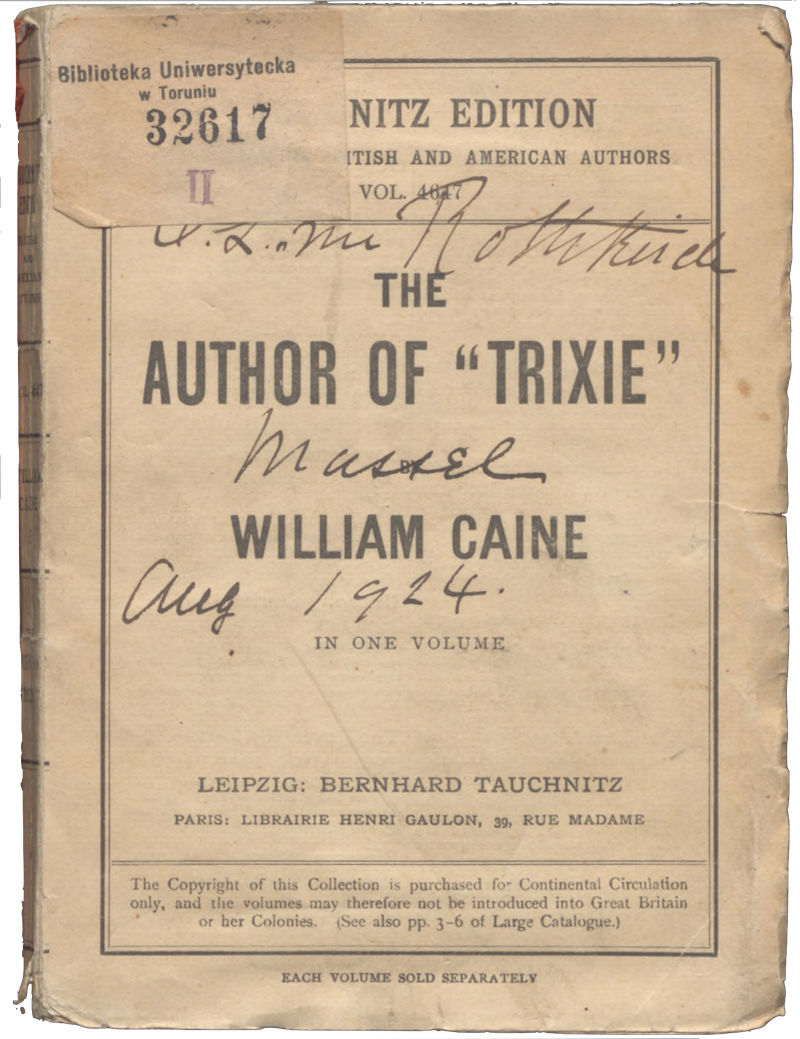
- 1924 German translation. — According to the Katalog der Deutschen Nationalbibliothek, the translation was published in 1928. The Author of “Trixie” was, however, published in August 1924 as volume 4647 in Bernhard Tauchnitz’s Collection of British and American Authors, a copy of which, from Biblioteka Uniwersytecka w Toruniu, was uploaded to the Internet Archive on May 29, 2024. Whoever originally owned this exemplar wrote, in pencil on the half-title, what looks like: “A most amusing little tale from a [undecipherable: droll author?] but just a little too unlikely daughter!” As books in the Tauchnitz series were on sale throughout Europe, especially in train stations, Nabokov could have read Caine’s novel — indeed, given how much he traveled in France, Germany, and elsewhere after he left Russia, it seems very likely that he did read it — in Berlin or Paris or just about anywhere else before he left le Vieux Continent for America aboard the Champlain in May 1940. As to whether the reader should imagine the copy on Sebastian Knight’s bookshelf as being the green hardcover Herbert Jenkins version or the tan softcover Bernhard Tauchnitz version — well, that is for the reader to imagine.
- Summed up his career. — Quoted in “Gossip of Books and Authors,” The Argonaut (San Francisco), January 19, 1918, p. 40.
- Obituary in The Oxford Chronicle. — “University Pages; For Dons, Undergraduates, & Citizens; Items,” The Oxford Chronicle, Friday, October 16, 1925, p. 15.
- Agnes Platt. — Playreader; theatrical producer; translator from the German, Norwegian, and Russian; improver and suggester of plots (see her ads in the Christmas 1926 supplement to The Bookman, p. 133); author of Practical Hints on Playwriting, Practical Hints on Training for the Stage, Practical Hints on Acting for the Cinema, and Telling the Truth: Inner Secrets of the Stage, as well as her memoirs, Anonymous, 1871–1935; see also Haddon (1922: 97–99) and Luckhurst (2006: 56; 73, n42).
- Caine’s father’s sister. — “He married Alice Chibnell Sirett, his first wife, in 1848, whom he met during his apprenticeship at Wolverton. She died in 1863; she was the mother of all his children. He afterwards married my sister, Phoebe Caine, who died in 1884, after a long and painful illness” (W. S. Caine 1887: xi). Hugh Stowell Brown was thus both father-in-law and brother-in-law of the father of the author of The Author of “Trixie”.
- Regular curricula of the two public schools. — Caine seems to have studied at the Westminster School as a homeboarder for only a little more than a year, from September 24, 1885, until December 1886 (Online Catalogue for Westminster School’s Archive & Collections; People & Organisations; Caine, William, 1873-1925 [http://collections.westminster.org.uk/index.php/caine-william-1873-1925]; this same source also states that Caine matriculated at Oxford on October 15, 1892, that he was called to the bar at the Middle Temple on November 17, 1897, and that he was born July 14 [sic], 1873). Thus, it seems that he attended the Manor House School, Clapham (Who’s Who 1922: 421; 1923: 428; 1924: 438; 1925: 445; 1926: 448), after leaving Westminster; that is, from, say, January 1887 till he went to the University of St. Andrews in 1889, when he was sixteen (Anderson 1905: 276). Yet, given that the aforecited Online Catalogue for Westminster School’s Archive & Collections incorrectly gives Caine’s date of birth as July 14, perhaps the leaving date of 1886 is also a typo, and should be 1889, and in reality Caine attended the Manor House School before going to the Westminster School? Of course, it’s also posible that he attended the Manor House School both before and after his year and a quarter or so at the Westminster School. As for the curriculum of which, see “London, Saturday, December 22, 1883,” The Times, Saturday, December 22, 1883, p. 9: “As the epilogue we printed yesterday testifies, music and drawing have been introduced into the regular course of Westminster. There and everywhere else modern history and geography are read diligently; French and German are learnt as well as they are commonly learnt in this country; and arithmetic and mathematics, which a generation back were treated as trivial accomplishments, have taken their place on a line, somewhat bent, with Greek and Latin.” And for that of the Manor House School, Clapham, see the advertisement in the Cambridge Weekly News, Saturday, January 10, 1880, p. 4: “Besides the usual subjects, Greek, German, Natural Science, Drawing, Singing, and Swimming are included in the ordinary school fees.”
- Something of a scholar. — “The Lighter Side; A Professional Wit,” The Nottingham Evening Post, Saturday, September 5, 1925, p. 5; “Notes of the Day; William Caine,” Westminster Gazette, Saturday, September 5, 1925, p. 4.
- Reform Club–mate. — See § 13, note 1.