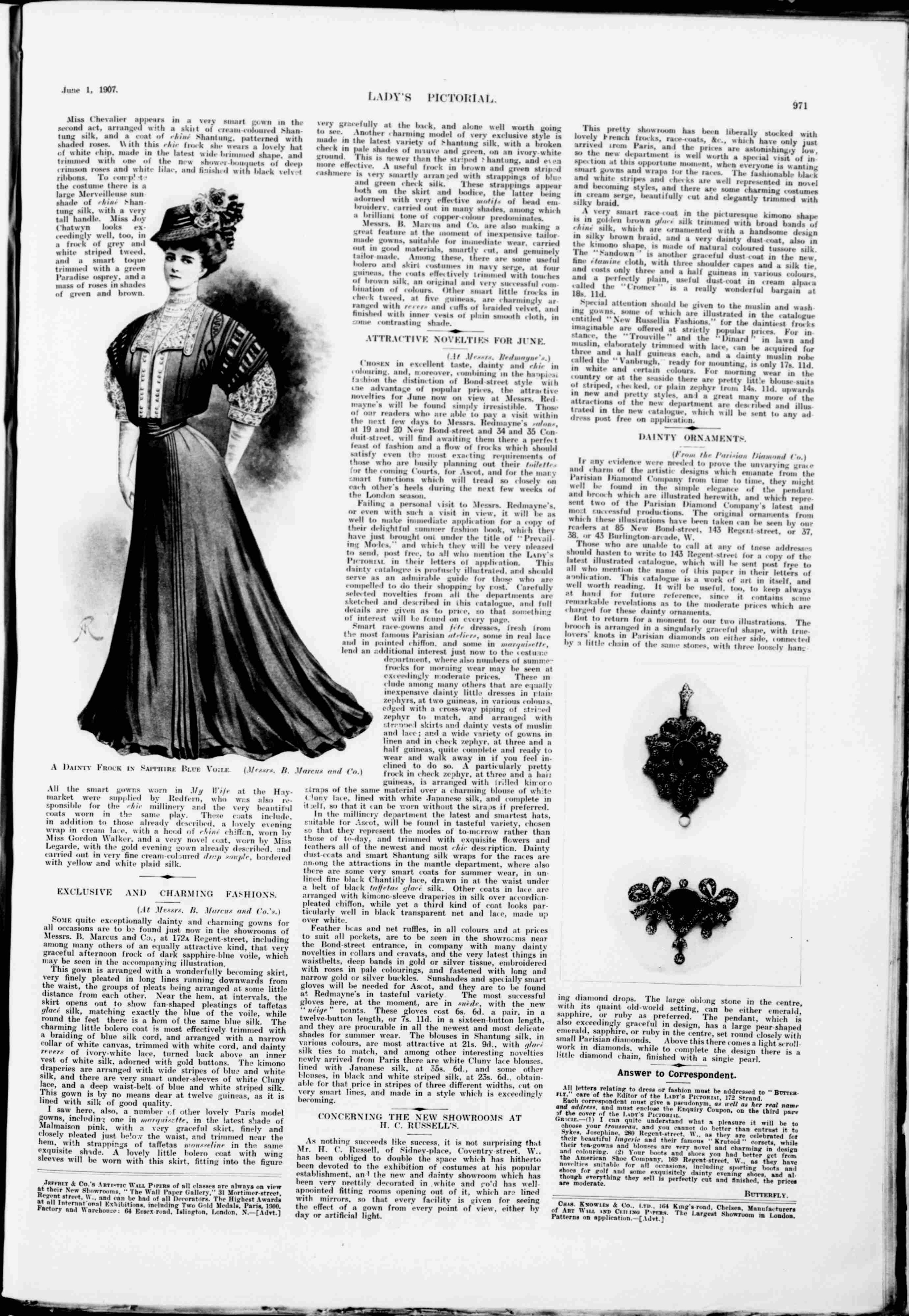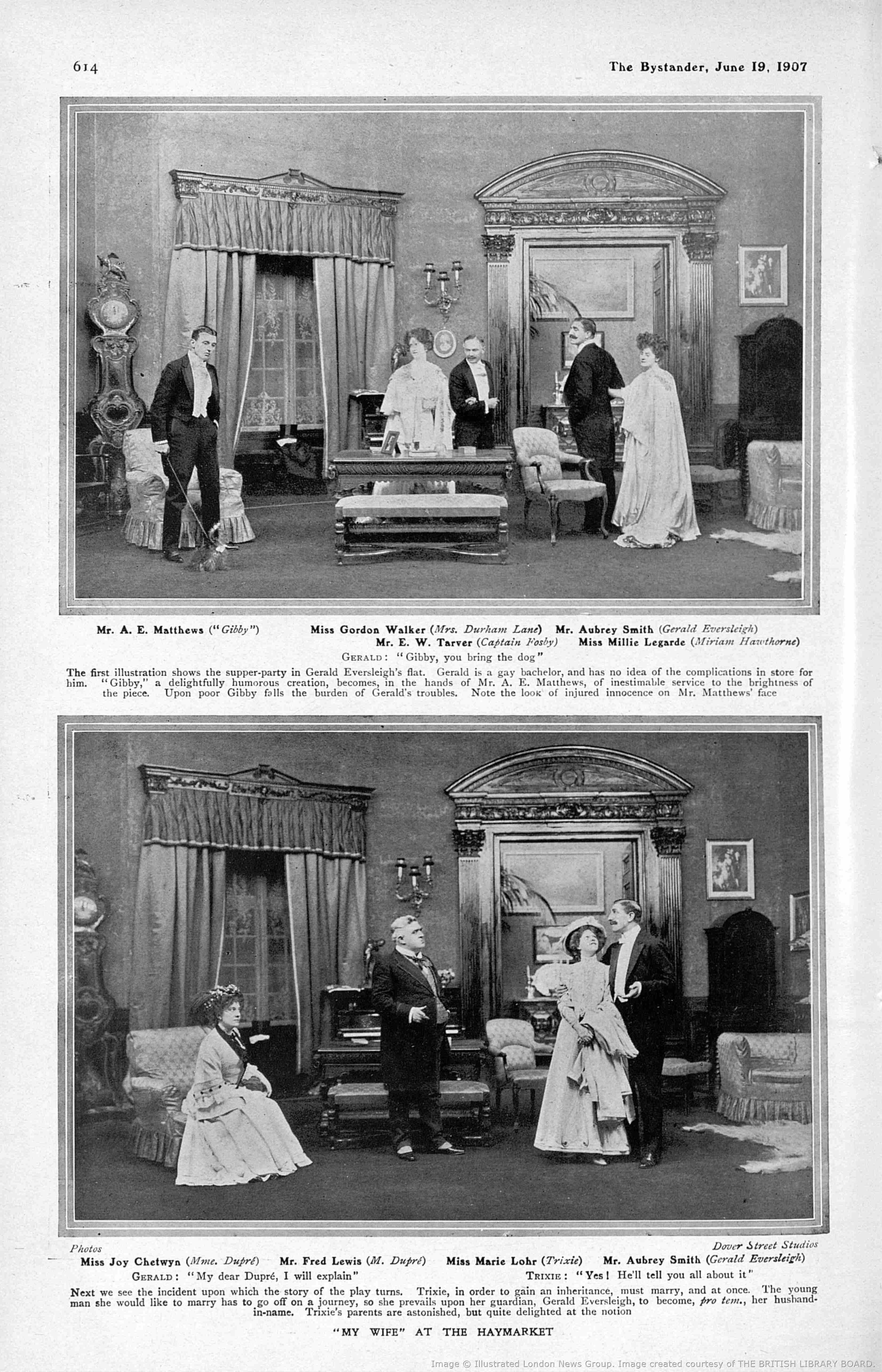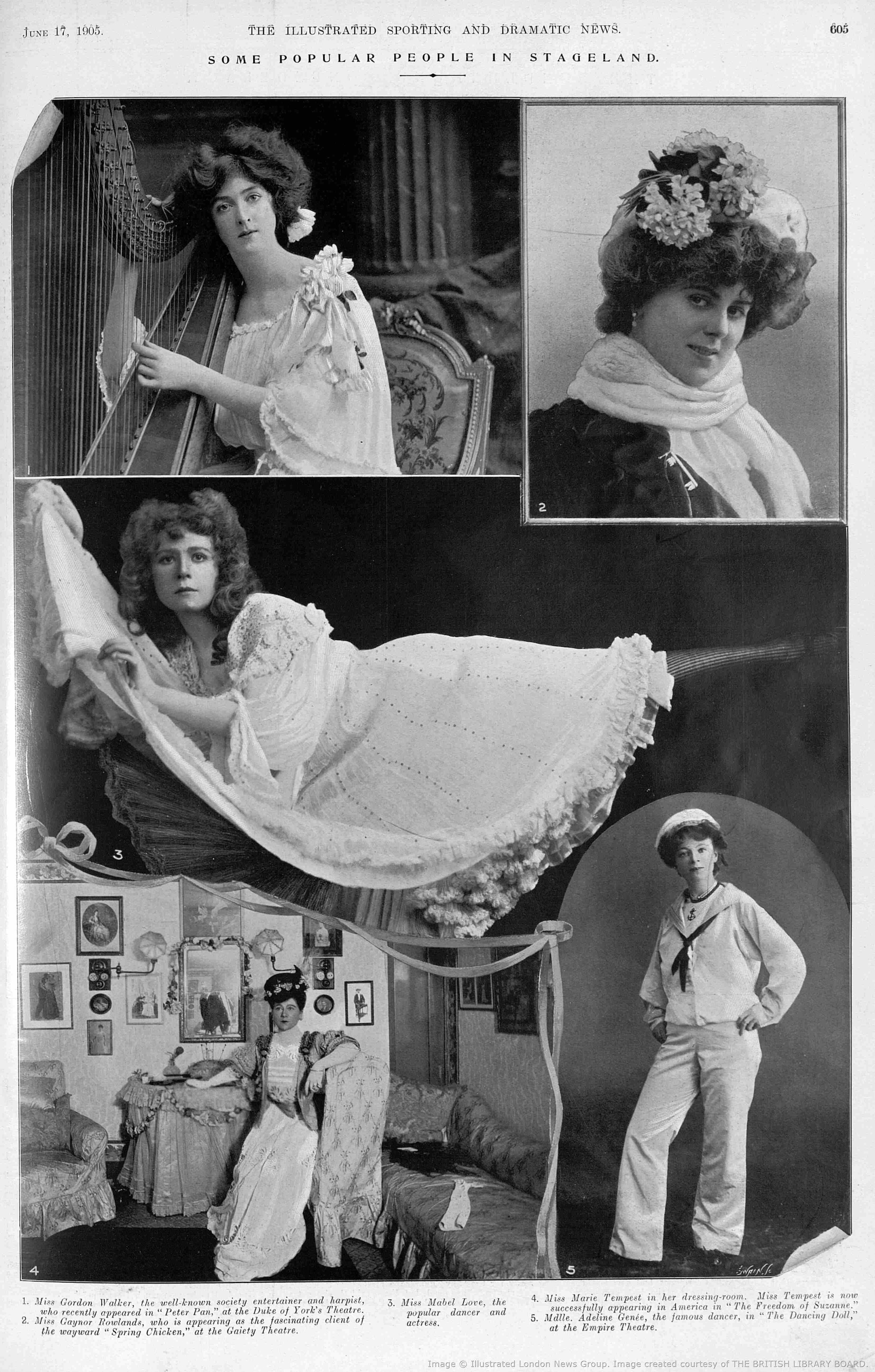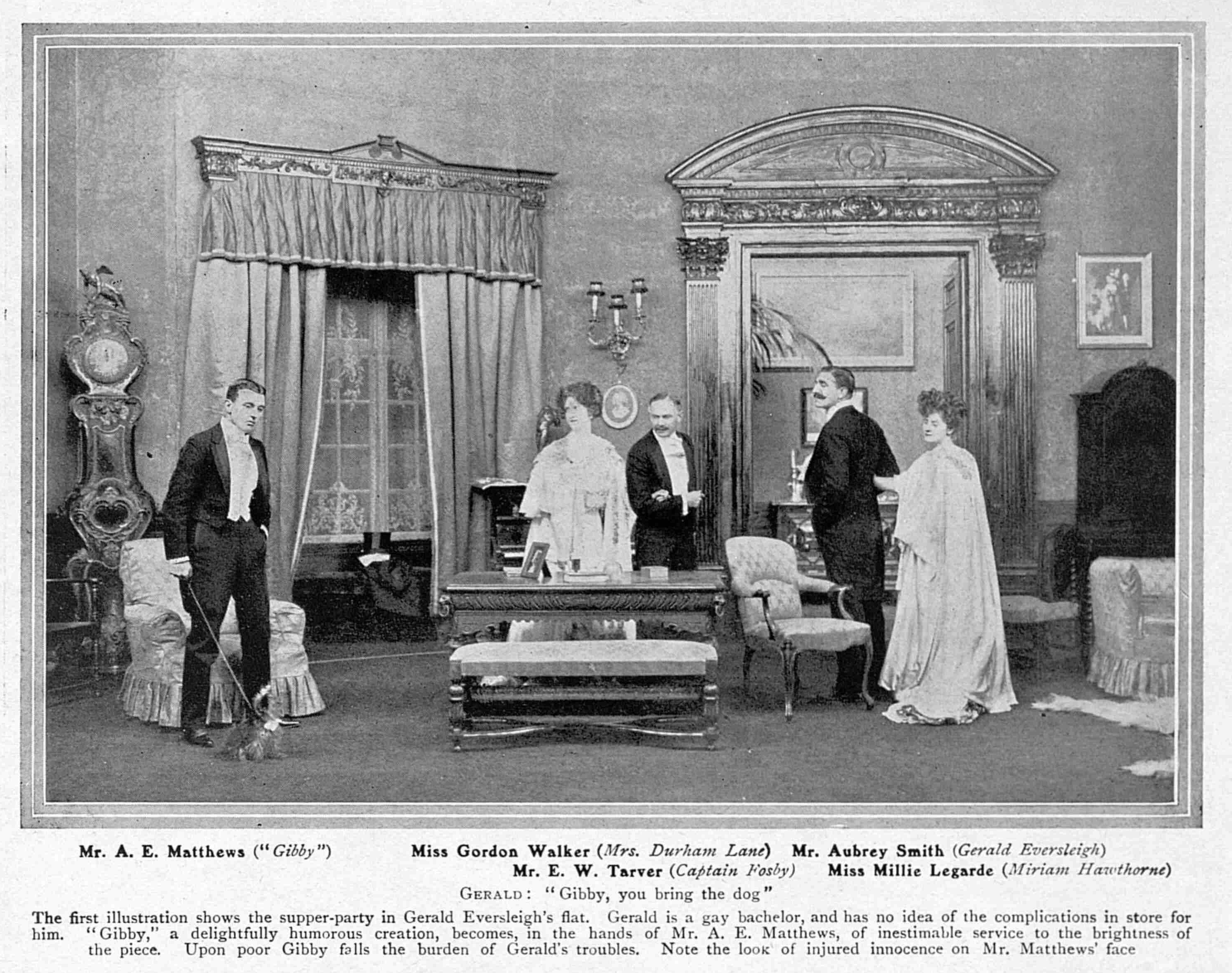
“All the smart gowns worn in My Wife at the Haymarket were supplied by Redfern, who was also responsible for the chic millinery and the very beautiful coats worn in the same play. These coats include, in addition to those already described, a lovely evening wrap in cream lace, with a hood of chiné chiffon, worn by Miss Gordon Walker, and a very novel coat, worn by Miss Legarde, with the gold evening gown already described, and carried out in very fine cream-coloured drap souple, bordered with yellow and white plaid silk” (“London Fashions; Footlight Fashions at the Haymarket,” Lady’s Pictorial, June 1, 1907, p. 971). Image reproduced from The Bystander, June 19, 1907, p. 614.
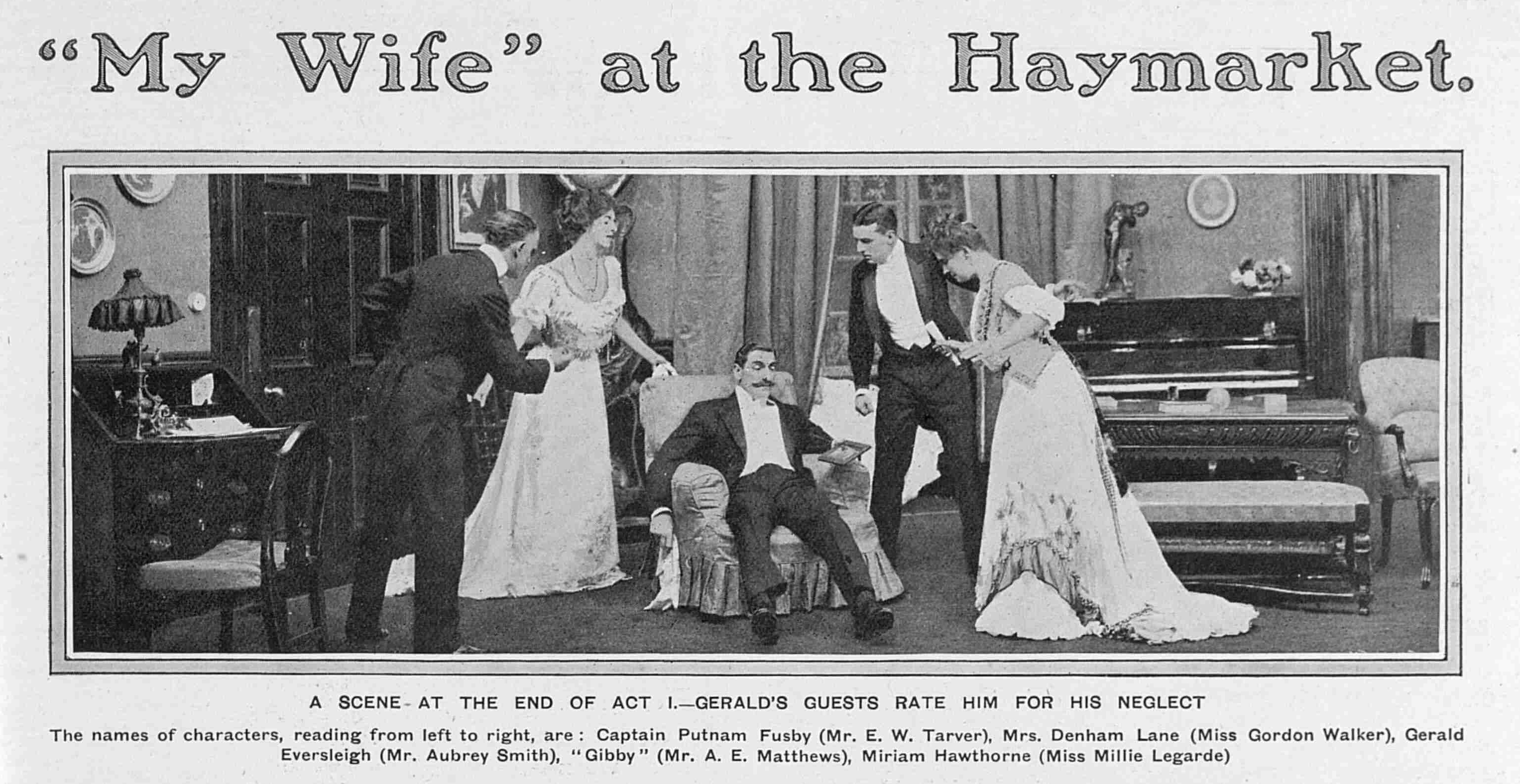
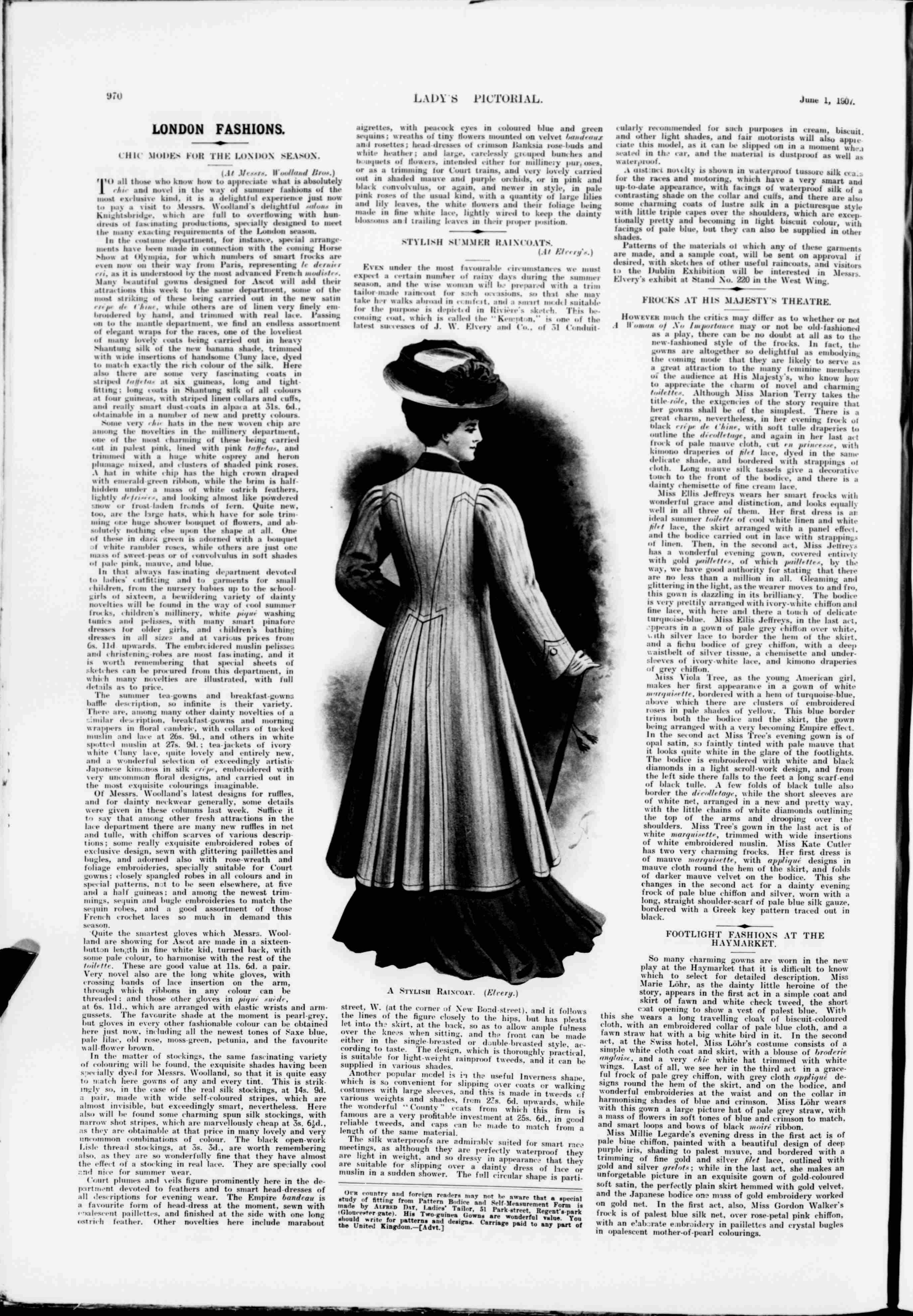
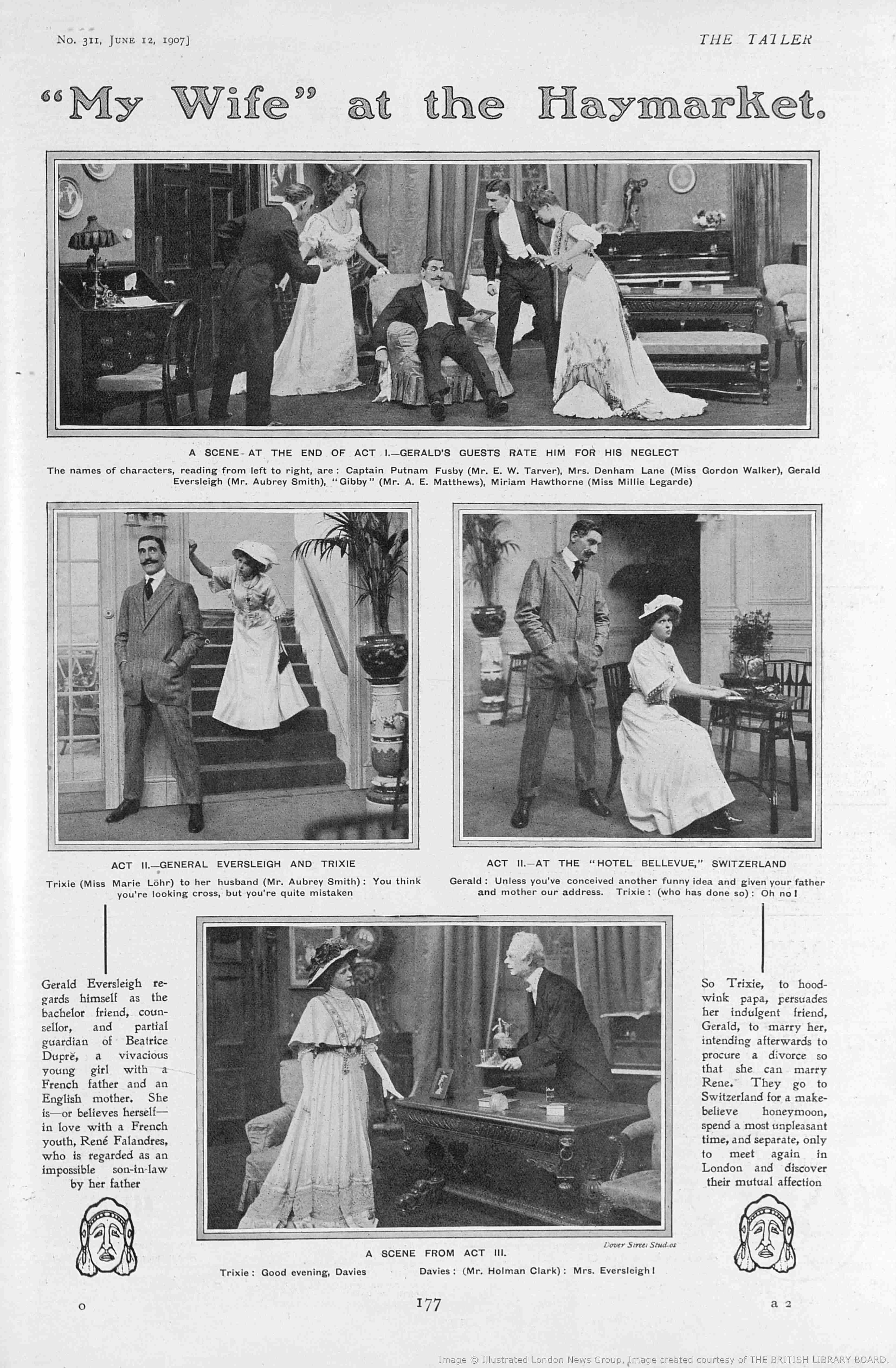
“In the first act, also, Miss Gordon Walker’s frock is of palest blue silk net, over rose-petal pink chiffon, with an elaborate embroidery in paillettes and crystal bugles in opalescent mother-of-pearl colourings” (“London Fashions; Footlight Fashions at the Haymarket,” Lady’s Pictorial, June 1, 1907, p. 970). Image reproduced from The Tatler, no. 311, June 12, 1907, p. 177.
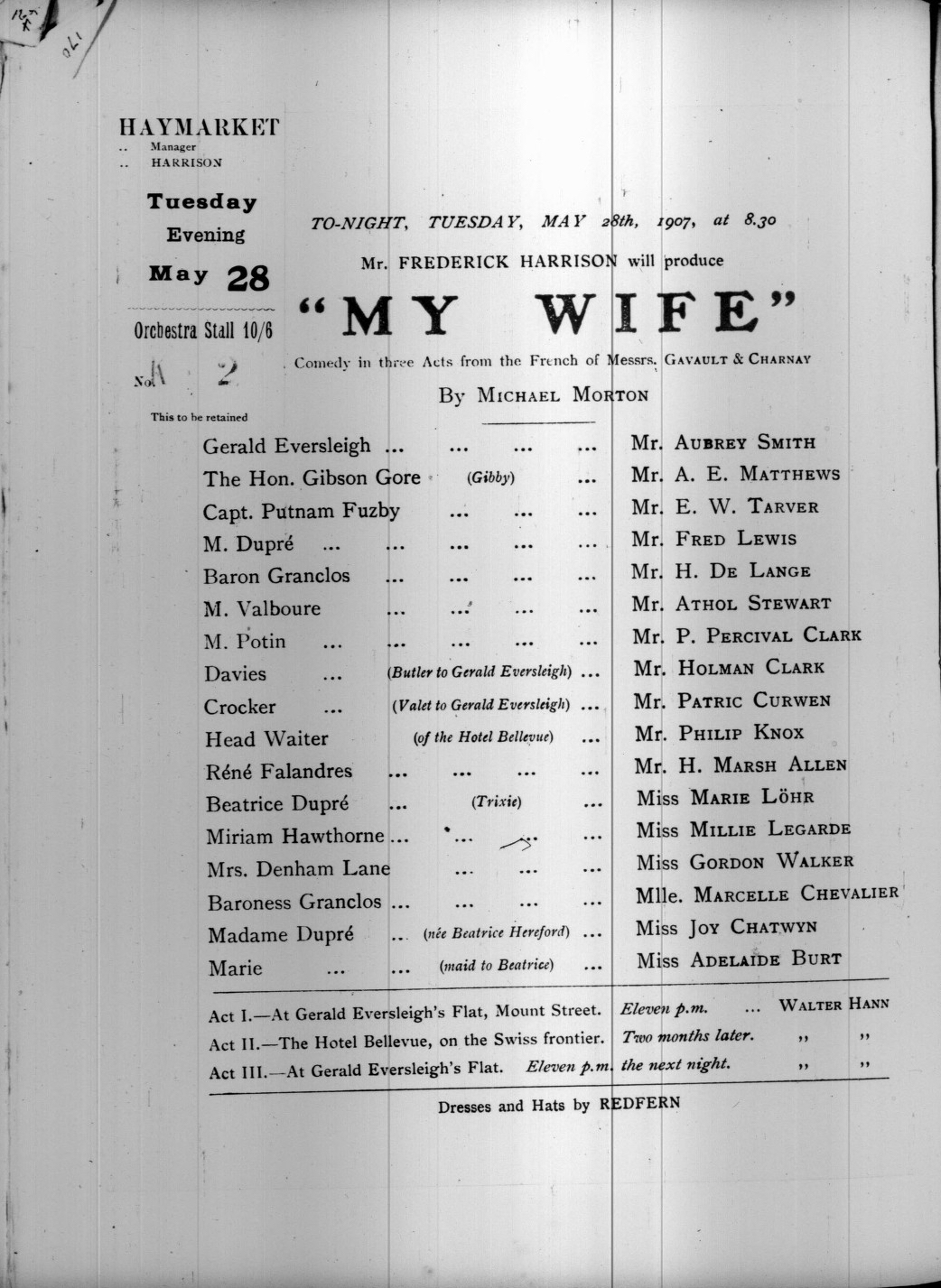
Reproduced from Waters (n.d.: II, 171).
Mademoiselle Josette, ma femme, the original of Morton’s adaptation, was a “comédie en quatre actes” written by Paul Gavault and Robert Charvay and first performed in Paris at le théâtre du Gymnase on November 16, 1906 (Gavault & Charvay 1907: half-title). As far as the rather convoluted plot goes, as well as some further differences between original and adaptation, I think those matters are best summarized by the following two extracts from the contemporary reviews:
Next to adapting a doubtful French farce to the requirements of the English stage, nothing is more difficult than to explain how it is that it fails, in its Anglicised form, to amuse as it does in the original. “Mademoiselle Josette, Ma Femme” is one of the funniest and liveliest pieces produced at the Gymnase for some time past. “My Wife,” though certainly not dull, is hardly to be described as the funniest farcical comedy presented on our stage. The explanation lies in the fact that Mr Michael Morton has very “skillfully adapted” it, that is to say, he has made the story as feasible in English as it is possible to make the plot of a French vaudeville, with the result that the Haymarket will not lose its reputation as a “family” theatre, and that all the points and essential characteristics of Mlle. Josette have disappeared. What we get in “My Wife” is a somewhat mechanical and wholly improbable farce, planned on very familiar lines, which, however, is not by any means unamusing, and what even the undiluted French play could not give us better is the acting which Mr Michael Morton’s comedy calls forth from the present Haymarket company. As a matter of fact, the author owes much to the interpreters of his work. In less skilful hands, it is to be feared, “My Wife” would have appeared less funny, less pleasant, and less plausible. It seems a great pity that we could not have had the play absolutely French or absolutely English, for it always handicaps actors and actresses to have to act in broken English. Whilst they are minding their accent they are missing points they might be making in their acting, or while giving their whole attention to their acting they forget their accent. The story turns, of course, on an absurd compact made with her guardian by an impossibly innocent young person, who wishes to marry a person disapproved by her relations, though she forfeits a fortune if not married by the time she is eighteen. Her guardian cannot refuse so sweet, so coaxing, so naïve a maiden as Trixie, and consents to marry her and divorce her at twenty-one, so that she can marry the other man. Meantime their relations are to remain as they were. The obvious happens. Trixie grows to love her guardian and he her, and all manner of complications result from their anomalous position, and the fact that the other man turns up, and, though really in love with someone else by this time, does not like to acknowledge it to Trixie. In Miss Marie Löhr, to whom this part has been entrusted, a young actress of great promise has been found. The character would be by no means an easy one even for an artist of wider experience, and that Miss Löhr has been at once able to surmount the difficulties and make Beatrice Dupré natural and winsome augurs well for her future career. She has an able coadjutor in Mr Aubrey Smith as the middle-aged lover, and an exceedingly clever study of a young man is contributed by Mr A. E. Matthews (“Before the Footlights; Haymarket Theatre,” The Queen, The Lady’s Newspaper, June 8, 1907, p. 1074).For the part of Josette (now Trixie) Dupré, played in Paris by Mdme. Regnier, Mr. Frederick Harrison has chosen Miss Marie Löhr, the eighteen-year-old daughter of that charming and still popular actress Miss Kate Bishop, whom those of us with memories extending back over some thirty years remember pleasantly as the original Violet Melrose of Our Boys, and one of the Idas in Two Roses. Thus the whirligig of time has brought round the child to the place filled in the seventies by the mother, although Miss Löhr is not exactly a beginner, as she played very prettily as Rosey in Colonel Newcome with Mr. Tree, and has quite lately been on tour with the Kendals. Her suitability for the title-rôle in Michael Morton’s version of the Gavault-Charnay [sic] piece is undoubted, and her performance of the frank and naïve girl, who does not really become Gerald Eversleigh’s wife until she has been married to him for some little time, is very charming indeed, marked as it is with youthful ebullience of spirits, grace, a nicely modulated voice, taking vivacity, a certain air of grave dignity, and pretty, pleading ways. Although the piece, in its English dress, has a conventional and semi-farcical basis, it goes on to something almost like serious drama, and it ends in some scenes, where the uprising of mutual passion is suggested with a certain amount of delicacy, that remind one rather of the similar final bringing together of husband and wife in The Marriage of Kitty and The Freedom of Suzanne. Here both Miss Löhr and Mr. C. Aubrey Smith (as the husband) indicated with sufficient clearness the underlying motive, right up to the very plain meaning of the dénouement, where Eversleigh replies to the announcement that the girl’s parents have “come to fetch Miss Trixie” by switching off the electric light and saying, “Mr. and Mrs. Eversleigh have retired.” The captivating, roguish, and irresistibly coaxing Trixie had forced Eversleigh to marry her, purely as a matter of form, as she thought, in a rather absurd and preposterous way. She was the daughter of an English mother (née Beatrice Hereford) and of a French father, had inherited the characteristics of both races, and had been accustomed from her childhood to wheedle Eversleigh, who had acted for her as guardian and co-executor. So, when she is compelled, under the terms of the will of an aunt who had left her a fortune, to marry by her eighteenth birthday, she refuses to accept the man chosen, after the French manner, by her father. She favours instead a totally ineligible Montague in young Réné Falandres, son of the head of a rival firm; and then, to get out of “the tangle,” as she puts it, she boldly proposes, as Réné is going away for a time, that Eversleigh should temporarily make her his wife in name, thus keeping the money in the family and paving the way for her obtaining a divorce and marrying Falandres on his return. Feasible possibly, as a point of French law, this monstrous proposal, so coolly and naïvely made, naturally takes the affectionate guardian’s breath away, and he probably would have refused thus to be driven into a painfully false position but for various embarrassing and puzzling circumstances. First, he is just giving a gay supper party at his flat in Mount Street, the guests including his chum the Hon. Gibson Gore (consistently represented by Mr. A. E. Matthews as in a state of collapse, from sleeplessness, nerves, or something) and Miriam Hawthorne, tartly described as “a musical comedy girl, of the demi-theatre,” who had entered the profession merely to make a good match, and has Eversleigh in her eye. That host is torn away from his friends by the incursion of Trixie and her maid, the parents having been left at the Carlton. Anon, Réné hurries in to keep and appointment which the cheeky young minx had made with him; and, finally, on the appearance of M. and Mdme. Dupré (the former indignant in a typically Gallic manner), Eversleigh, to save any Réné [sic] disclosures, calmly submits to fate, and asks her parents to give him Trixie.
The matrimonial engagement thus queerly entered into promises to work out badly in act two, where the couple, supposedly “honeymooning,” but really occupying separate rooms, one with and the other without a view of Mont Blanc, are shown at a hotel on the Swiss frontier. By her frankly girlish and innocently free ways the titular Mrs. Eversleigh takes the fancy of a conquest-desiring young Frenchman, M. Valboure, who had nearly fallen down a precipice whilst picking edelweiss for her; and this incident and the advantage he tries to take of an ardent letter from Réné, which had been picked up by the Baroness Granclos, another member of the party of tourists, lead to a duel between Valboure and Eversleigh. In this (by a detail which would probably be appreciated keenly in France) the husband is scratched on the finger so slightly that the wrong hand actually is bound up by his second, “Gibby,” who had hurried from London to Switzerland to avoid Miriam, who was transferring her designs upon Eversleigh to him. Less welcome visitors are the Dupré couple, who soon guess, from Trixie’s naïve admission, as to the relative position of her and her husband’s rooms, that something is wrong, and to escape from whom Eversleigh, in another fit of cowardice, bolts back to London. Thither — as he is resuming his bachelor life with another supper party at Mount Street — he is followed by Trixie, anxious to make it up. She has a fairly effective and prettily written scene with Miriam, who, puzzled at first, soon denies having any claim upon Eversleigh; then we have the re-appearance of the whirlwind Réné, anxious to explain that, to save himself from death, he had been obliged to marry a Moor’s daughter in Tangiers; and the funny and purely farcical incident of both men writing out cheques, due, as they think, as compensation to one another, is followed by the final scene of complete matrimonial felicity which we have already described (“London Theatres; The Haymarket,” The Stage, May 30, 1907, p. 16).
Reproduced from Waters (n.d.: II, 210).
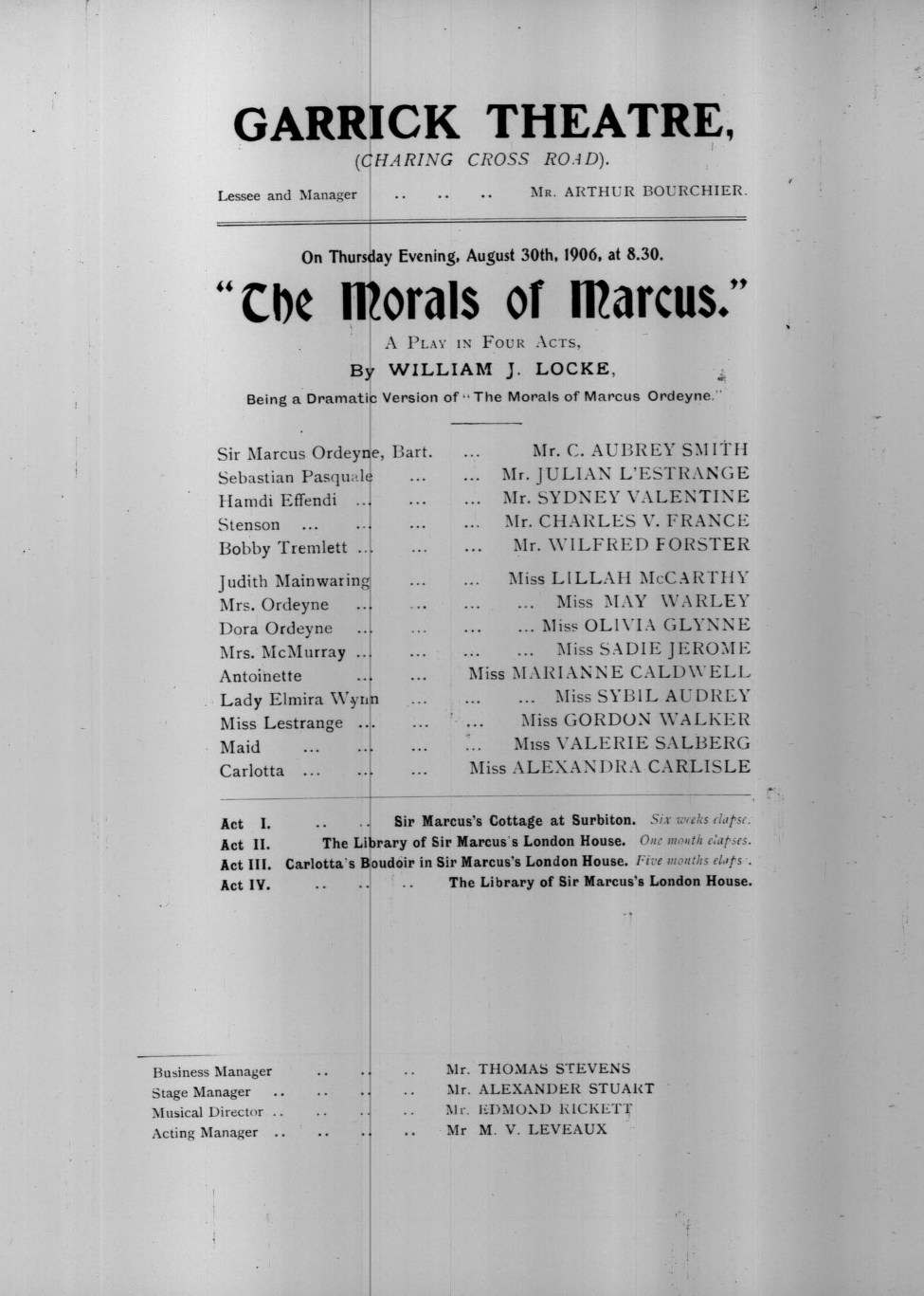
It is not often than an adaptation of a novel is more agreeable than the original; but this is certainly the case with The Morals of Marcus. In Mr. William J. Locke’s book almost excessive emphasis is laid upon the merely sexual and sensuous attraction of the heroine. The passion of Sir Marcus Ordeyne for Carlotta seems little more than the infatuation of an elderly man for an emigrant from a Turkish harem. One is made to wonder what sort of a life they will lead when the honeymoon is over, and how long the “child of nature” will remain constant to her mature benefactor. In the play a great deal of this feeling is removed by the fact that the representative of Carlotta is decidedly Saxon. One cannot imagine her telling improper stories, and when at last she “finds her soul,” we have some faith in her not losing it again.Walker played Miss Lestrange, a character absent from Locke’s novel and who appears only in the third act. Like the actress who first played her, Miss Lestrange is an American (Locke 1906: 47). She is wearing a “white lace dress” when the act opens, as well as a “large flower hat, reddish pink” (Locke 1906: 46), and is sitting on an ottoman in Carlotta’s boudoir which gives on to a studio in Marcus’s house. Also in the scene are Carlotta, Bobby Tremlett, Lady Elmira Wynn, “and a gentleman” (Locke 1906: 47). There is a burst of laughter, for apparently Carlotta has just been telling one of her “improper stories” about the harem she used to be an inmate of. Bobby, standing behind Carlotta and laughing, comments, “That’s ripping,” and Miss Lestrange says, “You are the very dearest, cutest little creature.” Carlotta replies, “I hope I have not shocked Miss Lestrange.” “Oh, you can’t shock her!” says Bobby, to which Miss Lestrange retorts, “Bobby!” Bobby wants Carlotta to tell more about the harem, but Miss Lestrange interjects, “Don’t you do it. Come and have tea with me by our two selves, and then you can tell me all about it” (Locke 1906: 47). She rises when Carlotta excuses herself to talk to Lady Elmira, and goes, with Bobby, into the adjoining studio for tea. Miss Lestrange and Bobby are still in earshot, however, for both giggle when Carlotta offends Lady Elmira by telling her that her “hair is very pretty, and it nearly matches your own” and then asking her where she bought it (Locke 1906: 48). Later in the act, Miss Lestrange is apparently among the “ladies” who “move off” in successive pairs (Locke 1906: 51, 52). Or does she remain on stage, and is in the studio with the other guests when Hamdi Effendi shows up and they become “aware that something odd is happening” (Locke 1906: 55)? Given that The Sphere reported, “Another American in the cast is Miss Gordon Walker, who gives clever little monologues of her own making,” I am unsure as to who exactly authored Miss Lestrange’s lines. Did Locke, in his play published “for private circulation only,” record what Walker invented in rehearsal? Or did Walker, in her performances, improvise (and improve) on the few lines Locke wrote for a character whose dramatic function is utterly superfluous? Speaking of which, in the first act, there is a dialogue between Marcus Ordeyne (who, by the way, had been, like Caine, a barrister [Locke 1906: 8]) and his aunt, Mrs. Ordeyne, which reminds me of a sentence in Borges’s “Tlön, Uqbar, Orbis Tertius” — “Entonces Bioy Casares recordó que uno de los heresiarcas de Uqbar había declarado que los espejos y la cópula son abominables, porque multiplican el número de los hombres | Then Bioy Casares recalled that one of the heresiarchs of Uqbar used to declare that mirrors and copulation were abominable because they multiply the human population” (Borges 1940a: 30; see also § 4). In Locke’s play, Mrs. Ordeyne says, “You are becoming more impossible than ever. Marcus, you ought to marry.” “Why?” asks Marcus. “It is every man’s duty,” answers Mrs. O. “From what point of view?” asks Marcus. “The mere propagation of the human race, or the providing a superfluous young woman with a means of livelihood? If the former, then in my opinion there are too many people in the world already. If the latter, I’m afraid I’m not sufficiently altruistic” (Locke 1906: 12). But back to Miss Lestrange’s superfluity, despite, or perhaps because of, which The Era called Walker’s enactment of it, “quite commendable.” Who was it, I wonder, who was “sufficiently altruistic” to provide Walker with the part of Miss Lestrange? Did she intrude herself into the play in the manner Psyche intrudes herself into Michael Hoffman’s comic opera in Hoffman’s Chance (see § 9-ter)? Was she named, possibly, after the actor playing the part of Sebastian Pasquale, Mr. Julian L’Estrange? (See playbill, above right; note also, for the purposes of my § 4, the character of Lady Elmira Wynn, played by Sybil Audrey.) Such speculations are most likely moot, since, according to the “Table Gossip” column of The Boston Sunday Globe (quoted in § 5), Walker was a member of the stock company of actors at the Garrick Theatre. Speaking of which, three weeks after The Morals of Marcus opened in London, a newspaper in Scotland published a letter from a lineage-mad self-styled relative of Walker’s, a letter which ties in with a statement in the Bristol Magpie piece reproduced in § 5 concerning the “popular raconteur and bewitching girl’s” kinship with the “Marquis of Huntley:”What is the essence of the acknowledged attractiveness of this play? Chiefly, we think, the acknowledgment of the purely physical basis of sexual love. Sir Marcus Ordeyne flatters himself that he is not as other men are, that he can preserve a purely philosophic attitude towards the opposite sex, and that he is a confirmed celibate. The Greeks in their drama were always teaching that it is dangerous to defy Venus, who invariably has her revenge upon those who ignore her power. And the goddess “comes down heavily” on Sir Marcus Ordeyne. The moment the right woman appears — the woman with sufficient beauty and piquant sensuous naïveté to appeal to his long suppressed “propensities,” he yields to the charm, and is soon the absolute slave of his passion. Amusing as Mr. Locke’s piece is in parts, it has an underlying vein of pathetic irony. We cannot help feeling for the unfortunate Mrs. Mainwaring, who is so much better fitted to make Ordeyne happy than the childish beauty with whom he is “in love.” And this is what makes The Morals of Marcus something more than a merely amusing “entertainment of the stage.” It touches us nearly; it is an old story with new characters, a truism of human experience, offered to us with delightful and diverting embellishments. And, while the pathos is only hinted at, and a “happy ending” is secured by an adroit turn in confined space, the dainty drollery is distributed over the whole of the action. We could not have conceived that the novel would have made so agreeable and interesting a play.
The play is divided into four acts, the first of which takes place in the garden of Sir Marcus’s cottage at Surbiton. Here, and not near the Thames Embankment, as in the story, Carlotta introduces herself in his household. In this act we are introduced to Ordeyne’s friend, Sebastian Pasquale, and also to Mrs. Judith Mainwaring, the lady with the bad husband, from whom she is separated. Between her and Ordeyne there has existed, for eight years, a steady platonic friendship, and she is naturally uneasy when she sees Sir Marcus’s heart going out to Carlotta, whose beauty, audacity, and originality fascinate him entirely. Sebastian Pasquale, a confirmed libertine with a foreign accent, is also charmed with the young Turk, and, in the third act, induces her to run away with him. This, however, he only accomplishes with the help of Mrs. Mainwaring, whose husband is now dead, and who hopes that Ordeyne may marry her. She tells Carlotta that Sir Marcus belongs to his old friend, and the girl, believing this, yields to Pasquale’s entreaties, and goes with him to Paris.
In the last act she returns, deserted by the rascally Pasquale, and having, as she says, “learnt wisdom by sorrow.” This is all the harder for Mrs. Mainwaring, as Sir Marcus, in his lonely and hopeless state, had almost resolved to make a marriage of reason with his old friend. Carlotta’s arrival, however, alters the case immediately. Sir Marcus tells her of his love, and she receives his offer with deep affection and pathetic gratitude (“‘The Morals of Marcus,’” The Era, October 20, 1906, p. 15).
In reference to the recent articles on this subject the Hon. Armistead Churchill Gordon, Staunton, Viginia, writes to us: — “I have found many things which have greatly interested me in the articles, and they have suggested to me some curious coincidences. The Craig Gordons of the North are duplicated on the Border by the Gordons of Craig in Kirkcudbrightshire; and there is a prominent family of the Gordons of Craig (of the Border) here in Virginia. This reminds me too that there were Gordons of Aikenhead both in Galloway and the North. I have always thought it an interesting coincidence that the Gordons of the North and of the South should have centred about the river Dee — that there should be two Dees with like Gordon associations. The reference in the articles to Jordan becoming Gordon reminds me that Mr Philip Crossle, of Newry, thinks that the names have been frequently interchanged in Ireland. Your “Clifford-Gordon” is reversed on this side in the name of a cousin of mine, Rev. Clifford Gordon, a Presbyterian minister of Missouri. So ‘Conway-Gordon’ reappears in Virginia without the hyphen in the name of another kinsman, Conway Gordon, Esq., of Richmond. Both of these men are descendants of my ancestor, Colonel James Gordon, of Lancaster, whose first wife was a Miss Conway. The Honourable Samuel Gordon Cumming of Hampton, Virginia, is a prominent lawyer and legislator of our state; and Alexander Duff Gordon was a resident of the county of Albemarle, Virginia, in 1805. James Hay, a member of Congress at this time from Virginia, married Miss Gordon: and I think they have a son named Gordon Hay. Dr Smith Gordon is another descendant of Colonel James Gordon, of Lancaster, who lives in the state of Louisiana. Miss Gordon Walker [who is at this moment playing a small part in ‘The Morals of Marcus’ at the Garrick Theatre, London] is a great-granddaughter of John Gordon, of Ohio, youngest son of Colonel James Gordon, of Lancaster, Virginia. And so it goes” (“The Name of Gordon,” The Huntly Express, September 21, 1906, p. 5 [brackets in original]).In December 1906, Walker was nominated for election to the Actors’ Association. And nine days after The Morals of Marcus closed at the Garrick, she was seen on the boards of the King’s Theatre, Hammersmith, London, where she gave “a favourable impersonation of the character” of Agnes Wickfield in Dan’l Peggotty. This four-act adaptation from Charles Dickens's David Copperfield which opened at the King’s, Hammersmith, on March 11, 1907, was attributed to H. Kellett Chambers. It was apparently the same Dan’l Peggotty which had been taken on a five-cities-in-five-weeks tour by “Mr. Charles Cartwright and his London company” in May and June of 1906 and which was variously attributed to Kellett Chalmers, Kenneth Chalmers, and Kellett Chambers — and is also the first trace of Walker I’ve been able to find following the “harp business” of her musical sketch, “On the Spur of the Moment,” with which she opened An Angel Unawares at Terry’s Theatre in September 1905 (see § 5). After rehearsals at the Savoy Theatre in London, the play ran May 7–12, 1906, at the Royal Court Theatre, Liverpool; May 14–19 at the Prince of Wales Theatre, Birmingham; May 21–26 at the King’s Theatre, Glasgow; May 28–June 2 at the Theatre Royal, Edinburgh; and June 4–9 at the Theatre Royal, Newcastle-on-Tyne. At the play’s opening in Liverpool — described by The Stage as “a clear and concise production, and one of the best stage arrangements of the famous story,” with a narrative that was “dramatically intelligible and self-interpretative” — Cartwright played “the rough, warm-hearted fisherman Peggotty;” Charles Collette “charmed everybody with his exquisite Micawber;” Ivan Berlyn gave “a finished idea of the sneaking” Uriah Heep; Alfred Woods played “the bashful, honest Ham;” Arthur Royston played Steerforth and Maud Williamson played Mrs. Steerforth; Humphrey Warden played David Copperfield; Ernest Mozar played Littimer; H. Carter Bligh played Mr. Wickfield; Molly Pearson played Little Em’ly; Mary Smith played Mrs. Gummidge; Cartwright’s daughter Edith played Rosa Dartle; Ruby Wyndham played Mrs. Barkis; Mabel Luxmore played Betsy Trotwood; Miss Scott-Lauder played Martha; and Miss Gordon Walker played Agnes Wickfield. It seems that Walker — who, in Glasgow, was described as “giv[ing] a charming idea of Agnes Wickfield” and who, in Birmingham, was “altogether charming” in that part — did indeed travel with her harp on the tour, since, in its review of the Liverpool performance, The Era reported, “The singing of ‘Believe me, if all these endearing young charms,’ by Mr. Mozar, accompanied on the harp by Miss Walker, was loudly applauded.” After its revival at the King's Theatre, Hammersmith, on March 11, 1907, the Cartwright/Chambers Dan’l Peggotty soon morphed, apparently, into David Copperfield, under which name it traveled to various other theatres. For instance, the Eastbourne Gazette noted that “Miss Gordon Walker looks well, but does little, as Agnes Wickfield” in the production of David Copperfield at the Devonshire Park Theatre, Eastbourne, on Monday, April 15, 1907, while The Era called her performance there, “pleasing and interesting.” The following week, the play moved back to London where it occupied the boards of the Broadway Theatre. Of that production, the reviewer for The Stage observed, “Miss Gordon Walker endows the character of Agnes Wickfield with a becoming air,” that for The Woolwich Herald wrote that she “makes a sweet and loveable Agnes Wickfield,” and that for The Era called her “interesting.” Cartwright and Co. next traveled to Plymouth (Royal Theatre, April 29–May 4), Cardiff (New Theatre, May 6–May 11), Liverpool (Shakespeare Theatre, May 13–18), and Manchester (Gaiety Theatre, May 20–25), where they alternated performances of David Copperfield with T. W. Robertson’s David Garrick and Gerald Lawrence’s The Coping Stone. In Plymouth, Walker was a “sympathetic Agnes Wickfield;” in Cardiff, she was “all that was required” for the “maidenly” character; and in the other cities no particular notice was paid her. The company continued on to Brighton where they presented their trio of plays at the Theatre Royal from May 27 to June 1. Walker, of course, was not among them, since she had returned to London for what turned out to be her theatrical swan song as Mrs. Denham Lane in My Wife, soon followed by her transformation into Mrs. William Caine. Apropos: The butler, Davies, who announces the entrance of Miriam, Captain Fuzby, and Mrs. Denham Lane into the opening scene of My Wife (Morton 1912: 13), was played by Holman Clark, the actor who would later share an obituary with Walker’s husband in which both were described as having “died, as they would have wished, in harness” (see § 7 and Appendix I: Caine’s Obituaries). But why did Walker give up the harness, so to speak, just two months after her marriage to that “Englishman of fortune” (see § 4)? After all, her acting teacher had continued her theatrical career under her stage name Miss Kate Reignolds for long after she had married, on Friday, June 28, 1861, “a young Boston merchant” named Erving Winslow — why did Walker not emulate her teacher and continue on the stage? Was it because, soon after marrying Caine, she had a sense that she would become “the spark her husband uses to write with,” as Mabel Dodge called her seven years later — or had she already become that spark even before her marriage which “followed very quickly upon the announcement of her engagement” (see § 3)? As will be seen in § 15, I think she was already that spark. Mais n’anticipons pas. Let me get back to the prehistory of the career Walker gave up to become, not merely that spark, but, as will be seen in § 14, something more — Caine’s “Conscience”.
I do not know when Walker became a student of Mrs. Erving Winslow (who, in 1892, had been teaching elocution and giving dramatic readings in Boston for five years after having retired from acting following an accident incurred on the stage in England c. 1870). Based on the news items related to Walker’s performances at the Sharon town hall on July 15, 1903, and at Potter Hall, Boston, on January 11, 1904, and quoted in § 5 and § 7, it seems likely that she did not do so until after she graduated from Wellesley. However, it’s possible that Walker was enlisted for these performances because she was a former student who, in 1903–1904, was achieving some renown as a harpist, dancer, and monologuist, and could thus both contribute her talents and attract an audience. I base my speculation on the following. During her junior year at Wellesley, Walker played the part of Villikins in a pantomime, Villikins and his Dinah, performed on the evening of December 10, 1898, in, apparently, the gymnasium. Forty-three years earlier, Walker’s teacher, then known as Kate Reignolds, played the same part during her first season as a stock actress at Burton’s Theatre, New York:
Another suggestion of Mitchell’s crept into the bill for November 17th, when was produced “an Original, Pathetic and Heart-rendering Tragedy, very mirthful to behold, in which is disclosed the Doleful Life and Dismal Death of a Pair of True Lovers — as also the Melancholy Wooing and Sad Undoing of a Gay and Gallant Lord.” This was but an attempt to make hay out of the sunshine of all-devouring popularity enjoyed by the ballad of Vilikins and His Dinah, which Burton and others had warbled so many times in the last year as the Wandering Minstrel. The present extravaganza of Vilikins and His Dinah, purporting to be “from an antique Ms. lately discovered amongst the waste papers of a retired Cheesemonger, and now given for the delight of the Public and the profit — it is hoped — of the Managers,” had a cast including Leffingwell as the Stern Parient, Mrs. Carpenter as the Tender Parient, Mrs. Thorne as Dinah, their daughter, Kate Reignolds as Vilikins, apprentice to the Stern Parient, and in love with Dinah, and H. Jordan as the Galliant Lord Pellmelle, “two centuries in advance of his age.” Miss M. Gourlay was the Lyttell Page, “from a very early duodecimo edition of Tom Thumb.” The three scenes, in order, were the Front Garding, the Interior of the Stern Parient’s Dwelling, and the Back Garding. In spite of the elaborately prepared fooling, I fear that this product of the front and back “gardings” was nipt i’ the bud (Odell 1931: 434).Did Walker choose, in 1898, to perform with her fellow pantomimists — Mary Lauderbach, 1899, as Dinah, and Emma Seward, 1901, as Father — an outdated comedy based on a burlesque ballad which had reached the zenith of its popularity in 1855, because her teacher of elocution had performed it long ago and continued to have her students perform it? My inability to answer that question leads me to ask another question, which I’m also unable to answer. When did Walker first step before an audience to recite memorized lines, to mime — or mock — emotionally fraught behavior? When, in other words, did she start acting? The earliest trace I’ve been able to find occurs during her sophomore year at Wellesley, in roles that, perhaps appropriately, would have involved movement only, no speech. For the first of the 1897–1898 academic year’s entertainments, the Barn Swallows presented, on Saturday, October 2, 1897, at the Barn, Mrs. Jarley’s Wax Works. A certain “Miss Walker, 1900,” played the part of the Mermaid and the Giggling Girl. Now, since there was a Florence Louise Walker of Westboro, Mass., who also graduated from Wellesley in 1900, I can’t be certain that the player of the Mermaid and the Giggling Girl was the future wife of the author of The Author of “Trixie”. Two factors, however, lead me to believe that the odds swing in favor of “Miss Walker, 1900” having been Edith Gordon rather than Florence Louise. First, as the Wellesley Legenda for 1900 notes, Florence Louise Walker “Entered Class in Sophomore year” (p. 52). So perhaps she was not yet on campus by October 2, or not socially connected enough yet to participate. Second, Mrs. Jarley’s Wax Works is based essentially on the sequence in Dickens’s The Old Curiosity Shop, in which Nell Trent and her grandfather travel in a caravan with Mrs. Jarley and her “wax-work” (Dickens 1841: 236–255), and one of the two original illustrators of Dickens’s work was named George Cattermole — which leads me to think that the characters of Peter Cattermole and his father Sir John Cattermole in Caine’s The Pursuit of the President are subtle allusions to what appears to have been his future wife’s premier pas into collegiate theatricals. Of course, the piece “Miss Walker, 1900,” performed in was not based directly on Dickens’s novel, but rather George Bradford Bartlett’s adaptation thereof, Mrs. Jarley’s Far-Famed Collection of Waxworks, in which The Mermaid is described as “Girl with long light hair; the body of a fish made of green cambric reaches to her waist; she holds comb and hand-glass” (Bartlett 1873–89: 3), and The Giggler as “Girl with large face and mouth; calico dress, long apron; holds newspaper” (ibid.: 4). The piece consists of Mrs. Jarley (played by “Miss Dodd, ’98”) describing, in turn, each of her waxworks, which is then “wound up” and allowed to go through its motions, then
After all have been described, the assistants wind up all, and the figures go through their motions all together, to the music of a piano, keeping time to a tune which gradually goes faster, then all stop, and curtain falls (ibid.: 5).Mrs. Jarley describes “The Feejee Mermaid” as follows:
In this beautiful combination of nature and art you behold united the body of a beautiful woman and a beautiful fish. This specimen of the codfish aristocracy is considered rather a scaly one. Her chief amusement when alive was to sit upon a high rock and allure sailors to destruction by her sweet songs, which always drew well. She used to comb her hair often, and when wound up she will give you a specimen of her manner of doing it (ibid.: 5).Her movements consist of combing her hair with one hand while gazing into a small mirror she holds in the other. As for the Giggling Girl:
The particular attention of young ladies who are too much given to levity is called to this fignre, the Unfortunate Giggler. This poor girl when young had acquired an unfortunate habit of laughing, which grew upon her as she grew up. The slightest event would make her laugh immoderately, and she was so reduced at last that she could smile at the dreary platitudes of the comic newspapers. Everything was the subject of her foolish smiles: even young men could draw them from her as they passed. Instead of following the advice of the immortal Shakspeare, and finding “sermons in stones,” every stone was for her a grin-stone whichever way she turned. She was finally choked while laughing at her meals, and this figure of her illustrates the truth of the following exquisite couplet by some poet, whose name has slipped from my memory, yet whose golden words will never slip from my mind: —Upon being wound up, she “smiles sweetly, then laughs loudly, and stops suddenly.” Apropos of calico and a loudly laughing girl: Caine’s The Pursuit of the President opens with Peter Cattermole breakfasting with his father Sir John, President of the Board of Enquiries into Army Scandals, at the latter’s house in Belgrave Square. Reading that morning’s Post, Peter informs his father that he, Sir John, is next on the list of government officials whom Miss Waugh, the leader of the Woman Suffragists, intends to interview, telling the reporter that she means to call on Sir John that very morning.“Laughing girls and crowing hens
Never come to no good ends.”
Wind her up, John, and let her laugh (ibid.: 16–17).
A slightly less surreptitious possible reference to Caine’s future bride occurs in the form of Sir John’s housekeeper who is mentioned in the paragraph that immediately follows the above:“She does? Then I’m going. Peter, if you’ve nothing better to do, you might stroll down to the office with me. No. I cannot touch a thing to-day. This business has killed my appetite. Ring the bell.”
Summers appeared.
“Summers,” said my father, “if any — ladies call here this morning you will tell them that I am out of town indefinitely.”
“Yes, sir,” said Summers with a smile.
“Dinner at eight as usual.”
“Very good, sir,” said Summers, with a grin.
“That is all,” said my father sharply.
“Thank you, sir,” said Summers; and she went out. As the door shut there was a sound as of calico being violently torn (pp. 25–26).
Another sly wink at the early theatrics of Caine’s future bride occurs a few pages later when, as the suffragists headed by Miss Waugh are converging on Belgrave Square, Peter and his father are hurrying out of it:“That girl must go,” said my father. “I shall speak to Mrs. Walker about her. You see how it is, Peter. The very servants know about this woman’s infamous designs on me.”
“You cannot blame them, sir,” I said, “for taking an interest in your political career.”
“Tchah!” said my father (p. 26).
A hansom came towards us, galloping. My father raised his stick; but the cabman cried, grinning; “Sorry gents. My ‘orse is done up,” and, lashing the remarkably fresh beast, vanished into the Square with the lie upon his lips. As my father stood looking after him, in the vain attempt to read his number, an elderly man wearing a shapeless felt hat, accompanied by a thin sallow woman in a shirt waist and pince-nez, hurtled into us from round the corner of Wilton Street.As part of the annual entertainment given by the Wellesley chapter of the College Settlement Association, on the afternoon of January 22, 1900, “candy and coffee were sold, and a play, ‘Cicely’s Cavalier’ given” in the barn. With the exception of Miss Franc Foote, who had graduated the year before, all of the five young women who acted in this production of Cicely’s Cavalier were seniors: Miss Nunnemacher, Miss Gordon Walker, Miss Voorhees, and Miss Wright. The short notice in The Wellesley Magazine gives no information as to who played which part, but there are five characters in Beulah Marie Dix’s one-act comedy set in “the time of the wars of Charles I and the Parliament” — Major Stephen Widdrington, “in the service of the Parliament;” Captain Richard Carewe, “of the Royalist Horse” [he’s been captured by the Major]; Reverend Nehemiah Saxby [in love with Cicely]; Cicely Widdrington [the Major’s sister]; and Dame Mehetabel [the Major’s cousin, his housekeeper, and who is in love with the Reverend] (Dix 1896: 2–3). Like Sardou/Simpson’s A Scrap of Paper which was put on at the Barn three months later, and in which Franc Foote played Baron de la Glacière and Walker played Suzanne de Ruseville (see § 8), the plot of Cicely’s Cavalier turns on — a scrap of paper. Major Widdrington has cut short his campaign against the Royalists and returned home with a captive, Captain Carewe, because he found this latter in possession of part of a love letter written by his sister Cicely. He gives Carewe a choice: save his sister’s honor by marrying her, or face the firing squad. Carewe had come into possession of that (partial) letter as the result of a duel with another Royalist officer, Heveningham, who was going about boasting of the favors its author was going to, or had already, ceded him. And though his imagination has become inflamed by the expressions of affection contained in the letter, Carewe has no intention of marrying a woman whom he has never met, whom he has in no way dishonored, and, taking offence at the Major’s suggestion, proclaims he would rather die. Saxby, when the Major tells him to fetch his sister in order to give her and Carewe an hour together to decide their fate, and wanting Cicely for himself, tries to pass off Mehetabel, a spinster both literally and figuratively, as the sister in question, and stealthily tries to marry them, and also whispers innuendos about Cicely into Carewe’s ear. For her part, Mehetabel would rather Cicely marry a young cavalier, though he be a Royalist, than the parson, whom, anyway, she desires for herself. Cicely soon appears and clarifies that she had written “a most innocent letter” to her cousin Heveningham because she was bored and lonely in this house of Puritans (meaning Mehetabel and Saxby), and wanted him to take her back to her mother’s family. “He must have torn away the cousinly first half of my letter” and left only the affectionate second half, she explains. “And he dared make use of it to compromise me, his kinswoman” (ibid.: 18). Cicely is indeed the beautiful young maiden Carewe had imagined her to be, and now wants to marry her, but Cicely says, “Nay, this is too speedy” . Meanwhile, Saxby has mustered the musketeers. “Now, then, Captain Carewe, which is’t to be?” the Major asks. At the last moment, Cicely puts hers arms around her captive cavalier’s neck and says to her brother, “This, Stephen” (ibid.: 19). The play ends, and so does my discussion of it. I return to Walker’s sophomore year at Wellesley.“Say,” he asked, without the least attempt at apology, “Where’s this old Belgrave Square, anyway?”
“Right there,” I answered, pointing. “Hustle if you mean to be in time.”
“Is the lynching begun?” he asked, over his shoulder, anxiously, as he ran.
“You bet your sweet life,” I shouted after him.
“Step along, Mehitabel,” he cried; and, seizing the lady by the hand, he disappeared from our sight in the wake of the cab (pp. 28–29).
On February 19, 1898, the Barn Swallows held a regular meeting in the Barn, entertaining each other with “scenes from famous works.” The first scene was from Kipling’s Captains Courageous, the third from George Eliot’s The Mill on the Floss, the fourth from Harriet Beecher Stowe’s Uncle Tom’s Cabin, and the fifth from Princeton Stories, by Jesse Lynch Williams. The second scene represented the sequence in volume I, chapter VII of Brontë’s Jane Eyre. After the title character (played by Agnes Edmund Fairlie, 1900) has been at the Lowood Institution for three weeks, its director, Mr. Brocklehurst (played by Miss Mansfield, 1901), visits the classroom being taught by Miss Temple (played by Talulah Maine, 1898). Brocklehurst reminds Miss Temple that the girls are limited to only one clean tucker (a piece of cloth in the neckline of a dress) per week (Miss Temple had allowed two girls a second tucker when they were invited to tea), and that they are not to be given lunch (twice in the past fortnight breakfast had been ruined, so Miss Temple had given the students bread and cheese). He spots Julia Severn (played by Mary H. Kilpatrick, 1899), whose red hair is naturally curly, and tells Miss Temple, “that girl’s hair must be cut off entirely” (Brontë 1847: 114). Noticing that other girls “have far too much of the excrescence,” he inspects the first-form students, then states:
Brocklehurst’s harangue is interrupted by the appearance of his wife (played by Sabra Maude Moore, 1898) and two daughters (played by Cornelia B. Rodman, 1901, and the future wife of the author of The Author of “Trixie”):“All those top-knots must be cut off.”
Miss Temple seemed to remonstrate.
“Madam,” he pursued, “I have a Master to serve whose kingdom is not of this world: my mission is to mortify in these girls the lusts of the flesh; to teach them to clothe themselves with shame-facedness and sobriety, not with braided hair and costly apparel; and each of the young persons before us has a string of hair twisted in plaits which vanity itself might have woven: these, I repeat, must be cut off; think of the time wasted, of — “ (ibid.: 114–115).
They ought to have come a little sooner to have heard his lecture on dress, for they were splendidly attired in velvet, silk, and furs. The two younger of the trio (fine girls of sixteen and seventeen) had gray beaver hats, then in fashion, shaded with ostrich plumes, and from under the brim of this graceful head-dress fell a profusion of light tresses, elaborately curled; the elder lady was enveloped in a costly velvet shawl, trimmed with ermine, and she wore a false front of French curls (ibid: 115).While Walker’s role in this scene from Jane Eyre is neither comedic nor involves much speaking (later in the sequence, when Brocklehurst has singled out Jane as “a servent and agent” of “the Evil One,” as “an interloper and an alien” [ibid: 118], the two Misses Brocklehurst whisper to each other “How shocking!” [ibid: 119]), it is one that serves to highlight, by her mere appearance, another character’s hypocrisy. A point that may or may not have a bearing on my subsequent discussions of Caine’s works. Before I move on to other roles Walker played during her Wellesley years, I would like to return briefly to those two spoiled breakfasts, in particular to Brocklehurst’s remonstration of Miss Temple for having, against the school’s regulations, remedied them with lunches of bread and cheese, for it reminds of that posthumously published essay by Caine (discussed in § 2 and § 3-bis) where he writes, “from the burning of my porridge, I can imagine the causes of my bad temper extending back, through the cook and her love for the butcher’s boy, which made her forgetful of my comfort and her duty to something which happened in Lower Egypt during the reign of Mollines the Third:”
“Madam, allow me an instant! — You are aware that my plan in bringing up these girls is, not to accustom them to habits of luxury and indulgence, but to render them hardy, patient, self-denying. Should any little accidental disappointment of the appetite occur, such as the spoiling of a meal, the under or the over dressing of a dish, the incident ought not to be neutralized by replacing with something more delicate the comfort lost, thus pampering the body and obviating the aim of this institution; it ought to be improved to the spiritual edification of the pupils, by encouraging them to evince fortitude under the temporary privation. A brief address on those occasions would not be mistimed, wherein a judicious instructor would take the opportunity of referring to the sufferings of the primitive Christians; to the torments of martyrs; to the exhortations of our blessed Lord himself, calling upon his disciples to take up their cross and follow him; to his warnings that man shall not live by bread alone, but by every word that proceed eth out of the mouth of God; to his divine consolations, ‘if ye suffer hunger or thirst for my sake, happy are he.’ Oh, madam, when you put bread and cheese, instead of burnt porridge into these children’s mouths, you may indeed feed their vile bodies, but you little think how you starve their immortal souls!” (Brontë 1847: 111–112).At the beginning of Walker’s junior year at Wellesley, the Barn Swallows put on, as their first production of the academic year, W. S. Gilbert’s “original dramatic contrast,” Sweethearts (1874). While Walker did not perform on this particular evening, the effectiveness of the production would have owed a great deal to her involvement in “the artistic arrangement of the stage,” since the play consists of two acts spaced thirty years apart:
Act I, Scene. — The Garden of a pretty Country Villa. The house is new, and the garden shows signs of having been recently laid out; the shrubs are small, and the few trees about are moderate in size; small creepers are trained against the house; an open country in the distance; a little bridge over a stream forms the entrance to the garden (Gilbert 1874: 2)There is one detail in the play which would have meant very little to Walker at the time, but a great deal, perhaps, in the following decades. The “sweethearts,” named Harry Spreadbrow and Jenny Northcott in the original, but renamed Philip Stewart and Elizabeth Esmond for the Wellesley production, had been childhood playmates in London, where they used to sit under an old sycamore on the lawn of “the dear old house at Hampstead” (ibid.: 2). “As Mr. Spreadbrow was going to London,” Jenny/Elizabeth tells the gardener Wil(l)cox who is handling a sycamore sapling in the first act, “I asked him to be so kind as to call, and tell the new people, with his compliments, that he wanted to cut a shoot from it for a young lady who had a very pleasant recollection of many very happy hours spent under it. It was an awkward thing for a nervous young gentleman to do, and it’s very kind of him to have done it” (ibid.: 2). Northcott/Stewart arrives to say goodbye to his friend; he is sailing to India that night. Together, he and Jenny/Elizabeth plant the sapling, which thus becomes a prop for the love he is unable to express directly: “And when this tree, that we have planted together, is a big tree, you must promise me that you will sit under it every day, and give a thought now and then to the old play-fellow who gave it to you” (ibid.: 7). She feigns indifference: “Oh, but I’m not going to have a big tree right in front of the drawing-room window! It will spoil the view, it will be an eyesore. We had better plant it somewhere else” (ibid.: 7). When Northcott/Stewart returns thirty years later, he finds Jenny/Elizabeth still unmarried, and the sapling a large tree, under which they sit. At first he doesn’t remember having planted it there: “It’s a curious place for a big tree like this, just outside the drawing-room window. Isn’t it in the way?” (ibid.: 13). As she tells him that he was the one who chose to plant it there, when it was just a sapling, it all comes back to him:Act II, Scene. — The same as in Act I., with such additions and changes as may be supposed to have taken place in thirty years. The house, which was bare in Act I., is now entirely covered with Virginia and other creepers; the garden is much more fully planted than in Act I., and trees that were small in Act I. are tall and bushy now; the general arrangement of the garden is the same, except that the sycamore planted in Act I. has developed into a large tree, the boughs of which roof in the stage; the landscape has also undergone a metamorphosis, inasmuch as that which was open country in Act I. is now covered with picturesque semi-detached villas, and there are indications of a large town in the distance. The month is September, and the leaves of the Virginia creepers wear their autumn tint (ibid.: 2).
Why, I remember; I went to London expressly to get it for you. (Laughing — sitting on her left.) And the next day I called to say good-bye, and I found you planting it, and I helped; and as I was helping I found an opportunity to seize your hand. (Does so.) I grasped it — pressed it to my lips — (does so), and said, “My dear, dear Jenny” (he drops her hand suddenly), and so forth. Never mind what I said — but I meant it — I meant it! (Laughs heartily — she joins him, but her laughter is evidently forced — eventually she shows signs of tears, which he doesn’t notice) (ibid.: 14).Some nine years after her “artistic arrangement of the stage” of the Barn for the October 22, 1898, production of a play in which a sycamore sapling from Hampstead serves a triple function as index of time’s passing, symbol of love, and spur to memory and dialogue, Walker would move, as Mrs. William Caine, into a new flat in a new building in that “pre-eminently […] Intellectual Suburb” of London (see § 8) which would be her home for the next twenty years. Also, Caine prominently plants a sycamore in Save us from our Friends! (May 1912). In the shade of this tree, the inhabitants of Villa Joyeuse, Trou-les-Dunes, France, are wont to sit and talk and take their meals, or lie in the attached hammock, and muse and smoke cigars and sleep… (see, again, § 8).
Later in Walker’s junior year, the Barn Swallows produced Bianca, an “operatic tragedy,” written in childhood c. 1847–1849 by Louisa May Alcott and her eldest sister Anna Bronson, published by the latter in 1893. Bianca, played, in this production of January 14, 1899, by Minnie Pappenheimer, 1901, and Adelbert, played by Walker, are in love and meet on nights when the moon is full. Huon, played by Alice Knox, 1900, has vowed revenge, since Bianca has earlier rejected him in favor of Adelbert. He goes to Hilda the witch, played by Florence Loop, 1900, to get a love potion. Unbeknownst to Huon, she gives him a vial of poison, the contents of which he secretly empties into a glass of wine for Bianca. Adelbert boats across the moonlit lake, arrives in Bianca’s garden and sings:
Weary from his journey, Adelbert drinks the glass of wine Bianca proffers:The moon is up, wake, lady, wake!
My bark is moored on yonder lake.
The stars’ soft eyes alone can see
My meeting, dear one, here with thee.
Wake, dearest, wake! lean from thy bower,
The moonlight gleams on tree and flower.
The summer sky smiles soft above;
Look down on me, thou star of love! (Alcott & Pratt 1893: 269).
Thanks to thee, dearest love, I am weary now no longer. When here beside thee, pain, sorrow, time are all forgot. Ah! what is this ? — a deadly pang hath seized me. All grows dark before mine eyes. I cannot see thee. Yon cup, — ’t was poisoned! I am dying, dying! (ibid.: 270)He dies. Huon later comes to the grieving Bianca, telling her that he intended to give her a love potion, not to poison Adelbert, but that the witch deceived him. Again, he offers Bianca his love, and again she rejects him. He stabs her, she dies. In the final scene, Huon is haunted by Bianca’s spirit:
Ha! spirit of the dead, what wouldst thou now? For long, long nights why hast thou haunted me? Cannot my agony, remorse, and tears win thee to forget? Ah, touch me not! Away! away! See how the vision follows. It holds me fast. Bianca, save me! save me! [Falls and dies.] (ibid.: 275).The moonlight, the boating, the singing, the botched romance — just as I’d like to think that Caine’s use of the sycamore in Save us from our Friends! pays homage to a coincidence rooted in his wife’s collegiate thespianism, so too would I like to think that the recurrence of the aforesaid elements from Bianca in the aforesaid novel (see, once again, § 8) are not mere coincidences, but are, rather, further examples of Caine’s uxorially inspired reuse, recombination, and transformation thereof. There is, alas, a coincidence which would have been beyond the transformative reach of Walker’s husband since it (and its tragic irony) can only be perceived posthumously. After Caine “fell dead while dancing a tango,” his widow “tried,” according to Graham (1964: 73), “but could not live without him. She threw herself from the window of that room in which we had dined so lavishly and so happily.” Edith Gordon Walker’s attempt to live without her husband took place over the course of two years:
Mrs. Edith Gordon Caine, aged forty-four, of The Pryors, East Heath Road, Hampstead, died in New End Hospital from the result of injuries sustained by falling from her bedroom window. She had lived for over twenty years at The Pryors, and since the death of her husband had been very depressed, and had suffered from delusions. At the enquiry held last week a verdict of “Suicide whilst of unsound mind” was returned (“Death from a Fall,” Hampstead and St. John’s Wood Advertiser, October 27, 1927, p. 8).And it appears that she lingered on for some three weeks after falling:
Delusions that the spirit of her dead husband was always with her, and that she was in money difficulties, were attributed, at the inquest at Hampstead on Monday, to Edith Gordon Caine (44), of Heath-road, N.W. Mrs. Caine, stated to be the widow of an author, jumped from a window of her flat on September 22nd, and died in hospital on Saturday. The Coroner recorded a verdict of suicide while of unsound mind (“Delusions of an Author’s Widow,” The Citizen [Gloucester], Tuesday, October 18, 1927, p. 9).Two other reports on the inquest held Monday, October 17, 1927, use the verb “mentioned” rather than “attributed,” with both also noting, “Mr. Cecil Maples, of Ormskirk, Lancashire, the sole executor of her will, stated that it was a delusion for her to think that she was short of money” — yet no report that I’ve found records who it was who mentioned Walker’s delusions or attributed them to her. Nor does any give a time frame. Did the spirit of the dead Caine follow Walker and haunt her for long, long nights (to use the language of Bianca) over the course of two years? Or did it hold fast to her only during the agony of those three weeks she languished in hospital? Furthermore, there is a slight discrepancy in the date she died: Saturday, October 15, as per the item quoted above from The Citizen, or Friday, October 14, as per the digital image of the tombstone she shares with her husband (see § 3)? Apropos of errors, I should perhaps also note here that, despite the aforesaid news items mentioning that Edith Gordon Caine was forty-four years old at the time of her death — a fact seemingly confirmed by the birthdate of September 29, 1883, on the image of the aforesaid tombstone — it is most likely the case that the widow of the author of The Author of “Trixie” was actually at least three years older. My reasoning is as follows. The birthdate on the tombstone would make Walker less than thirteen years old at the time she graduated from high school in 1896, and less than seventeen when she graduated from Wellesley in 1900. Even though she was described as “the youngest in her class” in the article from The Boston Sunday Globe of July 24, 1904 (reproduced in § 7), this seems rather too young. In any case, the article from the American Magazine Supplement to the San Franscisco Examiner of June 22, 1902 (reproduced in § 5), states, “Miss Walker is twenty-two years old,” implying a real birth-year of 1879 or 1880, dates consistent with the more plausible, albeit still young, ages of about sixteen and twenty for high school and college graduation, respectively. Furthermore, two news items published in 1882 in the city of her birth imply that she was already out and about more than a year before her tombstone claims she was born, belying, thus, the age of forty-four in 1927, and confirming the age of twenty-two in 1902:
In conclusion, I beg to say that Boston is great in her charities, sound in her Democratic politics and solid in her finances. Her society, the old element, is perfectly delightful in their unostentatious culture, hospitable and perfectly good tempered. I was charmed with the families of Capt. John Morse, Mr. and Mrs. Groute and Mr. and Mrs. Newhall, all friends of Mr. and Mrs. Walker, of Louisville but now of Boston. Little Miss Edith Gordon Walker has won all hearts by her sweet girlish manners. The Bostonians call her the Little Rosebud of the South, will fly at her on the streets and catch her up and kiss her as a prodigy of loveliness. Her blue eyes, golden hair and brilliant Kentucky complexion are much admired by appreciative people (Pan-Handle, “From Yankee Land,” The Courier-Journal [Louisville], Thursday, January 12, 1882, p. 3).As for Walker’s delusions of “money difficulties” at the time she died:Little Edith Gordon Walker, daughter of Mr. and Mrs. F. R. Walker, late of Louisville, but now of Gloucester, Mass., has a genuine color-type of pure, golden blonde that glistens in the sun like threads of virgin gold (“Value of Human Hair,” The Courier-Journal, Sunday, April 23, 1882, p. 8).
Mrs. Edith Gordon Caine, of Hampstead, London, widow of William Caine, left estate in her own disposition of £39,545 with net personalty £39,253.According to the Bank of England inflation calculator, £39,545 in 1927 would be worth £2,166,702 in August 2025. A year after the widow of the author of The Author of “Trixie” died, her trustee, Cecil Edward Maples, allocated £2,000 from her estate towards the costs of building extensions, including a children’s ward, an enlarged male ward, nursing staff accommodations, as well as anesthetics and X-ray departments, to the Ormskirk Cottage Hospital:She bequeathed her interest in the Hodbarrow Mining Company, Limited, equally between her sisters-in-law Hannah, Lady Clwyd, Lady Ruth Lewis, and Dorothea Colman.
She also left £20,000 upon trust for her mother, Edith Gordon Walker, for life, for remainder to her residuary estate and subject thereto all her property upon trust for such institution or institutions established for the care of sick children, as her trustee, Cecil Edward Maples, of The Elms, Ormskirk, Lancashire, may think fit.
Without in any way fettering his disposition she expressed the desire that he should allocate a substantial part to institutions for treatment of children suffering from tuberculosis or from affections of the heart (“Fortune for the Sick; Rich Woman’s Bequest to Children’s Hospitals,” The Manchester Evening News, Friday, November 11, 1927, p. 7).
With regard to finance, the two large sums which had been held out as bait during the past few months had been allocated by him as a trustee out of money entrusted to him under the will of the late Mrs. William Caine. He had very strict personal instructions from her and her husband that that money was to be applied for the benefit of sick children, but not simply thrown into into [sic] institutions, but to institutions that were alive, and where the people using them were taking an active financial interest in them. His heart was intensely full of gratitude today at being able to announce that their treasurer had that morning been able to finger that £1,000 because the other £1,000 had been put alongside of it […] (“Ormskirk Cottage Hospital Extensions,” The Ormskirk Advertiser, Thursday Afternoon, October 25, 1928, p. 3).Apparently, however, the widow of the author of The Author of “Trixie” had intended the money from her estate to be allocated “to institutions for treatment of children” only after her mother had died:
The question of whether a trustee could deal with a £20,000 section of a will nearly twenty years before it actually became available to him, was raised at the Liverpool Chancery Court yesterday.Did Walker’s mother ever see any of the income from that £20,000? Was Maples inspired to misappropriate funds held in trust, not just by his desire to help hospitals in the Liverpool area, but also by chapter VI of Caine’s Three’s a Crowd/The Wife Who Came Alive?Sir Leonard Stone (Vice-Chancellor) said Mrs Edith Gordon Caine, of The Pryors, East Head [sic] Road, Hampstead, died on October 14, 1927, and the sole executor and trustee was Mr C. E. Maples, who died on October 2, 1941.
The contestants of the case were Messrs J. C. Maples, J. T. Maples and Mr H. H. Robinson, executors of Mr C. E. Maples, and the Liverpool Regional Hospital Board for two hospitals concerned in the case.
Mrs Caine said in her will that £20,000 should be set aside and the income paid to her mother, Mrs E. G. Walker, during her life. The mother eventually died on November 30, 1946, and, according to the will, the money was then to go to institutions catering for sick children.
Not long after the will was proved, Mr Maples appointed, subject to withdrawal, the £20,000 to be held on trust to the Ormskirk Cottage Hospital and Dispensary. Then in 1932, Mr Maples appointed one-fifth of the £20,000 to Birkenhead and Wirral Children’s Hospital.
Giving judgment, Sir Leonard said the deeds made by Mr Maples were nullities and the power of selection now rested with the petitioners (“Trustee allocated £20,000 twenty years too soon,” Liverpool Daily Post, Wednesday, October 13, 1954, p. 5).
The American mail brought the usual letter from Mrs. Brackett. Doll opened it, expecting to learn the definite date of her mother’s sailing. What she discovered was something very much less pleasant. Mrs. Brackett announced her ruin.Maples, furthermore, was one of the executors, along with Caine, his mother, and his brother-in-law John Herbert Roberts, of Caine’s father’s will, which was proved May 22, 1903, and which stipulates that, should Mrs. William Sproston Caine remarry, she should receive “£700 a year for the remainder of her life from the income of his interest in the Hodbarrow Mines and other sources” — a stipulation which rhymes with that which Bisham Dunkle demands of the Archdeacon Roach in The Author of “Trixie”: “So settle seven hundred a year on Chloë and, as soon as we are married, I will accept responsibility for your awful novel” (p. 47). In other words, at the time of her death, Walker would have known Maples for some twenty years — a situation plagiarized in advance, sort of, by Three’s a Crowd/The Wife Who Came Alive:The details of financial catastrophes are not of interest to intelligent people, unless those intelligent people happen to be involved in those financial catastrophes. As neither you nor I lose a penny by Mrs. Brackett’s misfortunes I make no apology for sparing you a careful explanation of them. It is enough if I indicate a large sum of money left behind him by the late father of Doll, a widow totally ignorant of business affairs (because permitted by her husband to share none of his anxieties, but only the spoil of his successes), and a lawyer of unblemished reputation, but wholly deficient morality. Given these premises, the conclusion is certain, except in point of time. Mrs. Brackett might have lost her money two years earlier or ten years later than she did. That she would have lost it is beyond argument. But had the lawyer in question been able to keep on juggling the balls a little longer, it would undoubtedly have been more convenient for George March, because the catastrophe, by coming at this particular moment, made him liable for all the not inconsiderable expenses in which Doll, at her mother’s command, had involved him (p. 93/pp. 71–72).
Doll, moreover, had known the wicked lawyer all her life and had been very fond of him. She had not believed him to be beyond suspicion; she had never so much as connected him in her mind with the idea of suspicion. She had, as a child, been in and out of his house all day, as if it had been her own; gone to school with his children; stayed with them at their country house; driven with him in his sleigh a hundred times; made a special point, every Christmas, of discovering a gift which he would be sure to like. And now he had run off with all their money. It was the first great shock of her life, the first unmistakable indication she had ever received that all the world was not conspiring to be good to her (p. 96/pp. 73–74).I’m not saying, of course, that Maples was wicked, or that he ran off with anyone’s money; I’m just noticing a rhyme… And one more before I return to Walker’s practice of the histrionic arts at Wellesley: Caine’s eldest sister, that is, Edith Gordon Walker’s sister-in-law Hannah Rushton Roberts née Caine, became a member of the Society for Psychical Research in 1906, and was still a member in September 1949, two years before she died. The name Hannah Rushton, by the way, readily yields, for the apopheniacal grammatomant, that of Huon…

The “French Play” — Molière’s L’Amour Médecin, comédie-ballet (1665) — produced at the Barn, Wellesley, Saturday, January 21, 1899. Edith Gordon Walker, as Champagne, “valet de Sganarelle, dansant,” appears to be the central figure in the upper left image. Reproduced from the Wellesley Legenda 1900, p. 104.
On the evening of Saturday, January 21, 1899, Walker and her fellow Barn Swallows produced the much anticipated “French play” — Molière’s comédie-ballet in three acts, L’Amour Médecin — the success of which may be gleaned from the following brief reviews:
No time or energy was spared by the students in the advanced French courses in preparation of the French play, “L’Amour Medicin” [sic], comedie-ballet de Moliere, given Saturday evening in the “Barn” to a crowded audience of college girls and their guests. The giving of a French play with such careful attention to 17th century setting, costumes and manners, is something of an innovation at the college. Special care had also been given to pronunciation. The result was certainly highly commendable, very effective and Frenchy, both in spirit and costumes. The ballet was a feature of especial attraction. The proceeds from the play are to be used to buy books for the French library (“Wellesley College,” The Worcester Spy, Sunday, January 22, 1899, p. 3).As Sganarelle’s valet Champagne, Walker featured, silently I assume, in the first entry of that “especial attraction” of the piece “composed of the most beautiful and graceful among Wellesley’s six hundred students,” the ballet. Worried about his lovesick daughter Lucinde, Sganarelle calls his valet at the end of the first act: “Champagne! Champagne! Champagne! Vite, qu’on m’aille querir des médecins, et en quantité. On n’en peut trop avoir dans une pareille aventure. Ah! ma fille! ma pauvre fille!” Champagne dances and knocks on the doors of four doctors, who in turn enter, dancing. Fin du premier acte (Molière 1665: 523).In the French play, L’Amour Medicin,” [sic] by Moliere, given January 21, Miss Eleanor R. Conlon, 1902, of Worcester, was exceeding well gotten up, and altogether charming in her rendering of the love-sick “Lucinde.” This little play was first given before the court of Louis XIV of France in 1665, and though a somewhat slighter piece of work than most of Moliere’s dramas, it is exceedingly delightful and full of social satire (“Wellesley College,” The Worcester Spy, Sunday, January 29, 1899, p. 16).
Saturday evening, Jan. 21st, the students at Wellesley college presented before a large audience “L’Amour Medecin,” a comedy-ballet by Moliere. This play was presented for the first time at Versaille, Sept. 15, 1665, and at Paris the 22d of the same month. It was given at Wellesley in the original French, and one of the leading parts was taken by Miss Nina F. Poor of Belfast. The costumes were gotten up with great care and the ballet was composed of the most beautiful and graceful among Wellesley’s six hundred students. The performance was a great success, and the proceeds were devoted to the French library at the college (“The News of Belfast,” The Republican Journal [Belfast, Maine], Thursday, February 2, 1899, p. 5).
The French play recently given by a company of Wellesley college students was a great success. It was given in the recreation hall opened two years ago and called by the students “The Barn.” The clear profits, which came to $100, are to be devoted to the purchase of French books for the college library. Wellesley students have a great taste for theatricals, and every year sees a fine presentation of a play by the Shakespeare society, while impromptu theatricals form the greatest amusement of the “Barn Swallows,” the social club formed when “The Barn” was opened (“Woman’s Work in the World; News from Colleges,” The Springfield Weekly Republican, Friday, February 10, 1899, p. 10).

The “Junior Play” — A Russian Honeymoon — produced at the Barn, Wellesley, Monday, March 27, 1899. Edith Gordon Walker, as Baroness Vladimir, appears to be the woman in the fur jacket holding the fur muff, second from right, in top image . Reproduced from the Wellesley Legenda 1900, p. 105.

Norumbega Cottage, built 1885, opened 1886 (Converse 1915: 68–69). Reproduced from Wellesley College Archives Image Gallery.
De Bluster enters, elegant yet nervous, to propose marriage:Enter Madelina reading a newspaper.
Madelina. Really, this war news is so exciting, I spend all my time reading it, and the curious thing is that the more I read, the less I seem to understand about it. By-the-way, I forgot to look up Cuba on the map. I never can remember if it’s north or south of us. Oh, the poor suffering Cubans! I wonder why they are suffering, and what has Spain got to do with the matter, anyhow? Oh, how glorious war is! Picture giving your life for your country, and those broad-brimmed hats are so becoming! I never can care for a man who doesn’t respond to the call for volunteers! Talking of men, what are these? (Walks to bouquet and reads note.) Hum — Mr. de Bluster begs me to accept these few flowers, and hopes I will be at home at twelve o’clock, as he is anxious to see me for a very particular reason. It’s almost twelve now. I wonder how he feels about the war. I never can care for a man who doesn’t feel exactly as I tell him on every subject. And who are these from? (Walks across and opens note on basket.) Mr. Wheelshaft asks me to receive him at half-past twelve for a very particular reason. This is going to be an exciting morning! I ought to do a little thinking first. Reginald de Bluster is a millionaire, not handsome — no, certainly not handsome — but not so bad-looking, either, — for a millionaire, I mean. George Washington Wheelshaft is as handsome as possible, but oh, so poor! I’d have to order the dinner, and I wouldn’t have time to order him. Well, one thing is certain! I won’t marry any one who doesn’t take part in this glorious war, and go and fight the suffering Cubans to relieve Spain. Think of marrying a general! Mrs. General de Bluster! Mrs. General George Washington Wheelshaft! Both sound well. But Mr. de Bluster will be here in a minute, and I’ll have to be quick with him to bre ready for Mr. Wheelshaft (ibid.: 3–4).
Thus commences the most farcical of the several “rank deceptions” of the play. With the collusion of Madelina’s cousin Frederick, played by Annie H. Davis (1901), de Bluster will appear in a borrowed Army uniform to bid adieu to Madelina, claiming to have equipped at his own expense a company of “Tough Riders” which will be shipped to his “address at the seat of war” (ibid.: 16). Of course, instead of going to Cuba, he heads off to his hunting lodge in the Rockies for the duration of the war, to reappear as an absurdly dressed faux general with faux war wounds in the second act. Meanwhile, Wheelshaft enters:De B. (referring frequently to tablets). I yet venture to hope that the lifelong devotion you have felt for me — I mean I have felt for you, will count for something in my favor. Within the mighty grasp of your hand —
M. What!
De B. I mean the tiny grasp of your hand lie an estimable man, a house in town, a villa at Saratoga, a hunting-lodge in the Rockies, the most expensive yacht owned by a private party anywhere, not to mention a diamond coronet, and a family-tree dating back to Adam.
M. (aside). A diamond coronet! (Aloud.) Mr. de Bluster, I thank you for your regard, but at this moment I cannot consider your offer. How can I, an American girl of intelligence and education, give my attention to yachts and estimable men, when the suffering Spaniards and Cubans are calling aloud to us to protect them from the Philippines, and the noblest nation upon earth (I allude, of course, to the United States) is urging her sons to volunteer for the conflict! After the war, Mr. de Bluster, you may —
De B. (eagerly). I may hope?
M. (impressively). When you have laid down your life for your country, I will consider the question of marrying you.
De B. (starting). When I have laid down my life for my country!!
M. I repeat, Mr. de Bluster, that when you have laid down your life for your country, and have returned a general, I will consider your proposition. Is it possible you do not intend to raise a company and volunteer to command it?
De B. Well, aw — I didn’t exactly mean to run for governor, you know! —
M. Then, I shall never be your bride. What, turn a deaf ear to the shrieking Santiagos? Leave the hapless Spaniards in the grasp of Porto Rico? Where is your manhood? Even I, a feeble woman —
De B. Well, aw — you see — aw —
M. (tragically). All is over between us. (Walks away.)
De B. Oh, aw, Madelina — one minute, Miss Madelina, do you really mean that if I don’t volunteer, you won’t have anything more to say to me?
M. I do.
De B. (shivering). And — and if I went to the war and came back a general you — you would marry me?
M. I would seriously consider the matter.
De B. But, Madelina — suppose I — just suppose I didn’t return — you know!
M. I should see that a handsome monument was erected to your memory.
De B. Hu-hu-hum! —
M. Yes; the general and I would often weep there.
De B. The general!
M. Certainly. There are others!
De B. (shaking visibly). Madelina, your — your arguments are certainly convincing. But — but the rations are so uncommonly low. Wouldn’t the Quarter-Master Department do?
M. Certainly not.
De B. (his face growing longer and longer). Then there’s yellow fever — and — and camp-fever — and — and — typhoid fever — (Madelina prepares to leave the room.) Wait a moment, Madelina, I — I’ll go. I — I’d like it of all things.
M. (graciously). I thought you would see it as I do. When you are ready to start you can come and tell me. Goodbye. Au revoir! (ibid.: 4–6).
Another deception of the play involves Frederick trying to get his mother (and Madelina’s aunt), Mrs. Francis Charmington, “an attractive widow” (ibid.: 2) played by Bertha Harris Smith (1900), to tell defamatory lies about him in order to pique the interest of Madelina’s friend Dora Vandeveer, “a damsel yearning for a mission” (ibid.: 2) played by Martha Cornelia Shaw (1900) — “Tell her I drink, tell her I have such a bad temper that you are in constant fear of my committing murder. Tell I’ve been tried for forgery three times and ought to be in jail by now. Tell her the way I curse and swear is something dreadful. Say, as my mother, you thought it only right to warn her against marrying me. There may be some chance for me then” (ibid.: 9). Mrs. Charmington, who owns the Charmington Notion Factory and has just been awarded a lucrative contract to supply the US army “with thimbles, carpetbags and fancy pocket-knives” (ibid.: 7), proceeds to do so, the more farcically calumnious the lie, the more does Dora begin to believe that Frederick will satisfy her yearning. However, a chance meeting earlier with Mr. de Bluster had planted the notional seed of another possible mission — going to Cuba as a red Cross nurse — a seed which grows into resolution when Madelina, who had overheard her aunt defaming Frederick, disabuses Dora of her hopes:Wheelshaft (crosses stage rapidly and takes Madelina’s hand in both of his). Madelina!
Madelina (trying to draw away her hand). Don’t. You hurt.
W. I want you to promise to marry me.
M. (tearing away her hand). What, you want me to promise to marry you while the suffering Spaniards cry out to us —
W. Yes, Madelina, I do.
M. (flashing her eyes at him). And is it possible you do not intend to volunteer? Where is your manhood? Even I, a feeble woman —
W. I’m awfully glad you feel that way, Madelina. I was afraid — darling, I have volunteered already.
M. (starting). What!
W. And I leave this afternoon.
M. Going this afternoon, — and you’ve enlisted — without consulting me — and you pretend to love me —
W. (tenderly). I knew your heart was in the cause.
M. But it isn’t. I think it’s an unprincipled, horrid war. Heathen Cubans trampling on suffering Americans. You shan’t go. I won’t allow it.
W. Darling, I must.
M. And — and you’ll have yellow fever — and — and camp fever — and typhoid fever — and per-perhaps you’ll never come back at all.
W. It is possible. But I shall try.
M. And — and the rations are so bad — Oh, George, could — couldn’t you be a quarter-master?
W. No, dear.
M. And you mean to sacrifice ev-ev-everything to defend the bar-bar-barbarous Spaniards?
W. It is my duty, Madelina.
M. If you go I’ll never — never marry you.
W. You don’t mean that, Madelina?
M. I do mean — it. I despise a man who is not open to conviction.
W. Is this your answer, Madelina?
M. It is. I need not detain you longer. (She turns her back on him.)
W. Madelina!
M. Leave me, please.
(Wheelshaft pauses, walks toward her, pauses again and exit slowly.)
M. (looking over her shoulder). Why, he’s gone! Well, I — I’m glad of it! (She bursts into tears and exit holding handkerchief to her eyes.) (ibid.: 6–7).
In the second act, Frederick announces that peace is declared and that de Bluster will soon return, as a general: “His distinguished gallantry on the field of battle is incredible” (ibid.: 19). Thus, Madelina’s “brightest hopes have fled,” she says on reading the letter from de Bluster which Frederick hands her, “and George is lost to me forever” (ibid.: 19). However, “If I cannot marry the man I love, there is some comfort in the idea of a million I can spend as I please” (ibid.: 20). Dora also returns, undeceived by the dreadfulness of war, disenchanted of the very concept of mission (“that hateful word”), telling Madelina that she will never forgive de Bluster for having induced her to go to Cuba where, by the way, she never heard of him and his “Tough Riders” (ibid.: 20). She senses “some mystery about this, and I haven’t the least intention of Madelina’s marrying that horrid Mr. de Bluster. I shall prevent it somehow.” The means readily come to hand in the form of — a scrap of paper that Frederick accidentally drops after Dora saves him from a mock suicide attempt. Hiding behind a curtain, she hears him say (for he had noticed her there), “Oh, Dora, Dora, you will never know how I pined away for love of you. I have lost twenty-seven pounds this week. It cannot last. But why should I wish to prolong my dreadful existence.” She rushes out, grabs his pill-box (of quinine tablets), dashes it to the floor, and exclaims, “I — I don’t want you to kill yourself, I — I’d rather marry you” (ibid.: 21). After he leaves to meet de Bluster at the station, she notices the piece of paper on the floor. It is the last page of a letter over which Frederick has scribbled the draft of a love-poem for her:Dora (reproachfully). Madelina, you never told me that your cousin was a hopeless reprobate.
M. (warmly). He is no such thing!
Dora. How can you say so? Your aunt has just told me that he drinks, he murders, he forges, he curses, he swears, and even sends respectable clergymen to the devil.
M. (aside). What can I say without revealing the baseness of my aunt? Ah, I have it! (Aloud.) Dora, it is not true. My aunt labors under an hallucination.
Dora. An hallucination?
M. Caused by brain-fever at the age of six.
Dora (regretfully). Then your cousin is not a scoundrel! He does not drink, he does not forge, (hopefully) he does not even curse and swear?
M. His strongest expression is Lackadaisy!
Dora (sighing). This is the way my brightest hopes always fall to the ground!
M. I long to see you married to him, Dora.
Dora. You couldn’t tempt me to do it. (Brightening up again.) I leave to-morrow for Cuba.
M. What?
Dora. As a hospital nurse. Is it not a glorious mission? Think of the suffering and wounded, think of the dead and dying!
M. (with a shriek). Oh, don’t. I can’t bear it. George will be there.
Dora. Mr. Wheelshaft?
M. Yes. Oh, Dora, I — I love him! (Buries her head on Dora’s shoulder.)
Dora. My poor Madelina!
M. He will be shot. I know it. The best men always are.
Dora. He may be shot and still recover, dear. I promise you, darling, that when he is brought into the hospital wounded he shall receive the most careful attention.
M. You think so?
Dora. I will see to it myself. I will never leave his bedside. I will comfort him, whisper soothing words in his ear, stroke his fevered brow —
M. (stiffly). I think it would be better not to neglect your other duties.
Dora (offended). Oh, very well. If you prefer it, I can leave him to die.
M. Oh, no, dear, please — please don’t. But talk to him of me, dear, won’t you? Tell him — tell him I love him! (Breaks down.)
Dora. I will, dear. (They embrace.) (ibid.: 15–16).
The letter is from de Bluster, and ends: “as I will be gotten up as a general. If I can only deceive Madelina into thinking I have been to the war, until after the wedding, all will be well. The summer has passed pleasantly here in the Rockies. Sport, on the whole, has been good” (ibid.: 22). The “General” arrives, recounts absurd tales of his exploits and privations (“We were frequently reduced to an oyster-stew and a pâté de fois gras” [ibid.: 27]), and is soon exposed. All ends happily, with Frederick paired off with Dora (his role in the deception makes him even more appealing), Madelina with Wheelshaft, and Mrs. Charmington with de Bluster, who says, “What do you say, Mrs. Charmington? I may not be a general, but I still have a million!” To which the widow replies, “Which I will help you spend! Oh, that my sainted Francis were but here to give us his blessing!” After Madelina comes forward with her closing couplet — “We trust a little harmless fun / Has not offended any one,” — and Dora comes forward with hers — “And hope to see you all again / When next we go to war with Spain!” — the curtain falls on Huger Smith’s pun-farced farce (ibid.: 28). And since I’ve already discussed in § 8 the other play Walker performed in during her senior year at Wellesley — A Scrap of Paper — so, too, does it fall on her collegiate theatrical career. For, as already explored in § 5 and § 7, it seems that the future wife of the future author of The Author of “Trixie” focused mainly on dancing, harp-playing, and reciting monologues rather than acting during the four years between her graduation from Wellesley on Tuesday, June 26, 1900, and her departure from Boston harbor aboard the SS Devonian at 3:30 p.m. on Wednesday, June 8, 1904.Oh, Dora, when the orb of day,
Majestic, on its gorgeous way,
Sinks deep into the twilight grey,
The moon, effulgent queen of night,
Doth beam upon my aching sight.
Oh, Dora, of my soul the light,
No moonbeam radiant can compare,
Oh, Dora, with thy shining hair,
No star was ever half so fair (ibid.: 22)
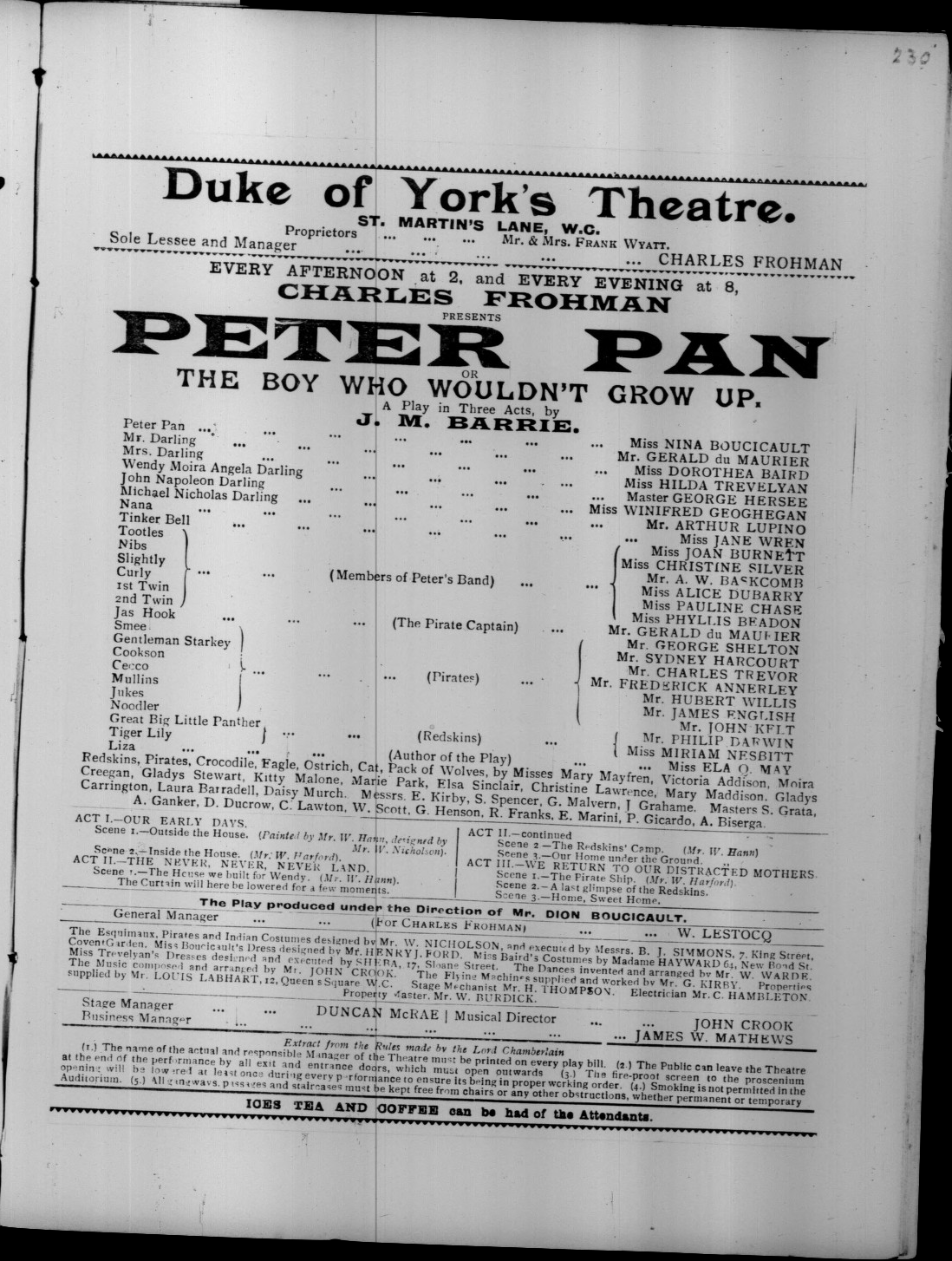
Reproduced from Waters (n.d.: I, 230).
Reproduced from Waters (n.d.: I, 232).
- Very loosely and indifferently constructed; Spoils her best song. — “Haymarket Theatre; ‘My Wife,’” The Morning Post, Wednesday, May 29, 1907, p. 7.
- Evening dress; Lovely evening wrap; Frock. — “London Fashions; Footlight Fashions at the Haymarket,” Lady’s Pictorial, June 1, 1907, pp. 970–971.
- Not yet turned eighteen. — “Leading Lady at Seventeen; Miss Marie Lohr’s Early Triumphs; Began as a Baby,” Daily Express (London), Thursday, May 30, 1907, p. 5.
- Praiseworthy; Satisfactorily. — “‘My Wife,’” The Era, June 1, 1907, p. 15; “London Theatres; The Haymarket,” The Stage, May 30, 1907, p. 16.
- The St. Pancras Chronicle stating. — “Musical & Theatrical Notes; ‘My Wife,’” The St. Pancras Chronicle, Friday, July 12, 1907, p. 5.
- Theatrical garden party. — “Theatrical Garden Party,” The Era, July 13, 1907, p. 15.
- Article in The Era. — “‘My Wife’ at the Haymarket,” The Era, August 24, 1907, p. 15.
- Contra the piece in Smith’s Magazine. — Walker is included in the cast list of the September 27 and 28 performances, as published in the The Daily Telegraph, Friday, September 27, 1907, p. 8 and The Daily Telegraph, Saturday, September 28, 1907, p. 10.
- Still in the heyday of her vitality. — “Theatrical Notes,” The Pall Mall Gazette, Monday evening, September 30, 1907, p. 1. See also: “Stageland and Thereabouts,” Reynolds’s Newspaper, Sunday, September 29, 1907 p. 4; “The Theatres; Romantic Comedy for the Haymarket,” Weekly Dispatch Sports Supplement, September 29, 1907 p. 10; Wearing (1981: 563–564).
- Flying matinee. — “‘The Morals of Marcus,’” The Morning Leader, Thursday, January 31, 1907, p. 3. Reviewed in: “‘The Morals of Marcus,’” Bristol Times and Mirror, Tuesday, February 12, 1907, p. 5; “Amusements in Bristol; Matinee at the Prince’s Theatre; ‘The Morals of Marcus,’” The Western Daily Press, Tuesday, February 12, 1907, p. 7.
- Most popular of London entertainments. — “Drama; The Week,” The Athenæum, no. 4116, September 15, 1906, p. 311.
- As The Sphere reported. — J. M. B., “The Reopening of the Playhouses,” The Sphere, September 1, 1906, p. 192.
- The Era called Walker’s enactment. — “‘The Morals of Marcus,’” The Era, October 20, 1906, p. 15.
- Nominated for election. — “Chit Chat,” The Stage, December 20, 1906, p. 15; “Theatrical Gossip,” The Era, December 22, 1906, p. 14.
- Seen on the boards of the King’s Theatre. — “London Theatres; The King’s, Hammersmith,” The Stage, March 14, 1907, p. 17.
- Chambers/Chalmers. — H. Kellett Chambers: “London Theatres; The King’s, Hammersmith,” The Stage, March 14, 1907, p. 17. Kenneth Chalmers: The Birmingham Daily Mail, Tuesday, May 15, 1906, p. 4. Kellett Chambers: The Stage, May 31, 1906 p. 3; The Era, June 9, 1906, p. 10. For the May–June 1906 tour of Dan’l Peggotty, referred to most often as Kellett Chalmers (see references in following note). Chalmers and Chambers were the same person: “For something more than five years Harrie K. Chambers, who is a brother of Haddon Chambers, has devoted himself to writing plays, but it was not until ‘Abigail’ met with the approval of Grace George and her husband that Harrie Chambers, newspaper writer, became Kellett Chalmers, playwright” (Davis 1905: 89). Under the name Kellett Chalmers, Chambers also wrote A Case of Frenzied Finance, first produced March 30, 1905, at the Academy of Music, Newburg, New York, then at the Savoy Theatre, New York City, on April 3, before moving to the Princess Theatre the following week (“‘Frenzied Finance’ Staged; Play Produced at Newburg with Get-Rich-Quick Plot,” The New York Times, Friday, March 31, 1905, p. 9; “At the Theatres; Savoy — A Case of Frenzied Finance,” The New York Dramatic Mirror, April 15, 1905, p. 16; “‘Frenzied Finance’ in Doubt; Opinions Differ as to Whether Farce is to be Taken Off,” The New York Times, Friday, April 7, 1905, p. 9; “Amusements,” The New York Times, Sunday, April 16, 1905, p. 10 [advertisement]). According to his obituary, Henry Kellett Chambers was born c. 1867 in Sydney, Australia, went to London in 1888, then to the US in 1891, where, before becoming a playwright, he worked on newspapers in San Francisco and New York (“Henry K. Chambers, Playwright, is Dead; Wrote ‘Abigail,’ Starring Grace George, and ‘Butterfly’ in Which Lillian Russell Led Cast,” The New York Times, Friday, September 6, 1935, p. 17). Apparently, he also traveled back to London in 1906–1907 to work on adapting Dickens to the stage, before returning to the US where, as H. Kellett Chambers, he wrote such plays as The Butterfly (1907) and An American Widow (1909).
- Five-cities-in-five-weeks tour. — For the Liverpool production, see: “Theatrical Notes,” The Pall Mall Gazette, Monday evening, May 7, 1906, p. 1 [“The production was rehearsed in London at the Savoy.”]; “Public Notices,” The Birkenhead News and Wirral General Advertiser, Wednesday, May 9, 1906, p. 1 [advertisement]; “Liverpool,” The Stage, May 10, 1906, p. 18 [review]; “Provincial Theatricals; Liverpool,” The Era, May 12, 1906, p. 8 [review]. For Birmingham: “Birmingham Amusements; ‘Dan’l Peggotty;’ New Dickens Play at the Prince of Wales;” The Birmingham Daily Mail, Tuesday, May 15, 1906, p. 4 [review]; “Birmingham Amusements; Prince of Wales Theatre; ‘Dan’l Peggotty,’” The Birmingham Daily Post, Tuesday, May 15, 1906, p. 11 [review]; “Stage and Stalls; Week’s Drama in Birmingham Playhouses; Another Dickens Play; ‘Peggotty’ at the Prince’s,” Birmingham Gazette and Express, Tuesday, May 15, 1906, p. 3 [review]; The Birmingham Daily Mail, Thursday, May 17, 1906, p. 1 [advertisement]. For Glasgow: “Dickens on the Stage”, The Daily Record and Mail (Glasgow), Wednesday, May 23, 1906, p. 3 [review: “Dickens-lovers, at all events — and their name is legion — should crowd the house to witness the most effective of adaptations from the Mater that we have yet had to welcome — Mr. Kellett Chalmers’s ‘Dan’l Peggotty.’”]; “Popular Entertainments,” The Daily Record and Mail, Wednesday, May 23, 1906, p. 4 [advertisement: “Mr. Charles Cartwright and his Specially Organised London Company, Including Mr. Charles Collette and Miss Molly Pearson, in Dan’l Peggotty, An Adaptation of “David Copperfield,” by Mr. Kellett Chalmers.”]; “Glasgow,” The Stage, May 24, 1906, p. 2 [review]; “Provincial Theatricals; Glasgow,” The Era, May 26, 1906, p. 7 [review]; “King’s Theatre; ‘Dan’l Peggotty,’” Glasgow Observer, Saturday, May 26, 1906, p. 2 [review]. For Edinburgh: “Amusements,” The Scotsman, Saturday, May 26, 1906, p. 2 [advertisement]; “Edinburgh,” The Stage, May 31, 1906 p. 3 [review]; “Provincial Theatricals; Edinburgh,” The Era, June 2, 1906, p. 7 [review]. For Newcastle-on-Tyne: The Evening Chronicle (Newcastle), Saturday, June 2, 1906, p. 1 [advertisement]; “The Provinces; Newcastle-on-Tyne,” The Stage, June 7, 1906, p. 7 [review]; “Provincial Theatricals; Newcastle-on-Tyne,” The Era, June 9, 1906, p. 10 [review].
- Devonshire Park Theatre, Eastbourne. — “Devonshire Park; Diluted Dickens; ‘David Copperfield’ at Devonshire Park Theatre,” Eastbourne Gazette, Wednesday, April 17, 1907, p. 8; “Provincial Theatricals; Eastbourne,” The Era, April 20, 1907, p. 8.
- Boards of the Broadway Theatre. — “London Theatres; The Broadway, S.E.,” The Stage, April 25, 1907, p. 17; “Broadway Theatre,” The Woolwich Herald, Friday, April 26, 1907, p. 3; “Broadway Theatre, S.E.,” The Era, April 27, 1907, p. 19.
- Cartwright and Co. next traveled. — “The Provinces; Plymouth,” The Stage, May 2, 1907, p. 7; “‘David Copperfield;’ Performance at the New Theatre, Cardiff,” South Wales Daily News, Wednesday, May 8, 1907, p. 6; “Dickens on the Stage; Performance of ‘David Copperfield’ at Cardiff,” Western Mail, Wednesday, May 8, 1907, p. 6; “Public Amusements; Shakespeare Theatre,” The Birkenhead News, Wednesday, May 15, 1907, p. 1; “Manchester Amusements; Gaiety,” The Manchester Courier, Tuesday, May 21, 1907, p. 6; “Provincial Theatricals; Manchester,” The Era, May 25, 1907, p. 9; “Entertainments; The Theatre Royal,” Brighton Gazette, Hove Post, Sussex & Surrey Telegraph, Saturday, May 25, 1907, p. 8.
-
Miss Kate Reignolds. — Born in England on May 16, 1836, Catherine Mary Reignolds traveled with her mother Emma, an actress and singer, to the United States sometime between 1848 and 1850 (Gatto 1994: 242–243). At the age of fourteen, Catherine persuaded her mother, who was playing the lead in a production of Cinderella at Rice’s Theatre, Chicago, to let her try a small part in the same play (Reignolds-Winslow 1887: xiii). Four years later, a month shy of nineteen, Miss Kate Reignolds made her New York début on April 17, 1855, at the Broadway Theatre, as Virginia to Edwin Forrest’s Virginius (Odell 1931: 347), in what was most likely James Sheridan Knowles’s tragedy in five acts, Virginius (Knowles 1820; see also Epes 1847 and Anon. 1876). (The tragedy was also, perhaps, known as Virginius, or the Liberation of Rome, and its first New York performance took place on September 25, 1820, at the Pavilion Theatre on Anthony [now Worth] Street, near Broadway [Brown 1903: 83].) The following year, she became part of the regular cast at Burton’s Theatre on Chambers Street, New York (Odell 1931: 431), “where, in a very short time, she established herself as one of the greatest favorites ever connected with that theatre” (Brown 1870: 309). In 1860, she joined the stock company of actors at the Boston Museum (Gatto 1994: 243) where she played, among other roles, Desdemona to John Wilkes Booth’s Othello at the Boston Museum on May 2, 1864, and Juliet to the same actor’s Romeo the following evening at the same venue (Samples 1982: pp. 151; 233–234). In her memoir, Yesterdays with Actors, she says of Booth:
How he threw me about! once even knocked me down, picking me up again with a regret as quick as his dramatic impulse had been vehement. In Othello, when, with fiery remorse, he rushed to the bed of Desdemona after the murder, I used to gather myself together and hold my breath, lest the bang his cimeter gave when he threw himself at me should force me back to life with a shriek.
In December 1857, Reignolds married actor Henry Farren, “who died in St. Louis, Jan. 8, 1860” (Brown 1870: 309; Gatto 1994: 243). She subsequently married Erving Winslow, “a young Boston merchant,” on Friday, June 28, 1861 (“New England News Items; Eastern Massachusetts,” The Springfield Daily Republican, Tuesday, July 2, 1861, p. 4; see also, “Marriages,” Boston Daily Evening Transcript, Saturday, June 29, 1861, p. 3). Mrs. Erving Winslow died at her summer home in Concord, Mass., on July 11, 1911, during a heatwave (“Kate Reignolds a Victim; Old Boston Museum Actress Succumbs to Heat at Her Home in Concord,” The Boston Globe, Wednesday, July 12, 1911, p. 9).The sharp dagger seemed so dangerous an implement in the hands of such a desperado that I lent him my own — a spring dagger, with a blunt edge, which is forced back into its handle if it is actually struck against an object. In the last scene of Romeo and Juliet, one night, I vividly recall how the buttons at his cuff caught my hair, and in trying to tear them out he trod on my dress and rent it so as to make it utterly useless afterward; and in his last struggle literally shook me out of my shoes! The curtain fell on Romeo with a sprained thumb, a good deal of hair on his sleeve, Juliet in rags and two white satin shoes lying in the corner of the stage! (Reignolds-Winslow 1887: 141–142).
- Teaching elocution; giving dramatic readings. — See Gatto (1994: 243) and Dinah Sturgis, “Mrs. Erving Winslow; Once Museum Star and Now a Favorite Reader; Instructive Chat on Her Art and Pupils in Elocution; Requirements for Success in Dramatic Readings,” The Boston Sunday Globe, Sunday, June 19, 1892, p. 26.
- Played the part of Villikins. — “College Notes,” The Wellesley Magazine, vol. 7, no. 4, January 10, 1899, p. 225.
- Burlesque ballad. — See the wikipedia article on Villikins and his Dinah [https://en.wikipedia.org/wiki/Villikins_and_his_Dinah].
- Saturday, October 2, 1897. — “Society Notes,” The Wellesley Magazine, vol. 6, no. 1, October, 1897, pp. 35–36.
- Afternoon of January 22, 1900. — “College Notes,” The Wellesley Magazine, vol. 8, no. 5, February 10, 1900, p. 259.
- Scenes from famous works. — “College Notes,” The Wellesley Magazine, vol. 6, no. 6, March 19, 1898, pp. 303–304.
- The artistic arrangement of the stage. — “College Notes,” The Wellesley Magazine, vol. 7, no. 2, November 12, 1898, p. 99: “For the artistic arrangement of the stage great credit is due to Gordon Walker, 1900, and to other members of the committee.”
- Barn Swallows produced Bianca. — “College Notes,” The Wellesley Magazine, vol. 7, no. 5, February 11, 1899, p. 277.
- Two others reports. — “Spirit of Her Dead Husband; Ormskirk Evidence in London Tragedy,” The Liverpool Echo, Monday, October 17, 1927, p. 8; “Woman’s Delusions,” The Yorkshire Evening Post, Monday, October 17, 1927, p. 12.
- Discrepancy in the date she died. — The date of Saturday, October 15, 1927, is also given in The Daily Telegraph, Tuesday, October 18, 1927, p. 5, while that of Friday, October 14, is confirmed by, e.g., “Births, Marriages, and Deaths; Deaths,” Liverpool Post & Mercury, Tuesday, October 18, 1927, p. 1; “Welsh and Border Wills; Gifts for Lady Clwyd and Lady Lewis,” Western Mail, Saturday, November 12, 1927, p. 10; “Auction and Property Announcements; Edith Gordon Caine, Deceased,” Hampstead and St. John’s Wood Advertiser, November 24, 1927, p. 2; and “Alumnae Notes; Died,” Wellesley College News, vol. 36, no. 20, March 8, 1928, p. 8. The copy of the burial record I obtained from the Brookwood Cemetery office on March 26, 2026 (see § 15), also confirms a death date of October 14, 1927.
- City of her birth. — Louisville, Kentucky. See entry 35358, “Miss Edith Gordon Walker,” in Lineage Book, National Society of the Daughters of the American Revolution, Volume XXXVI, Washington, D.C., 1912, p. 133.
- Walker’s delusions of “money difficulties”. — See also, e.g., “Wills and Bequests,” The Daily Telegraph, Saturday, November 12, 1927, p. 18; “Recent Wills,” The Manchester Guardian, Monday, November 14, 1927, p. 2.
- According to the Bank of England. — [https://www.bankofengland.co.uk/monetary-policy/inflation/inflation-calculator-beta].
- Allocated £2,000. — As acting chairman of the committee of the Ormskirk Cottage Hospital extension plan, it seems that Maples allocated the first £1,000 anonymously, as bait to induce the public to contribute another £1,000 (“Ormskirk Cottage Hospital Building Scheme; A Great Financial Effort Needed to Reach £1,000,” The Ormskirk Advertiser, Thursday Afternoon, October 4, 1928, p. 7); which condition having been met, Maples paid over another cheque for £1,000 during the ceremony for the laying of the foundation stone for the hospital extensions on Saturday, October 20, 1928 (“Ormskirk Cottage Hospital Extensions,” The Ormskirk Advertiser, Thursday Afternoon, October 25, 1928, p. 3).
- Did Walker’s mother ever see any of the income. — Mrs. Edith Gordon Walker’s estate was valued at $20,000 when she died at the age of 89 in Cambridge, Mass., on November 30, 1946 (“Gloucester Will Leaves $19,500 as Charity Fund,” The Boston Daily Globe, Wednesday, December 18, 1946, p. 5).
- Caine’s father’s will — “Will of Mr. W. S. Caine, M.P.,” The Leeds and Yorkshire Mercury, Tuesday, May 26, 1903, p. 5; “Wills and Bequests,” The Illustrated London News, Saturday June 13, 1903, p. 926. See also the three news items reproduced in § 7.
- Member of the Society for Psychical Research. — In Journal of the Society for Psychical Research (vol. XII, no. CCXXIX, May 1906, p. 254), Hannah Rushton Roberts is listed among the new members as “Roberts, Mrs. I. [sic] Herbert, Bryngwenallt, Abergele.” In Proceedings of the Society for Psychical Research (vol. XLVIII, part 176, September 1949, p. 370), she is listed as “Clwyd, The Lady, Bryngwenallt, Abergele, N. Wales.” Lady Clwyd, that is, Hannah Rushton Roberts née Caine, died January 1, 1951 (see, e.g., “Death of Lady Clwyd; Social worker,” Liverpool Daily Post, Tuesday, January 2, 1951, p. 5; “Death of Lady Clwyd,” North Wales Weekly News, Thursday, January 4, 1951, p. 7; “Lady Clwyd; Her life an inspiration,” North Wales Weekly News, Thursday, January 11, 1951, p. 4).
- Much anticipated “French play”. — “College Notes,” The Wellesley Magazine, vol. 7, no. 5, February 11, 1899, pp. 278–279. The students were apparently coached in French pronunciation by Alphonse Naus Van Daell, professor at MIT, author of An Introduction to French Authors (Boston, Ginn & Co., 1894) and An Introduction to the French Language (Boston, Ginn & Co., 1895), co-author of La Parole Française (New York, F. W. Christern, Boston, Carl Schœnhof, 1883); see “Among the Colleges; Wellesley,” New-York Daily Tribune, Monday, January 23, 1899, p. 9: “Professor Van Daell, of the Massachusetts Institute of Technology, who is also teaching at Wellesley this year, has been helping drill the students for the French play ‘L’Amour Medecin,’ by Molière, given last Friday [sic] evening.”
- Annual junior play. — “College Notes,” The Wellesley Magazine, vol. 7, no. 7, April 15, 1899, p. 384.
- So-called Smith Family. — “College Notes,” The Wellesley Magazine, vol. 8, no. 2, November 11, 1899, p. 92.
- Various members of the Smith family. — “Newark; Columbian Sociable,” Every Evening (Wilmington, Del.), Saturday, November 11, 1893, p. 1.
- Painted upon canvas. — “Local Lines,” The Boston Sunday Globe, Sunday, April 11, 1897, p. 23. See also, e.g.: “A Great Success,” Saginaw Evening News, Friday, November 14, 1890, p. 3; “The Inimitable Smith Family; They Give One of Their Unique Concerts in the Chapel of the First Presbyterian Church and are Rewarded With a Large Audience,,” The Plainfield Courier, Saturday, October 29, 1892, p. 3.
- On November 6, 1899. “College Notes,” The Wellesley Magazine, vol. 8, no. 3, December 9, 1899, p. 145. Walker is listed as “Miss Walker, 1901.” This is surely erroneous, as there was no one named Walker in the Wellesley class of 1901. Moreover, Walker’s entry on page 52 of the Wellesley Legenda 1900, which I’ve reproduced in § 5, clearly indicates her participation in the “Norumbega Play” during her senior year.
- Passed the lighthouse. — Shipping Gazette and Lloyd’s List, Friday, June 17, 1904, p. 6; “Mail and Shipping News; Steamship Movements,” The Daily News (London), Saturday, June 18, 1904, p. 2; Shipping Gazette and Lloyd’s List, Saturday, June 18, 1904, p. 6; “Shipping Intelligence; Liverpool; Arrived June 18,” The Public Ledger (London), Monday, June 20, 1904, p. 4.
- Debarked at Liverpool a few hours later. — “Docked Since Last Issue; Liverpool Docks,” The Journal of Commerce (Liverpool), Monday June 20, 1904, p. 7; “Commercial Gazette and General Memorandum; Foreign Meat Imports,” The General Advertiser (Dublin), June 25, 1904, p. 3.
- Three sources quoted in § 5. — That is, “The World of Women,” The Penny Illustrated Paper, May 27, 1905, p. 330, where Walker is said to have “made her debut in this country in ‘Peter Pan.’” “Some Popular People in Stageland,” The Illustrated Sporting and Dramatic News, June 17, 1905, p. 605, where Walker is said to have “recently appeared in ‘Peter Pan,’ at the Duke of York’s Theatre.” “Pithy Points,” The Bexhill Chronicle, Saturday June 24, 1905, p. 6, where Walker is said to have “recently played in ‘Piper Pan’ [sic] at the Duke of York’s Theatre, London.”
- Wildest medley. — “‘Peter Pan;’ Marked Success of Mr. J. M. Barrie’s Children’s Play; Author off to Paris; Unanimous Response to an Appeal to Show Belief in Fairies,” The Evening News and Evening Mail (London), Wednesday, December 18, 1904, p. 2.
- Plaintive, nautical, and barbaric. — “London Theatres; The Duke of York’s,” The Stage, December 29, 1904, p. 20.