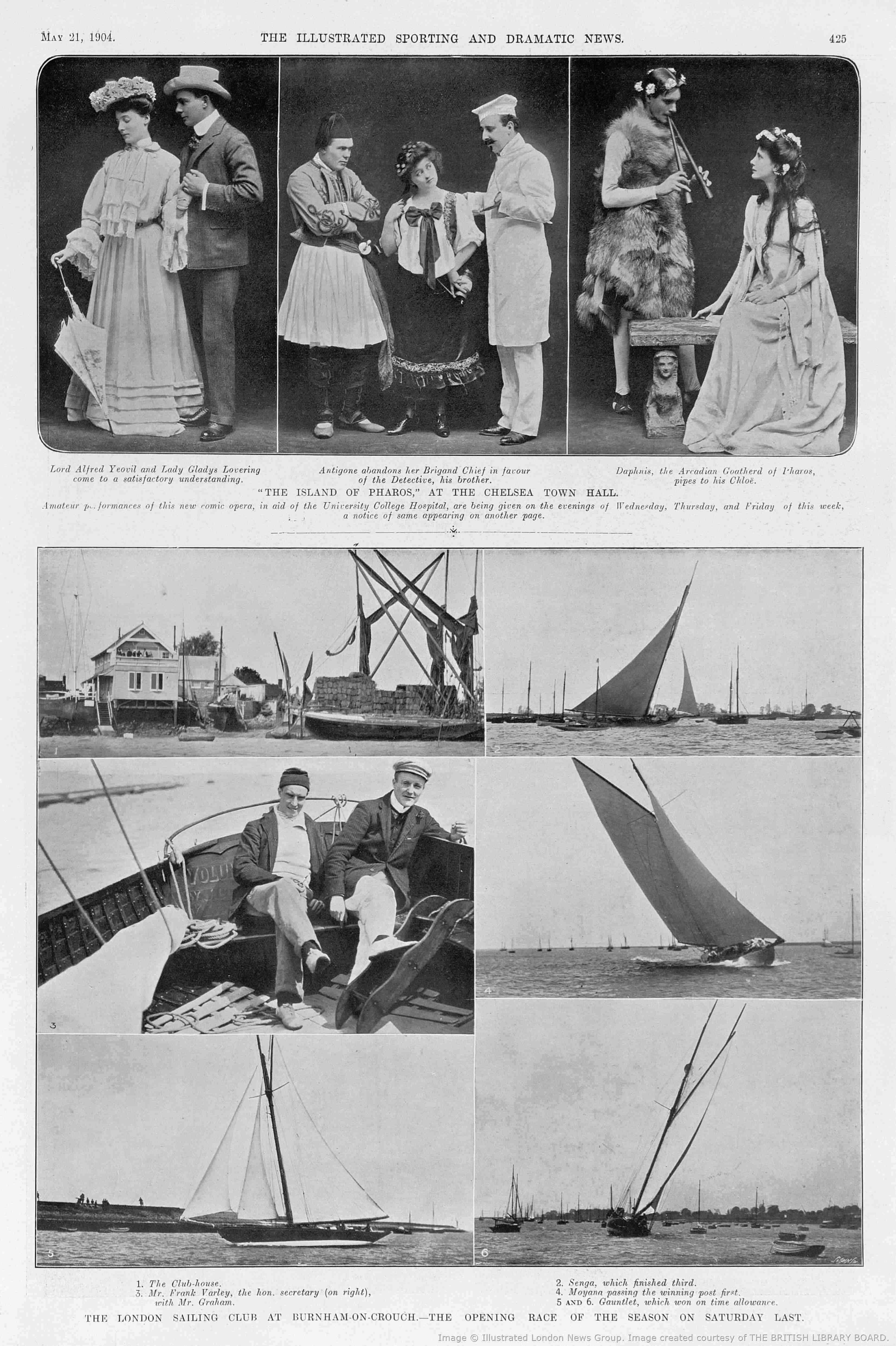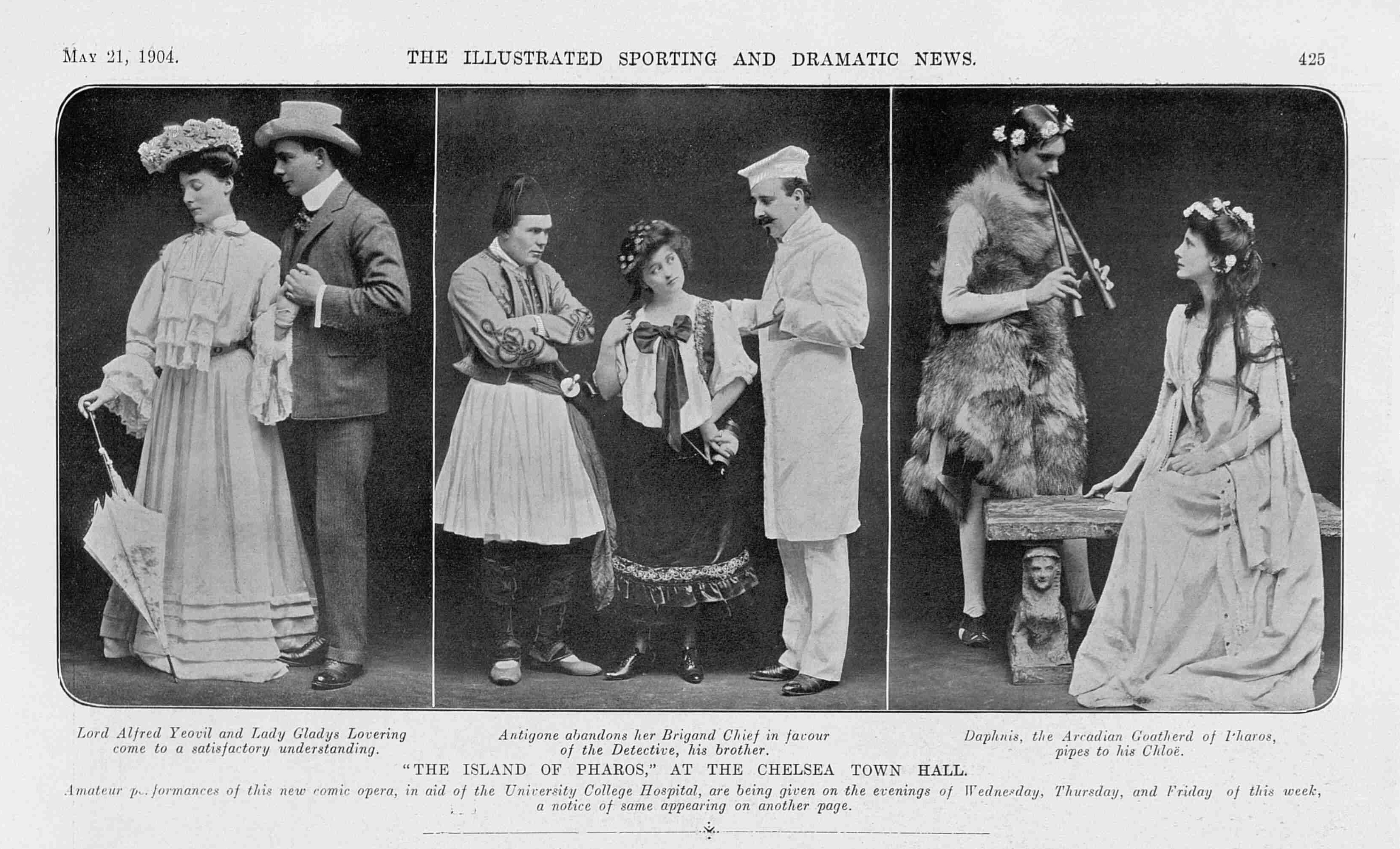
Reproduced from The Illustrated Sporting and Dramatic News, London, Saturday, May 21, 1904, p. 425. Photography by Langfier, Ltd., Bond Street.
There were large and fashionable audiences at the Chelsea Town Hall on the three occasions recently, when, in aid of the University College Hospital, an “entirely new and original comic opera,” entitled The Island of Pharos, was given by a very capable company of amateurs. For once the hackneyed description, “entirely new and original,” is not belied by the work, which is one both author and composer, Mr. William Caine and Mr. Osborne Roberts respectively, may be complimented on, the former particularly for his poetic gifts as shown in many neat and fanciful lyrics, the latter especially for the sympathetic manner in which he has set them. The plot has primarily to do with the adventures of two brothers, one of whom, William Sykes, has entered the office of a company promoter; the other, Henry, the Metropolitan Police. William embarks upon a career of excessive shadiness, which ultimately terminates in an engagement as head agent for the Balkan Peninsula of a syndicate floated for the promotion of brigandage in all its forms. His temporary absence from England is rendered advisable by the fact that, under the name of Julius Schwindelheimer, he is in request at Scotland Yard, and it is his own brother Henry who carries the warrant for his arrest.Disguised as a cook on board the yacht of a Lady Gladys Lovering, Henry the detective sets out for Greece, where he anticipates meeting with Schwindelheimer, the object of his search. This Lady Gladys Lovering, a wealthy young widow with a rooted dislike to matrimony, has taken her two sisters, Mabel and Henrietta, for a cruise in the Mediterranean, hoping this to escape from the pursuit of Lord Alfred Yeovil and his two friends, Mr. Powys and Sir John Kerr, who, however, are not easily evaded. On the rising of the curtain William and his brigands are found upon the quay, discussing the details of a scheme for capturing and holding for ransom Lady Gladys and her sisters. Already her crew has been kidnapped and the brigand band is about to offer its services in their place. The unexpected meeting of the ladies and gentlemen results in their united departure in Lady Gladys’ yacht, manned by this crew of desperadoes, for a picnic to Egina. The brigands have no sooner declared themselves than the yacht strikes upon a rock; William’s plans are thus upset, all take to the boats, and ultimately the whole party is brought safely to shore upon the Island of Pharos, which is dedicated to the service of Eros, God of Love, and has lain uncharted in the midst of the Mediterranean since the days of Theocritus. Its atmosphere is charged so heavily with the spirit of that golden age, that hate, jealousy, greed, and all the other unbecoming emotions may find no place within its coasts; and here eventually all ends happily, in evil being changed to good and lovers reunited.
The opera, which was produced by Mr. A. S. Barber, was given with plenty of vivacity by all who took part in it. Miss Catherine van Duzer was altogether charming as Lady Gladys Lovering, and sang very nicely, her pretty song, “The Weeping Willow Droops Above,” being extremely successful. Miss Jean Newman acted brightly as Antigone, a vivandière, and her singing of another song, well written both as to words and music, “Love Let Fly a Random Shaft,” was one of the most attractive items in the opera. Mr. C. R. Hills and Mr. H. H. Curtis Bennett were amusing as the two brothers, William and Henry; Mrs. A. S. Barber and Mrs. H. H. Curtis Bennett made very charming representatives of Lady Gladys’ sisters, the Ladies Mabel and Henrietta. Some extremely pretty solo dances were contributed by the Misses Evelyn and Estella West, and among others who assisted ably towards a success for the production may be mentioned Messrs. A. S. Barber, C. Wheeler, C. C. G. Roberts, Ivor Back, S. R. Van Duzer, Alec Welby, Leonard Russell, and the Misses Lois Van Duzer, Isabelle Hastings, and May L. Graves, while a special word of praise is due to the chorus, who worked together admirably (Autolyca, “Amateur Dramatic Notes,” Lady’s Pictorial, June 4, 1904, p. 1099).
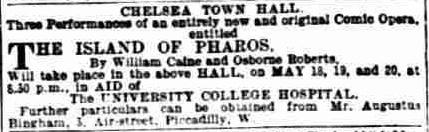
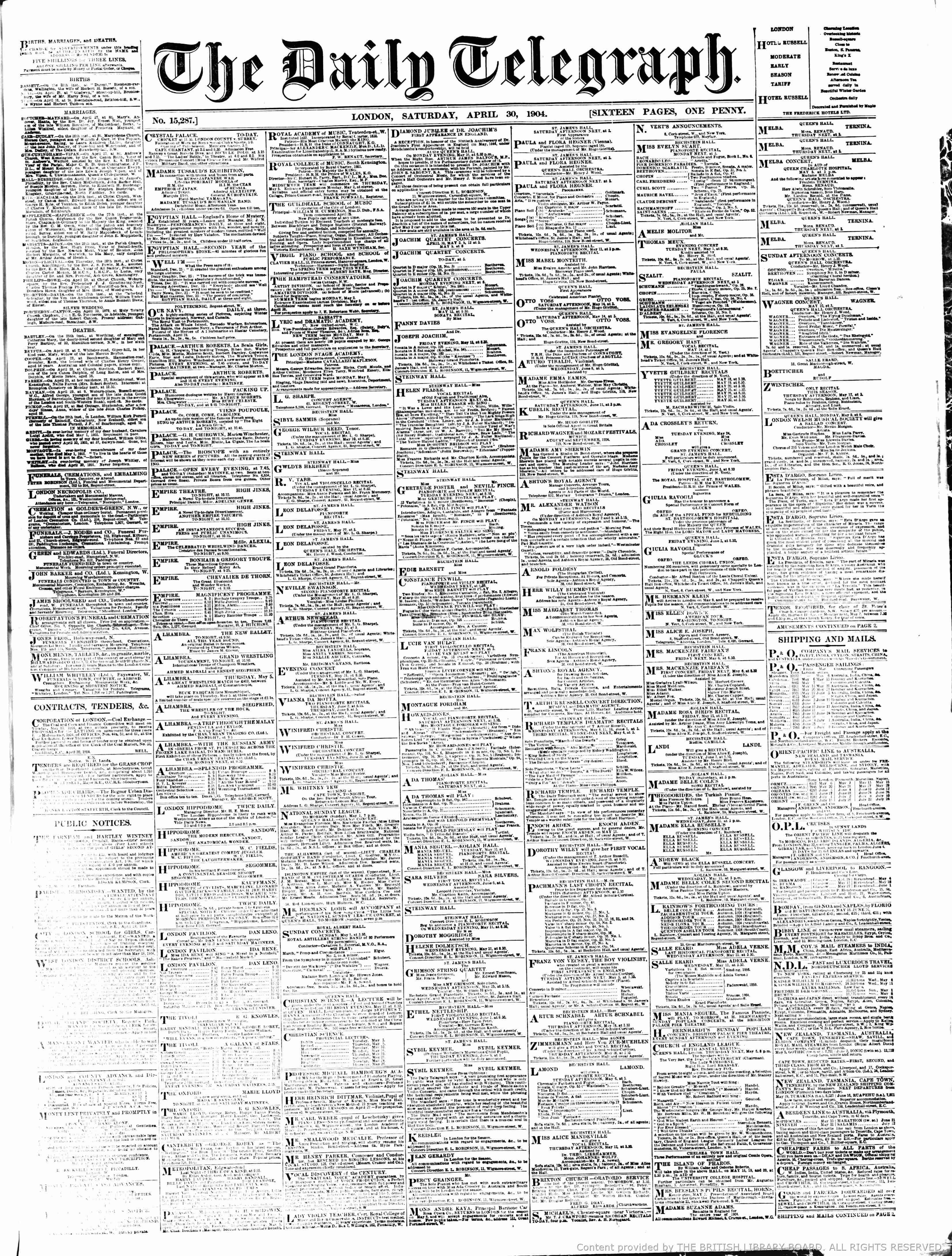
Reproduced from “Public Notices,” The Daily Telegraph, Saturday, April 30, 1904, p. 1.
A new comic opera, entitled “The Island of Pharos,” libretto by William Caine, and music by Osborne Roberts, will be performed by a distinguished company of amateurs on the evenings of May 18th, 19th, and 20th, at the Chelsea Town Hall, in aid of a deserving charity. The opera will be produced by Mr. A. S. Barber, and musical arrangements and management are in the hands of Mr. Augustus Bingham (“Musical and Dramatic Notes,” The Daily News, Tuesday, April 26, 1904, p. 4).
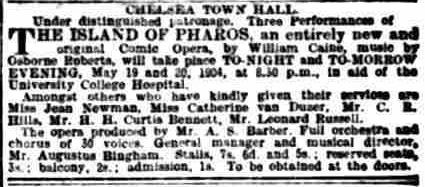
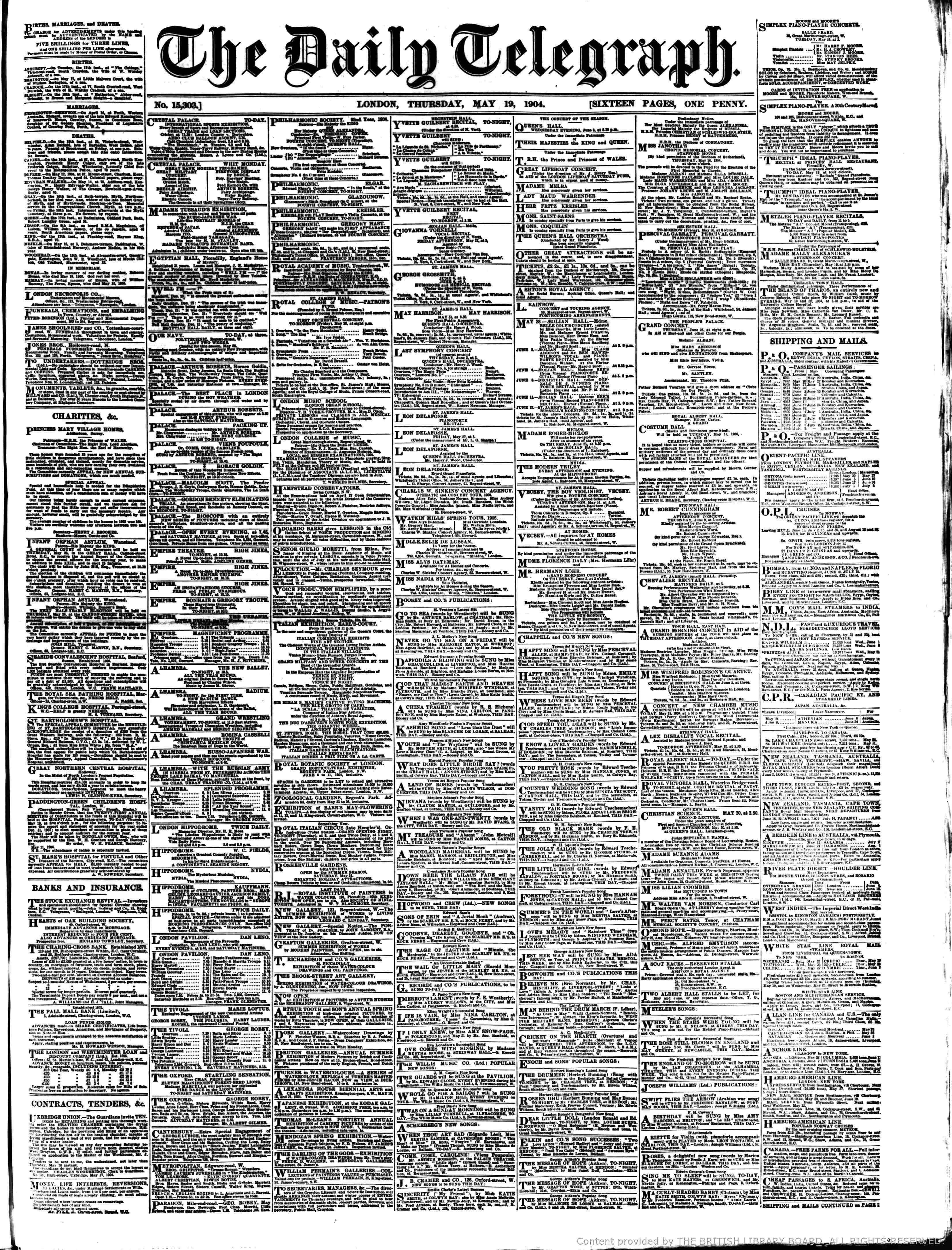
Reproduced from “Public Notices,” The Daily Telegraph, Thursday, May 19, 1904, p. 1.
“The Island of Pharos,” a comic opera in two acts, was produced last night by a company chiefly of amateurs at the comfortable little theatre at the Chelsea Town Hall in aid of University College Hospital. The performance reflected credit on all concerned. The book by Mr. William Caine was clear, and told a story which was lucid and humorous, and gave plenty of opportunity to the performers. It ran on rather conventional lines, but it was not, as so many of the stories invented for such productions are, reminiscent of the famous productions of Gilbert and Sullivan. Brigands kidnap the three delightful heroines and their lovers, but they are turned into peaceable farmers when they are landed, owing to shipwreck, on “The Island of Pharos,” where love reigns supreme, and all ends happily. The music of Mr. Osborne Roberts, deserves very high praise. Like the book it is unambitious, but some of the numbers were delightful, and showed an original gift of melody quite unusual in productions of this nature. Among the excellent numbers which deserve notice the song of the Colonel of Greek Horse Marines deserves special mention. It was admirably sung by Mr. Leonard Russell. Another delightful song, “The weeping willow droops above,” was rendered charmingly by Miss Catherine Van Duzer as Lady Gladys Lovering. The acting all round was exceptionally good. The performance was well received, and the piece, which will be played to-night and to-morrow night, is well worth seeing (“University College Hospital; Amateur Theatricals,” The Morning Post, Thursday, May 19, 1904, p. 4).“Onlooker” of the Daily Express briefly noticed the third night’s performance:
Last night concluded the third performance of “The Island of Pharos,” a clever and original comic opera, written by Mr. William Caine, which has been given at the Chelsea Town Hall in aid of the University College Hospital.And the review in The Illustrated Sporting and Dramatic News, when noting Caine’s “neat turn for fanciful lyrics,” reveals itself to be the source of the statement in the review by “Autolyca” in Lady’s Pictorial (quoted above) that the author may be complimented “particularly for his poetic gifts as shown in many neat and fanciful lyrics:”The performers were all amateurs, and included Mr. Curtis Bennett, Mr. Alec Welby, Miss Isabelle Hastings, and Miss May Graves.
The whole thing was beautifully carried out, and the music, by Mr. Osborne Roberts, wonderfully good (Onlooker, “My Social Diary; ‘The Island of Pharos,’” Daily Express, Saturday, May 21, 1904, p. 4).
On Wednesday evening was produced, and on the two following evenings repeated, at the Chelsea Town Hall, in aid of the University College Hospital, a new comic opera, The Island of Pharos, written by William Caine, with music by Osborne Roberts, and performed by amateurs. Detailed consideration of the merits of the work are not possible in present limits, and it must suffice to say that while hardly strong enough in its present form to stand the test of professional production at a West End theatre, there is decidedly promising material in the work. Both author and composer have ideas which could have stood more confident expression, and while the former has a neat turn for fanciful lyrics, the latter proved his ability to give them appropriate, scholarly, and often original as well as melodious setting — one of the happiest of their united efforts being a song, “The weeping willow droops above,” very charmingly sung by Miss Catherine van Duzer as Lady Gladys Lovering. Among other notably successful performers were Miss Jean Newman, who, as Antigone, a vivandière, scored greatly with a pretty ditty, “Love let fly a random shaft”; Mrs. A. S. Barber and Mrs. H. H. Curtis Bennett as Lady Mable and Lady Henry Hogan respectively; Miss Lois van Duzer (Chloe), Miss Isabelle Hastings (the Arch Nymph), and the Misses Evelyn and Estella West, as graceful solo danseuses; and Messrs. C. R. Hills, H. H. Curtis Bennett, A. S. Barber (by whom the opera was produced), C. Wheeler, C. C. G. Roberts, and Ivor Back, who all in their various characters contributed to the success of the production, which was well received and decidedly creditable to all concerned (“‘The Island of Pharos,’” The Illustrated Sporting and Dramatic News, Saturday, May 21, 1904, p. 442).“Carados,” the dramatic gossip columnist for The Referee, praised the music, but said little about the librettist:
A new comic opera, entitledThe Stage included a full cast list in its review and, calling the book “one of some merit,” significantly (in retrospect, of course) noted a theme intrinsic to so much of Caine’s subsequent work, viz., “the chances that govern accidents sometimes called coincidences:”“The Island of Pharos,”
composed by Mr. Osborne Roberts, who has a pretty appreciation of melody and clever orchestration, was given at the Chelsea Town Hall on Wednesday, Thursday, and Friday, with considerable success. The “book,” written by William Caine, deals with the unfriendly relations of two brothers, who are shipwrecked on a Greek island where several young people, who are cruising for pleasure, also find themselves. A rich young widow is accompanied by two pretty sisters, whom she is hiding from the pursuit of two admirers. Brigands and the romantic difficulties in which the lovers find themselves supply the chief part of the story which ends with everyone happy on the island and love supreme. Of the music only praise can be written. Mr. Roberts has been very happy in several charming numbers. Miss Jean Newman, as Antigone; Miss Catherine Van Duzer, as Lady Gladys Lovering; Mr. Leonard Russell, Mr. Sprinck, and Mr. C. R. Hills were particularly successful. Among the numbers entitled to special mention are a ballad, “The Weeping Willow Droops Above;” a breezy song by the Colonel of the Greek Horse Marines; and “Love Let Fly a Random Shaft,” while a charming song sung by the First Goatherd in the second act was one of the gems of the opera. Mr. Osborne Roberts is to be congratulated on a genuine success. The opera was produced by A. S. Barber. The University College Hospital will be benefited by the proceeds (Carados, “Dramatic Gossip,” The Referee, May 22, 1904, p. 3).
Chelsea Town Hall. — On Wednesday, May 18, 1904, was produced here a comic opera in two acts, by William Caine, and music by Osborne Roberts, entitled: —The longest and most detailed review of The Island of Pharos which I’ve found is also that which pays the most attention to the “poetic gifts” of the future author of The Author of “Trixie”. The Era noted, “As a librettist Mr William Caine shows considerable ability, all the verses in the book being characterised by neat workmanship. Some of the songs are marked by a refined humour, while the ballads have genuine poetic feeling happily expressed.” This review (much of which, by the way, was plagiarized by “Autolyca,” supra) also remarked the “curious freak of Fate” at the center of Caine’s plot:The Island of Pharos.
[Cast List]
The performance was repeated on the evenings of Thursday and Friday, May 19 and 20, the proceeds from the three performances going in aid of University College Hospital. The Island of Pharos is rather an entertaining piece, and was favourably received. Its music is melodious and bright, and its book one of some merit. The island referred to in the title is one on which good feeling overpowers more or less those who have the luck to reside there. By the chances that govern accidents sometimes called coincidences, the brothers William and Henry find themselves brought together, after one has chased the other half over the world. This chase, however, has resulted from no brotherly feeling. It appears that William is a company promoter, and under a false name with lesser schemes has floated a sort of Brigand Band, Limited. His brother Henry is occupied in the more respectable calling of Police-officer, and to Henry’s lot falls the duty of tracking down the swindling promoter. Needless to say, he is unaware of his relationship. When the two brothers eventually meet on this miraculous island the warrant for arrest is inoperative. The island, not being on the chart, is therefore not in the jurisdiction of the law. The brigands, who had previously carried on a roaring, if felonious, trade, are all converted to respectable farmers, and proclaim themselves as such unanimously. There are various side issues, one being the attempt of Lady Gladys and her sisters to fly from the persecutions in a matrimonial direction of Lord Alfred Yeovil and his two friends. All these find themselves on the island, and eventually Lord Alfred succeeds in winning the hand of Lady Gladys, while other characters are paired off happily. The opera had the advantage of an excellent rendering from capable vocalists. Mr. Augustus Bingham proved an able musical director, and the opera was produced under the direction of Mr. A. S. Barber, who also played the part of Lord Alfred (“Amateurs; London,” The Stage, May 26, 1904, p. 19).
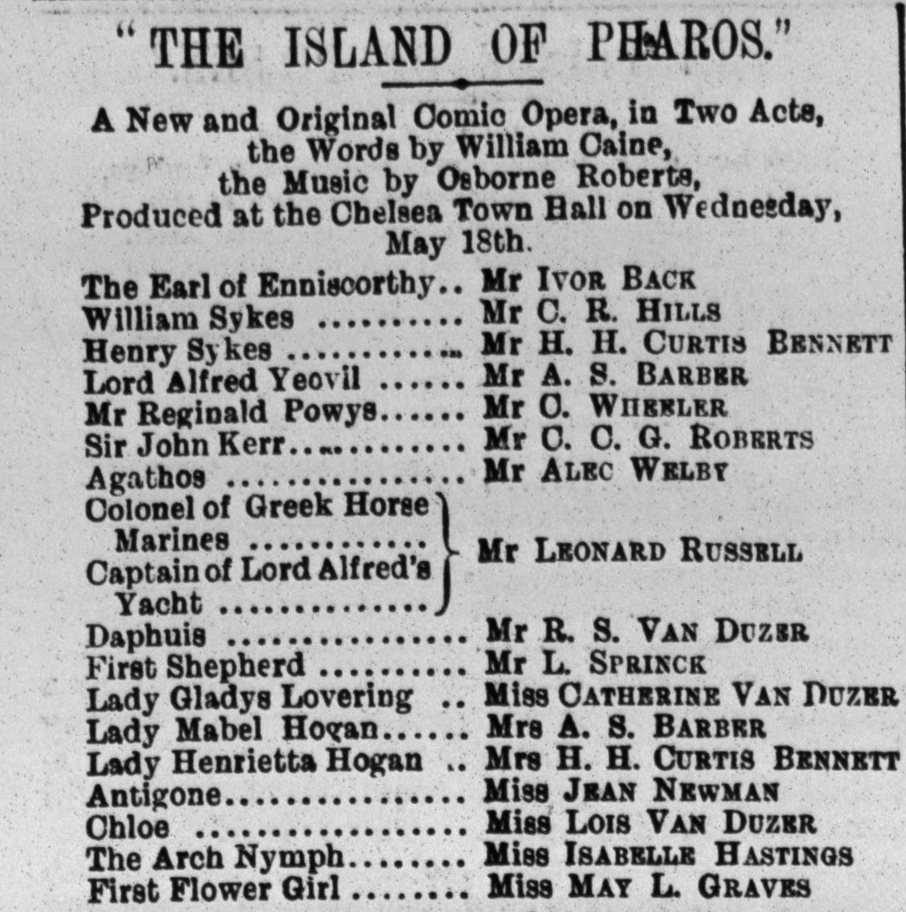
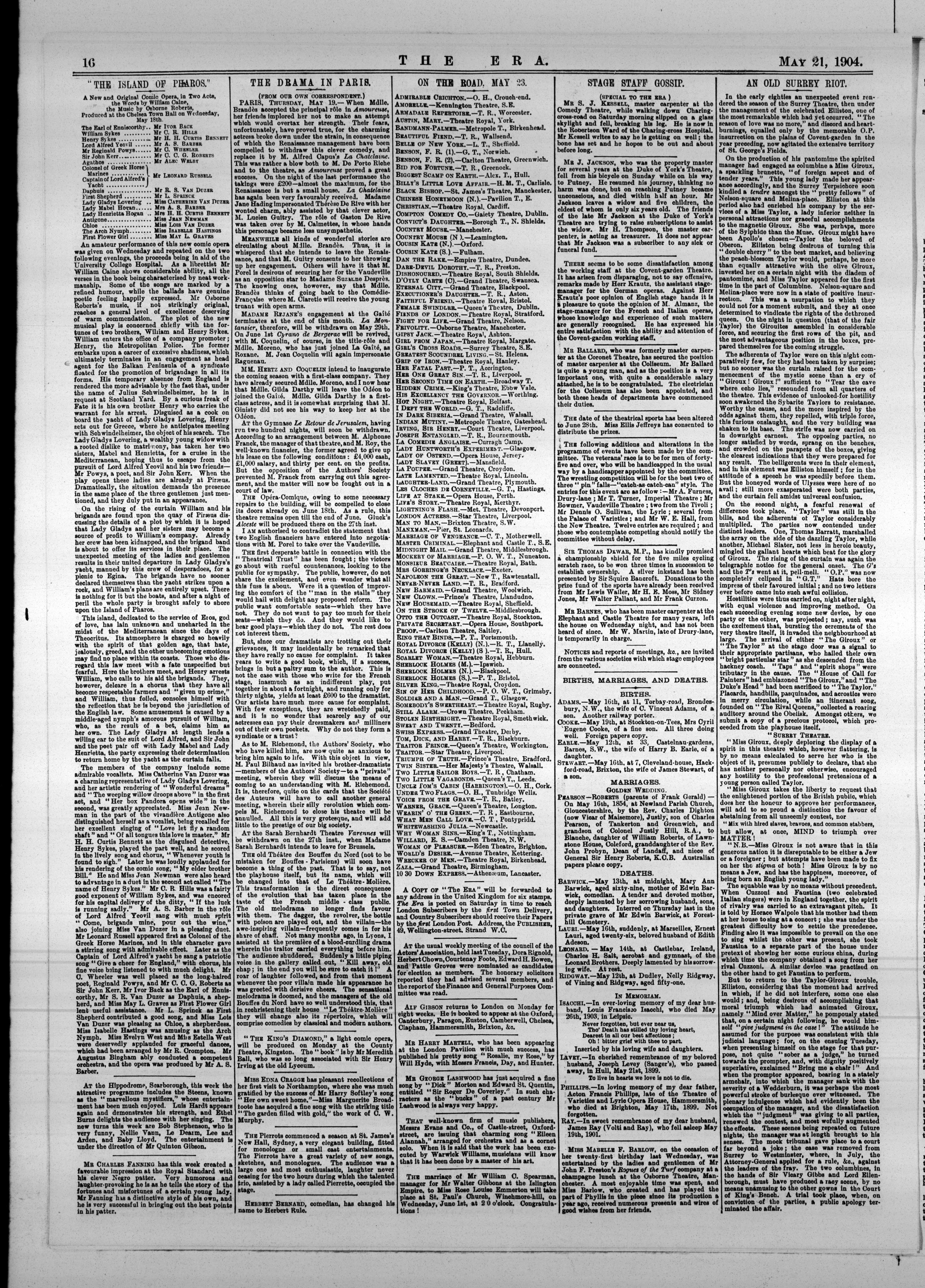
Reproduced from The Era, May 21, 1904, p. 16.
An amateur performance of this new comic opera was given on Wednesday and repeated on the two following evenings, the proceeds being in aid of the University College Hospital. As a librettist Mr William Caine shows considerable ability, all the verses in the book being characterised by neat workmanship. Some of the songs are marked by a refined humour, while the ballads have genuine poetic feeling happily expressed. Mr Osborne Roberts’s music, if not strikingly original, reaches a general level of excellence deserving of warm commendation. The plot of the new musical play is concerned chiefly with the fortunes of two brothers, William and Henry Sykes. William enters the office of a company promoter; Henry, the Metropolitan Police. The former embarks upon a career of excessive shadiness, which ultimately terminates in an engagement as head agent for the Balkan Peninsula of a syndicate floated for the promotion of brigandage in all its forms. His temporary absence from England is rendered the more advisable by the fact that, under the name of Julius Schwindelheimer, he is in request at Scotland Yard. By a curious freak of Fate it is his own brother Henry who carries the warrant for his arrest. Disguised as a cook on board the yacht of Lady Gladys Lovering, Henry sets out for Greece, where ha anticipates meeting with Schwindelheimer, the object of his search. The Lady Gladys Lovering, a wealthy young widow with a rooted dislike to matrimony, has taken her two sisters, Mabel and Henrietta, for a cruise in the Mediterranean, hoping thus to escape from the pursuit of Lord ALfred Yeovil and his two friends — Mr Powys, a poet, and Sir John Kerr. When the play opens these ladies are already at Piræus. Dramatically, the situaton demands the presence in the same place of the three gentlemen just mentioned, and they duly put in an appearance.Before I continue this section with a few examples of Caine’s “neat turn for fanciful lyrics,” as well as the subsequent career, in the form of a professional production, of The Island of Pharos, I would like to list the songs mentioned in the review above, and then summarize the little I have been able to learn about Caine’s collaborator, Osborne Roberts. First, the list of Caine’s and Roberts’s songs from The Island of Pharos:On the rising of the curtain William and his brigands are found upon the quay of Piræus discussing the details of a plot by which it is hoped that Lady Gladys and her sisters may become a source of profit to William’s company. Already her crew has been kidnapped, and the brigand band is about to offer its services in their place. The unexpected meeting of the ladies and gentlemen results in their united departure in Lady Gladys’s yacht, manned by this crew of desperadoes, for a picnic to Egina. The brigands have no sooner declared themselves than the yacht strikes upon a rock, and William’s plans are entirely upset. There is nothing for it but the boats, and after a night of peril the whole party is brought safely to shore upon the Island of Pharos.
This island, dedicated to the service of Eros, god of love, has lain unknown and uncharted in the midst of the Mediterranean since the days of Theocritus. Its atmosphere is charged so heavily with the spirit of that golden age, that hate, jealously [sic], greed, and the other unbecoming emotions may find no place within its coasts. Those who disregard this law meet with a fate unspecified but fearful. Here the brothers meet, and Henry arrests William, who calls to his aid the brigands. They, however, delcare [sic] in a chorus that they have all become respectable farmers and “given up crime,” and William, thus foiled, consoles himself with the reflections that he is beyond the jurisdiction of the English law. Some amusement is caused by a middle-aged nymph’s amorous pursuit of William, who, as the result of a bet, claims him as her own. The Lady Gladys at length lends a willing ear to the suit of Lord Alfred, and Sir John and the poet pair off with Lady Mabel and Lady Henrietta, the party expressing their determination to return home by the yacht as the curtain falls.
The members of the company include some admirable vocalists. Miss Catherine Van Duzer was a charming representative of Lady Gladys Lovering, and her artistic rendering of “Wonderful dreams” and “The weeping willow droops above” in the first act, and “Her box Pandora opens wide” in the second, was greatly appreciated. Miss Jean Newman in the part of the vivandière Antigone also distinguished herself as a vocalist, being recalled for her excellent singing of “Love let fly a random shaft” and “Of all tongues this love is master.” Mr H. H. Curtis Bennett as the disguised detective, Henry Sykes, played the part well, and he scored in the lively song and chorus, “Whenever youth is found to sigh.” Later he was loudly applauded for his rendering of the comic song, “My elder brother Bill.” He and Miss Jean Newman were also heard to advantage in a duet in the second act called “The name of Henry Sykes.” Mr C. R. Hills was a fairly good exponent of William Sykes, and was encored for his capital delivery of a ditty, “If the luck is running sadly.” Mr A. S. Barber in the rôle of Lord Alfred Yeovil sang with much spirit “Come, brigands mine, pour out the wine,” also joining Miss Van Duzer in a pleasing duet. Mr Leonard Russell appeared first as Colonel of the Greek Horse Marines, and in this character gave a stirring song with admirable effect. Later as the Captain of Lord Alfred’s yacht he sang a patriotic song “Give a cheer for England,” with chorus, his fine voice being listened to with much delight. Mr C. Wheeler was well placed as the long-haired poet, Reginald Powys, and Mr C. C. G. Roberts as Sir John Kerr, Mr Ivor Back as the Earl of Enniscorthy, Mr S. R. Van Duzer as Daphuis, a shepherd, and Miss May L. Graves as First Flower Girl lent useful assistance. Mr L. Sprinck as First Shepherd contributed a good song, and Miss Lois Van Duzer was pleasing as Chloe, a shepherdess. Miss Isabelle Hastings was amusing as the Arch Nymph. Miss Evelyn West and Miss Estella West were deservedly applauded for graceful dances, which had been arranged by Mr R. Crompton. Mr Augustus Bingham ably conducted a competent orchestra, and the opera was produced by Mr A. S. Barber (“‘The Island of Pharos,’” The Era, May 21, 1904, p. 16).
To which may be added two other songs, gleaned from a review of the Birmingham production (below), and which may or may not have been written by Caine:“Wonderful dreams” “The weeping willow droops above” “Her box Pandora opens wide” “Love let fly a random shaft” “Of all tongues this love is master” “Whenever youth is found to sigh,” lively song and chorus “My elder brother Bill,” comic song “The name of Henry Sykes,” duet “If the luck is running sadly,” ditty “Come, brigands mine, pour out the wine” Unnamed pleasing duet Stirring song of the Colonel of the Greek Horse Marines “Give a cheer for England,” patriotic song with chorus First Shepherd’s song
It’s evident that Caine had begun working with his brother-in-law, the composer Osborne Glynn Roberts (to use his full name), by at least May 1903 since, under the pseudonym “W. Quilliam,” Caine wrote the words for two other of Roberts’s songs, “Blue Skies, Blue Eyes” (copyright August 22, 1903) and “To Cynthia” (copyright May 14, 1903), this latter deemed a “song of fairly melodious character […] possessing a ’cello obbligato.” Perhaps these two pieces are the seeds out of which the two brothers-in-law would begin to grow their comic opera over the course of the ensuing year… Now, on to the little I’ve learned about Osborne Glynn Roberts, if only to distinguish him from the similarly named and (slightly) better known Welsh religious composer, Thomas Osborne Roberts.“Under the Panama” “When you’re a little girl of seventeen”
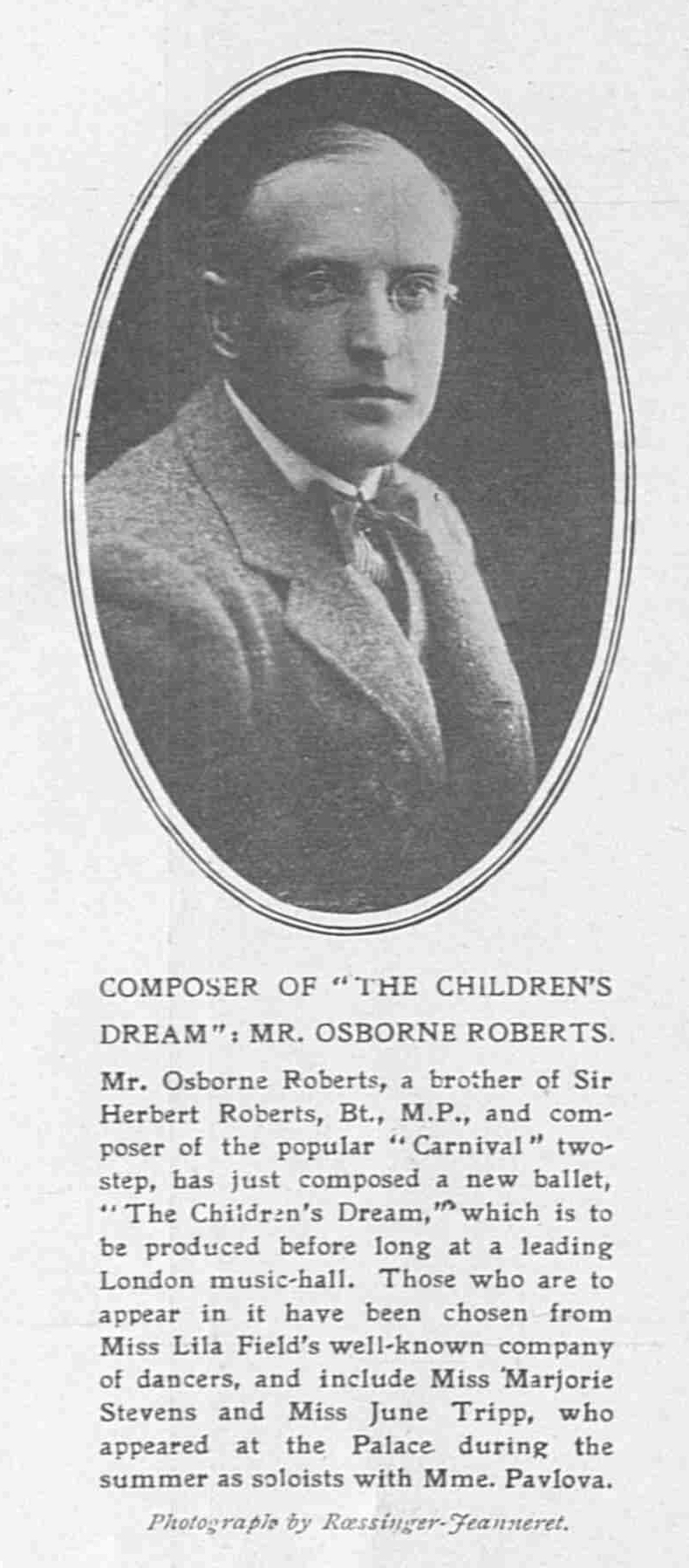
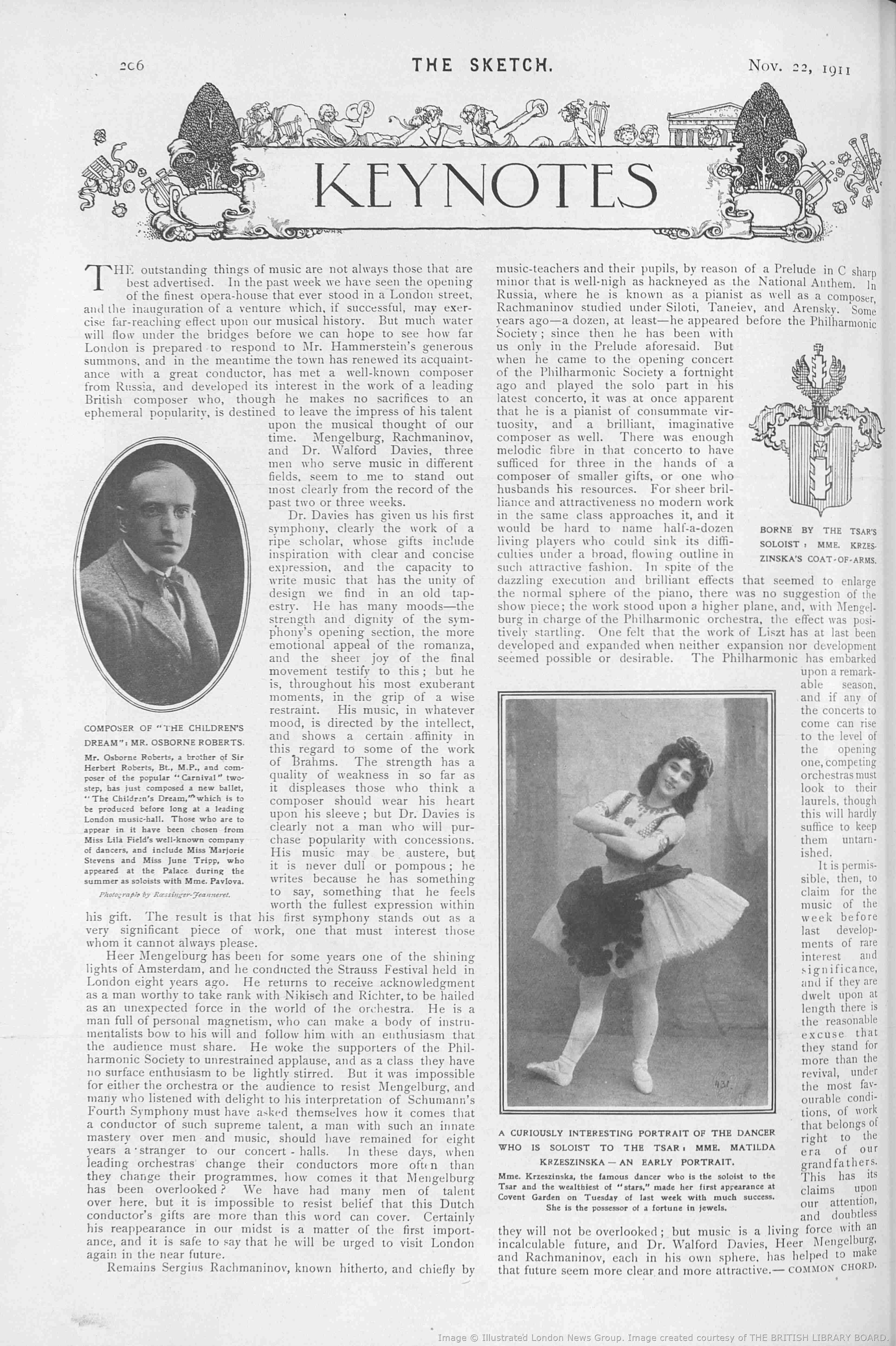
Reproduced from “Keynotes,” The Sketch, November 22, 1911, p. 206.
London, Monday Night. — Mr Osborne Roberts, the brother of the member for West Denbighshire, and Mr Wm. Caine, son of the late Mr W. S. Caine, M.P. (his connection by marriage), have collaborated in the composition of a light opera, which will be performed for the first time next week at the Chelsea Town Hall in aide of a local charity (“Wales in Parliament (By Our London Welsh Correspondent),” South Wales Daily News, Tuesday, May 3, 1904, p. 5).That is, Osborne Glynn Roberts was a younger brother of John Herbert Roberts, the husband, since August 1, 1893, of Caine’s eldest sister Hannah (see § 6 and § 4). It seems that, even several years after his career as a composer had been established, journalists felt the need to specify Roberts’s relationship with “the member for West Denbighshire:”
Mr. Osborne Roberts, a brother of Sir Herbert Roberts, Bt., M.P., and composer of the popular “Carnival” two-step, has just composed a new ballet, “The Children’s Dream,” which is to be produced before long at a leading London music-hall. Those who are to appear in it have been chosen from Miss Lila Field’s well-known company of dancers, and include Miss Marjorie Stevens and Miss June Tripp, who appeared at the Palace during the summer as soloists with Mme. Pavlova (“Keynotes; Composer of ‘The Children’s Dream’: Mr. Osborne Roberts,” The Sketch, November 22, 1911, p. 206; see photograph with caption, right).Even the brief items reporting Roberts’s death in London on Saturday, June 30, 1917, “after a severe operation,” slighted the career in music and emphasized the fraternal connection to the peerage:
Mr. Osborne Glynn Roberts, of Tan’rallt, Abergele, brother of Sir Herbert Roberts, M.P., died in London on Saturday, after a severe operation. He was devoted to music. The interment will take place at Abergele tomorrow (“Welsh Baronet’s Brother; Death of Mr. Osborne Glynn Roberts,” Liverpool Daily Post and Mercury, Wednesday, July 4, 1917, p. 4).Osborne Glynn Roberts was born Friday, April 7, 1871, at Bryngwenallt, the mansion in Abergele, North Wales, designed by architect Richard Owens of Liverpool in 1867 for Osborne’s father, the Liverpool timber merchant John Roberts. In addition to the eldest brother John Herbert (b. August 8, 1863, Liverpool), other of Osborne’s brothers include Frank Owen (b. May 17, 1868, Bryngwenallt), Arthur Lloyd (b. January 11, 1867, Bryngwenallt), and Charles Cecil Gwynedd (b. September 2, 1880, Bryngwenallt), all of whom (but not Osborne, who studied I do not know where) attended Trinity College, Cambridge (Venn 1953: 313–317). There was also at least one other brother, David Trevor (b. September 25, 1865), and several sisters, including Alice Meinwen, whose marriage to Captain Harry Fowler Bigge at Kensington Chapel on Monday, March 9, 1908, was attended by Caine’s mother and his sisters Hannah and Ruth.
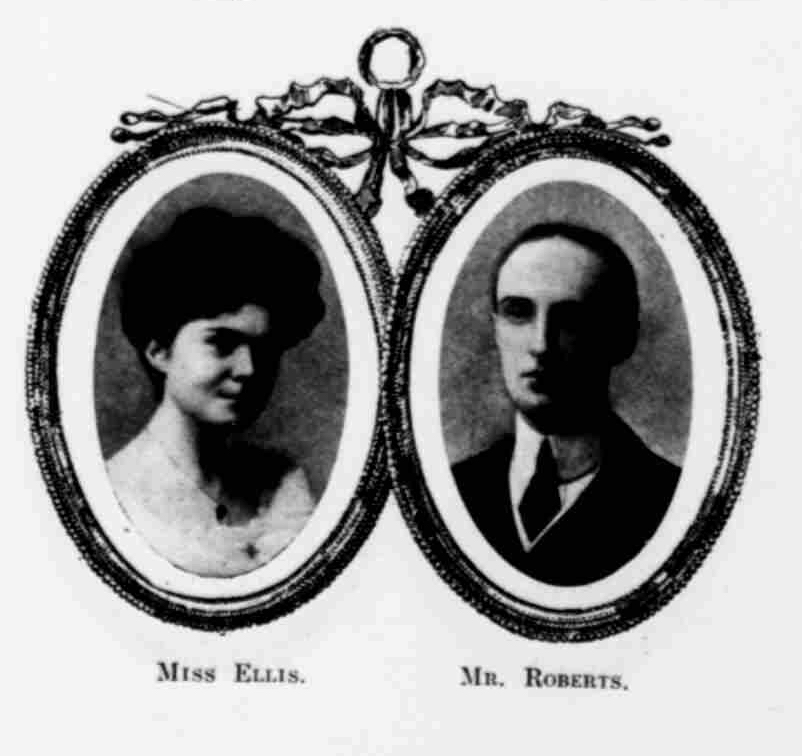
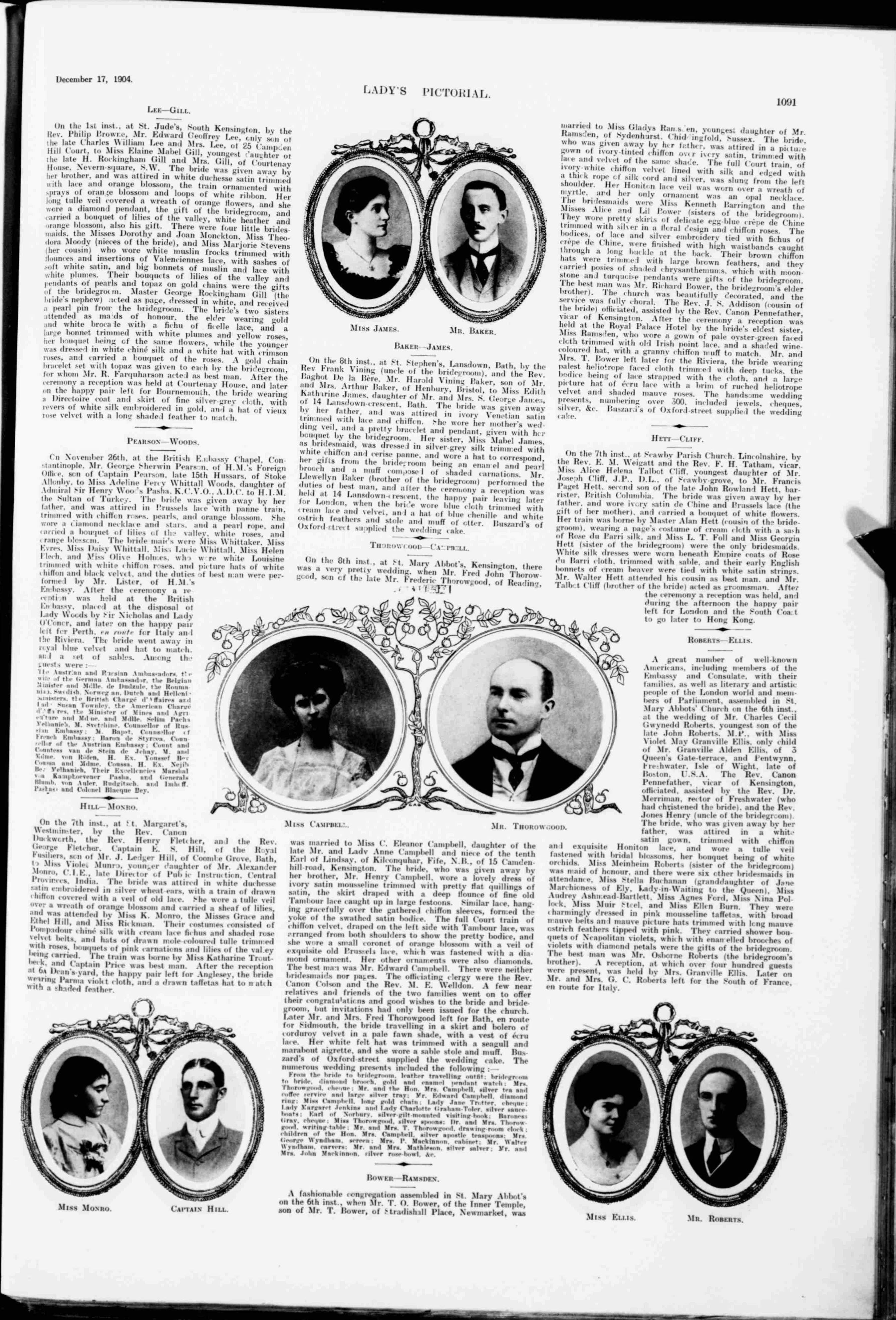
Reproduced from “Weddings; Roberts—Ellis,” Lady’s Pictorial, December 17, 1904, p. 1091.
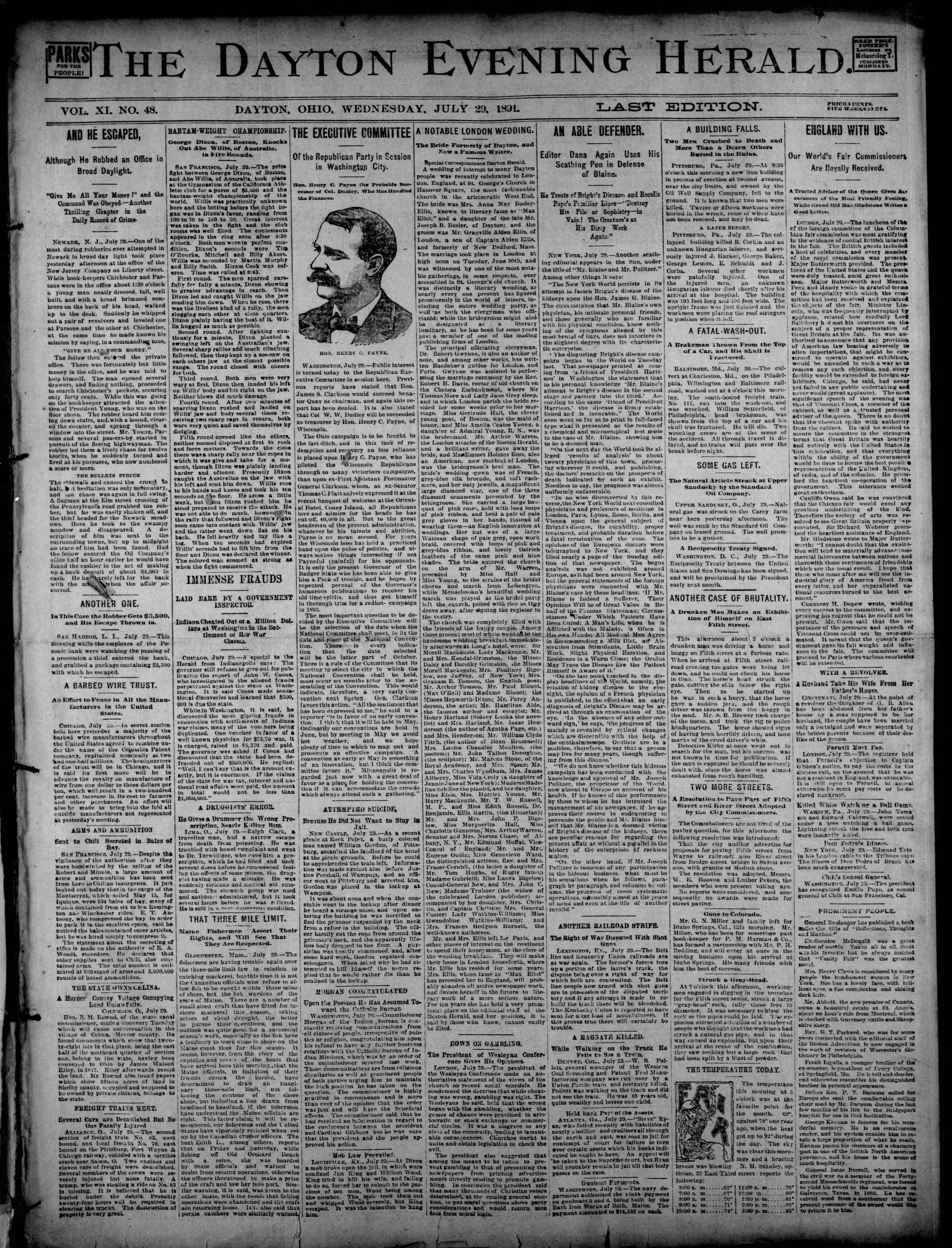
A great number of well-known Americans, including members of the Embassy and Consulate, with their families, as well as literary and artistic people of the London world and members of Parliament, assembled in St. Mary Abbot’s Church on the 6th inst., at the wedding of Mr. Charles Cecil Gwynedd Roberts, youngest son of the late John Roberts, M.P., with Miss Violet May Granville Ellis, only child of Mr. Granville Alden Ellis, of 3 Queen’s Gate-terrace, and Pentwynn, Freshwater, Isle of Wight, late of Boston, U.S.A. The Rev. Canon Pennefather, vicar of Kensington, officiated, assisted by the Rev. Dr. Merriman, rector of Freshwater (who had christened the bride), and the Rev. Jones Henry (uncle of the bridegroom). The bride, who was given away by her father, was attired in a white satin gown, trimmed with chiffon and exquisite Honiton lace, and wore a tulle veil fastened with bridal blossoms, her bouquet being of white orchids. Miss Meinheim [sic] Roberts (sister of the bridegroom) was maid of honour, and there were six other bridesmaids in attendance. Miss Stella Buchanan (granddaughter of Jane Marchioness of Ely, Lady-in-Waiting to the Queen), Miss Audrey Ashmead-Bartlett, Miss Agnes Ford, Miss Nina Pollock, Miss Muir Steel, and Miss Ellen Burn. They were charmingly dressed in pink mousseline taffetas, with broad mauve belts and mauve picture hats trimmed with long mauve ostrich feathers tipped with pink. They carried shower bouquets of Neapolitan violets, which with enamelled brooches of violets with diamond petals were the gifts of the bridegroom. The best man was Mr. Osborne Roberts (the bridegroom’s brother). A reception, at which over four hundred guests were present, was held by Mrs. Granville Ellis. Later on Mr. and Mrs. G. C. [sic] Roberts left for the South of France, en route for Italy (“Weddings; Roberts—Ellis,” Lady’s Pictorial, December 17, 1904, p. 1091).Moreover, “in accordance with the American custom,” stated The Manchester Courier, “each bridesmaid was accompanied by an ‘usher,’” among whom were the future author of The Author of “Trixie” and two other members of the The Island of Pharos cast, Ivor Back and R. S. Van Duzer. The site of the wedding reception — 3 Queen’s Gate Terrace, South Kensington — had long been known for Mrs. Granville Ellis’s “popular Monday ‘at homes,’” a salon said to “rival that of Mrs. O’Connor” (whoever she may have been) which contributed to her reputation of being “most lavish in her hospitality to countrywomen of her own profession.” Mrs. Granville Alden Ellis, née Anna Mai Bosler in Dayton, Ohio, began her career in journalism as a special correspondent for the Dayton Journal and the Cincinnati Times while she was still in school. She married, apparently without the consent of the groom’s wealthy family, Granville Alden Ellis of New Bedford, Mass., in 1876 — that is, while she was still in school, writing pieces on the Centennial Exhibition for the Dayton Journal. At some point the couple moved to Boston where, persuaded by threats of disinheritance, Ellis abandoned Anna Mai and fled abroad, while Anna Mai, throughout these years of matrimonial turmoil, abandoned her profession until after the couple’s eventual divorce in 1881, when she too took up traveling and, under the nom de plume of “Max Eliot,” began “writing sparkling and vivid letters from abroad” for the Boston Herald. Her entry in Who’s Who in America, however, states that she wrote for the Cincinnati Times, 1879–1881.
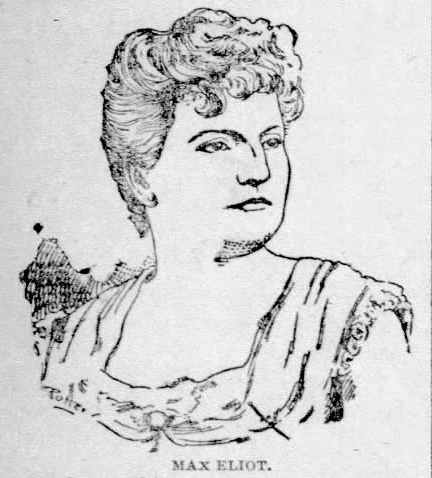
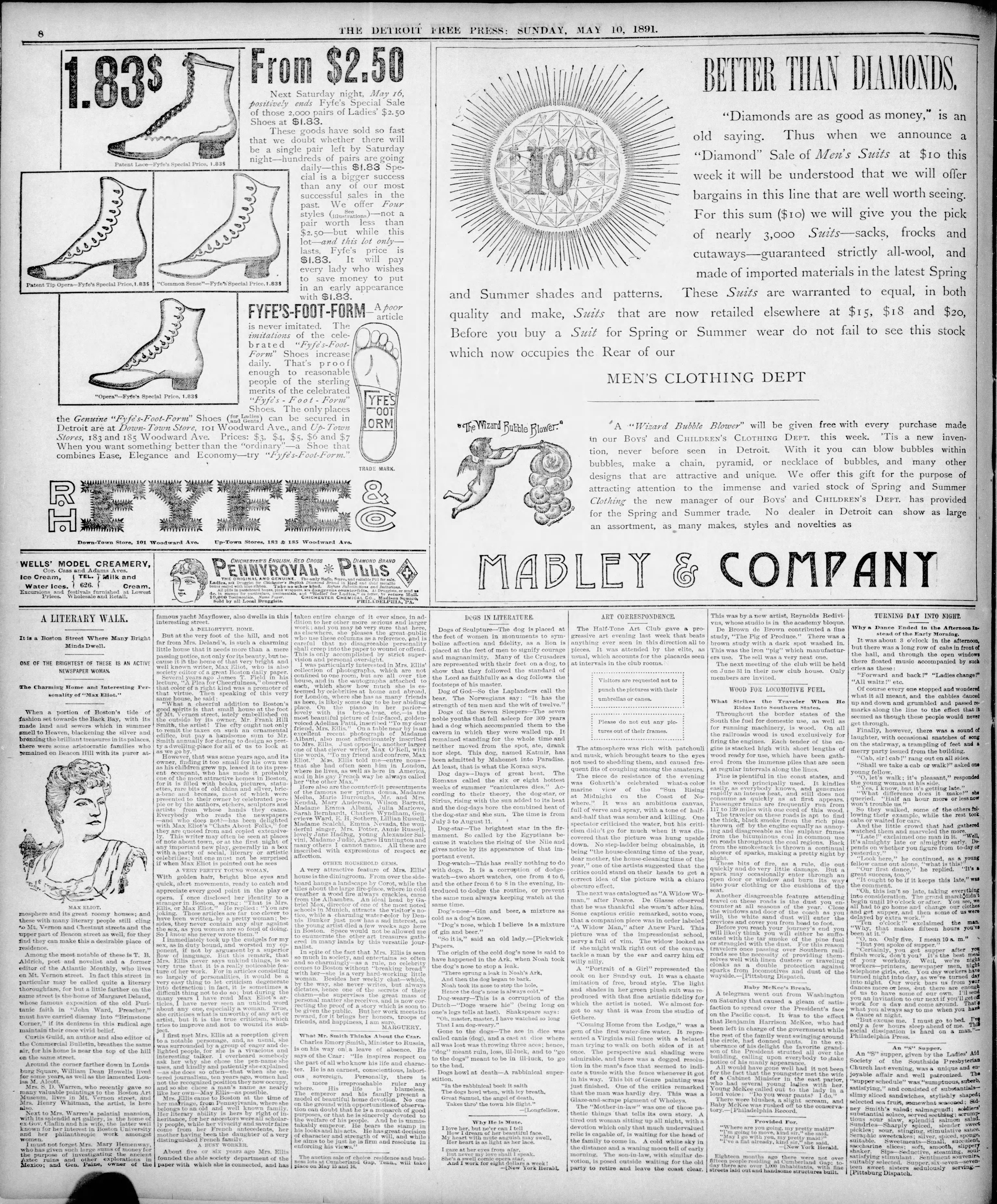
Reproduced from “A Literary Walk,” The Detroit Free Press, Sunday, May 10, 1891, p. 8.
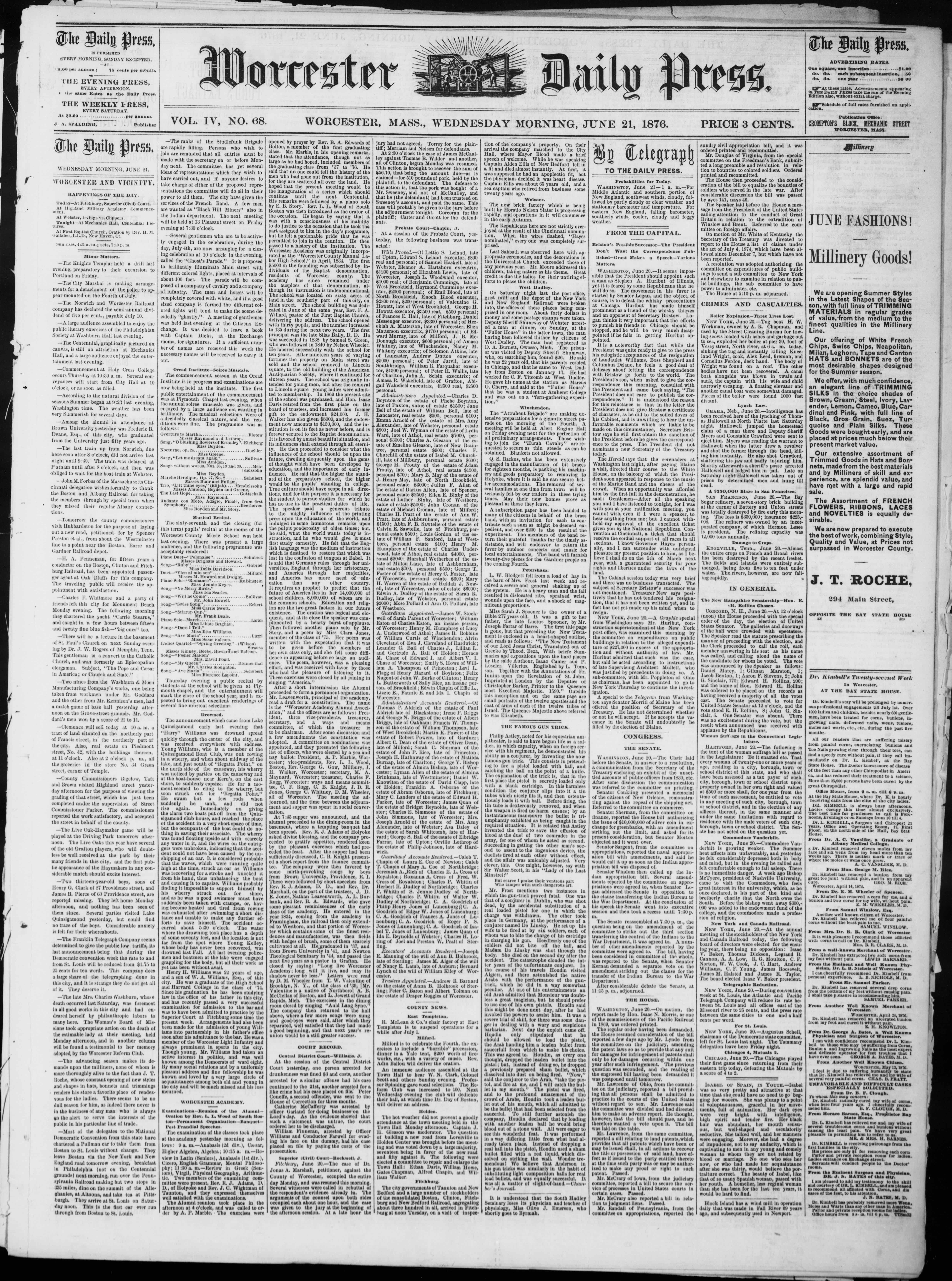
seen at places of note about town, or at the first night of any important new play, generally in a box with a party of social, literary or artistic celebrities; but one must not be surprised if when Max Eliot is pointed out he seesIn 1891, she moved to London, and married, on June 30 — Granville Alden Ellis, who in the meantime had remarried and been widowed. So I’m not sure if “Max Eliot” was the mother or the step-mother of the “American heiress” (implying thus, that any threats of disinheritance by Ellis’s family had by then become toothless) who married the youngest brother of the composer of The Island of Pharos. Nevertheless, whether mother or step-mother, Max Eliot continued her profession after re-marrying her ex-husband. She remained, for instance, with the Boston Herald as special London correspondent, and became special London correspondent for the New York Dramatic News (said to have beeen “hand in glove with Frohman and the Theatrical Syndicate” — whom we will meet presently). In addition to her journalism (which she allegedly dictated, rather than wrote), Max Eliot was a member of the Society of American Women in London. Her husband, whose father, Captain Alden Ellis, had died suddenly of what at first was thought to be “an apoplectic fit,” but turned out to be heart disease at the Fitchburg, Mass., City Hall, on Tuesday, June 20, 1876, was said to have been, at the time he remarried Max Eliot, “for some years past a member of one of the leading publishing firms of London.” The only “leading publishing firm” with which I can find Ellis associated is the London Printing and Engraving Company, in which Ellis partnered with fellow American William Augustus Bercry to publish commercial directories of various regions of Britain on a subscription basis. The firm issued a directory of Lancashire in 1892, directories of London, the ports of Bristol, and Yorkshire in 1893, and, in 1894, Rivers of the North, Their Cities and Commerce, and Industrial Great Britain, A Commercial Review of Leading Firms Selected from Important Towns of England. The commercial enterprises included in the directories were apparently “self-selected by subscription, leaving many prominent names unmentioned” while the volumes themselves “were attractively presented in brown cloth with embossed borders and lettering, more like a literary magazine than a directory” (Sykas 2023: 125). The Bercry-Ellis partnership dissolved in October 1895, with Ellis buying up Bercry’s shares in the business, which was to continue publishing at its addresses of 53 New Stone Buildings and 54 Chancery Lane, London, but apparently never did. Ellis’s involvement in publishing reminds me of Stanley Frodsham Packer (you have already met him in § 3), who, in Lady Sheba’s Last Stunt, inherited ten thousand pounds from his aunt, Mrs. Cheadle:a very pretty young woman,
With golden hair, bright blue eyes and quick, alert movements, ready to catch and appreciate every good point in the play or opera (“A Literary Walk; It is a Boston Street Where Many Bright Minds Dwell; One of the Brightest of These is an Active Newspaper Woman; The Charming Home and Interesting Personality of ‘Max Eliot,’” The Detroit Free Press, Sunday, May 10, 1891, p. 8).
Having ten thousand pounds, that is to say, Capital, Mr. Packer naturally became a publisher. For since he knew no more about publishing than my toothbrush, he could not be positive that he was unfitted for it. Publishing he could attempt unparalysed by that clear perception of danger and difficulty which must have blighted his endeavours had he once again essayed, for example, bone dealing or undertaking or horse dentistry. Publishing, in short, he could approach in at least a fairly hopeful frame of mind; and in business hope is half the battle; since hope breeds confidence and confidence success. Or it may. Whereas the man who begins in despair is already ended.I have taken the trouble to research and write this long digression within a digression about the parents of the bride of Osborne Roberts’s brother not only to get to the punchline of sorts from Lady Sheba’s Last Stunt quoted above, but also to bolster my speculation that Edith Gordon Walker may have been among those 400 guests attending the reception (the hostess of which was not merely a well known American woman journalist in London, but was also said to be, like Walker, “an enthusiastic golfer”) for the newly wedded Mr. and Mrs. C. C. G. Roberts at 3 Queen’s Gate Terrace, South Kensington, on December 6, 1904, and may, thus, have encountered there and then one in particular of the bridesmaids’ ushers, that is, the librettist of The Island of Pharos, the composer of which married in turn some two years later:Besides, he had always sighed to be eminent, or at least respectable, and now that he had some money he could afford to indulge his desire. But he knew himself to be not sagacious enough to be a solicitor, not urbane enough to be a stockbroker, not rude enough to be a barrister, not religious enough to be a clergyman, not honest enough to be a banker, not imaginative enough to be a company promoter, not tenacious enough to be a Civil Servant, not unprincipled enough to be a Member of Parliament, not opaque enough to be diplomatist, not cautious enough to be a critic, not reckless enough to be an underwriter, not far-sighted enough to be a prophet, not cultured enough to be a raconteur, not eupeptic enough to be a diner-out, not well-bred enough to be a gentleman.
There was really nothing for it (of a respectable nature) but publishing. He was, at any rate, well-off enough for that.
In the middle part of the year 1920 Mr. Packer accordingly commenced publishing under the style and title of Penberthy and Co. on the second floor of No. 13, Dog Street, Soho.
By the beginning of October 1921 his snug little little capital of ten thousand pounds had been reduced to a trifle over twelve hundred, while his liabilities from nil had swelled to something over seven thousand.
This may or may not constitute a record; but even in a man like Mr. Packer, who possessed a positive genius for failure, we cannot regard it as other than a highly distinguished performance. Mr. Packer had achieved his splendid result in the simplest possible way — by lavishly and extensively advertising costly books which no one would buy (Lady Sheba’s Last Stunt, pp. 23–25).
A particularly pretty wedding was that which was solemnised at St. Peter’s Church, Eaton-square, on Saturday afternoon. The bride was Miss Maude Tyndale Strover, daughter of the late Gen. G. A. Strover, Chief Commissioner of Upper Burmah, whilst the bridegroom was Mr Osborne Glynn Roberts, son of the late Mr John Roberts, M.P., of Bryngwenallt, Aberegele. The charming bride, in her Empire gown of white spotted net trimmed with satin, was met at the porch by her five maids. Upon her head she wore a dainty wreath of silver leaves and blossoms, which apparently held in place the gracefully arranged veil of exquisite lace, which fell about her in filmy folds of semi-transparency. White cloth gowns had been chosen as the attire for the bridesmaids, and they wore white picture hats trimmed with long ostrich feathers, and carried lovely bunches of Neapolitan violets, the gifts of the bridegroom. As the bride entered the church, leaning on the arm of Mr Leonard Stevens (brother-in-law), who subsequently gave her away, the choir broke into song with the beautiful hymn “The Voice that breathed o’er Eden,” and towards the close of the ceremony “O Perfect Love” was sung. The officiating clergyman was the Rev. Arthur Fairbanks, and the duties of best man were performed by Mr R. F. Currie. Mrs Leonard Stevens held a large reception at Mrs Walter Anderson’s house in Lowndes-square, and after congratulations had been showered upon them, plentifully intermingled with confetti, Mr and Mrs Osborne Roberts left for their honeymoon, the first portion of which will be spent in the South of France, whence they proceed for a tour in India. For travelling the bride donned a charming gown of pink faced cloth, an effective finish being given by her black hat and black fox muff and necklet (“Fashionable Marriages; Roberts—Strover,” The Queen, the Lady’s Newspaper, January 12, 1907 p. 65).The wedding, which took place January 5, 1907, was announced in several newspapers, among which was the following, headlined “A January Wedding”:
Under this heading, “The Onlooker” alludes to the approaching marriage of Miss Maude Strover to Mr. Osborne Roberts, at St. Peter’s, Eaton-square, on January 5th, and the reference is interesting in this locality by reason of the fact that Miss Strover was one of those responsible for the organisation of the amateur performance of “The Duke of Killicrankie” at the County Hall, St. Albans, in aid of philanthropic objects in April last year, and achieved a great success in the leading lady’s part. Besides, Miss Strover has numerous friends in the district. She is a daughter of the late General G. A. Strover, Commissioner of Upper Burma. The prospective bridegroom, who is a brother of the Member for West Denbigshire [sic], is an ardent musician, and is the composer of “The Island of Pharos,” which was produced two years ago at the Chelsea Town Hall in aide of a charity, and was very highly spoken of in the Press. An excellent photograph of the prospective bride appears in the publication referred to (“A January Wedding,” The Herts Advertiser & St. Albans Times, Saturday, December 22, 1906, p. 8).
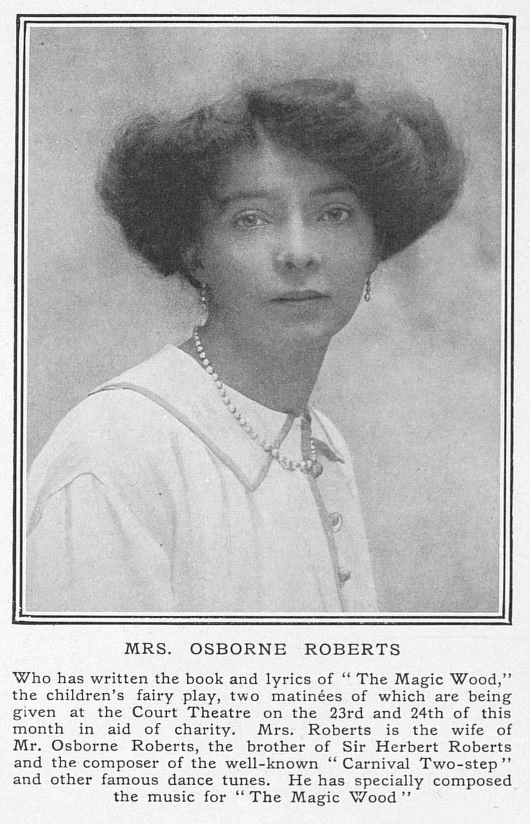
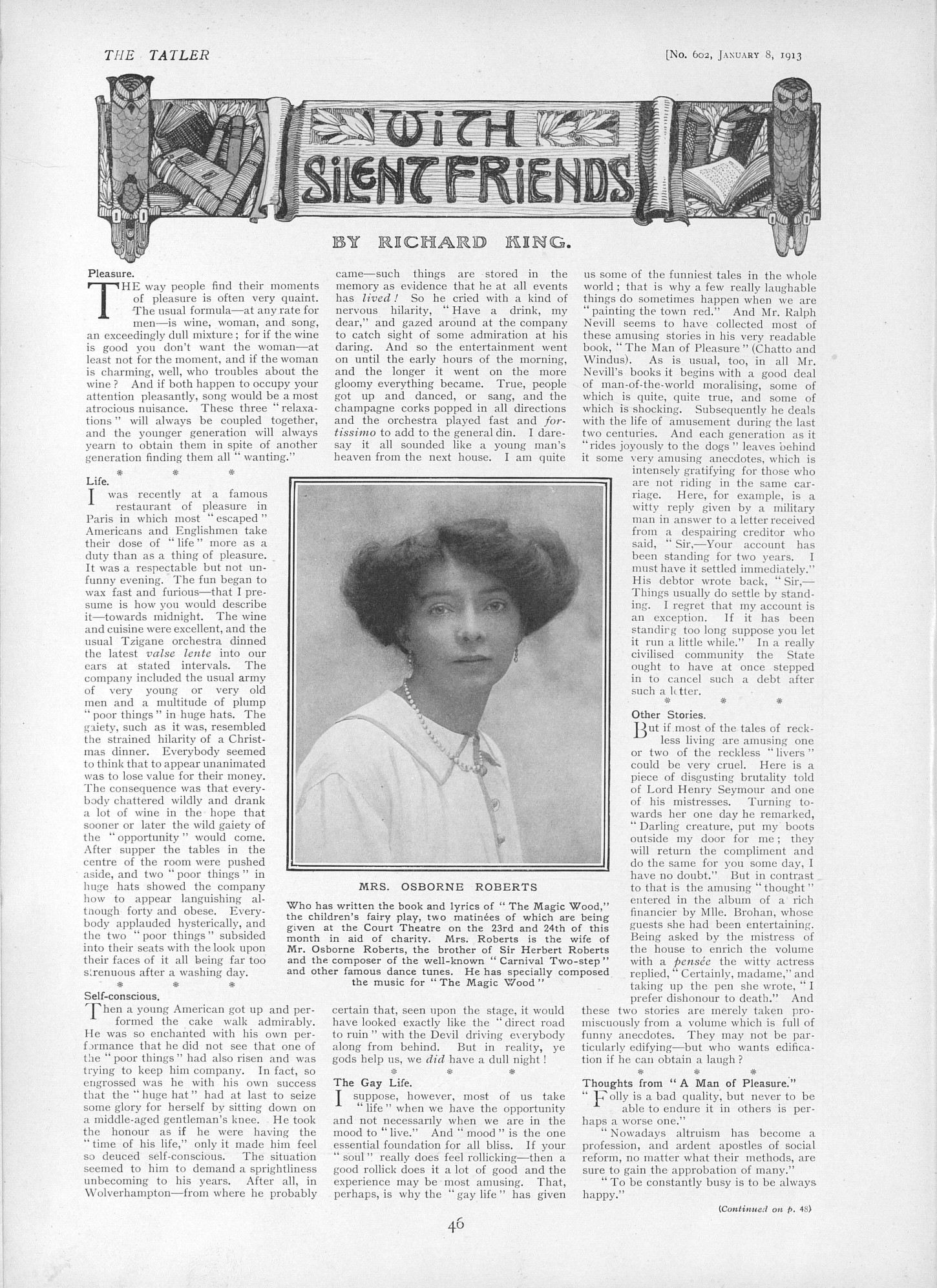
Reproduced from Richard King, “With Silent Friends,” The Tatler, January 8, 1913, p. 46.
Maurice’s Etons came home from the tailor’s —The second example was published, unsigned, five years later in Punch (vol. 126, March 2, 1904, p. 154). It is entitled “New Kindergarten Methods,” and takes its cue from a quote attributed to Mr. G. Archibald of Montreal, Child Specialist: “Whenever you say ‘Don’t’ to a child you crush the creative spirit within him which is the richest and most precious thing he has:”The collar, the dickey, the gloves, and the rest.
Maurice discarded his old suit of sailors —
The nautical scarf and the white flannel vest.
Maurice was bound for an evening party
Beginning at seven and ending at ten,
Maurice was blessed with an appetite hearty
And equal to that of a number of men.
Maurice was proud of his personal beauty,
And rejoiced in those Etons so tight and so smart;
Maurice was clear in his notions of duty,
“Never get up while there’s room for a tart.”
Maurice went in to his supper with Nelly
And sat himself down at the table at once;
Maurice gave Nelly a helping of jelly,
And fixed on a plateful of curranty buns.
Maurice, as soon as his turkey was finished,
Asked for some chicken and shouted for ham;
Maurice the trifle immensely diminished,
And fought for Victoria sandwich with Sam.
Maurice went in for a wedge of Madeira —
A hunk from a big Melton Mow-ber-ay pie;
Maurice reached over the table and nearer
Drew seven meringues that he happened to spy.
Maurice, believe me, had done himself proudly,
As you will be ready, no doubt, to agree;
Maurice’s Etons gave way rather loudly
In a manner too shocking to hear and to see.
Maurice should really have gone in his sailors,
So elastic and comfy and easy and loose;
Maurice’s Eton’s went back to the tailor’s
And he to his school with a lengthy excuse.
Ye fathers, ye mothers, ye guardians, indeedTwo brief notes before I get back to The Island of Pharos. First, Caine later expanded on the theme of the inherent contradictions and possible results of both unconditional and punitive parenting in But She Meant Well (see § 6), and later still, of a monstrous corollary thereof — the hybrid species of unconditional yet narcissistic helicopter parenting found in Three’s a Crowd (see § 13). Second, I wonder if, in Caine’s lines — “See yourselves in the new Psychological Ray / which beams from beyond the Atlantic!” — he is referring to the X-ray? If so, there is a potential coincidence with a poem, “Song of the X-Ray,” which the future wife of the future author of The Author of “Trixie” published in the Arlington High School Clarion a year after she graduated from that institution. Walker’s poem speculates midway through as follows:All ye persons “in loco parentis”
Who in infancy sow educational seed,
Which you reap in the teens and the twenties,
If the sheaves you would gather are goodly to see,
Here’s a rule that will help you to win them: —
Consider your charges; be guided by me,
And don't crush the creative within them.
Should the genius of Marmaduke lead him to rear,
From the dining-room floor to the ceiling,
A palace of crystal and china, oh! fear
To exhibit an atom of feeling.
But your Satsuma bowl you will cheerfully bring,
And, where others would threaten to skin him,
You will beg him to do as he likes with the thing,
Lest you crush the creative within him.
If Lucy refuses potatoes and bread,
And calls for meringues and for trifle,
Or anything else that may enter her head,
Such yearnings another would stifle.
You will hand her a card-menu, beg her to state
What she happens to fancy for dinner,
And pray that you never may find it your fate
To crush the creative within her.
See our little people, at work or at play,
And own your mistakes are gigantic!
See yourselves in the new Psychological Ray
Which beams from beyond the Atlantic!
Those brains-of-an-oyster, believe me, you owe
To the brutal Malacca and sinew
Which urged you along “in the way you should go,”
Yes! — and crushed the creative within you.
If these wonderful raysI reproduce Walker’s poem in full in § 15, where I also speculate about her possible role in Caine’s second book, The Confectioners. Now, back to The Island of Pharos, the professional provincial tour of which was announced in the week following Miss Gordon Walker’s debarkation from the Devonian at Liverpool:Which are now all the craze,
Can bring hidden matter to sight,
With them we may find
The true essence of mind,
The birth of a though bring to light.
“The Island of Pharos,” a new and original comic opera, in two acts, written by William Caine and composed by Osborne Roberts, will commence a short preliminary tour at the Theatre Royal, Plymouth, on July 11, prior to its production in London. The company is under the direction of Mr Augustus Bingham (“Theatrical Gossip,” The Era, June 25, 1904, p. 12).

Reproduced “Touring Companies,” The Era, June 25, 1904, p. 3.
“The Island of Pharos,” a new comic opera written by William Caine and composed by Osborne Roberts, is being set out on a short preliminary tour, starting at the Theatre Royal, Plymouth, this evening (“Dramatic and Musical,” The Liverpool Daily Post, Monday, July 11, 1904, p. 8).Similarly, since she was likely perusing the various British dramatic and musical periodicals in search of possible venues for her talents, she might have seen the announcement for the comic opera in The Referee:
The recently produced new comic opera entitled “The Island of Pharos,” written by Mr. William Caine, and composed by Mr. Osborne Roberts, is being sent out on a short preliminary tour, starting at the Theatre Royal, Plymouth, to-morrow. A strong cast has been engaged, including Messrs. Leonard Russell, Maitland Dicker, and Daley Cooper; Misses Cissie Vaughan, Ada Rodney, and May Clifton. The opera is being produced by Mr. E. Dagnall, and the entire arrangements are under the direction of Mr. Augustus Bingham (The Referee, July 10, 1904, p. 4).If Walker was still in the Liverpool area at that time, it’s unlikely that she would have traveled all the way to Plymouth, where the following brief notice appeared:
The return of Mr. C. F. Williams to the management of the Theatre Royal, Plymouth, was signalled by the production for the first time on any stage of a new comic opera entitled “The Island of Pharos.” It belongs to the popular order of musical comedy, and has just sufficient of connected story to supply motive for the incidents represented. It is really amusing (“The ‘Island of Pharos’ at the Royal,” The Western Evening Herald (Plymouth), Tuesday, July 12, 1904, p. 3).

Reproduced “Amusements,” The Blackpool Times and Fylde Observer, Wednesday, July 20, 1904, p. 4.
This is a new piece, described as a comic opera, but it is in no way distinguished for musical comedy. It is very pretty and has a certain good quality in its music. Here and there is a song or a chorus that strikes the ear pleasingly, but taken altogether the piece lacks character and wants pulling together. The story deals with the adventures of a yachting party, who through the treachery of brigands are shipwrecked and compelled to seek refuge upon the hitherto unknown island of Pharos, peopled by an unsophisticated, but kindly race, who extend a generous hospitality to the unfortunate strangers. There are, of course, the usual elements of love-making among the representatives both of civilised society and of the people who have nothing in common with the outer world save the instinct of love. Mr. Glynn Osborne has brought together a capable company. Mr. Daley-Cooper has the principal comedy part, and it is well sustained in grotesqueness and eccentricity. Mr. Maitland Dicker, as a detective apt in the discovery of disguises, is a good second in the comedy line. The Earl has a capital representative in Mr. Arthur Wilmot; and a trio of excellent male voices is found in Messrs. A. S. Barber, Frank Londen, and Leonard Russell. Mr. Albert Drewitt, who appears in the second act as a shepherd on the “undiscovered” island, dressed in skins, sings in good style, and makes the most of his part. Among the ladies Misses Cissie Vaughan, Bella Graves, and Ada Rodney form the trio of English girls, and take their parts with credit. Miss May Brooke is a vivacious shepherdess; and Miss May Clifton and Miss B. Luscombe support the comedy of the piece. On Monday night there were several encores, and Miss Dora Kennedy was loudly applauded for her speciality dances (“Places of Amusement; Her Majesty’s Opera House; ‘The Island of Pharos,’” The Blackpool Times and Fylde Observer, Wednesday, July 20, 1904, p. 5).I see no reason why Walker would have traveled to York or Middlesbrough, but perhaps she did, and saw, during the August bank holidays, The Island of Pharos at the Theatre Royal in the latter city:
There is a strong holiday attraction at the Theatre Royal, Middlesbrough, this week, in the new comic opera “The Island of Pharos.” The first act opens in the harbour of Piræus, Athens, and the second lies in that favoured land from which the opera takes its name. The music is of the essential lightness associated with such productions, and the scenery of a “summery” aspect, with plenty of blue sea and bright sky about it. Mr Daley Cooper, who will be remembered for his “Tweedlepunch” in “Florodora,” is included in the caste [sic], and those who have seen this versatile comedian will not need to be told that he makes the most of the humorous part allotted to him. He is “William Sykes,” with a number of aliases, whilst “Henry Sykes,” by turns a cook and a detective, is depicted by Mr Maitland Dicker, in a most amusing manner. Mr Albert Drewitt does sound work as “Daphnis,” the owner of the island, and Mr Horace Corbyn, as the captain of Lord Alfred’s yacht, is also alive to his opportunities. Mr Arthur Wilmot is a distinct success as the “Earl of Enniscorphy” [sic]. Messr A. S. Barber, Frank Louden, and Leonard Russell support the other male roles, and the principal ladies are Miss Cissie Vaughan, Miss Bella Graves, and Miss Ada Rodney. There is an excellent chorus, and some graceful dances are introduced (“Theatre Attractions; ‘The Island of Pharos,’” The Herald (Stockton), Saturday, August 6, 1904, p. 5).If she was still in the north of England in mid-August, I doubt Walker would have bothered to visit Birmingham, unless it was to see Janet Achurch as Nora Helmer in Ibsen’s A Doll’s House, playing at the Prince of Wales Theatre, and was intrigued by the piece being produced concurrently at the Grand:
Birmingham is so rich in theatrical association that it seems almost incredible that no Ibsen play has ever been performed at any of its theatres. Such, however, is stated to be the case. In view of this fact, patrons of the Prince of Wales Theatre have a special treat in store next week, when Miss Janet Achurch and her specially-selected company, under the direction of Mr. Charles Charrington, will appear in the Scandinavian dramatist’s world-famed play, “A Doll’s House.” Since her first appearance in the part of Nora Helmer, Miss Achurch has appeared in it in many of the largest cities in the world, including New York, Calcutta, Melbourne, Sydney, Bombay, and Alexandria, and her wonderful “creation” has everywhere excited the greatest admiration. No play ever produced in modern times has given rise to so much controversy as “A Doll’s House.” In his native country Ibsen found his play met with a torrent of hostile criticism, and Copenhagen society went so far as to ban it as a subject of conversation at fashionable gatherings. Opinion was greatly divided in this country when the play was first produced in London, but the fact that a wholesome moral is to be drawn from the play has frequently been commented upon both in the pulpit and on the judicial bench. Miss Achurch is supported by an admirable company, and the play will be most effectively staged.This production was noticed in London:A new comic opera, entitled, “The Island of Pharos,” is booked for the Grand Theatre. The piece, which was only produced a few weeks ago, possesses an interesting story, written by Mr. William Caine, something on the lines of “Utopia.” Mr. Osborne G. Roberts is the composer, and the music is distinctly original and exceedingly pretty. It is to be produced by Mr. Glynn Osborne’s company, which includes Mr. Leonard Russell, a local baritone, who was formerly associated with the “Floradora” company (“Next Week’s Amusements,” The Birmingham Daily Mail, Friday, August 5, 1904, p. 4).
At the Birmingham Grand a new comic opera, “The Island of Pharos,” was produced by the Glynn Osborne Company. It was very kindly received, almost as big a success as when first produced at Plymouth a few weeks ago.And, locally, seems to have better received than Ibsen’s play:Musical comedy would fit “The Island of Pharos” better as a descriptive title. There are some really good songs in it. “Under the Panama” seems likely to take on, and “When you’re a little girl of seventeen” is pretty and very catching. The music is really the best part of the piece. As for the rest, it will serve, but the plot wants mending, and the humour is badly mixed (“Plays and Players; The Stage in the North; ‘Under the Panama,’” Weekly Dispatch (London), Sunday, August 14, 1904, p. 6).
Much more to the liking of Birmingham people was “The Island of Pharos,” seen at the Grand. It may not say much for the theatrical tastes of the people of Birmingham, but “The Island of Pharos” did not leave a feeling of depression, and that is more than can be said for “A Doll’s House.” Unfortunately for Ibsen, people prefer something which will raise their spirits to something which will set them thinking about matters serious (“Stage Whispers; Birmingham Notes,” The Umpire (Birmingham), Sunday, August 14, 1904, p. 4).

Reproduced from “Public Notices,” The East Kent Times & District Advertiser, Wednesday, August 17, 1904, p. 1.
To good audiences Mr. Glynn Osborne’s Co. are at the Pavilion this week producing the comic opera, “The Island of Pharos.” It contains several brisk choruses, some of the lines are smart and humorous, and the opera is well put on. All the artists work energetically, the most capable work being done by Miss Cissie Vaughan (“Lady Lovering”), Mr. Daley Cooper (a most vivacious “William Sykes”), Mr. Maitland Dicker, the Misses Nita Clavering (capital as “Antigone”), Bella Graves, Ada Rodney, and May Brooke. Miss Dora Kennedy’s solo dances are very clever. The chorus is efficient and the orchestra satisfactory. “The Island of Pharos” remains all the week (“Local Amusements; At Ramsgate Royal Pavilion” The East Kent Times & District Advertiser, August 17, 1904, p. 5).The real, historical island of Pharos, according to the legend recounted by Philo of Alexandria, was the site chosen by the Jews who translated the Torah into Greek:
The island of Pharos lies in front of Alexandria, the neck of which runs out like a sort of tongue towards the city, being surrounded with water of no great depth, but chiefly with shoals and shallow water, so that the great noise and roaring from the beating of the waves is kept at a considerable distance, and so mitigated. They judged this place to be the most suitable of all the spots in the neighbourhood for them to enjoy quiet and tranquillity in, so that they might associate with the laws alone in their minds; and there they remained, and having taken the sacred scriptures, they lifted up them and their hands also to heaven, entreating of God that they might not fail in their object. And he assented to their prayers, that the greater part, or indeed the universal race of mankind might be benefited, by using these philosophical and entirely beautiful commandments for the correction of their lives.While it seems unlikely that Caine, who took his degree in modern history, would have bothered to read Philo while at Oxford, I like to think that, as a child, he encountered, in the form of Yonge’s 1854–1855 translation of the works of Philo on the shelves of the “literary workshop” of his father’s library, the seed of the imaginary island “where love reigns supreme, and all ends happily.” Just as likely — more so, rather — that seed could have been implanted by Caine’s schoolboy readings of Homer during his time at the Westminster School. In book four of the Odyssey, Telemachus, searching for his father Odysseus, visits Menelaus at his palace in Sparta (el-Abbadi 2004: 259–262). Menelaus recounts how, during his journey home from Troy, he stopped off at “a certain island, call’d / Pharos, that with the high-wav’d sea is wall’d, / Just against Ægypt” (Chapman 1857: 87) — νῆσος ἔπειτά τις ἔστι πολυκλύστῳ ἐνὶ πόντῳ / Αἰγύπτου προπάροιθε, Φάρον δέ ἑ κικλήσκουσι (Homer 1899: 60). After being stranded there, windless, for twenty days, the nymph Eidothea tells him how he and his men can capture her father Proteus, who will tell them what they must do in order to return home. Proteus also tells Menelaus that Odysseus is alive and well, though detained by the nymph Calypso on her island. Menelaus’s encounter with Eidothea and Proteus on the island of Pharos was allegorically interpreted by Heraclitus as follows:VII. Therefore, being settled in a secret place, and nothing ever being present with them except the elements of nature, the earth, the water, the air, and the heaven, concerning the creation of which they were going in the first place to explain the sacred account; for the account of the creation ot the world is the beginning of the law; they, like men inspired, prophesied, not one saying one thing and another another, but every one of them employed the self-same nouns and verbs, as if some unseen prompter had suggested all their language to them. And yet who is there who does not know that every lan-tuage, and the Greek language above all others, is rich in a variety of words, and that it is possible to vary a sentence and to paraphrase the same idea, so as to set it forth in a great variety of manners, adapting many different forms of expression to it at different times.
But this, they say, did not happen at all in the case of this translation of the law, but that, in every case, exactly corresponding Greek words were employed to translate literally the appropriate Chaldaic words, being adapted with exceeding propriety to the matters which were to be explained; for just as I suppose the things which are proved in geometry and logic do not admit any variety of explanation, but the proposition which was set forth from the beginning remains unaltered, in like manner I conceive did these men find words precisely and literally corresponding to the things, which words were alone, or in the greatest possible degree, destined to explain with clearness and force the matters which it was desired to reveal. And there is a very evident proof of this; for if Chaldæans were to learn the Greek language, and if Greeks were to learn Chaldæan, and if each were to meet with those scriptures in both languages, namely, the Chaldaic and the translated version, they would admire and reverence them both as sisters, or rather as one and the same both in their facts and in their language; considering these translators not mere interpreters but hierophants and prophets to whom it had been granted with their honest and guileless minds to go along with the most pure spirit of Moses.
On which account, even to this very day, there is every year a solemn assembly held and a festival celebrated in the island of Pharos, to which not only the Jews but a great number of persons of other nations sail across, reverencing the place in which the first light of interpretation shone forth, and thanking God for that ancient piece of beneficence which was always young and fresh.
And after the prayers and the giving of thanks some of them pitched their tents on the shore, and some of them lay down without any tents in the open air on the sand of the shore, and feasted with their relations and friends, thinking the shore at that time a more beautiful abode than the furniture of the king’s palace.
In this way those admirable, and incomparable, and most desirable laws were made known to all people (Yonge 1855: 81–83).
It is reasonable then that formless matter should be called Proteus, that the providence which formed everything should be called Eidothea, and that everything which derives from these two principles, once separated out, should be divided into adjacent masses which are constitutive of the universe. Plausible too is the naming of the island in which he fashioned these different forms as Pharos, because phersai [or pharōsai] means “to generate” […] Homer therefore has a scientific reason for calling the land that is the father of all things Pharos: the name, with its implications of generation, indicates his real meaning | ὥστε εὔλογον, τὴν μὲν ἄμορφον ὕλην Πρωτέα καλεῖσϑαι, τὴν δ᾽ εἰδωλοπλαστήσασαν ἕκαστά πρόνοιαν Εἰδοϑέαν. ἐξ ἀμφοῖν δὲ πᾶν διακριϑὲν εἰς τὰ συνεχῆ καὶ προστατικὰ τῶν ὅλων σχισϑῆναι. πιϑανῶς δὲ καὶ τὴν νῆσον, ἐν ἦ ταῦτα διέπλασε, Φάρον ὠνόμασεν ἐπειδήπερ ἐστὶ τὸ φαρῶσαι [φόέρσαι] γεννῆσαι […] φυσικῶς οὖν ἁπάντων πατέρα χῶρον ὠνόμασε Φάρον, ἐκ τῆς γονίμου προσηγορίας, ὃ μάλιστα ἐβούλετο, σημήνας (Pontani 2011: 143 | Mehler 1851: 131).That Caine was perhaps familiar with Heraclitus’s interpretation of the island of Pharos episode in the Odyssey may be gleaned from a telling phrase in his dedication of Hoffman’s Chance to Osborne Roberts; the experiences they shared while working together on their comic opera, Caine called “the real beginning of my life” (see § 12 for full citation and further discussion). Furthermore, the theme on which Caine and Roberts built their comic opera — that of an “island dedicated to the service of Eros” — will return in Caine’s spring 1912 novel. Save us from our Friends! (which I explored in § 8) closes with an excursion via yacht to the island of Le Chevreau, which, like the historical island of Pharos, is separated from the mainland by a “mile-wide strait” (p. 292). On both islands, Caine subtly evokes the erotic dénouements of three pairs of lovers — on Pharos, Lady Gladys “lends a willing ear to the suit of Lord Alfred, and Sir John and the poet pair off with Lady Mabel and Lady Henrietta,” while on (or in the vicinity of) Le Chevreau, Elsie West and Godfrey Peel “get engaged” in the latter’s yacht; Nora Gilbert and James Haslam renew, on the shore next to the picnic baskets, their passion which had begun at a dinner party in London and continued with their secret quick engagement in Montreux which ended two days later when James, jealous of Nora’s cousin Godfrey, tossed the ring he gave her into the grate; and Fanny Baxendale’s true intent in wanting to hurry off with her husband Charles in search of the reputed dolmen on the island is discreetly and tenderly revealed:
Coincidentally, or not, about a year before the announcement of the publication of Save us from our Friends!, Caine’s collaborator, as well as Miss Estella West, who had appeared with her sister Evelyn in the original production of The Island of Pharos, were noticed in an event at the Montreux Palace hotel (where Nabokov would later live):“What’s the time?” said Fanny, with a sigh.
Charles moved her a little so that he could get at his watch. “Half-past twelve,” he said.
“Gracious,” she said, “those poor things must be famished. We must fly.” But she stayed where she was a moment longer.
There was the blue sea in front of her, with a few white sails upon it, and the blue sky and a wheeling gull or two. She added rapidly the yellow sands, the fine rocks, the golden seaweed, the green top of the island, the warmth of the sun, the shelter of this cosy nook of the dolmen, Charles’s arm around her. She closed her eyes to fix these delectable things in her memory. She discovered that one addition was necessary. She opened her eyes and gazed for a moment into those of Charles, and her lips moved invitingly. Then the impression was made perfect.
Again she sighed and stirred from her place. She sat up and began to put her hat on in front of a pocket-mirror which she propped against the dolmen.
“Charles,” she said as she skewered her hat, “it is lovely to be in love.”
“Yes,” said Charles, and made dumb-bell motions with an arm. It was a little cramped.
“I shall never forget this place,” she said. “Dear old dolmen,” and she patted it affectionately.
“Excellent old dolmen,” said Charles, and he, too, patted it.
“Do you think,” said Fanny, “that we shall always be so silly?” She stood up, shook out her skirts and brushed away a scrap of lichen.
“Yes,” said Charles, and perceiving one of Fanny’s hairs upon his sleeve he removed it, rolled it up neatly, opened the back of his watch and deposited his treasure for safety. Fanny unfortunately missed this (pp. 311–312).
A very successful entertainment was given a few evenings ago at the Montreux Palace under the patronage of Lady Buchanan Scott and Mrs. Osborne Roberts. It was for the benefit of the popular Maliza orchestra that has been established here these many years, and whose admirable playing is a feature at local balls. Miss Roma Scott, daughter of Lady Buchanan Scott, played two violin solos in promising style, and a most dainty contribution was a dance by Miss Estella West to music taken from “The Children’s Dream,” a charming ballet, of which Mr Osborne Roberts is the composer. A French actor from the Theatre Réjane most kindly recited, and the interesting entertainment concluded with a bright little farce entitled “The Crystal Reader,” neatly acted by Mrs Osborne Roberts, Mrs Cuthbert Morrice, and Capt. Simons. Reference should be made to a new and attractive waltz, “The Skating Girl,” by Mr Osborne Roberts, which was played by the orchestra (“The Swiss Winter Season; Territet-Montreux,” The Queen, the Lady’s Newspaper, February 11, 1911. pp. 260–261).In the five months leading up to the premiere of The Island of Pharos, the future author of The Author of “Trixie” published, either unsigned or using his pseudonym “Quilliam” (as was the case for the two songs he wrote with his brother-in-law in 1903 and the poem in Punch referred to above), the following fishing pieces: “A Day of Humiliation” (The Field, January 16, 1904); “Daping with the Dry Fly” (The Field, February 13); Mayflies in August (The Field, March 12); “A Bout with Saithe” (The Field, April 2); and “Dry-Fly Notes. For the Very Rich” (Punch, April 20). In the months that followed, at least two more fishing pieces in The Field — “Playing Trout in Still Water” (June 11); “Three Days on the Sea Stream” (October 8) — and the remarkable anticipatory plagiary of Proust, “Recollections of a St. Andrews Man,” the delicious opening paragraph of which runs:
When the North British train for Dundee swings on to the points at Leuchars Junction, you may catch, if you are quick, a view between the hillocks of an obscure patch of grey surmounted by three tall towers. That is St. Andrews. I think that no St. Andrews man, however often he passes over those points, fails to look for the place. As for me, after all these years, I experience, at that little glimpse of the town, a physical thrill in the spine which only certain chords of music and certain passages in the Old Testament can cause me to feel. I suppose that one would be so affected by the sight of any place where, in the first ecstasy of complete freedom from the restraint of parents, guardians, and tutors, one threw away the golden hours of youth, utterly happy in the day, utterly careless of the morrow. As the train brings me into fuller view of the town a sort of enthusiasm attacks me. I am quite conscious that my heart beats more quickly, that my face is getting flushed. Not all the big new hotels and houses down by the sea can rob St. Andrews of this power over me. As I step upon the platform of the station I seem to enter into a possession, and I cannot contain myself till I have taken a tour of the streets and made my mind easy as to the continued existence of the ancient landmarks (Macmillan’s Magazine, November 1904, p. 20).Incidentally, Andrew Haggard, in a letter to The Field that was published on the very date that Edith Gordon Walker set foot on English soil, made an indirect allusion, intentionally or not, to the man behind the mask of “W. Quilliam:”
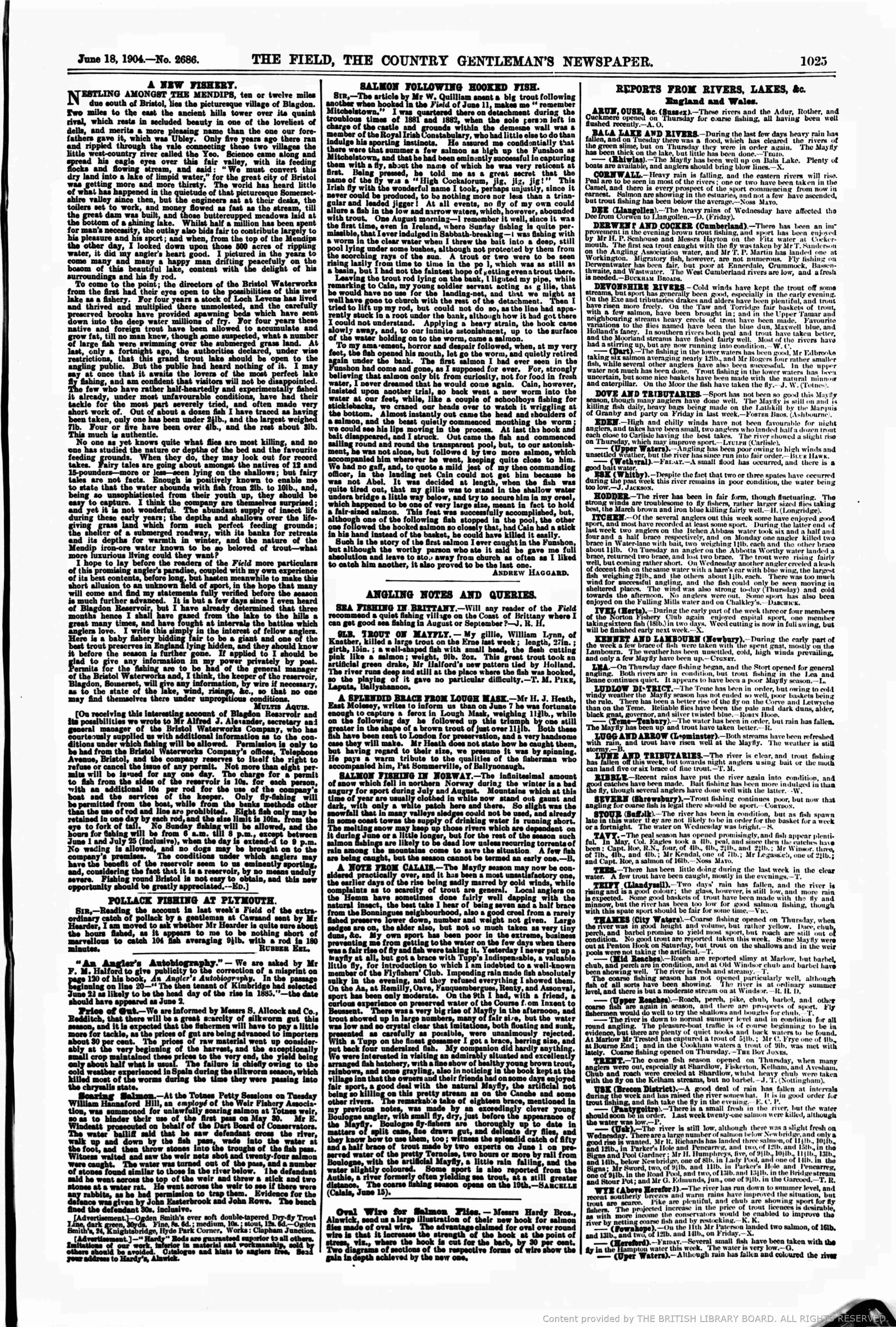
The article by Mr W. Quilliam anent a big trout following another when hooked in the Field of June 11, makes me “remember Mitchelstown.” I was quartered there on detachment during the troublous times of 1881 and 1882, when the sole person left in charge of the castle and grounds within the demesne wall was a member of the Scotch Irish Constabulary, who had little else to do than indulge his sporting instincts. He assured me confidentially that there were that summer a few salmon as high up the Funshon as Mitchelstown, and tht he had been eminently successful in capturing them with a fly, about the name of which he was very reticent at first. Being pressed, he told me as a great secret that the name of the fly was a “High Cockalorum, jig, jig, jig!” This Irish fly with the wonderful name I took, perhaps unjustly, since it never could be produced, to be nothing more nor less than a triangular and leaded jigger! At all events, no fly of my own could allure a fish in the low and narrow waters, which, however, abounded with trout. One August morning — I remember it well, since it was the first time, even in Ireland, where Sunday fishing is quite permissible, that I ever indulged in Sabbath-breaking — I was fishing with a worm in the clear water when I threw the bait into a deep, still pool lying under some bushes, although not protected by them from the scorching rays of the sun. A trout or two were to be seen rising lazily from time to time in the pool, which was as still as a basin, but I had not the faintest hope of getting even a trout there.The setting of the afore-quoted item, moreover, coincidentally turns out to make for an apt transition to the rather involved task I must now commence, that of expanding on what I touched on in § 4; namely, Caine’s tangential connection with Ireland:Leaving the trout rod lying on the bank, I lighted my pipe, while remarking to Cain, my young soldier servant acting as gillie, that he would have no use for the landing-net, and that we might as well have gone to church with the rest of the detachment. Then I tried to lift up my rod, but could not do so, as the line had apparently stuck in a root under the bank, although how it had got there I could not understand. Applying a heavy strain, the hook came slowly away, and, to our infinite astonishment, up to the surface of the water holding on to the worm, came a salmon.
To my amazement, horror and despair followed, when, at my very feet, the fish opened his mouth, let go the worm, and quietly retired again under the bank. The firt salmon I had ever seen in the Funshon had come and gone, as I supposed for ever. For, strongly believing that salmon only bit from curiosity, for for food in fresh water, I never dreamed that he would come again. Cain, however, insisted upon another trial, so back went a new worm into the water at our feet, while, like a couple of schoolboys fishing for sticklebacks, we craned our heads over to watch it wriggling at the bottom. Almost instantly out came the head and shoulders of a salmon, and the beast quietly commenced mouthing the work; we could se his lips moving in the process. At last the hook and bait disappeared, and I struck. Out came the fish and commenced sailing round and round the transparent pool, but, to our astonishment, he was not alone, but followed by two more salmon, which accompanied him wherever he went, keeping quite close to him. We had no gaff, and, to quote a mild jest of my then commanding officer, in the landing net Cain could not get him because he was not Abel. It was decided at length, when the fish was quite tired out, that my gillie was to stand in the shallow water under a bridge a little way below, and try to secure him in my creel, which happened to be one of very large size, meant in fact to hold a fair-sized salmon. This feat was successfully accomplished, but, although one of the following fish stopped in the pool, the other one followed the hooked salmon so closely that, had Cain had a stick in his hand instead of the basket, he could have killed it easily.
Such is the story of the first salmon I ever caught in the Funshon, but although the worthy parson who ate it said he gave me full absolution and leave to stop away from church as often as I liked to catch another, it also proved to be the last one (“Salmon Following Hooked Fish,” The Field, June 18, 1904, vol. 103, no. 2686, p. 1025).
On Wednesday evening, December 28, 1904, was produced, for the first time in London, by Mr. Charles E. Hamilton’s company, a play with music, in three acts, by Patrick Bidwell, music arranged and harmonised by Michele Esposito, entitled: —Peggy Machree.
The Lady Margaret O’Driscoll . . . Miss Marie Dainton
The Honourable Emily Pryor . . . Miss Dorothy Drake
Mdme. de la Cour . . . . . . . . . . . . . . Mrs. E. H. Brooke
Moira . . . . . . . . . . . . . . . . . . . . . . Miss Agnes Thomas
Molly MacMahon . . . . . . . . . . . . . Miss Nancy Malone
Nora . . . . . . . . . . . . . . . . . . . . . . Miss Kathleen Dawn
Kathleen . . . . . . . . . . . . . . . . . . . . Miss Bertha Seaton
Eileen . . . . . . . . . . . . . . . . . . . . . . Miss Nessie Walker
Sir Lawrence Borthwick . . . . . . . . . . . Mr. E. H. Kelly
Captain de la Cour . . . . . . . . . . . . Mr. Stanley Pringle
Alexander McDougall . . . . . Mr. J. Graeme Campbell
Michael . . . . . . . . . . . . . . . . . . . . . . . Mr. Shiel Barry
Rainey . . . . . . . . . . . . . . . . . . . . . . Mr. Chris Walker
Larry . . . . . . . . . . . . . . . . . . . . . Mr. William Wilson
Patsy . . . . . . . . . . . . . . . . . . . . . . . . Mr. A. S. Barber
Sergeant Bampton . . . . . . . . . . . . Mr. John Morley
Barry Trevor . . . . . . . . . . . . . . Mr. Denis O’Sullivan
Priest, Villagers, Soldiers, Servants, and Huntsmen.
Scene: Ireland. Period: Middle of the Eighteenth Century.
Act one. — Edge of Downkilty Fair. Act two. — Courtyard of Castle O’Driscoll, springtime, afternoon (ten years later). Act three. — Hall of Castle O’Driscoll (three days later).
At Wyndham’s last (Wednesday) evening, Mr. C. E. Hamilton began an intercalary season with Peggy Machree, a piece that has already visited half a dozen of the chief provincial towns since its production at the Prince of Wales’s, Great Grimsby, on November 7 last. The piece, which Mr. Hamilton originally produced upon a very liberal scale, making it one of the most noteworthy contributions of the country stage, in this respect, to the dramatic year, was given in the fishing seaport with Miss Marie Dainton in the title-rôle, Mr. Denis O’Sullivan as the luckless Barry Trevor, and Mr. Shiel Barry as the piper, Michael. These artists and others reappear in the London production, while the new comers to the cast make up, as will be seen, an exceptionally strong personnel for a play of the kind. But what, it may be asked, is the kind? Hybrid, perhaps, for farce [? — the word is unclear in the British Library’s digital copy, and looks rather like “frohe”] and sentiment, intrigue and interpolated song, the stage-crowd, and the melodramatic situation are curiously commixed. The name of the author, Mr. Patrick Bidwell, is new to us; and we do not know how true it may be that it conceals under one of the favourite male pseudonyms a lady-writer. In any case, the mosaic that Peggy Machree really is is a great advantage upon the average dramatic treatment of the musical play. It may be a rather obvious piece of playwriting, in which everything fits in mechanically, but the three acts are well held together.
The dramatic movement of Peggy Machree turns on a practical joke, which becomes for the two principals a stern reality. These principals are the impulsive, mischief-loving Lady Margaret O’Driscoll, “hither all dewy from her convent fetched,” and Barry Trevor, a young Irish gentleman, who jumps to her mood. But Barry does not know the madcap as the Lady Margaret O’Driscoll, only as a little wheedling colleen and singer of Irish airs. For the girl, out of high spirits, has assumed a peasant’s dress, and called herself simply Peggy. That is her device for entering fully into the fun at Downkilty Fair, the edge of which forms the bright and colourful scene of the first act. These things were more easily done a century or two ago — or, rather, the distance of time that the play premises (the period is 1750) allows them more easily to be done now, at all events on the stage. Peggy is not content with a simple masquerade; she wants a mock marriage, too. Her foster mother, Moira, was to be married at fair-time to Alexander McDougall, the castle major-domo, who flatters himself that he keeps a wary eye for the escapades of his young mistress. The thoughtful and even anxious Moira had a priest waiting to tie the marriage knot now the opportunity was come. For McDougall had been a slow wooer, taking ten years in meditation of the step to the alter. But at the last moment, true to his nature, McDougall has drawn back, and left the priest to sleep undisturbed in a cottage hard by, and also left the marriage festivity, for which many preparations have been made and guests invited by Moira, to take care of itself. It fits well with Peggy’s wilful humour to be the dea ex machina. In her disguise of colleen, she agrees with Barry to go through the marriage ceremony, with a mock priest in Barry’s friend, Sir Lawrence Borthwick, who is to take the place of the sleeping father, dressed up in the latter’s cloak. But while the wedding party are waiting in the chapel Sir Lawrence feels some misgivings about his share in the transaction. Therefore, not he, but the real priest — who has awakened — arrives, and lawfully marries the unsuspecting pair. The truth is soon out, and Peggy, without disclosing her identity, bitterly upbraids Barry. He, with a full sense of the folly of their act breaking on him, enlists in the King’s army.
Ten years pass, and the play, which has developed this serious interest, suffers a rather melodramatic turn when the action is taken up in the second act. Barry, worn in the wars, is now a penniless fiddler. Returning to Downkilty, he saves the Lady Margaret’s life, little imagining that she is the Peggy of the mad marriage. More, he foils a plot at abduction that Margaret’s unscrupulous cousin, Captain de la Cour, has hatched against her. Still, though Barry is now at the Castle, both he and Margaret have no idea of their true relation. This knowledge comes at the end of the second act, to Margaret, and also to Barry’s friend, Sir Lawrence. Margaret, for her own reasons, keeps the secret at first, teasing [?] Barry with the statement that she is acquainted with the facts of his marriage and will confront him with the girl. Barry by no means enters into the spirit of this final joke, seeing that he did not love the little colleen then and that he does love the Lady Margaret now. The pretty climax is brought about by the merry mistress of Castle O’Driscoll standing before him in the dress of Peggy at the old Downkilty fairing.
A defect of the representation is a want of atmosphere, not on the part of the principals, but in the general treatment. There is plenty of brightness, but it is a rather hard brightness, coming of an unimaginative stage management. In a piece of this kind the surroundings count for a great deal, and the warm, easy Irish life is an effect difficult to secure on the stage, as, for instance, in the Fair scene, where it is necessary for the sake of colour and charm. It would give a reality that seems lacking until an Irish melody, as as “The Tailor and the Goat,” used here for the “Peggy Machree” song and dance, and also as a leading motive, vitalises the scene and carries all before. “Shure, an Irish song sings itself,” says Barry; and if the vocal gifts of Mr. Denis O’Sullivan, Miss Dainton, Mr. John Morley, and Miss Nancy Malone call for no such facility, the great attraction of the piece lies in the airs that ripple and bubble through the play. But they miss a great deal of their effect, when the surroundings are not altogether sympathetic.
If the piece has a weakness in this respect, no one could want Irish songs sang better than Mr. O’Sullivan, Miss Dainton, and others sing them. Mr. O’Sullivan’s voice is full, rich, and suave in such songs as “An Irish Home,” “The Smith’s Song,” “My Fond Heart,” or snatches to the fiddle, which Mr. O’Sullivan plays in the second act. If Mr. O’Sullivan is the most natural of singers of variable and haunting Irish music, Miss Dainton is one of the most delightful. Her “Peggy Machree” song, with bewitchingly coquettish style od dance and darting smiles, has a fascination racy of the soil.
“Honey-moon Hall” she gives deliciously, and is enthusiastically cheered in “The Old Oak Tree.” Miss Dainton is very sprightly and captivating in the part, if a little studied — a little wanting in the buoyancy and feather-headed ways of a madcap. The interest is almost entirely between these two characters, but there are fairly good parts falling to Mr. J. Graeme Campbell, excellent as a canny Scot, to Miss Agnes Thomas, a very natural Moira, and Mr. Shiel Barry, acting well and with finish as a piper. Mrs. E. H. Brooke plays with her usual accomplished air as Mdme. de la Cour, and Mr. Stanley Pringle makes a most presentable figure of Capt. de la Cour, whose friend Sir Lawrence is suitably depicted by Mr. E. H. Kelly. Mr. Chas. Walker, Miss Dorothy Drake, and others fill in lesser parts in a picture that has so much that is pleasing and attractive as only to increase the wish that it were complete (“‘Peggy Machree;’ Production at Wyndham’s,” The Stage, December 29, 1904, p. 18).

L–R: Sir Lawrence Borthwick (Mr. E. H. Kelly), Barry Trevor (Mr. Denis O'Sullivan), Peggy (Miss Marie Dainton), and Moira (Miss Agnes Thomas). “The end of Act I. — Peggy and Trevor realise that their marriage ceremony has been a real and not a pretend one. To the command of the bride, ‘Go, sir, and never let me see your face again!’ the husband leaves his wife and takes the King’s shilling.” Reproduced from “‘Peggy Machree’ at Wyndham’s Theatre,” The Illustrated Sporting and Dramatic News, January 7, 1905, p. 754.
an ominous silence for the first few minutes, broken only by the hearty recognition of Miss Marie Dainton, when she made her first appearance. The reason for this initial lack of appreciation was not difficult to discover. The commencement of the play is a little too “talky.” The audience found it difficult to catch the drift of the author’s meaning, and really a considerably better effect would be produced by plunging into the story a little earlier. This could be accomplished by a little judicious cutting. Once the audience became interested the frigid atmosphere rapidly thawed, bursts of applause followed in quick succession, and the close of the act drew forth a loud and continued expression of approval, the curtain being twice called up. Altogether act I produced a distinctly favourable impression, but the demonstration was as nothing compared to that experienced at the finish. The audience cheered and cheered again, the curtain being raised and lowered at least half-a-dozen times. Even then the audience were not satisfied, and another storm of applause followed until Mr. Denis O’Sullivan and Miss Marie Dainton appeared before the curtain. There were even demands for the author, but that gentleman was either not present or was too modest to publicly acknowledge the congratulations of the audience. It has occurred to us that we have not yet mentioned the title of the new piece. It bears the attractive name, “Peggy Machree,” and is a musical play. It is a distinct departure from the style of the modern musical show, which for the most part has degenerated into a series of variety specialities, strung together with a weak, and often absolutely inane plot. In the present instance the object has been to create a play in which music shall form a prominent part, and yet have quite as much attention paid to the story. The result has been eminently successful. “Peggy Machree” although embracing a wealth of engaging humour, is by no means a comedy in the modern acceptance of the term. A technical description would be “a light, romantic, musical, costume drama,” and this admirably sums up the main features of the production.[…] It is ingeniously worked up by the author, but at the same time is not without its defects. There are occasions when there is a tendency towards a drag in the progress of the plot, but this is almost inevitable in the first performances of a new play. Rehearsals cannot bring out the strong and weak points to any appreciable extent, but they are quickly apparent when presented to an audience, and once realised the remedy is both obvious and easy. […] (“Amusements in Grimsby; Production of ‘Peggy Machree’ at the P.O.W.,” Grimsby Daily Telegraph, Tuesday, November 8, 1904, p. 3).

L: “Sir Lawrence Borthwick has been sent by his family to Ireland to propose to Lady Margaret O’Driscoll (Peggy), although he is in love with his cousin, and Peggy is already accidentally married.” R: “Trevor, five years after his mistaken wedding, comes to Castle O’Driscoll and fails to recognise his peasant wife in Lady Margaret, whom he asks for an engagement as a servant. Matters end happily for the married lovers.” Reproduced from “‘Peggy Machree’ at Wyndham’s Theatre,” The Illustrated Sporting and Dramatic News, January 7, 1905, p. 754.
quite distinct from the usual variety of modern musical production. The aim of the author has been to produce a play in which music shall be a prominent feature, and in which the plot shall be on a more pretentious scale than is usually attempted in such cases. The result has been highly pleasing. The story, which is of a most romantic character, possesses great dramatic interest, and would still form a presentable play were the musical portions cut out altogether (“‘Peggy Machree’,” The Era, November 12, 1904, p. 13).Peggy Machree continued at Grimsby through Saturday, November 12, before moving on to the Theatre Royal, Newcastle (Nov. 14–19); the Queen’s Theatre, Manchester (Nov. 21–26); the Shakespeare Theatre, Liverpool (Nov. 28–Dec. 3); the King’s Theatre, Glasgow (Dec. 5–10); and the Lyceum Theatre, Edinburgh (Dec. 12–17). By the time the curtain at Wyndham’s was raised for the first London performance of this “curious blend of musical comedy, light opera, melodrama, and farce,” some of its weak points, it seems, were already in process of being remedied. For instance, while some reviews of the London premiere, such as that from The Stage reproduced above, continued to imply that “Between acts one and two ten years are supposed to have elapsed,” as in the provincial run, others gave the gap as five years. Such discrepancies are perhaps explained by the piece’s condition of blue-pencil limbo:
“Barry, after many years — sometimes mentioned as ten and sometimes as five — returns, and although neither hero nor heroine has altered in the slightest degree, and each is supposed to retain a vivid remembrance of the other, the mutual recognition is deferred whilst the audience wonder” (“‘A Play with Music;’ Mr. Denis O’Sullivan in ‘Peggy Machree,’” The Manchester Courier, and Lancashire General Advertiser, Thursday, December 29, 1904, p. 8).Furthermore, it seems that Hamilton had brought in Canadian composer Clarence Lucas to provide “extra numbers” which not only “contribute[d] to the brightness of the entertainment,” as the review in The Standard put it, but also “cloak[ed] the baldness of the book:”Barry goes for a soldier, but returns as a wandering fiddler after five years, according to the program, although it is sometimes spoken of as ten; and, after various incidents of an unexciting and inconsequential character, finds out that Peggy is Lady Margaret, with whom he has fallen in love (“An Irish Music Play,” The Morning Leader, Thursday, December 29, 1904, p. 1).
In the working out of this artless but quite inoffensive plot the older ways of the theatre are freely followed, and coincidence has as many long arms as the Indian god Siva himself. But there are two popular artists to play the chief parts, and this — thanks to Miss Marie Dainton and Mr. Denis O’Sullivan — means not a little. Music, like charity, covers a multitude of sins, and Mr. Esposito has gathered from many sources a variety of songs wherewith to cloak the baldness of the “book.” Sometimes these are old Irish melodies, which naturally fall very agreeably to Mr. O’Sullivan, an artist who never sings without expressing a true meaning. Sometimes the numbers are provided for the occasion by Mr. Esposito or Mr. Clarence Lucas, both of whom can frame a taking tune. Or, again, sometimes the popular modern store, whence musical comedy is wont to draw some of its supplies, is sought out and ransacked. Perhaps we must assume that last night’s audience preferred the newer features of “Peggy Machree” to the old, for certainly the chief lyrical success of the evening was won by “The Old Oak Tree,” a ditty of the “Letty Lind” type, which suggested American rather than Irish authorship (“Wyndham’s Theatre; ‘Peggy Machree,’” The Daily Telegraph, Thursday, December 29, 1904, p. 9).The piece in question (which was also called “By the Old Oak Tree”), along with a second, “Honeymoon Hall,” were confirmed to have “come to us by way of America, and, although they sound slightly out of place, it must be confessed that in the hands of Miss Dainton they became very acceptable contributions to the evening’s entertainment.” Both were indeed “of the usual musical comedy type,” having “nothing to do with the play,” and both appeared in the pre-London provincial run of Peggy Machree, the former having been lifted from The Rogers Brothers in Paris, a series of vaudeville farces starring the comedy duo Gus and Max Rogers, knitted together into a single play of three acts and five scenes by John J. McNally, with lyrics by George V. Hobart and music by Max Hoffmann (the onomastic inspiration, no doubt, for Caine’s Michael Hoffman), and which seems to have first played at the Star Theater in Buffalo, New York, on Monday, August 29, 1904, before opening on Broadway at the Liberty Theatre on 42nd Street. “Honeymoon Hall,” composed by John W. Bratton with lyrics by Paul West, was based on a children’s book, The Pearl and the Pumpkin, which West had co-written with W. W. Denslow, the illustrator for The Wizard of Oz. It seems that even before the book was published in October 1904, plans were already afoot to turn it into an eponymous “imaginative spectacle” in three acts, which, however, would not be produced until Monday, July 17, 1905, at the Colonial Theatre in Boston. But back to Peggy Machree. As already seen in § 4, that show’s producer would later call in Clarence Lucas (again), along with French composer Henri Hirchmann and the future author of The Author of “Trixie”, to effect said piece’s evolution into a comic opera from what a reviewer of the London premiere described as “a fairly good type of a reversion to the ballad-opera […] with its rather obviously manufactured note of simplicity, its quite serviceable story in place of a dramatic plot, its particularly tuneful ditties in place of a definite musical scheme.” Apropos of which: Perhaps some of the stronger points of the piece had been changed for the worse? Compare, for instance, the descriptions of Peggy Machree as produced at Grimsby, above, with a few descriptions of its London incarnation, below:
At its best “Peggy Machree,” the new musical play produced yesterday evening at Wyndham’s Theatre, is simply an old-fashioned Irish comic-opera. It is of the false familiar order, beloved of amateur operatic societies, with an ever-ready chorus of colleens and “broths of bhoys,” and with eighteenth-century gallants arriving, in steeple-hts and riding-capes, to sing the solos and make love to the leading lady.Indeed, the piece, despite having “practically no plot,” was deemed “an artistic triumph” on its London premiere at Wyndham’s Theatre, where it continued to play through January 28, 1905, before setting out, with Dainton and O’Sullivan in the principal roles, on a four-month tour of the provinces and London suburbs which included the Devonshire Park Theatre, Eastbourne (Jan. 30–Feb. 4); Theatre Royal, Brighton (Feb. 6–11); Fulham Theatre, Fulham (Feb. 13–18); the Crown Theatre, Peckham (Feb. 20–25); the Alexandra Theatre, Stoke Newington (Feb. 27–Mar. 4); Kennington Theatre, Kennington (Mar. 6–11); the New Theatre, Oxford (Mar. 13–15); Theatre Royal, Leamington (Mar. 16–18); Camden Theatre, Camden (Mar. 20–25); the Prince of Wales Theatre, Birmingham (Mar. 27– Apr. 1); the Marlborough Theatre, Islington (Apr. 3–8); Theatre Royal, Portsmouth (Apr. 10–15); the Coronet Theatre, Notting Hill (Apr. 17–22); the Gaiety Theatre, Hastings (Apr. 24–29); and the King’s Theatre, Hammersmith (May 1–6). A little more than two months after the curtain at the King’s Theatre fell for the last time on Patrick Bidwell’s “play with music,” The Morning Leader announced “A New Comic Opera:”At its worst, “Peggy Machree” does not, one is sorry to confess, achieve very satisfactorily even that lowly ideal. Altogether, one is afraid there is hardly very much of a place for it just now in a London which is beginning to wake up to some new ideas — especially about Ireland.
The story, too, as well as the scene, is of the traditional Irish comic-opera kind. It tells of a young Irish squire (Mr. Denis O’Sullivan), who married a colleen (Miss Marie Dainton) for fun at Downkilty fair. He thought it was only a mock priest, who married them. By a mistake it was a real one, though, for some reason or other, he wore a monk’s cowl, which one hardly remembers to have been the accustomed habit of Father O’Flynns, even of the eighteenth century.
Discovering himself married to this most charming girl, the young squire promptly enlisted in the Georgian regiment that assisted the local and vocal peasantry in the chorus. Then came the entre-acte representing five years.
After these the young squire returns, only to find that the colleen he had married was really Lady Margaret O’Driscoll, who had also been at Downkilty fair for fun. At first the young people — as is so curiously usual in comic opera — fail to recognise one another. So they practically come on and off and sing songs until they do, which finishes the evening.
One may admit readily enough that even if all this had been an excuse for a really rollicking comic-opera, however old-fashioned — like, say, “The Emerald Isle” at the Savoy, one would have enjoyed the evening, and made it up afterwards with Mr. Bernard Shaw.
As it is, however, “Peggy Machree” is not rich even in the humours that are to be got out of Lover and Boucicault, or the songs that set feet tapping and heads wagging, and are to be got from anywhere. As a play it is dull. As a mere musical entertainment it is curiously handicapped by one of its chief artistic merits. This is the fact that Mr. Denis O’Sullivan, who is a real Irishman and a real musical scholar, has, so the programme says, chosen the greater number of his own songs. The result is that he has chosen to a great extent real old Gaelic melodies, which are anything but enlivening, and are in curious contrast to the conventional, jovial, happy-go-lucky, utterly un-Irish manner which he knows so well how to adopt for operatic purposes (“‘Peggy Machree,’ New Musical Play at Wyndham’s Theatre,” The Daily Chronicle, Thursday, December 29, 1904, p. 5).
It is in three acts, and is with more modesty than accuracy announced as a Play with Music by Patrick Bidwell. A more justifiable definition might, perhaps, have been Music Without a Play. The conditions observed are those of comic opera. One character after another comes on the stage and sings a ditty; almost every entrance is effected in the same manner. Meanwhile, precisely at the same moment, a chorus, masculine or feminine, as the case may be, which has been lurking behind the hedge or over the stile, comes forward and supplies an accompaniment or dance. Some of the characters, moreover, are furnished with musical instruments, which they are unable to use and which constitute so much useless lumber (“Wyndham’s Theatre; ‘Peggy Machree,’” The Globe, Thursday, December 29, 1904, p. 3).
“Peggy Machree,” which was produced at Wyndham’s Theatre to-night, is described as “a play with music,” possibly because, although the story is that of a comic opera treated somewhat seriously, the latter designation would not be strictly accurate, as music is not the predominating feature of the production. Yet without Signor Michele Esposito’s music and the interpolated ballads, old and new, by other composers, the work would fall to pieces. The author, Mr. Patrick Bidwell, when his plot shows signs of weakness, permits his characters to break into song with happy results (“‘A Play with Music;’ Mr. Denis O’Sullivan in ‘Peggy Machree,’” The Manchester Courier, and Lancashire General Advertiser, Thursday, December 29, 1904, p. 8).
On the the program last night’s production at this theatre is described as a play with music. This probably indicates that the music was an afterthought, and did not enter into the original scheme. […] There is a plot […] Only the plot doesn’t happen to be particularly good or interesting, and is made up of too familiar materials (“An Irish Music Play,” The Morning Leader, Thursday, December 29, 1904, p. 1).
It was a good idea to weld old Irish songs and ballads into a musical play, for the tunes comprise some of the finest melodies in existence, and the words are full of romance and manliness; but Mr. Patrick Bidwell, in writing the book of Peggy Machree, played for the first time in London last night at Wyndham’s Theatre, would seem to have been haunted by the requirements of musical comedy, and the result is a strange medley, as mixed as the brogues heard on the stage (“Wyndham’s Theatre; ‘Peggy Machree,’” The Standard, Thursday, December 29, 1904, p. 8).
It is not light opera, it is not opéra comique, it is not musical comedy, it is not just a play with incidental music, but something betwixt and between, to discover precisely the right appellation for which is a matter of small moment, having in view the more important fact that the result is a very bright and entertaining production, which proved wholly to the liking of those who heard it for the first time last night (“Wyndham’s Theatre; ‘Peggy Machree,’” The Westminster Gazette, December 29, 1904, p. 4).
“Peggy Machree,” that successful comedy with music which was produced at Wyndham’s last December, has been re-written, and new music has been supplied. The piece is now called a comic opera; and it will be reproduced by Mr. C. E. Hamilton, with Miss Claudia Lasell, of the Opera Comique, Paris, as Peggy.The same day’s edition of The Daily News likewise also ignored both of Peggy Machree’s pre- and post-Wyndham’s instars, but provided the date on which the new (fourth) instar was to eclose and also named exactly who it was whom Hamilton had enlisted to effect the play’s metamorphosis:Miss Lasell begins in this character her first work under a long contract for appearances in England; and she will be seen in London at Easter in a new opera.
A new part in “Peggy Machree” has also been written for Miss Aida Jenoure, who returns to musical work in the play (“A New Comic Opera,” The Morning Leader, Thursday, 13 July, 1905, p. 3).
“Peggy Machree,” which was produced at Wyndham’s Theatre last December, opens an autumn season of forty weeks at Blackpool on July 31st. Charles E. Hamilton, the proprietor of the company, has had the book entirely rewritten, new music has been composed by Clarence Lucas and Henri Hirchmann, the composer of “La Petite Boheme,” and new lyrics by William Caine. The piece, which is now called a comic opera, has been entirely recast (The Daily News, Thursday, July 13, 1905, p. 4).That the above announcements were cribbed from a press release is evident in the version published the same day in The Sporting Life:
“Peggy Machree,” which was produced with such distinct success at Wyndham’s Theatre last December, opens an autumn season of forty weeks at Blackpool on July 31. Charles E. Hamilton, the proprietor of the company, has had the book entirely rewritten, new music has been introduced by Clarence Lucas and Henri Hirchmann, the composer of “La Petite Boheme,” and new lyrics by William Caine. The piece, which is now called a comic opera, has been entirely recast. Peggy will be played by Miss Claudia Lasell, of the Opera Comique, Paris, who begins in this role her first work under a long contract for appearances in England. Miss Aida Jenoure returns to musical work in “Peggy Machree,” a part having been written for her (The Sporting Life, Thursday, July 13, 1905, p. 4).Essentially reiterating the above items, The Daily Telegraph expanded on the cast list, but failed to mention Caine:
The musical play, “Peggy Machree,” which made an excellent impression at Wyndham’s last December, starts on a tour at Blackpool, extending over forty weeks, on July 31. Mr. Charles E. Hamilton, the proprietor of the company, has had the book entirely rewritten, and new music composed by Mr. Clarence Lucas and M. Henri Hirchmann, the successful composer of “La Petite Bohême.” The part of the heroine Peggy is to be played by Miss Claudia Lasell, of the Opéra Comique, Paris, who is to be seen in London at Easter in a new opera. Other characters in the piece will be sustained by Miss Aida Jenoure, Mr. Leslie Stiles, Miss Blanche Astley, and Mr. Graeme Campbell (“Drama of the Day,” The Daily Telegraph, Thursday, July 13, 1905, p. 11).Coincidentally (one learns from the same “Drama of the Day” column), on the same day that the comic opera which the future author of The Author of “Trixie” had a(n invisible) hand in rewriting was to open on the Lancashire coast, a play which the future wife of the future author of The Author of “Trixie” would be tangentially involved with (as seen in § 5), was to open on the opposite side of England on the Dorset coast:
“An Angel Unawares” is the title of a new light comedy in four acts, by Mr. Robert Vernon Harcourt, who, if report may be trusted, has inherited no small measure of the literary ability revealed in days long past by his father, the late Sir William Vernon Harcourt. Some time ago the piece attracted the attention of Miss Fanny Brough, who at once expressed to the author her desire to produce it as soon as opportunity served. Owing to Miss Brough’s absence in America, the scheme has had to lie fallow for some little time, but now the opportunity has come. Starting from Sacramento on June 24, Miss Brough made her way with scarcely a halt to London, where she arrived on Sunday, and on Monday morning she began rehearsals of “An Angel Unawares.” The piece is to be given a short trial tour, beginning at Bournemouth on July 31, with Manchester, Liverpool, and Birmingham to follow, and, should the verdict of these towns be favourable, it will then be brought to London. Except at Bournemouth, it is to be preceded by Mr. Bernard Shaw’s “comediettina,” “How he Lied to her Husband,” in which Miss Brough will appear as “Herself” (ibid.).While I’m not sure exactly when Caine would have worked on transforming Peggy Machree into a comic opera, I assume it would have been during those two months or so between its final performance at the King’s Theatre, Hammersmith, on May 6, 1905, and the announcements (the most informative of which appeared in the July 14 edition of The Echo, which I’ve reproduced in § 4) of its impending forty-week tour following its rebirth in Blackpool on July 31, which was described as follows:

“Charles E. Hamilton presents the new comic opera, ‘Peggy Machree,’ from Wyndham’s Theatre. Book by Patrick Bidwell. Music by Clarence Lucas. Lyrics by William Caine.” Reproduced from “Entertainments,” The Blackpool Herald and Fylde Advertiser, Friday, August 4, 1905, p. 1.
Before a large and eminently well-pleased audience, at the Opera House, on Monday, Mr. Charles E. Hamilton’s “Peggy Machree” Company opened their provincial tour with this, one of the latest and prettiest of comic operas. The piece was produced at Wyndham’s Theatre, London, about a year ago [sic], and has had one tour during the recent spring. Since then, it has been re-constructed, re-dressed, and new and charming lyrics have been written by Messrs. Wm. Caine, Clarence Lucas, and Henri Herchmann [sic], the latter, by the way, being the author of “La Petite Boheme,” which will be introduced into London next Easter by Mr. Chas. Frohmann [sic], who will star Miss Claudia Lasell, the “Peggy” of this week’s Opera House performance. Miss Lasell, a charming actress, comes with a big reputation from the Opera Comique, Paris, and her first bow before the British public, was made before Monday’s audience. She had a most flattering reception, and indeed, all her work, both musical and theatrical, was artistic to a degree. The cast also includes Miss Aida Jenoure, who has lost none of her old musical charm, though of late she has been appearing in “un-musical” comedy. Mr. Lesile [sic] Stiles plays Barry Trevor, the hero of the piece, and just now he is in particularly good voice, while his acting is excellent. Mr. Graeme Campbell, as Alexander McDougall, a staid Scotchman, is admirably contrasted by Mr. Dan Fitzgerald, a comedian of high order, who extracts a vast amount of humour from the part of Michael, piper to the O’Driscolls. Peggy, by the way, is the Lady Margaret O’Driscoll. Miss Blanche Astley, who plays Molly, has a dance in the last act, which is a delightful feature of the performance. The whole cast is exceptionally strong, and there is a chorus which comprises a galaxy of rich musical talent.After running at the Opera House, Blackpool, from Monday, July 31, through Saturday, August 5, the piece moved on to Birkenhead (Aug. 7–12) where its premiere in that town marked“Peggy Machree” is called a comic opera, and, unlike the average musical comedy, has a distinct story running through it from the rise of the curtain to its fall at the end of the third and last act. Lady Margaret runs away from a convent on her birthday, disguises herself as a colleen, and in a fit of fun goes through what she believes to be a make-believe marriage with Trevor. The seriousness of the situation, however, is brought home to her when she discovers that the ceremony has been performed by a real priest instead of by a friend of Barry Trevor’s, as she thought. They separate. Five years later Trevor comes back just in time to save Peggy’s life in a a runaway horse affair. The hero is disguised as a strolling minstrel, and, the rest of the story can be imagined — how he discovers that the colleen, whom he married so long ago, is the Lady Margaret, how she discovers that her hero is indeed her husband, and how happiness envelopes the whole enchanting scene. It is decidedly a thing to be seen and enjoyed, this pretty, 18th century, musical “Peggy Machree” (“Where to Go; Her Majesty’s Opera House; ‘Peggy Machree,’” The Blackpool Herald and Fylde Advertiser, Friday, August 4, 1905, p. 6).
the commencement of a new state of affairs: the transformation of a theatre built in 1864 into an amusement palace of the most modern character. In the remarkably short space of five weeks the Theatre Royal has been completely re-decorated and structurally altered, and the effect the building presented on Monday night was one which astonished and delighted. One’s opinion of the management very much increased after a view of the work which has been accomplished, and it is safe to say that every visitor to the theatre on Monday night returned home perfectly satisfied. Mr. Kelly has not made the mistake of providing an admirable building with poor plays. Recognising that the public appreciate a high-class entertainment, he is striving to cater for that taste, as a glance at his list of bookings demonstrates. On Monday “Peggy Machree” was staged. It is a comic opera which has scored much success at Wyndham’s Theatre, and its presentation this week was looked forward to with much interest. Happily written, it has much about it that is pleasant, the story being of a very romantic description. The story is prettily told, interspersed with good music, and the applause called forth was thoroughly deserved by the excellent company responsible for its enactment (“New Theatre Royal,” The Birkenhead News, Wednesday, August 9, 1905, p. 3).The Birkenhead correspondent for The Stage was, if anything, even more enthusiastic about the renovated setting of the revamped “comic opera which has scored much success at Wyndham’s Theatre:”
The wonderful transformation that has been effected as regards the interior and the exterior of the old Royal, Birkenhead, came as a surprise and a delight to local playgoers on Monday night, when the house was re-opened as the New Royal. Mr. W. W. Kelly, the popular lessee and manager, can with pardonable prise assert that he has provided his patrons with one of the handsomest and cosiest theatres in the provinces, and one worthy the town and its 120,000 inhabitants. During the five weeks’ recess since Whitsuntide the building has undergone such a metamorphosis in its appearance, structure, and decoration as would almost suggest the aid of a magician’s wand, so complete and elaborate are the alterations and embellishments. The proscenium front has been entirely remodelled, to a handsome design in fibrous plaster; the fronts of the dress circle and gallery are new, and of elaborate workmanship. The scheme of colouring is cream and gold, with crimson draperies and panelled walls of terra-cotta, that give an artistic air of comfort to the house. The base is divided into orchestra stalls, pit stalls, and pit, and the dress circle and stalls are richly carpeted and upholstered in crimson velvet, the latest improvement in tip-up chairs having been employed. The crush-room has been elaborately furnished with Ottoman centres, Chesterfield lounges and settees, and richly carpeted in Wilton pile. The ceiling has been raised, and a hand-painted frieze makes a pretty effect; the staircase walls, etc., are finished in the same artistic vein, the vestibule has been inlaid with marble tiles, and a verandah, seventy-five feet long, ornaments the front of the house. Four new dressing rooms have been added below the stage level, and the existing rooms have been comfortably furnished, with the latest improvements in sanitation. A new and artistically painted act drop, from the brush of Mr. Charles Pell, has been added, the subject being Oriental, and representing a group of Nautch girls dancing. A complete installation of electric light brilliantly illuminates the building, and a massive electrolier hangs from the centre of the roof, with myriads of lights concealed along the front of the dress circle. Handsome refreshment buffets and smoke-rooms have been provided, and will be under the control and management of the lessee. The work has been carried out by Messrs. Waring and Gillow, under the supervision of Mr. A. Beedle; the electric lighting is by Messrs. Stafford and Co., under the direction of Mr. John Pell; and the designs of the alterations have been made by Mr. J. J. Coventry. The estimated cost of the transformation exceeds £4,000.The Peggy Machree company spent the following week (Aug. 14–19) at the Grand Theatre, Leeds, the city where the comedic duo of Salt and Blooter (see § 8) have just finished a week’s engagement on the Chawner tour when they are introduced (in a manner which coincidentally rhymes with the end of the above quoted item) into Caine’s Old Enough to Know Better:Mr. W. W. Kelly’s enterprise and liberality deserve a rich reward at the hands of Birkenhead playgoers. He has, for the first time in its history, provided the town with a theatre ample in size, comfortable in construction, and elaborate in decoration. He has published a list of prospective engagements, which include some of the most expensive attractions on the road. It would be ungrateful not to acknowledge this, and we look forward to the future history of the theatre being bright and prosperous. On Monday night the house was packed at early door prices. During an interval Mr. Kelly came before the curtain and obtained an enthusiastic reception in response to the query as to whether his efforts had been successful. This mark of favour was also extended to Mr. Charles Pell, who has worked zealously as acting manager. The only possible regret was that Miss Edith Cole (Mrs. W. W. Kelly), who is playing in London, could not be present to witness and share in the congratulations that were showered upon her husband, who had during the day received over two hundred telegrams from his many friends in the profession, expressing good wishes. In these we heartily join (“New Royal, Birkenhead,” The Stage, August 10, 1905, p. 2).
I hope I have not to commiserate with you on having been to Leeds. If I have let me do it very heartily. If not, let me congratulate you — just as heartily. In either case I must beg you to forgive me if our occasions — through no fault of mine — now lead us to that dismal town. Leeds, above all places, requires entertainment, and, above many, is prepared to pay for it. The Chawner tour passes, accordingly, through Leeds, and two gentlemen with whom we have now to do happened at this period of their lives to be engaged on the Chawner tour. Sooner or later they were bound to spend a week in Leeds, and it so happened that at the period to which my story has arrived they had just finished that week. I can only express my regret that they should not have been in York, a delicious city, or Scarborough, a spa of unrivalled attractions. Had they embarked upon the Chawner tour a week earlier, they would have been in the first; a week later, in the second. Such speculations, however, carry us nowhere.A word about that “spa of unrivalled attractions.” As noted in § 4, the Caines had been spending at least part of their holidays at either Strada Villa or Gainsborough House in Scarborough since at least 1878. According to Newton (1907: 63), “It was in 1877 that Mr. Caine first went to Scarborough with the idea of becoming second Liberal candidate, mainly through the instrumentality of Mr. Joshua Rowntree, who afterwards sat for the borough. In 1878, after a holiday in the Riviera and North Italy from March to May, the family settled in Scarborough from the middle of June to the end of September.” Caine’s sister Dorothea later recalled the holidays in Scarborough as being “full of interest,” since they were “spent in the midst of the fine scenery of the Yorkshire wolds and moors, and by the very beautiful coast, full of rockpools, shells and fossils […] It was a lovely place for children and our memories of it were very happy” (Colman n.d.: 10). Back to Leeds.They were in Leeds. There is no avoiding it (p. 242).
In the dismal town of Leeds, then, which can well afford to pay for the entertainment it so desperately needs, “A large and appreciative audience,” according to The Stage (August 17, 1905, p. 7), “welcomed Mr. Charles E. Hamilton’s company with Peggy Machree, a comic opera. The company are most competent throughout.” The Era of August 19, 1905 (p. 9), concurred: “An Irish comic opera of the eighteenth-century period, by name, Peggy Machree, is staged here this week, and is drawing good houses. The members, without exception, work hard, and achieve a distinct success, as is evidenced by the readiness of the audience in the matter of applause.” Indeed,It was Sunday morning, Sunday morning in Leeds, Sunday morning in theatrical lodgings in Leeds. Enough, one would think, to plunge in gloom the giddiest, gayest soul alive. But there was no gloom upon the red ugly face of Mr. Salt as he passed, in the glory of his sky-blue dressing gown, the comfort of his purple pyjamas and the luxury of an unshaven chin, from his bedroom in Haldane Street to the sitting-room which he shared with Mr. Blooter, his partner in whimsicality, his twin champion Cat-laffian Cross-talk Comedian of the World.
In his hand was the letter which had just been thrust under his bedroom door. Reading it, with a smile on his face, he crossed the sitting-room and pulled the bell. Then he sat down by the fireplace and continued to read.
He lit a cigarette, finished the letter and “Bless her!” he exclaimed.
At this moment certain clatterings were audible on the landing, the door opened and the landlady came in with the breakfast and the bill.
“Mrs. Abbott,” said Mr. Salt, “were you ever in love?”
“Ah,” said Mrs. Abbott as, with amazing speed, she distributed the elements of the meal upon the table.
“It’s good enough, eh?” inquired Mr. Salt.
“Ah,” said Mrs. Abbott, as she went out through the door. She was a woman of few words and many children. She had no time to wast ein chatting with her lodgers.
Mr. Salt kissed his letter and put it in the pocket of his dressing-gown. Then he got up, lifted a cover, inspected a finnan haddock, made a cup of coffee and going to the door shouted into the passage, “Bill-ee.”
A melodious cry answered him from above, and upon the staircase appeared, legs, clad in pyjamas. These were followed by the rest of Mr. Blooter, and there was a great deal of it.
Mr. Blooter was a huge young man with a very unintelligent face and a great development of chest and arm. His it was (when they were on the stage) to wear the silk hat, tight-fitting brown frock coat and trousers, white spats and patent-leather boots; his to twirl the malacca; his to stick the eyeglass in his eye and let it fall five times a minute. Litte Salt, on the other hand, wore the suit of rags, the decayed pith helmet and the great false bare feet, which looked so funny when the two men broke into the beat dance which took them off. Mr. Blooter, too, was reading a letter. He too smiled and smoked a cigarette. He too wore a dressing-gown over his pyjamas (Old Enough to Know Better, pp. 242–244).
Evidently Leeds people have missed their musical play at least a little during the past two months, for the new comic opera “Peggy Machree” was welcomed by an especially large audience at the Grand Theatre last night.Evidently, too, the extra numbers which Clarence Lucas had provided for the second and third instars of Peggy Machree, could be considered to have been varieties of harmonic imaginal disks, so to speak, which enveloped, overwhelmed and dissolved all traces of Esposito’s score in the mature fourth instar, the music of which was described by The Yorkshire Evening Post as “bright and pleasing, though in no way can it be said to possess any real distinction. However, a pretty madrigal, a sextet, trios, and duets, together with the usual sprinkling of love songs and catchy refrains, go to make up an acceptable dish, and serve to pass a pleasant hour or two.” Caine’s hand in the lyrics was also ignored by the Leeds reviewers, as were Hirchmann’s contributions to the score, one of which, according to the Lytham Times, was “a charming number, specially written” for Claudia Lasell and curiously called, apparently, “Hothen Love,” while another, “Sundial Shadows,” also sung by Lasell, was mentioned in both the preview and the review of the company’s performance at its next stopover, the Royal Opera House, Leicester (Aug. 21–26):Dealing with eighteenth-century Ireland, the piece has a pretty, if not strikingly original, story to tell of a mischievous Lady Margaret, who, disguised as a peasant girl, Peggy, goes through a mock marriage which turns out to be real. Five years later, when the wicked cousin is about to claim her hand, she is discovered by her sailor husband as a kind of fairy princess, and love, of course, scores another victory.
Mr. Clarence Lucas, who is responsible for the music, has caught the right spirit, and there are several numbers of distinct interest and charm. The story, too, loses nothing in the telling at the hands of Mr. Charles E. Hamilton’s Company (“Leeds Amusements; Grand Theatre,” The Leeds and Yorkshire Mercury, Tuesday, August 15, 1905, p. 8).
“Peggy Machree” made her initial bow to a Leicester audience at the Royal Opera House, last evening, and created a distinctly favourable impression. There is a delightful freshness pervading the whole play; indeed, it is as refreshing as the scenery of the Emerald Isle itself, where the action is supposed to take place. Although not strikingly original, the music is bright and effective, and several numbers, including a quartet at the end of the first act, and the interpolated songs, “Honeymoon Hall” and “Sundial shadows,” are really very nice. The outstanding feature, however, of the opera is its quiet, clean, droll humour. The book, judging by the name — Patrick Bidwell — is by an Irishman, and we venture to think that only a son of Erin’s Isle could have created such an atmosphere, reflecting so much of the breezy good temper and wit of the land of the shamrock. Then there is the story, well-connected and clearly worked out. It is slender enough, it must be confessed, but it is not extravagant, and does not depend upon irrelevant buffoonery for effect. The plot, described in a few words, is this: Lady Margaret O’Driscoll, or “Peggy,” is found masquerading at Downkilty Fair, somewhere in the middle of the eighteenth century, as a ballad singer. It is stipulated that five years later she is to marry and with the even receive a fortune. Captain De la Cour, the schemer of the piece — villain is scarcely a suitable term — makes brave efforts to win Lady Margaret — more especially her fortune — but the Lady Margaret marries the dashing, rollicking Barry Trevor, a lieutenant in the “Royal Navee,” who has come ashore on pleasure bent. The ceremony, suggested in freakish mood, is supposed to have been performed by a “mock” priest, but as a matter of fact the real article, by some mischance, has done the deed. When Lady Margaret discovers the true circumstances of the case she is indignant, and Trevor joins his ship, and does not return until five years later. All the time he is under the impression that he has married a peasant girl, but on the day that “Peggy” is to marry someone the true facts leak out, and the gallant sailor is made happy, and the bewigged and moustachioed Captain De la Cour cast down into the depths of chagrin and discomfiture. Miss Claudia Lasell fits the part of “Peggy” like a glove. She has a sweet, cultivated voice, and acts with an archness and charm which is altogether delightful. Other female characters who deserve special mention are Miss Aida Jenoure as Moira Cafferty, foster mother to Lady Margaret; Miss Blanche Astley in the role of Molly; Miss Catherine Carr, as Madame De la Cour; and Miss Dorothy Garden, as the Hon. Emily Pryor. Mr. Leslie Stiles impersonates Barry Trevor, the brisk, hearty, jolly sailor to perfection. He possesses a pleasing voice, and uses it to the best advantage. Mr. J. Graeme Campbell deserves nothing but praise for his conception of the part of the dour Scotsman, Alexander McDougall, while Mr. Dan Fitzgerald also acts very cleverly as Michael, the piper to the O’Driscolls. Mr. Dermot Fitzgibbon is good as the foolish but kindly beau, Sir Lawrence Borthwick, and the Captain De la Cour of Mr. Marc MacDermott is also worthy of mention (“Amusements; Royal Opera House,” The Leicester Daily Post, Tuesday, August 22, 1905, p. 5).It thus seems that the changes wrought by Caine, Hirchmann, and Lucas involved not only the addition of at least a couple new songs with which “to cloak,” in the words of The Daily Telegraph (Thursday, December 29, 1904, p. 9), “the baldness of the book,” but also making the story slightly more plausible by transforming Barry Trevor from a young (and in some reviews, penniless) Irish squire or gentleman into a lieutenant in the British navy on temporary shore leave. He thus, after learning that his mock marriage to Peggy was real, does not join the British army out of “penitence for his folly” (as the reviewer for The Era, November 12, 1904, p. 13 put it) or “remorse for the injury he has unwittingly done the girl” (according to The Manchester Courier, and Lancashire General Advertiser, Thursday, December 29, 1904, p. 8); instead, naval discipline calls him back to his ship before he can unsnarl the snafu with the colleen with whom he’s truly smitten. Nevertheless, as was also seen in the review of the Blackpool show, it seems that the revisers of the piece were not content to explain Barry’s return after a five-year absence as simply a chance to resolve a romantic entanglement and possibly reunite with the girl he loves now that his tour of duty has expired, but chose to keep him, à la the earlier instars, in the guise of a fiddle-playing minstrel. Which is perhaps one of the reasons why the reviewer of the first night’s performance at the company’s next venue, the Gaiety Theatre, Dublin (Aug. 28–Sept. 2), had to make “a few allowances for improbable or, at least, unusual events worked into the construction of the story:”
The large audience that crowded the Gaiety last night were highly pleased with “Peggy Machree,” the comic opera which comes here from Wyndham’s Theatre, London, where it had a successful run. The piece is somewhat of a change from the musical comedies — clever and entertaining after their miscellaneous variety fashion — which are frequently seen, and one reason for the popularity which it will in all likelihood win here is that it has a strong native flavour, not only in music, but in many of the characteristics of the comedy business, which is plentiful throughout. The scene is in Ireland, and there is a familiarity about those who occupy the stage, and making a few allowances for improbable or, at least, unusual events worked into the construction of the story, there is a good deal to remind us of the fun and frolic of some phases of Irish country life.The review of the same night’s performance in The Daily Express shows how the story could be “well-connected and clearly worked out” yet still contain “improbable or, at least, unusual events worked into [its] construction,” and also seems to imply that the catalyst for Peggy’s and Barry’s mock wedding in the earlier versions — their not wanting to disappoint the guests invited to celebrate the abruptly called off MacDougall–Cafferty wedding — has, in the mangonized version, evaporated in the face Barry’s subitaneous passion and Peggy’s flirtatious exuberance:a village fair
The first act is full of song, dance, and chorus, the sprightliness of boys and girls at the village fair being pleasingly represented. Miss Claudia Lasell, as Lady Margaret, sang and acted throughout in a very attractive manner. When, as Peggy Machree, she took part in the village festivities her brightness and gaiety were delightful. Mr. Leslie Stiles made a very fine figure, and sand in very good form, and his acting in conjunction with the supposed peasant girl being full of the spirit of the situation. Miss Aida Jenoure, as Moira Cafferty, foster mother to Lady Margaret, was a highly amusing widow, whose endeavours to capture the heart of a Scotchman gave rise to a lot of merriment.
pretty acting
Some pretty acting was also indulged in by Mr. J. Morley and Miss Blanch [sic] Astley, who had a couple of attractive duets. The Scotchman already referred to — namely, Alexander M’Dougall — was represented with considerable drollery by Mr. J. G. Campbell, who brought a lot of quiet humour into his characterisation.
The week’s engagement should be popular (“‘Peggy Machree;’ Irish Comic Opera at the Gaiety; Full of Fun and Frolic,” The Irish Independent, Tuesday, August 29, 1905, p. 6).
A plot which is very much above the average comic opera story is the main point of “Peggy Machree,” and it is worked out in a most effective and thoroughly charming manner. The music is pretty, and very happily arranged, but it cannot be said to be strikingly original, or even very much out of the common. It is always bright and pleasing, and distinctly clever, but these qualities are never of such a high order as to make it remarkable. The action of the piece is cast in Ireland about the middle of the 18th century, and the first act represents the edge of Downkilty Fair on a spring morning. It is a riotous scene, and the Lady Margaret O’Driscoll, who has just been let loose from a convent school, is carried away by the spirit of recklessness and jollity which pervades the day, and dresses up in the peasant clothes of Molly Cafferty, the daughter of Moira Cafferty, Lady Margaret’s foster mother. Two young naval officers — Sir Lawrence Borthwick and Barry Trevor — arrive at the fair and Trevor is greatly attracted by the sprightly little maiden, who informs him that her name is Peggy Machree. In a moment of wild folly he suggests that they shall perform a mock marriage ceremony, and she, equally rashly, enters into the fun of the thing, and agrees. Borthwick, who is a typical “silly ass,” is persuaded to play the role of the priest and instructed to don the garments of a reverend friar who is staying in Moira Cafferty’s cottage. The two then rush away together, and Borthwick is about to carry out his share in the escapade when he is dissuaded by Michael, the piper of the O’Driscolls, who points out the injudicious nature of the masquerade. Unfortunately the priest takes it into his head to go for a stroll just about this time, and is pounced upon by the couple in the village, who mistake him for Borthwick. He performs the marriage ceremony, and later, of course, the shocking truth is forced upon the hapless twain that the marriage has been a real affair and they are legally man and wife. At this critical point a sergeant of marines appears and informs the officers that orders have been sent for all officers to proceed at once to their ships, and so the curtain goes down on the weeping Lady Margaret and the agonised departure of the repentant Barry Trevor. Five years pass, and the day arrives when the Lady Margaret must conform to the time-honoured custom of the O’Driscolls — either to accept as her husband sound man of her own choice or betroth herself to her next-of-kin. The latter is a prepossessing scoundrel with a weird French accent and gorgeous raiment, named Captain de la Cour, who is extremely anxious to fill the vacancy. When the second act opens Barry Trevor has returned from his five years’ service, and is now roaming the country disguised as a fiddler searching for Peggy Machree. He saves the Lady Margaret’s life by stopping her runaway horse, but neither recognises the other. The amiable Captain de la Cour decides to kidnap his cousin, and thus make sure of his prize, but his scheme is frustrated by Trevor and Barry. The Lady Margaret recognises Trevor, and without revealing her own share in the tragedy, charges him with having ruined poor Peggy Machree’s life. He admits that he was the man, and expresses such deep contrition that his fair denouncer is not disposed to be too hard on him. In the third act the re-uniting of the pair and the utter discomfiture of the de la Cour person is successfully carried out, and Michael and Moira Cafferty also arrange to have a little wedding on their own account, to the intense surprise of Alecander MacDougall, the Major Domo at Castle O’Driscoll, who has been postponing his wedding with the Widow Cafferty for years, and now finds himself postponed for ever. It is a pretty, if not very feasible, little story, and the acting of the whole company is capital. Miss Claudia Lasell as the Lady Margaret O’Driscoll is charming. Her interpretation of the coquettish and wayward young lady is altogether delightful and her singing is thoroughly artistic. In the second and third acts she is especially successful, her treatment of Trevor, who hearing that Peggy Machree is dead feels himself at liberty to fall in love with Lady Margaret, being an extremely pretty piece of work. Mr. Leslie Stiles is excellent as Barry Trevor. He has a breezy style and appearance eminently suited to the part and his voice, while of a particularly powerful kind, is not unpleasing in quality. His acting is very good, and if he would overcome a slight tendency to shout and generally speaking to more vigorously control that enormous voice of his there would be no fault whatever to find with his interpretation of the part. The part of Moira Cafferty is admirably played by Miss Aida Jenoure, who, it will be remembered, gave a clever study of Miss Mulholland when “The Duke of Killiecrankie” made its first appearance in Dublin. She sings “The Widow Malone” in capital style, and her passages at arms with Alexander M’Dougal [sic] are extremely amusing. Miss Blanche Astley plays the part of Molly, Moira’s daughter, and sings and dances very prettily. Mr. John Morley, as Sergeant Bampton, makes the most of a small part. Mr. J. Graeme Campbell, as the canny Alexander, looks just as if he had been bodily removed from some tobacconist’s doorstep. He is a humorist with an immovable countenance and a martyred air, but he is none the less excessively amusing. He is ably supported by Mr. Dan Fitzgerald, who supplies his own particular brand of Irish humour as a set-off against the Scotch element. These two undoubtedly keep the piece going, and they do it in a thoroughly capable manner. Mr. Dermot Fitzgibbon is sufficiently silly as Sir Lawrence Borthwick, and Mr. Marc MacDermott is appropriately villainous as Captain de la Cour. The remainder of the cast is well sustained. The chorus work is particularly good, and in the first act the mad frolicking of the fair is very well done, while the singing leaves nothing to be desired.Likewise, the review in the Dublin Evening Herald said little about Peggy Machree’s music, but exclaimed that, “In the matter of plot,” its “superiority is quite marked:”Taken as a whole “Peggy Machree” is a very charming little opera, though whether its merits are of a sufficiently abiding order to carry it beyond a few seasons is open to question. There is not sufficient originality in the music, and none of the songs are remarkably catchy, or likely to gain a large amount of popular approval. However, the piece is a light and airy little trifle, amusing from start to finish, and its reception last night was indisputably cordial (“The Gaiety Theatre; ‘Peggy Machree,’” The Daily Express [Dublin], Tuesday, August 29, 1905, p. 4).

Reproduced from “In the Theatres; ‘Peggy Machree’ at the Gaiety,” The Evening Herald [Dublin], Tuesday, August 29, 1905, p. 2.
Whether “Peggy Machree” should be described as a comic opera, using the term as equivalent to the French opera comique, or as a musical comedy, is not of much importance, and in any event, as its music is largely composed of well-known Irish melodies, it approaches nearer to ballad opera of a kind than to either variety of musical composition. The main point is, it is a success, and the crowded and appreciative audience at the Gaiety last night evidently considered that success quite unqualified. The fact is worth noting inasmuch as that success is achieved in a perfectly legitimate manner, and owes nothing to the suggestiveness which is too often a feature of productions of the musical comedy type. In the matter of plot, too, theSuperiority is quite Marked,
for “Peggy Machree” possesses a plot which, if not surprisingly original, is at least skilfully worked out. The essence of the opera bouffe is the ridiculous and extravagant, but there is nothing of either one or the other in the piece now running at the Gaiety, which is thoroughly romantic, though its quality is light. The story of the opera is briefly this: The Lady Margaret O’Driscoll runs away from a convent on her birthday, disguises herself as a colleen, and in a fit of fun goes through what she believes to be a make-believe marriage with Barry Trevor, a naval officer whose ship is in port near by. The seriousness of the situation is, however, brought home to her when she discovers that the ceremony has been performed by a real priest instead of by a friend of Trevor’s, as she thought. They separate. Five years later Trevor comes back just in time to save Peggy’s life in a runaway horse affair. The hero is disguised as a strolling minstrel. The scene between Lady Margaret and Trevor where the latter, unaware of the identity between Lady Margaret and the colleen to whom he has been so strangely united and whom he believes to be dead, tells the daughter of the last chieftain of the O’Driscolls of his love, and where the latter keeps up the illusion with a truly Irish enjoyment of the possibilities of the situation, is admirably worked out, and is fittingly concluded with the resumption by Lady Margaret of the costume in which she captured her lover’s heart, with the charming, though inevitable, sequel. Much of the music is very agreeable, and the Irish airs and additional numbers are skilfully introduced, such slight anachronisms as a song of Mrs. Needham’s being sung in a scene the action of which takes place in 1740, being quite pardonable. The book, by Patrick Bidwell — whom the writer, on the evidence of the excellence of the love-scenes, suspects to be a woman, and an Irishwoman at that — is decidedly clever, better even than its musical setting. The cast is,
All-Round Extremely Good.
It would be difficult, if not quite impossible, to find a more charming or vivacious “Peggy” than Miss Claudia Lasell, whose sprightliness, for which her Paris Opera Comique training is, no doubt, partly responsible, finds excellent scope for its exercise. A charming actress and a singer possessed of much higher gifts than one usually sees and hears in comic opera, Miss Lasell alone would make the piece an undoubted success. A couple of handsome bouquets, numerous recalls, and enthusiastic applause she received last night, and thoroughly deserved. Miss Lasell is admirably seconded by Mr. Leslie Stiles as Barry Trevor, whose capital impersonation of the light-hearted sailor, who is half an Irishman, would be hard to improve on. Mr. Stiles has a fine baritone voice — his singing of the “The Donovans” has never been approached in Dublin — while his acting showed a thorough grasp of an attractive part.
The Humour of the Piece
is to a great extent, in the hands of Michael, Lady Margaret’s retainer, and the part is taken by Mr. Dan Fitzgerald. Mr. Fitzgerald gave us an Irishman of a type unknown ten years ago, rather melancholy, sententious, and superstitious, without either tail coat, battered hat, or blackthorn. The new stage Irishman is inclined to be a trifle uninteresting, besides bearing no resemblance to anyone in the greater part of Ireland, where cheerfulness and a certain irresponsibility and light-heartedness exist despite all adverse influences. Mr. Graeme Campbell was the canny Scot slightly exaggerated, as such characters must be, but even the most sensitive Scotchman would laugh at his quaint pourtrayal [sic] of the part of the major-domo. Miss Aida Jenoure, once again back from “the legitimate,” was quite as successful as in her recent visits to Dublin, while Mr. John Morley — whose name seems to be familiar — has a fine voice and an excellent presence. The remaining parts were well filled. The chorus deserves a special word of praise. The choruses of “Peggy Machree” are not very elaborate, but they were sung with excellent spirit and capital tone. The piece is admirably staged, the courtyard and hall of Castle O’Driscoll being well worth seeing. The dresses are charming, notably the Paris creations which Miss Claudia Lasell wears with such bewitching grace (“In the Theatres; ‘Peggy Machree’ at the Gaiety,” The Evening Herald [Dublin], Tuesday, August 29, 1905, p. 2).

Reproduced from “In the Theatres; ‘Peggy Machree’ at the Gaiety,” The Evening Herald [Dublin], Tuesday, August 29, 1905, p. 2.
That an Irish musical play should be a novelty in Ireland may appear a novel and perhaps a paradoxical suggestion. We have had plays in Irish which no one can understand, and we have had operas in Irish which were as dull as most water, but not since Stanford’s “Shamus O’Brien” have we had an Irish comedy opera which an intelligent Irishman could appreciate and enjoy. We can make allowances for aThe review in the Evening Telegraph noticed Caine’s contribution to the “telling production” of Peggy Machree in Dublin and remarked, “In both musical and dramatical respects the piece has a great deal of merit:”“Foreigner’s” Attempts to Acquire the Brogue
and if he does not brilliantly succeed, we are at least relieved to find that the Irish character is not travestied nor in any degree misrepresented. We are inclined to resent anything in the nature of a “bull” being regarded as typical of Irish character, but even a brief experience in Ireland will be sufficient to indicate that we, at least, are not exempt from their use. When Michael says, “I was behind before but now I am first at last,” he was merely using somewhat similar language to that employed by Mr. Swifte MacNeill recently in the House when he “wished to repeat what he never said before,” or the after dinner orator who desired to say a few words before he began to speak. A certain sensitive sect in Ireland at the present time would fain regard every joke at Ireland’s expense as
An Insult Against the National Character
If we were to adopt this attitude we would soon grow pessimistic and lose our sense of humour. We are Irish, but Barrie says in “Little Mary,” “it is sinful to boast.” We can, however, appreciate the excellent humour of Michael in “Peggy Machree,” especially when played by so admirable an actor as Mr. Dan Fitzgerald, who not only refrained from any tendency to exaggerate the part, but whose conception must have had a wholesome restraining influence over the entire company.
“Peggy Machree” is not an original opera. It is mainly composed of songs and concerted pieces adapted to old Irish melodies. But when we compare the pure structure of such melodies as “I’d roam the wide World Over” and “The Lark in the Clear Air,” with such pot-boiled rubbish as “Do You Like Love” and “I Like You in Velvet,” one wishes that we had fewer attempts at originality. But it must not be supposed that “Peggy Machree” is wholly free from original work, for if the thematic material is borrowed, its treatment, notably in the final choruses, is eminently
Fresh, Original and Interesting
Here indeed Mr. “Clarence Lucas” has displayed an intimate knowledge of his subject matter and excellent taste in scoring. Several songs are notable for their originality of treatment, among which may be mentioned Herchman’s [sic] song “Sundial Shadows,” sung by Miss Claudia Lasell, “My Family Never Does That” (Mr. Dermot Fitzgibbon), and “I Lost My Place” (Mr. Dan Fitzgerald). Mrs. Needham’s excellent song, “The Donovans,” and a song of the “Belle of New York” type, “Honeymoon Hall,” are both well received, and a duet in old English style deserved mention.
Miss Lasell is a
Bright and Vivacious Peggy
and she wisely refrained from attempting an Irish accent, though the language often demanded it, and produced at times rather ludicrous effects. When “Hould yer Whist!” is interpreted “Old You’re Wist!” one would prefer an alteration in the text. Still Miss Lasell was always acceptable, her singing was brilliant and sympathetic. The Moira Cafferty of Miss Aida Jenoure is generally pleasing, her dancing being a graceful feature of the performance. Mr. Leslie Stiles is a fine robust Barry Trevor, and sings with vigour. He contrives, however, to sing sharp, and this tendency was ruinous to the quartette in Act I. Mr. J. Graeme Campbell played Alexander MacDougall with
Interest and Some Humour
His song was very enjoyable. The chorus is young and bright. The stage management of the choruses of the songs is unusually picturesque. Mr. J. M. Capel though an admirable song writer, is a rather indifferent conductor. The orchestra would be greatly improved by the addition of a couple of horns, for which cornets are but a poor substitute (“Peggy Machree; A Refreshing Novelty,” The Mail [Dublin], Tuesday, August 29, 1905, p. 2).
In the Gaiety last night a crowded house gathered to hear the new comic opera, “Peggy Machree,” of which the book is by Patrick Bidwell and the music by Clarence Lucas, with lyrics by William Caine. It proved itself to be a telling production in every way, and may be safely said to have captured the audience. A brief word as to the story on which the piece is founded. Lady Margaret O’Driscoll, a wild young Irish lady, runs away from her ancestral home in a sort of mad freak disguised as a colleen. Near the locale of the O’Driscolls a man-o'-war is in port, and one of the officers, Barry Trevor, meets the colleen. A flirtation ensues and purely by way of a joke the lady goes through what she believes to be a mock marriage with Trevor. The celebrant of the marriage is, however, a real priest; and the situation has thus been rendered a very serious one to Lady Margaret, who had been under the impression that it was a friend of Trevor’s who performed the ceremony. However, the pair thus unconsciously locked in the bonds of matrimony separate in anger. Five years afterwards Trevor turns up just in time to save the colleen’s life in a runaway horse affair. Then he discovers that the colleen is Lady Margaret; she discovers that the preserver of her life is her real husband; and there is the usual happy finale. In both musical and dramatical respects the piece has a great deal of merit; several Irish airs are utilised for both solo and choral purposes; and to the portion of the score which does not consist of these inspiriting elements a very considerable amount of Irish flavour is imparted. The adopted airs are very well handled, whether introduced in solo, duet, or choral form. In the first choral ensemble “The Wearing of the Green” forms a principal subject; and “There is nothing half so sweet in life” and the “Widow Malone” are heard later on. In one chorus a few notes from Mendelssohn’s “Wedding March” come in effectively. The orchestration and choral working up are decidedly good. Miss Claudia Lasell played and sang the part of the wild young Lady Margaret, otherwise “Peggy,” with great spirit and vivacity throughout. Mr. Leslie Stiles, as Lieutenant Barry Trevor, the officer whose matrimonial freak eventuates in bonds indissoluble, displayed a very powerful voice and brought down the house by the song which he sings in the disguise of a minstrel on his return to the land of the O’Driscolls. This is a well-known Irish air. He also caused much amusement by his displays of fiddling. A very amusing episode is the lovemaking between Alexander M’Dougall, the Scotch major domo of Castle O’Driscoll, and Moira Cafferty, foster mother of Lady Margaret. This part was given a thoroughly “sawney” character by Mr. J. Graeme Campbell. Alexander wants to postpone the marriage though he declares that he does not want to do so indefinitely; and a very laughter-making incident is that in which the two naval officers lay hold of him and try to rush him by main force into the hymeneal noose. He escapes from them and is chased about the stage. Later on he appears in full Highland costume and delivers himself of a grotesquely humorous song consisting partly of spoken recitative relating to “Bonny Scotland,” the band supplying an accompaniment suggestive of bagpipe drone, and the bassoon uttering comic notes to match. To this song there is a very pretty choral refrain. Miss Ada [sic] Jenoure was extremely good as Moira Cafferty. Other good parts were Michael, piper to the O’Driscolls, Mr. Dan Fitzgerald, who has a good song about the genuine Irish style of making love; Madame de la Cour, aunt to Lady Margaret, Miss Catherine Carr; Captain de la Cour, Mr. Marc M’Dermott; Molly, Moira’s daughter, Miss Blanche Astley; and Sergeant Brampton [sic], Mr. John Morley. The staging and dresses are in excellent style.Likewise, The Irish Times included Caine’s lyrics among the “admirable results […] obtained” for Peggy Machree’s first Dublin visit and, most notably — and in drastic constrast with The Daily Chronicle’s judgement of the London production that “As a play it is dull,” or The Morning Leader’s that “the plot doesn’t happen to be particularly good or interesting” — stated, “The story is a very interesting one, and is so well developed that it might easily serve for a more sober theme than comic opera:”The opera will hold the boards during the week, and the usual matinee next Saturday (“Gaiety Theatre; ‘Peggy Machree,’” Evening Telegraph [Dublin], Tuesday, August 29, 1905, p. 2; identical piece in The Freeman’s Journal, Tuesday, August 29, 1905, p. 2).
The first visit of “Peggy Machree” to Dublin has been hailed with unqualified satisfaction. The Gaiety Theatre was crowded last evening in every part with an audience who, having heard the praises of the new comic opera sounded, were anxious to utilise the first opportunity of witnessing it. Their opinion was expressed in no uncertain tone, and the management may rest satisfied that during the entire engagement they will be favoured with bumper audiences. “Peggy Machree,” as its title indicates, is essentially Irish. It comes to Dublin with a record of very high success at Wyndham’s Theatre, and although it is well known that many of the London successes fall rather flat in the provinces, there can be no fear that such a fate will befall the present production. The book is by Patrick Bidwell, the music by Clarence Lucas, and the lyrics by Wm. Caine, and in all three respects most admirable results have been obtained. The story is a very interesting one, and is so well developed that it might easily serve for a more sober theme than comic opera. The idea may be summarised as follows: — Lady Margaret O’Driscoll escapes from a convent on her birthday, disguises herself as a colleen, and, as a joke, goes through what she regards as a mock form of marriage with Barry Trevor, a naval officer. The seriousness of the situation, however, is brought home to her when she learns that the ceremony has been performed by a genuine priest instead of by a friend of Trevor’s, as she had at first supposed. The couple part. Some five years later Trevor returns just in time to save Peggy’s life in an accident due to a runaway horse. He is disguised as a strolling player, but the disguise is soon penetrated. His discovery that Lady Margaret is the colleen whom he had married so long ago, Lady Margaret’s discovery that her rescuer is none other than her husband, and the happy ending which compensates for the unpleasant incidents in which both parties were involved, are happily worked out. The music is throughout tuneful and spirited, and bears an unmistakably Irish character. Some of the airs are quite familiar, while others are declared to be interpolated. The choral pieces, as a rule, are very attractive, and nothing could have been more acceptable than the manner in which they were rendered. There are numerous pretty dances, an abundance of pretty scenery and elegant costumes, and last, but by no means least, the company is a thoroughly efficient one. Miss Claudia Lasell, who filled the role of Peggy, is a highly gifted and beautiful American lady. She possesses a delightful voice, and has a full share of the captivating charm of manner for which her countrywomen are renowned. The welcome extended to her last evening was of the most cordial character, but was not a whit more than her talent merited. Mr. Leslie Stiles made a splendid Barry Trevor. He is also the possessor of a most agreeable voice, and as a comedian he scored considerably. Another very pleasing vocalist was Miss Blanche Astley, who filled the part of Molly. She was heard to especial advantage in a couple of duets with Mr. John Morley (Sergeant Bampton), whose vocal attainments have time and again elicited the warm appreciation of Dublin audiences, and who was greeted last evening as an old favourite. Miss Aida Jenoure as Moira Cafferty, a widow not averse to marriage, caused much amusement, being greatly assisted in her drollery by Mr. J. Graeme Campbell, who, as Alexander M’Dougall, was responsible for unbounded merriment. Mr. Dan Fitzgerald as Michael, the piper, was also very amusing, and acquitted himself in the best approved manner of some choice Irish “bulls.”The next city on the tour, Manchester, is also the first repeat. In its pre-London form, Peggy Machree played at the Queen’s Theatre (Nov. 21–26, 1904); revised, it occupied the boards of the Prince’s (Sept. 4–9, 1905). The Manchester Courier’s review of the return performance includes a cast list that indicates the addition of two new characters, Mademoiselle Boulay and Lawyer Keene, and goes on to note,The work will be produced each evening during the week, and on Saturday there will be a matinee (“Gaiety Theatre; ‘Peggy Machree’” The Irish Times, Tuesday, August 29, 1905, p. 5; reprinted under “Public Amusements” in Weekly Irish Times, Saturday, September 2, 1905, p. 17).
“Peggy Machree,” which is this week at the Prince’s Theatre, first visited Manchester a few months since, shortly after it was produced at Grimsby. It was then described as a musical play. So great a transformation has taken place in the piece that it is now more properly classed as comic opera — and very good comic opera too. Many new songs, bright and sparkling in character, have been introduced, and for the singing of several of these Miss Claudia Lasell, who now appears in the title role, is responsible. Whether as Lady Margaret O’Driscoll or as Peggy Machree, a character she assumes for a frolic, there is a charm about her acting which won her the hearty approval of last night’s audience, and her vocalisation in a rich mezzo-soprano voice, was enthusiastically applauded. Mr. Leslie Stiles makes a strong and manly Barry Trevor, his humour before and his pathos after the mock marriage which proved to be no mock marriage being admirable. There is much that is amusing about Mr. J. Graeme Campbell’s Alexander M’Dougall, the dour “Scots Cupid,” whose distaste for marriage renders a wedding necessary in order that the villagers may not be disappointed, and Miss Aida Jenoure, the would-be bride, plays up to him capitally as Moira. Mr. John Morley as Sergeant Brampton [sic], and Miss Blanche Astley as Molly, also contribute largely to the success of the piece. All the principals have good voices, the chorus is well balanced, the scenery is pretty, and the whole effect is most satisfactory (“Manchester Amusements; Prince’s Theatre; ‘Peggy Machree,’” The Manchester Courier, Tuesday, September 5, 1905, p. 8).The above-quoted review utterly refutes what I said earlier about the catalyst for Peggy’s and Barry’s mock wedding having evaporated; it still remains their not wanting to disappoint the guests invited to celebrate the abruptly called off MacDougall–Cafferty wedding. However, there do seem to have been some slight differences between the earlier and later productions, mainly involving the distribution of the music and the function of the chorus, as evidenced by the Guardian’s review:
It is boldly claimed for this joint production of the pens of Mr. Patrick Bidwell, who is responsible for the book, Mr. William Caine, who has written the lyrics, and Mr. Clarence Lucas that it is a “comic opera.” It must not even belong to that latest genus “comedy opera.” The authors of it would wince, and not unnaturally, if one were to speak of it as a “musical comedy.” It might, however, be described as a hybrid between the conventionally romantic and the conventionally unromantic. In the stage phrase the story is a “straight one.” It is ingeniously devised, and it interests. Here and there are ineptitudes, but they are not serious. There is but little of the rough-and-tumble method one has come to associate with the term musical comedy. There is a chorus of course, picturesquely dressed, who act and sing with quite amazing vigour. They swish on and off the stage periodically, and materially add to the brightness of the three scenes into which the piece is divided. But, if one’s memory serves, since the first performance of the opera in Manchester in December [sic] last year their work consists less in the chorusing of Irish melodies and more in the singing and acting of the choruses of the regular musical comedy type. There are still many old Irish melodies utilised in the score, but these are now mainly in the first act, which remains the best of the three. As we then dealt with the music of the opera at length, it is not necessary to refer to it again in detail. It is all sung with exuberance, and not infrequently with an attention to musical phrasing that one does not often meet with in announced “comic opera.”Peggy Machree as revised by Caine, Lucas, and Hirchmann next spent six days at the Royalty Theatre, Chester (Sept. 11–16), followed, two weeks later, by six days at the Opera House, Southport (Sept. 25–30). In between were six days (Sept. 18–23) at the same venue in the same city where the piece in its pre-London instantiation had spent Nov. 28–Dec. 3, 1904 — the Shakespeare Theatre, Liverpool:The company is without the services of Mr. Dennis [sic] O’Sullivan, whose rich and sympathetic voice enabled him to give delicacy, point, and emphasis to old Irish songs. He is, however, followed in the part of Barry Trevor by Mr. Leslie Stiles, who, if not possessing the voice of Mr. O’Sullivan, sings with abundant spirit and acts with considerable cleverness. In the character of the grim Scotch major domo Mr. A. [sic] Graeme Campbell is highly humorous. His stolidity, his imperturbability, and his canny remarks caused hearty laughter throughout the entire performance. The character of the madcap Lady Margaret O’Driscoll, who gleefully takes part in a supposed mock marriage which a few minutes later turns out to have been a real one, is acted with charm and sprightliness by Miss Claudia Lasell. In manner and facial expression she reminds one strongly of what Miss Florence St. John was in the days when she appeared in comic opera a great deal more frequently than she does to-day. Miss Lasell is the fortunate possessor of a strong soprano voice which has evidently been well cultivated. Miss Aida Jenoure is entertaining as the widow who has been setting her cap at the wily Scotsman for years (“Prince’s Theatre; Peggy Macree [sic],” The Manchester Guardian, Tuesday, September 5, 1905, p. 7).
The unrestrained enjoyment of the large audience at the Shakespeare Theatre last night was good to see. “Peggy Machree” may be welcomed as a sign that the public taste is not permanently welded, so far as lighter amusement is concerned, to the musical hotch-potch which for some time has done service — good service in its own way — as comic opera. In this new work of Messrs. Bidwell, Lucas, and Cain [sic] there is a coherent story; tuneful, bright, happy music; and the songs — even the imported ones that appear on this second visit to Liverpool — are not pitched at the audience with no earthly reason, but have some bearing on what is transpiring in the action and dialogue. With the slight exception of one unnecessary verse (which was not greatly appreciated in any part of the house) in an otherwise amusing character song by Mr. Fitzgibbon, there is not the least approach to vulgarity or ill-taste in any form. This surely is an advance on much that people have been accustomed to, and the fact that “Peggy Machree” is a solid box office success ought to point a moral to those who undertake the entertainment of the public.I would like to know more about that “one unnecessary verse (which was not greatly appreciated in any part of the house) in an otherwise amusing character song by Mr. Fitzgibbon.” Dermot Fitzgibbon played the role of Barry Trevor’s fellow naval officer Sir Lawrence Borthwick, he who was to play the mock priest, but backed out at the last minute. Based on the review in the Dublin Mail quoted above, it seems that his “amusing character song” would have been “My Family Never Does That,” possibly composed by Hirchmann with lyrics by Caine. Another song possibly composed by Hirchmann with lyrics by Caine was “I Lost My Place,” sung by Dan Fitzgerald as Michael, the O’Driscoll’s piper. Unfortunately, reviews of the production in other Liverpool newspapers do not provide any further insights into the matter. For instance, the only potentially relevant phrases from the Echo that are legible in the digital reproduction are, “The play itself is of course familiar to Liverpool playgoers. It has, however, been considerably altered as to words and music, and is now a more pronounced success than ever.” The Birkenhead News’ judgement echoed the above and also inverted the play’s ostensible evolution from an “ingenious piece of patchwork” of “many songs but little plot” into a “very good comic opera,” prefiguring, thus, the plot of Caine’s autumn 1912 novel Hoffman’s Chance (see § 12):Miss Claudia Lasell, a new star, who now plays the title-part, received gratifying recognition. Miss Lasell’s reputation had preceded her. Much was expected, and no on was disappointed. As the prancing hoyden of eighteen, fresh from convent and determined to have one day of giddy freedom, and afterwards as the great Irish lady, head of a noble house, who is living down the serious embarrassment resulting from the supposed to be mock marriage at the Downkilty Fair, Miss Lasell’s acting was pleasing in its self-possession, and in its naivete, and the freshness and gaiety and mischievous irresponsibility of young girlhood. Miss Lasell’s charming and joyous personality wins all hearts, and has additional piquancy in the decided American accent which there is happily no attempt to subdue or hide. Miss Lasell’s rich and expressive mezzo-soprano voice carries her successfully through the musical numbers that fall to her, and is especially sweet in the pretty sundial song.
Mr. Leslie Stiles’s almost boyish exuberance as the good-natured Barry Trevor was quite exhilarating, and all his singing is forcefull and effective. Mr. John Morley — the name seems familiar — acts and sings well as Sergeant Bampton; and Mr. Graeme Campbell presents a really masterly sketch of the dour Scottish major-domo in an Irish family. Mr. Campbell’s assumed density of expression, both of face and voice in all circumstances, is extremely mirth-provoking; and M’Dougall’s Scotch philosophy and proud national sentiments are delivered with a point that never fails to appeal to the humorous sense. The Irish essence of the work is kept to the front by Mr. Dan Fitzgerald as the Piper Michael. In addition to a thoroughly competent cast of principals, there is a highly-trained and not too conspicuous chorus (“Shakespeare Theatre; ‘Peggy Machree,’” The Liverpool Daily Post and Mercury, Tuesday, September 19, 1905, p. 7).
The piece has, however, undergone many changes since it was originally produced in Liverpool. Though the reconstruction that it has undergone may be said to mark a decline from the more ambitious plane of comic opera to that of musical comedy, it will be generally admitted that the play has gained rather than suffered by the process. Many new and delightful numbers have been introduced, and the serious strain which characterised the piece on its original production has been brightened by many alterations in the libretto and the introduction of witty and vivacious dialogue (“Public Amusements; Shakespeare Theatre,” The Birkenhead News and Wirral General Advertiser, Wednesday, September 20, 1905, p. 1).One of those many changes seems to have involved Sir Lawrence Borthwick’s reappearance (in act II, I assume) as one of Lady Margaret’s suitors, evidenced, e.g., by the Dublin Evening Telegraph’s review of the Wyndham Theatre production as well as by the caption to an image thereof which I have reproduced from The Illustrated Sporting and Dramatic News (above): “Sir Lawrence Borthwick has been sent by his family to Ireland to propose to Lady Margaret O’Driscoll (Peggy), although he is in love with his cousin, and Peggy is already accidentally married.” Without that complicatedly “amazing coincidence,” as the Evening Telegraph called it, of Borthwick coming to woo Lady Margaret — whom he fails at first to recognize as the “colleen” he failed to mock-marry his friend Barry to a (half-)decade earlier — at precisely the same time that Barry also reappears on the scene, Peggy Machree next travelled to the Empire Theatre, Oldham (Oct. 2–7); the Grand Opera House, Harrogate (Oct. 9–11); the Opera House, Buxton (Oct. 12–14); the Theatre Royal, Huddersfield (Oct. 16–21); and the New Theatre, Oxford (Oct. 23–28), where, in its first post-London form, it had already played for three nights seven months earlier (Mar. 13–15). The Oxford Review noticed the addition of the following interpolated songs: “The Simple Life” and “Sundial Shadows,” both sung by Claudia Lasell; “Her Little Man,” a duet sung by Blanche Astley (Molly) and John Morley (Sergeant Bampton); and “Look at Her,” sung by Leslie Stiles. During the following week’s residence at the Theatre Royal, Blackburn (Oct. 30–Nov. 4), Blanche Astley replaced Claudia Lasell in the lead role. Miss Astley returned to her role of Molly Cafferty and Miss Lasell returned to the part of Peggy Machree/Lady Margaret for the productions at the Theatre Royal, Darlington (Nov. 6–11); the Grand Theatre, Hartlepool (Nov. 13–18); the Avenue Theatre, Sunderland (Nov. 20–25); and the Royalty Theatre, Glasgow (Nov. 27–Dec. 2). Likewise for the Lyceum Theatre, Edinburgh (Dec. 4–9), and the Tyne Theatre, Newcastle (Dec. 11–16). As these last three stops on the tour also happen to have been cities which Peggy Machree had visited the year before, in the month leading up to its London premiere, a comparison of the reviews of its original and reconstructed forms as played in those cities may be of interest. The Glasgow Daily Record and Mail observed the piece’s evolution from a “delightful ‘play with music’” into “a better specimen of comic opera, with a dash of the higher-class musical comedy element,” but did not, unfortunately, provide any substantiating evidence:
Anyone who wants to see what a “musical play,” as distinguished from a “musical comedy,” should be has but to visit the King’s Theatre this week.In Edinburgh, The Scotsman remarked that the “musical play,” with its “curious blending of the modern domestic drama, old-fashioned Irish melodrama, and good musical fare,” had been “elevated to the rank of comic opera” by reason of Bidwell’s “improve[ment] upon his former ‘book,’” Caine’s “new and meritorious” lyrics, Lucas’s “bright and catchy” music, and a “well-balanced chorus [that] sang very harmoniously:”An excellent company, headed by Mr. Denis O’Sullivan, for some time prominent on the concert platform, and Miss Marie Dainton, an artiste of captivating vivacity who has been lost in the musical comedy wood but has at length found a path worthy of her talent, is producing “Peggy Machree,” a drama of love and fortune, set in the Georgian era, but informed by all the spirit and romance of Irish life and quite good enough in action, witty enough in dialogue, and rousing enough in song and chorus and dance to set the Liffey on fire.
Years ago the late Mr. W. J. Scanlan brought us something like this from New York. Mr. O’Sullivan is an Irishman from ’Frisco, and he has bettered Mr. Scanlan’s enterprise. He is not the author, of course — though, by the token, since “Patrick Bidwell” is the name on the programme, it may be whispered that it is a woman who is responsible — but he has been in “the secret,” and the result is apparent from start to finish of this lively, rollicking, and at times tender and pathetic, gem of Irish play-writing. There is no Celtic gloom, be it remembered; the story is coherent, plausible, even natural, and if the stage device is not ignored — well, that is neither here nor there in a piece that carries all before it.
Interpolated are old Irish airs selected by Mr. O’Sullivan and treated by him with exquisite beauty and no small amount of power, while the author’s lyrics have been arranged and harmonised by Signor M. Esposito, who, if a foreigner, has lived in Dublin so many years that he may be said to have imbibed native delicacy and taste in the lighter forms of musical expression. Miss Dainton’s “Honeymoon Hall” and “The Old Oak Tree,” which are bits suggestive of musical comedy as we know it, evoked warm applause last night.
But, indeed, the piece is altogether seductive, and went from start to finish with a verve that there was no mistaking. It will be surprising if the King’s is not a popular resort this week. A matinee is announced for Saturday (“‘Peggy Machree;’ Irish Musical Play at the King’s Theatre,” The Daily Record and Mail, Tuesday, December 6, 1904, p. 3).
The delightful “play with music” which Mr. Denis O’Sullivan and Miss Marie Dainton introduced to Glasgow last year under the title of “Peggy Machree” is at the Royalty this week in revised form. It has, in fact, developed into a comic opera of great charm, with Miss Claudia Lassell [sic], an American actress of youth and beauty and any amount of vocal and dramatic capacity, in the leading role, while the company generally, augmented as it is, is excellent in every sense of the word, and the mounting and dressing are extremely fetching.
The story is, of course, Irish, with a fine eighteenth century flavour of romance, and the songs, choruses, and dances are captivating in their variety and humour. A better specimen of comic opera, with a dash of the higher-class musical comedy element, it would be impossible to discover on the present-day stage. Miss Lassell established herself last night as a great favourite, and Miss Madge Avey [sic], Miss Blanche Astley, and Messrs. Leslie Stiles, Heribert Willis, Milroy Cooper, and John Morley (the latter of “La Poupee” fame) gave valuable support. If encores and recalls count for anything, “Peggy Machree” is assured of every success on its present visit. There will be a matinee tomorrow (“The Theatres, Peggy Machree,” Daily Record and Mail, Tuesday, November 28, 1905, p. 6).
Although “Peggy Machree,” the piece produced at the Lyceum Theatre last night for the first time in Edinburgh, is styled a musical play, it belongs to a different class from those nondescript comedies which have bulked so largely on the theatrical stage in late years, and which, for the most part, are little more than a musical melange filled in with variety business of the music hall order. The new piece is a curious blending of the modern domestic drama, old-fashioned Irish melodrama, and good musical fare. If it has not much to commend it in the way of plot, it does not fall short of many others in that respect, while it can appeal for success to the novel combination of qualities which it presents. There is a thread of a story, romantic in its way, but that is neither here nor there in the working out of the plot, which is simple and well-worn. Briefly told, it is that of a high-born damsel, Lady Margaret O’Driscoll, who, masquerading at a village fair as Peggy Machree, a ballad-singer, meets Barry Trevor, a jovial young Irishman, equally full of fun and exuberance of spirit. To gratify a crowd who had assembled to witness a marriage which did not come off, they agree to go through a mock ceremony, but the arrangement miscarries so far that a real priest officiates, and the bond of union is made legal. On learning the real state of matters, Trevor enlists in the army, and when he returns ten years afterwards, disguised as a fiddler, he is taken into the service of Lady Margaret, who reigns in her Castle, and whom he has on the day of his arrival rescued from accident by seizing her runaway horse. They do not know each other up to this time, but the villain of the piece, who has been forcing his attentions upon the lady, mistakes Trevor for a myrmidon whom he had employed to poison a horse which Lady Margaret was to ride to hounds next day, and as they enter into confidences it is easily seen that the biter will be bit. This is where a highly melodramatic scene comes in, and the man and wife wedded unintentionally ten years before are left to the enjoyment of their life’s union. There is a strong Hibernian flavour about the piece, which is by Mr Patrick Bidwell, and the music, always of a delightful nature, has been arranged by Signor Michele Esposito. The merit of the performance, however, lay in the admirable rendering by the two principals of some of the old Irish folk-songs and melodies, which are never without a peculiar charm of their own. Miss Marie Dainton and Mr Denis O’Sullivan filled the leading parts with the utmost satisfaction, both on the dramatic and vocal sides, and they had a most cordial reception. Miss Dainton is a young actress with a dainty presene and a sweet voice. She acted throughout in a neat and artistic manner, carrying through the first scene, in which she appeared as a colleen, in a spirit of great vivacity, and bringing the necessary dignity to bear in the more serious passages which followed in the later acts. Her singing was warmly appreciated, and hearty encores were given to her two chief numbers, “Honeymoon Hall” and “The Old Oak Tree,” the latter being followed by a very pretty and graceful step dance to illustrate the refrain of her song. Mr O’Sullivan, as Barry Trevor, gave an excellent impersonation of the impressionable young Irish lover. Of splendid physique and with handsome features, he realised to the full the large-hearted, good-natured, and rollicking Irishman typical of the stage. His full baritone voice was also heard to much advantage in the numerous songs which he rendered, and which were warmly applauded. Among the rest of Mr Charles E. Hamilton’s company who acquitted themselves creditably were Mr Graeme Campbell, who preserved all the humour without exaggerating the part of a kilted Scottish servant; Mr Shiel Barry, Mr Marc MacDermott, Mr Stanley Pringle, and Miss Freda Bramleigh. There was a fairly good audience, considering the stormy nature of the weather, and the performance was much enjoyed (“Amusements; ‘Peggy Machree’ at the Lyceum Theatre,” The Scotsman, Tuesday, December 13, 1904, p. 7).Deeming the original version of Peggy Machree a “recruit to a more worthy form of entertainment, where the music is sparkling without being shallow, and the humour is genuine and spontaneous and is not merely a meretricious compound of current slang and topical allusion,” The Newcastle Daily Chronicle could not decide whether its reconstruction as a comic opera was an improvement or not. Already possessing a coherent plot, the changes to the play, which seem to have entailed a dilution of its Irishness, lay mainly “in the briskness and brightness with which it is told. Now the stage is always more or less crowded, the action is quicker, and there is a swing about the piece that infects the audience.” There was now also “a much more powerful chorus:”The Lyceum had a monopoly of theatrical entertainments in Edinburgh last night, the other two theatres being closed in preparation for the forthcoming pantomimes. “Peggy Machree” is not new to the city, but it comes in a fresh guise. When here a year ago it was styled a musical play, but it has been largely rewritten and reconstructed, and is now elevated to the rank of comic opera. The theme is the same as before, although the author, Mr Patrick Bidwell, has improved upon his former “book.” The lyrics of Mr Wm. Caine are new and meritorious; while the music, which is by Mr Clarence Lucas, is of a bright and catchy nature. It is altogether a very entertaining specimen of the lyrical drama, and one which can be thoroughly enjoyed, as it was last night, by a large audience, who showed their appreciation by the heartiness of their applause and the frequency with which encores were demanded. The story is that of a high-born Irish maiden, Lady Margaret O’Driscoll, who simply for the fun of the thing masquerades at a village fair as Peggy Machree, a ballad singer. She meets Barry Trevor, a naval officer with as much exuberance of spirit as herself. Not to disappoint a crowd assembled to witness a marriage which did not come off, the pair agree to go through a mock ceremony, but as a priest has by an accident officiated, the bond of union becomes of legal effect. The couple so unintentionally mated then separate, and when Trevor returns five years afterwards disguised as a fiddler he finds the lady installed in her family mansion. He has been instrumental in saving her from an accident by stopping a runaway horse, and this paves the way for a disclosure of their identity and a happy finale. There is a pleasant Hibernian flavour about the opera, and it is enriched by the introduction of some pretty Irish melodies and old folk-songs, while the production also owed something to sparkling “business,” beautiful costumes, effective grouping, and picturesque scenery. Mr Charles E. Hamilton’s company brings the opera round, and for the title rôle he has secured an accomplished artiste in Miss Claudia Lasell, a young American lady, possessing vocal and dramatic gifts of a high order. She acted in a captivating manner, and her voice, which is of considerable range and of a very pleasing quality, was heard to much advantage in the many delightful numbers which fell to her lot. Mr Leslie Stiles gave a breezy and in all respect admirable rendering of the part of Trevor, and sang his songs in a vigorous and expressive manner. His fellow-officer had an acceptable representative in Mr Ralph Lynn; and Mr John Morley, who will be favourably remembered as the Jovial Monk in “La Poupee,” made the part of the sergeant of marines very enjoyable by reason of his intelligent acting and excellent singing. Mr Milroy Cooper was amusing as a Scottish serving-man, who could be intensely funny without being vulgar, and who could wear his Highland dress without making it ridiculous. Miss Blanche Astley gave a neat and piquant personation of an Irish colleen, and she sang nicely and danced with spirit and grace. All the other parts were competently filled, and a well-balanced chorus sang very harmoniously. Good work was also done by the orchestra, under the direction of Mr K. Ernest Irving. The opera will run for the week, with a matinee on Saturday (“Entertainments; ‘Peggy Machree’ at the Lyceum Theatre,” The Scotsman, Tuesday, December 5, 1905, p. 5).
“Peggy Machree” may be regarded as a sign of the times — a sign that the day of musical comedy is nearing an end, and that we are again reverting, by slow but welcome degrees, to a higher form of entertainment in which good music and real humour are really present. That they, after all, are acceptable to the public has been already proved by the success of such productions as the “Duchess of Dantzic” and “Veronique,” to instance two present and opposite examples, and in “Peggy Machree” we have another recruit to a more worthy form of entertainment, where the music is sparkling without being shallow, and the humour is genuine and spontaneous and is not merely a meretricious compound of current slang and topical allusion. If “Peggy Machree” cannot be said to boast a very complicated plot, it does at least possess one that has the virtue of coherence and one which does not outrage the probabilities. And, moreover, the story, even though it is interrupted by songs innumerable, is very closely followed and the auditor, besides being treated to a concourse of sweet sound, has also the pleasure of seeing not a little excellent acting. The central idea of the trifle is that one Lady Margaret O’Driscoll, masquerading as a Peggy Machree — the name indicates that the scene is laid in Ireland, the time is the middle of the eighteenth century — consents, principally, being Irish and irresponsible, for the fun of the thing, to go through a mock form of marriage with a handsome stranger who finds her at her masquerade and falls in with her mad humour. To their present misfortune, however, a real priest hiding from the soldiery performs the ceremony, and the stranger, Barry Trevor by name, in a fit of remorse and wishing to do what he can to make reparation there and then takes the shilling and goes off to the wars, leaving the pseudo Peggy to her own devices. Of course he comes back again — under sufficiently romantic circumstances — and equally, of course, there is a reconciliation and the curtain falls with the two preparing to live happily every afterwards. The story as presented does not leave a great deal of opportunity for the introduction of other characters than the handsome stranger and the madcap Peggy, and the burden and heat of the play fall almost entirely upon Mr. Denis O’Sullivan, as Barry Trevor, and Miss Marie Dainton, who supports the title role. The music, for the most part, is that of well-known Irish airs sometimes adapted to new words, but often enough left, and discreetly, to be sung to the old ones. It is a sheer delight to hear Mr. O’Sullivan’s wonderful voice and infinite capacity for drollery extracting the utmost effect from Lever’s famous “Widow Malone,” or to hear him in more sober mood give “The Lark in the Clear Air” or “The Birds Fly South,” and he sings “O’Driscoll Aboo” with such spirit that the audience would not be denied a second and third repetition. Miss Dainton, too, makes a distinctly good impression, and it is pleasant to find that the vivacity which enabled her to imitate the best artists of the day when she used to fascinate music hall habitues with her clever impersonations is just as much in evidence when she is her natural self. So far as the artistic completeness of the play is concerned, it is perhaps a mistake that such numbers as “Honeymoon Hall” and “The Old Oak Tree” should be introduced. Properly they belong to pantomime, and no doubt pantomime and the barrel organ will ere long claim them for their own; but, as nothing succeeds like success, their reception is perhaps the best vindication of their introduction, and they were certainly received most rapturously. In addition to singing sweetly, Miss Dainton dances daintily and acts throughout with a sparkle and spirit which is altogether admirable, and if “Peggy Machree” may be tersely described as a two part piece its evident acceptability to the audience at the Theatre Royal last night is almost entirely to be ascribed to the two principals. At the same time the chorus is a very capable one, and is very thoroughly trained, and it would be unfair to such players as Miss Ethel Weyburn, Miss Millicent McLaughlin, and Miss Freda Bramleigh to fail to extend a cordial approbation of the manner in which they fulfil what little they are called upon to perform. Mr. Marc Macdermott’s study of a vapid gentleman of the period, too, is clever, and Mr. Graeme Campbell as a dour Scotch retainer exploits a Scotch accent which, if names go for anything, should not be altogether assumed. The play is written by Mr. Patrick Bidwell, and the lyrics arranged by Mr. Michele Esposito, and they have done their work in a manner which accounts for a good deal of the the success which it is fairly safe to prophecy will be attained by “Peggy Machree” (“Local Entertainments; New Musical Play at the Theatre Royal,” The Newcastle Daily Chronicle, Tuesday, November 15, 1904, p. 11).Since “Peggy Machree” was last seen in Newcastle as a musical play it has been reconstructed as a comic opera, and it is difficult to say whether it is improved. Those who were charmed with the original version, so full of Irish melody and delightful romance, may regret the change. But the story is much the same. The difference lies in the briskness and brightness with which it is told. Now the stage is always more or less crowded, the action is quicker, and there is a swing about the piece that infects the audience. It is an appeal to the popular taste which met last night at the Tyne Theatre with almost general approval. Only lovers of music who heard Mr. Denis O’Sullivan sing so feelingly the Irish airs in the original production, and were not unmindful of the talent of Miss Marie Dainton as “Peggy,” might wish for the play as it was. Even they, however, must have conceded that the “Peggy” of Miss Claudia Lasell was a bright and sparkling performance, and that Mr. Leslie Stiles, who marries in fun only to find that he has tied the knot in earnest, was a handome, rollicking and humorsome young officer. Both Miss Lasell and Mr. Stiles sang with acceptance. Mr. Milroy Cooper was successful in importing the necessary amount of dry Scotch humour into this lively Irish society, and Miss Madge Avery as the widow he was so wary in marrying was more than a match for all his caution. Miss Adelaide Ross, Miss Dorothy Garden and Miss Blanche Astley all deserve praise for their respective personations, while more than mention should be made of the Sergeant Bampton of Mr. John Morley. The present production has the advantage of a much more powerful chorus and, in addition to the added lyrics contributed by Mr. William Caine, there are several interpolated songs which are sung with great success by Miss Lasell (“Local Entertainments; the Tyne Theatre,” The Newcastle Daily Chronicle, Tuesday, December 12, 1905, p. 12).
or ¿[of course, the reason why the real priest was staying in Moira’s cottage in the first place has also evaporated]? [in the first three versions, since Barry joined the army out of repentence, there was little reason for his return to the environs of Castle O'Driscoll; in the revised version, ]
"The music throughout is particularly bright and tuneful, including a quartet of an exceptionally captivating character. Concerted and single numbers alike are invested with the same degree of melody […] A word of praise is due to the well-balanced chorus." ("The Provinces; Leicester," The Stage, August 24, 1905, pp. 7–8).
The San Francisco Call Bulletin Mon, Sep 04, 1905 ·Page 12 [review of Peggy Machree in San Fran: seems to be original? as Barry enlists in army, rather than already being a navy lieutenant]; San Francisco Chronicle Mon, Sep 04, 1905 ·Page 4; San Francisco Chronicle Sun, Sep 03, 1905 ·Page 39 [preview]; The San Francisco Call Bulletin Sun, Aug 13, 1905 ·Page 19 [preview; implies music is Esposito's; gives some background into Bidwell's writing process]; The Oregonian Mon, Sep 04, 1905 ·Page 3 [notice; music by Esposito; "both the leading actor and the author were born and raised in San Francisco"]
Liverpool Echo - Saturday 16 September 1905, p. 8 [preview]
[The song which Caine worked on with Hirchmann: The Runaway: about the horse? or about Lady Margaret O'Driscoll running away from convent on her birthday? Or both?]
"Heard in the Green-Room," The Sketch, August 23, 1905, p. 219: both "The Runaway" and "Sundial Shadows" in Peggy Machree. Lyrics for "Sun-Dial Shadows," according to British Museum, by K. Ernest; by Kaye Ernest, according to Library of Congress, Catalogue of Title Entries, Musical Compositions, vol. 44, no, 40, p. 681/47 (Copyright no. 102331, August 28, 1905; item no. 80708; London: Hopwood & Crewe, Ltd.) K. Ernest/Kaye Ernest = K. Ernest Irving = Kelville Ernest Irving? Who was the music director/conductor at at, e.g. the Oxford, Blackburn and Darlington, and Edinburgh productions of Peggy Machree
[Caine: Three's a Crowd; Old Enough to Know Better; Caine's father's business Shaw's Brow Mining Co. ?]
[Summary of plot changes between original and revised forms? Old vs. New Songs; Old Songs doled out to different characters]
Also, seems that in May 1904, Caine published no pieces in The Field, as he was likely busy working on The Island of Pharos in April and May
Peggy Machree, as revised by Caine, Hirchmann, and Lucas, returned to Grimsby January 15-20, 1906. Reviewed: "Amusements in Grimsby; Prince of Wales Theatre," Grimsby Daily Telegraph, Tuesday, January 16, 1906, p. 3; "Prince of Wales Theatre; An Entertaining Comic Opera," The Grimsby News, Friday, January 19, 1906, p. 7.
The Stage - Thursday 22 June 1905, p. 20: notice of closing for renovations of New Theatre Royal, with Peggy Machree pencilled in as coming attraction; ditto: The Stage - Thursday 15 June 1905, p. 24;
The Stage - Thursday 19 October 1905, p. 3: On Tour: Oct 16th, Royal, Huddersfield; 23rd, New, Oxford
Glasgow, At the Royalty Theatre: "The comic opera Peggy Machree is presented here." Nov 27-Dec 2 Daily Record and Mail (Glasgow), Tuesday, November 28, 1905, p. 6 [review]:
The Stage - Thursday 04 January 1906, p. 5; The Province; Barrrow-in-Furness [review of piece at Royalty Theatre]; Soulby's Ulverston Advertiser and General Intelligencer - Thursday 04 January 1906, p. 2: [review]
Grimsby News - Friday 19 January 1906, p. 7: An entertaining comic opera [review, compares to original version]
"New Theatre, Cambridge; First Visit of 'Peggy Machree,'" Weekly News (Saffron Walden), Friday, February 9, 1906, p. 7 [review:] "In these days of music-hall medleys masquerading under miscellaneous misnomers it is an unspeakable relief to meet a musical play which is genuine comic opera. With a rational and coherent plot humorously and dramatically evolved to the accompaniment of effervescent and tuneful music, 'Peggy Machree' presents a melodious and harmonious whole in the best tradition of its class."
The Stage - Thursday 18 January 1906, p. 3: On Tour: Jan 15th, Prince of Wales, Grimsby; 22nd, Grand, Hull Jan 15-20, Grimsby
The Stage - Thursday 22 February 1906, p. 3: On Tour: Feb. 19th, Grand, Croydon; 26th, Shakespeare, Clapham
The Stage - Thursday 01 March 1906, p. 18: London Theatres; The Shakespeare, S.W. [Review of Peggy Machree at the Shakespeare, Clapham]
The Stage - Thursday 15 March 1906, p. 3: On Tour: March 12th, Royal, Chatham; 19th, Grand, Woolwich; The Stage - Thursday 15 March 1906, p. 6: The Provinces; Chatham [review of piece at Royal Theatre]; "Local Theatres; Grand Theatre Woolwich," Borough of Woolwich Gazette, Friday, March 23, 1906, p. 7 [review:]
[…] we have this week to chronicle a welcome return to comic opera in "Peggy Machree." Bright, tuneful, and merry, it goes with a swing from start to finish, and should prove a great attraction. The book is by Patrick Bidwell, and sets forth an interesting story of a mock marriage which turns out to be real, and the lyrics by William Caine are rhythmical and clever. The music by Clarence Lucas abounds with pleasing numbers, original and melodious, and frequent encores testify to the appreciation of the audience [confusing list of songs follows, among which is the information: "another charming concerted piece 'Wed in Haste,' which finished the first act, and was composed by Mr. Ernest Irving, the conductor."] ("Local Theatres; Grand Theatre Woolwich," Borough of Woolwich Gazette, Friday, March 23, 1906, p. 7; identical piece in Sydenham, Forest Hill and Penge Gazette, Saturday, March 24, 1906, p. 3).
The Stage - Thursday 29 March 1906, p. 3: On Tour: March 26th, Royal, Brighton; April 2nd, Royal, Portsmouth
The Stage - Thursday 05 April 1906, p. 3: On Tour: April 2nd, Royal, Portsmouth
The Stage - Thursday 12 April 1906, p. 3: On Tour: April 16th, Opera House, Cheltenham
Opera House, Cheltenham, Saturday, April 14; Monday, April 16-Saturday, April 21 [?], 1906: The Stage - Thursday 19 April 1906, p. 5: The Provinces; Cheltenham [review of piece at Opera House]:
Mr. Charles E. Hamilton’s Peggy Machree company opened their Easter week engagement on Saturday evening, April 14. A strong and well-drilled body of artists does justice to the fresh and tuneful music and to the bright dialogue, and the opera has the advantage of charming scenery and dresses […] (“The Provinces; Cheltenham,” The Stage, April 19, 1906, p. 5)."Eastertide Attractions; Opera at Cheltenham Theatre," The Echo (Cheltenham), Monday, April 16, 1906, p. 3 [review:]
[…] lovers of high-class popular music, tasteful historical costumes, and pretty stage ensembles and pictures, quiet humour, refined acting and singing, graceful dancing, and an old-fashioned simple love story to give logical coherence to the whole production, will find much to charm and interest them in “Peggy Machree,” which was played for the first time locally before an appreciative audience at the re-opening of the Cheltenham Opera House on Saturday night, after the short Holy Week vacation. This successful new comic opera is, in short, a noteworthy Eastertide attraction, and the enterprise of the management in securing a visit from it should be repaid with good houses during the present week. It must be admitted that the more boisterous fun of musical comedy is lacking from the action, but we may surely deny ourselves that gratification for the interest attaching to a temporary return to the methods of legitimate comic opera. Mr. Patrick Bidwell’s libretto is smoothly written, and his main theme is the somewhat familiar one of the mischievous heiress from the big house masquerading as a peasant girl. In this instance, however, the escapade leads to her being actually married in Act I. to a gallant young naval officer enjoying with his comrades an all-too-brief shore leave amongst the colleens. A mock marriage had been arranged in the spirit of pure mischief, but the hero’s comrade, who was to have borrowed the priest’s gown, shrinks from the part allotted to him, and the couple are actually united with all the ceremonial of the Church by the village priest himself. The hero is forced back to his ship thinking that he has merely a pretty village colleen for his wife; but he loyally returns to seek her after an absence of five years on duty, his reappearance enabling him to take part in romantic adventures which culminate in his freeing his wife from the attentions of an odious cousin being able himself to claim her hand, love, and fortune. The music, by Messrs. Clarence Lucas and K. Enrest Irving, is appropriately bright and tuneful, deftly combining Irish melody with suggestions of the old-English spirit, a strong feature being made of concerted numbers and unaccompanied part singing. Lyrics by Mr. William Cains [sic] have been charmingly set; but the composers have not hesitated to strengthen their work by the interpolation, quite naturally and smoothly into the action, of several popular ballads and songs in harmony with their general plan. The period, the middle of the eighteenth century, lends itself to picturesque costumes and mingling colour; and full advantage has been taken of this by the introduction of merry-making villagers, scarlet-coated marines, green-coated huntsmen, retainers, etc.; while Mr. C. E. Hamilton’s numerous and efficient company have been drilled on lines well calculated to display the spectacular side of the production.The opera is admirably presented, much of the verve and smartness of its performance being due to the excellent work of the rank and file of the company, who sing well, act naturally and gracefully, and make their numerous exits and entrances with a precision and spontaneity which are specially notable in the tuneful ensemble “Pretty maiden, I would woo thee” — one of the most taking numbers of the first act, with a lilt and a quaint refrain reminiscent of the old “chantey” beloved of the Cornish fishing folk. In the title part Miss Claudia Lasell made a most favourable impression on Saturday’s audience. she has a charming personality, and her well-cultivated voice is strong, resonant, and of a very pleasing quality. Several pretty numbers fall to her share, and in two of these, “Emerald Isle” and “The Simple Life,” she is well supported by the chorus, who have a pretty whistling and bouche fermee refrain in the last-named song. Miss Blanche Astley, as Peggy’s foster sister, Molly Cafferty, dances neatly and gracefully and sings with much charm two droll little lyrics, “Little Airs and Graces” and “The Old Oak Tree,” the former being an extra number by Miss Cecilia Loftus. Mr. Vernon Davidson is successful as Barry Trevor, the hero of the the little romance, and sings in the true Celtic spirit two interpolated Irish ditties, the familiar “Widow Malone” and Alicia Needham’s “The Donovans.” A tuneful and catchy number, which secured repeated encores on Saturday night, is “My family never does that,” sung, with a chorus of pretty lassies, by Mr. Ralph Lynn in the role of a good-natured but fatuous young aristocrat; while another repeatedly encored number was “In Bonny Scotland,” drolly sung with the approved Scottish gravity by Mr. Milroy Cooper, who creates plenty of fun as a dour and supercilious Caledonian among the irresponsible Hibernians. Mr. Dan Fitzgerald as the quaint and intensely superstitious piper to the O’Driscolls, and Miss Madge Avery as old Moira Cafferty, are responsible for the bulk of the typically Irish humour of the production. Mr. John Morley (Sergeant Bampton) has a fine baritone voice, heard to advantage in the “Deer” song in the third act. Miss Doris Kelvey, Miss Dorothy Garden, and Mr. Marc Macdermott appear with success in the parts of the aristocrats of the piece; Miss Flora Wood sings nicely in the small part of Aline, a village girl; and other minor studies are contributed by Mr. J. Herebert Willis and Mr. Edgar Ashwin. The augmented orchestra is directed by one of the joint composers of the opera, Mr. K. Enrest Irving. We may add that the scenery, dresses, and staging are all remarkably good (“Eastertide Attractions; Opera at Cheltenham Theatre,” The Echo [Cheltenham], Monday, April 16, 1906, p. 3).
The Stage - Thursday 26 April 1906, p. 2: Professional Cards: "Miss Doris Kelvey, Madame De La Cour, Peggy Machree Co. This [week], Marlboro' Theatre, Holloway; next [week], Broadway Theatre, Deptford." The Stage - Thursday 26 April 1906, p. 3: On Tour: April 23, Marlboro', N.W.; 30th, Broadway, Deptford.
The Stage - Thursday 03 May 1906, p. 14: Monday, May 7, 1906, Claudia Lasell in Hamilton's Peggy Machree, Alexandra Theatre, Stoke Newington, N.; Hackney Standard, Bethnal Green and Shoreditch Chronicle - Friday 11 May 1906, p. 2: review of piece at Alexandra Theatre
The Stage - Thursday 17 May 1906, p. 3: On Tour: May 14th, Prince's, Poplar; May 21st, Prince's, Bristol
Cambria Daily Leader - Friday 25 May 1906, p. 5: Forthcoming Visit of Peggy Machree to Grand Theatre, Swansea
The Stage - Thursday 07 June 1906, p. 3: On Tour: June 4th, Royal, Cardiff
The Stage - Thursday 31 January 1907, p. 3: On Tour: Jan. 28, Royal, Stockport
Caine’s aside in Old Enough to Know Better: “Now I think that actors would rather have the scenery on fire than a stage wait.” — incidents of stage fire in original production of Peggy Machree:
On Saturday evening, when the second act of “Peggy Machree” was proceeding at Wyndham’s Theatre, a sport of the scenery caught fire in full view of the audience. Mr. Chris Waters, one of the actors on the stage at the time, threw off his coat and smothered the flames. The incident was over so quickly (says the “Daily Graphic”) that no panic was caused, but when the audience realised what had been done they loudly cheered Mr. Waters (“An Actor’s Promptitude; Incident at Wyndham’s Theatre,” The Globe, Monday, January 16, 1905, p. 7).also in: Hull Daily Mail - Saturday 21 January 1905, p. 6
The Stage - Thursday 13 February 1908, p. 16: The American Stage, death of Denis O'Sullivan from appendicitis; doctor called in, said must undergo surgery; scoffed; called in another doctor, surgery not necessary, but then died of gangrene from appendicitis - Relate to Caine's story, A Careful Surgeon.
The Stage - Thursday 15 October 1908, p. 17: Chit Chat: Peggy Machree opens November 15, 1908, in New York, with Adrienne Augarde in title role
Themes from Island of Pharos, or tangentially associated with it: which recur, variants, elaborated on, in Caine's novels:
Peggy Machree, opened at Wyndham's Theatre next night, had actually been previously produced in the provinces (Daily Express - Thursday 29 December 1904 p. 5)
The Era - Saturday 01 September 1906 p. 15 Review of The Sweet girl (which Caine worked on): the column to the right is review of Morals of Marcus
Northern Daily Telegraph (Blackburn)- Saturday 20 October 1906, p. 3: Piece about Claudia Lasell, playing Lola in The Sweet Girl (translated and with lyrics by Caine)
Produced by Charles Frohman; Frohman also produced My Wife in New York Charles Hamilton, also theatrical producer, produced Peggy Machree;
Caine's Mr. Charles
Manuscript at British Library, MS Mus. 1767/2/3, entitled "Martin Shaw: ‘Twelfth Night’", contains: "ff.^. ‘A triple bill of musical plays’, by William Caine, [n.d.]. Carbon copy of typed scripts for ‘Déjeuner à la Fourchette’, ‘Those Admiralty Plans’, ‘In the Rose Garden’". Also MS Mus. 1767/2/4, "Martin Shaw: Playscripts," containing "ff.^. ‘A triple bill of musical plays’, by William Caine, [n.d.]. Carbon copy of typed scripts for ‘Déjeuner à la Fourchette’, ‘Those Admiralty Plans’, ‘In the Rose Garden’". cf, Collaboration with Shaw and Calderon on The Brave Little Tailor: MS Mus. 1767/1/1/2, "Martin Shaw: 'The Brave Little Tailor' and 'Miss Malindy'," containing "'The Brave Little Tailor', comic opera in 3 acts (words George Calderon and William Caine), 1912". And: [https://www.patrickmileswriter.co.uk/calderonia/?p=6194] and [https://www.patrickmileswriter.co.uk/calderonia/?p=16323]
- Co-direct a charity concert. — “Court Circular,” The Times, Saturday, June 20, 1908, p. 15.
- Fairly melodious character. — “New Music; (Willis Music Company),” The Daily Telegraph, Tuesday, July 14, 1903, p. 10.
- Item such as the following. — Similar, and slightly more specific, announcements in Welsh may be found in: “Personau A Phetau,” Yr Herald Cymraeg, Mai 10, 1904, p. 5: “Mae Mr Osborne Roberts, brawd Mr J. Herbert Roberts, A.S., a’i gyfaill, Mr William Caine, mab y diweddar Mr W. S. Caine, A.S., wedi cyd-gyfansoddi opera. Chwareuir hi yn Chelsea yr wythnos hon, er budd rhyw amcan elusenol” [Mr Osborne Roberts, brother of Mr J. Herbert Roberts, M.P., and his friend, Mr William Caine, son of the late Mr W. S. Caine, M.P., have jointly composed an opera. It will be played in Chelsea this week, in aid of some charitable cause]. And: The Montgomery and Radnor Echo, Saturday, May 14, 1904, p. 8: “Mae Mr Osborne Roberts, brawd Mr J H Roberts, A.S., a’i gyfaill, Mr William Caine, mab y diwedder Mr W.S. Caine, A.S., wedi eyd gyfansoddi opera. Chwareuir hi yn Chelsea yr wythnoe hon, er budd rhyw amcan elusenol” [Mr Osborne Roberts, brother of Mr J H Roberts, M.P., and his friend, Mr William Caine, son of the late Mr W. S. Caine, M.P., have gone on to compose an opera. It will be played in Chelsea this week, in aid of some charitable cause].
- Items reporting Roberts’s death. — Two other pieces do not mention music at all: “Personal,” The Herald (Carnarvon), Friday, July 6, 1917, p. 4; “Local News,” The Chronicle (Chester), Saturday, July 7, 1917 , p. 8.
- Osborne Glynn Roberts was born at Bryngwenallt. — For Roberts’s birth, see: “Births, Marriages, & Deaths; Births,” The Carnarvon and Denbigh Herald, Saturday, April 15, 1871, p. 4; also, the image of his tombstone at findagrave.com. For Bryngwenallt: “News from Wales,” The Builder, September 7, 1867, pp. 667–668 [https://archive.org/details/sim_building-uk_1867-09-07_25_1283/page/666/mode/2up]: “Mr. Roberts, timber merchant, Liverpool, has lately erected a dwelling-house at Bryngwenallt, near Abergele, the style being Domestic Gothic with barge boards, all of pitch pine, varnished. The exterior walls are dressed limestone, the whole interior woodwork being pitch pine. The verandah and all halls and staircases are laid with Minton tiles; all windows glazed with polished plate; all chimney pieces made to designs furnished by the architect, and grates to match. It is being done day-work, under the superintendence of the architect and Mr. J. Jones as foreman over all. The architect in this and in the previous cases mentioned above is Mr. Richard Owens, Liverpool.”
- Alice Meinwen marriage. — “Marriage of Miss A M Roberts, Abergele,” The Free Press (Denbighshire), Saturday, March 14, 1908, p. 8.
- Charles Cecil Gwynedd, the youngest, married. — “Fashionable Marriages To-Day,” The Westminster Gazette, December 6, 1904, p. 5; “Fashionable Marriages,” The Standard, Wednesday, December 7, 1904 p. 4.
- American custom. — “Yesterday’s Society Weddings,” The Manchester Courier and Lancashire General Advertiser, Wednesday, December 7, 1904, p. 6.
- Popular Monday “at homes”; Rival that of Mrs. O’Connor. — “Women’s Realm,” The Shreveport Journal, April 26, 1896, p. 6; “What’s Talked of in London,” The American Register, November 2, 1901, p. 7.
- Mrs. Granville Alden Ellis. — Who’s Who in America (1901: 346); Who’s Who in America (1906: 547); Who’s Who in America (1908: 577); “Recent Deaths; ‘Max Eliot,’ Newspaper Writer; Mrs. Granville A. Ellis of London Formerly Live in Boston and Was Well Known to the American Press,” Boston Evening Transcript, Thursday, February 23, 1911, p. 13. Mrs. Granville Alden Ellis, aka Anna Mai Bosler Ellis, aka Max Eliot, died February 20, 1911, at Pentwynn, Freshwater, Isle of Wight; her husband died ten years later, on September 1, 1921. See the digital image of their tombstone available at findagrave.com.
- Without groom’s consent; Threats of disinheritance; Abandoned. — “Society,” The Constitution (Atlanta), Sunday, April 8, 1894, p. 6; “All the World’s a Wheel; An American Romance,” The Constitution (Atlanta), Sunday, March 22, 1896, p. 26.
- Sparkling and vivid letters. — “‘Max Eliot,’” The Daily Inter Ocean, Wednesday Morning, December 15, 1886, p. 6.
- American heiress. — “Brother of Mr. J. Herbert Roberts, M.P., Marries an American Heiress,” The Weekly News and Visitors’ Chronicle (Conwy, Wales), Friday, December 9, 1904, p. 10.
- Hand in glove with Frohman. — “The Day of the Emotional Actress,” Toronto Saturday Night, June 9, 1900, 6.
- Dictated, rather than wrote. — “A Literary Walk; It is a Boston Street Where Many Bright Minds Dwell; One of the Brightest of These is an Active Newspaper Woman; The Charming Home and Interesting Personality of ‘Max Eliot,’” The Detroit Free Press, Sunday, May 10, 1891, p. 8: “Besides her weekly chat — which, by the way, she never writes, but always dictates, hence one of the secrets of their charm — she supervises the great mass of personal matter she receives, and is now correcting the proof of a story which is soon to be given the public.” Max Eliot’s private stenographer and secretary during her years as editor at the Boston Herald was a “woman journalist of the race” named Lillian Alberta Lewis. In addition to her “record for taking down copy verbatim” which was “among the highest in New England,” Lewis was a journalist and writer who wrote, under the name Bert Islew, the “They Say Column” for The Boston Advocate, before becoming a reporter for the Boston Herald (“Women as Journalists; Portraits and Sketches of a few of the Women Journalists of the Race,” The Freeman (Indianapolis), February 23, 1889, p. 4; “Our Journalists and Literary Folks,” The Freeman (Indianapolis), July 20, 1889, p. 4).
- Her husband; His father. — “County News; Fitchburg,” Worcester Daily Press, Wednesday Morning, June 21, 1876, p. 1: “Captain Ellis was about 65 years old, and a sea captain who retired from business some twenty years ago.” — “A Notable London Wedding; The Bride Formerly of Dayton, and Now a Famous Writer,” The Dayton Evening Herald, Wednesday, July 29, 1891, p. 1.
- London Printing and Engraving Company. — “The London Printing and Engraving Co.,” website [http://messybeast.com/history/london-printing-engraving-co.htm]. See also Sykas (2023: 125).
- Enthusiastic golfer. — Marilla Weaver, “War on Women Journalists in London,” The Worcester Spy, Sunday, February 2, 1902, p. 23.
- Professional provincial tour. — For announcements, see also, e.g., “Theatrical Gossip,” The Era, July 9, 1904, p. 14. For the itinerary, in addition to sources already cited in the text, see, e.g., “The Provinces; Plymouth,” The Stage, July 14, 1904, p. 6; “Places of Amusement; Her Majesty’s Opera House,” The Blackpool Times and Fylde Observer, Wednesday, July 13, 1904, p. 5; “Amusements,” The Blackpool Times and Fylde Observer, Saturday, July 16, 1904, p. 4; “Amusements,” The Blackpool Times and Fylde Observer, Wednesday, July 20, 1904, p. 4; “Amusements,” The Blackpool Times and Fylde Observer, Satruday, July 23, 1904, p. 4; “On Tour,” The Stage, July 21, 1903, p. 3; The East Kent Times & District Advertiser, August 10, 1904, p. 8; “Public Notices,” The East Kent Times & District Advertiser, Wednesday, August 17, 1904, p. 1.
- Literary workshop. — “Mr. Caine’s library is not a showroom, but has all the appearance of a literary workshop” (“Our Portrait Gallery; Mr. W. S. Caine, J.P.; President of the British Temperance League,” The Abstainers’ Advocate, vol. IX, no. 1, January 1898, p. 6). See also the quote from Caine’s sister Dorothea in § 1.
- Romantic comedy, musical play, Irish opera. — “Mr. Denis O’Sullivan, who was so successful as the rebel hero in Sir Charles Stanford’s opera, Shamus O’Brien, has arranged to appear in a new romantic comedy, specially written for him by Mr. Patrick Bidwell, with music by Signor Michele Esposito, a talented composer who has resided in Dublin for some years” (“Musical Notes,” Lady’s Pictorial, September 10, 1904, p. 342); “Mr. C. E. Hamilton has secured Miss Marie Dainton for the title-part in Mr. Patrick Bidwell and Signor Esposito’s musical play ‘Peggy Machree,’ wherein Mr. Denis O’Sullivan appears as the genial hero” (“Drama of the Day,” The Daily Telegraph, Thursday, October 13, 1904, p. 12); “A new Irish opera, ‘Peggy Machree,’ the composition of Messrs Didwell [sic] and Esposito, is about to be produced, with Miss Marie Dainton and Mr Denis O’Sullivan in the cast” (“Of Special Note,” The Northern Star [Belfast], Saturday, October 22, 1904, p. 5); “A feeling of curiosity is naturally aroused regarding the production ‘for the first time on any stage’ as the bills say, of Mr. Charles E. Hamilton’s new musical play ‘Peggy Machree’ on Monday next. This feeling is of course heightened by the announcement that the company, which is headed by the well-known operatic singer Mr. Denis O’Sullivan, and the equally well-known Miss Marie Dainton, of ‘Chinese Honeymoon’ fame, is identical with that which will present the piece in the West End of London early in January” (“Music and Drama; A ‘First Night’ at the Prince of Wales Theatre,” Grimsby Daily Telegraph, Saturday, November 5, 1904, p. 2).
- Pseudonym for a distinguished literary lady. — “‘Mr. Patrick Bidwell,’ who has written a new musical play entitled ‘Peggy Machree,’ for Mr. Dennis [sic] O’Sullivan, is better known to her husband by the name of Mrs. Dennis O’Sullivan” (“Stageland; Miscellaneous,” The Clarion, Friday, October 21, 1904, p. 3); “Mr. Denis O’Sullivan, who has been specially chosen by Mr. C. E. Hamilton to create the part of the hero in Patrick Bidwell and Signor Esposito’s new musical play, ‘Peggy Machree,’ at the Prince of Wales Theatre, Grimsby, next week, prior to its production in the West End of London, early in January, is eminently suited by nature and circumstances to undertake such a role. Born in San Francisco, the Bagdad of the West, at a time when life was held considerably cheaper than liquor, the recollections of his youth teem with excitement” (“A Word Sketch of Mr. Denis O’Sullivan; Interesting Information Concerning a Great Artiste,” Grimsby Daily Telegraph, Saturday, November 5, 1904, p. 2); “The new opera is the work of ‘Patrick Bidwell,’ the pseudonym for a distinguished literary lady, the music being composed and arranged by Mr. Michele Esposito, the Dublin musician” (“New Theatrical Manager,” Lloyd’s Weekly News, November 6, 1904, p. 13).
- Curious blend of musical comedy. — “‘Peggy Machree;’ The New Play at Wyndham’s Theatre,” Evening Telegraph (Dublin), December 29, 1904, p. 2.
- Charles Edward Hamilton. — “The latest addition to the ranks of theatrical managers is Mr. Charles Edward Hamilton, who on Monday night starts his own company at Grimsby in a new Irish opera entitled Peggy Machree […] Mr. Hamilton is a Northumbrian by birth and is 45 years of age. For many years past he has acted as Mr. Charles Frohman’s touring manager in the United Kingdom, and as Mr. William Gillett’s British representative, positions which he will still hold. His wife is the lady formerly known as Christine McGill, who before her retirement from the stage was an actress of rare promise, and was exceptionally good as Alice Faulkner in Sherlock Holmes at the Lyceum” (“New Theatrical Manager,” Lloyd’s Weekly News, November 6, 1904, p. 13); “Mr Charles Hamilton, who is best known as one of Mr Frohman’s staff, […] has fallen back on the Irish melodrama, but he has enlisted the services of music to sweeten an always sweet theme” (“London Letter,” The Western Daily Press, December 29, 1904, p. 3).
- Some reviews of the London premiere. — “Ten years elapse, and Barry Trevor reappears” (“Wyndham’s Theatre; ‘Peggy Machree,’” The Globe, Thursday, December 29, 1904, p. 3); “Trevor turns up as a travelling fiddler ten years later, but is unrecognised by, and fails to recognise, Lady Margaret, whose life he saves, and who takes him into her service as a token of gratitude” (“‘Peggy Machree;’ The New Play at Wyndham’s Theatre,” Evening Telegraph, December 29, 1904, p. 2); “Barry Trevor discovers his solution of the problem by going straightway to the wars, while Lady Margaret, at once maid, wife, and widow, but deprived of the rights and privileges of either state, passes a melancholy ten years at home” (“Wyndham’s Theatre; ‘Peggy Machree,’” The Westminster Gazette, December 29, 1904, p. 4).
- Ten years are supposed to have elapsed. — “‘Peggy Machree,’” The Era, November 12, 1904, p. 13. Also, e.g., “On learning the real state of mater, Trevor enlists in the army, and when he returns ten years afterwards, disguised as a fiddler, he is taken into the service of Lady Margaret, who reigns in her Castle, and whom he has on the day of his arrival rescued from accident by seizing her runaway horse” (“Amusements; ‘Peggy Machree’ at the Lyceum Theatre,” The Scotsman, Tuesday, December 13, 1904, p. 7).
- Gave the gap as five years. — “Then came the entre-acte representing five years” (“‘Peggy Machree,’ New Musical Play at Wyndham’s Theatre,” The Daily Chronicle, Thursday, December 29, 1904, p. 5); “When he finds out what has happened, Trevor enlists, to return to Ireland after five years to fall in love with the Lady Margaret herself, and to discover, of course, after many heart-burnings, that hs is his own wife” (“‘Peggy Machree;’ Irish Play, with Music, at Wyndham’s,” Daily Express, Thursday, December 29, 1904, p. 5); “Five years pass before the second act” (“‘Peggy Machree;’ Many Songs But Little Plot in Last Night’s Play,” The Daily Mirror, December 29, 1904, p. 4); “The stranger passed away to the wars, and turned up five years later to take service in her house […]” (“Latest News; From Private Correspondence; London, Wednesday Night,” The Scotsman, Thursday, December 29, 1904, p. 5); “In the [second] act Trevor arrives at Castle O’Driscoll. He does not know the name of the house, however, nor does he recognise Margaret when he meets her as its mistress, although he has only been absent five years” (“Wyndham’s Theatre; ‘Peggy Machree,’” The Standard, Thursday, December 29, 1904, p. 8); “Peggy goes back to the castle, and for five long years conceals her secret” (“London Letter,” The Western Daily Press, December 29, 1904, p. 3); “After five years of wars and wanderings, Trevor comes to Castle O’Driscoll in the character of a travelling fiddler […]” (“‘Peggy Machree,’” The Era December 31, 1904, p. 17).
- Clarence Lucas. — Sharyn Lea Hall, “Clarence Lucas,” The Canadian Encyclopedia. [https://www.thecanadianencyclopedia.ca/en/article/clarence-lucas-emc].
- Extra numbers. — “Wyndham’s Theatre; ‘Peggy Machree,’” The Standard, December 29, 1904, p. 8. See also: “‘Peggy Machree;’ Charming Irish Play; ‘An Artistic Triumph;’ ‘The Sweetest of Irish Music,’” The Irish Daily Independent and Nation, Thursday, December 29, 1904, p. 4; “Wyndham’s Theatre,” Pall Mall Gazette, December 29, 1904, p. 3; “Latest News; From Private Correspondence; London, Wednesday Night,” The Scotsman, Thursday, December 29, 1904, p. 5; “Wyndham’s Theatre; ‘Peggy Machree,’” The Westminster Gazette, December 29, 1904, p. 4; “‘Peggy Machree,’” The Era, December 31, 1904, p. 17.
- By way of America. — “Wyndham’s Theatre,” The Morning Advertiser, Thursday, December 29, 1904, p. 4.
- Usual musical comedy type. — “An Irish Music Play,” The Morning Leader, Thursday, December 29, 1904, p. 1; “‘Peggy Machree;’ Irish Musical Play at the King’s Theatre,” The Daily Record and Mail (Glasgow), Tuesday, December 6, 1904, p. 3.
- The Rogers Brothers in Paris. — “Latest Farce of the Rogers; Comedians got a royal Welcome at the Star last Night for their Production; Good Songs and Tunes; Lots of excellent Themes for the Whistlers — Show Girls the best seen here yet,” The Buffalo Express, Tuesday Morning, August 30, 1904, p. 6; Aeolian (1905: 154); Henderson (1973: 249). See also the announcement and advertisement for The Rogers Brothers in Paris in, e.g., The Buffalo Courier, Sunday, August 28, 1904, p. 36.
- Honeymoon Hall; The Pearl and the Pumpkin. — “Note and Comment,” The Indianapolis Journal, Sunday, May 15, 1904, part 3, p. 4; “Plans for the Players for Next Season; The Pearl and the Pumpkin,” The Rockford Daily Register-Gazette, Saturday, June 25, 1904, p. 9; “Music Hall Gossip,” The Era, November 12, 1904, p. 22; “Music Hall Gossip,” The Era, December 3, 1904, p. 22; “New Music; (Witmark),” The Daily Telegraph, Friday, April 21, 1905, p. 10; “Music and Drama; Colonial Theatre: Pearl and the Pumpkin,” Boston Evening Transcript, Tuesday, July 18, 1905, p. 10. See also, e.g., “Latest Song Successes,” The Civil & Military Gazette (Lahore), Wednesday, June 7, 1905, p. 11.
- Reversion to the ballad-opera. — “‘Peggy Machree’ at Wyndham’s,” St. James’s Gazette, December 29, 1904, p. 18.
- Practically no plot; artistic triumph. — “‘Peggy Machree;’ Charming Irish Play; ‘An Artistic Triumph;’ ‘The Sweetest of Irish Music,’” The Irish Daily Independent and Nation, Thursday, December 29, 1904, p. 4. Judgments of the touring company’s productions varied, however, with, for instance, the Oxford show being thought strong of plot, but weak of music — “‘Peggy Machree,’” as produced by Mr. Chas. E. Hamilton’s Company here on Monday night, strikes one as an example of a piece with a plot of more than ordinary interest spoiled by the introduction of musical numbers which rob it of cohesion (“The New Theatre, ‘Peggy Machree,’” The Oxford Chronicle, Friday, March 17, 1905, p. 12) — while the verdict of the Leamington show just a few days later was just the opposite: “Carefully selected songs are introduced without interfering with the sequence of the plot, which is coherently told” (“Theatre and Theatricals; ‘Peggy Machree,’” Leamington Spa Courier, March 17, 1905, p. 8).
- Four-month tour. — “On Tour,” The Stage, January 26, 1905, p. 3; “Entertainments, &c.; The Devonshire Park,” Eastbourne Gazette, Wednesday February 1, 1905, p. 4; A.B., “‘Peggy Machree,’ A New Musical Play; At Devonshire Park Theatre,” Eastbourne Gazette, Wednesday February 1, 1905, p. 5; “On Tour,” The Stage, February 2, 1905, p. 3; “Entertainments; The Theatre Royal,” Brighton Gazette, Hove Post, Sussex & Surrey Telegraph, Thursday, February 9, 1905, p. 8; Fulham Chronicle, February 10, 1905, p. 5; “On Tour,” The Stage, February 23, 1905, p. 3; “Alexandra Theatre,” The Stage, February 23, 1905, p. 12; “London Theatres; The Alexandra, N.,” The Stage, March 2, 1905, p. 16; “Public Notices; New Theatre, Oxford,” Jackson’s Oxford Journal, Saturday, March 4, 1905, p. 6; “Kennington Theatre,” Streatham News & Borough of Wandsworth Chronicle, March 4, 1905, p. 4; “Theatres and Music-Halls,” The Daily Mirror, Monday, March 6, 1905, p. 2; “Kennington Theatre,” The Daily Telegraph, Tuesday, March 7, 1905, p. 11; The Globe, Tuesday, March 7, 1905, p. 3 “‘Peggy Machree’ at the Theatre,” The Oxford Review, Saturday, March 11, 1905, p. 4; “‘Peggy Machree’ at the Theatre,” The Oxford Review, Tuesday, March 14, 1905, p. 4; “On Tour,” The Stage, March 16, 1905, p. 3: “Theatre and Theatricals; ‘Peggy Machree,’” Leamington Spa Courier, March 17, 1905, p. 8; "Theatres," The Morning Leader, Tuesday, 21 March 1905, p. 4; "London Theatres; The Camden," The Stage, March 23, 1905, p. 18; “Prince of Wales Theatre; ‘Peggy Machree,’” The Birmingham Daily Mail, Tuesday, March 28, 1905, p. 2; “Birmingham Amusements; Prince of Wales Theatre; ‘Peggy Machree,’” The Birmingham Daily Post, Tuesday, March 28, 1905, p. 5; “London Theatres; The Marlborough,” The Stage, April 6, 1905, p. 17; “On Tour,” The Stage, April 13, 1905, p. 3 “The Provinces; Portsmouth,” The Stage, April 13, 1905, p. 7; “Coronet Theatre,” The Standard, Tuesday, April 18, 1905, p. 5 “On Tour,” The Stage, April 20, 1905, p. 3; “London Theatres; The King’s, Hammersmith,” The Stage, May 4, 1905, p. 16; F. Cyril Broxholm, “‘Peggy Machree’ at the King’s Theatre,” The Paddington, Kensington, and Bayswater Chronicle, Saturday, May 6, 1905, p. 6.
- Ingenious piece of patchwork; many songs but little plot; very good comic opera. — “‘Peggy Machree;’ The New Play at Wyndham’s Theatre,” Evening Telegraph (Dublin), December 29, 1904, p. 2; “‘Peggy Machree;’ Many Songs But Little Plot in Last Night’s Play,” The Daily Mirror, December 29, 1904, p. 4; “Manchester Amusements; Prince’s Theatre; ‘Peggy Machree,’” The Manchester Courier, Tuesday, September 5, 1905, p. 8.