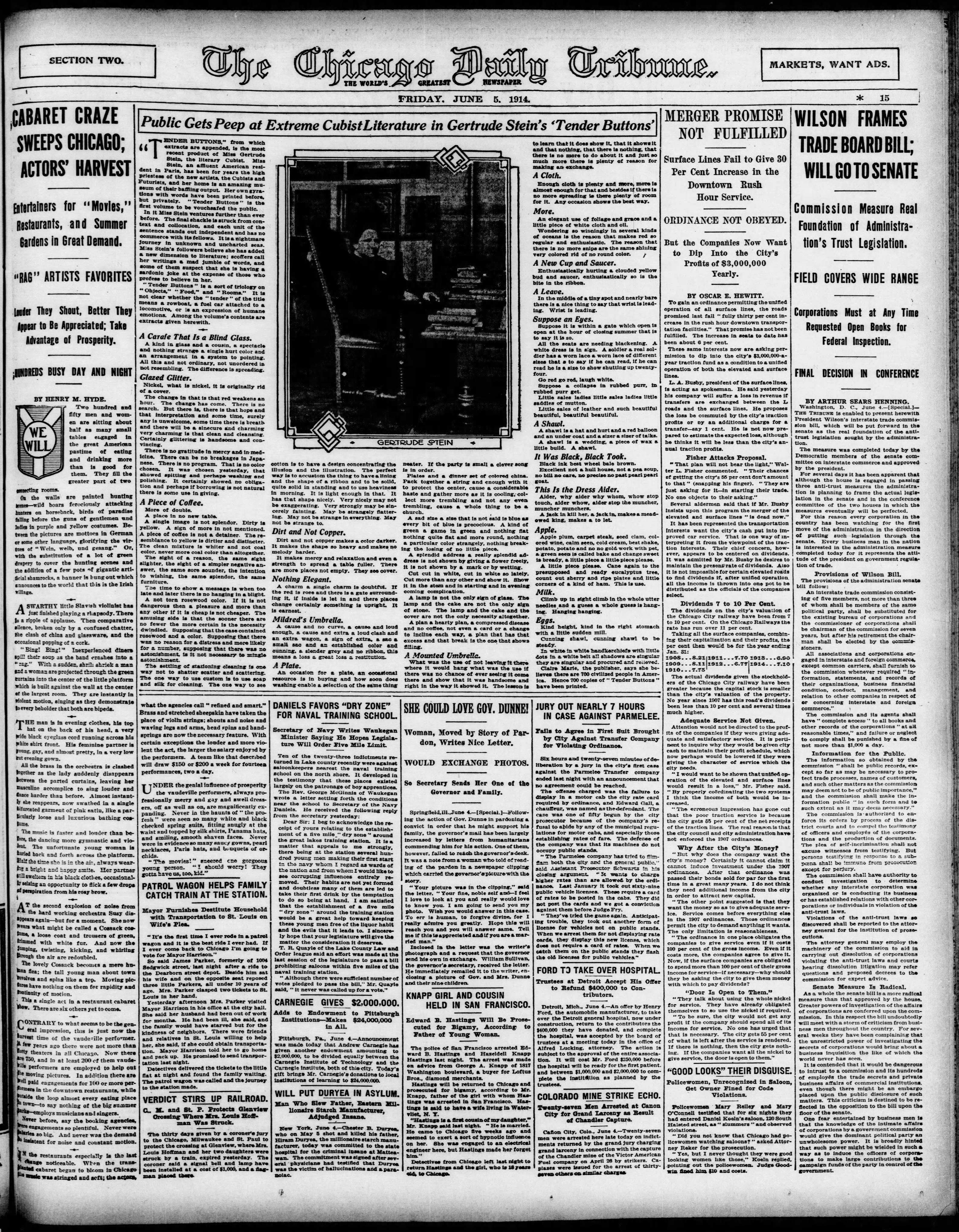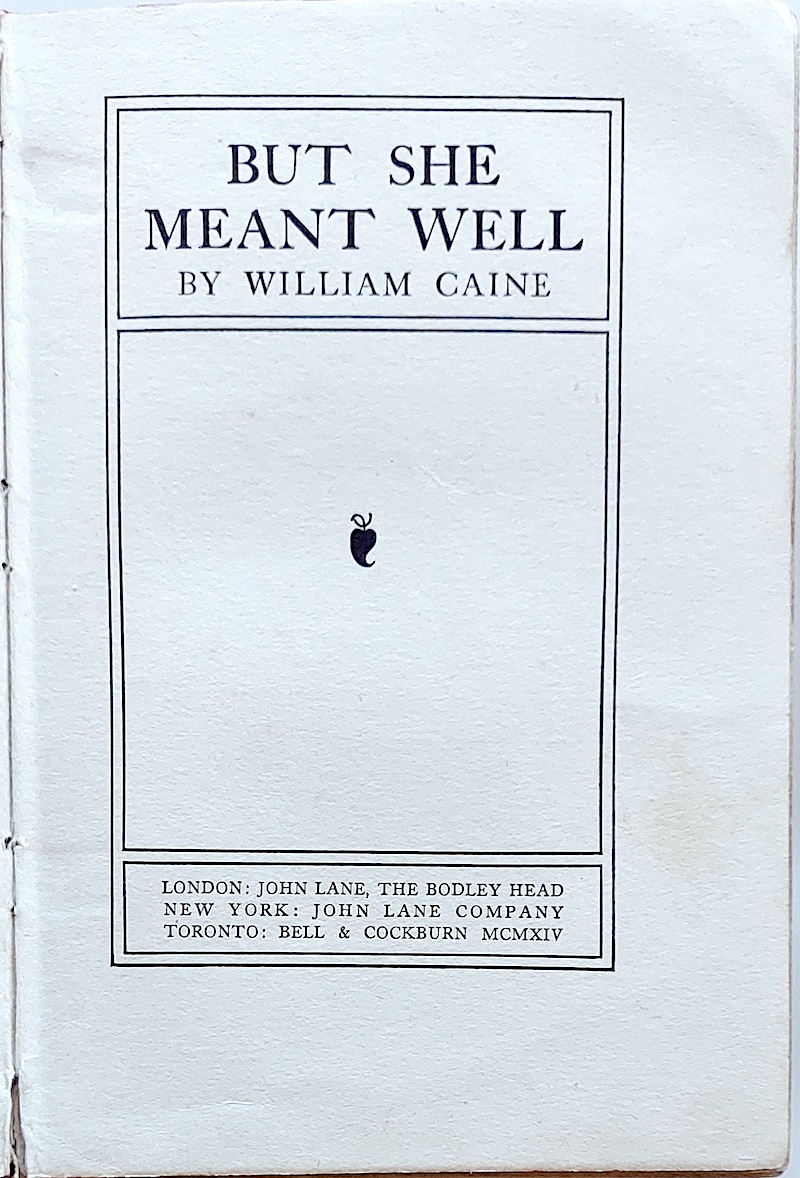
Scituate, June 25 — Mr C. W. Barron, a resident of the adjoining town of Cohasset, lost five valuable cows this week, from poison, which he attributed to their feeding in the fields which had been sprayed by the moth department of this town.If Caine had indeed still been able, in late June, to add material before the “dead line” to a book that was to come out in mid-October, I like to think that he transformed the above newspaper report of a passive bovine tragedy into the active — shall I say kinetic? — farce of chapter XI of But She Meant Well:Mr Barron’s cows were pastured in fields on the border line between the towns and on the Scituate side of the line the trees and foliage had been sprayed in the fight against the brown-tail and gypsy moth.
Warning signs of the danger of feeding on the premises had been put up, but nearly a dozen of Mr. Barron’s cows crossed the “dead line.” Five valuable animals have already died, and several others are in a precarious condition. One cow is reported to have cost its owner over $1000 (“Five Valuable Cows Dead; Mr C. W. Barron of Scituate Thinks Animals Were Poisoned by Feeding in the Fields That Had Been Sprayed,” The Boston Globe, Thursday, June 25, 1914, p. 13)
Six of Clarence W. Barron’s valuable cows are dead at Scituate, and three others are dying as a result of being poisoned with arsenate of lead which had been sprayed by moth workers in a pasture near the Cohasset line. None of the cattle were of Mr. Baron’s [sic] famous milking herd, but they were of great value and would have begun giving milk next month. The producers of the noted “100 percent certified milk” are kept at Oaks Grove Farm, Cohasset. The trees had not been sprayed when the cows were first put out to pasture, and when the moth men came they were warned by neighbors that cows were there; but it is said they persisted in crossing the fields and railroad tracks and going into it. The Scituate selectmen are planning to call a special town meeting to make adjustment with Mr Barron for his loss (“Barron Loses Valuable Cows; Herd of Cattle Killed by Eating Grass Sprayed with Moth Poison,” Boston Evening Transcript, Friday, June 26, 1914, p. 13; see also the advertisement for “Corona Dry” arsenate of lead, Boston Evening Transcript, Thursday, June 25, 1914, p. 12).
The carriage-drive to Henry Sterne’s house ran between two large meadows. In one of these lived Henry Sterne’s two horses; in the other several cows spent their days. These cows belonged to the farmer who lived a little way along the road to the station. Every evening, about six, Basil, a boy, came to let them out of their meadow and to drive them back to the farm, there to be milked. Of this ceremony Hannah was always an interested spectator; she used to hang about near the gate for a long time every evening, so frightened was she of missing the exit of the cows. You could not lure her away. […]This particular Monday evening, however, five-year-old Hannah, impatient for the cows (which have started bellowing) to come out, thinks that Basil is running late. And soThe gate through which these cows came out of their meadow was at the end of the drive which was nearest to the house. Close beside it was the gate of that little yard which I have mentioned, the yard where the water-butt was and where the kitchen door and the coal-shed and the room with the washing-copper were. At the other side of this yard, as I think you know (but I want you to be sure of it), was a second gate which led directly into the garden.
About half past five, the cows, eager to be milked, all used to come and stand just inside the gate of their field, waiting for Basil’s arrival; so while Hannah hung about, doing the same thing, she had a very good view of them.
They numbered five and Hannah knew all their names; and they were — Daisy, a white cow; Primrose, a brown cow; Queenie, a white cow with brown spots; Tizzie, a white cow with brown marks; and Coalie, a black cow. Hannah used to stand by the gate and address them by name and hold out to them little pieces of grass of which they generally took no notice. The hour between five and six was the one time of day during which Hannah’s mother had learned to feel quite happy. She knew just where Hannah was and what the little girl was doing. At this time Mrs. Neighbour could read the newspaper.
When Basil arrived he always used first to shut the gate of the yard carefully and then he used to open the cows’ gate wide. Hannah used to place herself behind it in order to be quite safe and then out the sweetly-scented cows used to come, nodding their heads and sometimes bellowing for the pleasure at the prospect of being milked so soon. They always turned off to the right down the drive. Then Basil used to shut their gate and go off behind them and Hannah would stay behind and admire the courage and cleverness of Basil, who drove great cows whithersoever he would.
Then she would go into the kitchen and tell her mother all about it and her mother would put down the newspaper with a little sigh.
On the Monday evening, then, Hannah stood by the cows’ gate waiting for the arrival of Basil. The weather was fine, warm and still. Hannah could hear in the garden the voices of the people who sat in the verandah which ran along the back of the house. These people were Mr. and Mrs. Sterne, Miss Beatrice, Mrs. Rankin, Mr. Hubert Rankin and the Rector. The last three had come to tea, which, in compliment to the warmth of the afternoon, had been served on the verandah (pp. 182–184).
She had an idea.“The pride and glory of th[e] garden” of this country house which Reginald Sterne and family have borrowed for two weeks from his brother Henry, “was its lawn of old, rich, velvety turf on which a century and a half of care had been expended” (p. 187), turf which Henry Sterne and his wife “were, indeed, given a little to boasting about” (p. 188):Why shouldn’t she let the cows out and send them down the drive to meet Basil? This would not only save Basil trouble (a thing which, since she was fond of Basil, she would be very glad to do) but would also remove these noisy cows from the vicinity of the tea-party which they must be so sadly interrupting. It would also please the cows to be let out quickly.
No thought of self tainted the pure purpose of Hannah as she lifted the latch of the gate and slowly swung it open.
The cows, delighted with Hannah, lowered their heads and stepped daintily through the gate. Hannah, flattened and secure behind the gate, thrilled with the realisation of her own daring, helpfulness, and obedience to the wishes of Miss Beatrice. Confidently she waited for the cows to go down the drive — to the right.
To her surprise Queenie, the first cow to emerge, turned to the left through the yard gate, which Hannah had not thought of closing, and entered the yard. Tizzie followed her. By the time Daisy and Primrose had followed their friends, Coalie was out of the meadow and Queenie was three of her own lengths inside the garden.
Far down the drive there came the howl of an excited boy. The cows, hearing this and knowing that Basil was coming with his stick, quickened their pace (pp. 186–187).
Many friends of theirs who had never been to their country house knew that the Henry Sternes owned a wonderfully fine lawn. It is not surprising, then, that Reginald Sterne and Lilian, his wife, and Beatrice, his sister-in-law, were well aware not only of the lawn’s quality but also of the high value which the Henry Sternes put upon it.Of course, the skeptical will say that Caine’s kinetic farce and the bovine tragedy at Scituate are too dissimilar even to be considered coincidence, and that it’s merely my own wishful thinking that can even imagine that the fictional episode may have been a real-life account, grossly transformed.Indeed, just as Hannah had opened the gate, Reginald had been expressing to Mrs. Rankin his admiration of the lawn, for Mrs. Rankin had just expressed her admiration of it to him. A water-wagtail hopping thereon had attracted their attention to the grass.
“It is,” Reginald was saying as Queenie entered the yard, “the pride of Henry’s soul. It is in a sense the pride of the whole family, for to be related to a man who owns the best lawn in this county (even if it is only he who says so) confers a certain lustre — High Heavens! a cow!”
“I beg your pardon,” said Mrs. Rankin, as she turned to see what he was glaring at so strangely.
“Two cows!” screamed Mrs. Sterne.
“Three!” said Beatrice, as she rose quickly out of her chair and grasped a croquet mallet which leaned against the wall near her.
“Four, by the Pope!” said Hubert, who was already out of his chair and running.
“Stop them!” shouted the Rector. “There are five!” He too got out of his chair, but slowly, for he was fat with good living and having nothing to do. Yet he was accustomed, by reason of his office, to taking the lead and issuing commands. That is why, with such presence of mind, he told the others to stop the cows.
Mrs. Rankin put on her spectacles. Unsuited, by her age and dignity, for an active share in that which must follow, she saw no reason to miss anything that was to be seen.
Hubert ran towards the cows, howling authoritatively.
The cows, mindful only of Basil and his stick in their rear, were not much affected by this unknown, unarmed person who strove to drive them backwards. They had been naughty, and they knew it. Now let them have a run for their money.
They kicked up their heels and scattered. Queenie bolted down a side path and disappeared in the shrubberies. Tizzie, Daisy, Primrose and Coalie took to the grass. Behind their hooves the turf of centuries rose, as it were in a mist.
Reginald Sterne began to run and shout. He uttered some dreadful words which Mrs. Rankin hoped the Rector did not distinctly hear and which the Rector hoped the three ladies would not understand.
Great pits appeared in the lawn where the four cows had been — four long lines of them, diagonally traced. Mrs. Sterne began to weep and to say that Henry and Charlotte would never forgive them.
Daisy and Primrose, their devastation done, plunged in among the ornamental bushes beyond the lawn and began to eat the young shoots.
Coalie, carrying on furiously, fell into the water-garden and remained with her chin on the stone edge, shrieking for help.
Basil added himself to the confusion and with oaths, shocking in a boy of his age, rushed all over the garden, striking athwart and alongst at every cow’s rump that he could reach and hurling stones in all direction. Basil had entirely lost his head.
The Rector ran about telling everybody what to do and calling out “Shoo!” at the cows and flapping his hat at them.
Wherever you looked there was some one waving his arms and shouting or there were the horns of a cow and its wildly rolling eye passing among the tender leaf of the ornamental bushes. The air was full of the strong lowing of cattle, flying stones, the crashing of shrubs and the cries of excited people.
Mrs. Neighbour, Miss Hawkey and Hannah, white with emotion, stood in the gate of the yard. They looked as if they were resolved that no cow should leave the garden except over their corpses, but in reality not one of them was aware that she blocked the only exit for those disastrous cattle-beasts. They wanted only to see what was happening. Respect to the people of higher social station than themselves kept them from venturing further into the garden (pp. 188–191).
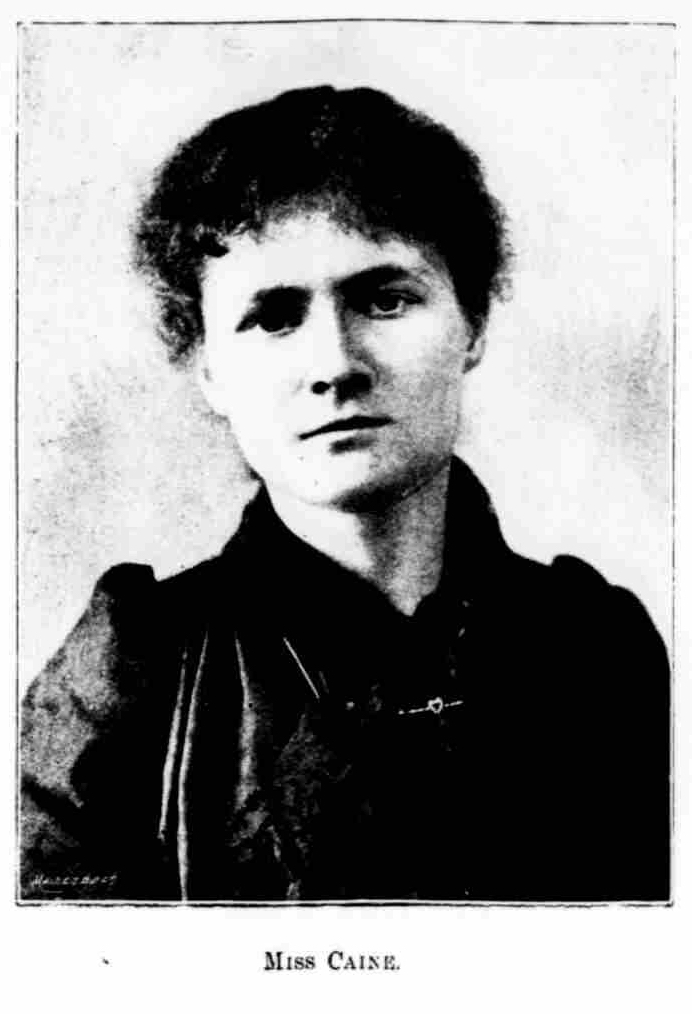
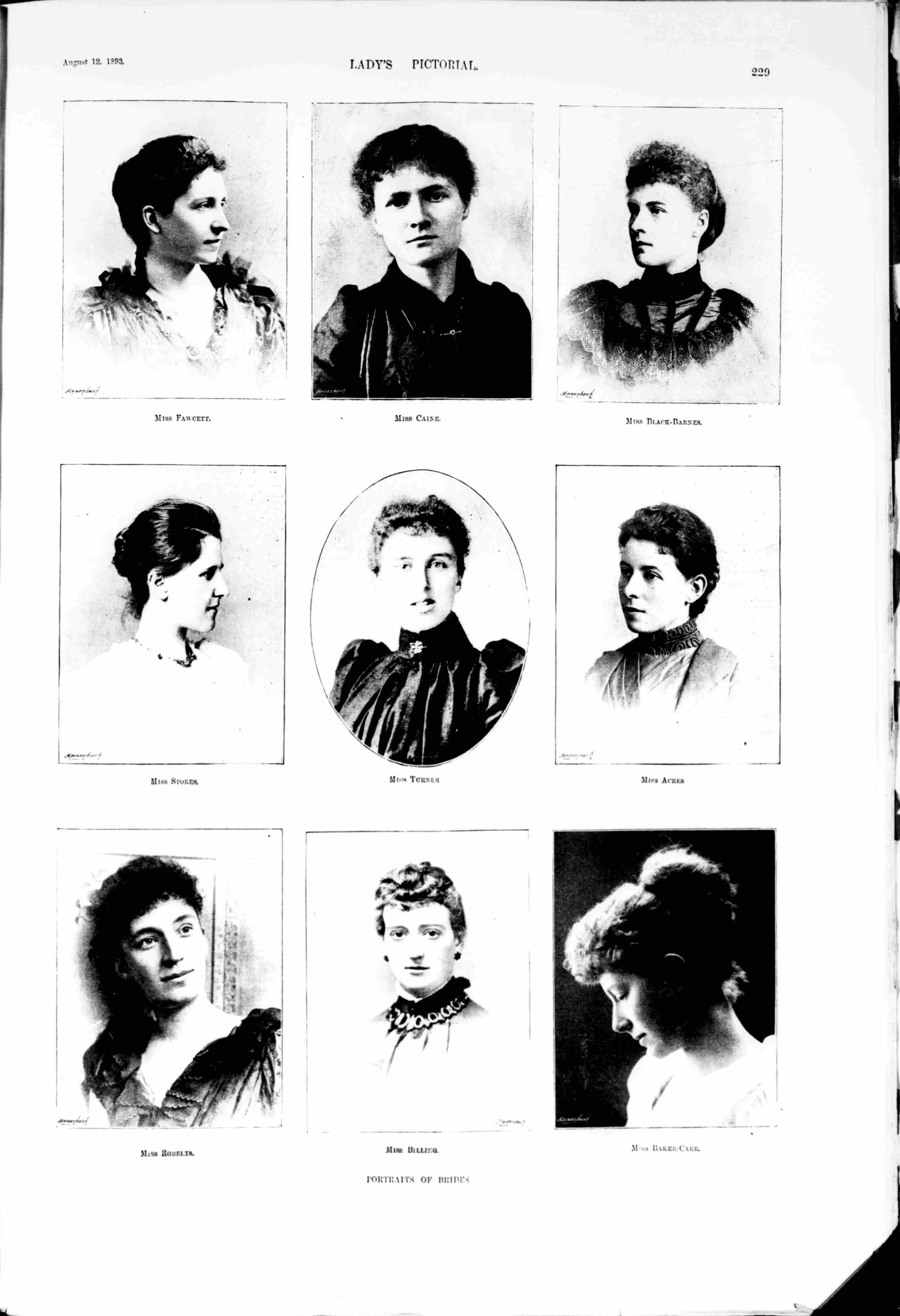
Hannah Rushton Caine, around the time of her marriage to John Herbert Roberts. Reproduced from “Portraits of Brides,” Lady’s Pictorial, August 12, 1893, p. 229.
The marriage of Mr. J. Herbert Roberts, M.P. for West Denbighshire, and son of Mr. John Roberts, Bryngwenallt, Abergele, late member for the Flint Boroughs, to Miss Hannah Rushton Caine, eldest daughter of Mr. W. S. Caine, M.P., of 33, North Side, Clapham-common, took place on Tuesday, August 1st, at Clapham Congregational Church. Mr. Trevor Roberts (brother of the bridegroom) acted as best man. The bridesmaids were Miss Dorothea Caine and Miss Ruth Caine (sisters of the bride), Miss Roberts, Miss Ella Roberts, Miss Meinwen Roberts (sisters of the bridegroom), and Miss Hilda Turner (cousin of the bride). They wore dresses of pale green crépon trimmed with lace and ribbon, and Tuscan hats with yellow roses and lace. The bridegroom’s gift to the bridesmaids were chrysoprase and diamond brooches. The bride wore a handsome costume of ivory broché trimmed with Limerick lace, and Limerick lace veil, and carried a bouquet of white roses. Jewels: diamonds and rubies (the gifts of the bridegroom). The bride was given away by her father, Mr. W. S. Caine, M.P. The officiating ministers were the Rev. Alexander Maclaren, D.D., of Manchester, assisted by the Rev. Principal Edwards, D.D., and the Rev. D. A. Taylor, of Comber, co. Down (uncle of the bride). The wedding cake was supplied by Messrs. W. and G. Buszard, of Oxford-street, W. (“Weddings; Roberts—Caine,” Lady’s Pictorial, August 12, 1893, p. 226; see also the references in § 4, n. 1 and n. 8.).
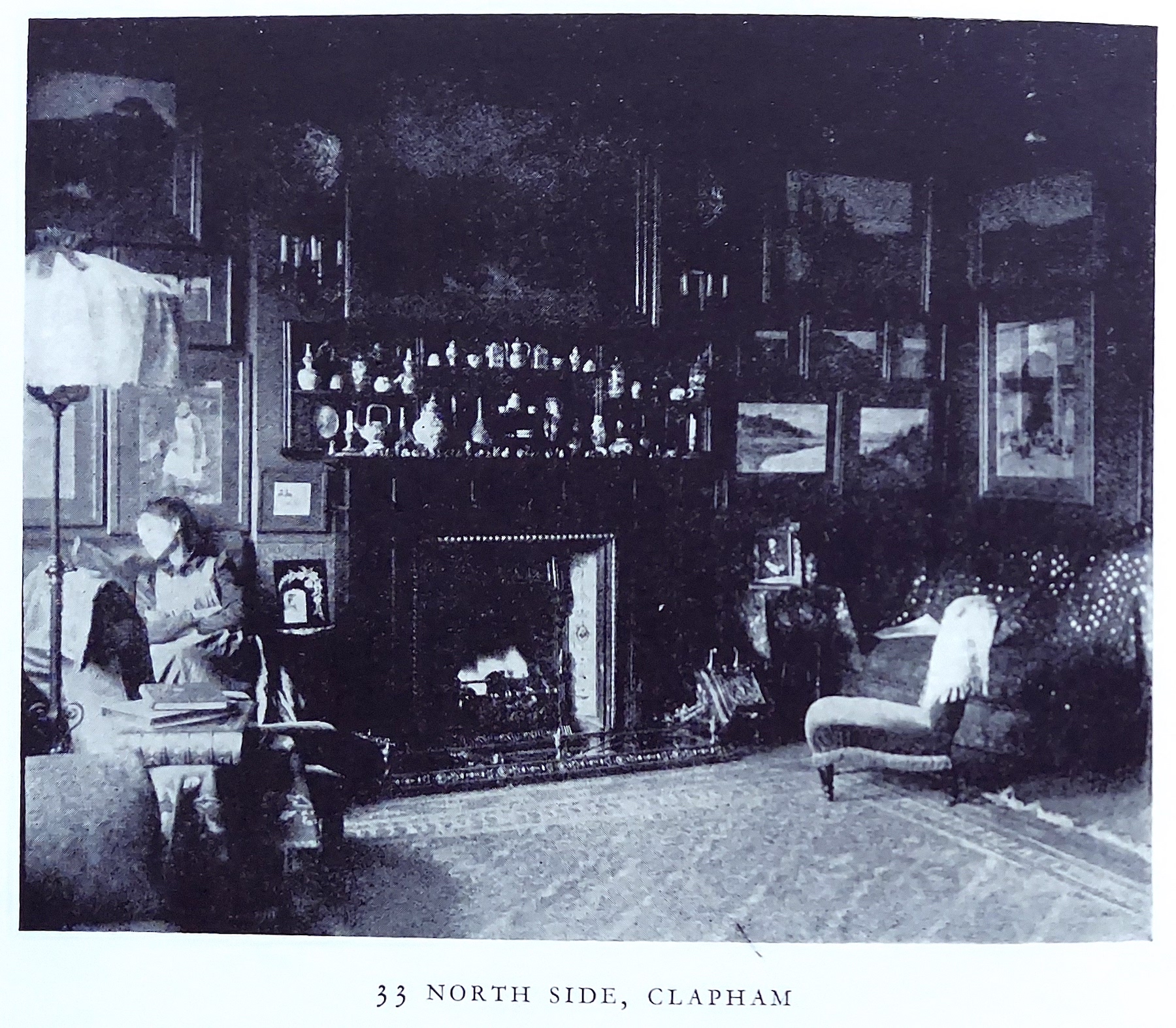
Hannah Rushton Caine as a child, dressed in a pinafore and sitting in an armchair in the drawing room of 33 North Side, Clapham Common, beneath a painting which seems to show her dressed in the same pinafore. Reproduced from Roberts (n.d.: 6). “When Father was elected member for Scarborough, he took a house on Clapham Common in order to be near the House of Commons, and in that house H.R.C. remained until her marriage” (Colman n.d.: 10).
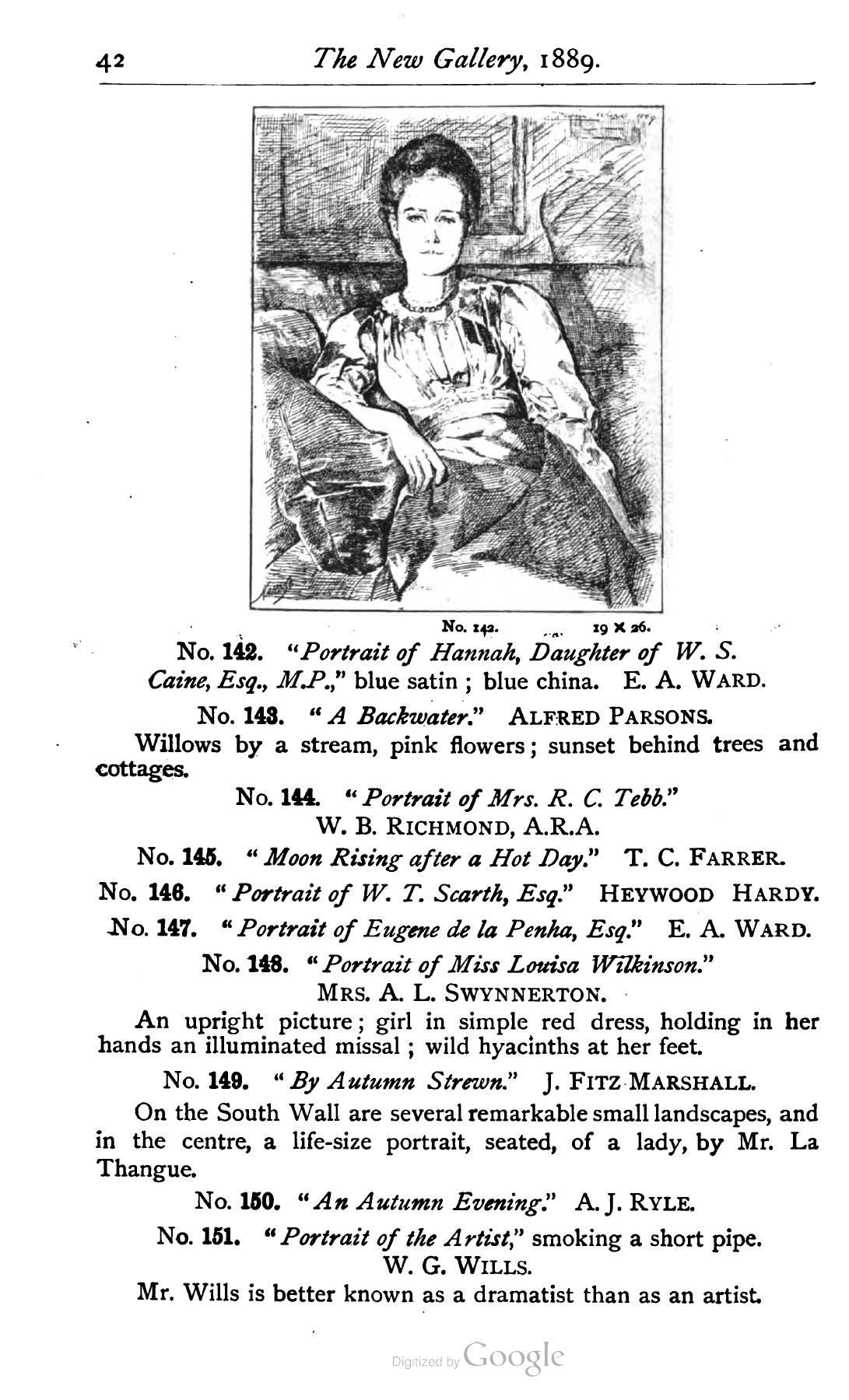
Mr. Ward has broken out in a new place this year, with a series of small highly-worked portraits of cabinet size, full of incidental colour, and aiming at positive beauty of surface. One would hazard the conjecture that Mr. Ward had been fired by a visit to the Holbeins at Bâle. Of the five examples of his portraiture, there is no doubt that the most pleasing is the “Miss Hannah Caine” (142), a harmony of brilliant shades of blue, which is as delicate as it is novel and sumptuous. The charm of this little picture is not ruined, but it is certainly marred, by certain technical imperfections; for instance, the blue hawthorn pot in the background is supported by nothing at all (“The New Gallery,” The Saturday Review, May 25, 1889, p. 639).
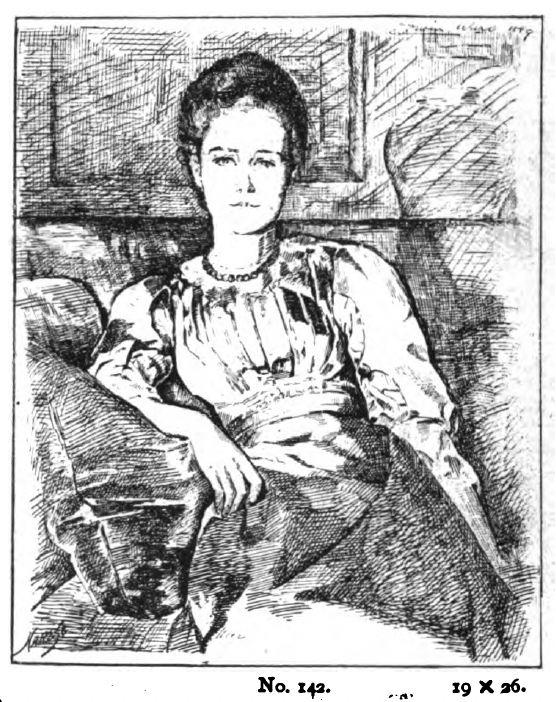
“Portrait of Hannah, Daughter of W. S. Caine, Esq., M.P., blue satin; blue china. E. A. Ward.” Reproduced from Blackburn (1889: 42).
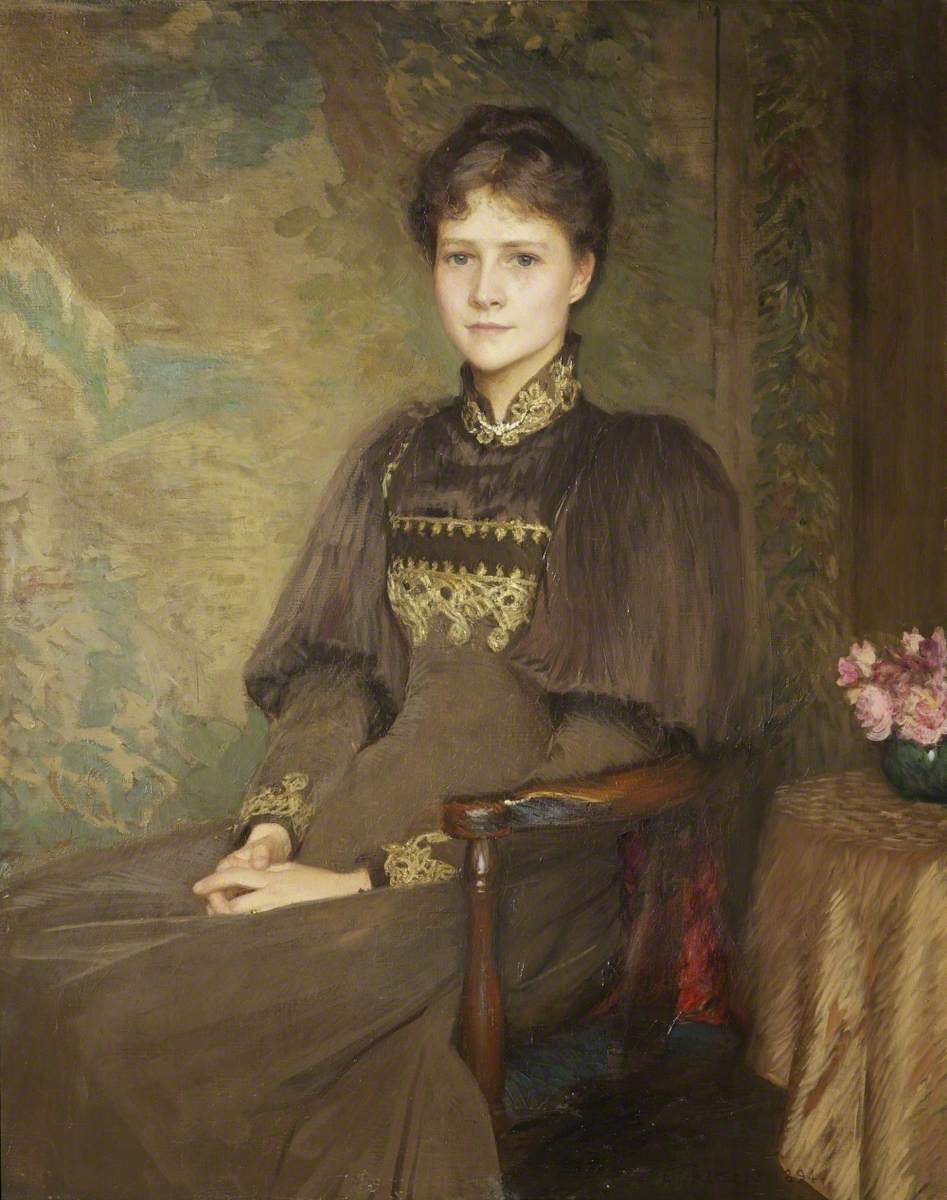
George Clausen (1894) Mrs. Herbert Roberts. Oil on canvas, 107 x 84 cm, Walker Art Gallery, Liverpool, WAG10679.
In the first room you’ll find a charming portrait by Mr. George Clausen — 57, Mrs. Herbert Roberts. Strange, but no one would know it was a Clausen. It looks more like a Fantin Latour than anything else. So much for the experts who pretend they can distinguish with unerring accuracy between the slightest works of the old masters. No expert would know this picture was a Clausen. But that by the way. A pretty little woman, too, is Mrs. Herbert Roberts, a calm, demure little person dressed in a quiet mouse-coloured dress; her hands are in her lap, a pale tapestry is behind her, and a few red flowers are in a bowl on the table beside her. We seem to know Mrs. Herbert Roberts; she looks like one of our friends, her pretty, open face, her fair, wavy hair, as portrayed by Mr. Clausen, are unforgetable [sic]. I like the intimacy of this portrait; we seem to see into the very heart of her life; into her very mind, and so it charms us, as the large satin draperies of Mr. Sargent and Mr. Shannon never have done.... Manet would have stopped to look at this portrait, and it would not surprise me if this portrait started a fashion for intimate portraiture. For surely the dressmaker-portraits have about run their course (“The Royal Academy,” The Speaker, May 11, 1895, pp. 515–516).
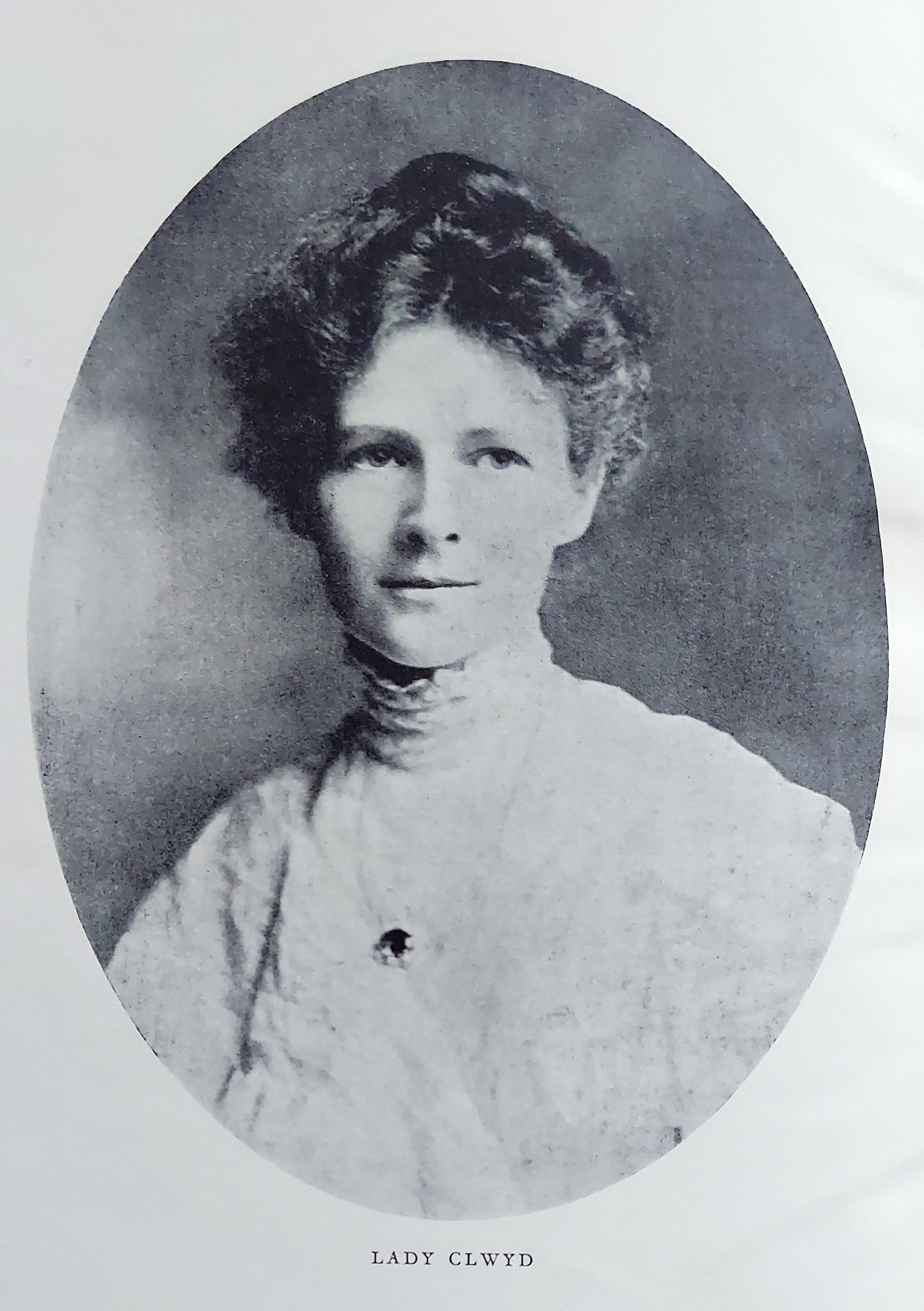
Hannah Rushton Roberts née Caine, later Lady Clwyd. Reproduced from Roberts (n.d.: frontispiece).
I first saw her, as a child of twelve, on a coach-and-four expedition from London to Dorking, arranged by her parents; and that vision remains ever bright and clear. Our wedding took place on the 1st of August, 1893. What happened then cannot be told, but it opened a vista of more than half a century of married life of unbroken joy. I will only call to remembrance the gladness that filled the air, the unforgettable kindness of the bride’s parents, the showers of affection and good-will which came from family and friends, and the presence at the service of two great figures in the religious life of England and Wales — Dr. Alexander McLaren and Dr. Thomas Charles Edwards (Roberts n.d.: 15).Roberts would have been eighteen or nineteen at the time, while Caine would have been around eight. A decade or so later, the newly weds’ journey to their new home of Tanyrallt on the Roberts family property of Bryngwenallt involved a carriage-ride from Abergele train station. Here’s how Roberts, who became the first Baron Clwyd in May 1919, recalled it:
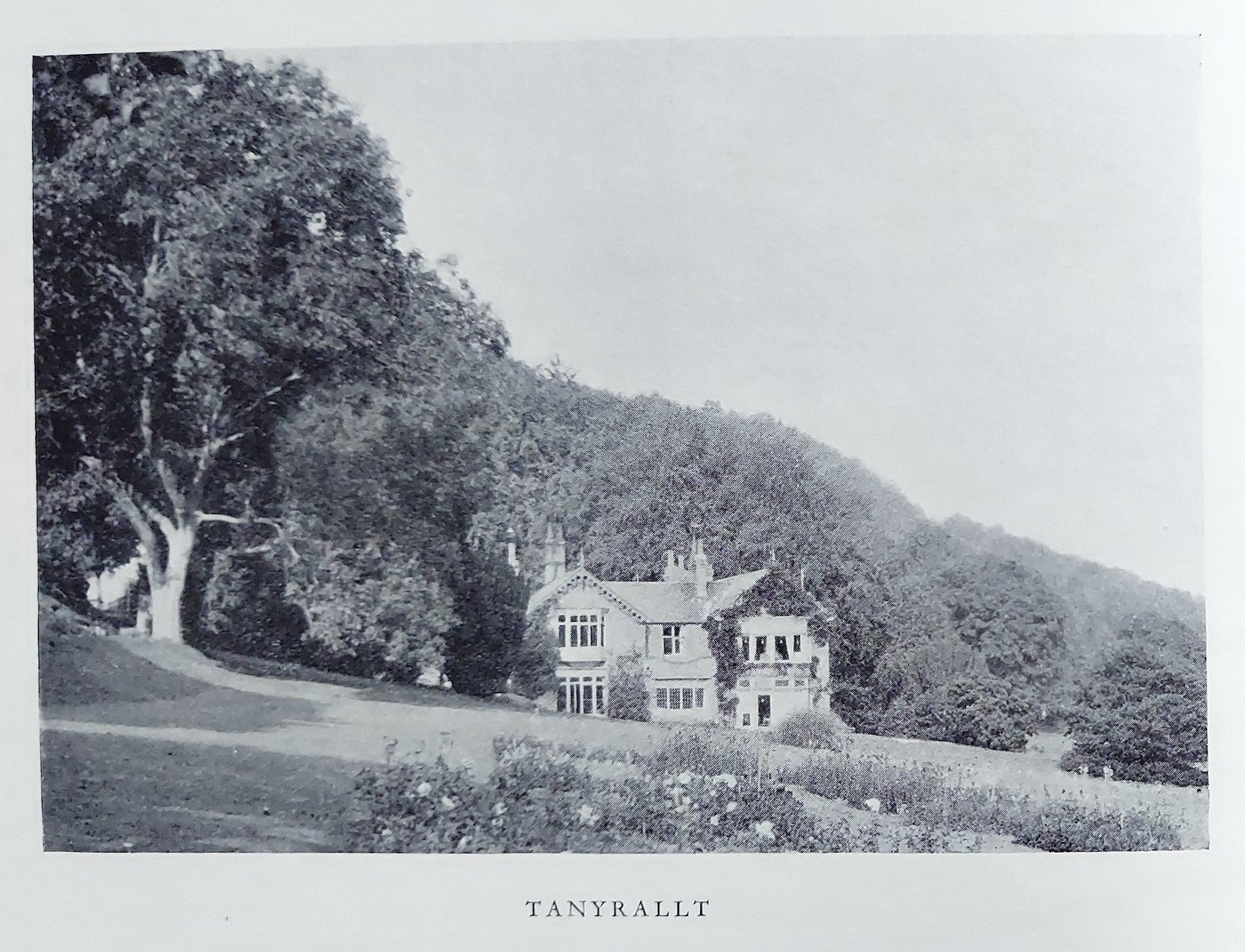
Tanyrallt. Reproduced from Roberts (n.d.: 16).
I well remember the scene upon our arrival from our honeymoon, the tumultuous reception that awaited us and the dragging of the carriage from the station to Tanyrallt — her new home in Wales — the addresses on the doorstep and, to crown all, her charming speech of thanks for her warm welcome (Roberts n.d.: 17).And here’s how a local newspaper described “the tumultuous reception […] and the dragging of the carriage” at the time:
On Tuesday Mr. Roberts returned home with his bride to Tanrallt, their future home, once the residence of Mr. David Roberts, Mr. Roberts’s grandfather.But She Meant Well opens on a railway platform (of which see my discussion in § 4) and a journey by train, followed in chapter II by a short procession, not by carriage or coach-and-four, but by waggonette and luggage cart. The latter, pulled by an old, fat, slow pony named Tommy who is also slightly naughty (“because he was cross at having been taken that afternoon out of the meadow, where he had been very comfortable, and made to work” [p. 33]), is driven by Miss Beatrice, with Hannah by her side because she had had a tantrum on arrival at the station because “she was disappointed to see none of the cows and chickens which her mother had promised her” (p. 28). The luggage cart soon falls far behind the waggonette, and the expedition turns perilous:The town was gaily decorated with flags and mottoes “from end to end.” It is unnecessary to describe these in detail, as almost every house displayed its little flag, “be it ever so humble,” thus testifying to the deep and universal regard and esteem in which the Bryngwenallt family is held in the town and neighbourhood.
The members of the committee went down to meet the 6.5 p.m. train in a number of carriages. Here there was an immense crowd waiting the arrival of the happy pair. On entering their carriage they were greeted with ringing cheers, and the procession was then formed. In the first carriage were the chairman, vice-chairman, and secretary of the committee, followed by the Llanddulas Brass Band, playing “Home, sweet home,” and other appropriate tunes. Then came the carriage containing the happy couple, followed by other carriages occupied by the committee and other friends. The procession went along Water-street, Market-street (as far as the Bee Hotel), then up Chapel-street, and round Bryngwenallt to Tanrallt. On the drive at Tanrallt there was a very pretty triumphal arch of evergreens, with the mottoes “Welcome home,” and “Long life and happiness.” On arriving the happy couple were met by Mr. John Roberts, the bridegroom’s father, who affectionately kissed the bride, and shook hands with Mr. Herbert Roberts (“The Return Home of Mr. and Mrs. Herbert Roberts,” Abergele Visitor and Colwyn Bay Gazette, August 26, 1893, p. 2).
They drove on and five times Miss Beatrice showed Hannah some cows and three times some chickens. Hannah thought that the country was a very strange place. She asked Miss Beatrice where all the houses were; also why there were no ’busses, and if the park man wouldn’t have the boy whom she had just seen picking flowers. Miss Beatrice answered all these questions and Hannah went on falling more and more deeply in love with Miss Beatrice.That business of knocking a stone from a pony’s hoof reminds me of an incident involving a stone in the hoof of an another equid pulling a cart — not a pony but a donkey — from the book Caine published a year before But She Meant Well, The New Foresters:All at once they stopped and Miss Beatrice put the rug aside and got out of the cart. “What’s the matter?” said Hannah. “What’jer going away for?”
“Don’t worry, Hannah,” said Miss Beatrice. “Tommy’s got a stone in his hoof.”
“What’s his hoof?” asked Hannah, but Miss Beatrice didn’t hear her because she was already by the pony’s head, stooping down, and was telling him to come one, old stupid, and Hannah could see that she had hold of one of the pony’s legs.
“Bother!” said Miss Beatrice and looked about her.
“What’jer want?” asked Hannah.
“A stone,” said Miss Beatrice, “to knock this thing out with.”
All at once the pony shook his head and moved a little. “Quiet!” said Miss Beatrice. “Naughty!” and he was quiet again. Miss Beatrice saw a stone of the size she wanted lying on the road a little way off and went to get it, turning her back to Hannah.
Miss Beatrice had said that Tommy was naughty. Miss Beatrice hadn’t got the whip to whack him with. Hannah would help Miss Beatrice with whom she was so much in love.
She took the whip out of its socket and, grasping it firmly with both hands, brought it down on Tommy’s back as hard as she could.
Tommy, who expected nothing in the world less, gave a violent start and began to run away. Miss Beatrice uttered a cry and sprang forward, but she was too late. Her fingers just touched a wheel. It is almost certain that Hannah would have been killed and that the cart would have been ruined (for the road was a very twisty one and there were many stone walls along it) had not a young man come walking round the next corner. Of course the appearance of this young man was not in itself enough to avert the calamities which I have indicated as being probable, but he happened to be a very strong, active and quick-witted young man, the very best kind of young man, indeed, who could possibly have come round the corner. So the cart and Hannah were saved from destruction at no greater cost than a little mud on the hat of the young man, which got knocked off in his struggle with Tommy, and a severe poke in the shoulder of the young man from a shaft of the cart.
Hannah shrieked with delight and urged him to do it again. She would have gone on like that gladly till bed-time. If only she hadn’t dropped the whip! She turned and called to Miss Beatrice to come and bring the whip.
Miss Beatrice arrived but she did not bring the whip. She had run furiously for quite fifty yards and was out of breath with alarm and violent exercise. She began to thank the young man. He said he was glad that he had been able to turn up and would she like him to stand by any longer? He offered to lead the pony if she didn’t think she coud get home quite safely. Miss Beatrice said that she would be able to manage quite well, thank you, now, and she picked up his hat from the road and gave it to him and said that she didn’t know what to say because thanks were of no use in such a case. The young man said that he had done nothing that anybody else couldn’t have done, and was she quite sure that she wouldn’t like him to lead the beast a little way? Miss Beatrice replied that she couldn’t think of troubling him and he said that it would be a pleasure and she said that that was very polite, but that it really wasn’t necessary, but that if he’d knock a stone out of the pony’s hoof she would be everlastingly grateful to him, because that was a job that she confessed she wasn’t tremendously good at herself. So he said, “Certainly,” and did what she wanted while she held Tommy’s head. Then he ran and fetched the whip and then he held Tommy’s head while Beatrice climbed up again beside Hannah. Then she leaned out of the cart and held out her hand and thanked him again and he took her hand and shook it and said that it was nothing at all and that he would do it a hundred times a day with the utmost pleasure and laughed and she said that she hoped it wouldn’t come to that and laughed and drove on.
Hannah looked back and waved her hand to the young man and called out “Ta ta” as she had been taught to do and told Miss Beatrice to do the same; but Miss Beatrice only drove on. For some little time there was no corner and Hannah continued to wave. The young man waved once and then stood quite still, looking after Hannah with a serious face. At last they reached a corner, just as Hannah was going to ask Miss Beatrice if they would be there soon and had forgotten all about the young man, and Miss Beatrice, instead of answering, turned and waved her whip to the young man and Hannah, turning too, saw him break out into smiles and large gesticulations. He looked so funny that she burst out laughing and asked Miss Beatrice if he wasn’t a funny man, but Miss Beatrice didn’t answer and Hannah, looking up, saw that she was crying. So she asked Miss Beatrice why (pp. 34–37).
We had now drifted back to Mrs. Judson’s house, and my wife at this point, with a stifled cry, drew our attention to the fact that Jack had devoured several inches of Mrs. Judson’s newly painted wooden railings.Beyond the thematic similarities, comparing the “stone-in-hoof” passages from The New Foresters and But She Meant Well also reveals an aspect of Caine’s transformative method. In this case, the earlier book’s indignant, repetitive, yet skillful rustic with “a mind superior to the minds of his class” gets a sort of heroic class-upgrade into the later book’s “very best kind of young man, indeed, who could possibly have come round the corner,” a young man who will turn out to be named Hubert George Rankin. I can only speculate as to what Caine’s eldest sister might have felt to be the namesake of her brother’s youngest protagonist, Hannah Ethel Branson Neighbour, a protagonist who is the daughter of a cook and who remains merrily oblivious of the peril she had been in as well as her role as the accidental catalyst of a budding romance that seems to heroically satirize and almost monstrously yet subtly distort the cheerful circumstances surrounding the prelude and introduction of her, Hannah Rushton Caine’s, own love story and life as the wife of a Welsh politician named John Herbert Roberts. (I concomitantly contemplate the five views of cows which foreshadow the five cows that will trample the garden in ch. XI, recall the “Five Valuable Cows Dead” of the Boston Globe report, rhyme with Hannah’s age, and echo the five examples of E. A. Ward’s portraiture in the 1889 New Gallery exhibition; furthermore, five views of cows plus three of chickens equals eight bucolic views in total, the age of Caine when he was on [if he was on] that “coach-and-four expedition from London to Dorking.”) Likewise, I can only speculate as to what Caine’s dedicatees might have felt when they read (if they read) that the owner of the country house where But She Meant Well takes place was also a Member of Parliament:While we were saying what had to be said a large man suddenly appeared among us. He had a fiery face and a watery eye.
He said, “That donkey’s got a stone in its foot.”
“Indeed?” I said, mastering my passionate desire to strike this giant. “Which one is it?”
He told me. “Either the near hind or the off hind, I forget which.”
Assuming my most horsy manner, I stooped down and picked up one of Jack’s hind feet.
The man snorted and said that he had said the other one.
Less horsily I made round the cart and attempted to pick up Jack’s other hind foot. He kicked out violently and my hand remained void of foot. After an attempt or two I secured it and there was a very devilish flat stone wedged into the shoe.
My blood ran cold. How long had it been there? I asked myself.
The man, answering my thought, said that very like that stone had been in that poor donkey’s foot for a week or more. This was not the case, for the day before I had practised that art which I had recently acquired from Miss Ellen, the art of cleaning out a donkey’s foot with a little stick. But I had not done it that morning. In the grief and excitement of departure from Beaulieu I had forgotten to do this thing. For donkey-driving, like everything else worth doing, is not learned in a day and the instincts of the driver had not been acquired in my couple of weeks. But I blame myself.
The man asserted roundly that the stone had been there for a week. He pointed out that it had been there when I arrived with my donkey. The poor animal, he said, was as lame as lame when I drove it past his house. I began to sweat in my gaiters. I was sick and sorry. I had put torture upon Jack, our good comrade of so many happy days. I had not known enough to see that he limped.
The man said that the stone had been in that poor donkey’s foot for a week. He told us of a man — by implication another ignorant fool — who had asked him what could be the matter with his horse to make it go lame for four days. There had been a stone in the horse’s hoof all the time, of course. That was the kind of thing that happened when horses and donkeys got into the wrong hands.
It was evident to me, to all of us, that this person looked upon me as a callous scoundrel who cared nothing if he lamed a hireling donkey or so. I found it impossible to figure in any other light. The women who looked on cast glances of hatred at me.
All this time I was trying to get the stone out of Jack’s hoof with my little penknife. It would have been impossible to do this had I amputated the hoof first. As Jack kept on kicking it was even more difficult.
The man said that obviously the stone had been in that poor donkey’s foot for a week. He said it was a wonder the poor creature hadn’ been lamed for life. He told us about barbarities which had been inflicted upon asses of his acquaintance. He also said that the stone had been there for a week.
By this time more women were present, and the man who had been painting Mrs. Judson’s railings, he was with us. And there were several children, giggling together in the background and telling each other that the stone had been a good week in the poor donkey’s foot.
At last I said, “Well, see what you can do.” I very nearly added, “And be damned to you!” But I wanted Jack relieved.
The man bent down and took hold of Jack’s ankle firmly. Jack lashed out as before. The man uttered a horrible sound, part grunt, part roar. No doubt it was one of those horse-words of which Mr. Borrow tells us. At any rate Jack became like wax in his hands. The fellow demanded a hammer. While Mrs. Judson went in search of one he pointed out the stone to anyone who cared to examine it and said that it had been there for a week. Worn all flat with the shoe, it was. It had been in that poor donkey’s foot for a week. It had, he said, been in that poor donkey’s foot for a week. It was a wonder the beast wasn’ lame for life. He supposed it gone all over the Forest with that stone in its foot, he shouldn’ wonder.
I asked him how long he thought the stone had been in the donkey’s foot. He said that it had been there as much as a week.
The hammer arrived and he knocked the stone carefully out. I will say this much: he knew what he was doing. When the stone fell into the road he picked it up and showed it to us and said that, from the condition of its exterior surface, he deduced that it had surely been a week in that poor donkey’s foot. He then turned it over and told us of the dire things which would have happened to the sensitive frog of the hoof if the stone had been sharp and jagged inside, instead of smooth and flat. He said it had been in the donkey’s foot for a week.
I thanked him sincerely. I did not like to offer this humanitarian any money for what he had done. He pitched the stone away with a snort of contempt. I felt that he had pitched me away, but I was glad to see the stone projected into the obscurity of a gorse bush. He departed, grumbling inarticulately. My wife ran after him and gave him half a crown. I suppose he did not like to offend her by refusing it. His indignation had been so righteous that he must have had a mind superior to the minds of his class. I think the acceptance of that money was a rare piece of delicacy.
I am really obliged to him for what he did.
But the stone had not been there for a week (pp. 185–189).
Mrs. Neighbour was making tidy the dining-room where Mr. and Mrs. Sterne and Miss Beatrice were going to eat and where Mrs. Sterne and Miss Beatrice were going to sit while they were staying in the house. As they had brought only Mrs. Neighbour to attend to them they wished to make as little work for her as possible. So they were not going to use the house’s drawing-room at all — only the dining room and the room which Mr. Sterne’s brother, when he was at home, called his study. Mr. Sterne’s brother, Mr. Henry Sterne, was a Member of Parliament and had an immense deal of work to do, writing to people to say that their suggestions would meet with his most earnest consideration or that his influence was so very slight in that quarter that any action on his part would be useless, but that if ever he saw his way to putting in a word he would surely not forget to do so. Therefore he had a study (p. 43).As for the brother of this MP who had a study:
A fine pauper was lost in Reginald Sterne.Was Caine’s caricature of Reginald Stern based on anyone in particular? For instance, Caine had also read history at university — Oxford rather than Cambridge (Hilliard 1914: 49; Elliott 1934: 206) — and was, like Reginald, “when he wasn’t making poetry or a fuss” (p. 90), fond of fly-fishing, and had provided himself with wealthy progenitors in the form of his grandfather and father, iron merchants, the former bequeathing a legacy of £500,000 in 1877, the latter but £2,501 in 1903 — an amount, however, which did not factor in significant shares in the Hodbarrow Mining Company nor properties such as his residence at 42 Grosvenor Road or his investment in a block of flats in Hampstead where Caine was to reside after c. February 1904. Around that time, Caine had begun writing the libretto for a comic opera entitled The Island of Pharos (for more on which, see § 11). The composer with whom Caine collaborated was Osborne Roberts, one of the brothers of the aforementioned Welsh M.P., John Herbert Roberts. Their grandfather David Roberts, “of humble parentage,” was apprenticed, at age fifteen, to a Liverpool timber merchant, David Hodgson, and when the latter went bankrupt, was able, thanks to a timely bequest, to buy a portion of the stock and establish his own timber business, Messrs. David Roberts and Co. Around 1856, his son John (who went on to become a M.P. as well as the father of John Herbert and Osborne) joined the company and, “in addition to their extensive dealings in timber the firm have been engaged in large transactions in the buying and selling of land for building purposes.” However, although the initial production of The Island of Pharos was an amateur affair for charity, it soon embarked on a professional tour of the provinces before sinking into oblivion. Likewise, by the summer of 1914, both Caine and Osborne Roberts were fairly successful in their respective fields. So did Caine perhaps have in mind an author who seems to have been in all the papers that same summer of 1914; that is, “the literary Cubist” who had also provided herself with a wealthy progenitor and with whom Caine and his wife had dined in Paris about a year before their trip to the US — Gertrude Stein? After all, Caine’s characterization of the “enormous things” produced by an “industrious bard” “conscious of his own responsibility” “with the help of nothing but an Encyclopedia Brittanica, the London Library, a merciless resolve, Roget’s Thesaurus and such brains as Heaven had spared to him,” does seem to rhyme à l’avance with Leo Stein’s description of his sister as “basically stupid” yet whose “massive self-admiration, and, in part, self-assurance, enabled her to build something rather effective on her foundations.” Morevoer, at the time the Caines dined with Stein and Toklas in Paris (for which see § 5), Stein’s output had only appeared in print with the aid of the aforementioned “unless:”Have I said that he was a poet? If not, let me say it now. He was a poet.
The first thing anybody who is going to be a poet must do is to provide himself with a father, grandfather, or other progenitor who made a lot of money. Mr. Sterne had seen to this. Two generations back was old Hezekiah Sterne with his wife’s family recipe for blacking and his own resolve to turn it to account. One generation back was Henry Sterne who made himself into a limited company. To-day there were Henry (the second, the parliamentarian) and Reginald.
But for Hezekiah and Henry he first, these brothers would have adorned quite other professions. I don’t know what the politician would have been doing, but Reginald would have been walking about between the casual wards. This is certain. Unfortunately he was in a position to be a poet and he was one. Who shall say, after this, that a poet is not born but made?
It must not be supposed that Reginald was one of your elegant versifiers, a wealthy trifler with the Muse. Not a bit of it. Seldom has a writer been more conscious of his own responsibility than was this man. A less earnest person might have found a stone of stumbling in the income which he enjoyed, a lure to golf and motoring from the steady prosecution of his art. Not Reginald. In his money he saw little but a stroke of good fortune to English Letters; in his own works he had discovered the reason for old Hezekiah’s energy. He would have thought it wicked not to write all day.
His poems were enormous things. The shortest contained over three thousand lines; the longest seemed to verge upon infinity. He was aware of having so much to say that a lifetime would not give him opportunity for saying it. This thought had no power to stay his hand.
He could not get anybody to publish what he had produced, except at a price — at which all things may be achieved. The magazines returned him or lost him; the book-trade regretted that it could not see its way, unless —. Reginald bowed to necessity; accepted that “unless.” Already his shelves and those of three great libraries supported five volumes of his published epiquettes; and the fellow was only thirty-seven. If it’s power you’re after, you can have the pen and the sword. Give me the purse.
Perhaps somebody may feel an idle wish to know the themes which were chosen for glorification by this industrious bard. There was but one — England, our England. Her story through the ages was what he was engaged in singing and, having read History at Cambridge he was perfectly fitted for the next. He had been doing this thing no for five years and he had already dealt with the Iberians, the Battle of Crecy, the Goidels and the Brythons, the Building of Stonehenge, Brute the Trojan, the Monmouth Rebellion, Taliesin, Simon de Montfort, the First Tinship from Tyre and the Gunpowder Plot. For you are to understand that he did not proceed with his task in strict chronological order. That would have hampered him. No; wherever, through the ages, a subject, germane to the matter in hand, that is to say the glory of the Island Race, happened to fire his imagination, upon that he set to work at once with the help of nothing but an Encyclopedia Brittanica, the London Library, a merciless resolve, Roget’s Thesaurus and such brains as Heaven had spared to him.
The only thing that is to be said in this poet’s favour is that he had plenty of guests to dine with him. The significance of this saying is not hard to grasp, but in case you are in a hurry it means that he had just enough sense not to read his productions aloud after dinner. He worked altogether for posterity, did Reginald.
I have told you that he had come to dwell in his brother’s house because he had had influenza and needed a change of air. The disease struck him down at the the twenty-eighth thousand three hundred and fifty-first line of “Walpole — a Fragment” and for a fortnight the last word, “bluff,” had been waiting for its rhyme, which was to be “enough” (pp. 59–61).
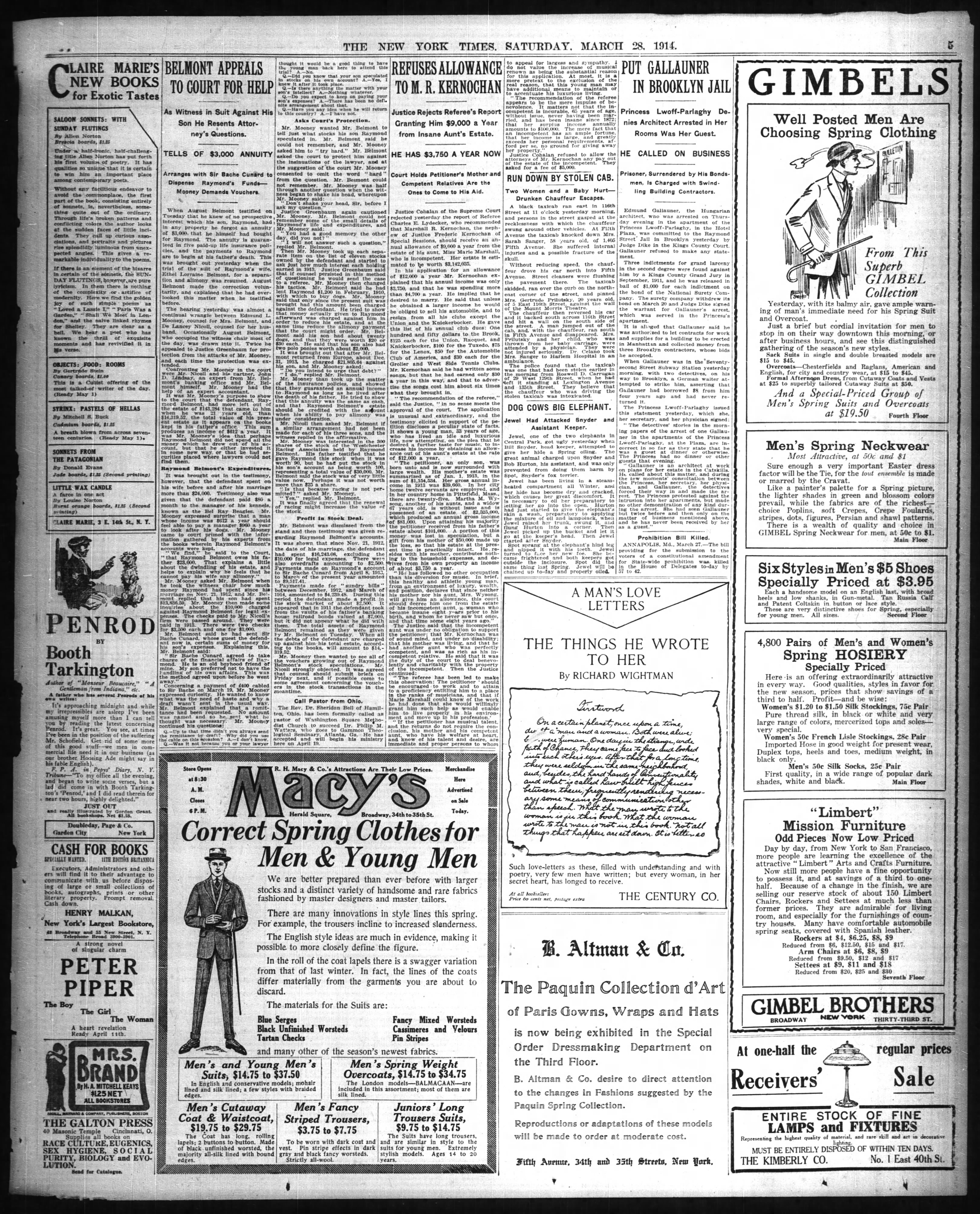
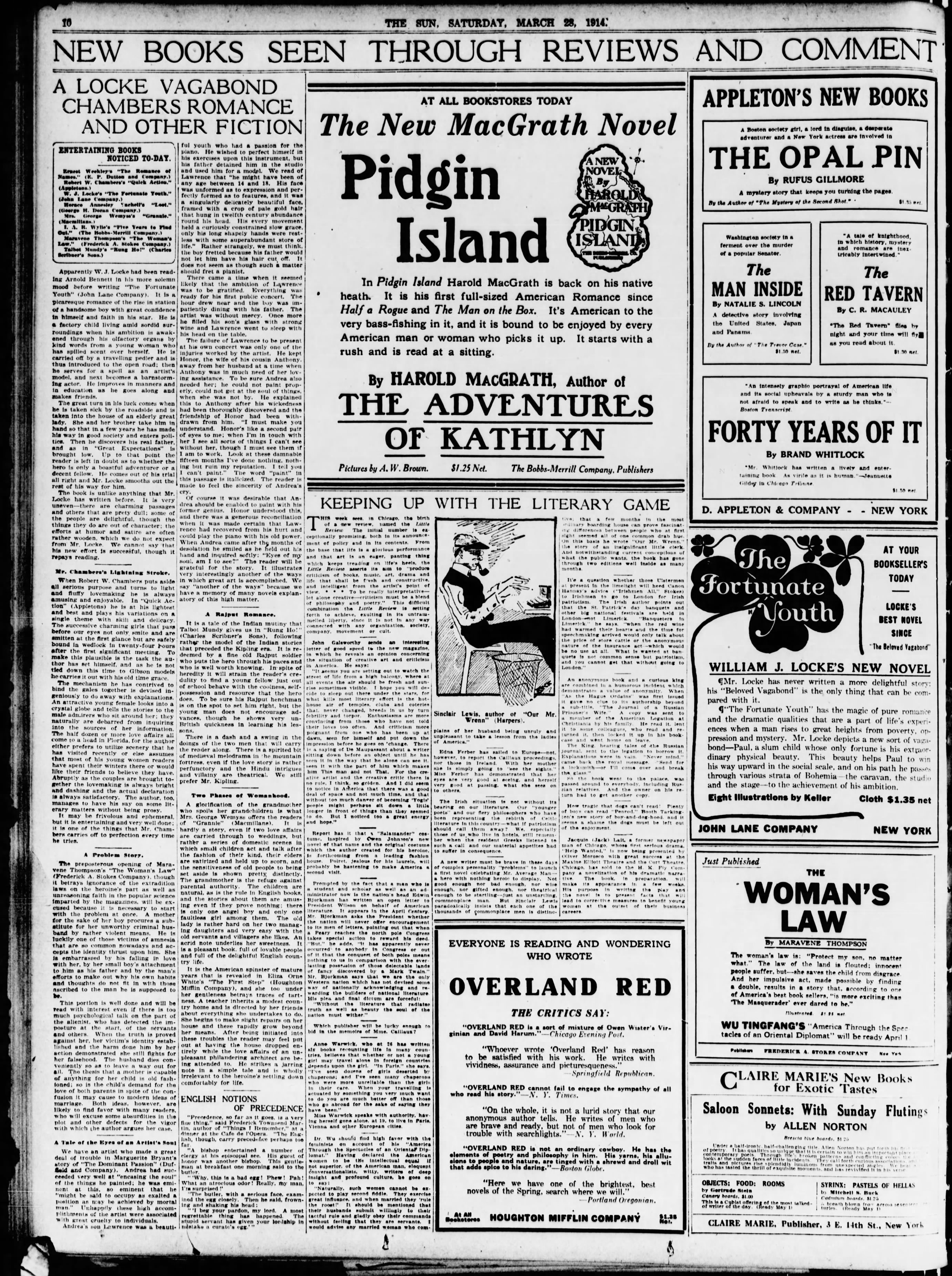
Her work privately printed has been seen by but few. Although word of her art is in every one’s ears, she has been a closed door to almost all save her closest friends. Recently a literary magazine asked: “Why has no publisher brought out the work of Gertrude Stein?” The answer was simplicity itself. Gertrude Stein was the reason. She steadfastly refused to seek a wider public and it was only upon the steady urging of her friends that she has consented to publish her works (“And She Triumphed in the Tragic Turnip Field! Not to Mention ‘It Lit a Chinese Candle in His Head,’ and a Few Other Choice Lines From the Lives and Works of the Futurists in Literature,” Dayton Daily News, Sunday, June 21, 1914, Feature Section, p. 6).I’m not sure whether or not Stein supplemented “the steady urging of her friends” with her own subsidy, and thus consented, sans any financial risk to her publisher Claire Marie, to open the door, in early June 1914, on the “Cubist offering of the most talked-of writer of the day,” Tender Buttons. In any case, there do seem to be convergences between the themes of Caine’s autumn offering and the “mere words” of Stein’s late spring release. For instance, in the lovely evocative piece entitled “A Box:”
Or in the sibylline “Eggs:”Out of kindness comes redness and out of rudeness comes rapid same question, out of an eye comes research, out of selection comes painful cattle. So then the order is that a white way of being round is something suggesting a pin and is it disappointing, it is not, it is so rudimentary to be analysed and see a fine substance strangely, it is so earnest to have a green point not to red but to point again (Stein 1914: 11).
And I, ever the wishful reader, have also spotted traces of — have manufactured correspondences with — But She Meant Well in some later Stein. For example, the spectre of Caine’s title seems to haunt Stein’s “There is a home in and around on account of a he meant well with out repaying” (1931: 14) and “Embroidery consists in remembering that it is but what she meant” (ibid.: 63). And Hannah’s impatience for Basil to come get the enclosed cows (I ignore Stein’s secret meaning of “cow,” for which see Dydo & Rice 2003), as well as the “customary hospitality” which Stein and Toklas showed the rosy-haired “Rose of Arlington” and her husband the (Williams) pear by asking them to come dine with them in Paris in “repayment” for their pleasant entertainment in London, seem to be “cubistically” refracted in “If fifty makes thirty and eighty who is helped to hold distaste tremble in intelligence double disconcert leave oak alone and be sorry that it was a credit accredited be like a pear bloom customary hospitality nearly considerably in organ perused inclose cows and glance do and origin” (ibid.: 49) and “It is best not to wait till five o’clock to bring the oxen. It is best to bring them sooner” (ibid.: 86). My chimerical perceptions may not be so farfetched after all, since it seems that Stein consciously employed something like that unconscious process à la Julien Gracq which I evoke in § 4 and which I elsewhere punningly call schizomythia; that is, what an unnamed friend of Stein’s called “a working proof of the Bergson theory of intuition:”Kind height, kind in the right stomach with a little sudden mill.
Cunning shawl, cunning shawl to be steady.
In white in white handkerchiefs with little dots in a white belt all shadows are singular they are singular and procured and relieved.
No that is not the cows shame and a precocious sound, it is a bite.
Cut up alone the paved way which is harm. Harm is old boat and a likely dash (Stein 1914: 47–48).
If we consider her then as a person who is consciously working out an art form and who knows what she is about, a description of her method of work may be illuminating. She will never talk of her work herself, but a friend has given the public some hints.But back to “that fastidious writer of poetry, Mr. Steine,” as one reviewer mistakenly called Reginald Sterne, who, in Caine’s novel, seems to have been a closed door to all but one reader, his sister-in-law, of whom he “was very fond:”[…]
“Her method of work is deliberate. She always works late at night, after reading several hours to get herself into the mood, and in the silence brings all her will power to bear on the banishing of preconceived impressions. Concentrating on the impressions she has received and which she wishes to transmit she suspends her selective faculty, waiting for the word or group of words which will perfectly interpret her meaning to rise from her subconsciousness to the surface of her mind. Then and only then does she bring her reason to bear on them, weighing and gauging their ability to express her impression. It is a working proof of the Bergson theory of intuition. She does not go after words — she waits and lets them come to her — and they do” (Robert Emons Rogers, “New Outbreaks of Futurism; ‘Tender Buttons,’ Curious Experiment of Gertrude Stein in Literary Anarchy,” Boston Evening Transcript, Saturday, July 11, 1914, pt. 3, p. 12).
Now one of Reginald’s principal reasons for liking Beatrice was her respectful attitude towards his poetry. Lilian (his wife) was sometimes forgetful of that which was due to it; Beatrice, never. Beyond encouraging him to be busy Lilian did nothing to show that she knew to what kind of a man she was married. He had long ago abandoned the hope of ever finding her appreciative of his writings. His collected works stood year after year on the shelf above her writing-table and he knew that they were never disturbed. One of them had never been wholly cut. He could say this certainly; the condition of the others he had never had the courage to investigate.Here is how our Comic Historian of England is seen by Hannah, who, after she has committed the well-meant blunder of blacking — hah! — Beatrice’s white-topped boots, has been told “not to sing or shout or run about in the hall” or in any way disturb him who “was working in the study” (p. 68) and has thus gone outside into the yard:Beatrice, on the other hand, knew whole passages of his by heart and could recite them to him beautifully, and when, as he now and then did, he confided to her hands some new manuscript whose first fine aroma he wished her to enjoy, her pleasure seemed always unbounded. In Beatrice, he was sure, he had a most willing reader.
Nor was he deceived. Beatrice’s delight in his poems was quite genuine. She called them (but only to herself) the Comic History of England (pp. 62–63).
She wondered what he was working at. Was he polishing silver? She resolved to go and see. She approached the window cautiously, ready to start away at any moment. She feared Mr. Sterne, but she could not bear not to know what he did when he was working. Holding her breath and moving on the point of her toes, she arrived before the window, laid her nose strongly against the glass and peered in.Seeing “Mr. Sterne walking down the drive very rapidly” (p. 71), Hannah realizes that he “had knocked off work for the morning” (p. 72):There was Mr. Sterne, seated before a table and doing absolutely nothing. His head rested against the back of his chair, his face was turned towards the ceiling and he held a smoking cigarette in one hand. On the table in front of him was a lot of paper.
Hannah thought it looked very easy work. She decided to tell Mr. Sterne this and tapped on the glass.
Mr. Sterne started and looked round at her and Hannah fled away like a deer.
For several minutes she quaked behind a tree, but at the end of that time the desire to see Mr. Sterne jump round in his chair and glare overcame her trepidation and she was very soon back at the window.
Still Mr. Sterne was idle. Hannah grew indignant and tapped on he glass reprovingly. Mr. Sterne jumped round in his chair as before, and, as before, Hannah fled behind her tree.
She heard the window opened and her name called. She flattened herself against the tree. The window was slammed down and Hannah giggled. This was better than polishing spoons (pp. 70–71).
She decided to go and see if he had been really doing anything at all in that room. She very much wanted to know this.Hannah also belonged to the class which neither employs private tutors nor have parents with sufficient leisure to fill that role. Hannah’s author, for instance had four private tutors (see previous section), and, according to his middle sister Dorothea,As she came into the kitchen, her mother said, “Lovely, Mr. Sterne’s just gone out. Won’t you run into his room and see if his fire’s all right, and come and tell mother?”
Hannah, who belonged to the class which lays fires, quite understood the importance of never letting them go out, once they have been lit. Her mother could therefore trust her to bring back a faithful report of the study fire’s condition (p. 72).
Our schooldays began before we actually went to school. Our mother, with the help of Reading without Tears, taught us to read at home before we started anywhere else. She also taught us a large number of Psalms. One verse was learned each day and repeated next day, when a second verse was learned. Daily repetition of all the verses we had already learned, plus the new verses, soon got the whole Psalm into our heads. When our sister Ruth and our brother Willy joined us, Mother kept to her system and we all managed to make a large number of Psalms our own (Colman n.d.: 9–10).Being also but five-years old, Hannah’s schooldays, alas, have not yet begun. And so, conveniently enough, she, like those Cohasset cows which, heedless of the warning signs, crossed over the “dead line” into Scituate, couldn’t read:
Hannah left her mother busily polishing, went out of the kitchen, passed through the hall, and entered the room where Mr. Sterne had been pretending to work. She had now forgotten that she had wanted to come and find out if he had or had not been idling; her thoughts were concerned with the condition of his fire.Caine complements the above “fire incident” (the sequelae of which I have reproduced in § 5) with another, where the servant-employing class is comically shown displacing its own helplessness into a supercilious distrust of “the class which lays fires.” Mrs. Rankin has paid a tea-time call on the Sternes:At the first glance she knew that there was no time to be lost. But two small red coals glowed in the grate. Hannah started to run back and fetch her mother, but all of a sudden she remembered how busy her mother was with the silver. Why shouldn’t she, Hannah, cause the fire to burn up briskly? She had often seen her mother lay a fire and knew just how it was done. How pleased her mother would be when she, Hannah, came back into the kitchen and announced that the fire had been nearly dead, but had been saved.
Without any further hesitation she caught up a lot of paper which lay on the table, heaped it in the grate, struck a match, laid the flame cunningly to the bottom of the paper-pile, and stood back to watch her handiwork. In almost no time there was a blaze there which almost frightened her, it roared so.
Suddenly something very exciting indeed happened. A great cloud of dirty stuff came falling down out of the chimney and black specks were everywhere. There was a most horrid choking smell in the room.
Hannah rushed out of the study, holding her nose, shut the door tight behind her, and went back into the kitchen. She would have liked to stay and watch the pretty flames, but not in that smoky smell. That was horrible. She answered her mother that the fire was going splendidly but she said nothing about what had fallen out of the chimney and the black specks and the smoky smell. She believed that it was better not to do this. Instinct told her (pp. 72–73).
“You golf?” said Mrs. Rankin, and Mrs. Sterne said that, yes, she goffed. Mrs. Rankin was now in such a good temper that she nearly uttered an invitation to Mrs. Sterne to come and try the course in the park; but at the last moment she was more wary and said “Ah!” instead. It would not do, she had reflected, to commit herself to too much with these people until she had sampled them a little more thoroughly. Hubert had been very insistent that she should call.I would like to return to Hannah’s “blacking” of Beatrice’s white-topped boots — to be precise, besmirching them with dubbin. Beatrice had given Hannah the opportunity to act on her own initiative when she asked Hannah to take “a pair of heavy boots, with nails in the soles […] to Miss Hawkey and ask her to give them a good greasing. […] Wait till the boots are done and then bring them to me, and if you’re very good you may lace them up for me” (p. 50). Hannah, carrying out her orders, had also seen the white-topped boots, and brought them along to Miss Hawkey:Mrs. Sterne would have liked to pursue the subject of golf but just then Mrs. Neighbour came in with the teapot, and left the door open as she carried the tray round to the place where Mrs. Sterne was sitting. Mrs. Sterne felt a draught. Looking round she saw that a window behind her was not quite closed. She asked Mrs. Neighbour to shut it. Mrs. Neighbour, to do this, had to stand on a chair, because the window was old and the weights did not bring the two halves of the window quite together; so the eyes of the company followed her movements as curiously as if no one of them had ever seen a window shut before. Indeed on Mr. Sterne’s face appeared an expression of intense anxiety; one eyebrow frowned, the other was raised and his mouth was all distorted and half open. Yet Mrs. Neighbour could be trusted absolutely to shut the window without injuring herself or anyone else.
She stepped down and Mr. Sterne’s expression relaxed as he said, rubbing his hands gluttonously together, “And now, Julia, how about those light-cakes?”
As he spoke a child came rushing in among them, a child who bore a china dish, a child who darted to the fireplace, where, as she had learned only a minute before, hot cakes must be put in order to keep hot.
This fireplace had hobs, one on each side of the grate, and Hannah was just putting the dish which she carried onto one of these hobs when the voices of these people for whom the light-cakes had been cooked, hitherto frozen in their necks by the suddenness and unexpectedness of the danger, all exploded together in a shrill, fierce cry to her to be careful.
Hannah started violently, and who shall blame Hannah, or Adam or any one else that the muffin-dish turned right over of itself and emptied all the light-cakes into the fire? (pp. 99–100).
Hannah tumbled all her boots onto the floor, picked up the big boots with nails, held them out to Miss Hawkey, and gave Miss Hawkey the message of Miss Beatrice. Miss Hawkey stopped polishing her knives, took the boots from Hannah, opened a round flat tin and smeared the boots all over with grease that came out of the tin. Then she gave the boots back to Hannah and resumed her work upon the knives.Upon receiving Hannah’s surprise, Beatrice resists the urge to become one “of those persons who are prosecuted from time to time by the Society for the Prevention of Cruelty to Children” (p. 65). Instead, she tells Hannah that she’s not old enough yet to do things on her own.Hannah had watched Miss Hawkey very closely because, for her own purposes, she wished to know how boots were cleaned. She meant to surprise Miss Beatrice. She ached to do something to show Miss Beatrice how much she loved her (p. 51).
Nietzsche made the final edits to the Foreword of Götzen-Dämmerung (Twilight of the Idols) in Turin, “am Tage, da das erste Buch der Umwerthung aller Werthe zu Ende kam” (on “the day when the first book of the Transvaluation of all Values was finished”), that is, September 30, 1888 (Nietzsche 1899b: 60; 1899b: 98). In that foreword he wrote:“When shall I be old enough?” asked Hannah. “And ain’tcher going to let me lace the others up for yer?” She burned to help Miss Beatrice to get her boots on.
Beatrice sighed and sat down on an oak chest. “Yes, Hannah,” she said, “you can lace them up.”
She drew on the stout boots and held out her feet for Hannah’s ministrations. While the lacing process was, with great slowness and much grunting, carried out, she sat and regarded this kind-hearted little child whose intentions had been so good and whose performance had been so shocking; and for a breath it seemed to her that there took place within her a sudden total transvaluation of all her values. That which she had hitherto believed to be good became bad, and bad good; and she was confronted with a hideous and despicable Scheme of Things, wherein love and innocence were found to work mischief such as the cruelest malice might only with difficulty invent. The unpleasant sensation passed; her training reasserted itself; she shrank back from the invitation to think and began to explain to Hannah why white-topped patent-leather boots must not be covered a quarter of an inch thick with dubbin. She could not find it either in her heart or her conscience to scold Hannah. The child had undoubtedly meant well. Her action had been good in every possible respect but one, her choice, to wit, of a field for her helpful activities. “Justice,” said Beatrice to herself (quite confident that she knew what Justice was and all about it), “justice can’t lay the blame for this on Hannah. She didn’t know. Perhaps it was my fault for leaving the boots out.” With this she tried to be satisfied. Since she couldn’t blame Hannah, she blamed herself; for in order to find any other object for censure she perceived that she must go further afield than, she felt, would be either comforting or seemly (pp. 66–67).
Eine Umwerthung aller Werthe, dies Fragezeichen so schwarz, so ungeheuer, dass es Schatten auf Den wirft, der es setzt, — ein solches Schicksal von Aufgabe zwingt jeden Augenblick, in die Sonne zu laufen, einen schweren, allzuschwer gewordnen Ernst von sich zu schütteln. Jedes Mittel ist dazu recht, jeder „Fall“ ein Glücksfall | A Transvaluation of all Values, that note of interrogation, so black, so huge that it casts a shadow on him who sets it up, — such a doom of a task compels one every moment to run into sunshine, to shake off a seriousness which has become oppressive, far too oppressive. Every expedient is justifiable for that purpose, every “case” is a case of fortune (Nietzsche 1899b: 59; 1899c: 97).Nietzsche uses the phrase “Transvaluation of all Values” notably in § 2 of the chapter entitled “Die vier grossen Irrthümer” (“The Four Great Errors”) in Götzen-Dämmerung (Twilight of the Idols):
Die allgemeinste Formel, die jeder Religion und Moral zu Grunde liegt, heisst: „Thue das und das, lass das und das — so wirst du glücklich! Im andren Falle…“ Jede Moral, jede Religion ist dieser Imperativ, — ich nenne ihn die grosse Erbsünde der Vernunft, die unsterbliche Unvernunft. Im meinem Munde verwandelt sich jene Formel in ihre Umkehrung — erstes Beispiel meiner „Umwerthung aller Werthe“: ein wohlgerathner Mensch, ein „Glücklicher“, muss gewisse Handlungen thun und scheut sich instinktiv vor andren Handlungen; er trägt die Ordnung, die er physiologisch darstellt, in seine Beziehungen zu Menschen und Dingen hinein. In Formel: seine Tugend ist die Folge seines Glücks | The most universal formula which lies at the basis of every religious and moral system is, “Do so and so, refrain from so and so — then you will be happy! In case of disobedience…” Every system of morality, every religion is this imperative; — I call it the great original sin of reason, immortal unreason. In my mouth, that formula transforms into its inversion — the first example of my “Transvaluation of all Values:” a man well constituted, a “fortunate man,” has to do certain actions, and instinctively avoids other actions; he introduces the arrangement which he represents physiologically into his relations to men and things. In a formula: his virtue is the result of his good fortune (Nietzsche 1899b: 92; 1899c: 135–136).The book which Nietzsche referred to as “the first book of the Transvaluation of all Values” was, of course, Der Antichrist (The Antichrist). One quote in particular from that book seems relevant to the “sudden total transvaluation of all her values” which Beatrice underwent whilst Hannah was lacing her boots:
Unterschätzen wir dies nicht: wir selbst, wir freien Geister, sind bereits eine „Umwerthung aller Werthe“, eine leibhafte Kriegs- und Siegs-Erklärung an alle alten Begriffe von „wahr“ und „unwahr“ | Let us not underestimate this: we ourselves, we free spirits, are already a “Transvaluation of all Values,” an incarnate declaration of war against and triumph over all old concepts of “true” and “untrue” (Nietzsche 1899b: 228; 1899c: 254).Might Hannah, perceived by Beatrice “to be the instrument of some perverse and sinister force which delights to turn her good impulses to its own advantage” (p. 102), be such an incarnation — or, rather, the parody of such an incarnation? In chapter IX of But She Meant Well, Caine opens his résumé of the previous chapter’s “water surprise” (which I have reproduced in § 4) with a parody of Nietzsche’s hard-hearted posturing in, for instance, § 203 of Beyond Good and Evil where he writes (in Helen Zimmern’s translation), “a transvaluation of values, under the new pressure and hammer of which a conscience should be steeled and a heart transformed into brass, so as to bear the weight of such responsibility” (Nietzsche 1909a: 129) — before quickly swerving off into the light-hearted, as Nietzsche himself does when describing, in the aforementioned Foreword, his Twilight of the Idols as “above all a recreation, a sun-freckle, a diversion into the idleness of a psychologist” (Nietzsche 1899c: 254):
Any one who shall undertake to display the effects which Circumstance, working through the agency of a small well-meaning child, can produce upon any given group of persons, must steel his own soul against all pity and nerve his own fingers for the writing of all dismal things, or how shall he proceed with his task? As between Circumstance and the temporary inhabitants of Henry Sterne’s house let me, then, hold the scales as evenly as I can, neither exclaiming at the brutality of the one nor commiserating the lot of he others. Here I am a pen only.The context for Beatrice’s perception of Hannah as “the instrument of some perverse and sinister force” occurs in chapter V, § 4, after the latter, startled by the adults’ cries to be careful, accidentally “emptied all the light cakes into the fire” (p. 100). On taking leave, Mrs. Rankin asks Beatrice to “‘set a poor old woman a bit on her way’” (p. 101):Yet may I consider, and must, the sensibilities of my audience. Though I feel it my duty to point certain things out to you, let me not do it in an unmerciful fashion. To free you, then, as quickly as possible from all suspense, let me tell you, at once, that the boiler did not blow up; no one was killed; I have no tragedy to record.
Reginald Sterne’s presence of mind and vigour of arm averted the gravest horrors with which the situation was pregnant and nothing worse happened than the rapid exhaustion of the well and the instant entry of air into the pipes. This, it is true, made it impossible for any one to get water out of any single tape which the house contained, but in the circumstances it was almost a relief to know that the protecting fluid could not be wasted. Nobody would be able to have a bath; hand washing had become a rare luxury; water, as a beverage, was now precious as white port. But — the danger-mark lay twelve inches below the surface of the cistern.
The boiler was not going to blow up (pp. 153–154).
Beatrice was extremely anxious to finish a certain novel, but she said that she would like nothing better and went with Mrs. Rankin, thinking all the more highly of herself for her violation of the truth; for though truth is mighty, it shall prevail, among decent people, only so long as politeness pleases.But She Meant Well in general can be viewed as a parodic expansion of the interplay between the two mottos Caine appended on page 7 between the dedication to his sister and brother-in-law (p. 5) and the start of the novel proper (p. 9). The first, which I reproduce in § 8, is attributed to Blooter and Salt, that is, the “world’s champion Cross-Talk Comedians” from Old Enough to Know Better (November 1911), and the second — “Verily a prodigy is this power of praising and blaming” — to “The Thousand and One Goals,” that is, chapter XV of Nietzsche’s Thus Spake Zarathustra. More specifically, the above-quoted discussion between the old and the young woman expands on the eighteenth chapter of Nietzsche’s book, entitled “Von alten und jungen Weiblein” (“From Old and Young Women”), the last few paragraphs of which run as follows:The old and the young woman went down the drive together talking of matters which, as they did not interest them, are not likely to say very much to us. Their conversation on the drive, then, may be omitted.
But when they had passed through the gate Mrs. Rankin, without warning, emitted a laugh. Beatrice supposed for a moment that she must have said something humorous, but, on reflection, decided that her last remark — the expression of her fear that rain might be coming — could not possibly be the cause of Mrs. Rankin’s mirth. So she asked Mrs. Rankin why she had laughed. She was sure that Mrs. Rankin wished her to do this.
“I was thinking,” said Mrs. Rankin, “of that little girl — Hannah, is it?”
“I think,” said Beatrice, “that you only laugh at the thought of Hannah because you don’t share a house with her.”
“I admit,” said Mrs. Rankin, “that it is easier to be amused by such children at a distance.”
“With a county between you, perhaps,” said Beatrice. “But if I lived within sight of Henry’s house, as you do, I shouldn’t laugh while Hannah is in it. I should travel.”
“You give her a terrible character,” said Mrs. Rankin.
“No,” said Beatrice, “I give her an excellent character. She is a very good little girl, though she can be naughty like the rest of them. But she appears to be the instrument of some perverse and sinister force which delights to turn her good impulses to its own advantage. Were it not for this she would be a blessing. As it happens, she is a common curse. I know that her first object in bringing those cakes in to us was to save her mother a journey and that her second one was to give us our cakes as hot as possible and that she had no other. It is inconceivable that she meant to burn our food before our eyes. Isn’t it?”
Mrs. Rankin knew more of life than did Beatrice.
“There are children,” she said cautiously, “who are capable of such fiendishness; but I’ll take your word for it that Hannah isn’t one of them.”
“Do you think a child of five could realise that she was burning a poem that had taken Reginald two months to write. Do you think that she could intend to set that chimney on fire. If Charlotte had had the sweep in, as she ought before we came, Hannah couldn’t have done it. No. As with those cakes, she was only trying to save her mother trouble. It was the fiend who uses her that laid her hands on poor Reginald’s precious papers.”
“There is a proverb about good intentions,” said Mrs. Rankin.
“It doesn’t apply to Hannah,” said Beatrice. “It was made about people who don’t carry their good intentions out. Now Hannah does, unfortunately.”
“That’s true,” said Mrs. Rankin. “That is perfectly true.” She looked at Beatrice with greater interest than before. This girl was no fool. “Nevertheless,” she said, “Hannah has been put to bed again, just as if she had meant to be naughty.”
“I know,” said Beatrice, “and it infuriates me. It’s so unjust, so absurd. By rights she ought to have been praised for what she did. But that would have been absurd, too.”
“Absurder,” said Mrs. Rankin.
“I don’t know,” said Beatrice.
“She thought for herself,” said Mrs. Rankin. “That is a dangerous offence in young children and one that must not be overlooked. She is better in bed.”
“She is safer at any rate,” said Beatrice, “I can see that. But is she never to learn to think for herself? At what age —?”
“You are trying to corner me,” said Mrs. Rankin, “and I can’t bear to be cornered. Let us agree that there are many things which we can’t understand.”
“But supposing we want to understand?” cried Beatrice (pp. 101–104).
Caine’s novel, in other words, is a variant on the battle between woman, i.e., truth, and the “dawg”-matists:Da entgegnete mir das alte Weiblein: „Vieles Artige sagte Zarathustra und sonderlich für Die, welche jung genug dazu sind.“
„Seltsam ist’s, Zarathustra kennt wenig die Weiber, und doch hat er über sie Recht! Geschieht diess dess-halb, weil beim Weibe kein ding unmöglich ist?
Und nun nimm zum Danke eine kleine Wahrheit! Bin ich doch alt genug für sie!
Wickle sie ein und halte ihr den Mund: sonst schreit si überlaut, diese kleine Wahrheit.“
„Gieb mir, Weib, deine kleine Wahrheit!“ sagte ich. Und also sprach das alte Weiblein:
„Du gehst zu Frauen? Vergiss die Peitsche nicht!“ (Nietzsche 1899a: 97–98).
Then answered me the old woman: “Many fine things hath Zarathustra said, especially for those who are young enough for them.
Strange! Zarathustra knoweth little about woman, and yet he is right about them! Doth this happen, because with women nothing is impossible?
And now accept a little truth by way of thanks! I am old enough for it!
Swaddle it up and hold its mouth: otherwise it will scream too loudly, the little truth.”
“Give me, woman, thy little truth!” said I. And thus spake the old woman:
“Thou goest to women? Do not forget thy whip!” (Nietzsche 1909b: 76–77).
Supposing that Truth is a woman — what then? Is there not ground for suspecting that all philosophers, in so far as they have been dogmatists, have failed to understand women — that the terrible seriousness and clumsy importunity with which they have usually paid their addresses to Truth, have been unskilled and unseemly methods for winning a woman? Certainly she has never allowed herself to be won; and at present every kind of dogma stands with sad and discouraged mien — if, indeed, it stands at all! (Nietzsche 1909a: 1).And on sallying forth into battle, Caine, of course, did not forget the whip, as already shown above by Hannah’s use thereof for her own perilous amusement in chapter II. And towards the end of But She Meant Well, Beatrice asks Hannah why she put plovers’ eggs into Mr. Sterne’s luggage:
“Oh!” cried Hannah shrilly. “So I did. Well, he told me he was packing to go away and sezee, ‘I’m orf directly, Hannah,’ he says and I found the eggs downstairs on the table and I thought he was going to leave ’em behind and so I took them up and stuck ’em in his box so’s he wouldn’t leave ’em. But the silly old man never went after all and —” Hannah’s voice became a mumble. Such sounds are made by children who have the hands of elder persons firmly pressed upon their mouths (pp. 295–296).In his Foreword to Götzen-Dämmerung, Nietzsche described himself as “an old psychologist and rat-catcher in whose presence precisely that which would like to remain unheard is obliged to become audible | alten Psychologen und Rattenfänger, vor dem gerade Das, was still bleiben möchte, laut werden muss” (Nietzsche 1899c: 98; 1899b: 60). Just as Caine expands that Foreword’s “note of interrogation, so black, so huge that it casts a shadow on him who sets it up” into, on the one hand, the recipe for blacking which made the Sternes’ fortune and, on the other, Hannah’s casting an irremediable shadow of grease upon Beatrice’s white-topped boots, so too, on several occasions, he obliges Hannah, whom others wanted to remain unheard, to become quite audible — her tantrum at the train station (pp. 29–31); her singing to her still-sleeping mother upon waking on her first morning at the Sternes’ country house, followed by falling back to sleep, then screaming when she wakes again to find her mother absent (pp. 39–42); her pounding on the floor of the bedroom, causing the house to shake (p. 77); her incessant questioning (passim). Caine similarly transforms Hannah into a rat-catcher of sorts, or, rather, the accomplice of a rat-catcher. “Twice within the past week had Hannah seen a rat in the kitchen, and once a mouse (so bold were these creatures), and on three occasions a loaf had been spoiled by them.” Recently, Hannah's mother, “entering the larder, discovered a large piece of bacon all gnawed and made uneatable and a fourth loaf ruined” (p. 196). “Hannah had no bacon for breakfast” that morning (p. 197). Fortunately for tomorrow’s breakfast, Mrs. Neighbour was able to buy a new piece of bacon from the ambulatory grocer after lunch. Discussing the rat problem with Beatrice, Hannah, echoing her mother’s and Miss Hawkey’s opining on the matter,
said that if something wasn’t done she didn’t see how they were going to live at all, and she told Miss Beatrice about the new bacon and said that she hoped to goodness the rats wouldn’t gnaw it. Hannah said the rats were awful, wicked things.Later, Hannah, following a mouse, discovers the top of a ventilator shaft in the form of a box built atop a bookcase. Thinking that “this was the way in to the place where the mice and rats lived” (p. 208), she retrieves the gnawed bacon, as well some spoiled fish, from the ash-pail, and, lifting up the hinged ventilator grating, stuffs it all down the shaft:“Why?” asked Miss Beatrice.
“Because they ate up my bacon,” said Hannah without any hesitation at all. She had never, as yet, had occasion to revise her scale of values.
“But,” Miss Beatrice said, “suppose they gnawed the bacon in order to bring home some for their children to eat. Were they wicked then?”
“Yes,” said Hannah.
“But,” said Miss Beatrice, “suppose you were starving and your father were to go out and get food for you, would your father be wicked?”
“Course not,” said Hannah. “He’s my father, ain’t he?”
“But,” said Miss Beatrice, “the rats are only doing the same as your father would do. I mean, going out and getting food for their children. Why are they wicked, Hannah?”
“Because,” said Hannah, “they’re rats and because they ate up my bacon and because I say they’re wicked.”
“Yes, Hannah,” said Miss Beatrice, “that’s about what it comes to, isn’t it?”
She began to talk to Hannah about the rats. She described their mode of life, how they lived in the walls and made long tunnels everywhere. She described the descent of the rats upon the larder on the previous night. She made up a story about five rats called Scratcher, Nibbler, Scurry, Squeak and Whiskers, and told how they set out at midnight from their home under the old drawing-room floor, how they crept along under the passage and through the long tunnels that they had bored in the walls until at last they came to the larder and ate the bacon.
When Beatrice began this story she had some idea of clothing her five rats with heroic virtues, giving them a sick mother for whom bacon had been specially prescribed by the doctor, and generally making a sort of case for the rats; but she failed to do anything with the story and it was a very dull story indeed. Theoretically rats might be good and not bad creatures, but this was too hard for Beatrice to demonstrate. She was secretly pleased by this discovery; she felt that perhaps after all the values with which she had been brought up might not be so wrong as she had lately begun to suppose (pp. 201–203).
Hannah said nothing to her mother about what she had done to help the household in its struggle to keep the rats from the bacon. It was a secret Hannah had, a happy secret.Of course,It didn’t matter now if Daniel set a trap for the rats or not. They would not come into the larder now. They would stop in their tunnel, eating the bacon and fish (p. 209).
Far down in the ventilator, safe, by reason of the ventilator’s upper and lower grating, from all rats, the bacon and the fish concerted measures of protest against the indignity which had been put upon them.Beatrice, meanwhile, when she wasn’t busy chasing cows or playing the incidental nanny for Hannah or fruitlessly trying to understand the case of Hannah with an older and more experienced woman, was putting her heavy hob-nailed boots to good use by going on longer and longer walks with that older woman’s son, he who had shown his mettle early on in But She Meant Well by stopping the spooked dray-pony and saving Hannah’s life. Hubert George Rankin has finished his studies at Oxford, and is waiting to learn the results of an examination he has recently taken, an examination that will determine whether he will qualify to be an architect or not. On their way to see a stone circle in a field,Circumstance, happy with two little trumps up its sleeve, dismissed this household from its consideration for a time and devoted itself to other unfortunates (p. 210).
Hubert made entertaining comments and laughed in all the right places. Beatrice began to like him very much. As she began to like him she began also to wish to know what views he had concerning some of the things which were troubling her; for when we are first confronted with the discovery that this world into which we have been pitchforked is a rather less uncomplicated place than our parents, instructors, and ghostly advisers have hitherto caused us to believe, we welcome every opportunity of learning what other people think about it. Perhaps they know something.Beatrice’s hopes are slightly dashed at first. For, while Hubert may be able to pass his architects’ exam with top marks,Again, we are much more ready to ask for the views of people whom we hardly know than for those of our nearest and dearest. Is this odd? I think not. We don’t like the idea of possibly upsetting the convictions of those of whom we are very fond. Beatrice could in no circumstances have asked, say, an aunt (as she asked Hubert without any difficulty at all), “What, for instance, do you call a good action?” She would have known that her aunt would tell her that it was not at all right to say such things and that everybody who had been decently brought up knew what was right from what was wrong and that Beatrice had made her very unhappy. From Hubert (because he had no business to be unhappy about her) she hoped for something more satisfactory. She hoped, I say (pp. 128–129).
with moralities, he found, he was uncomfortable.However, Beatrice’s struggles with the “total transvaluation of all her values” has affected Hubert. On the morning after he learns the results of the examination, he gloomily tells her the news:Among facts only was he at home. A young man with his way to make in the world does well to stick to facts, for the contemplation of abstractions is a vice that hinders feet which are set upon the path to success. The youth who wants to get on had better drink than concern himself seriously with the Cosmos — and who knows if the purpose of the Cosmos is not best served by refusing to examine it?
Hubert avoided abstract reflection as much by instinct as a beaver avoids rotten logs. For the edifice upon which he was engaged only the soundest materials may be employed without disaster. He had been provided with a good education, a code, and a host of attractive examples and he wanted nothing more in order to carry on a gentlemanly struggle for existence. One of these days some of the money which was called “the Rankins’” would be spent in buying him a partnership with some well-established architect and thereafter all would be plain sailing. He would live long (for he was very healthy) and build many houses and churches and hotels and town halls and (if he prospered truly) workhouses and prisons and lunatic asylums, and when the Cosmos reabsorbed him he would never have had a second’s doubt concerning the perfect integrity, decency, and worth of all his acts.
Such was the programme that seemed to be laid down for Hubert.
He seemed destined also to marry and have two children, a girl and a boy, to whom he would hand on his traditions and beliefs, whole and untainted; and the boy would set about succeeding like his father and the girl would marry, if she could, and if not, might begin to ask herself and other people questions. But the male line, let us hope, would remain sound, for that would mean that it would remain successful. It is only the unsuccessful who need to be discontented. Their failures must be accounted for somehow and it is never pleasant to have to blame oneself. The Cosmos is always a good butt for criticism, and to attack it makes anybody feel audacious and superior to his fellows. And as the Cosmos never replies, the argument is all on one side and correspondingly easy.
Hubert, then, showed Beatrice the stone circle very much in the spirit of an uncle who, being asked by his little nephew, “Why is the grass green?” pulls out a pencil and offers to draw a lion (pp. 132–134).
Hubert’s “ghastly” sense of guilt at coming out “top of the lot,” a sense of guilt which goes so far as to imagine some of those he beat as having already cut their throats, reminds me of a story of Caine’s which I discuss more fully in § 4, “The Rout of Sir John,” where the mirrors of a certain country house in Hertfordshire are haunted by “by the spectacle of a dark evil head, with blazing eyes and its throat laid open” — the ghost of Sir John, who had applied a razor “firmly to his carotid artery” in order to solve “all his difficulties.” I am also reminded that, on the same day that Nietzsche finished the first book of the Transvaluation of all Values,“Aren’t you as high as you hoped?” she asked, her voice warm already with consolation.
“A good deal higher,” he said. “I’m top of the lot.”
“Oh,” she cried. “How lovely!”
“I don’t know,” he said. “What about all the other poor brutes? There were nearly one hundred and fifty of them. I’ve got the prize that they all wanted more than anything in the world. I’ve got it; they haven’t. I suppose I ought to be pleased.”
“Well,” said Beatrice, “I am. I don’t care two-pence about those one hundred and fifty. You’re the only person I want to have the prize.”
“That’s very nice of you,” he said. “But I keep thinking of those other men — ever since I heard last night. I expect a lot of them needed this thing. Suppose I’ve knocked them on the head as architects. Suppose they have to go into banks and drapers’ shops. There’s no end to the beastly consequences of what I’ve done and I don’t like it. And I don’t see why I can’t enjoy my score without being plagued by this sort of thing. It’s a rotten world. If I’d set about to do all those one hundred and fifty men a bad turn I couldn’t have done ’em a much worse one than this. And I never thought about them till last night, except to be afraid of them. All I’ve done is my best for myself, without the slightest ill-feeling against any of them, and I daresay some of them have cut their throats by this time. And I think it’s rotten. How am I to go on working at my job when every time I get a bit of work I’m to think, as I pocket my money, ‘Here’s the price of some poor devil’s butcher’s bill?’”
“Oh dear, oh dear,” said Beatrice, “you’ve been thinking things out.”
“Well,” he said with a nervous laugh, “and who started me?” He was still unhappy in the discussion of abstract things. Doubtless he would always be so. It is indeed very difficult to be otherwise.
She looked at him eagerly. “Isn’t it horrible?” she said.
“It’s ghastly,” he agreed. “What’s the good of a world where one can’t earn one’s bread without doing another fellow out of his? A jungle’s no worse, and we’re supposed to be a cut above tigers, aren’t we? I swear I’ve a good mind to give up architecting. I’ve got enough to live on. But what’s the good of that? I want to do something more with my brains than spend the money my father left behind. And how did he get it? From some one else, ultimately. So that doesn’t help. And what’s the good of brains if one’s not to use them? And all one can use them on is to put other people out of business. If there was enough work to go around it might be different; but there isn’t. I don’t see any way through and it’s rotten. And I want other things and I’ve not got enough money for them.” He ended abruptly and looked far away over a field.
If Beatrice had asked them what those other things were he would no doubt have told her, but she didn’t. She felt that the ground was growing more dangerous than she wished.
It comforted her greatly to discover that he was not quite so satisfied with everything as he had seemed to be. Every one welcomes a companion in misery (pp. 229–231).
two more horrible murders were committed in the East-end of London, the victim in both cases belonging, it is believed, to the same unfortunate class. No doubt seems to be entertained by the police that these terrible crimes were the work of the same fiendish hands which committed the outrages which had already made Whitechapel so painfully notorious. The scenes of the two murders just brought to light are within a quarter of an hour’s walk of each other, the earlier discovered crime having been committed in a yard in Berner-street, a thoroughfare out of the Commercial-road, while the second outrage was perpetrated within the City boundary, in Mitre-square, Aldgate. In neither case can robbery have been the motive, nor can the deed be set down as the outcome of an ordinary street brawl. Both have unquestionably been murders deliberately planned, and carried out by the hand of some one who has been no novice to the work (“More Horrors in the East-End; Two Women Murdered; The Same Fearful Mutilation,” Pall Mall Gazette, October 1, 1888, p. 7).The Berner-Street victim, a woman whose “head was nearly severed from her body […] but not otherwise mutilated than by the gash in the throat, which had severed the jugular vein and must have caused instantaneous death” (ibid.), was found about 1 a.m., the body still “quite warm,” on the morning of Sunday, September 30, 1888. The Mitre-Square victim was found about an hour later:
The sight was a most shocking one. The woman’s throat had been cut from the left side, the knife severing the main artery and other parts of the neck. Blood had flowed freely, both from the neck and body, on the pavement. Apparently, the weapon had been thrust into the upper part of the abdomen and drawn completely down, ripping open the body, and, in addition, both thighs had been cut across. The intestines had been torn from the body, and some of them lodged in the wound on the right side of the neck. The woman was lying on her back, with her head to the south-west corner, and her feet towards the carriage way, her clothes being thrown up to her chest. Both hands were outstretched by her side (ibid.).On the morning of Monday, October 1, 1888, Caine was fifteen years, one month, and three days old, and would have been making his way from 33 North Side, Clapham Common, to either the Westminster School about three and half miles across the Thames, or to the Manor House School, only about a quarter mile from home on the north side of Clapham Common. In either case, it seems likely that he would have read about the ghastly spectacles in at least one newspaper; if not in the Pall Mall Gazette, then perhaps in, say, the The Globe:
The monstrous rage for murder and mutilation which burns in the breast of some abnormal being in the East-end of London is not stayed, nor is he deterred by the outburst of popular indignation or fear of discovery. Two fresh assassinations, one showing the astounding, peculiar, and brutal appetite for butchery which was displayed in two other cases, were perpetrated early on Sunday morning. At that hour, a little after midnight, the people of the district where they occurred are still up and moving about, so that the hideous crimes may be said to have been done with a recklessness rarely seen. It is true that the sites selected, in both cases, were exceptionally dark, and one of them almost deserted; nevertheless we may say that the murders were effected by someone who carefully calculated his chances and sought to seize the moment when it was most probable that he would not be interrupted. […] These incidents only add fresh horror to the series of what we may now call unparalleled crimes, because they indicate the existence of some one who is not only audacious to the verge of recklessness, but at the same time prudent, vigilant, and calculating. If his passion for slaughter is abnormal, it is governed by a certain kind of bold discretion, and that, we say, renders his deed more appalling, because it implies such a confidence in himself and his ability to secure immunity that, unless some strong and skilful steps are taken, we may expect these abominable crimes to recur again and again. […]And it’s also possible that, years later, when (if) Caine read Nietzsche’s Foreword to Götzen-Dämmerung, he would have noticed, not just the chronological, but also the (im)moral, coincidence… Now, I’m not saying that Caine was in any way traumatized or influenced by reading about the series of murders committed by the mysterious assailant(s) who came to be known as “Jack the Ripper,” nor even by reading, two months later, about what seems to have been a copycat murder of a boy committed in Havant near — surprise! — the Manor House School of that town. Percy Knight Searle, “a little fellow of only eight years of age, [who] was the son of a labourer in the employ of the water-works company,”What sort of man can he be? […] Everyone has noted that his knife is aimed at a peculiar class of women. It is also evident that mutilation, as well as murder, is a characteristic, or we should say the characteristic, of this criminal. Is it not possible that he is one who believes that he has a commission from on high to destroy, root out, and dishonour the kind of women whom he so persistently selects? It is known that some such fanaticism is not beyond the range of probability, still less of possibility, and it is not difficult to understand how a man who has dwelt upon the greatness of the sin may consider himself empowered to slay the sinners. Some of the worst crimes have been committed from a similar motive, especially when the mind acted upon is or has been exceptionally prurient, and afflicted with a sense of the possessor’s own shameless acts. If that be so, he might be found in almost any class; but looking to the fact that he has so easily evaded notice, must he not be one whose manners, appearance, and even dress are of a sort which do not attract observation, still less arouse suspicion? So that the police and the vigilants might look for one who combines these qualities — an aspect likely to escape special attention, and a character including at least a show of religion, and a conceited belief in the right of private persons to rectify, by their own hands, what they consider public wrongs. If the man were a maniac, there is a terrible method in his madness, and a savage or barbarous conception of evil and good, of right and wrong (“The New Murders,” The Globe, Monday, October 1, 1888, p. 4; see also, “Two More Murders in the East-End; Latest Particulars; Arrests on Suspicion,” The Globe, Monday, October 1, 1888, pp. 4–5).
had been sent by his mother at about six o’clock on Monday evening to the shop of Mr. Randall, draper, of North-street, not more than three hundred yards distant, for a small quantity of shirting. On his return he had to pass through a thoroughfare known as New-lane, which at one spot is bounded on one side by the wall of the Manor House School (of which the Rev. S. Spurgeon is principal), and on the other by Pallant House, now untenanted. It was in the darkness at this point and about a third of the distance home that the child was assailed. As to what took place, however, all that is known is contained in the following statement by Robert Husband, a boy 11 years of age, who says: “On Monday night, about six o’clock, my father sent me on an errand. I got as far as the top of the lane when I saw a man doing something to a boy. It was very dark at the time, and my attention was called to the matter by a voice like that of a boy making a regular squeal, not as though he was being ‘hided,’ or anything like that. It was a queer sound, like a gurgling noise. There was a lamp at the top of the lane and this shone on to Pallant House, which is opposite to the wall of the garden of Manor House School. When I heard the squeal I was about 25 yards from rounding the wall opposite Pallant House, and I saw distinctly the form of a man and a boy. The man had the boy down on the ground. I shouted ‘Murder!’ as loud as I could. When I shouted ‘murder’ the man ran away in the direction of the Fair-field. I ran as fast as I could to Mrs. Randall’s shop.” On his way it appears Husband met Mr. John Platt, a dairyman, of North-street, who was on his way home by way of Prince George’s-street. Husband was in a state of great excitement, and taking Mr. Platt by the sleeve he exclaimed “There’s a man up there murdering a boy.” Hurrying along, the two reached the wall of Mr. Spurgeon’s school, where lying in the roadway was the child Searle bleeding profusely from three stabs in the throat. The child, who was in a pool of blood and mud, with the parcel of drapery in his hand, gave three gasps and died. Mr. Platt is confident that from the time that elapsed between his leaving Prince George’s-street and the boy Husband taking him by the arm he must have been passing within a few yards of the spot at the very time the murder was being committed; but he neither saw nor heard anything. Husband’s account is that the murderer was a tall man, but beyond that he knew no details. The pocket knife covered with blood which was found was only about eight yards from the body (“The Extraordinary Murder of a Boy at Havant; Discharge of the Man in Custody,” The Daily News, Wednesday, November 28, 1888, p. 3).After the discharge of one potential suspect, a more plausible suspect was soon apprehended:
The cloud of mystery surrounding the terrible tragedy at Havant, which at one time appeared to be almost impenetrable, has at last, it is believed, been cleared away. The arrest of the lad Husband yesterday afternoon on the grave charge of wilful murder did not come altogether as a surprise, but it was nevertheless a great relief to the inhabitants of the district, for, as was only natural under the circumstances, the idea had got abroad that the terrible being who has perpetrated the undiscovered murders in the East End of London had made his appearance in Havant, and, changing his tactics for the nonce, had wreaked his wanton vengeance on an innocent and unoffending child. The mere suggestion that “Jack the Ripper” might have been the culprit in the present instance threw the whole neighbourhood for miles around into a state of violent excitement which increased rather than subsided as time passed without news of an arrest. Terror-stricken women and children, and in some cases even grown-up men, were timorous of venturing out alone in secluded places after nightfall, and all spoke with bated breath of the gruesome deed which caused a thrill of horror throughout the country (“The Havant Tragedy; A Boy Accused of the Murder; Astounding Revelations,” Portsmouth Times and Naval Gazette — County Journal, Saturday, December 1, 1888, p. 6).In all the works of the lesser known Caine which I’ve been able to find, there are no such “gruesome deeds” as those perpetrated by the “terrible being” in the East End or that which inspired the “thrill of horror” in Havant. And the parodies of murder mysteries he wrote, such as “The Fan,” “Those Admiralty Plans,” The Strangeness of Noel Carton, are, of course, parodies, containing much more mirth than murder, much more slapstickery than mystery. Yet perhaps the reviewer of But She Meant Well in The Scotsman who called Hannah’s father “an East End policeman” based on nothing at all, so far as I can tell (and despite Hannah’s telling a red-bearded hobo, after she gets lost while futilely trying to rescue a stray lamb, that her address is in South London [p. 236]), had an inkling that Caine’s Heedless Hannah the Innocent Goof-Up was a sort of Jack the Ripper in nuce infanti, as it were… Likewise, such advertisements as, for instance, that in the Evening Standard and St. James Gazette of October 30, 1914, stating that Caine’s “subject is a little girl, whose well-intentioned escapades during a visit to the country threw the whole neighbourhood into absolute chaos,” or that in The International Studio of November 1914 stating that Hannah “goes to a country house with her mother and speedily turns the neighborhood upside down,” or the reviewer in Country Life who wrote, “Hannah is a terror; Mr. Caine seems to have seen her as a terror of extra large size. It seems a pity that this should have been so, for it somewhat takes the edge off our amusement at the many fiascos that dogged the train of this well-meaning little girl. It strikes us Mr. Caine does not love his Hannah overmuch […]” — perhaps all seem to have been getting at, without being quite able to precisely articulate it, the method of Caine’s comedy: transforming the sprawling horrors committed in the world at large by monstrous fanatics with impenetrable motives into the farcical fiascos committed in the compact setting of a house in the country by the diminutive figure of a well-meaning child who simply happens to be the plaything of circumstance, or, as Beatrice put it, “one of those people for whom the powers of evil have a peculiarly tender regard:”
At the time he meets Beatrice, Hubert has built nothing, and has only ever designed a pig-sty for one of his brother’s farms (design rejected). As I’ve quoted above, he wants to “build many houses and churches and hotels and town halls and (if he prospered truly) workhouses and prisons and lunatic asylums” — a desire not too dissimilar from what John Roberts, former M.P. and father of John Herbert Roberts, M.P., had accomplished in his lifetime:“Obviously,” said Beatrice, “if she had meant to be bad, we should have had no trouble at all. If she had wanted to burn Reggie’s papers there would have been no matches in the study. If she had meant to despoil your mother’s garden of daffodils she would have picked them with long stems. If she had intended to flood the house, I should have come in from my walk a quarter of an hour before I did, and I should have gone straight to the bathroom, because I should have got mud on my hands from digging up primrose roots or something of the kind. Hannah, as a bad little girl, would have been left alone; the chances would have worked for or against her, normally. But she has the best intentions in the world and so she is one of those people for whom the powers of evil have a peculiarly tender regard. They never lose sight of her. But I have given you my views upon this subject before. I apologise.”
“You don’t seriously think,” said Hubert, “that there are devils hanging about, all the time, on the look-out for chances to turn people’s kindnesses into injuries?”
“I don’t know what I think,” said Beatrice. “I usedn’t to think about such things at all.”
“Much better not to,” said Hubert.
“How can one help it if one’s once begun? Besides you do. What about your prize?” She did not mean to let him go, her comrade in distress.
“It’s all a mistake,” said Hubert. “Let it alone. It leads to nothing but confusion. When I was young, I was ill for some months and I used sometimes to think about eternity. It was no good, and as soon as I was well again I gave it up. If your liver’s all right you don’t want to think about such things. Do what you have to do as decently as you can, and let the rest slide; that’s my motto. I think it’s a workable one. And about that prize of mine. Supposing every time I get a house to build, I sit down and worry about all the other architects whom I’ve robbed of a bit of work. How am I going to carry on at all? And I’ve got to carry on. No. If I’m content not to get trade by swindling and underhand dealing that’s the best I can ever hope for. That’s my conclusion. We’re all pitch-forked in here without a word to say about it; we’re given certain capacities and certain advantages; and then we’re left to make the best of it. For most of us it only amounts to making the best of a bad job, though a few have a pretty good sort of time. If we can do as much as we can with our talents and do as little harm as possible, I expect we’ve done as well as anybody else. And if what we want to be good turns out bad, it’s not our fault; we’ve got to blame the general crookedness of things and that’s something we can’t ever understand. Now you know what I think.”
“But that’s not what you think,” said Beatrice. “If you’ve thought as much as that you can’t be satisfied to leave it alone and you’ve got to worry. And you have been worrying and I’m glad,” she concluded, slowly.
“It’s only because you’ve been worrying,” he said. “If you hadn’t, I shouldn’t have cared a hang about these things. But what interests you interests me.” He caught his breath for he had suddenly realised that a new opportunity had presented itself. “Ever since I met you —” he began.
Beatrice jumped up. “I must get home,” she said, and looked at her wrist-watch (pp. 276–278).
He was head of the firm of Messrs David Roberts, Son, and Co., timber merchants, Liverpool, by whom extensive building operations have been carried on both in the city and suburbs, it being computed that no fewer than 20,000 houses in Liverpool have been erected by them in recent years (“The Late Mr. John Roberts,” The Wrexham Advertiser, Saturday, March 3, 1894, p. 5).
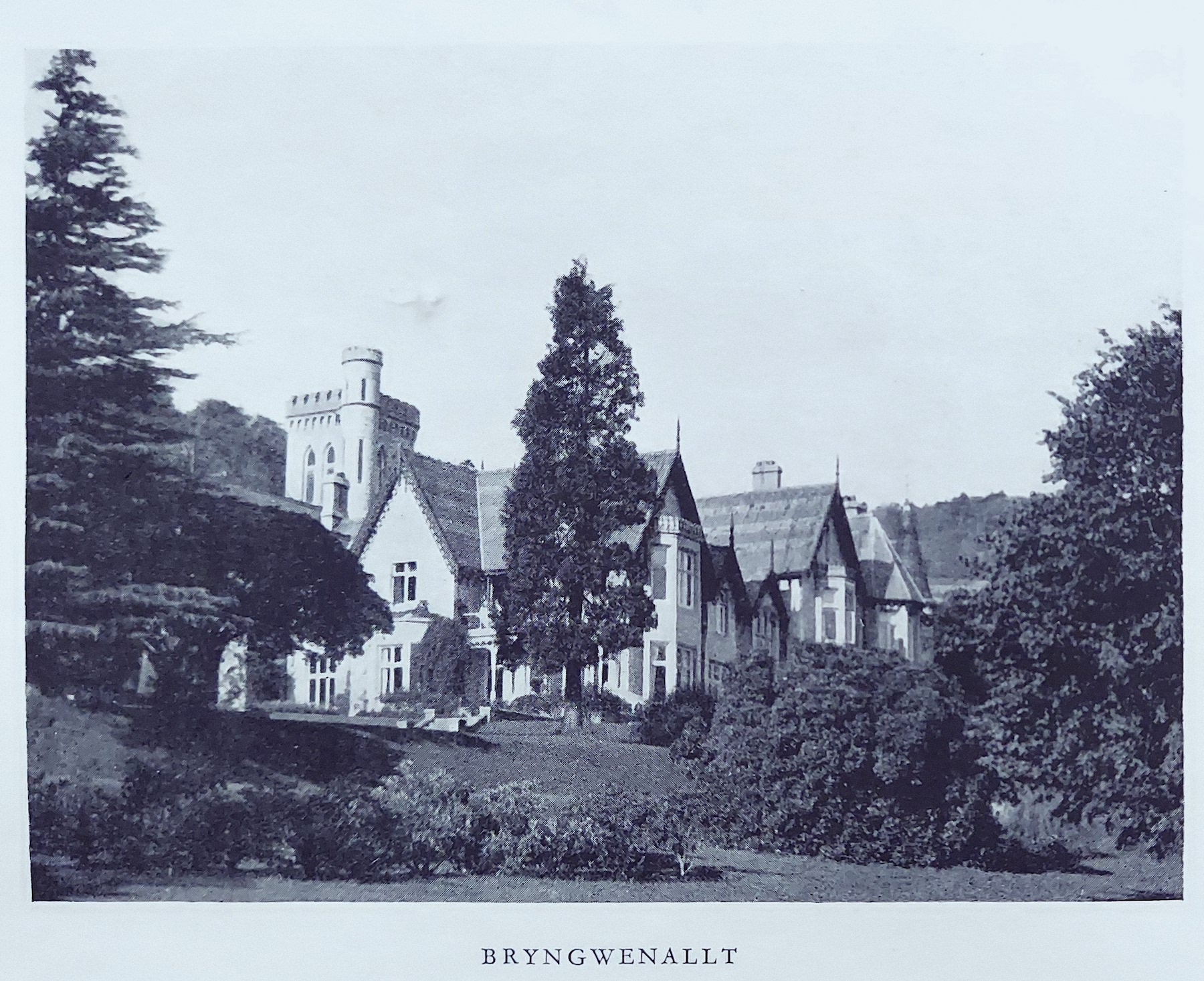
“In 1900 we moved to the larger house — Bryngwenallt” Roberts (n.d.: 17). “She was looking at the front elevation of an immense and noble palace whose central dome touched the skies and whose feet were planted among the steps and terrace of a great garden” (Caine, But She Meant Well, p. 167). Reproduced from Roberts (n.d.: 28).
He held out his sketch, and she took it from him eagerly.The dust jacket of But She Meant Well “shows,” according to a review published in The Australasian, “a small girl laid across the knees of her mother, who is wielding to some purpose a brush, apparently snatched hastily from a toilette-table.” No such scene occurs in Caine’s novel. However, after Reginald discovers “that the study was uninhabitable by reason of soot and the terrible smell which the burning chimney had caused” and that his “Walpole was not so much a Fragment as a feathery heap of cold, charred paper” (pp. 73–73), the culprit is put to bed:She was looking at the front elevation of an immense and noble palace whose central dome touched the skies and whose feet were planted among the steps and terrace of a great garden.
She had expected something so entirely different that she flirted the leaves of the sketch-book to see if he had not offered her the wrong page. But Hubert said: “No, you’ve got it there.”
“But,” she said, “it’s nothing like what I ordered. Where are the ingle-nooks?”
“They’re inside,” he said. “I couldn’t show everything you asked for so I concentrated on my elevation. Of course that’s only a rough sketch. I’ll make it a little more worthy, I hope, when I get properly to work on it.”
She set her head on one side and regarded him oddly.
“Is this an elaborate compliment you’ve been making me?” she said.
He nodded. “That’s what I’ve been doing,” he said, meeting her eyes hardily. She dropped hers and gave him back his sketch.
“You won’t have it?” he said.
“No,” she replied.
“All right,” he said, “but I’m not a bit sorry.” He pulled the sketch out of the book and took it in his two hands to tear it across.
“Don’t,” she said softly.
“If you don’t want it,” he said, “I don’t.” But he didn’t tear it.
“Won’t you need it,” she said, “when you — get seriously to work?”
He put it back in the book. “Yes,” he said, and there was a silence between them which Hubert employed in wondering if he had better or had better not try to go any further that afternoon (pp. 167–168).
Hannah knew that she had been put to bed because she had set the chimney on fire, and been a very naughty girl, and frightened them all out of their wits. That she deserved a whipping she knew also, because her mother had said so and because Miss Beatrice had said that she must not be whipped. It was not fair to whip her, Miss Beatrice had said. Let her be put to bed, if they must. It would at any rate keep her out of mischief. But don’t let her be whipped. She had not meant to set the chimney on fire, much less to destroy “Walpole — a Fragment.”Having already played with the window blind and broken it, Hannah is bored. So she jumps out of bed and pounds on the floor with her fists until:Hannah had been passionately grateful to Miss Beatrice for saving her from being whipped, but none the less she had felt very resentful at being put to bed in the middle of the day. Obscurely she blamed Mr. Sterne for what had happened to her. He had looked crosser and had talked more loudly than any of them. Her mother had cried and said she couldn’t think what would become of Hannah and had announced her intention of whipping Hannah; but she had not looked so cross as Mr. Sterne. Hannah felt that there was no justice in the world; otherwise why had she been put to bed if it had not been fair to whip her? If it had not been fair to whip her, it had not been fair to put her to bed. Hitherto whenever she had been put to bed she had always been whipped first. She did not mind not having been whipped first, but she felt that unless she had been whipped first she ought not to have been put to bed. She did not understand it at all. This was what came of trying to be a little help. She wished she had let the fire go out and then her mother would have had a job, laying it all over again (pp. 75–76).
The door opened and her mother came in. Without a word said on either side Hannah was picked up, soundly spanked, and put back into her bed.Hannah jumps out of bed again, intending to pound on the door. She sees her doll Bunty sittingHannah roared with anger and pain.
When she came to herself her mother was gone and all was as it had been before. She had got nothing for her trouble but a whipping (pp. 77–78).
in the corner of an easy-chair, with her feet out straight in front of her, her head on one shoulder, one arm behind her and the other raised above her head. Hannah had a thought.Later, after the flooding of the house, Reginald, arguing with Beatrice about what to do with Hannah, saysShe picked Bunty up, seized a hairbrush from the dressing-table, spanked Bunty soundly and put her to bed in her mother’s bed, thrusting poor Bunty right down to the foot of the bed, where it would be perfectly dark. Then Hannah felt better. She had passed some of it on. Dolls were useful things, very.
Then she got back into her own bed and began to talk about Bunty to an imaginary person whom she addressed as Miss Porky. She told this Miss Porky what a dreadful child Bunty was and asked Miss Porky what she thought would become of Bunty. She told Miss Porky that children were nothing but a worry and a care and that she, Miss Porky, did very well not to have any of them. Hannah had often heard her mother talking to her unmarried aunt just after she, Hannah, had been naughty and she knew exactly what to say and how to say it (p. 78).
“she must be punished for this bathroom business in a way that she will remember — for a week at any rate. I think a little boiling in oil might answer the purpose. Say half an hour of it.”There is another sense of whip which has whipped itself into my discussion, e.g., “When Mr. Caine [i.e., William Sproston Caine, the father of the author of The Author of “Trixie”] separated from Mr. Gladstone on the Home Rule question he actually became one of the whips of the Liberal Unionist party, but he rejoined the Liberal party in 1890, accepting Mr. Gladstone’s scheme for the government of Ireland.” That is, after W. S. Caine was reelected during the general election as the Liberal Unionist member for Barrow-in-Furness in July 1886,It was evident that he was fast regaining his spirits.
“But, I fear,” he concluded, “that a whipping is as much as we can hope for.”
“Why should she be whipped?” said Beatrice.
“Why?” cried Reginald. “What on earth do you mean? Hasn’t she nearly been the death of us all? Hasn’t she spoiled all the ceilings?”
“No,” said Beatrice, “she didn’t do those things.”
“Then I should like to know,” he observed, “who did?”
“So should I,” said Beatrice. “But it wasn’t Hannah. She was trying to get water for us all. She was being as good as she knew how. Will you never understand, Reggie, that Hannah is not a mischievous little girl?”
“You have told me so before,” he said, “and you always take her part and save her from the whippings she earns every five minutes; but still I find it difficult to regard her presence in this house as a blessing. I say that she must be whipped.” He turned on his heel and stirred up the fire emphatically.
“And I say,” cried Beatrice, “that it would be most unjust to whip her. We can’t let her be whipped for trying to help us” (pp. 159–160).
On August 5th the Marquis of Hartington summoned the Unionist M.P.’s to Devonshire House, in order to complete their organisation as a separate party in the Commons. The Marquis said that they now held the balance of power, and were able to prevent the return of a Liberal Government to office until Home Rule was abandoned. On the other hand they could “prevent a Conservative Government from adopting a retrograde course, or from taking steps dangerous to the welfare of the country, either with regard to foreign policy or to unsound domestic legislation.” He had declined to form a Government because it would have made the breach in the Liberal Party irreparable. They did not intend to cease to be Liberals, nor to give any ground for denying them that title.I’m not sure how whips functioned in the House of Commons in the 1880s, but as far as current British politics are concerned,Mr. Chamberlain cordially accepted the Marquis as the leader of their party, and proposed that Mr. Caine should be their chief whip. Lord E. Cavendish was appointed second whip. “I fear you will find me but an inefficient colleague in our political duties,” wrote Lord Edward [Cavendish], “and I must confess I should have been much inclined not to have undertaken them, except that I felt we should pull well together,” an anticipation that was well founded (Newton 1907: 171–172).
there have been serious accusations that whips have used leverage and intimidation to keep MPs in line, a reminder that the power of the whips’ office is not only procedural but relational. Allegations of wrongdoing are used as factional weapons or instruments of discipline rather than triggers for protection and justice (Jude Wanga, “The centre shrinks,” LRB Blog, 5 February 2026 [https://www.lrb.co.uk/blog/2026/february/the-centre-shrinks]).As I contemplate the moral (one of the morals) which But She Meant Well has in tow — not the banal insight that “eminently virtuous resolves” may produce “the most vicious results,” but rather its slightly subtler corollary that the true curses on this world are convinced that they are really blessings — a moral whose telling takes the form of a matryoshka-like embedding of innocent mindless doll within well-intentioned child “for whom the powers of evil have a peculiarly tender regard” within young woman who refuses to let that child “be whipped for trying to help us” within mature woman who understands that the ends of justice (a social convention, after all) may best be served, at times, by unjust means — as I contemplate that moral, I wonder if Caine’s dedicatees appreciated the lesson he perhaps rashly dedicated to them. In particular, his sister Hannah, whom “an old and valued friend of the family” described as
always beautiful, and she walked serenely through life in great purity of mind and in sweet harmony, and yet with a certain aloofness. No evil thought touched her, and she was all goodness, refusing to see wrong, or to believe in it. She lived in a world of spiritual strength and this strength was generously imparted to those less endowed than herself, and it came from her as a light and guidance of which she herself was hardly conscious. It was a beautiful influence.I can only speculate as to whether or not Hannah Rushton Roberts née Caine decided not to follow the example of Reginald Sterne’s wife and chose, instead, to actually open the book her brother dedicated to her and her husband. And perhaps, if she did, her own “great purity of mind” became at least slightly muddled and distempered, that is, infused with shadow and color, by reading about Beatrice’s “transvaluation of all her values,” her “sweet harmony” made piquant and provocative with the acute dissonance of laughter, and her eyes opened to not merely the existence, but perhaps even the necessity, of wrong and the antagonisms lurking in “the trivialities of life.”She contrived to live without antagonisms of any sort, very simple in spite of her unwanted wealth, and she disregarded her husband’s title as far as possible in her own personality.
In fact, the trivialities of life and its artificial adornments seemed to drop away from her from sheer unsuitability. She was a Madonna in bearing, absolutely virginal in thought, and when the time shall come for her to leave this world there can be little change for her who existed here as in a heavenly sphere ([Roberts] n.d.: 47).
- Set foot in America. — See reference in § 7, n. 2.
- North or South Shore; Spending the summer. — The Boston Evening Transcript, Friday, June 12, 1914, p. 13, noted, “Mr. and Mrs. William Caine (Gordon Walker) of London […] are to pass a few weeks at the North Shore,” while The Buffalo Commercial, Wednesday, July 29, 1914, p. 5, stated more generally that Caine had “taken a bungalow on the New England coast for the summer” (both pieces fully quoted in § 7). During her high school years, Caine’s wife’s family had a summer residence at Briar Neck, Long Beach, on the North Shore not far from Gloucester (see references in § 7, n. 22). That Caine and his wife may also have spent time at “the literary colony at Scituate” on the South Shore may be gleaned from a piece printed in The Springfield Daily Republican, Wednesday, January 2, 1918, p. 6 (see, again, § 7).
- Changing the title. — See “Latest Fiction; William Caine,” The New York Times Book Review, May 24, 1914, p. 246 and “Men and Women; Gossip and News About Prominent Persons,” The Buffalo Commercial, Wednesday, July 29, 1914, p. 5, both quoted in § 7.
- Back matter of some books. — See, e.g., Hermann Sudermann, The Song of Songs, Third Edition, London: John Lane The Bodley Head, 1914; Arthur Adams, Grocer Greatheart, London: John Lane The Bodley Head, New York: John Lane Company, 1915; Peter Blundell, Love-Birds in the Coco-Nuts, London: John Lane The Bodley Head, New York: John Lane Company, 1915 [the first-person narrator of this novel is named “Lolina”]; John Hubback, Russian Realities, London: John Lane The Bodley Head, New York: John Lane Company, 1915; William J. Locke, Jaffery, London: John Lane The Bodley Head, New York: John Lane Company, 1915.
- First year at Balliol. — Caine studied at the University of St. Andrews 1889–1891 (Anderson 1905: 276, 285, 292), then matriculated at Oxford as a non-collegiate student on October 15, 1892 (Foster 1893b: 97). He started at Balliol the following year (Hilliard 1914: 49; Elliott 1934: 206), and I assume the academic year began in September or October.
- Tanyrallt. — Also spelled Tanrallt or Tan’rallt; not to be confused with the Tanyrallt where Shelley stayed, for which see [https://commons.wikimedia.org/wiki/Category:Tan-yr-allt].
- Baron Clwyd. — See “Honours List; Four New Barons; 23 Baronets; 49 Knights,” The Times, Tuesday, April 29, 1919, p. 12, and “Titles of New Peers,” The Times, Tuesday, May 13, 1919, p. 13. As an aficionado of coincidence, I can’t help but admire the slant rhyme between Baron Clwyd and the farmer from Cohasset whose herd was poisoned five years earlier, Cl. W. Ba(r)ron.
- Caine had also read history at university. — As had his youngest sister Ruth, at Newnham College, Cambridge (Colman n.d.: 12).
- Provided himself with wealthy progenitors. — See § 3, n. 5, as well as the discusion of Caine’s father’s death in § 7, and references in nn. 13, 14, 15, 16, 17. For the block of flats in Hampstead, The Pryors, see discussion in § 8, and references in nn. 3 and 4.
- David Roberts. — “Death of Mr. David Roberts,” The Liverpool Daily Post, Tuesday, October 4, 1886, p. 5; “Death of Mr. David Roberts, J.P.,” The Liverpool Weekly Courier, Saturday, October 9, 1886, p. 8; “Death of Mr. David Roberts, J.P., of Liverpool,” The Mongomeryshire Express, Tuesday, October 12, 1886, p. 3.
- Literary Cubist. — “Public Gets Peep at Extreme Cubist Literature in Gertrude Stein’s ‘Tender Buttons,’” The Chicago Daily Tribune, Friday, June 5, 1914, s. 2, p. 1.
- Leo Stein’s description. — In a letter to Albert Barnes, 1934, quoted in Malcolm (2007: 39).
- Cubist offering. — See, e.g., the advertisment for “Claire Marie’s New Books for Exotic Tastes” in The New York Times, Saturday, March 28, 1914, p. 5 and The Sun, same date, p. 10; note that Stein’s book is not yet titled Tender Buttons.
- Mere words. — J. P. Collins, “The Resurgence of Mere Words; Gertrude Stein, the New Cubist Writer, Tells in Cubist Manner of Her Aims,” Boston Evening Transcript, Saturday, August 15, 1914, Part Three, p. 5.
- Schizomythia. — See, e.g., Strickland (2001/2019: 161, 165, 166, 168; 2018/2020: 264, 315, 318, 321; 2019: 34, 163, 182; 2024: 135, 303, 323).
- Fire incident; water surprise. — Readers of an alchemical or mystical bent may also note Hannah’s involvement with air and earth in ch. XV, where a pet canary “escaped into the garden and was no more seen, because a hawk had it almost at once” (p. 242), and p. 248, where Hannah, thinking young chickens to be canaries which she can catch to replace the one that escaped, rushes on them, trampling one “into the mud, slaying it instantly.”
- Expression of intense anxiety. — Perhaps Reginald was familiar with the works of his better known eponym: Seeing Julia at the window brought to mind “the misadventure of the sash” in Tristram Shandy, vol. V, chs. 17–18.
- The old and the young woman. — A more sphinxian moment involving ditto occurs in the first chapter of But She Meant Well when, on the train, Hannah notices that a sleeping fat man has dropped his ticket. Her mother is asleep, and so she looks for guidance from the other passengers in the compartment: “Hannah glanced anxiously towards the young woman and the old woman, but neither of them looked as if a communication would be welcome” (p. 21). I expand upon this incident in § 9.
- Either the Westminster School… — On my uncertainty as to which school Caine attended in 1888, see § 1, n. 5.
- East End policeman. — Yes, Hannah’s father is indeed a policeman (p. 41), but nothing in Caine’s novel seems to indicate (to me, at least) that he either lives or works in the East End.
- Bryngwenallt. — See § 11, n. 5, and Hubbard (1986: 100): “The house was large and very Gothic, with a four-storey entrance tower. Embedded in the centre was a hall with organ and open timber roof. Well over half, including the great hall, has been demolished, but the tower and broad stone staircase remain.” One of the things Beatrice tells Hubert she wants in her house — not “a big house. But I do want a big hall in it.” — is an organ (Caine, But She Meant Well, p. 166).
- Became one of the whips. — “Death of Mr. W. S. Caine, M.P.; Biographical Sketch,” The Western Morning News, Wednesday, March 18, 1903, p. 5.
-
Old and valued friend of the family. — [Roberts] included the quoted description of Caine’s eldest sister as the Epilogue of his wife’s In Memoriam, noting that it “was written some years ago by Mrs. Sylvester Samuel, an old and valued friend of the family.”
The piece must have been written before c. February 1926, since that is around the time that Mrs. Sylvester Samuel née Esther Hannah Beddington died.
On Wednesday, May 18, 1887, Caine’s mother Mrs. William S. Caine presented “Mrs. Harry Sylvester Samuel” to the Princess of Wales.
“Mrs. H. Sylvester Samuel” subsequently presented her daughter Edith to the Princess of Wales in 1894, and her daughter Evelyn and another, recently married, daughter, Mrs. Carel Wiener, to the King and Queen in 1904.
Several years earlier, when living in Liverpool, her husband ran for city council.
On Thursday, September 20, 1877, at “the house of Mr. W. S. Caine, Rodney-street, chairman of the Liberal Committee,” following upon the announcement of the retirement of David Campbell, the incumbent representative for Rodney Ward, a “formal invitation” was given “to Mr. Henry Sylvester Samuel, merchant, Orange-court, to become the Liberal candidate at the ensuing election.”
The following day, Samuel addressed the electors, in part, as follows:
[…] a large and influential meeting of the Liberal Committee was held yesterday, at which I was unanimously invited to come forward at the approaching Election as a Candidate for the Representation of your Ward in the Town Council.
At “a Meeting of the Friends and Supporters of Mr. Henry Sylvester Samuel” held Monday, October 8, 1877, at the Temperance Hall (also known as the Young Men’s Lecture Hall) on Hardman Street and chaired by W. S. Caine, Samuel began his address by stating thatI consider this invitation a high honour, and at once place my services at your disposal. I resided for 25 years in your Ward, have served as a member of the Liberal Committee, and taken an active interest in the Elections. I hope to have an early opportunity of addressing you and explaining fully my opinions on the more important matters that are likely to demand the attention of the Town Council, such as the Water Supply, the Efficient Control of the Tramways, the Licensing Question, the Application of the Artisans’ Dwellings Act, &c.
I solicit your votes, and if you do me the honour to elect me, I shall endeavour to merit your confidence by vigilantly watching the expenditure and guarding the interests of the ratepayers. Particular pledges I decline to give, as I value independence of opinion too highly to be the slave of any clique. I am and always have been a thorough Liberal, and, recognising the necessity of party organisation, I am prepared to loyally support the Liberal leaders in their efforts to promote measures which may conduce to the moral, sanitary, and æsthetic progress of the town (“Municipal Election; To the Electors of Rodney Ward,” The Liverpool Daily Post, Tuesday, September 25, 1877, p. 4).
He had lived in the ward for 25 years, and he believed he was pretty well known to the majority of the electors, so that if they elected him as their representative they might at least rest assured that their interests were not confided to a stranger, but to one who knew the ward and its requirements well, and would endeavour, to the best of his ability, to promote its welfare. (Applause.) (“The Municipal Elections; Rodney-Street Ward; Meeting of Mr. Samuel’s Friends,” The Liverpool Mercury, Tuesday, October 9, 1877, p. 6).
He ended his address by stating thatHe thanked heaven that his mind was not stained by the slightest taint of religious bigotry — (loud applause) — and if an official asked for an increase of salary, whether he was a gaol chaplain or anybody else, he should simply inquire in the first place whether he deserved the increase, and, secondly, whether the corporation could afford to give that increase; and if the answers to both those questions were in the affirmative, they might be assured he would vote for the increase to that official, whether he was a Protestant, a Catholic, a Mahomedan, a Jew, or, it might be, a “heathen Chinee.” (Laughter and applause.) (ibid.).
At the Liverpool municipal elections held on Thursday, November 1, Samuel lost to the Tory candidate, David Radcliffe. It seems that Samuel and his family later moved to Rio de Janeiro, and later still to London where, at the County Council elections of 1898, he ran as a Moderate candidate for Central Hackney. Before the polls could take place on Thursday, March 3, however, he died on Saturday, February 26, “from the effects of a severe chill which had attacked him in the middle of the week” while he was attending the funeral of one of his in-laws, H. Leopold Beddington. See: “The Representation of Rodney Ward,” Evening Express (Liverpool), Saturday, September 22, 1877, p. 2; “Municipal Election; To the Electors of Rodney Ward; Rodney Ward Election,” The Liverpool Daily Post, Monday, October 8, 1877, p. 7; “The Municipal Elections; Rodney-Street Ward,” Evening Express, Tuesday, October 9, 1877, p. 4; “The Municipal Elections; Rodney-Ward, 2543 Votes,” The Liverpool Mercury, Friday, November 2, 1877, p. 7; “Jubilee Drawing Rooms,” The Daily Telegraph, Thu, May 19, 1887, p. 4; “The Drawing Room,” The Times, Thursday, May 19, 1887, p. 6; “The Drawing Room,” The Standard, Friday, June 1, 1894, p. 3; “The County Council Election; Central Hackney; Death of a Candidate,” The Standard, Tuesday, March 1, 1898, p. 4; “Obituary,” The Times, Wednesday, March 2, 1898, p. 8; “Wills and Bequests,” The Morning Post, Saturday, April 23, 1898, p. 3; Peloni, “Our Home Letter,” The Jewish Herald (Melbourne), April 29, 1898, p. 171; “Their Majesties Court,” The Hebrew Standard (Sydney), July 1, 1904, p. 9; “Fear of Burial Alive,” Evening Standard, Wednesday, February 24, 1926, p. 1; “Chelsea Gossip,” West London Press, February 26, 1926, p. 5; “Hampton & Sons; Sale Thursday Next; By Order of the Executors of Mrs. H. Sylvester Samuel, deceased; 19, Cadogan-Place, S.W.,” The Daily Telegraph, Saturday, February 27, 1926, p. 20; “Sale this Day; By order of the Executors of Mrs. H. Sylvester Samuel, decd.; 19, Cadogan-Place, S.W.,” The Daily Telegraph, Thursday, March 4, 1926, p. 22.