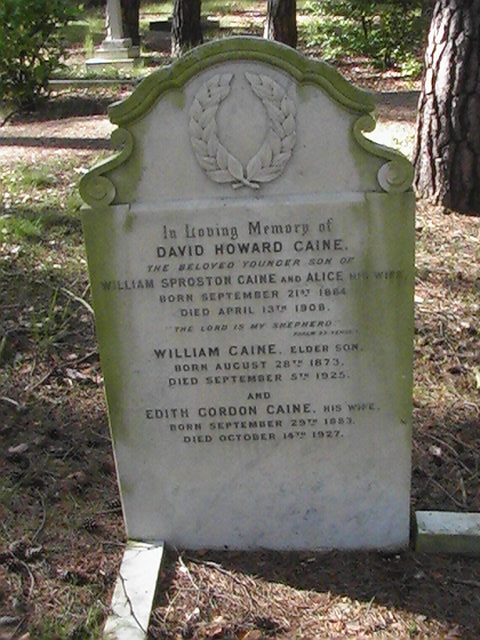
Tombstone of David Howard Caine, William Caine, and Edith Gordon (née Walker) Caine, Brookwood Cemetery, Brookwood, Woking Borough, Surrey, England. From findagrave.com.
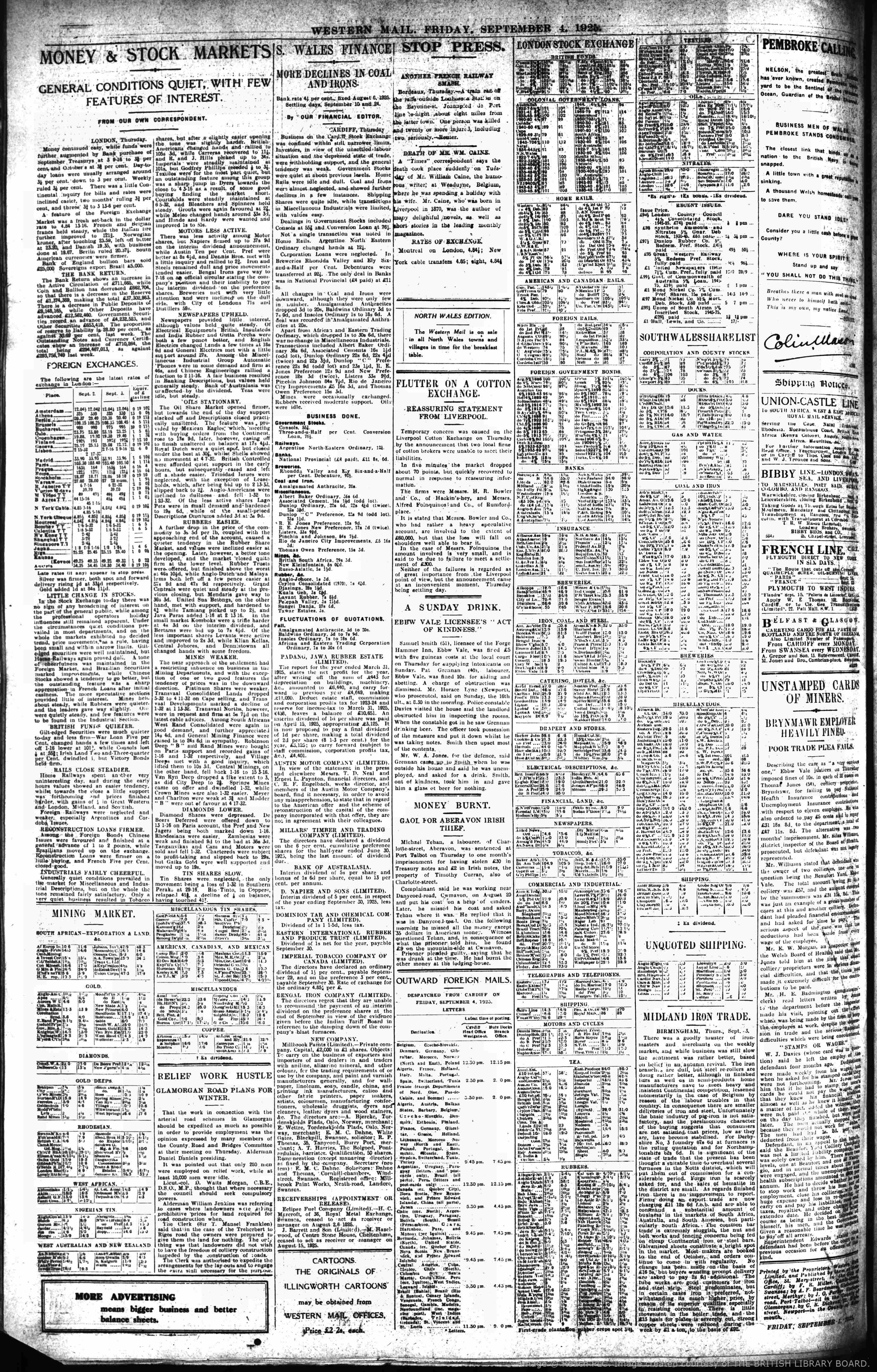
A “Times” correspondent says the death took place suddenly on Tuesday of Mr. William Caine, the humorous writer, at Weaduyne, Belgium, where he was spending a holiday with his wife. Mr. Caine, who was born in Liverpool in 1870, was the author of many delightful novels, as well as short stories in the leading monthly magazines (“Death of Mr. Wm. Caine,” Western Mail, Friday, September 4, 1925, p. 16).Judged by the tombstone, the birth year is incorrect, as is the implied date of death, Tuesday, September 1, 1925. The piece as it appeared in The Times (London) runs as follows:
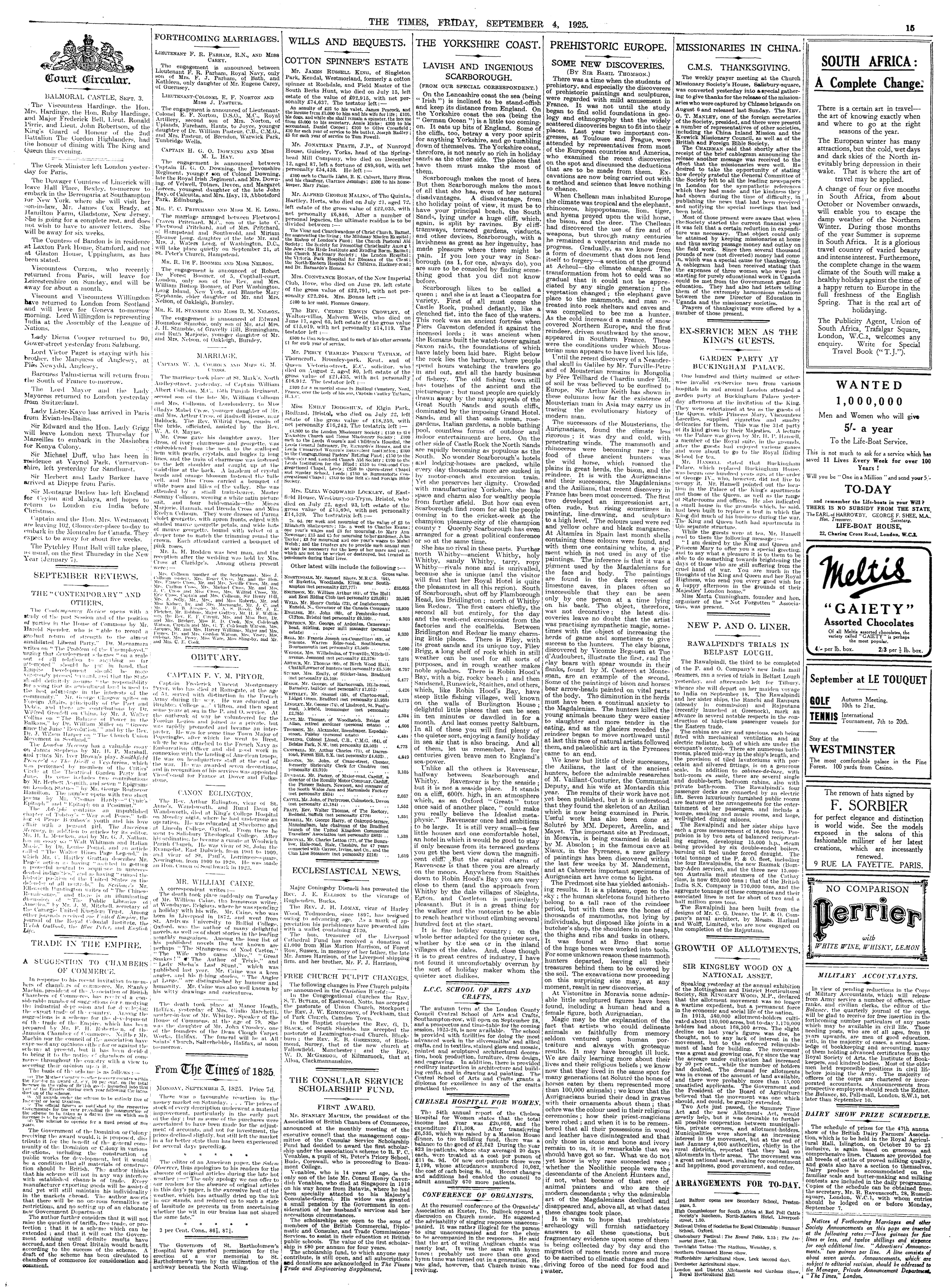
The date of death is still Tuesday, September 1, 1925, but the year of birth has moved a little closer to that stated on the tombstone. In addition, the spelling of the locale in Belgium has been corrected from Weaduyne to Wenduyne. Yet the piece gets the title of Caine’s collection of fishing stories wrong. It is An Angler at Large, not The Angler at Large. An otherwise fine obituary published the following month in The London Mercury gets the titles wrong in four out of the five books of Caine’s it cites (only The Confectioners is correct), and places his death in a completely different part of Europe:A correspondent writes: —
The death took place suddenly on Tuesday of Mr. William Caine, the humorous writer, at Wenduyne, Belgium, where he was spending a holiday with his wife. Mr. Caine, who was born in Liverpool in 1872, and went from St. Andrews University to Balliol College, Oxford, was the author of many delightful novels, as well as of short stories in the leading monthly magazines. Among the long list of his published novels the best known are perhaps “The Strangeness of Noel Carton,” “The Wife who came Alive,” “Great Snakes!” “The Author of Trixie,” and “Lady Sheba’s Last Stunt,” which was published last year. Mr. Caine was a keen angler, and his fishing stories, “The Angler at Large,” are distinguished by humour and humanity. Mr. Caine was also well known by his witty drawings and caricatures (“Obituary; Mr. William Caine,” The Times, Friday, September 4, 1925, p. 15).
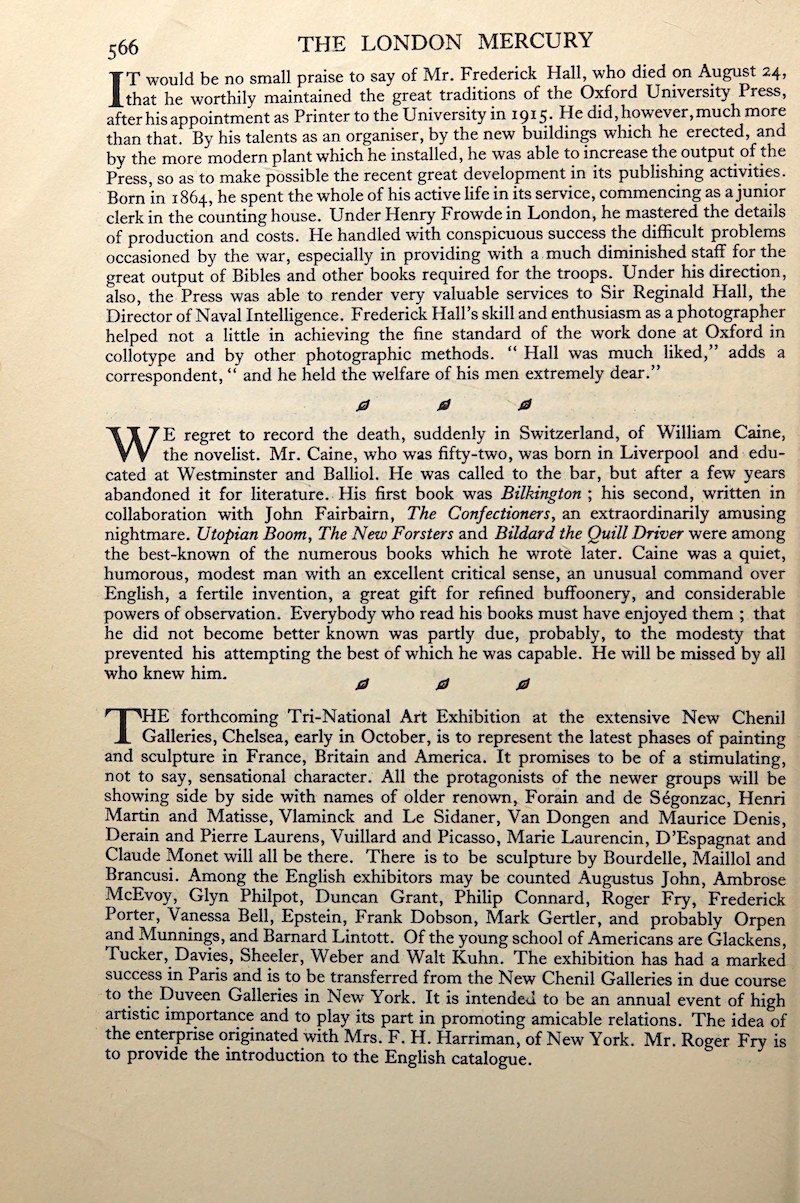
We regret to record the death, suddenly in Switzerland, of William Caine, the novelist. Mr. Caine, who was fifty-two, was born in Liverpool and educated at Westminster and Balliol. He was called to the bar, but after a few years abandoned it for literature. His first book was Bilkington; his second, written in collaboration with John Fairbairn, The Confectioners, an extraordinarily amusing nightmare. Utopian Boom, The New Forsters and Bildard the Quill Driver were among the best-known of the numerous books which he wrote later. Caine was a quiet, humorous, modest man with an excellent critical sense, an unusual command over English, a fertile invention, a great gift for refined buffoonery, and considerable powers of observation. Everybody who read his books must have enjoyed them; that he did not become better known was partly due, probably, to the modesty that prevented his attempting the best of which he was capable. He will be missed by all who knew him (The London Mercury, vol. XII, no. 72, October 1925, p. 566).I’ve already mentioned that the author of The Author of “Trixie” was born 124 years after the author of Dichtung und Wahrheit and eleven days before the author of Le Surmâle were born. A birth notice in a Liverpool newspaper —
Caine — August 28, at 16, Alexandra-drive, Mrs. W. S. Caine, of a son.— and an entry in Who’s Who 1922 both agree, as far as date of birth goes, with the image of the tombstone pictured above, confirming, thus, my parturio-literary allusions to Goethe and Jarry:
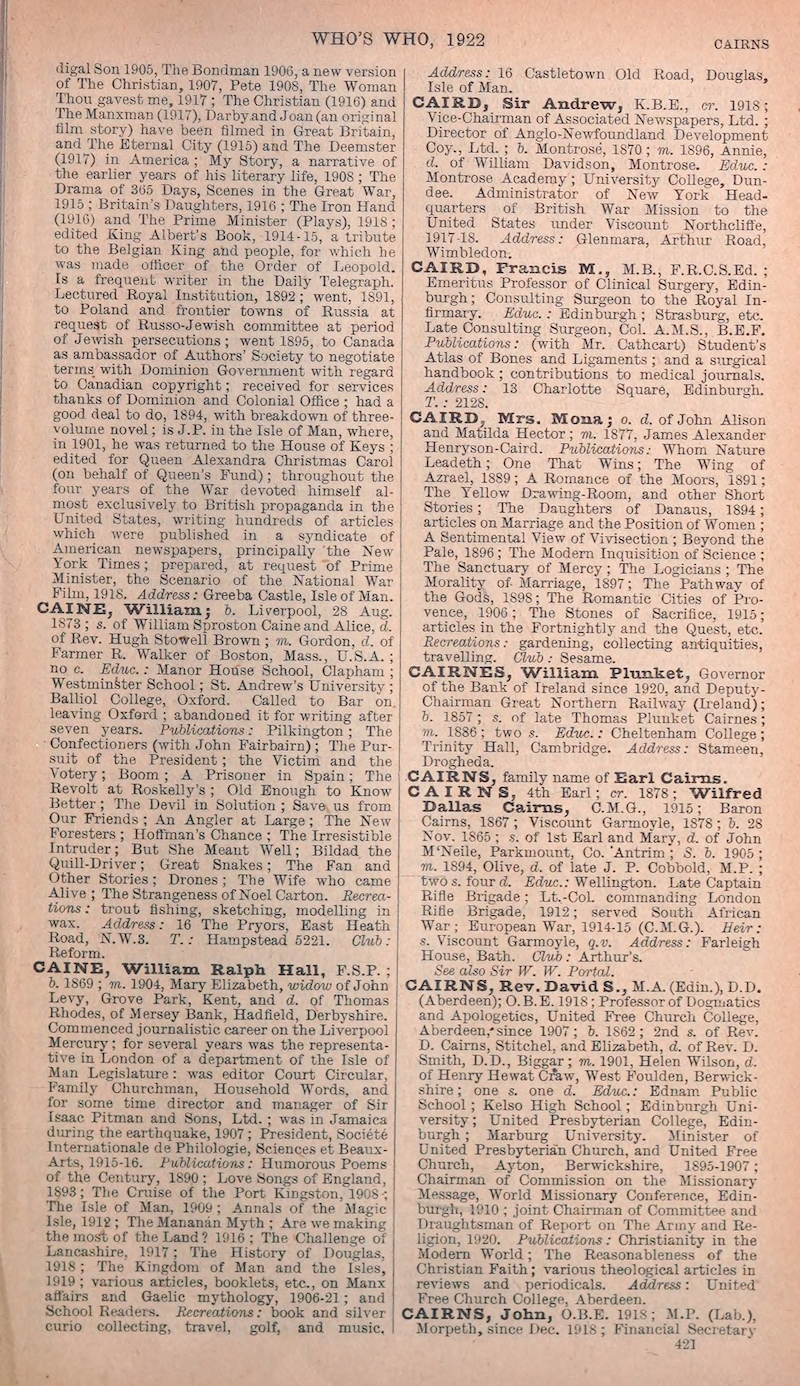
CAINE, William; b. Liverpool, 28 Aug. 1873; s. of William Sproston Caine and Alice, d. of Rev. Hugh Stowell Brown; m. Gordon, d. of Farmer R. Walker of Boston, Mass., U.S.A.; no c. Educ.: Manor House School, Clapham; Westminster School; St. Andrew’s University; Balliol College, Oxford. Called to Bar on leaving Oxford; abandoned it for writing after seven years. Publications: Pilkington; The Confectioners (with John Fairbairn); The Pursuit of the President; the Victim and the Votery; Boom; A Prisoner in Spain; The Revolt at Roskelly’s; Old Enough to Know Better; The Devil in Solution; Save us from Our Friends; An Angler at Large; The New Foresters; Hoffman’s Chance; The Irresistible Intruder; But She Meant Well; Bildad the Quill-Driver; Great Snakes; The Fan and Other Stories; Drones; The Wife who came Alive; The Strangeness of Noel Carton. Recreations: trout fishing, sketching, modelling in wax. Address: 16 The Pryors, East Heath Road, N.W.3. T.: Hampstead 5221. Club: Reform (p. 421).À propos of Who’s Who. The second chapter of the last book Caine published before he died opens as follows:
There are still great numbers of quite unknown people who are not (with me) in “Who’s Who”; but naturally a book of the kind has its limitations. The mere cost of paper and printing makes it impossible to include everybody who, by reason of his or her outstanding insignificance, is eligible. Nevertheless a great deal of heart-burning results from this state of affairs.In his essay on “Extravaganza” which I’ve already quoted from in § 1, Stephen Graham, during the course of his discussion of the differences between English and American humor, includes the above Who isn’t Who entry from Lady Sheba’s Last Stunt:I have often thought that there might be prepared, with good prospect of success, a companion volume entitled “Who isn’t Who.” Then everyone would be accounted for and everyone would be happy.
I do not propose to undertake this work; but if someone should attempt it I commend to him for incorporation the following biographical paragraph. I feel sure that it ought to go in.
Packer, Stanley Frodsham. B. 1873, only s. of Edward Packer of The Blue Duke, Bermondsey, Esq. F.O.S., A.O.B., etc., etc. Educ. Lansdowne House Ac. fr. y. gents. 1890 Bookmaker’s clerk. 1891 Cab shelter attendant; Bill poster. 1892 Envelope addresser. 1893 Private inquiry agent. 1894 Bill broker. 1895 Entertainer; Rabbit skin merchant. 1896 Fried fish shop proprietor. 1897 Servants registry office proprietor; Asylum attendant; Under porter in residential flats. 1898 Beauty specialist. 1899 Piano turner; Chiromantist; Public-house broker; Slate club secretary; Undertaker; Actor. 1900 Circular distributor. 1901 Traveller in corn plasters; Colporteur; Teacher of Physical culture. 1902 Bone dealer. 1903 Bone setter. 1904 Traveller in monumental masonry. 1905 Rent collector. 1906 Band agent. 1907 Waiter. 1908 Proprietor of the De Luxe Boarding Establishment, Ramsgate. 1909 Teacher of dancing. 1910 Traveller in clay pigeons; Traveller in labels; Traveller in loofahs. 1911 Obituary notice agent. 1912 Traveller in fly-papers. 1913 Business adviser; Chewing-gum vendor; Dealer in antiques. 1914 Debt collector; Fine art dealer. 1915 Cinema attendant. 1916 Horse dentist. 1917–1918 Soldier. 1919. Traveller in sausage casings; Sandwichman. 1920 Book publisher: Recreations: none. Clubs: none. Residence: 13, Dog Street, Soho.
It will be noticed that I have not invited you to accompany Mr. Packer beyond the year 1920. For this I have my reasons.
The story-teller who fails to maintain his suspense is doomed. It is partly with the fortunes of Mr. Packer that this tale is concerned. I should be a great fool, I believe, if I were to let you know, before I have well started, what kind of aspect these fortunes are ultimately to assume. To do so would be neither Art nor Business. I close my abstract of Mr. Packer's life with the year 1920, because to carry it further would be to rob myself of the sole advantage which I have over you — namely my power to maintain that suspense which alone shall retain your attention (LSLS: 21–23).
American humour often misses fire when brought to England; much English humour seems very solemn funning in the United States. In the days of Mark Twain and Tom Hood the nations were nearer together in literature than they are now, but the present generation of humorous writers are confined each to his own side of the Atlantic. This seems to be especially the case in books of extravaganza. Don Marquis, though he is almost a second Mark Twain, is unknown in London; William Caine’s riotously funny novels failed of recognition in New York.But back to the entry for Caine in Who’s Who. In subsequent editions, “modelling in wax” is removed from Recreations and to Publications are added, in 1923 (p. 428) and 1924 (p. 438), “Mendoza and a Little Lady”; in 1925 (p. 445), “The Author of Trixie; The Brave Little Tailor (with George Calderon);” and to this edition’s Recreations, a hyphen is inserted: “trout-fishing.” “Lady Sheba’s Last Stunt” is not added to Publications until the 1926 edition (p. 448); in this edition, too, the “Obituary” section (p. xxx) lists a death date for Caine which is in agreement with that implied by the Times correspondent in the obituaries (others may be found in Appendix I: Caine’s Obituaries) quoted above: “1 Sep. ’25.” This date is confirmed by the entry for Caine in The Balliol College Register:‘The Cruise of the Jasper B.,’ ‘The Old Soak,’ ‘Archy and Mehitabel,’ delightful as they are to one at home in both countries, are closed books to the stay-at-home Britisher. Extravaganza intensifies accent. When the cat Mehitabel says: ‘Being Cleopatra was only an incident in my career,’ it needs to be said in hoarse breathing Americanese to have its full complement of fun. Christopher Morley is nearer England; he was a Rhodes scholar, but his clever and artistic extravaganza ‘Where the Blue Begins’ though a ‘bestseller’ in New York was not comprehensible in London. In the same way the humorous writings of Wyndham Lewis, A. P. Herbert, and William Caine do not ‘get over’ in America.
Farce, and even political pasquinade, has more success than extravaganza. Apparently it is easier for the national gaze to adjust itself to the more artificial product. Felix the Cat goes well in both countries. But extravaganza differs from farce as a cartoon differs from Mutt and Jeff. It is much more a matter of Art, and it presents to the reader not laughable absurdity but real life illuminated by the humorous exaggeration of salient features. It is no use saying no one ever had such a long nose as a certain character in a certain book. What you must understand is that the nose is the man. Lady Sheba, in Caine’s amusing tale, is depicted with the most fantastic pen in the world, writing her scandalous memoirs. But then she is the vast exaggeration of the publicity-seeking girl of our age with a passion for the limelight.
Droop, the publisher’s reader who gets half-a-crown for reading manuscripts, is a cartoon of the whole tribe of Droops. The account of Packer the publisher, supposedly taken from a future ‘Who isn’t Who,’ with his marvellous and incredible past, is like a page of Rabelais — [here follows Packer’s entry; his activities for the years 1892–1894 erroneously, or intentionally, omitted].
Hoot, the publicity agent, is like a Simplicimus pictorial outrage — but he is the eternal booster. Hickey, the Bootleg King, is the wild spirit of American banditry ‘canned’ in a flaring canister. It is no use saying no American ever behaved so outrageously — he is the quintessence of hooch, bad whisky, and lynch law poured into one of the ‘hardest guys’ we’ve seen. The frightened English aristocrats so fantastically sketched are cartoons of popular ideas concerning aristocrats. Tutchley, who ‘touches’ so much money, is another fantasy derived from reality.
Every paragraph has its laugh; one laughs at items and one laughs at totals. And when the book is finished — all too soon — one is left in a very good humour, at peace with the world and with ourselves. A cordial geniality carries the story along. It is very English (Graham 1930: 113–116).
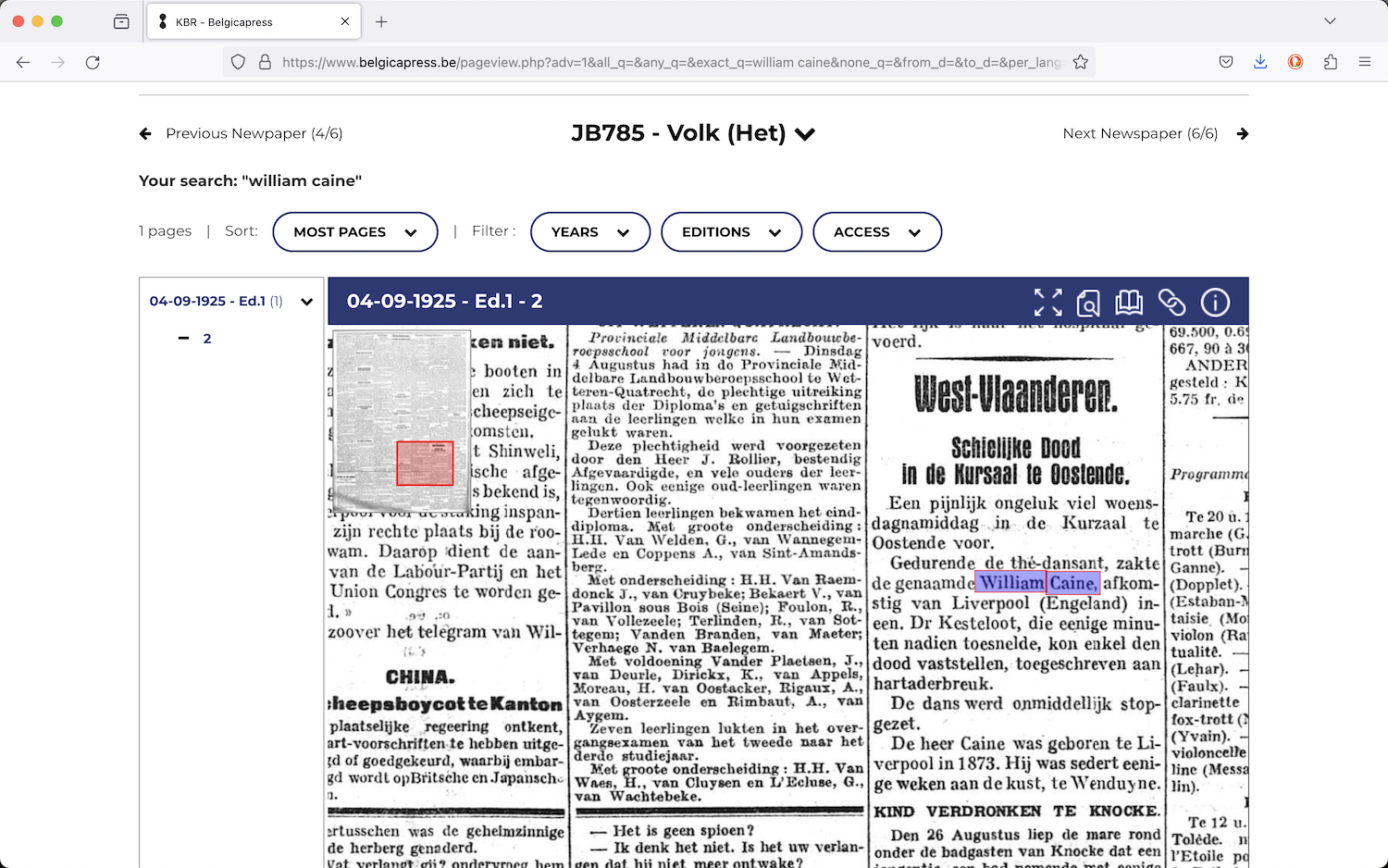
CAINE, William. — b. Aug. 28, 1873; e.s. of William Sproston Caine, of Liverpool, and Clapham. Educ. Westminster; St. Andrews Univ.; Non-Coll. 1892; Balliol Hil. 1893–5 (W.H.F., A.L.S.); 4th Mod. Hist., B.A. 1895; Torpid (1 and 2). Barrister M.T. 1897, N. Circuit; practised for 7 years, then left the Bar and worked as a novelist. Produced 21 novels, Boom, A Prisoner in Spain, &c. m. 1907, Edith Gordon Walker, of Boston, U.S.A. Died Sept. 1, 1925 (Elliott 1934: 206).To sum up: William, the lesser known Caine, author of The Author of “Trixie”, was born Thursday, August 28, 1873, at 16 Alexandra Drive, Liverpool, and died (notwithstanding the date carved into his tombstone) Tuesday, September 1, 1925, at Wenduyne, Belgium. But not so fast. Accounts in the Belgian press, such as the following from Het Volk (4 September 1925, p. 2), tell a slightly different story. Yes, it seems that Caine and his wife during their Belgian holiday had been staying at Wenduyne, but Caine did not die there. Instead, he died during a thé dansant a couple kilometers further down the coast at the Kursaal in Ostend. And this took place, not on Tuesday, September 1, but rather the afternoon of Wednesday, September 2, 1925:
As I try to imagine that Times correspondent dictating from his or her (but most likely his at the time) fretful shorthand over an uncertain phone line to a telegram clerk whose first language is not English who then verbally passes on what they’ve taken down to the telegram operator who types the item and transmits it to the wire service in London where it is but one of the many news items to be similarly broadcast to various newspapers and set rapidly into type with minimal proofing and fact checking, I’m reminded of the sort of situation which the freshly minted Mrs. Humbert Humbert encountered in Nabokov’s Lolita when, on the day of her wedding, a “little interview” with her husbandWest-Vlaanderen.
Schielijke Dood in de Kursaal te Oostende.
Een pijnlijk ongeluk viel woensdagnamiddag in de Kurzaal te Oostende voor.
Gedurende de thé-dansant, zakte de genaamde William Caine, afkomstig van Liverpool (Engeland) ineen. Dr. Kesteloot, die eenige minuten nadien toesnelde, kon enkel den dood vaststellen, toegeschreven aan hartaderbreuk.
De dans wer onmiddellijk stop-gezet.
De heer Caine was geboren te Liverpool in 1873. Hij was sedert eenige weken aan de kust, te Wenduyne.
[Translation by Google: West Flanders. Apparent Death in the Kursaal in Ostend. A painful accident occurred on Wednesday afternoon in the Kurzaal in Ostend. During the thé dansant, the named William Caine, from Liverpool (England), collapsed. Dr. Kesteloot, who rushed to the scene a few minutes later, could only determine death, which was attributed to cardiac artery rupture. The dance was immediately stopped. Mr. Caine was born in Liverpool in 1873. He had been on the coast at Wenduyne for some weeks.]
appeared in the Society Column of the Ramsdale Journal, with a photograph of Charlotte, one eyebrow up and a misprint in her name (“Hazer”). Despite this contretemps, the publicity warmed the porcelain cockles of her heart — and made my rattles shake with awful glee. […] never before had she come under that thrilling rubrique, and it was I who put her there, Mr. Edgar H. Humbert (I threw in the “Edgar” just for the heck of it), “writer and explorer.” McCoo’s brother, when taking it down, asked me what I had written. Whatever I told him came out as “several books on Peacock, Rainbow and other poets.” It was also noted that Charlotte and I had known each other for several years and that I was a distant relation of her first husband. I hinted I had had an affair with her thirteen years ago but this was not mentioned in print. To Charlotte I said that society columns should contain a shimmer of errors (Nabokov 1958: I, § 1, 77).That shimmer muddles the researcher at every turn, threatens to throw the pursuit of Caine entirely off course. Take, for instance, the onomastic antic contained in the following engagement announcement from 1907:
Boston, July 22. — Gordon Walker, a well-known young harpist of Boston, who has been studying for the last two years abroad, has announced her engagement to William Cline [sic], an author and playwright. The wedding will take place next month in London.Such misprints persisted for a good 50 years after the death of the author of The Author of “Trixie”, as per the coquille insisted upon in a piece from the TLS:Miss Walker’s parents live in Arlington, and probably will go to England to be present at the marriage. One of the early wedding gifts of the couple is a furnished house in London.
Thus were it not for The Real Life of Sebastian Knight one might never have discovered the splendid novels of William Carne [sic], who wrote The Author of Trixie (de Jonge 1975: 526)and
Anthony Olcott has also discovered the joys of William Carne [sic], but does not get all there is to be had from the book-list in Sebastian Knight, in an otherwise excellent study of that work (ibid.).The Joys of William Carne [sic] — good title for a book… De Jonge’s consistent misprint is nevertheless quite understandable since, in Caine’s The Strangeness of Noel Carton (1920), the titular protagonist is writing a novel whose protagonist is named Nigel Carter… This novel, indeed, occasioned not a little typographical trouble on the part of reviewers. For instance, Richard King, in his review in The Tatler, used a hybrid of Caine’s protagonist and Caine’s protagonist’s protagonist — The Strangeness of Noel Carter — both times he mentioned Caine’s novel by title. And in the “Books Received” section of Truth (June 2, 1920, p. 1112), the novel is listed as The Stinginess of Noel Carton. I think I’ve already mentioned that the TLS reviewed “this grim mixture of realism and fantasy,” but failed to include the review in its Index. Did I also mention that said Index (vol. I, pp. 526 and 811) lists Caine’s The Irresistible Intruder (1913) as having been authored by that novel’s protagonist, William Fennell? Yes? No? How about that the entry for The Revolt at Roskelly’s in the A. L. A. Booklist mistakenly lists the author as “Caine, William Ralph Hall”? I’m sure, however, that I pointed out in § 1 instances where Archdeacon Roach of The Author of “Trixie” was referred to as Archbishop Roach(e)… In any case, I would like to return to the marriage of the author of that last cited book. The wedding took place, not a month, but only four days, after the engagement announcement — not really enough time, it would seem, for the bride’s parents to travel from Arlington, Mass., USA, to London, England. As the Wellesley College News put it:
The marriage of Miss Edith Gordon Walker, 1900, to Mr. William Caine of London, followed very quickly upon the announcement of her engagement. Mr. Caine is a dramatist and son of a member of Parliament. Mrs. Caine has been abroad for two years continuing her studies on the harp, and has been received very favorably by English audiences (“Alumnæ Notes,” Wellesley College News, October 2, 1907, p. 5).The wedding date is given on the next page of that same issue of the College News:
Caine—Walker. July 26, 1907, in London, England, Miss Edith Gordon Walker, 1900, to Mr. William Caine of London (“Alumnæ Notes; Marriages,” Wellesley College News, October 2, 1907, p. 6).The event had also been announced earlier in one Boston newspaper:
Announcement was made yesterday of the marriage of Miss Edith Gordon Walker of Boston, and William Caine in London on July 26. The bride is a harpist, and Mr. Caine is a dramatist and son of a member of Parliament. Mrs. Caine is a native of Kentucky, but has made her home in Massachusetts for several years. She was graduated at Wellesley in 1900, where her playing and dancing received much attention. Two years ago she went abroad with Mrs. Lilla Viles Wyman to continue her studies. She is a member of the Daughters of the Revolution (“Personal,” Boston Evening Transcript, Wednesday, July 31, 1907, p. 4).And several years later — as part of an article about “bright, beautiful, engaging New England young women, who, in recent years, have become the wives of titled and noted Englishmen” — in another:
Miss Edith Gordon Walker, only daughter of Farmer R. Walker of Arlington, became Mrs William Caine of London, the ceremony being performed in London about July 30, 1907. She is a harpist and a reader of ability; he is an author and playwright and son of William Caine, MP (“Married Foreign Men of Note,” The Boston Sunday Globe Magazine, December 15, 1912, p. 4).
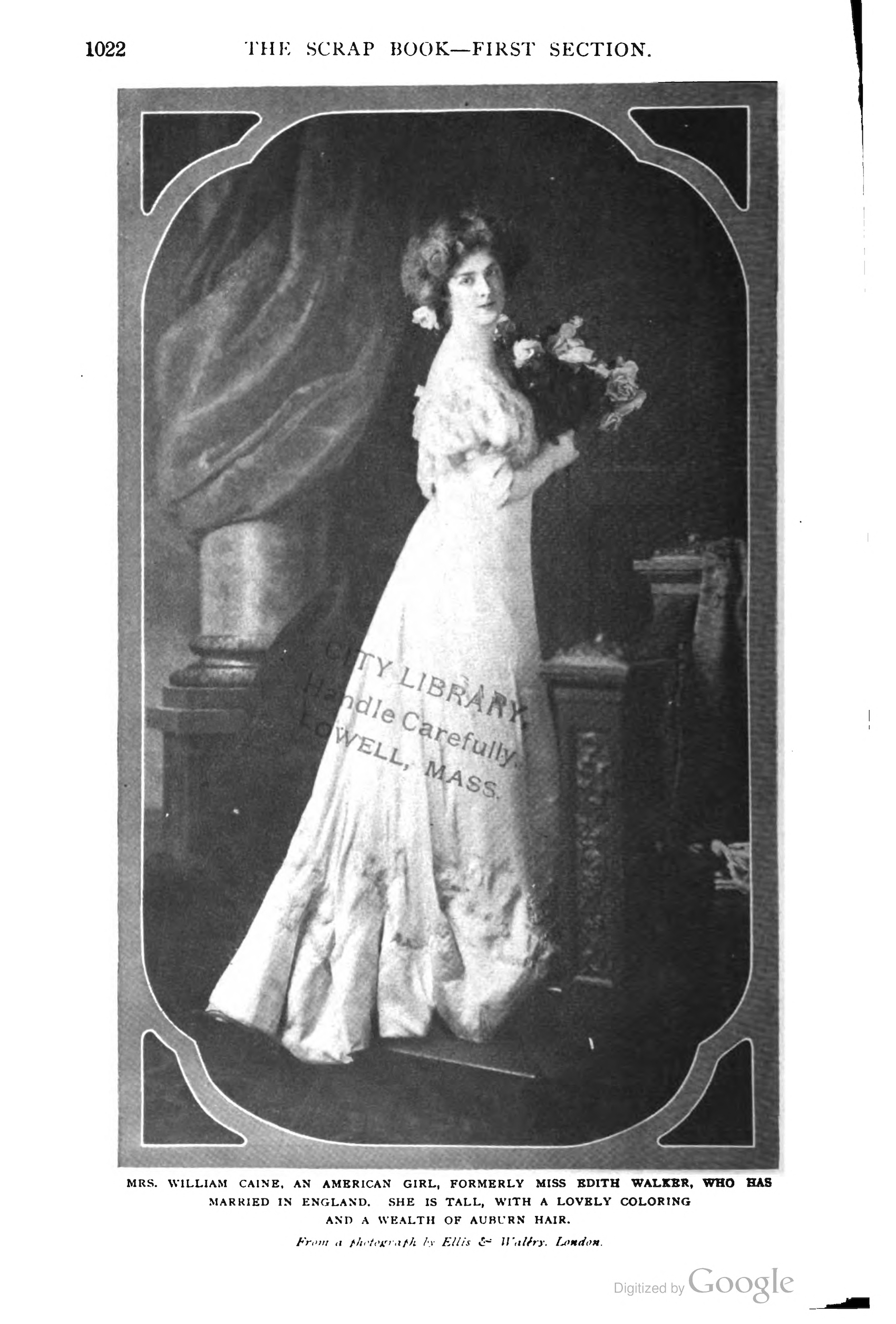
“Mrs. Willam Caine, an American girl, formerly Miss Edith Walker, who has married in England. She is tall, with a lovely coloring and a wealth of auburn hair. From a photograph by Ellis & Waléry, London.” Reproduced from The Scrap Book, vol. 5, no. 6, June 1908, p. 1022.
Boston furnished a charming bride to London in Miss Edith Walker, who recently married William Caine, the son of a prominent member of Parliament. Mrs. Caine is a Wellesley College graduate, and won distinction there both in letters and as president of the Mandolin and Golf Clubs. Her family came originally from the South, although her parents at present reside in Massachusetts. Mrs. Caine is tall, with a lovely coloring and a wealth of auburn hair. She went to London a few years ago to complete her musical education, and it was there that she met her husband. She has been enjoying a trip on the Continent before occupying her London residence — a wedding-gift from the groom’s father (“Types of Fair Women,” The Scrap Book, vol. 5, no. 6, June 1908, pp. 1024).The groom’s father, William Sproston Caine, had been dead since March 17, 1903, so that London residence must have been an inheritance rather than a wedding gift. Whether the implication that Caine’s father was alive and well and prominently carrying on his duties as a member of Parliament as well as being a wealthy doting father several years after his demise was intentional or accidental on the part of the copyeditors, I have no idea. However, a couple months before the above piece was published in The Scrap Book, there occurred a more tragic mistake, having the opposite sort of implication as far as the prospects of The Author of “Trixie” ever getting itself written would have been concerned. The writer of a report on the accidental death while hiking in the Lake District of “Mr. David L. Caine, aged about 23, of 42, Grosvenor Road, London,” notes that
Mr. David Caine was the son of the late Mr. W. S. Caine, formerly member for Barrow. His sisters are Mrs. Lewis, wife of Mr. J. H. Lewis, M.P., and Mrs. Roberts, wife of Mr. J. Herbert Roberts, M.P. Mr. Caine was a barrister, and was interested in journalism and literature. He contributed occasionally to Punch. His sad death has excited general regret (“Fatal Accident at Great Gable; Mr. W. S. Caine’s Son Killed; Great Fall of Rock,” The West Cumberland Times, Saturday, April 18, 1908, p. 5).The regretted hiker was William Caine’s younger brother, David Howard Caine, a medical student. Not only does the piece get the middle initial wrong, and fail to note that the late Mr. W. S. Caine had a second son — a first, rather — who was eleven years older than the unfortunate David and who was the barrister who “contributed occasionally to Punch” and who was still alive (and The Morning Leader, for instance, while getting the middle initial right, specified that David was “the only son of the late Mr. W. S. Caine, M.P.”) — the piece also ignores the existence of a third sister, Mrs. Dorothea Coleman, who was not just married to, but was herself, a medical doctor. Yet that shimmer of errors, though it hampers the researcher today, was a creative resource for Caine, and thus illuminates as much as it obscures my subject. For instance, in his fourth novel, The Victim and the Votery (July 1908), a sequel of sorts to his The Pursuit of the President (May 1907), a British colonial civil servant, Sir Arthur Prendergast, newly returned to London from India, is stalked and captured, for the purposes of a political stunt, by Mrs. Benjefield, a fanatical aspirant to the position of President of the Womanhood Suffrage League who mistakes him for his brother Bernard Prendergast, a Cabinet minister recently promoted to the post of Home Secretary, images of whom figure thus in the pages of the pictorial newspapers. I would like to think that Caine, in this absurd case of mistaken identity, capture, and ultimately escape, paid a sort of comedic homage to his brother who sadly died in a scree slide while out hiking, and who was mistaken, in some reports, for himself. But whether this tragicomic shimmer of errors merely coincided with a piece Caine was already at work on, or whether it formed the seed for the “guignolerie,” as it was subtitled, which he was then able to compose and get published in only three months, I have no idea. There is, however, another scintilla of this shimmer lurking in the Dictionary of Indian Biography which it seems to me Caine deliberately transformed into a sequence of his guignolerie:
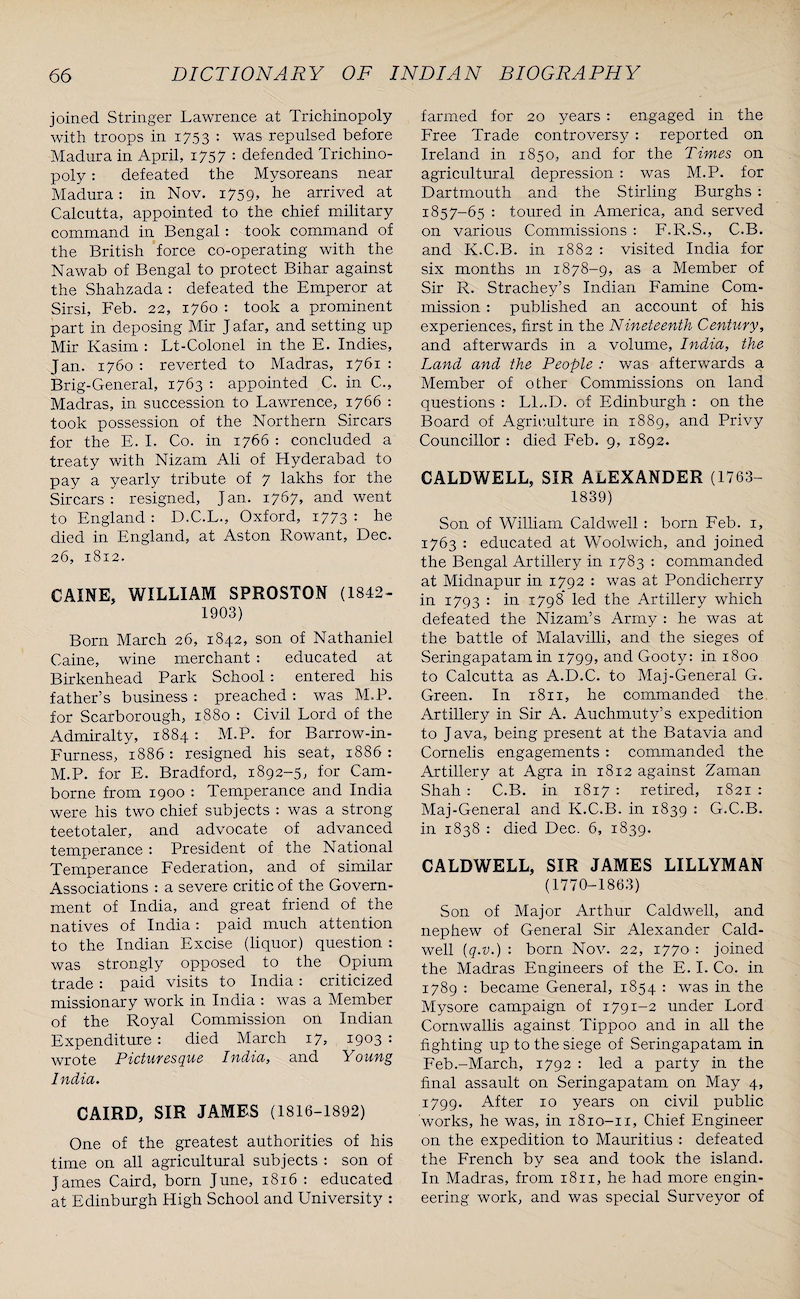
Now, neither William Sproston Caine, the father of the author of The Author of “Trixie”, nor Nathaniel Caine, grandfather of ditto, were wine merchants; they were iron merchants. In the sixth chapter of Caine’s guignolerie, the minor character of Stephen Baines, wine merchant, is pressed into service by Providence to ensure that Sir Arthur Prendergast miss the train to Colwyn Bay, and thus become easy prey for Mrs. Benjefield:CAINE, WILLIAM SPROSTON (1842–1903)
Born March 26, 1842, son of Nathaniel Caine, wine merchant: educated at Birkenhead Park School: entered his father’s business: preached: was M.P. for Scarborough, 1880: Civil Lord of the Admiralty, 1884: M.P. for Barrow-in-Furness, 1886: resigned his seat, 1886: M.P. for E. Bradford, 1892–5, for Camborne from 1900: Temperance and India were his two chief subjects: was a strong teetotaler, and advocate of advanced temperance: President of the National Temperance Federation, and of similar Associations : a severe critic of the Government of India, and great friend of the natives of India: paid much attention to the Indian Excise (liquor) question: was strongly opposed to the Opium trade: paid visits to India: criticized missionary work in India: was a Member of the Royal Commission on Indian Expenditure: died March 17, 1903: wrote Picturesque India, and Young India (Buckland 1906: 66).
Providence, having all eternity to work in, is rightly never in a hurry. Aeons ago its plot against Sir Arthur Prendergast was laid. To-day it was to find its fruition. The infinitely numerous ancestors of Sir Arthur and his brother had been engaged, during the whole lifetime of man upon this earth, in acquiring and transmitting the characteristics, physical and moral, which to-day distinguish the faces of the last pair of Prendergasts from the faces of other men. At the appointed time Dr. Spencer Barnes had committed to paper his Thoughts on Beards. At the appointed time Mr. Raeburn had appeared. It was ordained that the cabin steward should have a razor, that the lady in Colwyn Bay should fall ill. And now it became necessary that Sir Arthur should miss his train. A block in Piccadilly was required. As Providence scorns no method, however obvious, so it ordains no [sic? — should be “any”] instrument, however humble.It selected Henry Ward Beecher, District Messenger, No. 683. It caused him to purchase a banana from a barrow in Coventry Street, and to strew its peel upon the roadway where Piccadilly debouches upon its Circus. This done, Providence let go of Henry Ward Beecher till such time as it should have further use for him, and grabbed Stephen Baines, wine merchant, placed his foot upon the banana skin and cast him to the ground immediately in front of a Vanguard omnibus. The man at the wheel uttered a loud ejaculation of terror, jammed on the brake and brought his vast machine to a sudden halt. Stephen Baines rose from the wood pavement, damned the man who invented bananas and went his way. But the sudden stoppage of the traffic had caused the pole of a dray, a few places down the line of crawling vehicles, to pierce the back of the traveller’s brougham immediately in front of it. And immediately behind this dray was the cab which contained Sir Arthur Prendergast. Note the nicety of Providence’s work. Had Stephen Baines fallen a moment earlier, Sir Arthur’s cab would have been able to turn up Air Street, and no delay would have been occasioned him. In the event he was forced to wait for five good minutes while the Metropolitan Police Force grappled with one other problem.
As Sir Arthur drove into Euston Yard the train he had hoped to make was rolling out of the station (VV: 57–58).
- A birth notice in a Liverpool newspaper. — “Births, Marriages, and Deaths; Births,” Liverpool Daily Post, Saturday, August 30, 1873, p. 3. A near identical notice occurs in the Liverpool Weekly Courier, same date, p. 6.
- This date is confirmed by. — The death date of September 1, 1925, is also authoritatively restated in the Enciclopedia universal ilustrada europeo-americana (Bilbao, Madrid, Barcelona: Espasa Calpe, S. A., 1931, tomo II, p. 815): “CAINE (Guillermo). Biog. Escritor inglés, n. en Liverpool el 28 de agosto de 1873 y m. el 1º de septiembre de 1925. Estudió en la Universidad de San Andrés y en el Balliol College, de Oxford, ejerciendo algún tiempo la abogacía, que dejó, al fin, para dedicarse por completo a la literatura.”
- Engagement announcement from 1907. — “Boston Harpist to Marry; Gordon Walker Announces Engagement to English Author,” Musical America (New York), vol. 6, no. 11, Saturday, July 27, 1907, p. 8. The Walker-Caine engagement was also noted in Vogue (New York), vol. 30, no. 5, August 1907, p. 124-B.
- The Morning Leader. — “Tourist Killed in Lakeland; Accident at Foot of Great Gable; Sad Fate of Son of the Late Mr. W. S. Caine, M.P.,” The Morning Leader (London), Friday, 17 April, 1908, p. 1. Other reports on the death and funeral of David Howard Caine can be found in: “The Climbing Season; Tourist Killed in the Fell District; A Fall of 150-Feet; The Victim a Son of the Late Mr. W.S. Caine, M.P.,” The Yorkshire Evening Post, Thursday, April 16, 1908, p. 6; “Climber’s Fate; Mysterious Death in Lake District; Victim a Londoner,” The Daily News, Friday, April 17, 1908, p. 5; “Climbing Fatality; Fall on a Cumberland Mountain; London Student Killed,” The Standard, Friday, April 17, 1908, p. 6; “Funeral of Mr. D. H. Caine,” The Bolton Evening News, Saturday, April 18, 1908, p. 3; “Funeral of Mr. D. H. Caine,” The Westminster Gazette, April 18, 1908, p. 9.
- Wine merchants. — However, according to an obituary of Caine’s grandfather Nathaniel Caine, the elder brother of this latter, W. S. Caine, had been a wine merchant until 1830 or 1831, when he joined with Nathaniel to take over the business of Rimmer and Son, iron merchants, thus establishing the firm of W. S. & N. Caine. So, both the father and the grandfather of the author of The Author of “Trixie”, W. S. Caine and Nathaniel Caine, had been iron merchants, but the brother of his grandfather, that is, his great-uncle, also confusingly named W. S. Caine, had been a wine merchant before becoming an iron merchant. See “The Late Nathaniel Caine,” The Liverpool Mercury, October 1, 1877, p. 6, and “The Late Nathaniel Caine,” The Liverpool Weekly Mercury, Saturday, October 6, 1877, p. 4.