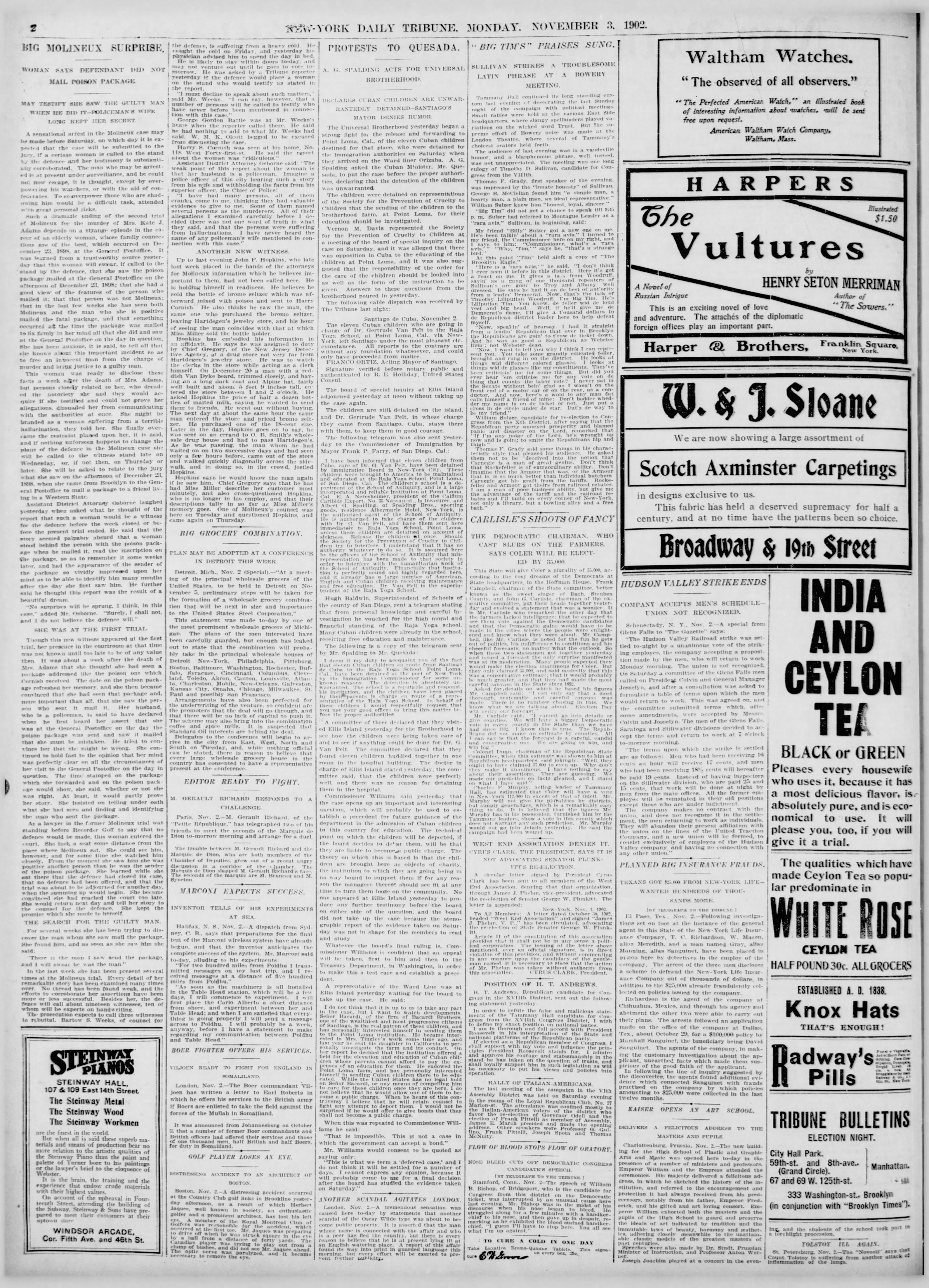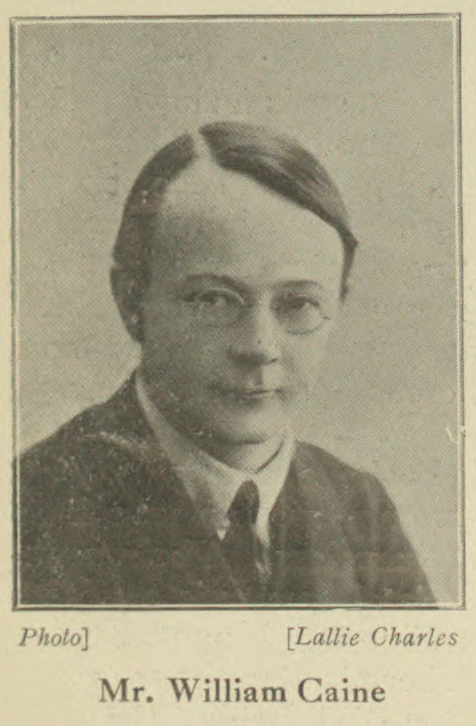
William Caine. Photograph by Lallie Charles. Reproduced from The Playgoer and Society Illustrated, vol. 2 (n.s.), no. 9, June 15, 1910, p. 128.
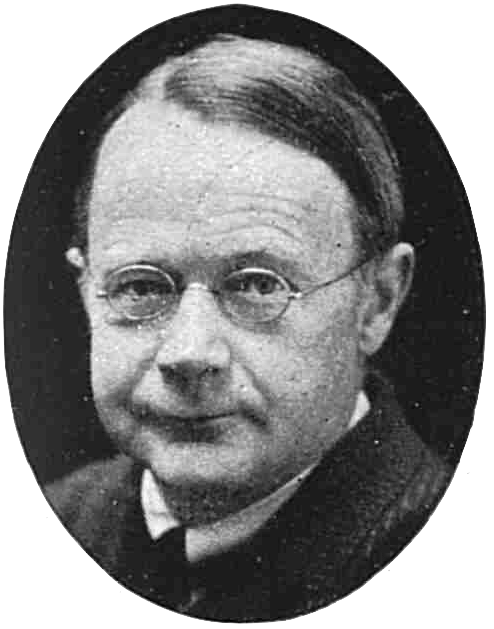
William Caine. Reproduced from The Graphic (London), September 19, 1925, p. 457.
La satira ha una componente di moralismo e una componente di canzonatura. Entrambe le componenti vorrei mi fossero estranee, anche perché non le amo negli altri. Chi fa il moralista si crede migliore degli altri e chi canzona si crede piú furbo, o meglio crede le cose piú semplici di come appaiono agli altri. In ogni caso, la satira esclude un atteggiamento d’interrogazione, di ricerca | Satire has a moralistic component and a mocking component. Both components I would prefer to be foreign to me, and I also don’t like them in others. Those who play the moralist believe themselves better than others and those who mock believe themselves smarter, or rather believe things are simpler than they appear to others. In any case, satire excludes an attitude of questioning, of research (Calvino 1980: 157).Yet, on splaying the boards of The Author of “Trixie” and reading chapter I, section 1, it seems that Caine, despite, or rather, because of his authorial intrusion which seems to imply that he belongs to a better and cleverer club than do the members of the Athenæum, cannot escape the blinkers of simple satire:
“Every man and woman,” said the Bishop of Pontefract, “has one novel in them.”Here, in the first sentence of the novel, is a bishop for Olcott’s mythical chess set (see § 1); ’tis indeed a pity he didn’t actually read the book, but simply took Nabokov at his understandably mistaken word. Also, Master of the Buckhounds and King’s Remembrancer, are, or rather were (the former having been abolished in 1901), real positions, which perhaps contributes to their absurdity. Caine’s use of the defunct position in his penultimate novel may be a sort of parody of a satire, since Mr. Cyril Flowerdew, a character in his third novel and fourth novels, The Pursuit of the President (May 1907) and The Victim and the Votery (July 1908), seems to refract one of his father’s colleagues, Liberal MP Cyril Flower. In August 1892, Flower apparently wanted to be appointed Master of the Buckhounds. Despite “being one of the best-looking and one of wealthiest men in the House of Commons” who “rides and drives the best of horses, and on one occasion won the Parliamentary Steeplechase” on a horse named Home Rule (Pall Mall Gazette 1892: 36–37; Pease 1932: 254), he was rejected by Queen Victoria. On Prime Minister William Gladstone’s recommendation, however, that same monarch elevated the rejectee to the peerage:There are not many clubs where you can hear things as good as that, things so original, so profound, so well expressed. In fact there is but one — the Athenæum. I need not fear to say this, for I am not a member.
They were chatting over their after-luncheon coffee, the Bishop, the Master of the Buckhounds, the King’s Remembrancer and old Mr. Lucas-Gore. Not far away sat Archdeacon Roach, listening to what they were saying while he pretended to read the Church Times.
“I wonder,” he thought, “if I have a novel in me,” and smiled (AT: 9–10).
Mr. Cyril Flower, M.P., is the eldest son of the late Mr. P. W. Flower, of Furzedown, Surrey, and was born in 1843. He was educated at Harrow and Trinity College, Cambridge. He was called to the Bar at the Inner Temple in 1870. He is a deputy lieutenant for the city of London, and was from 1876 to 1883 a lieutenant in the Buckinghamshire Yeomanry. Mr. Flower was a Junior Lord of the Treasury in Mr. Gladstone’s 1885 Administration. From 1880 to 1885 he sat in Parliament for Brecknock, and has since represented the Luton Division of Bedfordshire. He acted as Gladstonian Whip in the late Parliament. In 1878 he married Constance, eldest daughter of the late Sir Anthony de Rothschild. It is believed that the new peer will take the title of Lord Battersea (“The New Peers,” The Nottingham Evening Post, Tuesday, August 23, 1892, p. 4).Other of his “qualifications” included his riding “straight to hounds” and possession of “one of the few salons of Gladstonianism:”
Nobody except the lords-hating Radicals will take exception to the two peerages which have been conferred on the recommendation of Mr. Gladstone. Sir Lyon Playfair is an eminent chemist, and has also earned distinction in affairs, his scheme for the reorganisation of the Civil Service having stood the test of time with success. Mr. Cyril Flower’s deserts, in so far as the country as a whole is concerned, are of a less concrete nature, but he is rich and not parsimonious when party claims are concerned. For the rest, he rides straight to hounds, is a son-in-law of the late Sir Anthony de Rothschild, and his house near the Marble Arch is one of the few salons of Gladstonianism (“Metropolitan Notes,” The Nottingham Evening Post, Tuesday, August 23, 1892, p. 4).Henry Labouchère, founder and publisher of the weekly Truth, was apparently one of those “lords-hating Radicals:”
When I saw it stated in some newspapers that Mr. Gladstone contemplated making a few Peers, I felt that this must be an error. The Liberal Party has, by solemn vote, declared that hereditary legislators are an abuse. For Mr. Gladstone, therefore, to increase their number, except with a view to force some Bill through the Lords, and with the full determination to follow this up by the abolition of all hereditary rights to legislate, would be, I thought, to fly in the face of the political opinions of his Party, and to give himself over, bound hand-and-foot, to its opponents.Flower’s elevation to the House of Lords as Baron Battersea caused a vacancy in the constituency which had, only a month before during the general election, returned him to the seat he had held since 1885. A new election was thus called, and, although the Liberal candidate triumphed in the polling held Thursday, September 29, 1892, it was with a far slimmer majority than that which Flower had enjoyed:It would seem, however, that the error was mine. Sir Lyon Playfair and Mr. Cyril Flower are made Peers. Assuming the propriety of a Liberal Government granting these distinctions, there could not have been a better selection than the former. But, with all respect to Mr. Flower, why should he be an hereditary legislator? He is an amiable and good-looking gentleman, but this is no reason. He married a Rothschild, but this ought not to be a reason. He was the fifth or sixth of the Liberal whips, and had for a short time been a Junior Lord of the Treasury. The dignity is a very important one, and the services of a whip are wearisome. But have Mr. Flower’s former dignities, or his work as a sub-sub-whip been such either to his country or to his Party that I am to have him as a legislator over me, and that his grandchild is to occupy the same position to mine? We must really redouble our efforts to put an end to the absurdity of hereditary rights of legislation (“Entre Nous,” Truth, August 25, 1892, p. 388).
The large decrease in the Liberal majority in South Bedfordshire will be a cause of joy for the Opposition; but it is quite in accordance with our forecast ten days ago. We pointed out then that there were local and personal reasons which would tell against the Liberal candidates both in South Leeds and South Bedfordshire, and that consequently the Liberal polls might be expected to fall off, as they have done, in both constituencies. The candidates themselves were new to the constituencies, and were called upon suddenly to take the places of Members who had a long term of public service to back up their claims on the electors. Mr. Whitebread’s majority of 242 in South Beds is undoubtedly a long drop from the majority of 1,019 which Mr. Cyril Flower obtained at the General Election. Unless Mr. Flower, or, as he is now known, Lord Battersea, is greatly misrepresented, he is partly responsible for the falling-off of the Liberal vote. It is said that at the General Election he advocated the abolition of the House of Lords, yet one of the his first public acts after the election was his acceptance of a peerage, and a seat in the hereditary Chamber which a few weeks before he was ready to overthrow. It is clear, at all events, that the elevation of Mr. Cyril Flower to the Upper House has served no public object, and it would have been better if some other way had been found for rewarding whatever exertions he may have made in the service of his party (The Daily Chronicle [London], Saturday, October 1, 1892, p. 4).Why, you might ask, this long digression on an obscure politician in a chapter ostensibly about Caine’s involving of himself in his own irony? The pursued one of Caine’s The Pursuit of the President is Sir John Cattermole, President of the Board of Enquiries into Army Scandals. He is the father of the most prolix of the book’s eight first-person narrators, Peter Cattermole. The pursuer of the President of the Board of Enquiries into Army Scandals is Miss Ethel Waugh, President of the Womanhood Suffrage League. Miss Waugh hires Mr. Cyril Flowerdew (who is the ward of Peter Cattermole’s uncle and Sir John’s brother-in-law, Frederick Bristow) to be her secretary. (Recall that one of the characters of Wilde’s The Importance of Being Earnest is Cecily Cardew, ward of John Worthing.) Five years before The Pursuit of the President was published, a “scandal of the Oscar Wilde type” occurred:
London. Nov. 2. — A tremendous sensation was caused here to-day by statements that another scandal of the Oscar Wilde type was about to become public property. It is asserted that the man whose name is connected with the affair and who is a peer has fled the country, but there is every reason to believe that he is at present lying ill at an English watering place. A report of this affair found its way into print in guarded language this morning, but every effort will be exerted to prevent further publicity. (“Another Scandal Agitates London,” New-York Daily Tribune, Monday, November 3, 1902, p. 2).Said Schrödinger cat–like peer was none other than Lord Battersea, aka Cyril Flower, who, by the way, had been elected to the Reform Club in March 1880, and had been one of the Junior Lords of the Treasury during the time that his clubmate W. S. Caine, aka the father of the author of The Pursuit of the President, had been Civil Lord of the Admiralty (1884–1885). Chapter VI of the aforesaid novel consists entirely of an “extract from a letter from Mr. Claude Ashton of the Admiralty to Mr. Fortescue Loder, Bar-tender at Putnam’s Saloon, Red Dog City, Smith County, Wyoming” (PP: 107). In 1885–1886, one of Flower’s and Caine père’s Parliamentary colleagues, Sir Charles Dilke, member for Chelsea and at one time President of the Local Government Board, was involved in a scandalous divorce case in which it was alleged, among other things, that he had carried on an affair with the sister of his late brother’s wife, Mrs. Ashton Dilke (note how the surname readily transforms into “Claude” via “Klide”). Mrs. Ashton Dilke was a prominent member of the women’s suffrage movement in England, and her scandalous sister declared in court that she occasionally wrote to Sir Charles at his club, the Reform, to set their rendezvous. Dilke, of course, denied that such a correspondence had ever taken place, denied that such an affair had ever taken place. (Though he did admit in court to having been the lover of the mother of the two sisters…) But, as will be seen in more detail in § 9, Dilke’s denial of something was, for one French writer at least, sufficient proof of the contrary. An opinion shared by the editor of the Liverpool Evening Express, who, some seven months before Dilke embarked on the several years’ project of refuting the allegations and trying to resuscitate his political career, charged Dilke with being a sort of mentor in mendacity to the recently appointed Civil Lord of the Admiralty:
The new Civil Lord of the Admiralty has begun his career in a very promising manner. The most virtuously Radical ministers find it not unfrequently impossible to study what they call the “public interests,” i.e., their own party advantage, without indulging in what a great casuist has called “economy of truth,” of which fact, by the bye, the right honourable baronet who represents Chelsea is a most conspicuous instance. While, however, Sir Charles Dilke’s powers of stating things as they are not are usually reserved for the political stage, his promising colleague, Mr. W. S. Caine, has begun his apprenticeship to official life by making “economies” in private matters, probably by way of geting his hand in prior to exhibiting his powers of mendacity on the public stage. Mr. Caine, who is nothing if not a teetotaller of the purest water, recently endeavoured to wriggle out of a charge fastened upon him by Mr. A. B. Forwood of having lent money on mortgage of a public-house, and so made usurious profit out of a calling which he professes to regard as infamous. Mr. Caine tried to escape the onus of the charge by alleging that he was a “non-acting trustee” whatever that may mean, and that he never signed the mortgage-deed on which “a John Houlding” had informed Mr. Forwood that he had seen his signature. Alas, for M. Caine! The deed in question has not, as he doubtless hoped, “passed afay mit der lager beer into die ewigkeit.” The property was purchased by the Corporation, the deed is in the city safe, and Mr. Forwood, as a member of the Finance Committee, has properly access to it. There, writ fair and large, stands the signature “W. S. Caine,” duly witnessed, to contradict all its author’s virtuous protestations. Mr. Caine is fairly “nailed,” and that not to a statement of fact, but to a declaration that even his most confiding friends will have great difficulty in believing to be a mere slip of memory. Poor Mr. Caine! Ah [sic?] the sweets of office will scarce put out of his mouth the taste of the “biter” that Mr. Forwood has administered to him. Like his namesake of old, he will henceforth bear upon his brow a mark by which all men will know him, as the teetotaller who lent money on a public house, and then, with unlbushing effrontery, protested that he never did so (Evening Express, Saturday, January 3, 1885, p. 3).Of course, that “W. S. Caine” on the mortgage-deed of a public house could very well have been the signature of a different W. S. Caine — though his admitting to being a “non-acting trustee” would seem to justify the charge. Nevertheless, it seems clear to me that the future author of The Author of “Trixie”, whose eye had been trained to see, and “mind to appreciate readily what came before it” by his education at the Manor House School, Clapham, would have readily appreciated the multifarious ironies and comedic potentialities involved in statements such as the foregoing anent his father allegedly making “usurious profit out of a calling which he professes to regard as infamous,” or his father’s fellow Parliamentarian and Reform Club member taking “a seat in the hereditary Chamber which a few weeks before he was ready to overthrow” — an appreciation which will mature to epigrammatic concision in one of the several “negative capabilities” which qualify Stanley Frodsham Packer of Caine’s last novel to become a publisher: because “he knew himself to be […] not unprincipled enough to be a Member of Parliament” (LSLS: 25; see § 11 for the full list). Not long after Cyril Flower qua Lord Battersea took his seat in the bastion of “hereditary legislators” which he had been ready to overthrow a few weeks earlier, Caine matriculated, on October 15, 1892, at Oxford as a student not associated with any particular college; the following year he entered Balliol at the Hilary term, that is January–March (Hilliard 1914: 49; Elliott 1934: 206); and some twelve or thirteen years later, the woman who became his wife introduced British audiences to her “humorous stories, recitations, and harp solos” in the aforesaid “unprincipled enough” MP’s “salon of Gladstonianism” in his mansion near April March, I mean Marble Arch (see § 4 and § 5). Labouchère’s worries about his grandchild being lorded over by a grandchild of Flower’s, incidentally, were rendered moot some six months after Caine published The Pursuit of the President — the Barony of Battersea went extinct upon Flower’s death in November 1907. As for the third of the Bishops’s interlocutors at the opening of The Author of “Trixie”: Old Mr. Lucas-Gore seems to have been a rather long-lived and catholic clubster, showing up in a different club some 38 years after his appearance in the Athenæum. The fourteenth chapter of P. G. Wodehouse’s Ice in the Bedroom begins as follows:
The day which had turned out so well for Freddie’s cousin George had proved less enjoyable for Mr. Shoesmith of Lincoln’s Inn Fields. At breakfast a usually meticulous cook had served up to him boiled eggs which should have been taken from the saucepan at least a minute earlier and not content with this tort or misdemeanour had scorched the toast to the consistency of leather. At lunch at his club, the Demosthenes, he had been cornered by old Mr. Lucas-Gore, whose conversation was always a bleating mélange of anecdotes about Henry James, an author in whom the solicitor’s interest had never been anything but tepid (Wodehouse 1961: 107).That bit about “a usually meticulous cook” ruining breakfast reminds me of a piece which Caine supposedly wrote shortly before he died and which was published posthumously by The Daily Mirror. I have been unable to find that version, and so I quote below from one of several variants which appeared in Australia and New Zealand in late 1926, early 1927:
I go out into the street having just given way to evil temper because my breakfast porridge has been smoked. Being still in an evil temper, I become aware that I am being overtaken; an acquaintance who smiles and calls out, “Good morning” in a cheerful voice. The bad temper in which I am prompts me to turn suddenly down a side street and hurry away from my acquaintance, affecting not to have heard his call. But he knows I have heard it, for I half turned my head when he spoke. This little incident changes the whole appearance of the world for him. A sensitive soul, my rudeness upsets him dreadfully. So much so that when he reaches his office he speaks harshly and unjustly to his secretary, who, having a trifle of a headache, replies saucily, and is discharged upon the spot. Having lost her employment, she has not the means to provide the luxuries which her sick father requires. He dies, and his widow and daughter are reduced first to penury and then to dishonesty.There’s also the chapter on eggs in The Glutton’s Mirror, which starts out:Now, if I had kept my temper it is quite probable that the girl would have kept her situation and her father his life. Who shall say how many people may be affected directly by that girl going to the bad; and, indirectly, how many more must there be? Again, by my surly treatment of my acquaintance I have modified, however slightly, his character for the rest of his life. I have given it a twist towards instead of away from Evil. He can never be as he would have been had I not served him rudely. And every person with whom he ever again comes in contact during the rest of his life will be affected by that twist which I have given him.
My peevish treatment of an acquaintance in Putney to-day may decide the destiny of a South American Empire ten thousand years hence. While, from the burning of my porridge, I can imagine the causes of my bad temper extending back, through the cook and her love for the butcher’s boy, which made her forgetful of my comfort and her duty to something which happened in Lower Egypt during the reign of Mollines the Third (“Why Life Is Important,” The Adelaide Chronicle, October 23, 1926, p. 61).
English cooks know four ways of cooking eggs. They can hard-boil them, fry them, poach them and plain-scramble them. An English Cordon bleu can also sometimes boil them so that they are softer than rocks, but she hates to do it, for it isn’t in the true tradition (GM: 42).An example of such an “English Cordon bleu” overboiling her eggs “in the true tradition” occurs in the first chapter of The Pursuit of the President (quoted in § 9). But I was trying to make a slightly different point about Caine’s humor. Was he a mere mocker of others, a simple satirist of the moods, morals, and methods of his time and place? Or was he something more — a true humorist, open to questioning, using comedy as a research tool rather than a billy club — a humorist who could, perhaps, include himself in Calvino’s pantheon:
Quel che cerco nella trasfigurazione comica o ironica o grottesca o fumistica è la via d’uscire dalla limitatezza e univocità d’ogni rappresentazione e ogni giudizio. Una cosa si può dirla almeno in due modi: un modo per cui chi la dice vuol dire quella cosa e solo quella; e un modo per cui si vuol dire sí quella cosa, ma nello stesso tempo ricordare che il mondo è molto piú complicato e vasto e contraddittorio. L’ironia ariostesca, il comico shakespeariano, il picaresco cervantino, lo humour sterniano, la fumisteria di Lewis Carrol, di Edgar Lear, di Jarry, di Queneau valgono per me in quanto attraverso ad essi si raggiunge questa specie di distacco dal particolare, di senso della vastità del tutto | What I look for in comic or ironic or grotesque or farcical transformation is an exit from the limits and univocity of every representation and every judgment. A thing can be said in at least two ways: a way in which the person saying it means that thing and only that thing; and a way in which, yes, one means that thing, but at the same time recalls that the world is much more complicated and vast and contradictory. The irony of Ariosto, the comedy of Shakespeare, the picaresque of Cervantes, the humor of Sterne, the farce of Lewis Carrol, Edgar Lear, Jarry, Queneau are valuable to me in that through them one achieves this kind of detachment from the particular, a sense of the vastness of the whole (Calvino 1980: 157)Caine dedicated The Author of “Trixie” to his wife’s brother, Edward Fulton Walker (I don’t know why). On the verso is printed the following caveat:
The people in this story are all purely imaginary, with the exception of one of the members of the Committee of Authors, who is intended to be a caricature of myself.The caricature in question occurs towards the end of the book, chapter XVII, section 1:
Sir William Keyne came bustling forward, a thing he could always be trusted to do. “Now, my dear Archdeacon,” he said, “we’re all present and ready to hear what you have to say. So this is your son-in-law, Mr. Dunkle, is it? Permit me to introduce myself, Mr. Dunkle. I am Sir William Keyne, the novelist. It gives me very great pleasure to meet you, Mr. Dunkle, though I don’t happen to have read either of your books. You see, as a member of the Worst Sellers’ Dining Club, I am precluded by my oath from reading any work of fiction which sells more than three hundred and fifty copies in Great Britain. Nevertheless —”Another example of Caine’s sense of humor and use of the comedic method of self-entanglement — a method, Calvino adds, which, like the scientific method, is not the exclusive property of the aforesaid greats, but is available for use by all: “un tipo di rapporto col mondo, che può informare di sé manifestazioni svariate e quotidiane d’una civiltà | a type of relationship with the world, which, by itself, can inform the diverse and daily manifestations of a civilization” (Calvino 1980: 158) — comes from the ninth prose sketch of Smoke Rings, entitled “Of Picnics,” a characteristic paragraph of which runs as follows:“Oh, shut up,” said Chloë. At the same moment she drove the point of her parasol vigorously into the ribs of Sir William. “Now then, Venerable,” she went on, while Sir William fell back gasping and clutching at his side, “which is it to be — Peace or War?” (AT: 233–234).
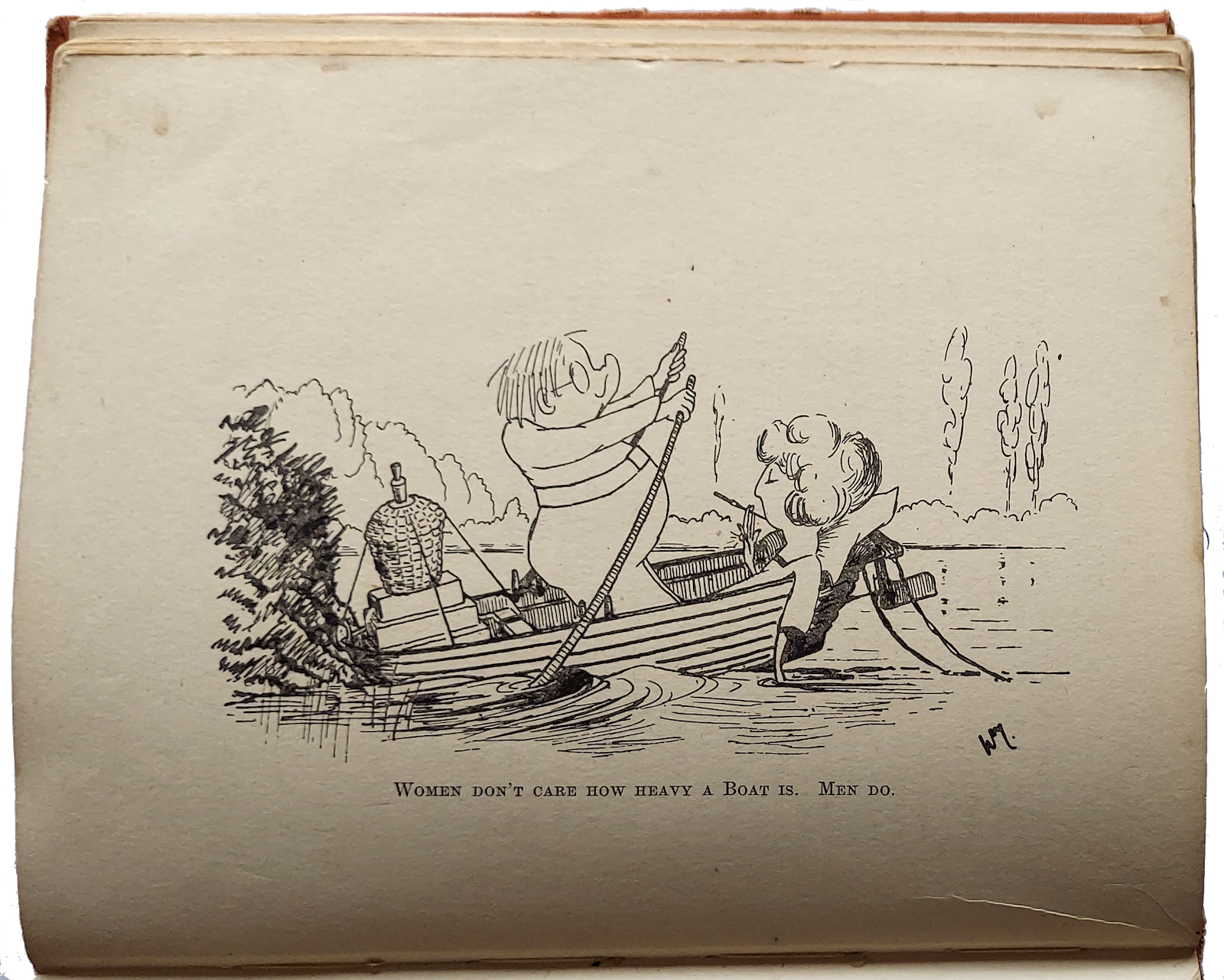
Reproduced from Smoke Rings (London: Stanley Paul, 1926, p. 40).
Women, being seated at their ease in the stern-sheets or up in the bows, don’t care how heavy a boat is. Men do. Women love to lean over the side, trail their pretty fingers in the water and plunge their vision dreamily among the swaying water reeds. They don’t mind how badly the boat is trimmed. Men do (SR: 41).Caine accompanied the piece with a caricature of himself and his wife — “the lazy lady in the punt just starting out on a picnic,” as she described herself in the prefatory note she provided for the posthumous book. The mode of locomotion of the overladen and rather badly trimmed boat in Caine’s caricature seems to be a hybrid of rowing and punting, as the long oars/punting poles appear to be engaged in tholes. Note also the ropes trailing in the water behind the reclining female caricature; these seem to indicate the direction of motion. Is Caine just on the point of trying to pole the boat forwards out of some wild tangle of bankside bushes into which, lacking any navigational help from his nonchalant mate, he has inadvertently rowed the boat backwards? The accompanying letterpress is not among Caine’s best, consisting of a convoluted parade of stereotypes anent the differences between men and women, ending with the mock-biblical moral, “Thus we see how our sins, sooner or later, are sure to find us out.” That is, “men in the beginning abused their strength and greedily relegated the females to the background, when food was going. And now, in the end, women abuse their weakness by compelling men to take them picnicking” (SR: 43). The innocuous, really rather not very humorous illustration takes on another dimension, however, when compared to a similar drawing attributed to Caine’s father, William Sproston Caine.
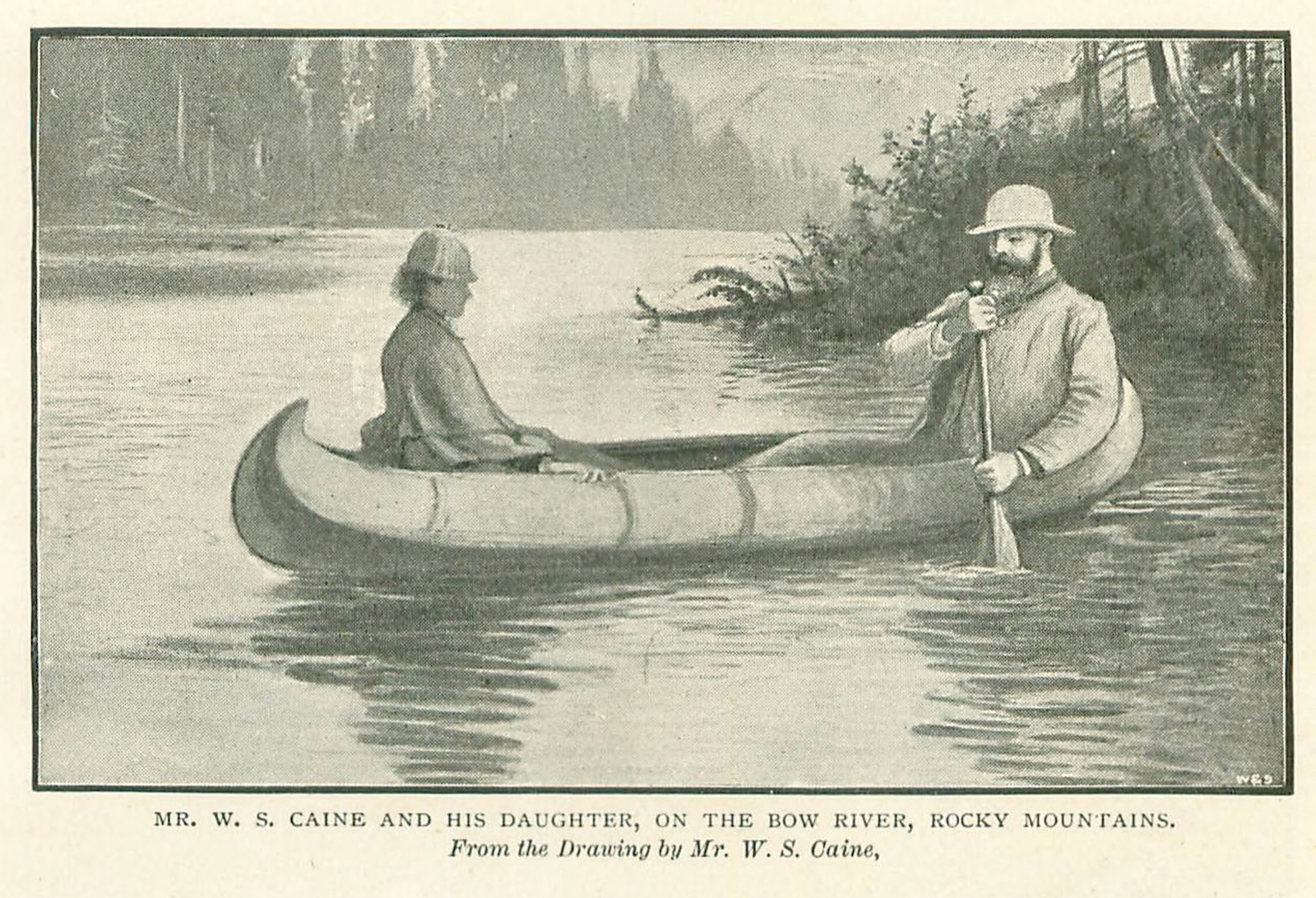
Reproduced from FitzGerald (1895: 417).
The redoubtable champion of the temperance cause is something of a traveller. He has thoroughly “done” India, and has written a book thereon; and he journeyed round the world in 1887–88, thereby fulfilling the primary duty of the ideal member of Parliament.Instead of reproducing a photograph of Mr. Caine, I show on the next page a sketch by himself, wherein he is depicted “paddling his own canoe” in the Rocky Mountains. This sketch was made by Mr. Caine after an abortive day’s fishing in the Bow River; but, perhaps, I had better let him tell his own story: —
“The following day we” (his daughter, Miss Hannah Caine, accompanied him) “explored one of the small streams tributary to the Bow, with a view to learning how to manage an Indian birch-bark canoe. These canoes are so light that a boy can lift one out of the water and carry it on his back. The paddler sits or kneels in the stern and propels the canoe with a broad, single-bladed paddle, steering with a sort of back-stroke that takes a good deal of learning. However, I managed to canoe my daughter up two or three miles of a running brook, and across the beautiful Vermillion Lake, whose banks were a wild tangle of brushwood, poplar, and maple — a perfect blaze of autumn red and gold, out of which sprang sombre pines and cedars. Behind these were the snow-clad mountains, the whole perfectly repeated on the placid surface of the water” (FitzGerald 1895: 416–417).
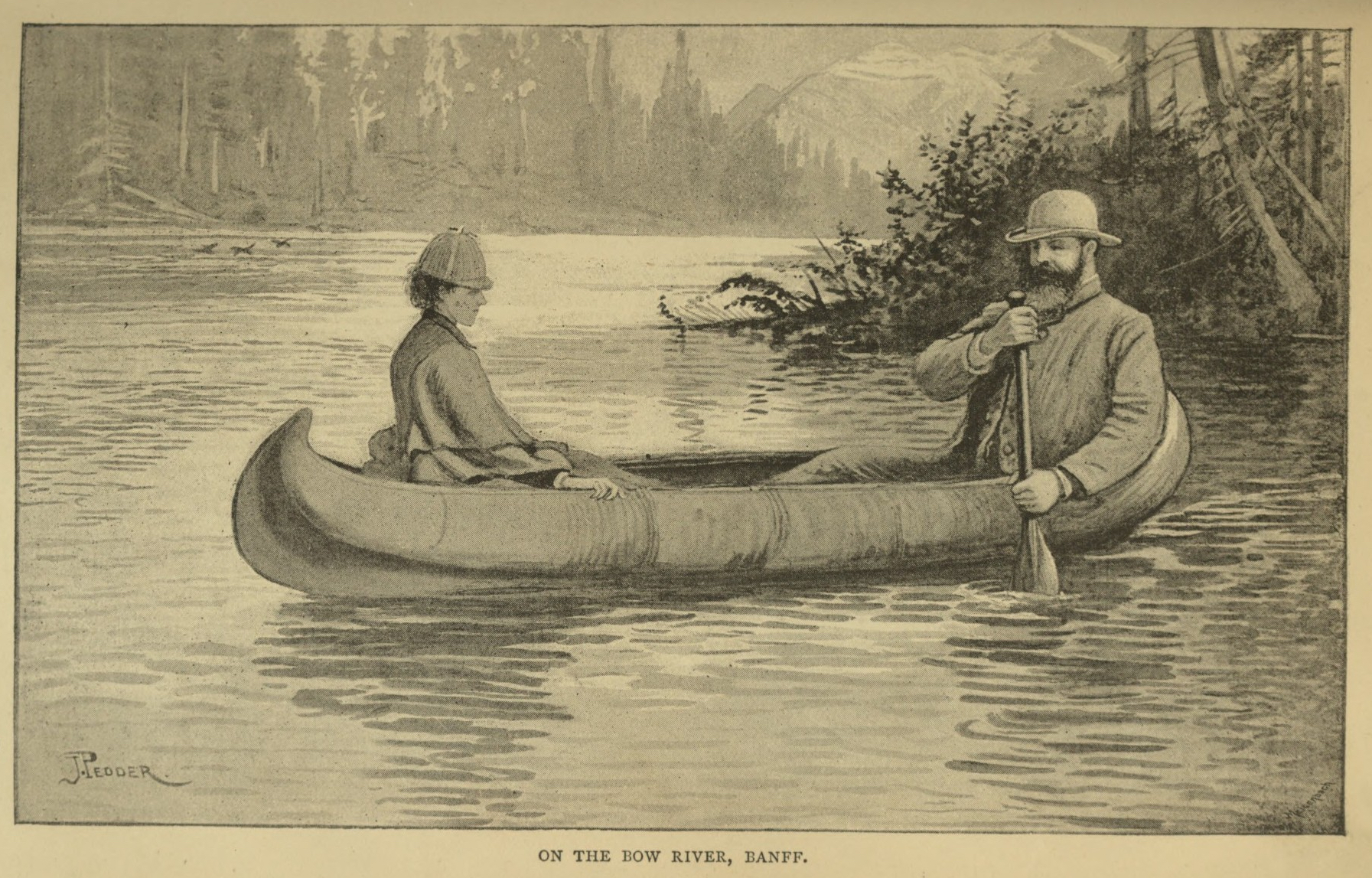
Reproduced from W. S. Caine (1888: 81).
In 1887 H.R.C. went for a voyage round the world with Father. Globetrotting was more unusual in those days than it became later. This was a wonderful “finish” to her education. They went across the Rocky Mountains in Canada, having visited the Great Lakes and Niagara. They travelled through Japan, at that time almost unspoilt, and they spent some months in India. It was to her an unforgettable experience. […] She was a lovely girl and she grew into a beautiful woman, but there was never a grain of conceit in her. She took her good looks as she would any other source of happiness. I am sure that she was glad to be as lovely as she was, for she loved beauty in everything and she realized, as the rest of us who contemplated her did, that her beauty was a gift of God to everyone who came near her (Colman n.d.: 13).A further twist, which may or may not inform Caine fils’s parody of Caine père’s boating prowess, is that the picture as reproduced in the latter’s book, A Trip Round the World (1888), is clearly attributed, in both the List of Illustrations (p. xxii) and in the image itself (p. 81), to J. Pedder. Did Pedder work from an original drawing by W. S. Caine? Or did FitzGerald (or Caine père) mistakenly or intentionally switch the attribution for the purposes of his article? Further confusing matters is that, in the picture as reproduced in The Strand Magazine, the monogram WCS or WSC seems to appear in the lower right corner; this is replaced, in the book, by what looks like “Meisenbach” or “Meigenbach.” Also, in the Strand Magazine image, Caine père seems to be leering at his vaguely rendered young daughter; in the book, he is peering redoubtably into the distance beyond her more detailed, older-looking, downcast face. Such differences are readily clarified, as are my foregoing confused, perhaps even libelous, speculations, by simply glancing at the preface Caine père wrote for his “modest contribution to the literature of travel,” which, he says,
differs — so far as I am aware — from any other of the kind which has yet been published. It is profusely illustrated. I trust more to my pictures than to my inexperienced literary powers, to make this volume acceptable to the public. I wish to acknowledge gratefully the assistance I have had from my old friend, Mr. John Pedder, of Maidenhead, who has evolved the greater portion of the illustrations, with accuracy and artistic skill, from a heterogeneous collection of rough sketches and photographs made by me on my journey (W. S. Caine 1888: ix–x).Or take analytical chemist Walter Gruntle, one of the protagonists of Caine’s second book, The Confectioners (December 1906), as another example of the author’s involving himself in his own comedic transformations. Both of Walter’s parents were also scientists, his father, Andrew Makepeace Gruntle, being “one of those men who almost from their birth seem to be destined to leave an imperishable name” (C: 71). He won, for instance, “a Nobel Prize while he was still in his teens,” thanks to his “production of a carrot and a haricot bean which defied every test of the connoisseur to disprove their genuineness” (C: 72). However, what concerns me about Andrew Makepeace Gruntle for the purposes of this section is the following:
When he was twenty-one he met and married Selina Pryce. On his twenty-second birthday he came running into his wife’s bedroom (she had been indisposed of late), his face illuminated with joy, and in his hand the latest triumph of his fertile brain and his astonishing apparatus.Compare the above passage with the following from John Newton’s biography of Caine’s father (published in 1907, but written at the request of Caine’s family; it’s quite likely, thus, that Caine read it in manuscript or proof before publication):“Congratulate me, Selina,” he cried; “I have just made a perfect sirloin of beef.”
“And I, Andrew,” she said, “I have a son for you,” and she directed the nurse to show Walter to his father.
“Pish!” cried Andrew, “don’t trifle, Selina. Look at this joint. There is not a roll of fat out of place.”
For a moment the maternal instinct struggled in Mrs. Gruntle’s bosom against the ecstasy of the trained scientist who lies in the presence of a masterpiece of Art. She looked once towards Walter’s cradle (let her not be blamed, the brute lurks somewhere in every human being), but the sirloin magnetically drew her eyes to itself, and her better nature had its way.
“Oh, Andrew,” she whispered, “how wonderful it is!” and she took the joint reverently into her hands.
“You will want some horse-radish for this,” she said presently. “Do you not think that old dancing gloves, macerated carefully in sulphuric, would answer capitally?”
“Selina,” said Andrew, “you are a wife indeed.”
“I will see what I can do this afternoon,” she said, “but just now I do not feel equal to any serious work. We women are sadly handicapped. Will you,” she asked, unconsciously proving her words, “will you look at the child?”
“Selina,” he said sternly, “you must fight this down.”
“I will try, Andrew,” she said humbly, as he carried the sirloin back to his laboratory (C: 73–74).
On March 24, 1868, William Sproston Caine and Alice Brown were married by the Rev. J. P. Chown in Myrtle Street Baptist Church, Liverpool. The young people were popular, their families were highly esteemed, and a crowded company assembled in the church to do them honour. The two then united were in all the deeper concerns of life in absolute agreement. Their principles they held in common, their interests were identical, and to the end their mutual affection remained unabated, “a joy for ever.”The honeymoon was spent in an unique way. Mr. Caine had no difficulty in combining business with pleasure. He had a dog-cart constructed to carry the bride’s box under the seat, and together they toured in Wales for six weeks, calling upon the customers of the firm. The hotelkeepers, in honour of the occasion, refused to charge for the entertainment of the bride.
Their first home was at River View, Seacombe, Cheshire. They retained their membership with the Myrtle Street Church, and crossed the river by the old steamboat twice each Sunday to attend divine service, suffering many a wetting in breezy weather on the open woodwork of the old pier. They began, as they continued, holding open house for their many friends, and particularly for those who were away from home. Referring to this laudable custom, Mr. James Smith writes: “I shall never forget the kindness then extended to the youth with few friends, living in lodgings, and spending his days in a Liverpool office.”
They remained at Seacombe for three years, removing in 1871 to No. 16 Alexandra Drive, Princess Park, Liverpool. Here the greatest domestic trial of his life fell upon Mr. Caine, in the prolonged and dangerous illness of his young wife. All through the long dark days of anxiety and suffering, he was most assiduous in his attendance at the bedside, nursing tenderly night and day. It was a hard exhausting fight for life, in which affection and skill happily won. To help Mrs. Caine back to sound health, they moved in September 1874 to Cliff Villa, New Brighton, remaining there until 1876, when they took up residence in Liverpool again, in Rodney Street (Newton 1907: 12–13).
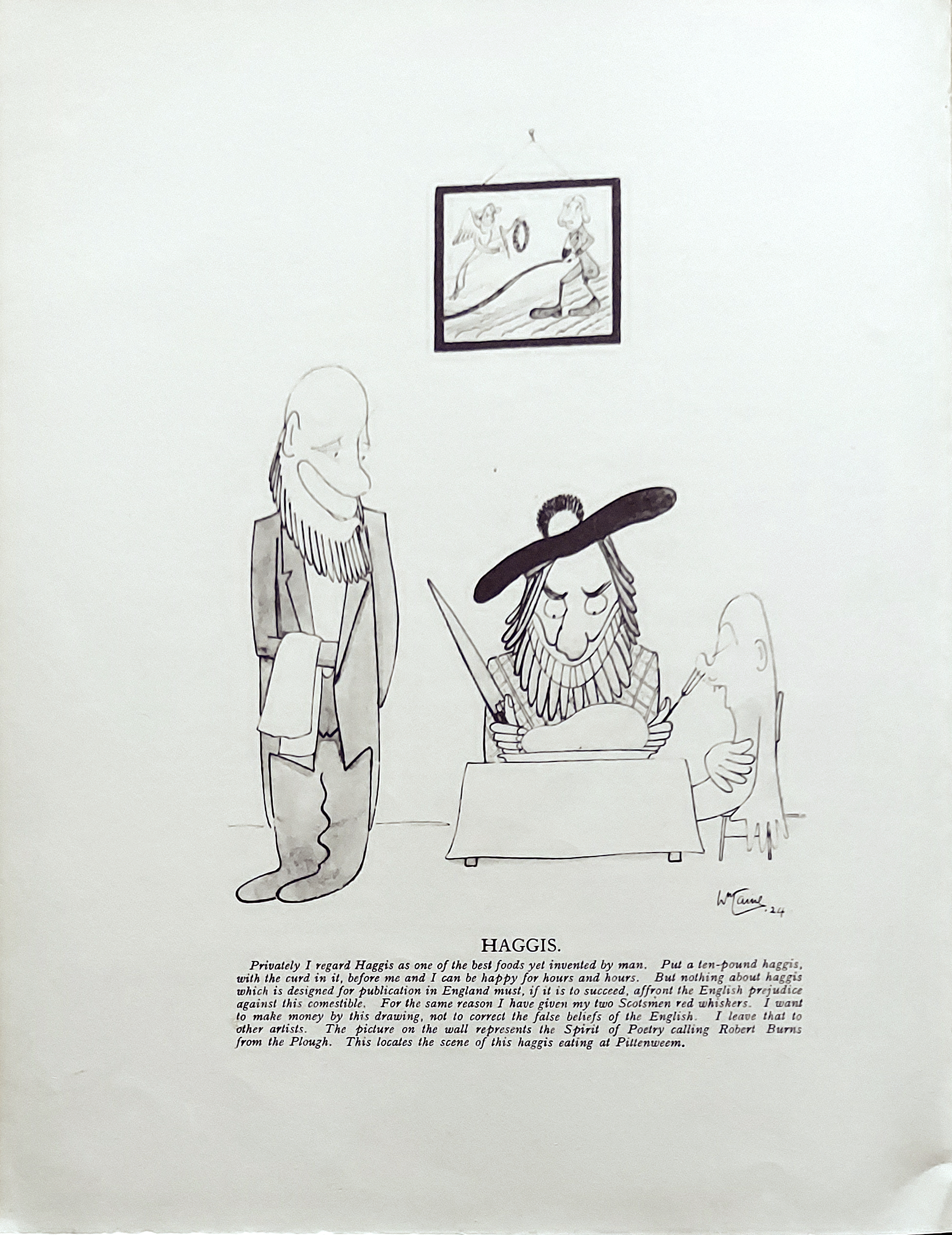
“HAGGIS. Privately I regard Haggis as one of the best foods yet invented by man. Put a ten-pound haggis, with the curd in it, before me and I can be happy for hours and hours. But nothing about haggis which is designed for publication in England must, if it is to succeed, affront the English prejudice against this comestible. For the same reason I have given my two Scotsmen red whiskers. I want to make money by this drawing, not to correct the false beliefs of the English. I leave that to other artists. The picture on the wall represents the Spirit of Poetry calling Robert Burns from the Plough. This locates the scene of this haggis eating at Pittenweem.” Reproduced from The Glutton’s Mirror, p. 46.
My fondness for haggis used to trouble me a good deal at one time. I didn’t see how a pure bred Manxman could enjoy haggis, seeing that the Isle of Man is practically a Suburb of Liverpool. But one day all was made clear to me by a learned Highland Genealogist who told me that the Caines are really MacIans all the time. It seems that this sept of the MacDunkles, fearing trouble with the police in the year 906 B.C., sailed away en masse from their homes by Loch Tuchy and settled on Man. Hence me. After that I have always eaten haggis without shame. The thing is in my blood. It is, in a way, my duty to eat haggis. However, I compromise by not reading Burns’ Ode aloud while I am eating it. Thus I remain partially loyal to Liverpool (GM: 47).That bit about the Caines being “really MacIans all the time” ties in with a later writer’s prim onomastics, which might have amused the author of The Author of “Trixie”:
There are several variants of the surname Cain, and among them are Cane, Caine and Kain, but none of them are baptismal. Life was cheap in the Middle Ages, and murder too much of an everyday occurrence to cause horror or deep indignation. But even the most hard-bitten ruffian would shrink from giving the name of the fratricide to his own infant son. The late W. S. Caine, who was a fervid politician, was often chaffed by his opponents about his supposed descent from the murderer of Abel. But the names mentioned are local and originate in the French town of Caen (Bowman 1932: 88).And one more item, also involving food. The first half or so of a Rabelaisian story entitled “Christmas Fare” (from What a Scream!, 1927) takes for its starting point Caine’s mother’s father Hugh Stowell Brown who was minister of the Myrtle Street Baptist Church, Liverpool, from 1847 until his death in 1886:
When I was a little boy I always went to spend Christmas at the house of my grandfather. So did my father, my mother, and my three sisters; but never mind about them. They don’t come in.Caine touches again on the Reverend Brown’s proclivities later in the story: “My grandfather always finished his Christmas dinner with a spoonful or two of Stiltonised maggots — for being a drinker of strong ale and a smoker of plug tobacco, he cared nothing for dessert — but I have never felt that cheese has its place in any serious meal” (WS: 263). Brown’s love of strong ale, of course, contradicted Caine’s parents’ principles of total abstinence from alcohol. In the third volume of his memoirs, Sixty Years in the Wilderness, Punch writer Henry W. Lucy touches on the conundrum:My grandfather was the minister of a very large and well-to-do Baptist chapel, and as he was a remarkably sensible man he saw to it that his congregation paid him handsomely for the trouble he had in saving their souls for them, most of them being engaged in gambling on cotton futures.
His was a robust religion, and he believed that its exponent should himself be robust. There was nothing whatever of the ascetic churchman about my grandfather. He had no use for mortification of the flesh. At the same time, he was no pamperer to it. His tastes were extremely simple. He loved such things as beef and bread and beer, and lots of them. He smoked the strongest plug Cavendish, which was smuggled ashore by several sea-captains, who were members of his congregation.
If he had a favourite food it was Stilton cheese, which he nursed with his own hands into the proper condition of rottenness — namely, one-third cheese to two-thirds maggots. He ate enormously of this cheese as he did of everything else that came his way. He liked to see his board groaning with victuals and surrounded by a large company of sea-captains and cotton brokers, all tucking in and all roaring with laughter. Homer could have done justice to these feasts. I can’t.
The house of such a man was exactly the sort of house in which a little boy could be sure of spending a happy Christmas holiday. Always well supplied with food, at Christmas the place became plethoric; for all my grandfather’s hundreds of friends knew what a fine appetite he had, and used to send him eatables of one sort or another, in token of the great goodwill they bore him. One would send him a barrel of apples, another a box of oranges, a third a Melton Mowbray pie, a fourth a keg of oysters, a fifth a ham, a sixth a brawn, a seventh some pheasants and a hare, and so on.
Below stairs the premises took on the appearance of a provision-dealer’s shop. The larder was a picture by Snyder. The store-cupboard was unreal. I wish I could tell you that I still dream of that store-cupboard.
All Christmas day I used to eat as a sheep does. For my breakfast I would have, let us say, a couple of fried eggs and a few rashers of bacon, followed by a slice or two of tongue, and a good wedge of Melton Mowbray pie, with toast and marmalade à indiscretion.
After breakfast, until we set out for chapel, I would consume, by suction, oranges which I had carefully softened between my hands, bored with a hole, and plugged with a lump of sugar.
On our return from chapel luncheon was immediately served. This was a cold meal, its principal feature being a colossal round of spiced beef, a food of which I was inordinately fond. Three or four helpings of this, followed by some apple tart and a couple of plates of trifle, generally sufficed me, for I was not the boy to ruin my Christmas dinner by over indulgence at luncheon.
More oranges, a few apples, a box of dates, a pound of ginger, another of figs, a bottle of French plums, a handful of raisins and almonds, some crystallized fruits, some chocolates, some Edinburgh rock, some Everton toffee, and similar light foods, carried me on till teatime, when I got seriously to work on muffins, plum-loaf, shortbread, Eccles cakes, jam puffs, and other bready things.
After tea I made it a rule to eat nothing till dinner. I might nibble a sugary biscuit or two, or suck a few dozen bull’s-eyes, just to keep my jaws limber, but that would be positively all. Dinner — for which the whole day had been no more than a preparation — found me accordingly in perfect condition to do it justice.
As we generally sat down some twenty strong, the turkey had to be a stout one, and it was. Its effect, as it replaced the débris of the giant turbot, was alpine. My grandfather was a big man, but when the turkey was placed in front of him he was practically eclipsed. I don’t know how many pounds that turkey used to weigh; probably they reckoned it by the stone, or even by the hundredweight. At any rate, it was always a very fine bird, and there was never any question of there not being enough. The sausages, too, never seemed to give out. However many dozen helpings of turkey you had there was always a sausage to accompany each one.
Then, the gas having been sacramentally extinguished in marched the pudding, triumphantly ablaze. The mince pies followed, and the creams and jellies and the tipsy-cakes and the rest of the sweet things.
One tried them all.
I don’t say one succeeded. One did one’s best.
Thereafter, dessert: pineapple, bananas, — a rare treat in those days — pears, more oranges, more apples, more dried fruits, more crystallized fruits, nuts, more chocolates, burnt almonds, candied violets, sugared rose-petals, olives, breadcrumbs.
In the crackers we pulled there was sometimes to be found a little inferior pink sweet, very shiny and hard. One ate that, too. On the Christmas-tree in the drawing-room hung small cupids made of plaster-of-Paris. I am told that in my very early years I took kindly to these, as also to the coloured glass balls which hung beside them. The candles I never touched.
Everyone knows that it is by the impressions which we receive in our early youth that our characters are formed. No one, therefore, need be surprised that soundly educated as I was in the keeping of Christmas, I have always regarded this festival with a peculiar affection; and, with a peculiar enthusiasm, that duty to the cultivation of which Christmas Day is especially dedicated — the duty, I mean, of filling our stomachs and thus maintaining in our bodies that life which has been given to us.
There is a lot of very foolish and wicked talk made about what is called the Sin of Gluttony. It is a perfectly safe assumption that the first moralist who condemned hearty eating was a dyspeptic, and that his condemnation was prompted by nothing finer than common jealousy. Being unable himself to assimilate anything but a peptonized meat-lozenge, he stigmatized as evil that which he vainly longed to do.
Because he couldn’t take part in the jolly gormandizing, he did his best to spoil the fun of those who could. Since no amount of edibles could make them physically uncomfortable, he vowed to give their consciences something about which to be troubled. The worst of it is that he succeeded. Ever since his time all moralists, with defective alimentary systems — which is to say nearly all moralists — have preached the wickedness of those who enjoy food; and not alas! without effect.
To such good — or bad — purpose have these green-eyed monsters talked that gluttony now ranks, quite as a matter of course, and without a word of protest from anybody, as one of the Seven Deadly Sins.
That it is our duty to eat up and enjoy it, hardly, I think, requires to be argued.
If we don’t eat, what happens? We die, don’t we?
There is no surer way of committing suicide — though there are many more pleasant and more rapid — than to decline to eat. The moralists, bless them, are very ready to condemn any form of self-destruction. And they won’t hear of anybody starving himself to death.
Well, I am with them there. I don’t believe that we were put into this world in order to shuffle out of it again. Since we’re here, it’s evident that we’re intended to stay here, and as long as possible.
Mark that! As long as possible.
That means that we have not only to eat, but to enjoy eating: because it’s a well-known medical and scientific fact that food you don’t enjoy does you no good. It doesn’t nourish you. In other words, you die quicker if you don’t enjoy your meals than if you do.
Very well, then, your duty, as I said before, and as I shall say again, if I please, is to eat up and enjoy it. And it’s no good trying to eat up and enjoy meagre rations. Enjoyment only begins when the necessities of the frame have been satisfied, and you begin to eat for the aesthetic pleasure of eating, as opposed to the mere filling of a void.
Enjoyment, in short, depends upon there being present a large excess of food beyond what the eater can possibly contain, a reassuring and challenging exuberation of alimentary substances. Thus, we see that it is our duty to eat up and enjoy it.
Our forefathers knew this.
They didn’t know very much. Compared with us, of course, hey were practically imbeciles. But they knew this. And so they have properly set aside one day in the year for the solemn celebration of a feast which should remind us by its ritual of our obligations towards our bodies, and towards the priceless possession of life, whereof those bodies are the tabernacle.
It was hardly by chance, I think, that this day was fixed during that period of the year when turkeys are in season. Lunatics, by modern standards, though our forefathers were, they recognised a good bird when they got their tooth into it (WS: 254—260).
On one occasion within my knowledge that other stern, unbending teetotaller, W. S. Caine, bowed his head in the house of Rimmon. It happened in 1886, at the beginning of the schism in the Liberal Party, when Caine gave a dinner at the Devonshire Club in honour of John Bright. The heat of political passion generated thirst. When the wine bill came in, Caine must have studied it with natural repugnance, aggravated by its excessive amount.He had a family grievance of his own in the matter. His father-in-law, Hugh Stowell Brown, in his day a famed preacher in Liverpool, had a blameless desire for bottled stout at his meals. He found no supply of the beverage when he visited his son-in-law at his house by Clapham Common. After for some time suffering the privation with Christian patience, he struck. His ultimatum may be summed up in a phrase adapted from the rigid rule of the mercenary Swiss troops of the Middle Ages:
“No bottled stout, no father-in-law.”
After a period of ineffective passive resistance, Caine capitulated, and his esteemed visitor was thenceforth comforted at meal-times with flagons of stout (Lucy 1916: 240–241).
- Master of the Buckhounds. — See the relevant wikipedia article.
- Rejected by Queen Victoria. — Jordaan (2022: 351): “Cyril’s peerage didn’t get him anywhere in one particular quarter: Queen Victoria vetoed him for an appointment with the Royal Household.” To this sentence Jordaan adds a footnote: “According to Sir Algernon West, he desired to be appointed Master of the Buckhounds, a now-abolished post responsible for the royal hunting pack.” Both this note and the reference to West on page 348, seem to refer to the same diary entry for August 8, 1892: “Cyril Flower wanted a Peerage, which surprised me — and the Buckhounds, which cannot be” (West 1922: 46). To this, West (or his editor) added a footnote: “He got it, with the title of Lord Battersea.”
- Several variants which appeared in Australia and New Zealand. — “Why Life Is Important,” The Advertiser (Adelaide), Saturday, October 16, 1926, p. 20; “Why Life Is Important,” Kalgoorlie Miner (Western Australia), Thursday, October 21, 1926, p. 7; “The Immortality of Actions,” New Zealand Herald (Aukland), Thursday, October 21, 1926, p. 10; “Why Life Is Important,” Adelaide Chronicle, Saturday, October 23, 1926, p. 61; Untitled, Christchurch Star (New Zealand), Monday October 25, 1926, p. 12; “Why Life Is Important,” Western Argus (Kalgoorlie, Western Australia), Tuesday, October 26, 1926, p. 19; “The Immortality of Actions,” Scone Advocate (New South Wales, Australia), Friday, October 26, 1926, p. 4; “The Immortality of Actions,” Western Star (Riverton, New Zealand), Tuesday, November 9, 1926, p. 3; “The Immortality of Action,” Manawatu Herald (Foxton, New Zealand), Saturday, November 20, 1926, p. 1; “Of No Importance. Novelist on Death.” Brisbane Telegraph, Monday evening, November 29, 1926, p. 5; “Immortality of Action,” Waipa Post (Te Awamutu, New Zealand), Thursday, December 16, 1926, p. 6; “Immortality of Action,” Waikato Independent (New Zealand), Thursday, February 3, 1927, p. 2. I have not yet been able to find the original piece as published in the London Morning Post, since the British Newspaper Archive does not hold digital versions of this paper later than December 31, 1909, and I do not currently have access to libraries stocking the physical volumes.
- Hannah Rushton Caine. — “Births, Marriages, and Deaths; Births,” The Albion (Liverpool), February 22, 1869, p. 3; “Death of Lady Clwyd; Social Worker,” Liverpool Daily Post, Tuesday, January 2, 1951, p. 5; “Death of Lady Clwyd,” North Wales Weekly News, Thursday, January 4, 1951, p. 7; “Lady Clwyd; Her life an inspiration,” North Wales Weekly News, Thursday, January 11, 1951, p. 4. For Caine’s birth and that of his youngest sister Ruth, see, respectively, “Births, Marriages, and Death; Births,” The Daily Post (Liverpool), Saturday, August 30, 1873, p. 3, and “Births, Marriages, and Deaths; Births,” The Liverpool Mercury, Saturday, December 2, 1871, p. 3.
- Coordinating the expense fund. — The Daily Post (Liverpool), Wednesday, August, 20, 1873, p. 1: “Expense Fund. Lady Students v. The Senatus of Edinburgh University. Mrs. W. S. Caine, Alexandra-drive; Mrs. Charles Holland, Liscard-vale, New Brighton; and Mr. J. B. Cooke, 19, Brown’s-buildings, will receive any Contributions in aid of the above.” See also the wikipedia article on the Edinburgh Seven.
- Hugh Stowell Brown. — In addition to W. S. Caine (1887) and Smith (1901), see also the relevant article in Wikipedia.