I. Books by William Caine
Pilkington. March 1906 | The Confectioners. December 1906 | The Pursuit of the President. A distraction in five flights. May 1907 | The Victim and the Votery. A guignolerie. July 1908 | Boom! A novel of the century. October 1909 | A Prisoner in Spain. A romance. April 1910 | The Revolt at Roskelly’s. November 1910 | The Devil in Solution. May 1911 | Old Enough to Know Better. November 1911 | An Angler at Large. December 1911 | Save us from our Friends! May 1912 | Hoffman’s Chance. October 1912 | The New Foresters. June 1913 | The Irresistible Intruder. October 1913 | But She Meant Well. October 1914 | Bildad the Quill-Driver. December 1915 | Great Snakes! A variation on a classical theme. July 1916 | The Fan, and other stories. March 1917 | Drones. September 1917 | Three’s a Crowd. An Anglo-American comedy. November 1917 (= The Wife Who Came Alive. April 1919) | Monsieur Segotin’s Story. March 1918 | The Strangeness of Noel Carton. May 1920 | Mendoza and a Little Lady. November 1921 | The Brave Little Tailor; or, Seven at a blow. September 1923 (with George Calderon) | The Author of “Trixie”. October 1923 | Lady Sheba’s Last Stunt. November 1924 | The Glutton’s Mirror. November 1925 | Smoke Rings. September 1926 | The Methods of Mendoza. 1926 | Fish, Fishing & Fishermen. May 1927 | What a Scream!, and other stories. March 1927.
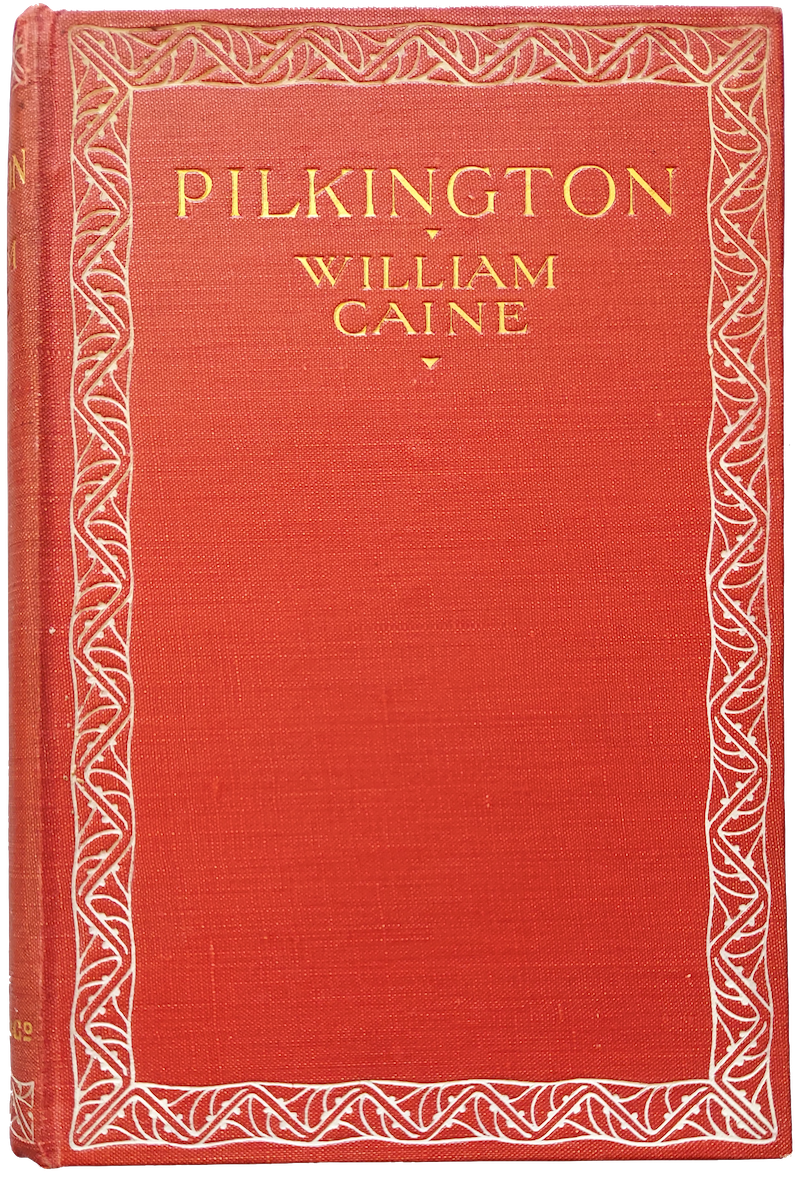
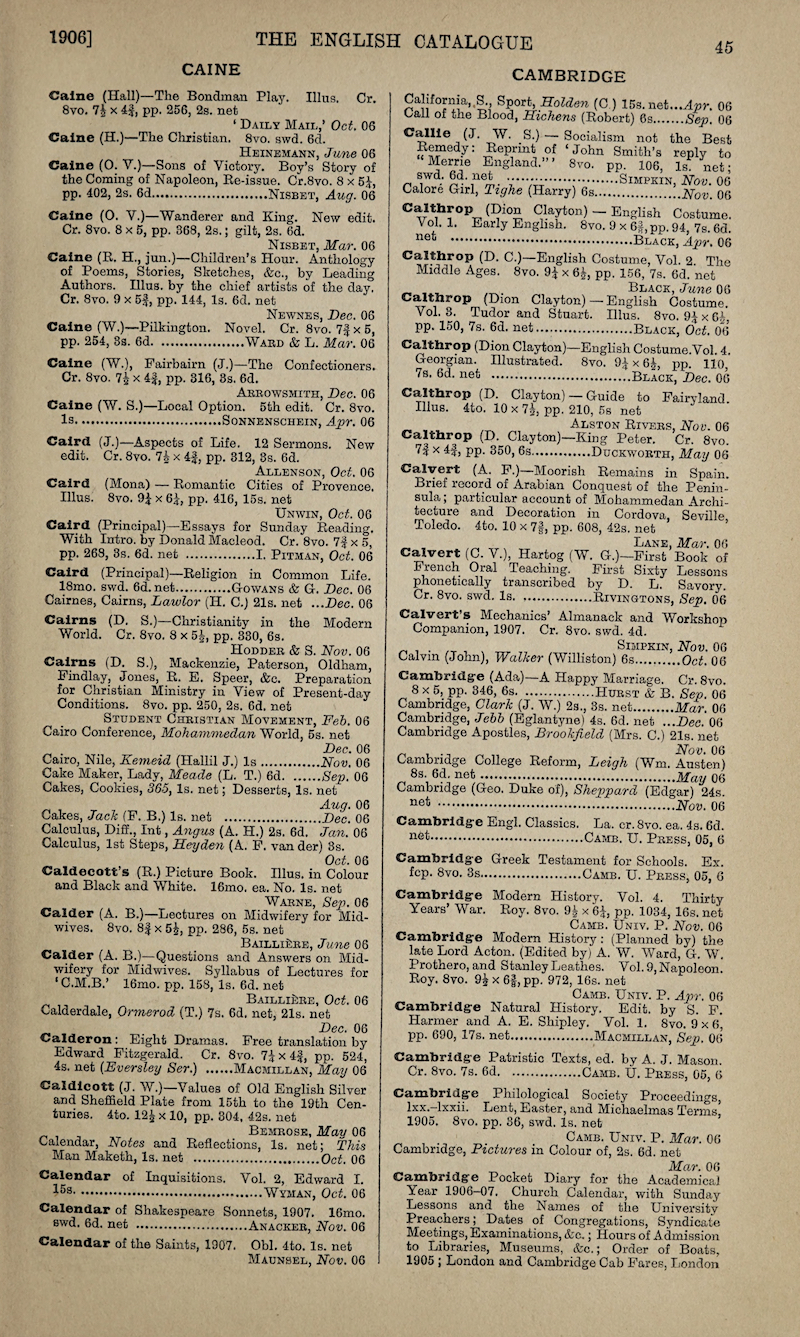
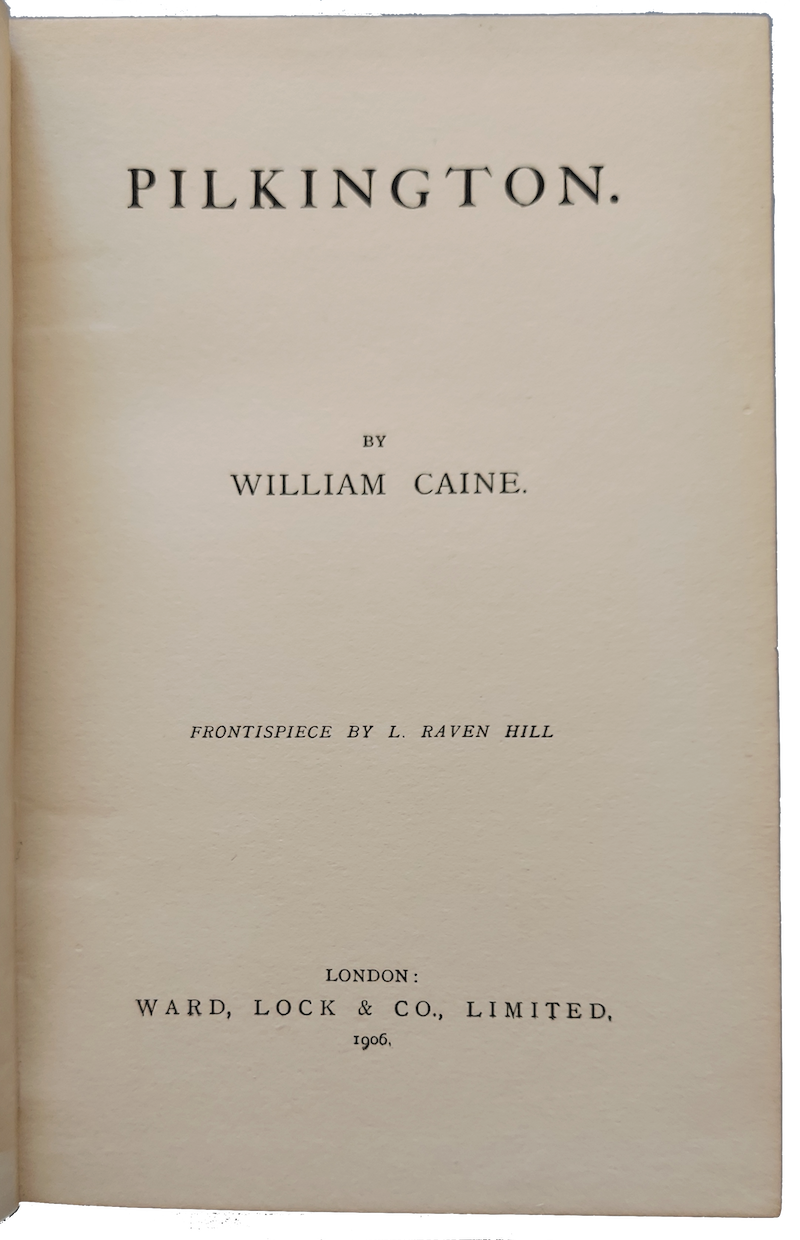
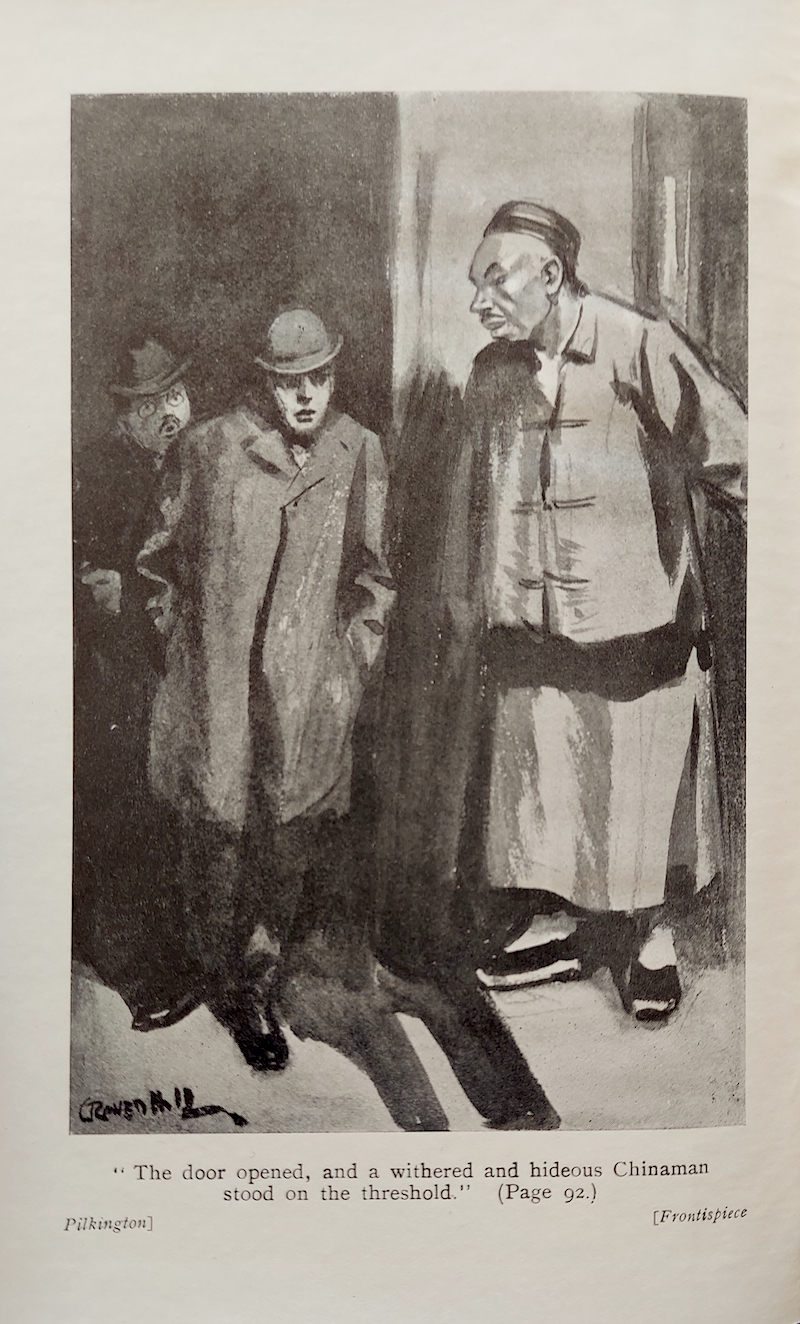
Pilkington, by William Caine. Frontispiece by L. Raven Hill. London: Ward, Lock & Co., Ltd. 254 pages, 8º. March 1906.
Frontispiece by L. Raven Hill. London: Ward, Lock & Co., Ltd. 254 pages, 8º. March 1906. [ECB 1906: 45].
Dedicated “To J. H. B.”
The exemplar pictured is my own, purchased from Hadwebutknown, Birnam, Perth, UK, on May 26, 2022, for US$123.14 plus US$26.43 shipping.
The Birmingham Daily Post, Friday, March 2, 1906, p. 4, “Books of the Week; Fiction.”
The story of a series of ingenious practical jokes played off on a young man of incredible density, but blessed with good temper and impossible good fortune. The story is a little thin in parts, especially at the commencement, but some of the humour is of good quality, and it is never lacking in taste.
The Times Literary Supplement, Friday, March 2, 1906, p. 76, “List of New Books and Reprints; Fiction.”
Pilkington is a kind of legal “Verdant Green.” He comes up, a simple-minded prig, from Cambridge, and falls into the hands of friends in “the honourable Society of the Outer Temple,” who show a real creative genius in playing off practical jokes upon him. They, and the reader, have much entertainment; but Pilkington “gets home” in the end.
The Scotsman (Edinburgh), Monday, March 12, 1906, p. 2, “Fiction.”
Pilkington is a student of Cambridge, who on leaving the University becomes a member of the Outer Temple, and there is the victim of a series of practical jokes played upon him by his friends. Considering that Pilkington was a B.A., B.C.L., Chancellor’s Medallist, and Treasurer of the Jurisperiti — a body of young gentlemen who were wont to meet in each other’s rooms after Hall, and there, over coffee and cigarettes, abandon themselves to the discussion of involved legal problems — he was a wonderfully simple-minded and good-natured soul, and, it may be added, of great density. Several of the barristers in the Outer Temple display considerable ingenuity in “taking a lend” of Pilkington; but he scores in the end by becoming engaged to a lady who is sought after by the others. The book has a touch of originality in it, and makes entertaining reading.
The Essex Guardian (London), Saturday, March 17, 1906, p. 3, “Some Interesting Books; ‘Pilkington.’”
There is much of the Verdant Green (and something better) class of humour about “Pilkington” (Ward, Lock, and Co., 3s. 6d.), and the gentleman who gives his name to the title of the book is responsible for much of the amusement which comes with practical jokes. Mr. William Caine tells his story in crisp and happy English. From the ’Varsity, Pilkington decided for the strenuous life, and, after payment of the fees which form a necessary preliminary to every step in a legal career, entered his name at the Outer Temple, and became a student of that honourable Society. His adventures are varied. Fellow students think he is fair game for them, and the practical joke is often the prelude for a decided “score” by the innocent Mr. Pilkington over his enthusiastic and merry friends. The imaginary plot to be frustrated, the plan by which in a lonely street they should all wait at different points to entrap imaginary Fenians progressed well up to one stage — the time at which all had crept away home except Pilkington, who was crouching in the cold to watch for the appearance of the Fenians, having been assured that his friends were at their posts also in the same business. When in the cold and early hours of the morning, however, a crash of glass is followed by the appearance of a burglar, Pilkington obediently presents the empty revolver with which he has been provided, and secures the burglar, with the aid of the master of the ransacked house, who has been aroused. Presents and glory for Pilkington follow; and the reader throughout is glad to find that practical joking can bring such “happy endings.”
The Birkenhead News, Saturday, March 24, 1906, p. 6, “Notes on New Books.”
We heartily congratulate Mr. William Caine, who is said to be new to authorship, upon his book. The matter is slight indeed, the story being nothing more than a series of episodes in the career of one Pilkington, student of the Temple, and the three friends whose delight in life is to play elaborate practical jokes upon him. But the humour is free and unforced, and the singular adventures of the ingenuous “Pilker” are related with rare spirit. The author gives the impression that he has thoroughly enjoyed the writing of the book, which we very heartily recommend to all that have a liking for rollicking and harmless fun. Pilkington, pedantic and slightly priggish, but good fellow withal, is made the butt of the high spirits of the three fellow students, Archer, the ingenious inventor of gruesome and perilous undertakings, Dawlish, his herculean coadjutor, and the gentle but none the less dangerous Flood. The author, however, has too great a liking for his hero to allow him to suffer from the concerted machinations of his friends, so that it happens that more often than not Pilkington scores unintentionally but none the less effectually. Thus, induced by his tormentors to watch a suburban residence during the whole of a winter’s night in order that he may frustrate an alleged anarchist plot, the innocent “Pilker” actually does capture a burglar, recovers the valuable booty the thief has annexed, and receives ample reward for his bravery. On other occasions the trio overdo their practical joking, with results more disastrous to themselves than to their victim, and in the end Pilker becomes engaged to a rich young widow, for whom both Messrs. Flood and Dawlish languish, and with whom he has been mixed up in a ridiculous adventure. “Pilkington” is excellent indeed, and Mr. Caine’s first book should prove exceedingly successful.
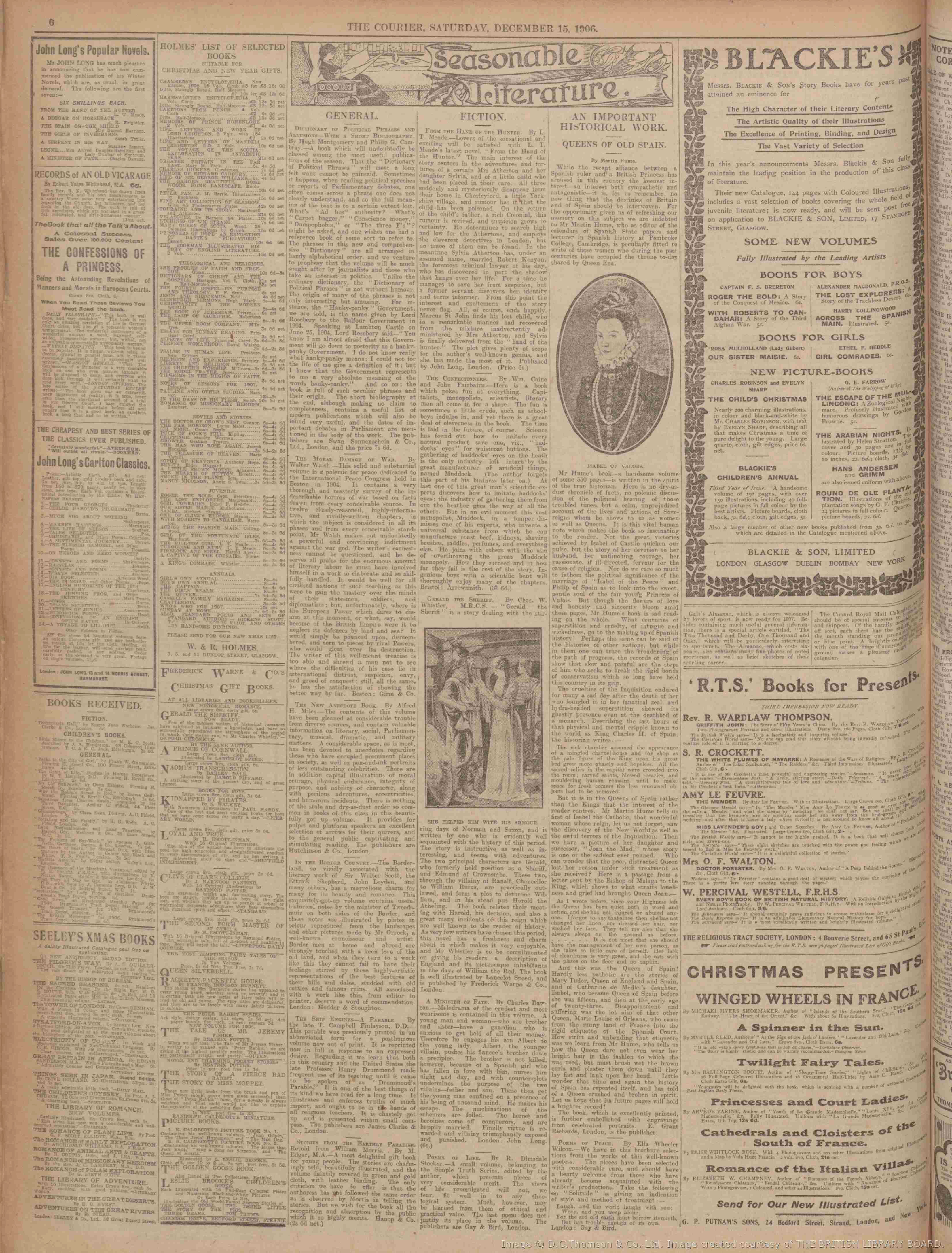
The Courier (Dundee), Saturday, March 31, 1906, p. 6, “Current Literature.”
This is a humorous and entertaining story by a new author. It relates the experiences of a Cambridge scholar — Pilkington, B.A. — who went up to London and entered at the Outer Temple to study law. Here he got entangled with a smart set of old stagers, who attempted to make fun of the simple young man from the country. The various plots all went agley, and their best laid schemes recoiled on their own heads. Many of the situations are highly improbable, but they are most amusingly told, and in the end Pilkington wins a wealthy bride, much to the discomfiture of his tormentors. There is little plot, but rather a series of incidents, which the author makes the most of. The book is smartly written, and shows Mr Caine to be capable of higher work.
The Morning Post (London), Tuesday, April 3, 1906, p. 3, “Recent Fiction.”
At first we thought that “Pilkington,” by William Caine (Ward, Lock, and Co., 3s. 6d.), was going to be amusing. But after a while the practical jokes played on Pilkington by his companions cease to amuse. In the end, however, he gets the better of his tormentors. Pilkington himself is quite a funny fellow. He is very ignorant of the world, but his conceit and self-confidence are colossal. If his adventures had not been so trivial he would certainly have appeared to greater advantage. But the book is altogether too slight.
The Field, the Country Gentleman’s Newspaper (London), no. 3780, Saturday, April 7, 1906, p. 543, “The Library; General Reader.”
Pilkington (Ward, Lock and Co.), who is depicted for us in various circumstances of discomfort by Mr William Caine, is a kind of legal Verdant Green. At Cambridge the acknowledged leader of the Jurisperiti, a company of seven wise young men, in London he becomes something of a butt, on which a trio of young barristers exercise their inventive faculties. We like Pilkington and we are sorry for his misfortunes, even while we laugh. So, to do them justice, are his tormentors. Anarchy, thuggee, opium, a mysterious and formidable secret society dubbed “The Confetti,” music-halls, the confidence-trick, all play a part in this very amusing book. All things, however, have their compensations and at the last Pilkington gathers an ample harvest of revenge; it is none the less ample for being unconscious. We can recommend his adventures as a cure for the dumps.
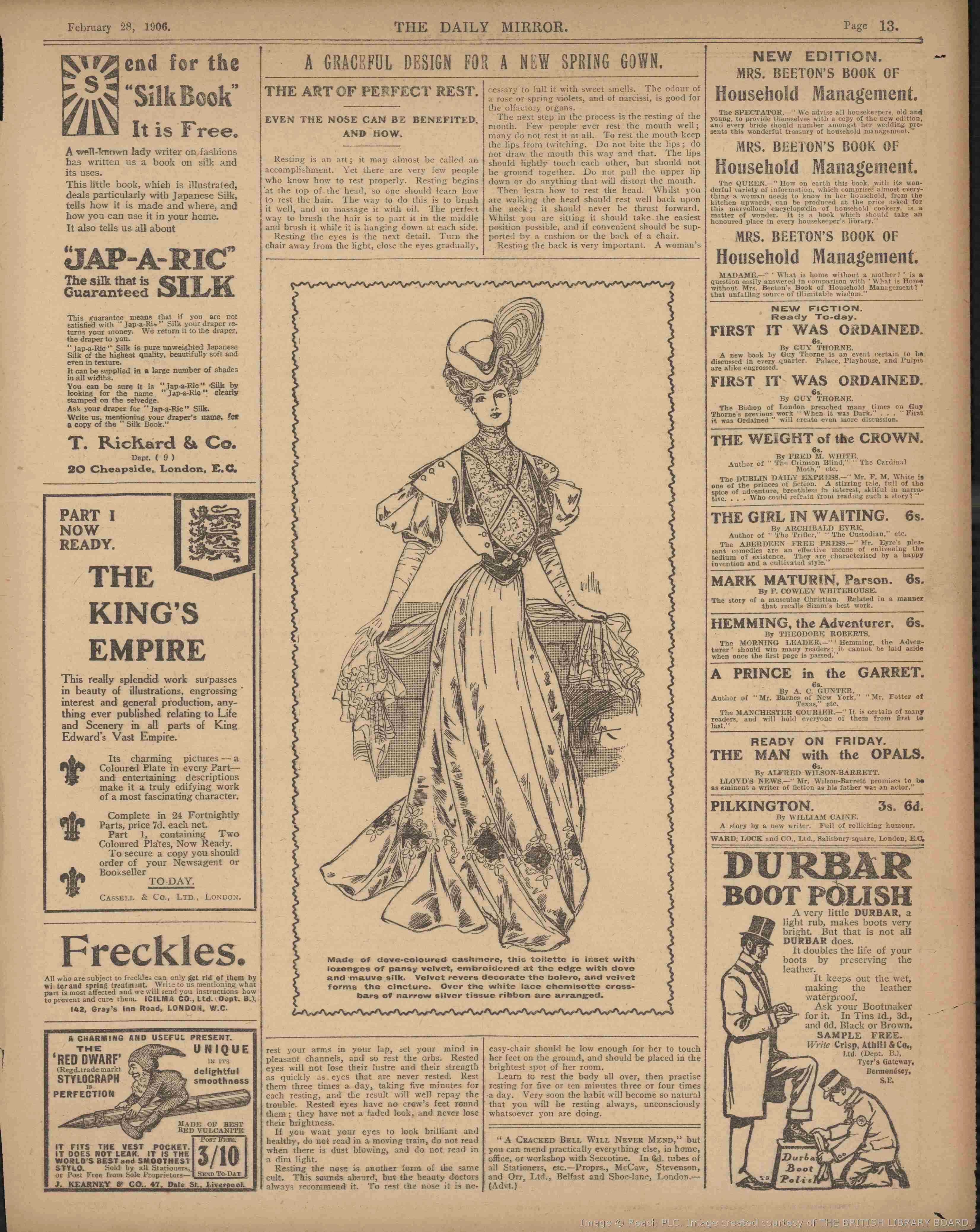
“Pilkington. 3s. 6d. By William Caine. A story by a new writer. Full of rollicking humour.”
The Daily Graphic, Wednesday, April 18, 1906, p. 15, “Some New Novels.”
Mr. William Caine’s humour is genuine if rather primitive, and within its own modest limits “Pilkington” (Ward, Lock and Co.) is very amusing. Pilkington is a sort of Verdant Green at the Bar. Fresh from an admiring circle at Cambridge, Pilkington had entered his name at the Outer Temple, where, on the night of his first appearance to dine in Hall, he makes the fateful acquaintance of Mr. Dawlish, who, scenting his prey from afar, presses Pilkington to join his table, and introduces him to his friends, Flood and Archer. Here the fun begins. Quite undeterred by any pangs of conscience, the three young men devote themselves with a zest that grows by what it feeds on, to gull the unhappy and unsuspecting Pilkington. In real life no young man could possibly be half so gullible, even if he had been brought up by a fond mother in the seclusion of the country, much less after a University career; but what does it matter since the book is genuinely funny? The first scene, in which Pilkington, prompted his friends, insists on taking wine with the benchers, is one of the best written of the book. Our sense of poetic justice is relieved when the long suffering Pilkington for once is avenged, on the occasion of a tea party in his rooms, at which the unconscious Flood and Archer are induced to eat a new kind of Scotch cakes, called Kromeskies, which turned out to be fire-lighters. “Pilkington” is the kind of book which makes one want to shake its author by the hand and thank him for genuine and spontaneous laughter.
The Sheffield Daily Telegraph, Wednesday, April 18, 1906, p. 3, “Books of the Week; Mirth-Provoking.”
A series of farcical episodes in the life of a fledgling on his way towards the Bar. The appalling innocence of the hero makes him an inevitable butt for his acquaintances; whilst his simplicity, aided by a kindly providence, always, more or less, results in their discomfiture. From first to last it is a pleasant feeling, and the fool — unconscious of his folly — has the best of it, and is, eventually, triumphant! If an honest chuckle aids digestion, Mr. Caine’s readers need not fear dyspepsia.
Pall Mall Gazette (London), Saturday, April 28, 1906, p. 4, “Books in Brief; Fiction.”
Our learned friend Pilkington is one of these men of whom it is said that they are born lucky rather than rich. However that may be, he certainly emerges with flying colours (through no cleverness of his own) from every one of the artful jokes carefully prepared for him by a few of his fellow law students. What is more, he is invariably successful in unwittingly turning each circumstance to his own good, while he finishes by marrying the charming lady to whom his good friends had severally and secretly given their hearts. The adventures of the gallant Pilkington are part of that light literature that helps to make short work of dull hours.
The Belfast News-Letter, Thursday, May 10, 1906, p. 10, “Literature of the Day; New Fiction; A Young Barrister and his Companions.”
“Pilkington,” by William Caine, is a story of the doings of a Cambridge student and his friends at the time when he is called to the Bar and in the period immediately succeeding. Pilkington was not only a B.A. and B.C.L., but Chancellor’s medallist, and Treasurer of the Jurisperiti, a body of seven young men who were “wont to meet from time to time in each other’s rooms, After Hall, where, over coffee and cigarettes, they would abandon themselves to the discussions of the most involved legal problems.” But the Jurisperiti do not confine themselves to such discussions, and this record of how they spent the days of their early manhood is much more interesting than it would have been if it had been merely a legal text-book. The publishers are Messrs. Ward, Lock, & Co., Ltd., Warwick House, Salisbury Square, London, and the price is 3s 6d.
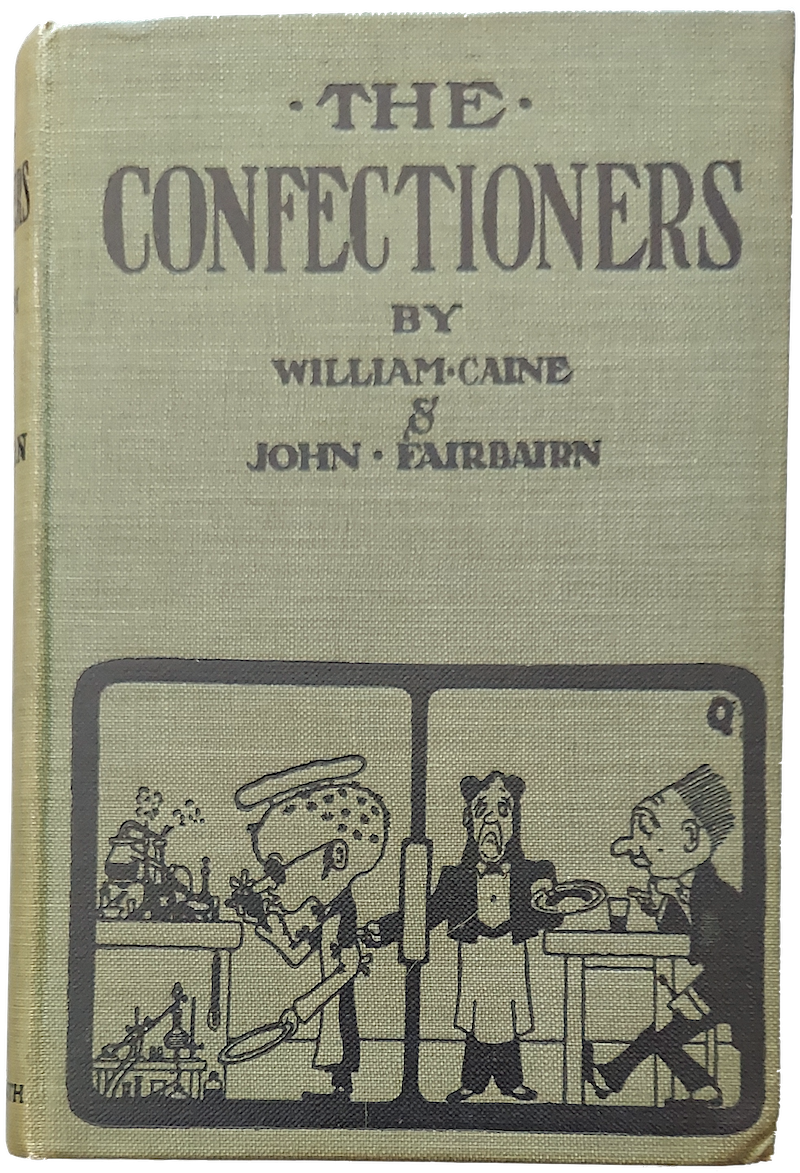
The Confectioners, by William Caine & John Fairbairn. Bristol: J. W. Arrowsmith. 315 pages, 8º. December 1906. Exemplar pictured is my own, purchased from Provan Books, Glasgow, on June 18, 2022, for US$112.95 plus US$25.59 shipping.
(with John Fairbairn). Cover, frontispiece, and illustrations by William Caine. [See Caine’s Note to Smoke Rings below. The entry in Bleiler (1990: 116) mistakenly attributes these to “Anon.”]. Bristol: J. W. Arrowsmith. 315 pages, 8º. December 1906. [ECB 1906: 45].
Dedicated “To L. H. B. Because she succeeded in reading it.”
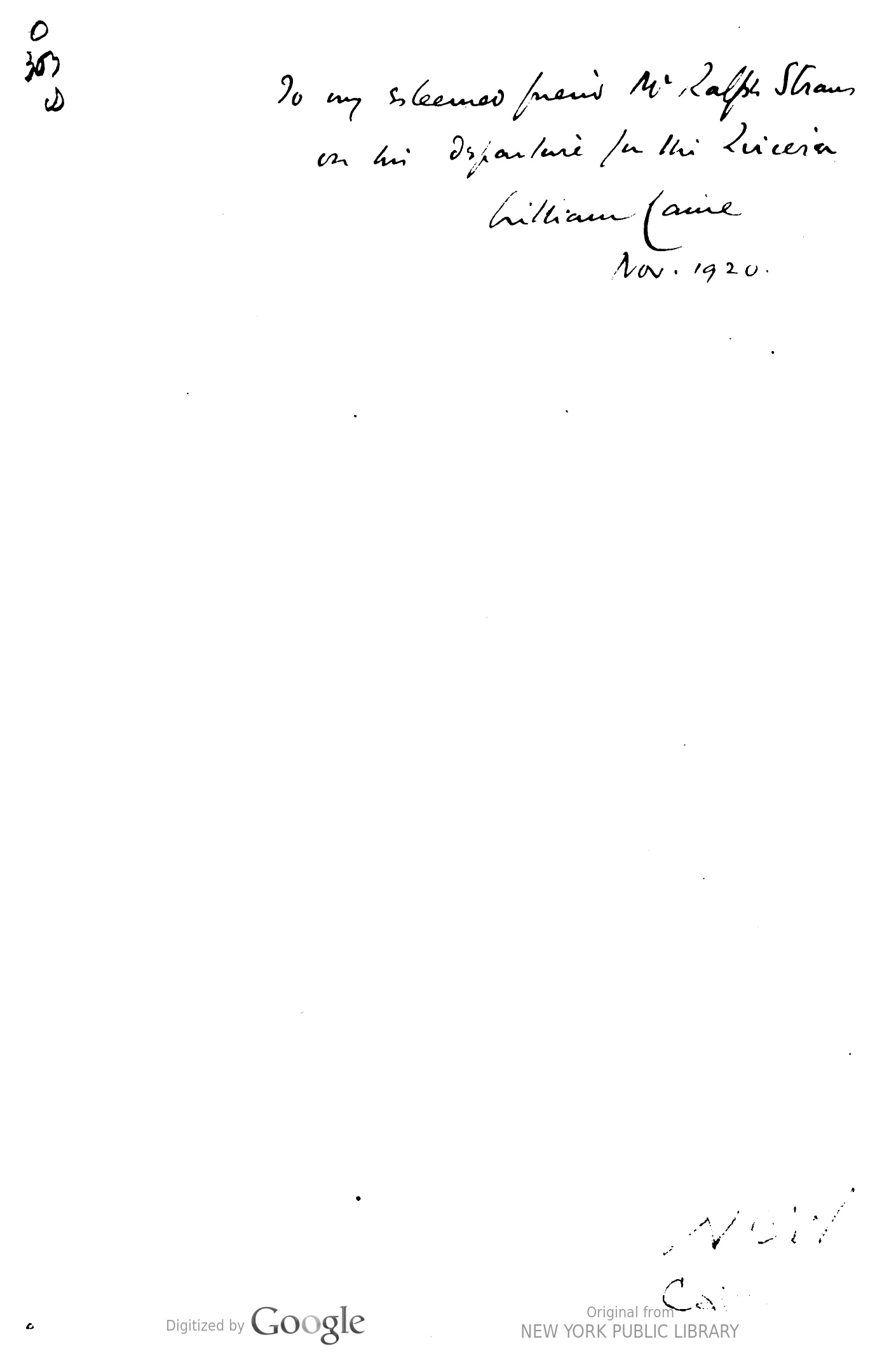
The exemplar available from both archive.org and babel.hathitrust.org is a scan of that housed in the New York Public Library and which bears, on the flyleaf, a personal dedication written by Caine and dated November 1920: “To my esteemed friend Mr. Ralph Shaw, on his departure for the Riviera.”
Evening Standard and St. James Gazette (London), November 29, 1906, p. 18, “Book Notes.”
Mr. J. W. Arrowsmith is publishing “The Confectioners,” by William Caine and John Fairbairn, dealing with the state of things which will exist when everything, down to the food we eat, is chemically prepared.
The Western Daily Press (Bristol), November 30, 1906, p. 9, “Literary Notes.”
Mr. J. W. Arrowsmith is about to publish “The Confectioners,” by William Caine and John Fairbairn. It deals in a very original and humorous manner with the state of things which we may suppose will exist sooner or later when everything, down to the food we eat, is chemically prepared.
The Times Literary Supplement, Friday, December 7, 1906, p. 411, “List of New Books and Reprints; Fiction.”
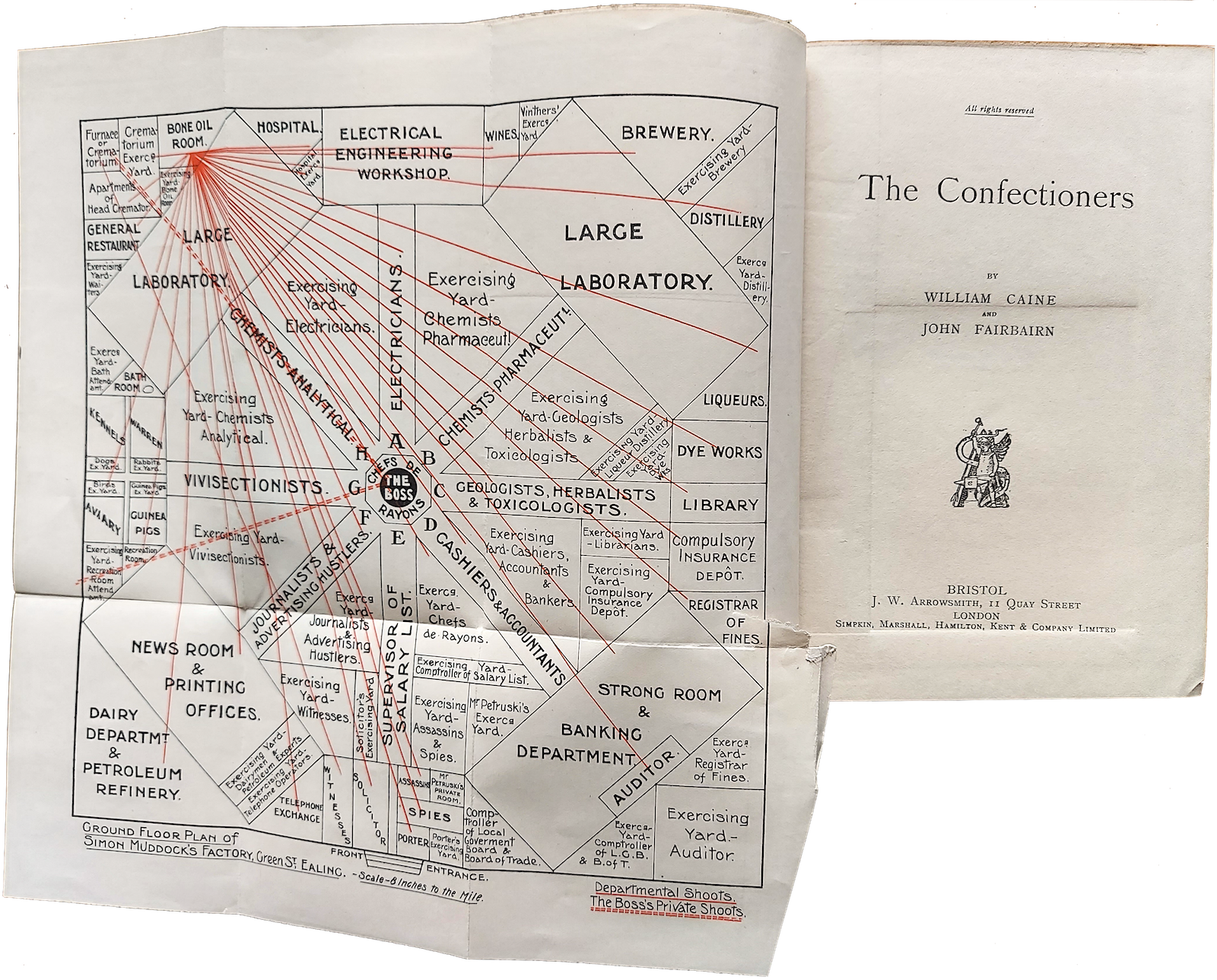
A rollicking and original tale of the great factory of Simon Muddock, where all the wants of man were met by chemical preparations; of its overthrow by the discovery of “Gruntleite,” the universal producer, with a surprising sequel.
The Academy, No. 1805, December 8, 1906, p. 594, “Books Received; Fiction.”
Intended to be humorous; we found the book rather distressing.
The Courier (Dundee), Saturday, December 15, 1906, p. 6, “Seasonable Literature; Fiction.”
Here is a book which pokes fun at everything. Capitalists, monopolists, scientists, literary men all come in for a share. The fun is sometimes a little crude, such as schoolboys indulge in, and yet there is a great deal of cleverness in the book. The time is laid in the future, of course. science has found out how to imitate every natural product save one, viz., “haddocks’ eyes” for waistcoat buttons. The gathering of haddocks’ eyes on the heath is the only industry left intact by the great manufacturer of artificial things, named Muddock. (The author forgets this part of his business later on.) At last one of this great man’s scientific experts discovers how to imitate haddocks’ eyes; the industry of gathering them from out the heather goes the way of all the others. But in an evil moment this vast monopolist, Muddock, in a temper dismisses one of his experts, who invents a universal substance from which he can manufacture roast beef, kidneys, shaving brushes, saddles, perfumes, and everything else. He joins with others with the aim of overthrowing the great Muddock monopoly. How they succeed and in how far they fail is the rest of the story. Ingenious boys with a scientific bent will thoroughly enjoy many of the chapters.
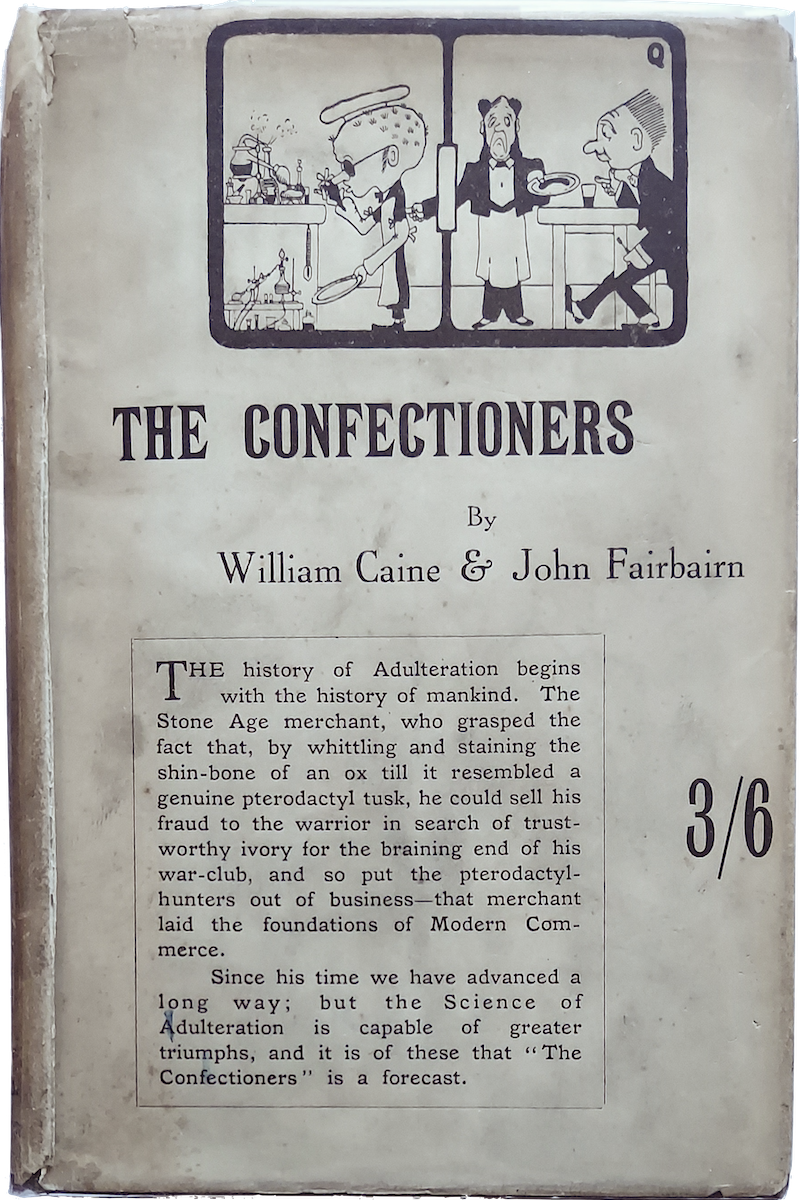
The Confectioners, by William Caine & John Fairbairn. Jacket front: “The history of Adulteration begins with the history of mankind. The Stone Age merchant, who grasped the fact that, by whittling and staining the shin-bone of an ox till it resembled a genuine pterodactyl tusk, he could sell his fraud to the warrior in search of trustworthy ivory for the braining end of his war-club, and so put the pterodactyl-hunters out of business — that merchant laid the foundations of Modern Commerce.
“Since his time we have advanced a long way; but the Science of Adulteration is capable of greater triumphs, and it is of these that ‘The Confectioners’ is a forecast.” Exemplar pictured is my own, purchased on December 28, 2024, from Hyraxia Books, Hutton Cranswick, UK, for US$259.00 plus US$25.15 shipping.
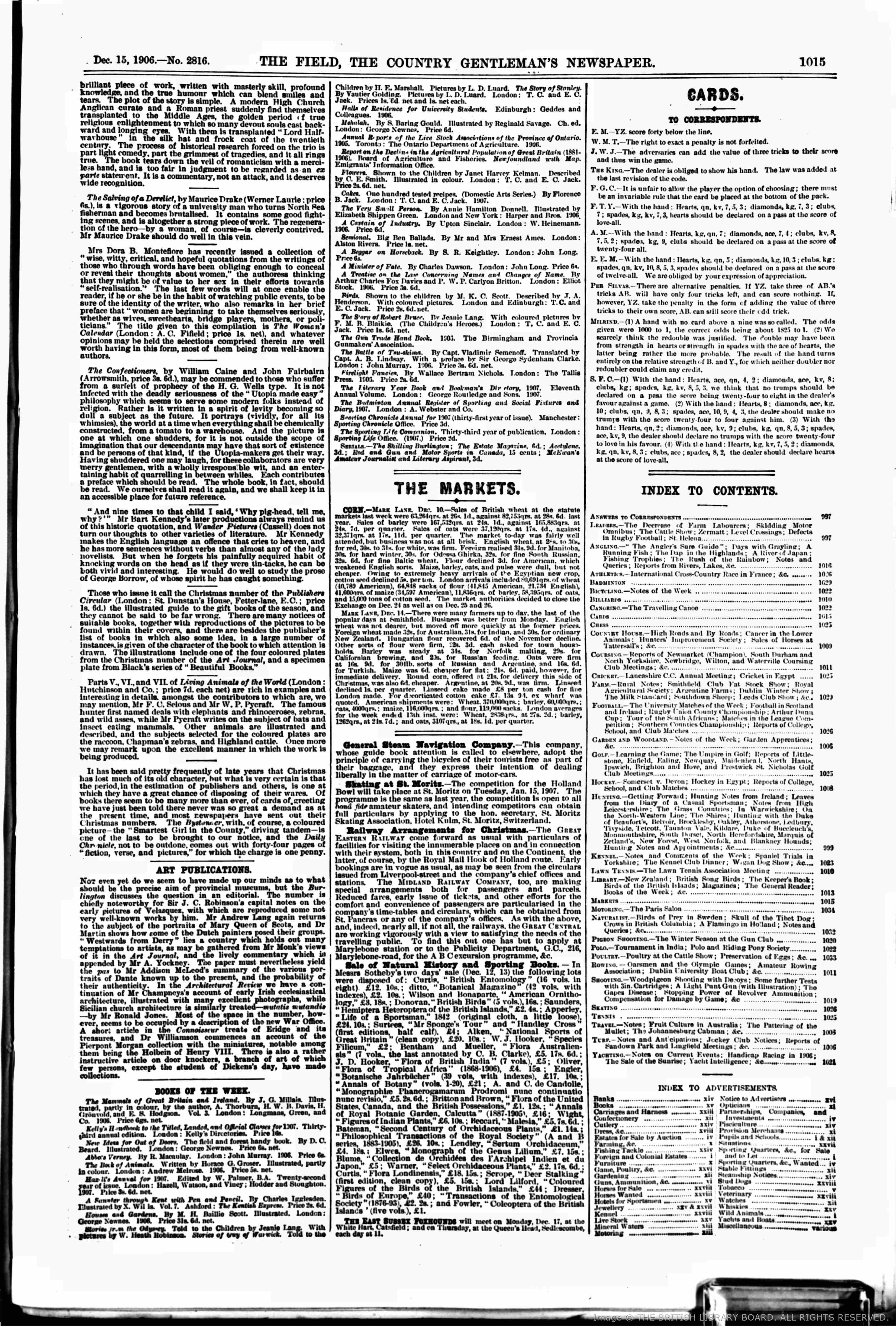
The Field, the Country Gentleman’s Newspaper (London), No. 2816, December 15, 1906, p. 1015, “The Library; General Reader.”
The Confectioners, by William Caine and John Fairbairn (Arrowsmith, price 3s. 6d.), may be commended to those who suffer from a surfeit of prophecy of the H. G. Wells type. It is not infected with the deadly seriousness of the “Utopia made easy” philosophy which seems to serve some modern folks instead of religion. Rather is it written in a spirit of levity becoming so dull a subject as the future. It portrays (vividly, for all its whimsies) the world at a time when everything shall be chemically constructed, from a tomato to a warehouse. And the picture is one at which one shudders, for it is not outside the scope of imagination that our descendants may have that sort of existence and be persons of that kind, if the Utopia-makers get their way. Having shuddered one may laugh, for these collaborators are very merry gentlemen, with a wholly irresponsible wit, and an entertaining habit of quarrelling in between whiles. Each contributes a preface which should be read. The whole book, in fact, should be read. We ourselves shall read it again, and we shall keep it in an accessible place for future reference.
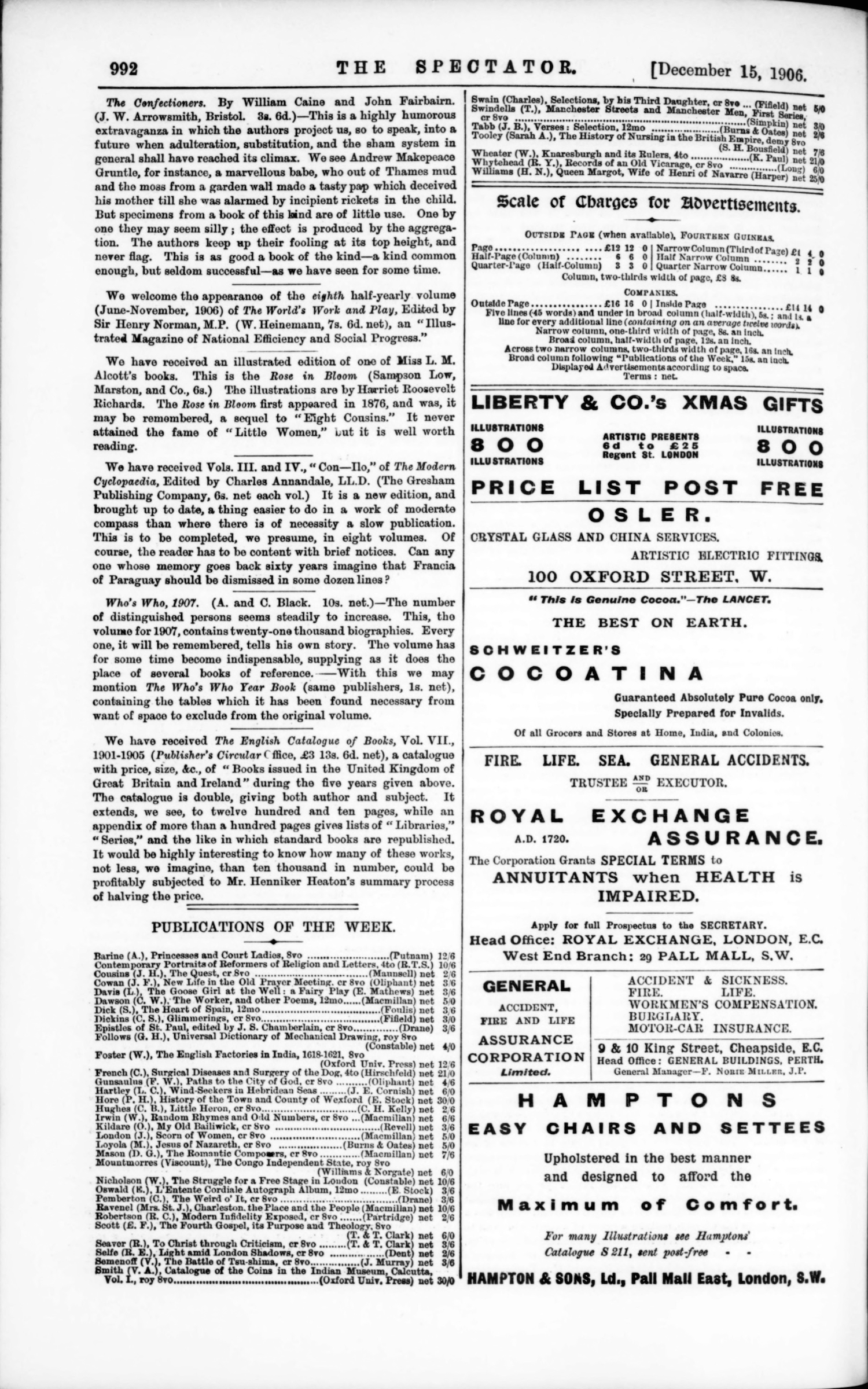
The Spectator, No. 4094, December 15, 1906, p. 992, “Some Books of the Week.”
This is a highly humorous extravaganza in which the authors project us, so to speak, into a future when adulteration, substitution, and the sham system in general shall have reached its climax. We see Andrew Makepeace Gruntle, for instance, a marvellous babe, who out of Thames mud and the moss from a garden wall made a tasty pap which deceived his mother till she was alarmed by incipient rickets in the child. But specimens of this kind are of little use. One by one they may seem silly; the effect is produced by the aggregation. The authors keep up their fooling at its top height, and never flag. This is as good a book of the kind — a kind common enough, but seldom successful — as we have seen for some time.
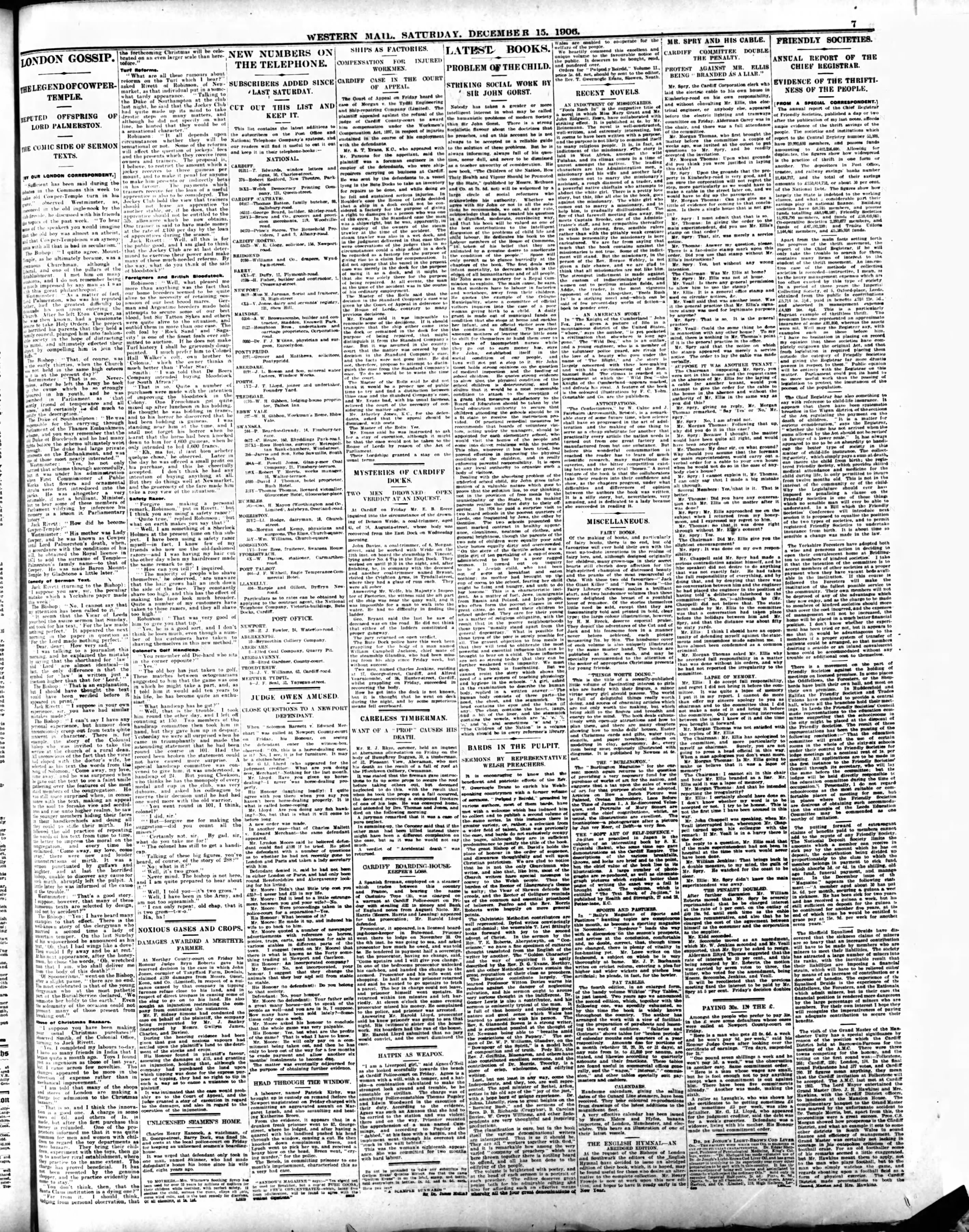
Western Mail (Cardiff), Saturday, December 15, 1906, p. 7, “Latest Books; Recent Novels; Anticipations.”
“The Confectioners,” by W. Caine and J. Fairbairn (Arrowsmith, Bristol), is a remarkable story of some future time, when science shall have so progressed in the art of adulteration and the making of one thing to serve as a cheap substitute for another that practically every article the nation needs is turned out from one great factory and manufactured from but one substance. But before this wonderful consummation is reached the reader has to learn of much scientific research, many marvellous discoveries, and the bitter competition existing between the great rival “bosses.” A novel feature of the book is that the collaborators take their readers into their confidence and show, as the chapters progress, under what difficulties and differences of opinion between the authors the book was written. It is a silly story, but, nevertheless, very amusing, and is dedicated to a lady because she succeeded in reading it.
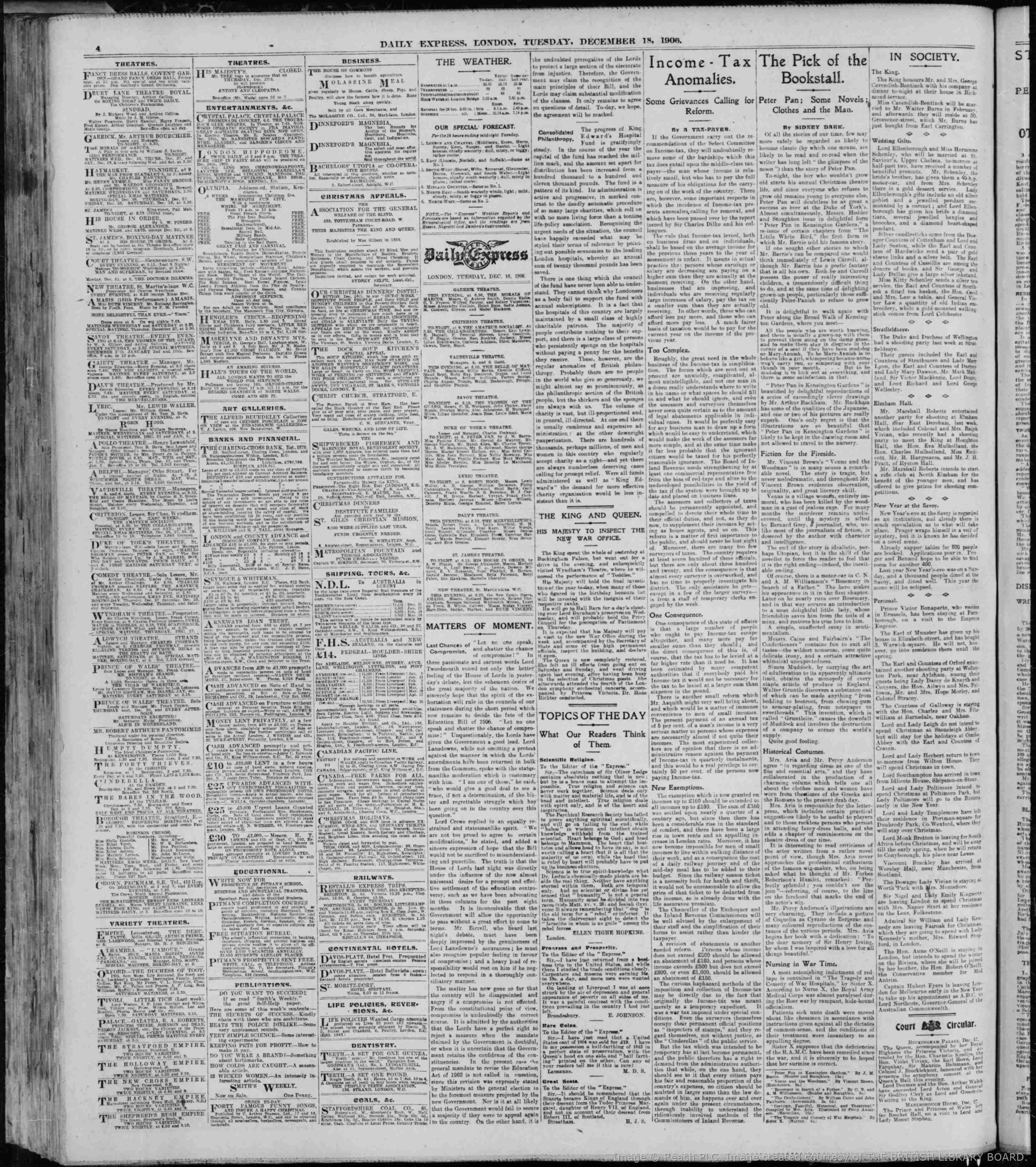
Sidney Dark, “The Pick of the Bookstall; Peter Pan; Some Novels; Clothes and the Man; Fiction for the Fireside,” Daily Express (London), Tuesday, December 18, 1906, p. 4.
Messrs. Caine and Fairbairn’s “The Confectioners” contains fun to suit all tastes — the wildest nonsense, some quite delicate irony, and a certain attractive whimsical unexpectedness.Simon Muddock, by carrying the art of adulteration to its apparently ultimate limit, obtains the monopoly of every staple article of produce in England. Walter Gruntle discovers a substance out of which can be made anything “from bedding to beetroot, from chewing-gum to armour-plating, from notepaper to sweetbreads.” This invention, which is called “Gruntleite,” causes the downfall of Muddock and involves the destruction of a company to corner the world’s supply.
Quite good fooling.
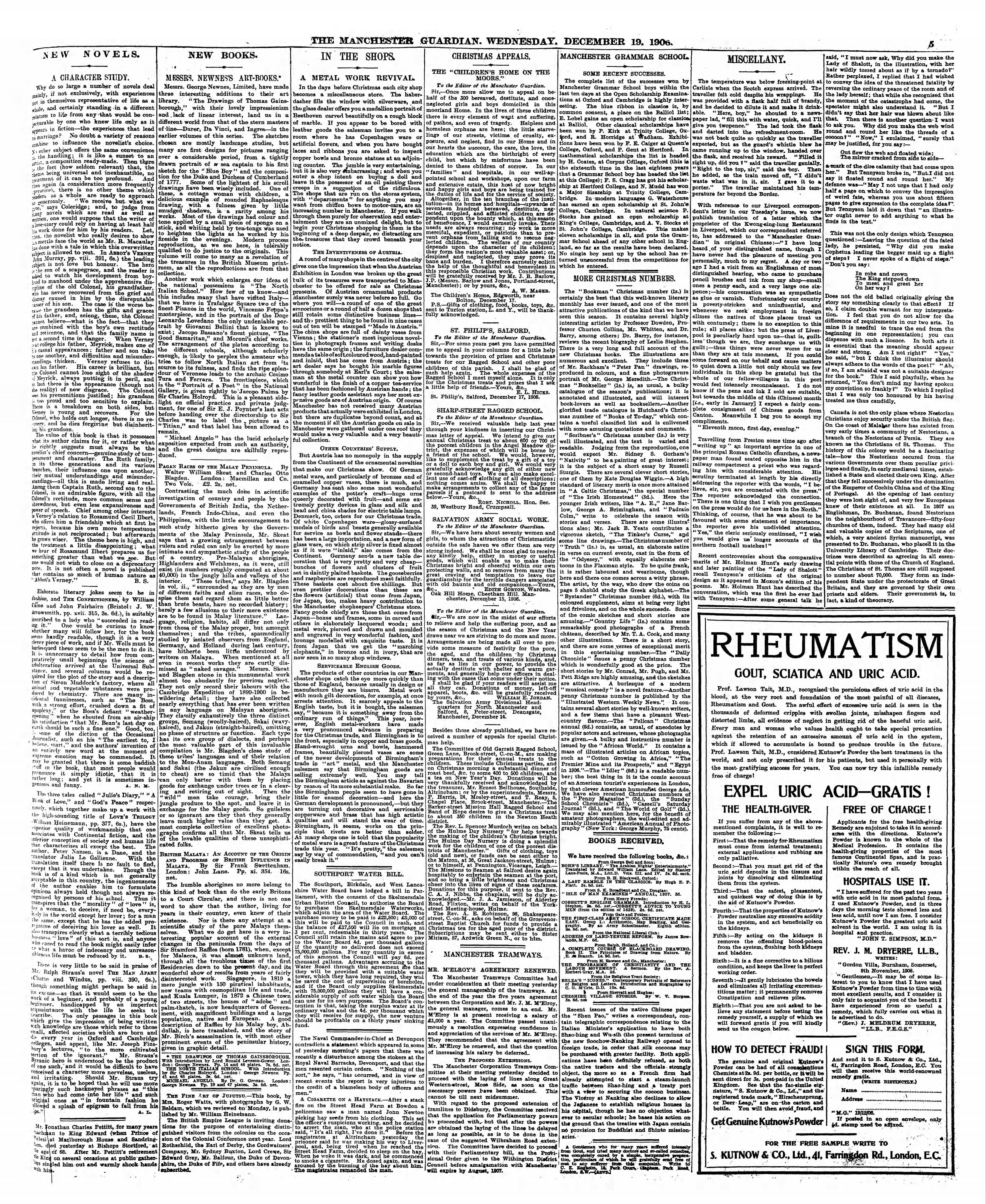
The Manchester Guardian, Wednesday, December 19, 1906, p. 5, “New Novels.” [Signed A. N. M.].
Elaborate literary jokes seem to be in fashion, and The Confectioners, by William Caine and John Fairbairn (Bristol: J. W. Arrowsmith, pp. xvii. 315, 3s. 6d.), is suitably inscribed to a lady who “succeeded in reading it.” One would be curious to know whether many will follow her, for the book seems hardly readable, though it is a very clever piece of work, and if Mr. Wells must be burlesqued these seem to be the men to do it. It is unnecessary to detail how from comparatively small beginnings the science of adulteration arrived at the Universal Substance, and several columns would be required for the plot of the story and a description of Simon Muddock’s factory, where all animal and vegetable substances were produced by chemistry. There are many incidental funninesses, such as “The Boss, with a strong effort, crushed down a fit of apoplexy,” or the Boss’s defiant “weather-opening” when he shouted from an air-ship his satisfaction “that Mr. Bean’s last day on earth should be such a fine one.” Good, too, is some of the diction of the Occasional Journalist, such as his “The earliest to, I believe, start,” and the authors’ invention of an entirely new word at the moment of supreme emotion may be commended. It may be granted that there is some baddish stuff in the book, that most people would pronounce it simply idiotic, that it is rather long; and yet it is sometimes ingenious and funny.
The Yorkshire Post, Wednesday, December 19, 1906, p. 9.
Having enjoyed the joke of writing it in collaboration, Messrs. William Caine and John Fairbairn have handed “The Confectioners” (Arrowsmith, 3s. 6.) to the public, who, as third parties, will laugh least. The dedication is to “L. H. B., because she succeeded in reading it.” Whoever follows her example deserves similar reward. The central idea of a manufactory where comestibles are compounded to order — a beef-steak being produced from a few acids, so to speak — is ingenious enough, but the authors interpolate between every chapter a page or two of italic type, reproducing the ipsissima verba of their quarrellings. This is merely wearisome, and because of it the joke misses fire.
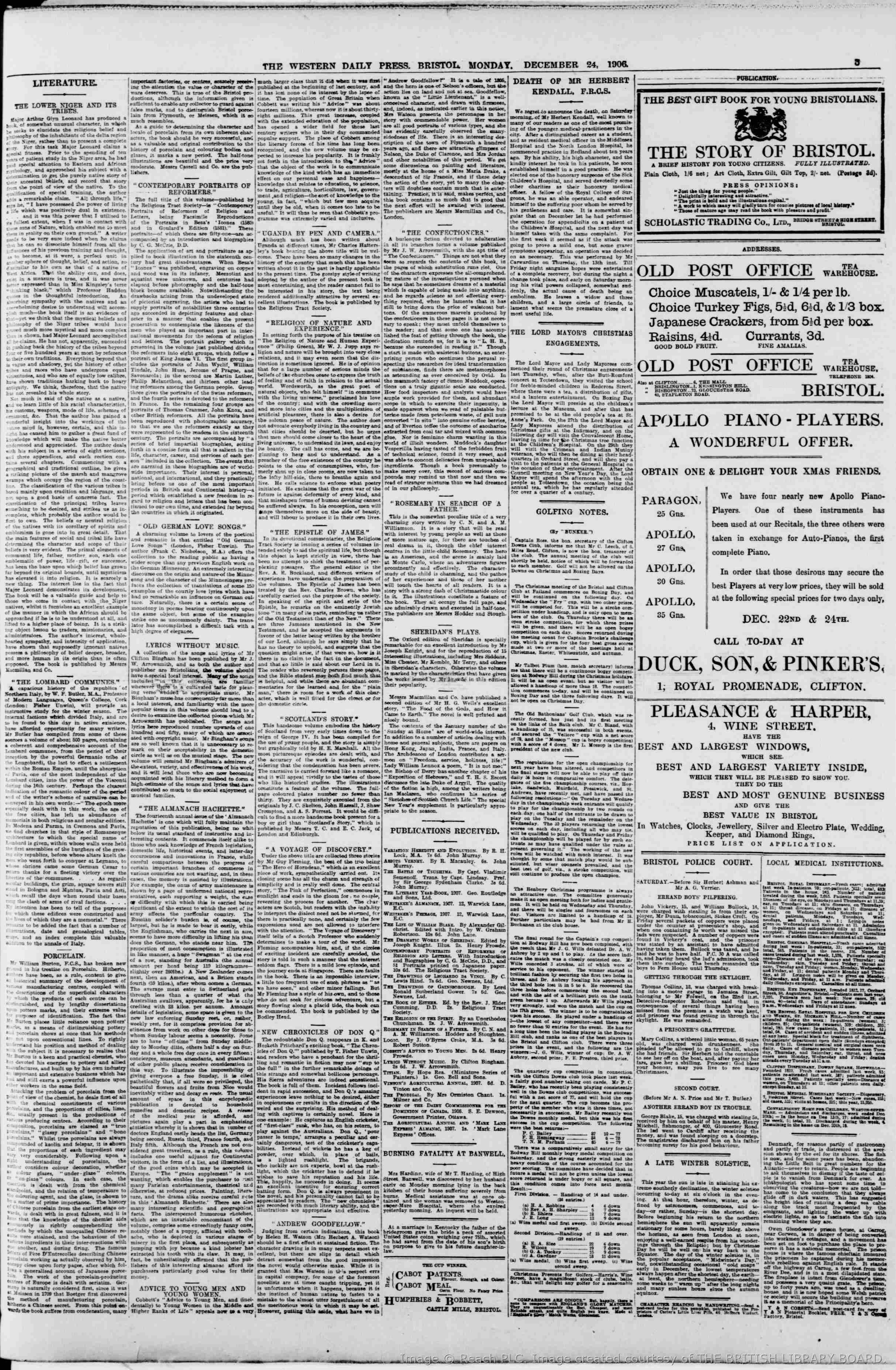
The Western Daily Press (Bristol), Monday, December 24, 1906, p. 3, “Literature; ‘The Confectioners.’”
A burlesque fiction devoted to adulteration in all its branches forms a volume published by Mr. J. W. Arrowsmith, with the apt title of “The Confectioners.” Things are not what they seem as regards the contents of this book, in the pages of which substitution runs riot. One of the characters expresses the all-comprehending nature of the investigations pursued when he says that he sometimes dreams of a material which is capable of being made into anything, and he regards science as not effecting everything required, when he laments that it has still to bring down the price of waistcoat buttons. Of the numerous marvels produced by the confectioners in these pages it is not necessary to speak; they must unfold themselves to the reader; and that some one has accomplished the feat of getting through the book, the dedication reminds us, for it is to “L. H. B., because she succeeded in reading it.” Though a start is made with waistcoat buttons, and enterprising person who continues the perusal respecting the researches for ideal transformation of substance, finds there are metamorphoses as astounding as ever conceived by Ovid. In the mammoth factory of Simon Muddock, operations on a truly gigantic scale are conducted. How food inspectors and analysts would have ample work provided for them, and abundant scope in which to exercise their ingenuity, is made apparent when we read of palatable butterine made from petroleum waste, of gall nuts converted “in situ” into genuine coffee berries, and of Everton toffee the outcome of saccharine extracted from coal tar and mixed with common glue. Nor is feminine charm wanting in this world of illicit wonders. Muddock’s daughter Vespertiila [sic] having tasted of the forbidden fruit of technical science, found it very sweet, and was able to concoct delicacies from unspeakable ingredients. Though a book presumably to make merry over, this record of curious compounds may remind us that now and then we read of stranger mixtures than we had dreamed of in our philosophy.
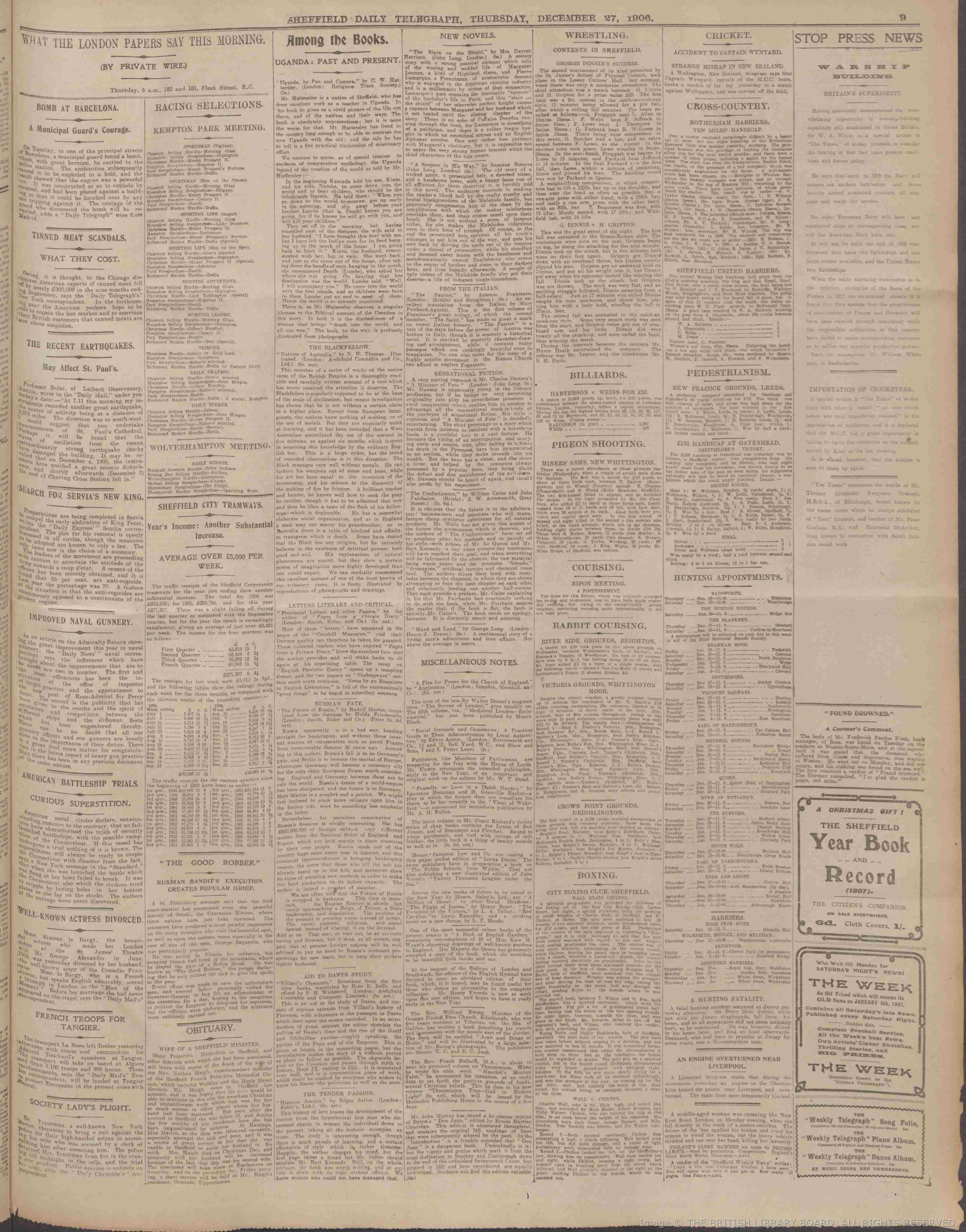
The Sheffield Daily Telegraph, Thursday, December 27, 1906, p. 9, “Among the Books; New Novels; Sensational Fiction.”
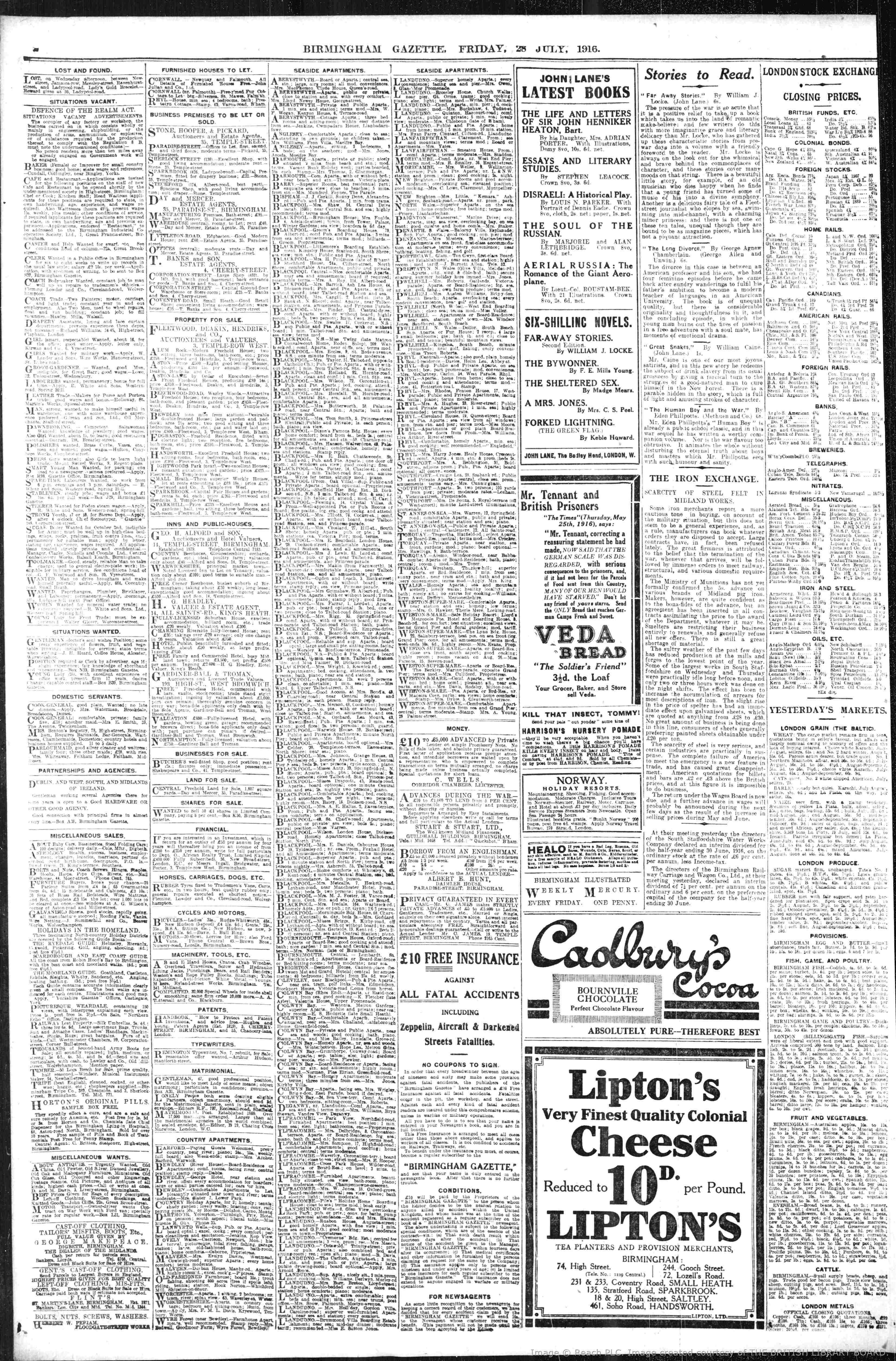
It is obvious that the future is to the adulterators! business-men and scientists who will manufacture cheap synthetic substitutes for all natural products. Mr. Wells has not given this aspect of the future the prominence which it deserves, and the authors of “The Confectioners” have set off to prophesy after his methods and in parody of his style — with echoes of Mr. Le Queux and Mr. Bart Kennedy — a day when present-day tendencies will have reached their goal, and when everything will be fabricated by the chemist, the raw material being waste paper and the products “breado,” “fromagine,” artificial turnips and chemical roast beef. The authors dilute their book with interludes between the chapters, in which they are shown attempting to foist the next chapter on each other and reluctantly lending one another half-crowns. They each provide a preface, Mr. Caine explaining in his that Mr. Fairbairn had practically nothing to do with the book, while Mr. Fairbairn assures the reader that, if the book is flat, the fault is entirely Mr. Caine’s. The book needs no apology, however. It is distinctly smart and amusing.
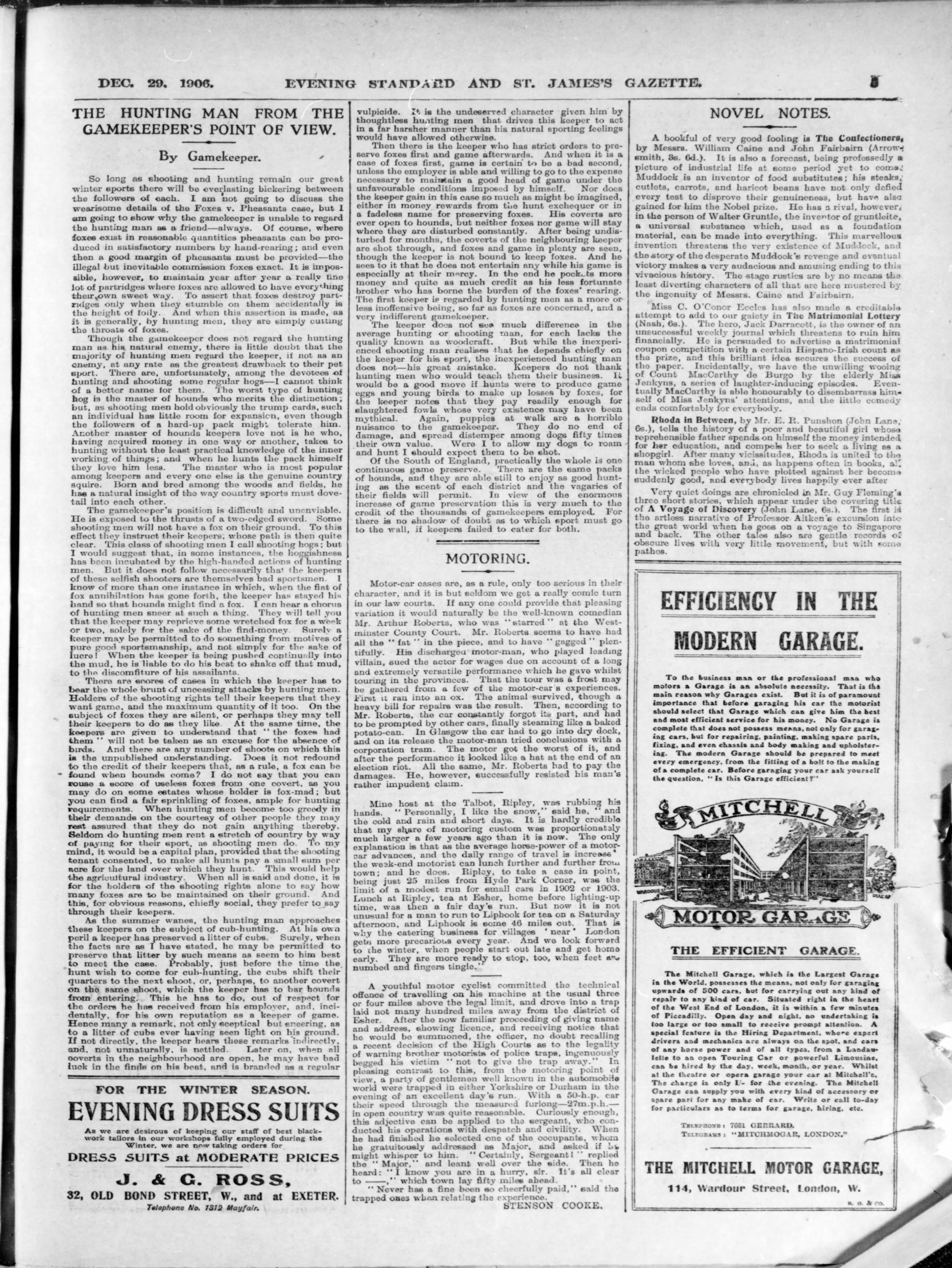
Evening Standard and St. James Gazette, December 29, 1906, p. 15, “Novel Notes.”
A bookful of very good fooling is The Confectioners, by Messrs. William Caine and John Fairbairn (Arrowsmith, 3s. 6d.). It is also a forecast, being professedly a picure of industrial life at some period yet to come. Muddock is an inventor of food substitutes; his steaks, cutlets, carrots, and haricot beans have not only defied every test to disprove their genuineness, but have also gained for him the Nobel prize. He has a rival, however, in the person of Walter Gruntle, the inventor of gruntleite, a universal substance which, used as a foundation material, threatens the very existence of Muddock, and the story of the desperate Muddock’s revenge and eventual victory makes a very audacious and amusing ending to this vivacious history. The stage rustics are by no means the least diverting characters of all that are here mustered by the ingenuity of Messrs. Caine and Fairbairn.
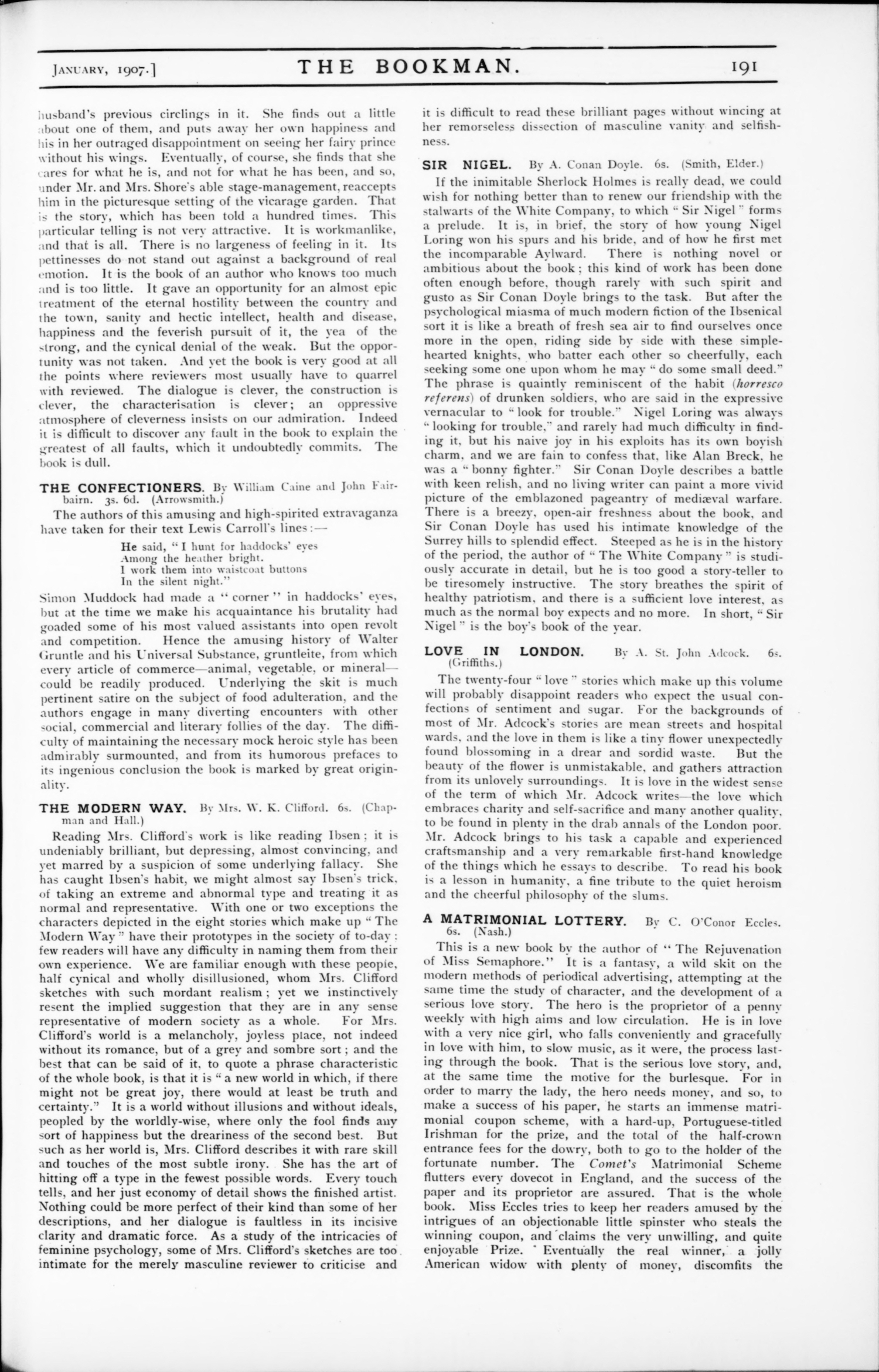
The Bookman, Vol. 31, No. 184, January 1907, p. 191, “Novel Notes.”
The authors of this amusing and high-spirited extravaganza have taken for their text Lewis Carroll’s lines: —He said, “I hunt for haddocks’ eyes
Among the heather bright.
I work them into waistcoat buttons
In the silent night.”
Simon Muddock has made a “corner” in haddocks’ eyes, but at the time we make his acquaintance his brutality had goaded some of his most valued assistants into open revolt and competition. Hence the amusing history of Walter Gruntle and his Universal Substance, gruntleite, from which every article of commerce — animal, vegetable, or mineral — could be readily produced. Underlying the skit is much pertinent satire on the subject of food adulteration, and the authors engage in many diverting encounters with other social, commercial and literary follies of the day. The difficulty of maintaining the necessary mock heroic style has been admirably surmounted, and from its humorous prefaces to its ingenious conclusion, the book is marked by great originality.
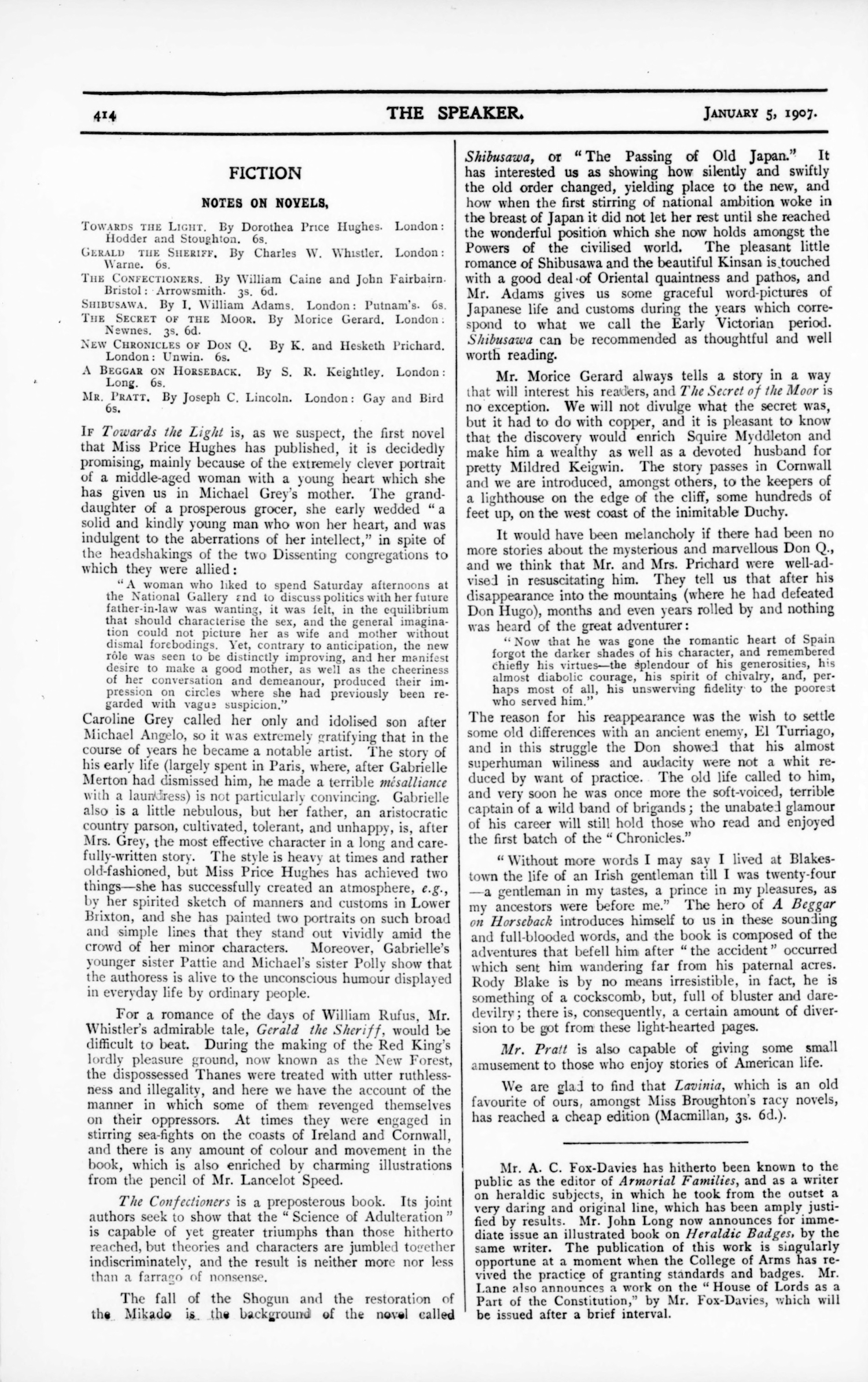
The Speaker, January 5, 1907, p. 414, “Fiction; Notes on Novels.”
The Confectioners is a preposterous book. Its joint authors seek to show that the “Science of Adulteration” is capable of yet greater triumphs than those hitherto reached, but theories and characters are jumbled together indiscriminately, and the result is neither more nor less than a farrago of nonsense.
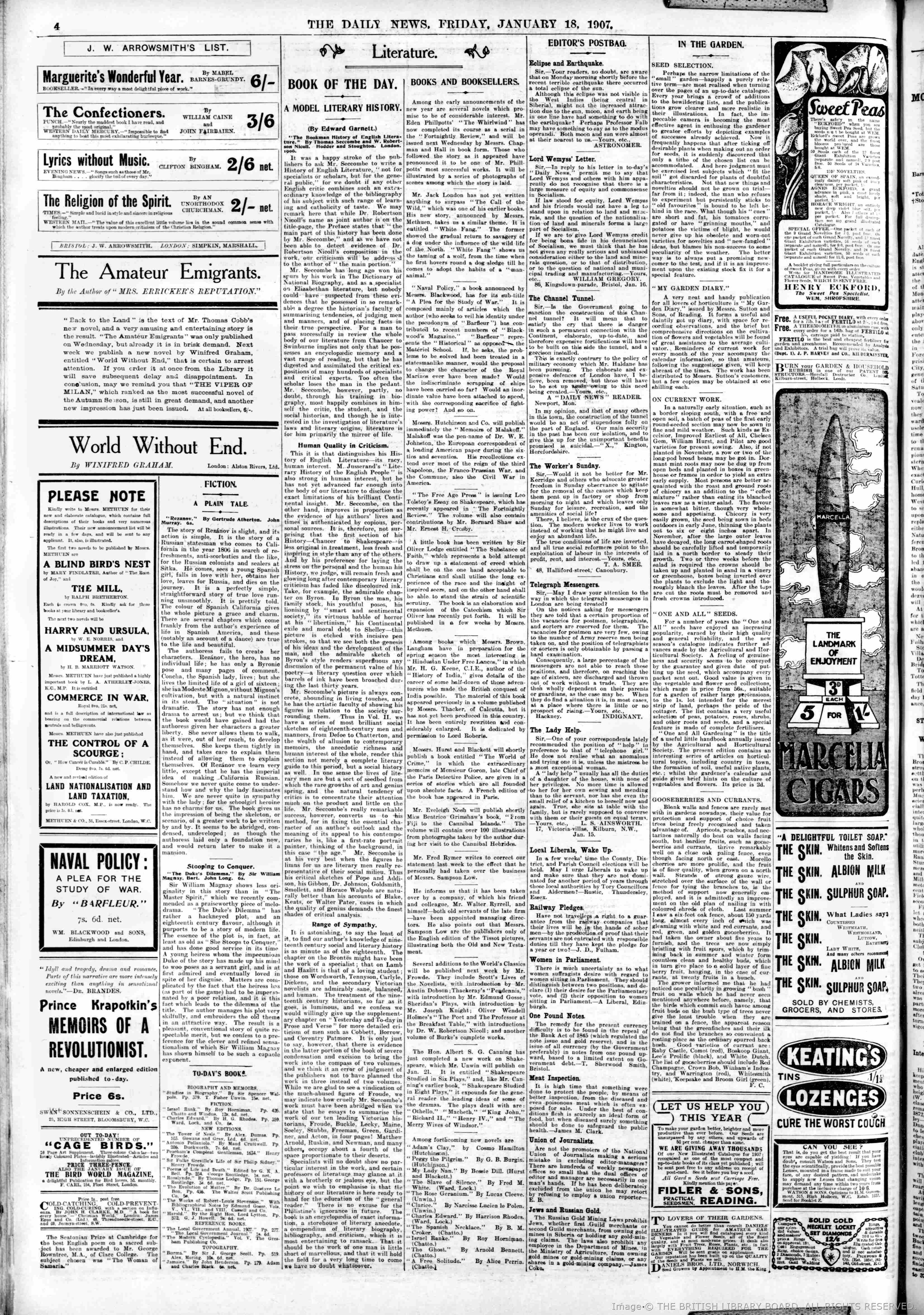
“The Confectioners. By William Caine and John Fairbairn. 3/6. Punch. — ‘Nearly the maddest book I have ever read, and probably the most original.’ Western Daily Mercury. — Impossible to find anything to beat this most exhilarating burlesque.’”
The Newcastle Daily Chronicle, Monday, January 7, 1907, p. 8, “Books of the Day; The Adulterators.”
These authors have made a very funny book in the form of a forecast of what are to be the achievements of the science of adulteration and the gentle art of using food substitutes. To-day the average man needs nine-tenths of his income to keep himself and family, but in the age dealt with in the book one-tenth of an average income is sufficient to live upon, leaving nine-tenths to play with. For instance, in the days of Edward VII, boots were made of “the hides of beasts, laboriously tanned and rottenly costly”; in this golden age they cost hardly anything at all, thanks to the discovery by the great Muddock of his “leather-like coriacine.” And so on to the end of a very amusing book which, though conceived in the broadest spirit of farce, is, we are afraid, “founded upon fact.”
Punch, or The London Charivari, Vol. 132, January 9, 1907, p. 36, “Our Booking-Office.” (Possibly by A. A. Milne; see Haring-Smith [1982: 221].)
The Confectioners (Arrowsmith) by William Caine and John Fairbairn, is nearly the maddest book I have ever read, and probably the most original. One of the original features of it is that at the end of every chapter the collaborators argue about the merits of the last section and the authorship of the next. If there were to be an epilogue in which I might be allowed to take part, it would go something like this: —Reviewer. Your book amused me a great deal.
Caine. [both in bracketed concord, see original] Thank you. I feel that I have not laboured
Fairbairn. [ditto] in vain.
F. (explanatorily to R.) My amanuensis, Mr. Caine.
C. (explanatorily to R.) Mr. Fairbairn roughed out some of the easier chapters for me.
R. But I think it was a mistake bringing the feminine element into a scientific work.
C. There, John, what did I say?
R. And I don’t quite understand Quilliam. Is he meant for G. K. Chesterton by any chance?
F. I have often asked William myself what Quilliam was doing in the book. I am glad you share my views.
R. Tell me, in a general way, are you satirizing science or the scientific novel?
C. I said the critics wouldn’t grasp the point of the thing, John.
F. I begin to despair of the critics, William.
R. Well, whatever the intention, the result is quite entertaining. I laughed many times.
C. John, he laughed.
F. Your hand, William.
The Morning Leader (London), Wednesday, January 16, 1907, p. 3, “Pages in Waiting; Men of Letters; To-Morrow’s Food.”
Persons of morose habit who desire a brief delirium of joy had better read “The Confectioners.” It is a riotous extravaganza on the food adulteration of the future, when chemistry is to make everything. Apart from the story, Messrs. Fairbairn and Caine (we suspect them of being really one, split up for purposes of fiction) have also provided a very pleasing set of prologues, asides, prefaces — but there is no name for this particular novelty. The frontispiece is an effort of genius, and the final chapters a debauch of eloquent nonsense. We take great pleasure in recommending to the public a new humorist (or two humorists) of a high order: there is not a line in the book which is not wholly original or diverting.
The Irish Times (Dublin), Friday, January 25, 1907, p. 9, “Books of the Week; Recent Fiction.”
“The Confectioners,” by William Caine and John Fairbairn, is a sort of fantasy which may, or may not, have been inspired by “The Jungle.” Anyhow, it treats of the coming era, some hundred years ahead, when the “manufacture” of every adjunct of human existence shall have reached a pitch almost incredible at present. Clothing, furniture, and food are all manufactured, and all by one vast firm or factory, belonging to one Simon Muddock, of Ealing. Muddock has whole armies of chemists and inventors in his pay, and they invent and discover for him from morning till night. Here again the idea of the story is good, and even humorous, but the authors have not been able to carry it out with sufficient skill and plausibility to engross the attention of the reader.
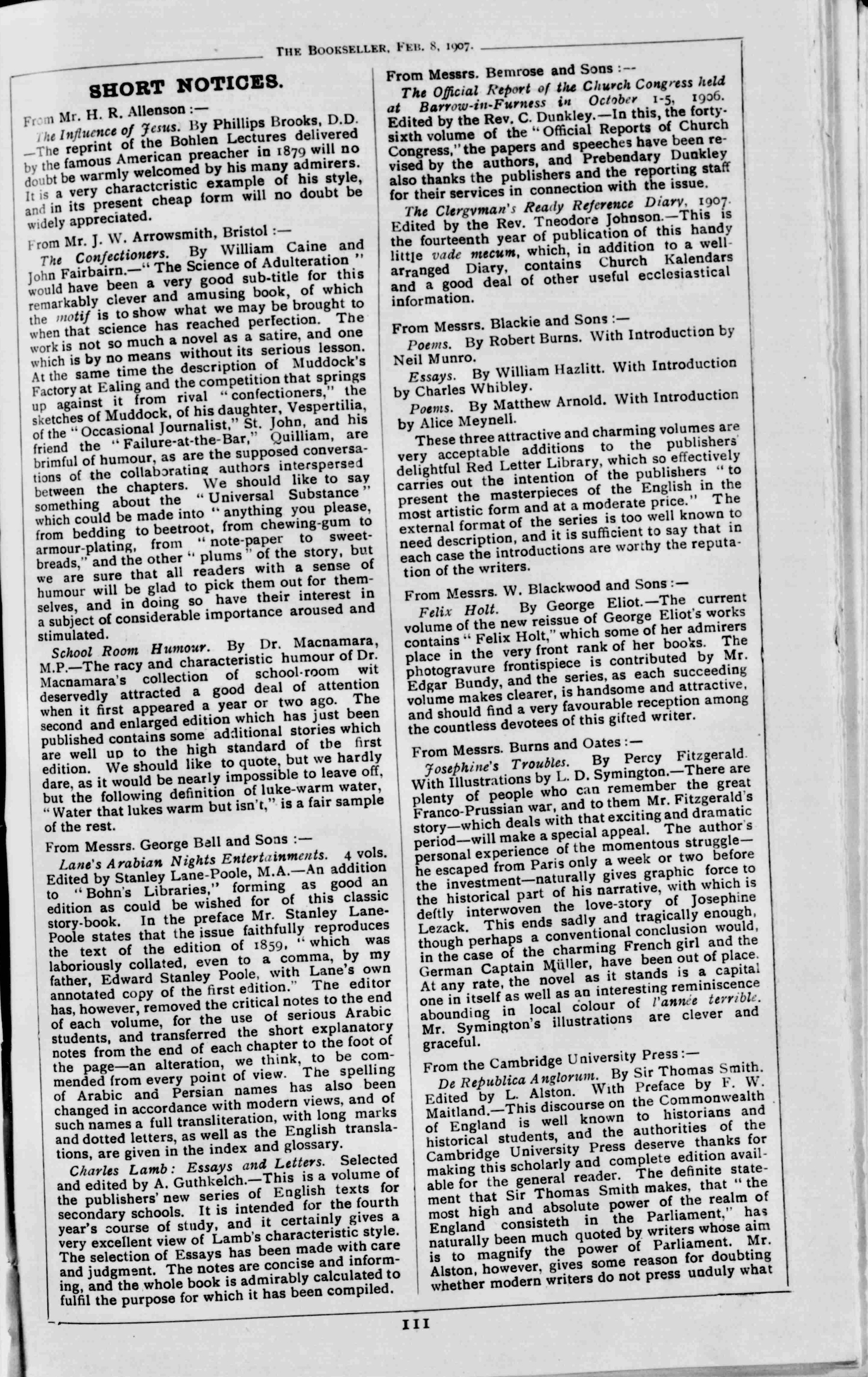
The Bookseller (London), Friday, February 8, 1907, p. 111, “Short Notices.”
“The Science of Adulteration” would have been a very good sub-title for this remarkably clever and amusing book, of which the motif is to show what we may be brought to when that science has reached perfection. The work is not so much a novel as a satire, and one which is by no means without its serious lesson. At the same time the description of Muddock’s Factory at Ealing and the competition that springs up against it from rival “confectioners,” the sketches of Muddock, of his daughter, Vespertilia, of the “Occasional Journalist,” St. John, and his friend the “Failure-at-the-Bar,” Quilliam, are brimful of humour, as are the supposed conversations of the collaborating authors interspersed between the chapters. We should like to say something about the “Universal Substance” which could be made into “anything you please, from bedding to beetroot, from chewing-gum to armour-plating, from “note-paper [sic] to sweetbreads,” and the other “plums” of the story, but we are sure that all readers with a sense of humour will be glad to pick them out for themselves, and in doing so have their interest in the subject of considerable importance aroused and stimulated.
Clark (1978: 31).
An amusing and ironic tale about scientific advances: artificial foods, the Universal Substance, tobacco substitutes, and other examples of human folly.
Entry no. 353 in Bleiler (1990: 116).
Ersatz Chesterton; an attempt to set up a parabolic, absurdist narrative with occasional rhetorical displays. The authors interrupt the narrative periodically and discuss what has been written, the actual writer indulging in self-praise, his collaborator in criticism. This material might well have been omitted. * England, unspecified date, but after the twentieth century. To list personalities: William Quilliam, an immensely wealthy failed barrister; his friend St. John; Bean, a small businessman who turns the haddock eyes found in heather into buttons (cf. Lewis Carroll); Simon Muddock, the great robber baron who controls the synthetics and food supply of Great Britain; Rambotham Jewel, an unscrupulous journalist; Meager, a surly unscrupulous electrician who has discovered a way to tap the earth’s magnetic field for power; and Walter Gruntle, a chemical engineer who works for Muddock. * Gruntle, who has ambitions above his station, invents a universal substance that with suitable additives and adulterations can be turned into almost anything, from food to wire. He tries to corner Muddock into giving him a share of the potential profit from it, but Muddock, who is an ogre, simply expels him from the closed, fortress-like factory compound. (Muddock and his works, it might be observed, are somewhat anticipatory of the parabolized capitalists of Thea von Harbou’s Metropolis.) Bean, in the meanwhile, has been put out of business by Muddock. Through a series of reasonable chances Bean, Meager, Gruntle, Quilliam, and Muddock’s daughter Vespertilia (who is in violent rebellion against her brutal father) join forces and form a company (Gruntleite) to exploit the discoveries of Meager and Gruntle, hoping to drive Muddock out of business. In a short time they take over his world markets and become wealthy beyond their dreams. But they are now exposed to the vicious dealings of big business, with spying and assassinations, and several of the members leave the organization. * Muddock strikes back, agitating among the workers from his giant airship, proclaiming that three million people will be unemployed if Muddock Enterprises collapses. * The workers attack the Gruntleite plant. Bean and Meager are hard men and do not hesitate to electrocute such workers as approach the plant defense perimeter. But Gruntle, who has degenerated mentally, causes the downfall of the associates by becoming obsessive about following side lines. For example, when it is necessary to have copper wire for setting up defenses, Gruntle insists on manufacturing daffodil stalks. * The workers burst into the Gruntleite plant. Bean and Muddock in death struggle fall off the roof and are killed. Meager blows up the factory, leaps into the Gruntleite vat, and dissolves. Quilliam, who is a weaker version of King Auberon in Chesterton’s The Napoleon of Notting Hill, retires to a monastery. * Some interesting touches, but without the brilliance and flash of Chesterton. * The title arises from an analogy with a pastry chef who can create all sorts of things with a little nozzle sack filled with basic material.
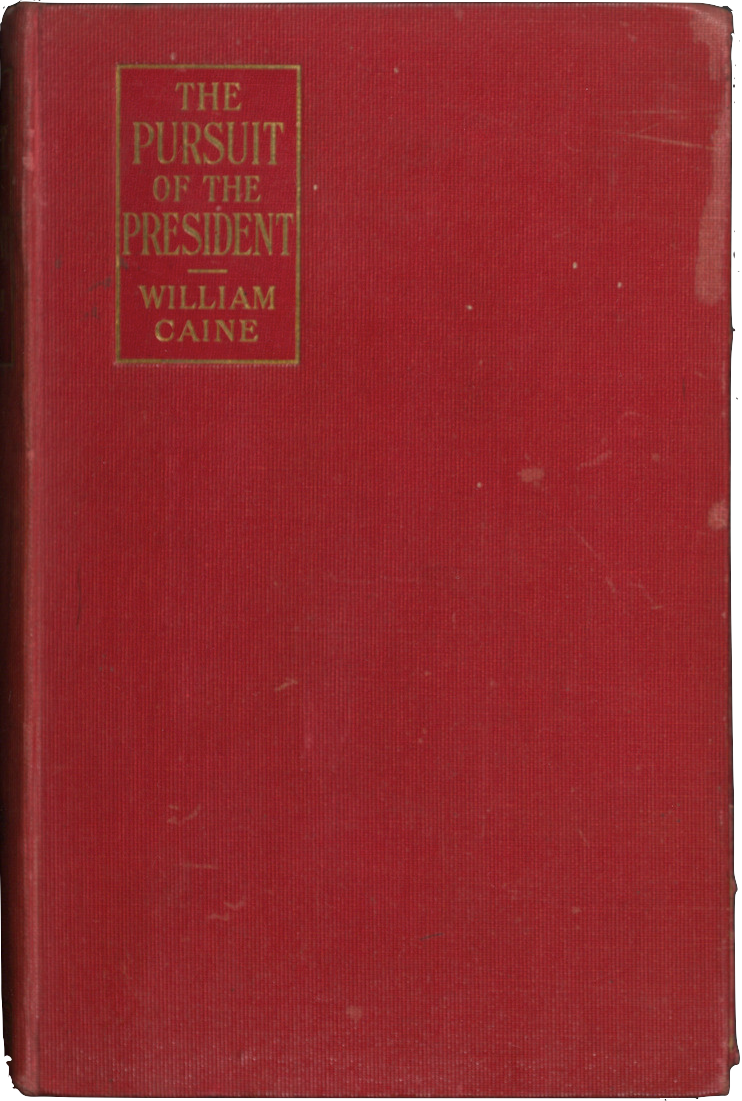
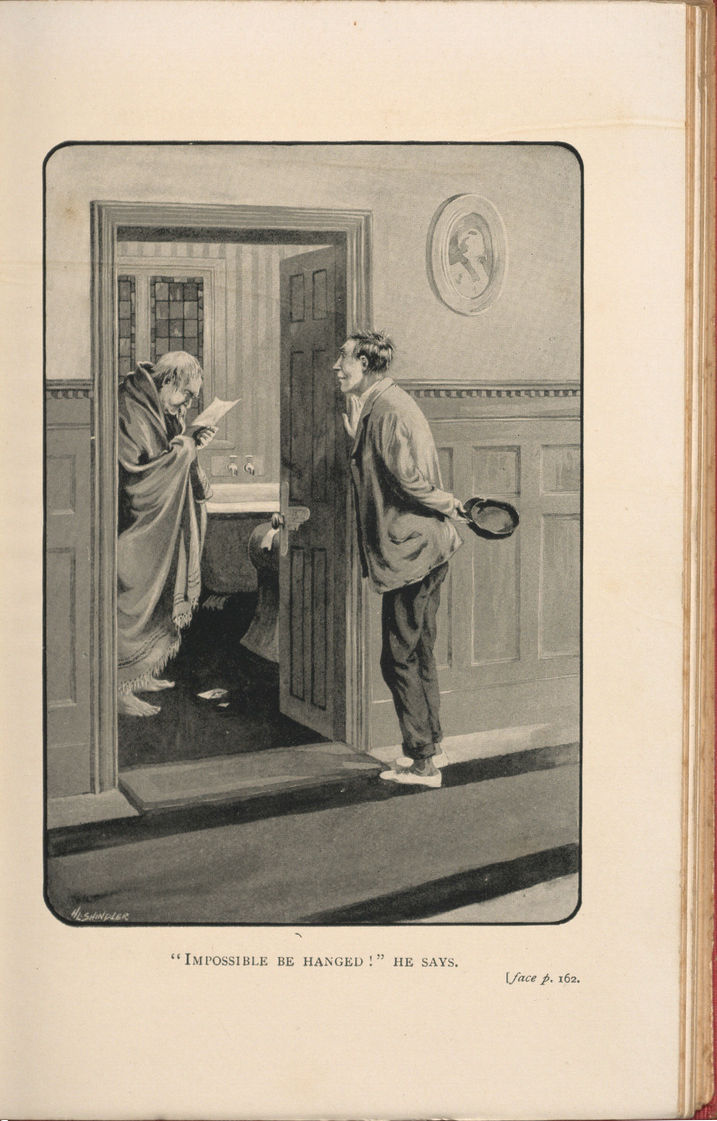
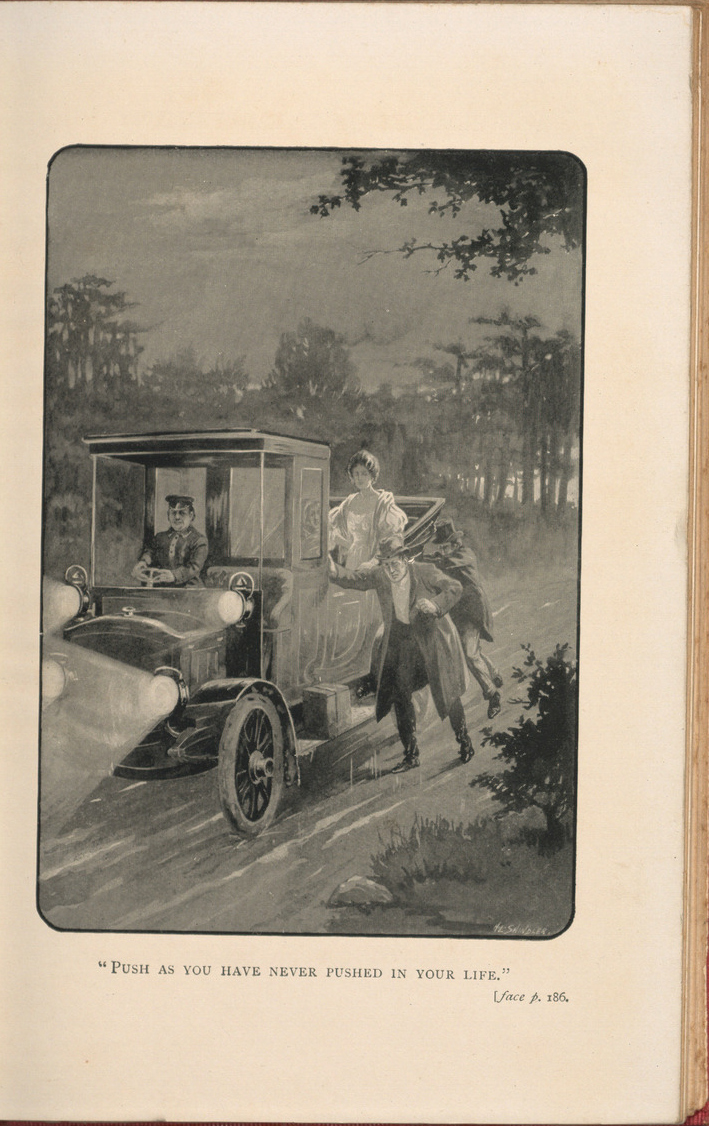
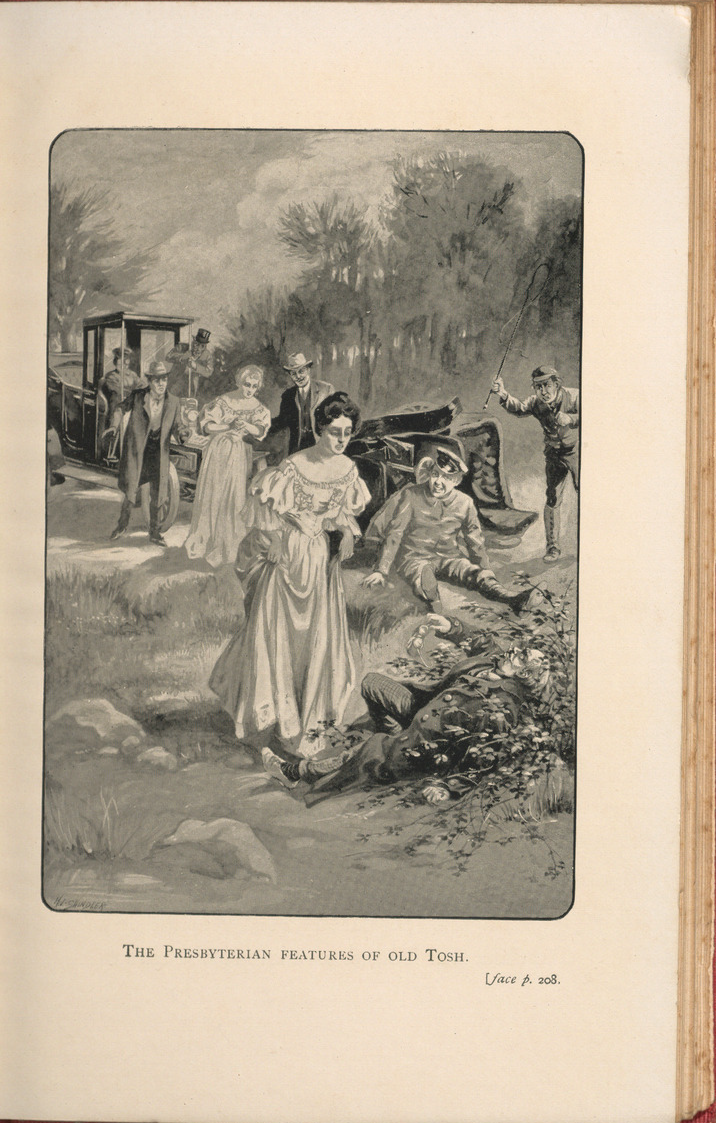
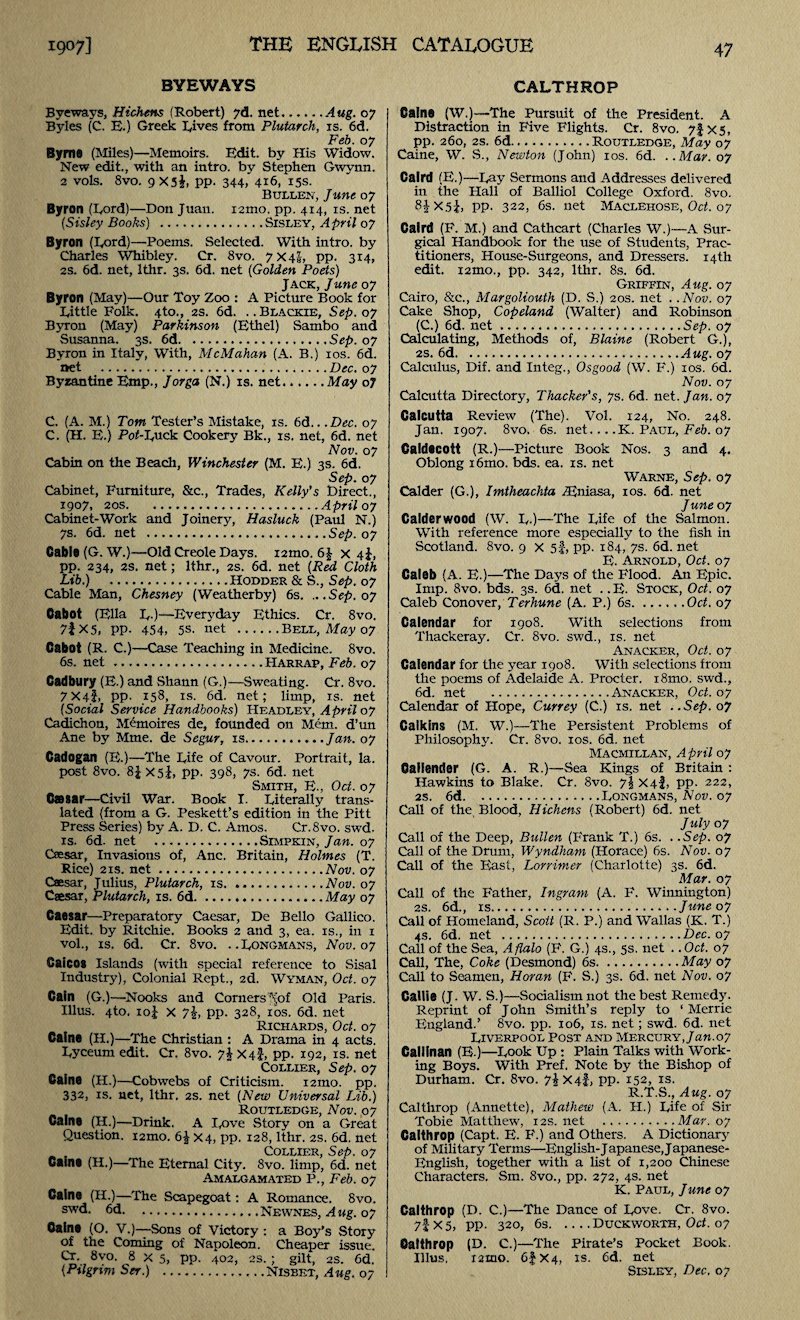
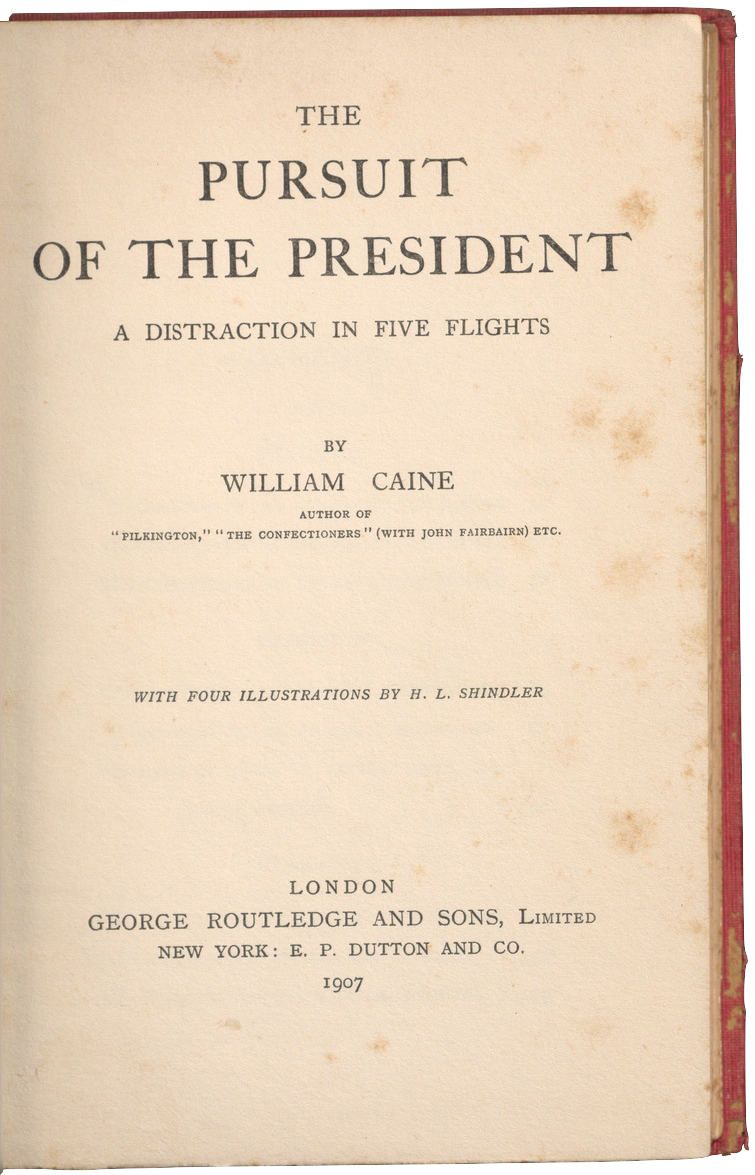
The Pursuit of the President, by William Caine. With four illustrations by H. L. Shindler. London: George Routledge & Sons. 260 pages, 8º. May 1907. Available at National Library of Australia.
A Distraction in Five Flights.
With four illustrations by H. L. Shindler. London: George Routledge & Sons. 260 pages, 8º. May 1907. [ECB 1907: 47].
In the digital copy which the National Library of Australia kindly provided me of its exemplar for the price of A$152, there are only three illustrations by H. L. Shindler: Facing pages 162, 186, and 208.
Likewise, the dedication page also seems to be missing from the scan.
This scan is now available online at the NLA.
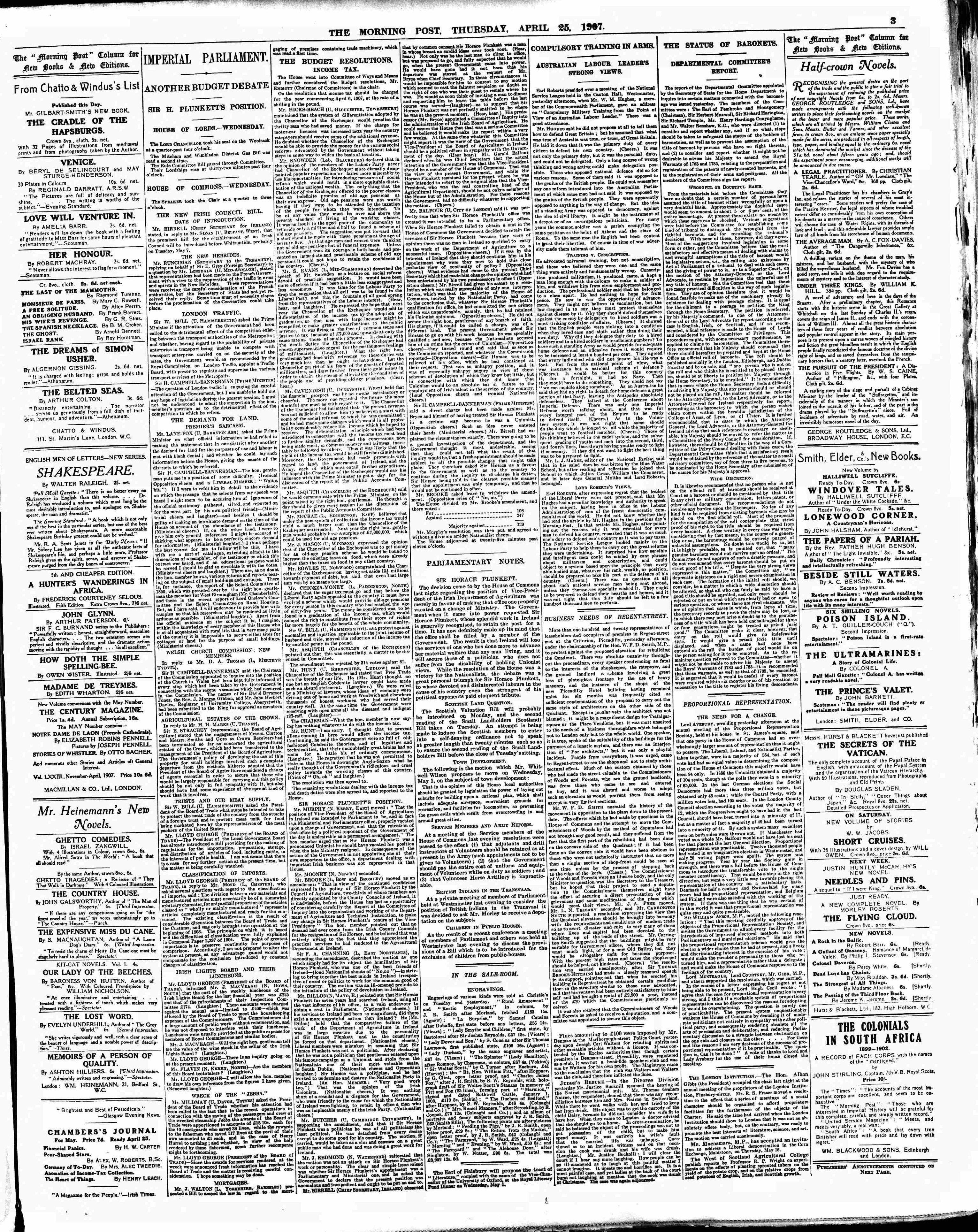
The Morning Post (London), Thursday, April 25, 1907, p. 3, “Half-crown Novels.” [Advertisement].
A rattling story of the siege and pursuit of a Cabinet Minister by the leader of the “Suffragettes,” and incidentally of the manner in which the Minister’s son joined on the pursuit of his father, and of the part in the drama played by the “Suffragette’s” niece. Full of incidents of adventure by road, water, and air. An irresistibly humorous novel of the day.
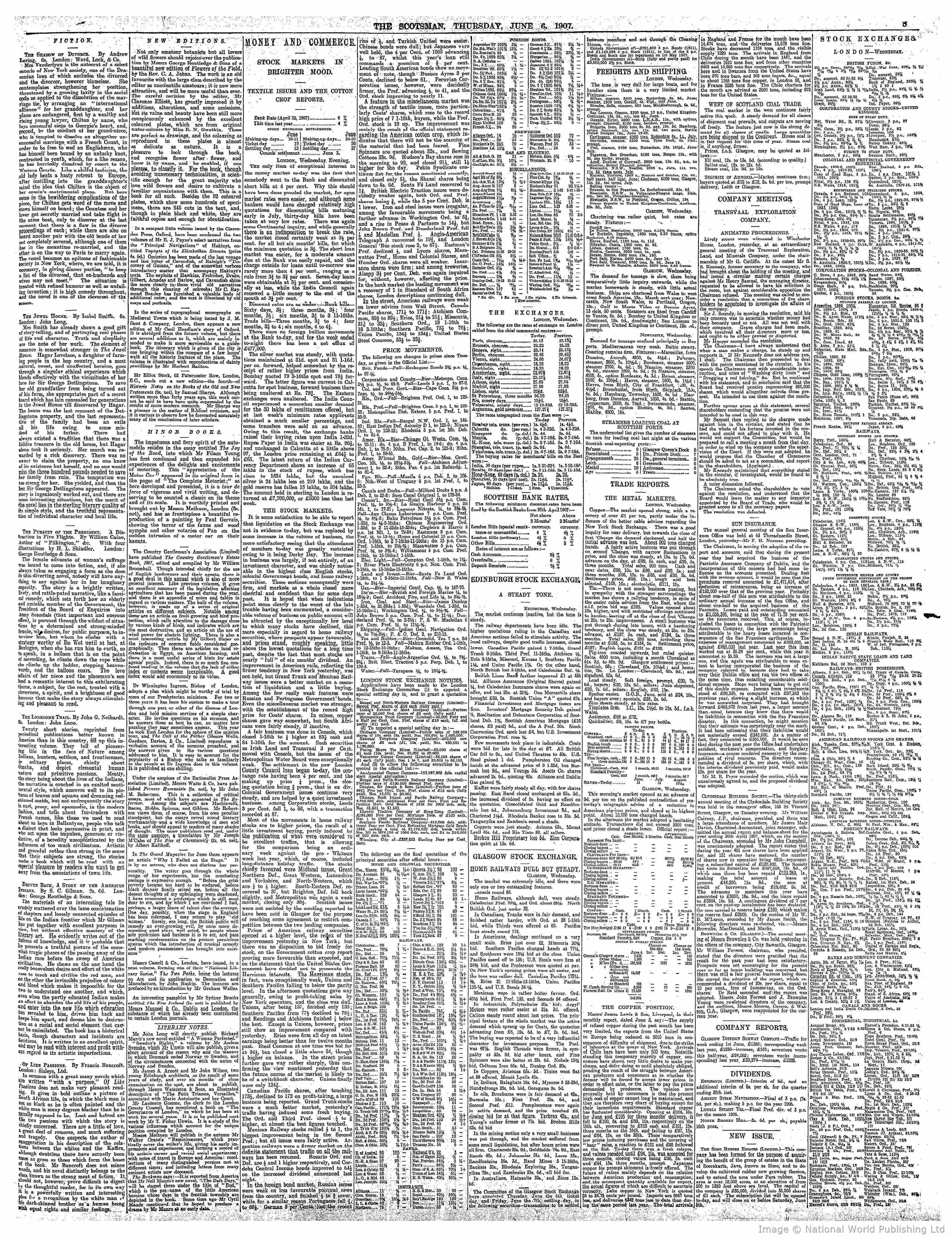
The Scotsman, Thursday June 6, 1907, p. 3, “Fiction.”
The female advocate of woman’s suffrage was bound to come into fiction, and, if she always takes as engaging a form as she does in this diverting novel, nobody will have anything to say against her in her imaginary capacity. The story is a brightly written, lively, and rattle-pated narrative, like a farcical comedy, which sets forth how an elderly and amiable member of the Government, the President of the Board of Enquiries into Army Scandals (that important and onerous office), is pursued through the wildest of situations by a determined and strong-minded female, who desires, for public purposes, to interview him, but whom he eludes with a strategy worthy of De Wet until at last, at Boulogne, when she has run him to earth, so to speak, in a balloon that is on the point of ascending, he climbs down the rope while she climbs up the ladder, stepping heavenwards, and the balloon soars. The love affairs of her niece and the placeman’s son lend a romantic interest to this exhilarating theme, a subject, for the rest, treated with a cleverness, a spirit, and a brightness of good humour that make the story always stimulating and pleasant to read.
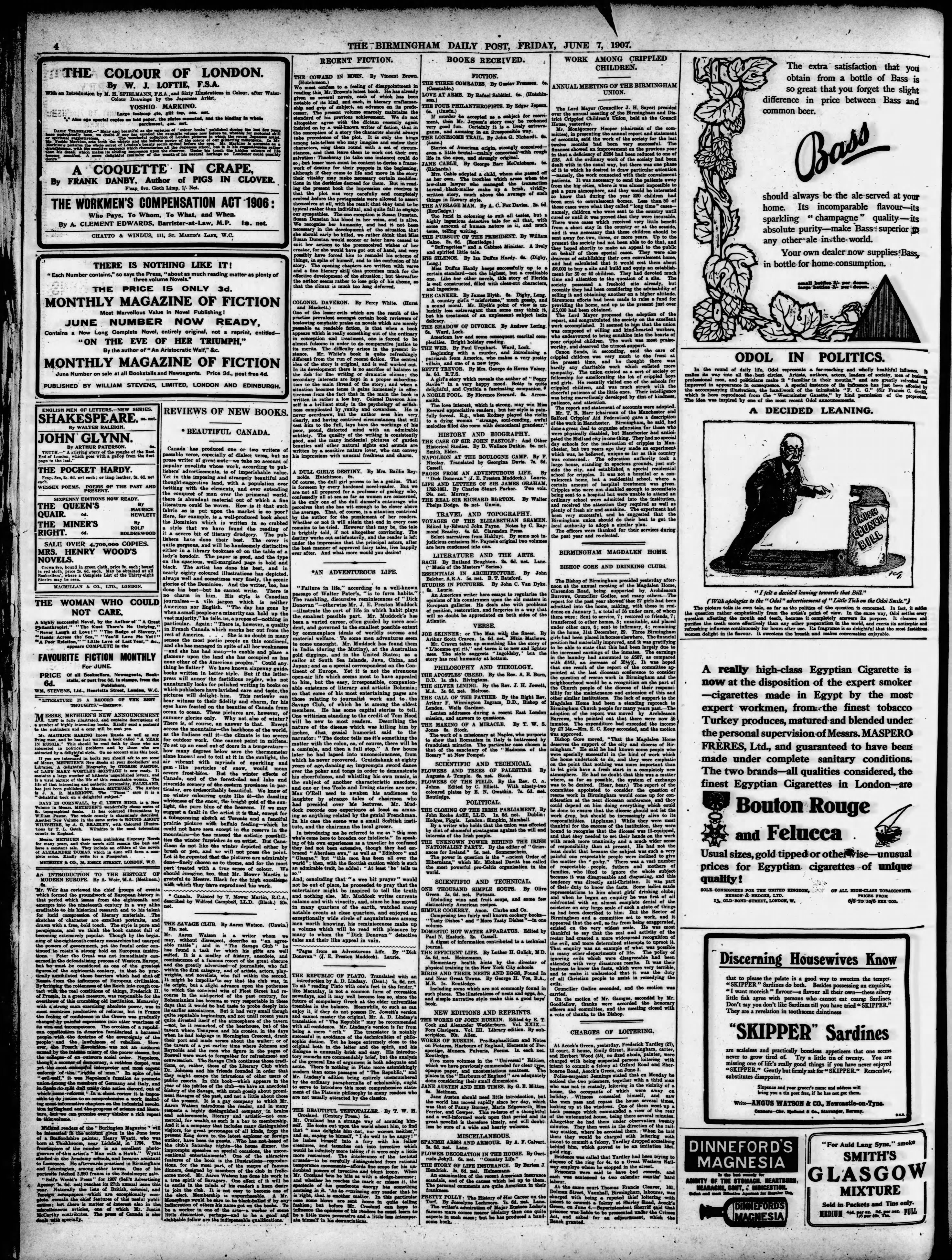
The Birmingham Daily Post, Friday, June 7, 1907, p. 4, “Books Received; Fiction.”
“Suffragettes” and a Cabinet Minister. A lively and spirited little tale.
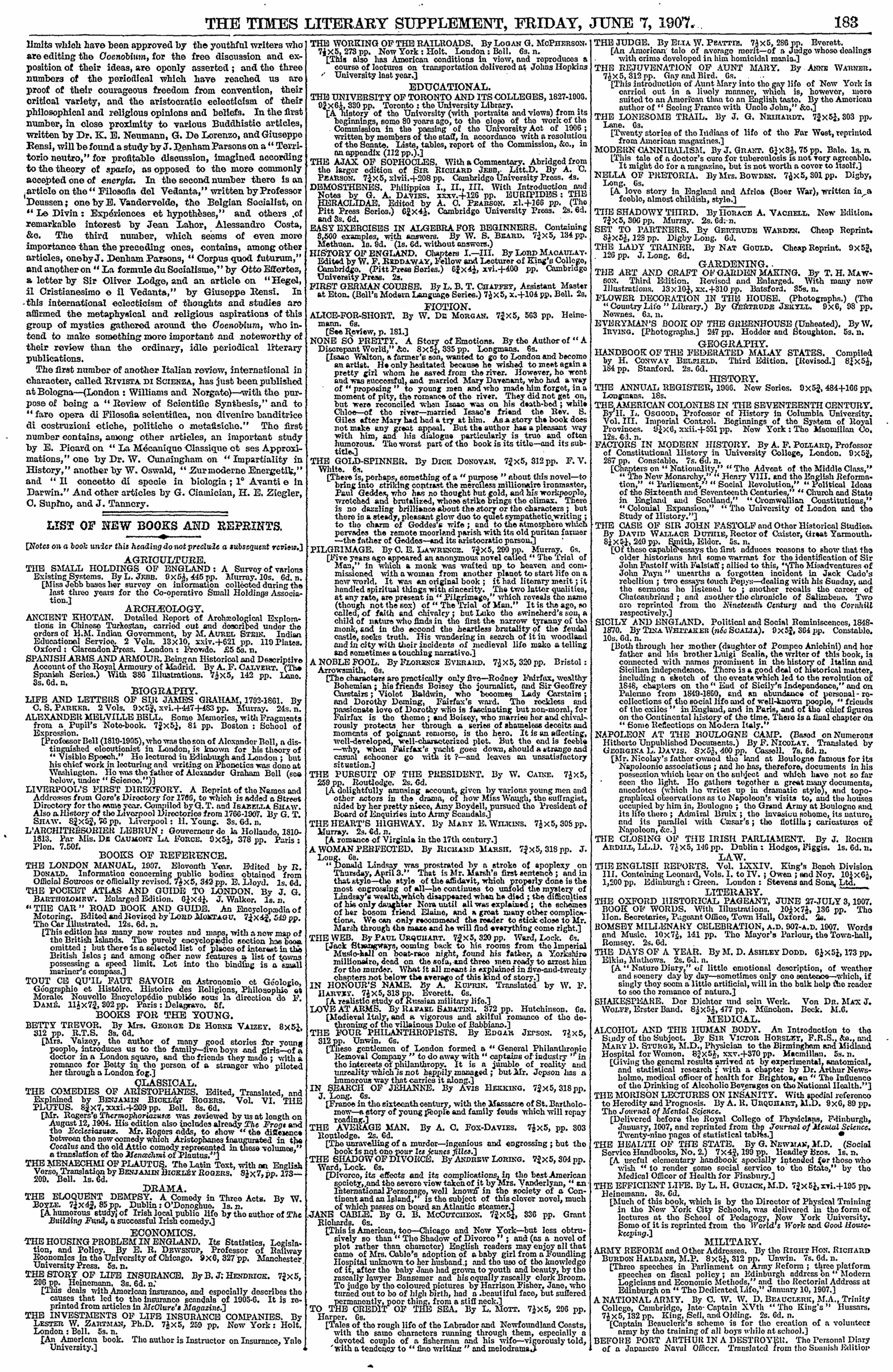
The Times Literary Supplement, Friday, June 7, 1907, p. 183, “New Books and Reprints; Fiction.”
A delightfully amusing account, given by various young men and other actors in the drama, of how Miss Waugh, the suffragist, aided by her pretty niece, Amy Boydell, pursued the President of Board of Enquiries into Army Scandals.
Pall Mall Gazette, Saturday, June 8, 1907, p. 4, “Books in Brief; Fiction.”
Mr. Caine has seized on one of the numerous phases of current politics — the Suffragette movement — and has played with it admirably. “The president” stands for a British Cabinet Minister, who has been marked down for interviewing by a lovely and energetic advocate of the rights of “downtrodden woman.” The Minister resolves not to be interviewed, weak woman resolves that, willy nilly, he shall be, and there ensues a struggle in which hansom cabs, motor-cars, steam yachts, and even balloons play their part so merrily that the little love story which runs through the score in grace-note fashion is almost forgotten. It is not literature on a high level — Mr. Caine would be the first to admit that — but it is laughter-provoking from the first page to the last, with here and there a dash of caustic, penetrating criticism, which shows that the author is capable of a good deal more than mere buffoonery. “The Pursuit of the President” will pass an idle hour or two as pleasantly as any of the modern specimens of fiction.
The Manchester Guardian, Wednesday, June 12, 1907, p. 5, “New Novels.” [Signed A. N. M.].
The Pursuit of the President (Routledge, pp. 259, 2s. 6d.) is by Mr. William Caine, part author of “The Confectioners” — a work which had possibilities of entertainment in it. Mr. Caine is not yet a humourist who may be confidently recommended, and yet he has a sense of fun and manages to differentiate in the preposterous. The story is about a determined lady suffragist who insists upon interviewing the President of the Army Scandals Board, and the pursuit by motorcar, steamer, and balloon has some good incidents.
The Croydon Guardian and Surrey County Gazette, Saturday, June 15, 1907, p. 3, “From the Publishers; Half-crown Novels.”
Visions of some of the suffragettes or suffragists, as they are indifferently called, inevitably flit before the vision as the reader peruses the exceedingly modern extravaganza that Mr. Caine styles “The Pursuit of the President.” He has certainly heard of the attempted waylaying of the present Prime Minister and Mr. Asquith, and the raids that have been made upon the House of Commons. The persecuted minister in this case is Sir John Cattermole, President of the Board of Scandals, and the director of the persecution is Miss Waugh, with whom various workers young and old, masculine and feminine [sic]. Poor Sir John has a bad time of it in seeking to evade capture. He makes his way over roofs like a captive, is relentlessly pursued in an adventurous affair of motors, is followed even across the sea, and is made to feel that he is unsafe even in a balloon. That he succumbs in the end is no fault of his own. The exciting narrative of Mr. Caine gains piquancy from being allotted to the pens of those who took part in the various adventures, and he is very successful in keeping up the interest of his comedy throughout. Probably the one who enjoyed the adventures most was Peter Cattermole, Sir John’s son, for did he not have the company of pretty Miss Boydell in almost all the fiery episodes, and did they not ultimately come to a perfect understanding?
The Newcastle Daily Chronicle, Wednesday, June 19, 1907, p. 8, “Books of the Day; Mr. Asquith Warned.”
The lady suffragist has got a play all to herself, and it was inevitable that she should fill a novel. It is not quite true, however, that she quite fills this novel, for the men are at least equally important, but she at least provides the mainspring of all the action, which is as rapid as yachts, railway trains, and motor cars can make it. The pursuer was a suffragist and the pursued was the Right Hon. Sir John Cattermole, who held the portfolio of the President of the Board of Enquiries into Army Scandals. All the other Ministers had yielded to the persecuting attentions of the suffragists, and had consented to be interviewed. But Sir John, unhappily for himself, was made of sterner stuff, and so he had to run for it by land, and by sea, and by air — it was by coming down the rope of the balloon while the suffragist was scaling the ladder that he escaped in the end. He is a Mr. Asquith in worse [?] case, unless, of course, the story be intended as a prophetic warning of what is in store for the Chancellor of the Exchequer. The story is a highly diverting piece of comedy of the up-to-date and more robust order.
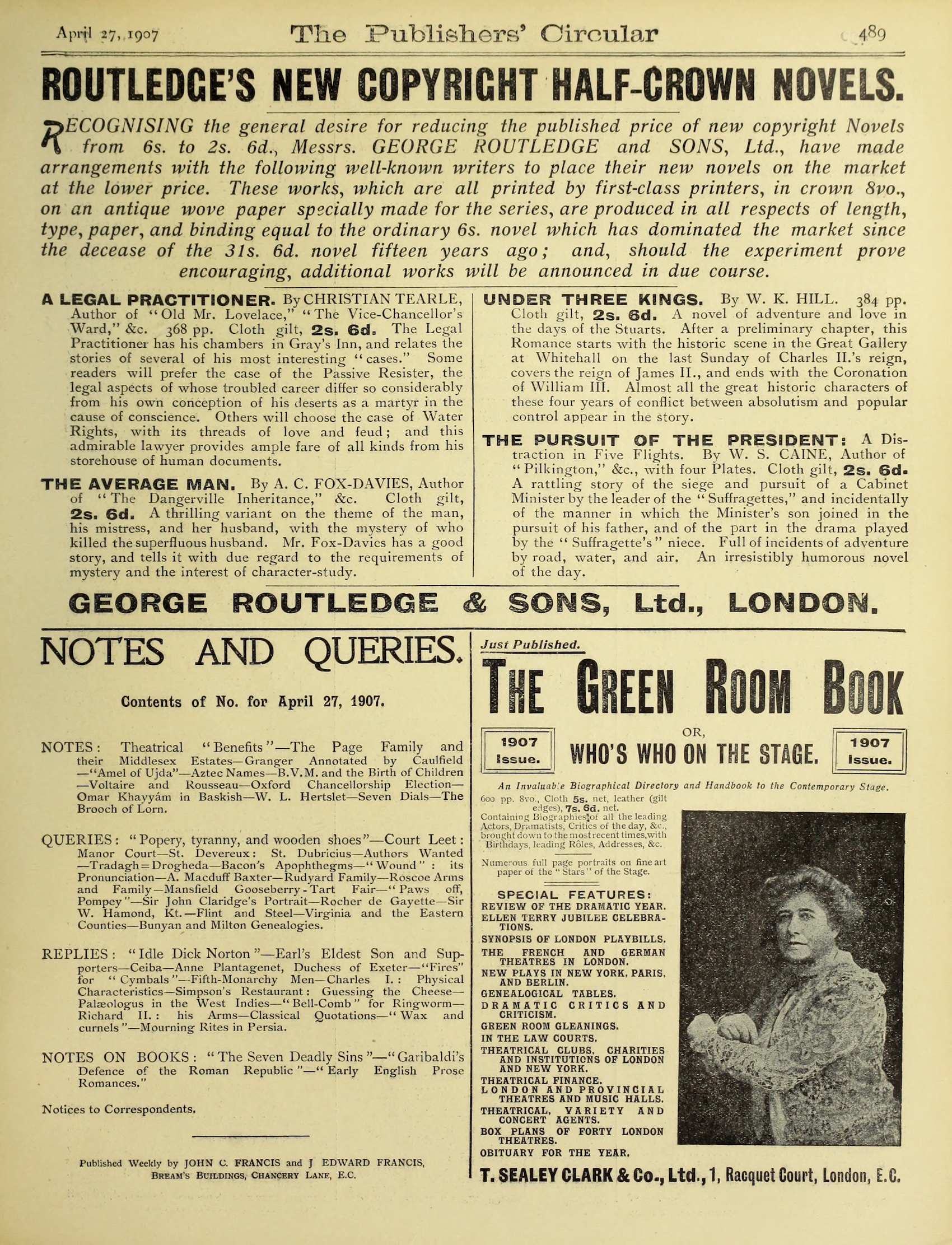
THE PURSUIT OF THE PRESIDENT: A Distraction in Five Flights. By W. S. CAINE, Author of “Pilkington,” &c., with four Plates. Cloth gilt, 2s. 6d. A rattling story of the siege and pursuit of a Cabinet Minister by the leader of the “Suffragettes,” and incidentally of the manner in which the Minister’s son joined in the pursuit of his father, and of the part in the drama played by the “Suffragette’s” niece. Full of incidents of adventure by road, water, and air. An irresistibly humorous novel of the day.
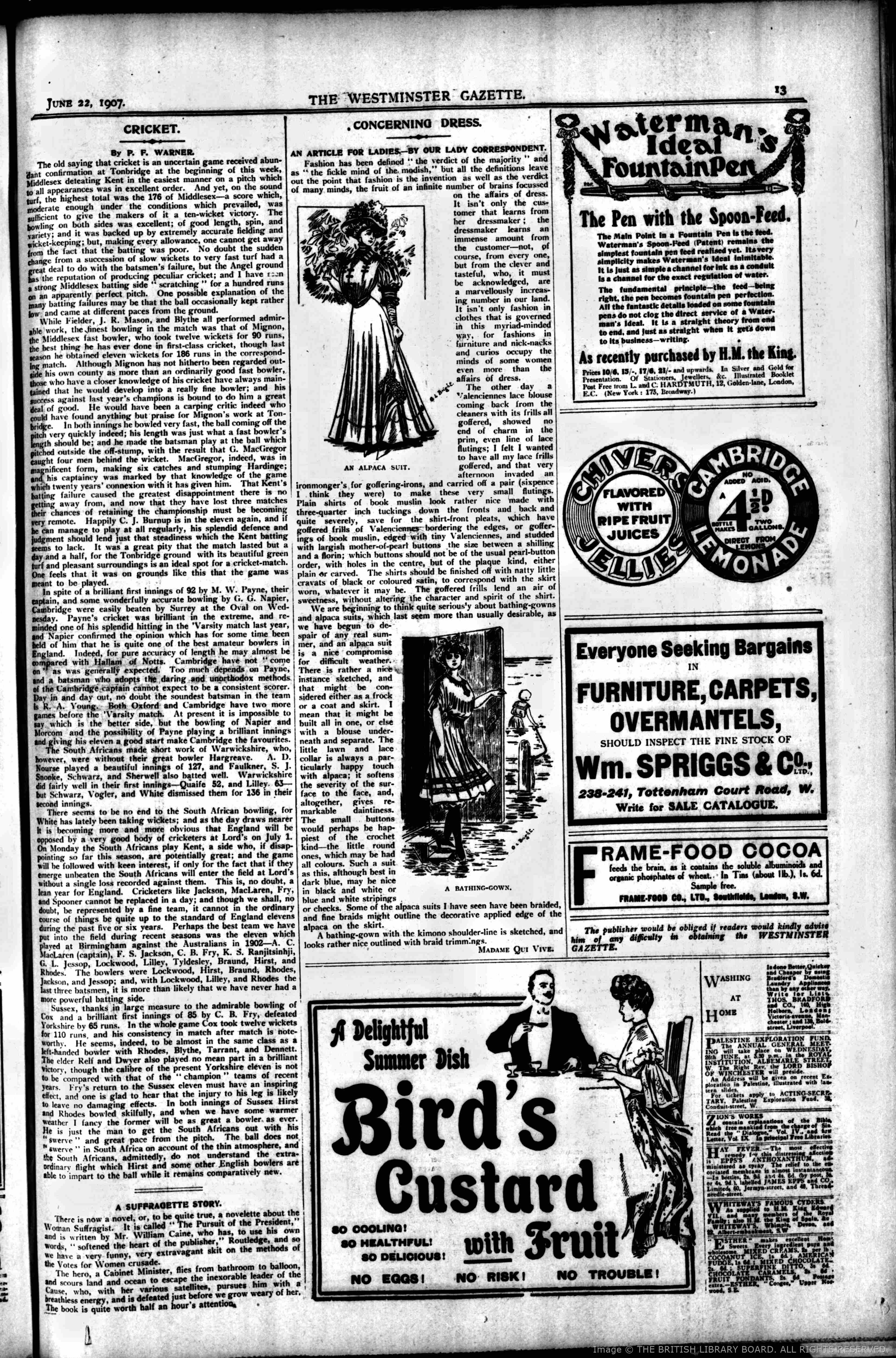
The Westminster Gazette, Saturday June 22, 1907, p. 13, “A Suffragette Story.”
There is now a novel, or, to be quite true, a novelette about the Woman Suffragist. It is called “The Pursuit of the President,” and it is written by Mr. William Caine, who has, to use his own words, “softened the heart of the publisher,” Routledge, and so we have a very funny, very extravagant skit on the methods of the Votes for Women crusade.The hero, a Cabinet Minister, flies from bathroom to balloon, and scours the land and ocean to escape the inexorable leader of the Cause, who, with her various satellites, pursues him with a breathless energy, and is defeated just before we grow weary of her. The book is quite worth half an hour’s attention.
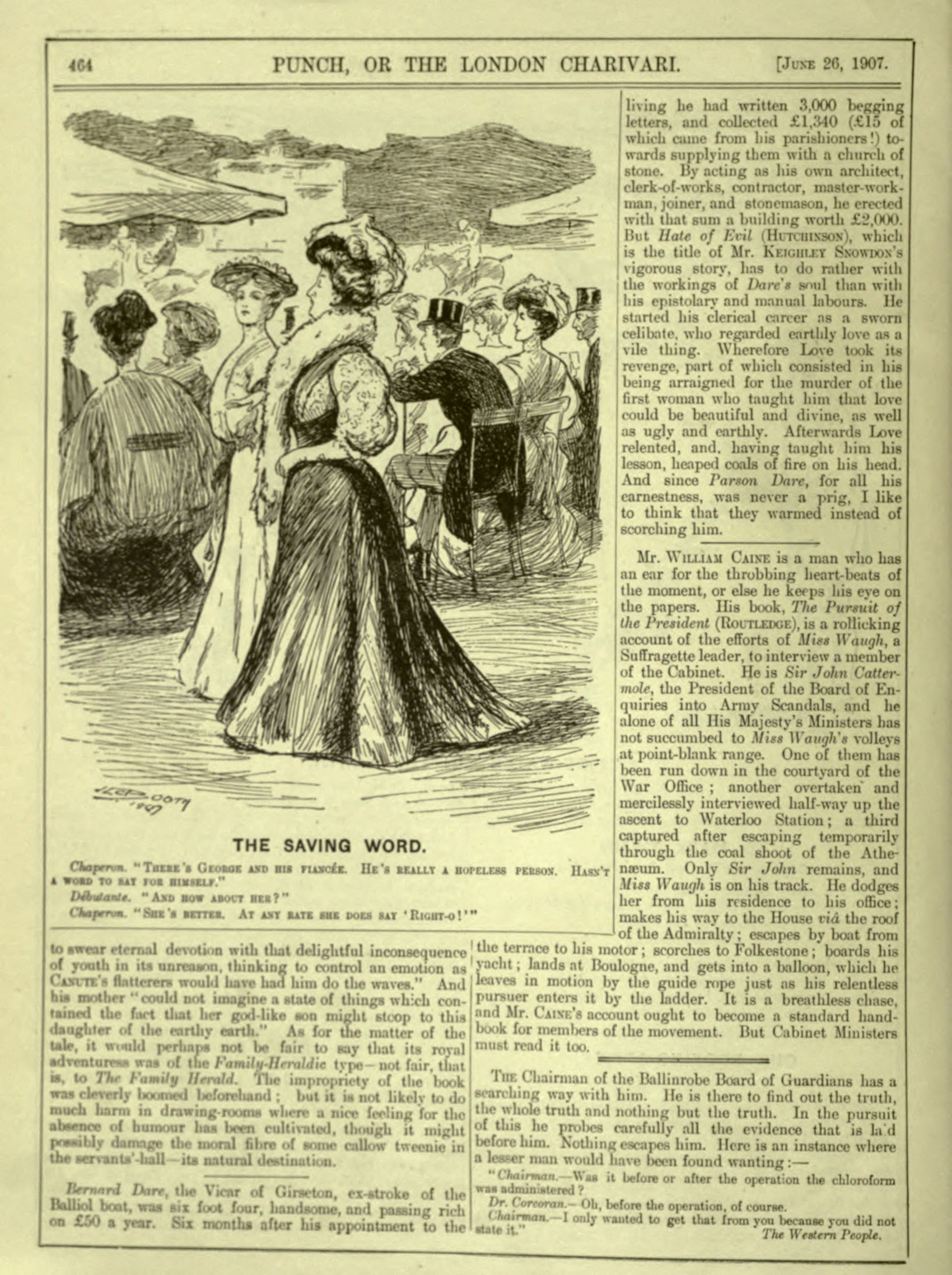
Punch, or the London Charivari, vol. 132, June 26, 1907, p. 464, “Our Booking Office.”
Mr. William Caine is a man who has an ear for the throbbing heart-beats of the moment, or else he keeps his eye on the papers. His book, The Pursuit of the President (Routledge), is a rollicking account of the efforts of Miss Waugh, a Suffragette leader, to interview a member of the Cabinet. He is Sir John Cattermole, the President of the Board of Enquiries into Army Scandals, and he alone of all His Majesty’s Ministers has not succumbed to Miss Waugh’s volleys at point-blank range. One of them has been run down in the courtyard of the War Office; another overtaken and mercilessly interviewed half-way up the ascent to Waterloo Station; a third captured after escaping temporarily through the coal shoot of the Athenæaum. Only Sir John remains, and Miss Waugh is on his track. He dodges her from his residence to his office; makes his way to the House viâ the roof of the Admiralty; escapes by boat from the terrace to his motor; scorches to Folkestone; boards his yacht; lands at Boulogne, and gets into a balloon, which he leaves in motion by the guide rope just as his relentless pursuer enters it by the ladder. It is a breathless chase, and Mr. Caine’s account ought to become a standard handbook for members of the movement. But Cabinet Members must read it too.
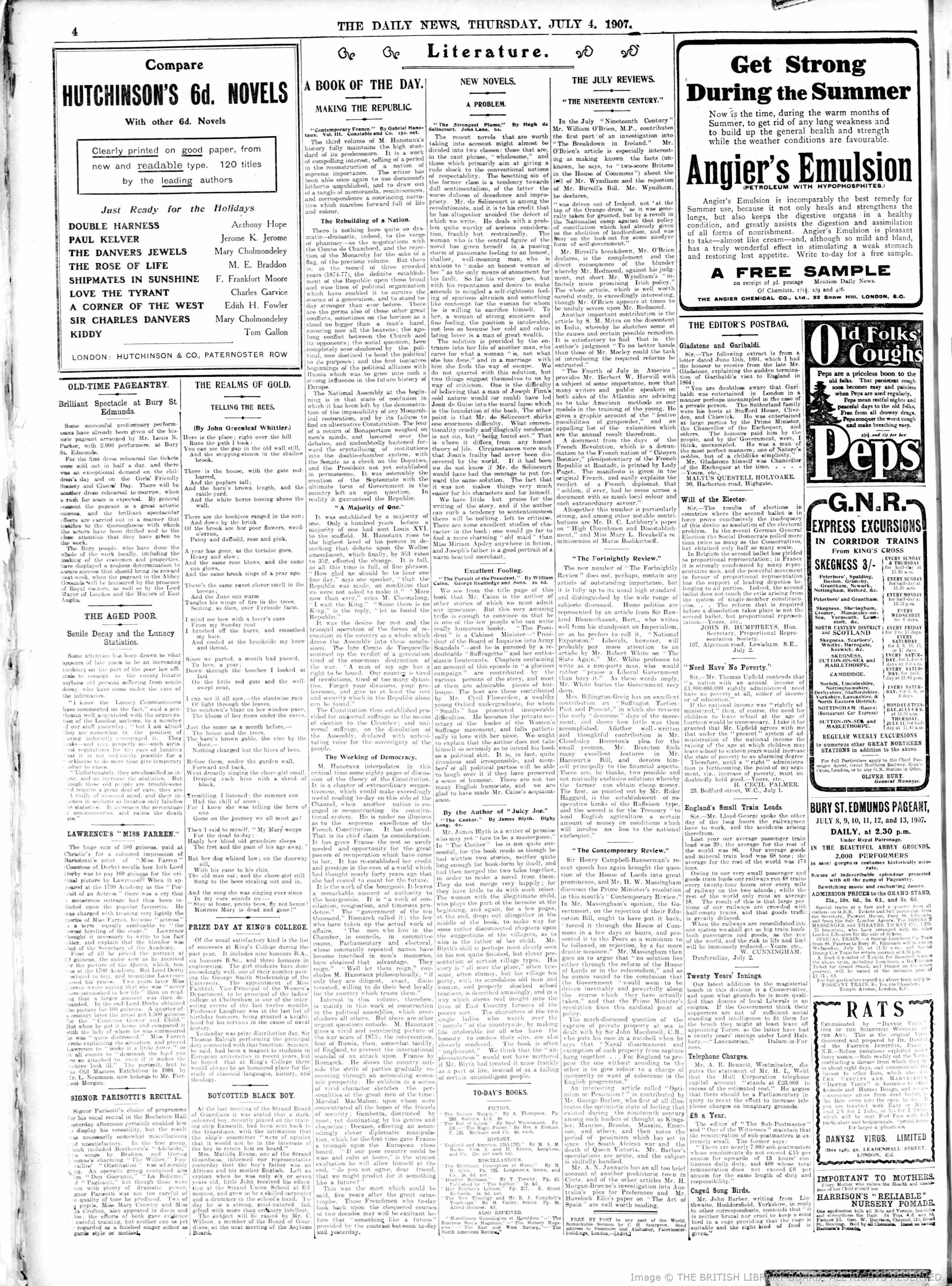
The Daily News, Thursday, July 4, 1907, p. 4, “Literature; New Novels; Excellent Fooling.”
We see from the title page of this book that Mr. Caine is the author of other stories of which we must admit our ignorance. But this very amusing trifle is enough to convince us that he is one of the few people who can write really humorous books. “The President” is a Cabinet Minister — “President of the Board of Inquiries into Army Scandals” — and he is pursued by a redoubtable “Suffragette” and her enthusiastic lieutenants. Chapters containing an account of this episode in “a glorious campaign” are contributed by the various persons of the story, and most of them are admirable pieces of burlesque. The best are those contributed by Mr. Cyril Flowerdew, a wealthy young Oxford undergraduate, for whom “Smalls” has presented insuperable difficulties. He becomes the private secretary of the leader of the Women’s Suffrage movement, and falls pathetically in love with her niece. We ought to explain that the author does not take himself so seriously as to intend his book as a political skit. It is, in fact, quite frivolous and irresponsible, and members of all political parties will be able to laugh over it if they have preserved a sense of humour. There are not too many English humorists, and we are glad to have made Mr. Caine’s acquaintance.
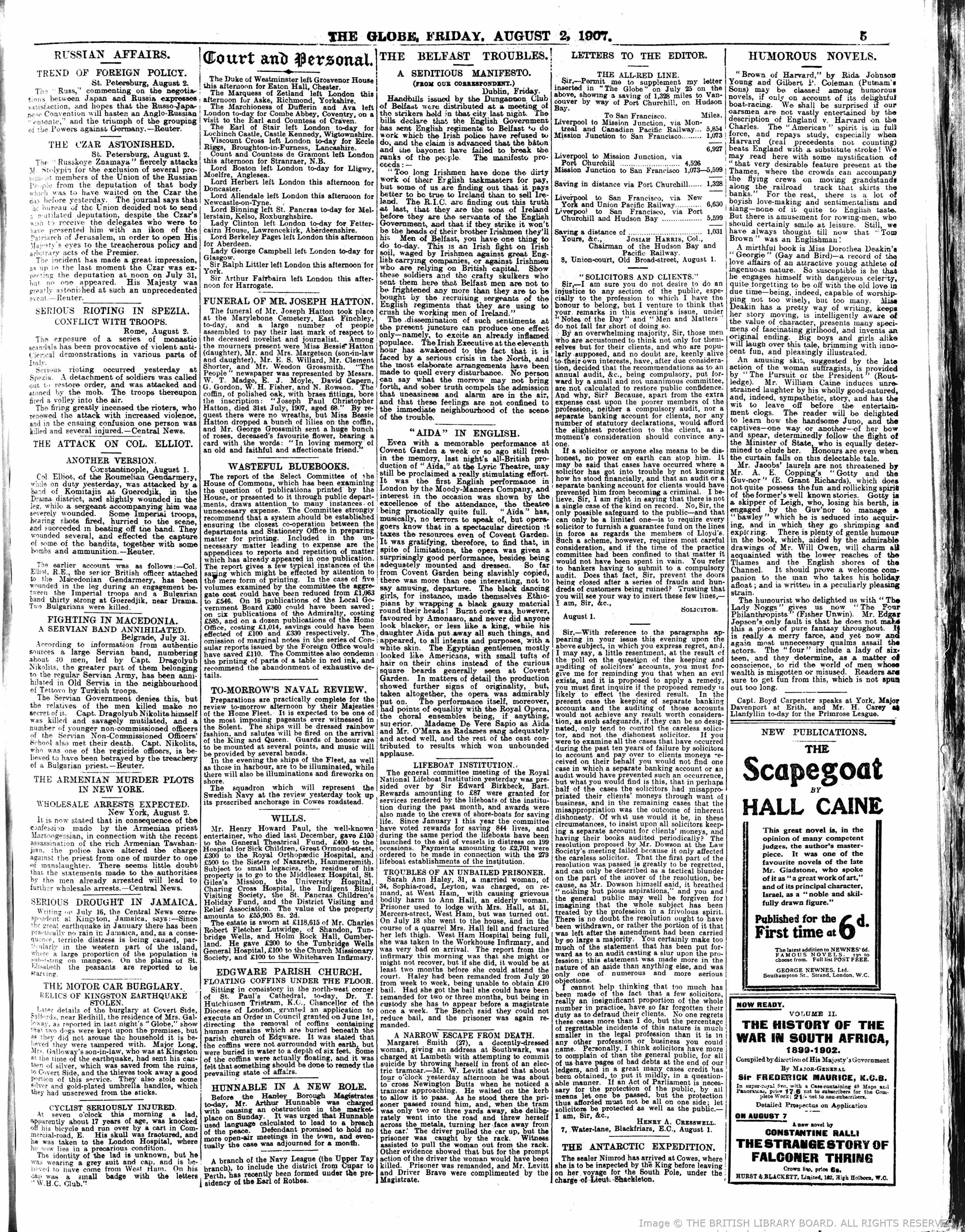
The Globe, Friday, August 2, 1907, p. 5, “Humorous Novels.”
An amusing skit, suggested by the late action of the woman suffragists, is provided by “The Pursuit of the President” (Routledge). Mr. William Caine induces unrestrained laughter by his wholly good-natured, and, indeed, sympathetic, story, and has the wit to leave off before the entertainment clogs. The reader will be delighted to learn how the handsome Juno, and the captives — one way or another — of her bow and spear, determinedly follow the flight of the Minister of State, who is equally determined to elude her. Honours are even when the curtain falls on this delectable tale.
The Academy, August 10, 1907, p. 779, “Fiction.”
This book treats, at some length, of the pursuit of the unfortunate President of the Scandals Board, by earth, sea and air, by the beautiful and single-hearted leader of the English woman-suffrage agitation. The pursuit, although the lady triumphs, does not terminate in quite so complete a capture of the President as some readers — owing to the account of her charms — will have begun to imagine.
Evening Standard and St. James’s Gazette, September 7, 1907, p. 5, “Novel Notes.”
The Pursuit of the President, by William Caine (Routledge, 2s. 6d.), is roaring farce, and fulfils the destiny of such. It never flags for a moment. Out of the dry bones of Woman’s Suffrage, the eternal, the palling, it snatches stuff for laughter. The lady principals are beautiful, for once, instead of the obsolete specimens usually presented as targets for music-hall wit. True, beautiful or not, they speak as not the veriest Suffragette ever spoke outside a novel. But the action is so fast and furious, the “pursuit” so spirited, and the result so ridiculous, that not to laugh is not to be a human being. But for the difficulty of staging the motor and balloon incidents, the book would make a delightfully funny curtain raiser.
The Queensland Figaro (Brisbane, Queensland), Thursday, September 26, 1907, p. 5, “Books; On the Library Shelves.”
“The Pursuit of he President” (by W. Caine), and “The Suffragette’s Love Letters” (Anon.). — Both capital light skits upon a burning subject — none other than the suffragette.
The Morning Post (London), Thursday, October 10, 1907, p. 2, “New Novels; A Good Farce.”
Mr. William Caine has succeeded where many other writers and nearly all political speakers have failed. He has succeeded in making fun of the extreme woman’s suffrage movement without being either vulgar or offensive. The story of how Miss Waugh pursued the President of the Board of Enquiries into Army Scandals with the object of impressing on him the need for granting votes to women is rollicking and good-humoured farce. The pursuit is well sustained, and is made by means of motor-cars, rowing boats, steam tugs, and even balloons. The president’s son falls in love with Miss Waugh’s niece, and provides a pleasant complication in the chase, which is quite as exciting as it is amusing. “The Pursuit of the President” is distinctly a book with which to enliven a dull hour.
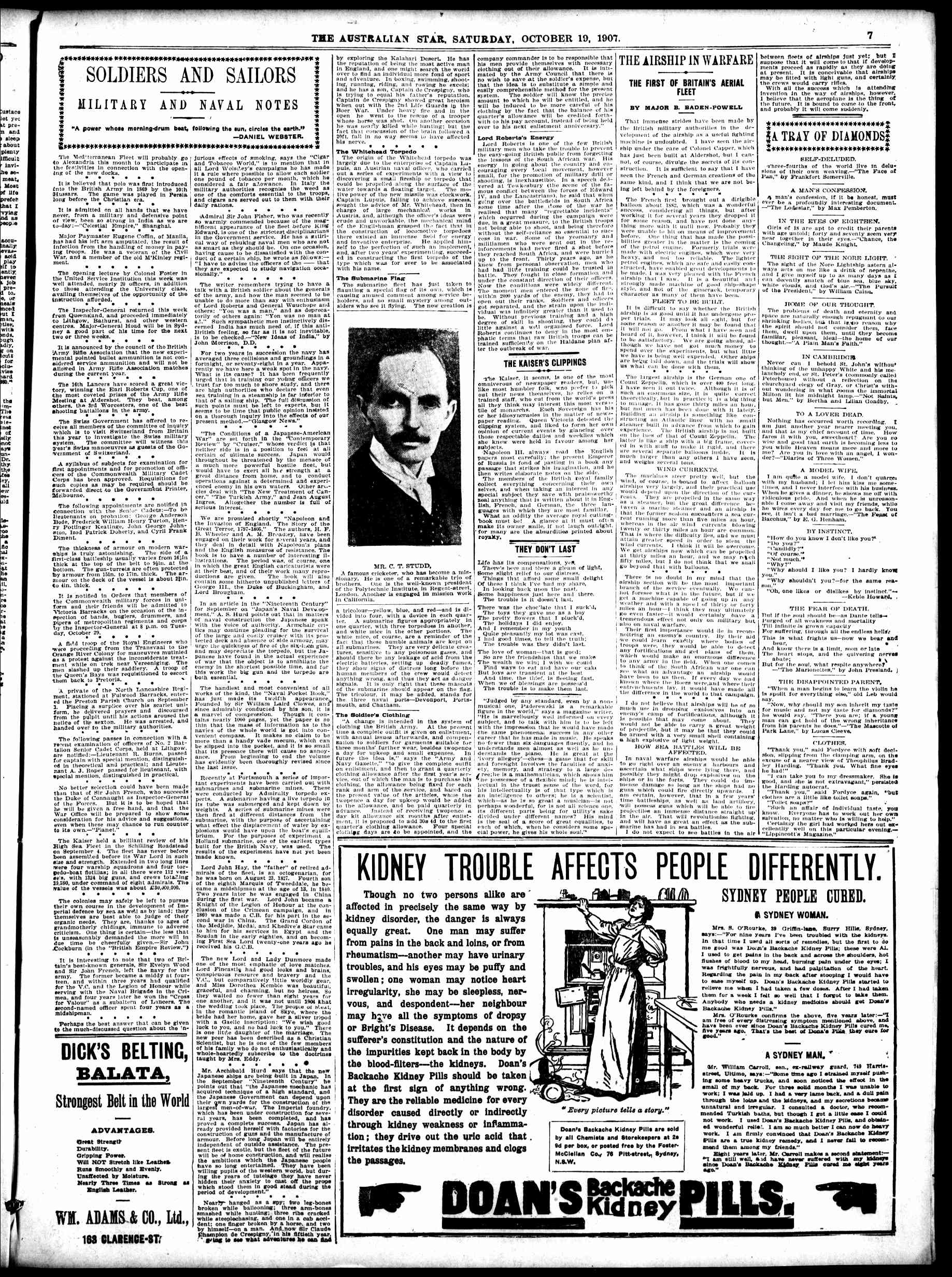
The Australian Star (Sidney), Saturday, October 19, 1907, p. 7, “A Tray of Diamonds; The Sight of the Nore Light.”
The sight of the Nore Lightship astern always acts on me like a drink of nepenthe, and I give myself up to as many days as I can decently snatch of blue sea, blue sky, white clouds, and God’s air. — “The Pursuit of the President,” by William Caine.
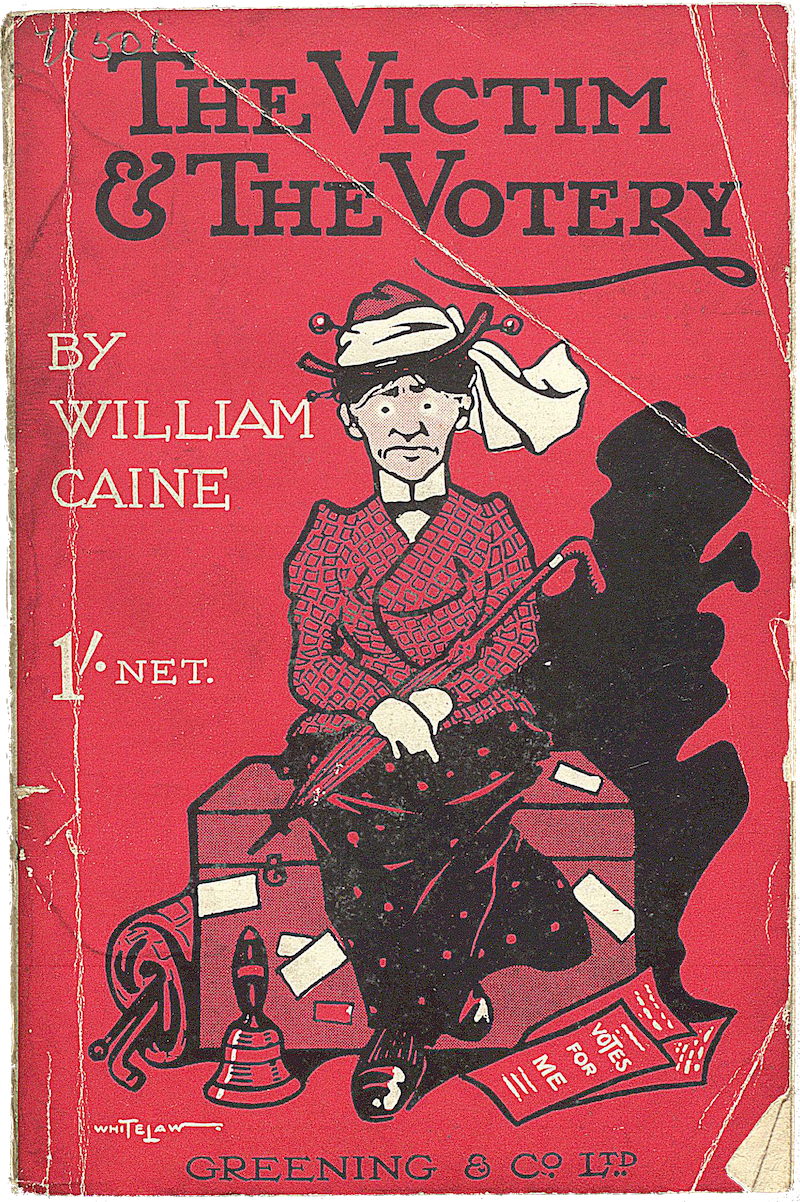
The Victim and the Votery, by William Caine. London: Greening & Co. 158 pages, 8º. July 1908.
A Guignolerie.
London: Greening & Co. 158 pages, 8º. July 1908. [ECB 1908: 47].
Dedicated “To Amy.”
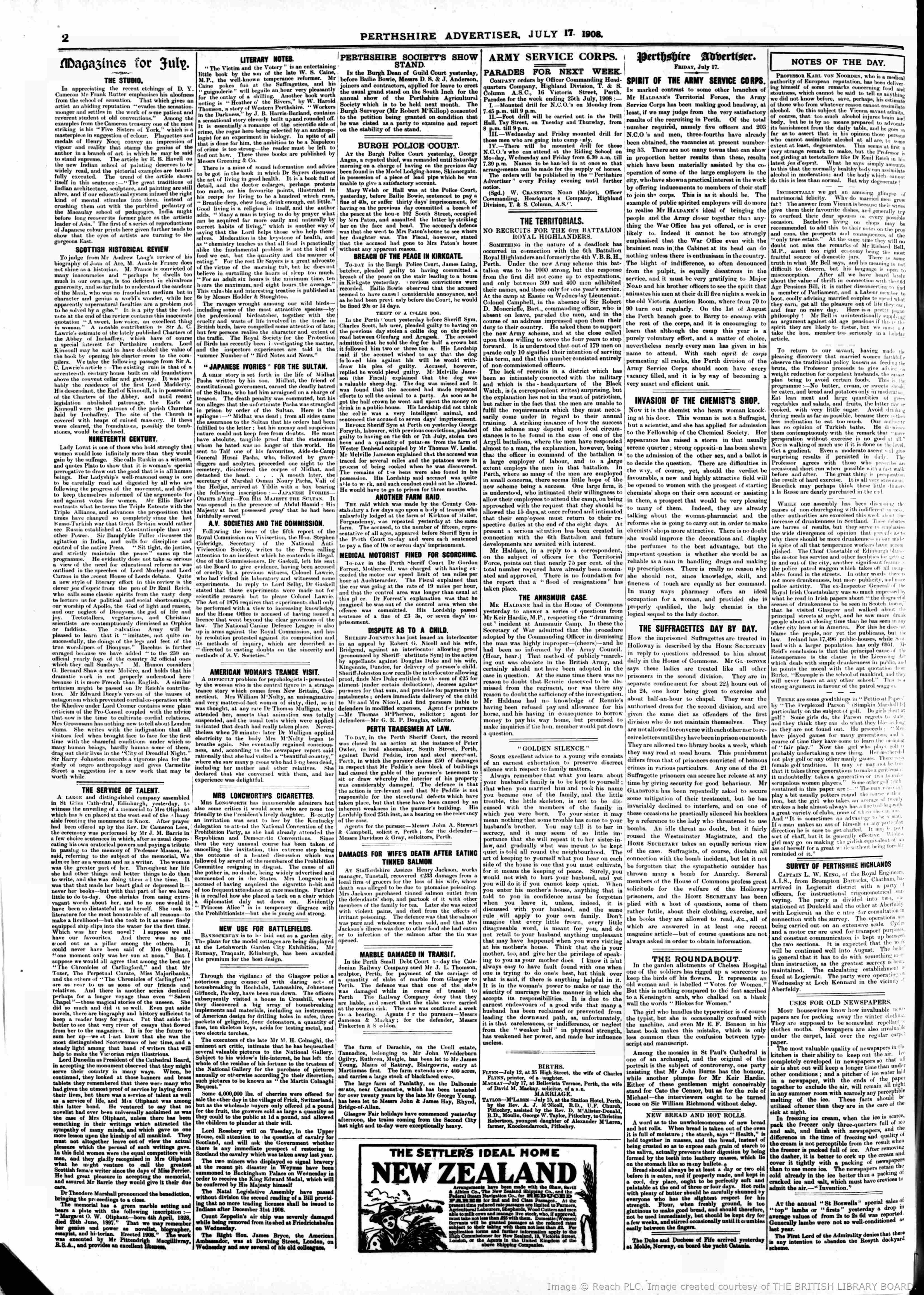
Perthshire Advertiser (Perthshire, Scotland), Friday, July 17, 1908, p. 2, “Literary Notes.”
“The Victim and the Votery” is an entertaining little book by the son of the late W. S. Caine, M.P., the well-known temperance reformer. Mr. Caine pokes fun at the Suffragettes, and his “guignolerie” will beguile an hour very pleasantly for the outlay of a shilling.
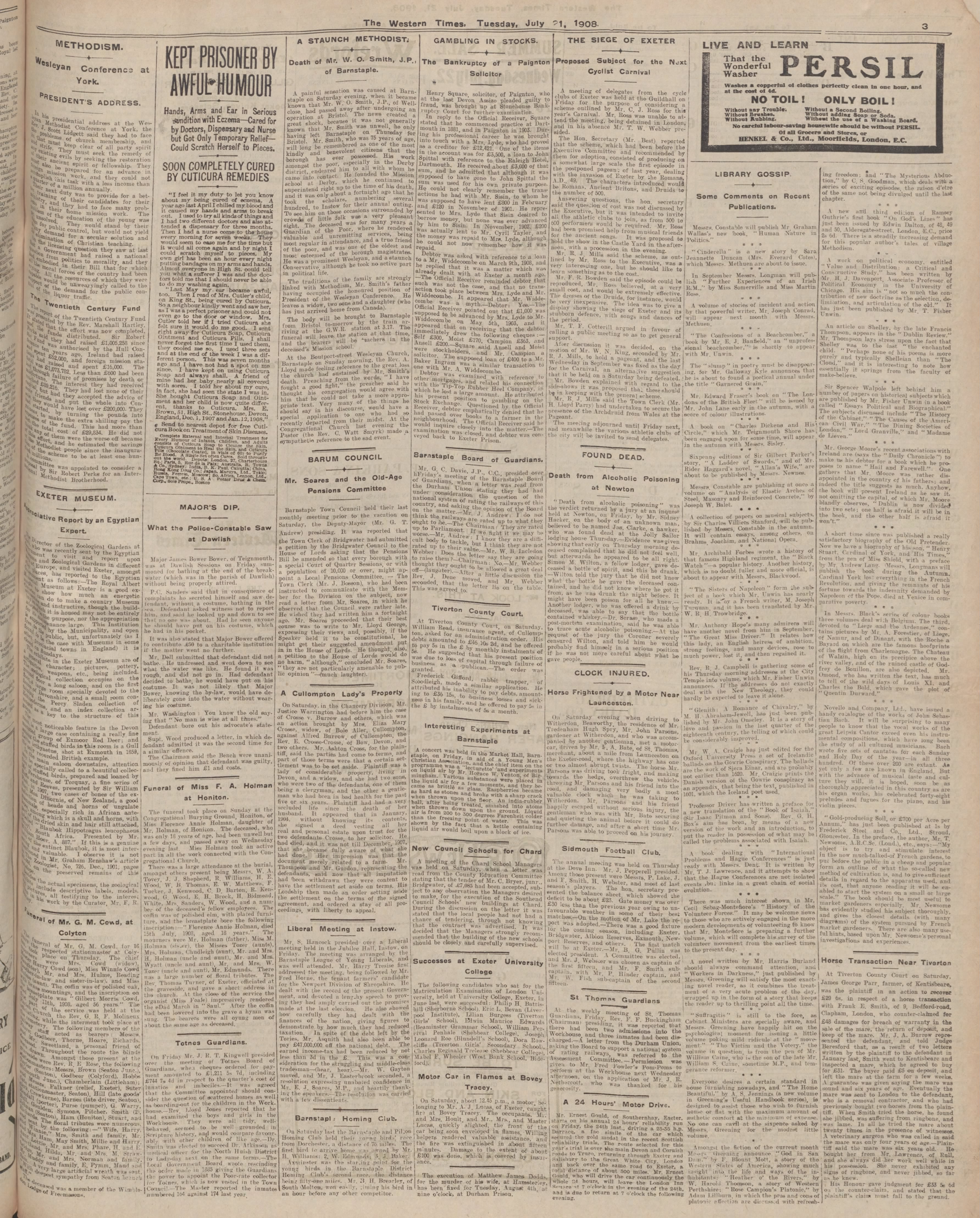
The Western Times (Exeter), Tuesday, July 21, 1908, p. 3, “Library Gossip.”
“Suffragitis” is still to the fore, as Cabinet Ministers are specially aware, and Messrs. Greening have happily hit on the psychological moment for issuing a little volume poking mild ridicule at the “movement.” “The Victim and the Votery,” the volume in question, is from the pen of Mr. William Caine, who is the son of the late Mr. William S. Caine, sometime M.P., and temperance reformer.
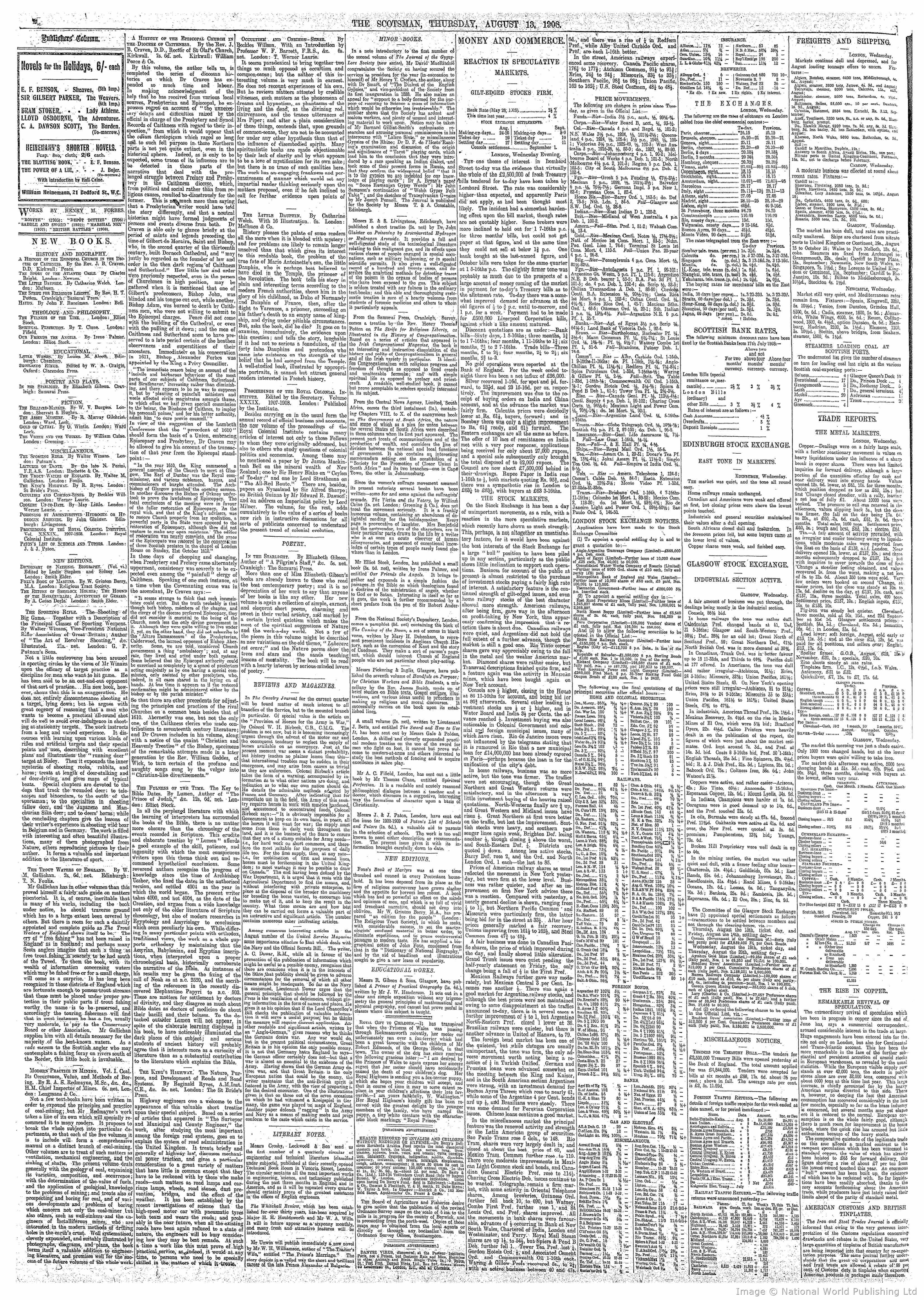
The Scotsman, Thursday August 13, 1908, p. 2, “Minor Books.”
Since the women’s suffrage movement assumed its present notoriety several books have been written — some for and some against the suffragists’ crusade. The Victim and Votery, by William Caine (1s. net. London: Greening & Co.), does not treat the movement seriously. It is a frankly humorous volume, containing an abundance of delightful reading for the holidaymaker. Every page is provocative of laughter. Mrs. Benjefield and the newsvendor, two of the characters, are in their particular parts drawn to the life by a writer who is at once an acute observer of human idiosyncrasies, and possessed of exceptional knowledge of certain types of people rarely found elsewhere than in London.
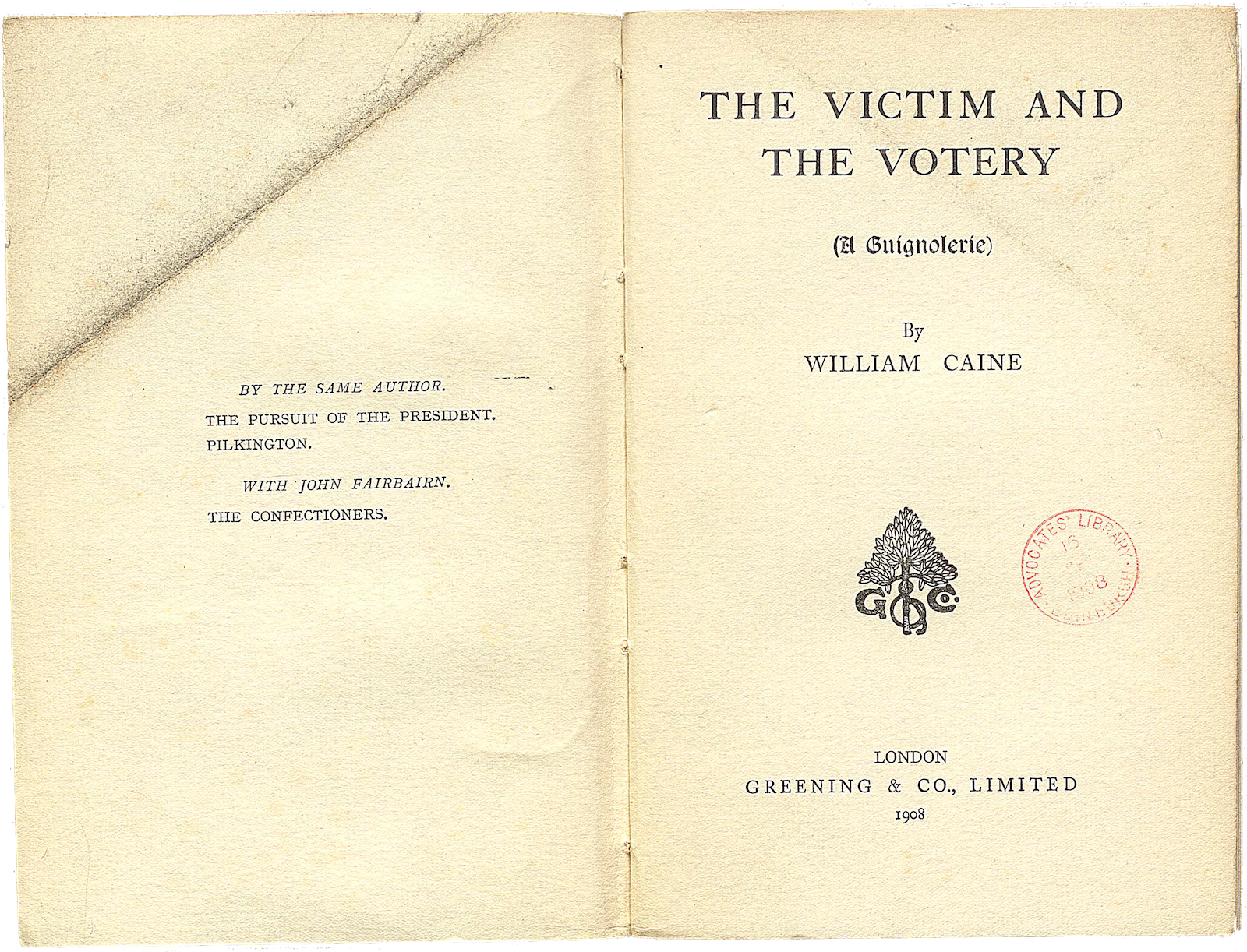
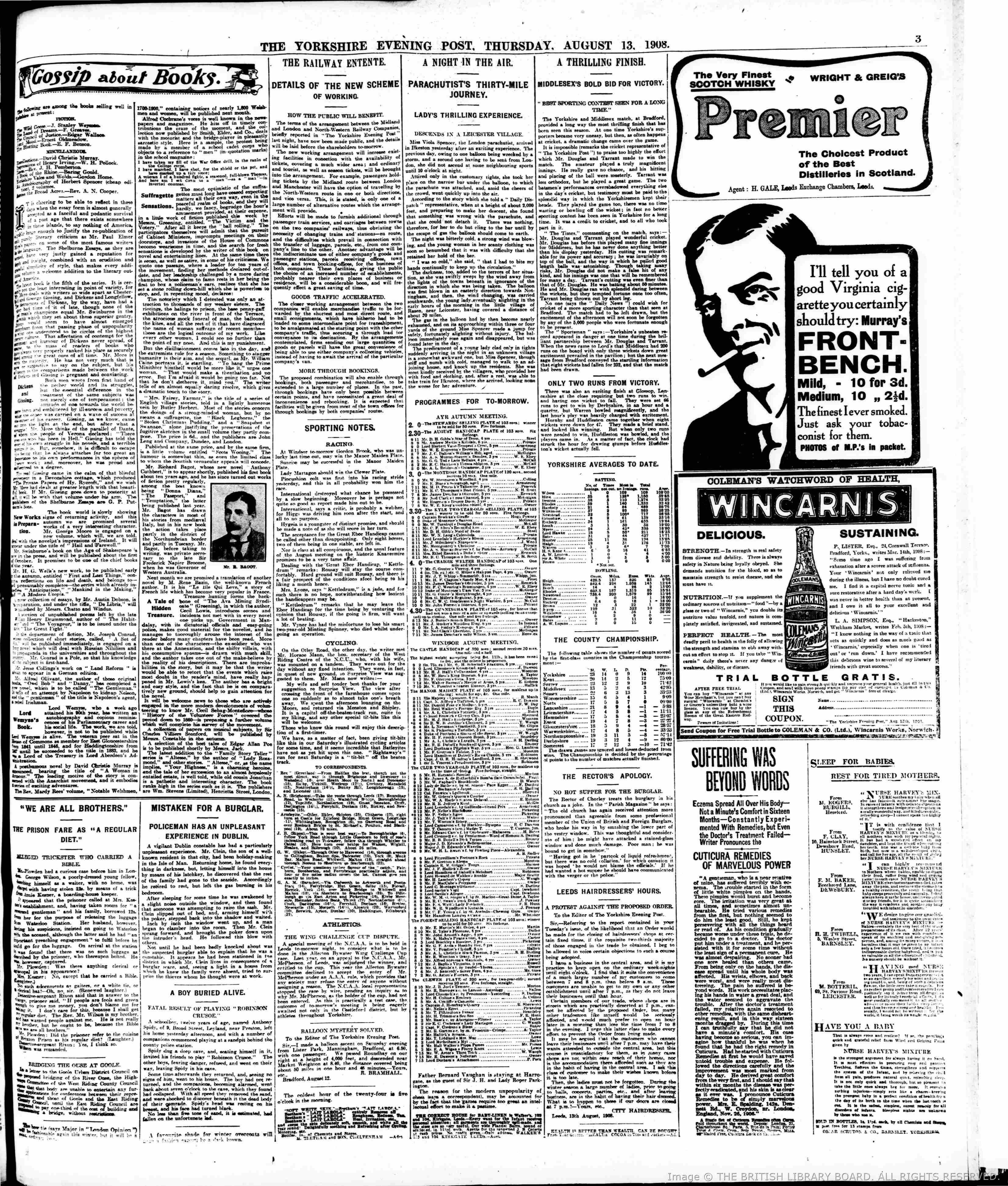
The Yorkshire Evening Post, Thursday August 13, 1908, p. 3, “Gossip about Books; Suffragette Sensations.”
The most optimistic of the suffragettes must long have ceased expecting matters all their own way, even in the peaceful realm of books, and they will hardly, we fancy, begrudge the hour’s amusement provided, at their expense, in a little work of fiction published this week by Messrs. Greening, entitled, “The Victim and the Votery.” After all it keeps the “ball rolling.” The participants themselves will admit that the pursuit of Cabinet Ministers, impromptu meetings on their doorsteps, and invasions of the House of Commons become wearisome in time, and the search for fresh sensations is developed by the writer of this book on novel and entertaining lines. At the same time there is sense, as well as satire, in some of his criticisms. We quote one passage, where a leader for ten years of the movement, finding her methods declared out-of-date, and her leadership challenged by a more daring champion, whose claim to fame rests on her being the first to box a policeman’s ears, realises that she has set a stone rolling down-hill which she is powerless to stop, and, in repenting mood declares:The notoriety which I detested was only an attraction to thousands of my weaker sisters. The riotings, the halings to prison, the base penny-gaff exhibitions on the river in front of the Terrace, the atrocious mock funeral of man, the balloons, the kites, and all the rest of it that have disgraced the name of woman suffrage of recent months — these are the logical outcome of my work. Like every other woman, I could see no further than the point of my nose. And this is my punishment.But the disillusionment comes late in the day, and the extremists rule for a season. Something to stagger humanity is their aim, and the sequel, as Mr. William Caine portrays it, is startling. “To hang the Prime Minithter himthelf would be more like it,” urges one woman. “That would make a thenthation and no error. But I’m afraid it would be going too far. Not that he don’t detherve it, mind you.” The writer tells of an almost equally daring resolve, which gives a dramatic touch to the story.
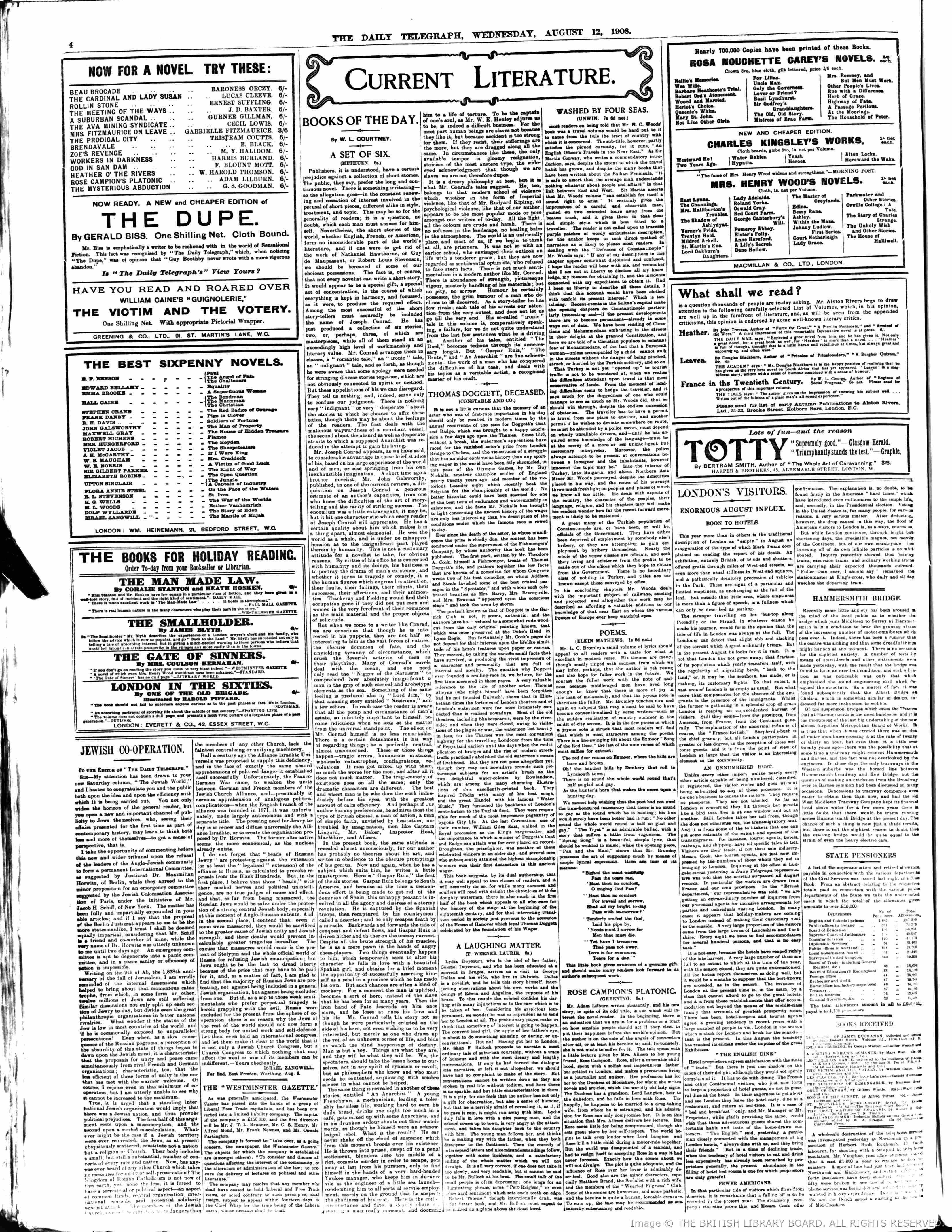
“Have you Read and Roared over William Caine’s ‘Guignolerie,’ The Victim and the Votery. One Shilling Net. With appropriate Pictorial Wrapper.”
The Birmingham Post, Friday, August 14, 1908, p. 4, “Books Received; Fiction.”
Proving (among other things) the inconvenience of being mistaken for a Cabinet Minister in ill-odour with the suffragists. Railway or holiday reading, but capital farce in its way, and neatly written.
The Morning Leader, Friday, August 14, 1908, p. 3, “Pages in Waiting; The Right Box.”
Mr. W. Caine seems to be wrapped up in the suffrage movement. His “Pursuit of the President” was an amusing extravaganza on advanced Feminist methods. “The Victim and the Votery” is another. It includes some of the characters from the former work, but is not, strictly speaking, a sequel to it. It tells how a very militant suffragist shut up what she fondly hoped was a Cabinet Minister in a box; how someone else was substituted for him; how the box was opened at a mass meeting in the Albert Hall. Incidentally there is a love story and some wildly farcical man-hunts over London. The framework of the tale strongly recalls “The Wrong Box,” except that it concerns the wrong man, not the wrong box. There are one or two lapses into a broader and more obvious humor than is necessary, but on the whole this is a witty and fresh piece of amusement, which deserves a far less vulgar cover and a far less silly title.
Perthshire Advertiser, Friday August 14, 1908, p. 2, “Notes of the Day.”
Talking of ladies and tobacco, the author of the latest skit on the Suffragettes depicts the leader as a cigar smoker. In the course of one interview she lights her cigar four or five times and invariably lets it go out again. This smart shillings-worth is entitled “The Victim and the Votery,” by William Caine (Greening & Co.), and it is brimful of wit and merriment. The author has brought the Monte Carlo trunk horror and Mr Maskelyne’s cabinet trick to bear on the Suffrage question with highly diverting results. His caricature of a militant Suffragette is of course intentionally overdone, but it is all part of a delightfully rollicking farce that is just what is wanted at the seaside and the country house in August. His reproduction, in colours one is tempted to add, of the language of the London newsboy, is a real work of art in its way, and quite the cleverest thing done in this line for a long time. This is a little book that will certainly add to the gaiety of holiday parties.
Evening Standard and St. James’s Gazette, August 18, 1908, p. 4, “New Fiction.”
A vastly entertaining skit on the Suffrage movement. To give away the plot would be to spoil the reader’s pleasure. But we may say that it is very ingenious, and that Mr. Caine has so wrought that even a Suffragist — supposing the sense of humour not to be altogether ousted by the desire for a vote — must laugh. An excellent holiday shillingsworth.
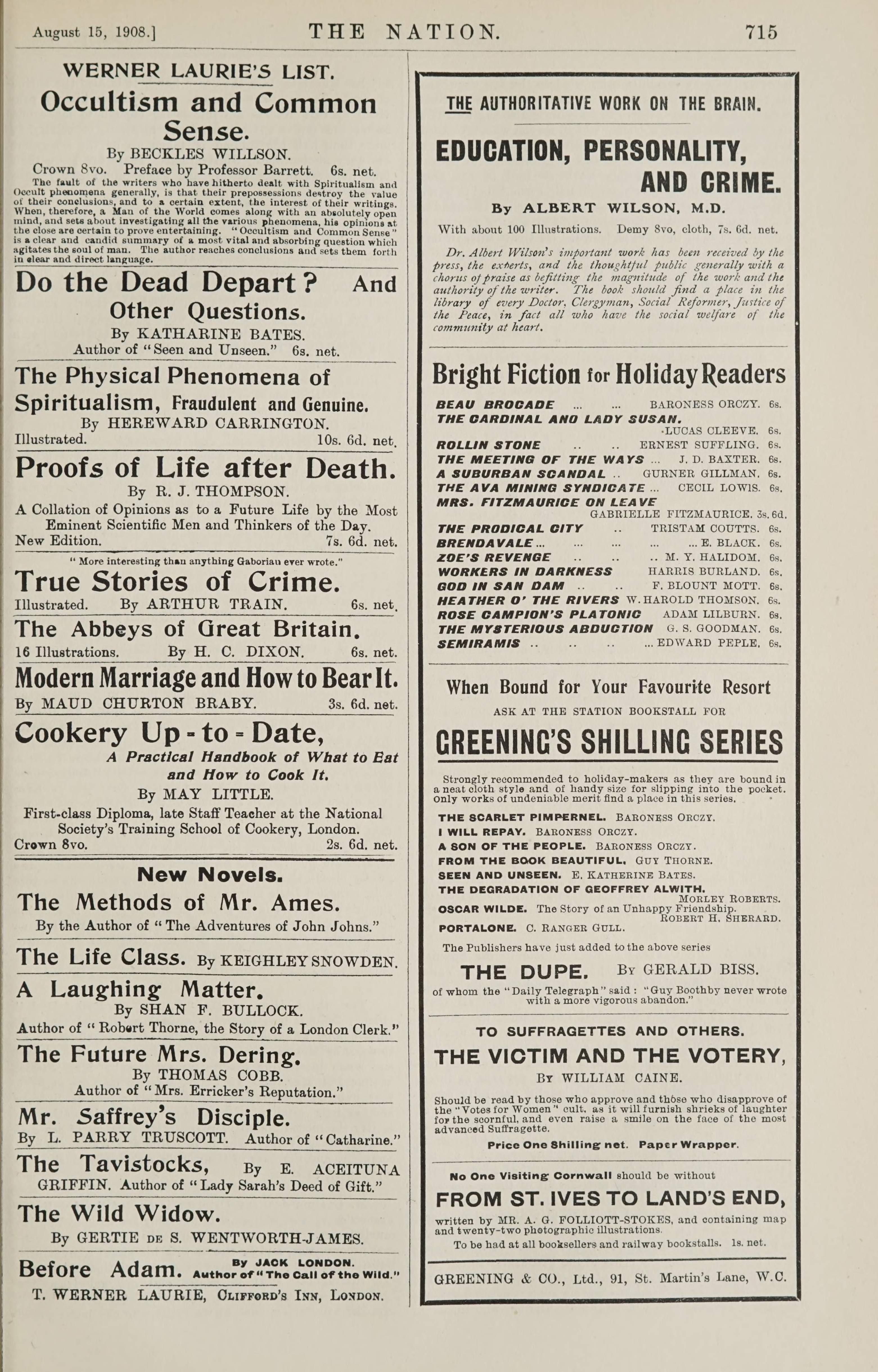
“To Suffragettes and Others. The Victim and the Votery, by William Caine. Should be read by those who approve and those who disapprove of the ‘Votes for Women’ cult, as it will furnish shrieks of laughter for the scornful, and even raise a smile on the face of the most advanced Suffragette. Price One Shilling net. Paper Wrapper.”
The Formby Times, Saturday, August 22, 1908, p. 11, “Reprints, New Editions, Etc.”
“The Victim and the Votery,” by William Caine (Greening, 1s. net), is a clever and amusing satire on the woman suffrage question. It relates how Sir Arthur Prendergast, returning after a long absence from India, is mistaken for his brother, the newly-appointed Home Secretary, and an enemy to female suffrage, and forcibly seized and imprisoned in a trunk by one of the most militant of the suffragists, and conveyed to the Albert Hall. His captor, Mrs. Bengefield [sic], is the leader of the extremists of her party; it was she who organised and carried out the aggressive campaign against the stubborn opponents of female suffrage. “She was the first woman to box a policeman’s ears, and a seat on the Executive Committee had been her reward. Chance alone had stayed her from occupying a seat in the historic car which followed Sir John Cattermole from Westminster to Boulogne-sur-mer.” She had devised the attacks on Parliament, “when balloons, appropriately inscribed, were floated over the House of Commons; when the Terrace wall from end to end was postered in the night with ‘Votes for Women’; when a hundred boats were launched to the attack and the members and their friends, at tea, were harangued through megaphones; when everything that might be deemed impossible was done to pierce the stony indifference of man in his citadel.” Mrs. Bengefield’s crowning triumph, however, is the capture of the supposed Home Secretary, and it is her intention to produce him at a great meeting of suffragists to be held at the Albert Hall. But when the great moment arrives, and Mrs. Bengefield, after informing her audience of her masterstroke, opens the trunk, the man who emerges therefrom is neither the Home Secretary nor his brother, Sir Arthur.
F. L. Maitland Davidson, “Light Literature; A Suffrage Extravaganza,” The Graphic (London), August 22, 1908, p. 240.
A smile, as has been said before in this column, is a thing almost beyond price. Consequently the sum of a shilling is a small one to pay for “The Victim and the Votery,” by William Caine (Greening). There is a pleasant, mild humour about this little extravaganza on the suffrage movement, in which Sir Arthur Prendergast, having rashly shaved his beard, suffers terrible things through his resemblance to his brother, the Home Secretary. It is pretty obvious fooling, but nicely done.
The Belfast News-Letter, Thursday, August 27, 1908, p. 9, “Literature of the Day; Miscellaneous.”
Messrs. Greening & Co, publish “The Victim and Votery,” by William Caine, a women’s suffrage novel, not of absorbing interest. The price is 1s net.
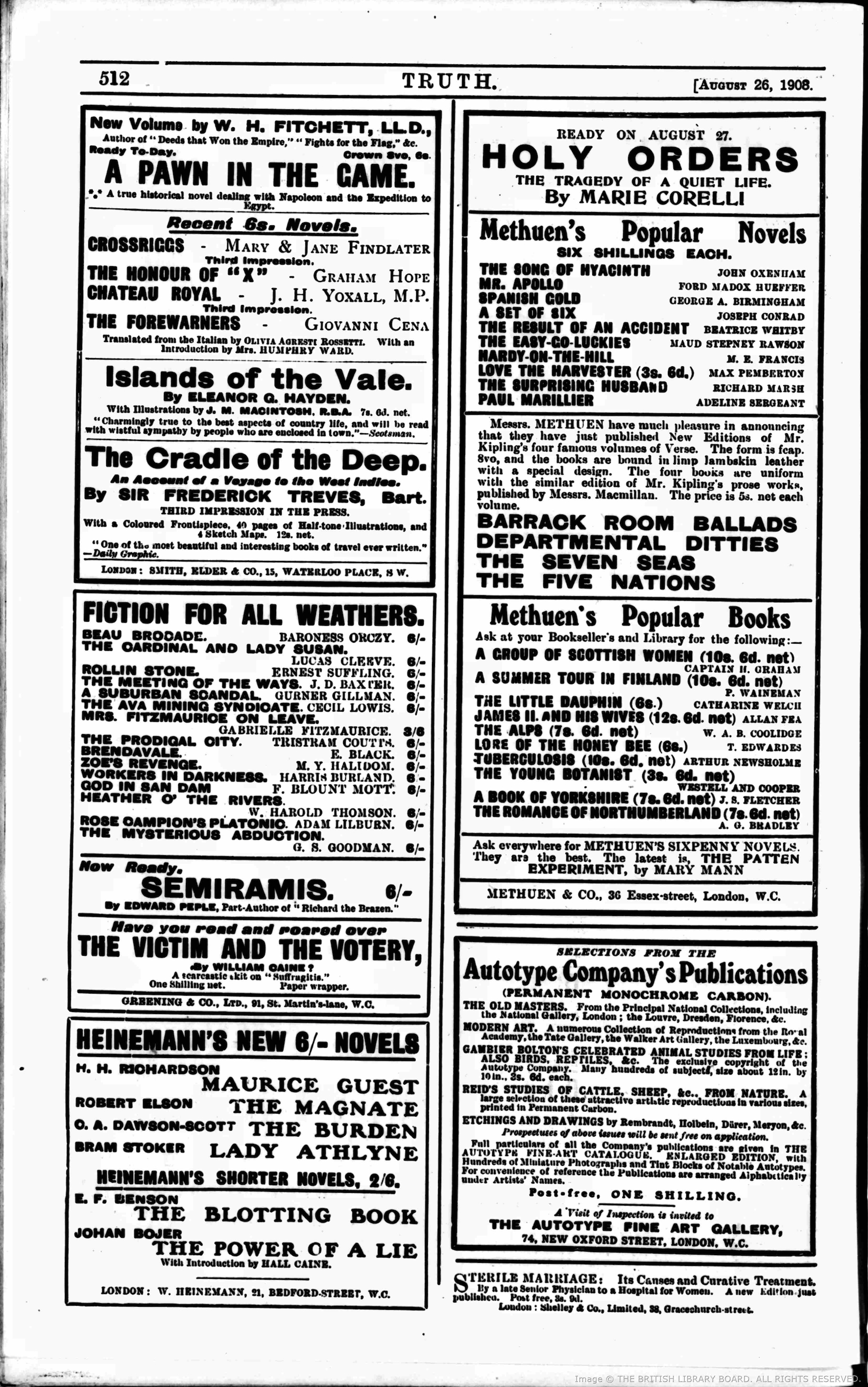
“Have you read and roared over The Victim and the Votery, by William Caine? A sarcastic skit on ‘Suffragitis.’ One Shilling net. Paper wrapper.”
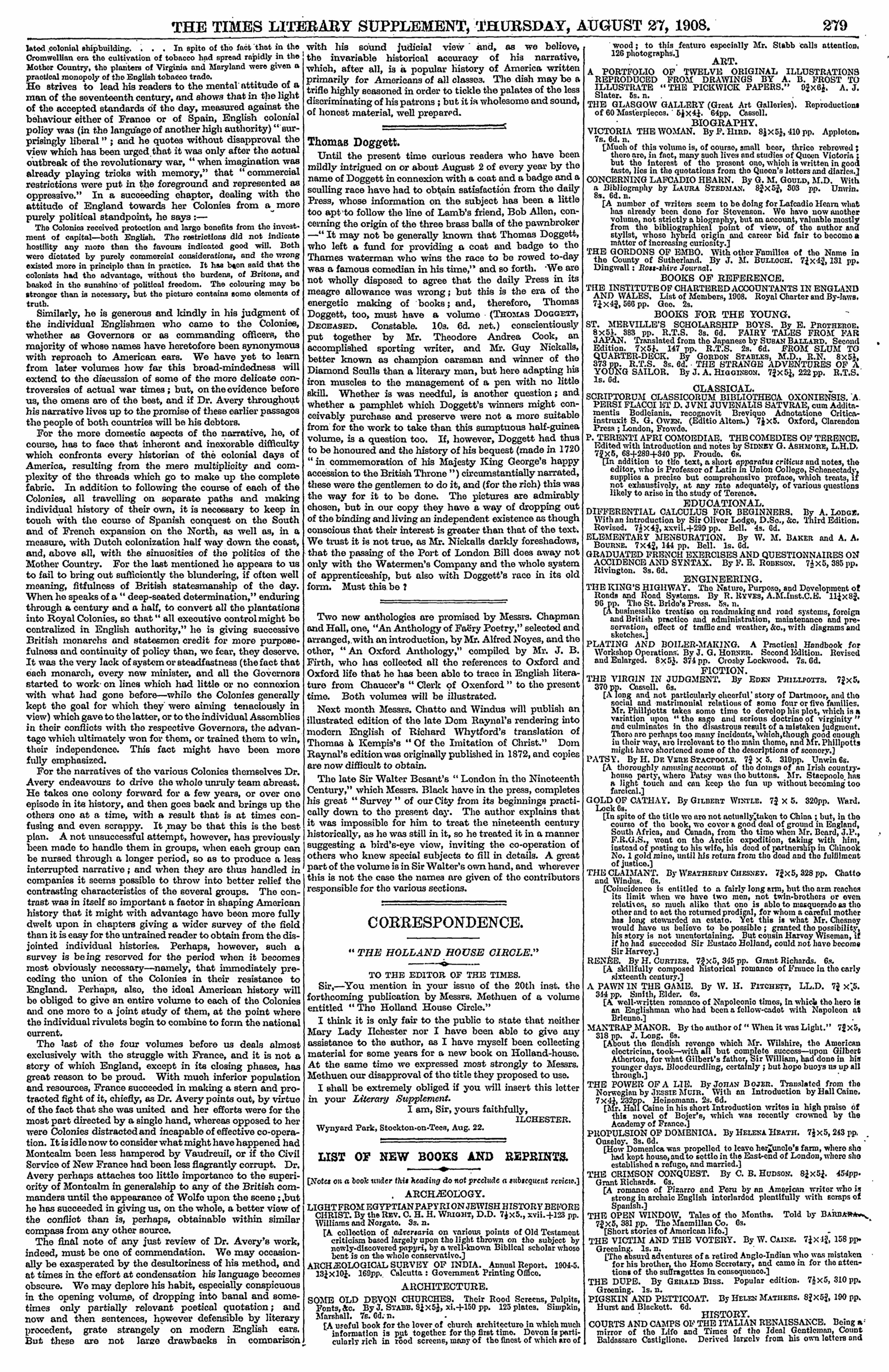
The Times Literary Supplement, Thursday, August 27, 1908, p. 279, “New Books and Reprints; Fiction.”
The absurd adventures of a retired Anglo-Indian who was mistaken for his brother, the Home Secretary, and came in for the attentions of the suffragettes in consequence.
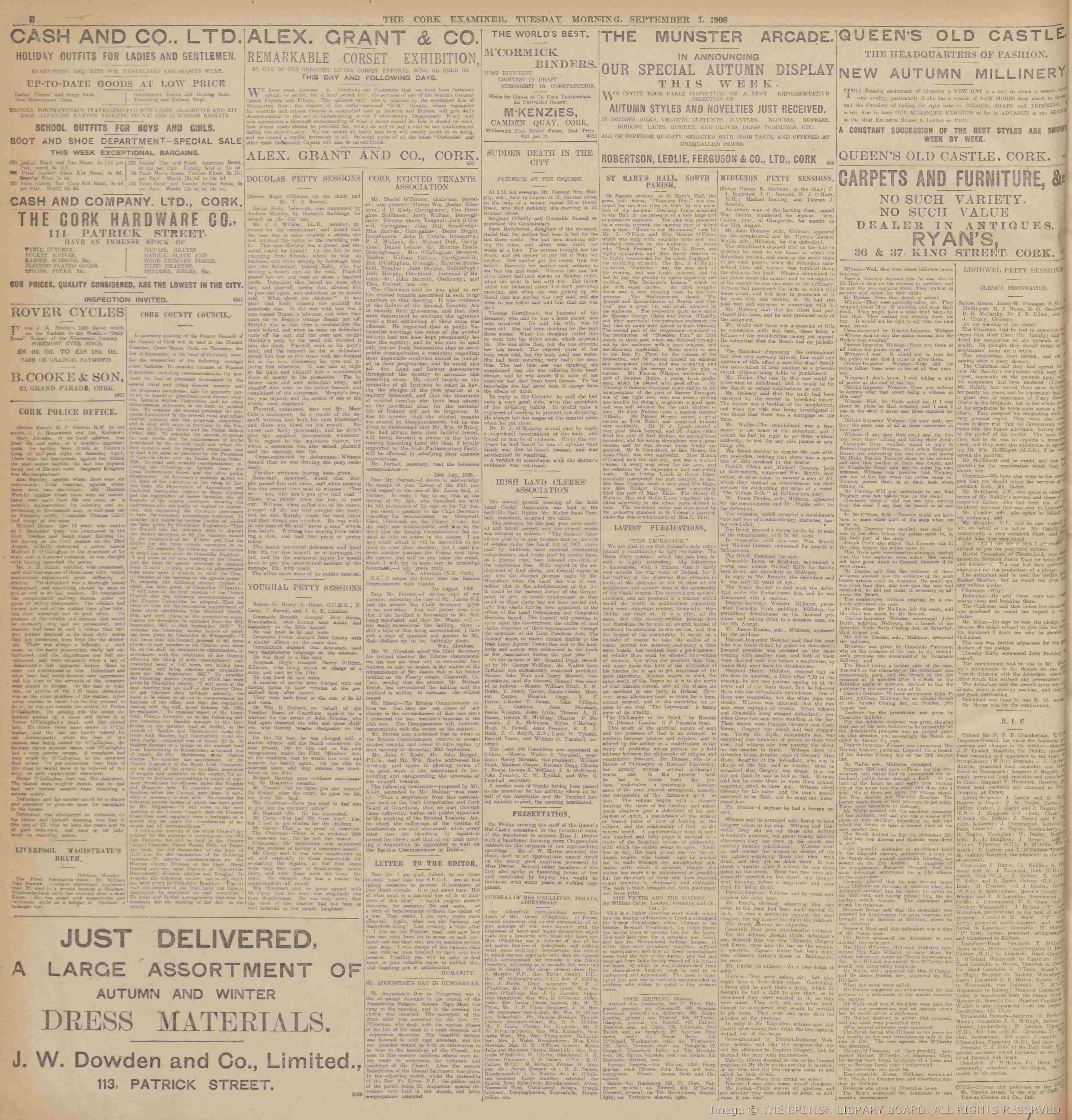
The Cork Examiner, Tuesday, September 1, 1908, p. 8, “Latest Publications.”
This is a highly diverting story which relates how the leading suffragettes of London kidnapped Sir Arthure Prendergast, whose likeness to his brother, Bernard Prendergast, the Home Secretary, has led them to mistake him for the latter. How their little plan for a sensation was foiled, and how the Womanhood Suffrage League, of which they were prominent members, suffered in consequence; and how all these complications arose from the fact that Sir Arthur, who had just returned from India having shaved off his luxurious beard, by which he was distinguished from his clean-shaven brother, must be read to be understood and appreciated. The book is brimful of fun, and can be cordially recommended to anybody who wishes to spend a few pleasant hours.
The Sportsman (London), Wednesday, September 2, 1908, p. 6.
“The Victim and the Votery” (Greening and Co.), by William Caine, is cleverly farcical.
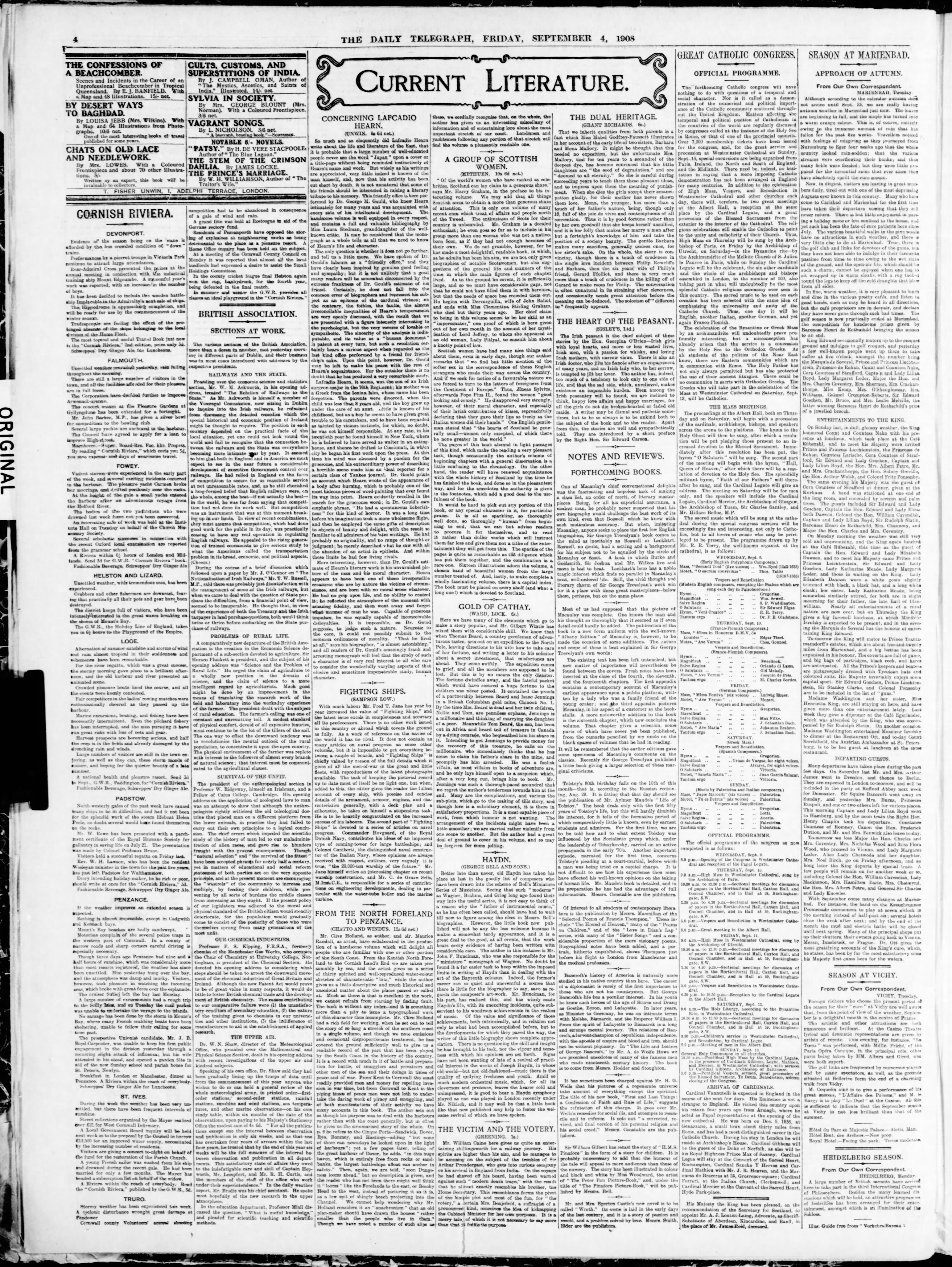
The Daily Telegraph (London), Friday, September 4, 1908, p. 4, “Current Literature.”
Mr. William Caine here gives us quite an entertaining shillingsworth for a railway journey. His spirits are higher than his aim, and he manages to be amusing on the subject of the troubles of Sir Arthur Prendergast, who gets into curious company on his arrival in England from India. On the voyage he had shaved off his beard, having been warned against such “modern death traps,” with the result that he almost exactly resembles his brother, the Home Secretary. This resemblance forms the pivot of the simple plot and most of the fun, for “the votery,” a certain Mrs. Benjefield, a suffragist of a pronounced kind, conceives the idea of kidnapping the Cabinet Minister for her own purposes. It is a merry tale, of which it is not necessary to say than that it fulfils its purpose.
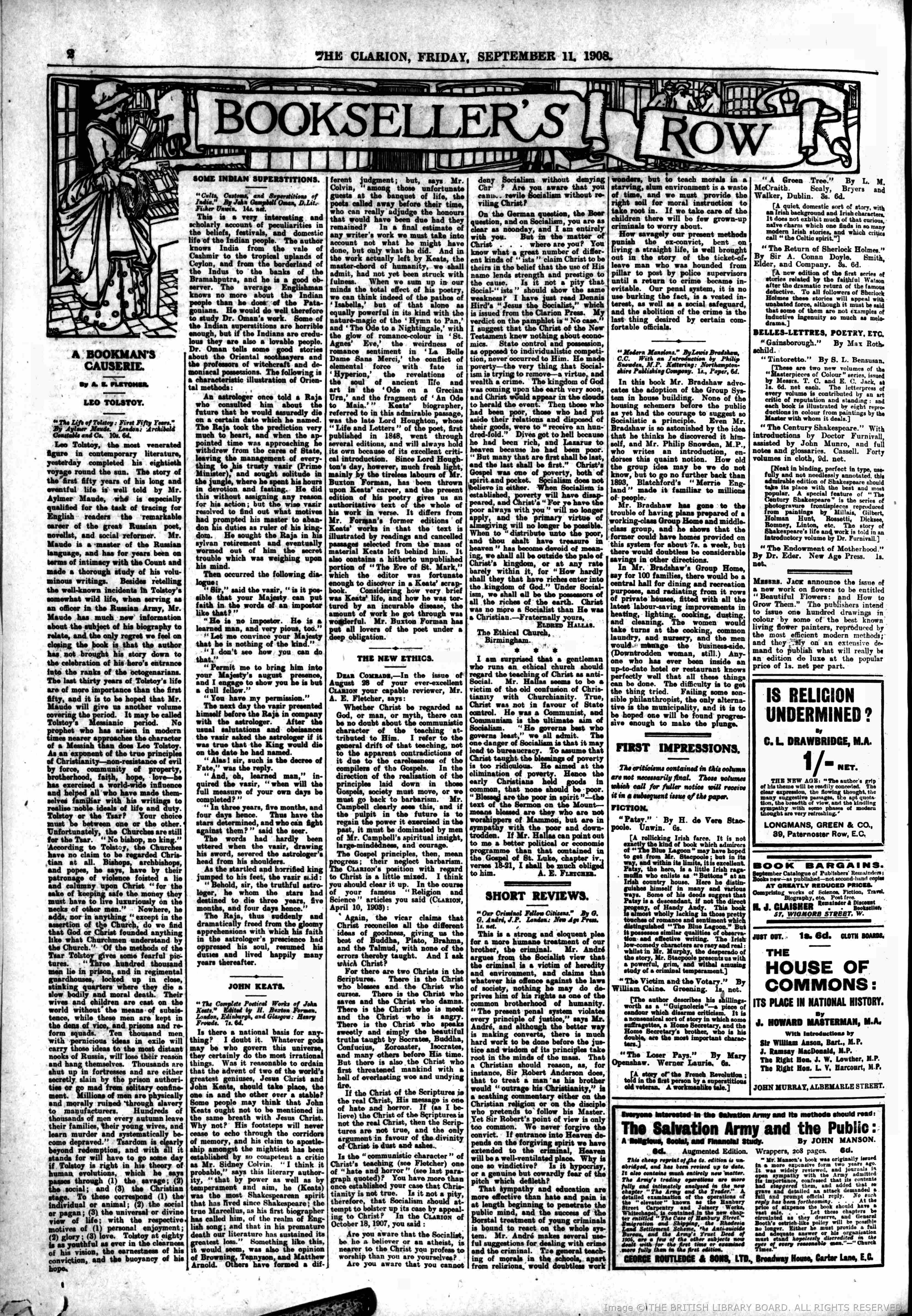
The Clarion (London), Friday, September 11, 1908, p. 2, “Bookseller’s Row; First Impressions.”
“The Victim and the Votary.” [sic] By William Caine. Greening. 1s. net.The author describes his shillings-worth as a “Guignolerie” — a piece of candour which disarms criticism. It is a nonsensical sort of story in which some suffragettes, a Home Secretary, and the Home Secretary’s brother, who is his double, are the most important characters.
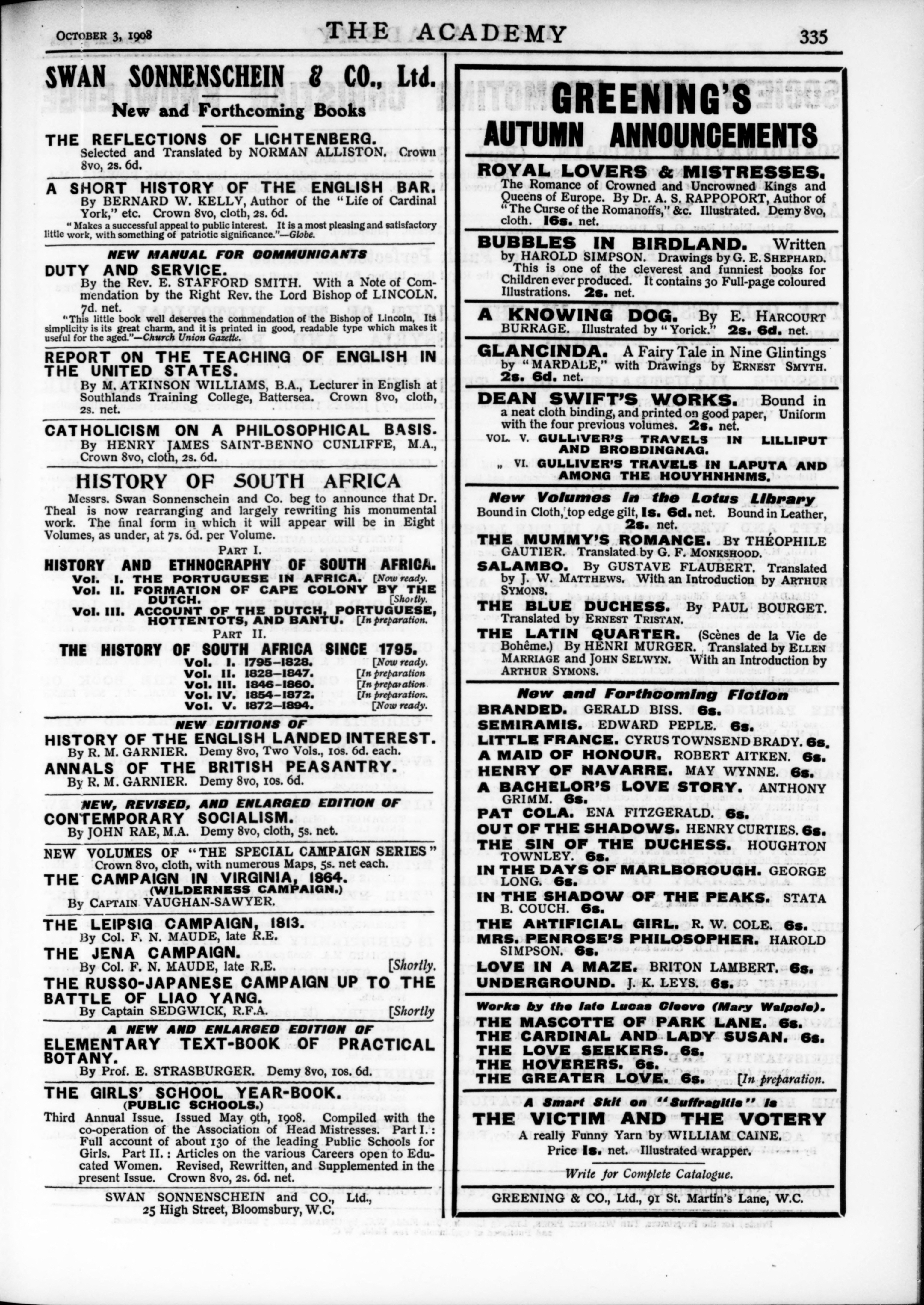
“A Smart Skit on ‘Suffragitis’ Is The Victim and the Votery. A really Funny Yarn by William Caine. Price 1s. net. Illustrated wrapper.”
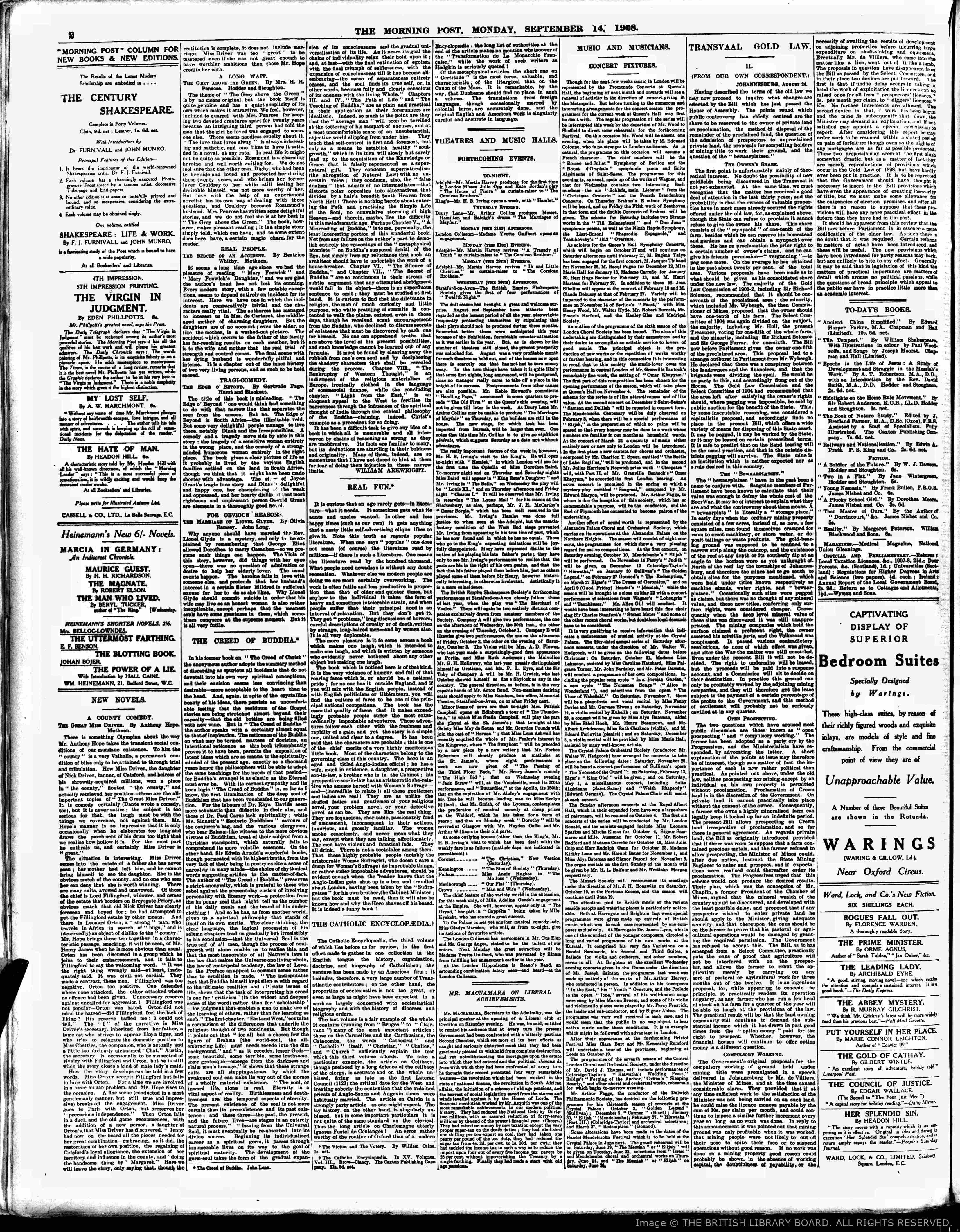
The Morning Post, Monday, September 14, 1908, p. 2, “Real Fun.”
It is curious that an age rarely gets — in literature — what it needs. It sometimes gets what its aunts and uncles wanted. In other and less happy times (such as our own) it gets anything that a nasty little self-advertising clique likes to give it. Note this truth as regards popular literature. When one says “popular” one does not mean (of course) the literature read by millions — if there is such a literature. One means the literature read by the hundred thousand. What people need nowadays is without any doubt recreation. Whatever else we modern people are doing we are most certainly overworking. The work is often futile and less productive in proportion than that of older and quieter times, but anyhow to the individual it takes the form of heavy and sometimes intolerable strain, and when people suffer that their principal need is an interval of relaxation. But they don’t get it. They get “problems,” long discussions of horrors, careful descriptions of cruelty or of death, written by strange, long-haired men — and by women also. It is all very deplorable.The more pleasure is it to come across a book which makes one laugh, which is intended to make one laugh, and which is written by someone who evidently never bothered about any other object than making one laugh.
The book which is noticed here is of that kind. It is the very violence of humour, and full of that roaring farce which is, or should be, a national pride; for no one has it outside England, and if you will mix with the English people, instead of the English politicians or littérateurs, you will find the culture of farce to be one of the principal national occupations. The book has the essential quality of farce that it makes exceedingly probable people suffer the most extraordinarily improbable adventures. These adventures follow each other with the freshness and rapidity of a gale, and yet the story is a simple one, united and clear to a degree. It has been said that the characters are probable; this is one of the chief merits of a very highly meritorious little book. Most of the characters belong to the governing class of this country. The hero is an aged and titled Anglo-Indian official; he has a wife, much in evidence, a daughter, a prospective son-in-law, a brother who is in the Cabinet; his prospective son-in-law has an aristocratic she-relative who amuses herself with Woman’s Suffrage — and — (incredible to relate!) all these gentlemen and ladies are real! The are as unlike the stuffed ladies and gentlemen of your religious novel, your problem novel, or your detective novel as can be. They are like the real thing. They are loquacious, charitable, passionately fond of amusement, inconsequent in their actions, luxurious, and grossly familiar. The women smoke ceaselessly, and never mean what they say, except when they are talking affectionately. The men have violent and fanatical fads. They all drink. There is not a teetotaler among them. That these highly probable people (notably the aristocratic woman Suffragist, who doesn’t care a dump for Woman’s Suffrage) do improbable things, or rather suffer improbable adventures, should be evident enough when the reader knows that the Anglo-Indian gets shut up in a box and trundled about London, having been taken by the “Suffragettes” for his own brother, the Cabinet Minister; but the book must be read, then it will also be known how and why the Hero shaves off his beard. It is indeed a funny book!
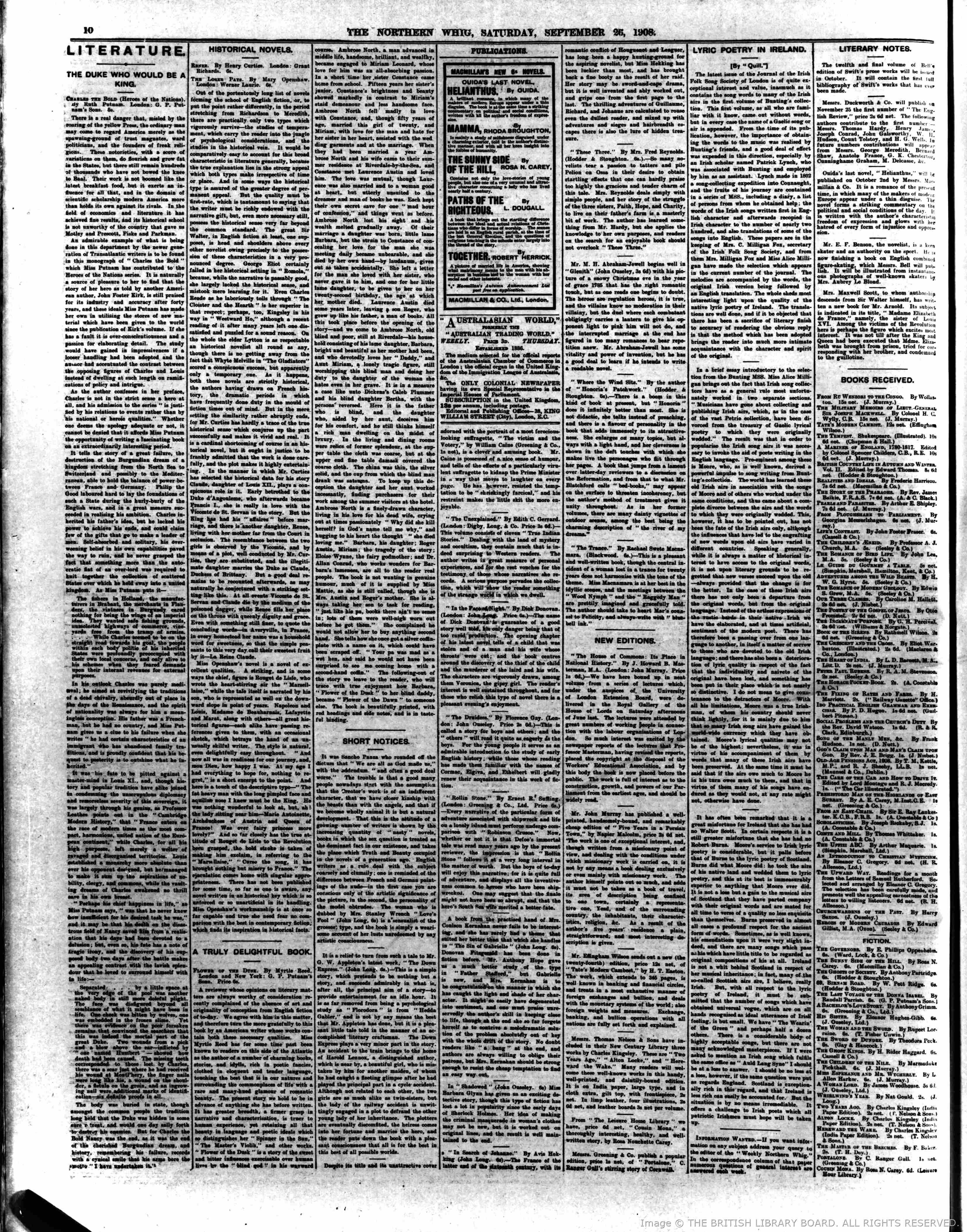
The Northern Whig (Belfast), Saturday, September 26, 1908, p. 10, “Literature; Short Notices.”
Despite its title and its unattractive cover adorned with the portrait of a most ferocious-looking suffragette, “The victim [sic] and the Votery,” by William Caine (Greening & Co., 1s net), is a clever and amusing book. Mr. Caine is possessed of a nice sense of humour, and tells of the efforts of a particularly virulent suffragette to kidnap the Prime Minister in a way that moves to laughter on every page. He has, however, resisted the temptation to be “shriekingly farcical,” and his restraint makes this little skit the more enjoyable.
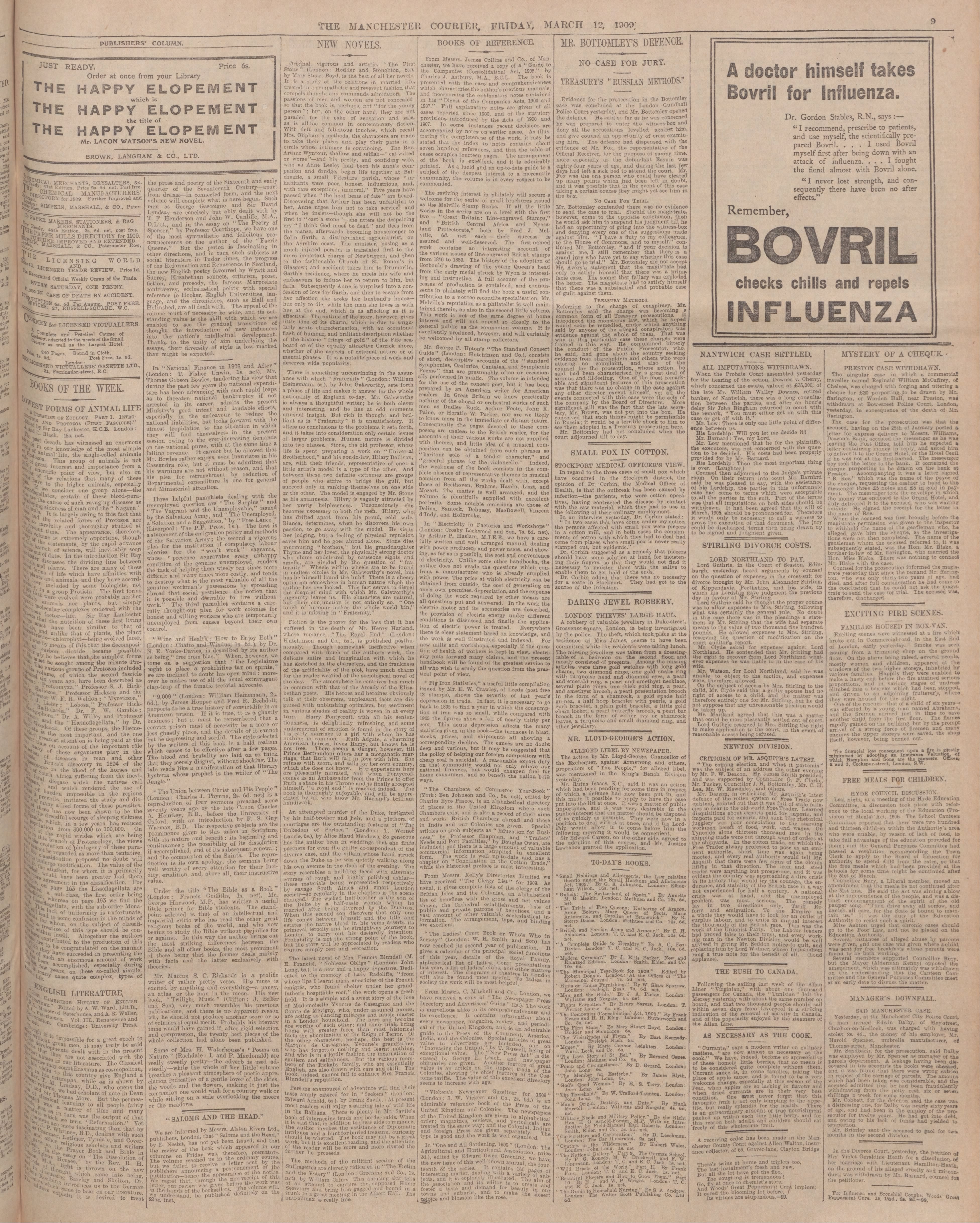
The Manchester Courier, Friday, March 12, 1909, p. 9, “New Novels.”
The methods of the militant section of the Suffragettes are cleverly ridiculed in “The Victim and the Votery” (London: Greening and Co., 1s. net), by William Caine. This amusing skit tells of an attempt to capture the supposed Home Secretary and bring him gagged and bound in a trunk to a great meeting in the Albert Hall. The anti-climax is really fine.
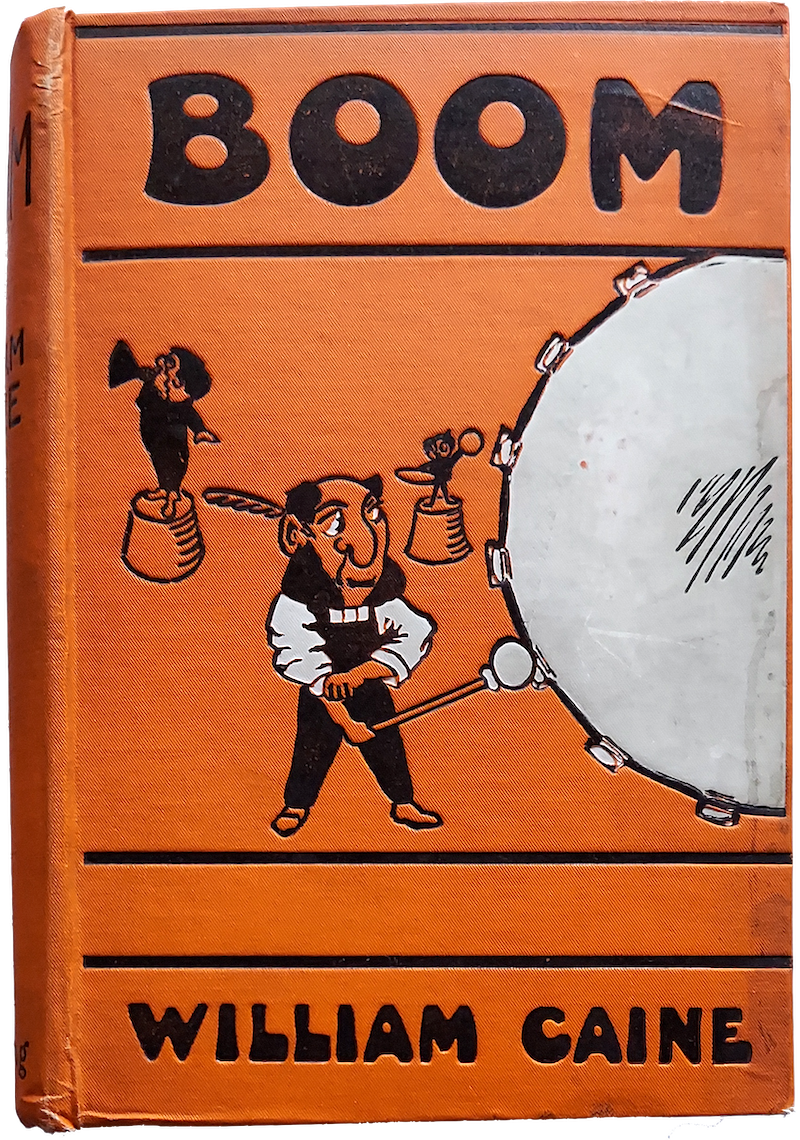
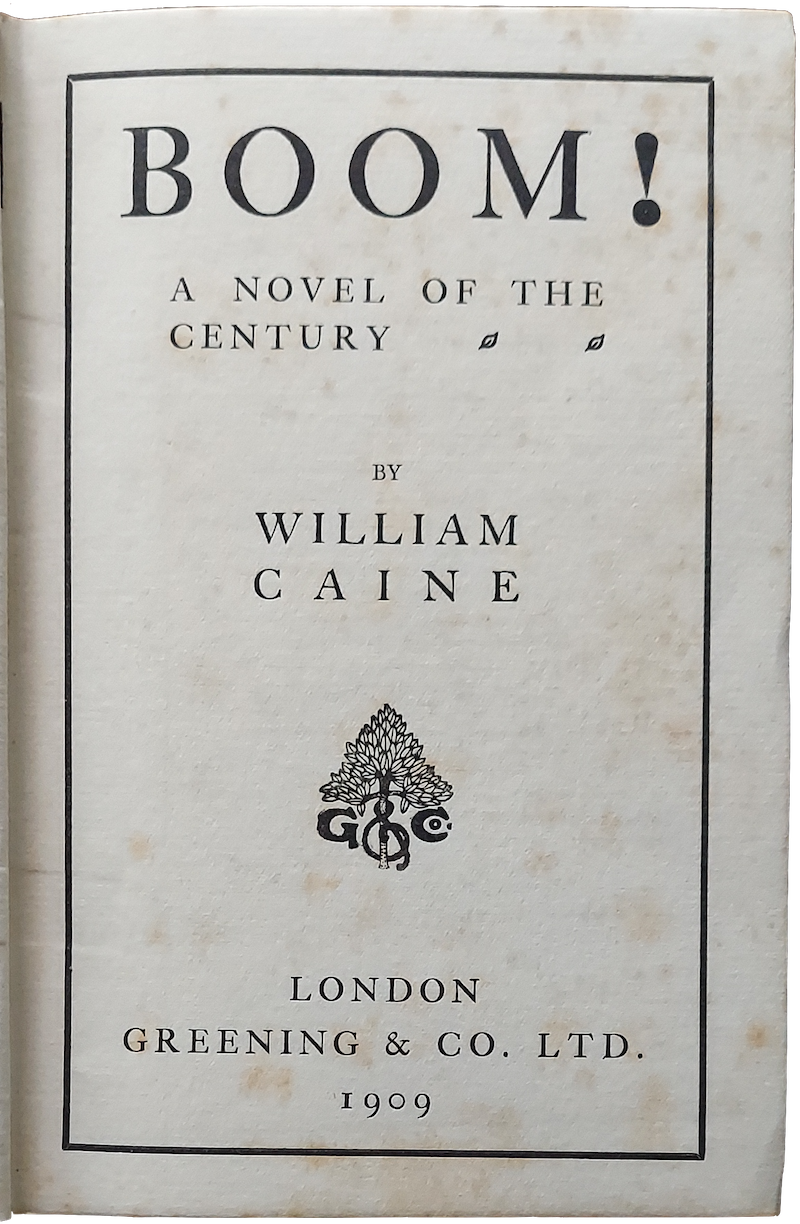
Boom! A Novel of the Century, by William Caine. Cover illustration by the author. London: Greening & Co. 314 pp., 8º. October 1909.
A Novel of the Century.
Cover illustration by the author [see Caine’s Note to Smoke Rings below]. London: Greening & Co. 314 pages, 8º. October 1909. [ECB 1909: 44].
Dedicated “To My Conscience.”
Cheaper edition. London: Greening & Co. 314 pages, 8º. July 1911. [ECB 1911: 44].
Sixth edition. With a note by Mrs. William Caine. London: Stanley Paul & Co. 255 pages, 8º. June 1926. [ECB 1926–1930: 259].
Edition printed in France. London: Benman’s, Bank Chambers, High Holborn. 1927. [Despite the indication, “With a Note by Mrs. William Caine,” this note is missing from the exemplar in my possession. And I can find no information on the publisher.]
Boom! Un roman du siècle. Préfacé, traduit et adapté par Hervé Lavergne. Paris: Aux Feuillantines. May 22, 2025. [Erroneously stated on back flap to be Caine’s “premier roman.”]
Perthshire Advertiser, October 27, 1909, p. 5, “Book Notes.”
Included in Messrs Greening’s very strong list of autumn fiction are “The Disc,” by Harris Burland; “The Secret of the Raft,” by Houghton Townely, who is rapidly coming to the front of writers of sensational, yet wholesome, fiction; and “Boom,” by William Caine, a capital and amusing yarn that gives away the methods of the successful master of the booming arts, which will be a revelation to the inquiring reader. [Identical copy in The Belfast News-Letter, Monday, November 1, 1909 p. 9, “Literary Gossip.”].
The Sportsman, Thursday, October 28, 1909, p. 6.
“Boom” (Greening & Co.), by William Caine, is oddly named and oddly written, but the author has abundant animal spirits and gives his reader the full benefit of them. He is no mere clown, however, and will be found worth reading. Unconventional and bubbling over with incidents, it is a readable enough story which is likely to single itself out from the ruck.
The Edinburgh Evening News, Wednesday, November 10, 1909, p. 6, “Recent Publications; The Gentle Art of Booming.”
“Boom,” by William Caine, published by Greening & Co., Ltd. London, is a clever skit on the craze for advertising oneself or someone else. Though it is called a novel of the century, it is rather a satire on the methods adopted in the twentieth century to bring persons or articles under the public notice. Dana Blair is the great “boomer.” He holds control of two or three newspapers, and in addition gets a commission not only from his clients but also from photographers and others who benefit by his operations. The author has ceratinly [sic] drawn a powerful character, and some of his methods are ingenious in the extreme. The present story tells how he boomed into notoriety and brought to the front an unknown chorus girl with no special ability. Not the least clever portion of the book is the author’s preface, in which he defends himself for adopting a most striking cover, while at the same time his book is written to decry specious methods of attracting the attention of the public.
Captain Candid, “Bookseller’s Row; First Impressions,” The Clarion, Friday, November 12, 1909, p. 2, “Fiction.”
A book the professed object of which is to denounce the use and abuse of advertisement. It is a clever skit, written in a tone of agreeable banter mingled with satire, which only occasionally degenerates into farce. Mr. Caine is to be congratulated upon the patronymical coincidence which gives such an air of nature to the association of his name with the word “Boom.”

“Boom! By William Caine. The above is a very clever piece of work written by one who will go far. ‘Boom’ will appeal to all who are interested in modern methods of pushfulness, as it lets the reader behind the scenes, as it were, and gives away the secrets of the art, in the guise of a very powerful and humorous story.”
The Scotsman, Monday, November 15, 1909, p. 3, “Fiction.”
Mr Caine need not have been at trouble to write a postscript to his conscience over Boom, or to offer an apology for the colour of the cover. The book ought to go well enough without either. Told in Mr Caine’s brisk style, the story fixes the reader’s close attention from first to last, and if he lays it down with the feeling that the “booming” is just a trifle overdrawn in some of the passages, he cannot but admire the clever way in which the author has disclosed how “the show” — to take a suggestion from the orange coloured covering — is run. One of Mr. Caine’s characters is boomed into a peerage, another — inept and fatuous — is boomed into the House of Commons, an obscure journalist is boomed into an author whom everybody is wanting to read, and an actress with a pretty face and golden hair, into a “leading lady.” One need not inquire too closely into the inner workings of the “boom;” it is enough for the reader of fiction to know that the satire on the uses of advertising will keep him from wearying.
The Liverpool Daily Post and Mercury, Wednesday, November 17, 1909, p. 11, “Our Publishers’ Columns; Novels of the Week.”
Mr. William Caine’s latest book, “Boom” (Greening and Co.), is a delightfully-conceived satire upon the modern system of push. He displays for us the methods, scrupulous and unscrupulous, by which the mediocre clients of one Dana Blair are puffed into undeserved fame and eminence. Fortunes are made, elections won, fashions created, and careers founded at the beck and call of this bandmaster and the puppets who fiddle to his baton. The whole story is full of humour, is thoroughly well written, and fully serves its author’s purpose of enlightening the the [sic] British public as to the part played by judicious and timely advertisement in the fame and fortune of persons who rise to prominence.
Desmond B. O’Brien, “Books,” Truth, November 17, 1909, p. 1184.
A great journalist said to me once that there was such a thing as a newspaper man — some mere nonentity whom the newspapers blow up like a balloon or like a monstrous iridescent soap-bubble — and this is the theme of Mr. William Caine’s “Boom.” Dana Blair, who is the incarnation of the Yellow Press, can, for a consideration, throw a gigantic magic-lantern shadow of any one on the screen and focus upon it for the moment the rapt attention of the public. The book, in fact, is an excellent satire upon modern newspaper methods; but it is, besides, a most natural and entertaining story of the chequered course of a chorus-girl’s love. From the first page to the last the novel at once amuses, instructs, and engrosses you.

“The most Audacious and Humorous Book of the Season. Boom! Boom! Boom! By William Caine. ‘Boom’ is a mad, merry jest, an amusing yarn that gives away the methods of the successful master of the booming art, which will be a revelation to the inquiring reader.”
The Irish Times, Friday, November 19, 1909, p. 7, “Recent Fiction.”
Mr. William Caine has given us a piquant and delightful satire on the making of contemporary reputations. The book is quite out of the beaten track of novels. It is written somewhat in the style which Mr. Belloc occasionally adopts, with all Mr. Belloc’s malice, and much more than Mr. Belloc’s élan. Dana Blair is the incarnation of the spirit of advertisement. He controls the English yellow Press, governs the world of musical comedy, makes poets laureate, rigs Parliamentary elections, and enriches the House of Lords with most undesirable new peers. The British public is a many-headed beast of unfathomable gullibility. Mr. Blair knows it, and plays upon its grotesque stupidities as a master musician on his instrument. Mr. Blair is frankly cynical. He stands to make money for himself out of the reputations which he engineers. The story is chiefly occupied with the fortunes of a musical comedy chorus girl whom Mr. Blair booms into the position of a star, and very nearly succeeds in marrying to an almost idiotic poet. The reader who accepts as true one-tenth part of what Mr. Caine hints and says will, after being immensely entertained, turn with disgust from the politics, the literature, the drama, and the society of our time.
The Morning Leader, Friday, November 19, 1909, p. 3, “Pages in Waiting; The Big Drum.”
Mr. William Caine is an indefatigable satirist of the noisier follies of to-day. In “Boom!” he attacks the advertising world. He shows how by judicious booming a worthless candidate may be shouted into Parliament, a chorus girl into the ranks of the stars, a minor poet into a great author. The way in which these surprising events happen is only exaggerated just enough to be absurd: there is a very real truth under the hilarity. The book has a plot which renders it in itself creditable comedy. It is a most amusing and original piece of satire.
The Newcastle Daily Chronicle, Friday, November 19, 1909, p. 11, “Books of the Day; The Art of Advertisement.”
The art of advertisement has been brought to a very complete perfection to-day, and Mr. Caine satirises those who have mastered it in its various branches in the most amusing fashion. The central figure in his book is a gentleman named Blair, who hails from the United States of America. He is a “boomster” by trade — the king of “boomsters” in fact. It is he who arranges the posture in which popular actresses shall stoop over baby’s cradle for the benefit of the printers of picture postcards and the edification of an adoring public. It is he who takes in hand the briefless barrister or the budding poet and “booms” them to the Bench or into innumerable editions. Mr. Caine only gives us a few typical examples of his efforts here, but they are sufficiently amusing; and if there is a temptation to think they are overdrawn, it is only necessary to look into the stationer’s windows, into the illustrated magazines, or at the hoardings to believe, that Mr. Blair must exist somewhere behind the scenes.

“Boom! By William Caine. ‘I read “Boom” at a sitting, which means that I found it interesting, but it is more than that — it is a first-rate satire and an irresistible piece of humour.’ — Black & White.”
V. V. V., “A Few Days Ago: A Random Chronicle,” The Sphere (London), November 20, 1909, p. 166.
A propos of the name of Caine, I have been reading a book which does much to reconcile one to it. This is called Boom, a satire by William Caine on many of the tendencies that come to a head in his famous namesake. Whether Mr. William Caine is a relative of that greater one I cannot say, but if he is it is a remarkable thing, worthy of the notice of the students of kith and kin. Boom is one of the sanest and most amusing stories I have read for a long time. It is a pity that it has a title so suggestive of ephemeral life.
Sheffield Daily Telegraph, Thursday, November 25, 1909, p. 3, “The Book Market: Notes and Criticism; Notes on Novels.”
A very pleasing novelty in works of fiction is provided by William Cain [sic] in “Boom” (Greening & Co 6s.). He sets out to point out the value of advertisement, not in the ordinary way, but in exaggerated style, and yet he manages to tell a good story, lightened with many touches of humour, quaintly conceived.
The Globe Literary Supplement (London), December 1, 1909, p. 4, “Shorter Notices.”
This is “a novel of the century,” mainly devoted to the theatrical career of a chorus-girl, and her love affairs, and bent on showing up the seamiest side of everything. The author has doubtless a wide knowledge of his subject, of rivalries and jealousies, and backbiting, of vapidity and brutality, of intrigue and heartlessness; of the waxing and waning of “stars,” of advertisement and — “booming.” It is all very vulgar and sordid and mean, all in a horrible world of low living and low thinking. Yet it has flashes of genuine satire, and is at times amusing. Those who have a liking for music-hall stories may thoroughly enjoy it.

“How to Win the Election. All Conservatives, Liberals and Socialists should read William Caine’s Sensational, satirical, side-splitting story. Boom!”
Belfast Evening Telegraph, Tuesday, December 14, 1909, p. 3, “Literary Notices.”
It is not often that a new humorist arises, and when this does occur the world is somewhat chary of taking him to its arms, so to speak. But in the case of Mr. William Caine, whose “Boom” (issued through Messrs. Greening) has got there, the public have heartily acclaimed the author as satirist and humorist combined. By the way, Mr. Caine is not related, as has been stated, to Mr. Hall Caine, but is the son of the late Mr. W. S. Caine, the well-known M.P. and temperance advocate.
Birmingham Gazette and Express, Thursday, December 16, 1909, p. 7, “Book Reviews; Boom.”
A capital book, of which one might say that it “fills a long-felt want.” By means of a pleasant and cleverly written story, the reader is initiated in the art of booming introduced from America, and is shown how the professional boomer is prepared, and for and in consideration of cash down or percentages afterwards, or both, to create a temporary fierce demand for anything, from songs to symphonies, and to make the fame and fortune of anybody who can pay, and who has but a moderate talent, or even none at all, by certain subtle arts of advertisement. As everybody reads the newspapers, and as everybody is more or less endowed with curiosity, and further as the population, according to the primary article of the boomer’s credenda, is composed of persons of whom the huge majority are fools, the boomer has only to secure public attention to effect his purpose. A ballet dancer is pushed into a high place and with a large salary by means of a bogus attempt at suicide, and the man who rescues her, a poet whose works had sold to the number of five copies, is placed on the highest pinnacle of popularity. But he has to act on the advice of the boomer, and dress in blue velvet, in order to give the fool public something to talk about. In like manner the ballet-girl is furnished with ermine, is photographed with the pre-arranged Kodak, and so is brought about a rush on the ermine in which she looks so charming, the said ermine, in view of the certain rush of the aforesaid fool-public, having been cornered by the boomers who put up the price and make enormous gains. We are shown how judges and counsel are boomed, and by the examples given we may discern the manner of the musical composer and the musical performer boom, whether vocal or instrumental, and the boom of the M.P.; in short, we may become au courant with all the sweet uses of cunning advertisement. Those who read the book and afterwards read the papers will have no difficulty in detecting the hand of the boomer whose motto might well be two lines of Samuel Butler, who appears to have predicted the boom when he wrote “Doubtless the pleasure is as great In being cheated as to cheat.” Apart from its teaching, the book is entertaining as a story. There is a love interest, and a hero, and despite many troubles and trials, faithfulness and honour are rewarded, and so we close the volume with a sigh of complete content.
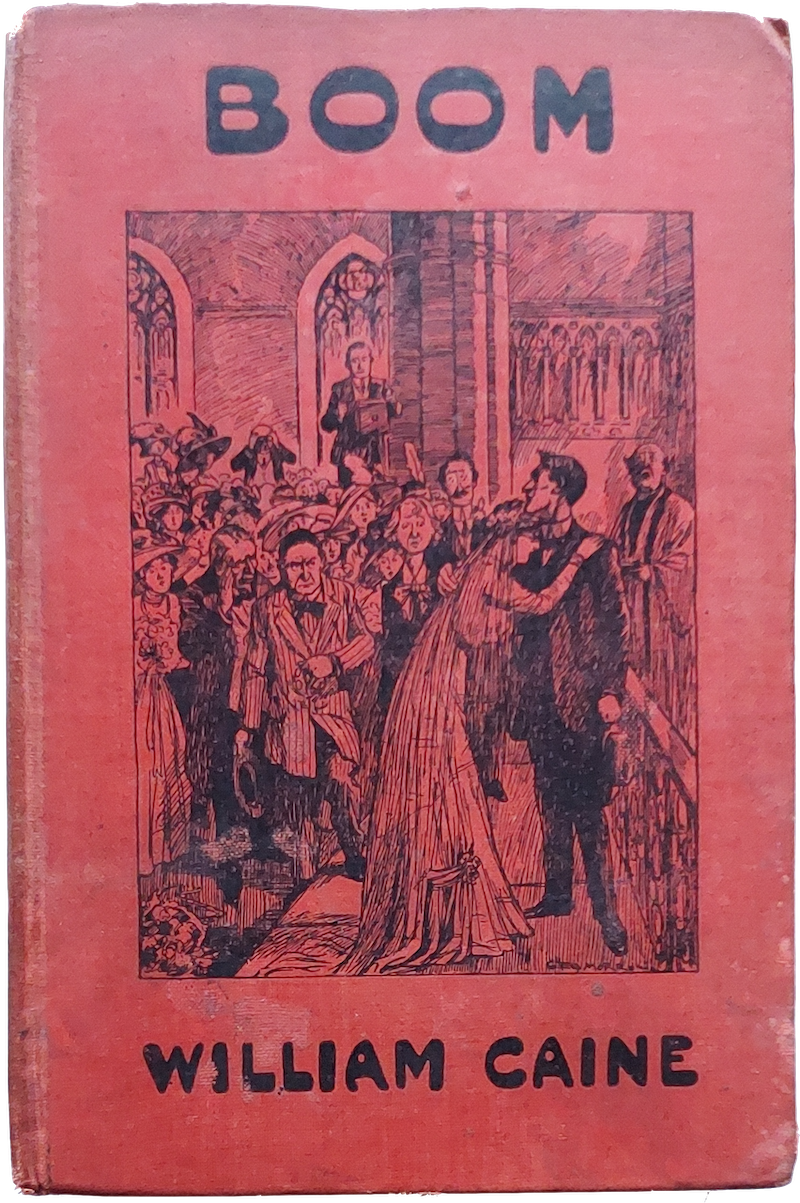
Boom! A Novel of the Century, by William Caine. Cover illustration and frontispiece by George Morrow. London: Greening & Co. 314 pp., 8º. Cheaper edition. July 1911.
The Daily Mirror, December 18, 1909, p. 7, “Christmas Books and Others.”
A witty and well-justified attack on the advertising methods of our time. Dana Blair is the advertiser-in-chief, and he undertakes to “boom” anybody or anything. He booms a worthless young man into Parliament; and an obscure girl into a leading position on the stage; he can do anything for money. The picture is a little overdrawn, fortunately, but only just a little.
Drayton Ford, “Christmas Humour,” The Bookman, vol. 37, no. 219, December 1909, Christmas Double Number, p. 131.
The first time I came across the name of William Caine it was on the cover of a book published by Arrowsmith, and bearing the unpromising title of “The Confectioners.” He was part author of that book, and I am ashamed to confess that, at the moment, I cannot recall the name of his partner; but I remember it vividly as the most original, fantastic, laughter-compelling book I had lighted upon for many a long day. Mr. Caine has since given us off his own bat — or, more correctly, off his own pen — “The Pursuit of the President” and “The Victim and the Voter” [sic], and how he is here again with “Boom! A Novel of the Century.” I shall not attempt to outline his story. It is dedicated “To My Conscience,” and there is no denying that the dedication is well deserved. For the rest, “my book is devoted to showing that, in this twentieth century, Advertisement is the surest and speediest method of attracting attention, of achieving any object whatever,” remarks Mr. Caine, and he holds you with a capital burlesque that has a deal of cold truth underlying it to enforce his argument. Everybody who reads it will rejoice in it unless he happens to be the original of one of the characters — for I have reasons for suspecting that some of them have originals.
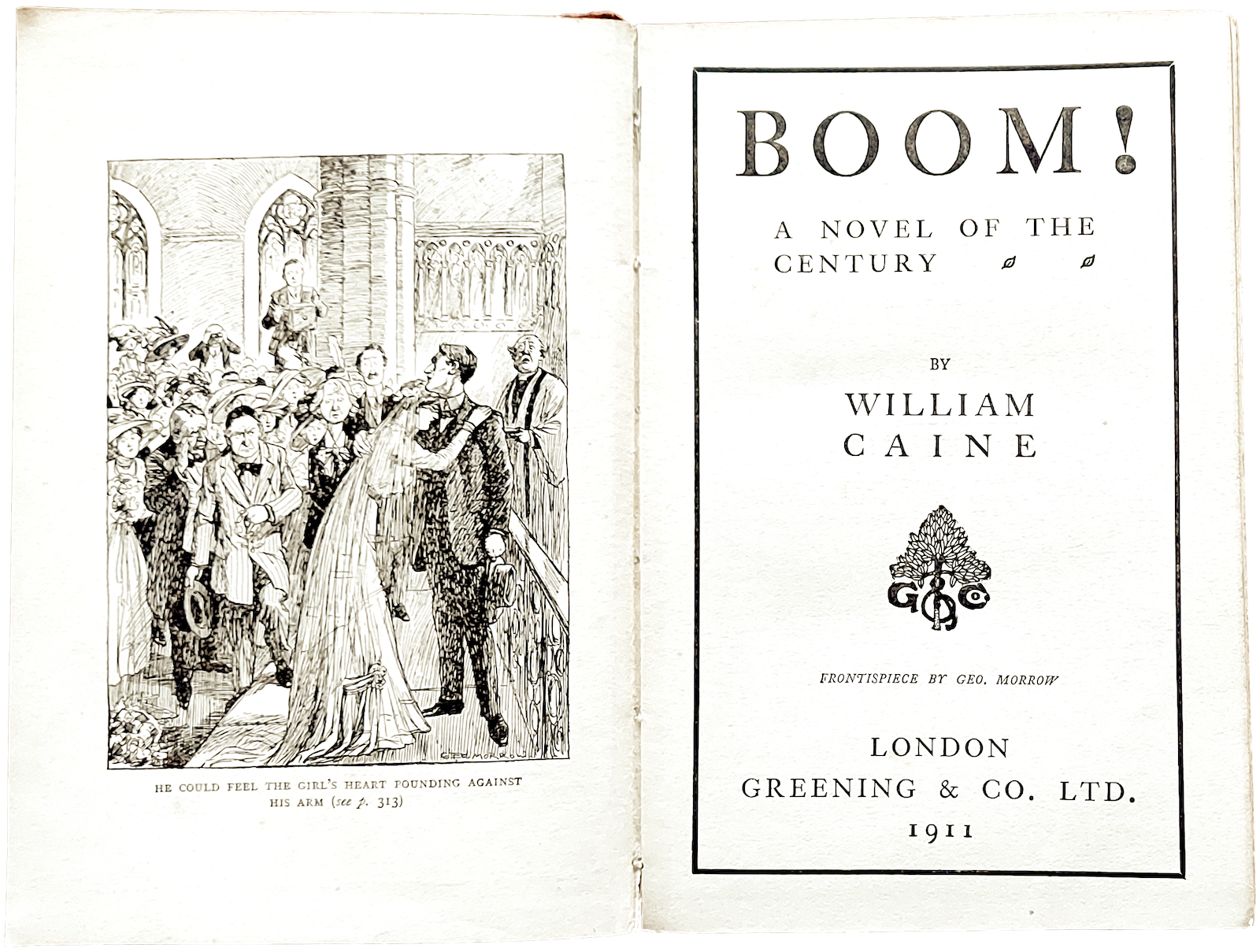
The Bookseller, Saturday, December 25, 1909, p. 85, “Publications of Messrs. Greening & Co.”
There is no denying that this is the age of advertisement, and when Mr. Caine describes his latest novel as “a novel of the century” he probably intends the description to be an indirect suggestion of the fact, which is sufficiently evident to the reader, that its main theme is the advertising spirit of the age. It is too true and too realistic to be described as a mere skit, so that Mr. Caine, we presume, has decided that he can best point his moral by setting forth in straight-forward language exactly what is so often done to-day. Helen Trimble, a very ordinary middle-class young lady, who is engaged to George Armstrong, an ordinary young man in business, merely to make a little pocket-money, takes a place as one of the chorus in the Laundrymaids at the Phœbus Theatre. She then comes across Mr. Dana Blair, and American advertising genius, who says frankly that he is in business to make money. He arranges that she shall attempt suicide in the pond at Walham Rye, and that she shall be saved by the Hon. George Deacon, who is at that moment contesting an election in that constituency. Helen is boomed in every way, and becomes the leading lady at the theatre, while George Deacon is elected by a large majority. Helen and George naturally are thrown much together, and possibly might have married, only Lord Widnes, George’s father, invokes the help of Dana Blair, and the danger is averted, and at the end of the tale, after one or two sensational and distinctly impossible scenes, returns to her lover. The perfect frankness with which the part played by advertising in theatrical life and elsewhere is set forth at once arrests the reader’s attention, and though in places there is some natural exaggeration, the main outlines are true enough. Mr. Caine makes his points very effectively, and his novel is certain to arouse a good deal of general attention.
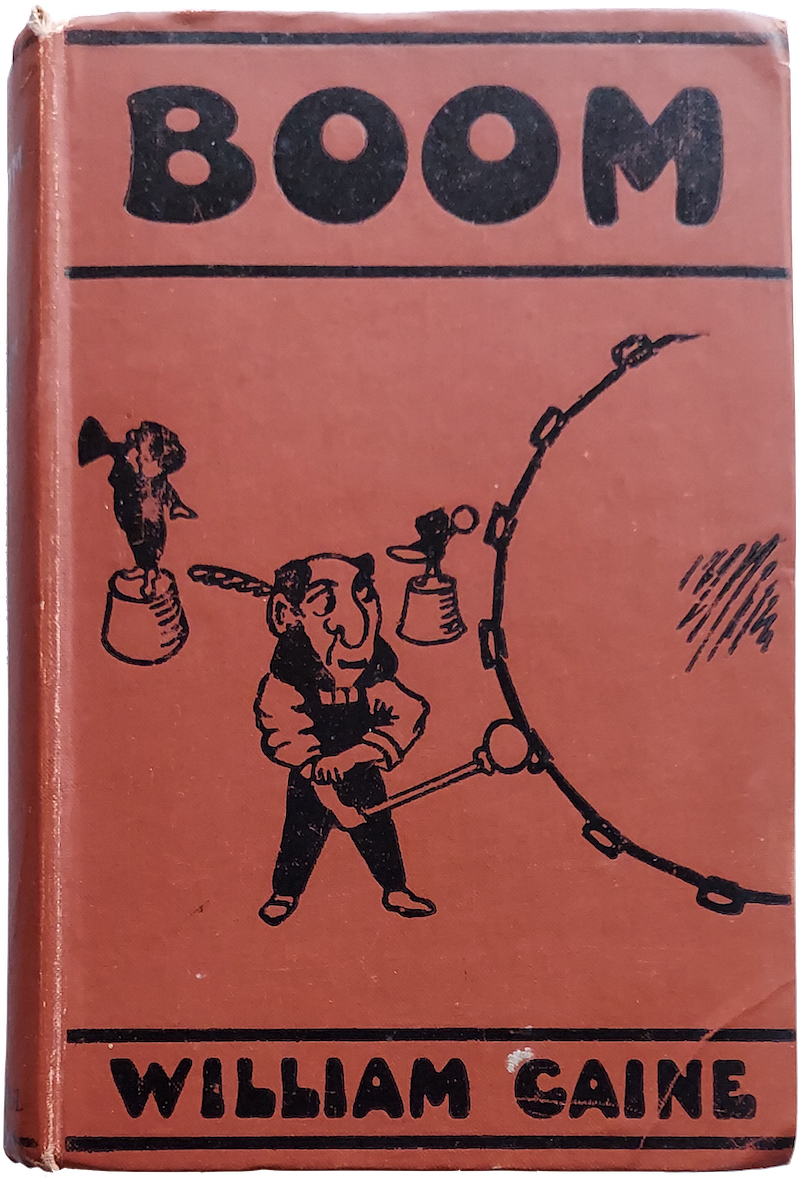
Boom! A Novel of the Century, by William Caine. Cover illustration by the author. With a note by Mrs. William Caine. London: Stanley Paul & Co. 255 pp., 8º. Sixth edition. June 1926.
The Northern Whig, Friday, December 31, 1909, p. 10, “Literature; Short Notices.”
Without possessing the soul of the æsthete, which squirms in agony at the sight of an advertisement hoarding, it is possible to dislike the modern craze for publicity and to strongly resent the methods of certain publicity agents. We do not suffer as much from the latter as they do in American, and — optimistic thought — perhaps never will, but we are bad enough, and there are many who will fully appreciate Mr. William Caine’s satire “Boom!” (London: Greening & Co. 6s.). The author achieved considerable success with his previous book “The Victim and the Votary” [sic], and there is reason to hope that when he has toned down his present redundant style we will have a humorist whose volumes will be awaited with pleasurable anticipation. The central figure in the present book is an American who has set up in business in England as a publicity agent, a man who combines the genius of Napoleon, Sherlock Holmes, and Mr. Hearst. Before his methods ordinary advertising agents hand diminished heads. By the simle expedient of a sham rescue from a three-feet-deep pond at Walham Rye, with a photographer and descriptive writer in alert attendance, he secures the return to Parliament of a previously hopeless candidate, lifts the heroine from the ballet of the giddy eminence of musical comedy star, log-rolls a very minor poet into blushing fame, and get [sic] the “Daily Wire” the reputation of being an exceedingly smart and up-to-date paper. At his suggestion Fitz-Stanley, the struggling artist, rapidly rose to be an R.A. with innumerable patrons by painting a puzzle picture — two young women exactly alike called “Mother and Daughter.” At his suggestion, too, an unknown architect painted his house in longitudinal stripes of vermilion, ultramarine, and gamboge, and, with the aid of judicious log-rolling by an “art writer,” suddenly leaped to prominence and fortune as an authority on “the house beautiful.” But for full details of the world’s greatest professional “boomist” we must refer the reader to the book itself, which is one of the most amusing volumes published for some time. The humour gains in piquancy by the knowledge that the story is not, after all, a very much exaggerated version of hard fact.
The Westminster Gazette, Saturday, January 1, 1910, p. 4, “Books of the Week; Recent Fiction.”
“Boom,” by William Caine (Greening, 6s.), is a piece of clever, though slightly heavy, satire on Modern London. The central figure is one Dana Blair, a professional boomster; and the story is concerned with a group of people whom he has boomed into success, and from whom he receives a substantial percentage on the proceeds. A peer, a member of Parliament, a literary critic, a poet, and a musical-comedy actress are the most important of his puppets, and the chief episode of the story is the attempted suicide of the actress, stage-managed by Blair for the primary object of winning an election for the member of Parliament. The actual results, however, include the success and advancement of the girl from the chorus to the principal star part and the booming of an idiotic young poet. The story is well constructed, and Mr. Caine shows considerable descriptive skill, as well as a knowledge of human nature which enables him to make his hero, Ned Armstrong, the only character untouched by Blair’s influence, an admirable creature in spite of his inclination to priggishness.
The Belfast News-Letter, Thursday, January 20, 1910, p. 5, “Literature of the Day; Recent Fiction.”
“Boom,” by William Caine, is a satirical novel but highly amusing. The leading character, Dana Blair, knows how to boom everything. Whether he undertakes to give men with no aptitude for politics the first place in the council of the nation, or to raise ladies without any special gifts, natural or acquired, to be “stars” in the leading theatres, he never fails. If Mr. Caine is not always successful in keeping clear of farce, he is amusing in every chapter, and thus he may be said to have fully attained his object. The part of the story which describes the relations of two self-willed lovers is not less interesting than the rest.
The Daily Express (Dublin), Literary Supplement, Thursday, February 10, 1910, p. 7, “New Books and Publishers Announcements; Fiction.”
In his shilling brochure, entitled “The Victim and the Voter” [sic], Mr. Caine, who must not be confused with the great Hall, has already shown that he has at his command a fund of humour. It was indeed, a most excellently funny skit on the Suffragette movement. And he carries his happy possession into his more ambitious story entitled “Boom,” which he piquantly dedicates “to the conscience” [sic], which begins, “Criticism is your province, and you realise it. Of how few consciences can this be said!” And which ends: “We have done our best with ‘Boom.’ Now it claims the notice of a larger audience. They may hiss; they may applaud; but ‘we’ have had a good time.” Let our readers also seek a similar good time in the pages of Mr. William Caine’s “Boom”!
The Modern Man (London), Week Ending August 19, 1911, p. 1, “Cheek.”
“Boom” is the name of a new book by Mr. William Caine. If the author had been Hall of that ilk, the title would have been more appropriate.
Western Mail, Thursday, August 19, 1926, p. 9, “Reviews of Books; Recent Fiction; ‘Suicide’ for Publicity.”
“Boom” is something out of the ordinary and is full of amusing and lively scenes. It deals with the courtship of a journalist and a chorus girl. The former, though really wishing that his lady love would give up the stage, believes in everyone being free to lead his or her own life. The girl, piqued by the apparent lack of interest of her lover in what she does, agrees to take part in a publicity stunt by pretending to attempt suicide and being rescued by a prospective member of Parliament. The result of this adventure and publicity makes a stage “star” of the girl and widens the breach between herself and her lover. The complications ensuing from the enterprise of the advertising agent are highly amusing.
A Prisoner in Spain, by William Caine. London: Greening & Co. 320 pp., 8º. April 1910.
A Romance. London: Greening & Co. 320 pp., 8º. April 1910. [ECB 1910: 43].
Cheaper edition. London: Greening & Co. 320 pp., 8º. March 1915. [ECB 1915: 43].
The Advertiser (Rotherham), Saturday, April 16, 1910, p. 6, “Literary Notes.”
One of the most successful books of last season was undoubtedly “Boom,” a bright and amusing, slightly humorous, slightly sarcastic modern story, being the “first novel” [sic] of Mr. William Caine. Messrs. Greening now inform us that they are publishing, almost immediately, a new story by Mr. Caine, entitled “A Prisoner in Spain,” which will deal with the “buried treasure” swindle from an entirely fresh and amusing point of view. [Identical announcements in The Daily Express (Dublin), Thursday, April 21, 1910, p. 7, “Literary Notes,” and The Middlesex Gazette, Saturday, April 23, 1910, p. 6.]
Truth, April 20, 1910, Special Literary Supplement, p. 8, “Notes.”
The Spanish prisoner and the buried treasure swindle with which readers of Truth have so long been familiar will play a part in a forthcoming story by Mr. William Caine, the author of “Boom.” The book is entitled “A Prisoner in Spain,” and it will be published by Messrs. Greening.
The Birmingham Post, Friday, May 6, 1910, p. 5, “Books Received; Fiction.”
Out of the “Spanish prisoner” swindle, and the misadventures of an English J.P, who went to Spain to hunt the trickster out, Mr. Caine has made a very lively and amusing novel, thoroughly worth reading.
The Edinburgh Evening News, Thursday, May 12, 1910, p. 2, “Recent Publications; New Novels.”
Spain occasionally enters into our novels. It is a land of romance, and although old customs are now rapidly dissolving, the people and their ways have still a charm of their own, and are well worth the efforts of a descriptive pen. In “A Prisoner in Spain,” William Caine handles his material with considerable skill and no little humour, while the spirit of adventure is also strong in his pages. “A Prisoner in Spain” is published by Messrs. Greening & Co., London.
The Times Literary Supplement, Thursday, May 12, 1910, p. 175, “List of New Books; Fiction.”
Mr. Caine would show us how a prosaic and commonplace English country gentleman of to-day can all of a sudden be plunged into a perilous romance worthy of medieval Spain. The letter which decoys him to that country and its sequel in over 300 closely printed pages are highly ingenious, and Mr. Tom [sic] Billing’s adventures, as Mr. Caine relates them, though not wildly absorbing, will be found exciting enough for most tastes.
The Daily Mirror, Friday, May 13, 1910, p. 7, “Books for the Library List.”
John Billing, an English squire, goes over to Spain to investigate a message he receives from a supposed relation in Spain who is in prison. Billing finds a perfect nest of intrigue when he arrives at San Pablo, the only innocent person being Mercedes, a beautiful young girl, for whose sake the whole web has been spun. The villain, Colonel Ribera, tries to murder Billing when he finds that the Englishman loves Mercedes, but a rescue is effected, and the young Spanish girl goes to England as a bride.
Truth, May 18, 1910, p. 1286, “Entre Nous.”
I had often wondered how it was that my old friend the Spanish Prisoner had never been annexed by the novelist in search of a theme. It may be, of course, that the fear of a charge of plagiarism of a Spanish contemporary had exercised a restraining influence, for undoubtedly the Spanish Prisoner has proved himself a writer of fiction of no mean order. But the possibilities of the subject have at last been realised, and in “A Prisoner in Spain” (Greening, 6s.) Mr. William Caine has woven a thrilling romance around my old acquaintance. When I say that the recipient of the letter from the prisoner is an old Truth reader, and thoroughly acquainted with the usual swindle, it is enough to prove that the story is not developed on hackneyed lines. Now who is going to write the romance of the “Great Gold Brick”?
The Morning Leader, Friday, May 20, 1910, p. 3, “Pages in Waiting; The Cautionary List”
Only a week or two ago “Truth” unearthed once more our old friend the Spanish prisoner, who figures with such regularity in the “Cautionary List.” Mr. William Caine is certainly right in making the hero of “A Prisoner in Spain” disbelieve an appeal from an alleged relative incarcerated at Pablo [sic]. But when this same very British gentleman is almost immediately taken to Pablo by a charming Anglicised Spanish friend, and finds most of the details of the begging letter true, the plot distinctly thickens, if we may use a thoroughly misleading term. The plot becomes stimulating and vivacious as well as complicated, and the reader is soon very pleased with himself. Sometimes we wish Mr. Caine had let his sense of irresponsibility overpower him a little more; but on the whole this is an excellently light and diverting book.

All Truth Readers must read A Prisoner in Spain. By William Caine. Author of “Boom.” “A Prisoner in Spain” shows the working of the “Spanish Prisoner” swindle in the form of a bright, humorous and adventurous romance.
Evening Standard and St. James’s Gazette, Saturday, May 21, 1910, p. 4, “Novel Notes.”
A Prisoner in Spain, by William Caine (Greening, 6s.), is not a story of the Inquisition, but a modern narrative, brisk, adventurous, and humorous, concerned with a set of people to whom the reader speedily becomes attached, from the jovial but unmitigated villain to the delightful if ponderous hero and the dear little heroine. Mercedes has a touch, but only a touch, of the Spanish girl of fiction. The author succeeds in making her so living and lovable that her reality as a type must not be questioned. The frizzled curls and large gilt earrings carry conviction, if nothing else. The story gets a little melodramatic towards the end, but the style is so quiet, and the characterization so admirable, that we are ready to believe in the kidnapping of John and the explosion in the lighthouse and all the rest. John is an extraordinarily likable person, and he is drawn with pronounced humour and charm. [Identical review in St. James’s Budget, June 3, 1910, p. 8, “Literary Notes and Reviews.”]
Reynolds’s Newspaper, Sunday, May 22, 1910, p. 2, “Books of the Week.”
Who has not read the newspapers and marvelled at the credulous people who, time after time, are gulled by the Spanish prisoner fraud — a beautiful maiden, a father languishing in prison, whilst wealth untold is lying in security waiting to be claimed and shared by anyone who will advance a substantial sum of money to aid in rescuing the prisoner? Mr. William Caine has made this well-known fraud the basis of his charming story “A Prisoner in Spain” (Greening and Co., 6s.). John Billing, a fine English country gentleman, is approached from the Sunny South in what proves to be the vain hope that he will send money to liberate a “cousin.” Being rather suspicious, he travels to San Pablo, much to the disgust of the writer of the letter. From the time of his arrival John is fascinated by Mercedes Guadarrama, the dancer and daughter of the “prisoner.” He is torn by a desire to help the father and to keep out of the clutches of Uncle Hilario, who wants the money. But John is cautious, and this trait in his character leads him into a most awkward situation, from which he barely escapes with his life. The contrast between John Billing and his Spanish friend Quesada is good. In a measure we are indebted to the latter for the story. He wanted a companion on his journey to Spain, and in spite of John’s determination to inform Scotland Yard, the Spaniard gains the day and John goes Southward. Mercedes the dancer is not a strong character; but one must marvel at Senor Hilario as a genius — his lies are appalling, and the reader is quite at a loss as to the true facts of the case owing to this gentleman losing his head and inventing many versions for John’s edification. The result may be imagined. It is a farce, pure and simple, and it is to be hoped Mr. Caine will give the public many more such books. Every page of “A Prisoner in Spain” is brimful of interest.
The Manchester Guardian, Wednesday, May 25, 1910, p. 5, “New Novels.” [Signed S. H.]
You are acquainted with the Spanish prisoner swindle, the trick which has been continually exposed in the columns of “Truth.” Now suppose that a special instance of it should turn out to be not a swindle, or rather that it should present sufficient superficial plausibility to appear genuine even to a man on his guard. That is the assumption with which Mr. Willian Caine begins in A Prisoner in Spain (Greening and Co., pp. 320, 6s.), and we are soon launched into an elaborate intrigue, with a complete outfit of bluff John Bulls abroad, shifty Spaniards, and charming ladies, all in a suitably romantic Southern setting. To get an effect of lightness and intimacy Mr. Caine writes conversationally. “They seemed to be getting on very well, these two”; we say this kind of colloquial thing, but should an author write it? Not, we suggest, at very great length, or it loses its sprightliness as elastic loses its quality if stretched too far. Besides, Mr. Caine designs to thrill at times, and his persistent levity of diction comes perilously near being fatal to his design.
The Sheffield Daily Independent, Wednesday, May 25, 1910, p. 7, “Books of To-Day; Novels.”
William Caine is the author of “A Prisoner in Spain” (Greening, 6s.). The book has its hero and its heroine, the latter, Mercedes, being a capital example of character study. There is kidnapping, and an explosion, villainy and jollity, all of which, of course, are indispensable in a truly coloured Spanish story. We have even a smack of the prisoner who can tell you of treasure store if you will only render him some little service. One of the best characters in the book is that of John. The story is certainly one of the best things Mr. Caine has given us.
The Courier (Dundee), Thursday, May 26, 1910, p. 6, “New Books of To-Day.”
In “A Prisoner in Spain” Mr Wm. Caine has given us a romance founded on the very well-known tale of a letter from Spain offering a very large fortune to our hero on condition first of a large advance. In addition to this, the young and lovely daughter is also promised as his bride. Mr Billing’s adventures are rather amusing, but they would have been more so had they been compressed. Of course, after sundry stormy events, he married Mercedes, and it is possible, judging from her character, that he lived unhappily ever after. Certainly Billing was a bold man to face such a crowd of undesirable relations-in-law. Mr Caine delights in the sensational, and to a certain extent, not wholly, has he succeeded in the present volume. There are really too many villains trotting round, and they are too minutely described; in fact the pages bristle with unnecessary explanations, which leave nothing to the imagination. The novel is one which just misses complete success.
The Spectator, May 28, 1910, p. 889, “Readable Novels.”
“The Spanish Prisoner” fraud is skilfully employed. John Billery [sic], J.P., and Mercedes are admirably contrasted.
The Westminster Gazette, June 4, 1910, p. 5, “Recent Fiction.”
Mr. William Caine is versatile. His fourth [sic] novel is quite unlike any one of its predecessors, and it is also better than them all, better even than “Boom,” because it is a less ambitious work, and in it we feel that Mr. Caine is for the first time completely master of his theme and of his medium. “A Prisoner in Spain” (Greening and Co., 6s.) is called “A Romance” on the title-page, but melodramatic comedy is the description we should give it after a careful and appreciative reading. It deserves the praise implied in the title of comedy on account of the careful and effective character-drawing, and also because of the clever if not very subtle interplay of some of the characters. John Billing, the hero, Hilario, the sentimental villain, Ann Dicey, the thoroughly nice girl, Quesada, the adequately nice man who is provided for her, are all well executed, cleverly manipulated, if familiar, figures. As for melodrama, well — the culmination of the story shows us John Billing bound and gagged in the lantern of a disused lighthouse, Quesada racing a lighted fuse burning uphill to the dynamite which will blow that lighthouse and its occupant into the sea before the opened eyes of the lady who loves but has denied the hero, and Ribera, the rather too villainous principal villain, dancing with joy at the prospect, a raving, foaming maniac. If Mr. Caine has not aimed very high this time, he has certainly hit his mark fairly and squarely, and on all but one account must be congratulated on a signal success.
Punch, or The London Charivari, June 8, 1910, p. 432, “Our Booking-Office.”
If I am to meet a villain (in fiction) I like him to be so unlimitedly wicked that I can hate him to my heart’s content. The man who wastes precious time in wavering between crime and repentance is not depraved enough for me. Gladly I award full marks for villainy to Colonel Ribera in A Prisoner in Spain (Greening). As he proceeded steadily from crime to crime he became the dominating figure in the book, and, like a true artist, he kept his original and outrageous crime until the end. I congratulate William Caine upon the creation of such a very perfect monster. Hilario was also as vicious as his weak knees would allow him to be, but, though his intentions were the worst in the world, the Colonel could still have given him a stroke a crime [sic?]. Two little love-stories help to clear the criminal atmosphere; yet, amiable and well-drawn as these lovers are, I was so exhausted with hatred of the arch-villain that I had no emotion left in reserve for them. Should your taste in villains be the same as mine, I commend this novel to you.
The Bookseller, June 10, 1910, p. 734, “Short Notices; From Messrs. Greening and Co.”
The ancient swindle of the Spanish Prisoner must be familiar to most of us, but we believe this is the first time it has been immortalised in fiction. John Billing, a country squire, one morning receives the familiar letter anent the hidden treasure, and his natural procedure is to enclose it in an envelope and address it to Scotland Yard. Before he has time to send it off, an old College chum, a Spaniard, pays him a visit, and induces him to journey to San Pablo in his company to enquire into the truth of the story, which, strange to relate, is in every detail perfectly correct. Mercedes, the young and beautiful daughter, speedily captivates him, and Billing is determined to thoroughly investigate the mystery. Ribera, the Governor of the Jail, who has set the ball a-rolling, is furious, as he had contemplated securing both the fortune and the lady. Events, however, turn out favourably for the knight errant, who emerges, after a most complicated series of adventures, including the slight excitement of nearly being blown up with gunpowder, victorious all along the line, and brings his bride to England. Mr. Caine has provided incident and excitement in plenty, and we welcome this further story from the talented author of “Boom.”
Western Mail, Saturday, June 11, 1910, p. 9, “Recent Books; The Spanish Swindle; Made the Basis of a Diverting Book.”
Originality and humour are outstanding features of Mr. William Caine’s new novel, “A Prisoner of Spain” [sic] (Greening; 6s). It has the Spanish swindle for its groundwork. A beautiful maiden, a father languishing in prison, untold wealth waiting to be claimed and shared by anyone who will advance a substantial sum of money to aid in rescuing the prisoner — all the characteristics of the well-known fraud are introduced, and we are brought in touch with a set of people who captivate our interest at the start, and hold us closely until the end of the last chapter. Take, for instance, Mercedes Guadarrama, the dancer and the daughter of the “prisoner.” She is a living, lovable little person, who stands out in sharp contrast to Senor Hilario, whose inventive mind and appalling lies are responsbile for the most diverting situations, The book, in fact, is full of charming characterisation, and we look forward to Mr. Caine’s next work with eagerness.
The Western Morning News, Tuesday, June 14, 1910, p. 3, “New or Recent Books; New Novels.”
Mr. Caine must be congratulated on one of the most original and amusing novels that has appeared for a long time. If any of his readers should chance to be the recipient of a “Spanish Prisoner” leter after this, they will find it harder than before to consign it to its proper place, the waste paper-basket, remembering into what a whirl of strange, amusing, and exciting adventures John Billing was led by such an epistle, during the three days in Spain in which he goes through so many emotions. Rapid as the story is, there are no loose threads in its workmanship; the plot is most ingeniously worked out, and the characters are all admirable in their way, the Spaniards especially, little Mercedes and elderly Teresa, the two men who play the villains’ parts, and the lucky Quixote. The story all takes place in Spain, and the romantic charm of the skillfully suggested background adds to the reader’s enjoyment of the scenes so graphically described.
The Playgoer and Society Illustrated, vol. 2 (n.s.), no. 9, June 15, 1910, p. 128, “From the Bookshelves.” [Signed E. W. M.]
A wag has been defined by some worthy man of learning as “a merry, droll fellow.” This is just what Mr. John Billing is, only, being an Englishman, he doesn’t realise the fact. He spends his days doing and saying things that would make his fortune if he were on the stage and trying to be funny. He is so big and downright and quaint and fond of his friends that you can’t help loving him. When he asked his old “pal,” Ann Dicey, to arrange that his walk with the little Spanish dancer should be unchaperoned, he was quite surprised that she should guess why.“‘Oh,’ said John, ‘that be hanged! You don’t think — Why, Ann, you ass. It’s nothing of that kind. I’ve only known the girl two minutes. You are a jolly old clown, Ann.’
“He was so pleased with Ann that he didn’t mind in the least what he said to her.
“‘You ox!’ he said.
“‘If you don’t stop abusing me,’ she said, ‘I’ll walk back to San Pablo with you myself.’”
If instead of a first-rate plot there was nothing in A Prisoner in Spain but the conversations and the character-sketches, you could still read it and feel on good terms with the world when you had finished.
Belfast Evening Telegraph, Tuesday, July 19, 1910, p. 3, “Literary Notices.”
“A Prisoner in Spain,” issued by Messrs. Greening & Co., Ltd., 91 St. Martin’s Lane (6s), is a new romance by the Mr. William Caine, who has achieved considerable fame by his previous work, entitled “Boom,” one of the cleverest satirical and humorous novels published within the last 12 months. There is perhaps more of the real novel in Mr. Caine’s latest work, but it is scarcely so enjoyable as the expose of modern systems of advertising. Mr. Caine, however, takes as his text a subject with which we are all familiar — the Spanish swindle — and starting with this base he evolves a thrilling and well-written tale.
The Revolt at Roskelly’s, by William Caine. London: Greening & Co. 316 pp., 8º. November 1910.
London: Greening & Co. 316 pp., 8º. November 1910. [ECB 1910: 43]. Verso of title page states: “Copyright in the Dominion of Canada. October, 1910.”
New York and London: G. P. Putnam’s Sons. 361 pp., 8º. June 1911.
Cheaper edition. London: Greening. 316 pp., 8º. May 1914. [ECB 1914: 48].
Third edition. With a note by Mrs. William Caine. London: Stanley Paul & Co. 316 pp., 8º. June 1926. [ECB 1926–1930: 259].
A scan of Harvard University Library’s exemplar of the Greening first edition is available at hathitrust.org. Two scans of the Putnam’s first edition are also available, one from Harvard University Library (also at archive.org), the other from the New York Public Library.
Perthshire Advertiser, Saturday, November 5, 1910, p. 2, “Books.”
Mr William Caine, whose first novel, “Boom,” was acclaimed as something really original in the way of fiction, has broken out in a fresh place, and his new novel, “The Revolt at Roskelly’s,” which Messrs Greening are publishing, gives us a story that for human interest and marked sense of character cannot easily be beaten. Mr Caine has a humour decidedly of his own, and yet at the same time knows how to tell a good story, and as his new book deals with the adventures of a number of people at a hotel during Christmas week it should come appropriately enough during the forthcoming season.
The Times Literary Supplement, Thursday, November 17, 1910, p. 454, “List of New Books and Reprints; Fiction.”
Here we move in the little circle of chance guests whom Christmas has brought together at the well-known hotel — Roskelly’s — in the Cornish Riviera. An exclusive and imperious old general well contrasted with a cheery and sociable “Mr. Yule,” George, the General’s nephew, and Elizabeth Day are the leading characters — though there are a good many others — who all help to fill out a comedy depicting in an amusing way the social conventions of hotel life.
The Revolt at Roskelly’s, by William Caine. New York and London: G. P. Putnam’s Sons. 361 pp., 8º. June 1911. Available online at archive.org.
The Spectator, December 24, 1910, p. 1143, “Books; Novels; Readable Novels.”
“Roskelly’s” is a winter-resort hotel; the revolters are its non-fashionable frequenters, with a certain mysterious “Mr. Yule” for their leader. This is a most amusing story.
Desmond O’Brien, “Books,” Truth, December 28, 1910, p. 1630.
Mr. William Caine’s “The Revolt at Roskelly’s” and Mrs. Barclay’s “The Mistress of Shenstone” have one thing only in common — in each case a nobleman incog. plays a principal part. In “The Mistress of Shenstone” the heroine also is incognita, and this and her furiously striking the hero with a fan are the only original things in a commonplace story. On the other hand, “The Revolt at Roskelly’s” is the reverse of commonplace, being a thoroughly Christmas story, admirably and humorously told, of snobbery brought to confusion.
A. L. A. Booklist. A Guide to the Best New Books. Chicago: American Library Association Publishing Board. Volume 8, no. 1, September 1911, “Fiction,” p. 35. [Mistakenly identifies author as “Caine, William Ralph Hall.”]
A lightly written, amusing satire on English snobbishness as revealed at a hotel in the “Cornish Riviera” during the holiday season. The arrival of a benevolent old gentleman who, impervious to snubs and class distinctions, dispenses his Santa-Claus favors to snobs and “plebs” alike, creates consternation among the former which the revelation of his identity turns to adulation.
The Devil in Solution, by William Caine. Illustrated by George Morrow. London: Greening & Co. 320 pp., 8º. May 1911.
Illustrated by George Morrow. London: Greening & Co. 320 pp., 8º. May 1911. [ECB 1911: 44].
The Daily Telegraph, May 10, 1911, p. 6, “Current Literature; Notes and Reviews; Forthcoming Books.”
Messrs. Greening have nearly ready a new satirical novel, by Mr. William Caine, the author of “Boom.” It is called “The Devil in Solution,” and is reported to contain a light-hearted skit upon modern men and manners, and to abound in portraits (humorously veiled) of prominent leaders of social life to-day. The amusement afforded by the book is likely to be considerably enhanced by the inclusion of a number of comic sketches by Mr. George Morrow, to whose lively pencil the works of E. V. Lucas and Mr. C. L. Graves owe so much.
Western Daily Press (Bristol), May 29, 1911, p. 8, “Literature; ‘The Devil in Solution.’”
Mr William Caine’s latest novel is extremely funny. The whole thing is a screaming burlesque. It tells of Lord Mark Mucklethew, “Britain’s Greatest Athlete,” who won everything there was to be won in every branch of sport. Incidentally, too, he is a Cabinet Minister. But he has a valet, who is a rogue, and a scoundrel. It is he who instils into Lord Mark the necessity of using Ath-Cocoa, and Lord Mark becomes a Cocoa-path. Without Ath-Cocoa he can do nothing — social, political, and physical failure stare him in the face. He fails signally at certain crises without it, and Smith, the wicked valet, holds the whole stock. How Lord Mark overcomes the temptation finally, and marries Lady Cerise, readers will revel in finding out. The illustrations by George Morrow are in keeping with the humour of the story. Messrs. Greening and Co. publish it.
The Daily News, June 15, 1911, p. 5, “Literature; Notes on New Novels.”
Mr. Caine gave us in “Boom!” a brilliant farce about advertising. “The Devil in Solution” is another farce on the same theme, for the hero, Lord Mark Mucklethew, M.P., who is the admirable Crichton of British athletics and politics, falls into the clutches of a valet who is advertising agent for a certain weird brand of cocoa. Lord Mark is in love with a lady whose father, Lord Bognor, has one great passion in life — the abolition of cocoa-drinking — and when, with good grounds, the latter accuses Lord Mark of being a helpless coco-path, Lord Mark lies valiantly for the lady’s sake. Murder will out, however. Lord Mark becomes more and more addicted to Ath-cocoa, till at length he is getting through five tins a day. “His days must soon become one monotonous round of boiling the kettle and ladling out brown powder. From one teaspoonful, with which he had begun on the Monday night, he was now at three tablespoons the cup. That very morning he had bought the largest mug in Tottenham-court-road, but it was already too small.” It will be seen that there are amusing possibilities in Mr. Caine’s plot, and he has made entertaining use of them. Lord Mark triumphs as a lover in the end by discovering that Lord Bognor, who pretends to live on nuts, is a secret meat-eater.
Sub Rosa, “Under Cover; Recent Fiction,” The Gentlewoman, June 17, 1911, p. 805.
Mr. William Caine is a genial satirist whose work must surely be amusing even to the very people whose follies he drags to the light of day. “Boom” will be remembered as something new, at the time of its appearance, in the way of satirical writing. The zest, the freshness, which Mr. Caine brought to his work, left a corresponding impression on the reader, and Mr. Caine remained in the mind as a writer to be watched. Subsequently “The Revolt at Roskelly’s” showed the author in a somewhat new light, and now The Devil in Solution, a return to the earlier manner, comes to set us all bubbling with merriment at the next man’s follies. The succumbing of Lord Mark Mucklethew to the cocoa-fiend (“The Devil in Solution”), provides Mr. Caine with the necessary peg on which to hang his satire, and for three hundred and twenty breathless pages we follow the record of temptation of this athletic hero, “Britain’s Greatest Athlete,” and of his final triumph. Every page presents a temptation to quote from this delightfully refreshing book, which, in grotesquely magnifying life, comes much nearer the truth of matters than does many a laborious would-be transcript. An extract from Mr. Caine’s description of his gorgeous hero must, however, suffice: “A superb specimen of English manhood, Lord Mark stood six feet eight and a quarter inches in his socks, though, with bare feet, he was a fraction under that height. The hair was golden, and waved over the temples. One — nay many — would have said, ‘a young Greek god.’ The eyes were blue and large, and owned that concentration which invariably stamps the gaze of the county cricketer. The nose was short and broken — broken gloriously at Queen’s Club by the heel which occasionally stamps the face of the international footballer.” It will be noted that Mr. Caine has a special rod in pickle for the obvious, and a crow to pick with the novelist of the studied conventional type.
Punch, or The London Charivari, August 9, 1911, p. 106, “Our Booking-Office.”
I question which of the three of us, Mr. William Caine, who wrote The Devil in Solution (Greening), Mr. George Morrow, who illustrated it, or I, who read it, enjoyed himself with the greatest abandonment. It is without doubt the most absurd book I have ever read. The mere idea of alleging the cocoa-drinking habit as the last and most vicious form of self-stimulation, and not only so, but further hanging the whole complicated plot upon that alone, is clearly inexcusable. To set up the victim of the vice, Lord Mark Mucklethew, the aristocratic politico-athlete, who was better at everything than everybody and offensively aware of it, as a hero deserving of sympathy and applause, is preposterous; and that my attention and interest should have been seriously invited to the insincere narrative of this person’s frankly inconceivable career I regard as a a piece of bare-faced impudence on the part of the author and his equally guilty collaborator. Possibly they may attempt to justify their outrageous antics on the grounds of satire; certainly I fancied I caught a suggestion now and then that they were getting at somebody; but whether the objective was the Government, the Smart Set, or merely myself, I cannot tell, because I did not stop to think. Satire or no satire, the whole thing stands outside the pale of dignified criticism, and I have nothing more to say for it. But, heavens! how I laughed from start to finish!
Old Enough to Know Better, by William Caine. London: Greening & Co. 320 pp., 8º. November 1911.
London: Greening & Co. 320 pp., 8º. November 1911. [ECB 1911: 44].
Dedicated to “My Dear J. S. B. and M. E. B., Accept this book with my grateful love. Always yours, William Caine.”
Two-shilling edition listed as “forthcoming” in The Bookman, May 1914, p. 65, and July 1914, p. 151. Not confirmed by [ECB 1914: 48].
The exemplar available from babel.hathitrust.org is a scan of that held by the New York Public Library.
The Daily Express (Dublin), Thursday, November 16, 1911, p. 7, “New Books and Publisher’s Announcements; Literary Notes.”
Mr. William Caine, the author of “Boom,” is just publishing his new book with Messrs. Greening. “Old Enough to Know Better” is the quaintly humourous title of Mr. Caine’s new work, and the scene of the story is practically laid in one district, namely, the well-known Vale of Health at Hampstead. Mr. Caine should be considered, in the light of his recent work, as one of the coming humourists of the day, and his new book, the publishers confidently anticipate, will do more than enhance his reputation.
The Scotsman, Thursday, November 23, 1911, p. 3, “New Fiction.”
What story there is in Mr William Caine’s rather too level and inconsequential, yet often amusing, novel concerns itself with the schemes, successes, and failures of a designing young person, who, living at the present day in London, and being under engagement to marry a deserving contortionist of the variety stage, then touring the provinces, nevertheless so entangles a resident in London, no longer young, that she is within an ace of haling him to the bar of justice to answer in damages for breach of promise to marry, when the touring contortionist, abandoning provincial plaudits, returns unexpectedly to the Metropolis and confronts her. Such is the main purport of the plot. But the work depends less upon its plot than upon the easy-going and unscrupulous veracity with which it depicts the frank vulgarity of people who live in the less intellectual purlieus of Hampstead. The airs, the oddities, and the humours of such London are touched off in the book with a cleverness that more than compensates for the languor of its dramatic interest.
The Times Literary Supplement, Thursday, November 23, 1911, p. 482, “List of New Books and Reprints; Fiction.”
A diverting comedy staged at Hampstead — the topography of which is followed with exactitude — in which Ridley Carpenter, a writer who lodged there, and is of a mercurial disposition, gets entangled with the scheming daughter of a restaurant proprietor in the Vale of Health.
The Athenæum, Saturday, November 25, 1911, p. 657, “New Novels.”
In the first chapter of this book the principal character, a young author, appears on Hampstead Heath at an early hour of the morning in the semblance of a Zulu in pyjamas. In the last chapter a small regiment of ex-fiancés confronts the lady to whom they were all simultaneously more or less attached. These are but two instances of the extraordinarily complicated life of Ridley Carpenter during the two days recorded by Mr. Caine. The author has happily surmounted the difficulty in humorous fiction: he has made his characters lifelike, and not marionettes. The lady of the many fiancés is the single exception; it is not easy to understand how the daughter of a retired “strong man” of the music-halls managed to capture a solicitor with a taste for Swinburne. But that does not hinder the book from being funny.

“If you don’t read ‘Old Enough to Know Better,’ By William Caine, Author of ‘Boom,’ You are missing a good thing, that’s all. Laughter all the way. At all Libraries. Price 6s.”
The Manchester Guardian, Wednesday, November 29, 1911, p. 7, “New Novels.” [Signed “S. H.”].
Mr. William Caine’s new novel, Old Enough to Know Better (Greening and Co., pp. 320, 6s.), is a sprightly confection which we approach gingerly. It is important to find out as soon as possible just what Mr. Caine is up to in a new book; you are never quite certain when you have him, or, indeed, whether he may not be having you all the time. His main theme here is one which might inspire a fine and tremendous work — the consideration of how far a man may sincerely love one girl whilst he dallies with another of coarser clay. And, really, in this case we are at first uncertain whether Mr. Caine has bitten off rather more morality than he can chew, or whether it is his tongue that is in his cheek as he writes. It is true that he has always made a practice of seeing the comic side, and since he contrives for the end of his story a situation that would make the fortune of a three-act farce it is improbable that he wishes us to take matters too seriously. It is a very pleasant mode of writing, this of Mr. Caine’s, and we are vastly entertained. The sport is rarely so admirably wild as the lunacy of the author’s “Devil in Solution”; but there is a constant supply of those things he does so extremely well, those freshly invented whimsies that are best referred to by their stage slang term of “wheezes” or “japes.” Of such are the speculations respecting a plausible false name for a non-existent firm of solicitors; or the parody “March at Bexhill-on-Sea” sent to an editor as a protest against the rubbish he published daily and accepted by him in good faith as a “poem”; or the pair of “cross-talk comedians” relieving the intolerable strain of an emotional episode by dropping into their familiar “cross-talk.” The novel is full of these jollities, often irrelevant and untrue but always diverting.
Belfast Evening Telegraph, Monday, December 11, 1911, p. 2, “Literary Notes and Notices.”
“Old Enough to Know Better” hardly strikes one as an original title, and of the scene of the story — Hampstead Heath, a similar observation may be made as to locale. It is a very old maxim, however, that a book should never be judged by its title, and its wisdom could not be better illustrated than in this instance. Mr. William Caine has a rare and refreshing gift for humour in colloquy and in delineation of character. Typical of the one is the first chapter, in which the precocious Urquhart Snyder and “Artie” discuss the prospects of extracting a lively half-hour’s entertainment out of Mr. Carpenter through the medium of a goat addicted to the irritating practice of bleating; illustrative of the other is the picture of Mr. Carpenter aroused at six in the morning by the soulless brute making sleep impossible by its plaintive call beneath his bedroom window. A bombardment of bananas proving ineffectual to dislodge either the goat or goatherds, he springs from bed, and by the aid of burnt cork, chalk, and a Kaffir shield and weapon, sallies forth in pyjamas to rout his assailants. The rout having been accomplished, he returns, to find the door closed and a couple of park keepers in hot pursuit, anxious to have some explanation of the phenomenon of a presumed Kaffir parading in broad daylight in full warpaint and pyjamas. While Carpenter murderously pounds the door to arouse the household the populace is attracted to the spot, and a screamingly funny incident is terminated by the next-door neighbour providing a welcome asylum. A progression of adventures in the career of Mr. Carpenter, each one more exquisitely amusing than its predecessor, brings the reader to the concluding item, where the altogether too amative Emmie is discomfited by the simultaneous appearance on the scene of the five different strings which she believed to be securely attached to her bow. What a picture that is! Mr. Caine is to be heartily congratulated upon a really amusing book, in which he seems to have exactly caught the materials suited to his purpose, and employed them to the best purpose.

“Latest Autumn Fiction. William Caine’s New Humorous Work Old Enough to Know Better. One Huge Delight is Old Enough to Know Better. The Funniest Book of the Season is Old Enough to Know Better. By the Author of ‘Boom.’”
Truth, December 13, 1911, p. 1418, “Notes on Novels.”
Strong men, horrid little boys, a delightful writer, and a polite Hampstead Heath guardian are the “dramatis personæ” of “Old Enough to Know Better” (Greening, 6s.), a humorous, absorbing novel by Mr. William Caine. The strong man has a daughter, Emily, who, intending to marry a prosperous solicitor, has yet cast her eyes upon Carpenter, the writer. Carpenter, in love with Mary Massinger, finds himself gradually recognised by the strong man’s friends as engaged to Emily. Luckily, she is also engaged to several other young men, who all bring matters to a climax in the garden. While the plot is extremely amusing, the characterisation is still better, and the reader will find it worth while to read every page of “Old Enough to Know Better.”
The Belfast News-Letter, December 21, 1911, p. 4, “Literature of the Day; Recent Fiction.”
[…] a humorous recital of the doings of Ridley Carpenter, the young man who should have known better […]
Punch, or The London Charivari, January 3, 1912, p. 18, “Our Booking-Office.”
Every Paradise has its serpent, and Snyder’s Paradise, that pleasant, fully-licensed Eden situate in the Vale of Health, Hampstead, was no exception. Her name was Emily, and her serpentine manœuvres with Ridley Carpenter, man of letters, are set forth by William Caine in Old Enough to Know Better (Greening) with a spirit and humour which recall the same author’s Boom! But Emily went too far. Before the story is past the halfway mark, we find her engaged to be married not only to Mr. Carpenter, but also to Mr. Hamley, a solicitor, one Chilper, a heath-keeper, and Salt and Blooter, the famous music-hall cross-talk comedy duo (“they make the orchestra smile”). The scene of the meeting of these five victims is one of the most brilliantly farcical I have read. It was Emily’s Waterloo, of course. But she fell gallantly, and I was glad when I realized that the exposure, so far from damping Mr. Hamley (she was engaged to them all, but Hamley was the one she wanted to marry), only endeared her the more to the devout lover. “His face, as he looked upon her, expressed nothing but an amazed delight.” Mr. Caine has the true secret of farce. His characters are living people. Fate makes their actions farcical, but in essence they are comedic. His description of the home-life of those married lovers, the Strong Woman and Mr. Watt the contortionist-and-animal-delineator, is pure comedy. It is not every man who would care to be the husband of a female Hercules, but Mr. Watt had his point of view. She might be able to wring his neck between her finger and thumb, but she could not hold a cigar in her toes and smoke it, seated and balanced the while on an inverted beer bottle. Mr. Watt could, and, as he was accustomed to say, “It evened things up more’n a little bit.” This is the philosophy that makes for the happy marriage. “Nobody knows, with the single exception of the word damn,” says Mr. Caine, in his excursus on cross-talk comedians, “what will make people laugh;” but I think I can guarantee Old Enough to Know Better to do it.

“A New Humorist is William Caine, Author of ‘Boom.’ Old Enough to Know Better is his new work. ‘At least one chuckle a page.’ — London Opinion. Read it — and laugh.”
The Manchester Courier, Friday, January 5, 1912, p. 9, “New Novels.”
We congratulate Mr. Caine on his latest novel. The humour is brighter and more sparkling than ever, and the gently ironic criticism of the canness [sic: canniness? scariness? coarseness? wariness? weariness? chariness?] and sordidness that underlie so much of the life of the average man is exhibited in his characters with a frankness that show they are real transcripts from the life of the day. It is only by great skill that a writer can depict vulgar people without something of this vulgarity being reflected on him, but Mr. Caine has passed through the ordeal successfully. On every page there is to be found some aphoristic expression such as “Very few people have a strong enough sense of the ludicrous to be amused at their own misfortunes.” His hero, Ridley Carpenter, is delightful, and we feel much interest in his light misdemeanours, though he is “old enough to know better.” We are informed that Carpenter, the day before the story opens, had used language to hear a repetition of which a youth had, for the first and only time in his life, turned out at six o’clock in the morning. Perhaps Mr. Caine may be induced to issue for the enrichment of the vocabulary of some of his more hardened readers a specimen of Mr. Carpenter’s “cusses.” It is not slight recommendation of a book to state that it will bear re-reading, but we can safely say this of the present volume.
The Nation (London), Saturday, January 27, 1912, p. 724, “The Heroine Who Does Not Marry.”
Mr. William Caine is another writer who does not trouble about the complexities of the age in which he lives, or of any other. “Old Enough to Know Better” is an excellent piece of fooling, with some good character drawing and a plot that borders on farce but never quite gets there, because the people who are the actors in it happen to be real though perhaps a little original in type. It is not quite convincing in places — where, for instance, a particularly nice young fellow, called Ridley Carpenter, manages to get himself involved with a particularly vulgar young woman called Emily Snyder, not because nice young fellows are immune from the intrigues of vulgar young women, but because the intrigues of this one are so transparent and so very devoid of all charm. And Ridley Carpenter is a delightful jester whose inconsequent conversation would seem to demand an epicure for a listener, not a publican’s daughter who is after wealth and spangled fans and diamond brooches. It is very difficult to believe that Em’ly ever for a moment considered him seriously. All this, however, is immaterial, since the book is not one that is meant to be considered seriously. It will pass an hour or two more easily than the average story of a farcical kind; and once upon a time, when bookstalls were young, it would have been bound in a yellow-backed cover.
The Bookman, February 1912, p. 270, “Novel Notes.”
A recent novel, “A Man with a Past,” contained a diverting sketch of a certain Mr. Patten, a whimsical music-hall song writer, who was wont to dislocate the even tenor of his conversation by sheering off suddenly into impromptu verse. Mr. William Caine in this amusing novel of his has struck an equally happy vein in Messrs. Blooter and Salt, the World’s Champion Cat-laffian Cross-talk Combination, whose habit of breaking into absurdly inconsequent patter and “business” on the slightest provocation proves wholly irresistible. Other “pros” whose oddities enliven the story include a retired Strong Man and an active Strong Woman, who rejoices in a contortionist for a husband. The retired Strong Man keeps a tea and beer garden in the Vale of Health, Hampstead, where the wholesale flirtations of his flashy daughter Emily involve no fewer than five victims. Carpenter, the principal victim, is an impossible young author, whose dislike for doing anything that is obvious plunges him into a series of farcical escapades. The description of the way in which Carpenter is slowly but inevitably drawn into Emily’s net is one of the best things in the book. Mr. Caine exhibits a keen relish for the practical joke, but he does not despise subtler forms of humour, which ever and anon find play in witty digressions on the fads and foibles of mankind — Hampstead mankind in particular. If you do not want to laugh don’t read “Old Enough to Know Better,” for it will certainly make you laugh if you do.
Winifred Slatchford, “In the Library,” The Clarion, Friday, February 9, 1912, p. 2.
There are three books on my desk waiting for attention, and it is Monday morning, just three days late for “copy,” and the voice of the Martin bird is to be heard in the land. A cold, cold voice; a disdainful voice; a voice as withering in its sarcasm as the chill wind that sweeps the snow and slush of our most Worshipful Street outside. A most blood-freezing voice has our Master Printer when the Staff prove laggards and copy comes reluctantly. But what will you do when the temperature is Arctic and the brain and hand are numbed and frozen? Go to, friend Martin, and migrate thee to the South, where slack journalists do not trouble and lines will be at rest. And, maybe, to quote from an opera I wot of, “I fink I’ll come wiv you.”In the meantime, there are those books: all worthy of attention and all acceptable on a cold and frosty evening when the day’s toil is ended and the fire crackles jauntily. The first to my hand — or, to be more exact, at my left elbow as I write — is a right jolly book by William Caine, called “Old Enough to Know Better.” Well, personally I am glad he professed not to know better, this unusual hero, for if he had we should have missed a gentleman of most surprising activities and tremendous fund of humour. This is Ridley Carpenter, aged twenty-six and a man of letters. He is also, more conspicuously, a man of pranks and moods: a lovable, most absurdly simple journalist, whose heart refuses to grow up and whose mind revels in unusual situations. He simply does not mind public opinion; he minds very much missing a chance to laugh or arouse laughter; and, being an incongruous person, he chooses Hampstead, “the intellectual suburb,” as the scene for his extraordinary pranks and jests. The author, by the way, has a happy knack when he would reveal to us some of the psychology of this most intellectual garden suburb. As per example:
We have a history.
There is a book called “The Story of Hampstead.” Where will you find the Story of Perivale Alperton, I should like to know?
We possess what it [sic: is] called a Roll of Fame. Mighty names, on plaques, illustrate many of those houses which have not been torn down for the erection of flats and shop premises and desirable villas. But we do not live in the past. We maintain our tradition. We press onwards. We keep the flag flying. Greatness is in the air we breathe; we see to it that the supply does not become exhausted. Our forerunners thought for themselves, and so do we.
We go hatless in the street. Our women disregard the fashions [sic: fashion].
We form ourselves into societies. We meet in one another’s houses and discuss the most difficult matters. We read poetry, yes, and explain it to each other. We abstain from animal food; we know all about proteids. We chew nuts. We struggle for the rights of Woman, or we concert together to weld her chains more firmly upon her. We wear sandals. Nearly all of us write books. The rest write pamphlets. We imagine that we are mystics. We understand the Bahai movement. We want to see flies exterminated. We look for the Miilennium [sic] what time bearing-reins are abolished. We do all sorts of things [sic: intellectual things].
We meet our hero first early one morning, barred out of his own house, in this most respectable and intellectual of suburbs, sparsely attired, and most wondrously “made-up” in pyjamas, feathers, war-paint, and spear, assumed to strike terror into the hearts of two boys who have violated his slumbers on several occasions, with the aid of a goat who will bleat beneath the slumberer’s window. Having scared the children to his infinite satisfaction, he finds to his horror that he is locked out; the key, in his waistcoat, is inconveniently within doors, and several early risers of the no-hat and sandal brigade in search of health on Hampstead’s breezy heath, are standing around in various shades of amazement and joy at the spectacle of Mr. Ridley Carpenter arguing, in full Red Indian rig, with two scandalised and irate heath keepers.
That is our introduction. After which we follow our comic Ridley through many adventures, the most embarrassing, to him, and the most amusing, to us, being his little flirtation, and subsequent danger of of [sic] a breech of promise case, with a lively young lady named Emily Snyder, who is barmaid to her father, the ex-Strong Man.
How the poor journalist is threatened by Emily and her friends, and comforted and cheered by his own friends, through these comically tragic days you must read for yourselves. The most amusing people are to be found in this book, including the “World’s Champion Cat-laffian Cross-talk Comedians,” who turn up at a critical moment to save Ridley, along with various other gentlemen to whom the enterprising young barmaid has at various times promised her hand.
“The Cat-laffian Cross-talk Comedians” upon our first meeting give us the impression that they are mad. But they are not mad; they are merely very earnest, very painstaking comedians, who are always practising quite comic repartee, and who, when one fails to answer before five is counted by the other, have to pay a fine of one penny. For instance, the two are at breakfast. “Little Salt,” the one in a suit of rags, a decayed pith helmet, and great, false feet; the other, Mr. Blooter, in dressing gown and pyjamas:
“Bon jaw, Mount Sinai,” he said as he entered.“Au reservoyer, Ferdinand,” said Mr. Salt, sitting to table. “How did you sleep?”
“On me back,” said his friend facetiously. “And you, Orlando?”
Mr. Salt thought a moment. “On the flo-er?” he said at last, with a questioning intonation.
“Rotten,” said Mr. Blooter. “Try again, Jack. How did you sleep?”
Mr. Salt thought again.
“With me eyes shut?” he suggested.
“That’s better,” said the other approvingly. “There’s about ’arf a larf in that.” He buttered toast recklessly. “Fine mornin’,” he observed, and split the haddock.
“Ah,” said Mr. Salt instantly, “but nothing to the weather we had to-morrow.”
“What do you mean, nothing to the weather we had to-morrow?” demanded Mr. Blooter fiercely. “That was in Portugal.”
“What do you mean, Portugal?” cried Mr. Salt. “It was Christmas and freezing. That’s how you got that frorst-bite on your chrenometer. And I’ll point at your boko, Billy.”
“Oh, chuck it, Jack,” said the other, with a sudden change of manner. “What’s the day of rest for?”
“One, two, three, four, five,” counted Mr. Salt, and “Ah-hah, Billy,” he cried triumphantly. “I done you that time. Pay up.”
“Right O, laddie — just as you please.”
“I done you. And you hadn’t ought to be done by a little wheeze like that. How would this do? I say, ‘That’s how you got that frorst-bite on your chrenometer,’ pointing at you conk, same as I said, and you say —”
“Oh, cut it out,” said Mr. Blooter. “Cut it out, do. I owe you your damn penny.”
“All right, cully,” said Mr. Salt obligingly, “if you don’t feel up to it this morning. But you began it, you did.”
“I did,” Mr. Blooter admitted, “but you give me an opening, Jack, and I had to take it. But not any more, thanks. Not just now. I’m eating,” which piece of information the effect of two ounces of haddock upon his speech made superfluous.
This is a book with more than one laugh in every page, and is well worth the attention of those who like to take their pleasures joyously. It is published by Greening and Co, at 6s.
An Angler at Large, by William Caine. Kegan Paul, Trench, Trübner & Co. 306 pp., 8º. December 1911.
London: Kegan Paul, Trench, Trübner & Co. 306 pp., 8º. December 1911. [ECB 1911: 44].
Available online at archive.org.
Save us from our Friends, by Willam Caine. London: Greening & Co. 320 pages, 8º. May 1912.
London: Greening & Co. 320 pages, 8º. May 1912. [ECB 1912: 48].
Reprint announced July 1914; not confirmed by ECB 1914: 48.
Truth, March 6, 1912, p. 593, “Books.”
In fiction the same firm [Messrs. Greening] announce a new story, “Save Us from Our Friends,” by Mr. William Caine, whose last book, “Old Enough to Know Better,” showed that he is a real and original humorist.
The Athenæum, No. 4413, May 25, 1912, p. 593, “Notices of New Books; Fiction.”
In his own original way this writer makes his characters live for us. At a villa in a little French watering-place they chatter together in the most natural manner for a day or two. When the matchmaking hostess’s four guests have managed, in spite of her, to shuffle themselves into a position to drink to their married happiness, this, the slightest of sketches, comes to an end — and we are sorry.
The Newcastle Daily Chronicle, Tuesday, May 28, 1912, p. 8, “Books of To-Day.”
Mr. William Caine, who is one of our most genial humorists, takes quite a new line in “Save Us from Our Friends” (Greening, 6s). It relates how a matchmaking hostess carefully draws four young people into her hospitable net, “with a view to matrimony,” and is sadly puzzled at the failure of her best efforts to pair them off. Love, however, laughs at matchmakers as well as at locksmiths, and in spite of the mistaken but well meant efforts of the hostess the “double event” is brought off. The dialogue throughout is as amusing as are the situations, and “Save Us from Our Friends” is to be recommended as a most excellent companion during a holiday or two.
Punch, or the London Charivari, June 12, 1912, p. 460, “Our Booking-Office.”
The only thing that I do not like very much about Save us from our Friends (Greening) is the title, which seems cumbersome, though it is certainly expressive of this excellently entertaining story. Mr. William Caine dedicates it “to any matchmaker,” and one can only hope that its lesson and warning may be taken to heart by all such well-meaning but often devastating persons. The awful example here is one Fanny Baxendale, who, because she was happily married herself and had a passion for string-pulling, nearly succeeded in playing ducks and drakes with the lives of the four people whom she and her complacent husband had brought to share their holiday at Trou-les-Dunes. The trouble was that Fanny, misunderstanding the facts, would try to pair off the right duck with the wrong drake. Hence general vexation of spirit; and incidentally, through the craft of Mr. Caine, a comedy of baffled courtship that is as amusing as anything I have read on the subject this great while. It is all light as foam, but so deftly treated and kept so well in just the right holiday humour that you will be bound to laugh both at and with all six of its delightful characters. I myself chuckled aloud (a thing I seldom do at the bidding of a printed page) over the failure of poor Fanny’s nocturnal river-party, which, from her wrong assortment of couples, became, instead of a romantic serenade in the moonlight, a wild race between two mutually jealous and suspicious oarsmen. But the whole book is capital fun, and, before its happy ending, will have made for you six jolly new friends, from whom, despite their pigheadedness, you will have no desire whatever to be saved.
Bristol Times and Mirror, Saturday, June 15, 1912, p. 24, “Our Literary Page; Cigarette Papers; Old Writers & New Books; Written in a Library; New Books; Save Us from Our Friends.”
Mrs. Baxendale has, as she imagines, a gift for match-making, so she invites James Haslam and Nora Gilbert to stay with her at Trou-les-Dunes, little guessing that they had once been engaged for a week, but had quarrelled over some jewelry which Nora’s cousin Godfrey had given her, and had parted two years ago. In James’ despair at the situation he appeals to Elsie West to stick to his side; now Elsie is in love with the cousin Godfrey, but good-naturedly stays with James, thus recking Godfrey with jealousy, and causing Mrs. Baxendale to change her ideas, substituting Godfrey, for James in her plans for Nora. The couples struggle to disentangle themselves, only to find themselves more firmly bound, for Godfrey at last thinks Elsie must care for Jim, while the latter of course was always convinced Nora had loved Godfrey all along. Mr. William Caine tells a most amusing and apparently hopeless tale of how much harm the kindest of friends can do, until the last chapter: when the real lovers take the bull by the horns and insist on going their own ways. The story is brightly written, and admirably suited for holiday reading.
Pendennis, “Books of the Day; The Novel-Shelf; The Matchmaker,” Pall Mall Gazette, June 22, 1912, p. 9.
This is a most amusing story: its counterpart on the stage would be called a farce rather than a comedy, for the characters are but wooden puppets, though they move most deftly and entertainingly. The Matchmaker is a young married lady, Fanny Baxendale, and she and her husband, Charles, have taken the Villa Joyeuse, at Trou-les-Dunes, for the summer. They are joined there by James Haslam, Charles’s cousin, who has been travelling for two years because he had behaved like a fool to Nora Gilbert, having broken off his engagement in a fit of temper and jealousy. Fanny, not knowing this, has invited Nora to meet him, hoping to make a match of it. Haslam is jealous of Godfrey Peel, Nora’s cousin; but Godfrey is in love with Elsie West. They all meet at Trou-les-Dunes. Haslam, thinking that Nora disdains him, pairs off with Elsie, and Godfrey, in Haslam’s jealous eyes, pays attentions to Nora, which can only be explained in one way. Of course, the Matchmaker, though she was right at first, gets quite mixed up, and is certainly not thanked for her mistaken pains. Nobody need be jealous, but everybody is jealous of the wrong person. The situations are often extremely comic, and the dialogue light and vivacious. The book can be read at a sitting without once looking at the clock.

“The Latest Fiction. A New Humorous Story, by the Author of ‘Boom.’ Save Us From Our Friends. By William Caine.”
The Belfast News-Letter, Thursday, June 27, 1912, p. 5, “Literature of the Day; Recent Fiction.”
William Caine has a large number of readers, and his new story, “Save Us From Our Friends,” will add to them. The scene opens in a quiet watering-place in France, where love affairs soon develop, and the record of them is interesting, though there is little original in it.
The Bookman, July 1912, p. 184, “Notes on New Books; Messrs. Greening & Co.”
What we are pleased to call “the holiday season” has brought some most appropriate books with it, and one of the best is Mr. William Caine’s Save Us From Our Friends (6s.). One seems naturally to use a food simile in describing its merits: it is light, it is pleasant, it is easily digested, it temps the holiday appetite, it is piquant, yet simple and wholesome. It is in truth merely an account of a holiday at a little French seaside place, where a match-making young wife, very much in love with her own husband, tries to settle the matrimonial affairs of her friends, and drives them nearly crazy. The everyday reality of Mr. Caine’s style is most entertaining; the dialogue, while being simply natural, is always brisk and amusing; and the cross-purposes at which the sextet play are life-like without being boring. With a good, easy, capable manner of writing, Mr. Caine has made a very slight theme serve him well. No kit-bag should be without it when the summer exodus takes place.
Truth, July 3, 1912, p. 48, “The Book-Box.”
Mr. William Caine’s last novel was so good that I am inclined to resent the cheap farce which takes the place of his natural humour in “Save Us from Our Friends” (Greening, 6s.). Fanny endeavours to arrange matches between two couples, who, for reasons of their own, feel bound to follow her to evade her schemings. There are situations in plenty, but Mr. Caine is “old enough to know better” than this.
Western Daily Press (Bristol), Tuesday, July 9, 1912, p. 7, “Literature.”
Mr William Caine is to be congratulated on having produced another piece of delightfully irresponsible badinage. The story of an amiable and persistent match-maker, whose misguided efforts to secure a state of matrimonial bliss for others less fortunate than herself are not always received with the extatic approbation that might have been expected, is, of course, ‘vieux jeu,’ but if the author has set to work upon a plot which is archaic, he has transformed it into a prolonged peal of mirth. It is all wildly improbable, and could not exist for a moment outside the artificial atmosphere of farce; but that is scarcely a disparagement. Where the author excels is in depicting the mental state of the unhappy victims, who have been baulked of their rightful partners by the exasperating manœuvres of this well-intentioned busybody, who, all unwittingly, is bent upon bringing off a couple of méssaliances [sic]. Plot and counter-plot ensue until, the matchmaker having been temporarily evaded, the parties right themselves, though on her return the good woman succeeds in offering congratulations to the wrong people. The book is published by Messrs Greening and Co.
The Globe (London), Wednesday, July 17, 1912, p. 5, “Recent Fiction.”
If one is young or unattached, the woman who imagines her metier to be matchmaking is a creature to be avoided at all costs. Such are irritated by her very palpable efforts to pair them off with the right person, and fail to be amused at her subterfuges even though they emanate from purely good intentions. The sentimental matchmaker at the seaside is the worse offender, and Mr. William Caine hits off her propensities to a nicety in this farcical comedy novel. His matchmaker is a young, happily-married woman, who, having rented a villa at Trous-les-Dunes [sic], sets about to unite the destinies of four young people in whom she is interested. She does not know that two of the four have been betrothed, and have departed after a senseless lovers’ quarrel. This is where the fun comes in, for the other couple, although pining for each other’s company, are called upon by the once engaged to help them out of the difficulties which every hour are thrown in their way by the matchmaker. So it happens that the wrong people pair off at every expedition arranged to bring matters to a conclusion; everyone is jealous of everyone else, and the game of cross purposes is the order of the day. With the sea and the moon to aid them, however, the young people reassert themselves, much to the amazement of their self-appointed mistress of the ceremonies. All this is lightly and vivaciously told by Mr. Caine, who, forsaking for once his accustomed vein of extravaganza, gives us a deft and entertaining story, in which are many humorous situations.
The Nation (London), August 3, 1912, p. 674, “The Unruly Passion.”
Mr. William Caine has not attempted to be introspective or subtle in his latest novel, “Save Us from our Friends.” It is the merest trifling from the first page to the last, and very excellent trifling at that. There is, however, a danger that this kind of thing may become a habit; and we would venture to suggest that “Old Enough to Know Better,” another novel of Mr. Caine’s that we reviewed in these column [sic] some time ago, was less hastily put together, and showed a better sense of proportion. In his newest work there is hardly any plot, and absolutely no psychology. Novel readers who want none of these things will probably pass an hour or two pleasantly enough with “Save Us from Our Friends.”
The Weekly Graphic and New Zealand Mail (Aukland), August 21, 1912, p. 51, “Bits from the New Books; Marriage.”
“Mariage is a thing a man ought to decide on for himself; that’s the only safe way. The moment other folk begin to interfere it hampers his judgment. A man ought to marry because he’s in love and can’t help marrying, not because Mrs Jones and Mrs Smith have put their silly nuts together and decided that it would be a delightful arrangement. On these matters a man ought to be perfectly independent.
“It’s not fair to the girl to let other people make up his mind for him. That’s the cause of half these divorces. Two poor devils get let in for the thing by their friends and relations, and after a year they can’t stand it any longer. Their friends and relations are pretty jolly clever at getting them into the trap, but they can’t keep ’em there.” — “Save Us from Our Friends,” by William Caine. Greening.
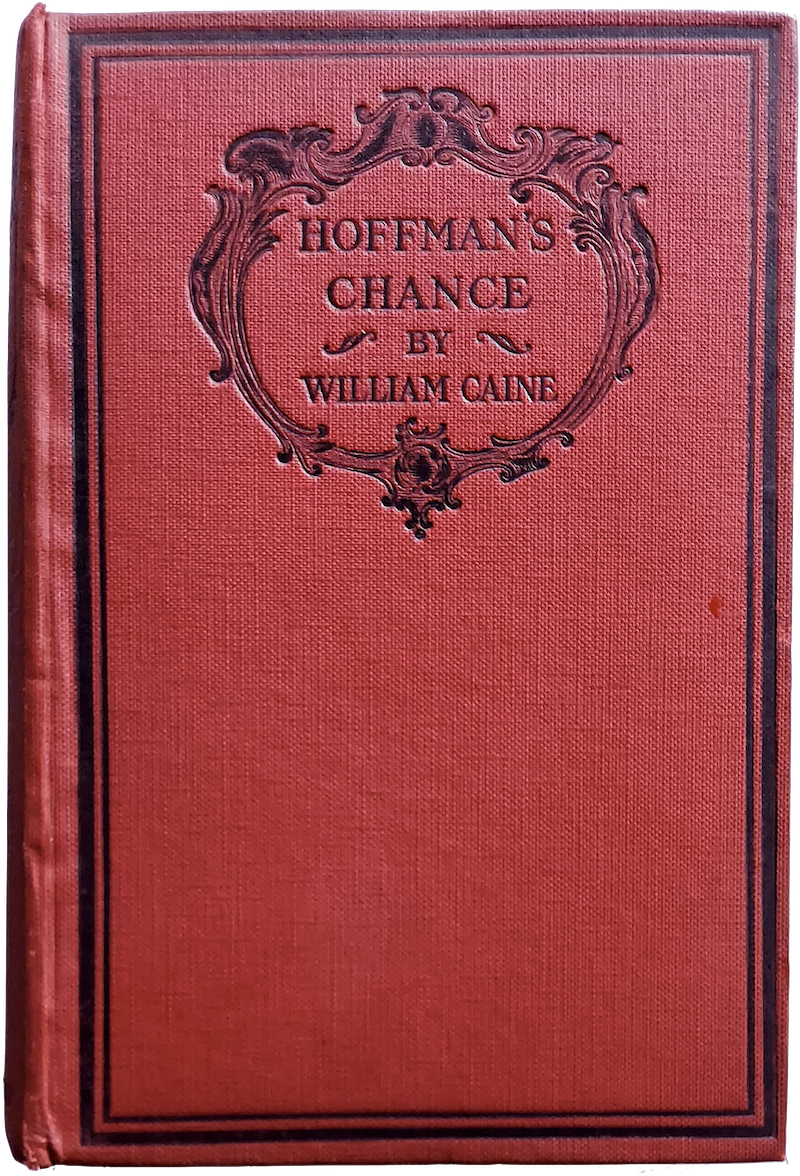
Hoffman’s Chance, by William Caine. London: John Lane The Bodley Head. New York: John Lane Company. Toronto: Bell & Cockburn. 376 pages, 8º. October 1912.
London: John Lane The Bodley Head. New York: John Lane Company. Toronto: Bell & Cockburn. 376 pages, 8º. October 1912. [ECB 1912: 48]. With unsigned frontispiece illustration.
Dedicated “To Osborne Roberts.”
The digital version available online at archive.org is a scan of an exemplar housed at the University of Toronto Library. The lettering on its cover is gold rather than black, and its flyleaf bears a holograph dedication dated “Sept 1913.”
The Times Literary Supplement, Thursday, October 17, 1912, p. 443, “Fiction; Hoffman’s Chance.”
Of the making of musical comedies there is no end, and very nearly no end, it would seem, to the number of people who find much study of them anything but a weariness of the flesh. But whether they are to be considered a high form of art or not, there is one thing about them which constantly puzzles the thoughtful men in the stalls: Why is it that it takes so many hands to produce the finished article — authors, adapters, composers, librettists, and makers of lyrics, to say nothing of the various producers, managers, acting managers, stage managers, and others whose names figure on the programme? A good deal of light is thrown on the mystery of this plurality by Mr. William Caine in Hoffman’s Chance (John Lane, 6s.). Hoffman was a young man with music in his soul, who, like others before him, set out with the idea of writing a comic opera. It was not his fault that so many cooks had a hand in the making of his broth that they turned it into a bad musical comedy, and that when it was served up hot to the British public it was booed off the stage. And so Hoffman, talking it all over with the woman whom he was to have married if the play had succeeded, just had to make another start. That is how the story ends — in the ragged failure that is so common and so true to life. In many respects Mr. Caine has written an unusual and an unusually good book. The “chance” consisted in the fact that Hoffman, with half the score of his opera ready written in his head, happened upon a young amateur, with artistic social ambitions and plenty of ready money, just clever enough to see the value of Hoffman’s music, and ready, for his own glorification, to collaborate and produce the play. And Hoffman’s music, if it had been let alone, would have pulled the libretto through. But the collaborator, in trying to gain his own selfish ends, wrecked the whole concern and ruined Hoffman’s music and his chance. It is some consolation to feel that he also lost his own money. Besides the story of the five weeks’ rehearsal of the doomed play, which is marked by a wide professional knowledge of the stage and a fine sense of the human side of life behind the scenes, Mr. Caine’s book has another claim on the gratitude of his readers. It contains barely a page of actual love-making. But the romance of his affection for the plain, tired, hard-working girl whose happiness is his first object makes them a notably lovable pair. Her life, the more passive but equally strenuous and disappointing life of the woman, and her connexion with the spoilt beauty whose cat-like disposition and selfish desire to go on the stage were one of the main causes of the play’s ruin, are described with the same vigorous but delicate touch and keen observation as the complementary part of the story, and the book as a whole is one of those that stay with one.
The Era, October 19, 1912, p. 17, “Bits about Books; A Composer’s Adventure.”
This novel pleases by the easy, natural way in which it is written, its convincing though consistently shallow characters, and the author’s thorough knowledge of his subject. It is an episode in the life of a clever musician who has written a comic opera. He has to take into partnership a capitalist, a pretentious person who can just turn out a neat lyric, and wants to pose as a librettist. How the opera is spoilt on the first night by the introduction into the cast of a “pushing” but ineficient young woman who has charmed the capitalist is told with great gusto, and with a commendable absence of the voluptuous “realism” which is the blot on so many modern stage stories. The description of the first-night failure is excellent.
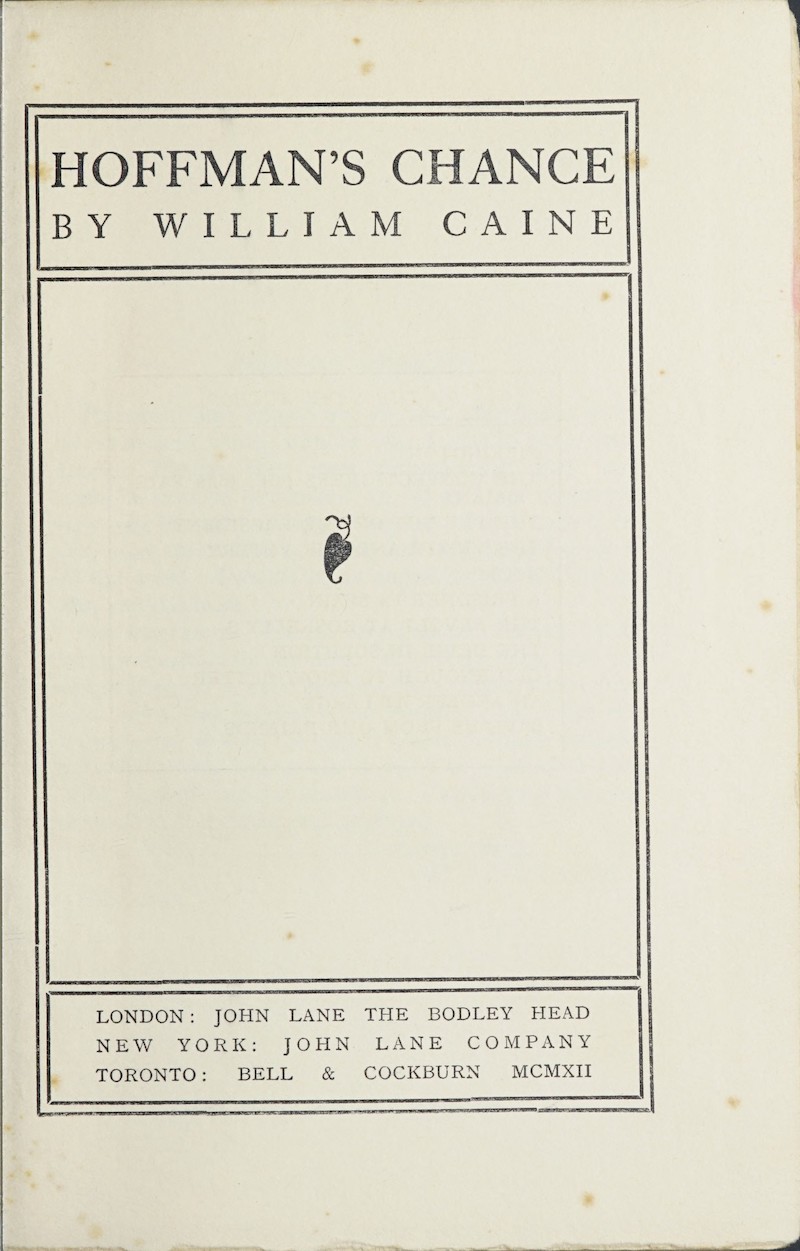
Western Daily Press (Bristol), Monday, November 4, 1912, p. 7, “Literature; Hoffman’s Chance.”
Mr William Caine has descended the airy Pegasus he rode at the time of “Save us from our Friends.” He is still intensely funny when opportunity occurs, but in his latest novel it is evident tht [sic] he has a more serious mission than in the days when he went a-match-making on the golf links near Boulogne. Mr Caine’s central idea is good. He wishes to describe the conception, working-out, rehearsing, and production of a musical comedy, or rather, in deference to Michael Hoffman, we should say, perhaps, comic opera. Hence he is able to bring together an assortment of people very appropriate to Gilbertian opera, and who, without the least taint of plagiarism, might well be first cousins to some of Mr W. T. Locke’s immortals. Hoffman is a brilliant, though impecunious author [sic]; Orde, a brainless, but moneyed author. Now Hoffman is in love with an even more impecunious Linda, employed to read fiction to a wealthy Mr Whittaker, whose daughter Psyche is even more brainless than the deficient Orde. Psyche imagines herself cursed with the “artistic temperament,” and a passion for the stage, so that when Orde and Hoffman collaborate she manages, with a good deal of hook and crook, to force her way into the company. Orde, just to show how utterly brainless he really is, develops into a species of “tame robin,” cuts his “book” about, and ruins his company, according to the capricious will of his deity. The play, as is only to be expected, is a “frost,” and the description of the première when the audience “give it the bird,” and the curtain has to be rung down in the third act, is, perhaps, the best thing in an extremely interesting piece of work. The publisher is Mr John Lane.
The Sphere, November 9, 1912, p. x, “Literature: Some New Books and New Editions.”
This is a story of a comic opera, the woes of its musical composer, and the caddishness of the wealthy lyric-writer and producer. As far as local colour is concerned it is doubtless exact in its details, and may possibly cause a sympathetic chord to respond in those who have been concerned in an unsuccessful play. But apart from such “shop” the book is very depressing. In the whole course of his very lengthy story Mr. Caine has failed to arouse in us any interest whatever in his characters. Michael Hoffman, the musical genius, and Linda Brooke, the plain, tired heroine, are strangely dull, while Psyche Whittaker, the heartless girl who ruins the comic opera, and her absurd father are too unreal to be worth considering.
The Birmingham Daily Post, Friday, November 22, 1912, p. 4, “Recent Fiction.”
Mr. Caine has chosen quite an original type of hero, and has made him the central figure of an entirely unconventional plot. Briefly, Hoffman was an obscure musician, full of ambition, full of enterprise, far too good a man to be condemned to life-long hack work — though by no means an inspired genius; and his chance came when he discovered a young man about town, with more money than sense, who fancied himself as a writer of musical comedy, but needed a composer to help him along. How the two collaborated, how both overrated their capacity, and how the author played foul — all this Mr. Caine relates with the certainty of touch and wealth of detail which suggest intimate acquaintance with the theatrical world; and the story is a good one. Indeed, it is something more than merely that. Mr. Caine has done good work before, but nothing quite of the same order as this. For the abundant cleverness in points of detail is only incidental, as it were. The whole thing is big in conception.
Porter Garnett, “Book Reviews; Novels and Short Stories,” The San Francisco Sunday Call, December 1, 1912, p. 9.
A story of artistic life with a Bohemian atmosphere. The hero is a musician and playwright, whose difficulties in the pursuit of his ambition are related in an interesting narrative of the London art world.
Musical Courier, vol. 71, no. 3, Wednesday, July 21, 1915, p. 24, “How to Write an Opera.”
Somewhere between Maine and California there must be hidden, even at this very moment, some young man who burns with ambition to write a musical comedy. We can give no potent reasons for holding this belief, nor can we pile up great arguments to convince our readers that such a man exists. Perhaps it is only the intuition of genius that prompts us to plunge so recklessly into a sea of uncertainty. Nevertheless we feel that there is a youth who longs to step into the shoes of Sullivan or wear the mantle of Offenbach. We beg of him to read a book called “Hoffman’s Chance.” It is a novel by an Englishman named William Caine, who has had a good deal of experience as a stage writer and an opera book maker. He knows what he is writing about, and in this musical novel of his he has described vividly and with the most perfect accuracy all the details of constructing a plot, making verses, composing music, orchestrating, rehearsing, managerial troubles and vexations, interruptions and distractions by lady friends, performance, failure and debts.The book is absolutely true to stage life and is an unexaggerated picture of the beginning, middle and end of ninety-nine per cent. of musical comedies. Of course there is a love story and plenty of humor in the book apart from the music. But these things are the stock in trade of the novelist and need not detain us now.
It is the musical part of the book that claims our attention and our respect, for the author, unlike most novelists, does not misuse musical terms. He does not make his young woman play Palestrina masses on mandolins, or his heroes sigh out their souls in Chopin romances with murmuring arpeggios on the tuba.
This is how William Caine describes the progress of the first act of the opera which Hofmann thought was to be his chance for fame and fortune:
But the house was not pleased. Things had taken a wrong turn. , , , The excellent impression which the overture and the stage picture had produced had vanished, and its place had been taken by a conviction that the piece was going to be just one other wild-cat musical comedy gamble, one of those unsubstantial ventures, two or three of which every year offer themselves as victim’s of London’s contemptuous neglect. It seemed to be the same old story. A syndicate with a few thousands and a cheap play and a lot of hope; a cast, got together anyhow, to unknown cheap people, and one good but out-of-date comedian; a theatre that had never had a run; and a pretty fool, with somebody to put in some money for her and insist that she shall get a show. The house was tired of this sort of thing: it had had too much of it. It was time something was done to show these people that the public wasn’t taking any more of it.
Need we quote more? Is not this dismal picture true to life? Those of us who have eaten of the dry bread of criticism and drunk the salt water of musical journalism for many years know that the book is true.
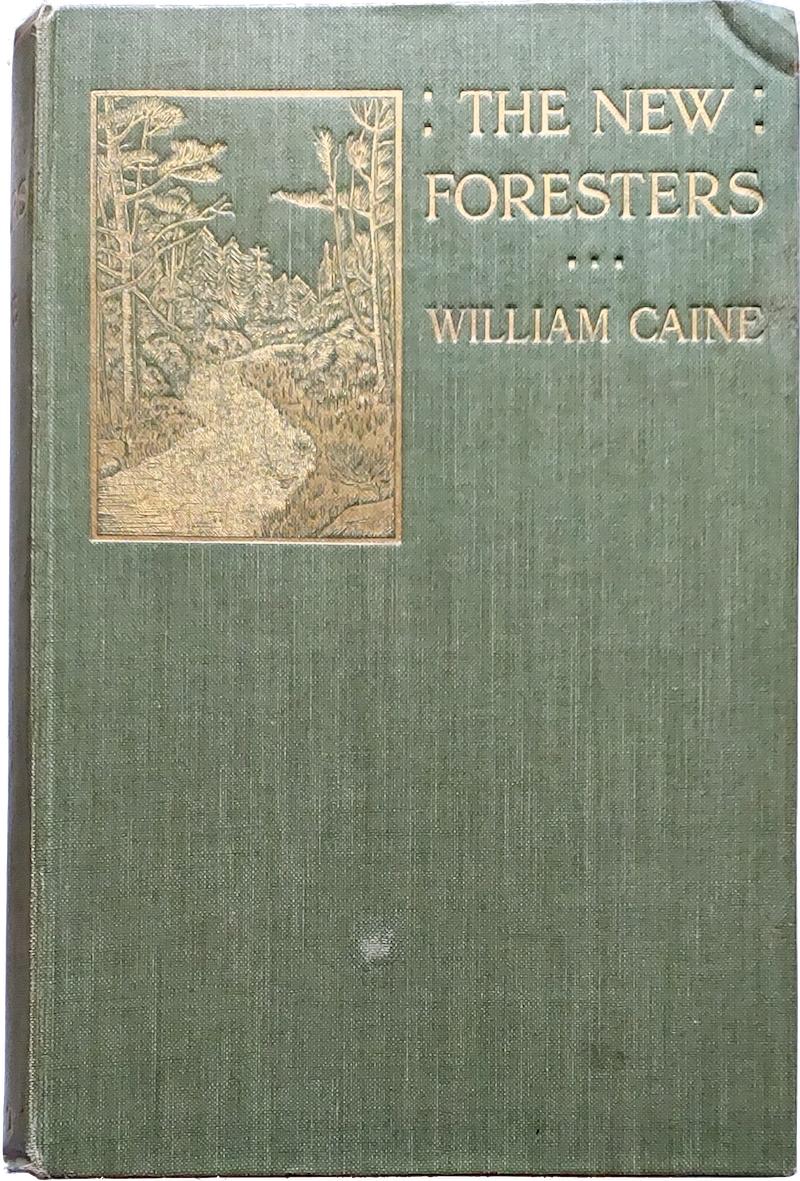
The New Foresters, by William Caine. With coloured frontispiece by Dudley Tennant and map. London: James Nisbet & Co. 248 pages, 8º. June 1913.
With coloured frontispiece by Dudley Tennant and map. London: James Nisbet & Co. 248 pages, 8º. June 1913. [ECB 1913: 50].
Reprinted November 1913.
Added to Internet Archive on May 3, 2026.
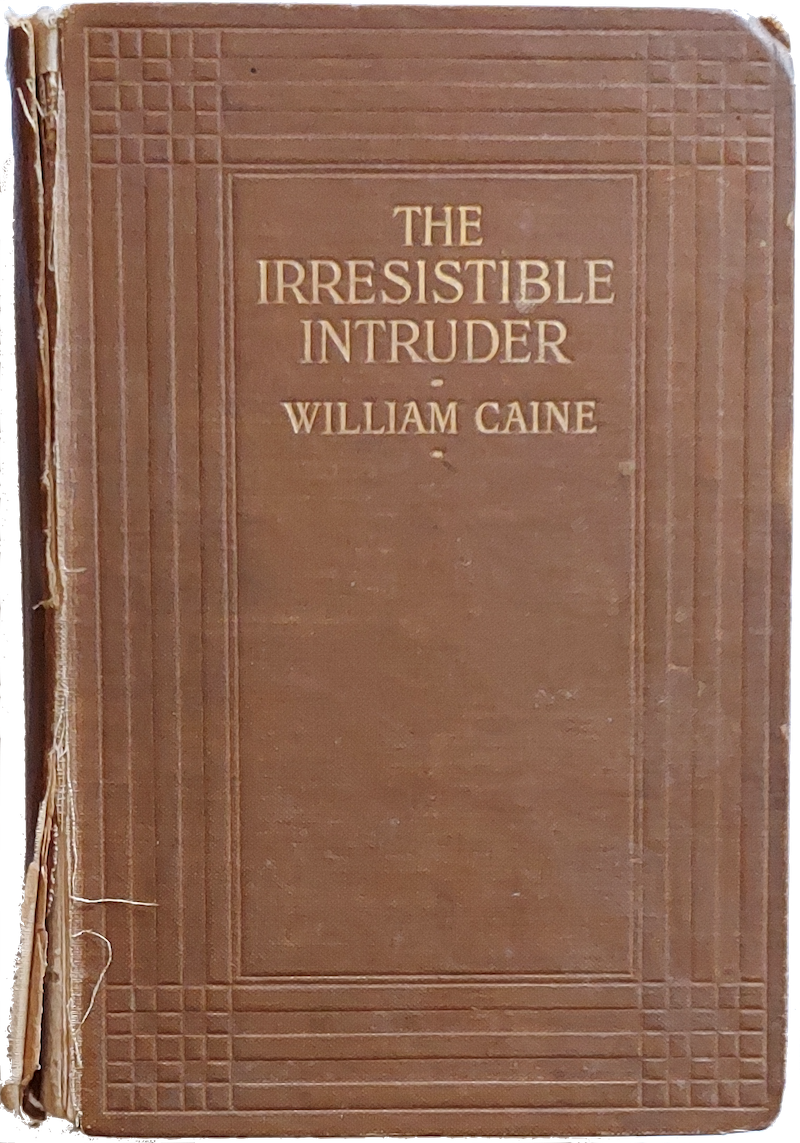
The Irresistible Intruder, by William Caine. London: John Lane The Bodley Head. New York: John Lane Company. Toronto: Bell & Cockburn. 376 pages, 8º. October 1913.
London: John Lane The Bodley Head. New York: John Lane Company. Toronto: Bell & Cockburn. 376 pages, 8º. October 1913. [Despite title page showing “MCMXIV”. ECB 1913: 50].
The Times Literary Supplement, Thursday, October 30, 1913, p. 480, “Novels of the Week; ‘The Irresistible Intruder.’”
Mr. William Fennell, the literary gentleman, ætat. forty-five, who describes in The Irresistible Intruder, by William Caine (Lane, 6s.), the three or four decisive months of his even and blameless life, dips his pen into a writing fluid which is clearly most congenial to him. It is not ordinary ink; still less is it blood or tears; it is small beer. Yet, with this comparatively mild medium of expression he is able to treat adequately of no trivial theme. For what he relates is nothing else but the workings of the grand passion itself, which came upon him, it is true, unawares, though for ourselves we can see it coming, and made him supremely happy, and then, owing to an extraordinary vagary on the lady’s part, extremely unhappy, and, finally, it is to be supposed, definitely happy again for good. Mr. Fennell has told his story in a very leisurely way; for he had no idea of what was in store for him, from the time when Cecilia announced that the boy Publius was coming to spend his holidays with her and her precise old brother; and such was the pottering mood, which had become a second nature to him, that even when writing of those eventful weeks afterwards it was the trivial things, such as the lighting of a cigarette, the buying of toffee for the boy, the swimming and fishing expeditions with the same youth, and all the small incidents which make up the average summer day in the country, quite as much as Cecilia’s engagement to Brander Pepys — which he never foresaw, though we guessed it when Brander was so bored that day when Cecilia failed to come to lunch — and the actual progress of his own love affair with little Mrs. Swift, that he chose to remember and record. No doubt it was partly the result of the middle-age temperament and thorough enjoyment of a particular mode of life. But there are not many men, after passing through such an ordeal, who would have written the last chapter with so much restraint. The excitement of Mrs. Swift’s jump out of the moving train into the autobiographer’s arms would have disturbed the style of almost anybody else. But Mr. Caine, or Mr. Fennell, is true to his medium to the last, and refuses, in just conformity with his character, even in the most triumphant moment, to be deflected from it.
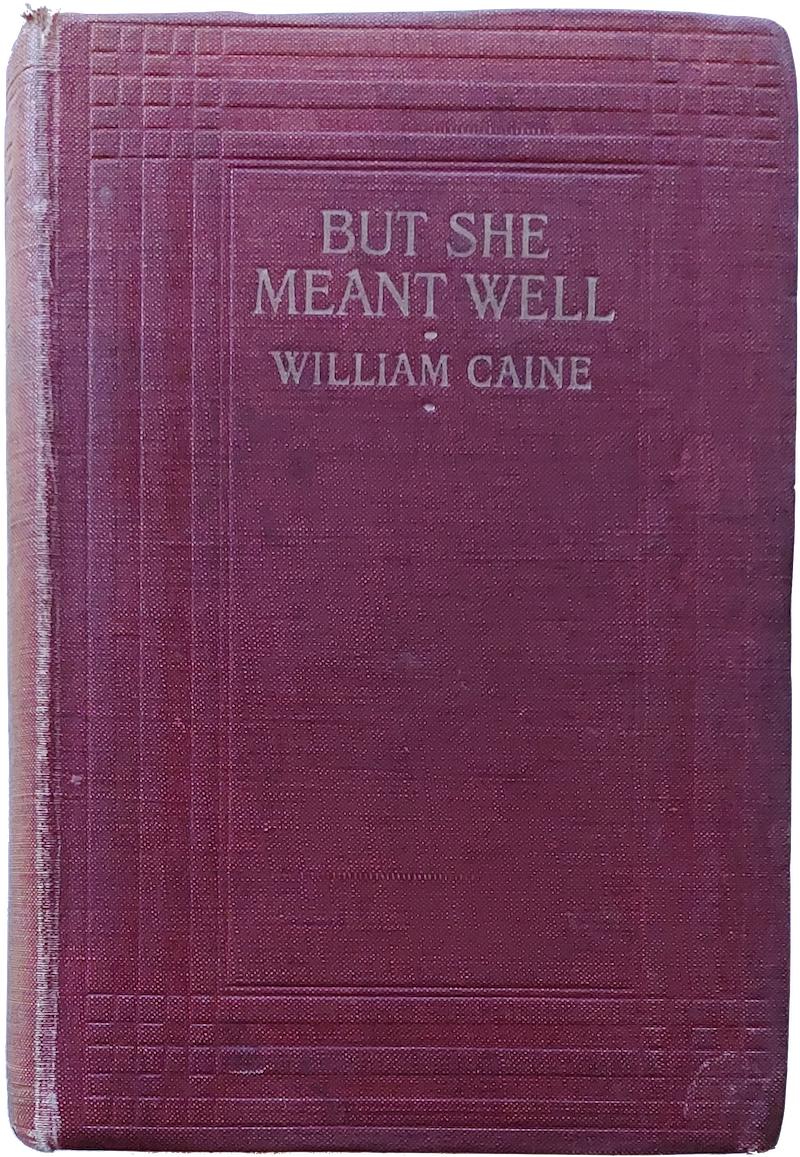
But She Meant Well, by William Caine. London: John Lane, The Bodley Head. New York: John Lane Company. Toronto: Bell & Cockburn. 8º, 300 pages, 10 pages publisher’s ads in back. October 16, 1914.
London: John Lane, The Bodley Head. New York: John Lane Company. Toronto: Bell & Cockburn. 8º, 300 pages, 10 pages publisher’s ads in back. US copyright October 16, 1914. Two copies in Library of Congress, October 20, 1914. [LOC 1914: 11, 118, 1000]. UK November 3, 1914. [ECB 1914: 48].
The Sun (New York), Saturday, October 17, 1914, sect. 2, p. 6, “Brief Glances at Some Outstanding Titles; Humor, Wit, Fantasy.”
Hannah, aged 5, indulges in deeds which were always inspired by kindly motives, but the results are most disastrous. She goes to a country house with her mother, speedily turns the neighborhood upside down, but succeeds in bringing about a marriage between two of the characters.
The New York Times Book Review, Sunday, October 18, 1914, p. 456, “News of Books; Forthcoming Volumes in Many Departments of Literature.”
Two novels ready for publication by the John Lane Company are “But She Meant Well,” by William Caine, the story of a girl who gets everybody into trouble by her efforts to be of some use, and “The Valley of a Thousand Hills,” by F. E. Mills Young, another of this author’s stories of South Africa.
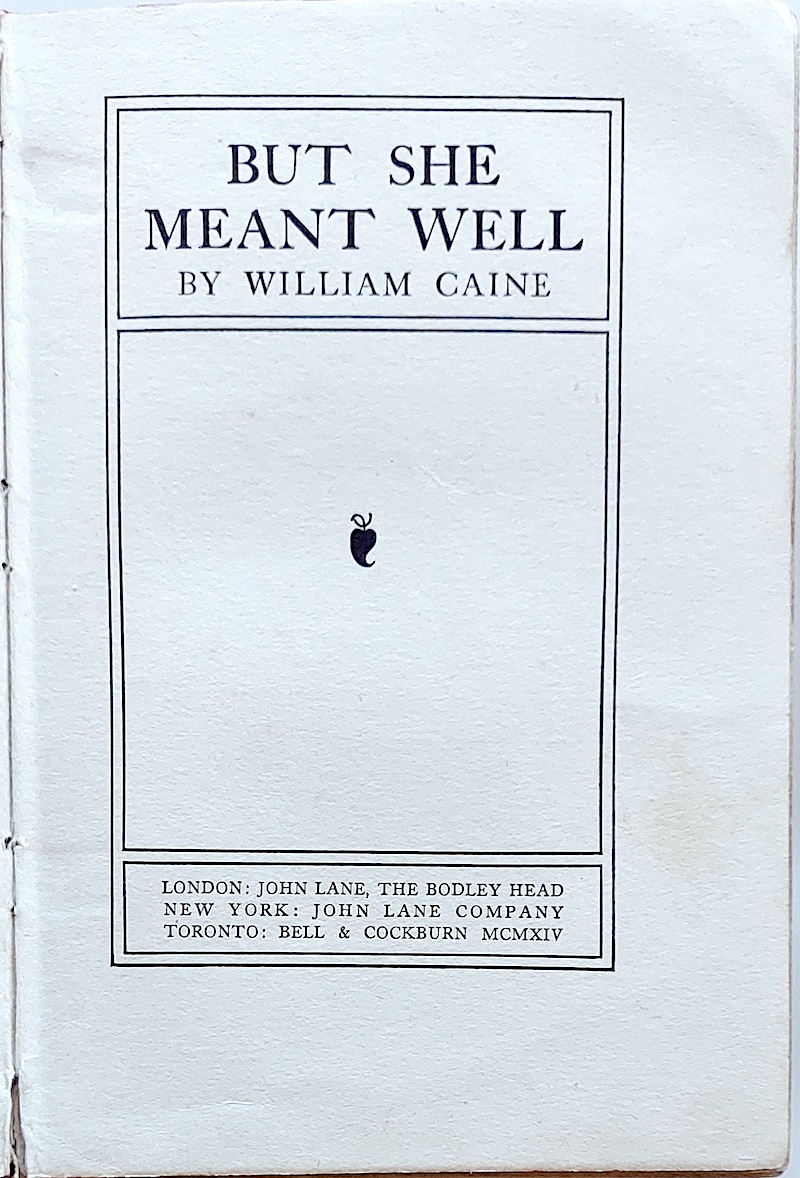
The Argonaut (San Francisco), October 24, 1914, p. 264, “The Latest Books; Gossip of Books and Authors.”
Two new novels just published by the John Lane Company are “But She Meant Well” and “The Valley of a Thousand Hills.” The first is by William Caine, author of “The Irresistible Intruder.” Hannah, who “means well,” causes fires and fights, is lost, poisoned, and turns a two weeks’ visit into a six weeks’ siege by whooping cough in her anxiety to be a “little help.” However, she promotes a happy marriage.
The Buffalo Commercial, Saturday Evening, October 24, 1914, p. 9, “Books and Magazines.”
But She Meant Well is a new book by William Caine. It is the story of a few weeks in the life of a meddlesome child of five, which means much when the capabilities of such a child for mischief are considered. Hannah accompanies her mother to a country house and the escapades of the always busy youngster plunge the household and the entire neighborhood into confusion. Mr. Caine has the happy faculty of delineating child character in a manner to please the reader and he has never displayed this trait more clearly than in his account of the doings of Hannah. She is a live child, immensely so, and her friends and victims are also delightful company. Published by the John Lane Company.
The Sun (New York), Saturday, October 24, 1914, p. 10, “Books of the Week Seen in Review and Comment; Some New Fiction.”
The successive efforts of a little five-year-old girl to help others are related by William Caine in “But She Meant Well” (John Lane Company). Each ends disastrously, with far reaching consequences in some cases, but nevertheless each manages in the most unexpected manner to advance the love affair between a young man and a young woman. The child’s performances are extremely funny and provoking; after a while even a child psychologist will feel that spanking, however unjust and illogical, is the only practical cure; but they are related in the cold blooded, rather inhuman way that marks some forms of British humor about children. They leave the impression that the author is tired of the fashion of dragging children into fiction. The grownup comments also have a kind of snarl in them, so that what on the surface is an idyllic simple tale seems somehow to be pretty ill natured. It is a clever piece of work all the same.
The Publishers’ Weekly, October 24, 1914, p. 1339, “Weekly Record of New Publications.”
A few weeks in the life of Hannah, a mischievous child of five, whose little knowledge was a dangerous thing. Some relatives lent her parents their country house. In a few days’ time Hannah had plunged the neighborhood into confusion and interfered with a romance. When the visit was nearly over, all the grown-up people were looking forward to returning to London, but Hannah interfered with that also. She developed whooping-cough. This put them all in quarantine, which Hannah alone enjoyed.
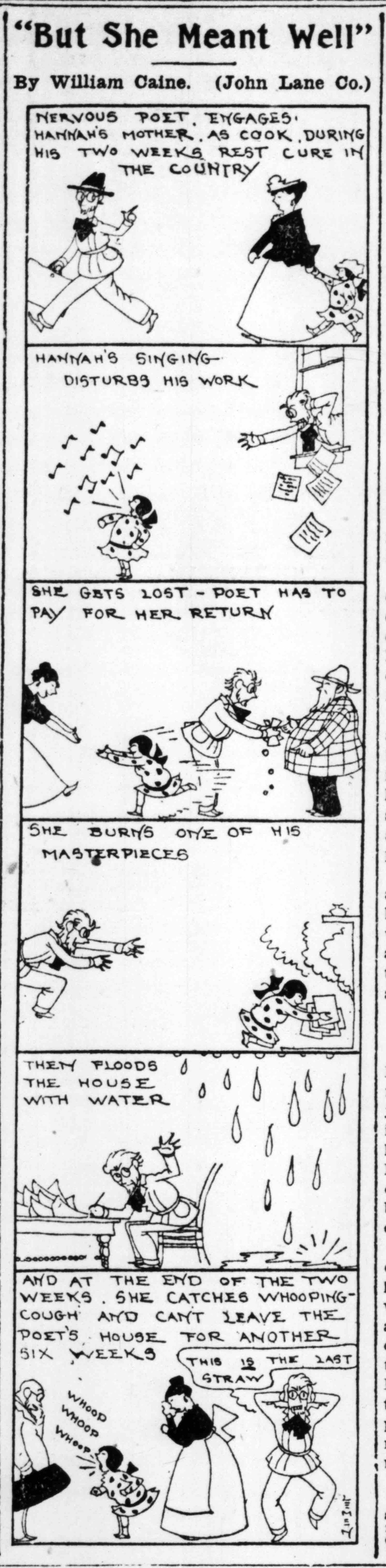
Reproduced from St. Louis Post-Dispatch, Saturday Evening, October 31, 1914, p. 5, “Reviews of New Books.”
St. Louis Post-Dispatch, Saturday Evening, October 31, 1914, p. 5, “Reviews of New Books.”
[Review in the form of a comic strip; see image, left.] [Cell 1: Nervous poet engages Hannah’s mother as cook during his two weeks rest cure in the country]. [Cell 2: Hannah’s singing disturbs his work]. [Cell 3: She gets lost — poet has to pay for her return]. [Cell 4: She burns one of his masterpieces]. [Cell 5: Then floods the house with water]. [Cell 6: And at the end of the two weeks, she catches whooping-cough and can’t leave the poet’s house for another six weeks [Word balloon: This is the last straw]].
The Sunday Oregonian (Portland), November 1, 1914, sect. 5, p. 9, “Books; New Books Received.”
But She Meant Well, by William Caine, $1.30, a likeable, sunny English novel about a little girl, Hannah, 5 years old, a child of remarkable originality (John Lane Co., N. Y.).
The Boston Sunday Globe, November 8, 1914, p. 64, “Pranks of a Live Child; Juvenile Mind Appreciated in ‘But She Meant Well.’”
However well intentioned he or she may be, a meddlesome child of 5 years can do a great deal of mischief and create some rather odd and trying situations. This is well shown in “But She Meant Well,” by William Caine. The story deals with the episodes of a little girl taken to the country on a visit. The author understands child life and has made Hannah intensely alive. The dismay of the household at some of her pranks, and indeed the confusion of the neighborhood, is cleverly pictured. New York: John Lane Company.
The Detroit Free Press, Sunday, November 8, 1914, pt. 5, p. 4, “Views and Reviews of New Books; New Fiction; ‘But She Meant Well’ — By William Caine.”
A few weeks in the life of a five-year-old girl of inquiring mind are the basis of some amusing if rather prolix experiences, covering 300 pages. Hannah is a very genius in thinking up naughty things to do which are always to be credited to the best intentions. (New York: John Lane Co.)
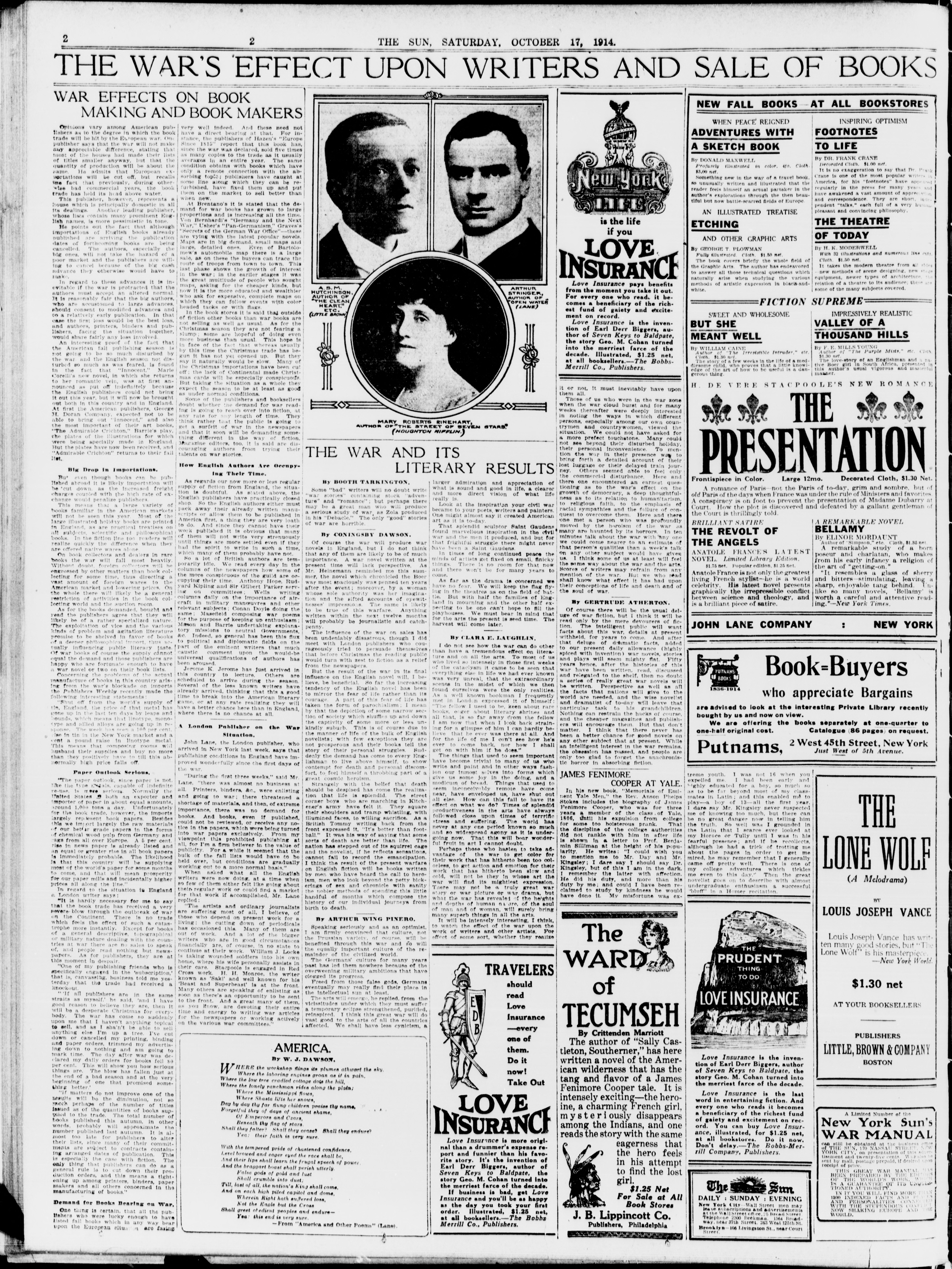
“New Fall Books — At All Bookstores. Fiction Supreme. Sweet and Wholesome. But She Meant Well. By William Caine. Author of The Irresistible Intruder. Cloth. $1.30 net. The story of a few weeks in the life of a meddlesome child, who proves that a little knowledge of the art of how to be useful is a dangerous thing.”
The New York Times Book Review, Sunday, November 8, 1914, p. 486, “Fiction for November; But She Meant Well.”
To be the heroine of a novel is a hard task for a five-year-old child. Generally she tries to live up to her position by wearing habitually a white muslin frock with a large pink sash, golden curls, and the cardinal virtues. If she is so fortunate as to be possessed of warring parents, she reconciles them; if not, she seeks out a young man and a young woman and embarrasses them into matrimony.Hannah, however, is not a white muslin child. She is a good-natured child, obedient and intelligent enough for her age, but she wears no halo. And she is an entertaining child — to read about.
But Mr. Caine, her enthusiastic biographer, does not fill the reader with a yearning to adopt this vivacious infant. To see her for a few minutes, rolling her hoop through the Sternes’ garden, or assisting Daniel to mend the pump, that is all very well. But there is a certain satisfaction in knowing that Hannah is safely shut between the covers of a book.
Not that she is a bad child. Her mother, who spent several eventful weeks as cook at the Sternes’ country house, would be the first to deny that, and surely she ought to know. Nor could Mr. Reginald Sterne, the sensitive poet, question the excellence of Hannah’s motives, although she set fire to the chimney, let the cows into the lawn, and burned up the precious manuscript of “Walpole, a Fragment.”
Nor could Miss Beatrice question the goodness, the nobility of Hannah’s intentions. And yet the least that she suffered from the small hands of that industrious child was the thorough blacking and polishing of her new white-kid shoes.
No. Hannah was not intentionally mischievous. She was eager to be helpful, and it so happened that all her attempts at kindness resulted disastrously for the intended beneficiaries. William Caine tells the story with characteristic sympathy and humor. He gives an air of reality to the little family group whose lives are for the time being governed by the whims of their cook’s child, and he introduces with delicate skill a charming romance.
But the real plot of “But She Meant Well” does not depend upon Hubert’s courtship of Beatrice. It depends upon that not unattractive and absolutely human child Hannah, her joys and sorrows, and especially her good impulses and their generally direful results. There is just a suggestion of speculative philosophy about this book — just a suggestion, for it raises in the reader’s mind certain questions as to whether or not, with grown people as with children, it is safe always to judge motives by results. But those who dislike such problems need have no fear. “But She Meant Well” is first and last an entertainment. It is one of the most thoroughly amusing books to be given the public since “Hoffman’s Chance” appeared. Mr. Caine meant well by his readers, and unlike those of his heroine his intentions have been delightfully accomplished.
The Times Literary Supplement, Thursday, November 12, 1914, p. 505, “New Books and Reprints; Fiction.”
Hannah, the five-year-old daughter of a policeman, went into the country with her mother, who was to be a cook for a fortnight to Mr. Sterne (the poet), Mrs. Sterne, and Miss Beatrice. Hannah consistently does good according to her lights, and evil consistently ensues. Her efforts to be a help result in (amongst other catastrophes) the flooding of the house, the burning of the poet’s poem, the destruction of the lawn by cows, and a steady current of minor discomforts. We leave her triumphantly wrecking the plans of everyone by catching whooping-cough. We hope (as, no doubt, Mr. Sterne does) that Hannah dies of it. An adult Hannah would paralyse all moral judgment. We feel sure, however, that Hannah (meaning well) will recover — with inevitably deplorable consequences, to which, however, we shall reconcile ourselves if Mr. Caine continues to record them.
The Globe, Saturday, November 14, 1914, p. 8, “For the Library List; A Survey of Recent Fiction.”
Hannah is a little girl who, early in life, discovers that the way to a very disagreeable place is paved with good intentions. She always means well, but somehow or another things will go wrong. Quite a delightful book.
The Kansas City Star, Saturday, November 14, 1914, p. 5, “Book News; A ‘Peck’s Bad Boy’ in Petticoats.”
To one who does not love children, William Caine’s novel, which he calls “But She Meant Well,” will be agonizing. It can never be finished by any one except a person to whom it is given to understand the fantastic dreams and motives of childhood.Whenever a grownup would say to Hannah, “Now, run away and be a good little girl,” it was time fot eh household and all the neighbors to prepare for eventualities. And when Hannah said, “Ain’t I helpful?” the next thing to do was to look for something wrong. Perhaps the cows were in the flower beds, or if that had not occurred, she had daubed Miss Beatrice’s white shoes with blacking or cast a decaying fish down the ventilator to feed the poor rats.
Nor was this little miss, in her few weeks’ stay at a country house, distinctly helpful to the love affair of the two delightful young folk of the book.
“But She Meant Well,” by William Caine; John Lane Co., $1.30.
The Illustrated Buffalo Express, Sunday, November 15, 1914, p. 28, “War Books and Others; But She Meant Well.”
Hannah, aged five, indulges in deeds which were always inspired by kindly motives, but the results are most disastrous. She goes to a country house with her mother, speedily turns the neighborhood upside down, but succeeds in bringing about a marriage between two of the characters.

“Ready Next Tuesday, A New Novel Entitled But She Meant Well. By William Caine, Author of ‘The Irresistible Intruder,’ &c. 6/-. Another of Mr. William Caine’s studies of childhood — real, natural, mischievous childhood. This time his subject is a little girl, whose well-intentioned escapades during a visit to the country threw the whole neighbourhood into absolute chaos. It is the funniest story Mr. William Caine has ever written. John Lane, The Bodley Head, W.”
Pendennis, “Books of the Day; New Novel; The Efforts of Hannah,” Pall Mall Gazette, November 16, 1914, p. 6.
Mr. Caine is a delightful humorist, and he gathers the honey of his laughter from what seems the most unpromising material. But that is only his cunning, for his material is, of course, most ingeniously selected. When Hannah, aged five, gave her hand, which had previously been in her mouth, to Mr. Sterne, he talked to her quite as nicely as he was able, and we have quite forgotten all about that handshake till we are told that Mr. Sterne, as he walked away, rubbed the palm of his right hand against the right side of his ulster. If we laugh at that, how much more easily shall we be made to laugh when we read of the many disasters which were due to Hannah’s eager desire to be good and to be a help to others! She was really a very good little girl; that is, she always meant well, but the results were so different from what she intended. As a humorous casuist Mr. Caine need fear no rival. And Hannah belongs to the company of the very few good little girls who will always be able to make us laugh.
The Scotsman, Monday, November 16, 1914, p. 2, “New Fiction.”
Hannah Neighbour is the daughter of an East End policeman and of a cook, and when we part company with her, with mingled feelings of regret and relief, at the close of Mr. Caine’s book, she is barely five years old. But throughout the scenes in which she takes part at the country house where her mother presides, during a brief holiday, over the kitchen arrangements of the Sterne family, Hannah takes and keeps the centre of the stage. The comfort and happiness, and even the moral principles and views of life, of the whole household turn on the doings of this small child, concerning whom all that can be safely predicated is that when she is out of sight she is deep in mischief. Yet Hannah, as we are constantly being called upon to notice, is a good girl; her way is paced with the best intentions, and her worst blunders arise form her uncontrollable desire to be helpful and to give pleasure. No one who as any sympathetic, first-hand acquaintance with little girls can fail to be both amused and charmed by the book of Hannah’s delinquencies.
The Athenæum, no. 4543, November 21, 1914, p. 532, “Fiction; Fantasy and Fun.”
This is a trifle light as gossamer — a series of escapades of a small child who, always with good intentions, performs a number of disastrous and annoying acts. The book contains neither plot nor characterization, and might, indeed, have been written for a child’s “Library.” The situations are amusing, but somewhat improbable and farcical. Provided the reader knows what he is about to receive, and desires that particular food, the book will afford entertainment.
The Graphic (Los Angeles), November 21, 1914, p. 15, “Books; ‘But She Meant Well.’”
Many times has the enfant terrible been put into books, yet in “But She Meant Well,” by William Caine, she comes clothed in garments of a wholly new cut. It is no spirit of mischief or meanness that impels little Hannah, but a sweet desire to be good and helpful. The most vicious intentions could not work greater havoc on one unfortunate household. Her mother is the esteemed cook for a family which has gone to the country for the lord and master’s health, and little Hannah’s well-meant assistance, has everyone by the ears from the first moment. The anticipated restful visit becomes a purgatory beset with new and increasingly awful visitations every day. But Hannah does help along the love affair which meanders through the book and so redeems herself. The story is full of humor ranging from the most delicate, to plain “Peck’s Bad Boyism.”
Robert Mountsier, “Judge’s Between Covers; Passing Sentences,” Judge (New York), vol. LXVII, no. 1727, November 21, 1914, [p. 10].
“But She Meant Well,” by William Caine. Helpful little Hannah literally raises Caine with her good intentions. Not only does she make those about her miserable — and you happy — but she raises to an even higher place in my estimation her creator, an English author whose other books deserve to be better known in this country.
Dayton Daily News, Sunday, November 22, 1914, [p. 36], “Books.”
“But She Meant Well,” by William Caine, author of “The Irresistible Intruder,” is the story of a few weeks in the life of a meddlesome child of 5 — the age when a little knowledge of the art of how to be useful is a dangerous thing. Hannah accompanies her mother to a country house, and the well-intentioned escapades of the child soon plunge the household, and indeed the entire neighborhood, into confusion. There is sheer delight in the description of the episodes, and Mr. Caine has never displayed his gift for portraying children to better effect that in the passages which show a fresh plot hatching in the mind of Hannah. She is immensely alive, and her friends and victims are also delightful company.
The Reading Standard, Saturday, November 28, 1914, p. 2, “Literary Notices.”
Mr. William Caine is at his happiest in this study of two weeks in the life of a mischievous child of five whose well-intentioned escapades plunge a household, and indeed a whole neighbourhood, into confusion. The author has never appeared to greater advantage as a humorist.
The Saturday Review, 28 November 1914, “Reviews; Novels,” pp. 563–564.
The enfant terrible has appeared so often in fiction that it requires no little ingenuity to render the subject acceptable. Mr. William Caine, however, is fully equal to it. His Hannah, the five-year-old daughter of a policeman, is a delectable person — to read about. Not to live with, we should add, for Hannah was up to every kind of bedevilment it is possible to imagine, and we doubt whether even the most ingenious child could ever have exhibited such perfect genius for doing the maddening thing. From the moment when she placed her well-sucked hand in the palm of that fastidious writer of poetry, Mr. Steine [sic!], we knew she meant mischief. He was able surreptitiously to wipe away on his ulster the traces of her wet fingers, but the effects of her later escapades could not so easily be removed. But, unlike other children, Hannah did not indulge in mischief for mischief’s sake. She was exasperatingly good, and she always perpetrated her worst feats with a desire to be a “helpful little thing.” She meant well. Amongst other results of her efforts were the flooding of the house, the destruction of the lawn by cows, the burning of the poet’s great poems, and a host of minor achievements.Mr. Caine’s fresh and buoyant humour will compel laughter even from the most case-hardened. He has a cheerful wit of his own, and out of the slenderest materials has made a capital book.
Gerald Gould, “New Novels,” The New Statesman, December 5, 1914, p. 226.
Mr. Caine’s story is not dissimilar in type from Helen’s Babies. Hannah is a natural and charming child, always in mischief and generally “meaning well.” The incidents are simple and obvious, but, they too, natural and charming; the book is one to raise smiles rather than laughter — pleasantly readable, and not aiming at being more than that. A natural child is necessarily and always pleasant to read about.
The Courier-Journal, December 7, 1914, p. 6, “Books and Their Writers; But She Meant Well.”
Hannah, the youthful heroine of William Caine’s story of the above title, is a dear, sweet, affectionate child. She is moved by the missionary spirit. She wants to set everything right. She tries to do all the things that the “grown-ups” have overlooked or, according to her ideas, neglected — with the result that the twice almost destroys the house, once by fire and once by flood; lets the cattle in to devastate a century-old lawn — a catastrophe more than heartbreaking to the true Briton — and causes incalculable mischief in every department of her own and every other household she invades. Peace and meditation flee before her, havoc and misfortune accompany her, and all her well-meant endeavors end in disaster — to other people. She has a defender in Beatrice, to whom she brings an awakening experience, and in whom she arouses deep speculations of ultimate right and wrong. As this young lady says: “I think her chief aim in life is to be kind. But she appears to be the instrument of some perverse and sinister force which delights to turn her good impulses to its own advantage. Were it not for this she would be a blessing. As it happens, she is a common curse.” Poor little Hannah is a type one meets every day — the type that cannot temper zeal with discretion, and, in its short-sighted way goes about the world carrying misery in its train. Have we not all met them? These kind-hearted, injudicious people, who are constantly trying to make us happy according to their own ideals, without considering our point of view at all. Mr. Caine tells the story with a dry humor that is irresistible, and makes the philosophical aspect of the case most interesting. It is a study and a lesson well worth reading.
The Independent (New York), December 7, 1914, p. 383, “The New Books; But She Meant Well.”
The author of The Irresistible Intruder, William Caine, is a past master in the art of depicting mischievous children. His latest heroine is five and alarmingly well-intentioned. “Hanna [sic] loved to be helpful” and her eager helpfulness makes trouble for a whole community, including a pair of lovers.
Punch, or The London Charivari, Vol. 147, December 9, 1914, p. 488, “Our Booking-Office.”
Mr. William Caine has a very nice and persistent sense of humour, and his last book, But She Meant Well (Lane), shows him in his most natural and therefore best vein. His lady of the good intentions was one Hannah Neighbour, an incorrigible infant whose eminently virtuous resolves produced the most vicious results without the adventitious aid of any extraordinary circumstances. There is generally about people who mean well something pathetic and something else which is worse, and these characteristics are apt to become so exaggerated in fiction as to be almost offensive. Mr. Caine’s young person is not of that sort; she is no prig, and her fault is not weakness but irrepressible activity. To whatever extent she annoyed me, I was always possessed with the morbid desire to see some even worse result attending her efforts; and all the while I had to give her credit for infecting the other characters of the story with a remarkable vitality. I congratulate the author upon his presentation of the problem, how can you deal with such a misguided child so that you may at the same time check dangerous proclivities and yet do justice to her excellent motives? Still more was I pleased with his frank, if abominable, admission that in order properly to inculcate discipline it is necessary for the most part to ignore motives and let justice be blowed.
The Academy, December 12, 1914, p. 512, “Reviews; Shorter Notices; Fiction.”
In “But She Meant Well” (John Lane, 6s.) Mr. William Caine introduces us to a delightful little miss of five, who is continually getting into mischief through the best intentions. The offspring of a cook-general and a member of the force, she is born with a quite natural craving to help others, and it is no fault of hers that her precocious efforts in this direction end disastrously, and often entail spanking. At last, whooping-cough puts a term to her juvenile activities, but these are so amusingly placed before us that we sincerely wish her a speedy recovery. “But She Meant Well” is decidedly not a book for children. It is for grown-ups only, and should be kept carefully under lock and key, for youngsters are notoriously imitative, and they might seek to emulate Hannah and bring topsy-turvydom into the happy home.
Country Life (London), December 12, 1914, p. 792, “Literature.”
The heroine of this tale is called Hannah, and she is just five years of age, but her potentialities in the way of making herself felt are lightly rated when compared with those of five-times-five. Hannah is a terror; Mr. Caine seems to have seen her as a terror of extra large size. It seems a pity that this should have been so, for it somewhat takes the edge off our amusement at the many fiascos that dogged the train of this well-meaning little girl. It strikes us Mr. Caine does not love his Hannah overmuch; and, really, though she does at times seem to have been possessed, when all is said and done there is always the extenuating circumstance the title points out to us — she meant well. The book is full of humour, the slightly acid humour with which a pedant of not too philosophic temper might regard a tiresome, but well-intentioned, little girl whose adventurous spirit had cost him dear in the matter of peace and comfort; and Hannah is certainly not a heroine to be overlooked.
The Graphic, December 12, 1914, p. 822, “Books That Take You Away From the Horrors of War.”
[A good antidote for war oppression, because it is written in Mr. Caine’s merry manner.]
The Nation (London), December 12, 1914, p. 346, “Reviews; Four Nondescripts.”
We confess to a large partiality for Mr. Caine — he so thoroughly enjoys himself when he writes. Not for him is the authorship which fixes one eye painfully on the press and the newsagent orders, and the other imploringly on fame. “But She Meant Well” is of the adventures of Hannah (aged five) — beneficent and well-intentioned Hannah, who is so anxious to perform “little, nameless, unremembered acts of kindness and of love” to the adults around her who are in any way afflicted with a troublesome circumstance; abominable Hannah, the instrument of the malevolent Furies, whose paralysing deeds bring such dire consequences upon the household, and are such an ironical reflection upon the intentions that fattened them. The book is frankly extravagant — outrageously extravagant; and its episodes are diabolically twisted to the author’s Machiavellian purpose. But the point is that Mr. Caine does exactly what he wants to do. He and Mr. Milne [author of Once a Week, one of the other “four nondescripts” reviewed in the article] employ practically the same method. But Mr. Milne swims about in the enclosed tank of his invention with a lifebelt on; Mr. Caine, on the other hand, chooses more open waters, and frisks in them with the agility of an eel. He is extravagant, if you like; but how exquisitely ingenious! He is perhaps artificial; but what a brisk, refreshing, bubbling style to buoy his midsummer madness! At any rate, we prefer Mr. Caine’s excursus of consummate fancy to many of the solemn, surpliced, psychological pilgrimages on which some of our more ambitious but worse equipped pundits so often travel.
The Age-Herald (Birmingham, Ala.), Sunday, December 13, 1914, p. 23, “The Book Shelf, by The Bibliophile; ‘But She Meant Well.’”
The story of a few weeks in the life of a meddlesome child of five, the age when a little knowledge of the art of how to be useful is a dangerous thing, is the theme of William Caine’s book, “But She Meant Well.” Hannah accompanies her mother to a country house, and the well intentioned escapades of the child soon plunge the household and indeed the entire neighborhood into confusion. There is sheer delight in the description of these episodes, and Mr. Caine has never displayed his great gift for drawing children to better effect than in the passages which show a fresh plot hatching in the mind of Hannah. She is indeed immensely alive, and her friends and victims are also delightful company.
Richard King, “With Silent Friends; The Story of a Child,” The Tatler, no. 704, December 23, 1914, p. 272.
One cannot help feeling that little Hannah, though most amusing to read about, must have been an exasperating and tiresome child to live with. Of course, “She Meant Well” (that is the title of Mr. William Caine’s clever new story just published by Mr. John Lane), but people who mean well are more estimable when they live in other people’s houses. When she came to live with the Sternes, along with her mother, who was engaged there as cook, I wonder Mr. Sterne did not live up to his surname far more often than he did. For he was gentleman possessed of nerves. Worse, he was a poet whose shortest poems contained over three thousand lines, and the longest seemed to verge upon infinity. Happily he worked for posterity and did not give his guests a foretaste of that period after dinner. For that they might consider themselves born to luck. You can imagine, then, the scenes which occurred between a poet with nerves and a child of whom the best that could be said of her was that she meant well. Poor Hannah, she ran from one awful risk into another. She was like an unruly but very human puppy about the house. If one felt simply frightfully well one might perhaps love her. But at the first suspicion of a headache she would most certainly be killed. But Mr. Sterne did not kill her. Between him and her there came his sister-in-law, Beatrice.A Child’s Friend.
This young woman loved children. It might even be said she doted upon them. Such people give children a real chance. Little Hannah took it on the spring, as it were. She blacked boots which ought to have been left white; she burnt the poet’s poems; she cast hot, greasy tea-cakes upon the drawing room carpet; she nearly flooded the house out, and blew it up in her various efforts of being helpful. Of course, she meant well all the time, but Beatrice and the child’s mother were the only people who understood her really angelic intentions. The others, especially the poet, would have liked to bang the misguided angel out of her. But the angel in Hannah would not be banged out. She continued to mean well and to help others. She put the fish down the ventilator to entice away the rats from eating the bacon in the larder; she nearly caused a riot quite innocently in the village; she pretended to swallow a bottle of medicine containing laudanum because previously she had hurt her mother by refusing to take it. So she kept the household up all night walking her round and round and singing to her at the top of their voices. Then it came out that she had not swallowed the medicine after all. By that time, however, the fish in the ventilator had begun to smell.
Hannah — for Ever!
Last of all, just when the poet and his wife were joyfully preparing to leave the house and Hannah, she developed whooping cough, and they had to remain there for another six weeks. Not, however, that Hannah had the whooping cough very badly. She did not. But she had it sufficiently to wake the poet very early in the morning with her whoops, but not badly enough to prevent her from going on being helpful during the day. It is really a most amusing book. Hannah is quite a character. Hannah will be long remembered. Hannah must be met with again. Let us hope she will go on meaning well in yet another book. She is the most entertaining child that has appeared in literary form for years and years. But I am thankful that she does not live in our house! I might be tempted to begin meaning well myself — with the hammer. And two alike in the same house leads to murder.
Gordon Ray Young, “A Year’s Best Fiction,” Los Angeles Daily Times, Wednesday Morning, December 30, 1914, pt. 2, p. 4.
[Included among list of ten best works of fiction.]Three of that number — “Gillespie,” “Faces in the Dawn” and “Pierre Vinton” — are first novels; three others — “Love’s Legend,” “Wintering Hay,” “But She Meant Well” — are by writers who may not be called well known; the remainder are by established authors.
I know very well that it isn’t a popular selection. I know very well that there is scarcely a so-called “good story” among the group — not a one that is “exciting.” But they are exceedingly well written books, portraying life accurately, vividly and with deep penetration.
“The Street of Seven Stars,” “Faces in the Dawn” and “But She Meant Well” are more on the order of romances. “But She Meant Well” is not, strictly speaking, a romance; a child, 5 years old, is the heroine — but it is not a children’s story.
A. L. A. Booklist, vol. 11, no. 4, January 1915, “Fiction,” p. 219.
Amusing if taken a bit at a time and not all at once. Though it is rather improbable that so many incidents of the first grade of destructiveness should occur through one child, in the short space of time, it is not impossible. Written in an easy, practised manner.
Clara Elizabeth Fanning, editor; descriptive notes written by Mary Katherine Reely, Book Review Digest 1914, White Plains and NYC: The H. W. Wilson Co., 1915, p. 86.
Hannah was a very little girl, five or six years old perhaps, and her intentions were always of the best. Her mission in life was to be helpful, and the scene of her operations was the country home of Mr. Reginald Sterne, an epic poet, in which her mother was serving as cook. One of her many deeds of kindness was to kindle a fire in Mr. Sterne’s study, using the manuscript of “Walpole — a fragment” of which some twenty-thousand lines had already been composed. Mr. Caine tells of Hannah’s exploits with philosophical humor and treats a little side love story in a like happy manner.
The Devon and Exeter Gazette, Tuesday, January 5, 1915, p. 6, “Books; Some New Issues; Amusing Incidents.”
It would be difficult to find a book more crammed full of amusing incidents and entertaining reading than the latest effort from the pen of Mr. William Caine, “But She Meant Well,” and which throughout somewhat resembles the style of the inscription on the front page: —“My brother’s just giv us a fine dawg.”
“That’s good.”
“No, that’s bad.”
“How’s that bad?”
“Because that dawg killed a chicken next door.”
“Why! that’s bad.”
“No; that’s good.”
“How’s that good?”
“Because we ad the bird, Sunday.”
Hannah was the small daughter of Mrs. Neighbour, who acted as cook to the family of Mr. Sterne, and we first make Hannah’s acquaintance as she is waiting on the platform for her mother on her way to the country, where the family of Sterne have arranged to spend a holiday. Now, Hannah was a child full of good intentions, and who shall blame her if those intentions invariably proved the reverse? How was she to know that the papers with which she coaxed the dying fire contained a few hundred lines of “Walpole — A Fragment,” from the poetical brain of the illustrious poet, Mr. Sterne? Was she to be punished because she tripped with the plate of hot tea cakes, consigning them to the flames instead of the hearth to keep them warm? How was she to know that when she picked the prize daffodils to help Miss Beatrice that stems were required in addition to the heads? Her efforts to assist the household to obtain a full supply of water when the windmill refused to perform its duty are best told in Mr. Caine’s own words, and we may be forgiven for quoting an extract from this highly enjoyable volume. Daniel (the coachman-gardener) had been called in to work the hand-pump, much to his misery and degradation. Hannah wasn’t the girl to miss a real treat when it presented itself. She stared and stared. Presently she shrilly asked Daniel this question. “What yer doing that for?”
“Fun,” said Daniel, who had his sardonic side. “Is it a game?” she asked. “It’s the sport of Kings,” said Daniel furiously, as he mopped his brow and suppressed curses. “What’s it for?” Hannah said.
“To git water,” said Daniel, whose sarcasm was exhausted. “Why don’tcher turn on the tap?” said Hannah. Daniel’s rage became a perfectly silent one. “When my mother wants any water,” Hannah continued, “she turns on the tap. Didn’tcher know? I sh’d a thought that anybody knoo enough to turn a tap.” Daniel went on pumping — degrading himself. “Why don’tcher git any water then?” Hannah demanded. Ever since Daniel had told her that he was doing this strange thing in order to get water, the little girl had been waiting for it to begin pouring out of the scullery pump. She did not realise that the handle which Daniel was working up and down had no connexion with the scullery pump. “Why don’tcher git any water, then?” she repeated. “Oh, hell!” muttered Daniel, failing entirely in that reverence which is due to little children. Suddenly Hannah had a plan. She knew how to do it. She went to the bath-room and turned on all the taps — two in the bath and two in the basin. After making sure that the taps were turned on to their utmost and that the water which everybody wanted so much was coming in really satisfactory quantities, Hannah left the bath-room, closed the door after her, as she had been taught always to do, and descended the stairs, thoroughly pleased with herself, deciding to say nothing until Daniel came back to pump in the evening. Then they would all see how stupid Daniel was and how clever Hannah was. It is not necessary for us to relate the result. Readers will draw their own conclusions. Suffice it to say that if they want more than one hearty laugh, let them read “But She Meant Well,” and we have no hesitation in saying that they will at once recommend the book to all their friends and acquaintances. The publishers are Messrs. John Lane, The Bodley Head, Vigo-street, London.
The Spectator, January 23, 1915, p. 120, “Books; Fiction; Readable Novels.”
A pleasant and truly humorous comedy of a few weeks and of a child’s capacities for mischief.
The Bookman, February 1915, p. 162, “Novel Notes.”
Boswell told Dr. Johnson that fond parents filled him with exasperation when they forced him to pay their children empty compliments. Thereupon the great man thundered: “You are quite right, sir. We may be excused for not caring much about other people’s children, for there are many who care very little about their own.” Now, Mr. Caine’s new book deals with a little child of four years, named Hannah Neighbor [sic], and the author is good enough to warn the reader that “in order to enjoy the society of little girls like Hannah you must have passed a good night and have nothing on your mind,” and adds that he has had to “nerve his fingers for the writing of all dismal things” concerning her, and there “there is a special hell for such little children.” It will be seen, therefore, that the author does not care overmuch for his Hannah who, when taken into the country for a few weeks, played any number of pranks, some of them (as was to be expected from so young a child) very silly, a few of them quite dangerous, none of them either original or funny, and all of them very tiresome. Moreover, she is not in the least a loveable little thing, else how easy it would be to forgive her! Neither are we at all convinced that she meant well. If such a child as Hannah exists — and we are far from being sure — it is to be hoped that by now she has received more spankings than were meted out to her in Mr. Caine’s book. The author has been unfortunate, perhaps, in the choice of his theme, but the book contains descriptive passages that are exceedingly good, and his gift of writing easy and natural conversation is used with much effectiveness.
The Liverpool Daily Post and Mercury, Wednesday, February 17, 1915, p. 4, “Books of the Day; New Novels.”
Mr. William Caine is one of the most brilliant and at the same time one of our most uncertain novelists. The present writer has followed his career with interest and, on the whole, with enjoyment. But there have been disappointments, and Mr. Caine’s latest book, “But She Meant Well” (John Lane) is one of the heaviest. Much of it is amusing and clever, but it strikes us as mechanical in design and in execution. It is the story of a child who is always getting herself and other [sic] into trouble with the best intentions. A short story with such a heroine or villain would be admirable, but Mr. Caine elaborates the tale until, to be quite frank, it begins to weary us.
The Australasian, April 10, 1915, p. 739, “Literature; New Novels.”
The cover of Mr. William Caine’s new story, “But She Meant Well” (London: Lane) shows a small girl laid across the knees of her mother, who is wielding to some purpose a brush, apparently snatched hastily from a toilette-table. Evidently the small girl is Hannah, the heroine of the story. Hannah is the five-year-old daughter of a London constable. She goes down into the country for a fortnight with her mother, who has undertaken to act temporarily as cook to the family of Mr. Reginald Sterne, the poet, during a short holiday spent at a little place belonging to Mr. Sterne’s brother Henry, a well-provided house, with a charming and carefully-kept garden. With the poet are his wife and his wife’s young sister, Miss Beatrice. The last mentioned picks up a suitor in the person of an amiable architect; but the love interest is wholly secondary. The charm of the story lies in the record of Hannah’s exploits, the effect they have upon Mr. Sterne’s frayed nerves, the retribution they provoke at the hands of Hannah’s distracted mother, the excuses which kind-hearted Miss Beatrice makes for the child, and the desperate efforts Mrs. Sterne exerts to secure for her husband the quiet which his poetic temperament imperatively demands. Hannah always means well. It is with the best of intentions that she floods the house, and all but explodes the kitchen boiler, burns the poet’s latest manuscript poem, and sets fire to the chimney, lets the cows play havoc with the lawn, and by packing plovers’ eggs in Mr. Sterne’s suit-case, creates an impression that the drains are out of order. Finally, she upsets all the family arrangements by catching whooping-cough. It is a most exciting fortnight for all concerned, and Mr. Caine tells with humorous zest of all its extraordinary incidents.
The Feilding Star (Feilding, New Zealand), Monday, April 19, 1915, p. 4, “Reviews for Readers.”
William Caine may be depended on to write a sprightly tale. Over a dozen of his books — including “The Irresistible Intruder,” “A Prisoner in Spain,” and “The Devil in Solution” — are on the bookselves in proof thereof. But now and again Mr Caine goes in more for sprightliness than for story, and this offence he has committed in the latest addition to the Bodley Head Library “But She Meant Well.” It is a wearying 300 pages about a spoiled kid that should have been spanked before she was novelised — and then Mr Caine would have devoted his time to something better.
Great Snakes, by William Caine. London: John Lane: The Bodley Head. New York: John Lane Company. 8º, 248 pages, 6 pages of “By the Same Author” in back. July 1916.
A Variation on a Classical Theme.
London: John Lane, The Bodley Head. New York: John Lane Company. 248 pages, 8º. July 1916. [ECB 1916: 38].
New York: John Lane Company. London: John Lane: The Bodley Head. 207 pages, 8º. US copyright September 1, 1916. Two copies in Library of Congress, September 22, 1916. [LOC 1916: 13, 102, 761].
American version available online at Internet Archive.
The Times Literary Supplement, Thursday, June 29, 1916, p. 311, “New Books and Reprints; Fiction.”
This little farce, which carries us down to farmhouse lodgings in the New Forest, has no special merits as a farce — the notion of the snake lying in old Mr. Wildbore’s handbag side by side with Mrs. Wildbore’s speeches, is worked for rather more than it is worth; but it links up with another strand of the plot, the attempted cure of Bouverie from a habit of excessive joviality. The best thing in the story, perhaps, is the humour of the New Forest rustics.
The Evening News, Saturday, July 1, 1916, p. 4, “A Book for the War Weary; Diverting History of a Pink Snake, a Bottle of Brandy, and Some Temperance Speeches.” [Signed “A. M.” (= Arthur Machen).]
One thing is quite certain: “Great Snakes,” by William Caine (Lane, 1s. net), must be scheduled at once as a necessary matter of equipment for all military hospitals, for the trenches, for all camps of training. It is “great medicine,” as the African would say; it is sovran alike for the sick and the strong. These it will enable to perform mightly deeds, those it will so comfort with the vis medicatrix of laughter that their wounds will be swiftly cured, to the amazement of the physicians.Mr. Caine declares in his sub-title that “Great Snakes” is “a variation on a classical theme.” I suppose that he is referring to Stevenson’s “Wrong Box,” since there is some similarity between the contrivance of the two books.
Certainly, “Great Snakes” is quite as funny as that tale of two packing-cases which got mixed up on their journey; and it lacks that element of grimness which was never far away from Stevenson’s work. It is all mirth from beginning to end.
THE GURGLING READER.
I have tried it on my friends. They cannot read it quietly and decently. A man will begin the first chapter with a steady face and amazing expectations. Presently his features are seen to be contorted. Gurgling noises then emerge from him. He chokes. He feels that he must read the passage aloud; it is too good to be enjoyed alone. He attempts this task bravely, biting his lips. But it is no good. In the middle of the sentence the reader’s voice falters and trembles, and the closing words are lost in a howl of uncontrollable mirth.
Yet it is all very simple; and really I cannot see that it it improbable. Mr. Bouverie, a young gentleman over-addicted to strong drink, is being taken by his doctor to a boarding-house in the New Forest. Near Waterloo Station Mr. Bouverie remembers that he has no cigarette, and buys 500. What shall he put the tin boxes in? The man at the door of the next shop sees his difficulty, and tenders a cheap leather bag, which Mr. Bouverie buys gratefully.
The tradesman had previously supplied Mr. Wilberforce Wildbore, a lifelong teetotaller, with the twin of Mr. Bouverie’s brown bag. Mr. Wildbore is carrying down a big bundle of his wife’s “temperance” speeches to the New Forest boarding-house where the Wildbores are staying, which is the boarding-house where Mr. Bouverie is going to stay.
“THREE STAR” AND A PINK SNAKE.
There is nothing improbable that I can see in all this. There is, further, nothing improbable in Mr. Bouverie’s surreptitious purchase of a bottle of “Three Star,” which is placed with the cigaretts in the brown bag. It is also plausible, at all events, that the snake-catcher of the New Forest, perceiving Mr. Wildbore to be a foolish old man, compels him to buy a pink, or albino, blindworm, which goes, quite obviously, into Mr. Wildbore’s brown bag.
And when these bags get exchanged, and the alcoholic Mr. Bouverie, seeking his “Three Star,” sees a pink snake; and Mr. Wildbore, the teetotaller and non-smoker, finds a bottle of brandy and 500 “Calumets” where he had expected to discover teetotal speeches and a coloured serpent, well, there is nothing for it but streaming eyes, aching ribs, unseemly howls, and all the maddest circumstances of mirth.
Western Mail, Saturday, July 1, 1916, p. 7, “Reviews of Books; ‘Great Snakes.’”
Mr. William Caine has crowded into “Great Snakes” (The Bodley Head) a vast amount of very good fun. Strict abstainers and a young man who is not a teetotaller are led into situations which are awkward for themselves, but very amusing to the reader. An amusing and entertaining book.
Supplement to The Huddersfield Examiner, Saturday, July 15, 1916, p. 2, “On the Bat’s Back; Two Humorous Books.” [Signed “Ariel.”]
Last of all, I would draw your attention to a volume by Mr. William Caine which Mr. John Lane has just added to his shilling library. The book, which has not been published before, is called “Great Snakes,” and to those who are familiar with Mr. Caine’s previous work I need not recommend it. For the benefit of those who are not so fortunate, I may say that Mr. Caine is one of the truest and most original humourists who is writing to-day, and that in “Great Snakes” he is at his best. I am not sure that the more strict members of the United Kingdom Alliance would altogether approve of the volume, for its motif is distinctly bibulous. But I am a good blue-ribboner myself and I confess that it has made me chuckle inordinately. It is, of course, wildly improbable; but that doesn’t matter a brass farthing. What does matter is that its incidents are ludicrous to the last degree, and that its ingenious plot is brought to its climax with the nicest skill. One wants all the laughs one can get in these days, and Mr. Caine is a national benefactor. Was it for this reason, I wonder, that Mr. John Lane decided to publish the book straight off at a shilling?
The Daily News and Leader, Thursday, July 20, 1916, p. 2, “Literature; Reviews in Brief.”
Mr. Caine’s versatile talent has here led him to an essay in farce. He handles it with all suitable vivacity, but it needs a special kind of reader or a special kind of mood to enjoy undiluted farce. The New Forest, which Mr. Caine made the scene of another (and very charming) book, does give a little relief; but it also makes the persons of the tale seem more tiresomely bent on humour.
Birmingham Gazette, Friday, July 28, 1916, p. 2, “Stories to Read.”
Mr. Caine is one of our most joyous satirists, and in this new story he redeems the subject of drink slavery from its usual grossness by giving a farcical turn to the struggles of a good-natured man to cure himself in the New Forest. There is a parable hidden in the story, which is full of light and amusing strokes of character.
The Brooklyn Daily Eagle, Saturday, September 2, 1916, p. 7, “Feminism, the Immigrant Jews, Other Subjects of Fiction.”
“Great Snakes,” by William Caine (John Lane Company), is the story of a staid old gentleman and a dissipated young club man on their travels. A blind white worm dropped into the old gentleman’s bag by a waggish tramp proved to be an undesirable traveling companion, but was finally the means of breaking down the barriers that separated two devoted young lovers and helped toward the conversion of the inebriate. The story abounds with wholesome fun and unusual situations.
Great Snakes! A Variation on a Classical Theme, by William Caine. New York: John Lane Company. London: John Lane, The Bodley Head. 8º, 207 pages, 1 page of “Novels by William Caine” in back. US copyright September 1, 1916. Available online at Internet Archive.
The Clifton and Redland Free Press, September 7, 1916, p. 3, “Local Notes; Book Review.”
It is practically impossible to attempt a brief resumé of the plot of “Great Snakes,” a new novel by William Caine, for the simple reason that the reviewer would only turn a humorous tale into a very plain story. His pen unfortunately lacks the ability of Mr. Caine’s, who has caught on a whimsical idea, has told it with obvious pleasure and gusto, and has turned it into one of the best “smile producers” now on sale. Added to its unique plot and its genuine unforced humour are touches of real philosophy which show that Mr. Caine is both a humourist and a keen observer of his fellow humans. Truly a book to bring pleasure and smiles wherever it goes!!! It is sold at the modest price of 1/-. and that it is well printed is guaranteed by the name of the publishers — John Lane, of The Bodley Head. [Identical piece in The Horfield and Bishopston Record, September 8, 1916 p. 3.]
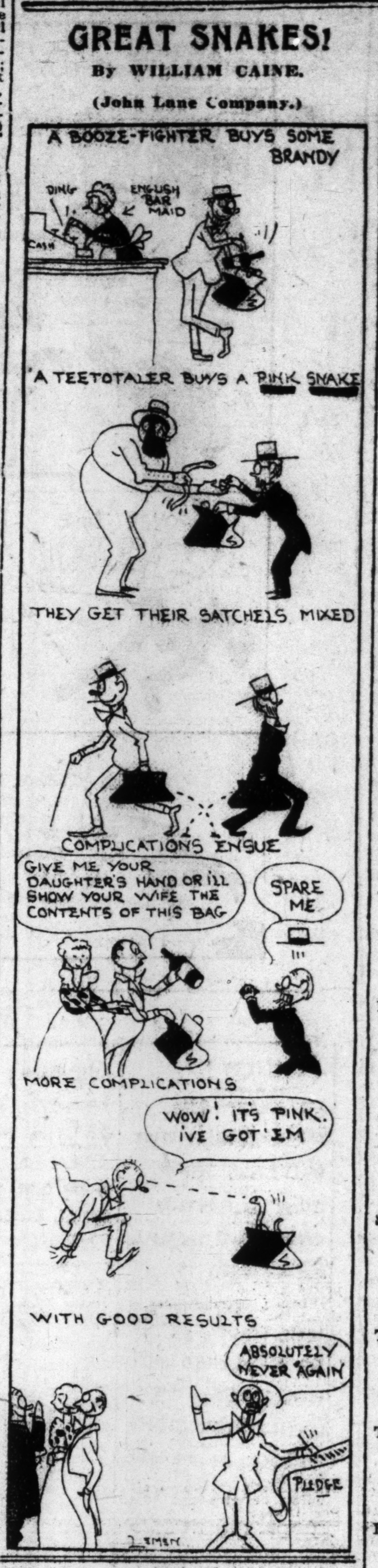
St. Louis Post-Dispatch, Saturday, September 9, 1916, p. 9, “Book Reviews.”
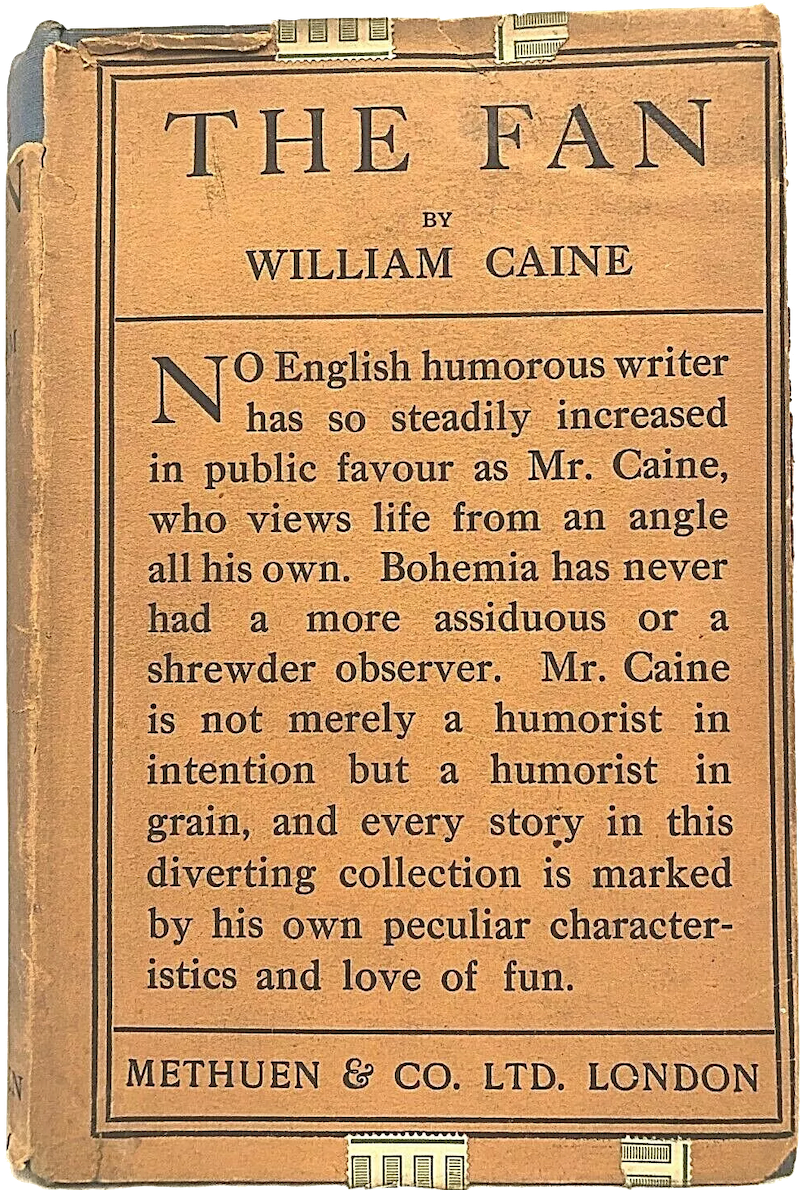
The Fan, by William Caine. London: Methuen & Co. 8º, 301 pages; 35 pages publisher’s ads in back. March 1917. — “No English humorous writer has so steadily increased in public favour as Mr. Caine who views life from an angle all his own. Bohemia has never had a more assiduous or a shrewder observer. Mr. Caine is not merely a humorist in intention but a humorist in grain, and every story in this diverting collection is marked by his own peculiar characteristics and love of fun.”
London: Methuen & Co. 8º, 301 pages; 35 pages publisher’s ads in back. March 1917. [ECB 1917: 35].
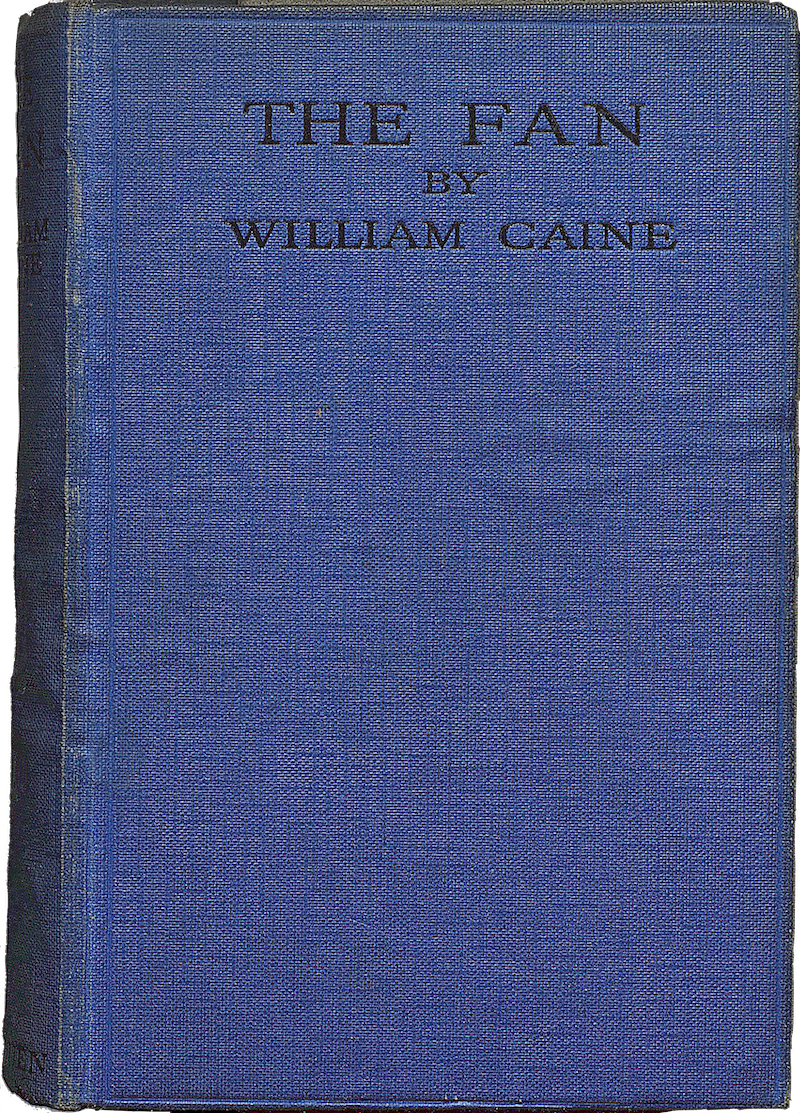
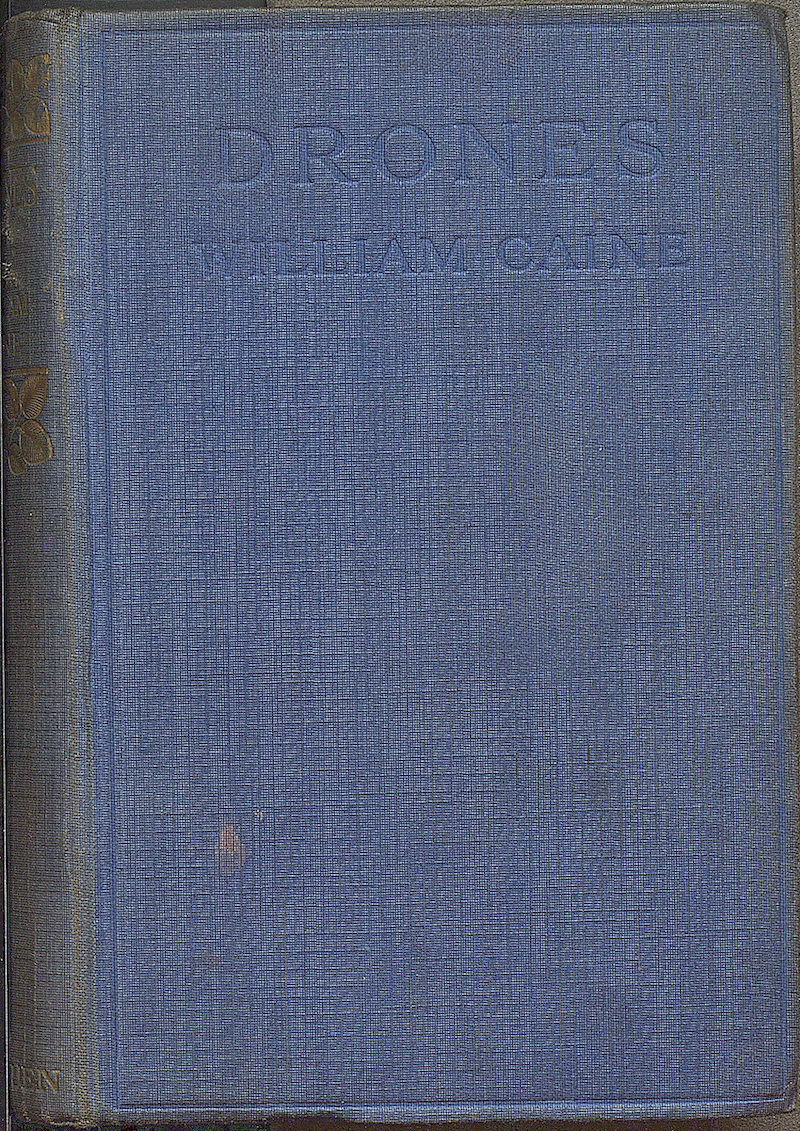
Drones, by William Caine. London: Methuen & Co. 8º, 316 pages; 31 pages publisher’s ads in back. September 1917.
London: Methuen & Co. 8º, 316 pages; 31 pages publisher’s ads in back. September 1917. [ECB 1917: 35]. [LOC 1917: 14, 146, 1154].
The Times Literary Supplement, Thursday, September 13, 1917, p. 440, “New Novels; Drones.”
Mr. William Caine is a brave man; Drones (Methuen, 5s. net) is the title of his latest novel, and the opprobrious title is applied to artists! Surely the privilege of inscribing on one’s books “Banned in Chelsea” can be bought too dear — Mr. Kipling once allowed himself to write of “flannelled fools” and we have had to have a world war to rehabilitate him. The convictions of the community are not to be lightly flouted; and that artists must not be judged by ordinary standards is a maxim which artists have succeeded in imposing upon it. But Mr. Caine will have none of this. To read him one would think that working on a statuette is no excuse for borrowing money from a servant girl and losing it at roulette. He goes further. If we do him no injustice, he blames a painter whose success has been made possible by the self-sacrificing generosity of an elder brother for representing that brother as a curmudgeon who cast him off until success was attained. Where is Mr. Caine’s culture and breadth of view? Can he not realize how much more interesting to pretty ladies is the artist who can talk to them of the days when he had nothing to eat than one who proses of the quarterly arrival of bourgeois cheques?These hints will indicate Mr. Caine’s rendering of the artistic temperament. He exhibits it in a painter and in a sculptor; and if his story does not record their discomfiture, that is only because it is part of his case that artists are not discomfitable — you cannot unfrock a man who makes no pretence of wearing any clothes at all. But a limit is put to their exploiting respectively a hard-working brother and sister. In fact, those who take up a book for the story may complain that they experienced no exquisite agonies at the prospect of warm-hearted Esther marrying painter Austin, because they were never allowed to take her coldness to draper Arthur seriously. They will, however, be sufficiently concerned about Esther to be glad of her escape; for whereas the other characters have their actions and words dictated by the theme, she is allowed more self-expression. She carries her warm heart without offence, for it is balanced by a cocksureness which redeems her from insipidity. And her aptitude for seizing on any explanation, however improbable, if it will be creditable to people she likes, is a human and endearing quality. So, too, is her vanity. Austin’s deference to her criticism was like honey to her: —
She could never decide whether she was more pleased by his praise of her critical faculty or his appreciation of her omelettes. To know that she was an influence for good in his art was a joy beyond the telling; but it was one day when she saw him greedy for her eggs that she really knew that she loved him.
Apart from Esther it is with his moral alone that Mr. Caine seems interested; and the result is that he does not greatly interest us in his artists. It is essential to the treatment that they should be selfish and shameless; and they are that first and artists afterwards. They are not selfish and shameless because they are artists — because they are preoccupied and carried away by some creative impulse. The result is that we feel that they are merely abnormal persons, not essentially artists. But artists have so much sympathy extended to them in books that some whole-hearted antipathy makes good reading.
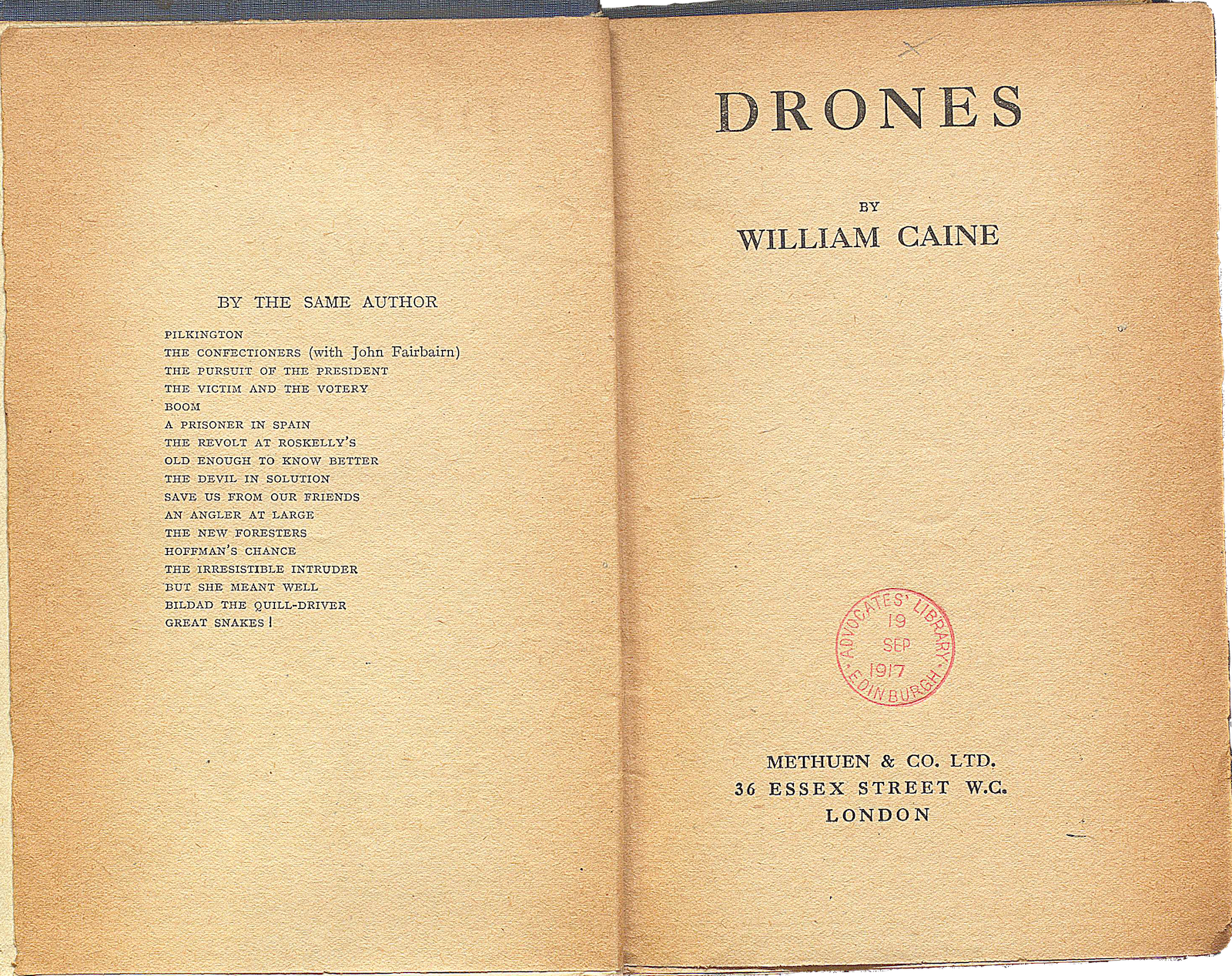
The New York Herald (Paris), September 20, 1917, p. 3, “Leaves Shaken from Autumn’s Literary Trees; In ‘Drones’ Austin got Art, and Inartistic Arthur got Esther.”
Autumn not only brings down the leaves but also brings out the “popular novels.” Messrs. Methuen and Co. are in the first rank with a list of works to suit every taste.There is, for example, the artistico-ironic taste. It will appreciate “Drones,” by William Caine, a story mainly about a fashionable painter, Austin Jenner, but also about his model Esther and his brother Arthur. Austin was more than a clever painter, he was a clever man, too much so to be satisfied with art for art’s sake. What he wanted of art was all that it could bring in the shape of good living, summer in the country, winter on the Riviera, automobiles, fine Havanas, pretty women and champagne suppers. He got them, rather more of them than he really wanted. Arthure, inartistic Arthur, the utterly impossible Arthur, got Esther.
The Nation (London), vol. 22, no. 1, Saturday, October 6, 1917, pp. 24, 26, “Reviews; Varieties.”
We have always believed that Mr. Caine has never received his proper due as a novelist. He has himself partly to blame. He is modest, unaffected, and quiet; he does not go in for breaking the conventions with such a loud pop that a startled world pricks up its ears, and he works upon a sober material. Yet within strictly definable limits and by the easy play of minor rather than powerful qualities, he is really one of the best writers of comedy we possess. His style perfectly comprehends the flourishing little independent kingdom which is the terrain of his work; his dialogue is always fresh and adaptable to the varied circumstances which both summon and release it; he has a copious and happy wit; his construction is sound; his workmanship precisely fits that now antiquated but admirably expository word “invention”; and, last and most striking, he possesses what is by no means common within the leisurely ambit of the modern novel, a very adroit sense of the stage. This eye of his for the dramatic situation is in “Drones” at its most glistening. It is apt, indeed, to get the better of the probabilities and to put a strain upon the consistency and reality of the creatures of his bright fancy which, delighted with Mr. Caine’s expert ingenuity, we are none too anxious to test.It would not be a just criticism to call “Drones” rather more serious-minded than some of the author’s previous work, because harlequinade as some of that work undoubtedly is, it generally has a solid and critical background. In “Drones” that background, as occurs in a change of scene at the theatre, is pushed into the fore. A rash Philistine might conclude “Drones” to be a satire upon artists, since the whole plot turns upon the altruism of Arthur Jenner, a rope-maker, who, in his zeal for art and devotion to his brother, chains or rather ropes himself to the drudgery of his trade, in order to keep the artist-brother in funds in London. Mr. Caine is quite pitiless with Austin the brother, who conceals the benefactions of the honest Arthur even from Esther, his betrothed, a modern young woman, without harshness, pretentiousness, or self-consciousness; treats him with patronage, and disdan, and his art as a visiting-card to wealth. Mr. Caine, in a short book of concentrated action, abounding in those telling situations at which he is an adept, brings Arthur unexpectedly to London, to discover his brother’s ingratitude, self-seeking, and evasions, and leaves him engaged to Esther (who herself has an entertaining young rascal for a sculptor-brother) at the end of a fortnight’s reactions and disillusionments. This quartet, with the addition of Mrs. Meldrum, the Biscuit Queen, who hunts down Austin to their mutual satisfaction, and one or two others for exits and entrances, is the author’s measure for a vivacious, neat, shrewd, witty, and highly capable piece of work. Nor is it a mere mechanism. It has a oint of view — that art is greater than the man but hardly an excuse for the parasite and the career-monger. And Mr. Caine does not fall into the error that a less balanced and discerning temper might have done with similar material. He does not condemn the artist as seceding from current morality as from a more universally acceptable integrity and humanity. Austin and Eric are no more true to their art than to life; had they been to the one, there would, we feel, have been very little to quarrel about in the other.
The Illustrated London News, October 20, 1917, p. 474, “New Novels; ‘Drones.’”
“Drones” (Methuen) is a comedy of the moderns. It is an incisive performance, and less a satire than an exposure of the basenesses that may be found taking cover behind the artistic temperament. Mr. William Caine’s two men of talent live in a world of false values, and they are both hugely aggrieved when stolid virtue comes blundering into their pasteboard paradises. This is, of course, very true to life: sinners are less often repentant than chagrined at being found out. The world does not live for Art, though the artists make-believe otherwise. They consider themselves privileged; and a privileged class is always a danger. “There’s a lot of the child in every one of them — the mere fact that they invent things shows that.” It also shows why Mr. Caine has made such a striking success of his studies of the scapegrace young sculptor, Eric, and the shifty, time-serving portrait-painter, Austin. Nobody knows better the nature of children than the author of “But She Meant Well” and “The Irresistible Intruder,” and these children of a larger growth spring naturally to life in his new novel. They are not the only successful characters in “Drones” — in fact, there is not a failure in the cast. The book is lively with vivid situations, and it leads from interest to interest, unflagging from the first scene to the last. We use the language of the stage designedly, for it is impossible not to visualise “Drones” as sparkling across the footlights. The humour of Mr. Caine saves it from bitterness, and his perception of the immutability of the non-moral mind carries a warning to over-zealous and sentimental persons who juggle with the standards of society. Here is the truth, a lantern in slippery ways — even the ways of the charlatan and the genius.
An Anglo-American Comedy. Boston and New York: Houghton Mifflin Company. 8º, 436 pages. November 1917. [LOC 1917: 14, 126, 961].
The Wife Who Came Alive
London: Herbert Jenkins. 8º, 319 pages. April 1919. [ECB 1919: 42].
The New York Times Book Review, Sunday, October 21, 1917, p. 409, “Five Hundred Leading Autumn Books; Fiction; II. — Romance and Mystery.”
“Doll” Brackett has been shielded from all discomfort by her rich American mother, but after her marriage to a young English portrait painter various complications ensue, through Doll “comes alive.”
The Brooklyn Daily Eagle, Sunday, November 4, 1917, s. 2, p. 4, “New Books Today.”
A remarkable situation is created when a mother’s care clashes with a husband’s affection.
The Bee (Omaha, Nebraska), Friday, November 9, 1917, p. 19, “For Booklovers.”
Doll Brackett and her mother are rich Americans. While traveling in Europe, Doll marries George March, an English portrait painter and a fine fellow. Things go well until Mrs. Brackett’s attempts to make Doll happy begin to conflict with the same efforts of George, who cannot understand why his wife should have at once the freedom of the “new woman” and the coddling which belong to the “clinging vine.”
The Pittsburgh Post, Saturday, November 10, 1917, p. 8, “Books and Authors.”
The story of an American girl, married to an English painter, and of the American mother’s well-meant but unfortunate facility for constituting the third person who makes “a crowd.” The girl’s name is Doll and her mother has always treated her as a doll, until, when put to the test, the doll becomes a real woman at last.
Richmond Times-Dispatch, Sunday, November 11, 1917, s. 2, p. 4, “Books and Authors.”]
“Three’s a Crowd,” the tale of an Anglo-American marriage by William Caine, just published by Houghton Mifflin Co., has had an adventurous career. The author is an Englishman, and the manuscript came from England to this country during the summer. After a long delay, the manuscript, in two volumes, put in an appearance, very much battered and water-soaked. It had been on a torpedoed steamer, and, after being recovered, continued its journey. A page of the manuscript, showing the damage done by sea water, is now on exhibition at the annual exhibition of the National Arts Club in New York. [Near identical piece in The Courier-Journal (Louisville, Kentucky), Monday, November 12, 1917, p. 6, “Books and their Writers,” edited by Anna L. Hopper. A two-sentence version is given under “Bookland; News from the Publishers,” in the Holyoke Daily Transcript, Wednesday, December 5, 1917, p. 14: “‘Three’s a Crowd,’ the amusing tale of Anglo-American marriage, by William Caine, just published by the Houghton Mifflin Co., has had an adventurous career. The manuscript was on a torpedoed steamer, and after being recovered, continued on its journey.”]
Mollie Conners, “Book Reviews,” Oakland Enquirer, Saturday, November 17, 1917, p. 4.
“Three’s a Crowd” is the unusual title of a new book, published by the Houghton Mifflin company, and is written by William Caine. It is an Anglo-American comedy, and the title is taken from the old saw, “Two’s Company, Three’s A Crowd.” The story tells of an American girl, married to an English painter, and of the American mother’s well-meant but unfortunate facility for constituting that third person, who makes a crowd. The girl’s name is Doll, and her mother has always treated her as a doll until, when put to the test, the doll “comes alive” at last. The original title for the story was “The Doll That Came Alive,” but this, though excellent, was discarded, since it gave the impression that the book was for children, until one had read the story. [Mollie Conners also writes in “Book Reviews; Literary News Notes,” Oakland Enquirer, Friday Evening, December 7, 1917, p. 8: “Readers of ‘Three’s a Crowd’ (Houghton Mifflin Company), William Caine’s amusing story of the marriage between an Englishman and an American girl, and of the trouble stirred up by the American mother-in-law may be interested to know that Mr. Caine is himself an Englishman and that his wife is an American. But the sequel is that ‘Three’s a Crowd’ is dedicated to ‘The Dearest and wisest of Little Mothers-in-Law, gratefully.’”].
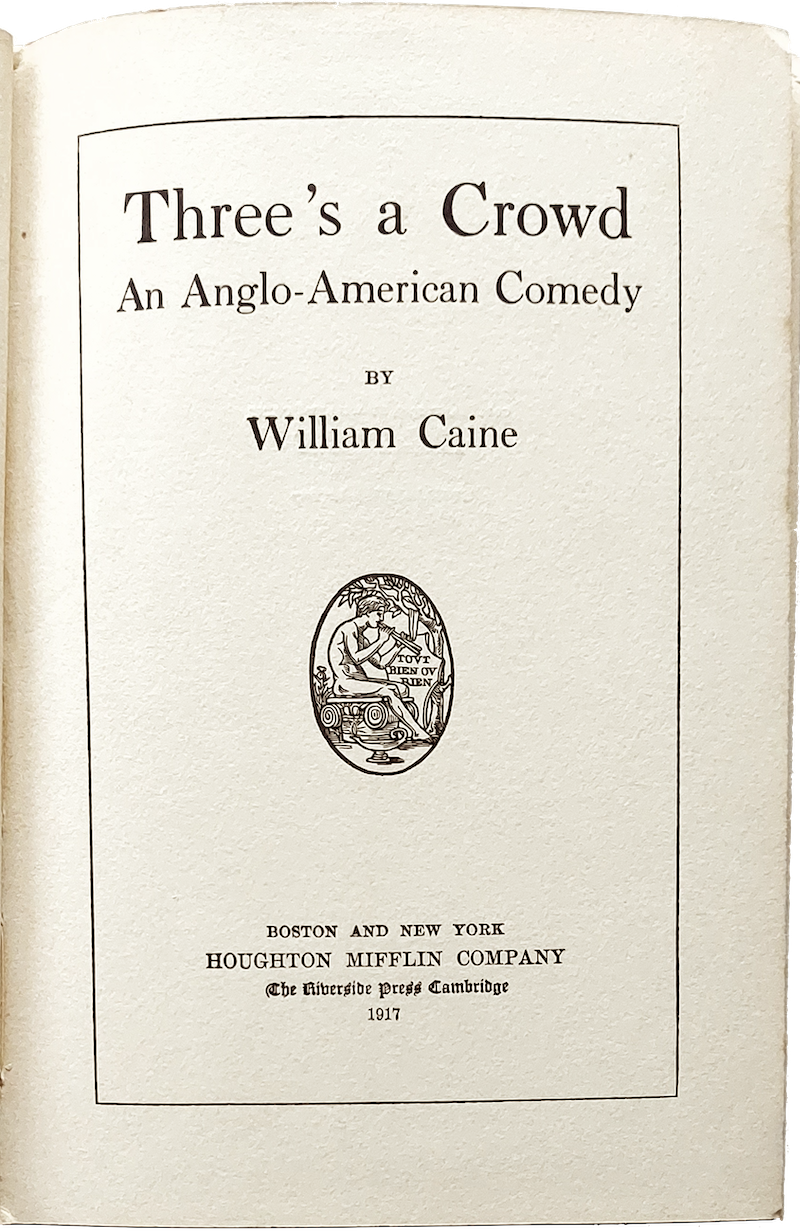
The New York Times Book Review, Sunday, November 18, 1917, pp. 474–475, “Latest Works of Fiction; Three’s A Crowd.”
Here is a story that has the familiar mother-in-law theme for mainstay, and an Anglo-American marriage as a side show. The mother-in-law is very objectionable in a hectic, desperately devoted to her daughter, manner. She and the girl are Americans, and the man is an English painter of portraits.The book is curiously superficial. Never for a moment are we at grips with anything more real than the author’s opinions and judgments. He constantly plays the showman, with the result that his characters are puppets. Agreeable and amusing puppets, several among them, with a turn for wit at times, not to mention an astonishing power for long flights of speech. On several occasions one or other among them holds forth uninterruptedly to the extent of several pages, and always at moments when the action is tense, and the possibility of contradiction or enraged interjection imminent. It reads rather like the work of a clever amateur, cultivated and observant, with all the time in the world on his hands, and a facility for fluent expressions, than a book by any one to whom the term professional novelist could be ascribed.
This is not to say that it is not entertaining reading. The beautiful American, exquisite from her crown of shining golden hair down to her presumably small feet, though these fail of mention, is a very good specimen of the spoiled girl, the pet of her parent and the object of all young men’s adoration and slavish service. She has no conception of the realities of life nor of that special reality, the value of money. She is a good girl, but a silly one, and her silliness and lack of any training lead her into some difficulty. This leading is engineered by her mother with energy and determination, she being a sentimental egoist with a common streak in her and what might be called a gooey type of conversation, except when she launches out into invective.
Everything happens as you know it will. There is never an instant of uncertainty in the whole book. The best friend of the husband who falls in love with the wife is here, rich and titled to the extent of being a Baronet, and according to tradition he goes to Africa to kill lions and elephants as a relief to his feelings. It is interesting to ponder upon how many of these fierce beasts have untimely bit the dust because of the hopeless or misguided love of young Englishmen — at least in novels. This particular Baronet returns uncured, but later on his cure appears to be accomplished by the far simpler expedient of a talk with the lady, during which she makes it clear that she would rather live with than without her husband.
But in spite of being somewhat hackneyed, the partial study of the character of the mother is marred by the desperate resolve of the author to maintain the light and playful touch at all hazards, for is the book not described as a comedy? In spite of the fact that he refuses to be serious even in his conception of the persons in his story, the mother is interesting. She is almost real, almost alive, and she is type that would be worth more thorough treatment.
For one thing at least Mr. Caine merits unstinted praise, and that is the dialogue which he puts in the mouths of his Americans. It is the sort of dialogue an American could use without strain, and which he has no trouble in understanding. This, from an English writer, is a remarkable fact.
The book will prove light, pleasant enough, and a complete escape from anything having to do with the war. It might have been written in 1913, so untouched it is by recent events, the ease and celerity with which the characters rush back and forth across the Atlantic alone placing it far indeed from today, giving it almost a quaint air of passed times and older ways, before the Hun had dipped his bloody hands into the clean brine of the seas.
Sunday Capital News (Boise, Idaho), Sunday, November 18, 1917, p. 8, “Review of Books.”
If, on the day of Doll Brackett’s marriage to George March, Mrs. Brackett could have been sentenced to 30 years beyond the tight little island, “Three’s a Crowd,” might have been a story unwritten. The event not turning that way, here is William Caine’s book dealing its pointed warnings and rebukes to all meddling mothers-in-law.The Bracketts are American. George March is an English painter of portraits. Mrs. Brackett is under the impression that she is imbued with a fine spirit of mother love. What really moves her is rank jealousy, and by means of her interference, her protestations and sly whisperings into her daughter’s ear — all under the pretext of securing the beloved Doll’s happiness — she succeeds in breaking up for a time as neat a little love nest as ever was built in Hampstead.
How things finally came right and how near Mrs. Brackett comes to producing a tragedy our author manages to tell with a surprising touch of humor. Since he does arrive at a happy ending one may forgive him for treating the meddling mother too kindly in his closing chapters.
The Pittsburgh Gazette Times, Monday, November 19, 1917, p. 9, “Books; Reviewed for the Gazette Times Reader.”
A foolish mother, a silly daughter, and a sane young artist constitute the bunch, and would seem to be a-plenty. However, some others are brought in to help out. The mother thinks her daughter is too good to be the wife of any man, so undertakes to run the whole thing. Not being satisfied with the way the artist husband is doing, she compels her daughter to leave, and suggests that she cleave to another who has more money. While not exactly thrilling, it is intensely interesting, and mainly because there are just such foolish persons, and you may know some. The young folks finally rally their forces and come together and live happily.
The Brooklyn Daily Eagle, Saturday, November 24, 1917, p. 4, “Where ‘Three’s a Crowd.’”
Doll Brackett was a beautiful American girl, the only daughter of a wealthy widow. While travelling in Europe she met George March, a rising young English portrait painter, fell in love with him and was married to him. They resided in a suburb of London, and Doll, who knew nothing of the value of money, plunged into all sorts of extravagance, so that they were soon deeply in debt. Her mother, who had made her a large allowance, lost all her money in America through a rascally lawyer and returned to England to live. She encouraged Doll in her extravagance, until George rebelled, and ordered her from the house. Doll went with her and refused to return to George. The two women became very poor and finally the mother in desperation urged her daughter to elope with Sir Richard Crewe, a wealthy man and an old friend, who admired her. Angry at such an infamous proposal, Doll rushes from the house. She endeavors to become an actress, but receives scant courtesy from the managers. Crewe has her traced to a cheap hotel and telephones to George to come and get his wife. They are reunited and even the mother is forgiven. All of which is told at great length in “Three’s a Crowd,” by William Caine, which is published by the Houghton Mifflin Company.With this slim plot, the author has spun out 436 pages, or about 120,000 words. Many pages are taken up with tedious moralizing without any dramatic action, and in fact the book could have been cut down nearly one-half without any loss. Mrs. Brackett and Doll are stupid Americans, but the Englishmen are all noble and virtuous. There are many sneers at American manners and customs which might be omitted. Mr. Caine calls it “An Anglo-American comedy,” but his humor is rather elephantine than light, and his subtlety resembles that of the ostrich who is reputed to stick his head in the sand to conceal himself. [Reprised in The Brooklyn Daily Eagle, Sunday, December 9, 1917, s. 5, p. 3, “Where ‘Three’s a Crowd.’”].
The Los Angeles Times, Book Book Review Section, Sunday, December 23, 1917, p. 4, “‘Two’s Company, Three’s a Crowd.’” [This piece, unsigned, is nearly identical to Mollie Conners's notice in the Oakland Enquirer.]
The title of William Caine's new novel, "Three's a Crowd," an Anglo-American comedy, just published by Houghton Mifflin Company, is take, of course, from the old saw, "Two's company, three's a crowd." The story tells of an American girl, married to an English painter, and of the American mother’s well-meant but unfortunate facility for constituting the third person who makes a crowd. The girl’s name is Doll, and her mother has always treated her as a doll, until when put to the test, the doll “comes alive” at last. The original title for the story was “The Doll That Came Alive,” but this, although excellent, was discarded since it gave the impression that the book was for children, until one had read the story.
The Springfield Daily Republican (Springfield, Mass.), Wednesday, January 2, 1918, p. 6, “Boston Letters and Art.”
“Three’s a Crowd,” from the press of Houghton Mifflin company, is by William Caine, who but for the war, might have given us a book of some importance about America. He came to New York early in 1914 on his first visit to his wife’s home. For he had married in London a few years before an attractive Wellesley graduate from greater Boston, Miss Gordon Walker, and he was spending the summer with the literary colony at Scituate when the war broke out. Putting aside all his plans, with Mrs Caine he hurried back to England, where both have found much to do for Great Britain ever since. After the war, perhaps, Mr Caine will be able to finish the book of impressions of the United States that he began then. “The war put an end to it,” he says in a recent letter, adding humorously, “The war has been blamed for a good deal, but let this stand to its credit.” Mr Caine’s previous books, dealing with English country life chiefly, have been exceedingly popular for their insight and humor, and his “Three’s a Crowd” will be especially welcome here since its author has a real knowledge of life as it is lived in England as well as in America. [Identical piece in The Springfield Weekly Republican, Thursday, January 10, 1918, p. 8.]
New York Tribune, Saturday, January 12, 1918, s. 3, p. 7, “Books: Review; Some Recent Fiction; A Doll’s Awakening.”
It is a long time since we have read so thoroughly consistent a character study of that kind of American woman who, pampered and guarded and petted, is after all only a grown-up spoiled child, as William Caine gives us in Doll Brackett. On the very first page we get an impression of her, which the author enlarges upon without passion in a delightfully detached manner. The mother and sister of George, Doll’s fiancé, are calling on Doll and her mother.“Here, in Mrs. Brackett’s suite in the Savoy Hotel, they had large opportunity for improving their knowledge of the girl’s appearance. In the room there were, great and small, eight photographs of her. She was to seen equipped for dancing, walking, dining, bathing, riding, motoring, being presented at court, as a baby, as a child, as a girl, as a young woman; looking down, looking up, looking sideways; with a fan, with a bouquet, with a horse, with her mother. No one who should so much as glance around this small reception room could fail to perceive the importance of Doll. Of course, Mrs. March and Hilda were already quite alive to Doll’s importance, though, perhaps, not in the same way as was Mrs. Brackett. They thought of her as George’s future wife.… Mrs. Brackett thought of George as Doll’s future husband.”
After this felicitous beginning Mr. Caine proceeds in lighter vein, in a simpler manner, but with the same thoroughness which characterizes Meredith’s immortal pictures of the complete male egoist, to draw us one of the female sex. One constantly recalls Sir Willoughby, and is even driven to speculation as to the engrossing events which might ensue should Doll and Sir Willoughby chance to meet outside the pages of fiction. And yet Doll is a much pleasanter creature than Willoughby, even if Mr. Caine’s book is not so great a literary tour de force.
“Three’s a Crowd” is a very human little story, turning with new variety on the old theme of the meddling mother-in-law. It skirts tragedy at times, but the author’s method makes him turn what have been tragic into clever comedy. Mr. Caine has a delightful sense of humor, which enlivens what otherwise might have been difficult situations, and he takes the reader into his confidence in a charmingly intimate fashion. The story turns around the manner in which Doll Brackett, a girl made thoroughly selfish by he deplorably pampered bringing up, “comes alive,” as she herself expresses it. Her mother having managed all her affairs and made all her decisions before marriage, is unable to relinquish the reins after Doll acquires a husband. The chastening of Mrs. Brackett is not the least interesting part of the story. There are many Dolls in the world, but one seldom finds them so well and undidactically in fiction.
The Montreal Daily Star, Saturday, January 26, 1918, p. 14, “Books Worth Reading; Neat, Pretty Satire Animates Pages of William Caine’s Novel.”
Mr. Caine has a pretty gift of satire, and he turns it neatly in this case upon the banality of a mother-in-law who made mischief between her adored and spoiled daughter and the daughter’s devoted, but reasonable husband. Somehow one’s mind flies back to Thackeray when faced with the ungrateful duty of trying to convey to other persons just how Mr. Caine goes about his delicate business. Take this for instance, apropos of the impeccable young man who found himself in love with his friend’s fiancee:So went away this poor Richard Crewe, with the dart through his vitals, manfully protesting that he was glad because old George was so happy and had done so well for himself.
He rode his horse into a lather and was surprised to find how quickly he had got home. He supposed that Mrs. March’s hall-clock must have been all wrong. But there had been nothing the matter with Mrs. March’s hall-clock.
Let us all pray for Richard Crewe.
Or this, of the privileged servant with the “buttony” nose:
Mary Bates stood in the door, cap all on one side, grinning and waving her hand with a familiarity that greatly distressed Mrs. Brackett’s democratic soul.
Mrs. Brackett was the mother-in-law, we should add. Mr. Caine never forgets to add anything — or explain everything. He apologizes for giving some attention to a wedding, but murmurs that he wanted to make it look more important than the funeral, which came after; and when he dutifully punishes the mother-in-law for her sins, he anxiously appeals:
Further to lay bare the pain and bewilderment of this broken heart must be as miserable a task as it should be a superfluous one. I have worked to poor purpose if any elaboration of Mrs. Brackett’s grief is necessary to your understanding of her pitiful case.
There are not a few novelists of the day to whom a self-examining reading of “Three’s a Crowd” might be recommended.
The Lexington Herald (Lexington, Kentucky), Sunday, January 27, 1918, “The Book Review,” p. 12.
This serio-comedy of an Anglo-American marriage is dedicated “to the dearest and wisest of little mothers-in-law gratefully.” It is the story of an American mother who was in no sense wise and who, when she had lost her own fortune, was angry and bitter because her English son-in-law, an artist of moderate means, neither could nor would gratify every extravagant demand of his beautiful, beloved and badly spoilt wife. The story is rather an extravaganza and not to be taken too seriously, though there is much wisdom in it, first and last. An American admirer of William Caine may be, perhaps, permitted to suggest that it is not always merely in deference to a mother’s prejudice that carefully reared young matrons from America refrain from chewing gum; nor do they invariably at ball games “steadily munch peanuts,” “from time to time emitting shrill little cries of encouragement to the players.” When our author speaks of the vile climate of America, one wonders whether he means that of Alaska or Florida, till one realizes that of course he means the climate of New York. But these are trifles.It is important, perhaps, to observe that neither in England nor in America do nice, or near-nice women permit open criticism of their husbands. The interest of the story lies not in the fortunes of Mrs. Brackett nor her “Doll-that” so slowly “came-alive,” but in the imperilled friendship of George and Dick. The manner of the author is reminiscent of Snaith in the “Principal Girl”; the method is suggestive of De Morgan, and, that being true, no faults of the story can quite steel the critic’s heart against it. And if one seek consolation in the sorry puzzle of life in 1918, one may find it in this story of a world before 1914, when women were concerned about clothes and complexions; when Englishmen in search of occupation had to go to Africa to hunt big game, and when anybody had time to make large miseries out of petty friction.
Bangor Daily Commercial (Bangor, Maine), Saturday, February 2, 1918, p. 9, “Books and Their Makers.”
“I was called to the bar and practiced for seven years with complete lack of success. This is to be attributed to two causes. First, I cannot speak in public, and, second, I cannot understand law. I did not begin to write seriously until I was 30, and even then I wrote frivolously. Some of my short stories were collected into a book. It may now be bought second hand.” These are a few of the facts which William Caine, author of Three’s a Crowd, an Anglo-American comedy, just published by Houghton Mifflin Co. has contributed, concerning himself. And in concluding his amusing little biographical sketch, Mr. Caine says: “In 1914 my wife and I visited the United States. I began to write a book of my impressions, but the war put an end to it. The war has put been blamed for a good deal but let this stand to its credit.”
The Leader (Regina, Canada), Thursday, February 7, 1918, p. 7, “‘Three’s a Crowd’; In a new novel William Caine depicts some of the ways in which mother-in-law makes life thorny for young artist.”
One of the January novels published by Thomas Allen, Toronto, is William Caine’s “Three’s a Crowd,” a comedy with its pages exclusively taken up with the affairs of Doll and her husband and her mother. A second man and a third appear on the scene now and again, but not because Doll pays them any attention.Doll and her mother are rich Americans. While traveling in Europe Doll meets and marries George Marsh [sic?], and English portrait painter, and a splendid, level-headed fellow, who is completely absorbed in his love for his wife and for his art. He has money enough, too, not to need to struggle to keep up appearances, and his wife should have found her outlook a rosy one.
But Doll’s mother proves a turbulent element in the new household, whether she’s present or absent. She has over-worshipped her daughter all her life; has always done things for her; and by her stronger nature has overshadowed the daughter’s personality. It has been easier for Doll to be obedient to her mother’s wishes than to question them; and by conforming always, there are money and comforts rained on her.
The man Doll marries has no intention of having his bride and himself come under the government of Mrs. Brackett. But she is jealous of the one who comes first now in her lovely daughter’s life. The mother loses her money by the treachery of those her handled her business, and can no longer spend lavish sums upon gifts for the extravagant Doll.
How the young woman learns her lesson that her mother’s love is largely selfishness; and that people of honor revise their modes of living when they no longer have funds for buying luxury motor cars and similar earlier luxuries; and that a good man’s love is something to be prized and guarded, fill interesting pages. The style of the book is light and gossipy. “Three’s a Crowd” will be popular among those who insist upon personalities pervading all the pages they read. The author is content with revealing through the action of the days’ events how this American girl was saved from having her life spoiled by an indulgent and jealous mother.
The Evening Sun (Baltimore), Saturday, June 1, 1918, p. 6, “Books to be Read — or Read About.”
“Three’s A Crowd,” by William Caine (Houghton-Mifflin) is called by the publishers “An Anglo-American Comedy,” but the story very nearly runs upon the rocks of tragedy. It deals with an American girl who marries an English artist of note and the subsequent meddling of a harebrained mother-in-law. A readable story for the leisure hour of a summer day, but inclined to incite murderous feelings toward mothers-in-law.
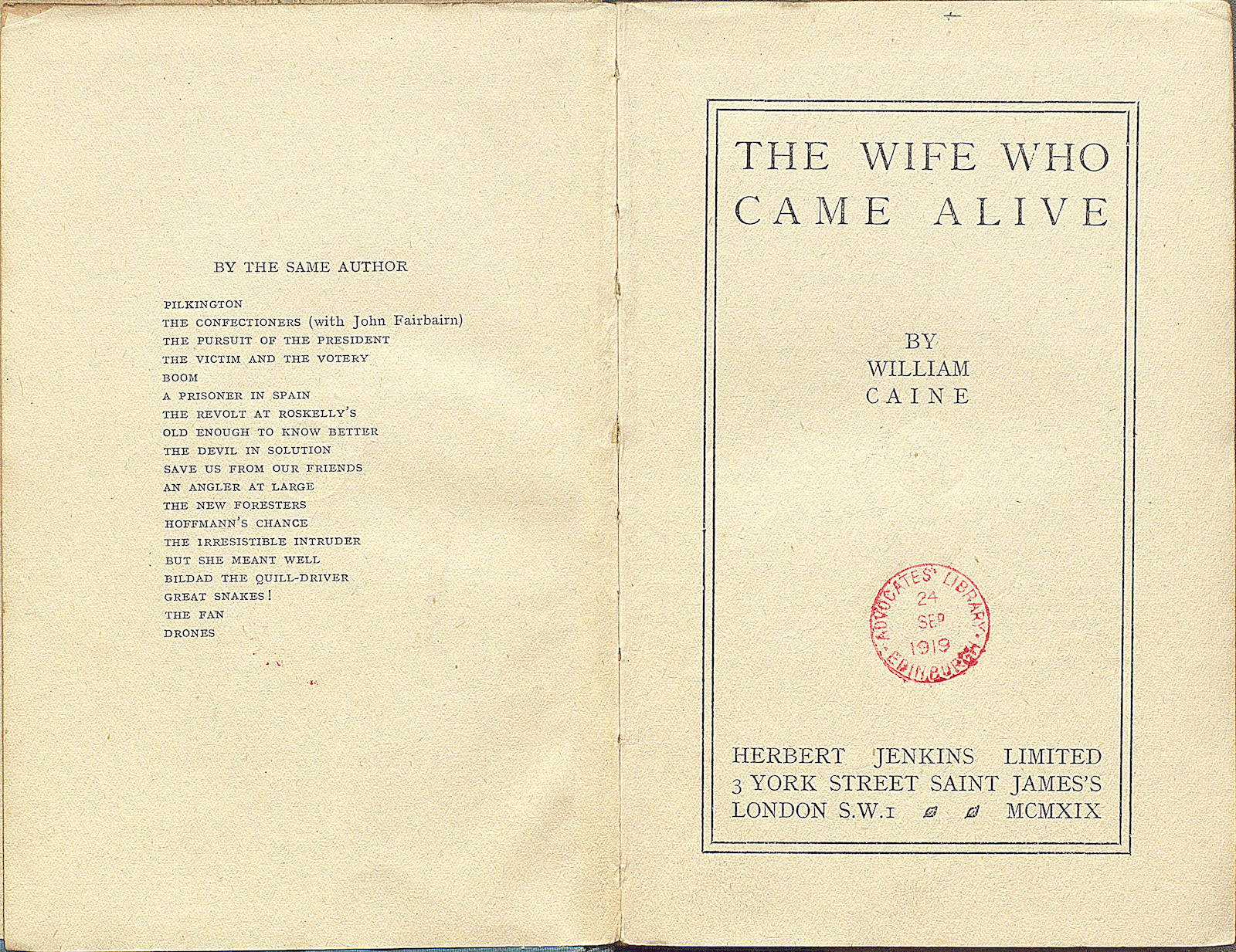
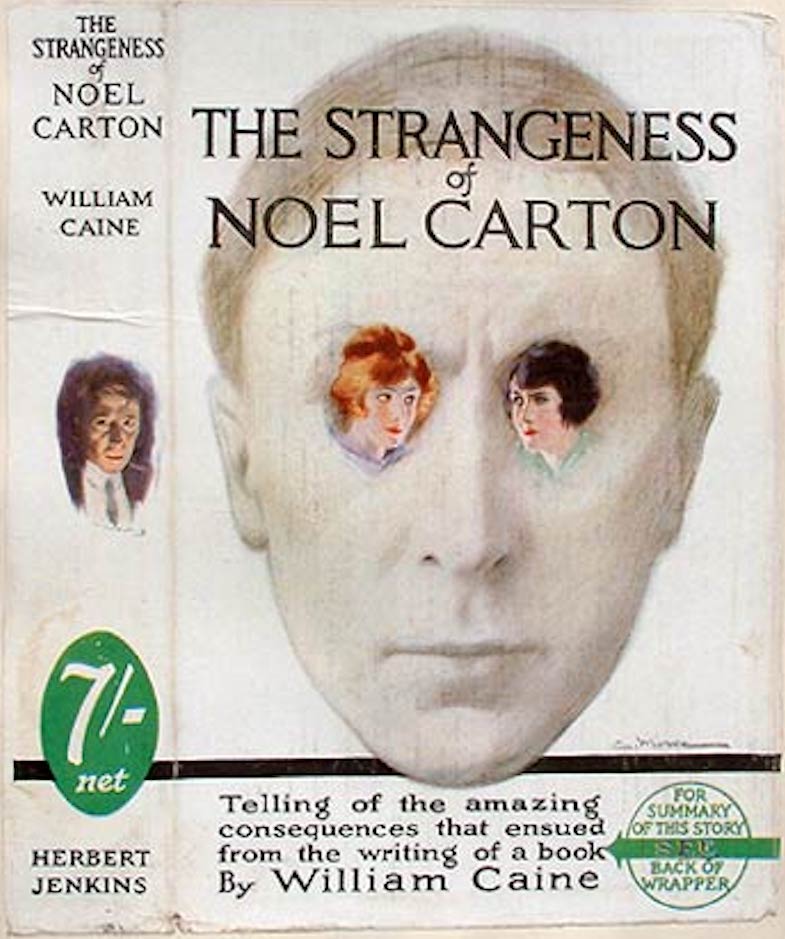
The Strangeness of Noel Carton, by William Caine. London: Herbert Jenkins. 304 pp., 8º. May 1920. Jacket illustration by C. Morse (Salomon van Abbé). Reproduced from “Straight Jackets: the Art of the Book Jacket.” University of Otago Library, Auckland, New Zealand, December 20, 2004 to March 31, 2005.
London: Herbert Jenkins. 304 pp., 8º. May 1920. [ECB 1920: 46]. [LOC 1920: 17, 57, 449]. Available online at hathitrust.org.
New York and London: G. P. Putnam’s Sons. 302 pp., 8º. July 1920. [LOC 1920: 17, 60, 474]. Available online at archive.org.
Leipzig: Bernhard Tauchnitz. Collection of British and American Authors, volume 4565. 269 pp., 16º. December 1921.
Die Narrheit des Noel Carton
Berlin–Wien: Glöckner Verlag. Glöckner-Bücher 22. Berechtigte Übersetzung aus dem Englischen von A. W. Freund. Illustriert von Michael Biró. 241 pp., 16º. July 1929. [ÖVG 2: 295].
A kétarcú ember
Budapest: Pesti Napló. Forditotta Wiesner Juliska. 192 pp., 15cm x 10cm. 1930. Kék regények 22. [The two-faced man. Translated by Juliska Wiesner. Blue Novels Series #22].
The Evening Standard (London), February 27, 1920, p. 10, “Talk About Books; A Very Original Plot; Too Lifelike.” [Signed F. W. H.].
There has been a tendency among many novelists to neglect the plots of their stories and concentrate on long dissertations on every subject under the sun. Mr. H. G. Wells has much responsibility for this fashion, but where he succeeds other novelists fail. Mr. William Caine, who has written some delightful books, thinks the plot of a story is all-important. In his new book, “The Strangeness of Noel Carton,” which Herbert Jenkins will publish shortly, Mr. Caine has hit on one of the most original plots I have ever heard of. Without giving away too much of the story, here is the plotA man marries a woman with money, but is made to feel his position so keenly that he determines to earn some himself. He starts to write a novel. As the story progresses the author is astonished to find that all the characters in his book are drawn from life. His wife is in it as large as, or rather larger than, life, his friends at the club — most persons he has met. Slowly his mind becomes unhinged as his novel progresses.
One incident from the book will suffice. One of his friends who in the novel is burnt to death in a theatre fire walks past the window of his club as the author is sitting there. The demented author rushes out of the club, overtakes the man, and, shaking him, says, “Damn you, what are you doing alive; you were burnt to death a week ago.”
Punch, or The London Charivari, June 2, 1920, p. 439, “Our Booking-Office.”
I certainly admit that the publishers of The Strangeness of Noel Carton (Jenkins) have every justification for speaking of it as “a new note in a novel.” Indeed that clever writer, Mr. William Caine, has here sounded as new, original and (for all its surface humour) horrible a note as any have heard in fiction for some time. My trouble is that I can hardly indicate it without giving away the whole business. Very briefly the tale is of one Noel Carton, who has married beneath him for not quite enough money to gild a detestable union, and, being an unstable egoist and waster, presently seeks consolation (and pocket money) by writing a novel founded in part on his own position. One may note in passing that Mr. Caine seems to have but a modest idea of the mental equipment required for such a task. Still I suppose he knows, and anyway that isn’t the point. The point is that, once Noel has got himself properly projected into his novel, all sorts of the queerest and most bogie coincidences begin to occur. Again to quote the puff preliminary, “as the book develops the reader has a suspicion which becomes almost a certainty, until the great and astounding climax is reached;” concerning which you may justly remark that no reader with a certainty would regard its verification as “astounding.” But this takes nothing from the craft with which, on looking back, you see the climax to have been prepared. I could hardly call the tale altogether pleasant, but it is undeniably new and vastly original.
The Times Literary Supplement, Thursday, June 3, 1920, p. 353, “New Books and Reprints; Fiction.”
Not every reader is likely to enjoy this grim mixture of realism and fantasy, but it is impossible to deny the power with which it is written. The Hon. Noel Carton, who tells his own tale throughout in a jerky and at times slangy style, which from the very beginning forebodes his ultimate mental breakdown in a singularly disquieting manner, has married a purse-proud and snobbish little Jewess for the sake of her money. He has paid the penalty to the utmost farthing and seeks relief from his daily misery by writing a novel in secret. Into this novel, the chapters of which alternate in the book with passages of his journal, he, naturally, introduces his wife, most unlovingly portrayed, and himself. Naturally, too, he creates the glowing figure of a girl, Hilda Rundle, who, with her red-gold hair, her kindness and simplicity is physically and morally the exact opposite of his own Josephine. By the time “Nigel Carter,” his own double, has saved Hilda from being destroyed in a fire at a theatre and pulled her into safety off the back of a bolting horse in Hyde Park, the story has so gripped its author that he is dreaming it at night. Soon he is living it by day, for, worn out as he is by insomnia, for which he takes drugs, and by his domestic worries, he begins to meet his own creations as he walks about London. In chapters of a growing tensity and horror we watch the journal and the novel fusing, hallucination giving place to madness, and finally (without quite knowing when he was able to write it down) we see the maniac strangling his wife — not the dream one. The tale is made plausible by its skilful characterization. Noel-Nigel, Josephine-Jocelyn, and the visionary Hilda are none of them dummy figures of fiction. They are alive enough to wake quite a painful interest. In the two big scenes of the novel, the theatre fire and the accident in the Row, the author contrives by his skilful selection of details to give a vivid impression of real events.
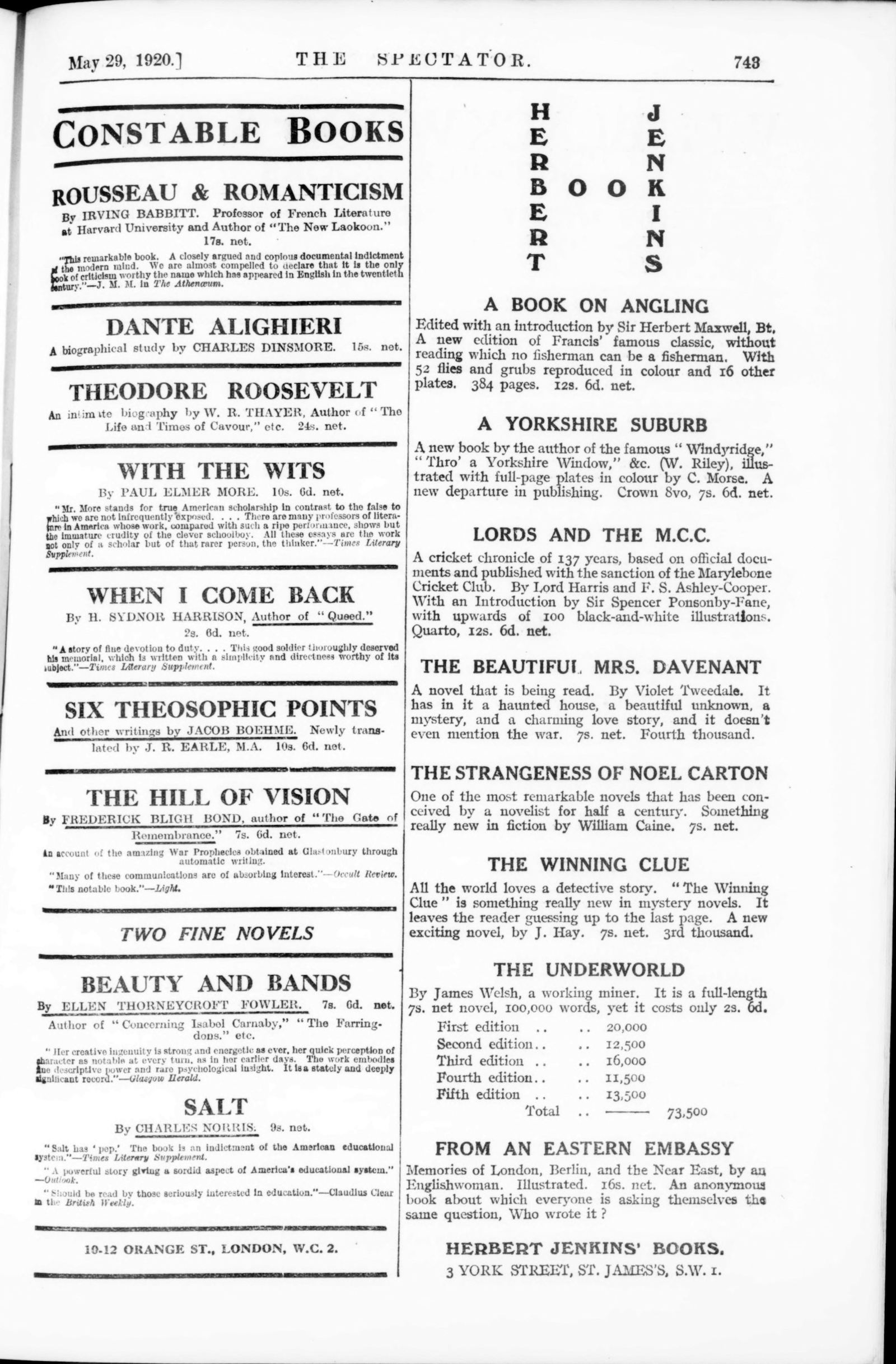
“The Strangeness of Noel Carton. One of the most remarkable novels that has been conceived by a novelist for half a century. Something really new in fiction by William Caine.”
The Observer (London), June 13, 1920, p. 5, “Books of the Day; New Novels.”
Noel Carton put an enemy into his mouth to steal away his brains. That, we venture to think, rather than the writing of his book on the keeping of his diary or his compulsory attendance upon the woman in all England least suitable to be his wife, is tha cause of his tragic “strangeness” and its climax. It is a, perhaps, unwelcome compliment to a novel intended, with all its cleverness, to be merely light and almost farcical, that it leaves a painful impression. The artist has overcome the farceur in Mr. Caine, and he has made his study of growing insanity extraordinarily lifelike and therefore a little terrible. This suggests that, if he cared, he could sound the depths instead of keeping to the sunny shallows where we mostly find him. The story is really original. It has been curiously mistold, by the way, upon the back of the ingenious paper-wrapper.
Truth, June 16, 1920, p. 1213, “Some New Novels.”
The publisher’s claim that Mr. William Caine’s new book, “The Strangeness of Noel Carton” (Jenkins, 7s), strikes a new note in a novel is justified. It certainly does, but it is not quite so certain that it is an altogether pleasant one. The story is of a thoroughly despicable waster who has sold himself to a vulgar woman who wanted social position. He determines to write a novel. He also determines to keep a diary, and the result is that the diary and novel become inextricably mixed. This is Mr. Caine’s method of describing an onset of insanity. It is a really clever psychological study, though a whole page of “ha-has” is rather a silly means of getting an effect. The only question the reader is likely to ask is whether the story was quite worth the telling.
Sheffield Daily Telegraph, Thursday, June 17, 1920, p. 3, “Novels.”
“The Strangeness of Noel Carton,” by William Caine (Jenkins, 7s. net) is a very clever piece of work. It should be read a second time with the ending well in mind, when it will reveal itself as a rather pitiless study in the stealthy coming of insanity. From that point of view the book has a keen if rather morbid fascination. We are not quite sure that it is a good book — good from a literary, not from a moral standpoint, we mean — but it is extremely clever.
The Derbyshire Advertiser, June 18, 1920, p. 2, “Notes on Books and Bookmen; Realism and Fantasy.”
The story of a man who wrote a novel and was haunted by the characters he had created is impressively told by Mr. Caine in “The Strangeness of Noel Carton.” The Hon. Noel Carton has married a Jewess for her money and is paying the price. To seek relief from his misery he writes a novel secretly. Into his novel he introduces his wife and himself. The heroine, Hilda Rundle, a glorious creature with red-gold hair, is the opposite in every respect of his wife Josephine. Carton is troubled by insomnia and takes to drugs with the result that he begins to meet the creatures of his novel as he walks about London. Finally madness, and we see the maniac strangling the real wife and not the dream one. A piece of cleverly characterised fiction.
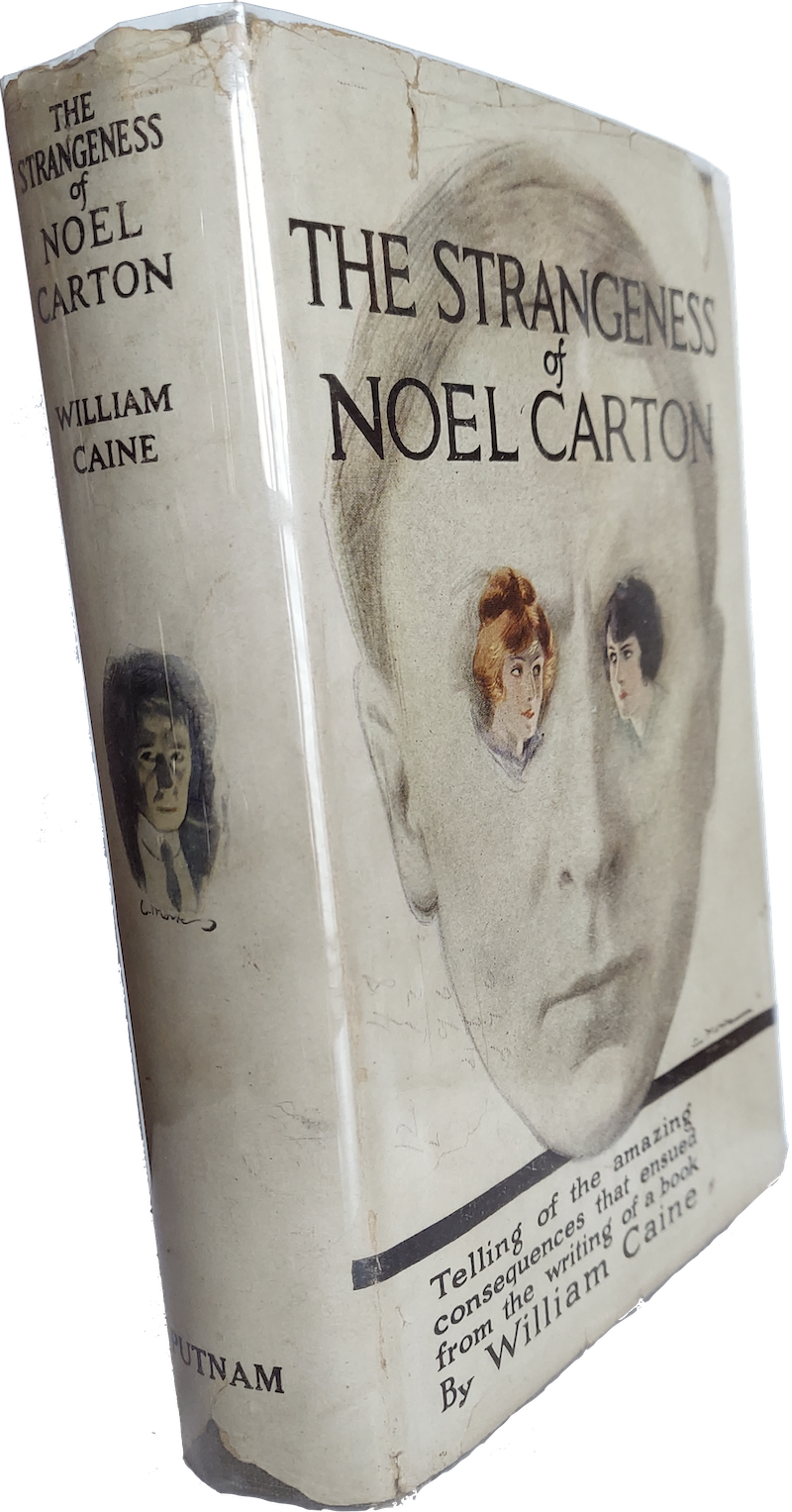
The Strangeness of Noel Carton, by William Caine. New York and London: G. P. Putnam’s Sons. 302 pp., 8º. July 1920. Jacket illustration by C. Morse (Salomon van Abbé).
Nottingham Journal and Express, Tuesday, June 22, 1920, p. 4, “Book Reviews.” [Signed M. V. G.].
An original plot and a queer metaphysical streak in the thought make “The Strangeness of Noel Carton” attractive. Noel, on the tenth anniversary of his marriage to a woman for money (she married him for position), begins to write collaterally a journal in a “silly, damned, fat, lockable book” he buys at the Army and Navy Stores, and keeps up a chimney; and, as a result of his wife’s taunt, “You’re not fit to write sentimental stories for a servants’ magazine,” a novel.He begins gaily enough recording fact and writing fiction, but a dream comes to blur the boundaries of diary and novel — real and unreal — and he finds that his characters seem to have an independent life of their own. “One can manipulate them, you see,” he writes in the journal, “but only within limits.... The imaginary is somehow more actual than we suppose, and a good deal less subject to our authority than we flatter ourselves is the case,” and after that the Noel of life and the Nigel of fiction merge, until the latter becomes more real than the former — the created than its creator — and Noel writes in the diary: “Suppose Nigel Carter is not a figment of Noel Carton’s imagination, but Noel is a figment of Nigel’s: Suppose I am just somebody in another fellow’s dream.”
A fascinating thought — that might yield much in Mr. Algernon Blackwood’s hands — but in Mr. Caine’s hero is merely symptomatic of madness, and madness that expresses itself in melodramatic fashion at the end of the book. Mr. Caine’s treatment of insanity is clever and individual, recalling rather Mr. Walpole’s method with Mr. Perrin than Mr. Compton Mackenzie’s with Mrs. Raeburn.
He achieves his climax skilfully. In an aside in the journal Noel comments shrewdly on the attitude of critics to The Obvious in books: “It’s the Unforgiveable Sin,” he writes, “you can be as immoral as you please and they’ll sing your praises to the sky, as long as you don’t cliché. That’s the Red Rag.” Which statement shows that apart from “one prevalent decipiency” and “single delirium,” “a man may meet with.... good sense in Bedlam.” The weakness of the book lies in a seemingly divided intention, a falling between the two stools of comedy and tragedy.
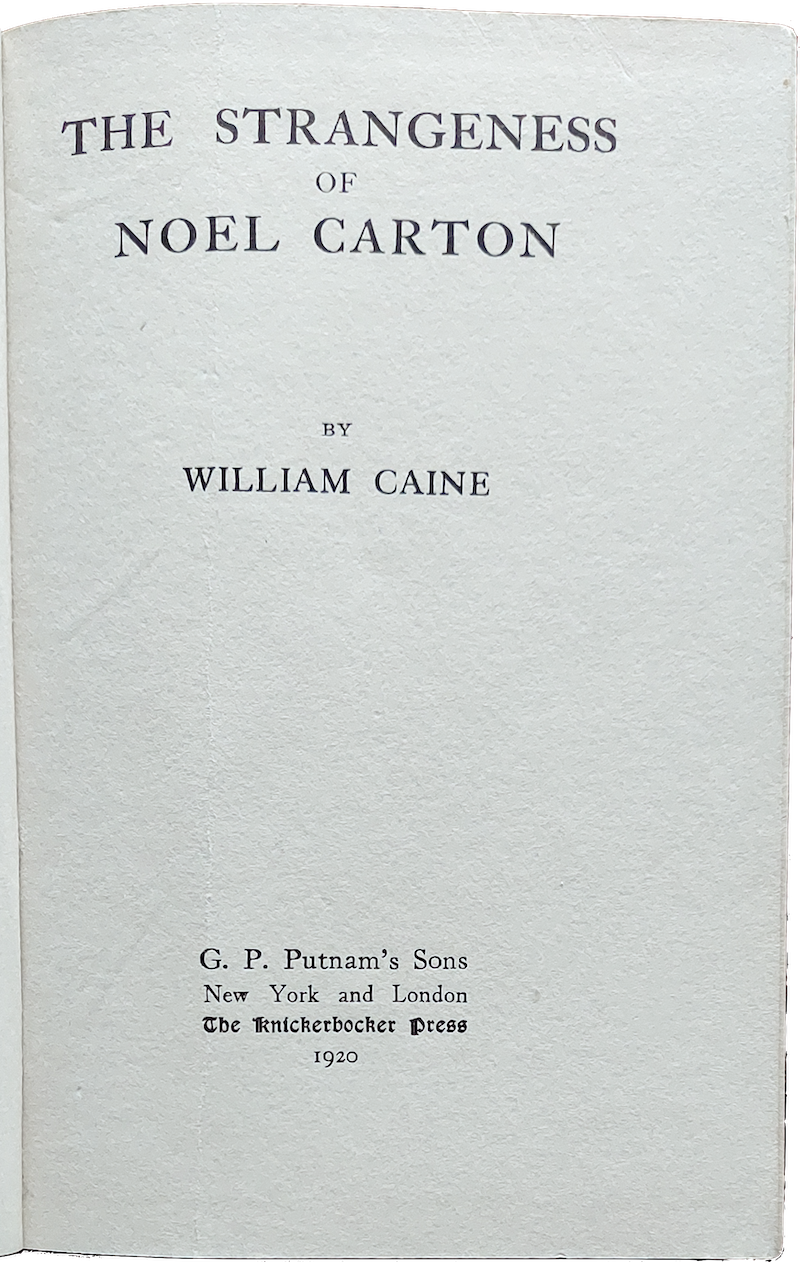
The Athenæum, June 25, 1920, p. 846, “List of New Books; 800 Literature; Fiction.”
The fastidious reader will be inclined to put this volume aside after the first few pages, but if he can persevere he may very quickly realize that the vulgarity of the author’s manner is deliberate, and very effective and moving. The story is told by the Hon. Noel Carton, who has married for money and paid the penalty. He seeks alleviation by writing a novel in secret. The method by which the real and the imaginary stories are alternated and more and more closely interwoven, until we are no longer able to distinguish between them, is original and clever. Mr. Caine’s climax is full of horror, but fascinating. Carton awakes from one of his spells of fiction-writing to find himself strangling the wife whom in real life he hates. Subconsciously he has been portraying all the time the people with whom he actually lived, including himself. It is paying a great compliment to Mr. Caine to say that no one who does not read this remarkably plausible tale from cover to cover could believe it.
The Newcastle Daily Chronicle, Wednesday, July 7, 1920, p. 2, “Books of the Day; Some Novels.”
In “The Strangeness of Noel Carton,” Mr. William Caine has struck a new line in fiction. It is an extraordinary novel with a startling development. It begins in cynical humour, there is much that causes laughter, and there are boisterous serio-comic outbursts all through the book. Noel Carton married beneath him for money, and his family cut him and his vulgar wife. He married for money, she for position, and neither disguised the fact, and the result is eternal domestic feud. His wife’s jibes at her husband’s uselessness, determines him to write a novel which he keeps secret. As the plot develops, Noel finds his characters becoming very familiar, and discovers that he has subconsciously been drawing portraits of living people with whom he is well acquainted. The book is written partly as Noel Carton’s diary and partly as the chapters of the novel, and the reader soon begins to find himself under the spell of the confusion between the real people and the imaginary characters in Noel’s novel. Then the trouble begins. Noel becomes so deeply interested in the characters in his story that extraordinary things happen and interest in the book heightens as it reaches its astounding climax. In the end one feels that the flippancy and unrestrained humour to be almost incongruous with the serious denouement. It is published by Herbert Jenkins, London, 7s.
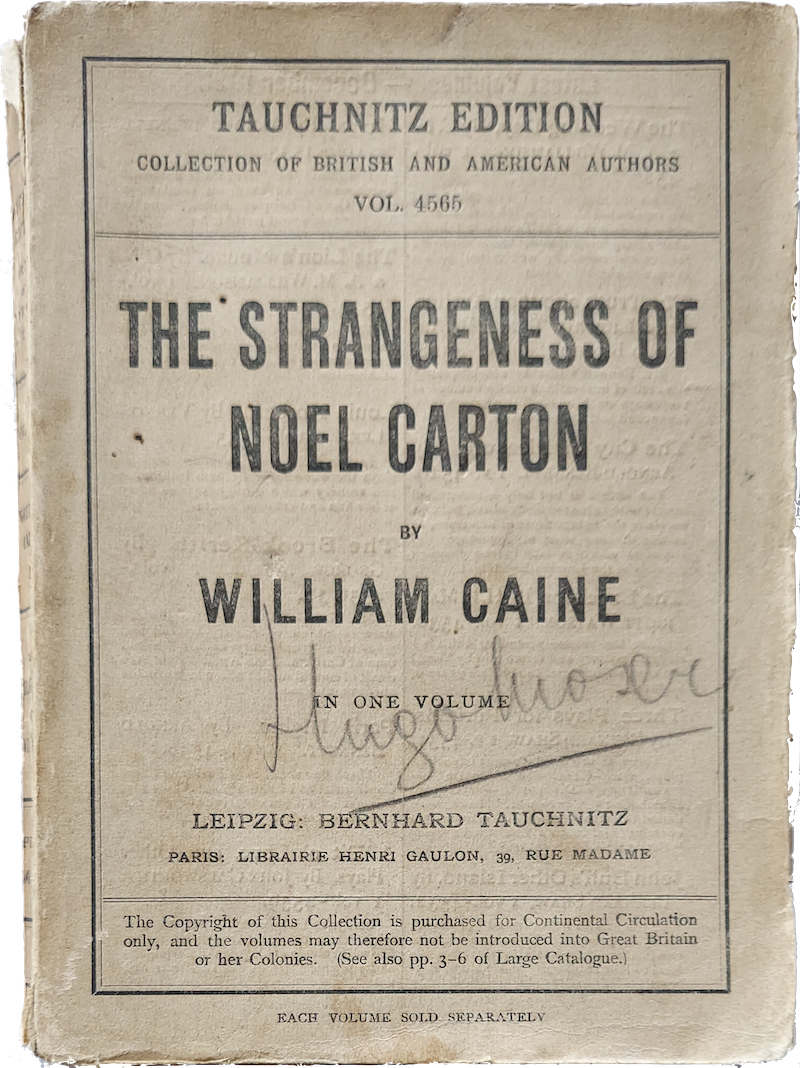
The Strangeness of Noel Carton, by William Caine. Leipzig: Bernhard Tauchnitz. Collection of British and American Authors, volume 4565. 269 pp., 16º. December 1921.
The Telegraph (Brisbane, Australia), Saturday Evening, July 10, 1920, p. 13, “Books of the Day; Reviews and Literary Notes; A New Note in a Novel.”
The author of this book may fairly claim to have struck a new note in a novel. Whether or not that note will sound pleasantly to the reader is a matter of individual taste. The Hon. Noel Carton, who is made to tell his own story, has married a vulgar little woman for her money. Her ways irritate him past bearing, and since she makes no pretence about having married him for a social position, constant domestic squabbles are the result. This “hero” then decides to keep a journal and to write a secret book. His one fear is that the book will fall into the hands of his wife, Josephine, whom he has put into the book under the name of Jocelyn. In his journal he tells the reader many things about the writing of books. He writes well, and he discusses in his journal whether an author creates and guides his characters to their destinies, or whether the characters themselves take charge of the author and work out their own destinies, retaining him merely as a narrator. All this is done very cleverly indeed. The heroine imagined by Carton seems to live strongly, and the reader is half-inveigled into believing that she is not the mere figment of Carton’s brain. And Carton writes himself into the book as Nigel Carter, the highly-born husband of the vulgar but rich Jocelyn. Carton invents also a hero of sorts, and in his journal he makes plain to the reader his difficulties in deciding what to do with his love story. Somehow or other Carter, or Carton himself, falls in love with his imaginary beautiful lady and twice saves her life. She is on the eve of her wedding with his imagined hero, but, disturbed by a question from Carter, she postpones the marriage. It is plain that Carton is making this imaginary woman fall in love with himself. Complexity on complexity. And Carton goes on subconsciously writing into his novel some of the people he has actually met. We cannot say that the climax will be readily expected, but the climax is the explanation of the strangeness of Noel Carton.[Identical piece in The Week (Brisbane), July 16, 1920, p. 30.]
Belfast News-Letter, Wednesday, July 14, 1920, p. 8, “Literature of the Day; Recent Fiction.”
Among the novels by Mr. William Caine, his new one, “The Strangeness of Noel Carton,” published by Messrs. Herbert Jenkins, Ltd., will attract some attention. It is in the form of a journal, and it opens: “Here beginneth the journal of Noel Carton, Literary Gent-To-Be,” and many of the entries are frivolous, but not uninteresting. There are scenes of domestic infelicity, and other incidents which interrupt the progress of a novel on which he is engaged.
Stylo, “Books and Authors,” Liverpool Daily Post and Mercury, Tuesday, July 27, 1920, p. 9.
A novelist whose work I have followed with great enjoyment is Mr. William Caine. He has written at least one serious novel, but I like him best when he is lighthearted. In which category we should place his latest story, “The Strangeness of Noel Carton” (Jenkins), I cannot say, but let us call it serio-comic. The label matters little: suffice that it is an impressively ingenious tale. The plot is one of the most original I know, and it is worked out with a cleverness that will surprise anyone who has not yet discovered that Mr. Caine is an extraordinarily clever writer.
Richard King, “With Silent Friends; Another Most Extraordinary Tale,” The Tatler, September 1, 1920, p. 286.
And another even more uncommon book — not in the way it is written, but by its originality — is Mr. William Caine’s new story, “The Strangeness of Noel Carter” [sic] (Herbert Jenkins). At first you think it is just an ordinary story of a man who wishes to take revenge on the people who surround him, especially his wife, by writing a novel about them, and incidentally telling them what his opinion of them is. Then gradually you perceive that he is mixing up the real characters with their literary portraits, and, in seeking to bring his heroine to a dreadful end, the figure of this woman is beginning to merge into that of his own wife. Briefly, that the writer is going mad! The sensation is most strange and uncanny. The book begins to grip you, rather like a horrid nightmare. The last scene of all, when he murders his wife — because now she has become for him the heroine of his book only — is one of the most terrifying, haunting scenes I have read for a long time. Indeed, the book is rather terrifying all the way through, even though it is written in the lightest possible manner. It is this very “lightness” which fascinates you. You can see, all the time, how what started as being a piece of ill-natured fun becomes the wicked hallucinations of a maniac. “The Strangeness of Noel Carter” is certainly one of the strangest books I have read for years. You like it, and yet you hate it. You close it at last and cry, “Fudge! It’s only a novel.” And yet, it haunts you. It is a most uncommon novel, and “creepy” in the most “creepy” sense.
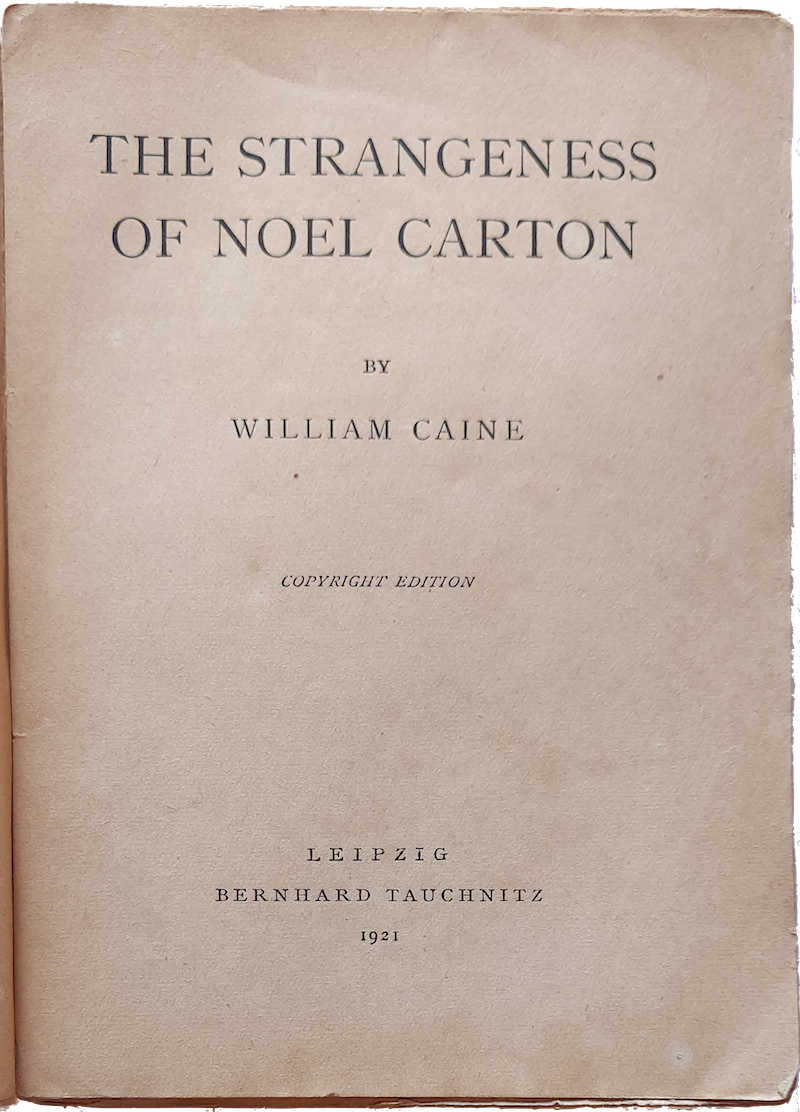
E. L. Pearson, “Latest Works of Fiction,” The New York Times Book Review and Magazine, September 5, 1920, p. 24.
There seems to be a theory to the effect that you cannot have a novel of character and thrill at the same time. If you get one you sacrifice the other. So soon as you meet, in the pages of a book, a man or woman who is alive and who becomes to you part of your material for the fuller comprehension of human emotion and action, so soon you are supposed to resign yourself to an absence of keen story interest, of the breathless moment when you wonder what the turning of a page is to bring about, when the interruption of anything outside the story is an irritation — if it reaches you at all.Well, traditions are busted in William Caine’s story, “The Strangeness of Noel Carton.” From the moment you meet him, his wife, and his situation you are deeply interested in all three. You don’t like him nor yet his wife, but he is a vivid, actual creature, and he makes every one, perhaps we might better say everything, he touches, vivid and compelling. He startles you, and he startles you before you are aware that there is any reason why he should do so, other than the face that he has so suddenly, by the mere opening of a book, become so extraordinarily a part of your experience.
He does not try to make himself agreeable, Heaven knows. He paints himself as he is, in the pages of his peculiar journal as well as in the novel he writes alongside of it. And he is, to use his own words, “a pimply, bandy-legged Honorable.” He married a Jewess because she had money enough to support him and allows her to do so, even though that means that he takes her orders, her bad temper, her tyranny, even though he hates her — and he hates her very thoroughly — because he lacks the courage to risk losing his allowance, and to be once again thrown on a world that showed him little mercy while he was on the loose.
The book begins, as many books begin, with a scene between the author and himself. He has resolved to begin a journal, because he has also resolved to become a novelist. He takes the reader into his confidence, while seeming only to be discoursing familiarly with himself. It is an old trick. But even then there is a freshness, a queerness, that attracts you. Almost the first thing that he puts into his journal is a detailed account of a quarrel with his wife — not agreeable, as we said. But intensely real and with the effect on you that continues and grows as you go on with Noel and his story, or, rather, stories, for there are two, even though these two are quite inextricably one — an effect that you are a participant in the scene, that, as is later the case with Noel and Nigel, you are actually enduring it as Noel endures.
Nigel is the hero of the novel which presently Noel, partly as an escape, partly to prove to himself anyhow, if not to the hateful Josephine, that he can do something, begins to set down, mixed in with the journal, for the journal is largely an account of how the novel gets itself written — gets itself, for that matter, lived. It is no ordinary novel.
You are, in such instructions as come to writers of fiction, told to identify yourself with the hero of your tale. But it may be doubted whether the most enthusiastic exponent of this method would have you go quite so far as Noel. Presently it is impossible for you, who read, to be certain whether or not it is the hero or the author with whom you have to do. Yes, decidedly, there is a strangeness. You begin to have sudden suspicions, but at first you laugh at them. It is when you look back from the end that you realize that you were rather clever, after all. And all the while something lies uneasily on you. You hate these two people with the hate they have for each other, and yet you are pitiful toward them, too. You get to know them so very well, you see, and to know all is to pardon all, as has been said so well in French. You are sorry for this pitiable man, who has sold himself to the devil of hate for three square meals and a roof and a club. You are sorry for the mean little creature he has married, who thought when she did so that she was making a good bargain and who hates the fate that tricked her as well as the bargain itself.
And as for the people in the novel:
Hilda is the glass of crystal spring water to the dying of thirst, the kind heart to the beaten and terrified, the glimpse of paradise to those bound in torment. And Ronald, clean and fine, is the man Noel would like to have been, if the world and his weaknesses had not trampled him into the mud where he wallowed. They are the refuge. If, in time, they grow more real than he who thought himself their creator, perhaps they are so, since they are strength and goodness and love.
Not that all this is ever said by Noel. But it is Noel’s struggle, his bitter comprehensions and revelations, that bring you to your own thoughts on the subject. Noel in a sense ceases to be. Does he merge into Nigel, finding a kind of shadowy nobility after his, let us call it, erasure of himself? Probably not. But at least he has had moments when he was distinctly not Noel.
There is no use going on with this discussion with any one who has not read Caine’s book. The story is not one that should be given away: you will want to follow its thread and reach each knot in the course of the unwinding without assistance from any one who has performed the process ahead of you. It seems sure that once you begin on that process you will not want to desist. Your desire will be to be let alone to pursue your way steadily.
Perhaps, if you expect to be asked to play golf or tennis, this being the season when such requests are likely to be made, or to go motoring, or to do anything else of the many charming acts possible to weekends, perhaps you had better not take Noel with you on your little holiday. Unless the train trip is long and tedious and you are making it alone. Then, by all means, get Noel to be your companion. You will be quite unconscious of your trip — unless, most annoyingly, it should end before the book.
Misprints in books issued by good publishers used to be rare. They are getting increasingly common. In this book there are constant, irritating misspellings, misplaced words, transposed words, even one whole line of print is transposed. This is all wrong. A reader has the right to expect a book that costs a very good sum and is worthy of being placed on his shelves to be decently proofread.
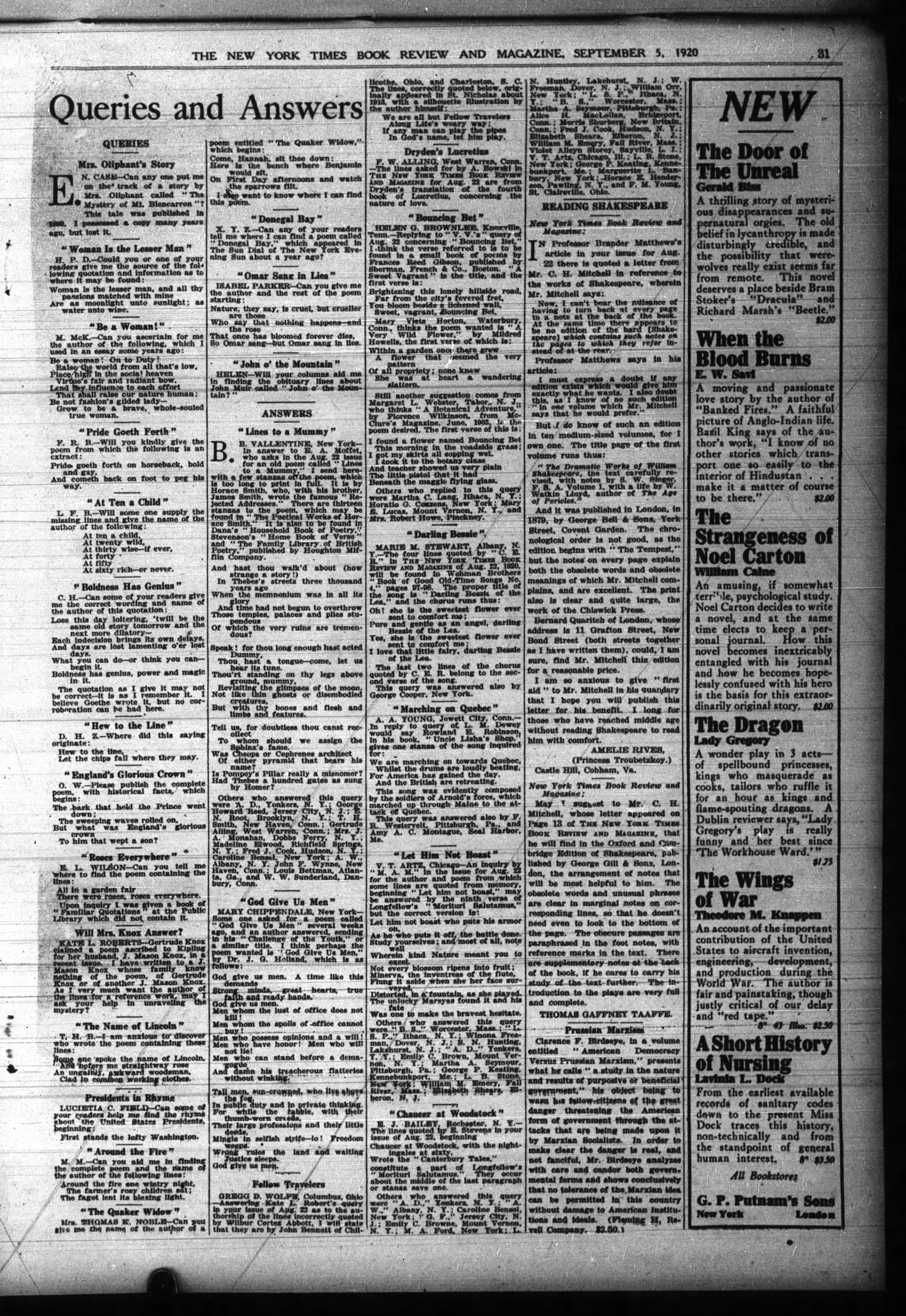
“The Strangeness of Noel Carton. William Caine. An amusing, if somewhat terrible psychological study. Noel Carton decides to write a novel, and at the same time elects to keep a journal. How this novel becomes inextricably entangled with his journal and how he becomes hopelessly confused with his hero is the basis for this extraordinarily original story. $2.00.”
The Brooklyn Daily Eagle, Tuesday, September 7, 1920, p. 6, “New Books Received.”
A story that concerns the consequences of writing a book.[Reviewed in the November 27, 1920, issue of same.]
The Yorkshire Post, Wednesday, September 15, 1920, p. 4, “The Library Table; Recent Fiction.”
“The Strangeness of Noel Carton” (Herbert Jenkins, 7s. net), by William Caine, is a very remarkable story, a grim comedy, told with exceptional power. It is a story within a story, for the hero, who has made a loveless marriage and has come to hate his purse-proud and ambitious wife, sets to work to write a novel in which he can pillory her — and himself as well — and becomes so wrapt up in his fiction that it becomes an obsession, and then an aberration. In the end he so mixes up his imagined experiences with his actual ones that he loses all sense of personal identity, and what began as “strangeness” culminates as mania. On the surface it is a most amusing story, but if one takes it too seriously it is a tragedy.
F. P. A., “The Conning Tower; The Diary of Our Own Samuel Pepys,” New York Tribune, Saturday, September 18, 1920, s. 3, p. 10.
In the evening A. Samuels come, and played some musick, and so to bed, reading in “The Strangeness of Noel Carton,” by William Caine, and so interesting I hated to lay it down, but my wife could not sleep with the light shining, so I put by the book, but thought about it till morning.
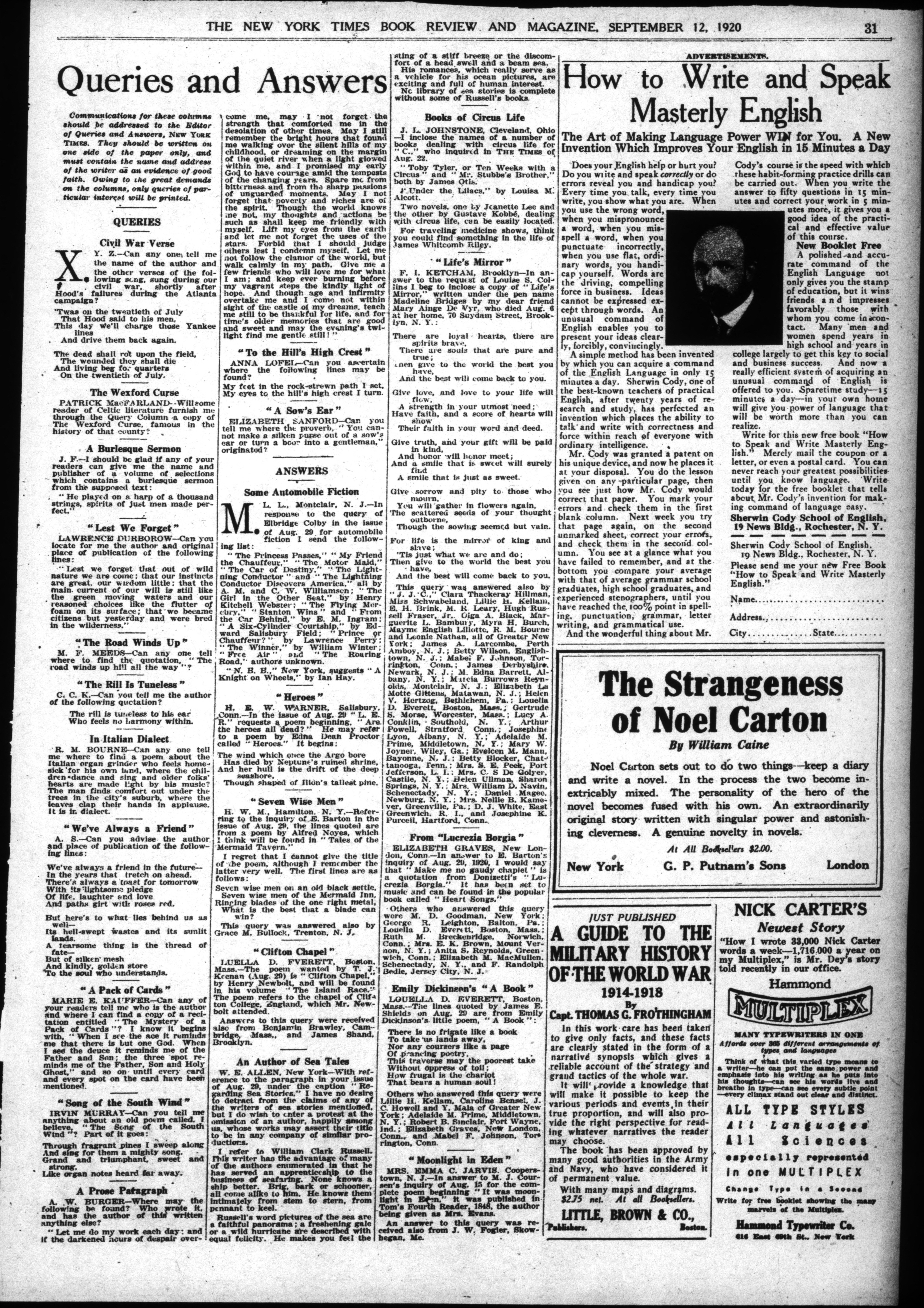
“The Strangeness of Noel Carton. By William Caine. Noel Carton sets out to do two things — keep a diary and write a novel. In the process the two become inextricably mixed. The personality of the hero of the novel becomes fused with his own. An extraordinarily original story written with singular power and astonishing cleverness. A genuine novelty in novels. At All Booksellers $2.00.”
Nashville Tennessean, Sunday Morning, September 19, 1920, p. 13, “Book Reviews.”
Here is a novel by William Caine telling of the amazing consequences that ensued from writing a book. Noel Carton, driven to desperation by his vulgar little wife, who, in buying his position, is forced to accept him with it, determines to bury himself in the writing of a novel, in the vain hope of forgetting. At the same time he decides to keep a secret journal. In his novel he subconsciously draws the portraits of the living people surrounding him. Then the novel becomes inextricably entangled with his own secret journal, and this is the basis for this extraordinarily interesting story, which leads to an an astounding climax.
F. P. A., “The Conning Tower; The Complete Characterizer,” New York Tribune, Saturday, September 18, 1920, s. 2, p. 12.
[From “The Strangeness of Noel Carton,” by William Caine]Jocelyn did things because other people liked doing them.
If she had pleased herself she would never have worn stays and would have lived in a dressing gown and soft slippers; yet she went always carefully corseted and spent much thought and money on her clothes. She did not like cigarettes; yet she was a persistent smoker. The only reading she enjoyed was trashy novels and magazines; yet she took in The Fortnightly and The Contemporary and The Spectator and Blackwood’s and The Studio, and she was always able to talk with a sort of knowledge about any book of travel or volume of memoirs which might be making a stir. She hated bridge, because it required so much concentration; but she had put herself under a professional teacher and had labored so faithfully that she had positively acquired a competence at the game. She didn’t care a fig for art; but she attended all the private views. In order to do this she had to buy one or more pictures from each of the galleries so get on their free lists; these pictures she had hung about the walls of her house, where they remained, for her, invisible. The gramophone amused her, yet she was always at concerts, particularly those which stamp their audiences intellectual. It bored her to look on at games; but she never missed the Eton and Harrow and the Universities’ Matches at Lords, spent whole afternoons applauding the poloists at Hurlingham, and every winter sat with frozen feet and chattering teeth to see the rival blues hunting the rugby ball. Cricket, polo and football alike were mysteries to her, and as it was not necessary that they should be anything else, they weren’t. She sought no instruction here. She feared horses and disliked the way they bumped her when she sat on them; but since long before her marriage she had never, when in London, missed her morning canter in the park.
America, September 25, 1920, p. 548, “Books and Authors; Fiction and Drama.”
“The Strangeness of Noel Carton” (Putnam, $2.00), by William Caine, is a well-named novel. The author sets out to keep a diary and at the same time a novel. The two contrive to become inextricably mixed up one with the other, as well as the author with his principal character. This confusion is cleverly manipulated and considerably enhances the interest besides giving the story a pleasant originality.
The Argonaut (San Francisco), September 25, 1920, p. 200, “The Latest Books; A Strange Novel.”
Noel Carton hates his wife. So, it may be said, do a good many other men, but they hide the fact, or try to. Noel Carton proclaims it loudly and incessantly, without reservations of mitigations. He married her because she was rich and he could not live on his income. In other words, she bought him, and she acts as one does act toward purchased goods. It may be admitted that Noel is a good deal of a worm, and yet, in a sense, rather a manly sort of worm.It is a difficult story to review, although an easy one to read. Mrs. Carton taunts her husband with not having brains enough to write a servant girl’s novelette. So Noel decides to do so. Having been attracted to a very pretty girl he makes her his heroine, and also assigns fictional places to his wife and himself. Henceforward the story — the real story, not Carton’s novelette — runs along three lines. There is the veracious story of Carton himself. There is Carton’s novelette as he writes it chapter by chapter, and there are Carton’s dreams, which play a rather weird part in the whole fabric. It sounds rather confusing, but it is not so, not at all. The idea may also seem a rather trivial one, but it is not trivial. Indeed it comes close to being tremendous.
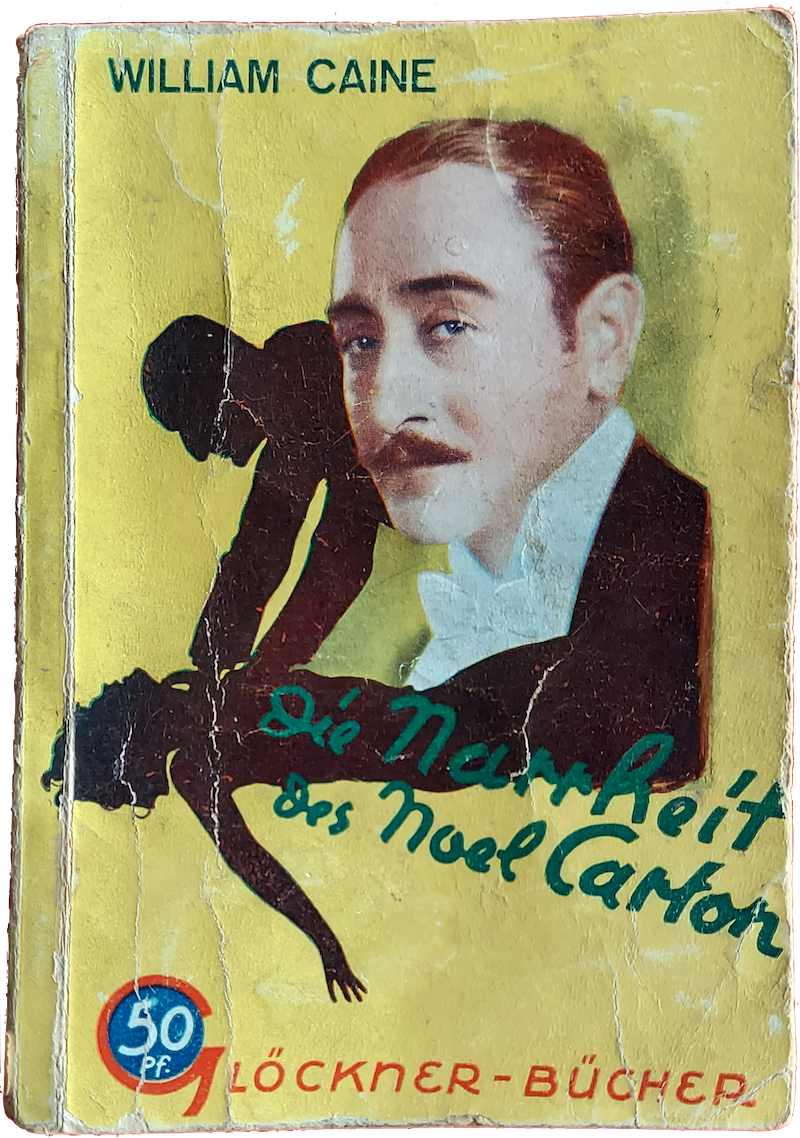
Die Narrheit des Noel Carton, von William Caine. Berlin–Wien: Glöckner Verlag. Glöckner-Bücher 22. Berechtigte Übersetzung aus dem Englischen von A. W. Freund. Illustriert von Michael Biró. 241 pp., 16º. July 1929.
The Buffalo Commercial, Saturday Evening, September 25, 1920, p. 9, “The World of Books; Views and Reviews.”
The author probably laughed at himself when he wrote this rather remarkable yarn. He may, also, have promised himself a laugh at the expense of the public when he penned it. For it certainly leaves the reader stunned, as it were, and ready to go out and dash his head against brick walls or start on a still hunt for the author. Fortunately for our peace of mind and size of pocketbook, Mr. Caine is far away from here over in England.Noel Carton, man of letters, is the impecunious husband of a rich wife. Not only that, but he appears to be on the point of desperation because she is continually nagging him on the fact that she holds the purse strings. As many better men have done, he begins to write a secret journal. The beginning of the journal, or diary, inspires him to start a novel. The novel runs along the lines of his own pitiful plight and before long he finds novel and journal inextricably mixed up. The results are weird in the extreme, and the reder finds himself rather muddled too before long. There’s an astounding climax which leaves one in doubt whether he has been sitting in at a tragedy or a farce.
Carolyn Gordon, “William Caine Writes Novel at la [sic] Jekyll and Hyde,” The Chattanooga News, Saturday, September 25, 1920, p. 2.
The first opinion which presented itself to this reviewer after reading “The Strangeness of Noel Carton,” by William Caine, published by G. P. Putnam & Sons, was “what a horrible book!” It is, however, hailed by many reviewers as one of the most remarkable novels of the year. It is supposed to have completely smashed the tradition which holds that you can’t have a novel of character and thrill at the same time. As a matter of fact Leonard Merrick smashed that old tradition all to pieces last year with his “The Worldlings,” which holds the reader equally absorbed by the interest of its happenings and its penetrating character analysis. And “The Worldlings” was the work of an artist. “The Strangeness of Noel Carton” is not. It has no artistic merit — if artistic merit is a matter of workmanship.That is the crux of the whole plot — the machinery of the novel itself. And this conception, which has roused much acclaim, is after all only a revamping of “Dr. Jekyll and Mr. Hyde.” It is a study in dual personality, with the contrast in character which gave the spice to that famous pair, left out.
“Noel Carton was to use his own words,” [sic] a bandy legged honorable, who was too lazy to work and married a fat Jewess for her money.” She married him for his social position and felt herself cheated in the bargain, for Noel’s social position vanished after his marriage to her. Noel repents of the bargains, too, but is too lazy to cut himself loose from his wife’s purse strings, so he takes her orders and her money and hates her. Finally he decides to write a novel as a sort of refuge from the intolerable situation. He begins by keeping a journal as a prelude to being a man of letters. This journal is largely an account of how the novel gets itself written. The plot is really an extension — one cannot say improvement — of Stevenson’s idea. It is a Dr. Jekyll and Mr. Hyde complex, for we have to pairs of dual personalities — Noel and his hero, and the novel and the journal, which finally become so inextricably entangled that nobody, including the author can tell which is which.
The chief characters of the novel are Hilda Rundle, Ronald Wantage, Jocelyn and Nigel Carter. Ronald is the man Noel would like to have been. Hilda is the girl he would like to have fallen in love with. Nigel is Noel himself and Jocelyn is Josephine, Noel’s wife. The character’s come to have an independent existence of their own, an existence which seems to be beyond the control of their author. Noel becomes Nigel and Josephine merges into Jocelyn. Finally the events of the novel become so real to the author that he strangles his wife under the impression that she is Jocelyn. The publishers call this an “astounding climax.” We really don’t see how the thing could have turned out any other way. The only thing we were doubtful about is the method Nigel-Noel would use.
Mr. Caine presents his characters with extraordinary vividness. You feel that you know them all very well indeed, and quite understand why Noel-Nigel should hate Josephine—Jocelyn [sic] and worship Hilda. You understand and pity Noel, while despising him. And this is evidence of the realistic quality of the story. Mr. Caine has given his reader such an intimate picture of his pitiful hero that all the time Noel debates how he shall end his novel you know that it can have but one ending — and that a tragic one. A strange book. In some respects a powerful book, but after all our first impression is the most lasting. It is a horrible book.
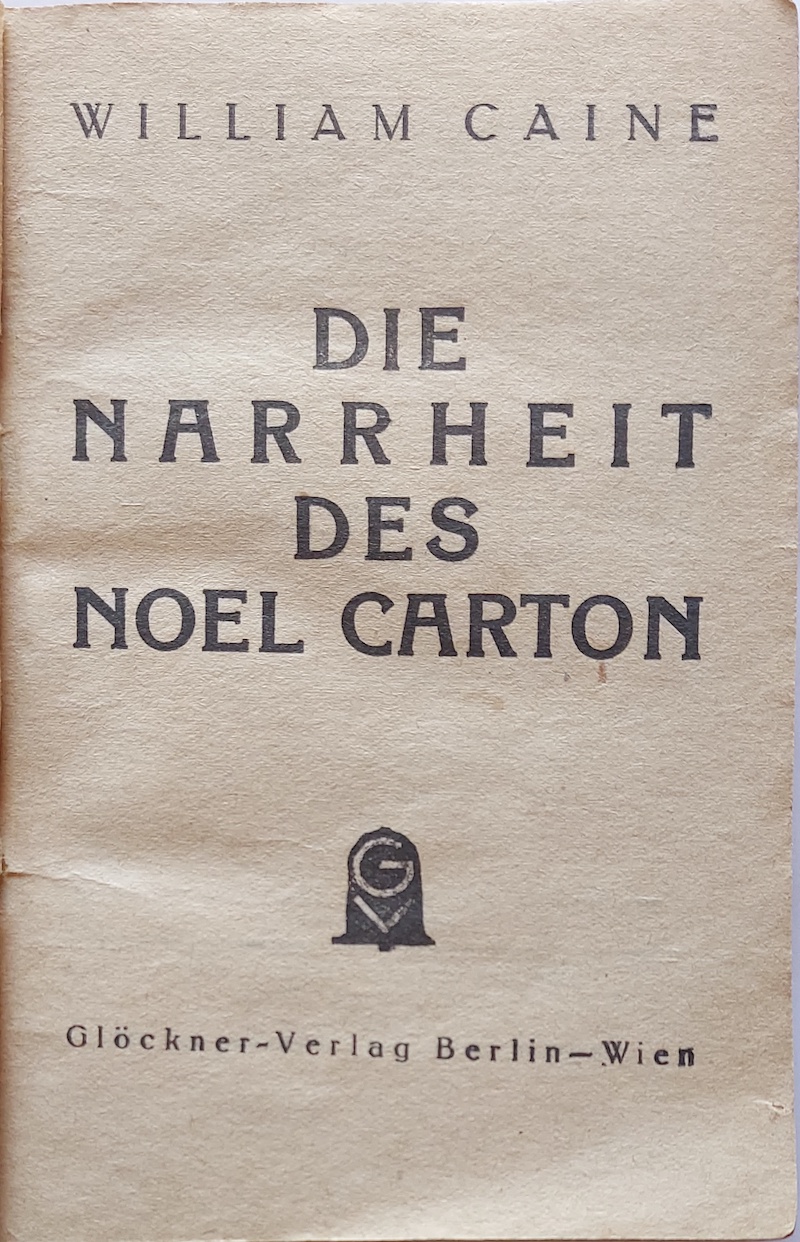
The Seattle Star, Saturday, September 25, 1920, p. 8, “Tabloid Book Reviews.”
The Strangeness of Noel Carton, by William Caine: Comes now the flood of stories dealing with dual personality. This novel relates the experiences of a man who, in attempting to write a novel and keep a diary at the same time, becomes the victim of dual personality. If the hero had taken up china painting at the same time, he might have been the victim of the deadly triple personality!
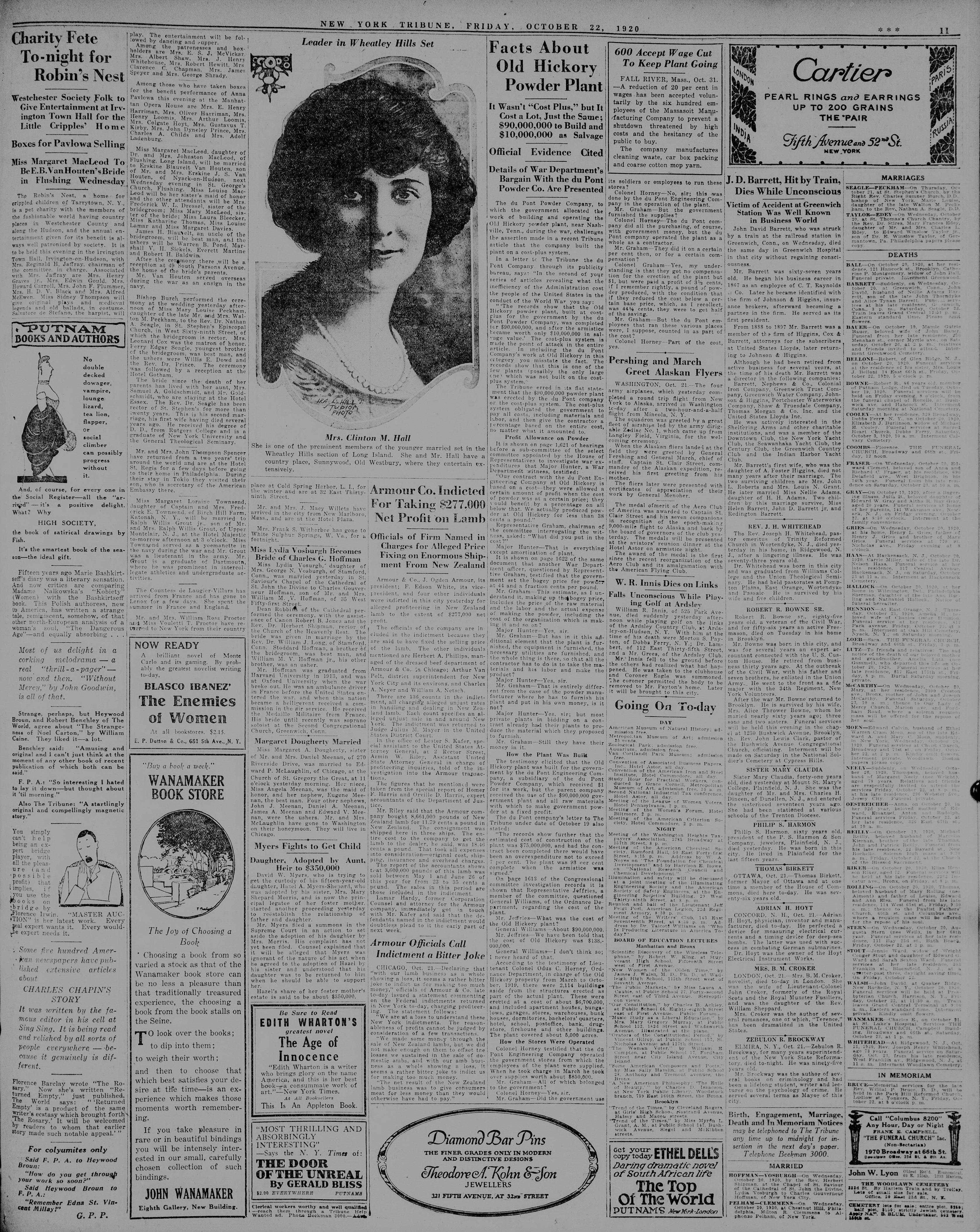
“Putnam Books and Authors. Strange, perhaps, but Heywood Broun and Robert Benchley of The World agree about ‘The Strangeness of Noel Carton,’ by William Caine. They liked it — a lot. Benchley said: ‘Amusing and original and I can’t just think at the moment of any other book of recent publication of which both can be said.’ F. P. A.: ‘So interesting I hated to lay it down — but thought about it ’til morning.’ Also The Tribune: ‘A startlingly original and compellingly magnetic story.’”
New York Tribune, Sunday, September 26, 1920, s. VII, p. 9, “Analysis of a Mind Deranged; The Strangeness of Noel Carton Is a Remarkable Study of Dementia.”
There is no province of fiction more difficult of approach and successful exploration than that of the mind astray, the weird land of dementia. Many a novelist has tried to traverse this country, only to find himself lost in its dismal bogs or snaring thickets.A few, a very few, authors contrive to get through to the fences on the other side, safely and with a fairly reliable chart in their hands. It is a problem of the normal, legal mind interpreting the disordered and illegal mind, and that’s a mighty hard affair to handle triumphantly.
And so for us it is hats off to William Caine, who, in his The Strangeness of Noel Carton (Putnams), has written a novel of the mistly [sic] land of the disordered intellect and, in so doing, has produced a startlingly original and compellingly magnetic story. One has to read but a dozen pages to find himself settled in his chair with a profound desire for oblivion of all else save Noel Carton and the vapory but haunting Nigel Carter.
The Strangeness of Noel Carton is written in the first person. We are introduced at once to Noel and his wife, Josephine, who has “bought him,” a spendthrift, literally with her pounds and shillings, and owns him. He is a mere dog, tied to her wrist. But Noel, who guards in the sanctum of his inner self memories of early aspiration and a love of fair ideals in life and letters, hourly is irked and rebellious under the lash of his wife’s tongue and the sordid meanness of her petty, society-seeking existence. In a moment of flaring scorn — she never understands him — she dares him to write a book, with her inferential challenge that he cannot write up to the level of a servant. And so Noel goes to work to shape the scenario of a story to be written in secret, to be hidden, page by page, in a chimney until finished. He will find nepenthe from chagrin and barb for an arrow in his task with pen and paper.
So far so good, although the read of this novel, if he be ruminative, will scent the unusual in its first chapter. Caine intrigues one at the start, yet it is difficult to tell just why. Noel Carton becomes Nigel Carter, and a girl, the golden-haired Hilda Rundle, strides into the thread of the plot immediately. Noel, in the flesh and tthe [sic] spirit of Nigel, sees in her the dream of his youth, yes, and of his maturing age. Josephine becomes Jocelyn in the shadowy mirroring of weird resemblances, and her sharp tongue and low class manners accentuate for Nigel the lure of Hilda. And so this poor, suffering man Noel, murmuring grievances and at odds with the world, writes out his heart through his imagined simulacrum of himself, Nigel Carter.
Sounds attractive, doesn’t it? But we have merely opened a door an inch or two. You may suspect that Noel is not “quite right.” He isn’t. He is drawn into the region of the unreal made real. His own self merges with that of Nigel. One by one old landmarks fade, disappear. The swirl of the winds around the edges of the Kingdom of Dementia have drawn him over a boundary line. At one moment hs is the living man, Noel Carton. At another he is the phantom of himself, Nigel Carter, desperately in love with Hilda and receiving her smile of kindness and understanding. The streets of London become peopled with men not there in reality. His wife, Josephine, worried by his muttering the name “Jocelyn” and made decisive through his unwonted actions, is frightened and calls in an expert in insanity. Then, like a flash of lightning, unexpected and glaring, comes the final stroke and silence.
The Strangeness of Noel Carton will stand out among the season’s rank and file of fiction, gloomy and lonely its sinister drapery. If read, as it should be, at a single sitting and with the riveted attention it deserves, it will leave a series of pictures in the mind of the reader that will endure for days. For it is a remarkable study in a realm of practically uncharted roads in fiction; yet it has the force of an authentic human experience.
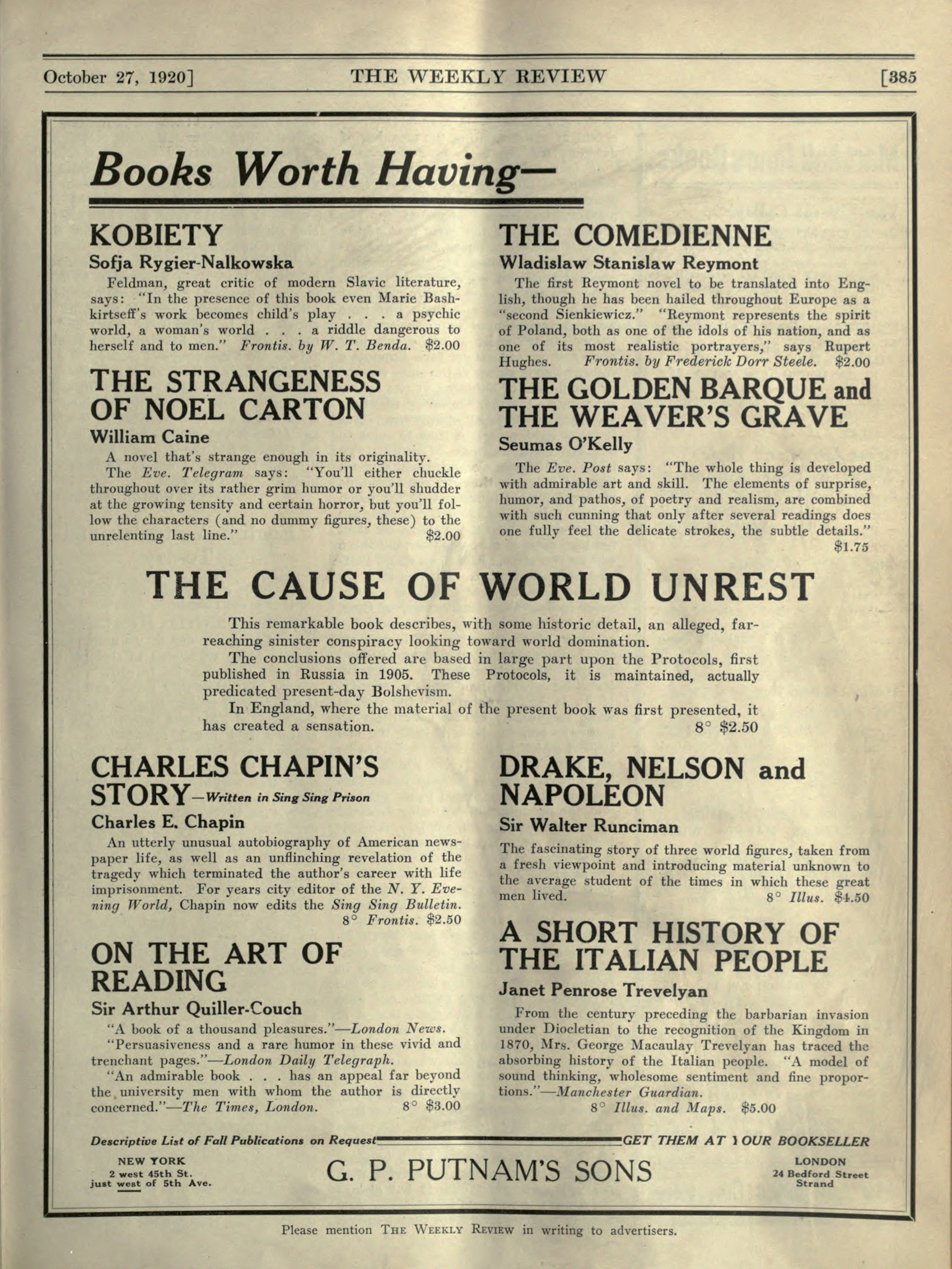
“Books Worth Having — The Strangeness of Noel Carton. William Caine. A novel that’s strange enough in its originality. The Eve. Telegram says: ‘You’ll either chuckle throughout over its rather grim humor or you’ll shudder at the growing tensity and certain horror, but you’ll follow the characters (and no dummy figures, these) to the unrelenting last line.’ $2.00.”
The Detroit Free Press, Saturday, October 2, 1920, p. 17, “Among the New Books; Recent Fiction.”
This is a crazy sort of a novel, yet one the reader is willing to follow to its denouement, once having surmounted the author’s tentative introduction through two frank journal entries, in which he bares his hero’s marital infelicities. Having an insufficient 200 pounds a year, he marries Josephine, who has three thousand, and advises those about to marry money to first secure a millstone about their necks and walk into the millpond. To demonstrate his ability to “do something” he undertakes to write a novel. The fashion in which the journal becomes the novel, the reader’s acute visualization of the several characters, and the apparent gradual lapse of the writer into the madman make this one of the most singular and original books of the season.
St. Louis Post-Dispatch, Saturday Evening, October 16, 1920, p. 6, “Reviews of New Books (Conducted by Otto Heller, Professor of Modern European Literature in Washington University).”
Noel Carton, traditional Englishman of “family” but no means, marries Josephine, daughter of a money lender, who weds in the belief she will attain social position. When Carton’s family promptly drops him after the nuptials, she repents her bargain and spends much of her time with her husband in recrimination. Noel’s life is made almost intolerable, but he frankly admits to himself that he prefers the flesh pots of Egypt, as provided by his wife’s monthly allowance, to facing the world and making his own way.In a jeering mood, his wife tells him he could not even write a story for a servant girls’ magazine, and this inspires him with the idea of secretly writing a novel that will astound the literary world. So, drawing up a stereotyped sort of plot, he commences his task.
From this point, the book alternates between chapters of his novel and tales of what Carton himself is doing. He finds, to his astonishment, that in his absorption he has unconsciously portrayed the characters of those around him and that the character of his hero — which he bases upon himself — is becoming real to him. He also discovers that his heroine, Hilda Rundle, represents all that he considers worth while in feminity [sic], and establishes her as a sort of drem [sic] Galatea. So strong an effect do his characters have upon him that the influence commences to be manifest in his daily life. Unconsciously he takes the attitude with his nagging wife that his hero is supposed to take in similar circumstances, and the results amaze even himself.
Although the reader may be inclined to suspect that he is about to find a Peter Ibbetson sort of atmosphere about the book, there is no indication of this as the tale proceeds. Carton commences to live more and more in imagination with these phantoms of his own creation and finally realizes it. The method he takes to solve the question brings an unexpected termination to the novel
The Boston Globe, Saturday, October 23, 1920, p. 6, “Latest Books; Fiction.”
“The Strangeness of Noel Carton,” by William Caine — is original in conception and cleverly handled. This is the story of a man driven to desperation by his vulgar wife, who, in buying his position, has to accept him with it. To bury himself he decides to write a novel and drawing his characters from life about him finds those characters taking the “bit in their mouths” and acting as he had no intention of having them act. The result provides an absorbing story.
Edmund Lester Pearson, “New Books and Old,” The Weekly Review (New York), October 27, 1920, p. 376.
A few years ago a fresh and original novel appeared with the name “The Irresistible Intruder.” It was by William Caine — a story about a small boy and a group of adults in an English village. Mr. Caine’s new novel, “The Strangeness of Noel Carton” (Putnam), is both enjoyable and curious. Its complicated machinery — for it is a novel within a novel — would be apt to make it artificial, but Mr. Caine has the ability to make even the puppets devised by his puppet hero lively and important enough to keep the reader’s attention.
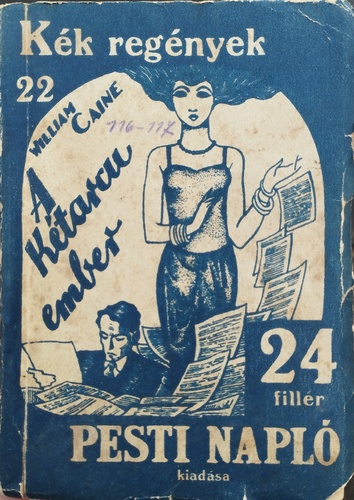
William Caine, A kétarcú ember [The two-faced man]. Fordította [translated by] Wiesner Juliska. Budapest: Pesti Napló, 1930. Kék regények 22 [Blue Novels Series 22]. 192 pp., 15cm x 10cm. Book jacket image from [https://moly.hu/konyvek/william-caine-a-ketarcu-ember].
The Bookman (Harrisburg and New York), November 1920, p. 273, “Some Tabloid Reviews”.
Novelty is the chief qualification of this book, which takes the reader behind the scenes, as it were, and shows him how ’twas done. As the author of the book, as well as the author about whom he writes, became considerably involved in their respective efforts, “strangeness” is an appropriate description. Mr. Caine’s idea of halting after each chapter to describe what his author hero has written and what he is about to write, is something new in literature. Just when it begins to become tiresome, Mr. Caine’s author hero allows his leading character to become so linked with his own life that he not only starts writing the novel-within-a-novel in the first person but apparently meets in real life the characters who were figments of his imagination. When Carton and his imaginary characters seem to trade places, the action grows more intricate until the author (Mr. Caine this time) is finally forced to end the matter by — but never mind how! The ending is startling and yet not entirely unexpected. In a unique combination of diary and straight novelistic construction, Mr. Caine has done something for the novel which one Reizenstein once did for the stage in “On Trial” — he has found a new form.
The Columbia Evening Missourian, Saturday, November 6, 1920, p. 4, “The New Books; Pleasures of an Instane [sic] Husband.”
Insanity must be rather delightful. That is, after the victim is once firmly converted to the cult, stripped of the cumbering clothes of sanity and the garters of convention. It is only the discommoded relatives, intims, acquaintances and wives who grieve over the translation of the object of solicitude from their world of thought and action to another freer realm where one may tell fat clubmen, policemen, waiters and wives what one thinks of them. Or so one gathers from a reading of “The Strangeness of Noel Carton” wherein William Caine reveals in diary form the mind-wrecking effect of novel-writing upon a London husband who sold himself to a Jewish frump to insure meals, tobacco and tailor and club privileges for himself.Noel Carton hates his wife. His wife hates him. She goads him daily. By chance she says that he has not mind enough to write for a servants’ magazine. It must be that a servants’ magazine is something very awful for Noel is much exercised by this remark. It affects him to such an extent that he spends some of his wife’s money for “look-up” [sic] book and, half-seriously, half whimsically, he sets out to write a Novel and to keep a Journal — to be a Man o Letters. His novel-writing and his Journal-keeping, and his drug-taking, coupled with the parallel between his married life and the married life of his hero, soon become hopelessly mixed up. He confuses characters in his Novel with people on the street; tries to dream the chapters of the book; recognises the brother of the heroine on a walk in a London park and speaks to him, thereby grievously disconcerting a passing governess. Trailed by a detective who has been put on his trail by the Novel—wife [sic], or, more presumably, by his real wife, he goes down to Paddington station to meet his heroine. After meeting three trains a day for a week or so he meets the novel-heroine, takes her to tea, talks to her and all that. He goes roaming in the suburbs; swims in a lake; rests in the wood; the heroine comes to him and they kiss each other quite satisfactorily. The heroine without further kissing or talk drifts off through the trees and Noel hurries home to put it down in the diary. Being an Englishman and not a Frenchman or a New Yorker, he must have a scene with his wife. She has started divorce proceedings. The last few paragraphs of the diary indicate that this family scene was a trifle depressing for the wife.
As entertainment “The Strange Case [sic] of Noel Carton” will please unhappily married husbands by its sympathetic tone. It will intriuge [sic] writers by its analysis of the methods of novel-writing and the maelstrom into which characters of a book can suck their creator. For others the book will have a fascination. The audacity of expression, the conversational freshness of the writing, and the skillful portrayal of the wrowth [sic] of insanity will hold the readers’ eyes to the pages through out.
If you like devilish humor, seasoned with plot, read this book. Read it once and you will keep it by for future evenings.
The Sunday Star (Washington, DC), November 7, 1920, pt. 3, p. 4, “Reviews of New Books.”
One becomes deeply absorbed in the hero of this tale, Noel Carton, who decides to become a man of letter, a novelist. First, like all good novelists, he hits upon a plot. Then it occurs to him that a journal, faithfully kept, might prove a useful reservoir of fact and suggestion from which to draw for the development of his novel. Gradually he gets lost in his literary creation, becoming to all intents and purposes the hero of the tale, Nigel Carter. The journal and the novel become as inextricably tangled as do the author and his hero. And the reader, too, finds himself unable to keep the two separate and distinct. He finds himself also in the strange current of imaginary things, things that are diverting this man of letters from the plain and sane walks of life. A curiously vigorous and ingenious treatment of a highly original plot.
Title page image from [https://www.antikvarium.hu/konyv/william-caine-a-ketarcu-ember-869008-0].
Portland Evening Express & Advertiser (Portland, Maine), Saturday, November 20, 1920, p. 12, “Chat of Books and Writers; The Strangeness of Noel Carton.”
A story as unusual in its conception as it is remarkable in its handling, is The Strangeness of Noel Carton, by William Caine. The plot is very original, the idea being unique and the way in which the author works it out is as surprising as is the plot itself. Noel Carton, the hero has married a rich but vulgar little wife, in fact he has been bought and paid for by a common, vulgar woman. Driven to a frenzy by his position, he determines to forget his trouble by writing a novel. At the same time, he decides to keep a secret journal; to this journal he tells all of his troubles. The novel he decides shall be a story of his life but at the same time he determines to draw his characters in such a way that his wife will never suspect that the story is a story of his life and of hers. Her name is Josephine. He names the heroine of his book Jocelyn; his name is Noel Carton, he makes the hero of his novel Nigel Carter. He then begins writing the things into his story that have made him suffer through his married life. In doing this he works up a considerable plot. In writing his story he works for a while on the story, then he writes of himself in the journal. In the end he gets the story and his own life so mixed that he becomes unbalanced and confuses his wife and the heroine of his story. In order to stimulate his imagination, he has resorted to morphia. The habit grows upon him and in the end he becomes the victim of hallucinations. The reader is bewildered by the mixup and in the end finds himself wondering which is Noel, which is Nigel; which is Josephine and which is Jocelyn.
The Brooklyn Daily Eagle, Saturday, November 27, 1920, p. 5, “A Becky Sharp from Canada; A Wide Range of Friction [sic?]; Here Is a Fictional ‘Nut.’”
When William Caine wrote “The Strangeness of Noel Carton” (Putnam) he proved that he possesses something more than a mere suspicion of the literary gift, but of his hero he undoubtedly made a literary “nut,” as this slang word is understood in this country. It is satire, cynicism, romance and tragedy combined in a harmless output, with occasions for considerable amusement. As an incident of the story the slang used in polite English society is exposed as something even worse than the American brand of the same article.Noel hates his wife, Josephine, a rich Jewess, because she bought him and is paying for him with monthly checks and three square meals a day. He meets Hilda, the fiancee of his friend, Roland, and at once begins to dream what happiness would be his if he coul [sic] only capture Hilda and get rid of Josephine. In his dreaming he visions a plot for a novel. Novelists will linger at this point, some with chuckles, no doubt, when he discovers that some of his characters are drawn from subconscious memory. In that way Nigel, his hero, is Noel himself slightly disguised in looks, and Jocelyn, his heroine, is his own wife. He has made a journal of his own life, especially of his hatred of his wealthy, patronizing marital partner, and on this journal he plans to lay the scenes of his novel, but before he has gone far he is stunted for ideas, and night dreams evolve a wonderful plot in sympathy with his waking wishes. Nigel twice saves Hilda’s life, thus tying her to him with silken cords of gratitude. Hilda breaks her word to her fiance, and she then falls into Nigel’s arms like a ripe fruit from the peach tree of love. By this time Noel is a hopeless “nut,” and when the reader reaches the end of the story he will probably think he is standing on the threshold of an asylum for the insane.
W. H. Chesson, “Reviews,” Occult Review, vol. XXXII, no. 6, December 1920, p. 379.
Originality, mystery, an intellectual something to tease yet please the reader — these recommendations to perusal are not common, and they are offered by this peculiar novel. Told in the first person by a gentleman tied by a loveless marriage for money, it indicates the possibility of imagination becoming confused with reality by a process which may be defined as the externalization of one’s dreams. One thing is clear: Noel Carton sets before us the harmony of love and the discord of contempt, ecstatic craziness and the criminality of despair. Page 261, consisting solely of reiterated “ha ha’s,” is worthy of Sterne’s irresistible humour; but, whatever the book is, it is not a cliché but a live, enjoyable work of art.
The Indianapolis News, Monday, December 6, 1920, p. 14, “With the Books and Writers; ‘The Strangeness of Noel Carton.’”
“The Strangeness of Noel Carton,” by William Caine, is fascinating. Carton has married a vulgar woman, who has driven him to the verge of desperation. She finally taunts him by saying he can’t even write a story fit for a servant’s magazine. He sets out to write a novel. He keeps a journal, in which he makes comments on his book, but the novel becomes an obsession with him, and the two get inextricably mixed up. Carton suffers from insomnia, and between that disease and his vulgar wife his mind becomes unhinged. The climax is dramatic. The book is well worth reading. The atmosphere of abnormality is cleverly drawn. The reader feels Carton’s impending mental crisis. The end is worthy of Poe.
The Deseret News (Salt Lake City, Utah), Saturday, December 11, 1920, s. 4, p. 4, “Literature; New Books; A Study in Madness.”
William Caine presumably is an Englishman, because he spells favor with a “u;” he writes fluently about “old top,” “tuppence ha’ penny,” “Charing Cross” and generally scatters some weird English idioms throughout his study of a man going mad. This he has called “The Strangeness of Noel Carton.” However, once in so often some good old American slang creeps in — all of which may be charged up to the American invasion of the Tight Little Isle subsequent to the war. The characters the reader is introduced to are hardly inspiring, while the plot is involved, so much that it is debatable whether this latest contribution from the publisher is a strikingly original story or just the inextricably entangled and jangled scribblings of a drug addict. The story starts out with plenty of vim and humor of an acquired taste but ere the end is reached the reader perforce lays down the book sadly, or maybe frantically, with a muddled suspicion that either he or the author is going crazy — perhaps this is art. Noel Carton, a desperate little bow-legged, rabbit-toothed aristocratic cad, has married a vulgar little wife, who in buying his position is forced to accept him with it. This little Jewess taunts him with his worthlessness and avers that he could not write a story a household maid would read. Carton opines he could, and proceeds to demonstrate. At the same time he elects to keep a secret journal. In his novel he subconsciously draws the portraits of the living people surrounding him, including the wife. Then he gets both the journal and the novel tangled up — it gets worse and worse. Finally he strangles his wife! Surely, a nice cheerful gift book.
H. W. Boynton, “For the Light Reader,” The Weekly Review (New York), December 15, 1920, p. 598.
“The Strangeness of Noel Carton” is a new turn: an eccentric comedy with a novel and ingenious idea. The hero and chronicler is a bored British Johnny who has married a rich and disagreeable woman and seeks recreation in the simultaneous writing of a diary and novel. These records become quaintly mingled as time goes on, with effects disconcerting to our addle-pated chronicler and the world in which he gyrates. If anyone cared to assure me that this yarn and “Double Life” [by Grant Richards, reviewed earlier in the piece] are trash, I shouldn’t have the front to dispute him — until he has defined the word, at least. Meanwhile I suspect there is more virtue in them than in most of the sour or pretentious or haphazard documents gravely set before us under the name of novel. They do what they set out to do; and people who are too heavy-minded for such entertainment, for story-telling of the elder and timeless sort, many [sic] easily find their account elsewhere.
Samuel Abbott, “London Is an Inexhaustible field for the Novelist; Noel Carton’s Strangeness,” New York Tribune, December 19, 1920, s. VII, p. 10.
The wanderings and stumbles of a mind astray should daunt any writer of fiction. They have no insurmountable obstacles for William Caine who, in his The Strangeness of Noel Carton (Putnam), has contributed to the cohorts of novels of 1920 one of their wildest, weirdest members. This is a book that gradually drives one into the swirl of its mad maelstrom, into the seethe of an intellect that has lost all the bearings of its original self and become merged in the woes and the hopes of another being conjured up from the disordered dreams of its own sick mind. There is a precision in this book, in places of London that occur and in milestones in the mental journey of Noel Carton, over to the apparition of Nigel Carter, that imbues this strange novel with a power of haunting reality. When one closes this excursion into the land of Dementia he is ready to jump the nearest fence and clear for the hills of Sanity.
Mary Katherine Reely and Pauline H. Rich, editors, with descriptive notes by Emma Heller Schumm and others, The Book Review Digest. Sixteenth Annual Cumulation. Reviews of 1920 Books. New York: H. W. Wilson, February 1921, p. 84.
This is not exactly a story within a story but rather two stories so interwoven and fused that in the end they are not distinguishable apart. They are both written in the first person by Noel Carton and one is his journal and the other the novel he writes because his wife has said he couldn’t do it. This wife he hates for her crudity and smallness, altho he has sold himself to her for the home and comforts she gives him. In his novel he unconsciously portrays himself and his wife Josephine as his main characters, Nigel and Jocelyn. As he becomes absorbed in his plot, and as he takes more and more powerful drugs in his fight against insomnia, it is increasingly difficult for him to distinguish between the real of his life and the unreal of his fancy. The climax comes when his hallucinations give way to madness, and the tragedy of his novel is carried out in real life.[Entry also includes a quote from a review in the New York Evening Post, September 25, 1920, p. 9, which I have not been able to find: “The book is original and exceedingly well done.”]
Benjamin De Casseres, “The Blue Law and the Wrinkled Mirror; The Great Flaherty Case,” Judge (New York), vol. 80, no. 2058, April 9, 1921, p. 30.
Noel Carton took his usual does of aspirin, but he couldn’t sleep. He was writing his best seller and the plot got mixed up with his journal, which he kept secretly hidden in the cold, cold stove with his aspirin needles.Hilda and Nigel entered the following afternoon. Noel had disappeared. Three cents lay in the card table. A pair of high heel shoes stood stock still on the icebox. A cat purred.
Cousin David flew in his Ford toward the Aquarium. The subways were packed to the straps. Not a psychologist moved. There was a nip or two in the air. Many bonded investments could be seen through colored windows.
“Blast him! Blast him!” howled Noel as he entered the club on the arm of the Duchess, who up until that time had not noticed the state of the weather. “For God’s sake! Come along!” murmured Ike the darkey, hidden behind the lingeries in the reception room.
Two chapters elapsed. Let us return to Lugg, a small town in the Oranges. It was fascinating, though all the lights were out. “Why not?” It was Kraut that murmured this. The pince-nez fell as the portcullis rose. Kraut started. It was only a Staten Island ferryboat coming into the Battery.
But Clarence, the Super-Eye of the Force, sat quietly in Hollywood reading his Judge. It was “Lenso” that gave him the tip. He was off like a flash.
And it was in this wise that “The Strangeness of Noel Carton” (G. P. Putnam’s Sons) came to be writ by William Caine.
Joseph Collins, “Lunatics of Literature,” The North American Review, vol. 218, no. 814, September 1923, pp. 378–379.
In interesting contrast with this story [by Georges Duhamel] is an English novel published shortly before Midnight Confession, by a writer who has not achieved any great vogue in America, Mr. William Caine. It is called The Strangeness of Noel Carton. A young man who has married a vulgar woman for money, will keep a diary and write a novel. He creates ideal individuals to hate and to love. In his fiction he cuts an irresistible figure, instead of the drab and contemptible one of real life. Most of his heroics are suggested and developed in dreams, but gradually he ceases to differentiate between dream work and conscious production. Soon he identifies persons in the flesh with his imaginary creations, and carries on with the latter in his actions. This prompts his wife to suspect his sanity. He discovers the draft of a letter from her to her solicitor which convinces him that he is going to be confined to a madhouse. The wife enters the room and he shoots her with a loaded pistol which he has discovered in her desk.Were it possible for a writer to depict an insane person who did not display any features of insanity, Mr. Caine should have succeeded with this novel. Noel Carton was strange, but he was not insane. His flight from reality was an interesting experiment. It was an index of sanity to have undertaken it.
[Article reprinted as chapter 18 of: Joseph Collins, Taking the Literary Pulse. Psychological Studies of Life and Letters. New York: George H. Doran Co., 1924, pp. 304–317.]

Mendoza and a Little Lady, by William Caine. London and New York: G. P. Putnam’s Sons. 287 pages, 8º. November 1921.
London and New York: G. P. Putnam’s Sons. 287 pages, 8º. November 1921. [Despite date of 1922 indicated on title page. ECB 1921: 43; ECB 1921–1925: 251].
Leipzig: Bernhard Tauchnitz. Collection of British and American Authors, vol. 4566. 295 pages, 16º. December 1921. Dedicated “To H. M. Bateman.”
The Times Literary Supplement, November 3, 1921, p. 718, “New Books and Reprints; Fiction.”
The art of book-making as here revealed by Mr. Caine is a simple matter indeed. There are two kinds of men only, artists and the others. The artists are all men (or women) of genius, and likewise heroes. The others are critics, collectors, and connoisseurs; likewise villains. Life consists in the persistent endeavour of the collector-villain to exploit the artist-hero; the collector, it need not be said, is tediously rich, the artist monotonously poor. If the latter has any money, he puts it all in a bank that goes smash, or leaves his studio door invitingly open for the nearest thief to walk in. This, of course, gives him the opportunity for displaying the uncomplaining fortitude, self-effacing devotion, generous humanity, &c., which Mr. Caine evidently believes go naturally hand in hand with an artistic temperament. Those who share this illusion will be glad to hear that all comes right in the end; the exploiters are discomfited, whilst the people of genius, fame and fortune assured, sort themselves out into happy couples and guardians of more than avuncular benevolence.
Punch, or The London Charivari, November 23, 1921, p. 420, “Our Booking-Office.”
When Mr. William Caine comes off he is very amusing indeed, but he intersperses among his good things rather loose lumps of careless stuff, not a little boring, which suggest either an uncritical mind or an insensitive artistic conscience; that is to say, he he may know — he probably does — but he doesn’t care. Mendoza and a Little Lady (Putnam) is (as Sir Arthur Quiller-Couch won’t allow me to say) a case in point. Mendoza is the greatest of all living caricaturists; the little lady, Ottilie Wigmore, is a modern Beardsley, who can draw a young lady and thirteen Pekinese spaniels (or what not) on the space of half a postcard; Adkin is an overwhelming genius among illustrators; and all this talent is recklessly flung at one by the author. There are two collectors, both villains, as collectors seen through the eyes of artists are all apt to be. The sleeker and astuter of them, who may well be a malicious caricature of a late-Victorian figure, grows rich and fat by exploiting young and callow genius. The mixture is stirred and the result quite reasonably light and palatable.

Richard King, “With Silent Friends; A Charming Story,” The Tatler, no. 1066, November 30, 1921, p. 298.
Mr. William Caine has written a delightful fantasy — or perhaps, I should call it “a fairy tale in a moderns setting” — in his new novel, “Mendoza and a Little Lady” (Putnam). And yet, I don’t quite know why I should call it a “fairy story.” In life, it does happen sometimes that young, struggling artists achieve fame and fortune before they are too old to enjoy either; they do triumph over the machinations of those who wish merely to exploit them; there are middle-aged men who shower upon the women they love all the gifts which are theirs to give, while, at the same time, realizing that they are too old to link their lives to theirs by marriage. These things happen in Mr. Caine’s charming tale, and because they happen just at the right moment, it reads too much like a lovely fairy story to be quite true to common experience. But it is a delightful love-story of Chelsea artists, poor geniuses, who live so happily on their art and on their hopes. To them, life, in spite of its hardships, is like some wonderfully thrilling story vividly told. And in Mendoza, the rich Spanish artist, Ottilie Wigmore, and Raymond Adkin, whom she marries, Mr. Caine has given us three people whom it is a positive delight to meet.
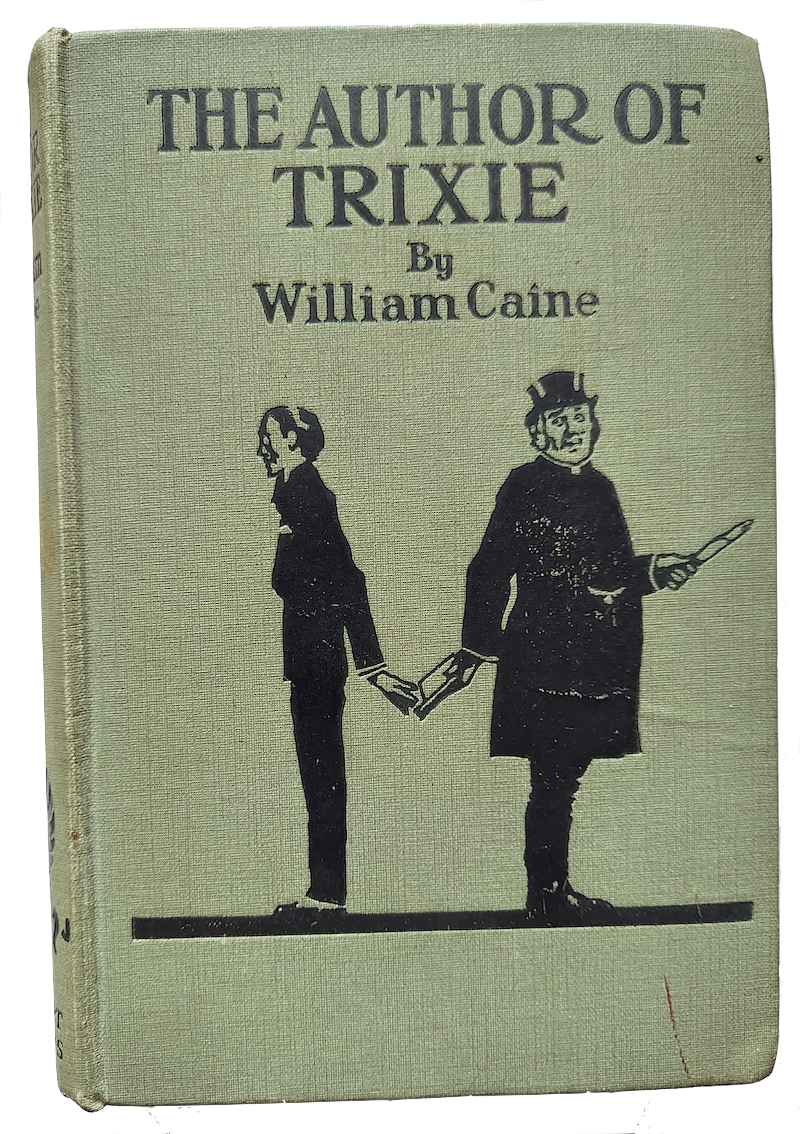
The Author of “Trixie”, by William Caine. London: Herbert Jenkins. 247 pages, 8º. October 1923.
London: Herbert Jenkins. 247 pages, 8º. October 1923. [Despite date of MCMXXIV indicated on title page. ECB 1923: 58; ECB 1921–1925: 251].
Leipzig: Bernhard Tauchnitz. Collection of British and American Authors, vol. 4647. 256 pages, 16º. August 1924.
London: Herbert Jenkins. 247 pages, 8º. Cheap edition. June 1927. [ECB 1926–1930: 259].
Trixie. Der Roman eines Romans. München: Georg Müller. Georg Müllers Kriminalromane. Berechtige Übersetzung aus dem Englischen von A. W. Freund. 183 pages, 8º. 1928.
Anonim. Powieść. Warszawa: Bibljoteka Groszowa. 1930. 182 pages, 16 x 12 cm. [BP 1901–1939, 3: 524]. Available online at polona.pl.
Qui a écrit “Trixie”?. Paris: Aux Feuillantines. Traduction et postface par Hervé Lavergne. Préface par Olivier Barrot. 196 pages, 160 x 240 mm. October 2023.
Daily Chronicle, Saturday, October 27, 1923, p. 4, “The Miscellany; For Week-End Reading.”
“Buck up! What the dickens do you think you’re doing boozing port here with the governor?”
“Tuck in your shirt, old plum,” responded Dunkle amiably. “I’ve been fixing things with your father — about us, you know. He’s going to stand you seven hundred a year, settled, and we’re to be married just as soon as you say.”
“Oh, are we?” she said. “Well, see here: unless you’re out of this and into the car inside of three seconds you can wash me out of any arrangements you may be making for the future.”
This is the way of a modern maid with a man. Dunkle is a poet, she is an Archdeacon’s daughter, and Dunkle’s arrangement with the venerable dad is to be known as the author of a novel which the Archdeacon has inadvertently written and is afraid to publish.
How the novel proves a best-seller, how the Archdeacon wanted to claim fame and was restrained providentially, and how literary complications beset Dunkle, is all set down with a full disregard for the truth by Mr. William Caine in “The Author of ‘Trixie’” (Jenkins, 3s. 6d.). It is a joyous story for a wet Sunday afternoon.
The Times Literary Supplement, Thursday, November 8, 1923, p. 752, “New Books and Reprints; Fiction.”
The author of “Trixie” was an Archdeacon. He wrote a novel so supremely bad that it sold better than any best seller in history. Unfortunately for him he wrote it under the name of his son-in-law, a decadent poet, who with his wife, a detestable young woman, proceeded at once to blackmail him and to batten on his royalties. There followed a rather long-winded and elaborate game of bluff between the two sides which ended in the Archdeacon being made a Bishop and renouncing all claims to the fame and the interviewing and the photographs in the illustrated papers for which he had so pathetically pined. The story, so intentionally preposterous, should be written lightly and pleasantly, and that is where Mr. Caine fails.

“Ready Mid-October. The Author of Trixie. ‘Everybody has, at least, one novel in him,’ and an Archdeacon puts this theory to the test. He writes what proves to be a ‘best seller,’ but Archidiaconal dignity necessitates anonymity, and yet…! By William Caine. 3s. 6d. net.”
The Reader, “Our Literary Letter; Spirits and Other Things; Fiction,” The Manchester Evening News, Saturday, November 24, 1923, p. 6.
Messrs. Herbert Jenkins, Ltd., have issued another batch of fiction of a popular order, and their latest list caters for everybody. There are the stirring tales of the Far West like “The Westerner,” by Luke Allan, a book which deals with prairie life and Canadian adventures; “The Man Who Wasn’t,” by George Goodchild, which is quite up to the author’s reputation for Klondyke yarns; and a variety of others, including “Watchman, What of the Dawn?” by Munro Faure, an unusual story of an Egyptian Princess and a chest; “Helen of London,” a powerful story by John Goodwin, dealing with a dual personality; “The Battle of London,” by Hugh Addison, which deals with the fight against Bolshevism, and “The Author of Trixie,” by William Caine, which is an amusing story concerning an archdeacon’s essay into fiction.
The Scotsman, Monday, November 26, 1923, p. 3, “Current Literature; New Fiction.”
Anonymous letters ought to go into the waste-paper basket for reconstructive purposes, but anonymous novels are sometimes best sellers in this wicked world; and Mr. William Caine’s amusing story, The Author of “Trixie” (3s. 6d. net. London: Jenkins), sets out a diverting comedy of the embarrassment of an author who persuades somebody else to shoulder the responsibility for a successful novel. He is a dignified clergyman of the Anglican Church; and the presumption is, of course, that he has a conscience. But that is not the question. He has wealth and a marriageable daughter, and the purely literary considerations that corruscate throughout the tale are in the event sordidly submerged.
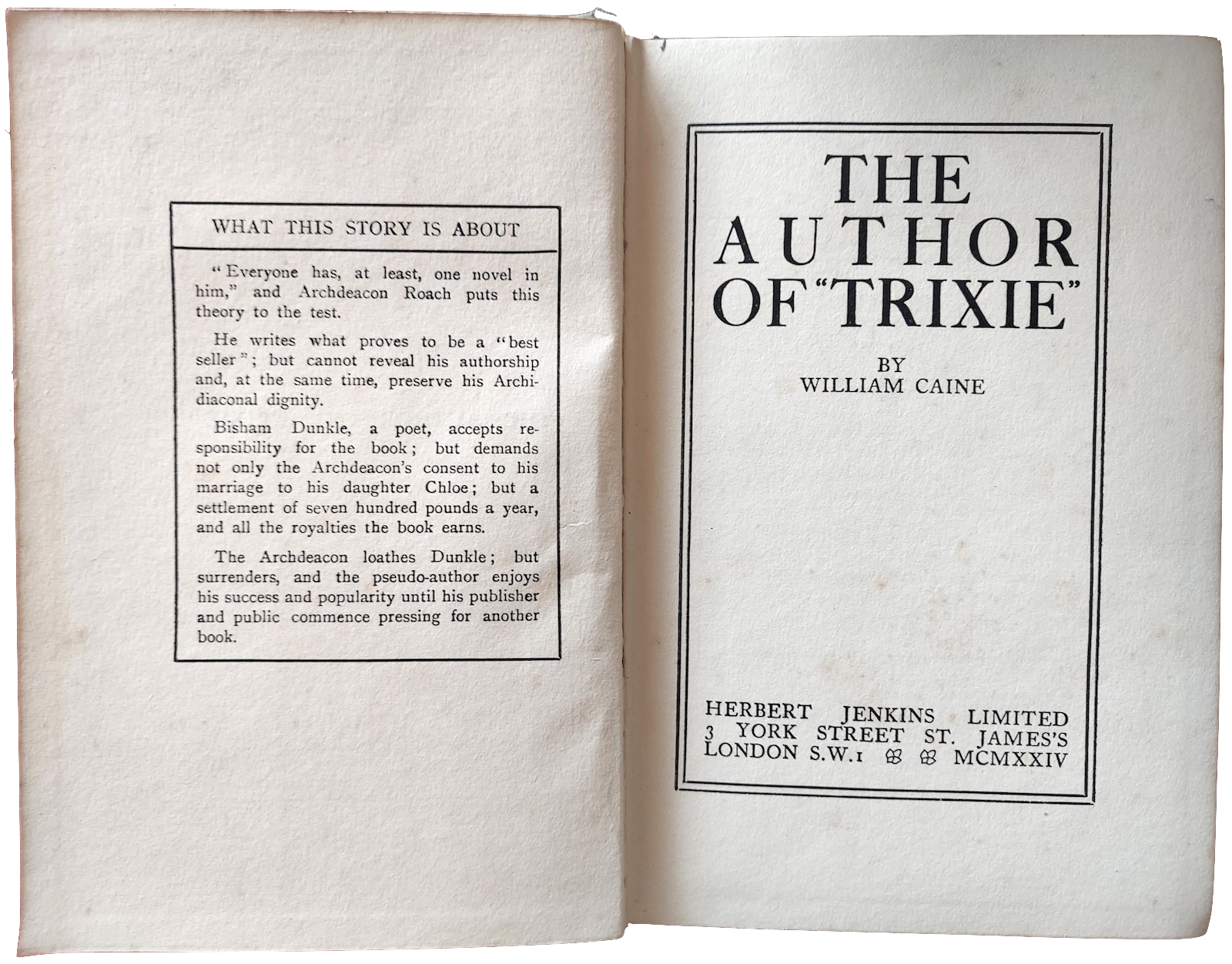
Aberdeen Press and Journal, Tuesday, December 11, 1923, p. 2, “The Christmas Bookshelf; Novels.”
“The Records of Reggie,” by A. A. Thomson (Herbert Jenkins, 7s 6d), recounts the humorous adventures of a young man in his serious but ludicrous efforts to obtain work. A self-confessed “ass,” he finds himself in the queerest situations. Although there is a distinctly musty flavour about him, he provides many a hearty laugh from his impersonation of the son of a confectionery king to his role of peacemaker between conflicting neighbours or his self-imposed duty of match-maker at a friend’s party. Equally amusing would be “The Author of Trixie,” by William Caine (Herbert Jenkins, 3s 6d), were it not for its constant repetition of inane forms of address. On the assumption that every man has at least one novel in him, Archdeacon Roach writes the plot of “Trixie,” but fears to acknowledge its authorship, and bribes a hack-poet, who afterwards marries his daughter, to accept responsibility for it.
Plomer, “Books & Bookmen; Farce and Humour,” The Sporting Times, January 26, 1924, p. 6.
An author who dissociated himself from his book because, being an Archdeacon, the book was not in keeping with his sacerdotal position; who hands it over to a minor — a very minor and erotic poet — and with it his daughter, an allowance, and all the unexpected profits made out of the book, provides Mr. William Caine with the idea of “The Author of Trixie.”Mr. Caine is a humorist of the highest class. There is no straining or labouring about his work; it all comes along in apparent sequence. But it romps home with frolic and fun, every stage of the story having its own jest. Like “Trixie,” it ought to prove a best-seller.
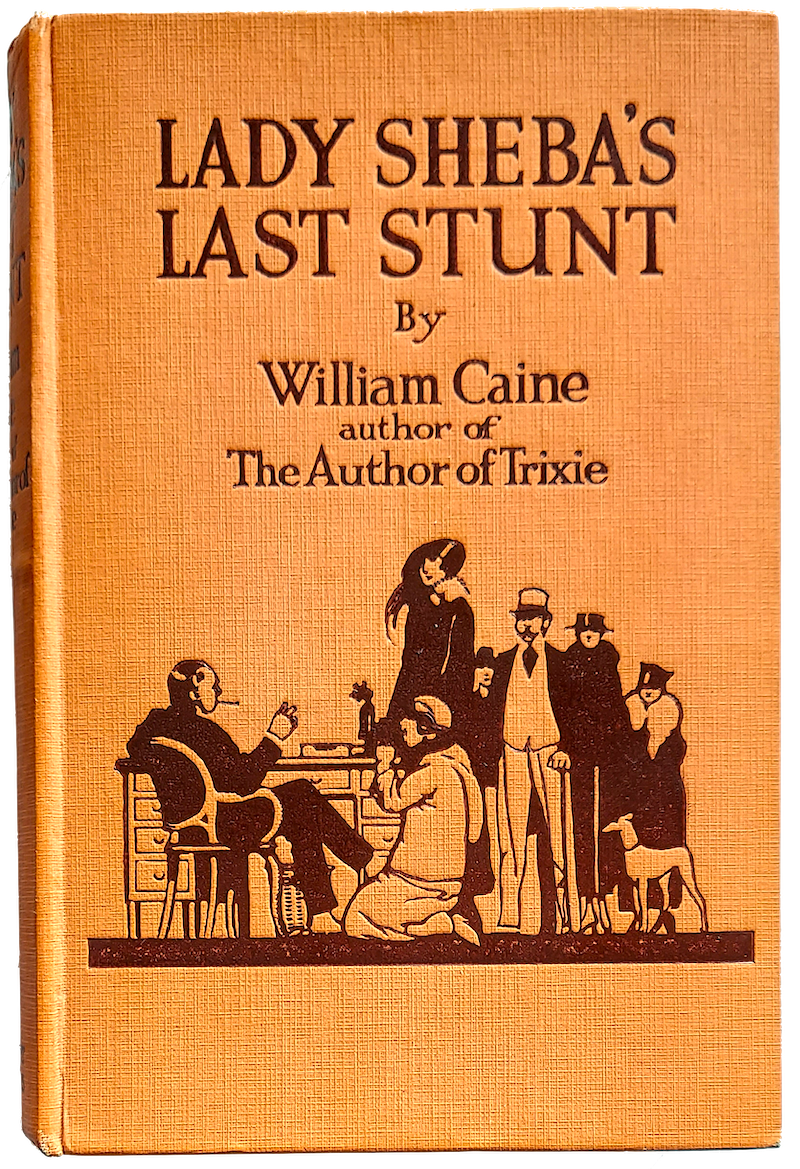
Lady Sheba’s Last Stunt, by William Caine, author of The Author of Trixie. London: Herbert Jenkins. 251 pages, 8º. November 1924.
London: Herbert Jenkins. 251 pages, 8º. November 1924. [ECB 1921–1925: 251].
Leipzig: Bernhard Tauchnitz. Collection of British and American Authors, vol. 4679. 264 pages, 16º. March 1925.
London: Herbert Jenkins. 251 pages, 8º. Cheap edition. April 1927. [ECB 1926–1930: 259].
Lady Shebas letzter Trick. Berlin–Wien: Glöckner Verlag. Glöckner-Bücher 37. Berechtigte Übertragung aus dem Englischen von A. W. Freund. Titelbild und Illustrationen von Michael Biró. 250 pages, 16º. October 1929. [ÖVG 2: 295]. [The text of the translation of Caine’s novel runs pp. 5–238. Pages 239–250 consists of Joe Pym und sein Schiff, die gute alte „Mary Snow“, von Hans Sudet.]
The Times Literary Supplement, Thursday, December 4, 1924, p. 828, “New Books and Reprints; Fiction.”
[Page 828 in the Gale Primary Sources database for the TLS is missing; instead, there is a doublet of page 827. Advertised in same issue, page 821.]
The Daily Telegraph, Tuesday, December 9, 1924, p. 4, “Books of the Day; New Novels.”
If ever Mr. William Caine finds the tide of literary success on the wane — an extremely improbable event, by the way — he might with profit turn his attention to that modern profession the members of which are known by the expressive description, “publicity merchants.” The experienced newspaper sub-editor is ever on the watch that he may not fall into the net spread for him by these clever gentlemen. Generally he succeeds. Sometimes he does not. And if Mr. Caine took a hand in the game the risks for falling would reach the uninsurable point.For Bird Hoot, the moving spirit in this very amusing book, is a very prince of “stunt planters.” Learning that Lady Sheba Sangsue, the 17-year-old daughter of the Earl of Boyze, had “damned the skin” of the Master of the Quorn, he decided that here was the woman for his money, and within a very short time his client was the most-talked-of lady in England. The noble Earl looked on in agonised apprehension as the stream of publicity swept higher and stronger around his hopeful offspring, but the Lady Sheba was a dutiful child. There was money in these “stunts.” Mr. Hoot saw to that. The Earl got his share. And he needed money badly. Lady Sheba’s last stunt was her undoing. It concerned the manuscript of a highly scandalous volume of memoirs which it had never been intended to publish. Unfortunately the manuscript got lost, and the finder was a match for Mr. Bird Hoot and the lady as well. Quite an appreciable portion of society paid him at the rate of £4,000 apiece for the destruction of the terrible document, and the publication of Lady Sheba’s actual autobiography was such an anti-climax that she took refuge in marriage with the boss of all the “boot-leggers.” The story is real good fun from beginning to end.
[Reprinted in The North China Herald (Shanghai), January 24, 1925, p. 162, “The Book Page.”]
Aberdeen Press and Journal, Wednesday, December 10, 1924, p. 2, “Some New Novels.”
A Jenkins publication, “Lady Sheba’s Last Stunt” (3/6), by William Caine, contains a number of amusing situations and irrepressible fun. Lady Sheba is a young damsel usually in the limelight of public criticism, but her “last stunt,” the writing of her memoirs, condemns her forever to the shadows.
The Sheffield Daily Independent, Wednesday, December 10, 1924, p. 7, “The Bookshelf; New Fiction; Published in Eight Languages.”
When the publishers claim that “Lady Sheba’s Last Stunt” is a book of “irresistible fun” they are speaking words of truth. A burlesque and caricature of Society life in England and also of American manners, the story is delightfully funny, with a laugh on every page. At first the reader may not care for Mr. Caine’s brand of humour, but he has to succumb to it sooner or later, and the last chapter will leave him in a state of helpless laughter.The story concerns one Lady Sheba, who early in life learned the value of publicity. When she wrote her memoirs the publisher refused to print them, as they were too scandalous. The manuscript was stolen, and an enterprising and original blackmailer had a good time extracting money from Society people mentioned in the memoirs. No synopsis, however, can do justice to this amusing book.
Sheffield Daily Telegraph, Thursday, December 11, 1924, p. 5, “Books of the Season; Fiction; Roaring Satire.”
An impudent society girl, with a mania for self-advertisement and the financial profits attaching thereto; a sponging and impoverished nobleman, her father; a bounder from the States, her Press agent; a raw and rampant plutocrat, also from the States, her suitor; an incompetent publisher; an efficient and humorous blackmailer — who more likely to handle such a team with skill than Mr. William Caine? In “Lady Sheba’s Last Stunt” (Jenkins, 3s. 6d. net) he does handle them with skill, and drives them at a furious pace. The “stunt” is Lady Sheba’s memoirs, packed with gross libels upon the entire Peerage, and seized by the expert blackmailer when still in MS. It is a wild and whirling extravaganza, but we have found it as amusing as it is extravagant.

“Lady Sheba’s Last Stunt. By William Caine. A novel of amusing situations and irresponsible fun. 3/6 net.”
Punch, or The London Charivari, January 7, 1925, “Our Booking-Office,” p. 28.
More than once Mr. William Caine has given me good entertainment, and so I was a little depressed when, after reading the opening pages of Lady Sheba’s Last Stunt (Jenkins), I found him more facetious than funny. However, when once his engine is warmed up he supplies his readers with situations of which the humour is well up to the standard of their improbability. In her search for notoriety the much-advertised Lady Sheba decided to accept the request of a publisher and write her memoirs. Young though she was, her knowledge of Society scandals was peculiar, and when her knowledge failed her she was prepared to draw upon her imagination. Her publicity agent, an ingenious person called Bird Hoot, saw to it that these memoirs should be boomed as no book has ever been boomed. Society, with reason, was terribly alarmed. Duchesses, earls and dozens of smaller fry rushed to the publisher’s office and offered to pay thousands of pounds to have their names omitted from this devastating volume. Funny as these scenes are to read I believe they would be even funnier if adequately acted.
Gerald Gould, “Adventures of All Sorts; Shrugs and Smiles,” The Daily News, Monday, January 12, 1925, p. 8.
Mr. William Caine is an old and good hand at riotous farce. His account of how Lady SHeba, in pursuit of publicity, wrote some libellous memoirs which were subsequently stolen, and was wooed by an American millionaire, is witty and ingenious, goes at a great pace, and makes excellent fun. I like particularly Mr. Hickey’s method of obtaining the best advertising spaces in the London Press at the pistol’s point; but I should hesitate before recommending it to others.
Shields Daily Gazette and Shipping Telegraph, Monday, January 19, 1925, p. 4, “Books of the Day; New Comers in the World of Literature; Notes and Comments.”
“It might seem superfluous to state that all the people in this story are imaginary, but it had better be done I suppose,” says William Caine in a foreword to “Lady Sheba’s last Stunt.” Well, these people are certainly a quaint set of rascals, from the heroine to that priceless scoundrel and blackmailer, Mr Tutchley. Lady Sheba’s crowning eccentricity in a juvenile life full of efforts to get publicity (efforts aided and abetted most cordially by one Hoots, a Press agent) — is the perpetration of her memoirs (two versions, one dull and tolerably truthful, the other as lively and libellous as possible.)Round these versions a rollicking farce revolves. The publisher is afraid to publish the piquant memoirs; there are a host of people who tremble at the thought of being held up to scorn by Lady Sheba, and so fall into the hands of Mr Tutchley, who has constituted himself publisher’s adviser, and extorts thousands of hush money on promise of suppressing the imminent libels. Then Highball Hickey, a caricature of an American, complicates the situation by trying to secure the wicked set of memories so as to further his suit with Lady Sheba.
Mr Caine enjoys himself immensely with all these puppets and frolics through the task of keeping them in motion with rare humour. “Lady Sheba’s Last Stunt” is thoroughly funny.

“Lady Sheba’s Last Stunt. Lady Sheba’s craving for publicity causes her to write scandalous memoirs. A novel full of amusing situations and irresponsible fun, by William Caine.”
The Evening Star (Dunedin, NZ), February 14, 1925, p. 162, “Books and Bookmen; A Literary Corner; New Books.”
Mr William Caine touched high-water mark with ‘Mendoza and a Little Lady,’ a first-rate novel dealing with art life in London. He followed up this success by writing ‘The Author of Trixie,’ a book full of humor. His latest work is ‘Lady Sheba’s Last Stunt,’ an extravaganza or burlesque, in which certain aspects of society life in London are pierced by shafts of ridicule. Lady Sheba Sangsue, third daughter of the Earl of Boyze, is determined to be in the limelight, and she engages a Press agent to boom her eccentricities. She becomes so much talked about in society that, though she is only seventeen years of age, an enterprising publisher engages her to write her memoirs. These, however, turn out to be so libellous that the publisher is frightened to carry out his contract. Then the manuscript is stolen, and there is great consternation in society, for disastrous disclosures are feared should the MS. get into the hands of a blackmailer, which actually happens. It is a book of amusing situations and humorous incidents written with much ability. Messrs Herbert Jenkins, Ltd., are the publishers.

“Lady Sheba’s Last Stunt. By William Caine, Author of The Wife Who Came Alive. A novel full of amusing situations and irresponsible fun. Daily Telegraph. — ‘The story is real good fun from beginning to end.’”
Montrose Standard and Angus and Mearns Register, February 20, 1925, p. 6, “Literature.”
This is a farcical comedy in book form. Lady Sheba, who loves the limelight, promises to write her “Memoirs” for a firm of publishers. When she has done so, after the contract has been signed, they turn out to be so scandalous that the publisher is frightened to print them. Trouble of course arises and in the meantime the M.S.S. is stolen. The fat is fairly in the fire. Many highly-placed members of society are frightened, a blackmailer gets his opportunity, and the fun waxes fast and furious. Mr Caine knows how to carry a plot like this triumphantly, and he lets himself go. It is all very lively, very improbable, and very amusing. The author pokes fun at many phases of our civilization. The penny illustrated daily papers, the craze of a certain class of society for frisky details, the hard-up nobility and many others figure in these pages. Reviewers are also mentioned. Mr Caine mentions one who wrote of the “Memoirs”: “This is the sort of book that will be liked by those who like this sort of book,” and even at the risk of being pilloried by Mr Caine that is exactly what we are inclined to say. We hope this will not prove to be Lady Sheba’s last stunt. We leave her married, but she is young and ought to be good for a few more stunts before she becomes a staid and sober matron.
The Sydney Morning Herald, Saturday, April 18, 1925, p. 12, “Current Literature; New Fiction.”
The heroine of “Lady Sheba’s Last Stunt,” by William Caine, is the daughter of a peer who contrives to be passing poor on £10,000 year allowed to him by two other daughters married to American millionaires. However, she is a social luminary of the brightest lustre, and has moreover a keen business sense and a resourceful publicity agent. No perfume nor powder nor cigarette nor soap can hope to succeed on the market unless Lady Sheba gives it her cachet by using it, and for her condescension she exacts a handsome fee. One day her Mr. Snoop conceives an enterprise which will eclipse all the others financially. Scandalous memoirs enjoy an immense vogue. Let Lady Sheba write her reminiscences, which will out-herod Herod. True, she is not of an age to remember much, but she can give her inventive powers a free rein. It is done, but the complete manuscript is lost. It will supply material for a hundred libel suits; blackmailers will have a golden opportunity. Remarkable complications ensue. But a deus ex machina appears in the person of an iron-jawed young American, who has organised the boot-legging trade in America, and amassed a fortune that defies calculation. He has offered her his hand, his heart, and his multi-millions without success; his suit fares better when the oblation includes the missing M.S. The whole thing is wildly extravagant, but most amusing.
Josef Hofmiller, “Bücher; Neuerscheinungen; Neue Tauchnitz-Bände,” Süddeutsche Monatsheft, 23 Jahrg., Heft 1, October 1925, p. 63.
William Caion [sic], Lady Sheba’s Last Stunt: eine amüsante Geschichte aus der hohen Gesellschaft mit Dokumentendiebstahl und Erpressung als treibenden Kräften [an amusing story from high society with document theft and blackmail as the driving forces].
Independent & The Journal (Yarmouth), July 9, 1927, p. 14, “Books for the Holidays; Notes on New Novels; Among the Humorists.”
“In Lady Sheba’s Last Stunt” [sic] (2s. 6d.), that comedy expert, William Caine, demonstrates that he can be as funny as ever. It is a book of amusing situations and irresponsible fun. Lady Sheba writes her “Memoirs.” These are of such a scandalous character that there is great consternation in society, where undesirable disclosures are feared.
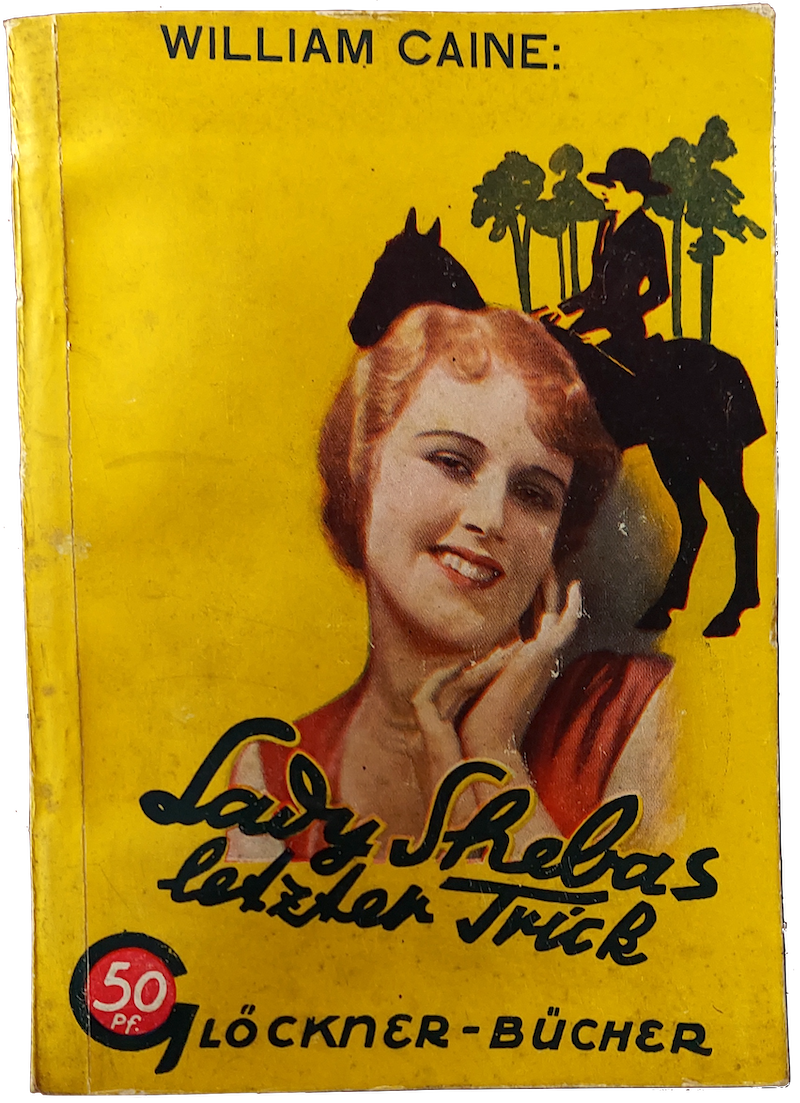
Lady Shebas letzter Trick, von William Caine. Berlin–Wien: Glöckner Verlag. Glöckner-Bücher 37. Berechtigte Übertragung aus dem Englischen von A. W. Freund. Titelbild und Illustrationen von Michael Biró. 250 pages, 16º. October 1929.
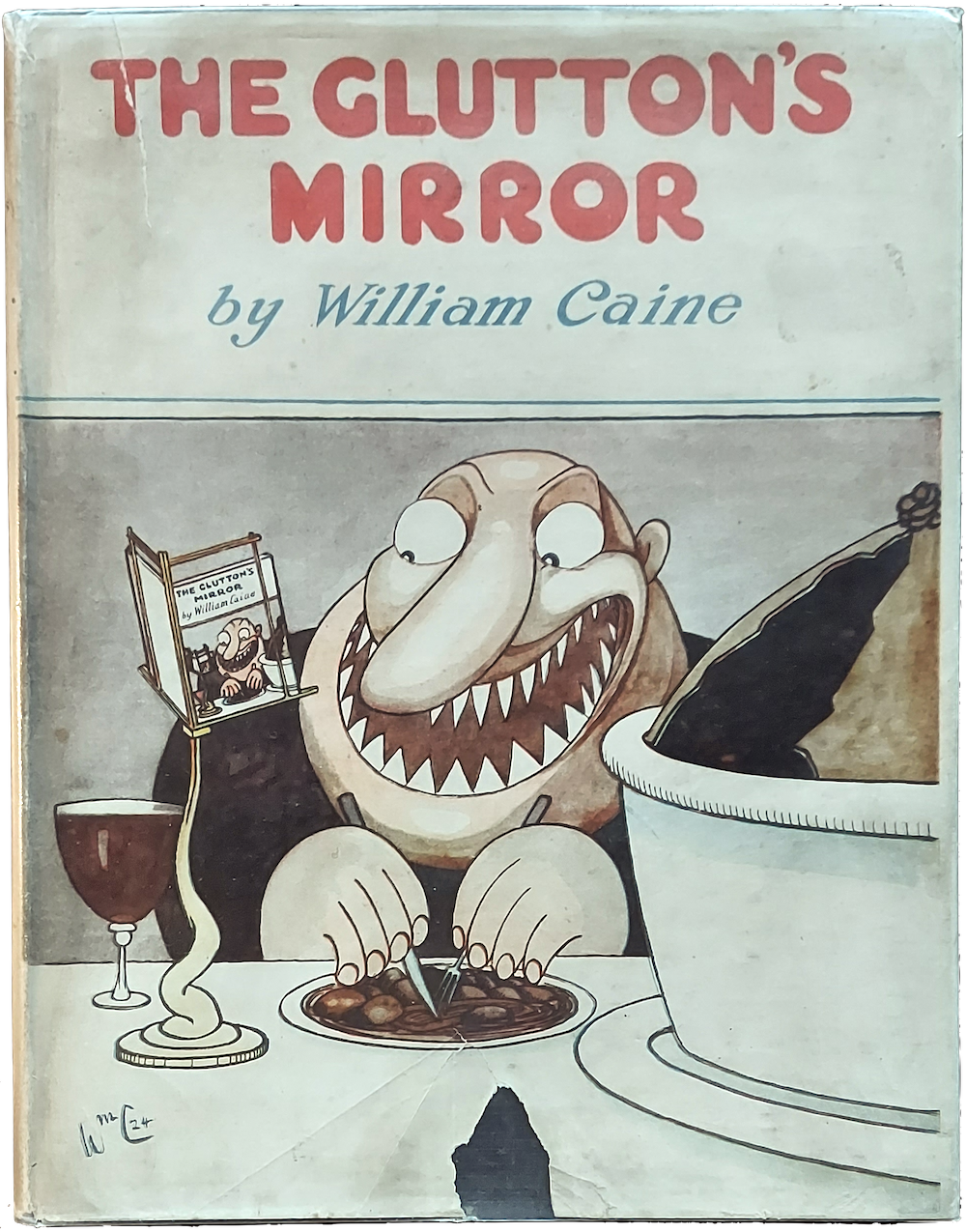
The Glutton’s Mirror, by William Caine. Illustrated by himself. London: T. Fisher Unwin Ltd. 88 pages, 4º. November 1925.
Illustrated by himself. London: T. Fisher Unwin Ltd. 88 pages, 4º. November 1925. [ECB 1921–1925: 251].
Dedicated “To My Wife.”
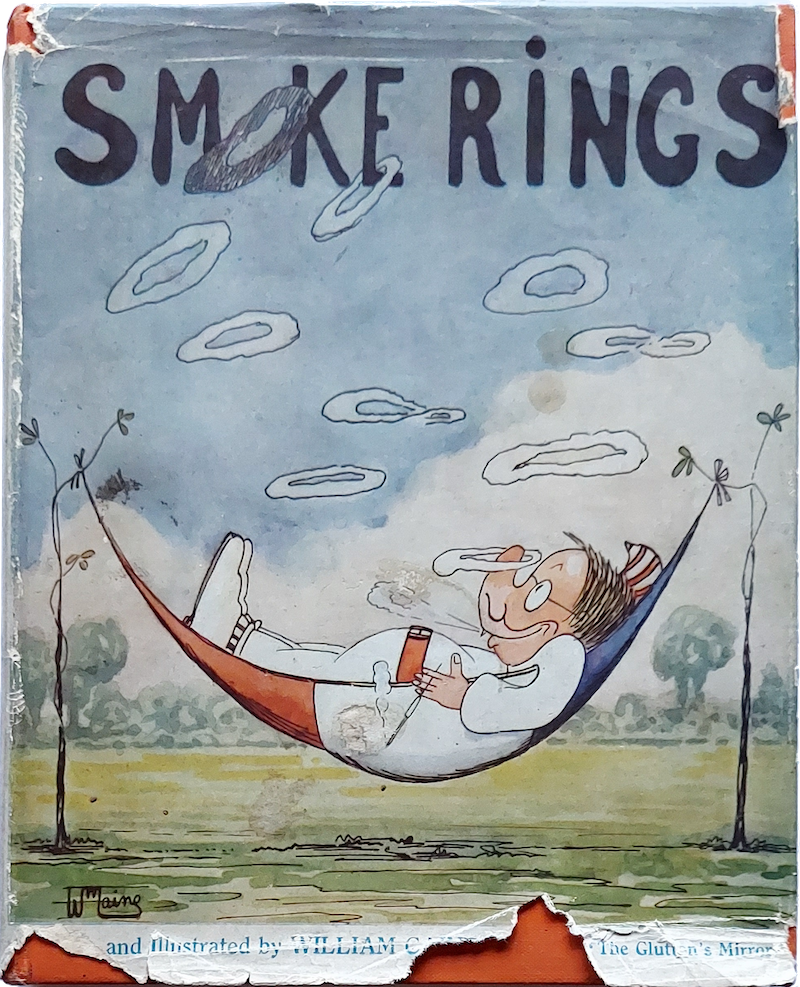
Smoke Rings, Written and Illustrated by William Caine, author of The Glutton’s Mirror. London: Stanley Paul & Co. 131 pages, 21.3cm x 17cm. September 1926.
London: Stanley Paul & Co. 131 pages, 21.3cm x 17cm. September 1926. [ECB 1926–1930: 259].
Collection of pieces originally published in The Humorist [see Caine’s Note below].
Dedicated “To Mr. Reeves Shaw with grateful thanks.”
The Evening Herald (Dublin), Thursday, September 16, 1926, p. 4, “Book Gossip; Notes on Current Literary Topics.”
Just about a year ago “The Glutton’s Mirror,” by the late William Caine, was given to us, and it is good to know that another volume of drawings and witty letterpress from the same pen will shortly be on our shelves. It is to be called “Smoke Rings,” and Messrs. Stanley Paul will be the publishers. The book contains over thirty illustrations. Visitors to the recent William Caine exhibition at the Leicester Galleries will be glad of an opportunity to possess a permanent record of some of his most brilliant work.
Westminster Gazette, Friday, September 17, 1926, p. 5, “Book Notes; Wm. Caine as Artist.”
Mr. William Caine’s posthumous volume of humorous drawings, “The Glutton’s Mirror,” took many of his readers by surprise about a year ago. It is to be followed by another, “Smoke Rings,” which Messrs. Stanley Paul are to publish. The book contains over thirty illustrations, each of them with its witty letterpress. Visitors to the recent William Caine exhibition at the Leicester Galleries will be glad of an opportunity to possess a permanent record of some of his most brilliant work.
Sheffield Daily Telegraph, Thursday, November 18, 1926, p. 3, “Books of the Day; The Humourists.”
“Smoke Rings,” written and illustrated by the late William Caine (Stanley Paul; 3s. 6d.), makes delightful and amusing reading.
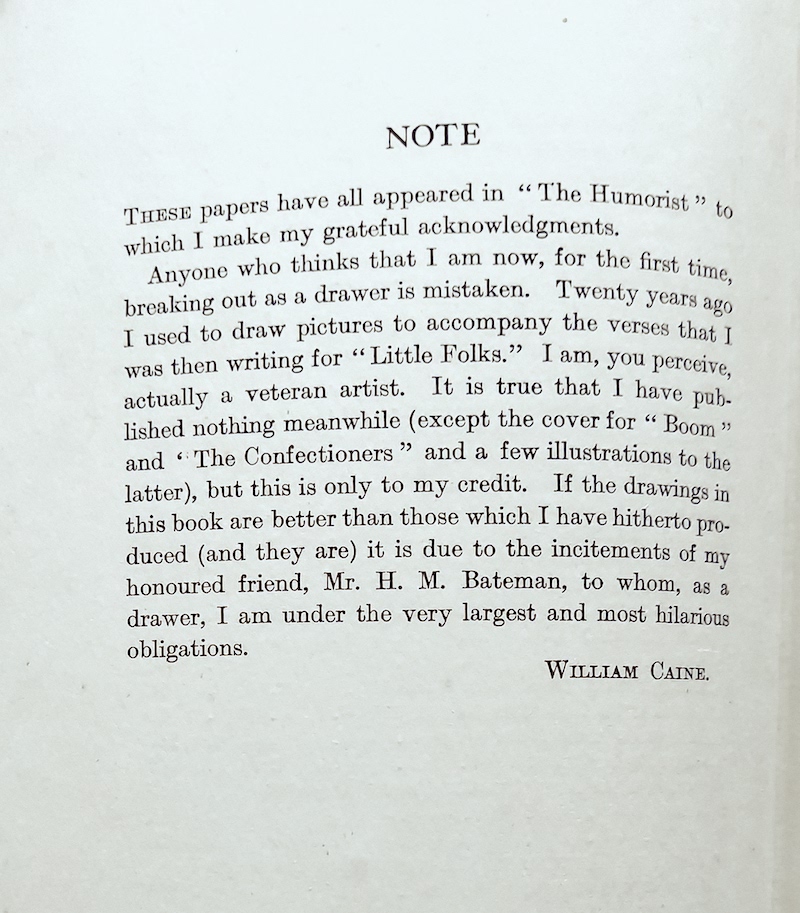
Note to Caine’s Smoke Rings: “These papers have all appeared in ‘The Humorist’ to which I make my grateful acknowledgments.
“Anyone who thinks that I am now, for the first time, breaking out as a drawer is mistaken. Twenty years ago I used to draw pictures to accompany the verses that I was then writing for ‘Little Folks.’ I am, you perceive, actually a veteran artist. It is true that I have published nothing meanwhile (except the cover for ‘Boom’ and ‘The Confectioners’ and a few illustrations to the latter), but this is only to my credit. If the drawings in this book are better than those which I have hitherto produced (and they are) it is due to the incitements of my honoured friend, Mr. H. M. Bateman, to whom, as a drawer, I am under the very largest and most hilarious obligations.”
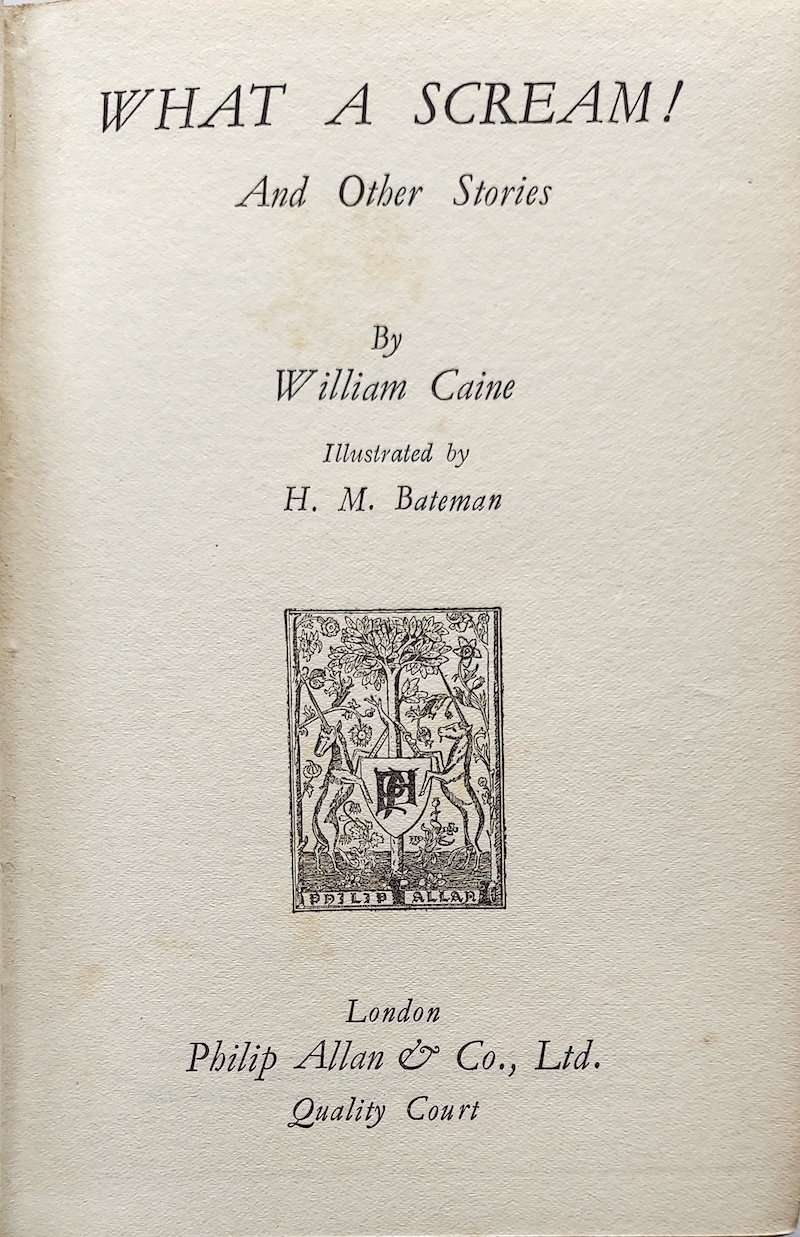
What A Scream! And Other Stories, By William Caine. Illustrated by H. M. Bateman. London: Philip Allan & Co. 279 pages, 8º. March 1927.
London: Philip Allan & Co. 279 pages, 8º. March 1927. [ECB 1926–1930: 259].
Cheaper edition. Philip Allan & Co. February 1928.
- ECB 1906: 45. — The English Catalogue of Books for 1906. London: Published for the Publishers’ Circular, Ltd. by Sampson Low, Marston & Co., Ltd. 1907, p. 45.
- ECB 1907: 47. — The English Catalogue of Books for 1907. London: Published for the Publishers’ Circular, Ltd. by Sampson Low, Marston & Co., Ltd. 1908, p. 47.
- Advertisement. — A similar ad entitled “Half-crown Novels” with identical copy for Caine’s book occurs in The Westminster Gazette, Saturday, April 27, 1907, p. 5.
- ECB 1908: 47. — The English Catalogue of Books for 1908. London: Published for the Publishers’ Circular, Ltd. by Sampson Low, Marston & Co., Ltd. 1909, p. 47. Note the typo in the title: ‘Votary’ instead of ‘Votery’.
- ECB 1909: 44. — The English Catalogue of Books for 1909. London: Published for the Publishers’ Circular, Ltd. by Sampson Low, Marston & Co., Ltd. 1910, p. 44.
- ECB 1911: 44. — The English Catalogue of Books for 1911. London: Published for the Publishers’ Circular, Ltd. by Sampson Low, Marston & Co., Ltd. 1912, p. 44.
- ECB 1910: 43. — The English Catalogue of Books for 1910. London: Published for the Publishers’ Circular, Ltd. by Sampson Low, Marston & Co., Ltd. 1911, p. 43.
- ECB 1915: 43. — The English Catalogue of Books for 1915. London: The Publishers’ Circular, 1916, p. 43.
- ECB 1912: 48. — The English Catalogue of Books for 1912. London: Published for the Publishers’ Circular, Ltd. by Sampson Low, Marston & Co., Ltd. 1913, p. 48.
- Reprint announced July 1914. — “In Preparation,” The Bookseller, July 17, 1914, p. 972.
- ECB 1913: 50. — The English Catalogue of Books for 1913. London: Published for the Publishers’ Circular, Ltd. 1914, p. 50.
- ECB 1914: 48. — The English Catalogue of Books for 1914. London: The Publishers’ Circular, 1915, p. 48.
- ECB 1926–1930: 259. — The English Catalogue of Books. (Including the original ‘London’ and ‘British’ catalogues). Books issued in the United Kingdom. Volume 12, January 1926 to December 1930. Edited by James D. Stewart. New York: Kraus Reprint Corporation, 1963, p. 259.
- LOC 1914: 11, 118, 1000. — Library of Congress Copyright Office, Catalogue of Copyright Entries for the Year 1914. Washington: Government Printing Office, 1914. Part 1, Books, Group 1, New Series, Volume 11, no. 118, p. 1000.
- ECB 1916: 38. — The English Catalogue of Books for 1916. London: The Publishers’ Circular, 1917, p. 38.
- LOC 1916: 13, 102, 761 — Library of Congress Copyright Office, Catalogue of Copyright Entries for the Year 1916. Washington: Government Printing Office, 1916. Part 1, Books, Group 1, New Series, Volume 13, no. 102, October 1916, p. 761.
- ECB 1917: 35. — The English Catalogue of Books for 1917. London: The Publishers’ Circular, 1918, p. 35.
- LOC 1917: 14, 146, 1154 — Library of Congress Copyright Office, Catalogue of Copyright Entries for the Year 1917. Washington: Government Printing Office, 1917. Part 1, Books, Group 1, New Series, Volume 14, no. 146, February 1918, p. 1154.
- LOC 1917: 14, 126, 961. — Library of Congress Copyright Office, Catalogue of Copyright Entries for the Year 1917. Washington: Government Printing Office, 1917. Part 1, Books, Group 1, New Series, Volume 14, no. 126, December 1917, p. 961.
- ECB 1919: 42. — The English Catalogue of Books for 1919. London: The Publishers’ Circular, 1920, p. 42.
- ECB 1920: 46. — The English Catalogue of Books for 1920. London: The Publishers’ Circular, 1921, p. 46.
- LOC 1920: 17, 57, 449. — Library of Congress Copyright Office, Catalogue of Copyright Entries for the Year 1920. Washington: Government Printing Office, 1920. Part 1, Books, Group 1, New Series, Volume 17, no. 57, p. 449.
- LOC 1920: 17, 60, 474. — Library of Congress Copyright Office, Catalogue of Copyright Entries for the Year 1920. Washington: Government Printing Office, 1920. Part 1, Books, Group 1, New Series, Volume 17, no. 60, p. 474.
- ÖVG 2: 295. — Murray G. Hall, Österreichische Verlagsgeschichte 1918–1938, Band 2: Belletristische Verlage der Ersten Republik, 1985 (2016), p. 295.
- ECB 1921: 43. — The English Catalogue of Books for 1921. London: The Publishers’ Circular, 1922, p. 43.
- ECB 1921–1925: 251. — The English Catalogue of Books. Vol. XI, January 1921 to December 1925. New York: Kraus reprint Corporation, 1963, p. 251. See also, for Lady Sheba’s Last Stunt: “Books Receiver,” The Birmingham Post, Friday, November 21, 1924, p. 14; “Books Receiver,” Truth, November 26, 1924, p. 978.
- ECB 1923: 58. — The English Catalogue of Books for 1923. London: The Publishers’ Circular, 1924, p. 58. See also: “Books Received,” Truth, October 31, 1923, p. 756.
- BP 1901–1939, 3: 524. — Bibliografia Polska, 1901–1939. Tom 3, Bol–Ce. Janiny Wilgat, pod redakcją. Warszawa: Biblioteka Narodowa, 1993, p. 524.
- ECB 1926–1930: 259. — The English Catalogue of Books. Vol. XII, January 1926 to December 1930. Edited by James D. Stewart. New York: Kraus reprint Corporation, 1963, p. 259.