III. Verse, lyrics and libretti by William Caine
Signed Quilliam, illustrated by the author. Little Folks. London, Paris, New York and Melbourne: Cassell and Company, 1899.
“Bearded John,” pp. 31–32.
“Stanley,” p. 141.
“Maria,” pp. 141–142.
“Maurice,” p. 172.
“Ugly Lloyd,” p. 172–173.


Verses by W. Quilliam; music by Osborne Roberts. London, Willis Music Co., 1903.
Copyright no. 47261, May 14, 1903; two copies deposited, Library of Congress, April 20, 1903.

Words by W. Quilliam. Two songs, by Osborne Roberts. no. 1. Leipzig, Bosworth & Co., 1903.
Copyright no. 53441, August 22, 1903; two copies deposited Library of Congress, August 22, 1903.

Punch, or the London Charivari, vol. 126, March 2, 1904, p. 154. Unsigned.

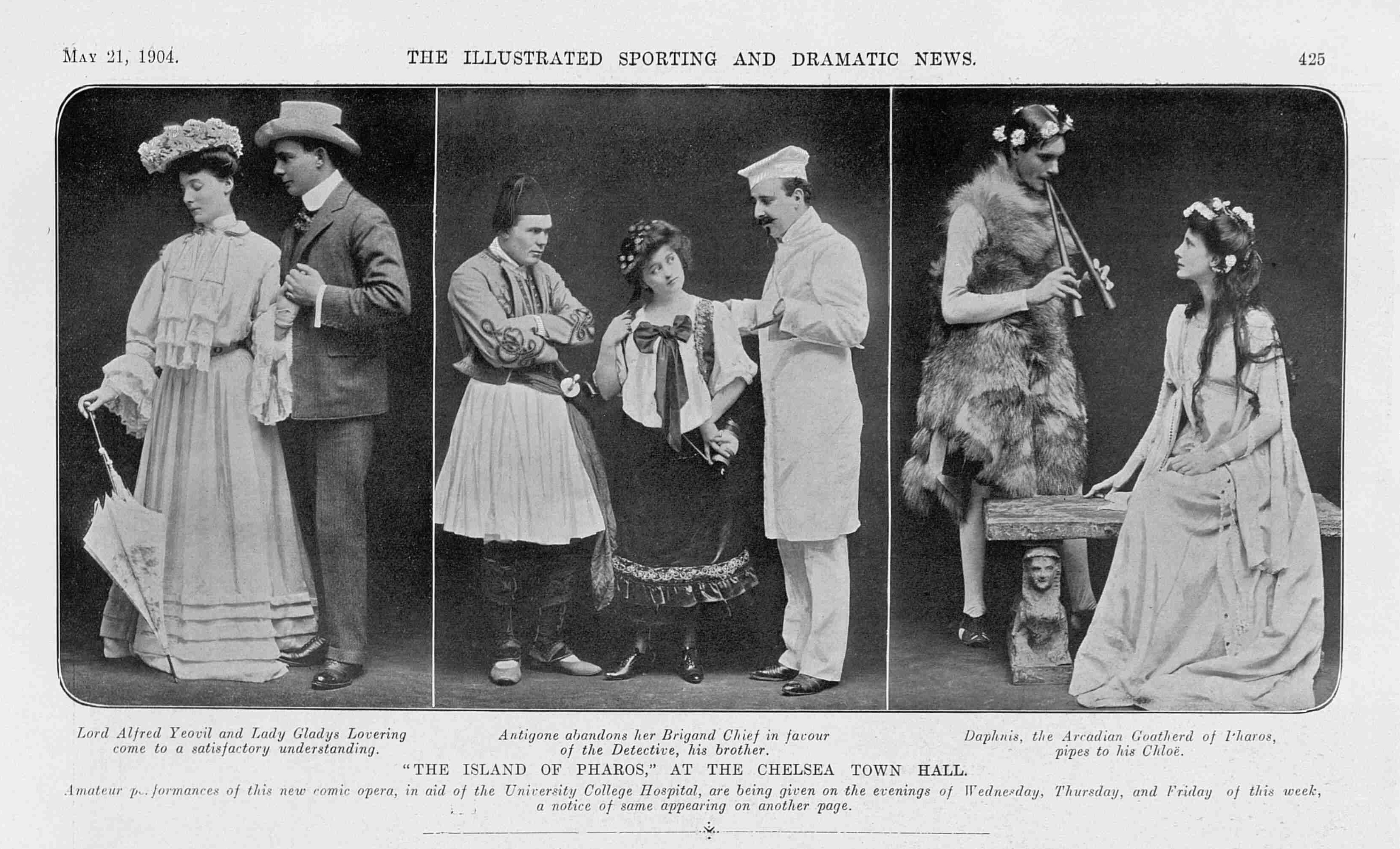
Comic opera, in two acts; words by William Caine, music by Osborne Roberts.
First performed at Chelsea Town Hall, London, May 18, 19, and 20, 1904.
Toured: Plymouth, Theatre Royal, July 11–16, 1904; Blackpool, Her Majesty’s Opera House, July 18–23, 1904; York, Theatre Royal, July 25–30, 1904; Middlesbrough, Theatre Royal, August 1–6, 1904; Birmingham, Grand Theatre, August 8–13, 1904; Ramsgate, Royal Pavilion, August 15–20, 1904.
Listed in The Era Almanack and Annual, Dramatic and Musical, 1905. Conducted by Edward Ledger. New Plays and Important Revivals Produced at the London Theatres From December 1, 1903, to November 30, 1904, p. 56; ibid. Alphabetical List of Plays Produced in London and Provinces from December 1, 1903, to November 30, 1904, p. 66.
A new comic opera, entitled “The Island of Pharos,” libretto by William Caine, and music by Osborne Roberts, will be performed by a distinguished company of amateurs on the evenings of May 18th, 19th, and 20th, at the Chelsea Town Hall, in aid of a deserving charity. The opera will be produced by Mr. A. S. Barber, and musical arrangements and management are in the hands of Mr. Augustus Bingham.Similar ads appeared in other London newspapers, e.g., Lloyd’s Weekly Newspaper, Sunday, April 24; The Stage, Thursday, April 28; The Sporting Times, Saturday, April 30, and Saturday, May 14; and The Referee, Sunday, May 1. A review the first night’s performance, under the headings “University College Hospital.” “Amateur Theatricals.”, may be found on page 4 of The Morning Post dated Thursday, May 19, 1904:


“The Island of Pharos,” a comic opera in two acts, was produced last night by a company chiefly of amateurs at the comfortable little theatre at the Chelsea Town Hall in aid of University College Hospital. The performance reflected credit on all concerned. The book by Mr. William Caine was clear, and told a story which was lucid and humorous, and gave plenty of opportunity to the performers. It ran on rather conventional lines, but it was not, as so many of the stories invented for such productions are, reminiscent of the famous productions of Gilbert and Sullivan. Brigands kidnap the three delightful heroines and their lovers, but they are turned into peaceable farmers when they are landed, owing to shipwreck, on “The Island of Pharos,” where love reigns supreme, and all ends happily. The music of Mr. Osborne Roberts, deserves very high praise. Like the book it is unambitious, but some of the numbers were delightful, and showed an original gift of melody quite unusual in productions of this nature. Among the excellent numbers which deserve notice the song of the Colonel of Greek Horse Marines deserves special mention. It was admirably sung by Mr. Leonard Russell. Another delightful song, “The weeping willow droops above,” was rendered charmingly by Miss Catherine Van Duzer as Lady Gladys Lovering. The acting all round was exceptionally good. The performance was well received, and the piece, which will be played to-night and to-morrow night, is well worth seeing.Following all three performances of the piece, The Illustrated Sporting and Dramatic News, London, reviewed it in its issue for Saturday, May 21, 1904 (p. 442):

The Referee of London, on page 3 of its issue of May 22, 1904, includes in its praise a concise description of the piece which is slightly different from that found in The Morning Post:“THE ISLAND OF PHAROS.”
On Wednesday evening was produced, and on the two following evenings repeated, at the Chelsea Town Hall, in aid of the University College Hospital, a new comic opera, The Island of Pharos, written by William Caine, with music by Osborne Roberts, and performed by amateurs. Detailed consideration of the merits of the work are not possible in present limits, and it must suffice to say that while hardly strong enough in its present form to stand the test of professional production at a West End theatre, there is decidedly promising material in the work. Both author and composer have ideas which could have stood more confident expression, and while the former has a neat turn for fanciful lyrics, the latter proved his ability to give them appropriate, scholarly, and often original as well as melodious setting — one of the happiest of their united efforts being a song, “The weeping willow droops above,” very charmingly sung by Miss Catherine van Duzer as Lady Gladys Lovering. Among other notably successful performers were Miss Jean Newman, who, as Antigone, a vivandière, scored greatly with a pretty ditty, “Love let fly a random shaft”; Mrs. A. S. Barber and Mrs. H. H. Curtis Bennett as Lady Mable and Lady Henry Hogan respectively; Miss Lois van Duzer (Chloe), Miss Isabelle Hastings (the Arch Nymph), and the Misses Evelyn and Estella West, as graceful solo danseuses; and Messrs. C. R. Hills, H. H. Curtis Bennett, A. S. Barber (by whom the opera was produced), C. Wheeler, C. C. G. Roberts, and Ivor Back, who all in their various characters contributed to the success of the production, which was well received and decidedly creditable to all concerned.

As noted on page 4 of the July 10, 1904, issue of The Referee, The Island of Pharos subsequently set out on a five-week tour starting in Plymouth on July 11:A new comic opera, entitled
“The Island of Pharos,”
composed by Mr. Osborne Roberts, who has a pretty appreciation of melody and clever orchestration, was given at the Chelsea Town Hall on Wednesday, Thursday, and Friday, with considerable success. The “book,” written by William Caine, deals with the unfriendly relations of two brothers, who are shipwrecked on a Greek island where several young people, who are cruising for pleasure, also find themselves. A rich young widow is accompanied by two pretty sisters, whom she is hiding from the pursuit of two admirers. Brigands and the romantic difficulties in which the lovers find themselves supply the chief part of the story which ends with everyone happy on the island and love supreme. Of the music only praise can be written. Mr. Roberts has been very happy in several charming numbers. Miss Jean Newman, as Antigone; Miss Catherine Van Duzer, as Lady Gladys Lovering; Mr. Leonard Russell, Mr. Sprinck, and Mr. C. R. Hills were particularly successful. Among the numbers entitled to special mention are a ballad, “The Weeping Willow Droops Above;” a breezy song by the Colonel of the Greek Horse Marines; and “Love Let Fly a Random Shaft,” while a charming song sung by the First Goatherd in the second act was one of the gems of the opera. Mr. Osborne Roberts is to be congratulated on a genuine success. The opera was produced by A. S. Barber. The University College Hospital will be benefited by the proceeds.

The recently produced new comic opera entitled “The Island of Pharos,” written by Mr. William Caine, and composed by Mr. Osborne Roberts, is being sent out on a short preliminary tour, starting at the Theatre Royal, Plymouth, to-morrow. A strong cast has been engaged, including Messrs. Leonard Russell, Maitland Dicker, and Daley Cooper; Misses Cissie Vaughan, Ada Rodney, and May Clifton. The opera is being produced by Mr. E. Dagnall, and the entire arrangements are under the direction of Mr. Augustus Bingham.A notice also appeared in the “Dramatic and Musical” section on page 8 of The Liverpool Daily Post of July 11, 1904:
“The Island of Pharos,” a new comic opera written by William Caine and composed by Osborne Roberts, is being set out on a short preliminary tour, starting at the Theatre Royal, Plymouth, this evening.On the day following the opening in Plymouth, the “Extra Special” edition of that city’s Western Evening Herald of Tuesday, July 12, 1904, ran the following brief account:
It seems that The Island of Pharos played through Saturday, July 16, at the Theatre Royal, Plymouth, then went to Her Majesty’s Opera House, Blackpool, from Monday, July 18 to Saturday, July 23; the Theatre Royal, York, July 25–30; the Theatre Royal, Middlesbrough, August 1–6; the Grand Theatre, Birmingham, August 8–13; before ending its tour at the Royal Pavilion, Ramsgate, August 15–20, 1904. The production in Blackpool was reviewed on page 5 of The Blackpool Times and Fylde Observer of Wednesday, July 20, 1904:The “Island of Pharos” at the Royal.
The return of Mr. C. F. Williams to the management of the Theatre Royal, Plymouth, was signalled by the production for the first time on any stage of a new comic opera entitled “The Island of Pharos.” It belongs to the popular order of musical comedy, and has just sufficient of connected story to supply motive for the incidents represented. It is really amusing.

The Herald of Stockton, Durham County, reviewed the Middlesbrough production in its “Theatre Attractions” column on page 5 of its Saturday, August 6, 1904, edition:Her Majesty’s Opera House.
“THE ISLAND OF PHAROS.”
This is a new piece, described as a comic opera, but it is in no way distinguished for musical comedy. It is very pretty and has a certain good quality in its music. Here and there is a song or a chorus that strikes the ear pleasingly, but taken altogether the piece lacks character and wants pulling together. The story deals with the adventures of a yachting party, who through the treachery of brigands are shipwrecked and compelled to seek refuge upon the hitherto unknown island of Pharos, peopled by an unsophisticated, but kindly race, who extend a generous hospitality to the unfortunate strangers. There are, of course, the usual elements of love-making among the representatives both of civilised society and of the people who have nothing in common with the outer world save the instinct of love. Mr. Glynn Osborne has brought together a capable company. Mr. Daley-Cooper has the principal comedy part, and it is well sustained in grotesqueness and eccentricity. Mr. Maitland Dicker, as a detective apt in the discovery of disguises, is a good second in the comedy line. The Earl has a capital representative in Mr. Arthur Wilmot; and a trio of excellent male voices is found in Messrs. A. S. Barber, Frank Londen, and Leonard Russell. Mr. Albert Drewitt, who appears in the second act as a shepherd on the “undiscovered” island, dressed in skins, sings in good style, and makes the most of his part. Among the ladies Misses Cissie Vaughan, Bella Graves, and Ada Rodney form the trio of English girls, and take their parts with credit. Miss May Brooke is a vivacious shepherdess; and Miss May Clifton and Miss B. Luscombe support the comedy of the piece. On Monday night there were several encores, and Miss Dora Kennedy was loudly applauded for her speciality dances.

The Birmingham production was announced under “Next Week’s Amusements” on page 4 of The Birmingham Daily Mail of Friday, August 5, 1904:“THE ISLAND OF PHAROS.”
There is a strong holiday attraction at the Theatre Royal, Middlesbrough, this week, in the new comic opera “The Island of Pharos.” The first act opens in the harbour of Piræus, Athens, and the second lies in that favoured land from which the opera takes its name. The music is of the essential lightness associated with such productions, and the scenery of a “summery” aspect, with plenty of blue sea dn bright sky about it. Mr Daley Cooper, who will be remembered for his “Tweedlepunch” in “Florodora,” is included in the caste [sic], and those who have seen this versatile comedian will not need to be told that he makes the most of the humorous part allotted to him. He is “William Sykes,” with a number of aliases, whilst “Henry Sykes,” by turns a cook and a detective, is depicted by Mr Maitland Dicker, in a most amusing manner. Mr Albert Drewitt does sound work as “Daphnis,” the owner of the island, and Mr Horace Corbyn, as the captain of Lord Alfred’s yacht, is also alive to his opportunities. Mr Arthur Wilmot is a distinct success as the “Earl of Enniscorphy.” Messr A. S. Barber, Frank Louden, and Leonard Russell support the other male roles, and the principal ladies are Miss Cissie Vaughan, Miss Bella Graves, and Miss Ada Rodney. There is an excellent chorus, and some graceful dances are introduced.

A new comic opera, entitled, “The Island of Pharos,” is booked for the Grand Theatre. The piece, which was only produced a few weeks ago, possess an interesting story, written by Mr. William Caine, something on the lines of “Utopia.” Mr. Osborne G. Roberts is the composer, and the music is distinctly original and exceedingly pretty. It is to be produced by Mr. Glynn Osborne’s company, which includes Mr. Leonard Russell, a local baritone, who was formerly associated with the “Floradora” company.This production was noticed in the “Plays and Players” column of the London Weekly Dispatch under the rubric “The Stage in the North”:

On the same date, The Umpire of Birmingham favorably contrasted how locals responded to The Island of Pharos to how they reacted to Ibsen’s A Doll’s House:“UNDER THE PANAMA.”
At the Birmingham Grand a new comic opera, “The Island of Pharos,” was produced by the Glynn Osborne Company. It was very kindly received, almost as big a success as when first produced at Plymouth a few weeks ago.
Musical comedy would fit “The Island of Pharos” better as a descriptive title. There are some really good songs in it. “Under the Panama” seems likely to take on, and “When you’re a little girl of seventeen” is pretty and very catching. The music is really the best part of the piece. As for the rest, it will serve, but the plot wants mending, and the humour is badly mixed (Sunday, August 14, 1904, p. 6).

Much more to the liking of Birmingham people was “The Island of Pharos,” seen at the Grand. It may not say much for the theatrical tastes of the people of Birmingham, but “The Island of Pharos” did not leave a feeling of depression, and that is more than can be said for “A Doll’s House.” Unfortunately for Ibsen, people prefer something which will raise their spirits to something which will set them thinking about matters serious (“Stage Whispers.” “Birmingham Notes.” Sunday, August 14, 1904, p. 4).The August 17, 1904, issue of The East Kent Times & District Advertiser, under “Local Amusements” on page 5, briefly reviewed the Ramsgate production:

And finally, The Indian Daily News of West Bengal noted, in an article about the upcoming six-week engagement of the Dallas-Bandman Opera Co. at the Theatre Royal, that “Mdlle. Bel Luscombe, who is the possessor of a highly-trained powerful soprano voice [...] whilst playing the Arch Nymph in a magnificent production of a new comic opera entitled, ‘The Island of Pharos’ was engaged by Mr. [Henry] Dallas for his Indian and Far Eastern tour” (October 20, 1904, p. 16).AT RAMSGATE ROYAL PAVILION.
To good audiences Mr. Glynn Osborne’s Co. are at the Pavilion this week producing the comic opera, “The Island of Pharos.” It contains several brisk choruses, some of the lines are smart and humorous, and the opera is well put on. All the artists work energetically, the most capable work being done by Miss Cissie Vaughan (“Lady Lovering”), Mr. Daley Cooper (a most vivacious “William Sykes”), Mr. Maitland Dicker, the Misses Nita Clavering (capital as “Antigone”), Bella Graves, Ada Rodney, and May Brooke. Miss Dora Kennedy’s solo dances are very clever. The chorus is efficient and the orchestra satisfactory. “The Island of Pharos” remains all the week.
Words by William Caine; music by Henri Hirchmann. London: Hopwood & Crew, 1905. 7 pages, folio.
Copyright no. 102202, September 11, 1905; two copies deposited, Library of Congress, September 11, 1905. Catalogue of Title Entries, Musical Compositions, v. 44, No. 39m p. 666/932, item 79324.
The Catalogue of Printed Music in the British Library to 1980. Volume 28, Hee-Hoek. London, München, New York, Paris: K.G. Saur, 1984, p. 357, item H.3984.y.(21.)

Words by William Caine; music by George Hornsby. No. 1, in D. London: J. B. Cramer & Co., November 6, 1908.
Copyright no. 102202, September 11, 1905; two copies deposited, Library of Congress, September 11, 1905. Catalogue of Title Entries, Musical Compositions, v. 44, No. 39m p. 666/932, item 79324.


