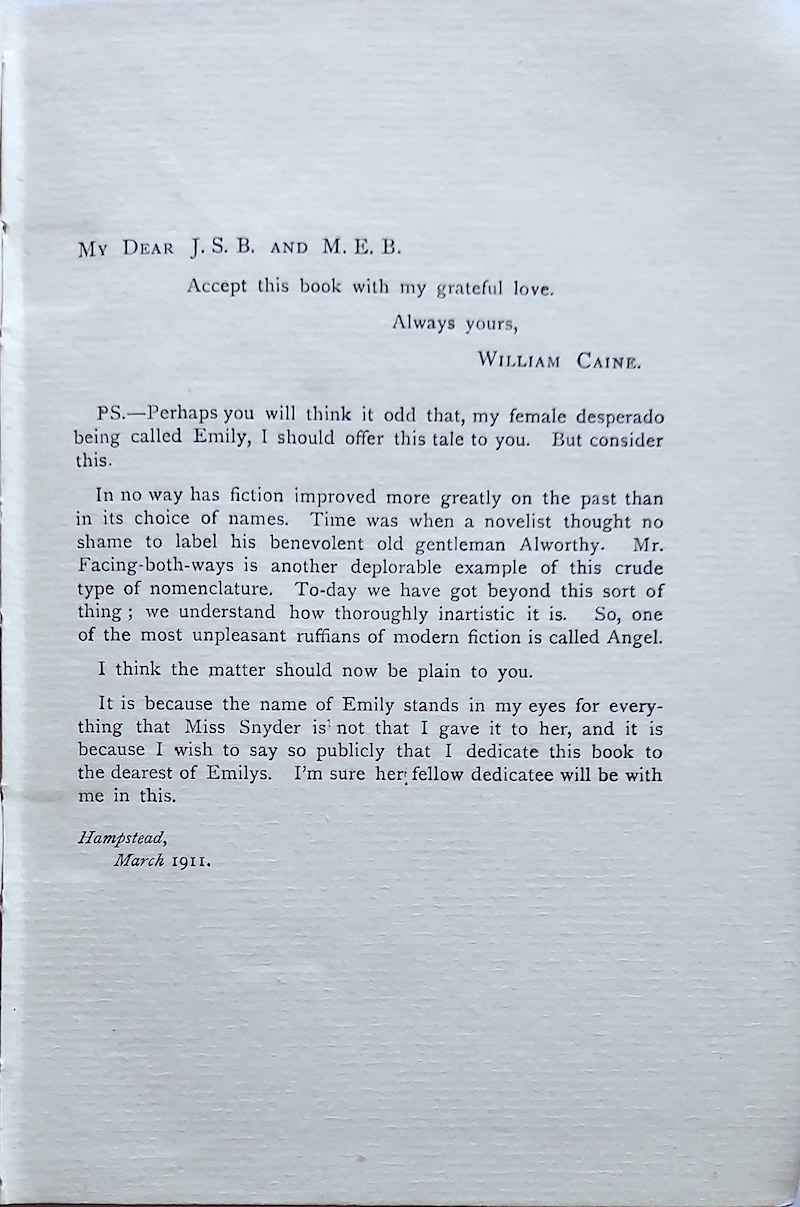
Dedication page to Caine’s Old Enough to Know Better.
My Dear J. S. B. and M. E. B.Between this dedication page and the start of the novel proper, Caine interposed a note entitled, “Concerning my Title:”Accept this book with my grateful love.
Always yours,
William Caine.
PS. — Perhaps you will think it odd that, my female desperado being called Emily, I should offer this tale to you. But consider this.
In no way has fiction improved more greatly on the past than in its choice of names. Time was when a novelist thought no shame to label his benevolent old gentleman Alworthy. Mr. Facing-both-ways is another deplorable example of this crude type of nomenclature. To-day we have got beyond this sort of thing; we undersand how thoroughly inartistic it is. So, one of the most unpleasant ruffians of modern fiction is called Angel.
I think the matter should now be plain to you.
It is because the name Emily stands in my eyes for everything that Miss Snyder is not that I gave it to her, and it is because I wish to say so publicly that I dedicate this book to the dearest of Emilys. I’m sure her fellow dedicatee will be with me in this.
Hampstead,
March 1911.
As everybody knows, this is the most important feature of a novel, for by the title the reader asks for it at the library. It is immoral, therefore, to use a title which has been used before, and the trade rightly refuses to countenance a practice which, by creating confusion, tends not only to reduce sales but also to rob writers of their just reward. As to plots, there is, of course, no such restriction. Were novelty in this respect insisted upon the writing of novels would cease — an unthinkable disaster. To a plot, then, one may help oneself, but not to a title.Now over a thousand novels are produced annually in England.
It becomes apparent at once that such a demand for titles must create a shortage in the supply, and indeed it is much easier now-a-days to write a tale than to discover a name for it. He is the wise author who makes books for his titles rather than titles for his books.
It is suitable, then, that I should not permit it to be supposed that I am responsible for the name of this book. Superhuman labour resulting in nothing, I went whence I never return empty, and the title was instantly presented to me. I feel that I must let this be known.
I might be silent upon the invaluable criticisms which, from the same source, have enabled me to make Old enough to know better into what I believe to be a presentable story; I might suppress all notice of encouragement, inspiration, suggestion and such minor matters. A mere book is the fruit of these things.
But I cannot assume a real merit which belongs to another.
William Caine.
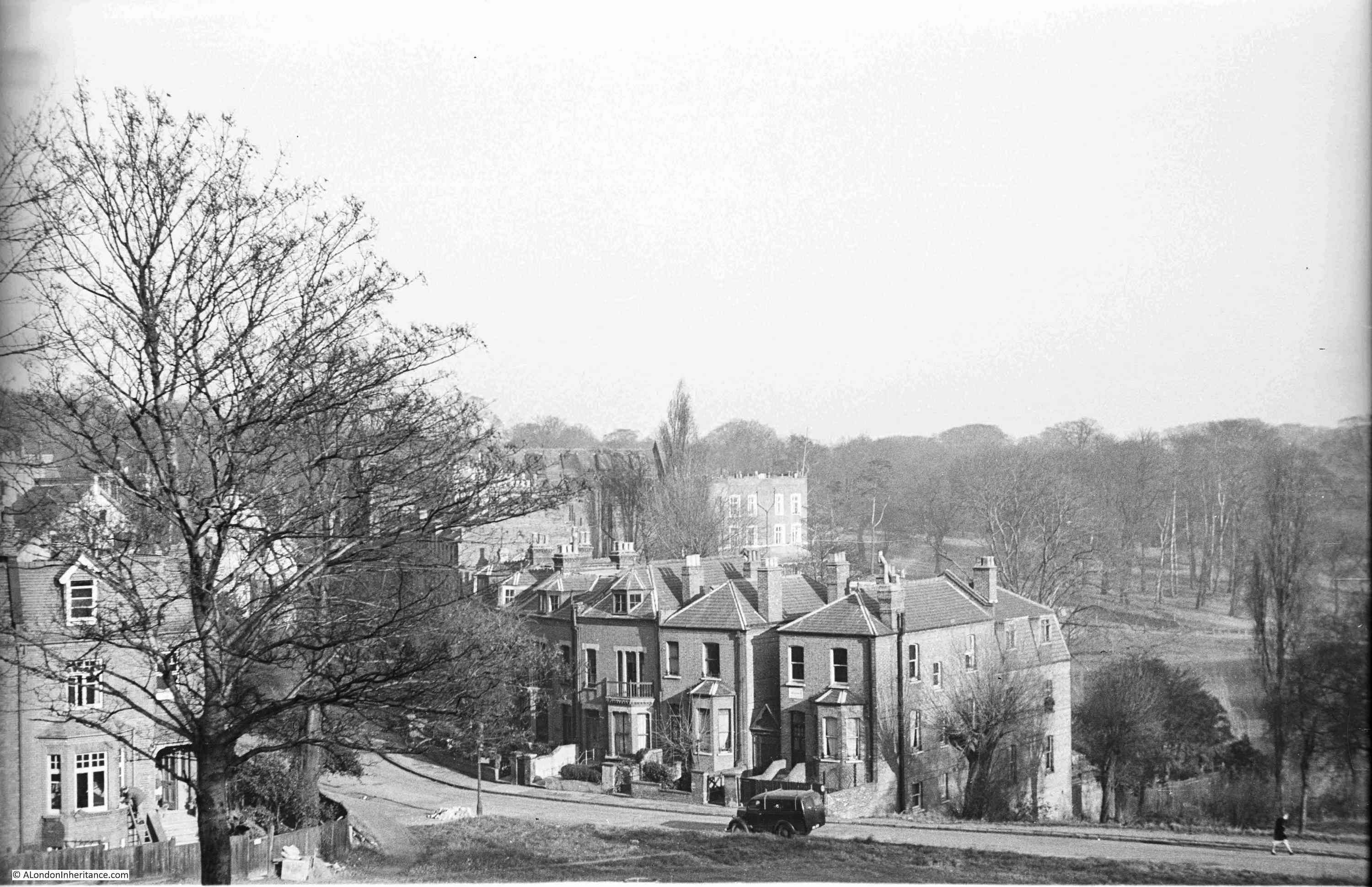
The Vale of Health, Hampstead, c. 1946–1954. Reproduced from A London Inheritance.
in bed from a pleasant dream of flocks and herds and cattle upon a thousand hills. Stretching out a hand he took up his watch from the night table, bent the angry gaze of the unseasonably awakened upon it, and learned that it was six in the morning. The sun shone brightly into the room, and Mr. Carpenter, who had no wish to see anything of the kind for at least another three hours, turned his face peevishly to the wall, shut his eyes firmly and recomposed himself to sleep. After an interval he suddenly sat bolt upright and listened.The Snyder lad is Emily’s thirteen-year-old brother Urquhart (named, no doubt, after Rabelais’s first English translator) and on the summer morning with which the first chapter of Old Enough to Know Better opens, the third morning of the goat nuisance, he is sitting “beneath an aged willow tree” (p. 9) with the owner of the goat, who is younger than him, waiting for the “refined delight of the exhibition at the window” to happen. Carpenter, however, “the luckless Ridley, fast between his sheets, urged towards madness by soft reiterated bleatings” (p. 18), has a surprise in store for them:“Something bleats,” he said. “Some damned thing or other is bleating.”
This was perfectly true, unless we except the qualification. For to bleat is the province of the so-called dumb and generally-supposed-to-be-soulless brutes.
After a short interval Carpenter flung himself downwards upon the bed, pulled the sheet and blanket over his head and so lay. Almost at once he hurled his coverings from him, leaped from bed and was at the window.
He looked out upon Hampstead Heath which lay before him sparkling with dew and early sunshine. A soft clean air fanned his disordered head. Hundreds of little melodious birds hymned the fine weather. But the deliciousness of these things awoke no responsive chord in the bosom of Carpenter. He had no eyes for the rapture of earth beneath the first caresses of the day.
His sight was riveted venomously upon a young yellowish goat, which stood beneath his very window busily nibbling a blade of grass.
And as he looked the creature achieved the morsel and happily bleated.
Mr. Carpenter dashed up the window and leaned out. “Shoo!” he cried, “Shoo! Begone, goat! Shoo!”
The goat looked up timidly and removed itself a few paces; then again, while choosing among the grasses, bleated its gentle bleat.
Mr. Carpenter looked in the grate for coal, but, it being the height of summer, found none. Nor was there any in the sitting-room.
But there was a dish of bananas.
At the moment Mr. Carpenter was in search of a missile, and forgetful of any other use to which a banana can be put, he snatched one up and returning to his bedroom, leaned out of the window and hurled the fruit furiously towards the goat. The banana alighted upon the goat’s back, thence fell to earth. The goat, after one soft start of surprise, turned to the banana and ate it with evident pleasure. Then very properly, it stretched out its scraggy neck and bleated its appreciation of the favour.
Whereupon a tiny boy, who had darted from behind a tree, too late to secure the prize, said very impudently, “Me too, governor,” and grinned — hideously, Carpenter thought.
“If you take that beast away,” he said, “you shall have one.”
The boy said, “Right O!”
Carpenter fetched another banana, and threw it to the lad. “Now,” he said, “remove your goat, if it is yours.”
“Oh, it’s mine all right,” said the boy. “Ain’t yer, Billy?”
The goat, hearing its name, looked up and bleated. The foolish little sound maddened Carpenter.
“Then, my lad,” he said, “run off and take it with you. Go away at once. The goat prevents me from sleeping, you know.”
“Ah,” said the boy, “it does, does it?”
“Yes,” said Carpenter, as he left the window, “it does. Good-bye.” He fell into bed again.
Three minutes later the boy was delighted to see him appear once more at the window. “I told you,” he said, “to take that infernal goat away. And you promised you would. Why haven’t you?”
“I will, governor,” said the dastard, “reely and truly I will, if you’ll give me another banana. Just one, governor, for luck.”
“Unmitigated serpent,” said Carpenter, and withdrew hastily.
Such was the beginning of this young man’s trouble with the goat. Too late he recognised the completeness with which he had delivered himself into the hands of this boy. Too late he resolved to bestow no more bananas. Too late did he reflect as follows beneath his blankets and sheets.
“That boy is unprincipled to the lowest degree. A boy of that age is a walking œsophagus. All the vessels of the Elder Dempster Line could not fetch bananas enough to satisfy his cupidity. He would still gape with his mouth and incite his goat to bleat.”
Yes, such was the beginning of the goat nuisance, but I do not propose fully to relate the matter. There were, however, two mornings of it, and on no less than five occasions (two the first morning and three the second) Carpenter might have been seen, dishevelled, at his window, abusing goat and goatherd, appealing to the lad’s better nature (which was non-existent) and hurling things of no value — of which there were too few in his possession. The boy, finding the fruit supply exhausted, condescended upon the less staying, more refined delight of the exhibition at the window. Every moment hopeful of its renewal, he found that time passed with wonderful swiftness. Continually he would have blessed the name of his uncle, bestower of the goat, but he never so much as thought of that excellent corn-chandler.
About eight o’clock each morning, mindful of breakfast, he called to his pet and rambled homewards. On the afternoon of the second day, currying favour with a hero, he confided his gorgeous secret to the Snyder lad (pp. 15–18).
I have said that this young man was a man of letters, a writer. With the help of a small regular income, derived from solid railways, it is possible for a writer, even though he have learning and imagination, to live and practise his art. The encouragement with which Carpenter had met so far in his career had not been great, but he had by no means reached that point where hope of appreciation in his lifetime lightens the labours of the artist. No less than three novels, bearing his name, had within the two years then immediately past been published in London, nor was he thereby out of pocket more than the few shillings represented by the difference between the cost of their typing and the amount which he had received for the copyright of the first. He had received the circulars of one literary agent, and three press-cutting agencies, and several newspapers had published short and erroneous summaries of his plots. A vast number of magazines had carefully considered some of his stories, and I think in no case had any of them failed to return his manuscripts. And this with regret. Many of them had even thanked him for giving them the opportunity of perusing his work, and two had absolutely besought him to permit them to consider other tales which he might produce. His position was, therefore, a very hopeful one, and gave him no reason to doubt that, after he should have published another dozen or fourteen books, his status in the literary world should have become so eminent as to compel the Times Library to offer his six-shilling novels in the catalogue of its annual rubbish sale, not at a shilling or even one and threepence (which is success), but at one and sixpence (which is fame).The rest of the first chapter of the “presentable story” which Caine was enabled to make thanks to the “invaluable criticisms” he received “from the same source” as that which gave him his title shows Carpenter putting his “much more entertaining plan” into action, while chapter III shows the “quag” he got himself mired in, and how he got out of it. Meanwhile, in chapter II, a few ironic swashes of local color swiftly fill in the background before introducing the story’s female anti-desperado:Yet is not this all. Fortune’s pet, nothing seemed to be denied this young man. A poem — no less — a passionate outburst addressed to an imaginary object, wrought in scorn of all versifiers and sent in the same spirit to the editor of an evening newspaper, had positively appeared, and Ridley had positively been paid. Five shillings of minted silver had proved the reward of his attempt to heap ridicule upon the poetry of that journal. He had been taken, as they say, seriously — to the extent of five valuable shillings. Ridley had laughed and spent the money on a Swiss watch whose merits as a timekeeper were boldly extolled in his morning newspaper. For he was so simple as to believe that it is possible to make a trusty watch and sell it, at a profit, for five shillings. He also grudged the two pounds ten, asked by a West-end jeweller for putting his dead father’s gold repeater into working order. Since buying the Swiss watch he had calculated that it lost between sixty and seventy-five minutes in every twenty-four hours. But he put it forward every evening hoping that things would improve, for the cover was too stiff to remove, unless one had a hatchet, and Carpenter had no hatchet. But this, for the moment, is rather by the way.
It was about his imagination that I wished to tell you.
There are few things more dangerous than an imagination. It suggests departures from the beaten track. In nine cases out of ten any proceeding of the kind proves disastrous, though in the tenth case it may make a man’s fortune. Before, therefore, anybody indulges in these excursions, let him carefully survey the ground upon which he is to travel so that, becoming aware of the quag which almost certainly lurks for him, he may take counsel with himself and withdraw his foot to the safety of the highway. But the properly original spirits are so prodigiously pleased with the look of the off-lying land, its flowers appear to them so radiant, its fruits so juicy and appetising, that they never can find time to pause, and leaping eagerly forth from the metal which thousands before them have trodden into perfect monotony and consistency, they dart away ardent and joyful, heads up, snuffing the fresh air, and land themselves without any trouble at all in a whole bog of trouble.
Your ordinary safe kind of man would have told the policeman about the goat and the boy which made morning odious to him. And the nuisance would have been at an end.
This was too obvious a course for Ridley Carpenter so much as to think of it. He had a much more entertaining plan (pp. 18–21).
Hampstead has long been regarded by its inhabitants as pre-eminently the Intellectual Suburb. It may yield to Clapham in saintliness — though I believe Clapham has less reason to congratulate itself on this score than it had — to Weybridge in gaiety, to Brighton in the matter of sea-air; but where intellect is in question Hampstead has no doubts; none at all. Intellectually it leads the way. It is positive about this.Since the coming amongst us of the Garden Settlement, public opinion on this point has acquired so much force as really to put the matter beyond question.
We have a history.
There is a book called The Story of Hampstead. Where will you find the Story of Perivale Alperton, I should like to know?
We possess what is called a Roll of Fame. Mighty names, on plaques, illustrate many of those houses which have not been torn down for the erection of flats and shop premises and desirable villas. But we do not live in the past. We maintain our tradition. We press onwards. We keep the flag flying. Greatness is in the air we breathe; we see to it that the supply does not become exhausted. Our forerunners thought for themselves, and so do we.
We go hatless in the street. Our women disregard the fashion.
We form ourselves into societies. We meet in one another’s houses and discuss the most difficult matters. We read poetry, yes, and explain it to each other. We abstain from animal food; we know all about proteids. We chew nuts. We struggle for the rights of Woman, or we concert together to weld her chains more firmly upon her. We wear sandals. Nearly all of us write books. The rest write pamphlets. We imagine that we are mystics. We understand the Bahai movement. We want to see flies exterminated. We look for the Millennium what time bearing-reins are abolished. We do all sorts of intellectual things.
It is not surprising, then, that early morning pedestrianism should flourish upon Hampstead Heath.
High thinking demands clear brains, and there is nothing for clearing the brain like a smart walk before breakfast, as almost anyone who is unable to sleep after six a.m. will tell you.
Early in the morning, then, as it was when I have to introduce you to her, a young woman who was walking upon that pleasant, sequestered Heath road which is known locally as the “Sandy-’orse-ride,” was by no means in solitude. She, however, did not walk there with any idea of stimulating her intellects. Not being a resident in Hampstead, she had very little brain to speak of. When I say this I mean that proteids were to her no more than a name, and that she concerned herself no whit with her own political disabilities; that she wore admirable, if simple clothes, and high heels to her boots; that she wrote nothing but letters, and that, though she ate nuts, she regarded them as a dessert rather than as the Regenerators of Mankind.
She was out thus early because it was her pleasure to be out thus early. The morning had attracted her. The Heath had attracted her. She had allowed herself to be attracted. Presently she would go into breakfast. Till then she strolled, and delighted in the early day and the blue glimpses of distant Middlesex which she obtained here and there between the trees of the West Heath. She also took pleasure in observing the people whom she met, little men with high foreheads and upright hair, stamping along, their ice-clear brains busy with the Bahai movement; tall, cadaverous fellows in spectacles and sweaters and sandals, swinging down the paths to the composition of pamphlets against the use of Greeks in schools; uncommon looking, low-browed girls in comfortable sage-green clothes, leading gigantic St. Bernards; stout, wretched gentlemen in running shorts, whose bare legs twinkled heavily forwards upon the Path to Health, without which no mind, however great, can hope to do its best.
The name of this girl was Mary Massinger. She was a little round thing with a skin like a peach and big brown eyes, a pleasant firm mouth, a strong chin and plenty of brown hair — one of those dear little women who remind you of robins (pp. 26–28).
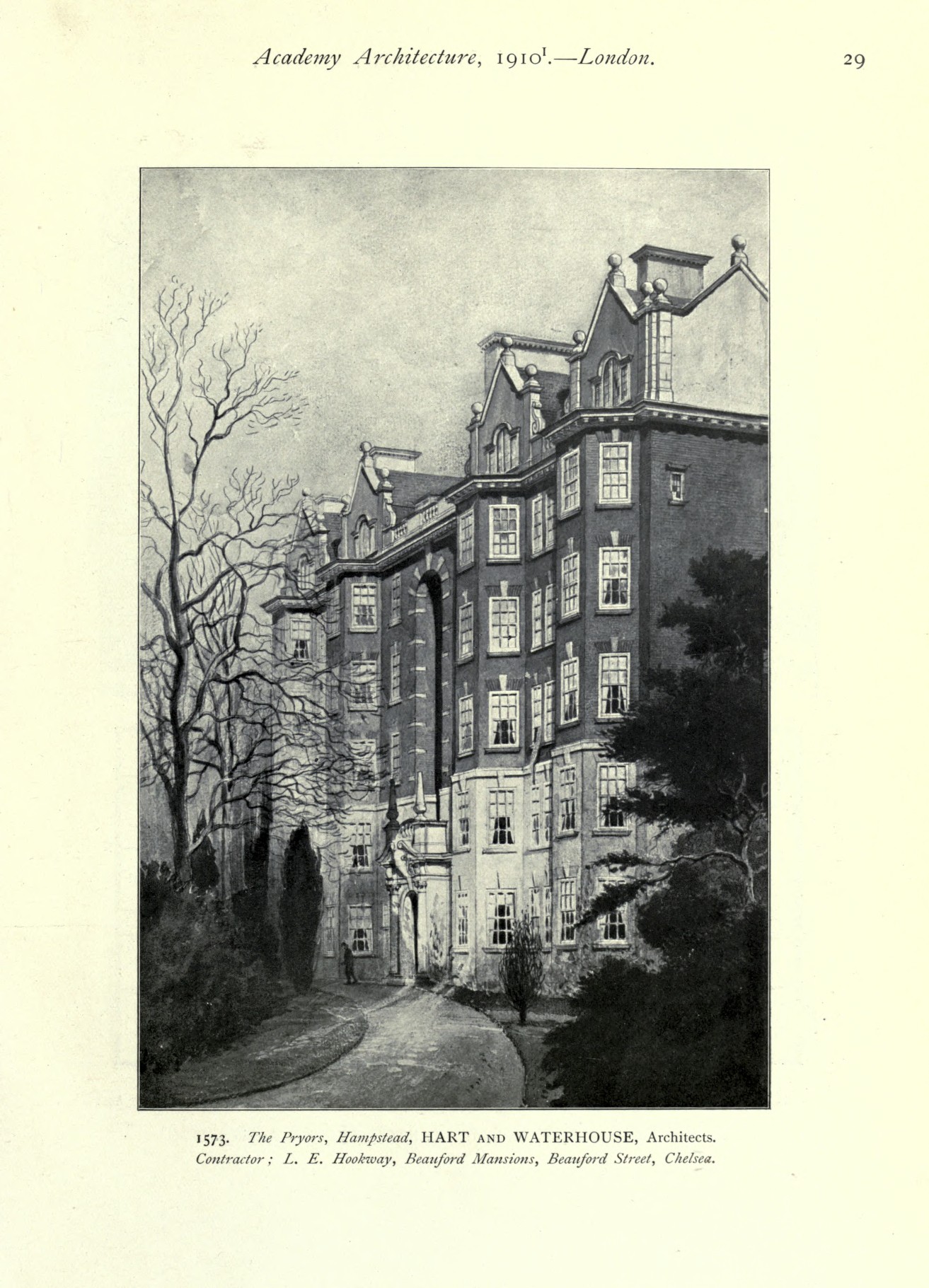
The Pryors, East Heath Road, Hampstead. Reproduced from Koch 1910: 29.
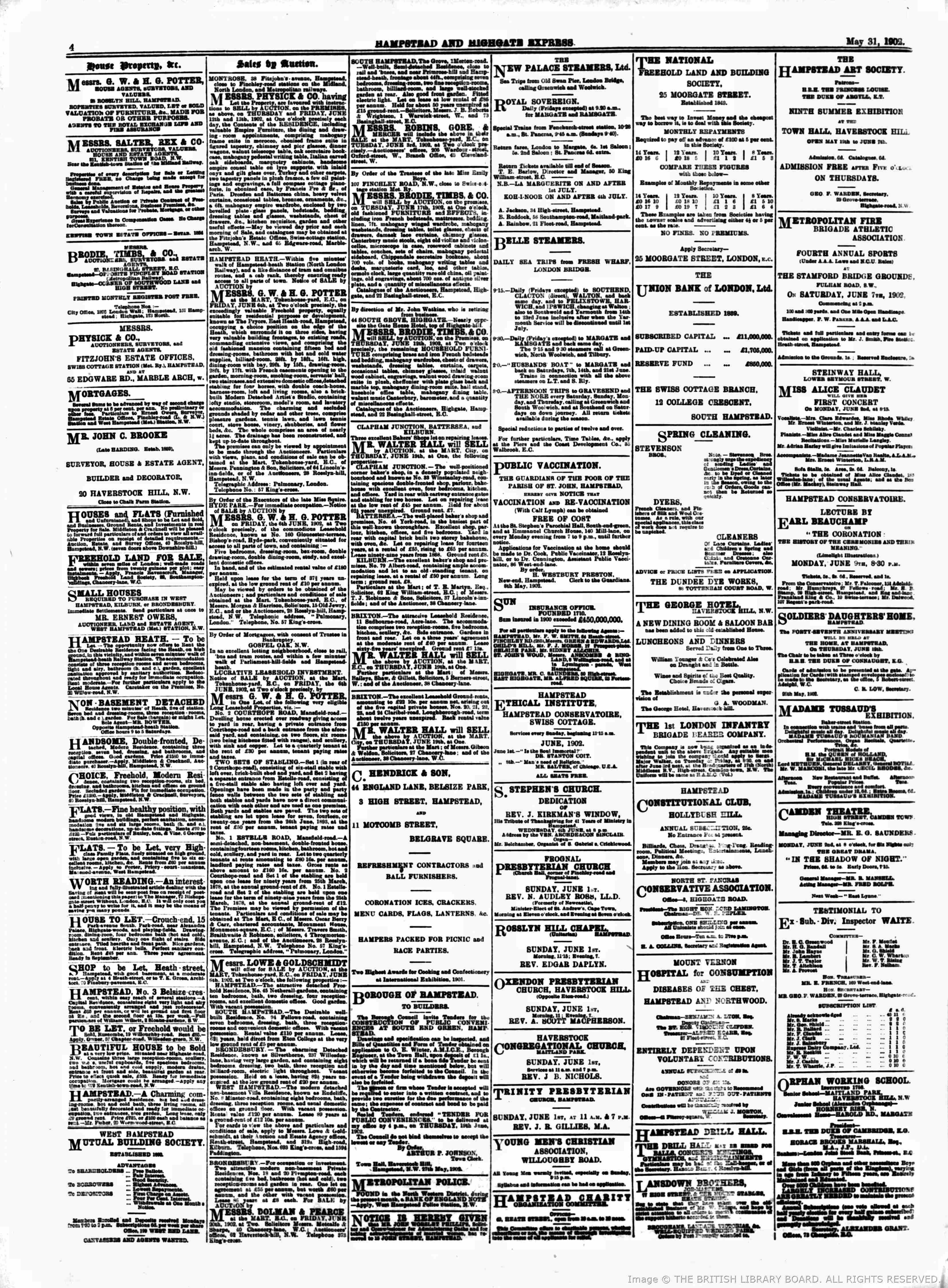
a tall and beautiful blonde, of admirable figure, blue-eyed, golden-haired. Her health was obviously prodigious. She was overdressed in heliotrope and cheap lace. Her feet were large but well shod; her hands were powerful but well tended. Her rosy nails glittered in the sunlight, scarcely less brightly than the jewels in her many rings. Her waist was considerable, but it was clear that she did not by her stays at the first shop. A girl with an eye to her own appearance (p. 74).She is also quite the opposite of “tall, rosy-haired and very good-looking” Edith Gordon Walker, aka Mrs. William Caine (see § 5). Yet perhaps those “blue glimpses of distant Middlesex” hint notionally at its transatlantic namesake, i.e., the Massachusetts county encompassing the town, Arlington, where she who deserves the “real merit” for having given Caine the title of his novel attended high school? And “those dear little women who remind you of robins” recall, perhaps, the “operatic tragedy” which the author of Little Women penned with her sister in childhood and which she who gave Caine those “things” — “encouragement, inspiration, suggestion and such minor matters” — of which his “mere book is the fruit” performed in during her junior year at Wellesley (and which I discuss in § 10)? But back to the matter at hand. According to her entry in the Wellesley College Record, 1875–1912 which I’ve reproduced in § 5, Edith Gordon Walker, aka Mrs. William Caine, had lived, since at least May 1912, at “16 The Pryors, Hampstead, London, Eng.” The report of her death some fifteen years later in the Hampstead and St. John’s Wood Advertiser (reproduced in § 10), states, “She had lived for over twenty years at The Pryors,” thus placing her there since at least the autumn of 1907. Walter Besant (1911: 368) called The Pryors a specimen of “those charming old red-brick mansions which make Hampstead what it is,” but as Besant died in 1901, he was referring to “the old-fashioned mansion containing fifteen bed and dressing-rooms” which was put up for auction in June 1902 and torn down in May 1903. The first “pile of modern residential flats” known as The Pryors seems to have been completed on the site by February 1904, with another block completed by July 1909. The address of 16 The Pryors existed by October 1906, as shown by a want ad under “Situations Vacant; Domestic Servants, &c.” in the Hampstead and Highgate Express, October 20, 1906, p. 3:
Good General servant wanted for flat in Finchley-road; two in family; age 25-30. — Apply 16 The Pryors, East-heath-road, Hampstead.Finchley Road is also in Hampstead, and lies about half a kilometer west of, and more or less parallel with, East Heath Road. Was Caine already living at 16 The Pryors in October 1906, and, thus, in the older block of flats? Was he, and perhaps Walker, too, associated with the flat in Finchley Road? Were either of these flats, or neither, the London residence which The Scrap Book erroneously called “a wedding-gift from the groom’s father” (see § 3)? In any case, it’s quite possible that the Caines moved into 16 The Pryors shortly after their marriage, or after they had returned from their honeymoon on the Continent, and that Caine’s story (and many others) got itself made presentable there in that flat which, according to The Graphic, “contained a large collection of Bateman’s drawings and a Chinese room adorned with decorative panels painted by George Sheringham.”
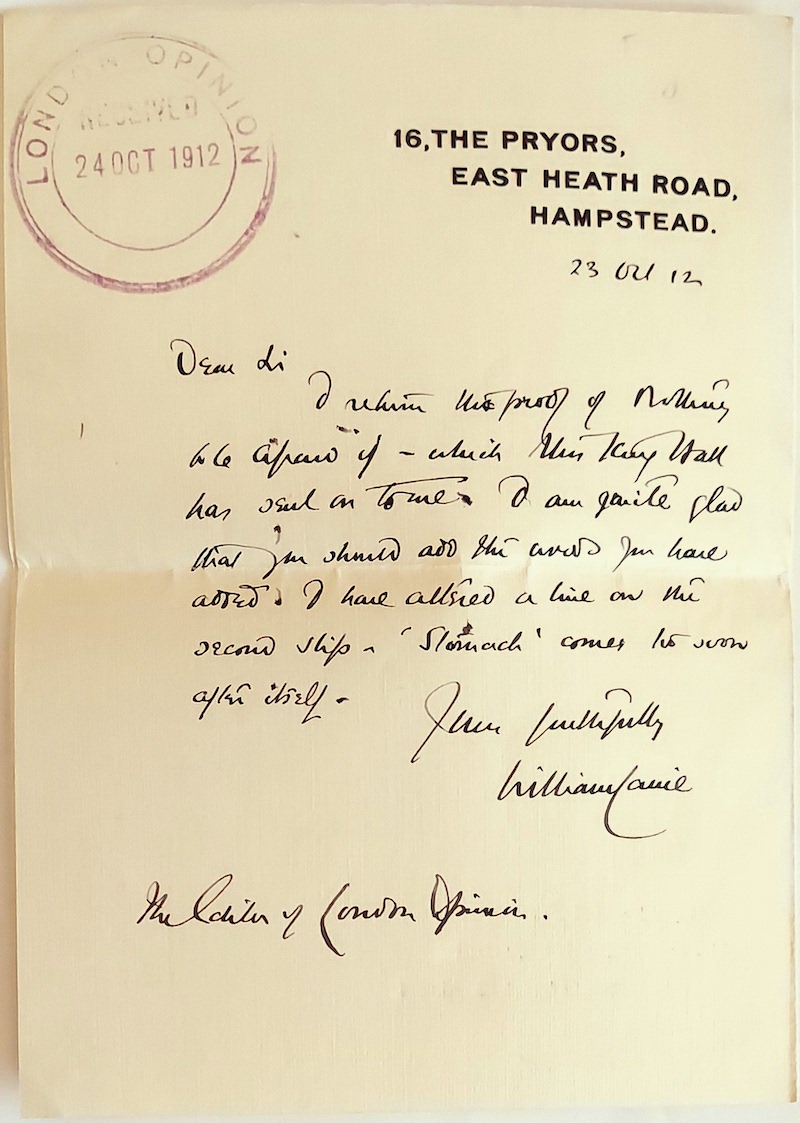
Dear Li [?]For the starting point of a story about a wealthy arriviste who builds an artificial English village at the gates of his villa (“A Deal in Villages,” from What a Scream!, pp. 119–133), Caine uses, if not exactly “the pile of modern residential flats” in which he lived, nor quite “the old-fashioned mansion” which it replaced, at least the name:I return this proof of Nothing to be afraid of — which Miss Kay Wall [?] has sent on to me. I am quite glad that you should add the words you have added. I have altered a line on the second slip. ‘Stomach’ comes too soon after itself.
Yours faithfully
William Caine
The Editor of London Opinion.
Then he foreclosed his mortgage on The Pryors, entered into possession, fitted it with furniture from Tottenham Court Road, and pictures by nobody under an A.R.A., and set up as a local county magnate, vice old Mr. Gladwyn, expelled.Lying to the east of the fictional The Pryors, Stoke Gladwyn seems to be modeled vaguely on the village-like area lying to the west of the real The Pryors, the Vale of Health, where Caine’s friend and fellow-writer, the notorious anti-women’s-suffragist George Calderon, had been living since November 1901 in a house called Heathland Lodge — a house similar, perhaps, to that into which Ridley Carpenter had moved two weeks before Old Enough to Know Better starts. One of Calderon’s friends was a lawyer named Archibald Edmund Ripley. Ripley and Calderon matriculated at Trinity College, Oxford, the same year (1887), and graduated the same year (1891). That year, Ripley was also president of the Oxford Union Society. Before and during his university years, he travelled extensively, visiting North Africa in 1882, and in 1888, he went to Norway, Sweden, Russia, and Switzerland. After university, he worked as a barrister in London, travelled to Sri Lanka, Australia, China, Japan, and Canada, and married Katherine (“Kittie”) Hamilton in Chelsea on April 30, 1895. All his life he suffered from ill health, very likely tuberculosis, and on Sunday, October 23, 1898, he died. Two years later, on Saturday, November 10, 1900, Calderon married Ripley’s widow at St. James’s in Piccadilly. I’m not sure exactly when Caine and Calderon (whose middle name, by the way, was Leslie) became friends — not at Oxford, surely, since Caine matriculated there a year after Calderon graduated — but supposedly Calderon “had known Caine since at least 1900, when he played bridge with him” (Miles 2018: 335) — and surely Caine had Calderon in mind when he wrote, “We struggle for the rights of Woman, or we concert together to weld her chains more firmly upon her.”The Pryors was an Elizabethan Mansion, shaped loyally like the letter E, and mouldering into ruin by reason of the inability of the Gladwyn family to keep its hospitable expenditure at anything like the level of its means. That, of course, was the Gladwyn family’s business. Sir Benson’s was of another kind altogether. That is why old Gladwyn made way for Sir Benson. But old Gladwyn was not the only person who had done that. If he had been, Sir Benson would not have been possessed of fifteen or sixteen hundred thousand pounds, would he? People like old Gladwyn exist so that people like Sir Benson may exist. At least, it seems so. But I was talking about The Pryors.
The house stood in a fair park of green land and notable timber. Old Gladwyn had got out rather than see the timber cut, the unaccountable old idiot. But don’t let us talk about old Gladwyn. He had to get out because he wouldn’t get on. He is really unworthy of a moment’s consideration. Let us yield him no more, the old dodo.
The carriage-drive of The Pryors had been made by a Hanoverian Gladwyn. It ran for a mile perfectly straight, between huge chestnuts, from the front door to the wrought-iron gates where the Gladwyn gryphons sat on their haunches, nursing three-cornered crusading shields and grinning at a landscape which had once been the Gladwyn’s landscape. Beyond these gates was the high road from London to Colchester. Beyond the road was a hedge. Beyond the hedge were fields, green or brown according to the season of the year. One mile up the road to Colchester was the village of Stoke Gladwyn, with its Early English Church, wherein the Gladwyns had been accustomed to bury one another. The Gladwyn Arms was another feature of the place, an aged building of brick, timber and thatch. It was the sort of inn which nobody who carried a kodak could possibly pass without pressing the button at least twice. Not that a kodak has any button to press (pp. 119–120).
Reproduced from Burgh House, The Collection.
on 4 January 1913, George approached the novelist and angling-writer William Caine about collaborating on a pantomime for commercial performance. The idea had, apparently, been suggested to George by the composer Martin Shaw more as a ‘children’s fairy play’ to which he could ‘put music’ (Shaw had had some success with similar productions in 1911 and 1912). George chose the Grimms fairytale ‘The Valiant Little Tailor’ (Miles 2018: 334–335).Ten years later, Caine described their collaboration as follows:
During the winter of 1913 Calderon asked me to write a pantomime with him. Naturally I agreed, though I had little expectation of ever seeing the thing finished. What did matter was that I should be engaged upon a bit of fun with Calderon. Together we were to concoct absurdities. There would be laughter.In his autobiography, Up to Now, Shaw provided a few glimpses of their collaboration and of life in the “Intellectual Suburb” as follows:We took in Martin Shaw to be our music man and set about it forthwith. How much Calderon wrote and how much I wrote I don’t know. I have a fatal facility in writing dialogue and this enabled me to draft rapidly a great many scenes, which I then turned over to him to be cut and polished as he pleased. The scenes which he undertook (notably those in which the Giants and Dwarfs appear) required, by the time I heard them, no cutting or polishing at all.
By the spring of 1914 we had all the book of our pantomime and half its music; nor had I been disappointed of my laughter. I then went to America, leaving Calderon to find us a manager. By the time I got home again he was fighting in Flanders. A wound brought him back to Hampstead. The moment it was healed he was off abroad again, this time to the Dardanelles, where he was killed.
Our pantomime has still to be produced. Probably it never will be produced. But there is so much of him in it that it would not be proper for me to let it be altogether lost. So I’ve made it into a book.
I wish he could have done it (The Brave Little Tailor [September 1923], Preface, p. 7).
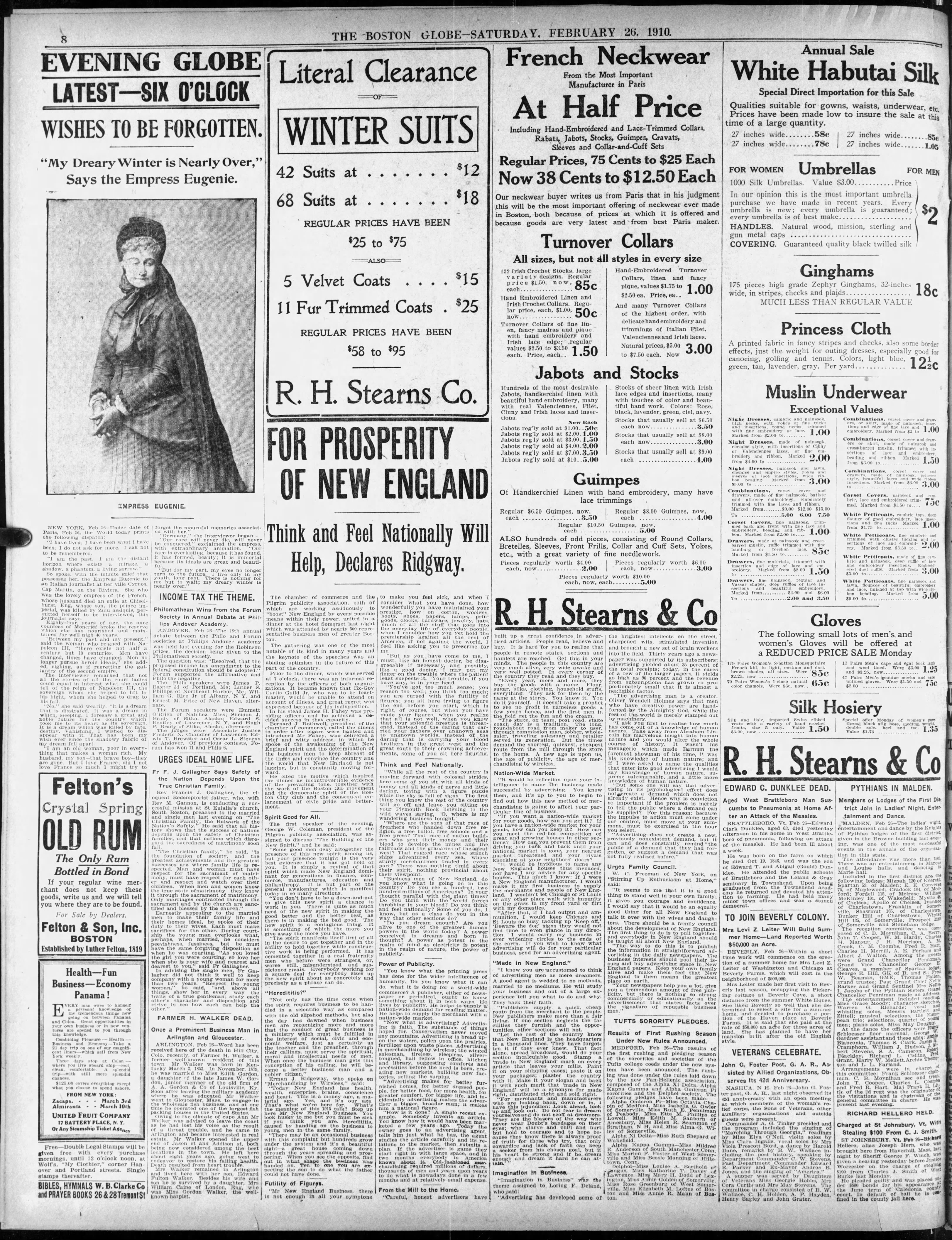
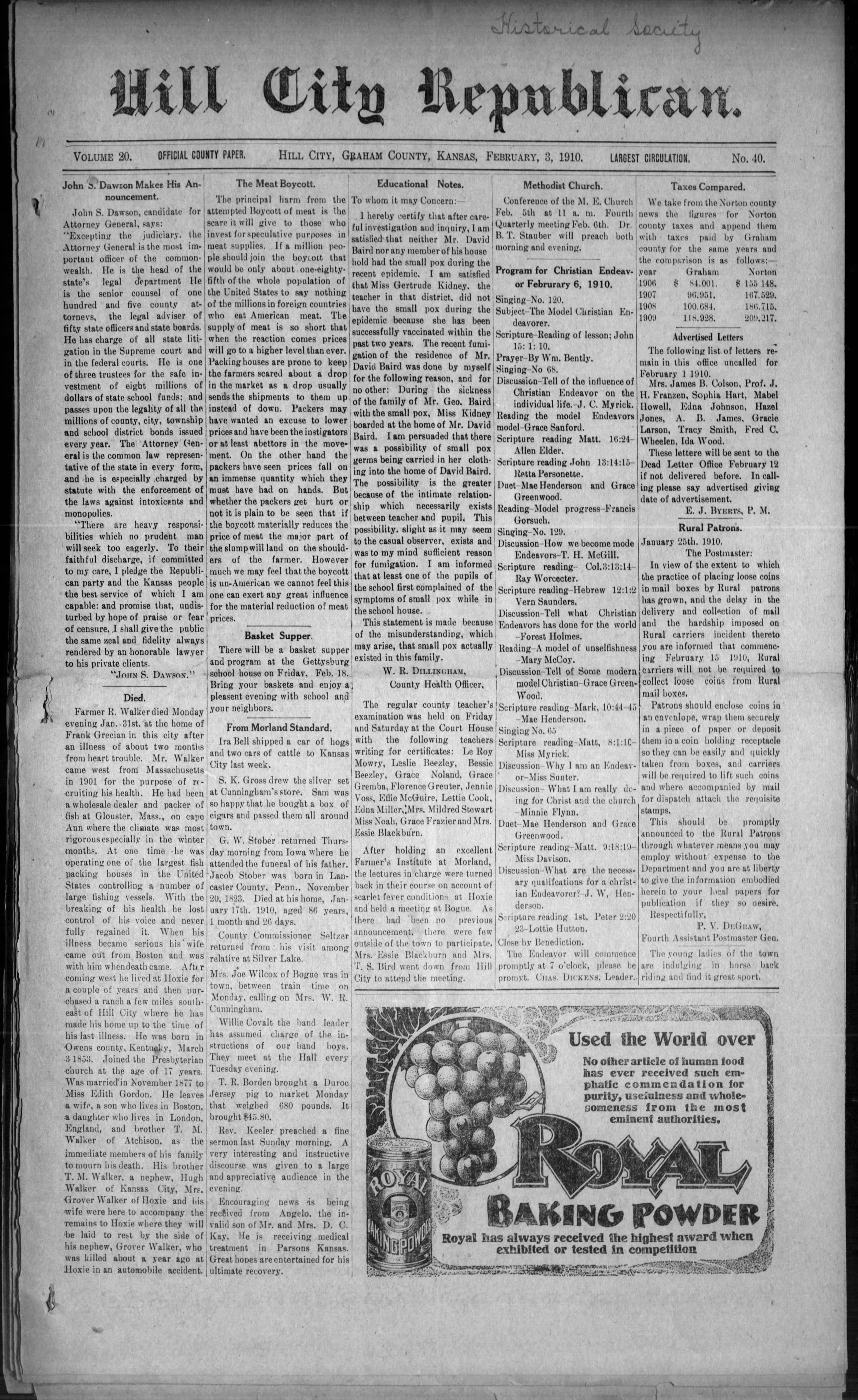
But back to Caine’s “network of connections between the events, the people, and the things of the world.” In addition to the Ripley Calderon ⇌ Ridley Carpenter resonance and his lending a parody of his own authorial self to the latter; in addition to his female desperado being both antithesis of his dedicatee (who is perhaps similar to Mary Massinger) and a modulation of his wife who “supplied the spark her husband uses to write with, also to any others who temporarily need it” (see § 7); Caine also doles out his legal self to Harry Hamley, a “gaudy young City solicitor” with “a genuine liking for poetry” whoseAs I say, my friendship with George Calderon and his wife came at a very opportune moment. He and Jimmy Pryde carried me through one of the worst periods of my life. I was nearing forty, in bad health, penniless, unknown, and unsuccessful. An afternoon walk on the Heath with Calderon or an evening in Jimmy Pryde’s studio helped to compensate for returned manuscripts. (Jimmy had established himself in a delightful house — which he of course made much more delightful — in St. John’s Woods Road, of which Mrs. Jimmy was the vivacious and efficient châtelaine.) Calderon liked my music, so I suggested to him that he should write a children’s fairy play to which I could put music. With characteristic energy he immediately set to work on The Brave Little Tailor, calling in William Caine, the novelist, to collaborate. In a very short time the play was written. Calderon and Caine never thought of the practical side of it, i.e. expense of production, limitation of characters, &c. They simply did it to enjoy themselves and their exuberance knew no bounds. So I don’t suppose, in these days, it will ever be produced — which is a pity, for their dialogue and verse is most brilliant and witty. I enjoyed writing the music very much (Shaw 1929: 112–113).
The Brave Little Tailor gained me the friendship of William Caine. He was the son of William S. Caine, the temperance politician, Civil Lord of the Admiralty in one of Mr. Gladstone’s governments. Caine also lived in Hampstead and walked the Heath with Calderon. I always enjoyed a meeting with him and have had many a pleasant evening at his flat in The Pryors, East Heath Road. He was a prolific novelist and writer of short stories. Hoffman’s Chance and The Devil in Solution are in my opinion his two best works — the former being a really fine novel which deserves to be better known than it is. The Devil in Solution is a masterpiece of absurdity and extravaganza and really amusing. Poor Billy Caine! His heart was always weak and he died suddenly in his wife’s arms at a dance (ibid.: 115).
office shelves were not loaded altogether with textbooks and law reports. Smith’s leading cases were the neighbours of Keats in two volumes; Swinburne, in six, stood between Prideaux and the Mayor’s Court Practice. The Rubáiyát lay upon the table, a slim volume, bound (for the benefit of clients) in black. It would be fatal to a solicitor’s practice should he be suspected of indulging, in office hours, a vicious craving for golden words (Old Enough to Know Better, p. 122).Like Carpenter, Hamley is one of the constellation of people “soft on Emily,” for all of whom her brother Urquhart has “the profoundest contempt:”
He often wondered how it could possibly be that so many people were soft on Emily. If they only knew her! Hamley, for instance. There was a fine man, a glorious, gay, knowing fellow, a man who had landed a hundred pounds on last year’s St. Leger. Yet Hamley was one of them. Even Hamley was an ass where Emily was concerned; always hanging about. And Blooter, a real tip-topper, who went the Chawner Tour — Blooter, of Salt and Blooter — the world’s champion Cross-Talk Comedians — he was gone on Emily. And Salt, too, he shouldn’t wonder, though he had no proof of this. It was very puzzling. There was Chilper, the Heath-keeper, too, and others. Every one who came to the Paradise seemed to go soft on Emily. And now Carpenter was. A blooming writer! A person of no consideration at all! A person that he, Urquhart, baited with goats! (pp. 89–90).During her morning stroll upon the Heath, Mary Massinger chances upon one of those people “soft on Emily” and held in contempt by Urquhart:
At that point in the Sandy Horse-ride where it dips down-hill towards the Bull and Bush tavern, Mary came upon three Heath-keepers, who stood in front of a young hawthorn-tree which was loaded with pink blossom. Sadly they regarded the bush. In defiance of all notices a small branch had been removed. The white scar, dumbly eloquent upon the trunk, had declared the crime to vigilant eyes.Those “world’s champion Cross-Talk Comedians” Urquhart seems also to be disappointed by for being soft on his sister are the music-hall artistes Jack Salt and Billy Blooter (note their initials: J. S. B. B.) whom the Chawner Tour has taken to Leeds where, over bottles of post-breakfast Bass, they fantasize about a double-wedding, double-honeymoon with their two gals who, unbeknownst to them, are really one:They did not speak about it. They just stood round the tree and shook their heads. The matter was past remedy. This was the first outrage of the kind which had been discovered that morning. Two of them had, by shouting, brought the third nearly one hundred yards to confirm their suspicion that the tree had been assailed by lawless hands. And now, having settled the matter beyond all question, they remained in place shaking their heads and grieving inwardly over the depravity of the public.
In one of the Heath-keepers, a handsome young giant, Mary was pleased to recognise Alfred Chilper, a late Sunday-school scholar of her own. For six months now he had been on the Heath staff, where (because he wished to better himself) a place had been found for him by Mary’s brother, the bosom friend of an energetic member of the London County Council. No more did Alfred hop the clods of his (and Mary’s) native valley, but, arrayed in brown becoming clothes, graced the Heath of Hampstead and indulged an enormous leisure at the expense of London’s ratepayers.
Now Mary had something to say to Alfred Chilper.
She hailed him. He looked up; knew her; touched his hat; came forward largely grinning. His companions passed ponderously away towards the Flagstaff.
“Well, Alfred,” she said, “here you are, then?”
“Thanky, Miss Mary. Ay! Here a be,” said Alfred. “Biding in the Vale with Muss’r Jim a spell, Miss Mary?”
She said yes, she had come to stay with her brother for a week or so.
These important facts being established, she said, “Are you happy in London, Alfred?”
To this he replied, “Thanky, Miss Mary, main happy. Thanking you and Muss’r Jim for what you done fer I. ‘Tis a pig in clover I be, surely.”
“You’ve certainly grown fat,” she said.
“Ah,” he said. “I wax ever. ’Tis the victuals, I rackon.”
“I shouldn’t wonder if it was, Alfred. Who cooks ’em?”
“Mrs. Wilding do, Miss Mary. Wife to that air man.” He pointed at his retreating colleagues. “Him on left side,” he said. “I be lodger of they, the pleasant good souls.”
Mary considered him, her head on one side.
“Does Mrs. Wilding mend for you, Alfred?”
“Thanky, Miss Mary, she do just so. Like a mother she be to I.”
“That’s all right,” she said. “Then since you’re so comfortable, I suppose you’re going to get married to some girl who can’t cook, but plays the piano, and who’ll ruin you for her clothes and let yours go to pieces. Is that the way of it, Alfred?” she asked sternly. Mary had a poor opinion of the new generation of wives. She had also a reason for asking this question.
He cast down his eyes, blushed, grinned and giggled.
Mary pointed her stick at him. “You are,” she cried. “Oh, Alfred, you poor silly thing! Who is it? Out with her name. Is it a Cold Harbour girl? You had your eye on Jane Orton at one time, I know. Is it Jane Orton? It is.”
“Naw, Miss Mary. ’Tisn’ Jane. ‘Tisn’ any Cold Harbour maid. ’Tisn’ any one you know, I rackon.”
Displeasure appeared on her face.
“I don’t care who it isn’t,” she said. “Who is it? Who is it?”
“’Tis,” Alfred admitted, “a Hampstead young lady.”
“Young lady!” she snorted. “They’re maids in Cold Harbour, Alfred Chilper.”
“Ah,” he said, “but not hereabouts. Thick one’s a cut above they young heifers at home. Should see her, Miss Mary. My wuz! ’Tis a miracle —”
“Tush!” said Mary indignantly. “What’s got into you, Alfred Chilper? Heifers, indeed! I believe I’m sorry I made Mr. Jim find you a place here. London’s not been good for you” (pp. 30–32).
“It’d be a pity not to make it a double event. Might git a picture in the Sketch, but separate we wouldn’t stand a earthly. Then we can all go to Paris together for the honeymoons and start the Dimmock tore in April, a ’appy family party of four, none of us out in the cold. Wow! Wow!”Those “whims of an unaccountable and delightful sex” will eventually bring the diverse constellation of Urquhart’s objects of contempt into conjuncture in the garden of the house where Carpenter rents his two rooms. That house is next door to the house of Carpenter’s old friend Jim Massinger, Mary’s brother, neither of whom know that he’s been Jim’s neighbor for the past two weeks, since he rented the flat without telling Jim and has been waiting to spring a surprise. Carpenter’s landlords are Lottie and Herbert Boase, Lottie being one of Emily’s and Urquhart’s sister. A third sister will also become involved (and so Urquhart, like Caine himself, has three older sisters) — Julie, who when she’s not on tour with her contortionist husband Willy Watt, lives in Clapham. Three years before Old Enough to Know Better opens, Ridley had proposed to and been rejected, in the town of Cold Harbour, by that “little round thing with a skin like a peach and big brown eyes” who, unbeknownst to Ridley, is visiting Jim who“I like the idea,” said Blooter. “It’s all right. Yes, we must try to work it. Do you think yours’ll agree?”
“Well, you never know your luck. Gals don’t always fancy double weddings. They don’t care to ’ave another bride sharing the limelight, you know. Now with men it’s different. I shouldn’t care how much support I had. What about yours?”
“Why, we can but ask, Jack.”
“Ah!”
“You’d never believe, Billy,” said Mr. Salt, “the way that gal loves me. I can’t undersand it, a plain ordinary fellow like me, and she fit for a king. Why —!”
“Don’t you worry yourself, old man,” his friend interrupted. “She knows a good ’un when she sees him. But I know ’ow you feel. I’m just that way meself. Think of me, a coarse rough man winnin’ the regard of a blessed angel like that. Jack, old boy, if you’ll believe it —.”
“I do, old son, I do. But women’s odd creatures and you never know how it’ll take ’em. Now I expect your gal’d think me quite ’orrid, and I shouldn’t wonder if mine couldn’t look at you twice. Yet we’re both pretty much alike, you and me. Just two ’ard-working, respectable pros. It’s very rum.”
“I hope they won’t think that of us, old friend. I do hope they won’t take us that way. Because if we’re all to tore together —”
“Ah, that’s different, that is. They’ll git on all right with us as friends. I meant as husbands. That’s where a gal gets so particular.”
“Do you think they’ll like each other.”
“Oh, I reckon so. Anyway, it’s no use meeting trouble.” There was a moment’s thoughtful pause, then Blooter said —
“Jack, I do wish we could be free and open about them. It’s very ’ard to talk things over under present circumstances.”
“It is, Billy, it is,” said the other, “and I wish we could too. But we promised and we got to abide by our given word.”
“Women loves these mysteries,” said Blooter. “Why the devil shouldn’t I tell you my gal’s name and show you her picture?” He touched his breast pocket. “And why shouldn’t you do the same? There ain’t no sense in it, that I can see. Two pals like you and me. It ain’t fair to us. Here’ve we been just busting to confide it all to a sympathetic ear for three weeks and nothing said.”
“And,” Mr. Salt solemnly assured him, “nothing going to be said, Billy. We give our sacred word.”
“Oh,” said Blooter airily, “I wasn’t goin’ to say nothing. But I don’t see where the ’arm would come in. It isn’t as if we weren’t ever going to know. Why, in February we’ll all be walking on the boulevards, arm in arm, if all goes right, and yet you and me mayn’t tell who the ladies that we’ll be walking with are. It’s foolish.”
“It’s woman,” said Salt oracularly, “and that’s an explanation that’s good enough for me. I don’t pretend to understand their little ways, I don’t. I leave that to the young boys that’s never had no experience. Hay! Ho! Woman’s a paradock, and that’s half her charm.”
“A what?”
“A paradock, laddie. Something you can’t tumble to.”
“Oh, you mean a what-do-you-call-it, Reginald?”
Mr. Salt responded instantly. “Not exactly,” he said. “More of a thingumybob, Dennis.”
“Don’t expose your ignorance, Adolphus. Don’t you know that a thingumybob’s a what’s-its-name?”
“Wrong, Algernon. You’re thinking of a junnysaykwah.”
“No. That’s a kind of horse.”
“Well, I’m talking about fishes, too.”
“So will you.”
“You’re funny, aren’t you?”
“No, I am.”
“Ha, twice!”
They were at it again. Mr. Blooter had forgotten his mild annoyance at the vow of secrecy which sealed his lips upon the identity and personal appearance of his lady. Mr. Salt was concerned no longer, with artless cynicism, to defend the whims of an unaccountable and delightful sex. Battle was joined. They were artists once more. Woman is strong, but Art is stronger (pp. 252–254).
was a year younger than Mary, and much better looking. Indeed, with his fine head, his straight nose, his firm mouth and family eyes, he was no less than handsome. Not only was he handsome, but he was good, and goodness is not a common quality in the beautiful. That is why I mention it. He had a motherly nature. He liked to take care of people. This, perhaps, explains his friendship with Ridley Carpenter. It also accounts for his annual beef-and-beer party to the Heathmen, which he was wont to hold at the beginning of January in the large room at Snyder’s Paradise in the Vale of Health. This entertainment gave him great pleasure always. First, he could very well afford it because he was a bachelor, had no great demands on his purse and earned a comfortable income as an adviser upon furniture and decoration to persons possessed of more money than taste. Secondly, he was one of those persons who obtain real pleasure from seeing victuals put away in a masterly manner by other people. He would go for miles to help at a Robin Tea (if you know what that is), and was always leading social wrecks into Lockhart’s Coffee-shops and giving them carte blanche among the sausage-rolls and fried fishes. But from so feast did he derive such enjoyment (in the kind which I am considering) as from his Heathmen’s Supper. The healthy, hearty Heathmen! None but they could truly gratify Jimmy Massinger. For they came to their meal with well-rounded waistcoats and plump rosy cheeks. No fire of starvation burned in their eyes as they disposed their legs beneath the tables. There was nothing to sadden their host in the glances which fell upon the sirloins. The Heathmen’s Supper was for him all unadulterated delight.Her own mother having died when she was seven, and her father’s long before, she had come to “mother” her father, “a comfortable country gentleman, quite undistinguished” (p. 55).But if James was motherly, what are we to say of Mary?
That she was grandmotherly? No, we are not to say that. There is really no word in our language sufficiently forcible to describe Mary’s degree of motherliness. Let us say, then, that she was remarkably, super-femininely motherly, that motherliness was easily her first attribute (pp. 54–55).
But long before that she had done the same by the birds in the garden, and the puppies and kittens and other young things that appeared from time to time among the stable buildings, and she would have liked to mother the lambs and calves in the fields, but her nurse would not have it. All her days she had but two dolls: Pauline, who in her sixth year was savaged by the sow and had positively to be buried; and Beatrice, who, retiring from active life on Mary’s sixteenth birthday, persisted to this day, hale and hearty, in an upper shelf of Mary’s bedroom cupboard.After being fortuitously rescued by Jim from the quag he had got gotten himself into after springing his surprise on the perpetrators of the goat nuisance, Ridley is in Jim’s house, changing out of his pyjamas into borrowed clothes. Having returned from her walk, Mary, tasked with making breakfast for three rather than two,Jimmy, Mary had always mothered, and her elder brother Kenneth, until he married and was withdrawn from under her ministrations. But he had two children already, so Mary was better off than ever.
During the lean years after Jimmy’s first going to school, her propensities had been rather starved, for she was hardly old enough to mother the villagers, though she resolutely tried. But when Jimmy came back in his holidays she did double mothering and, taking the year as a whole, maintained a good average. And Jimmy brought friends home with him very often, and she mothered them so valiantly that their own mothers wondered at the excellent repair which their clothes exhibited on their return, and thought that that Massinger boy must be a very nice quiet little fellow — until Jimmy returned their sons’ visits.
Among the visitors was one Carpenter, son of a doctor in a large town not far away. Him she mothered ruthlessly, for he was perhaps the most unfortunate boy of her acquaintance, and never went out to angle for trouts in the river without falling in or tearing himself to pieces with barbed wire, because he had climbed out upon a rotten and overhanging branch or had not examined the hedge through which he had tried to force a way. She was always stitching when Carpenter was staying with them. She loved Carpenter. He was so footless, she said.
Then came her own school and the Paris finishing school, and this and that, and she began to see very little of Carpenter. He was supposed to be at Cambridge with Jimmy. And then he was supposed to be in London learning to be a doctor. Shortly after this his father was understood to be dead and he was reported gone abroad, — to Italy, she thought. He had quite enough to live on, Jimmy said, and he proposed to live on it and travel about and see the world. He had also taken it into his head that he was going to be a writer. At any rate, he had definitely given up medicine and gone in for gathering experiences.
She forgot nearly all about Carpenter.
And then, three years before this tale begins, he came down to Cold Harbour one June to fish. He had not become a writer. Still, he gathered experience. A fortnight he stayed. He left suddenly, having added to his experience. They had not met since (pp. 55–57).
was not entirely calm. I imagine that no kind-hearted girl can expect the arrival of a man whom she has refused — even though it be three years ago — without a little excitement. Three years is a long or a short time, just as you happen to regard it. Mary was not blasé of proposals, and the memory of the three which she had had always remained vigorously alive. She supposed that this particular unfortunate had also got over it by now. The others had both married, and had become models of felicity. This one had seemed very much cast down at the time, but, she reflected, he had a buoyant nature and by now, no doubt, he must be quite happy again. She hoped so. For she had very much liked Ridley Carpenter, and had been very sorry when he had done that very foolish thing. Yes, if they could only re-establish the nice old friendly footing. That was the thing to aim at. But wouldn’t it be difficult?Mary’s anticipation of Ridley’s “new stability” will be dashed, since he has meanwhile gotten himself involved in a variant on the “scrap of paper” theme on which turned the plots of at least three plays the wife of the author of The Author of “Trixie” performed in during her college years — A Rank Deception and Cicely’s Cavalier, both of which I discuss in § 10, and A Scrap of Paper, which I discuss below. In Ridley’s case, the scrap of paper, on which he’s written out and signed with a heart pierced by an arrow his parody-poem “March — At Bexhill” (which I reproduced in § 5), has gotten into the hands of Emily who, vaguely hoping to get some money out of Ridley for breach of promise, shows it to the “gaudy young City solicitor” Harry Hamley, whose “vicious craving for golden words” enables him, after reading a mere four lines, to knowShe wondered if he had changed at all; if he had managed to acquire any strength of character in the last three years. It was his hopeless irresponsibility which had dismayed her, his inability to stick to anything. But for that she might — there was no knowing what she might have done. Yet she had never doubted that she had done right. A man who couldn’t take a serious view of anything, even of the art which he was supposed to be following, could never be the man for her. Yes, she expected a change of some kind in him. For one thing, he had got to work and written three books. She had them at home; had read them every word; thought well of them; found them light but full of honest writing — no scamping, no slushy stuff in them, and well constructed. And the second had been better than the first, and with the third he had made a real jump forwards. There they stood upon her shelf, tangible evidence that the man was taking his art seriously.
Sometimes she wondered if the knock-down which she had administered had provided the stimulus necessary to this feather-headed young man. It was a pleasant thought — much pleasanter than that which she would have had to reject if Ridley had proceeded to go to the devil. So she was grateful to him, and expected him to look more than three years older. She anticipated a new stability in him (pp. 58–59).
that he was engaged with very poor stuff. Instantly his manner became comical, and for six stanzas he read with the ludicrous unction of one who damns by jeering. About this time, however, his manner underwent a second alteration, and he concluded on a quite serious note. You see, he thought, “Good Lord! Has she written this tripe and brought it to me to criticise?” He had not thought it necessary to conceal his deplorable tastes from Miss Snyder, to whom, indeed, he had, at her own request, presented a Golden Treasury.Emily tells Hamley how “about two weeks ago this young man Carpenter” had become a lodger in her sister Lottie’s house and how Lottie had brought Carpenter around one day to Snyder’s Paradise and the next day she had met him by chance while out strolling on the Heath and then she went out strolling with him in the evening and “on a bench beside the Leggamutting Pond” he put his arm around her and tried to kiss her and “Well,” she concludes,“I suppose,” he said, “you aren’t Ridley Carpenter, by any chance?”
She shook her head, a little puzzled by the question.
“You swear?” he asked. It wasn’t her handwriting, but that did not entirely reassure him.
“Of course I’m not. What an idea! Well, what do you think of it?”
“Why,” he said, much relieved, smiling again, “I think it is very bad. I should call it doggerel. Whoever Mr. Ridley Carpenter may be, I can’t congratulate him on his verses. Not if he were a dustman. And that’s my honest opinion.”
“Harry,” she said, “you’re absolutely chronic. Do you think I want —? Oh, read it again. Imagine it’s not poetry.”
“Well, it isn’t.”
She stamped her foot at him. “Imagine it’s a letter,” she said, “what does it mean? Tell me as a lawyer, Harry, what does it amount to?”
Mr. Hamley’s face suddenly lost its look of friendly amusement and became keen and, taking its chubbiness into consideration, almost sharp.
Again he bent over the paper. After an interval he looked up.
“As a lawyer, you said, eh?” he asked a little hoarsely.
“Yes. Is it a promise of marriage, for instance?”
The flesh of Mr. Hamley’s neck turned a dull red above the white collar. “What do you mean?” he said at last, slowly looking up.
“What I say. Is that a promise of marriage?”
“It might be,” he said hoarsely. “Yes, it is.”
“Thank you,” she said, picking up the paper, “that’s what I wanted to know.”
He got up suddenly and hit the table with his fist. “Who is this Carpenter?” he cried.
“I don’t know,” she said, “that that’s any business of yours, is it? I’ve asked you a question as a lawyer. You’ve answered it as such, but I don’t think that gives you any right to ask me why.” She opened her purse and took out some money, which she laid on the table. “I think you’ll find that right,” she said. “Six and eightpence. Good-morning, Mr. Hamley.” She took her parasol from the shelf of the bookcase.
He struck the money into the fender and, “No,” he said, moving quickly between her and the door, “you don’t go till you’ve told me.” He puffed out his cheeks and was very pink.
“Really?” she asked. Then she laughed. “One’d think,” she said, “that you had some call to be disturbed. What’s it to you if I receive a proposal, I should like to know?” She stared him down, folding Carpenter’s poem slowly between her fingers.
“It’s everything,” he said more humbly. “Didn’t you know?”
“That’s very interesting,” she said, “but how should I know? I’m not good at guessing.”
“Well, it is. Everything. Absolootly.”
“I suppose,” she said, “that I ought to be flattered?”
“Damn it!” he cried crudely enough, “I love you.”
“Is it possible?” she drawled.
“It’s a fact.”
“I don’t think this is very respectable,” she said, with a smile. “Really, I’d better be going. Do you talk so to many of your lady clients, Mr. Hamley?”
“Oh, dry up,” he said. “For God’s sake don’t chaff a fellow. I tell you, I love you.”
“It’s a good thing,” said Emily, “that Carpenter can’t hear you. Isn’t it?”
“Curse Carpenter! Will you marry me?”
The paper fluttered from her hand. She leaned against the table and closed her eyes. I doubt if she herself knew whether her emotion was real or assumed. Certainly I am unable to tell you. I should as soon undertake to explain why this particular woman wished to marry this particular man.
Though the part she played called for a little appropriate business at this momentous point of the scene, that business suffered in no way from the eagerness with which she had waited for Hamley’s question. If you choose to blame her for cold-bloodedly calculating her effect, be generous enough to allow her the measure of honest warmth which made her performance so convincing. Perhaps you or I, knowing what we do about this girl, would have turned sadly away. But Hamley was less well-informed than we. Moreover, he had dallied for some months with the thought of making Emily his wife, and his judgment was impaired. At this moment the jolly freedom of the bachelor seemed to him a matter of absolutely no account whatever. He was concerned solely to snatch that which he coveted before it should be lost to him for ever; in short, to get in ahead of a threatening Carpenter.
He stared at her rather wildly for a second while she swayed against the table, then jumped to her side and caught her in his arms.
“Do you mean to say you care for me?” he asked. “Do you? Can you?”
For reply she buried her face upon his shoulder and, “Oh, Harry,” she whispered, “I am so happy.” And curiously enough, though she was perfectly conscious of choosing her words from the novels she had read and plays she had heard, just as if they made up the line of a part which she had learned, the line which followed the cue “Can you?”; though her judgment commended her reply as an entirely suitable one and perfectly adapted to the end she had in view; though, while she had been snuggling her nose upon his coat, she had deliberately rejected several other well-established formulæ — curiously enough, I say, happy she was. She had won her fight.
As for Mr. Hamley, he had become delirious. His tongue uttered he knew not what. He kissed her and he patted her on the back and he laughed and he cried all at once. He was not himself at all. His soul was possessed by an enormous triumph. “To think,” he was saying to himself, “to think that I ever hesitated. To think that I might have lost her!” He found himself obliged to share this second reflection.
“To think,” he said, “that I might have lost you, my beauty!” Emily hid her smile in the safe hollow of his shoulder.
The conversation proceeded upon conventional lines, and we have nothing to do with it until the moment when Hamley’s eye lit upon Carpenter’s verses, which lay on the floor. He bent down and picked it up.
“Mr. Carpenter,” he said, “we are much obliged to you. And now,” he took out a silver matchbox and struck a match.
“What are you going to do?” cried Emily, and she put her hand quickly on his arm.
“Burn Mr. Carpenter,” he said. “Burn him to ashes. Finish him off.”
Emily blew the match out. “No,” she said.
“No?” he cried, suddenly jealous. “Why not?”
“Because,” she said, “we haven’t done with Carpenter. He’s got to be punished.”
“Punished? How?” Mr. Hamley, it is to be noticed, did not begin to roll up his coat-sleeves or exhibit any other fighting symptom. Far from this, his voice had very little belligerency in it. He looked, moreover, rather aghast, and it was with evident anxiety that he waited for Emily’s reply.
“That’s what I’m going to tell you,” said Emily. “Now be a good boy and listen quiet and don’t interrupt or get mad, because the thing’s going to be done in the way I say, and not in any other. I’m not going to have my boy scrapping with any hulking beast like Carpenter.”
Mr. Hamley sat down obediently. I don’t know what he would have done if Emily had described the unknown as a snivelling little worm.
“Wade in,” he said, “I’m all ears.”
“What’s the good,” said Emily, “of being a solicitor and setting about a man with your hands. No! That’s not the way we’re going to do it. You shall fight my battles, Harry, but not with your poor old fists. I want you to issue a writ against him for breach.”
Mr. Hamley’s eyes sparkled; here he was quite at home.
“Ah,” he said, “for breach?”
“That’s the idea.”
Mr. Hamley pondered this a while. At length, “It’s easy enough,” he said, “to issue a writ. But that’s not the same as winning your case. Wish it was.”
“Yes,” said Emily, “this one.”
“You mean he won’t fight.”
“No, I’m dashed if he does,” said Emily.
“Well,” said Hamley reflectively, “you know him. I don’t. Let’s hear what corroborative evidence you’ve got.”
“There it is — in your hand.”
“What, these verses? Aren’t you joking?”
“Not a bit. You said yourself —”
“So I did. Let’s have another look at the thing.” He wrinkled his smooth brow over Carpenter’s parody. “Yes,” he said at last, “it’s a promise all right, though the form’s a bit out of the usual line. I suppose this is his writing and signature?”
“Yes, and don’t forget the heart.”
“How did you come to get hold of this?” he asked after a pause. Jealousy was once more in his voice. “You must have led him on a bit, eh?”
“Yes,” she said angrily, “I did. I’ll teach him to think he can play his games with me. We will, Harry.” Mr. Hamley was appeased (pp. 122–128).
“I led him on, as you say. First of all I burst out crying, which, of course, alarmed him very much; and then I threatened to tell pa, and when he begged my pardon enough times, I said that I’d forgive him if he’d swear to never do it again. I was very artful, but I was very angry. He called himself all the names he could think of and swore to be good, and then, of course, he had to beg me to come out with him again, just to test him. So, of course, I did.”The initial — partial — conjunction of the constellation around “this resourceful, courageous and entirely admirable girl” occurs at the dinner party celebrating Emily’s coming of age at Snyder’s Paradise. Carpenter’s landlords, Lottie and Herbert Boase, who both think, approvingly, that Ridley is engaged to Emily, are there, as is Emily’s other sister Julie, who thinks the same, less approvingly — “An author and a gentleman,” she had told Emily in Clapham. “I don’t half like it” (p. 141). Julie’s husband Willy the contortionist is also there, of course, and he, being an old friend of Jack Salt, will send, the next day, a letter to the latter, stating, “I suspeck that a ‘certain lady’ what shall be nameless is playing you up” (p. 255). Meanwhile, back at the dinner, Ridley, having been invited by Hamley (for Hamley is also there) to rise and make a speech, in which, Ridley thinks, everyone expects him to make a formal announcement of his engagement to Emily, is saved in the nick of time by the arrival of a telegram he had earlier sent himself, announcing his financial ruin:“Ah,” said Mr. Hamley again, in the voice of one who wanders among his reminiscences. He was thinking how true it all was, how familiar it all sounded, how much one girl behaved like another on these occasions. But it never occurred to him to reflect how odd it was that such righteous indignation should exist simultaneously with such cynical experience. Outside his law Mr. Hamley had not the clearest head in the world, and at this moment such judgment as he had was all to pieces.
“Yes,” said Emily, “I went for a walk with him again, and this time he behaved himself quite respectful, and so I went again, and one thing leading to another, I got him to write that poem out for me and sign it. Which it had appeared in an evening paper that morning. It’s a parody, or something. He told me it was funny, but I can’t see it. Anyhow, he wrote it out for me, and that’s it. He added the heart and arrow on his own. He thought it all great fun. By that time we was the best friends in the world. And now,” she concluded, “I’ve got him good. He’s going to pay for my trousseau, that’s what Mr. Ridley Carpenter’s going to do for us, Harry.”
“By Gad!” said Hamley admiringly. “You’re a nut, Emmie.” He saw nothing in this horrible story but an additional beauty in his prize. She was smart. She had her head screwed on the right way. She was a nut. He had never dreamed that such a degree of nuttiness was to be found in her. Mentally he shook hands with himself that his wife was to be this resourceful, courageous and entirely admirable girl. “You’re a wonder,” he said (pp. 130–131).
Ridley had reason to congratulate himself on his powers as a composer of convincing telegrams. The effect of this one, at any rate, was prodigious. People simply gaped at each other, finding nothing to say.The full conjunction occurs the next day, in a farcical scene reminiscent of the noria of intrusions in The Importance of Being Earnest. Ridley is having Jimmy and Mary over for afternoon tea, served by his landlady, in the garden of the house where he rents his flat. Mrs. Boase, having overheard him telling Jimmy and Mary about his telegram to himself and his narrow escape from Emily’s clutches, rushes off to Snyder’s Paradise to inform her sisters (Julie Watt had stayed the night) of Ridley’s duplicity. Emily soon shows up to confront Ridley. Julie and Hamley are in tow, the latter explaining that the object of his presence is “not to lay the foundations of an action which will prove profitable to myself, but rather to effect what, in my profession, we call a friendly settlement” (p. 281). He hands Ridley the damning scrap of paper.Permit me a short digression.
Among the many small ingratitudes which life appears to present to the notice of the observer is that of the playwright, who begins his play with a number of intolerable observations, exchanged between a group of characters for whom, after the first fifteen minutes, he is fortunately able to find no further use. The object of this device is to enable the stalls to fill up. Its ingratitude appears to lie in the fact that, for the benefit of the wealthy and selfish patrons, the author penalises his humbler supporters in the unreserved seats and those few better-natured people in the reserved parts of the house who have done him the compliment to arrive in time.
But if we look deeper into the matter we find that this conduct is forced upon the poor man.
He fancies himself obliged to live. If he has a wife and family he is, without any doubt, bound to support them. To do this he must sell his plays. To sell his plays he must please the actor-manager. To please the actor-manager he must postpone the entrance of his principal character till a quarter to nine. Worse, he must prepare an effective entrance for the gentleman.
Hence these intolerable observations. Hence this complete disappearance of the persons who open the play as soon as the actor-manager has come on. Hence the nature of their remarks while they contend with the noise and bustle which is going on in the richer parts of the house.
For what do these poor people discuss?
They discuss the character which the actor-manager is to play. We hear (for instance) about his long absence abroad, why he went there. They recall incidents of his past life, his wild youth. They say what a merry, dare-devil chap he was. How brave. How breezy. How strenuous. How generous. How rich he has become all of a sudden. How vexed the girl must be who was engaged to him when he left England and who has just married somebody else. Somebody wonders what she will do when he comes back. This is perhaps what the play is to tell us. Somebody else, opening a letter or a telegram or something of that nature, announces that he will be here in five minutes. Somebody else rushes in crying that he is on the stairway (perhaps the watch of the last speaker was slow). The actor-manager bounds on to the stage and the house applauds.
This is what he likes. This is why he bought the play.
But let us try to imagine what would happen if, while passing from his dressing-room to the left upper entrance (supposing it is through this that he bounds), the actor-manager were to trip on something or slip on something and falling, dash his head against something else, and remain, insensible, upon the floor, while the crowded house waits breathless, its hands itching to begin the applause.
Perhaps this would happen.
The person entrused with the line rushes on crying, “He is coming up-stairs.” Everybody on stage turns expectantly towards the left upper entrance. Nothing happens. The person who has last spoken repeats his line in a louder voice. It is an entrance cue, and may not have been heard. “He is coming up-stairs,” he shouts.
Nothing happens. Now I think that actors would rather have the scenery on fire than a stage wait.
The oldest actor present resolves to save the situation. He darts towards the left upper entrance, and raising his voice to a yell, pronounces these words, which are not in his part.
“And here he is!”
But he is not.
The oldest actor, absolutely inspired, cries, “I will go and see what he’s doing,” and vanishes through the left upper entrance, while the other mimes perspire and pretend to be carrying on flirtations or what not in dumb show.
At last they are released from their torture by the slow descent of the curtain.
This is an example, extreme perhaps, of that which may be called the Triumph of the Unexpected. No entrance, however gay and strenuous, which the actor-manager could possibly make, could possibly create one quarter of the effect which is produced by his failure to appear in that doorway whereon the gaze of eager thousands is adoringly fastened.
So in te tea-garden of Snyder’s Paradise no announcement, however enthusiastic, of his engagement to Emily which Carpenter could have made, could have wrought with one quarter of the power upon his fellow-guests as did the simple news of his ruin, contained in the telegram.
The silence which followed it was for a few seconds broken only by Emily’s sobbing. The girl and, I suppose, Hamley only knew why she wept. Everybody else thought that it was from sorrow for the young man who had captured her heart (pp. 216–219).
Ridley accepted it, and stared at it for a moment, while the colour first faded from and then deepened in his cheeks.The behavior of both confrontress and confrontee, however, shake Julie’s perception of the situation:“That,” said Hamley, “is, of course, only a copy. The original I have in my other pocket” — he slapped his chest — “here. I’m sure,” he went on, turning to Jimmy, “that you will agree with me that it would be unwise to place the original of an important document, I may say, upon which my whole case depends — in the hands of that person who would most profit by its destruction.” He laughed. He was glad of this opportunity to vex Massinger, to insult Carpenter.
Jimmy got up without answering him and went to look over Ridley’s shoulder. So did Mary.
Together they read through those unfortunate stanzas. Together they examined the heart and arrow design. Together they sorrowed over the signature, Ridley Carpenter. Together they recognised the well-known writing.
And as she gazed, suddenly Mary comprehended what had happened, and a frightful temptation caught her by the throat. Why didn’t they act? Why did they go on poring over the thing? Why didn’t she, herself — since they were so foolish — snatch it from Ridley’s hand and run away before anyone could stop her into the house, down the passage and stuff this bit of paper in between the bars of that blazing fire which she had left in the kitchen. The maternal instinct is not concerned with questions of honour. Her eye stole round, taking in the disposition of the company.
Hamley lay back in his chair, his hands in his pockets, whistling under his breath, his attention engaged with the floating of the clouds across the blue summer sky. Emily and her two sisters, heads close together, consulted in a whisper. The path to the kitchen was free. She would have several yards start of everybody but Jimmy, and, of course, Jimmy would —
She sighed, because she had realised that this was quite an impossible plan of hers. As soon as Jimmy entered into her calculations there was an end of them. But what a pity one had to be so scrupulous, even with unscrupulous people.
Ridley (pale enough, for he had never so much as considered the possibility of this) held out the paper to Hamley.
“You may keep that,” said the solicitor, without moving.
“Thank you,” said Ridley, “but you’re mistaken in thinking that this is a copy. You must have mixed ’em up, you know. One does make mistakes like that sometimes.”
Hamley jumped to his feet and snatched the thing from Ridley’s hands.
“Yes,” said Jimmy, with a laugh. “It’s almost impossible to be too cautious about placing important documents in the hands of people who would profit by their destruction.”
Hamley shot a quick glance at the three Snyder sisters. He found that they had missed nothing of that which had happened.
“Well,” said Emily, “I wonder which of you two is the biggest mug. Gimme that paper, Harry.” He handed it over without a word. There was really nothing for him to say in his defence. Emily buttoned it into her blouse (pp. 284–286).
Mrs. Watt’s eyes dwelt on her sister thoughtfully. The strong woman was here to see justice done on a villain who had basely deceived a young and trusting heart, and she was puzzled. She had begun to have considerable doubts about the villain since he had handed back the paper upon which, she understood, his punishment wholly depended. And now she was confronted with the question: “What about the young and trusting heart?” Till this moment she had believed implicitly in Emily’s unhappiness, and by no means had she been prevailed upon to stay at the Paradise when the girl set out for Killarney [the name of the Boase’s house] with Lottie and Hamley. Not she. Mrs. Watt had come into the garden prepared to be just as violent as circumstances should demand. A great wrath had possessed her; a mighty resolve to get fair play for “the kid.” And now —Meanwhile, Salt and Blooter are both, unbeknownst to each other, converging upon the Vale of Health from Leeds (Blooter having been tipped off by a letter from “A FXXXD,” i.e., Urquhart, who seeks vengeance on Ridley); Chilper, who in the morning had been convinced by Mary that he really had no chance with the “Hampstead young lady” and should return to Cold Harbour and propose to Jane Orton before it’s too late, will presently arrive, seasonably fetched by Mary who had slipped away from the tea-party unnoticed. Salt arrives first:“For shame, Emily,” she said (pp. 286–287).
Salt turns his wrath away from Emily to Ridley, who’d been intervening between himself and the “girl that other men wanted:”“Ah-hah!” shouted Salt passionately, as he came. “There you are then, are you? And what’ve you to say for yourself?”
Jimmy moved quickly between them, but Ridley was there before him.
“Clear out,” he said. “What the devil do you mean by coming bellowing into my garden, you confounded Guy Fawkes?”
Mr. Salt stopped dead. If Ridley had been alone he might have risked it, but with Jimmy there as well, the odds were too great.
“And ’oo are you?” he asked truculently.
“Clear out,” said Ridley again.
“Yes,” said Jimmy.
“Why,” exclaimed Mrs. Watt, “it’s Jack Salt.”
“Ah,” cried Mr. Salt. “You bet it is. And you two blokes stand aside and when I’ve said what I got to say to that there gal I’ll attend to whichever of you is Carpenter.”
“Me, in fact,” said Ridley.
“Oh, it’s you, is it? All right. You can wait, you can. I’ll know you again, but no one else will when I’ve done with you. Stand aside.”
“If you don’t go away this instant,” said Ridley, “you’ll find that you can’t wait.”
“Oh, Mr. Carpenter,” cried the little contortionist, “don’t you and your friend hit him. He’s a good boy, but he’s savage and I don’t wonder, considering the way he’s been treated. Yes, Julie, you can scowl all you please, but Emily’s played him up somethink crool and you may’s well know it. She’s a bad girl. She’s broke Jack’s ’art, that’s what she’s done.”
Ridley and Jimmy looked at one another.
“See ’ere, Willie,” said Mrs. Watt, rising, “don’t you say nothing against my sister.”
“Well, arst ’er if I’m lying,” cried the contortionist shrilly. “Look at her. Does she look innercent?”
“Ah!” shouted Salt.
Everybody looked at Emily. The girl was white to the lips. When a young woman’s plans for the future include the quiet dropping of an admirer so soon as she shall find no use for him either as an excitement or an amusement or as a source of chocolates, the circulation of her blood is almost bound to be affected should he suddenly refuse to be dropped until he has spoken his mind in the presence of the man with whom she imagines her life’s happiness to be bound up. So Emily was very white and very silent. The arrival of Salt from a clear sky had deprived her of all impudence. Her eyes turned from one of them to another piteously. Only at Hamley did she not look. Had she done so there was comfort waiting for her.
“Gad!” the solicitor was thinking, “another of ’em!”
But it was triumph, not disgust, which was master of his mind. Never before had the allurement of this girl been so great. She had played up Carpenter. She had played up Salt. But she was going to marry him, Hamley. That was what she was going to do. The reflection was infinitely flattering to Hamley. His face, as he looked upon her, expressed nothing but an amazed delight. She was a girl that other men wanted. Let them want. He, Hamley, would see to that (pp. 300–302).
“All right,” shouted the comedian, “that’s enough. I don’t want no more words with you. That’s all over, that is. And now, Mr. Carpenter, suppose we ’ave a word or two with one another.”Urquhart, who all this time has been trying either to get into the garden through the house (the front door keeps being shut on him) or get a glimpse, through a hole in the fence, of adult goings-on from the Heath, will eventually be “rewarded for all his disappointments” (p. 320). Meanwhile, Caine, as is his wont, intrudes himself into the narrative:The angry little man began to remove his jacket.
“Good lord,” said Ridley, “he’s going to fight me.”
“No, he’s not,” said Mrs. Watt.
Salt flung his jacket down.
“Oh, ain’t I?” he asked, rolling up his sleeves.
“No, you ain’t,” she said, as she seized him deftly by his collar and straightened her arm. “You stand still while I tell you something for your good.” Salt became dumb with that rare passion which overmasters only the powerful man who finds himself held kicking at arm’s length by a woman.
“I say nothing about Emily,” Mrs. Watt proceeded, “not now. But I will say this, that if she ’ad to play people up it’s a pity she didn’t try to leave her own sister out. I’ll talk to her later. But if you think, Jack Salt, as how Mr. Carpenter’s been trying to marry your girl, let me tell you you’re wrong. It’s she that’s bin trying to marry him. And I’ll trouble you to remember that. Why, she only wanted to blackmail him for a few hundred quid damages, that’s all she wanted to do.”
“Christmas!” said Salt, who was not always careful to employ the most appropriate exclamations. He suddenly became as mild as he had been angry. Then he burst into a guffaw. “Seems,” he said, “as if we’d had what you might call a providential escape, guv’nor.” So easily does the resilient artistic temperament sustain the heavy strokes of Fate.
“Yes,” said Emily, “that’s all I wanted with Mr. Carpenter, Jack. So you can put on your coat, dear. And just to make you quite happy I don’t mind telling you that I never promised him what I promised you in Cut Throat Lane.”
“And what you promised I,” shouted a stentorian voice, “on top o’ Parlyment Hill.”
Turning as one, they perceived the healthy face of Mr. Alfred Chilper framed by the topmost shoots of the Pyrus japonica which adorned the wall of Mr. Boase’s garden.
“And me,” bellowed a second voice wrathfully behind them, “a-leaning on the Viaduc’.”
Mechanically and incapable of further surprise they swung round to find a monstrous young man, known to many of them, seated on top of the fence which separated garden from Heath. As they gazed he leaped down and a boy’s voice, behind the fence, rose up in complaint.
“Gimme a ’and. Gimme a ’and, you liar. Oh, what a swine you are, Billy Blooter” (pp. 303–304).
I fear I should only disgust you were I to choose this highly critical moment to explain at any length the presence of Mr. Chilper’s face among the leaves of the Pyrus japonica, the position of Mr. Blooter upon the top of his fence. Happily I am under no necessity of thus incurring your displeasure.Caine, of course, despite the “present crude state of the publishing art” and “the limitations of the pen,” manages to sketch, quickly and with exactitude, the multiplicity of perspectives converging towards “the overwhelmed centre of conflict” which in turn converges, very visibly, towards Borges’s “invisible center of the plot” (see § 4), while his invocation of the “bioscopic method” involving “a series of pictures” of “vigorous scenes” concomitantly prefigures, in a much more innocent vein, Humbert Humbert’s use of the same (Nabokov 1958: I, § 13, 59–64; I, § 30: 136–137). There is, for instance, Mrs. Boase turning “pink, and breathing hard through her nose” on overhearing Ridley telling Mary and Jim “his plan for scaring the Snyder family from his track” (p. 272). There’s Urkie’s frustrated desire to see what’s going on. There’s Willy the contortionist’s knowledge “that, whatever it might be which was now to take place in the garden, a small and malicious boy would not be a suitable witness of it. His hand, therefore, detained Urquhart and placed him on the step. Once more the door was shut in the poor child’s face” (pp. 298–298). There’s Emily’s hypocritical indignation when she first triumphantly intrudes and then, when Salt arrives on the scene, her courage (from despair that not even Hamley will have her now) to tell all, followed by her burying her face in her hands. There’s Hamley’s “amazed delight” at his many-wiled and admired-by-many Odysseus wrapped in Penelope, so to speak. There’s Mary’s maternal instinct to save Ridley by, for instance, grabbing the scrap of paper and burning it, as well as her hypocritically masked jealousy: “This Snyder girl was a lovely thing, but she could never get Ridley. Never!” (p. 275). There’s Jimmy’s amazement “that he had never before remarked the beauty of this girl that he had seen going about the Vale of Health for years. He stood frankly admiring her” (p. 279). There’s Salt’s anger quickly quenched by “that rare passion which overmasters only the powerful man who finds himself held kicking at arm’s length by a woman.” There’s Ridley’s “intense resolution” when faced with Emily’s intrusion into the garden:The fact alone that you have followed my tale so far argues in yourself a high level of intelligence which it would ill become me to insult by taking you with Mary to the house of Mr. Wilding, or by panting in the footsteps of a hastening Blooter from that broken-down motor-cab which we left at the bottom of East Heath Road. This is no opportunity for telling you how the Sunday trains run to Cold Harbour. You have already guessed that Mr. Chilper could have gained nothing by setting out for Waterloo much before half-past four o’clock, and that, because of this, he encountered Mary within a hundred paces of her house door. What she said to him, what answers he made, what objections she combated successfully, how she appealed to his sense of what was fair, how he vainly strove to escape the ordeal she proposed for him, how she whirled him as they talked back along the Vale of Health, how they did not so much as try to get into Killarney because Mary thought of her brother’s garden and her own latchkey, — all these things may here be sketched in with the lightest touch imaginable. We are not demonstrating a geometrical theorem, but getting a story told, and in that business audience and tale-teller has each a share.
Similarly I should be wronging you dreadfully were I to convey you backwards in time some five minutes and force you to assist at the breathless arrival of Blooter, his discovery of Urquhart, eye to fence; his artless endeavour to pump that horrid child as to the condition of affairs at the Paradise. I may leave you to imagine the devilish joy which lit up the pasty face of Blooter’s FXXXD at finding that his anonymous warning had met with so happy a success, the poison which was then distilled into the large red ear of a much abused young man. I may invite you to admire, without any aid of mine, Mr. Blooter on his knees beside the fence.
And I can get on.
Yet never before have I more painfully realised the limitations of the pen. For such scenes the written word is all inadequate. Here the aid of the cinematograph might fitly be invoked, were not the practical difficulties of applying its ingenious mechanism to the illustration of books wholly insuperable in the present crude state of the publishing art.
I want you to see all our dramatis personæ simultaneously in motion — Mr. Blooter alighting within the garden, Mr. Chilper’s face being joined by Mary’s, above the wall, Mr. Salt throwing himself foward to the encounter of his partner, and Mr. Watt accompanying him, Mrs. Watt raising her hands into the air and opening her mouth to say that she was blowed, Emily standing stiffly in her place, her head moving woodenly from side to side upon her shoulders, Ridley (convinced that there was really going to be a fight) rolling back his cuffs, Jimmy going across the lawn to ask his sister what the deuce was all this, Hamley taking a firm hold of a chair, Mrs. Boase, her child in her arms, once more emerging from the house.
Could I but turn a switch and roll it all off for you on a sheet how happy I should be, and how happy, supposing you enjoy these vigorous scenes, you would be also.
At one side of the picture you would observe the encounter of the Cross-talk Comedians, their tongues and arms going apace, little Mr. Watt writhing all round them in his endeavours to place a word. At the other side you would see a brown-clad Chilper descending into the arena and a small, elegant Mary being lifted down from the wall by her brother. The centre of the scene is occupied by Miss Snyder, no longer laughing but seated now with her face buried in her hands beside the tea-table; Mrs. Watt, arms folded, sternly regards her peccant sister. Hamley is well behind his chair. Ridley’s bright eyes move restlessly hither ahd thither. He is grinning now. In the background Mrs. Boase slaps her son to still his deafening cries, for she is anxious to miss no word of that which is to come. And now the grouping tightens, the comedians and the contortionist sway to the centre. Chilper and the Massingers cross the lawn. Emily is surrounded by people. Blooter employs the whole strength of his lungs. Salt tries to drown him. Mrs. Watt joins in. Chilper vociferates.
I fear we must get back to the narrative form and make the best we can. This bioscopic method, though alluring, takes an intolerable deal of doing and cannot be successful, and if I were to draw you a series of pictures presenting the movements, attitudes and relative positions of all these persons which were seen by the next five minutes, you would infallibly close this book without ever learning the end of these remarkable events.
Let us then resume, choosing the moment when Mr. Blooter for the fifth time called Mr. Chilper liar, a dangerous thing, as we know, to do. But Mr. Chilper took the abuse like a lamb. He was very sorry for Blooter and Mary was near.
“No,” he said, “I bain’t a liar. Ask she” — he pointed to the overwhelmed centre of conflict — “if I be. I dares her to say she didn’t promise to marry I — more shaame to a fule that didn’ know when he was well off.” Dramatically he again indicated Miss Snyder. Mary whispered in his ear and he nodded. “And see here,” he concluded, plunging a hand into a breast-pocket, “look at this, won’t ’ee. Read what’s wrote on ’un. Just read that.” He handed a photograph to Blooter.
Blooter looked at it and then at Emily. “Well,” he cried, “well, my girl? And wot’ve you to say to it?” He handed the picture to his partner, who handed it to Ridley. While it circulated Emily spoke.
“Oh,” she said dully, “take a carrot, Billy Blooter. I’m fed up with the lot of you. I’m off.” She began to get up, but Blooter put a heavy hand on her shoulder and forced her back into her chair.
“No,” he said.
“Don’t you see boy,” cried Salt, “she’s bin a-playing of us all up, this cove and me and you and this gentleman here, this Mr. Carpenter. ‘Lovingly E!’ Wow! Wow! Oh! she’s a peach, she is, and don’t you forget it.”
“I ain’t likely to,” cried Blooter. “But what I say is, she can’t ’a’ done us all in like this absolutely on her little own. Somebody’s been encouraging of her and what I want to know is, who’s the party. I got to ’it somebody, so who’s going to oblige first.” He stared about him angrily. There was a great deal of hot blood in Blooter at this time, and a furious necessity of battle was upon him (pp. 305–309).
Indeed, though this crisis had been sprung upon the man, he was by no means unprepared to meet it. Many hours of imaginative speculation had familiarised him with scenes of this nature, scenes in which he and Emily came to an explanation with each other. This one was going differently from anything that he had yet conceived, but he felt that his past experiences, though no more real than dreams, were going to help him now. He was perfectly cool (p. 275).And there is, of course, Blooter’s “furious necessity of battle,” soon to be appeased by Salt and “something stronger than himself:”
Salt went on with his labour of appeasement. Of the two he had much the cooler head, and he recognised that the odds were against him and his friend if blows began to fly. Leaving Hamley quite out of the question, there were three big men in the garden. And there was Mrs. Watt. And no longer did he feel any resentment except against Emily, whose sex protected her. If Blooter began to set up a rough house he would have to back him up, but he had no wish to imperil his features in any mellay over a girl that he loathed.The Champion Cat-laffian Cross-talk Comedians of the World perform their concluding song-and-dance routine and take their exit, followed by Mr. and Mrs. Watt, Mrs. Boase, and Chilper (Mr. Boase had long before the start of all this gone for a walk upon the Heath). Ridley, the Massingers, Emily and Hamley remain in the garden. Emily stamps“Gor’ blime, Billy,” he cried, “it’s larfable to think of us going about together engyged to the same gal and she carrying on anyhow all the time with these other pore deluded blokes. It’s larfable, Billy, that’s about the size of it; larfable, old son. Why, when I think of that little old ’oneymoon of ours, I could cry a-larfin’. What price you and me a-strollin’ the Booleyvards arm in arm with our loving little wifey. Wow! Wow! Why we’d a bin bloomin’ bigamists,” he cried, “that’s wot we’d a bin.”
“Wotyer mean, bigamists?” shouted Mr. Blooter. “We wouldn’t a bin bigamists. She’d a bin —” Then the word starting something in his being which was stronger than himself, he broke off, “Bigamists,” he then said reprovingly, “is a kind of potato. Don’t you know nothing, Hubert?”
Salt, sensing salvation, replied like lightning.
“What jer mean, a kind of potato?” he demanded. “Do you think we’re talking politics, Algernon?”
Visibly Mr. Blooter contended with his professional pride. Salt began to count “One — two — three,” and “Never mind what we’re talking,” Blooter shouted. “You get on with your story.”
“How can I when I haven’t finished it? One — two —”
“Easy, if you’d clean your face once.”
“Ah, and talkin’ of faces, you’d look well with a lemon in your mouth, you would. One —”
“Don’t bray so loud.”
“Ah, but I want you to foller me.”
“Do you know where you’ll be if I start follering you?”
“Yes. Just in front.”
“Oh, you’re comic, aren’t you?”
“Well, there’s only you competin’.”
“How do you live, poor man, when you’re not talking, if you call it a fair question?”
“Listening to you, you blighter, if you call that a life.”
“I expect it’s better in gaol,” said Blooter. “P’raps you’ll say.”
“If —” began Salt and was silent.
“One,” counted Blooter, “two —”
“There’s a —” Again Salt was dumb, agonised by the repression of a triumphant retort. There was one sure way, he knew, of putting Billy into a good temper.
“Three — four —”
“Will you —” Nothing came, for Salt could sacrifice himself for the good of the combination.
“Five,” cried Blooter. “Pay up, Jack, and look pleasant.”
Mr. Salt produced a penny and handed it to his partner. Ridley was applauding with both hands.
“Go it,” he called. “Oh, go it, you very droll dogs.”
Blooter gazed round him vacantly and realised where he was. And because he had won his penny he found it impossible any longer to be angry. He grinned. “Take your call, Jack,” he said, and the two, hands on one another’s shoulders, bowed repeatedly to the company (pp. 309–311).
her foot at them and swayed forwards. Never once had she glanced at Hamley. “You beasts,” she said firmly. “You beasts.” Then she burst out crying and began to run.Jimmy leaps over the wall back into his own garden, leaving Mary and Ridley alone (yet not unseen), with the latter pacing and rambling on about going abroad, about being a swine:Hamley ran after her. “Emily,” he cried, “Emily.” He caught her at the door and they saw his arms go round her.
For some moments they remained quite silent, seeking one another’s eyes. Then suddenly Mr. Carpenter struck the table with his open palm. “By George!” he cried. “He was a runner. Five of us. It’s a knock-out. It’s a miracle” (p. 313).
Caine’s next and, perhaps, fluffiest novel of all, Save us from our Friends! (May 1912), which he dedicated “To Any Matchmaker,” also consists of a multiplicity of things “sketched in with the lightest touch imaginable.” In this particular instance, Fanny Baxendale has been in the habit, ever since her own marriage, of trying to pair off her unmarried friends. Fanny’s husband Charles Baxendale is “an uninspired and prolific writer of books for boys and the best of lazy souls” (p. 8). Charles’s younger cousin James Haslam has just returned to “London after a mysterious absence abroad of two years and a half” (p. 7). The Baxendales have invited James, as they have every summer until he went abroad, to stay with them at their summer house which, this year, to James’s initial annoyance, is not “that house in Wiltshire which they had had four years earlier” (p. 10) but rather the Villa Joyeuse, Trou-les-Dunes, France. James lunches at his club and crosses the Channel the same night. Between cognac and boat-train, however, there occurs a rather suggestive gem of quickness:“Well, swine though I am, and swine that I am, yesterday I found that I was just as hard hit as ever. Three years had only made it worse. Love’s a fool. Do you know because you told me you’d read my books, I began to hope again. On the strength of that I thought, ‘She turned me down because I never did anything. Now I’ve written three books and she tells me she’s read them. That means that she’ll say “Yes” when I ask her again.’ Hah! that’s the sort of damn fool that I am, Mary. And while I wallowed in hope, Emily Snyder stepped forward and began to make her silly trouble. Do you imagine that finished me off? Oh, dear me, no. Not me. It was a bit of a staggerer, but when I’d gone and got it off my chest to you, up bobbed my bright little hope, and began to make nothing of it at all. It did, Mary, if you can believe it. And now — well now — I’m not coming to supper to-night and that’s all. The fact is I can’t be friends with you, Mary. I’ve tried, but then I had some hope. And now — well, after this I can’t, and there’s an end of it.”
“But if I can,” she said.
“Oh, it’s easy enough for you,” he cried irritably. “You ain’t in love with me. I see no reason why you shouldn’t be friends till the cows come absolutely capering home. Oh! can’t you see it’s no good, Mary? Let me go away somewhere and try to forget that you ever wanted to be a sister to me. And you pretend that I’ve defrauded my creditors and live in Callao. It’s far the best thing for us to do.”
“No, it isn’t,” she said.
“Oh,” he cried, “don’t be a silly ass, Mary, for God’s sake. Don’t you think I can ever be serious. This is serious. Don’t argue with me. Do you suppose I don’t know what’s the best thing for myself?”
“I was thinking of myself too.”
“You?” he said. “What the deuce have you got to do with it? This is my funeral.”
“There are,” she observed, “more cheerful ceremonies than funerals.” For the first time he looked into her eyes.
“What the devil do you mean?” he gasped.
“Oh, you silly old Ridley,” she said, “I thought you were old enough to know better.”
He stood pulling at his moustache with both hands, staring at her wildly. “My Aunt!” he said, “My sacred Aunt!”
A moment later Urkie was rewarded for all his disappointments (pp. 318–320).
After drinking the liqueur he left the club and walked to South Kensington, where he called on four ladies with whom this story is not concerned. He wished to assure himself that he had plenty of friends still (p. 15).Is Caine implying that James visited a brothel? Or did he simply visit, say, his mother and his three sisters? Or were they actresses, artists, artists’ models, dancers, “Bohemians” of some sort? (James’s vocation, by the way, is never specified.) Or did James call on his “greatly respected” former governess and her family who, like the governess who taught Caine and his sisters for two years from around the time he turned seven (1880), lived in South Kensington:
After we went to London, for about two years we had a governess called Miss Bennett, a student of Girton College, Cambridge, in its early days. She lived in South Kensington with her widowed mother, and came over to Clapham every day. She had previously been with the children of Mr. and Mrs. George Howard (later the Earl and Countess of Carlisle). She was a first-rate teacher. With her we began Latin and Euclid; and she paid great attention to our arithmetic and French, also to English literature. We learned many dialogues from Shakespeare as well as famous passages from Milton, Coleridge, Wordsworth and other poets. She was very particular about neat writing and always insisted on a margin being left on the left-hand side of our exercise books. She was greatly respected and liked by our parents and ourselves, and we felt grateful to her for many things (Colman n.d.: 11).Whoever James’s four lady friends were, Caine is good to his word, as they are never referred to again. Meanwhile, James arrives at Villa Joyeuse the next day, unpacks, and a delicious instance of visibility and exactitude shows him lunching in the garden with his cousin and cousin-by-marriage:
They ate their meal in the shade of the sycamore. They began with a half melon apiece, went on to a fat paysanne omelette, continued with kidneys à la brochette, haricots that melted in the mouth; then a flan of cherries, Port Salut cheese and admirable coffee. James was wholly reconciled to being in France. He freely forgave Fanny and Charles for not having taken that house in Wiltshire. They expressed their gratification and plied him with their good victuals. There was a pleasant little red wine they had; they gave him of that; it was just the right liquor for breakfast under a tree on a genial summer morning (Save us from our Friends!, pp. 32–33).James has prepared a lie to answer the question he knows Fanny is dying to ask him: Why did you clear out so suddenly? After lunch, Charles goes off to correct proofs and Fanny reclines in the hammock under the sycamore:
James fingered his moustache and produced his lie, miserably conscious, now, of it futility. “Sudden wish to see foreign lands, I suppose,” he mumbled. “Never done much travelling. Always promised myself to go round the world and look up some of those men. Billy was always plaguing me to come out to India, and John was always doing the same from the Straits. Thought I’d take them at their word. That’s about what happened.”James lies in order to spare Fanny’s feelings — “she must never be allowed to guess” “her own share in his misfortune” (p. 43). He realizes, however, that she knows he’s lying and is pained by it, so he decides to tell part of the truth:Fanny’s eye scorned him.
“Upon my soul it is,” said James pleadingly.
“Nonsense,” she said (p. 41).
Soon after their engagement at the unspecified hotel in an unspecified locale where “it rained all the time,” a cousin of the unnamed girl showed up. James believed that the cousin, having given her a diamond pendant, was in love with the girl. Going to dinner, James notices that, on the necklace where she’s wearing his ring because they’ve decided to keep their engagement secret for the moment, she’s also wearing her cousin’s pendant. Jealous, James says that she cannot wear both:“Well, look here, Fanny,” he said, “if I give you the bare outline, will that do? I’m not proud of the incident, you understand.” Fanny cheered up.
“My dear James,” she said, “did you ever know me to ask you to tell me more than you wished? I’m a confidant, not an inquisitor. I’m just an open ear and a sympathetic bosom. Say nothing at all, if you prefer it. I shan’t be offended; but I do think you might give me a hint. It isn’t as if I were entirely a stranger, is it?”
“Well,” he said impressively, “it was girl.”
“Ah,” said Fanny, making herself still more comfortable. There was another pause. “Yes?” she asked; he seemed to need help.
James suddenly took fright. “That’s all,” he said. “It was a girl. Isn’t that enough?” Be he knew that it wasn’t nearly enough.
“You mean,” said Fanny solemnly, “that you were in love with her?”
He nodded gloomily.
“And is it —? Are you —? I mean do you still —?”
He laughed his special hollow laugh. “Oh,” he said, “that’s all right. I’m not worrying any more.” He was quite sure of this.
“Poor old boy,” she said, giving him a hand. “How could she?”
“How could she what?”
“Why — refuse you?”
“She didn’t,” he said indignantly.
“Do you mean you didn’t ask her?” she cried.
“You’re very flattering, Fanny,” he said; “but I certainly asked her. And she took me. Oh, we were engaged all right.”
“Bless me!” said Fanny. She was conscious of a pang of disappointment. She had had no hand in this. “Then you — she — it came to an end?” she asked.
“That’s what happened.”
“It’s tragic,” she said.
“Not a bit,” he told her, quite gaily. “It’s comic. The whole thing’s comic. To begin with, we only took a week to get engaged. That’s funny by itself. Think of two people deciding to spend their lives together on a week’s acquaintance. It’s most amusing;” and he laughed again.
“I don’t know,” she said softly, “it might be most beautiful.” She was grieved to find him so cynical.
“Well, in this case,” he assured her, “it wasn’t. But here’s the really screaming thing. How long do you think we took to break it off?”
“How should I know?”
“Two days,” he said.
“James!”
“Yes,” he said, “it’s droll to think that within nine days a man can believe both that his life’s happiness depends on a woman and that if he marries her it’ll be hell. But the funniest thing of all is, that a few months later he can wonder what the deuce he saw in her either to want so much or to hate so heartily.” He was quite certain that this was his view of the matter.
Fanny resented these platitudes, these generalities.
“Tell me all about it,” she said.
“We met abroad — in an hotel,” he said. “It rained all the time, and life was a perfect bore. We found ourselves engaged before we knew it; of course, long before we knew each other. There was really nothing else to do. We were just a pair of idle asses.”
Fanny (a person of fine ideals on the subject of love-making) frowned at his flippancy.
“Two days later,” he went on, “we quarrelled, and I went abroad. That’s the story” (pp. 43–46).
As there was in Old Enough to Know Better, in this novel too a vortex of multiplicity is at work, that is, “the simultaneous presence of the most disparate elements that converge to determine every event” (Calvino 1988: 106). A few hours later, after tea, alone (his hosts having gone golfing) in this villa in a seaside town in an unspecified prefecture in France, reclining in the same sycamore-shaded hammock in which Fanny had lain while he told her a story in which she (so she disappointedly thought) had played no part, James torturously recollects what he had left out. Two and half years ago, the Baxendale’s had invited him to dinner at their London flat. Also invited, as per Fanny’s wont, was Nora Gilbert.“[…] I told her she showed curious taste by wearing the ring and another man’s pendant on her breast at the same time, and that did it. Like anybody else she couldn’t stand having her taste criticised. She said there was a very simple remedy and pulled off the chain with my ring on it and handed me the ring. I chucked it in the grate and went right out of the room and upstairs and packed and left by the night mail and never went back” (pp. 49–50).
He pictured Nora’s entrance and lived again through the sensations which he had felt. He recalled the touch of her hand on his arm as he took her in to dinner, the commonplace opening of their conversation, what she had said about the risk of typhoid to the eater of oysters, and how he had pretended to take fright at the three natives on his plate so that she might have half-a-dozen. He remembered Fanny’s eye dwelling on them benevolently through the meal, and how he had partly raged to think that she had at last succeeded, and partly blessed her for what she had done.The multiplicity of Save us from our Friends! can be discussed in terms, say, of the network of empire, trade, and tourism that would have enabled “an Englishman of fortune” (as Smith’s Magazine referred to Caine; see § 4) to travel smoothly from London to Montreux to Canada (for the Straits James refers to are, I think, those between Vancouver Island and the mainland and not the Straits Settlements of Penang, Singapore, Malacca, and Dinding) to India and back again to London then quickly on to France; and an Englishwoman of fortune to travel, with her father, from London to Montreux, then, unescorted, it seems, to Egypt — for that is where Nora had fled to after James ditched her — then to Italy and France — for Fanny, ever up to her schadchenkeitlich shenanigans, has a surprise in store for James:It was with the joint that he discovered that Nora was going out to Montreux for the winter on the following day. It was with the bird that he discovered the name of her hotel. It was with the ice that he asked if he might call, should he, as he half hoped, be in Montreux himself in the course of the next month. And she had said he might. With that he had been content for the evening. The dessert had passed, he never could remember how; but afterwards, in the drawing-room, he had talked to someone else. He had not wished Fanny to suppose that he had been at all impressed by her latest bait to marriage, silly ass that he was! As if it mattered.
Then he went out to Montreux with himself, called at the Bristol on the afternoon of his arrival, assisted (miserably) at the renewal of the acquaintance. For a week then he skated with her, tobogganed, lunched at Les Avants with her. (In telling Fanny that it had rained all the time he had departed from the truth. He had thought it better not to mention the skating and tobogganing, for Fanny was pretty clever at putting things together.) Then he had tea’d with her at the Kursaal, dined with her and her father at his own hotel, dined with her and her father at the Bristol, danced with her, sat with her in the moonlight in a glass corridor overlooking the lake.
There must have been a madness at work upon them. He did they ever arrive in seven short days at a point which he had not dared to contemplate for a month at least? Oh, it went quick with them, far too quick. And another two days finished it. So it did. So it did. It was just a fire of straw (Save us from our Friends!, pp. 93–95).
Added to this is an allusive multiplicity involving, for instance, the round the world voyage made by Caine’s father, as well as Caine’s namesake, Irish-born, who was the colonial secretary of Hong Kong from 1846 to 1859 and died in 1871. Also, after learning that the woman he fled from two or so years ago in Montreux is coming to stay at Villa Joyeuse, James contemplates “a thousand plans of escape,” some of which, possibly, allude to Caine’s hapless brother David who arrived at the Wastwater Hotel, Cumberland, on Sunday, April 12, 1908, went out for a hike on Monday, April 13, leaving behind his knapsack and other belongings, and then was found, dead, on Wednesday, April 15, after his hat and walking stick were spotted by other hikers:“[…] I’ve asked a very nice girl here to play with you. So you’ll be in no danger.”
He grinned. “It’s no use, Fanny,” he said. “No jolly go, you know. You’d better give me up.”
“Oh, nonsense,” she said; “I never give up anybody, least of all you. I think you’ll like Nora.”
“Nora?” he said.
“Yes,” said Fanny, “that’s her name. And now I must go in to dress.” She began to walk towards the house.
“Nora what?” he asked in a still small voice.
“Nora Gilbert,” said Fanny over her shoulder. “You met her once in the flat at dinner — the very last time you dined with us, it was. I expect you’ve forgotten. You told me you thought her rather a nice girl, I remember, but you didn’t seem very enthusiastic. I don’t suppose she’s made any impression. She’s dark: wears ear-rings.”
“I dare say,” he said — absently, she thought.
With that she left him, hoping that he would begin to speculate about Nora. She felt that she was being very clever to excite his curiosity thus and then slip away before he could ask any more questions (pp. 52–53).
A thousand plans of escape suggested themselves to him, each more vain, fantastic and impossible than the others.And then there’s the plot-driving multiplicity of kinship and society involving the cousins James and Charles and Charles’s wife Fanny; Jame’s love-interest Nora Gilbert and her cousin Godfrey Peel, he who had turned up in Montreux and will turn up soon enough in Trou-les-Dunes; and one more character, Elsie West, a child James had known “since she could talk,” who is now eighteen and staying nearby with her parents in Villa Rose (the Baxendales had actually learned about Trou-les-Dunes from the Wests) and whom James reencounters for the first time in two and a half years on the tram from St. Denise to Trou-les-Dunes:He could go and leave his clothes on the seashore somewhere and disappear, thus giving out that he had been tempted to bathe and been drowned. But how to disappear without any clothes! And he would in any case have to turn up again some time. — Not even to escape from that which threatened did he feel inclined to vanish altogether from his world. And when he turned up, how was he to explain his conduct to Fanny?
Or he could walk a long way and then pretend to break his leg and be laid up in some little hotel. That would secure his absence from Trou-les-Dunes for a time. But in order to carry it through he would have to take some doctor into his confidence, and he doubted very much if his French was strong enough to explain a matter so delicate in a way that would win the assistance of a doctor — however gallant a French doctor might be assumed to be. The only alternative was really to break his leg, and again this seemed a fearful method of extrication. It was altogether too much to expect of him.
As these were perhaps the brightest expedients which his poor brain suggested, you can understand why I do not trouble you with the others.
The fact was that no escape was possible. He had told Fanny about what he always called “the Montreux business,” and though he had given her no names, it seemed perfectly clear to him that, however he should set about leaving Trou-les-Dunes, the result of his conduct would be to make Fanny see that he fled from Nora because he and she had been engaged and had quarrelled. And Nora’s engagement was Nora’s secret. Fanny must not know it; therefore he must stay (pp. 64–65).
He sat there, frankly admiring her. He was greatly pleased that she had developed into such a bonny girl. Jolly little Elsie! Every now and then they shook hands again enthusiastically as if to assure themselves that they were reunited. James wondered how it was that he had thought of her so little for two and half years. To be sure he had sent her a few postcards from India and other places, but only because she had been collecting them when he left England. Postcards, when he saw them for sale, had sometimes reminded him of her existence, and sometimes he had bought one and stuck a stamp on it and scrawled “Going strong” or “Love to all” on it and dropped it in the nearest post-office. But he had never thought of her as anything but a nice kid. And all the time she had been growing up into this. It was a vast improvement, he was bound to admit. And no airs. Not an air. She was just as she had been — only she had grown up. He sat and wondered at her. It was really amazing (p. 20).To put a few more cogs in the machine of this social multiplicity: James, after learning that Nora is to arrive, asks Elsie to stick close to him so he can avoid Nora; he also asks Godfrey (whom Fanny had invited for Elsie to play with) not to mention Montreux to Fanny or Charles; Nora, arrives and, wishing, for similar reasons, to avoid James, sticks close to her cousin and good friend Godfrey (the cousins’ families, by the way, had long expected them to marry; both Nora and Godfrey had always laughed at this expectation, but Godfrey begins to worry that maybe Nora’s joking was really a façade…). Seeing this, Fanny doubts her original plan, and moves the plot along by rearranging the couples. This leads to another instance of what could be called (after James’s “thousand plans of escape”) the multiplicity of affect and imagination, this time from Godfrey’s perspective. After a botched boating excursion of two couples in two boats on the moonlit estuary (a subversion, as it were, of the lightness which according to Calvino is always associated with the moon, since what was meant to be an enchanting, leisurely, doubly romantic, postprandial paddle turns into a strenuous, jealousy-fueled boatrace):
Fanny and Charles were waiting for them in the garden when they returned to the villa.The vortex of multiplicity as “a network of connections between the events, the people, and the things of the world,” as “the simultaneous presence of the most disparate elements that converge to determine every event,” does more than structure the plot of Save us from our Friends!, however; there’s also a biobibliographical dimension. Caine’s character, James Haslam, returning to England after an absence of two and a half years, is thirty-two years old. In July 1907 when Caine married Edith Gordon Walker, he was a month shy of thirty-four; two (or two and a half) years earlier, he would have been thirty-one going on thirty-two (see § 3). Haslam follows Nora Gilbert from London to Montreux, Switzerland, where she is staying at the Bristol Hotel. When Edith Gordon Walker was performing as part of the Ella Snyder Company in June 1905 in Bexhill-on-Sea, she stayed at the Metropole Hotel; indeed, had stayed there a year earlier as well (see § 5). The Bristol in Montreux : the Metropole in Bexhill — this seems to be more than mere coincidence; this seems to be exactly the sort of lexical transformation one would expect to find in the toolbox of a writer such as Caine, a writer who, à la Calvino’s “vero «umorista»” (see § 2), was wont to involve himself in his own irony by means of distortion, antithesis, ventriloquy, and creative hypocrisy. Added to this is that James had “tea’d” with Nora at the Kursaal in Montreux (p. 95). Edith Gordon Walker, of course, had been performing at the Kursaal in Bexhill in June 1905. More poignantly, the Ashton’s Royal Agency ad promoting her talents as “harpist; also recitations and short amusing stories” (see § 5) which appeared on the first page of The Morning Post of Monday, May 29, 1905 , is in the same column, and directly beneath, an advertisement for six concerts by the Ostend Kursaal Orchestra in its first appearance in London. Twenty years later, on Wednesday, September 2, 1925, Caine would die during a tea dance at the Kursaal in Ostend — perhaps the obituarist for The London Mercury had had Save us from our Friends! in mind when he wrote that Caine had died “suddenly in Switzerland” (see § 3). Furthermore, the name of the “matchmaker” in Caine’s novel — Fanny Baxendale — evokes both the locale where Edith Gordon Walker was performing in June 1905 — Bexhill — and the star of the play she opened for three months later in London — Fanny Brough in Robert Vernon Harcourt’s An Angel Unawares. Indeed, the plot of Harcourt’s “singularly chaotic and bewildering piece of work” could be said to be an anticipatory parody of Caine’s novel (perhaps even several of them), as per the following summaries which I excised from the reviews quoted in the relevant footnote in § 5:They arrived in their two couples, Godfrey and Nora preceding James and Elsie by about twenty yards.
“Well, you two?” said Fanny to Godfrey and Nora.
Words are, after all, a limited medium for the exchange of ideas. It is the voice and intonation which accompany them that make them the live things they are. “Well, you two?” said Fanny, and as she spoke Godfrey suddenly perceived all that follows, to wit —
1. That in Fanny’s eyes he and Nora were a pair indissoluble, not to be thought of as ever being apart.
2. That the world regarded their marriage as a thing settled.
3. That he had been invited to Trou-les-Dunes at last to repair what Fanny and the rest of the world supposed to be the omissions of many years, that is to say, to make Nora happy.
4. That he was considered to have acted abominably in carrying on a flirtation with Elsie West during Nora’s absence abroad, but that of course he had never had any serious intentions towards Elsie, and that nobody would think anything about it if only he would now toe the line and do the right thing by poor dear Nora.
5. That if he had not proposed to Nora on the river he ought to have done so, but that he probably had, and if not would take the very next opportunity of doing it, but —
6. That if he had (Nora’s acceptance of him being regarded as certain) Fanny was now inviting him to communicate the news to her and Charles.
7. That Elsie was the only girl in the world, and that he was going to marry Elsie whatever Nora might think of it, or Fanny or the rest of them.
He simply sat down on the bench and said nothing, for he could not trust himself to make any observation at all (pp. 180–181).
There is a single lady, Miss Helen Benton, who lives in Ryland’s Manor, and is the sort of friend whom all her male acquaintances call “a real good sort.” She is pestered by the attentions of a doddering idiot, Sir John Alexander, who represents the class of provincial politician. Then there is a nice young man, who paints wretched daubs, Algy Wood, and his older friend, a selfish bachelor, and invertebrate peer of England’s bluest blood, Viscount Clair. So far we move easily and pleasantly enough. But at this moment there occurs a Transatlantic invasion which is absolutely confusing in its effects on all the inhabitants of this old country. Miss Nellie P. Francis, of Boston arrives, and is followed by Frank Bruce, of Montreal and New York. Why she comes is not quite clear. Apparently she is a missionary, who tells people truths pleasant and unpleasant; just as Mr. Bernard Shaw serves out his plays. At all events, she is in the first act a cook, in the second a flirt, and in the third a matchmaker. Incidentally she reveals to Miss Helen Benton that she has a fund of emotion within her nature, and drives Frank Bruce (of Montreal and New York) nearly frantic by “carrying on” in a garden with Lord Clair. And then the characters meet in the club-room of a golf club, Miss Benton having various appointments with the men all at the precise hour of five. And then, and then — no, we give it up, the story cannot be told. It seemed to resemble a historic masterpiece. Just at that moment the waiter put his head into the room. What, no tea? So she cried, and Miss Benton very imprudently married the viscount, and there were present at the wedding the two Americans (who had themselves decided to marry so as to keep their Transatlantic wit under strict protection for native use) and the honourable Algernon Wood and the old Panjandrum himself, Sir John Alexander, with his bald pate on top. And they played at “raise the curtain as often as you can” till the enthusiasm of the audience ran out at their finger-tips (The Daily Telegraph).In § 5 I speculated about the possibility that the “Transatlantic invasion” of Harcourt’s play in the form of “an artless American girl” from Boston who was “in the first act a cook, in the second a flirt, and in the third a matchmaker,” may have been inspired by the woman who would become the wife of the author of The Author of “Trixie”. Perhaps also there was a rivalry — if only imaginary, as in that between James and Godfrey for Nora in Save us from our Friends! — between Caine and Harcourt for the attentions of Miss Gordon Walker? A rivalry, furthermore, which Caine and Harcourt had inherited, so to speak, from their fathers, both Liberal MPs? For instance, when the future author of The Author of “Trixie” was two months shy of turning fifteen, his father, then the Liberal Unionist member for Barrow-in-Furness (I touched on Caine père’s switch from Liberal to Liberal Unionist and back again in § 4), wrote a letter to The Times explaining why he was against a “clause of the local government bill” which would give county councils the “local option” to “close publichouses on Sunday for all, or any part of, that day.” William Sproston Caine, after all, was not only a well-known temperance reformer, he had also co-written a book which concludes, “To both the friends and opponents of the liquor traffic, Local Option would secure, for the settlement of the question, the only tribunal which can satisfactorily give judgement upon the issue between them” (Caine, Hoyle & Burns 1885: 102). So why was he against this clause which would seem to align perfectly with his principles and on which, so he opened his letter, “During the present week the House of Commons will be invited by Sir William Harcourt” to vote? On the one hand, he considered the clause unreasonable and unworkable in that it entailed creating some hundred new counties out of boroughs with a population greater than 50,000, and so, if passed, the clause would “only transfer our contest, on the very verge of victory, from a decisive battleground to a scattered guerilla war in over a hundred districts.” On the other, he preferred that Parliament “extend Imperial Sunday closing to England,” just as, at that time, “publichouses are closed on Sunday in Scotland, Ireland, and Wales by Imperial legislation.” He had “never demanded local option for Sunday closing,” he wrote, and believed “we can win in Parliament, and win better and easier than in the scattered contests all over the country.” He furthermore implied that the father of the ten-year-old future author of An Angel Unawares was in favor of the clause for opportunistic reasons: “Sir William Harcourt, who has never given a shilling of money or an hour of his time to the temperance movement, […] has picked up the 9th clause as a stick good enough to beat the Tory dog with.” W. S. Caine ended his letter as follows:There is Miss Helen Benton, a middle-aged woman, who has long retired from the love-path, a character played with pungent humour by Miss Fanny Brough. There is Viscount Clair, an indolent, pampered, middle-aged peer, who is a mass of self-satisfaction and believes himself the quarry of every eligible girl. Left to themselves, this couple — though firm friends — would never come together. The question is how to bring them together. A means is forthcoming in an artless American girl, Nellie, an angel who rushes in where fools, and older heads — if we may be Irish — would fear to tread. She has met Clair in America and starts on a mission to England, with a view to reforming him by unconventional methods. She insinuates herself into the house he is visiting by accepting the situation of cook, which she obtains, by the bye, on the strength of a highly favourable character penned by herself. This cook-motive makes the piece shape like farce, but it drops out as soon as Helen, who does not relish the idea of Clair being taken in hand by Nellie, bears her off. Helen does not foresee that her prisoner will, by her audacious artlessness, awaken in her those sentiments that have long lain dormant. But so it is, and through Nellie’s instrumentality Clair and Helen ultimately come to an understanding. The only other character necessary to the main action is Bruce, an American builder, or engineer. In love with Nellie, he tracks her over to England to save her from the possible consequences of her somewhat mad mission. Nellie, that mission fulfilled, rewards him with her hand. The story is prettier in its conception than efective in its execution, the incidents being rather sparse, the characters not very incisively sketched, and the dialogue, while containing a fair sprinkling of brilliant and amusing lines, decidedly diffuse (Pall Mall Gazette).
At the ensuing debate in Parliament, Harcourt, “the right honourable member for Derby,” in turn accused “the honourable member for Barrow” — who, he joked, “was a great classical scholar and […] appeared to have borrowed a Latin grammar to assist him in writing his letter” — of political opportunism. Given that “the Prime Minister [i.e., Lord Salisbury] had asserted that there was one thing which in no conditions would he ever admit, and that was a universal, compulsory, Sunday-closing clause for England” (as had apparently been proposed in an alternative bill authored by James Cochran Stevenson, Liberal member for South Shields), “the people of England, and even the temperance party, saw through a device of this character. They knew that it was not in the cause of temperance the hon. member for Barrow wrote those letters; it was thoroughly understood that it was for a very different object, and that he was the instrument of a different policy.” In effect, Harcourt implied, W. S. Caine was hypocritically supporting “Imperial Sunday closing” because he knew very well that such legislature “could not be passed” and that keeping pubs open on Sunday was in the interests of the liquor-lobby-backed Conservative government with which the Liberal Unionist party was aligned. Harcourt furthermore stated that it was W. S. Caine himself who had advised him to argue in favor of the clause:When the Greeks retreated from the siege of Troy they left behind them a wooden horse filled with armed men, which the Trojans drew into the city with shouts of triumph. They had reason to regret it. The licensing clauses of the Bill are gone, to the heartfelt relief of the temperance party, but Sir William Harcourt now wishes us to drag back the 9th clause. I am inclined to say of Sir William to my temperance friends —
“Ulla putatis
“Dona carere dolis Danaum? Sic notus Ulysses?”
and of the Marquis of Salisbury —
“Timeo Danao, et dona ferentes.”
Yours faithfully, W. S. Caine.
1, The Terrace, Clapham-common, S.W., June 25.
Sir Wilfrid Lawson, Liberal member for Cockermouth, joined the debate by stating that he “thought that the right hon. member for Derby had put the matter before the Committee very clearly.” He then went on to make fun of W. S. Caine’s letter:Mr. CAINE. — Do I understand rightly the right hon. gentleman to assert that I advised him to take the course he is now taking with regard to this clause?
SIR W. HARCOURT. — Yes.
Mr. CAINE. — Then I absolutely deny the truth of the right hon. gentleman’s assertion. (Cheers and counter-cheers.)
SIR W. HARCOURT. — All I can say is that I did not put this notice upon the paper without endeavouring to ascertain the views of the hon. members with regard to it. I went to the persons whom I regarded as the sincere supporters of the temperance movement and of Sunday closing to obtain their opinions with regard to the proposal to retain this clause. I confess that I did not go to the hon. member for Barrow. (Cheers.) No; I did not go to the hon. member for Barrow, but the hon. member came to me. (Cheers and laughter.) He came to me — I do not consult the hon. member for Barrow as a rule (laughter) — and offered me his advice, which was that I should propose the retention of this ninth clause. (Laughter.)
Mr. CAINE. — I deny having done anything of the kind. (Cheers and laughter.)
SIR W. HARCOURT. — I leave the matter there — there are others who know that what I state is accurate (“Local Government Bill,” The Times, Friday, June 29, 1888, p. 7).
The hon. member for Barrow, having stated that he intended to stand by imperial Sunday closing, and to let the whole of the proposals in the Bill with regard to licensing go into limbo altogether, and having exhausted his English, turned to Latin (laughter), and quoted two Latin sentences. One of the sentences he did not understand [the account has switched back, confusingly, to third-person]; but the other he did, because it was one of the oldest established quotations. It was: — “Timēo Danāos” — (laughter, and cries of “Oh.”) He could understand it, but he could not pronounce it. (“Laughter,” and “hear, hear.”) He believed the translation was — (cries of “Read,” and laughter) He would try it again (laughter) — “Timēo Danāos et dona ferentes.” (Loud laughter.) It was, at any rate, a good sentence. He knew very little Latin; but he knew one sentence of two words, and he would say to the hon. member for Barrow, after reading his letter, “Cave canem.” (“Laughter,” and cheers.) Beware of him, indeed! (“Local Government Bill,” The Times, Friday, June 29, 1888, p. 7).The Weekly Dispatch gave perhaps the clearest account of the issues at stake and W. S. Caine’s untenable and incoherent position in regards to them, as well as Lawson’s punning mispronunciation of canem, as follows:
The vote was taken and the ninth clause authorizing “the county councils to fix the hours during which public-houses should be kept open on Sunday” was excised from the bill. But what does the aforesaid footnote to Parliamentary history have to do with Save us from our Friends!? Only that Caine père’s “bad quarter of an hour” at the hands of Harcourt and Lawson is one of the numerous potential strands making up the “network of connections” which link the narrative node of the James Haslam–Godfrey Peel conflict in Caine fils’s novel to “the events, the people, and the things of the world.” Another such strand, linking up with a different node in the novel — the character of Fanny Baxendale — and tying in, moreover, with Ridley Carpenter’s exclamation on the last page of Old Enough to Know Better — “My Aunt! My sacred Aunt!” — involves Fanny, the older of the two middle sisters of the father of the author of The Author of “Trixie”. On April 14, 1880, Fanny Caine married, in Florence, Italy, Henry Boyles Murray, former captain of the 84th (York and Lancaster) Regiment. On July 6, 1886, four days after being re-elected member (Liberal Unionist this time, rather than Liberal) for Barrow-in-Furness, William Sproston Caine traveled to Geneva to see Fanny, “who was seriously ill, taking with him his sister Adah. He returned on the 16th” (Newton 1907: 169). Fanny died in Geneva less than a year later, on April 24, 1887. Her husband, however, lived on until 1910, dying at Bina Gardens, South Kensington, on August 24, and bequeathingThe Ninth Clause.
of the Local Government Bill authorised the county councils to fix the hours during which public-houses should be kept open on Sunday, and, if the majority were so inclined, to shut them up altogether on that day. This form of local option is popular in the House and in the country, and in fact several county bills to the same purport have at various times been introduced into the House. It is a very much better way of dealing with the question than Mr. Stevenson’s bill, which would give no option anywhere, but would treat a restaurant in the Strand as if it were a village alehouse in the country. But because the Government were obliged to abandon their compensation clauses, they resolved to spite the temperance party by withdrawing this ninth clause, which has literally no connection either with compensation or the transfer of licences to the county councils. Needs must when the Devil drives! No fewer than fifty-seven of the Ministerialist majority were committed not merely by pledges but by votes to the ninth clause. Yet to oblige Messieurs the Publicans and the Government, they did not scruple to falsify their convictions, and coolly walked into the lobby with the Government. Apparently, Mr. Ritchie [Charles Ritchie, Conservative member for St. George, Tower Hamlets, and President of the Local Government Board] thinks that, as he has not gained much by his attempt to conciliate the temperance party, he had better seat himself firmly on the beer barrel, as, after all, the most solid support he can get.
A Scene. — Caine gives Harcourt the Lie Direct.
When people do what they know to be wrong, they are naturally very sensitive about any reflections on their conduct. Mr. Caine, who is doubtless a perfectly sincere and even fanatical teetotaller, found himself in an awkward fix when, owing to the exigencies of party, he was obliged to declare against Local Option on the Sunday Closing question. With the various casuistical devices by which a man in Mr. Caine’s position persuades himself that he does no wrong when he sacrifices Duty to Interest, the public are not really concerned. They are interesting to the student of the morbid action of the human mind, but in other respects are of no importance. But the mental agonies through which Mr. Caine passed before he found peace and rest in the rejection of the ninth clause had a serious effect on his temper, and even clouded the usual clearness of his memory.
The storm burst forth in the course of Sir W. Harcourt’s speech. He said that for reasons well known to Mr. Caine he refrained from saying what he thought of him on this occasion. Caine then wanted to have it out. Sir William readily obliged, and told the House that Mr. Caine had advised him to move the retention of the ninth clause, and the dropping of the tenth. Up rose Mr. Caine, with hot face and loud voice: “I absolutely deny having ever done anything of the kind.” Sir William Harcourt went on with his speech, calmly observing that there were others who knew that what he was stating was absolutely true.
Caine follows it up and comes to Grief.
This was a pretty kettle of fish — flat contradiction was the order of the day. But Mr. Caine sprang to his feet as soon as Sir William had finished, and proceeded to give his story. He got on very well till he incautiously spoke of the “fancied conversation in the lobby.” This gave Sir William an opening. He rose and wanted to know whether Mr. Caine had not reported this conversation to the National Temperance Federation and founded his action upon it. To this straight question Mr. Caine refused to give a straight answer, and in a huffish tone declared that if he was not allowed to answer the question in his own way he would not answer it at all. And therein the hon. member was as good as his word. An amusing episode occurred at this point. Mr. Caine appealed to Mr. Handel Cossham [Liberal member for Bristol East] to say whether his statement was not correct, when the hon. member hastily got up and said, “Oh, I cannot confirm it.”
Cave Caine-m!
That Thursday evening poor Mr. Caine had a bad quarter of an hour. For after Harcourt had stripped him of his clothes, Sir Wilfrid Lawson proceeded to flay his skin. Sir Wilfrid delivered on of the witty and brilliant speeches which in former days made his parliamentary reputation; and the members of the present House have never before enjoyed so good a specimen of his style. It bristled with points and jokes, with keen shafts of sarcasm, with gay wisdom, and even wit puns. His scarification of Mr. Caine was perfect. His criticism of Mr. Caine’s Latin quotations set the House in roars of laughter. One of the two the hon. baronet said he could not understand; the other he did, because it was trite and worn threadbare. This he proceeded to read, taking care to mispronounce the second word, which, of course, increased the merriment. This laid the basis for his parting shot. “I know I cannot pronounce Latin correctly,” he said; “but I will give Mr. Caine the benefit of the two Latin words that I do know. Cave Canem“ (beware of the dog) (“Imperial Parliament; Notes and Incidents,” The Weekly Dispatch, July 1, 1888, p. 2).
His collection of works of art, including pictures, jewelry, miniatures, china, fans, ecclesiastical plate, and other objects of bijouterie and virtu, or such as they may select, to the trustees of the Victoria and Albert Museum, South Kensington, for the benefit of the nation, subject to the condition that none of the said collection shall ever be sold or exchanged or be dealt with “except as herein presented.” The collection shall be deposited and kept together as much as possible in the said Museum under proper regulations as one collection, and not distributed over various parts of the Museum. It shall be known as and bestyled “Captain H. B. Murray’s Bequest.”So perhaps the four ladies James Haslam called on in South Kensington were “really” four portraits, or a single painting of four women, one of whom may potentially be conceived of as another amital strand going to make up, this time, the narrative node represented by Nora Gilbert. Nora Caine, the youngest sister of the father of the author of The Author of “Trixie”, died, unmarried, at Cannes on January 28, 1881. Further speculation along amital lines thus leads me to imagine Haslam’s four ladies as Caine’s four paternal aunts — Phoebe, Fanny, Ada, and Nora — while speculation of a purely phonetic nature links Mrs. Fanny Baxendale of Save us from our Friends! to Mrs. Fanny Costello from Caine’s first novel, Pilkington, via Miss Fanny Brough of An Angel Unawares and la feue Mrs. Fanny Boyles Murray née Caine of Geneva. Moreover, the “lettristic concord” involving, on the one hand, Baxendale with Bexhill, and, on the other, Edith Gordon Walker with both Godfrey Peel and Nora Gilbert, leads me to notice that Elsie West rhymes, as it were, not only with the sisters Evelyn and Estella West, who performed in the original production of the comic opera Caine wrote with Osborne Roberts in 1904, The Island of Pharos (see § 11), but also with the place Walker graduated from when she was twenty (if the age given in the San Francisco Examiner article quoted in § 5 is to be trusted) — Wellesley College. Furthermore, when James sees Elsie again for the first time in two and half years, it is in the locale and garb of a sport of which the real-life Wellesley graduate was not only fond, but was her college club’s president:£50,000 to the trustees of the said Museum upon trust for investment and to apply the income annually and not by way of anticipation in the purchase of such works of art as in their uncontrolled discretion they shall think fit, to be added to and form part of the said collection (“Art Bequest to the Nation,” The Times, Tuesday, October 25, 1910, p. 8).
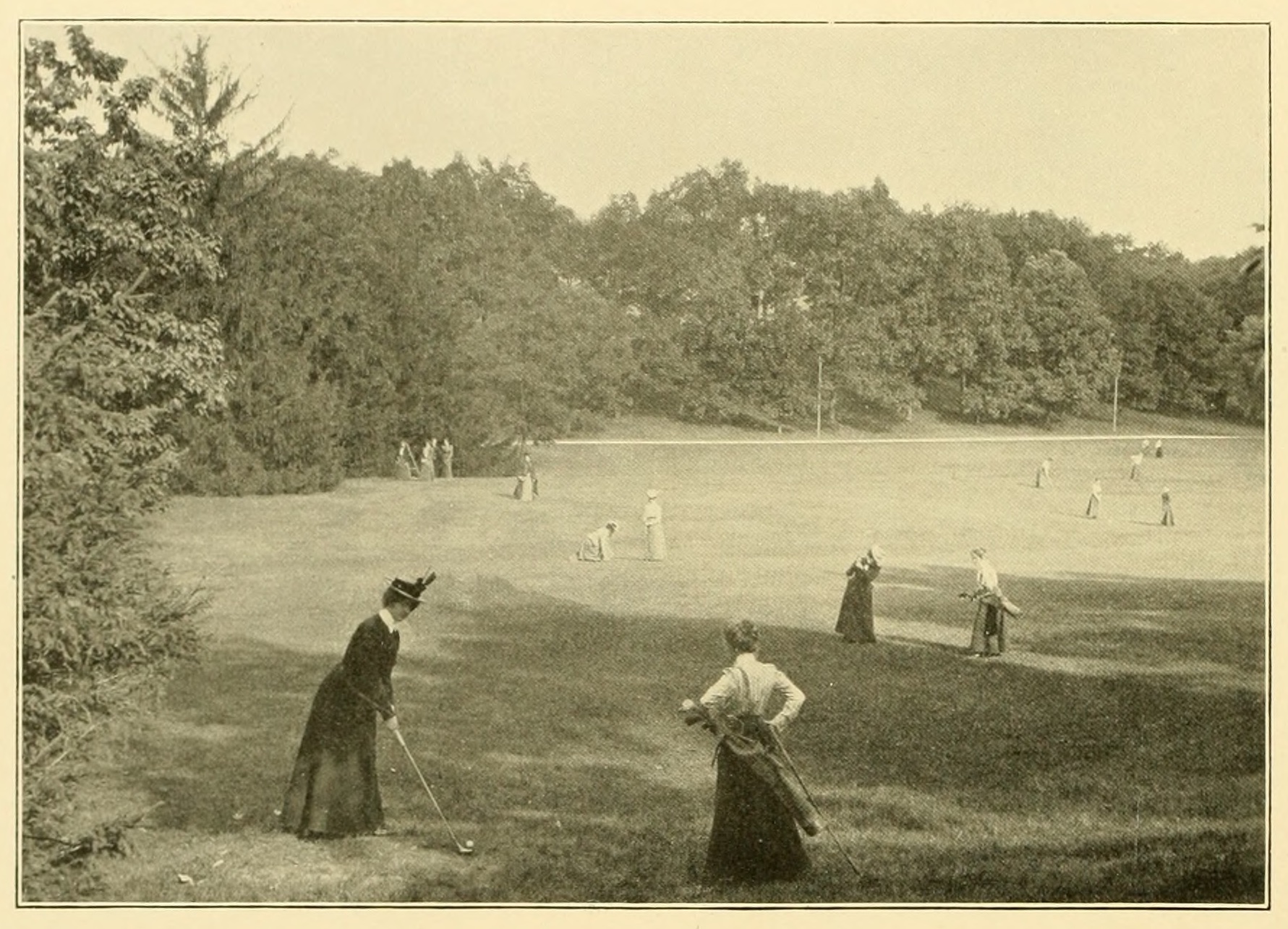
Presently, looking ahead, he saw one of the little sheds which served the tram-line for stations. Above it was written its name — Golf.Walker began golfing her freshman year at Wellesley:“I might have expected as much,” he thought, “with all this links lying about.”
He hoped Charles and Fanny hadn’t taken to golf in his absence. That would be a dismal business. “Anyhow,” he reflected, “I defy them to make me play or caddie. Unless,” he reflected again, “Fanny’s new girl golfs — in which case I suppose I shall have to” (p. 17).
Under the shed which he was approaching stood a young girl with a bag of golf-clubs over her shoulder. He saw that she was fair-haired and hatless and wore a brief skirt and considerable boots. Then he noticed that she was waving and smiling at the tram. He looked about among his fellow-passengers to see who responded and found that no one was interested in the girl. He looked back at her and perceived with a happy surprise that it was Elsie West, grown up; his excellent little pal Elsie, with her hair coiled round her head; Elsie, no longer lanky, but trim, round, and much prettier than he would have supposed (pp. 17–18).
Interest in golf at Wellesley College, Wellesley, Mass., has steadily increased as the season advanced. For certain temperaments and for certain kinds of weariness it has been found that a quiet game is the best kind of tonic.According to James Shields Murphy, editor of The Golfer:The links are quite extensive, reaching from the back of Norumbega cottage down by the lodge on the side toward the railroad station. It is good ground for golf, as it is filled with depressions and hillocks which necessitate stiff playing with a good many hazards, which always delight the old stager.
The girls at Wellesley, as is well known, are never daunted by anything of this kind, and they do some very pretty work. Miss Martha Dalzell is the chief and keeps the score cards. The girls wear for playing their regular gymnasium suits or bicycle costumes.
They have made no arrangements yet for match games, but it is thought that in another year a good deal will be done along that line, now that the obstacles against match games have been swept away. For the Golf Club is anxious to make itself a place in college athletics and a name for good playing not unworthy of the reputation Wellesley enjoys. The Wellesley Golf Club, which makes the accompanying graceful group, is composed of the following members:
Miss Dalzell and Miss C. Ham of the junior class, Miss Louise Baldwin, Miss E. G. Bull and Miss C. Coburn of the sophomore class and Miss Geraldine Gordon, Miss Florence Halsey, Miss Katherine Storrow, Miss Gordon Walker and Miss Corinne Abercrombie of the freshman class. The strong representation in the entering class speaks well for the future of the sport in Wellesley (“Links for College Girls; Golf Will Be the Prevailing Sport This Year,” The Commercial Appeal (Memphis, Tenn.), Sunday Morning, June 27, 1897, p. 16).
Golf has been steadily growing in favor at Wellesley College for the last three or four years, having virtually come into existence there with the class of 1900. The chief incentive to the interest among the students has been the persevering efforts of Miss Edith Gordon Walker, President of the club, and also a member of the newly-formed Arlington club. There are a hundred and thirty members of the college club, students and instructors, the majority being students. Miss Harriet N. Randall, assistant in the Wellesley gymnasium, is the regular coach for golf, and once a week during the season an expert from town comes out to give additional instruction. The links are almost constantly in use on pleasant days (“American Golf Tutors,” The Chicago Tribune, Sunday, May 6, 1900, p. 19).Walker’s “persevering efforts” as president of the Wellesley golf club (to which she was elected in February 1899) included performing in a play in order to raise funds to improve the condition of the links:
The golf outlook this fall is very bright. With a club membership of about one hundred and fifty, under the efficient leadership of Miss Walker, 1900, there is every reason to expect a prosperous year. It is true the links are not in the best of conditions, and there is a dearth of ready money in the treasury, but plans are being made for the giving of a play sometime in January, when the ducats are expected to be forthcoming (“Athletics,” The Wellesley Magazine, Vol. 8, No. 3, December 9, 1899, p. 142).The condition of the Wellesley links, and the nature of the games played there, were described in 1897 as follows:
About twenty-five members make up the Wellesley Golf Club, which, like all the other sports, is organized under the Athletic Association. The only officers of the club are the president, Miss Martha S. Dalzell, and the treasurer, Miss Louise F. Baldwin.It seems that, while the popularity of golf at Wellesley had more than quintupled, from a club membership of twenty-five or so when Walker joined as a freshman to the 130–150 during her tenure as president, developments on campus had reduced the extent of the links by half:Each member of the club is expected to play three times a week around the golf links, and the club sticks are reserved for the use of members every afternoon from four to six o’clock. Aside from this time-limit the sticks are at the disposal of anyone wishing to play, so it happens that at almost any hour of the day Wellesley girls may be found upon the golf courts, gaining the good from exercise in the woods and meadows.
The links are not yet in the best condition, though the general situation of the ground is good, and there are several fine natural hazards. Each of the holes is rather short, but in all they cover about two miles of territory. The general course is over the college campus, across the Simpson meadow, and thence out upon the hill and dale section in the neighborhood of Fiske Cottage.
Much zeal is manifested for the game, and the measure of efficiency steadily increases. As golf at Wellesley has the advantages of fine instructors and plenty of room, it becomes more popular each year, and the president hopes to arrange for some inter-class games another year, taking the four best players from each class. Miss Hill, director of the gymnasium, finds that golf, like the other outdoor games, proves an invaluable accessory to the prescribed physical training (“New Rules for Golfers,” Boston Evening Transcript, Saturday, June 12, 1897, p. 6).
Golf is preëminently in favor at Wellesley this autumn, among both students and faculty. There is a large golf club, of which Miss Gordon Walker is president. The club members naturally have right of way on the links, every hour during the pleasant afternoons being almost invariably taken. There are nine holes upon the Wellesley golf field, and about a mile is covered by the course. The building of the new observatory on the knoll overlooking interfered with one of the holes as first laid out, but the course has been altered, and a new plan followed. The teeing ground for the first hole is in front of College Hall, in the corner of the campus, and the first drive is by far the best, although it is a short one. The course is carried out across the meadow fronting the chapel, then up on the hill behind the observatory, out around to Fiske cottage and across virtually in line with the road boundary, back to the meadow corner near the chemistry building. The entire ground is now in fairly good condition, as the grass has been cut recently, and all the teeing grounds are in reasonably satisfactory shape. Not so much work has been done on the putting greens. At present members of the golf club who are least in practice are being coached by expert golfers from Boston (“Country Club Golfing,” Boston Evening Transcript, Saturday, October 28, 1899, p. 10).A report the following spring in the same paper echoed much of the foregoing:
Golf has been steadily growing in favor at Wellesley College for the last three or four years, having virtually come into existence there with the class of 1900. The chief incentive to the interest among the students has been the persevering efforts of Miss Edith Gordon Walker, president of the club, and also a member of the newly formed Arlington Club. There are a hundred and thirty members of the college club, students and instructors, the majority being students. The golf organization, like that of all other forms of exercise, requires of its members trained physical ability and close adherence to the rules regarding use of golf clubs, hours of playing, etc. Miss Harriet N. Randall, assistant in the Wellesley gymnasium, is the regular coach for golf, and about once a week during the season an expert from town comes out to give additional instruction. The links are almost constantly in use, on pleasant days. As yet there is not a long course, but it is in fairly good condition. The first and eighth holes are by all odds the best. Starting from the first teeing ground, which is at the head of the campus, halfway between College Hall and the Shakspeare House, the first hole runs straight across the beautiful, smooth campus, a splendid drive. Hole number two starts in from near the Houghton Chapel, and though very short, only to a knoll on Simpson meadow, has the adavntage [sic] of a brook hazard. To the next hole is a somewhat long walk, and this third hole runs up hill, near the Whitin observatory. Both four and five are played on the hill also, both being short holes. Seven [what happened to six? — MSS] begins in front of the observatory on a slight rise, looking toward Fiske Cottage. The eighth, which begins close to where the seventh ends, is four hundred yards in extent (the longest on the links), and runs parallel with the main street toward the west lodge; and the last hole brings the course out to a point near the chemistry building. On each hole the teeing grounds are far better than the greens.The college golf club has recently given a play to raise money toward improving the course, though the grounds are already sufficiently good to attract many players. As the Wellesley “Legenda” puts it, “on any fine and sunny afternoon, the observer may see short-skirted maidens brandishing sticks with a menacing air, or wildly rooting up the turf in their enthusiasms, while others go poking furtively among the woods and boggy places, seeking for ‘that old ball I lost’” (“Golf at Wellesley; Several Excellent Courses in This Suburb,” Boston Evening Transcript, Saturday, April 28, 1900, p. 28).
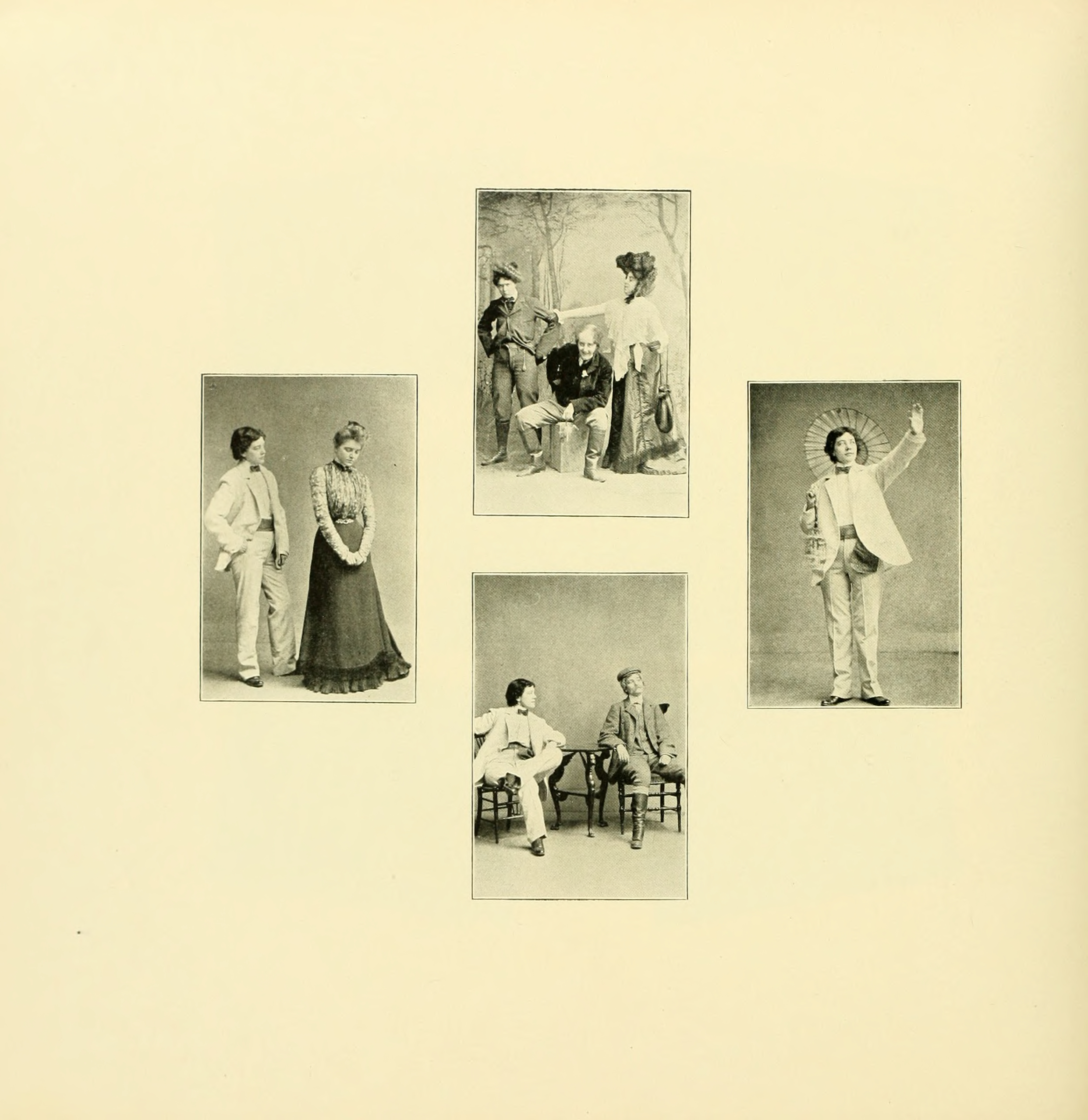
Sardou/Simpson’s A Scrap of Paper, as performed at the Barn, Wellesley College, Saturday, March 24, 1900. The character in the white suit is Prosper Couramont, played by Corinne Abercrombie. In the left vignette, s/he seems to be talking with Louise de la Glacière, played by Helen L. Grover, and in the bottom, with the Baron de la Glacière, played by Franc E. Foote. I am not sure about the trio in the top vignette. Reproduced from the Wellesley Legenda 1901, p. 120.
Prosper Couramont, a young gentleman, probable heir to a rich landed proprietor, Brisemouche, has just returned to the latter’s chateau after an absence of three years. During this time he had made the tour of the world. At the moment of his return, he finds that Louise, a young lady whom he had fervently admired, had been for some years the wife of the Baron de la Glaciere, living in the neighborhood of Brisemouche’s chateau. The uncle and nephew are invited to the mansion of the Baron. Prosper not only recognizes it as the old home of Louise, but is surprised to find the principal sitting-room in precisely the same arrangement of furniture as when he was last there — the favorite suitor of Louise. He even observes that the statuette of Flora still stands on its bracket, and that its companion statuette, accidentally broken about that time, has never been replaced. While he is lost in wonder, Louise enters. He refers to past times, and seeks to reawaken the old flame in the breast of the beautiful lady. But she at once checks his ardor — telling him that she is married to a man whom she respects and loves. Prosper then accuses her of inconstancy — in having led him to suppose that she loved him, and then, without a word of explanation, breaking off all communication with him. She replies that after they last parted, she placed a note for him, as usual, in the statuette of Flora. To which note he had never replied; and she, taking offence at this slight, and hearing soon after that he, Prosper, had left for a tour of the world, acted on the advice of her relatives, and became the wife of Baron de la Glacière — and was well satisfied with the match. It was now Prosper’s turn to explain. He said that upon leaving her presence on the evening referred to, he found two gentlemen on the lawn gazing up at her window. Demanding their business, he received impudent replies, and the result was two duels, in the last of which he was so severely wounded, that he kept his room for months. The cause of the duel rendered it necessary to keep it a profound secret. Consequently the lady had never heard of it. As Prosper thus invalided, could not call at Louise’s house, the note was probably still in the Flora, where it had been placed three years ago. The thought at once struck the two whilom lovers, and they made a rush for the Flora. Louise to destroy the gushing proof of her girlish love, Prosper to use it to favor his suit with a young lady for whom he had conceived an attachment. From this moment, the main interest of the play attaches itself to the various attempts made by Louise, Prosper, and Suzanne, a cousin of Louise’s, to gain possession of this scrap of paper. After many times finding his efforts baffled, Prosper at last gets possession of it, and as he thinks, successfully hides it. Indeed, so certain is he that Suzanne cannot find it, that he tells her it is in one of two rooms in which his curiosities — the spoils of his travels — are kept. Suzanne not only tells him that she will find it, but vows that he shall burn it. When Louise is informed by Suzanne where the scrap of paper is hid, she joins in the hunt. Unfortunately the Baron comes to the locked door. Louise, terrified at the thought of being found in Prosper’s apartment, hides, and Suzanne at last allows the Baron to enter. The latter has begun to grow jealous of Prosper, owing to certain suspicious acts which he had observed in relation to the scrap of paper, and Suzanne, to screen Louise, hints to the Baron that Prosper is her lover, but that he has not treated her properly. The Baron takes fire at this — will not listen to reason — and vows that he will make Prosper marry her. This adds another tangle to the already tangled skein. Mixed up with this principal plot, is an amusing underplot, in which an old maid, Zenobie, tries to get young Anatole for a husband. The strange fortunes of the scrap of paper keep everything lively until at last Prosper actually burns it. But not before through its instrumentality the flame of love has touched his heart, and he becomes engaged to Suzanne, to whose ingenuity and good offices it is owing that great mischief was not caused by the simple scrap of paper (Simpson n.d.: 3–4).I should first point out that the synopsis is mistaken in at least one matter: Brisemouche (who, by the way, is a fusion of two of Sardou’s characters, Thirion and Busonier) is not Prosper’s uncle, nor is Prosper Brisemouche’s heir; rather, they are friends. Prosper’s “enormously rich” uncle lives in “a sort of dilapidated owl’s nest” (“une espèce de pigeonnier” in Sardou [1860: 18]) “about a mile from” the country house near Chinon in which the first act takes place (p. 10). Louise (Clarisse in Sardou) née de Merival (de Crussoles in Sardou) inherited the house from her mother, who died a year after Louise married (p. 5). It is this house to which Louise returns with her husband, the Baron de la Glacière (merely Vanhove in Sardou), after three years spent in Paris. Prosper, after his three years of travels, takes up his “quarters” in the house of Brisemouche, who seems to be a more closely situated neighbor to the ménage de la Glacière than the unnamed uncle and “who always has a bachelor den ready for” him (p. 10; “qui me garde ma chambre d’ami depuis dix ans” in Sardou, p. 19; Busonier is also a neighbor). And here, aside from the obvious, though inexact, parallel between Carpenter’s poem and the “scrap of paper” — the letter hidden in the statuette of Flora — is a set of correspondences to both of Caine’s novels: reunion after a time of absence, neighboring houses for narrative convenience (there’s also the matter of cousins). A second set of correspondences involves the “compulsion” to marry, and the concomitant “tangled skein” of desire and jealousy. For Prosper will inherit from his uncle (and not from Brisemouche) only if he gets married within the next six months (“six semaines” in Sardou, p. 19), and Brisemouche would like to get his own ward, Anatole (Paul in Sardou), “well married, to keep him out of harm’s way” (p. 8). Brisemouche (Thirion) has also suggested to Prosper a way out of his “dilemma” — and a reason for Prosper’s visiting the Baron (Vanhove) so soon after his arrival:
He described your charming sister-in-law as just the wife for me — advised me to pay you a visit, make your acquaintance, and propose for the young lady’s hand. I have paid you a visit, made your acquaintance, and I hereby propose for the young lady’s hand (Simpson n.d.: 10).The Baron (Vanhove) passes the matter on to his wife, and leaves to check on his dogs; hence the reason for the former lovers’ reunion, alone together in the same salon, after three years:«Parbleu! me dit-il, j’ai ton affaire. M. Vanhove arrive demain avec sa femme et sa petite belle-sœur!... une perle!... Viens le trouver, fais ta demande, et c’est fait!» Je viens vous trouver, je fais ma demande, est-ce fait?... (Sardou 1860: 19).
Of course, Prosper’s not-too-serious wish to marry Mathilde (Marthe) complicates matters, since Anatole (Paul) wants Mathilde (Marthe) for his own — and their flirtatious interactions imply that the feeling is mutual — while, as per the synopsis supra, Brisemouche’s sister Zenobie (in Sardou she is Colomba, Thirion’s wife) desires Anatole (Paul). As for the similarities with Caine’s novels, there is more than the mere reencounter after a gap of three years; just as Louise (Clarisse) still finds Prosper “as absurd as ever” (“toujours un peu fou”), so too does Mary Massinger find Ridley Carpenter in Old Enough to Know Better: “Ridley — author of three novels or no author of three novels — still got into trouble, it appeared” (p. 59); “She was thinking of the old absurd Carpenter boy with the fantastic prejudices among proper names. What was the one he used so particularly to detest? Merton, that was it” (p. 65); “‘He seems almost exactly the same,’ she thought. ‘But there is a difference. He has written those books’” (p. 68). There is, furthermore, a word for word parallel in Prosper and Louise’s first conversation after three years, and James and Fanny’s first post-luncheon conversation after two and half years in Save us from our Friends!. Both female interlocutors say, “Tell me all about it.” And, by the way, there is in the play a translingual pun of a sort which Borges/Quain might have appreciated (see § 4), involving both Mathilde (Marthe) and the character played by Edith Gordon Walker in the Wellesley production, Suzanne. In the first act, Mathilde (Marthe) is dressed in a riding habit (“en amazone” in Sardou), and indeed, when Prosper first sees her, as he recounts to Brisemouche and Zenobie (Thirion and Colomba), she is on horseback:Louise (showing card). I could scarcely believe my eyes, when I read this well known name. And it is really you?
Prosp. Positively I, and no other — am I so changed, then?
Louise. Indeed you are!
Prosp. Frank, at all events. I will be as candid — time has passed you by.
Louise. As gallant as ever, I see — but you are wrong — I am changed entirely.
Prosp. Entirely? what, does nothing then remain of the heart which, three years ago, promised mine so bright a dream of happiness?
Louise. Nothing whatever — there’s not a scrap of my heart, nor a thought of my mind, that does not belong to its proper owner.
Prosp. A sad change indeed. (sighs.)
Louise. Now, don’t sigh in that silly way, my dear Prosper. Our idle flirtation, I’m sure, has no more real place in your heart than it has in mine. We shall always be good friends, and have long talks about your travels, and so on. And now, what did you wish to see me about?
Prosp. About my marriage.
Louise. Marriage! tell me all about it — with whom?
Prosp. With your sister, Mademoiselle Mathilde de Merival.
Louise. Mathilde! She’s a mere child.
Prosp. There are no children now, madam, except babies in arms.
Louise. But she doesn’t even know you.
Prosp. So much the better — the unknown has so many charms.
Louise. How do you know but what she may love somebody else?
Prosp. I should be delighted to hear it.
Louise. Delighted?
Prosp. Certainly, my dear madam. I’ve been in China, and know something about teas. It’s a capital plan to pour boiling water on the tea leaves, in order to open them, and then throw it away — the first infusion is apt to be bitter — the next cup is sure to be all the more agreeable. So with love, my dear madam, — throw the first infusion away: and the second will have all the real flavor.
Louise. You are not so changed as I had thought — you are as absurd as ever, I see (Simpson n.d.: 11–12).
clarisse.
Je n’en croyais pas cette carte! c’est bien vous, monsieur!...
prosper.
Venu, comme le prince de la légende en question, à travers mille broussailles, pour voir ce qui a survécu au grand coup de baguette!...
clarisse.
Oh! rien !
prosper.
Rien! — Dans votre coeur, peut-être; mais le mien n’oubliera jamais trois mois de l’amour le plus jeune, le plus tendre, le plus pur, né dans les fleurs et le soleil!...
clarisse.
C’est mort!...
prosper. ,
C’est mort?
clarisse, s’asseyant à gauche sur le canapé.
Asseyez-vous donc, — et dites-moi d’où vous venez de si grand matin, pour me parler de tout cela!...
prosper, assis.
D’où je viens? — Je viens de l’autre monde, madame, et pour vous parler d’autre chose!
clarisse.
Ah!... de quoi?
prosper.
De mon mariage, madame.
clarisse.
Avec qui?
prosper.
Avec votre soeur Marthe, si vous le permettez!
clarisse.
Marthe!... quelle folie! une petite fille...
prosper.
Oh! en fait de petites filles, il n’y a guère que de petites femmes !
clarisse.
Elle ne vous connaît seulement pas!
prosper.
Avantage énorme!... l’imprévu!
clarisse.
Enfin, qui vous dit qu’elle n’en aime pas un autre?
prosper.
J’y compte bien!
clarisse.
Ah! vous comptez qu’elle en aime...
prosper.
Mais oui! — Tenez, voulez-vous permettre une comparaison orientale, à un homme qui revient de Calcutta... Comment vous y preniez-vous, chère madame, pour nous préparer du thé, le soir, dans ce même salon? En versant d’abord quelques gouttes d’eau bouillante pour dilater les feuilles et en absorber l’amertume; et cette première eau jetée aux cendres... l’infusion suivante n’en était que plus suave! — Ainsi d’un premier amour de jeune fille!... il se jette aux cendres, et toute la saveur est pour la première tasse!...
clarisse.
Vous êtes toujours un peu fou! (Sardou 1860: 20–22).
When Prosper meets Mathilde (Marthe) again in the salon of the house, he exclaims (to himself), “My enchanting horsewoman of this morning!” (p. 14; “Ah! mon Dieu!… c’est elle, mon amazone!” [Sardou, p. 27]). Suzanne enters soon after, to join the rest of the cast (sauf les servants, naturellement) who are awaiting the bell for lunch, with Louise (Clarisse) and Prosper providing physical comedy by making, while the others are engaged in conversation, dashes towards the Flora to retrieve the letter. Prosper succeeds in getting the letter (it falls from the statuette, he steps on it, then retrieves it beneath his deliberately dropped mouchoir), the bell rings for lunch, and Suzanne and Prosper are the last to proceed, arm in arm, to lunch (and offstage to end act I):Zeno. […] And do you mean to say you have been round the village in that outlandish garb?
Prosp. I’ve been round the world in it! […] And I may say triumphantly, I produced the most striking effect just now, on a charming girl, I met on horseback — a charming girl. She laughed in my face! (Simpson n.d.: 8).
colomba.
[…] Ah! mon dieu!… Est-ce que vous avez fait le tour du village dans cette tenue-là?
prosper.
Mais comme j’ai fait le tour du monde, madame… et toujours avec le plus grand succès. — J’ai même rencontré, tout à l’heure, une amazone qui n’a pas dissimulé à ma vue son excessive gaieté!… Une délicieuse amazone! (Sardou 1860: 11).
The pun on amazone/Amazon only works for readers of both Simpson and Sardou, since, in the French, of the interaction quoted directly above, only “Madame… daignez accepter…” occurs (p.34). In Sardou, the function of the Baron’s phrase — “Are you coming, you two?” which rhymes with Fanny’s question to the arriving Godfrey and Nora, “Well, you two?” — is performed by Suzanne’s “Seulement, donnez-moi le bras, car le mari nous regarde.” Simpson’s replacement of the French Suzanne’s act-closing words, “Alors, vous aimez les Chinois… décidément; et mangez-vous, comme eux, avec de petites baguettes?” with the statement about Amazons is decidedly an improvement in a certain sense, yet perhaps he also felt a need to categorize and thus somewhat temper her flirtatiousness (or was it merely part of the necessary transpositions involved in fusing three characters — Thirion, Busonier, Colomba — into two — Brisemouche and Zenobie?), a flirtatiousness which, along with that of Louise (Clarisse), is established early on in the play, before either has appeared on stage. In the case of the original, this is accompanied by a character and subtext elided in the Englished version, Busonier the cuckold:Baron (turning back). Are you coming, you two?
Prosp. (aloud). Deign to accept my arm, madam.
Suz. So you are a collector of curiosities? I think I shall be able to show you a few curious matters which may astonish you, great traveller that you are!
Prosp. (laughing). In instruments of warfare?
Suz. In instruments of warfare! Have you ever met with any Amazons in your travels? They say it is a fabulous race — not quite, my dear sir; not quite, I can assure you — I’m an Amazon! Only, now a days, people call us old maids, blue stockings, or strong minded women! (Simpson n.d.: 16).
Et voilà, the source of that “real merit which belongs to another” — the flirtatious character of Mademoiselle Suzanne de Ruseville, described as “old enough to know better,” and played by the wife of the author of The Author of “Trixie” during her college years. That source, or, rather, its narrative context, ramifies throughout both of Caine’s novels here under discussion in the form of comedic duels. In A Scrap of Paper, Prosper tells Louise (Clarisse) that his reason for not answering the letter she placed in the Flora statuette, is that, on leaving her three years earlier, “instead of going to bed, I stayed standing on the damp grass to gaze upon your window — I had lighted a cigar and was emitting smoke and sighs together, when all at once” (Simpson n.d.: 13; “au lieu de rentrer chez Thirion, je fais un tour sous les arbres… j’allume un cigare; et comme tous les amants platoniques, je m’appuie contre un arbre, en regardant vos fenêtres encore éclairées!… et en poussant mille soupirs!… quand tout à coup” [Sardou 1860: 24]). When all at once Prosper sees the lighted end of first one, than another cigar. And thus that same full-moon night on which he took of leave of Louise (Clarisse) three years earlier, Prosper ends up duelling with, and getting wounded by, two cigar-smoking co-admirers of his lover: “par un beau clair de lune je blesse Tonnerieux… une piqûre… de Rivière me perce le bras… je tombe, on m’emporte, et me voilà au lit, avec fièvre et délire” (Sardou 1860: 25). In Save us from our Friends!, after walking Elsie back to the Villa Rose after the botched moonlit boat excursion and then returning to Villa Joyeuse and chatting briefly with his cousin Charles, James reclines in the hammock beneath the sycamore, smoking a cigar:busonier.
Parbleu!… Elle s’est fait enlever!
colomba.
Ah! quelle horreur!
thirion, d’un ton de reproche.
Ah! mon ami, devant Colomba!…
busonier.
Ma foi! madame Thirion ne peut pas le prendre au tragique plus que moi; et du moment que je tourne la chose en gaieté…
thirion.
En gaieté!
busonier.
Tiens! croyez-vous que je vais faire la sottise de m’arracher les cheveux, pour doubler mon ridicule!… Ah! que nenni!…Pas si sot, Busonier, que de donner à ses amis la satisfaction de le plaindre!… A la première nouvelle, un autre se fût caché!… moi, j’ai pris ma canne, mon chapeau, et je suis allé droit à mon cercle!… — J’entre, on me tend la main d’un air de condoléance!… J’éclate de rire!… l’assemblée ripose… mais j’ai ri le premier, et mon rire a tué l’effet du sien!… Qu’un bossu oublie sa bosse, tout le monde s’en moque!… Qu’il s’en moque!… tout le monde l’oublie!…
colomba.
C’est prendre la chose en philosophe!
busonier.
Voulez-vous que je la prendre en Georges Dandin?… Suis-je à ce point solidaire des sottises de madame Busonier, que mes trente ans de probité bien connue fassent banqueroute avec sa vertu!… Grâce à Dieu! mon honneur est à moi!… comme son déshonneur est à elle!… J’étais honnête mari!… je reste honnête homme!… Elle perd les deux, tant pis pour elle!
prosper.
Enfin!… voilà donc un homme sans préjugés!…
busonier.
Oh! certainement: et c’est aussi l’avis d’une femme pleine de sens et d’esprit, à qui je contais l’aventure ce matin?
thirion.
Qui donc!
busonier.
Mademoiselle Suzanne.
thirion.
Elle est ici?
busonier, se levant.
A Chinon, où je l’ai laissée au milieu des malles!… Elle vient passer l’automne au château.
colomba.
Qu’est-ce que c’est que mademoiselle Suzanne?
busonier.
Ah! c’est juste…, madame ne la connaît pas! — Mademoiselle Suzanne est une Parisienne… petite cousine de madame Vanhove, et marraine de sa jeune sœur, qui, maîtresse d’une assez jolie fortune à la mort de ses parents, a constamment refusé les meilleurs partis, par amour de l’indépendance.
colomba.
Une vieille fille!
busonier.
Une charmante femme qui frise aujourd’hui la trentaine, et qui a le droit par conséquent de connaître en théorie bien des choses que les ingénues sont censées ne pas savoir. Spirituelle, d’une franchise d’allure qui choquerait peut-être chez un autre, mais qu’elle sait rendre aimable;… voyant à Paris le meilleur monde, et, plus sage dans sa liberté que beaucoup d’autres dans leurs chaînes… témoin madame Busonier! (Sardou 1860: 13–15).
Zeno. (snappishly). I tell you once more, brother, that you don’t fulfill your duties as guardian to that child [meaning Anatole — MSS].
Brise. A child! poor dear little baby!
Zeno. It was all very well before you conceived the ridiculous idea of taking the boy with you to Paris.
Brise. It was necessary, my dear, for his law business.
Zeno. And putting all sorts of notions into his head, by throwing him in the way of a quantity of improper Parisian flirts.
Brise. I’m sure he only saw the best of company at Madame de la Glacière’s.
Zeno. Madame de la Glacière, indeed! The greatest flirt that ever existed! I’m sure she got herself prettily talked of before her marriage — only ask that absurd friend of yours, Monsieur Prosper Couramont, who has just arrived from Cochin China, or Nova Zembla, or who knows where.
Brise. Well, if she did flirt with Prosper a little before he went abroad, it was before she was married — what of that?
Zeno. What of that? Flirting is flirting, before or after; and she and her Parisian flighty friend, Mademoiselle Suzanne, who is old enough to know better, are not fit associates for an innocent boy like that.
Brise. And do you expect that he is to be an innocent boy all his life — tied to your apron strings? I was an innocent boy once myself, and I am now a devil of a fellow —
Zeno. Brother, I insist on you holding your tongue! You know you are going to say something shocking.
[… Prosper enters …]
Brise. I should like to see you come to a pitched battle with Mademoiselle Suzanne on these points; and I’ll wager she has the best of it. I know her arrival is expected in the course of the day.
Prosp. And pray, who is this redoubtable Mademoiselle Suzanne?
Brise. Mademoiselle Suzanne de Ruseville, cousin to Madame de la Glacière, and godmother to her young sister Mathilde —
Prosp. Godmother, and still Mademoiselle?
Brise. Although mistress of a large fortune, she has refused every offer, and chosen to remain single from the sheer love of independence.
Zeno. Ridiculous affectation! Don’t talk of her — she’s highly improper!
Brise. At any rate, though she does live in the midst of the best Parisian society in the most independent style —
Zeno. The audacious creature!
Brise. She makes better use of her freedom than most women do of their —
Zeno. Hold your tongue, brother! You are going to say something shocking (Simpson n.d.: 7–9).
All this time (you are to know) the eyes of James had been fastened on a certain lighted window in the Villa Joyeuse.After “feasting his sight like a fool” for some time, he involuntarily calls out softly, “Nora,” thus revealing his presence and causing Nora to vanish (p. 207). Miserable with embarrassment and despair, he falls asleep in the hammock, wakes early in the morning, goes for a walk and finds Godfrey standing outside and staring at Villa Joyeuse, where, instead of returning to his yacht, he has been stationed, sleepless, all night. A verbal altercation ensues, followed by a march across the sand-hills of the links to find a cove wherein they may halfheartedly (both realize the ridiculousness of fighting, yet neither is willing to back down) duel, with fisticuffs. They are saved in the knick of time by Elsie who, hearing their altercation, has rushed out and chased them across the links to the beach. Thus does Caine parody Sardou’s parody of a theatrical convention involving three cigar-smoking suitors looking up at a lighted window and duelling over a girl “par un beau clair de lune.” A parody, moreover, which Caine had earlier parodied in Old Enough to Know Better using a different configuration. A man — “a man of letters” with “learning and imagination” — duels, so to speak, over a “young yellowish goat,” on “a fresh and beaming” morning “sparkling with dew and early sunshine” with two children who have begun quarreling while waiting for Carpenter to “come and cuss at the winder” (p. 11):Upstairs there were but three rooms that gave upon the garden; the room of Charles and Fanny, the room of James, and another room. It was the window of this third room which was lighted. The eye of James never left it.
Whether lovers first gazed at bedroom windows or writers first suggested the practice to them will never now be known. It is a profitless inquiry. They do it, that is enough. James did it. He did not know that he was doing a conventional and rather foolish thing. He did not, indeed, know that he was doing it at all. The illuminated curtain simply held his eyes. Do you know, I am inclined to think that the lovers began, though it doesn’t matter.
Suddenly the light went out; immediately afterwards the blind went up with a rattle, and Nora, with her hair all about her, and clad in a lovely frilly dressing-gown, appeared in the black opening. She sank down, apparently upon a chair, crossed her arms upon the window-sill and contemplated the moon-flooded night. She was about thirty yards from James, who had not left the hammock. He saw her with perfect distinctness, and for a few minutes his heart stood quite still.
Nora began to brush her hair (pp. 204–206).
He awoke […] to bleatings, with a firm and well-considered purpose.Carpenter’s “fantastic attire” parodies and exaggerates the “outlandish garb” of all white in which Prosper made both “le tour du village” and “le tour du monde,” while the “trifles” — the bric-a-brac of multifarious imperialism — with which he concocted his attire were the spoils, not of his own travels, à la Prosper, but of those of his deceased father who had once been doctor for an “African Exploration party” (p. 64); indeed, Ridley’s spear and shield are the counterparts of Prosper’s parasol and fan, while the yellowish goat may nod, perhaps, to the outfit of all yellow which Prosper wore in the 1884 Théâtre-Français production of Les Pattes de Mouche. Along a different plane of analysis, the “strong little stick” which Urquhart carries aloft “to belabour the wretched wight” echoes the clause which W. S. Caine accused Harcourt senior of using as “a stick good enough to beat the Tory dog with.” And as for Ridley’s parting mot d’esprit to Urquhart — “before you again take up the whip towards the weak, make very certain that there is none by to bring scorpions to your chastisement” — Caine will expand upon that in the Nietzschean whip theme of But She Meant Well which I discussed in § 6. Apropos of which: Caine prefaces But She Meant Well with a motto attributed to Blooter and Salt (the duelling “cat-laffian comedians” who are also briefly mentioned in Hoffman’s Chance [October 1912] as potential celebrity invitees to an exclusive salon [p. 94]):He looked at his new five-shilling Swiss watch, which told him that the hour was 6.13. Then he got out of bed and did the following things.
He lit a candle and in the flame held a beer cork, which he had brought with him into his bedroom on retiring for the night. When the cork had been scorched, he applied it to his face, and thereon with it drew circles around his eyes and lines and splashes upon his forehead and cheeks. Then he took a piece of billiard chalk which he happened, like most young men, to possess and with it whitened the flesh which was not made black. Then he brushed his hair wildly on end and estimated his appearance with a pleased eye, laughter-filled.
After this he put on boots. His pyjamas, having regard to the earliness of the hour and his wish to get back into bed at the first possible moment, he considered a sufficient attire.
Then he went into his sitting-room and from the wall took down a large Zulu shield of white and black cowhide, and a spear about eight feet long, one-third of which was shining steel. A very broad and heavy head had that spear. Then from another wall he took (you must know that his father had been a collector of such trifles) a feathered head-dress, fifteen inches high, such as witch-doctors affect for the purpose of inspiring awe in the minds of the savages who wander about, murdering each other, in the neighbourhood of the Limpopo or Crocodile River. This he assumed, baring his teeth wickedly, and “Bless us!” he exclaimed, grinning, “if I wasn’t in the secret I’d run away from myself.”
He went out into the passage, opened the front door cautiously and peeped out, a sly smile upon his lips. For you must know that he thought it was funny, this thing that he was doing. Not a soul was in view. He slipped through the door, and being very anxious to be very careful, closed it softly behind him, quite regardless of the fact that his latchkey was in his waistcoat pocket and that his waistcoat was on a chair in his bedroom.
Then suddenly he ran down the steps, turned the corner of the house and, leaping in the air and whirling his spear and shield, began to rush upon two boys and a kid who were situated at some thirty yards distance. Half-way he halted.
He had not been prepared for two boys. Hitherto but one had angered him. But it was not the unexpected increase in the enemy’s forces which gave him pause. No. It was rather the attitude in which he found them. The kid indeed — cause of all these proceedings — nibbled its meal peaceably enough. But the lads were at war, there could be no doubt about it.
The larger held the smaller — in whom Carpenter recognised the tormentor — by the wrist, and had doubled the arm behind the back in a manner which obviously caused his victim great pain. And as Carpenter watched, in his hand the oppressor carried aloft a strong little stick, with which he surely meant to belabour the wretched wight who struggled and called out for mercy in his furious grip.
Instantly all memory of his own sufferings at the hands of this boy left Carpenter. His own intention to scare the life out of the little fellow and so drive him and his goat to new pastures and get some sleep of a morning for himself was forgotten. All consciousness of his own fantastic attire vanished from his mind. Tyranny stalked the Heath this day. A lusty lout was bullying a little chap.
Carpenter sprang forward, his soul on fire with generous impulses.
And as he ran, suddenly the combination in front of him broke up and both lads fled from him, the kid accompanying the lesser. But for kid and its owner Carpenter had now no thought. Now it was otherwhere that his energies were to be directed. In a few hot strides he was upon the bigger boy, had clouted him thrice on the head, had booted him once in the place appointed, and had left him grovelling and howling miserably for mercy in a gorse bush. But one observation did he make before he went away, and it was this, and he was greatly pleased with it.
“So, malign bashaw, before you again take up the whip towards the weak, make very certain that there is none by to bring scorpions to your chastisement.”
What Urkie thought of this I do not know (pp. 21–24).
Caine also includes as prefatory motto to But She Meant Well the first sentence from a paragraph of chapter XV, “The Thousand and One Goals,” of Thus Spake Zarathustra:“My brother’s just giv us a fine dawg.”
“That’s good.”
“No, that’s bad.”
“How’s that bad?”
“Because that dawg killed a chicken next door.”
“Why! that’s bad.”
“No, that’s good.”
“How’s that good?”
“Because we ’ad the bird, Sunday.”
Verily, a prodigy is this power of praising and blaming. Tell me, ye brethren, who will master it for me? Who will put a fetter upon the thousand necks of this animal? (Nietzsche 1909b: 68).Furthermore, in the sentence from the above-quoted passage from Old Enough to Know Better — “Carpenter sprang forward, his soul on fire with generous impulses.” — Caine foreshadows the “virtuous resolves, vicious results” of But She Meant Well. Likewise, Carpenter’s reflecting on his entanglement with Emily while sitting on a bench beneath a tree on the Heath — in particular, his thought, “Is it possible, then, to behave villainously with perfectly harmless intentions.” — also prefigures the last-named novel’s primary theme:
Why the devil couldn’t you leave the girl alone? A man of your age, too! That sort of hugging at large is all very well for young boys, but after twenty-three it’s lunacy. And you are twenty-six. And still hugging. It’s sickening.It is while sitting on this bench beneath a tree on the Heath that Ridley gets himself involved in another farcical duel. A tract-disseminating old gentleman wearing a Gladstone collar sits down beside him:But Mary wouldn’t have me. Am I, then, never to talk to a girl again on that account?
Hugging and talking are totally different matters, as you know perfectly well, you swine.
But she is so thundering pretty. And she didn’t mind. So why not?
Why not? Why not? Oh, you swine! You swine! As if you didn’t know why not. Besides, how do you know she didn’t mind?
That sort of girl never does. They think nothing of a kiss more or less.
How do you know? Suppose she did. Suppose she took it all seriously.
She couldn’t. The difference in our position —
You fool! You might be a Peer instead of an unsuccessful writer. Rot the difference in your positions! And what about that at the station just now? She’s been spying, and spying spells jealousy, and jealousy —
Oh Hades!
That won’t help you very much. You’ve behaved pretty rottenly, haven’t you?
Well, I haven’t kissed a girl for years before Milly.
I should hope not. Now what are you going to do about it?
How the deuce should I know? Drop it, I suppose.
By all means. And how? Perhaps you may remember that you have told her you love her. That was a lie, no doubt; but suppose she believed it?
She couldn’t. It’s inconceivable that she should believe it. What an idiot I am!
Yes. Now supposing she did, suppose also she fell in love with you — on the strength of it?
She couldn’t. It’s quite impossible for her to fall in love with me.
Why? You’re no worse looking than twenty thousand young men with whom girls fall in love. This isn’t conceit, it’s common sense.
Well, that’s true. Yes, I must admit that. Yes, it is possible that she might take a fancy to me.
Then if this were the case mightn’t she be in a frame of mind to believe that when you told her you loved her you meant it?
She might. There’s no getting away from that.
And if she were? And did?
Good Heaven! I have in that case behaved very villainously to the poor thing.
Yes.
But my intentions were perfectly harmless. Is it possible, then, to behave villainously with perfectly harmless intentions. Plato says —
Never mind Plato. Stick to the point (Old Enough to Know Better, pp. 149–151).
He opened his bag and produced a tract. “Permit me —” he said and proffered it. “Here you will find nothing religious. I believe in no Deity, thank God. I worship Reason alone. In this little brochure — my own work, I may add — you will find comfort, I do believe. I, too, have suffered. I have had my troubles. But I have found the way out. And my way is your way, the way of every man. Here I demonstrate that trouble is nonexistent. There is no trouble. No, it is not Christian Science. I deny that pernicious belief. This little paper is like nothing that you have ever heard of. I owe nothing to anybody that has gone before. In sorrow and deep labour of soul I evolved my conceptions, and now, happy once more, I go about bringing comfort to the afflicted. To you, my brother.” He moved the tract, a little impatiently. It made a light, crackling sound, but Carpenter still did not stretch out his hand for it. At last he said —The old gentleman, however, “was not in the least prepared — as I am sure you will be glad to know — to leave a lunatic at large on Hampstead Heath to the common danger” (pp. 153–154) and so summons, in the absence of a constable, a brown-clad Heathman, who happens to be Chilper. Ridley’s reflections are thus interrupted again when “a heavy hand was laid upon his arm, and a deep voice said in his ear, ‘What’ve ’ee bin a-saying, then, to this pore ole man?’” (p. 153):“I eat old men like you. I had one for breakfast, or you wouldn’t be talking now. But I shall want one for dinner, I expect.”
“Ha! ha!” said the old gentleman nervously; “you are pleasant, sir.”
“With what?” Carpenter asked of Highgate Hill; “shall I dispatch him? He would shriek if I stuck my big, sharp knife into him and my revolver would also make a noise. These things would attract attention. And when I cut up my prey I like to be undisturbed. Spectators worry me. I could take him and hold him for five or six minutes under the water of that pond. But he is so clean, and it would be a pity to spoil him. Ha! I have it. My shoe-string. I will strangle him and his cries together. Yes, my shoe string will do.”
He brought one of his feet up to the bench on which they were sitting, and began to unlace the shoe. “How handy,” he thought, “is a shoe-string.” His eyes gloated on the old gentleman. The eyes of the old gentleman were fastened upon the lace. Just as it was ready to come out of the last pair of holes, he sprang to his feet and waddled quickly away. Carpenter smiled to himself, and began to relace his shoe (pp. 148–159).
Ridley shook off the big hand and jumped lightly to his feet, facing his tormentors, breathing fast and with heightened colour.Ridley is thus rescued from this duel by one of his opponents from his earlier duel with George Wilding and Henry Holloway Hunt, that is, by “one of the Heathmen who had, earlier that morning, held him at bay on his own doorstep” when, after having frightened off the goat and its owner and clouted and booted Urquhart, he found himself unable to get back into his house because he was keyless and his landlords had not yet returned from their overnight excursion to Barnes. Chilper will also eventually recognize in Carpenter the “Muss’r Cayp’nter” of his childhood in Cold Harbour. Likewise, I recognize in Elsie West of Save us from our Friends! another trace of the flirtatious, independent, strong-minded, golf-loving actress who became the wife of the author of The Author of “Trixie”. The Wellesley College News of Thursday, October 31, 1901, noted on page 1 that “Edith Gordon Walker, 1900, has been making an extended trip through the West.” It seems she started her journey west in Buffalo, New York, sometime in July, made her way (via Chicago, most likely) to Nevada, Missouri, where she visited, in August, her brother Edward Fulton Walker, manager of that city’s telephone company, and then spent several months in Kansas, mostly in Atchison where she seems to have been the center of social life for the youth of that town:“I’ve had enough of this!” he cried. “I’ve had enough annoyance from you fellows for one day. Just Heaven! I’ve had too much.”
“Oh, ’tis that’s the way of it?” said Mr. Chilper significantly, but still in jest. “’Tis a bit early in the day.” He grinned and again winked.
“You fool!” cried Ridley, “do you think I’m drunk?”
A swift change came over Mr. Chilper’s face.
“Ah,” he said, a little hoarsely. “I be a fool, then, be I?”
“It beats me,” said Ridley, “to imagine where the County Council finds so many thick-headed clowns.”
“Oh, it does, does it?” asked Mr. Chilper. His eye was beginning to smoulder.
“I am tired,” said Ridley, “of you snuff-coloured asses.” [Recall from § 5 Edith Gordon Walker’s “I’ve grown quite tired/Of being admired.” — MSS.]
“Oh, you be?”
“Is there no one else,” asked Ridley, “on this broad Heath for you to persecute but me? Can’t you go and find a little boy to bully somewhere? Anyhow I advise you not to try it on with me, my man.”
“Knock him down!” cried the old gentleman suddenly. “He is armed. He told me so himself. Knock him down before he has time to draw his revolver.”
Ridley Carpenter had even yet to learn that it is a mistake to tell big, powerful, quite unintelligent men that they are fools. It makes them angry, and when they are angry they do not always act with circumspection.
No sooner had the old gentleman uttered his advice than Mr. Chilper lowered his head, spread open his arms and rushed upon Ridley with a shout. He was no longer sceptical as to Ridley’s mental state. Anger lent him full belief. Ridley, who was as light on his feet as a cat, avoided him with great ease, and as they all happened to be standing on a footpath which runs along the top of a rather steep slope, Mr. Chilper was carried by his own impetus over its edge and thence, by additional power of the law of gravitation, to its foot. Here he pulled up and, turning, shook his fist at Ridley. Ridley, from the footpath, returned the compliment.
Persons began to run from all points of the compass.
This circumstance had a sobering effect upon Mr. Carpenter. In spite of his anger at things in general and at the Heathman in particular, he began to see that he must be calm or anything might happen. As on the screen of a cinematograph theatre he saw himself passing along the High Street of Hampstead, between two policemen and followed by anything between five hundred and two thousand excited citizens. He was covered with dust and he wore tatters. There was blood upon his face. But he longer struggled. A large brick building sprang suddenly into the field of vision and swallowed him up.
“I say,” he called down to Chilper, “please don’t be an idiot. It’s all right, really it is.”
“Oh, be an ijit naow, be I?” roared the other, as he began to charge up the slope.
But it was not written that our hapless young friend should be hauled to prison by constables.
As he stood there, paralysed by that which was happening, just wise enough not to run, a voice spoke in his ear.
“Aw right, guv’nor, leave ’im to me.” Turning quickly he perceived one of the Heathmen who had, earlier that morning, held him at bay on his own doorstep in circumstances which were still fresh in his memory. Before he had decided whether to be rejoiced by this discovery or further infuriated, another voice spoke in his other ear, a female voice, which cried, “Why, Mr. Carpenter, whatever is the matter?” Spinning round he was confronted by Mr. and Mrs. Boase, returned that moment from Barnes.
Before anything more could be said or done the climber, breathing fire and slaughter, reached the top of the slope. He found himself opposed by the outstretched arms of his colleague, Mr. George Wilding (pp. 158–160).
Most of the young society people of Atchison attended an old fashioned Hallowe’en party last night at the home of Mrs. T. M. Walker, which was given for her niece, Miss Gordon Walker. The porch of the house and rooms were hung with jack o’lanterns. The refreshments were apples, doughnuts, molasses candy, and cider. A real gypsy [sic] told fortunes, and the boys and girls danced on the porch and had a general good time. The guests were disguised in sheets and pillow cases. A prize was given to Miss Mona Cain for guessing the greatest number of her friends through their disguises (“Personal,” The Atchison Daily Globe, Friday, November 1, 1901, p. 4; reprinted in Osborne County Farmer, November 7, 1901, p. 7).In January 1902, she returned to Boston via Buffalo:The first question the family asks when one of its members comes home from a party is, “What did you have to eat?” The answers grow more and more satisfactory in Atchison, as the women have passed the dab of ice cream and square of cake stage. Yesterday afternoon Mrs. T. M. Walker gave a six-handed euchre party for her niece, Miss Gordon Walker, and her guests, besides having a good time, had such good things to eat that the family question was worth answering: Veal loaf, escaloped oysters, potatoes, hot biscuits, coffee, cake and ice cream. The prize was a paper knife and a pearl handled pen, and was won by Miss Effie Symns. Mrs. Walker’s guests were the Dreamers and Primroses. Mrs. W. H. Bryning assisted the hostess during the afternoon (“Personal,” The Atchison Daily Globe, Tuesday, November 5, 1901, p. 2)
Miss Gordon Walker, who has been visiting at the home of her uncle, T. M. Walker, for some time, will leave next week for her home in Boston. Her father, who is an invalid, and who has been here for several weeks, will leave next week for New Mexico (“Personal,” The Atchison Daily Globe, Tuesday, January 14, 1902, p. 2).That same month she was also described as having “spent last summer at the Sulphur Springs in Missouri, with her father, who has been very ill. Now that Mr. Walker is recovering his health, Miss Walker is returning to her home in Arlington, paying several visits on the way.” There’s also that item published in The Courier-Journal about a week before Walker sailed for England and which I reproduced in § 5, about her being “the daughter of a former Louisville man who failed in business and went West to recover health.” Alas, his health, too, ultimately failed him. The former “prominent business man in Arlington and Gloucester” remained out west and died in 1910:Miss Gordon Walker, who has been spending several months at the home of her uncle, T. M. Walker, left this evening for Buffalo, N. Y., where she will visit before returning to her home in Boston (“Personal,” The Atchison Daily Globe, Monday, January 27, 1902, p. 2).
To be exact, the father of the wife of the author of The Author of “Trixie”, Farmer Reese Walker, died January 31, 1910, not in Hill City, Colorado, but rather Hill City, Kansas:arlington, Feb 26 — Word has been received here of the death in Hill City, Colo [sic], recently, of Farmer H. [sic] Walker, a former well-known resident of this town. Mr Walker was born in Kentucky March 3, 1853. In November, 1879, he was married to Miss Edith Gordon, a daughter of the late James W. Gordon, junior member of the old firm of A. A. Gordon & Co of Louisville, Ky. Soon after leaving the military academy where he was educated Mr Walker went to Gloucester, Mass, to engage in the wholesale fish business, and at one time he operated one of the largest fish packing houses in the United States.
Owing to the climate of cape Ann Mr Walker was advised to leave the coast as he had lost his voice as the result of a throat trouble, and he came to Arlington and became interested in real estate. Mr Walker opened the upper end of Jason st at Addison st, both being now considered among the best locations in the town. He left here about eight years ago, going west to endeavor to restore his failing health. Death resulted from heart trouble.
Mrs Walker remained in Arlington and lived here with her son, Edward Fulton Walker. Besides his wife and son he is survived by a daughter, Mrs William Caine, of London, Eng, who was Miss Gordon Walker, the well-known harpist (“Farmer H. [sic] Walker Dead; Once a Prominent Business Man in Arlington and Gloucester,” The Boston Globe, Saturday, February 26, 1910, p. 8).
Farmer R. Walker died Monday evening Jan. 31st. at the home of Frank Grecian in this city after an illness of about two months from heart trouble. Mr. Walker came west from Massachusetts in 1901 for the purpose of recruiting his health. He had been a wholesale dealer and packer of fish at Glouster [sic], Mass., on cape Ann where the climate was most rigorous especially in the winter months. At one time he was operating one of the largest fish packing houses in the United States controlling a number of large fishing vessels. With the breaking of his health he lost control of his voice and never fully regained it. When his illness became serious his wife came out from Boston and was with him when death came. After coming west he lived at Hoxie for a couple of years and then purchased a ranch a few miles southeast of Hill City where he has made his home up to the time of his last illness. He was born in Owens county, Kentucky, March 3, 1853. Joined the Presbyterian church at the age of 17 years. Was married in November 1877 to Miss Edith Gordon. He leaves a wife, a son who lives in Boston, a daughter who lives in London, England, and brother T. M. Walker of Atchison, as the immediate members of his family to mourn his death. His brother T. M. Walker, a nephew, Hugh Walker of Kansas City, Mrs. Grover Walker of Hoxie and his wife were here to accompany the remains to Hoxie where they will be laid to rest by the side of his nephew, Grover Walker, who was killed about a year ago at Hoxie in an automobile accident (“Died,” Hill City Republican, Hill City, Kansas, February 3, 1910, p. 1).The invalid in Save us from our Friends! is not Elsie West’s father; it is her mother.
- John S. Brown. — “Births, Marriages, Deaths; Marriages,” The Newsman (Chelmsford), Saturday, January 3, 1885, p. 4.
- Quag which almost certainly lurks. — See also the quag in An Angler at Large, the passage concerning which I’ve reproduced in § 1.
- Since at least May 1912. — The Wellesley College Record, 1875–1912, published in November 1912, was based on biographical information elicited via inquiry cards sent to alumni and returned to the school before June 1912 (p. iii).
- Put up for auction in June 1902. — “Sales by Auction,” Hampstead and Highgate Express, May 17, 1902, p. 4: “Hampstead Heath. — Within five minutes’ walk of Hampstead-heath Station (North London Railway), and a like distance of tram and omnibus routes, and a cab rank, thereby ensuring ready access to all arts of town. Notice of Sale by Auction by Messrs. G. W. & H. G. Potter, at the Mart, Tokenhouse-yard, E.C., on Friday, June 6th, at Two o’clock precisely, the exceedingly valuable Freehold property, equally suitable for residential purposes or development, known as The Pryors, East Heath-road, Hampstead, occupying a choice position on the edge of the Heath, which surrounds it on three sides, having very valuable building frontages, to existing roads, commanding extensive views, and comprising the old-fashioned mansion containing fifteen bed and dressing-rooms, bathroom with hot and cold water supplies, billiard-room, 28ft. by 18ft., 16ft. high, dining-room with bay, 29ft. by 15ft., drawing-room, 28ft. by 17ft. with French casements opening to the garden, morning-room, smoking-room, servants’ hall, two staircases, and extensive domestic offices, detached stabling for four horses, with double coach-house, harness-room, loft and living rooms, also a brick-built Modern Detached Artist’s Studio, containing lofty studio, storeroom, model’s room, and lavatory accommodation. The charming and secluded grounds shaded by cedar and other trees, comprise pleasure gardens, tennis lawn, and lawn tennis court, stove house, vinery, shrubberies, and flower beds, &c. The whole comprises an area of nearly 1 3/4 acres. The drainage has been reconstructed, and kept up-to-date throughout.” See also: “Sales by Auction,” The Standard, Monday, May 5, 1902, p. 12; “Sales by Auction,” Hampstead and Highgate Express, May 31, 1902, p. 4; and “Hampstead Borough Council; General; New Station and Roads,” The St. John’s Wood, Kilburn, and Hampstead Advertiser, December 18, 1902, p. 6: “A letter, dated 4th December, from the hon. secs. of the Hampstead Heath Protection Society, forwarding for the information of this Council copy of a letter which they had addressed to the London County Council on the subject of the proposal now before the County Council for making a road on the site of The Pryors, East Heath-road, and for the erection of blocks of buildings thereon, was received; also one dated 8th December, from Mr. A. L. Clarke, of Foley House, East Heath-road, on the subject of the above proposal to build on The Pryors estate, and urging the preservation of the fine trees now standing there, especially as it appeared that blocks of flats were contemplated, unless the opportunity was taken of adding the estate to the Heath.”
- “Pile of modern residential flats”. — “The Metropolis; Hampstead’s Beauties Imperilled,” The Daily News, Saturday, May 30, 1903, p. 9: “Operations this week have been commenced for the clearing away of the old-fashioned mansion known as The Pryors, standing in its own beautiful grounds on Hampstead Heath, near Wall-walk [sic], in which grounds there are many magnificent trees, for the purpose of erecting on the site a pile of modern residential flats.” Also: “London; Hampstead Heath,” The Daily News, Saturday, February 13, 1904, p. 11: “The society which exists for the sake of protecting Hampstead Heath […] regret that the site of ‘The Pryors’ was not saved from the builders, as the blocks of flats erected are a great disfigurement of the heath.” And: “Flats, Maisonettes, and Chambers,” The Standard, Friday, July 16, 1909, p. 16: “Hampstead Heath (actually on the heath), splendid views. — Large private garden. — The Pryors: new block just completed: every convenience, close Tube: rents £85-£175. — Apply Hookway Office, Beaufort-mansions, Chelsea, or on site. ’Phone. 1906 Ken.” Service (1989: 13), thus, seems to be partially in error when he states that “the two large blocks of flats called The Pryors” were designed by the architects Hart and Waterhouse in 1910 and c. 1920. Koch (1910: 29) confirms the earlier date and firm of architects and specifies the contractor as L. E. Hookway, Beauford [sic] Mansions, Beauford [sic] Street, Chelsea. However, the dates which I’ve gleaned from the newspapers are confirmed by the London Picture Archive, which calls The Pryors “a block of mansion flats built in 1908,” and by Ikin (1985: 25), who notes that “there had been complaints when flats were built at the Pryors in 1903.”
- According to The Graphic. — R. H. W., “A Humorist at Play; The Genial Drawings of William Caine, Writer,” The Graphic, September 19, 1925, p. 457.
- Dear Li [?]. — The editor of London Opinion in September 1914 (according to the mastheads of the two issues, September 12 and September 19, 1914, I’ve been able to find) was named Lincoln Springfield, so my interpretation of Caine’s handwriting is not so farfetched. Hence my decipherment of the foot of Caine’s note, despite the lack of the lagging superscripted barring of the t found in the rest of Caine’s autograph. The name of the proofreader or subeditor, however, is a wild guess.
- George Calderon. — Most details concerning Calderon are from Miles (2018). His move to Heathland Lodge, Vale of Health: 151–153; his opposition to women’s suffrage: 243–260; his move to Well Walk: 334. That his middle name was Leslie comes from J. Foster (1893b: 97).
- Archibald Edmund Ripley. — Miles (2018: 2–9); J. Foster (1893b: 97, 512).
- Calderon married Ripley’s widow. — Miles (2018: 133) and “Court Circular,” The Morning Post, Monday, November 12, 1900, p. 5; “Births, Marriages, and Deaths; Marriages,” The Globe, Tuesday, November 13, 1900, p. 7; “Marriages,” Daily Express, Tuesday, November 13, 1900, p. 2; “Births, Marriages, and Deaths; Marriages,” The Morning Leader, Tuesday, November 13, 1900, p. 1; etc.
- Caine’s namesake. — William Caine (1799–1871); see relevant wikipedia article [https://en.wikipedia.org/wiki/William_Caine_(Hong_Kong)].
- Caine’s hapless brother David. — See § 3 and references therein.
- Lightness according to Calvino. — “As soon as the moon appears in poetry, it brings with it a sensation of lightness, suspension, a silent calm enchantment” (Calvino 1988: 24). In Sardou, the two duels “par un beau clair de lune” also subvert, destroy, the moon’s lightness; the moon is not mentioned in Simpson.
- Letter to The Times. — “The Ninth Clause of the Local Government Bill,” The Times, Wednesday, June 27, 1888, p. 6.
- Ensuing debate in Parliament. — “Local Government Bill,” The Times, Friday, June 29, 1888, p. 7. See also Newton (1907: 200–203).
- Fanny Caine. — “Births, Marriages, and Deaths; Marriages,” Pall Mall Gazette, April 19, 1880, p. 3; “Births, Marriages, and Deaths; Marriages,” The Liverpool Weekly Mercury, Saturday, April 24, 1880, p. 5; “Deaths,” The Times, Tuesday, April 26, 1887, p. 1; “Births, Marriages, and Deaths; Deaths,” The Liverpool Mercury, Wednesday, April 27, 1887, p. 7. Caine also had a second cousin named Fanny. Fanny Caine Layborn, youngest daughter of his grandfather’s sister Mary and sister of Henry Kirkus Layborn (this latter is touched on in § 9), died at Torquay on November 30, 1910 (“Births, Marriages, & Deaths; Deaths,” Evening Express [Liverpool], Thursday, December 1, 1910, p. 3).
- Nora Caine. — “Births, Marriages, and Deaths; Deaths,” The Liverpool Mercury, Saturday, January 29, 1881, p. 6.
- Estella West. — Estella West also performed, at Montreux in February 1911, a scene from Roberts’s ballet The Children’s Dream (see, again, § 11).
- Elected in February 1899. — “School and College; Wellesley College; Current Events in the College Life; Officers of the Athletic Association,” Boston Evening Transcript, Saturday, February 11, 1899, p. 5. I should also note that Walker’s “very dear friend and college mate” who made a postprandial visit to 27 rue de Fleurus in May 1913, Mrs. Van Vechten, aka Anna Elizabeth Snyder (see § 5), became head of the Wellesley Golf Club after Walker graduated (Wellesley 1901: 99; Wellesley 1902: 137).
- Evening of Saturday, March 24, 1900. — “School and College; Wellesley College; Play to be Given by the Golf Club,” Boston Evening Transcript, Saturday, March 24, 1900, p. 9: “This evening the college golf club, of which Miss Gordon Walker is president, will give the play ‘A scrap of Paper’ to raise money for the golf links on the college grounds. Golf souvenirs in the shape of caddy-bags and balls, filled with bonbons, will be a feature of the evening’s entertainment.”
- A thorough success. — “College Notes,” The Wellesley Magazine, Vol. 8, No. 7, April 17, 1900, p. 417–418: “The play was a thorough success. The scenery was more ambitious than usual and very attractive. Miss Abercrombie and Miss Sylvester made the most effective hits, but every part was well cast and cleverly worked up” (418). For cast list, see also the Wellesley Legenda 1901, p. 121.
- Trip through the West. — It’s possible that Edith Gordon Walker traveled west again in 1903, spending at least part of the late summer in Pacific Grove, California: — “Mrs. S. Stephenson, Mrs. G. E. Bartholomew and Miss Edith G. Walker are pleasantly located on Laurel avenue” (“Society; Pacific Grove News,” Stockton Evening Mail, Saturday, August 1, 1903, p. 7).
- Her journey west. — “Social Register,” The Buffalo Commercial, Monday Evening, July 8, 1901, p. 12; “Social Register,” The Buffalo Commercial, Monday Evening, July 8, 1901, p. 12: — “Mrs. J. B. S. Colt of Crescent avenue gave a charming dinner last evening for her daughter, Miss Colt, who has recently returned from Columbia College, and Miss Edna Simpson of Columbia and Miss E. Gordon Walker of Wellesley College, who are visiting Miss Colt. The table was beautifully decorated with white sweet peas, and ribbons in the Columbia and Wellesley colors. The places of the guests were marked with dainty hand painted name cards.” — “Buffalo in Society; Great American Traveler,” The Buffalo Enquirer, Tuesday, July 9, 1901, p. 3; “Personal Gossip,” The Buffalo Evening Times, Tuesday Evening, July 9, 1901, p. 1: — “Mrs. J. B. S. Colt of Crescent Avenue gave a charming dinner last evening for her daughter, Miss Colt, who has recently returned from Columbia College, and Miss Edna Simpson of Columbia and Miss E. Gordon Walker of Wellesley College, who are visiting Miss Colt.” — “Local Items,” Vernon County Democrat (Nevada, Missouri), Friday, August 16, 1901, p. 5: — “Miss Edith Gordon Walker, of Chicago [sic], sister of E. F. Walker, manager of the telephone company of this city, arrived here Wednesday for a visit to he [sic] brother and father.” — “Personal,” The Atchison Daily Globe, Thursday, October 24, 1901, p. 2: — “Mrs. T. M. Walker and her niece, Miss Gordon Walker, of Boston, will be the guests of Grover Walker, of Hoxie, Kansas, at the horse show in Kansas City to-morrow.” — “Personal,” The Atchison Daily Globe, Tuesday, October 29, 1901, p. 2; “Personal,” The Atchison Daily Globe, Thursday, October 31, 1901, p. 2; “Social and Personal,” The Atchison Champion, November 9, 1901, p. 1; “Personal,” The Atchison Daily Globe, Tuesday, November 12, 1901, p. 2; “Social and Personal,” The Atchison Champion, November 14, 1901, p. 1; The Alton Empire (Alton, Kansas), Thursday, November 14, 1901, p. 4; Osborne County Farmer, November 14, 1901, p. 5; Osborne County News, November 14, 1901, p. 5; “Personal,” The Atchison Daily Globe, Wednesday, November 20, 1901, p. 4; Osborne County Farmer, November 21, 1901, p. 7; “Social and Personal,” The Atchison Champion, November 21, 1901, p. 2; “Personal,” The Atchison Daily Globe, Friday, November 22, 1901, p. 4; “Social and Personal,” The Atchison Champion, November 28, 1901, p. 1.
- That same month she was also described. — “Alumnae Notes,” College News, Wellesley, Mass., Thursday, January 30, 1902, p. 2.
- Farmer Reese Walker. — See entry 34717, “Mrs. Edith Gordon Walker,” in Lineage Book, National Society of the Daughters of the American Revolution, Volume XXXV, Washington, D.C., 1912, p. 249, and 35358, “Miss Edith Gordon Walker,” in Lineage Book, National Society of the Daughters of the American Revolution, Volume XXXVI, Washington, D.C., 1912, p. 133.