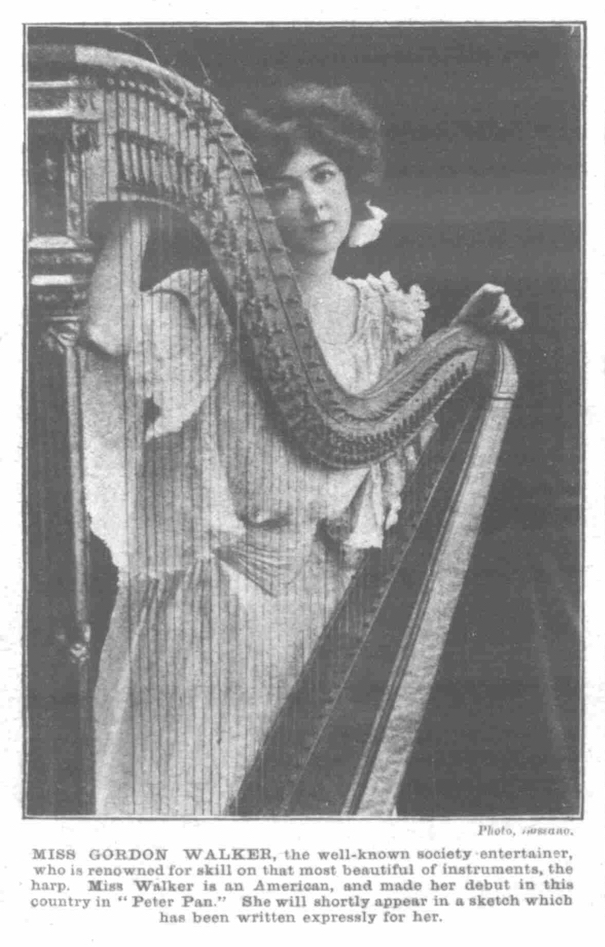
“Miss Gordon Walker, the well-known society entertainer, who is renowned for skill on that most beautiful of instruments, the harp. Miss Walker is an American, and made her debut in this country in ‘Peter Pan.’ She will shortly appear in a sketch which has been written expressly for her.” Photograph by Bassano. Reproduced from The Penny Illustrated Paper (London), May 27, 1905, p. 330.
Among the people that we had met at John Lane’s in London was Gordon Caine and her husband. Gordon Caine had been a Wellesley girl who played the harp with which she always travelled, and who always re-arranged the furniture in the hotel room completely, even if she was only to stay one night. She was tall, rosy-haired and very good-looking. Her husband was a well known humorous english writer and one of John Lane’s authors. They had entertained us very pleasantly in London and we asked them to dine with us their first night in Paris. I don’t know quite what happened but Hélène cooked a very bad dinner. Only twice in all her long service did Hélène fail us. This time and when about two weeks later Carl Van Vechten showed up. That time she did strange things, her dinner consisting of a series of hors d’œuvres. However that is later.John Lane and his wife held Sunday afternoon teas at their “richly carpeted apartment in Lancaster Gate,” Bayswater (Graham 1964: 39). Stein and Toklas apparently attended two such teas during their January–February 1913 stay in London (Stein 1933a: 157; 1933b: 139; Everett 1996: 155–173). Presumably, they would have first met “Gordon Caine and her husband” on one of those two occasions (when it was that they “had entertained” Stein and Toklas “very pleasantly in London,” or if that was even a separate occasion, I have no idea). John Lane had published Caine’s Hoffman’s Chance the previous year, in October 1912, and would go on to put out three more of his novels: The Irresistible Intruder, But She Meant Well, and Great Snakes!. Stein became one of John Lane’s authors in February 1915 when the collection of stories she had had printed at her own expense in 1909, Three Lives, was reissued as a “futurist novel.” The evening in Paris when “Hélène cooked a very bad dinner” for the first time would have most likely taken place around May 26; May 24 if the Caines had come on Saturday. According to The Autobiography of Alice B. Toklas,During dinner Mrs. Caine said that she had taken the liberty of asking her very dear friend and college mate Mrs. Van Vechten to come in after dinner because she was very anxious that she should meet Gertrude Stein as she was very depressed and unhappy and Gertrude Stein could undoubtedly have an influence for the good in her life. Gertrude Stein said that she had a vague association with the name of Van Vechten but could not remember what it was. She has a bad memory for names. Mrs. Van Vechten came. She too was a very tall woman, it would appear that a great many tall ones go to Wellesley, and she too was good-looking. Mrs. Van Vechten told the story of the tragedy of her married life but Gertrude Stein was not particularly interested (Stein 1933a: 165–166).
It was about a week later that Florence Bradley asked us to go with her to see the second performance of the Sacre du Printemps. The russian ballet had just given the first performance of it and it had made a terrible uproar. All Paris was excited about it. Bradley had gotten three tickets in a box, the box held four, and asked us to go with her. In the meantime there had been a letter from Mabel Dodge introducing Carl Van Vechten, a young New York journalist. Gertrude Stein invited him to dine the following Saturday evening (Stein 1933a: 166–167; 1933b: 147).The first performance of Le Sacre du Printemps took place Thursday, May 29, 1913, and the second, Monday, June 2, 1913 (see, e.g., the schedule for Théâtre des Champs-Elysées published under the rubric “Théâtres” in La Petite Presse, mercredi, 7 mai 1913, p. 3). Therefore, Carl Van Vechten (“the hero or villain of Mrs. Van Vechten’s tragic tale” [Stein 1933a: 168; 1933b: 149]) must have dined with Stein and Toklas for the first time on Saturday, June 7. On that occasion, “Hélène did for the second time in her life make an extraordinarily bad dinner. For some reason best known to herself she gave us course after course of hors d’œuvres finishing up with a sweet omelet” (Stein 1933a: 168; 1933b: 149). Perhaps the “reason best known to herself” for why Hélène “gave […] course after course of hors d’œuvres” was because she was paying homage to the passage in Caine’s Hoffman’s Chance where the main character, composer Michael Hoffman, wishes to take his girlfriend Linda Brook to dinner at the Café Royal:
“We’ll begin with hors-d’œuvres. A really wise man would make his dinner off the Café Royal’s hors-d’œuvres, but as we’re not wise, but out on the beano, we’ll follow with the soles” (HC: 143).And she finished with a sweet omelet to pay homage to a mollifying lunch described in Caine’s But She Meant Well:
Fortunately the annoyance which Hannah had caused Mr. Sterne by tapping on his window had, for that day, dissipated his working mood. I say “fortunately” because, when he returned to the house at lunch time, he found that the study was uninhabitable by reason of soot and the terrible smell which the burning chimney had caused. It is possible that he might have recovered sufficiently to proceed with “Walpole — A Fragment,” after lunch, but the discovery that Walpole was not so much a Fragment as a feathery heap of cold, charred paper drove the lust for poetry-making right out of him. Mrs. Sterne and Miss Beatrice had a bad half hour with him; but since the agony of strong men with ugly faces is a thing which no one can willingly contemplate (much less describe) I spare you and myself some very distressing pages by omitting all that he said concerning Hannah, his brave struggle with and ultimate triumph over the complete loss of appetite which he announced at the beginning of lunch, his gradual abandonment (induced by his wife’s arguments and some quite exceptional hock) of his resolution to see Hannah expelled that very afternoon from the house. Since the going of Hannah meant necessarily the going of Julia; since the going of Julia meant a repacking and their own departure (for in the depths of the country a cook is not obtainable at a minute’s notice), since it would be unkind to the Henry Sternes to throw their house back at them in a moment, and since he was assured that Hannah would certainly be kept under control, he was willing to try this arrangment of Lilian’s for one more day.Of course, Hélène would have confused, in her homage, not only the “young New York journalist” with the “well known humorous english writer,” but also the present with the future, since But She Meant Well was not published until October 1914 in the US, and November 1914 in the UK. Stein, of course (to continue with another course), wrote The Autobiography of Alice B. Toklas well after the author of The Author of “Trixie” and his wife the former Wellesley girl had died, so it’s possible that Stein’s having constructed the Caine–Van Vechten nexus around a core of Hélène’s two occasions of bad cookery could be viewed as an expression of the memory of having read, say, Caine’s posthumous Daily Mirror piece (which I touched on in § 2) where his hypothetical narrator goes “out into the street having just given way to evil temper because my breakfast porridge has been smoked,” or the rare occasion when Julia, worried about her daughter Hannah’s coughing in But She Meant Well, “sadly over-cooked Mr. Sterne’s breakfast bacon” (BSMW: 210). For Reginald Sterne’s cook Julia Neighbour was, like Stein and Toklas’s cook Hélène, not normally given to failing in her duties. As Caine relates with his distinctive genial blend of narrative fiction and authorial intrusion:But if —
Mrs. Neighbour, white and tear stained, entered at this moment with one of those perfect jam-omelettes which Mr. Sterne’s wife knew he liked so much. Beatrice — immoral creature — advanced the hock, hazarded something a little humorous (BSMW: 73–75).
As soon as Mrs. Neighbour should have made the beds she proposed to boil those eggs to that they should be thoroughly cold by lunch time. Mr. Sterne had begged her, if she loved him, not to send the eggs in warm and though Mrs. Neighbour did not love Mr. Sterne (for she suspected that he did not like Hannah), she meant to oblige him, because she was a good cook and regarded food, rightly, as something sacred, though she did not know this and would have thought what I have just said impious, because she had been properly brought up, like me, only I have advanced (BSMW: 223–224).Or perhaps Stein, when writing her partner’s “autobiography” in October–November 1932, had in mind (though she did not know it) the second paragraph of the sixth chapter, entitled “Hors d’œuvre,” of the last book Caine had prepared for publication before he died, The Glutton’s Mirror:
You get worse food in Spain than anywhere out of England, but the Spanish are quite sound about hors d’œuvre. They give you a dish of olives and another of red peppers and let it go at that. In Spain you are never tempted to excess among the hors d’œuvre. In Paris, on the other hand, you will find restaurants where they bury you under little snacks, each one prettier and more enigmatical than the next, and the moment you come up to breathe, swamp you with a second lot, all quite new to you. If you intend to eat any luncheon, it is better to avoid such places (GM: 28).But back to that dinner in late May 1913 at a different place in Paris, 27 rue de Fleurus. Stein’s “vague association with the name of Van Vechten,” for instance, may have been not only with the letter of introduction she had received from Mabel Dodge “in the meantime,” but also with that of Alice Van Vechten Brown who, before becoming professor of art at Wellesley in 1897, supposedly studied in Paris where she exhibited at the Salon des Artistes Indépendants, and later co-wrote with William Rankin A Short History of Italian Painting (1914). Furthermore, Mrs. Caine’s “very dear friend and college mate” was Anna Elizabeth Snyder who graduated from Wellesley in 1902, two years after Miss Gordon Walker did, and became Mrs. Carl Van Vechten in London on June 29, 1907; that is, a month before Miss Gordon Walker became Mrs. William Caine. I also find Stein’s description of Mrs. Caine as “tall, rosy-haired and very good-looking” to be curiously similar to that which I quoted from The Scrap Book in § 3 — “tall, with a lovely coloring and a wealth of auburn hair.” Another interesting similarity involves Stein’s description of the former “Wellesley girl who played the harp with which she always travelled” and Caine’s description of traveling with his wife’s harp in its harp-case in the first chapter of An Angler at Large (1911):
Few people travel with a harp. This accounts for the prosperity of Mr. Cook, Dr. Lunn and other convenient gentlemen.As for his wife’s penchant for rearranging “the furniture in the hotel room completely, even if she was only to stay one night,” Caine describes this in the second chapter of the same book:Harps are provided in Heaven. Otherwise there would be no orchestra.
The cost of appeasing porters when travelling with one of these instruments explains the dimensions of the Hebrew variety. This is an unworthy sneer at an admirable race. It is the fault of the harp. I am at my worst just after the thing has accompanied me on a journey. To-morrow it will be taken out and strung up and played, and then I shall love it again. In this — in nothing else — it resembles a young child, which, when it has been washed and fed and has slept and has been washed and fed once more, becomes something adorable and entirely different from the curse of yesterday’s railway travel.
The harp-case has power to turn smiling, kindly, bearded men into brutal Grobians. They fetch out the trunks with a jest; whistling, load their barrows with sausages and telescopic baskets. “Anything more, sir?” they ask alertly. “There is only,” I reply, with my forced smile, “a harp.” And the weather changes for the worse. Two, three, four of them bend their enormous muscles to the toil. I see their honest faces redden, grow purple. I hear muttered words which I recognise as popular expressions of hate. While elevating their outrageous fardel to the roof of our conveyance they give themselves permanent strains. They rupture their abdominal walls. They become out-patients at infirmaries and bind themselves in trusses. They lose their situations. Their children starve. Their sticks are sold up. At least, I imagine all these things happening.
And to change these sour-faced, fainting, loathing, blasphemous enemies back into friends, what sums are needed!
I do not mind the loss of money — the harp is ready for the road — but the thought of these men’s animosity is very painful to me. For I would go about the world among smiles and kind words. A humble ambition, but not easy to realise (AL: 2–4).
Wherever we go — and you must know that we are always going somewhere — this ceremony begins our sojourn, because, as my wife would tell you, I have my particular views upon the placing of tables and chairs and the Oriental fabrics which brighten up the dingiest room. I like to see what is called ‘the feminine touch’ in my habitation. What is good enough for careless bachelors is not good enough, believe her, for me. I can never do anything until I have got the harp out of the harp-case and the harp-case into the back premises out of sight — ugly thing! And if there is no sofa, I will carry a bed down from an upper room and cover it with djidjims and cushions and feign a divan, rather than allow my drawing-room to lack this essentially feminine touch. And when my wife is on it, then and not till then do I feel that the place begins to be habitable. Ask her if this is not so.And I will work far into the night, long after she has grown exhausted, carrying out her excellent suggestions, lugging great wardrobes across and across the floor till they are in exactly the situation to make right the new adjustment of the large tables and the piano, if there is one.
And I welcome every suggestion she makes (from the couch that used to be a bed), because I know her to have a sound instinct for placing furniture. It is extraordinary how sound it is. We always agree — in the end. How lucky it is that we should be married! Supposing she had wedded a man who detested this kind of hard labour. An unfastidious man. A man such as I used to be before I knew her (AL: 13–14).
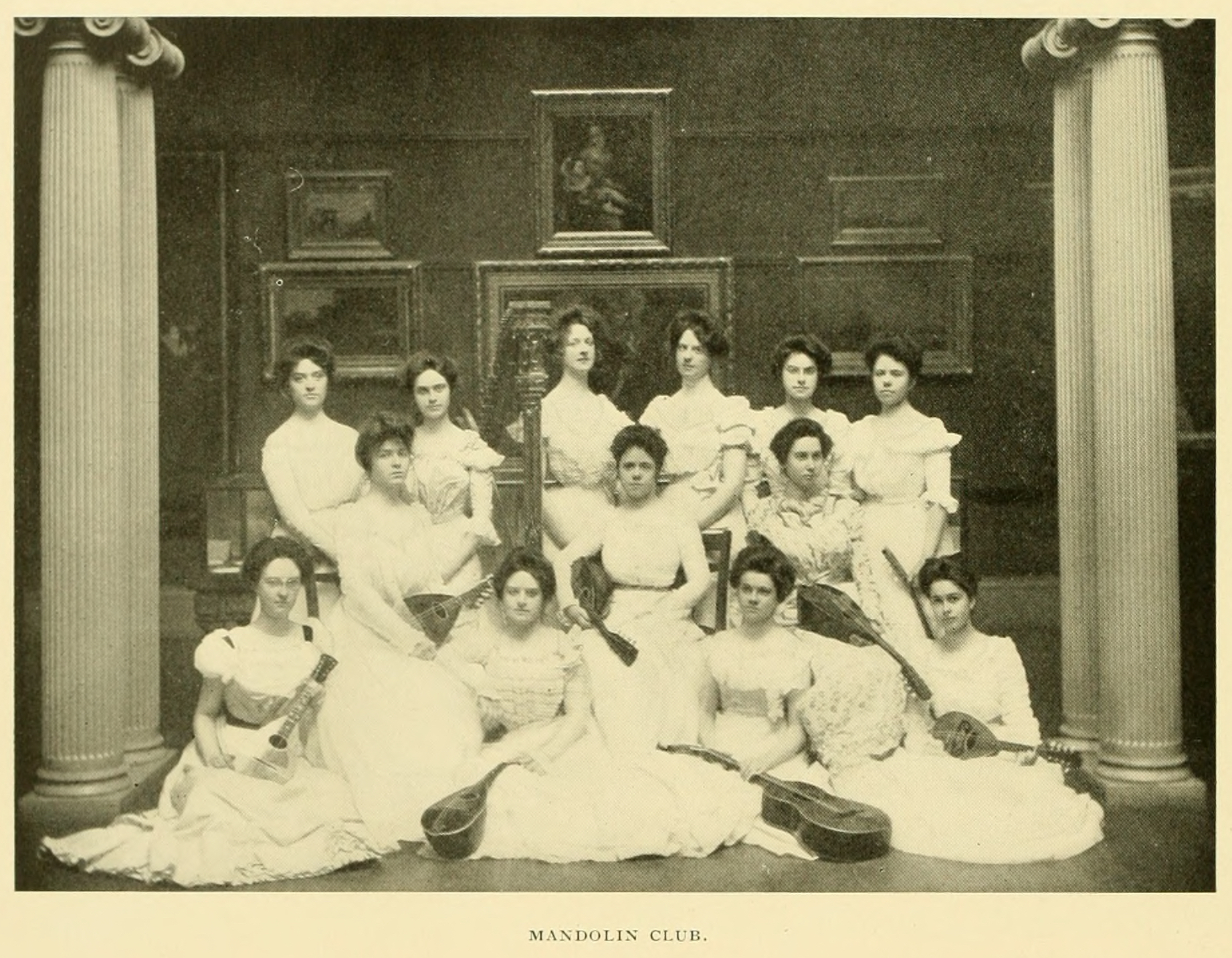
The Mandolin Club at Wellesley, c. 1900. Edith Gordon Walker stands in the back row, immediately behind her harp. Reproduced from the Wellesley Legenda 1900, p. 112.
Walker, Edith Gordon 99 Jason Street, Arlington, Mass.I have not yet been able to figure out what “N.N.N.” stands for. “A.A.” stands for Athletic Association, “C.A.,” I think, for Christian Association, and “B.S.” stands, not for Bachelor of Science or Bull Shit, but rather indicates that Edith Gordon Walker was a member of the “Barn Swallow Society.”B.S., C.A., A.A., President of Golf Club, College Settlement, N.N.N., Red-Headed Club, President of Mandolin Club, Basket Ball Team (1), Lacrosse Team (1), Junior Play (3), French Play (3), Norumbega Play (4).
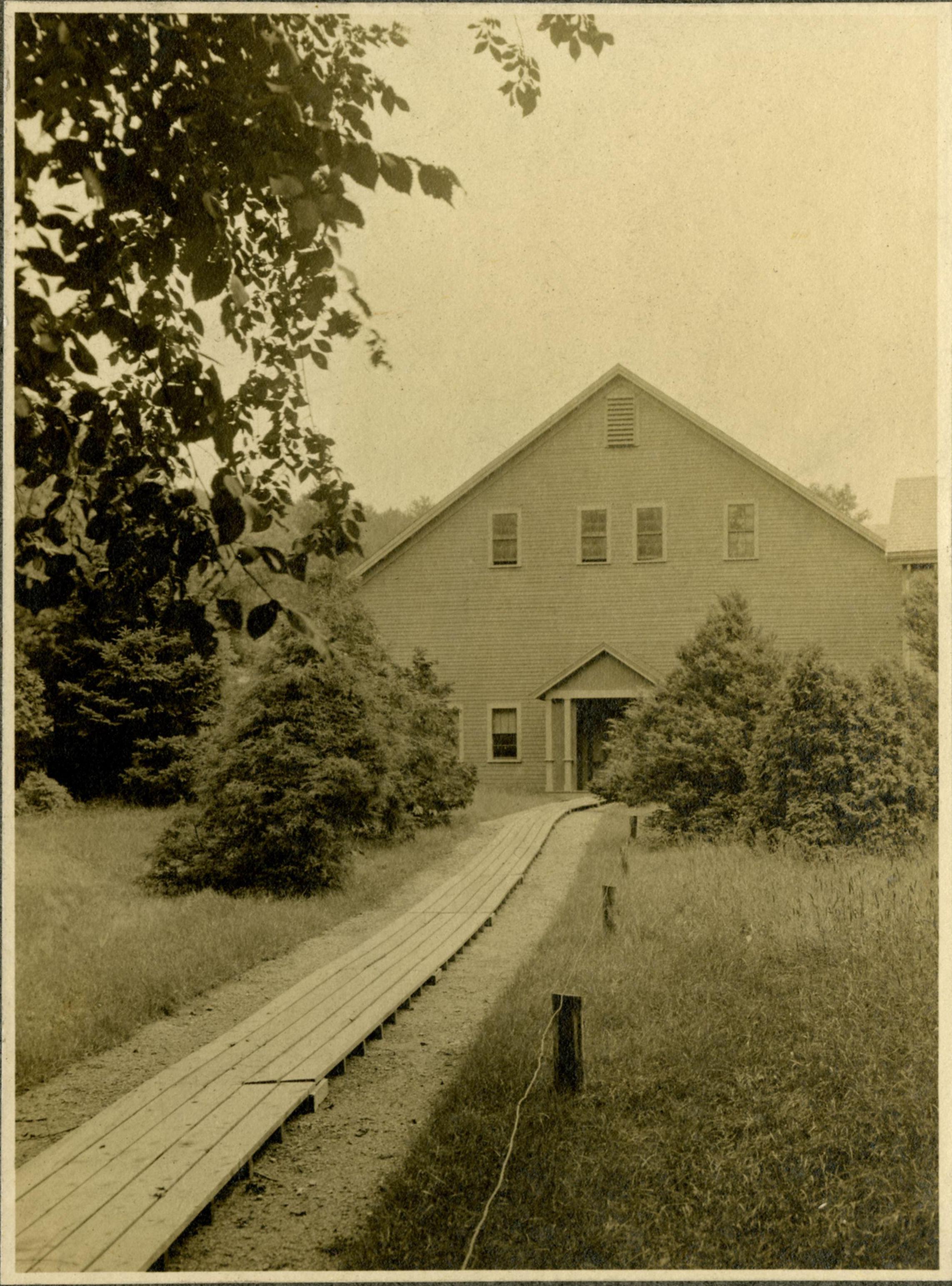
The Barn, Wellesley, c. 1900. [https://www.jstor.org/stable/community.23063090].
The Barn Swallows Society, which comprises nearly every one in the college, meets every three weeks for some kind of good time. When it is a play the whole preparation is put into two weeks, with a limited number of rehearsals, and the whole aim is to distribute the work of preparation for the good times of the “Barn Swallows” among a great many with little work for each.The Barn Swallows’ “good times” took place in the Barn, described in The Worcester Spy as follows:
This barn, be it known, is to all outward appearances, an ordinary one, which it originally was. Finding that as such it was no longer needed, some bright Wellesley girls, formed a Barn Swallow Society, to which all students may belong, and with the funds thus raised, had the interior cleared, a hard wood floor laid, stage, curtains and scenery provided and lo, Wellesley has now a miniature theatre, which accommodates an audience of about 900. Here, during the winter season, the society has for several years given amateur theatricals every other Saturday evening (“Seniors at Wellesley Did Themselves Proud,” The Worcester Spy, Sunday, July 1, 1900, p. 13).It is clear that Edith Gordon Walker was a member of Wellesley’s Red-Headed Club (Jennie F. Beers, of Newtown, Conn., seems to have been the only other member of the class of 1900 who was also a member of this club [p. 41]), that she was President of both the Golf and Mandolin Clubs, and was active in the College Settlements Association. She apparently also played basketball and lacrosse, although her name is not included on the list of members of the class of 1900 basketball team (p. 129), nor does she seem to appear in the team photograph (p. 128). Perhaps the numbers in parentheses in The Legenda’s entries indicate freshman (1), sophomore (2), and so forth. If so, Miss Walker played basketball and lacrosse only in her freshman year, and appeared in the “Junior” and “French” plays when she was a junior, and the “Norumbega” play when she was a senior. Furthermore, her entry in the Wellesley College Record, 1875–1912 (p. 272) tersely states:
WALKER, Edith Gordon, enr. 96–00 fr. Arlington; B.A. 00; Mrs. William Caine, 16 The Pryors, Hampstead, London, Eng.; American Express Co., 5 Haymarket, London, Eng. (permanent); concert work, 02–04; stage, London, 04–07; mem. Boston Co. Club.I will return to Walker’s Junior, French, and Norumbega plays, as well as that “stage, London, 04–07,” when I touch, in § 10, on the theatrical career of the wife of the author of The Author of “Trixie”; for now, I concentrate on her college harp-playing and later “concert work,” to the distant strains of which Caine devotes the entire tenth chapter, entitled “Of a New Voice in the Valley,” of his An Angler at Large:
These mornings I fish to slow music, for the wind sits ever in the N.W. As I near the island the breeze takes on a new kind of voice. Its sigh becomes melodious; faint breaths of harmony intermingle with its whisper; its very lulls are tuneful. Where, hitherto, the cuckoos and the larks, the sheep and the cattle, the reeds and the poplars alone have raised their untutored voices, the meadows are vocal with arpeggios. The Spring Song of Mendelssohn is distinguishable, sometimes above, sometimes below that of the valley.The earliest documented performance on the harp by Edith Gordon Walker I’ve been able to find so far took place on Wednesday, February 22, 1899, when she was a junior at Wellesley. The “College Notes” entry for that date in The Wellesley Magazine (March 11, 1899, p. 333) states, “The annual Glee Club concert was received, as always, with enthusiasm. The programme this year included several charming new numbers.” The enthusiastic reception is briefly described in a piece in the Boston Evening Transcript:It is at this time of the day that my wife practises.
Is there something in the harp which makes it more akin to Nature than any other instrument ? In solitudes such as these one rarely hears any human music. A piano may tinkle in a cottage (for we are so excessively educated nowadays), a travelling gramophone may stutter and wheeze from the high road, a mouth-organ may go by at the march, a hurdy-gurdy clatter out with impartial gusto a waltz or a hymn. These are the instruments of the countryside. Or a Flower Show may provide a brass band all the afternoon. And I have endured fiddling. This surely exhausts the list. Until I heard the harp thus, I denied the right of human beings to make music in chalk valleys. Let them keep to those rivers where men in starched collars punt girls under Japanese umbrellas. It does not matter to me that on such waters — more streets than streams — the banjo and the concertina, the mandolin, the cornet thump, wheeze, twang, and blare. I am not there. In this valley, however, I have always resented the intrusions of music — until now.
Whether the harp is really wilder than other instruments I cannot say. That it is this alleged savagery which renders it pleasing to my ear in this place I do not think. It may be so, but I have a suspicion that a ’cello or a flute, or a sackbut for that matter, under the same conditions, would be to me similarly agreeable. For when the harp sounds it sings to me of matters which lie entirely outside the scope of aesthetics. It is a new voice in the valley, and it carries messages to me which the old never reported. Perhaps to the wooing strains of Gounod’s Serenade I seek to lure that four-pound trout which persists within the Island glide. Or, again, when I have risen and lost him, it is Consolation which celebrates the event. But whatever the music and whatever the fortune, I am assured, by the harp, that everything that was once good is now a thousandfold better, and that there is nothing bad anywhere at all (AL: 69–71).
The annual glee and mandolin club concert on Wednesday evening was largely attended, many guests, notably college men, coming from out of town, and being entertained at supper by the Wellesley students living in the different dormitories. The concert programme was made especially attractive this year, through the harp playing by Miss Edith Gordon Walker, and the addition of the violin, played by Miss Alma Seipp, both members of the college. Signor Augusto Rotoli is musical director of the glee club, Miss Ethel M. Cobb, leader, and Miss Helen M. Burton is leader of the mandolin club; each club numbers sixteen students (“School and College; Wellesley College,” Boston Evening Transcript, Friday, February 24, 1899, p. 11).As for the “several charming new numbers,” the mandolin club’s contribution to the first half of the program consisted of “The Prince of India,” a ragtimesque march by Van L. Farrand, Mendelssohn’s “Spring Song,” and a harp solo by Miss Gordon Walker, Dubez’s “Song without Words.” Johann Dubez’s opus 33 is actually entitled “Deux Chansons sans paroles.” Unfortunately, the programme does not specify which one Miss Walker played; perhaps she played both, since they are rather short. Here’s how harpiana.com describes them:
Chanson I begins with a majestic sequence of rolled chords, fancied up with multiple modulations calling for a slew of pedal changes, followed by straight two-handed chords in 8th notes that either ring in unison or are accompanied by a simple repetitive pattern. As the music moves toward an expressive climax, the octaves quicken into lively 16th notes that dare the student to find their footing while practicing acrobatics in the upper range. A sequence of chords moving from C Minor to Eb Major then sets the tone for the repeat or for a calmed down ending with ascending and descending arpeggios.For the second half of the concert of February 22, 1899, the Mandolin Club performed Reiter’s “Manuela Portuguese” and one of George Rosey’s “Spanish Waltzes,” entitled “La Susana.” Miss Gordon Walker is also mentioned under “College Notes” in the previous issue of The Wellesley Magazine (February 11, 1899, p. 277), where, on the afternoon of January 7, she is described as having “entertained members” of the M. I. T. Glee, Banjo, and Mandolin Club before their “annual Wellesley concert […] in the townhall of the village.” How she entertained the members of that club is not specified. Towards the end of her junior year, Miss Walker performed again, on Monday, June 26, 1899, in what appears to have been a sort of commencement or graduation ceremony. The Worcester Spy described it thus:Chanson II also opens rather ceremoniously, with chords and arpeggios introducing tunes in 8th notes intended to first revel in sweetness, then in passionate expression. Suddenly we enter full-fledged arpeggio territory, in a style close to the “three-handed technique” introduced by Parish Alvars on the harp and Sigismund Thalberg on the piano. Here the composer emphasizes the notes of the tune on the downbeat through a right-hand chord paired with a left-hand octave. If this looks obvious, the descents on beat 3 operate more mysteriously, with a dotted rhythm singling out the tune within the arpeggios, as if played by an invisible third hand. In the end, the music builds up a bit of drama with final two-handed arpeggios alternating between Cb Major and Ab Minor, to end triumphantly in the beginning tonality of Cb [https://harpiana.com/product/dubez-deux-chansons-sans-paroles/].
Monday was unofficially called class day by the students. The Glee and Mandolin Club concert was given out of doors by Longfellow Pond. Miss Gordon Walker played the harp, and the concert was made up of many old familiar college songs, with a few new friends. After the concert, the guests went to the slope facing the campus, where they watched the tree exercises.A piece in The Boston Globe had earlier described the participation of the glee and mandolin clubs in the class day exercises as follows:The seniors came down from the east end of the building in caps and gowns, singing their class song, and each carrying a large wooden spoon decorated with the class colors, green and white, and to be used in the tree exercises. Each senior caught up the black gown of the one in front of her as the procession marched over the green, in a long, winding march. The effect was rather unusual, with the academic gowns thus caught up and fluttering in the breeze. After the march, the tree exercises took place, which consisted of the planting of the bulbs of the class flower, the narcissus, about the tree, and the singing of class songs. The senior tree day dances were repeated on the campus, much to the delight of the many spectators (“Wellesley College; Class Day Exercises, Commencement and Senior Serenades,” The Worcester Spy, Sunday, July 2, 1899, p. 14).
The annual [sic] glee club concert came in the afternoon. The slopes to the east of Longfellow were covered with people, happy seniors and their fond parents, students from Harvard and the institute of Technology, and grave alumnæ busy meeting old friends.On February 22 of the following year, the mandolin club again took part in “the principal social event of the season at Wellesley college,” as The Boston Sunday Globe called the college’s mid-winter glee club concert (“Table Gossip,” February 25, 1900, p. 38), preparations for which were described in The Musical Courier (New York):The glee club members in their white gowns made a pretty picture. “All Hail to the College Beautiful” first rang out clear and strong, followed by the pathetic “Old Uncle Ned.” The saddest of all Wellesley’s songs, “’Neath the Oaks,” came next, and then the mandolin club, armed with gay colored cushions for seats, took their places before the audience. A golden harp stood up straight and tall behind the other players, from which Miss Gordon Walker 00 drew sweet strains of music. A violin, played by Miss Alma A. Seipp 99, also added its melody to that of the mandolins. Miss Helen Burton 99 acted as leader (“Wellesley’s Class Day; Elaborate and Beautiful Ceremonies, With Music, Dances and Song to Help on Goodbys,” The Boston Globe, Tuesday Morning, June 27, 1899, p. 12; ditto, Tuesday Evening, June 27, 1899, p. 8).
The Mandolin Club of Wellesley College has announced its organization, and commenced its rehearsals in preparation for the annual concert, which is to be given on the evening of February 22. The officers of the club are: Leader, Ella Mason (1900), president, Gordon Walker (1900), secretary, Ethel Gibbs (1901). The members are: First mandolin, Ella Mason (1900), Ethel Bowman (1900), Ethel Gibbs (1901), Carolyn Kampman (1902); second mandolin, Juliette Cook (1902), Marjory Gouinlock (1902), Georgia Silver (1902); guitars, Edna Mason (1900), Alice Dane Knox (1900), Alice Wilcox (1902), Lucia Proctor (1903); mandola, Jessie Lathrop (1903); harp, Gordon Walker (1900); violin, Marie Louise Richards (1904); castanets and tambourine, Alice Dana Knox (1900) (“Boston Music Notes,” The Musical Courier, January 10, 1900, p. 21).Perhaps the above-cited notice in The Musical Courier had something to do with the concert’s popularity:
February 22. — The annual concert by the Glee and Mandolin Clubs was given as usual on Washington’s Birthday in the College Hall chapel. The concert, which was an especially good one, was enjoyed by a large audience. The number of seats was so out of proportion to the tickets demanded that the clubs have decided to repeat the concert on March 5, for the benefit of those who were unable to procure tickets for the regular concert (“College Notes,” The Wellesley Magazine, March 10, 1900, p. 347).Or perhaps Miss Gordon Walker’s presence at a “subscription party held by Arlington’s younger set” the previous evening at the Arlington town hall was a factor. While the repeat concert on Monday, March 5, was described in The Wellesley Magazine “College Notes” (April 17, 1900, p. 416) as a “marked success,” the Boston Evening Transcript specified that
The Glee Club concert on Monday, although a repetition of that given Feb. 22, did not suffer any lack of appreciation. There was a large audience and the music was enthusiastically received. Miss Florence L. Walker of 1900 is president of the glee club; Miss Edith Gordon Walker of 1900 president of the mandolin club (“School and College; Wellesley College Notes,” Boston Evening Transcript, Wednesday, March 7, 1900, p. 7).A couple months later, on Saturday, June 23, 1900, to be exact, Wellesley again held its class day ceremonies, which were described by The Worcester Spy:
Nineteen hundred certainly is favored in the weather for her festivities. Dainty teas and receptions extending over the time from 3 to half-past 4 yesterday afternoon were largely attended and much enjoyed, especially by those who made the rounds from one to another, thus meeting with many an old friend and fellow-student.And by The Boston Globe:Four-thirty saw very few guests at these functions, however, and unless one happened to know where they had all gone, their sudden departure might have caused some wonderment. All Wellesley and her visitors did know, though, and those who were not already there hastened to the shores of Longfellow Pond to listen to the concert by the Glee and Mandolin Club.
The afternoon was perfect. The recent rains had left everything fresh and green, birds chirped in the trees overhead, and the afternoon sun shone brightly in on the assembled throng, lighting up like so many flowers the beautiful vari-colored gowns.
After the success of the Glee and Mandolin Club in February, every one expected a good concert, nor were any disappointed. The singing by the glee club was excellent in every way. The enunciation was especially clear and distinct, a very important point in the success of such humorous songs as formed a greater part of their program. Solos, with glee club accompaniments, were sung by Miss Diamond Donner, ’01, of Portland, Oregon, and by Miss Hetty S. Wheeler, 1902, of Bridgeport, Conn., both songs being greatly enjoyed.
The Mandolin Club did its full share of the entertaining, too, and rendered its numerous selections with great skill and success. Miss E. Gordon Walker, ’60 [sic], of Arlington, Mass., played a harp solo, which is something of a novelty in the way of college entertainment (“University and College; Wellesley,” The Worcester Spy, Monday, June 25, 1900, p. 2).
As the glee club, all in white, came out from from the trees, they made a pretty picture against the background of green woods. The songs sung this year were mostly new, with one or two old favorites to please the alumnæ.Likewise, the Boston Evening Transcript (Monday, June 25, 1900, p. 5) noted that “one of the most attractive features” of the “outdoor concert near Longfellow Pond” was “a harp solo by Miss Edith Gordon Walker.” Three days later, on Tuesday, June 26, 1900 — the 25th anniversary of the founding of Wellesley College — the future wife of the future author of The Author of “Trixie” was among the 133 Wellesley seniors who received their bachelor of arts degrees. Her contribution to the “Quest of the Golden Girl,” a renga of citations gleaned by her and her 132 classmates from a multiplicity of sources and collated in the Wellesley Legenda, was (p. 153):“Three Doughty Men,” by Humphries, was the first selection, followed by a bright little song entitled “Proposal.” Miss Nina F. Poor, 00, acted as leader of the club. Then the mandolin club, carrying gayly colored cushions for seats, came forward, and, led by Miss Ella Mason, 00, gave two lively selections, “Scarf Dance” and “Ameer March.” The mandolin club includes among its members players on many instruments besides mandolins, as the guitar, tambourine, violin, castinets, mandola and harp.
One of the most enjoyable features of the afternoon was the harp solo by Miss E. Gordon Walker 00. “My College Girl,” set to music by Prof. Junius W. Hill, for many years at the head of the college music department, elicited much applause from the audience as a typical college song, while every one kept time involuntarily to the “Fortune Teller” waltzes, and “Ragtime Skedelle,” played by the mandolin club (“Pretty Picture; As Wellesley Glee Club Made Their Appearance; Girls in White Against Background of Green Woods; Songs This Year Were Nearly All New Ones; Mandolin Club Greeted With Much Applause; Audience Broke up to Attend Teas of Seniors,” The Boston Globe, Saturday Evening, June 23, 1900, p. 5).
What was our author doing in the meantime? Having been elected to the Northern Circuit on July 13, 1899, the future author of The Author of “Trixie” was already, just a month and a half shy of turning twenty-six, practicing as a barrister-at-law from the offices of 3 Hare Court, London (Lynch 2005: 220). Although Little Folks had already published in 1899 his self-illustrated, “Quilliam”-signed series, “Tales Moral and Marvellous (Monthly),” he had not yet received that special nudge — or spark — which would set him on the path “to writing in earnest,” as the paragraph in the November 23, 1912, issue of The Graphic (quoted in § 4) put it. The lesser known Caine briefly glossed that nudge and spark and his own day-to-day c. 1900 in the “Dedicatory Letter” he addressed to the angling editor of The Field, Hugh Tempest Sheringham, in his, that is, Caine’s, An Angler at Large:“I’ve grown quite tired
Of being admired.”
[…] gratitude compels me to dedicate the Angler at Large to you, the man most truly, though perhaps not the most conspicuously, responsible for its appearance. For lacking your encouragements (of which this book is the most direct fruit), very possibly I had been still floundering clueless in the labyrinth of Conveyancing Law, and employing my pen upon the infinitely discreditable labour of storing up trouble for the harmless unborn children of inoffensive clients. You have done more than any twenty men (though less than one woman) to save me from this misery and infamy, and I hold myself bound publicly to testify my obligation (AL: vii).And so back to that “one woman,” who, a few months after graduation, was noticed at a golf match held at Wellesley on Monday, October 29, 1900, and won by Alexander H. Findlay. According to the Boston Evening Transcript,
Miss E. Gordon Walker, Wellesley, 1900, president last year of the now disorganized college [golf] club, was an interested spectator of the game, and the largest audience was on the part of the college, to whom, especially, Mr. Findlay’s coming was a much appreciated event (“Alex Findlay Wins Close Match at Wellesley; Findlay Plays at Wellesley; Beat the Best Ball of Wright and Sibley by 1 Up,” Boston Evening Transcript, Tuesday, October 30, 1900, p. 12).In late December, Miss Gordon Walker “appeared as a lunar moth, in green, with glittering wings” in a spectacle entitled Fairyland, held at Mechanics Hall, Boston, to benefit that city’s Women’s Educational and Industrial Union. Three performances of Fairyland took place, Thursday, Friday, and Saturday, December 27–29, 1900, and
nearly three hundred persons took part, suffragists and “antis” coöperating with impartial goodwill (“College and Alumnæ,” The Woman’s Journal, Saturday, December 29, 1900, p. 416).The relevance, if only in a coincidental way, of that detail about suffragists and anti-suffragists cooperating will become clear later when I get to Caine’s two “suffragette” novels, The Pursuit of the President (1907) and The Victim and the Votery (1908). Likewise, the following short “theoretical” paragraph with which the Boston Evening Transcript closed its review of Fairyland could serve as an additional epigraph to The Confectioners:
The labor, the ingenuity and the taste that have been lavished on this production are certainly worthy of great praise; and it must not be supposed that it is merely for the delectation of children. The atmosphere of the fairy world, the world of “Alice in Wonderland” and of all the classics of the subject, is as full of delight and entertainment to all properly constituted adults as it is to the credulous juvenile heart. And, in whatever spirit one approaches “Fairyland,” that atmosphere is so charged with the magnetism of the unreal, so potent with the actuality of the impossible, so eloquent with the logic of the preposterous, that the spectator promptly accepts, with a joy that is childlike and bland, the illusions and dreams of the most unrestricted imagination, the maddest and merriest fancy (“Mechanics Hall a Fairyland; Elves and Goblins, Witches and Fays, Danced in a Greenwood, for the Women’s Educational and Industrial Union; A Large Audience Views a Marvellously Beautiful Spectacle,” Boston Evening Transcript, Friday, December 28, 1900, p. 9).On second thought, there’s really no reason to delay bringing The Pursuit of the President into play here, for I believe that the character of Miss Amy Boydell, the niece of the leader of the suffragettes in that book, is the third of several literary incarnations of Edith Gordon Walker (the first and second being, on the one hand, the distributed avatar of Edith Wason and Mrs. Fanny Costello in Pilkington, and, on the other, Vespertilia Muddock in The Confectioners, as well as that book’s ostensible co-author, John Fairbairn). Miss Boydell is first observed through the eyes of Peter Cattermole, the son of the President of the Board of Enquiries into Army Scandals (i.e., the pursued one of the book’s title):
So I paid the cabman and was just about to step off the pavement, when a little hand was laid on my arm and a soft little voice said: “I beg your pardon, but may I ask you one question?”Having sprained her ankle, Miss Boydell is next seen for the first time by a second admirer, reclining:I turned round to find a young lady with a pair of large, wide-open eyes, of a very attractive, sapphire blue, which were gazing appealingly into mine.
I swept off my hat and assured her that I was ready to answer as many questions as she was ready to put to me.
“Oh,” she said, “One will be enough. Was that Sir John Cattermole?” she asked.
“Hah!” I cried, and moved away a step to consider her. She had dressed herself in a gown of highly becoming dove colour. She wore a round hat of the same shade, with some pink roses under its brim. Her hands were neatly gloved in grey suede. In one she held a piece of paper, and in the other she carried a pink parasol. Her hair was of a golden brown, and of her nose and mouth I need only say that the first was not her strong point and the second was. Her complexion was exquisite (PP: 31–32).
We were shown into a spacious and handsomely furnished drawing-room, where we found, lying upon a sofa, the most beautiful girl that I had ever seen.This second admirer is named Mr. Cyril Flowerdew (an homage, perhaps, to Cecily Cardew of Wilde’s The Importance of Being Earnest, as well as a satire of Cyril Flower, M.P.; see § 2) and his statement — “as I write, I can by shutting my eyes instantly bring before me every feature of that lovely face” — reminds me of a statement in Calvino’s Six Memos for the Next Millennium:I cannot recall the impression which I received on seeing her this first time save that it was highly pleasurable. Though, as I write, I can by shutting my eyes instantly bring before me every feature of that lovely face, my sentiments towards her have undergone since that day changes so vital, so opposite in character, that it is impossible for me to examine the fair vision with the unknowing and unbiassed eye with which I then saw her (PP: 84).
If I have included visibility in my list of values to be saved, it is to give warning to the danger we run in losing a basic human faculty: the power of bringing visions into focus with our eyes shut, of bringing forth forms and colors from the lines of black letters on a white page, and in fact of thinking in terms of images (Calvino 1988: 92).Flowerdew’s expression of what Calvino calls a basic human faculty also reminds of me Humbert Humbert’s distinction between “two kinds of visual memory:”
one when you skillfully recreate an image in the laboratory of your mind, with your eyes open (and then I see Annabel in such general terms as: “honey-colored skin,” “thin arms,” “brown bobbed hair,” “long lashes,” “big bright mouth”); and the other when you instantly evoke, with shut eyes, on the dark innerside of your eyelids, the objective, absolutely optical replica of a beloved face, a little ghost in natural colors (and this is how I see Lolita) (Nabokov 1958: I, § 3, 13).Forty or so pages after their first meeting, Miss Boydell, bored by enforced indolence (her aunt, Miss Waugh, is overly concerned about her ankle), invites Flowerdew to take tea with her:
There was no resisting such an invitation, accompanied as it was with so bewitching a smile. So, casting caution to the winds, I rang the bell, told the servant that Miss Boydell had a commission for me to execute, mounted the stairs and was soon engaged in a most pleasurable conversation. Beyond the merest commonplaces I had had no talk with Miss Boydell, and, from her extraordinary beauty, I had surmised that she was a girl of a frivolous mind. Here I found that I was very much in error. For after we had exchanged a few questions and answers relating to Oxford and Oxford men, which soon convinced both of us that we had no common acquaintances in the University, she suddenly began to talk of her Aunt’s work and the whole vexed question of Woman’s Rights in a way which showed me that here was no mere giddy, pretty, gad-about, but a young woman of earnest purpose and clear political insight. Now I was very ignorant of everything relating to the Cause which Miss Waugh championed, and I heard Miss Boydell most gladly and, I flatter myself, obtained from her a great deal of information without revealing the fact that in politics I was a novice. She seemed excellently instructed in everything appertaining to the subject. She told me, what I had not expected, that women’s claim to the suffrage was no new and revolutionary thing. They had exercised this very right, it seemed, down to so recent a date as 1726, but in the general upheaval occasioned by the Wars of the Roses, their political power had sustained a blow from which it had never recovered. Women during this period had been so fully occupied in nursing their wounded menkind back to life and making the mourning apparel of which they themselves had need, (in order to honour the memory of their dead husbands, fathers, brothers and fiancés,) that they had no time to worry about visiting the polling booths; and, as this state of affairs had lasted for rather more than a century, their custom of voting at parliamentary elections had gradually fallen into desuetude, and the men had never permitted them to revive it. In Magna Charta, King John expressly confirms the Burgesses, or women Burghers, of the Boroughs of England in their right to elect one Knight to represent them in the Witanagemote. The Constitutions of Clarendon are equally clear upon the point. Queen Elizabeth undoubtedly sat in Parliament, and the Venerable Bede, writing in 1606, refers to the “old women who sit upon the Opposition Front Bench.”On Tuesday, May 28, 1901, Edith Gordon Walker “entertained with selections on the harp” during graduation ceremonies in dressmaking and millinery for the Women’s Educational and Industrial Union held at Perkins Hall, Boston. It seems that the future wife of the author of The Author of “Trixie” spent the remainder of 1901 traveling — sans harp apparently, for I have not been able to find any more notices of her playing for that year. Furthermore, the Wellesley College News noted:She told me many more most interesting facts of the same character, the truth of which she said she could guarantee, as she had read History at Newnham [as had at least one of Caine’s sisters, Ruth — MSS], and had consulted all the original authorities. With her permission I made notes of some of the most remarkable incidents — as I thought that they would prove useful should I ever have occasion to address a public meeting on the subject of female suffrage — and it is owing to this bit of foresight that I am now able so clearly to set down what she told me.
She seemed to take the keenest pleasure in teaching me, and I own that I received her instruction with delight. It was an exquisite thing to see her sitting there, her great blue eyes dancing with enthusiasm, her smiling lips opening to pour forth a never-ending stream of fact, comment, and argument. It made me almost ashamed to think that so young a girl should be so completely my master in historical or any knowledge.
And if I had admired her before, for the beauty of her face, how much the more did I learn to reverence her during that all-too-short hour which first discovered to me the even rarer excellences of her intellect. I left the house her captive bound. Love had come to me at last (pp. 122–126).
Miss Gordon Walker, ’00, spent last summer at the Sulphur Springs in Missouri, with her father, who has been very ill. Now that Mr. Walker is recovering his health, Miss Walker is returning to her home in Arlington, paying several visits on the way (“Alumnae Notes,” College News, Wellesley, Mass., Thursday, January 30, 1902, p. 2).Upon returning east, Miss Gordon Walker performed as harp soloist during the “Ladies’ Night” entertainment held by the Alter Ego Club in Chelsea, Massachusetts, on Thursday, March 20, 1902. A few months later, on Tuesday, June 3, she performed in a “musicale” held at Association Hall, Arlington, Mass., the “Table Gossip” column in The Boston Sunday Globe (June 8, 1902, p. 42) calling her “a picturesque figure at the harp,” noting also that she “has much talent both for dramatic reading and for the harp.” Also appearing at this musicale were soprano Nettie Young Baker, bass L. Willard Flint, Miriam O’Leary, recitations, and Walker’s harp teacher, Harriet Shaw.
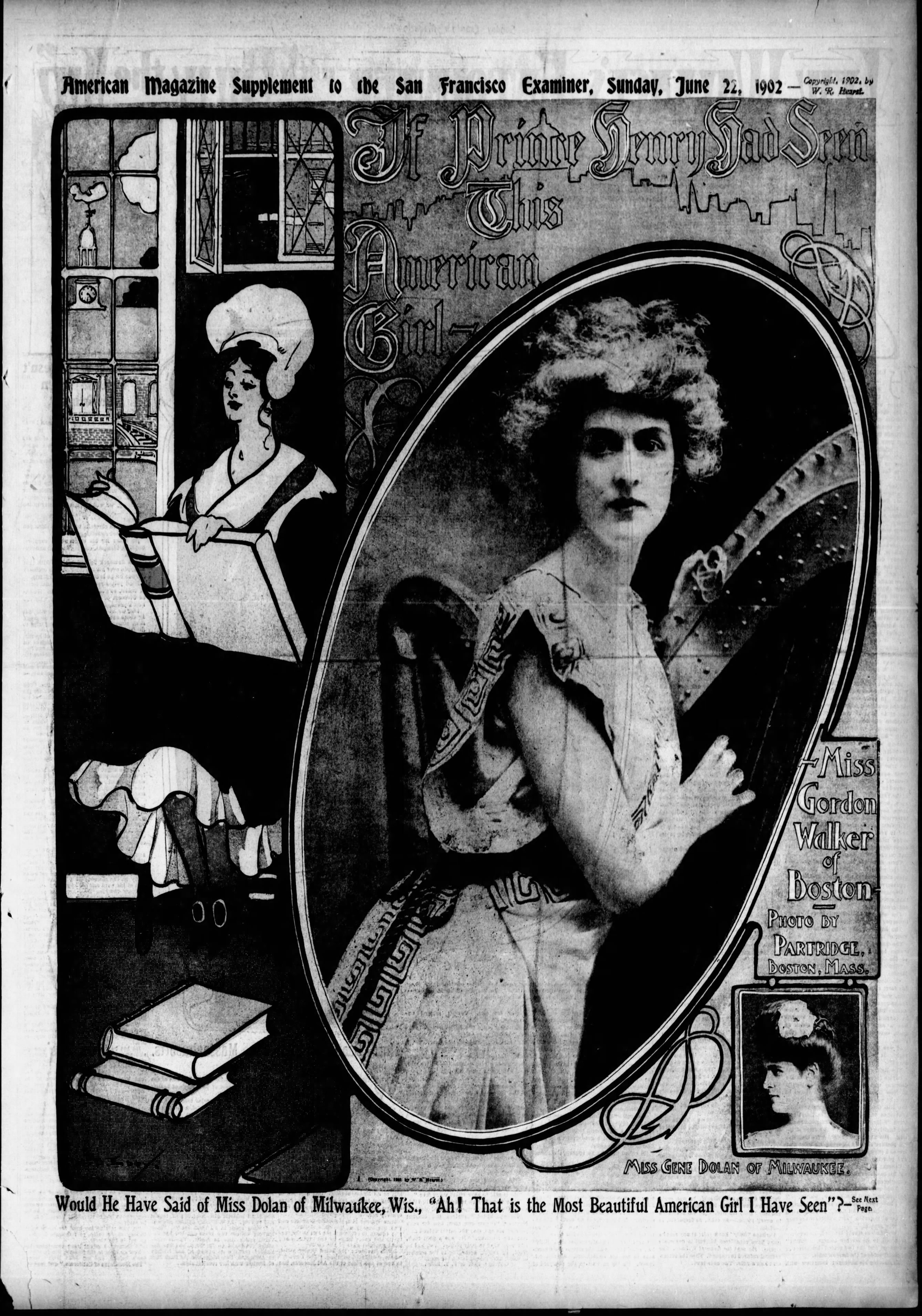
“If Prince Henry Had Seen This American Girl — Would He Have Said of Miss Dolan of Milwaukee, Wis., ‘Ah! That is the Most Beautiful American Girl I Seen’? Miss Gordon Walker of Boston. Photo by Partridge, Boston, Mass. Miss Gene Dolan of Milwaukee.” American Magazine Supplement to the San Franscisco Examiner, Sunday, June 22, 1902, p. 1.
The New York Journal of Sunday, June 22, printed a full page picture of Miss Gordon Walker, of Boston, together with a statement that she is considered the most beautiful girl in Massachusetts. It quotes Louis Kronberg, a noted Boston artist, as pronouncing Miss Walker one of the most perfect types of New England beauty, and says that if Prince Henry had seen Miss Walker first, he would not have declared Miss Gene Dolan, of Milwaukee, the prettiest American girl he had seen. The paper says Miss Walker is known as “The Rose of Arlington,” her home being at Arlington, a fashionable suburb of Boston. She is the daughter of F. R. Walker, a wealthy real estate man. Miss Walker visited at the home of T. M. Walker, in Atchison, last summer (The Atchison Daily Globe, Tuesday, June 24, 1902, p. 4).I have not been able to find the piece as it appeared in the New York Journal; I assume it was identical or similar to the piece entitled “Most Beautiful Girl in Massachusetts,” accompanied by the cover montage reproduced at left, that was published in another Hearst paper:
When Prince Henry of Prussia saw Miss Gene Dolan of Milwaukee, he exclaimed with pardonable enthusiasm:Apropos of that “complexion of pink and white” is Caine’s description of Doll Brackett, the future wife of George March, in the second section of the first chapter of Three’s a Crowd:“Oh, Evans [sic?]! That is the most beautiful girl I have ever seen.”
But would he have made that remark if he had first seen Miss Gordon Walker of Boston?
Boston, like other American cities, will not for a moment admit the pretension that Milwaukee possesses the handsomest girl or girls.
Miss Gordon Walker of Arlington Heights, one of the fashionable suburbs of Boston, is considered the most beautiful girl in all Massachusetts. She bids fair to become as famous for her grace and charm as that historic beauty, “Dorothy Q.” of a century ago.
Miss Walker is a Wellesley graduate and was the beauty of the class of 1900. She was chosen to represent the sun in the fantastic sun dance done by the prettiest and most graceful girls of the class.
Louis Kronberg, the noted Boston artist, whose celebrated painting, “The Dancer,” is one of the gems of the Art Museum, has pronounced Miss Gordon Walker one of the most perfect types of New England beauty he has ever seen.
Miss Walker has regular features and a face of the most perfect oval, a mouth delicately curved and as rosy as a cherry. Added to these charms is a complexion of pink and white and large eyes of soft hazel.
“The Rose of Arlington,” is what her friends and admirers call her. As one of them says, she is so beautiful because she has the power of expression that shows every shade of thought and emotion in her exquisite face.
Miss Walker is the daughter of the wealthy real estate owner, F. R. Walker of Arlington. The Walker home is the big, roomy house at No. 99 Jason street, perched high up on one of the commanding hills of Arlington Heights.
Miss Walker is twenty-two years old. She is an athletic girl, fond of golf, tennis and rowing. At Wellesley College she was a leading spirit in all these sports. Since leaving college two years ago she has devoted much time to music. She is especially proficient on the harp, and has delighted many a gathering of her friends in Arlington, Cambridge and the Back Bay of Boston with her musical skill (“Most Beautiful Girl in Massachusetts,” American Magazine Supplement to the San Franscisco Examiner, Sunday, June 22, 1902, p. 2).
She was about five feet nine inches high and admirably developed. Her mother had been right about her vitality, which declared itself instantly in the superb carriage of her head, the fine poise of her body, the clear cream and roses of her cheeks. The Earth was this tall girl’s footstool; Humanity had been created to admire her. Though she was, without a doubt, posing in her doorway, it seemed that she did so less for the sake of herself than for that of other people. The flattery of all the eyes that had ever fallen upon her had not turned her head; she had simply become immune to the dangers of it. It did not trouble her; it did not bore her. It was part of her existence like the breath of her body. She expected it, and provided for it unconsciously. If she had not received it she would have been as astounded as if her hands would have suddenly refused to do the few things that were required of them (HM: 8; HJ: 8–9).Caine goes on to describe Doll’s hands as “very small and soft; very useless-looking things” — the exact opposite of the famously strong, long-fingered hands which harpists such as “The Rose of Arlington” must have possessed.
The next and last instance of Walker’s harp-playing for the year 1902 which I’ve been able to find occurs under “Special Notices” in The Woman’s Journal (Saturday, December 27, 1902, p. 416), where it is announced that “Miss Gordon Walker, the harpist and monologue reader, will give an entertainment” at the New England Women’s Club on Monday, December 29, at 3 p.m. Her “entertainment, which was well received by the large audience, eliciting an appreciative response,” consisted of “several groups of interesting monologues interspersed by selections on the harp” (“Women’s Clubs,” Boston Evening Transcript, Saturday, January 3, 1903, p. 22). As for 1903, her contribution to a concert organized by the Daughters of the American Revolution and held Thursday, February 19, is described as follows:
An exceptional array of talent will be presented at the subscription recital in Potter Hall, New Century Building, Thursday evening next. Miss Gordon Walker of Arlington, will give a new monologue by Mrs. Sutherland, also, a harp solo by Miss Harriet A. Shaw, her teacher. Mrs. George Lyman Cade will give her own compositions for the voice, some in Japanese attire; Miss Enneking will appear in violin solos, George H. Galpin will whistle two numbers, and Mr. U. S. Kerr and other soloists are to give groups of songs. A feature will be the souvenir programmes, distributed by a score of young girls. Miss Walker and Mrs. Cade are members of the D. A. R., which organization will be represented by the highest Massachusetts officers as patronesses (“Note and Comment,” Boston Evening Transcript, Saturday, February 14, 1903, p. 27).The Boston Globe gave a few more details:
Miss Gordon Walker of Arlington will on Thursday evening give an unpublished monologue from the pen of Mrs Evelyn Greenleaf Sutherland, entitled “The Butterfly and the Pudding.” This is by special permission. Later on the program she will give a harp solo, the work of Miss Harriet Arline Shaw. Potter hall will be made attractive on this occasion, the stage to be dressed up in drawing-room fashion (“Table Gossip,” The Boston Sunday Globe, February 15, 1903, p. 42).A review of that concert, however, failed to mention the harp solo composed by Harriet A. Shaw:
A very successful subscription musicale was given last evening in Potter hall, New Century building, when that auditorium was nearly filled by a fashionable audience. A particularly attractive program had been arranged, and it was carried out without any disappointments. The patrons and patronesses included many of the most prominent society people of the city.By May 1903, Walker’s “entertainments” had evolved into miniature Gesamtkunstwerken in which “monologues interspersed by selections on the harp” were supplemented with dance. She gave, for instance, “a varied and charming program at her entertainment” at the Wellesley Town Hall on Tuesday, May 26. “The selections on the harp were especially well received, but the readings and Spanish dance met with merited applause” (“College Notes,” College News, Wellesley, Mass., Wednesday, June 3, 1903, p. 3). She also combined harp solos with acting, as attested by her performance on July 15:Miss Emily Enneking, violinist, had the first number and played in a pleasing manner “Canzonetta” and “Vision,” by Bohm, and responded to an encore. Miss Gordon Walker of Arlington pleased her hearers in her reading of Mrs Evelyn Greenleaf Sutherland’s monologue, “The Butterfly and the Pudding,” and gave an encore selection. Mrs Salome Thomas Cade sang with excellent effect an old English aria by Dr Arne and also an encore piece. George H. Galpin did some remarkably skilful whistling in “Gondoliera,” by Arditi, and “Suwanee River.” U. S. Kerr met a warm reception when he stepped upon the stage, and was heartily applauded after each of his group of three songs, “Am Meer,” Schubert; “Adoration,” Frey; “Four-Leaf Clover,” Brownell, and an encore selection.
After an intermission, Miss Walker delighted the audience with a harp solo, “Chanson sans Paroles,” by Dubez, responding to a hearty encore. Miss Gertrude Roosevelt of Cambridge then gave a monologue entitled “Tomorrow at Ten,” which was one of the most interesting and pleasing numbers of the evening. She was presented with a big bouquet of yellow jonquils, and as an encore piece gave Eugene Field’s “Winkin’, Blinkin’, and Nod.” Miss Katherine Ricker and Mr Kerr sang a duettino by Pinsuti and an encore number, and the program ended with Clayton Thomas’ “Japanese Love Song,” sung by Mrs Cade, in costume. This was carried out very daintily and left everyone in a happy mood (“Subscription Musicale; Patrons and Patronesses Prominent Society People,” The Boston Globe, Friday, February 20, 1903, p. 2).
One of the most charming entertainments ever given in the pretty town hall at Sharon was that of Mrs Erving Winslow’s pupils on Wednesday night for the benefit of the Sharon improvement and literary association. Through the personal efforts of Dr Dennett, president of the association, many beautiful articles were procured which added much to the stage setting, and his efforts in this direction were untiring. The plays were “Oh! Monsieur!” “Two Can Play at that Game,” and “The Mouse Trap.” Miss Gordon Walker rendered a harp solo in the course of the introductory sketch of the performance, and Miss Mary Sears, who has been one of Mr Lang’s most promising pupils, presented a pianoforte fantasia in “Two Can Play at that Game.” Miss Walker and Miss Sears each excelled in their different parts and were unquestionably accorded the highest honors of the evening (“Table Gossip,” The Boston Sunday Globe, July 19, 1903, p. 38).
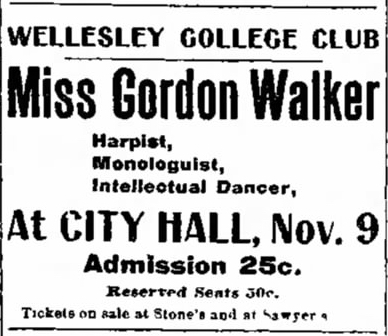
Reproduced from Fitchburg Daily Sentinel, Tuesday, November 3, 1903, p. 6.
It will be remembered by many that the members of the Wellesley College club are endeavoring to secure a scholarship at Wellesley for some deserving Fitchburg girl who could not otherwise have the advantage of a college education. Several applications are already before the club for consideration. Please remember, if you are invited to assist in this cause, that the club is not working for Wellesley College, but for the benefit of one of Fitchburg’s own daughters, for a graduate of the Fitchburg high school.Walker’s concert was curtly reviewed as follows:The club has already established a reputation for giving more than a full equivalent for any money paid into its treasury and is about to offer an entertainment, artistic in the highest degree and so unique that it delights the most blasé pleasure seeker.
Nov. 9, Miss Gordon Walker (Wellesley 1900), “harp soloist, dramatic reader and intellectual dancer,” is to appear for the first time in this city. Miss Gordon Walker was chosen for her grace and beauty to do the Sun dance on Tree day, the year of her graduation. Boston society promptly took her into their hearts, Mrs. J. Montgomery Sears setting the ball in motion by inviting her to appear before invited guests in her drawing room, and Mrs. Jack Gardner setting the seal of approval upon her. Holker Abbott, the masculine arbiter of fashion in Boston, contributed to Miss Gordon Walker’s popularity by inviting her to do Spanish dances at “The Artists’ Festival” in Copley Hall last winter. Her success outrivalled that of any other artist Mr. Abbott had ever brought out. Later, Miss Gordon Walker appeared before the Browning society of Boston in an Oriental dance, illustrating Browning’s tragedy, “The Return of the Druses,” and there scored another triumph.
Miss Gordon Walker has a high conception of the dance as a means of expressing dramatic art. The ancient Eastern dance was, of course, the expression of thought or feeling, particularly, a means of expressing religious fervor. Miss Gordon Walker brings the dance into the intellectual plane by making it in every instance the expression of thought.
In addition to her powers as a dancer, Miss Gordon Walker is a harpist who stands in the first rank of musicians and as she also excels in monologues, the entertainment to be given by the Wellesley College club, Monday evening, Nov. 9, promises to be the most attractive entertainment given in Fitchburg for some time past. Since this is also an opportunity to aid a Fitchburg high school girl to obtain a college education, liberal patronage is solicited (“The Wellesley College Club,” Fitchburg Daily Sentinel, Monday, October 26, 1903, p. 6).
Miss Gordon Walker appeared in city hall, Monday night, under the auspices of the Wellesley College Club of this city, the proceeds to be devoted to a fund being raised for the purpose of helping some Fitchburg girl obtain an education at Wellesley. This object received material assistance by last night’s entertainment as a good sized audience responded to the invitation to help along the cause, receiving also much pleasure in hearing and seeing Miss Walker, a young lady of great personal attraction and possessing an unusual variety of accomplishments.An article about “Women’s Clubs” in the Boston Evening Transcript (Saturday, November 14, 1903, p. 24), announced that, at “the eighteenth birthday anniversary of the New England Women’s Press Association,” “Miss Edith Gordon Walker will give an entertainment, consisting of harp solos and monologues, several of which have been written by members.” That anniversary was celebrated at the Vendome in Boston on Wednesday, November 18. Walker gave a reprise of “The Butterfly and the Pudding” by Evelyn Greenleaf Sutherland, a member of NEWPA. The other monologues written by members which she recited were Miss MacCracken’s “The Apology,” Mrs. Emily Sellinger’s “Aint the Baby Any More” and “The Maiden of Japan,” and Miss Brazier’s “How a member of the New England Women’s Press Association got hot water in Paris.” Walker also recited pieces not penned by NEWPA members — “Wisht I Was a Boy,” “His Grandmother’s Way,” “Judy O’Shea Seeing Hamlet” — and interspersed into her program two harp solos, one of which was a “Romance” by her teacher Harriet Shaw. On Monday, December 7, at the home of Miss Maysie Simpson, 72 Claremont Avenue, Arlington Heights, Walker “contributed several selections on the harp” to the monthly meeting of the Washington Elm Chapter of the Daughters of the American Revolution (“The Patriotic Societies,” Boston Evening Transcript, Wednesday, December 9, 1903, p. 26).As a matter of course, Miss Walker would be seen to a better advantage in a small hall where niceties of expression and inflection in her monologues would not fail to be quickly perceived and impressed upon the minds of her auditors but she showed dramatic perception and the gift of expression. Her versatility enables her to vary her program. Harp selections and monologues to which added interest were [sic] given by her graceful dancing. Miss Walker was received with great favor by the audience (“Miss Gordon Walker in City Hall,” Fitchburg Daily Sentinel, Tuesday, November 10, 1903, p. 6).
At 3 o’clock on the afternoon of Tuesday, February 23, 1904, Walker gave “a delightful programme of dances, recital and harp music” at the Vassar and Collegiate Alumnæ Exchange, 685 Main Street, Buffalo, New York. While “her celebrated harp” was reported to have reached the venue the day before the concert, the “charming Wellesley college girl” herself arrived in Buffalo just one hour before she was scheduled to perform. As this Kunstwerk appears to have been particularly gesamt, I will include a review of it in § 7. As far as concerts devoted more specifically to the harp go, the next trace of Walker I’ve been able to find is her performance on Thursday, April 14, 1904, at the First Church Chapel in Quincy, Mass. In the weeks leading up to this concert, the social columns of the Quincy Daily Ledger included several notices of her imminent performance. For instance:
Quincy people may have an opportunity soon to hear the talented harpist and reciter Miss Gordon Walker who has captivated Boston society this winter. She has been asked to come to Quincy and give an entertainment for the benefit fo First church organ fund and if her engagements permit of her coming a delightful afternoon may be anticipated for she is charming personally, plays the harp beautifully and is equally fascinating in recitations and dancing (“Social Realm,” Saturday, March 5, 1904, p. 5).Walker’s concert was reviewed on the front page of the following day’s Quincy Daily Ledger:Miss Gordon Walker, the beautiful young harpist and dramatic reader, is to give an afternoon recital in First Church chapel, on Thursday April fourteenth, for the benefit of the organ fund of the church. Several well known young matrons of the church are interested in the affair and it promises to be a great success (“Notes About Town,” Tuesday, March 29, 1904, p. 4).
Miss Gordon Walker the harp soloist, dramatic reader and intellectual dancer who is to give a recital at First Church chapel on Thursday afternoon, April fourteenth, is a Wellesley college graduate, and a pupil of Miss Harriet Shaw and Mrs. Erving Winslow. She is always artistic whether playing the harp, dancing or reciting; of charming personality. It will be Miss Walker’s first appearance south of Boston and she will doubtless meet the same hearty greetings accorded her in Boston, Cambridge, Arlington and other places (“Social Realm,” Saturday, April 2, 1904, p. 5).
The afternoon with Miss Gordon Walker, Thursday, was most delightful. First Church chapel where the recital was given was filled with the leading society people of Quincy, Wollaston and Braintree. After listening to Miss Walker’s exquisite harp playing and charming recitations, the audience gathered in the parlor, where an informal reception was given Miss Walker. Mrs. Ellery C. Butler and Mrs. James H. Stetson, representing the church and the parish, assisted in receiving.“The Social Realm” column in the next day’s edition of the newspaper printed, on the front page, the following notice:At the table, dainty with spring flowers, pretty china and silver, Mrs. Russell A. Sears and Mrs. Clarence Burgin poured chocolate, assisted by the patronesses: Mrs. Paul R. Blackmur, Mrs. Edwin E. Davis, Mrs. Henry M. Faxon, Mrs. Nathaniel S. Hunting, Mrs. Sylvester A. Miller, Mrs. George E. Pfaffmann, Mrs. Charles A. Price, Mrs. Harry E. Russell and Mrs. A. F. Schenkelberger.
All were beautifully gowned, adding much to the charm of the affair. Mrs. James H. Stetson wore an elegant white gown with a large white hat of white lilacs and plumes.
Miss Gordon Walker was girlishly pretty in white silk, and charmed all who met her. She has a lovely face and figure and is a woman of rare ability. Since graduating from Wellesley college in 1900, Miss Walker has given considerable attention to harp playing, reading and dancing, and for one so young her success has been remarkable. The little dance and monologue with which she closed her program Thursday was most artistic and called forth hearty applause, in fact every one seemed to enjoy the whole program and to regret when it was over. Should Miss Walker return to Quincy another season it would doubtless be to a crowded house, and already there is talk of an evening at Music hall early in the fall.
Quincy people are indebted to Miss Annie L. Prescott for a most delightful afternoon, as she arranged and carried out the whole affair. The organ fund of the church has also been increased as it was a financial success.
Miss Gordon Walker, whose readings and harp playings were so much enjoyed on Thursday afternoon, in First Church chapel, is contemplating going abroad this summer to study with the leading harpists of Europe.The same column in the May 28 issue of the paper noted:
Miss Gordon Walker, whose recital at First church chapel in April, was so much enjoyed, goes abroad early in June to continue her studies on the harp. She is to fill many engagements while away and near London.
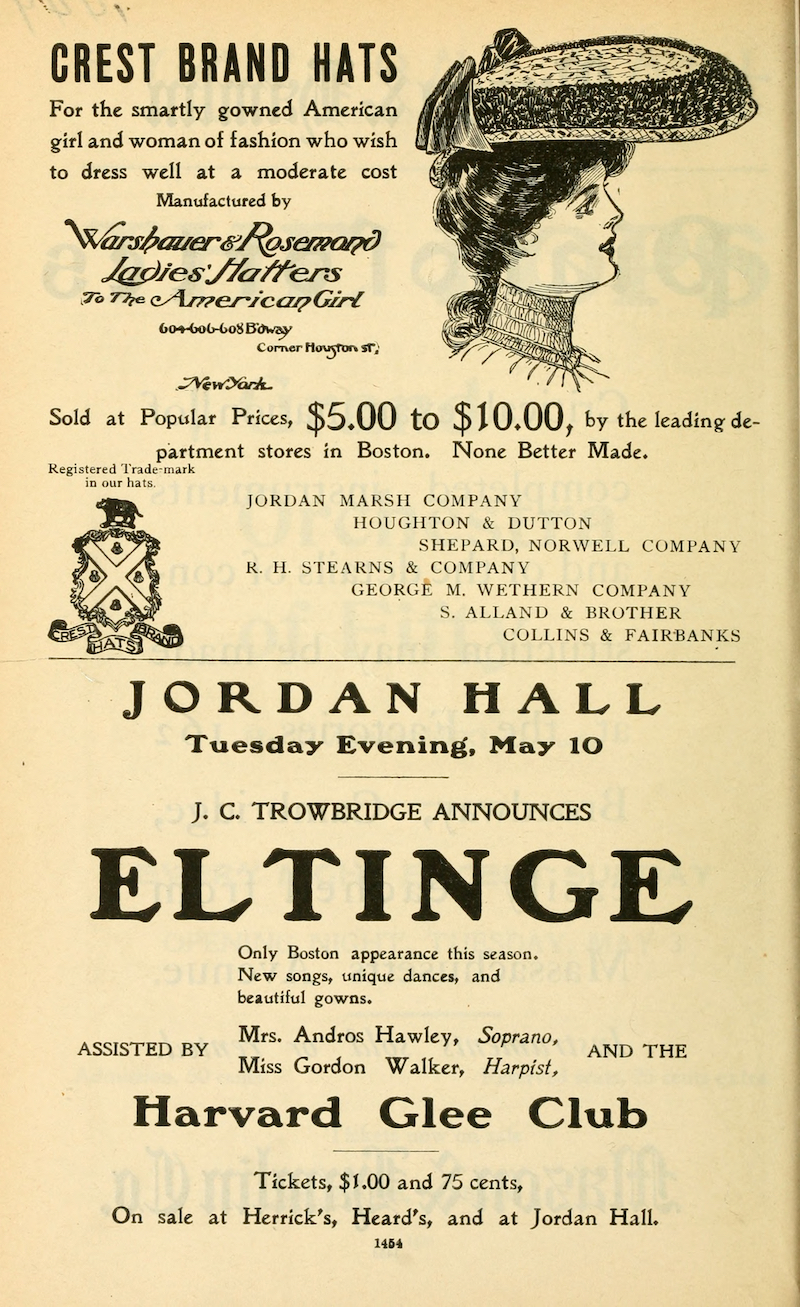
Reproduced from Boston Symphony Orchestra, Twenty-Third Season, 1903–1904, Programme, p. 1454.
Miss Edith Gordon Walker, a Louisville girl and a graduate of Wesleyan [sic] College, who for two years has been one of Boston’s musical favorites, is to sail for London this week, where she hopes to repeat her successes and dance and sing her way to the higher circles of the social set in London, Paris and Berlin. This remarkable girl is a descendant of one of Virginia’s oldest families and counts relationship with five Presidents of the United States — Washington, Adams, Taylor and the two Harrisons. She is the daughter of a former Louisville man who failed in business and went West to recover health. Dancing is not her only attainment, her “studies in child life” showing her talents as a delineator of child parts, and as a monologist she has made a pronounced hit. She is a harpist of great ability (“She Is Related to Five Presidents,” The Courier-Journal, Tuesday Morning, May 31, 1904, p. 2; reprinted in The Daily Ledger [Tacoma, Wash.], Sunday, June 19, 1904, p. 12).Walker is listed among the 74 saloon-class passengers aboard the Leyland liner SS Devonian which departed Boston at 3:30 p.m., Wednesday, June 8, 1904, bound for Liverpool. Also listed among the saloon passengers was Walker’s dance teacher, Mrs. Lilla V. Wyman. Before sailing, however, Walker, in the company of composer/soprano Annie Andros Hawley and the Harvard Glee Club, assisted fellow Fairylander and student of Lilla V. Wyman, the well-known female impersonator J. D. Eltinge, in his or her first professional performance. The concert took place at Jordan Hall, Boston, on Tuesday, May 10, and was reviewed as follows:
It was a decidedly fashionable audience that greeted Julian D. Eltinge in Jordan hall last evening. Mr Eltinge was presented under the management of J. C. Trowbridge and was assisted by Mrs Andros Hawley soprano, Miss Gordon Walker reader and harpist, and the Harvard glee club.The program was well arranged. “Johnny Harvard” and the “Champagne Song” were given by the Harvard glee club as the opening numbers. Next Mrs Hawley sang the pretty waltz song, “Delight.” Mrs Hawley’s voice is of good quality, and she sings with rare understanding.
Mr Eltinge’s first selections were given in evening dress (male). This was something of an innovation, for hitherto this young man has never smiled across the footlights except in the garb of womankind. He sang two of Mrs Hawley’s compositions, “Day Dreams” and “African Romance.”
Miss Walker’s first reading was a monologue, descriptive of the various things that happen to a pretty woman just “Before the Ball.” Mrs Hawley sang “The Rosy Morn” and “Spring.”
Mr Eltinge next gave imitations, first “The Cup of Tea” and second, “Some People You know.” Both were cleverly given bits. Miss Walker’s harp solo met with deserved applause, and the Harvard glee club’s “Bavarian Yodel” and “Rhine Wine” made hits. The last number on the program was contributed by Mr Eltinge, two dances, “Pas Seule” and a “Spanish Dance.” Both were done with the artistic grace for which the young man is famed (“To Fashionable Audience; Julian D. Eltinge Makes His Bow In Jordan Hall,” The Boston Globe, Wednesday, May 11, 1904, p. 3).
A gayly caparisoned crowd went to Jordan Hall yesterday evening to see and hear Mr. Julian Dalton Eltinge, an artist not easy to classify. In the course of the evening he sang such songs as “Day Dreams” and “African Romance,” by Mrs. Andros Hawley; he danced agilely in female costumes of great splendor; he gave really clever imitations of Fay Templeton, Minnie Ashley and some others. As singer, dancer, and impersonator, Mr. Eltinge always delighted his audience. To provide the concert-giver with sufficient time for his changes of raiment, Mrs. Andros Hawley, soprano; Miss Gordon Walker, reader and harpist, and the Harvard Glee Club, lent their assistance. The accompanists were Messrs. Moritz Hauptmann Emery and Frank H. Grey. Mrs. Hawley sang a brilliant waltz by Luckstone, Henschel’s “Spring” and a ditty by Landon Roland. Miss Walker displayed much versatility, for she had dancing to do in her monologue by Abbie Farwell Brown, and her harp solo must not be forgotten. The occasion was unquestionably a success (“Music and Drama; Notes and Comment,” Boston Evening Transcript, Wednesday, May 11, 1904, p. 17)
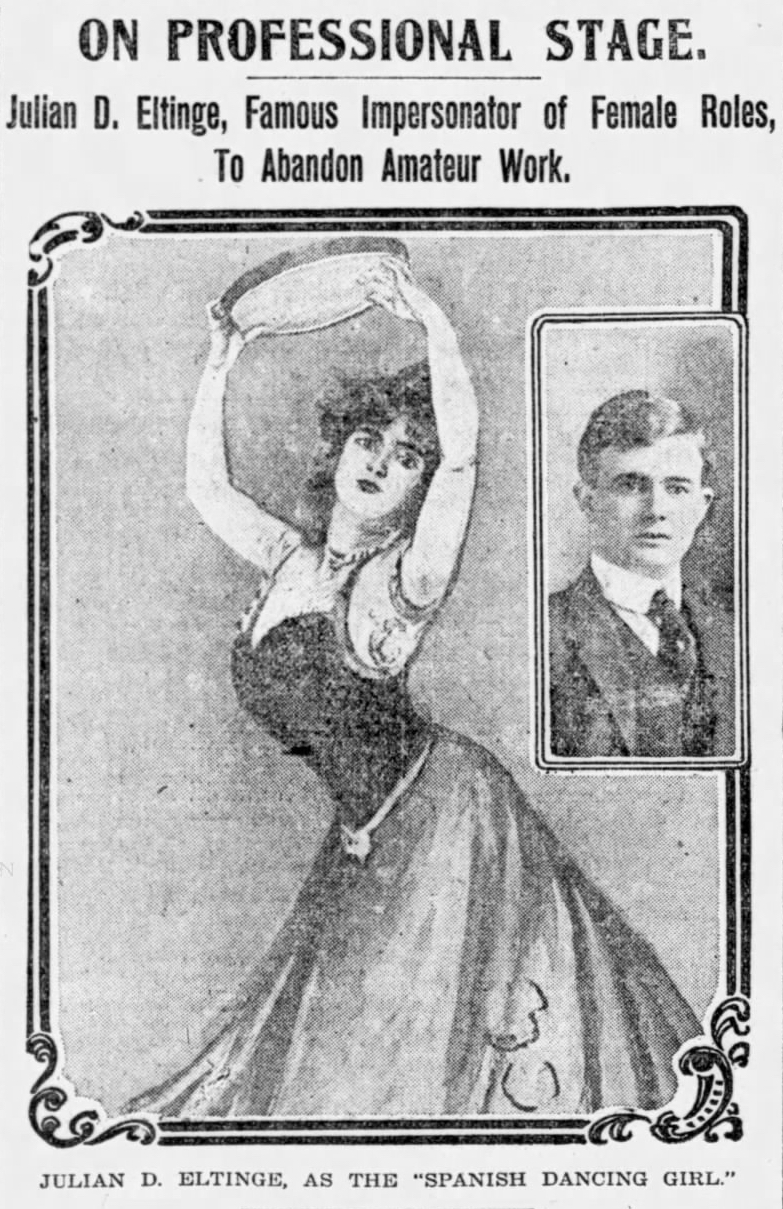
Reproduced from The Boston Sunday Globe, May 8, 1904, p. 7.
Jordan hall was filled with an enthusiastic audience Tuesday evening when Mr Julian Dalton Eltinge made his only appearance in Boston this season in his inimitable songs and dances. He was assisted by Mrs Hawley, who sang several songs; Miss Gordon Walker, who gave a clever monologue and played a solo on the harp, and the Harvard glee club. Mr Eltinge’s imitations of “Some People You Know,” were very clever, and his dancing fairly brought down the house. His first costume was of white muslin, ankle length, and in his last dance, which closed the evening, he wore a short dress of black lace, ruffled. Mr Eltinge is soon going abroad to cultivate his voice (“Table Gossip,” The Boston Sunday Globe, May 15, 1904, p. 46).In the month she sailed to Liverpool, Photo Era published a portrait of Walker by Garo (left). Is this the “the charming picture […] of Miss Gordon Walker, of Arlington,” which was displayed in a shop window in Quincy, Mass., and which “attract[ed] considerable attention” back in April? Probably not. That, most likely, was a picture of her posing with a harp, similar to that published in the San Francisco Examiner in 1902 and reproduced above.
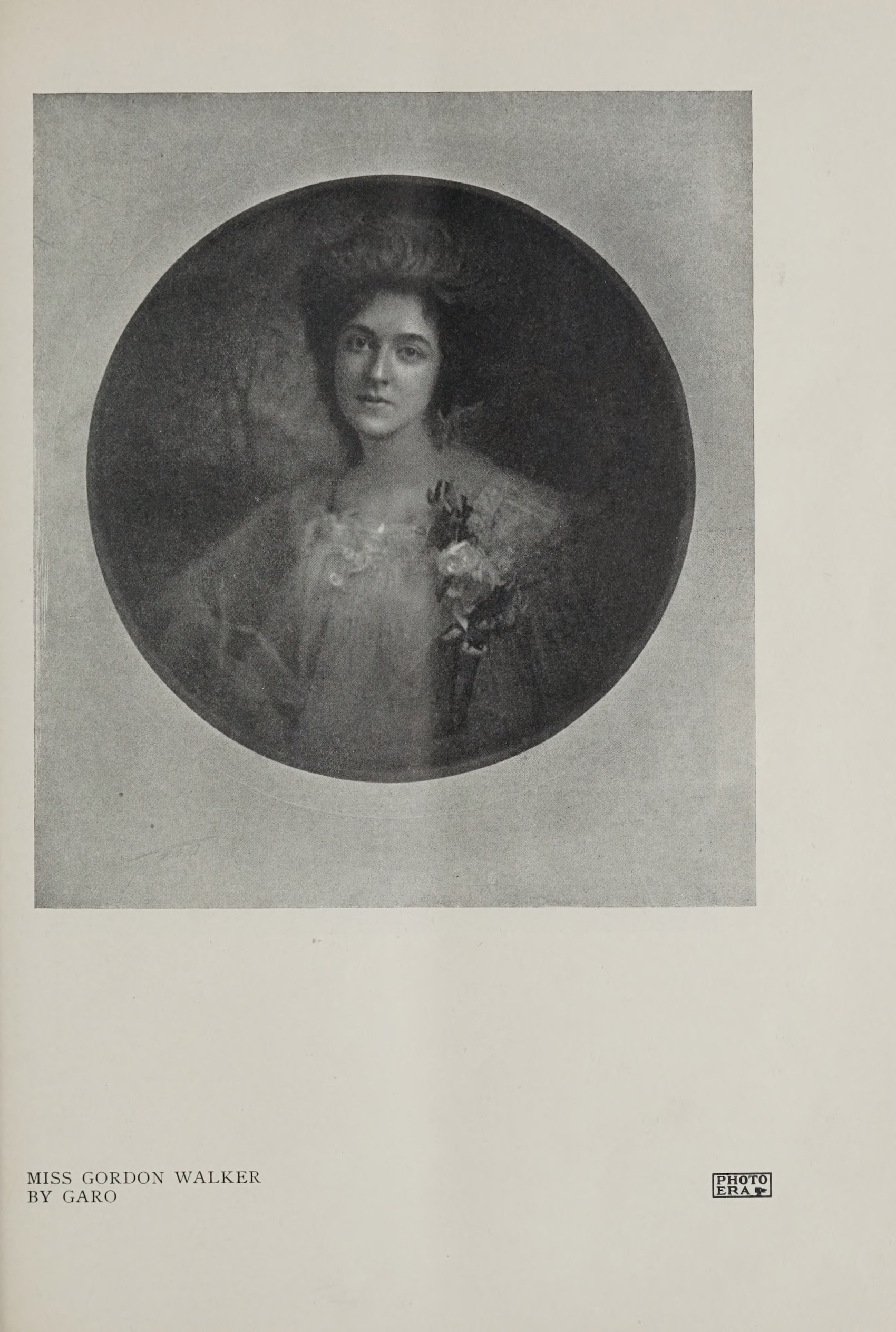
Reproduced from Photo Era, the American journal of photography, vol. 12, no. 6, June 1904, p. 97.
Ralph Cain received a letter from his sister, Miss Eva Cain, yesterday, who is visiting in London, in which she says that she had the pleasure of meeting Miss Gordon Walker there. Miss Gordon Walker will be remembered as having visited at the home of T. M. Walker, of Atchison, and has many friends here. Miss Cain will land in Philadelphia the 18th of this month (“City News,” The Atchison Daily Globe, Wednesday, September 7, 1904, p. 3).It’s possible that Walker returned to the US in December, since a weekly published in Newton, Mass., announced that Miss Gordon Walker was to give “a musical morning” at the meeting of the Newton Centre Woman’s Club in Bray Hall on Thursday, December 22. Furthermore, the Springfield Sunday Republican announced on January 1, 1905, that “Miss Gordon Walker, reader and dancer, has been engaged for the occasion” of the annual “gentlemen’s night” of the Woman’s Club of Athol, Mass., to be held February 14. However, according to an item in the Quincy Daily Ledger for January 21, 1905,
Miss Gordon Walker, who gave such a delightful recital at First church chapel last spring and who went abroad for the summer to study and for pleasure, is still in London and having no end of social successes.And on Tuesday, March 7, it appears that Walker performed as “harpist and reciter” at the Fourth Annual Humber Pilotage Concert held at the Assembly Rooms in Hull “in aid of funds of the two orphan homes.” Some two months later, starting, it seems, on Monday, May 22, she began to be listed among the talents represented by Ashton’s Royal Agency and advertised on the front pages of such London newspapers as the Daily Telegraph and the Morning Post:
ASHTON’S.If the name Ashton sounds familiar, it is because the sixth chapter from the second flight of Caine’s The Pursuit of the President is entitled “Extract from a letter from Mr. Claude Ashton,” as mentioned in my discussion of the similarity in structure between that book and Quain’s April March in § 4. Whether Caine’s Ashton — a clerk of the Admiralty writing to a “Mr. Fortiscue Loder, Bar-tender at Putnam’s Saloon, Red Dog City, Smith County, Wyoming” (p. 107) — is a parody of the managing director of Ashton’s Royal Agency, George Ashton — who stated in conversation with a correspondent for The Musical Courier in 1903, “It is, of course, always my endeavor to introduce some novelty every season” and “I make a point of acting only for performers whose powers are absolutely beyond question” — is anybody’s guess. However, given that one of Ashton’s artists was the Scottish comedian Harry Lauder, one begins to wonder… But back to Miss Gordon Walker.
Miss GORDON WALKER,
Harpist.
Also Recitations and Short Amusing Stories.
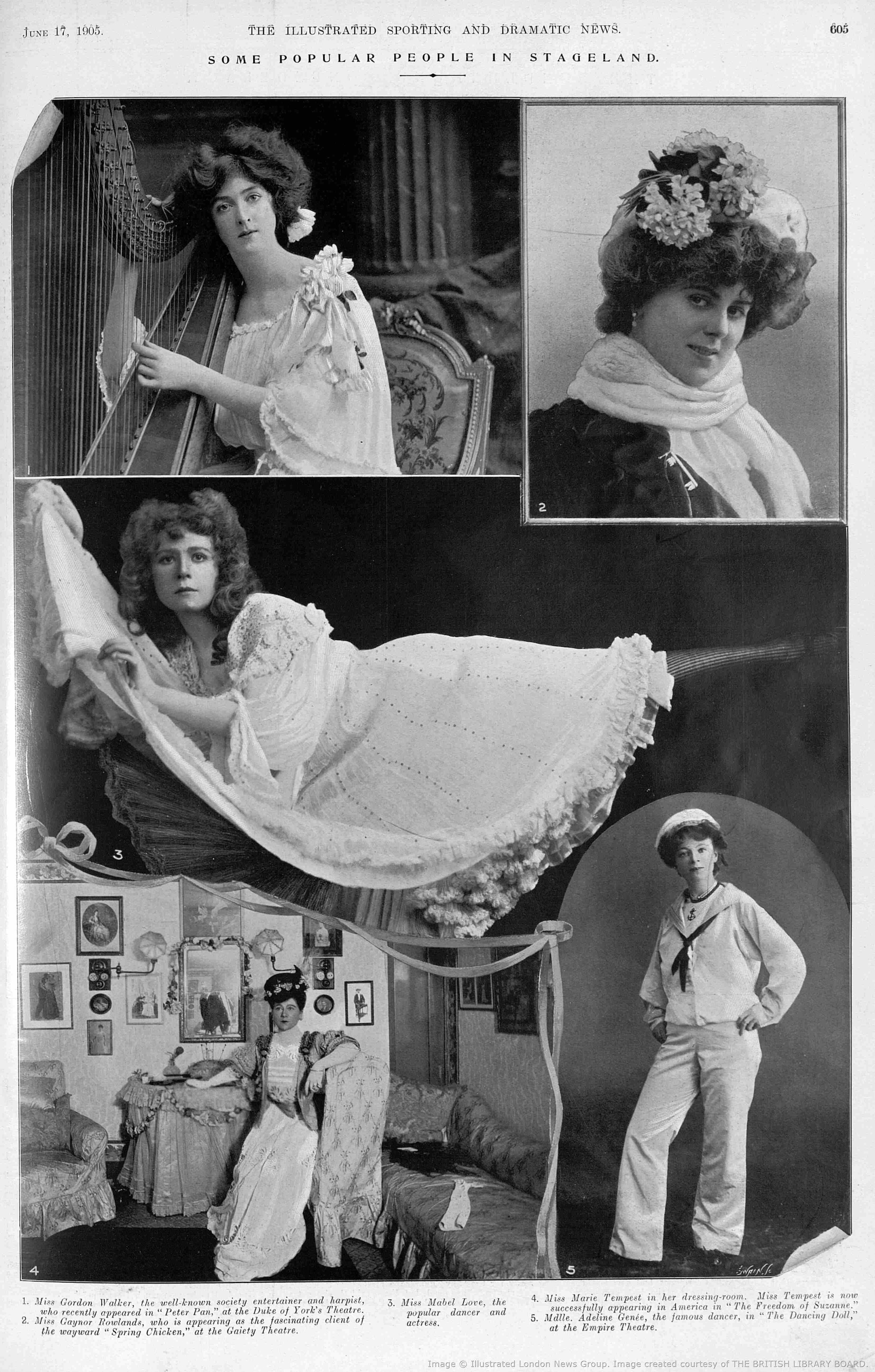
“Some Popular People in Stageland,” The Illustrated Sporting and Dramatic News (London), June 17, 1905, p. 605. Photograph of Miss Gordon Walker by Bassano.
The dramatic entertainments at the Kursaal are especially interesting items in the holiday programme. At great expense the Ella Snyder Company, consisting of Miss Ella Snyder, of the Apollo and Shaftesbury Theatres, Mr. Harry Lambart, and eight charming American ladies, have been engaged, and they will produce, for the first time in England, a new musical comedietta entitled “Pretty Kitty.” Performances will be given every evening next week, with matinées on Monday and Saturday. Many pretty American songs and dances are introduced in this play, and it is so pleasing in every detail that the Palace Theatre, London, has engaged the company for eight weeks from June 26.Every performance of “Pretty Kitty” will be preceded by “The Last Witness,” which will also be performed in England for the first time. This is a tragic little episode in one act by Mr. Edward Ferris. The action of the play is laid in the Central Criminal Court, London, which is accurately represented by the scenery. The plot is somewhat of the Hyde-Jekyll order. A barrister-at-law becomes a burglar during his spare time, and for one of his crimes an innocent person is arrested. By the irony of fate he is retained to defend the accused. During the trial seven witnesses are called, all of whom are impersonated by Miss Adie Boyne. This is one of the features of the play. In the last scene the barrister-burglar takes poison out of his handkerchief in the same manner that Whittaker Wright was supposed to have done.
The musical comedy and tragedy will not, however, conclude the evening’s entertainment. Miss Gordon Walker, the well-known American Society Entertainer, will also contribute to the programme. Her humorous stories, recitations, and harp solos are famous, and with such a strong triple bill the Kursaal should be crowded every evening (“Whitsuntide Attractions at the Kursaal; Special Dramatic Entertainments,” The Bexhill Chronicle, Saturday, June 10, 1905, p. 3).
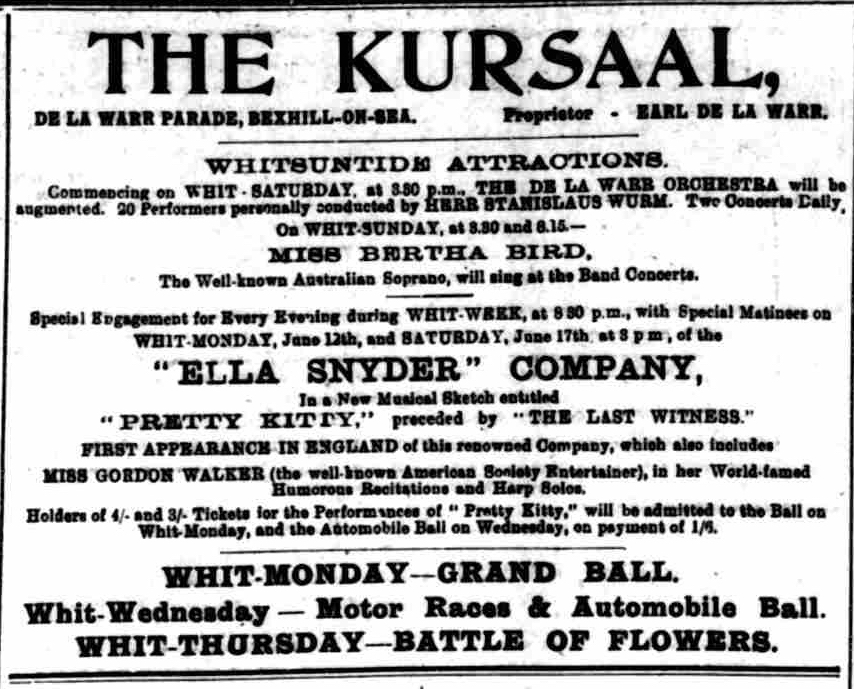
“Miss Gordon Walker (the well-known American Society Entertainer), in her World-famed Humorous Recitations and Harp Solos.” The Bexhill Chronicle, Saturday, June 10, 1905, p. 5.
The dramatic entertainments which are being given at the Kursaal every evening this week are certainly of a novel character, for though theatrical performances such as tragedy and musical comedy are given, the programme possesses something of the variety of the music hall. That the innovation is appreciated by the public is shown by the crowded houses that have been experienced during the week. Indeed, it would have been strange if people had not flocked to the Kursaal in their hundreds, for the entertainment is not only excellent in itself, but it possesses special interest by reason of the fact that this is absolutely the first time that the musical comedietta, “Pretty Kitty,” and the tragic episode, “The Last Witness,” have been produced in this country. Then again, Miss Ella Snyder’s Company is composed of actors and actresses of the highest ability, so that altogether the dramatic productions at the Kursaal this week are of quite an exceptional character, and if there are any local playgoers who have not already witnessed the performance they should not fail to be present at the concluding entertainments this afternoon or this evening.Snyder and company’s spectacle was popular enough to enable them to perform a second week at the Kursaal, June 19–24. During her stay in Bexhill, Walker stayed at the same hotel as Miss Snyder, the same hotel, in fact, where she had stayed the previous September: the Metropole. On the final day of the company’s seaside production, The Bexhill Chronicle noted:“Pretty Kitty” is a delightful little musical comedy, full of pleasing songs and choruses. An important feature is the wonderfully pretty dresses worn by the ladies. Although the play is only a short one, there are no less than four changes of costume, and the beautiful dresses, and their fair wearers, combined with the picturesque scenery, produce a striking spectacular effect. There is not much dialogue in “Pretty Kitty,” and what there is is written merely to lead up to the musical numbers, which are the substance of the piece. It opens with a novel little incident which, however, has to omitted at the Kursaal owing to the insurmountable difficulty presented by the design of the building. In a theatre containing boxes, however, one of the boxes would be occupied by a lady and gentleman. Just as the orchestra starts, an attendant enters the box and requests the lady to remove her hat. At first she refuses, but afterwards consents to do so, but as she takes it off it falls into the auditorium, on to the head of an old gentleman sitting in the stalls. He picks it up, and recognises it as one belonging to his wife from whom he has been divorced. He utters an exclamation, the lady in the box recognises him, screams, faints, and is carried out. In this quaint fashion is the play introduced. The lady in the box is “Pretty Kitty,” and the gentleman with her, “Jack.” But the incident which is acted in the auditorium seems to have no connection with the play, which does not possess the vestige of a plot. Miss Ella Snyder makes a charming “Pretty Kitty.” Musical comedy is her forte, and she appeared in “The Belle of New York” at the Shaftesbury Theatre, while she will also be familiar to patrons of the Apollo and Gaiety Theatres. Her song “Kitty,” in which she is assisted by a chorus of eight pretty girls in Spanish costumes, “brings down the house.” She also scores a success in an American number, “When the rent comes round,” while in “Nancy Clancy,” which is the song of the day on the other side of the Atlantic, she is particularly good. In this song the whole company appear in coster costume, Miss Snyder being dressed to represent a street urchin, and there is a lot of what is technically known as “business.” Miss Dorothy Drew, who appears as “Nancy Clancy,” is an accomplished dancer, and her clever and graceful dances are a special feature of the performance. Mr. Harry Lambart, as “Jack,” takes the leading male part, and his song, “Since I first met you,” in which the chorus ladies wear beautiful evening gowns, is one of the most entertaining numbers in the play. In addition to those mentioned, the following ladies and gentlemen take part in “Pretty Kitty”: — The Misses Gordon, Kay, Campbell, Karri, Arnold, Allan, Davison, and Drew, Messrs. Arundel, Delahauty, MacGrath, and Dampier. The costumes were specially designed for this play, and are the work of Messrs. Hugo Baruch and Co., Berlin, Messrs. Morris Angel and Co., and Miss Gloag, while the millinery is by Madame Freda, New Bond Street, and the wigs by Clarkson.
The performance of “Pretty Kitty” is preceded by a tragic episode in one act, entitled, “The Last Witness,” by Mr. Edward Ferris. The plot is somewhat of the Hyde-Jekyll order. A barrister-at-law becomes a burglar during his spare time, and for one of his crimes an innocent person is arrested. By the irony of fate he is detained to defend the accused, and fails to secure his acquittal. Eventually the barrister-burglar admits his guilt, and takes poison out of his handkerchief in the same manner that Whittaker Wright was supposed to have done. The action of the play is laid at the Central Criminal Court, and Mr. Guy Stephenson, the well-known barrister, supervised the details of the scenery used.
Mr. Edward Ferris, who is well-known in the theatrical world as Mr. Lewis Waller’s leading man, appears as Philip Marsden, the defending counsel, a part which affords him ample opportunities to display his powers as a tragedian. Mr. Harry Lambart represents Mr. Somerville, K.C., the prosecuting counsel, with great ability. The great feature of the production, however, is Miss Adie Boyne’s impersonation of seven witnesses. These are called in quick succession, and so diverse are the characters, and so admirably does Miss Boyne act them, that no one would imagine, if it were not announced on the programme, that they are all the work of one individual. The other parts were allotted as follows: — Judge, Mr. H. A. Tonge; Usher, Mr. C. Dampier; Foreman of the Jury, Mr. R. McGrath; Richard Bradley, the prisoner, Mr. Delahauty.
The evening’s entertainment is also contributed to by Miss Gordon Walker, the well-known American society entertainer. She is an exceedingly clever harpist, knows how to tell a humorous story in the right way, and her recitations are splendid (“Whit-Week in Bexhill; ‘Pretty Kitty at the Kursaal,” The Bexhill Chronicle, Saturday, June 17, 1905, p. 2).
Miss Gordon Walker, who is now appearing at the Kursaal, recently played in “Piper Pan” [sic] at the Duke of York’s Theatre, London. A photograph of this popular entertainer, with her harp, appears in the current number of “The Illustrated Sporting and Dramatic News” (“Pithy Points,” The Bexhill Chronicle, Saturday June 24, 1905, p. 6).It seems that Walker did not travel to London with the Ella Snyder Company and continue to perform her “World-famed Humorous Recitations and Harp Solos” with them during their sojourn at the Palace Theatre. Instead — But before I get to that, here’s a little divagation.
Caine’s Old Enough to Know Better (1911) contains “a passionate outburst addressed to an imaginary object” which the protagonist, Ridley Carpenter, had “wrought in scorn of all versifiers and sent in the same spirit to the editor of an evening newspaper” (p. 20). Said editor published Carpenter’s piece and “five shillings of minted silver had proved the reward of his attempt to heap ridicule upon the poetry of that journal. He had been taken, as they say, seriously — to the extent of five valuable shillings” (ibid.). Carpenter subsequently gave the original (or copy he had written in ink and signed) of this “passionate outburst” — “ornamented at [its] foot with an ingenious little design representing a heart pierced by an arrow” (p. 121) — to Emily Snyder, a young woman on the verge of turning 21 he had distractedly kissed a few times on Hampstead Heath. Miss Snyder, intending to extract a few hundred pounds from Carpenter (whom she knows to have inherited some money) for breach of promise, shows his “execrable stanzas,” entitled “March — At Bexhill,” to the man she truly intends to marry, Harry Hamley, a solicitor (ibid.):
Purple-white, passionate main,
Desolate, aching sky,
Sundered apart for ever,
Why must it be, oh why?
Mocking, illusive line
Where you seem to meet and kiss,
Ever together, ever apart.
What is the cause of this?
Oh, Circle, intangible, false
That binds but to sunder more
Like the wedding ring on a maiden’s hand
That dead from the church they bore.
Impotent lovers twain
Tug at your fetters still;
Know that I am above you both,
A man who can say “I will.”
A puny, paltry man,
The Sport of the raging wave,
Aching sea and desolate sky
He laughs to hear you rave.
For the girl that I love is mine,
And the ring that shall bind I hold,
Yours of impalpable atmosphere
But mine of caratted gold.
Then laugh with me now, my girl;
Leave them to sigh in vain,
Lovers forever, forever apart,
Desolate sky and main.
But Thou shalt be mine, my love,
And I shall be thine, my life;
Wedded forever as they are forlorn,
Marvellous Man and Wife.
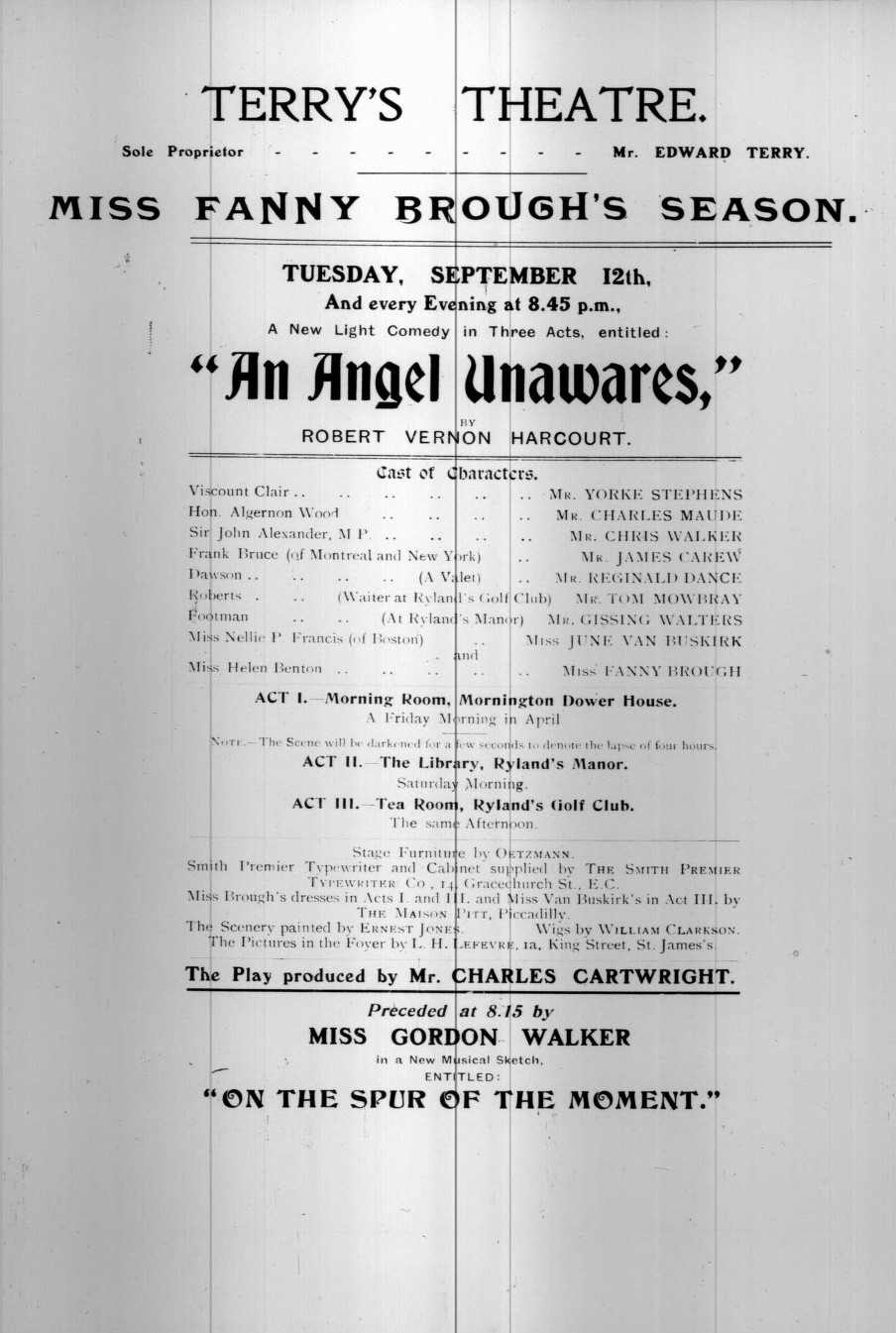
Playbill for An Angel Unawares. Reproduced from Waters (n.d.: II, 221).
Miss Fanny Brough has decided to bring the run of Mr. Robert Vernon Harcourt’s comedy, “An Angel Unawares,” at Terry’s to an end on Saturday next, thus furnishing Mr. Weedon Grossmith, whose tenancy of the Comedy terminates on the same day, with a home to which to transfer his play, “The Duffer.” Mr. Harcourt is at work on a new play, which he hopes will be ready for presentation in London some time during next year (The Morning Post, Tuesday, September 19, 1905, p. 5).Before opening at Terry’s, An Angel Unawares had had a successful run in the provinces from July 31 to August 26:
After having been closed for several months, Terry’s Theatre is about to be re-opened. It has been taken by Mr. Charles Frohman, to produce Mr. Robert Vernon Harcourt’s comedy, “An Angel Unawares,” the provincial success of which has justified immediate arrangements for bringing it to London. The date selected is Sept. 12, and it is hardly necessary to add that Miss Fanny Brough will appear in it, since, as was stated in The Sketch on the eve of its production, it was written for the express purpose of providing her with a fine part for the exploitation of her great gifts (“Heard in the Green-Room,” The Sketch, August 23, 1905, p. 219).The angel of the title, however, was not represented by the character of Miss Helen Benton played by Brough. Instead, the angel was Miss Nellie P. Francis (of Boston), as she is dubbed in the playbill:
The unconventional American, Nellie P. Francis, is the Angel, and her vivacious conduct is the point round which the action centres. Her reception by the other characters is at first hardly of a cordial nature, but the principal character, Miss Helen Benton, suddenly conceives an admiration for her, and is converted to the views of the quick witted Bostonian. The Angel’s desire is that people should employ their lives in the most profitable manner, and with the object of furthering this aim she masquerades as cook to two bachelors, Viscount Clair and the Hon. Algernon Wood. The languid Viscount is under the impression that she wishes to marry him. But he is quite mistaken, and the attractive American ultimately effects the union with the kind-hearted Miss Helen Benton (“Public Amusements; Shakespeare Theatre,” The Birkenhead News, Wednesday, August 16, 1905, p. 2).
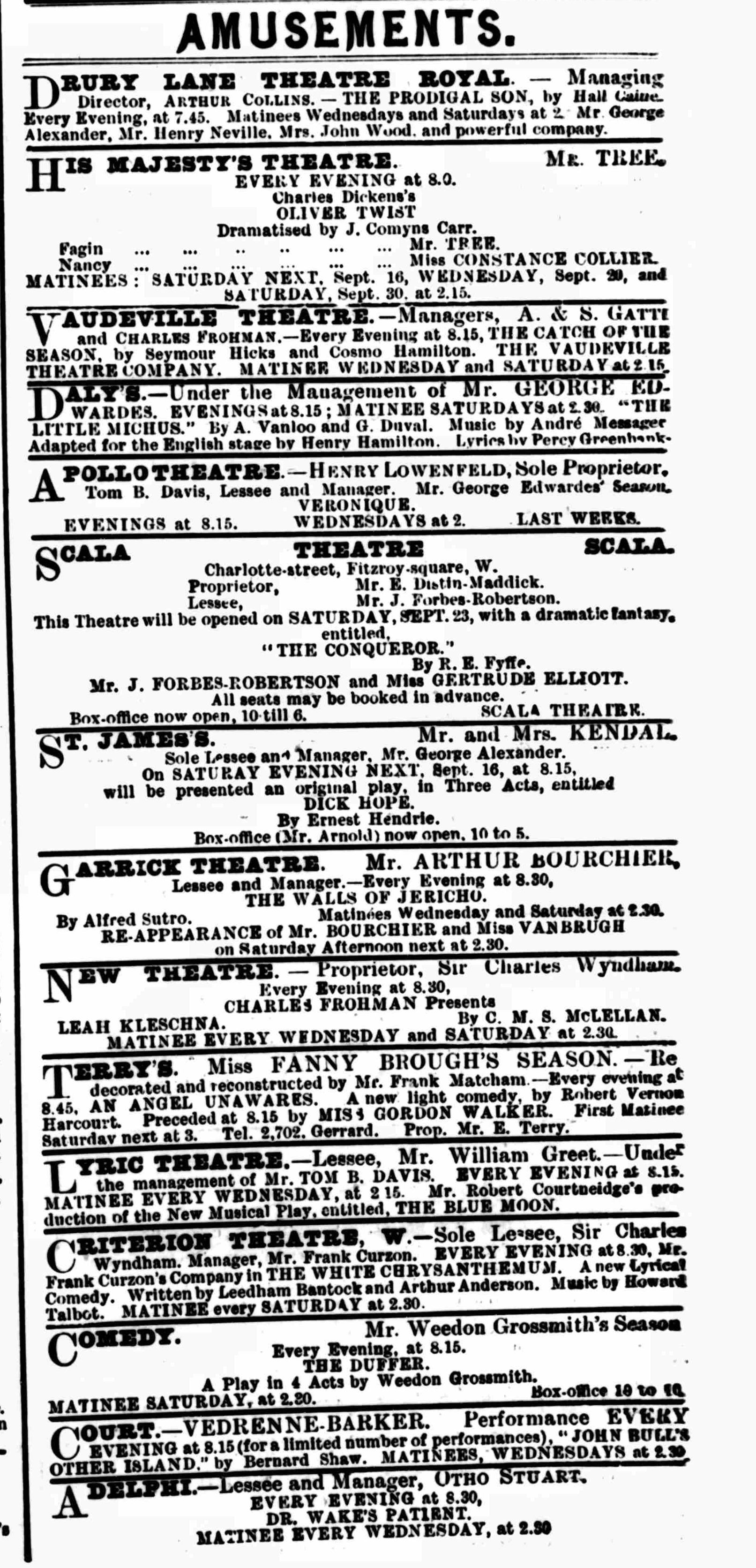
Reproduced from Truth, September 14, 1905, p. 661.
The title, with its Biblical suggestion, characterises the reception of a Transatlantic angel, who visits these shores, and is entertained by English people, reluctantly as well as unawares. Miss Nellie P. Francis, the youthful angel in question, comes to this country with a half-crowned mission, not easily defined, and emphatically self-imposed. So far as we can understand a piece that is incoherent rather than nebulous, Miss Francis has met in Boston Viscount Clair, an English nobleman, rich, unmarried, indolent, and convinced that every woman he meets is aiming at his capture. To disabuse him of a belief unflattering to her country and her sex, she follows him to England, resolved to make a fool of him, and obtains admission into the house of Lady Mornington, in which he is staying, by means that can only, by the employment of a euphemism, be characterised as fraudulent. After offering to sit as a model to the Hon. Algernon Wood, the son of her unconscious hostess, and an amateur painter, she is at length accepted as a cook on the strength of a character written in presence of the audience by herself. She fails signally in making a fool of her Lordship, even though nature had mercifully gone half-way in meeting her wishes [further plot summary follows]. An end of a sort is at length reached, and the audience, before which Mr. Harcourt declined to appear, though challenged so to do, received the whole with much laughter, some applause, and extreme bewilderment. A stranger piece has seldom been seen. It is decidedly clever, has some excellent dialogue, and is very juvenile. If the object had been to perplex an audience the success would have been overwhelming. The heresy that an audience likes to be mystified is one of the most dangerous on which an author can act, and if Mr. Harcourt can find no other way of telling the world what he is after he had better inform it on his playbill. We have no wish to discourage a writer from whom we may have much to expect, but we should prefer to have a glimmer of comprehension of what is signified by the incidents we contemplate and the good things to which we listen (“Terry’s Theatre; ‘An Angel Unawares,’” The Globe, Wednesday, September 13, 1905, 4).The actress who played the angel in An Angel Unawares in both the provincial and London runs was June Van Buskirk, an American from Pleasant View, West Virginia, who graduated from the American Academy of Dramatic Arts in March 1899. After graduating, Van Buskirk “was most inconspicuous in American stage doings, but from 1904 until 1908 she found ready employment in the best London theatres, chiefly with Arthur Bourchier and Cyril Maude. Then came her marriage with Percival J. Mitchell, a wealthy business man, and now the stage knows her not.” Throughout the course of her “stage doings,” both British and American, Van Buskirk had a stormy relationship involving contested divorce proceedings and a child custody battle with fellow AADA student Francis Sedgwick Wilson whom she had married in 1898 when she was 17 and he was 21 and with whom she had had a son in 1900. But I’m writing about Walker and Caine, not Van Buskirk and Wilson… It seems that Walker did not contribute her musical sketch to the initial provincial run of An Angel Unawares. For instance, there’s no mention of her in either the ads for or reviews of the play’s premiere week at the Theatre Royal, Bournemouth, Monday, July 31, to Saturday, August 5. Each performance of the play during its tenure at Prince’s Theatre, Manchester, from Monday, August 7, to Saturday, August 12, was preceded by Fergus Hume’s farce, A Scotch Marriage. And each performance during its tenures at the Shakespeare Theatre, Liverpool, August 14–19, and Prince of Wales Theatre, Birmingham, August 21–26, was followed by Bernard Shaw’s one-act, How He Lied to Her Husband. Of the reviews of the London production, only a few took note of Walker’s musical sketch:
The theatre, which has been most tastefully redecorated, contained a friendly audience, and the reception of the piece was favourable. Instead of a curtain-raiser Miss Gordon Walker, a lady with a harp, gave a musical sketch entitled “On the Spur of the Moment” (“Terry’s Theatre, ‘An Angel Unawares,’” The Morning Post, Wednesday, September 13, 1905, 4).Under rather depressing conditions, Miss Gordon Walker gave a bright entertainment entitled “On the Spur of the Moment.” Her harp playing was excellent, but her American stories were not too easily comprehended of the public. As a drawing-room entertainment the performance would probably be a great success (“Terry’s Theatre; ‘An Angel Unawares,’” The Globe, Wednesday, September 13, 1905, 4).
Early comers on Tuesday, when they had admired the alterations and the decorations completed during the recess, were asked to give attention to Miss Gordon Walker, who was announced to appear in a new musical sketch called “On the Spur of the Moment.” Miss Walker told some tall stories with a distinctly chestnutty flavour, and played on the harp. The harp business was pronounced good (“Dramatic Gossip; ‘An Angel Unawares,’” The Referee, September 17, 1905, p. 2).
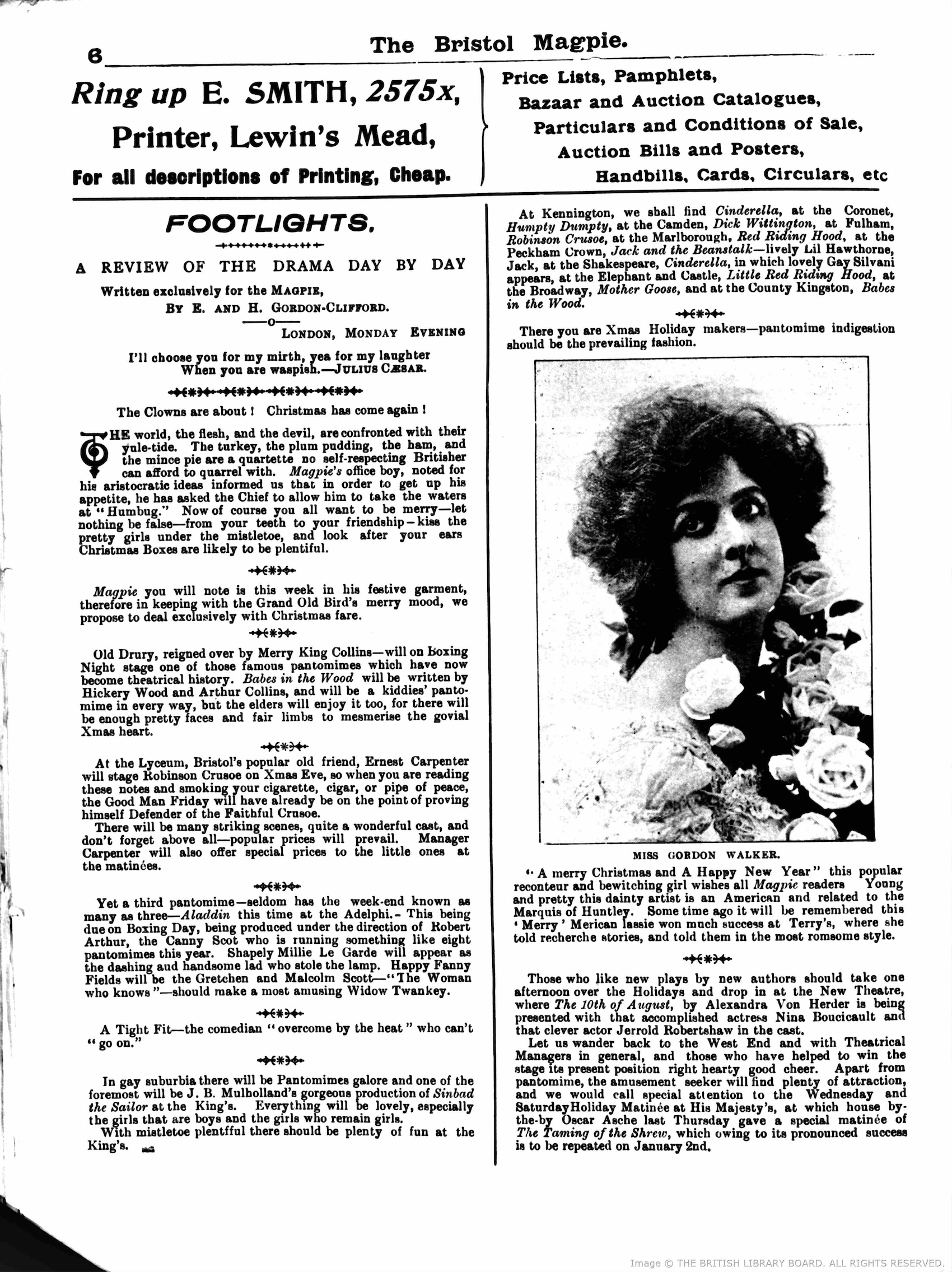
The Bristol Magpie of December 24, 1907, p. 6, was still calling Mrs. Edith Gordon Caine by her stage name, Miss Gordon Walker, even though she had been married since July 26 of that year.
Before this play, by the way, there is given as a curtain raiser a novelty in the shape of a monologue entertainment by a young American girl, Miss Gordon Walker, of Virginia [sic], who appeared during the season with considerable success in many London drawing rooms (“Week’s Chat of London; Many American Actors,” The Sun [Baltimore], Sunday, September 17, 1905, p. 5).It’s possible that, after An Angel Unawares closed on September 23, Walker continued performing “On the Spur of the Moment” or some other musical sketch in the drawing rooms of London, since, according to a small item in the Boston Evening Transcript:
Miss Gordon Walker will remain in England until after the New Year, so that she can present the new sketch which has been written for her in London, instead of returning to Boston to take part in the Actors’ Church Alliance Festival this month, as was announced (Boston Evening Transcript, Saturday, November 11, 1905, Part One, p. 11).The final trace of Walker’s stint at Terry’s Theatre which I’ve been able to find occurs in a season’s greeting published more than two years after the fact; after, indeed, she was no longer Miss Gordon Walker, but had become Mrs. William Caine:
I wonder if Gertrude Stein, too, either during that dinner at 27 rue de Fleurus, or earlier at John Lane’s in London, remembered having read, sometime during her years in Baltimore, Boston, New York, and San Francisco, c. 1900–1903, about the “recherche stories” told by the “tall, rosy-haired and very good-looking” “Wellesley girl” who had been called the “Most Beautiful Girl in Massachusetts” and who not only continued to play “the harp with which she always travelled,” but “whose classic dancing” was described as “threaten[ing] to eclipse that of Loie Fuller and Isadora Duncan” (for which, see § 7). Perhaps that is why the normal “house rules” — “The geniuses came and talked to Gertrude Stein and the wives sat with [Alice B. Toklas]” (Stein 1933a: 105; 1933b: 97) — seem not to have applied? That is, Edith Gordon Caine née Walker and her husband were both considered geniuses? Or neither was? Or —? In any case, either in London or Paris, one topic of conversation, perhaps, could have been the near coincidence of the last time either Walker or Stein had set foot in America — June 8, 1904, for Walker, and June 11 of the same year for Stein, just before she stepped aboard that “floating palace, equipped with all the conveniences of a first-class hotel,” the North German Lloyd steamship Princess Irene, and set sail from New York harbor at 1 pm, bound for Genoa via Gibraltar and Naples. Or perhaps they laughed about both having operatic namesakes. For the wife of the author of The Author of “Trixie”, the mezzo-soprano who became a soprano, Miss Edyth Walker (touched on in § 14); for the author of The Autobiography of Alice B. Toklas, Miss Gertrude May Stein, contralto. And perhaps, much later, Stein included a small obscure homage to the former president of the Wellesley Mandolin Club and her “well known humorous english writer” of a husband in a paragraph of “Arthur a Grammar:”miss gordon walker.
“A merry Christmas and A Happy New Year” this popular raconteur and bewitching girl wishes all Magpie readers. Young and pretty this dainty artist is an American and related to the Marquis of Huntley. Some time ago it will be remembered this ‘Merry’ Merican lassie won much success at Terry’s, where she told recherche stories, and told them in the most romsome [sic] style (The Bristol Magpie, December 24, 1907, p. 6).
Happy to hold a topic which is out lasting possibly making fortunately theirs as they do this with it as to call the nascent provender massed hem stitched in allusion portable in clad maintenance coming perfectible as a nucleus comes understated comfort to them surely for at all cut it out as a hummed aground into tune coupled coupling could fellow in distress ratiocination woods a benevolence for them as shore shore line argued in two reckoned and remainder put shut averaging actively ditto center let an alloy resist in chicken for the reign to-day they call however how are are there distaste depredation do blown very fairly dubiety constrained inkling regained as a cherishing primarily for theirs in case it is better to be best main a mandoline do help a joint lacking this is a did go for the opposition in a pride (Stein 1931: 52–53).
- Wellesley girl; many tall ones go to Wellesley. — Oddly, in the British version of the same passage, both instances of “Wellesley” are changed to “Vassar” (see Stein 1933b: 146–147).
- Became one of John Lane’s authors. — “Stein received another publicity boost in 1915 when John Lane published an edition of Three Lives in England” (Leick 2009: 65). E.g., the New York Tribune (“Current Talk About Books and Authors,” Saturday, February 13, 1915, p. 11) announced “Gertrude Stein’s Debut as a Novelist:” — “Gertrude Stein is about to make her début as a novelist with ‘Three Lives,’ which the John Lane Company will publish next week. ‘The form of this novel is quite new,’ the publisher informs us; it is also ‘an important work of art, a native and genuine expression of the author’s temperament, of her way of seeing the world.’ It is safe to predict at least a success of curiosity for Miss Stein’s ‘Three Lives.’” The Publishers’ Weekly, in its piece on the “Spring Lines of the Publishers and Some of the Men Who Will Show Them” (February 20, 1915, p. 554), noted, “New novelists on the John Lane Company’s list this year, Keble Howard and Gertrude Stein, have written respectively ‘The Silver Spoon,’ dealing with the vicissitudes of a young Oxford man in achieving literary success in London and ‘Three Lives,’ a striking achievement in the method of realism.” The following week, the same hebdomadary in its “Weekly Record of New Publications,” (February 27, 1915, p. 633), called Three Lives, “Three distinct stories of three humble creatures, each a servant and one colored; set down in a new form to show ‘those faint stirrings in the human brain called thought.’” The Philadelphia Evening Ledger (“Among the Books; The New Books,” Saturday, March 6, 1915, p. 6) described Three Lives as, “Tales by the futurist poet cast in a new form of realism.” The following month, the same daily (“Among the Books,” Saturday, April 10, 1915, p. 4) entitled its review of Stein’s book, “A Futurist Novel:” — “Style is a matter of little importance when a certain effect is sought. Gertrude Stein knows this well when she merely sketches her ‘Three Lives’ (John Lane, New York). There is a spirit in the method with which she tells us of the lives of three simple souls, and by this spirit, which comes from an instinctive feeling toward her subjects, Miss Stein accomplishes more than she could by any rhetorical or academic ‘style.’ […] We cannot read these lives without thinking and sensitive minds. We must study the lines, the colors, the direction and, above all else, the spirit of the author. The mind must be keen and alert. For the blur which this futurist in writing at first creates cannot be cleared until we are willing to bring the thought and intelligence to its interpretation which we needed when examining ‘The Nude Descending the Stairs.’ Let us welcome the new art, if it brings such wealth of simplicity and effectiveness as Miss Stein has shown in these sketches.” As for the original private publication of Three Lives: “Finally, Knoblauch found a vanity press willing to publish the book at Stein’s expense, the Grafton Press of New York. For $660, Stein arranged to have five hundred bound copies of Three Lives printed on 30 July 1909” (Leick 2009: 26).
- Alice Van Vechten Brown. — Siyu Chen, “Brown, Alice Van Vechten,” Dictionary of Art Historians (website [https://arthistorians.info/browna/]); Alice Van Vechten Brown & William Rankin, A Short History of Italian Painting (London & Toronto: J. M. Dent & Sons; New York: E. P. Dutton & Co., 1914).
- Became Mrs. Carl Van Vechten. — “Alumnae Notes,” Wellesley College News, October 2, 1907, p. 6. Note that this is the same source for the date of the Caine–Walker marriage and that, interestingly, Miss Snyder’s groom is mistakenly referred to as “Carl Hanvechten.”
- Article in the March 10, 1912, edition of The New York Times. — “News of Interest to Undergraduate and Alumnus; Wellesley Barn Swallows; An Amusing Mock Track Meet Given by the Students,” The New York Times, Sunday, March 10, 1912, part 7, p. 9.
- The Barn, described. — A brief history of the Barn and the Barn Swallow Society may also be found in The Wellesley College Legenda 1906, pp. 143–144, and Traditions of Wellesley, Chicago, September 1916, pp. 31–33.
- College Settlements Association. — See the relevant Wikipedia article for an overview.
- Above-cited notice in The Musical Courier. — The concert was also announced in the Boston Evening Transcript, Saturday, February 17, 1900, p. 20, where, under the rubric “School and College,” it is noted, “The mid-winter Glee Club concert, given annually by the Wellesley students, has been arranged to come off next Thursday evening. This is always the great social event of the winter term, and many guests are expected. Miss Nina F. Poor is leader of the glee club this year; Miss Florence L. Walker, president, and Signor Augusto Rotoli, musical director. The mandolin club, which will also take part in the concert, has as leader Miss Ella Mason, and as president, Miss Gordon Walker.”
- Subscription party held by Arlington’s younger set. — “Last of the Series,” The Boston Globe, Thursday, February 22, 1900, p. 9; see also “Table Gossip,” column 2, The Boston Sunday Globe, February 25, 1900, p. 38.
- Received their bachelor of arts degrees. — “Joy Unbounded!; Funds Enough to Clear Wellesley’s Debt; Doxology and Cheers Follow the News at Commencement; Silver Jubilee a Day of Great Rejoicing; Hon. E. S. Converse, Boston, Donor of $25,000; ‘College Beautiful’ Creates 133 Bachelors of Arts,” The Boston Globe, Wednesday, June 27, 1900, p. 14. See also, “Wellesley College; Perfect Conditions for Today’s Celebration; Impressive Ceremony of Class Graduation; Exercises in Houghton Memorial Chapel; Address Given by Professor Woolsey of Yale,” Boston Evening Transcript, Tuesday, June 26, 1900, p. 7. See also Wellesley College. Twenty-Second Annual Commencement. Tuesday, June 26, 1900 [https://repository.wellesley.edu/object/wellesley31419].
- Entertained with selections on the harp. — “They Can Make Dresses,” Boston Evening Transcript, Wednesday, May 29, 1901, p. 12; “Able to Earn a Living; Graduates in Dressmaking and Millinery Classes of W. E. and I. U.,” The Boston Globe, Wednesday, May 29, 1901, p. 3.
- “Ladies’ Night” entertainment. — “A Chelsea Club Entertained Ladies,” Boston Evening Transcript, Friday, March 21, 1902, p. 12; “Success, as Usual; Ladies’ Night of the Alter Ego Club of Chelsea,” The Boston Globe, Friday, March 21, 1902, p. 4.
- Also appearing. — “Dramatic Notes,” The Boston Sunday Post, June 1, 1902, p. 14. Miss Harriet A. Shaw is indicated as Walker’s teacher in “Note and Comment,” Boston Evening Transcript, Saturday, February 14, 1903, p. 27.
- Newspaper in Atchison, Kansas. — See also “Local and Otherwise,” The Hoxie Palladium (Hoxie, Kansas), Thursday, August 7, 1902, p. 1.
- “Most Beautiful Girl in Massachusetts”. — Also published in The Butte Weekly Miner (Butte, Mont.), July 24, 1902, p. 11.
- HM: 8; HJ: 8–9. — Page citations from Three’s a Crowd, published by Houghton Mifflin, are indicated by HM; those from The Wife Who Came Alive, published by Herbert Jenkins, by HJ.
- Concert organized by the Daughters of the American Revolution. — See also: “Table Gossip,” The Boston Sunday Globe, February 1, 1903, p. 42; “Table Gossip,” The Boston Sunday Globe, February 15, 1903, p. 43; “The Patriotic Orders; Memory of Historical Events Kept Green,” Boston Evening Transcript, Wednesday, February 18, 1903, p. 18; “Delightful Evening’s Entertainment,” Boston Evening Transcript, Friday, February 20, 1903, p. 10.
- Wellesley Town Hall on Tuesday, May 26. — Announced in: “Alumnae Notes,” College News, Wellesley, Mass., Wednesday, May 6, 1903, p. 7; “School and College; Wellesley College,” Boston Evening Transcript, Friday, May 8, 1903, p. 12; [Advertisement], College News, Wellesley, Mass., Wednesday, May 20, 1903, p. 8: “Miss Edith Gordon Walker ’00, will give an entertainment at the Wellesley Town Hall, on Tuesday evening, May 26. Miss Walker will render selections on the harp, give readings and illustrate certain poems with dancing.”
- Mrs Erving Winslow’s pupils. — Before becoming a drama teacher and playreader, Mrs. Erving Winslow had been the actress Miss Kate Reignolds (Henry Austin Clapp, “Reminiscences of a Dramatic Critic,” Atlantic Monthly, September 1901, p. 345). See also: “Table Gossip,” The Boston Sunday Globe, June 28, 1903, p. 38: — “Mr and Mrs Erving Winslow and Mr Charles Edward Amory are at Sharon. Mrs Winslow has her school of acting there, and her pupils, including Miss Florence Scare and Miss Gordon-Walker [sic], will give a performance in the town hall July 15 for the benefit of the Sharon improvement society.” And: “Music and Drama; Note and Comment,” Boston Evening Transcript, Thursday, July 9, 1903, p. 13: — “Mrs. Erving Winslow’s company of players — her pupils — are giving an entertainment July 15, for the benefit of the Sharon Improvement Society, in the town hall, to which residents and the summer visitors are looking forward as quite the event of the early season. The programme includes the brilliant little sketch from the French, “Oh, Monsieur!” the comedy, “Two Can Play at That Game,” and Mr. Howells’s “The Mousetrap.” Among the performers are Miss Gordon Walker, who is also to play upon the harp; Miss Mary Sears, Miss Ruey Gertrude Burnham, Miss Hariette J. Amsden, Mrs. Minnie Frances Bagley, Miss Beatrice Nichols, Mr. A. Archibald Willis and Mr. Charles Edward Amory Winslow. The guests of the Massapoag House are going over en bloc, and there will be a large delegation from Boston and vicinity.”
- That anniversary was celebrated at the Vendome. — “Women’s Clubs,” Boston Evening Transcript, Saturday, November 21, 1903, p. 24. See also: “Newspaper Women Celebrate,” Boston Evening Transcript, Thursday, November 19, 1903, p. 16; “Founders and Friends; At the 18th Anniversary Observance of the N. E. W. P. A.,” The Boston Globe, Thursday, November 19, 1903, p. 4.
- At the Vassar and Collegiate Alumnæ Exchange. — “In Social Circles,” Buffalo Sunday Morning News, February 21, 1904, p. 5. See also: “The Social Circle; At the Exchange,” Buffalo Evening News, Friday, February 19, 1904, p. 3; “College Exchange Meeting with Great Success,” The Buffalo Enquirer, Saturday, February 20, 1904, p. 7: — “Miss Walker has created a sensation wherever she has appeared and it is expected that the entertainment she will offer will be original and very pleasing.” — “College Exchange; Miss Gordon Walker, Dramatic Reader, Will Be One of Next Week’s Attractions,” Buffalo Evening News, Saturday, February 20, 1904, p. 3; “Miss Gordon Walker,” The Buffalo Enquirer, Monday, February 22, 1904, p. 7: — “Miss Gordon Walker of Boston, dramatic critic [sic], harp soloist and intellectual dancer, will be the attraction at the College Exchange […]” — “The Social Circle,” Buffalo Evening News, Monday, February 22, 1904, p. 3; “Special Program; Miss Gordon Walker Will Entertain the College Exchange Patrons Tomorrow,” Buffalo Evening Times, Monday, February 22, 1904, p. 3: — “Miss Gardon [sic] Walker of Boston, dramatic leader [sic], harp soloist and intellectual dancer, will be the attraction.” — “News of the Buffalo Schools; Graduate of Wellesley,” Buffalo Evening Times, Tuesday, February 23, 1904, p. 5.
- Her celebrated harp. — “The Social Circle; At the Exchange,” Buffalo Evening News, Tuesday, February 23, 1904, p. 3; “Society; Calendar for Today; At the College Exchange,” The Buffalo Enquirer, Tuesday, February 23, 1904, p. 7.
- One hour before she was scheduled to perform. — “The Social Circle; At the College Exchange,” Buffalo Evening News, Wednesday, February 24, 1904, p. 3.
- Social columns of the Quincy Daily Ledger. — Notices for March 5 and 29, 1904, may be found in [https://archive.org/details/Daily_Ledger_1904-03-Mar/page/n19/mode/2up] and [https://archive.org/details/Daily_Ledger_1904-03-Mar/page/n115/mode/2up]; for April 2, [https://archive.org/details/Daily_Ledger_1904-04-Apr/page/n7/mode/2up].
- Front page of the following day’s Quincy Daily Ledger. — “Matinee Recital; Miss Gordon Walker, the Harpist, Entertains,” Quincy Daily Ledger, Friday, April 15, p. 1 [https://archive.org/details/Daily_Ledger_1904-04-Apr/page/n55/mode/2up]. This review is reproduced, under the title “Miss Walker’s Recital,” in The Quincy Patriot, Saturday, April 16, 1904, p. 3 [https://archive.org/details/Quincy_Patriot_1904-2-Apr-June/page/n9/mode/2up].
- The following notice. — “The Social Realm,” Quincy Daily Ledger, Saturday, April 16, 1904, p. 1 [https://archive.org/details/Daily_Ledger_1904-04-Apr/page/n59/mode/2up].
- The same column. — “Social Realm,” Quincy Daily Ledger, Saturday, May 28, 1904, p. 8 [https://archive.org/details/Daily_Ledger_1904-05-May/page/n111/mode/2up].
- Aboard the Leyland liner SS Devonian. — “Water Front Items,” The Boston Globe, Thursday, June 9, 1904, p. 11.
- Mrs. Lilla V. Wyman. — Wyman has also already been encountered in the Boston Evening Transcript’s announcement of the marriage of Walker and Caine which I’ve reproduced in § 3. It appears that Wyman traveled regularly to Britain and Europe. For instance, she visited the newly weds in London on her way back to Boston from Europe in autumn 1907: “Mrs Lilla Viles Wyman, who has spent the summer abroad, having visited Seville, Madrid, Paris and London, has returned to her apartments in Boylston Chambers. While in London she had luncheon with Mr and Mrs William Caine (Miss Gordon Walker of Boston). Last winter Mrs Caine, who has been recently married, was a member of Arthur Bouchier’s [sic] London stock company at the Garrick. Mr Caine is a literary man and comes from a fine old London family. His father, now deceased, was a member of parliament” (“Table Gossip,” The Boston Sunday Globe, October 20, 1907, p. 46). Four years earlier, she is listed among the “distinguished set” attending the Perth Hunt Ball held Wednesday, September 23, 1903, in Perth, Scotland (“Perth Hunt Ball; Distinguished Assemblage,” Perthshire Advertiser, September 25, 1903, p. 3).
- The well-known female impersonator J. D. Eltinge. — See “On Professional Stage; Julian D. Eltinge, Famous Impersonator of Female Roles, To Abandon Amateur Work,” The Boston Sunday Globe, May 8, 1904, p. 7, where it is noted: “His next success was in ‘Fairyland’ at Mechanics hall in Boston. His dancing in this production was one of the principal features of the entertainment.” That Eltinge was a student of Wyman is noted in “Deaths and Funerals; Mrs. Lilla Wyman; Dance Teacher, Director, Dies at Fitchburg Home,” The Boston Daily Globe, Saturday, April 15, 1944, Sports Section, p. 2. Eltinge’s professional début at Jordan Hall is also announced in the Boston Evening Transcript, Saturday, April 30, 1904, p. 17: “Mr. J. C. Trowbridge announces a concert in Jordan Hall on Tuesday evening, May 10, at eight o’clock, in which Mr. J. D. Eltinge, who has spent the season now closing in New York and in the South, will make his only Boston appearance. Others who are to take part are Mrs. Andros Hawley, soprano; Miss Gordon Walker, reader and harpist, and the Harvard Glee Club. Mr. Eltinge will be heard in songs by Constance Tippett and Mrs. Hawley. Between the programme numbers there will be music by an orchestra of six pieces, under John Little, ’cellist. Mr. Eltinge sails in June for Europe, where he is to study voice and dancing.”
- Charming picture. — “Notes About Town,” Quincy Daily Ledger, Monday, April 11, 1904, p. 4 [https://archive.org/details/Daily_Ledger_1904-04-Apr/page/n43/mode/2up].
- Metropole Hotel in Bexhill. — “Hotel Arrivals; Metropole Hotel,” Bexhill-on-Sea Observer, Saturday, September 3, 1904, p. 11.
- Weekly published in Newton, Mass. — “Among Women,” The Newton Graphic, Friday, December 16, 1904, p. 2 [https://archive.org/details/NewtonGraphicDec_1904/page/n19/mode/2up].
- Annual “gentlemen’s night”. — “Athol,” The Springfield Sunday Republican, January 1, 1905, p. 17.
- Item in the Quincy Daily Ledger. — “The Social Realm,” Quincy Daily Ledger, Saturday, January 21, 1905, p. 1 [https://archive.org/details/Daily_Ledger_1905-01-Jan/page/n79/mode/2up].
- Fourth Annual Humber Pilotage Concert. — “Local Notes and News; Forthcoming Events; Humber Pilots’ Concert,” The Telegraph (Grimsby), Friday, February 17, 1905, p. 3; “Musical & Dramatic,” The Daily Mail (Hull), Friday, March 3, 1905, p. 5; “Amusements, Concerts, Etc.,” The Daily Mail (Hull), Monday, March 6, 1905, p. 2; “Charity Concert at Hull,” The Yorkshire Post, Wednesday, March 8, 1905, p. 8.
- Such London newspapers as the Daily Telegraph and the Morning Post. — See, for instance, page 1 of The Daily Telegraph for Monday, May 22, 1905, as well as the editions for May 25, May 27, and June 3; also, The Morning Post, Monday, May 29, 1905, p. 1.
- George Ashton stated in conversation. — “Ashton’s Royal Agency,” The Musical Courier, Wednesday, May 27, 1903, p. 24.
- Harry Lauder. — Given that “Lauder gave a command performance before King Edward VII in 1908” (Brown 1959: 486) and that Ashton’s Royal Agency billed itself as “Variety, Theatrical, Concert, and Entertainment Agents to Their Royal Majesties the King and Queen; Their Royal Highnesses the Prince and Princess of Wales” (see, e.g., The Era Annual Advertiser, 1907, p. 18) it follows that Ashton and Lauder were acquainted at least on a professional level; a deduction borne out by an anecdote recounted in Lauder (1934: 67-68).
- World-famed Humorous Stories, Recitations, and Harp Solos. — “Public Notes; The Kursaal,” Bexhill-on-Sea Observer, Saturday, June 10, 1905, p. 6.
- A second week at the Kursaal. — “Next Week’s Events,” The Bexhill Chronicle, Saturday, June 17, 1905, p. 4; “The Kursaal,” The Bexhill Chronicle, Saturday, June 17, 1905, p. 5; “The Kursaal,” The Bexhill Chronicle, Saturday, June 24, 1905, p. 5.
- The Metropole. — “Bexhill-on-Sea Visitors’ List; Hotel Arrivals,” Bexhill-on-Sea Observer, Saturday, June 17, 1905, p. 12; “Bexhill Visitors’ List,” The Bexhill Chronicle, Saturday, June 17, 1905, p. 8; “Bexhill-on-Sea Visitors’ List; Hotel Arrivals,” Bexhill-on-Sea Observer, Saturday, June 24, 1905, p. 12.
- Singularly chaotic and bewildering piece of work. — “Terry’s Theatre; ‘An Angel Unawares,’” The Daily Telegraph, Wednesday, September 13, 1905, p. 11: — “It is, no doubt, an idle aspiration, but it would be really interesting to see the scenario of ‘An Angel Unawares,’ originally presented by the author to Miss Fanny Brough. It would be interesting, because it would help solve certain obstinate questionings on the part of the average spectator. Was there a scenario, and if so, was it as big as Mr. Balfour’s historic half-sheet of paper? Was there a story in the mind of Mr. R. V. Harcourt when he wrote his play, or only a series of clever remarks and one or two impressions of character? Perhaps the paper on which the tale was supposed to be told was a blank sheet, and the scenario as non-existent as the Emperor’s clothes. Or, perhaps, which is the more likely hypothesis, the play, such as it is, grew out of a brilliant phrase, a suggested episode, an outlined situation — grew irregularly, spasmodically, shapelessly, in the manner of the growth of Topsy. We cannot tell how ‘An Angel Unawares’ came to pass, but the fact remains that it is a singularly chaotic and bewildering piece of work. If the author constructed a scenario, at all events to write a connected account of its plot is a task that exceeds the ingenuity of an ordinary man. Let us try. [Here follows a plot summary; see § 8.] And now, having had our little grumble at the author because he has no story to tell us, let us add that he does not get on at all badly without it. Mr. Robert Vernon Harcourt is very clever, very incisive, very witty, and some of his sallies set the audience on a roar. In each act he has good things to say, and distributes them with an impartial hand among his various characters. And for the most part the good things grow naturally out of his situations, and are not forced in from the outside. They have the proper attribute of happy remarks [in] that they cannot be divorced from their proper context, nor yet would they seem altogether funny if they were separately quoted. [Description of scene involving Miss Fanny Brough; other actors’ roles.] The play was, on the whole, well received, although the audience was a little puzzled as to what to make of it. It is the work of a clever man, who has the pen of a ready writer, and is endowed with quick wit. He has, however, no sense of construction, finds it difficult apparently to elucidate character, and has not sufficient self-control to tell a story lucidly. But ‘An Angel Unawares’ has many bright, amusing passages, which, though they do not by themselves make a play, undoubtedly can put an audience into a good temper.” See also, for instance: “Terry’s Theatre; ‘An Angel Unawares,’” The Daily News, Wednesday, September 13, 1905, p. 8, the first paragraph of which runs: — “In one respect Miss Fanny Brough’s season opened auspiciously last night. The theatre has been enlarged and redecorated, and looked very bright under a number of electric lights fixed in the ceiling. But one cannot extend similar praise unreservedly to the new piece. As the son of a late distinguished statesman the author, Mr. Robert Vernon Harcourt, inherits some of his father’s wit, but in construction his play exhibits the faults conspicuous in the work of amateurs.” Or: “Terry’s Theatre,” Pall Mall Gazette, September 13, 1905, p. 3: — “Playwriting appears to be becoming a fashionable relaxation in our political families. Can we be within measurable distance of a time when no English exercise-book will be complete without conversation of this sort: ‘Have you seen the tragedy by the wife of the Postmaster-General?’ ‘No, but I have seen the comedy by the son of the late First Lord of the Admiralty.’ We have had the ‘Gordian Knot’ of Mr. Claude Lowther, and ‘Warp and Woof’ by Mrs. Alfred Lyttelton. It is only fair that the Opposition should have a turn, and last night, at Terry’s, Miss Fanny Brough produced a play by Mr. Robert Vernon Harcourt. ‘An Angel Unawares’ was originally produced at Bournemouth a few months since, when it was well spoken of by the local press. We fear that the constitution of the play is better suited to Bournemouth than to London: which demands some robustness, especially when the night air is to be braved. The story of the play is rather simple, or would be were the play written with greater decision and force. [There follows a plot summary and appreciation of the acting; see § 8.] A rather tame play met with a rather tame reception. The theatre has been re-decorated and is now one of the brightest-looking houses in London.” Or: “The Theatres; ‘An Angel Unawares,’ at Terry’s,” Truth, September 21, 1905, p. 697: — “Plays by new dramatists, as a rule, may be said to be of two kinds: those which make you go home and pray that their authors will give up the pen for the sword or some other implement, and those which leave you dissatisfied but hopeful. In the latter category comes Mr. Robert Vernon Harcourt’s ‘An Angel Unawares,’ with which Miss Fanny Brough has just reopened the newly-decorated and reconstructed Terry’s Theatre. Mr. Harcourt, having seen it acted, probably knows its weak points by this time as well as I do. Terribly incoherent, it is yet not uninteresting, which is rather astonishing, because it is wholly concerned with a pack of people who do not know whether they are in love with one another, or what they want, or what they are going to do, until a precocious minx comes from America and ‘hustles’ them. Pretty Miss June van Buskirk is this minx — I should say angel — and she is astonishingly free from family ties, for when she flits across the Atlantic, unattended and unprotected, the only individual who seems to take any stock in her movements is a stalwart young Canadian. He comes right along in her train, rather anxious, I guess, and well he may be, for the young woman’s first proceeding is to offer herself as an artist’s model, while her second move is to take a position as cook. You may ask why she does this. [Plot summary follows.] There is a bewildering amount of talk in the play, and it is difficult to be keenly interested in a pack of invertebrates who let themselves be marshalled and paired off by sweet seventeen (American brand), but patches of clever writing make me hope that Mr. Harcourt will bring forth a better work in the near future.”
- June Van Buskirk. — “Dramatic and Musical; Nineteen Newly Made Actors,” The New York Times, Tuesday, March 21, 1899, p. 7; “The American Invasion, by An English Actor; Influence of Trans-Atlantic Marriages,” The Green Book Album, vol. 7, no. 2, February 1912, p. 426 [https://archive.org/details/sim_green-book-magazine_1912-02_7_2/page/426/mode/2up]; Colorado Supreme Court; George R. Wilson et al., Plffs. in Err., v. June V. B. Mitchell, in Burdett A. Rich and Henry P. Farnham, eds., The Lawyers Reports Annotated, New Series, Book 30, Rochester, N.Y., The Lawyers Co-Operative Publishing Co., 1911, pp. 507–517 [https://archive.org/details/lawyersreportsa80compgoog/page/506/mode/2up]; “June Van Buskirk Wants Her Child,” The San Francisco Dramatic Review, July 3, 1909, p. 4 [https://archive.org/details/sanfrandram19sanf/page/n405/mode/2up].
- Initial provincial run of An Angel Unawares. — See, e.g., “Theatre Royal, Bournemouth; ‘An Angel Unawares,’” The Bournemouth Daily Echo, Tuesday, August 1, 1905, p. 3 as well as the ad on the same page; “Concert and Stage,” The Bournemouth Graphic, August 3, 1905, p. 78; “Manchester Amusements; Prince’s Theatre,” The Manchester Courier, Tuesday, August 8, 1905, p. 8; “Shakespeare Theatre,” Evening Express (Liverpool), Tuesday, August 15, 1905, p. 7; “‘An Angel Unawares,’ Miss Fanny Brough in Light Comedy at the Prince’s,” The Birmingham Daily Mail, Tuesday, August 22, 1905, p. 2.
- Did not pass unnoticed across the Atlantic. — The notice in the Baltimore Sun was repeated in: “Americans Cast for London Plays,” The Philadelphia Inquirer, Sunday, September 17, 1905, s. 3, p. 1; “Americans Attract London First Nighters,” The Minneapolis Sunday Times, Sunday, September 24, 1905, p. 5.
- Final trace of Walker’s stint at Terry’s. — Chronologically, of course, the final trace is the “popular triumph when she appeared at Terry’s in a mélange of refined song, story and dance” (Smith’s Magazine, March 1908, p. 947) already quoted in § 4.
- Floating palace. — The Princess Irene was described as a “floating palace” etc., in “Dr. Stewart Writes Home,” The Tecumseh Chieftain, Saturday, June 25, 1904, p. 1. For Stein’s voyage (with Etta Cone), see “Sail for Genoa,” The Sun (Baltimore), Saturday Morning, June 11, 1904, p. 6; “Mail & Steamship News,” The Liverpool Mercury, Monday, June 13, 1904, p. 9; “Mail & Steamship News,” The Liverpool Mercury, Wednesday, June 22, 1904, p. 8; “Mail & Steamship News,” The Liverpool Mercury, Saturday, June 25, 1904, p. 7; “Mail & Steamship News,” The Liverpool Mercury, Monday, June 27, 1904, p. 9.
- Gertrude May Stein. — See, e.g., “Music Events of the Coming Week,” The Brooklyn Citizen, Sunday, January 20, 1901, p. 9: “Fritz Kreisler, violinist; Miss Gertrude May Stein, contralto, and Mr. Leopold Winkler, pianist, make up a superb trio that is to appear at Association Hall in concert on the evening of Wednesday, Jan. 30, under the auspices of the Brooklyn Institute. […] Miss Stein has sung here many times and recently appeared at an Institute Quartet concert when her duos with Mr. Julian Walker were especially admired. One of her numbers is to be the beautiful song cycle by Von Fielitz, ‘Schon Gretlein,’ consisting of seven exquisitely dainty settings of appropriate words, the music being especially suited to such a rich contralto voice as Miss Stein possesses.”