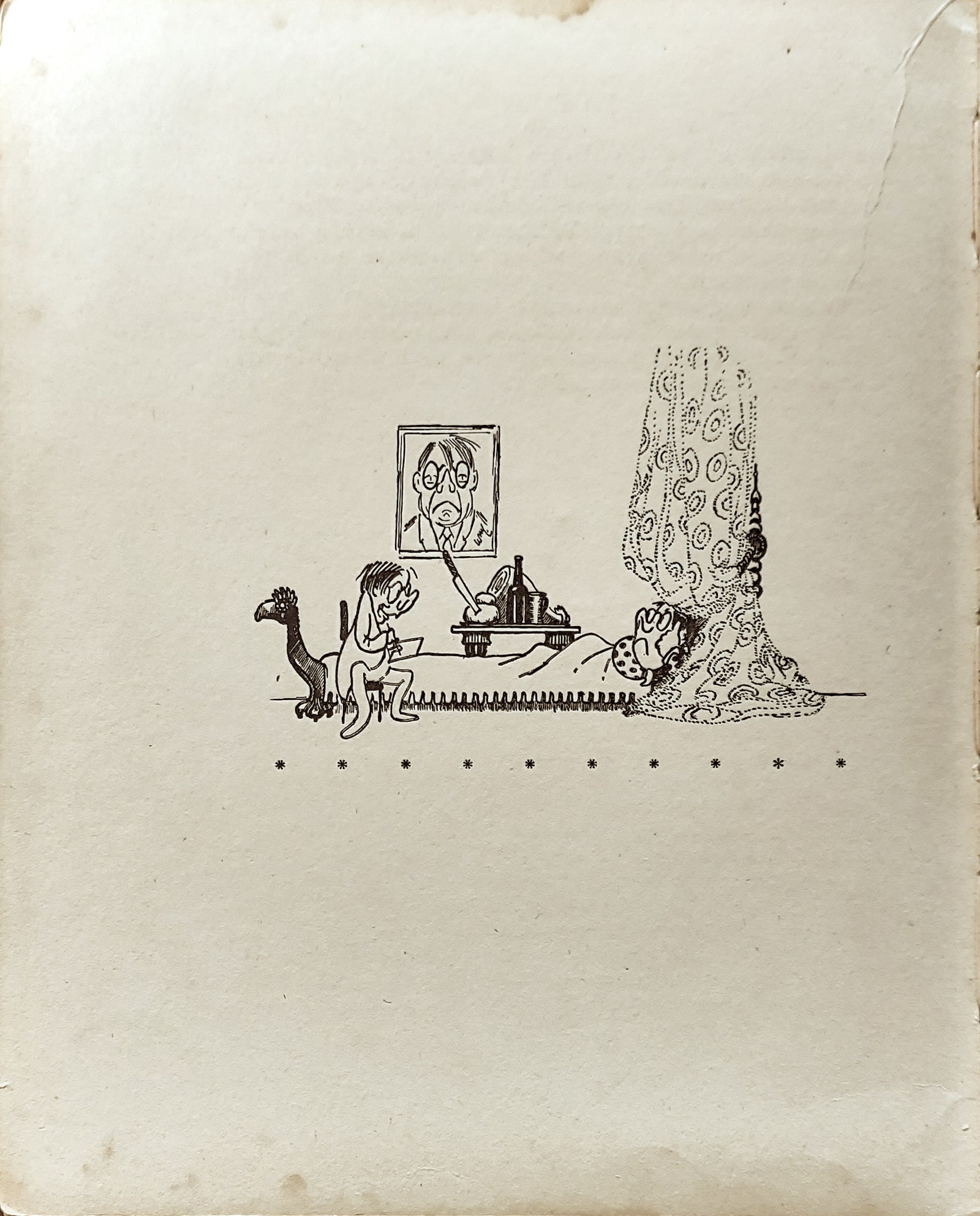
Reproduced from Smoke Rings (London: Stanley Paul, 1926, p. 124).
OF WILLIAM CAINE, THE MAN AND HIS MESSAGE
(AN INTERVIEW)
I found William Caine in bed. The time was eleven o’clock in the morning.
“This is a nice hour to be still between the sheets?” I said as I opened my note-book.
He yawned till I thought his head was going to come apart. “Yes,” he said: “it is. If it wasn’t, I should be up, you fool.”
I let this pass. “What, Mr. Caine,” I inquired, “is your name?”
“Anson Berkley,” he replied, “but of course that’s only the name I write under. My real name is Llewellyn Solomons. Ours is the Rutlandshire branch, you know.”
“Your favourite breed of dog, please?” I demanded.
He only yawned till I thought the roof would be displaced.
“Your favourite flower?”
“Cauli,” he said, having now finished his yawn. “Favourite dog,” I said, writing in my Book. “Colley.”
“No,” he corrected me, “that’s wrong. My favourite dog is the starling. I wish you wouldn’t put words into my mouth. And that reminds me.” He stretched out an arm and pressed a hanging electric bell. “You’ll join me in some supper?” he inquired.
Before I could answer, his second butler brought in a tray loaded with hams and teapots, and things of the kind. Soon we were eating together as if we had known one another for weeks. I noticed that he ate sparingly of mustard and drank his tea with a slice of carrot in it, as the Danes do, I expect.
It is these little personal touches which I always look out when I am interviewing a man. They are so intensely interesting, don’t you think? I noticed also, for example, that he put his tea into his sugar instead of the other way round as most of us do, and that he ate his boiled egg with a knife and fork. There’s something rather marvellous about that, I believe.
But I was there to get this man’s Message. I said so. “Mr. Caine,” I said, “what is your Message?”
He yawned till I feared for my life. “My message?” he repeated. “Do you mean the date of my birthday? If I told you that it would be telling, wouldn’t it? No, no. You don’t catch me out that way, my young friend. Not that way.” He looked almost inconceivably droll as he said this. His eyes twinkled till I thought they would escape.
“No,” I said, “I know the date of your birthday. It’s in the Pentonville Calendar. I want to know what your Message is. What, I mean, are you trying to Say to Your Generation? What do you Stand For Among Your Contemporaries? What, in a word, are you After?”
“Money,” he said, gaping the while like an alligator. (It takes Caine a long time to wake thoroughly up.)
I tried another tack. “Mr. Caine,” I said, “the readers for whom I cater would be interested to know where you were educated, if at all.”
He stared at me in frank surprise. “Why,” he said, “I was done in the left arm, like everybody else.”
“You were at Oxford, I think,” I said. “No doubt you feel you owe a great deal to her.”
“Thousands,” he said, “and have this thirty years. Nearly all for fancy waistcoatings, too. I never could resist a fancy waistcoating when I was a young fellow.”
“And now,” I said, “about your career at the Bar, Mr. Caine?”
“Well,” he said, yawning, “what about it?”
“Can’t you give some word of helpful cheer for those of my readers who are engaged in your old profession; some short, pithy sentence which they can frame and hang up and read when shaving and carry with them to their day’s work?”
“A sort of slogan, in fact,” he suggested.
“Well,” I said, “perhaps. Something of the ‘Strike On!’ order, eh?”
He thought for a moment. At last he said: “I don’t think I ever took such a dislike to a necktie as I have to yours.”
“What,” I asked, “is your golf handicap, Mr. Caine?”
“Twelve stone seven,” he said.
“Who, in your opinion, Mr. Caine,” I asked, “won the War for us?”
“I did,” he said, “by not being Commander-in-Chief.”
“Now, Mr. Caine,” I said firmly, “I want that message of yours, please.”
“Oh, ah!” he said. “My Message, eh? But do you mean to the people of England, or just to the population of the Globe?”
“Whichever you please,” I told him delightedly.
“Frankly,” he said, “I haven’t an idea. I’d better leave all that to you, I expect.” With these words he began to shave.
It was a hint. Taking it, I left him (SR: 125–127).
- Witty letterpress. — As reviewers at the time called the texts which accompanied Caine’s drawings; see, for instance, “Book Gossip; Notes on Current Literary Topics,” The Evening Herald (Dublin), Thursday, September 16, 1926, p. 4; or “Book Notes; Wm. Caine as Artist,” Westminster Gazette, Friday, September 17, 1926, p. 5.
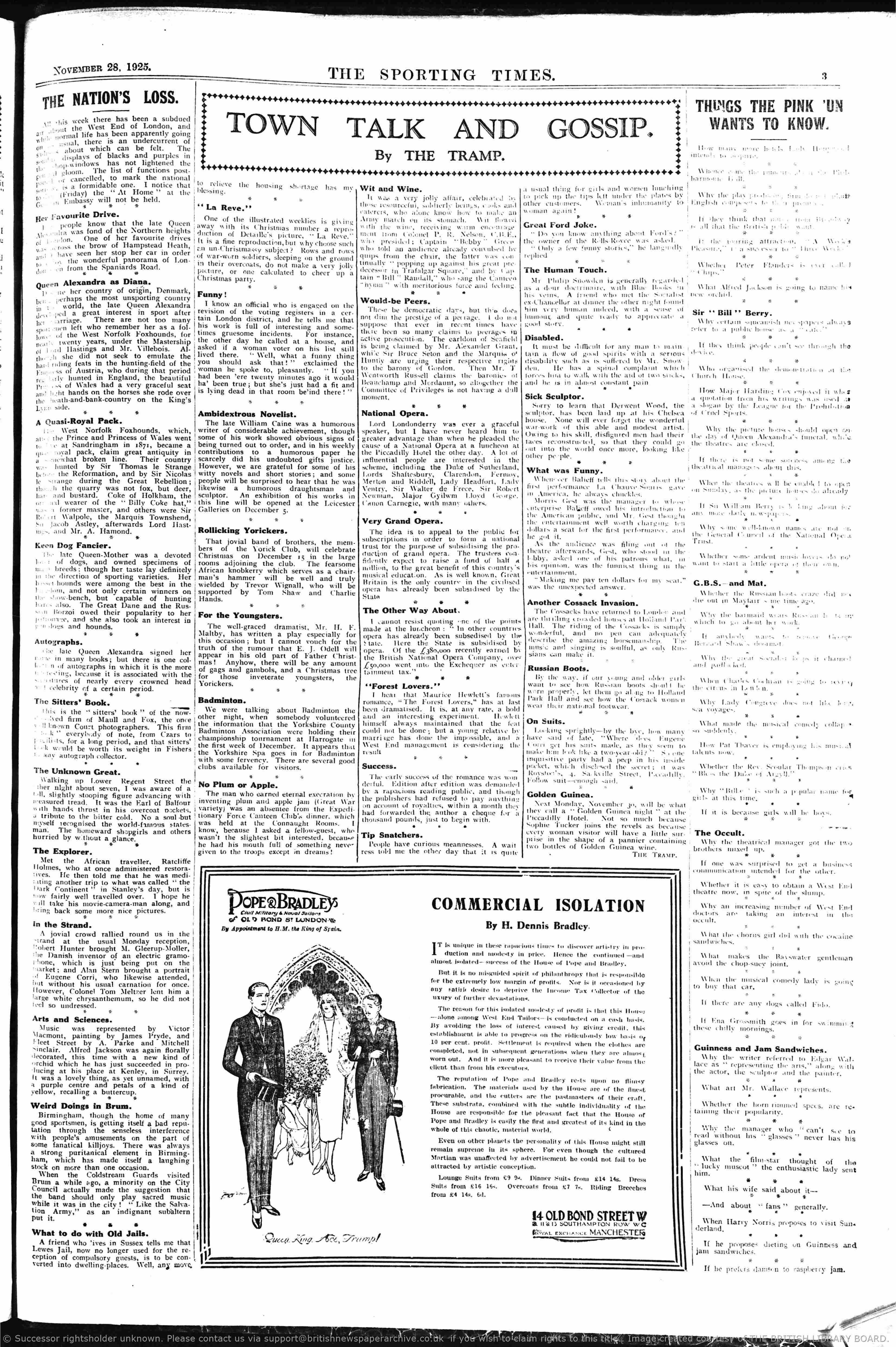
- Weekly contributions to a humorous paper. — “Town Talk and Gossip, by The Tramp; Ambidextrous Novelist,” The Sporting Times, November 28, 1925, p. 3; see also Caine’s note in Smoke Rings.
- Published by George Newnes. — Contento & Stephensen-Payne 2026; Quinn 2025. See also, e.g., Wikipedia articles on George Newness Ltd and London Opinion.