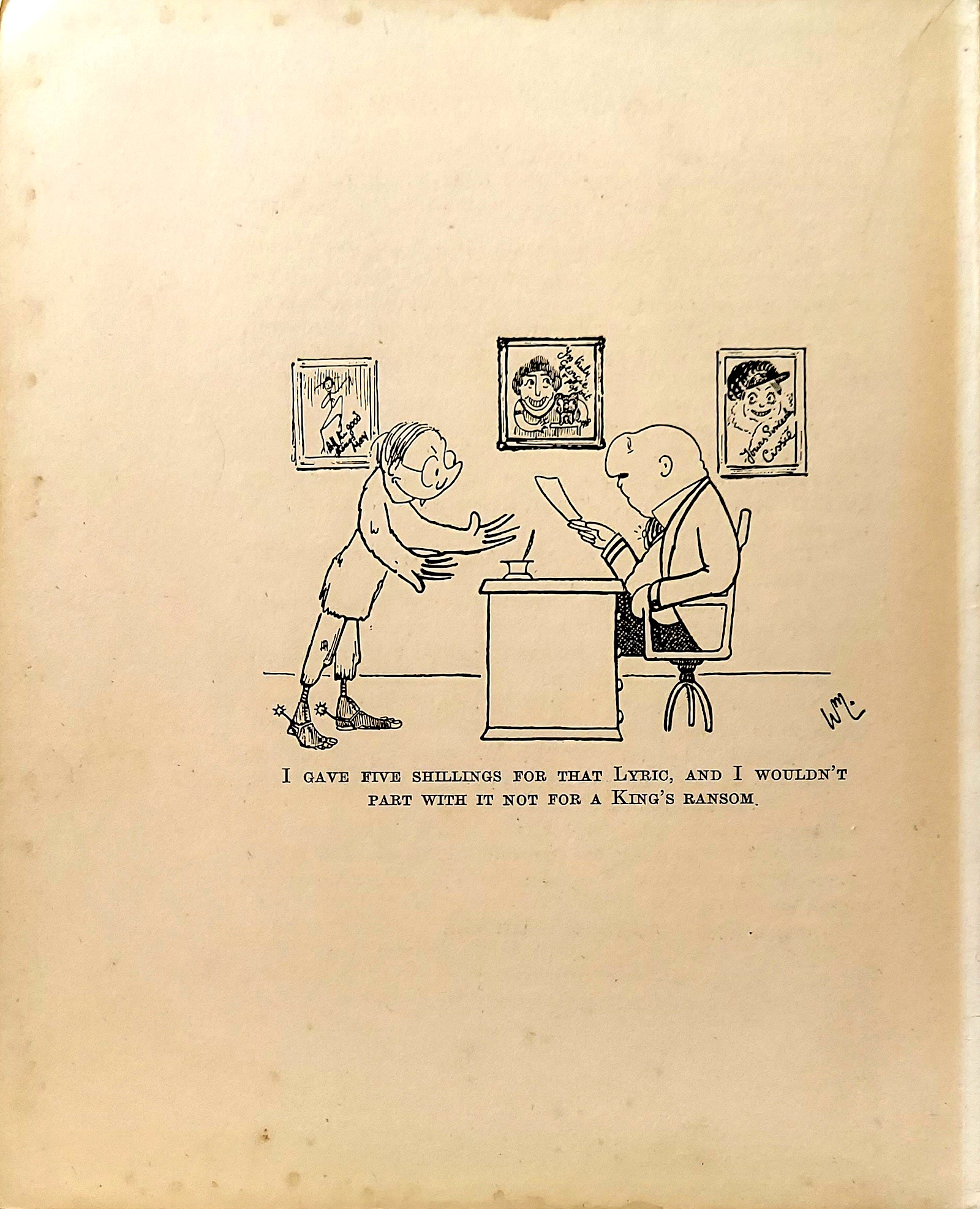
Reproduced from Smoke Rings (London: Stanley Paul, 1926, p. 128).
Mr. Caine has written musical comedy for the stage, but has not gone on with it, as he writes, “I seek peace rather than fortune” (see § 14 for full citation).Likewise, The Yorkshire Evening Post, at the time of Caine’s death, summed up, “in his own words,” his experience of working on The Island of Pharos: “A musical comedy which I wrote cost my collaborator £1,000.” Caine further developed such musico-comedic ironies in the final sketch, and its accompanying illustration (left), which rounded out his posthumous Smoke Rings (pp. 129–131; note that the character of “Mr. Charles” appears to be an amalgam of Charles Frohman and Charles E. Hamilton):
Alternatively, the story Caine published in The Pall Mall Magazine in July 1910, “‘Canoodle-oodle-oo,’” did a similar job:A PERFECT LYRIC
In the days of long ago, when I was winning my spurs (and not much else) in the glorious profession of letters, it was my fortune to meet with a certain theatrical manager, whose name for the purpose of this paper shall be Mr. Charles.
This Mr. Charles happened to be on the look-out for a person who should write some additional lyrics for a musical comedy which he was about to inflict on the provinces. I happened to be on the look-out for someone who should pay me to write lyrics, or epics, or bucolics, or acrostics, or anything else whatsoever. Thus we came to do business together — at least, he did.
In my eagerness for gold and glory I spared no effort to please Mr. Charles. I produced lyrics by the bucketful. As he was paying me (though I knew it not) precisely one-fifth of the price then current for this kind of wares, Mr. Charles naturally felt that he had a right to be difficult, and he was. He accepted perhaps one per cent of the things I submitted. My lyrics, he said, were too subtle, too clever, too would-be Gilbertian. “I wish to Purgatory,” he cried one day, “as I could lay hands on a lyric I have somewheres in this desk of mine. There’s a lyric, my boy, as is a lyric. It’s the goods, that lyric is. I call it ‘The Perfect Lyric.’ A glance at that lyric, Caine, would teach you more about what I want from you than I could tell you in a year. It’s an inspiration, that lyric is. The story is simple and sweet; it’s told straightforward and the economy of words it shows is marvellous. The rhythm is plain and uncomplicated and the whole thing is so vocal that it practically sings itself. You shall have it for a guide the moment I can track it down for you.”
Imagine then, how eager I was to have a look at this masterpiece. With such enthusiasm, almost with such adoration did Mr. Charles speak about it that I was convinced that if I could but read it through once, nothing that I should write thereafter would be turned down, for everything that I should produce would be the goods.
At last, one morning. I was transported to hear Mr. Charles say: “Oh, by the bye, I’ve found that Perfect Lyric for you. Here it is. Now I want you to study up that lyric good and hard. Analyse it. Tear the secret out of it. Mark its fine simplicity, and observe how intensely vocal it is. Work on it till you’ve surprised all the greatness that lays back of it. The boy who wrote that lyric is dead now, but if he’d have lived, he’d have been the greatest lyric writer the English stage ever saw. I expect he was too good to live. That lyric’s never been sung, and until I can find the right composer for it, it never will be sung. It would be like blasphemy to wed that lyric to unworthy music. I gave five shillings for that lyric, and I wouldn’t part with it not for a King’s ransom. I wouldn’t and that’s what I think of that lyric.”
Here followeth the Perfect Lyric:
“Within a mill, upon a hill,
A pretty girl was grinding corn:
And far beneath, on a barren heath,
There was a love-sick swain.“Into the mill upon the hill,
The love-sick swain came up from the vale;
He sang his strain, but all in vain —
The clatter drowned his tale.“But from the mill upon the hill,
The pretty girl came out to the swain;
And to the heath that lay beneath,
He never went again.”If all this that I have written were not true, it would not be worth writing. But it is true, and nothing which shall illustrate the marvellousness of man’s mind can ever be proclaimed in vain or concealed without peril to the concealer. For to this end (among others) are we writers sent into the world, to make manifest to our fellows the glories by which we and they are surrounded, in so far always as it is given to us to perceive them.
Therefore have I written this that I have written.
One morning Hacke received the following letter:Of course, the full exploration of that thousand-pound-loss and the subsequent pursuit of “peace rather than fortune” occurs in the novel Caine published in October 1912, Hoffman’s Chance, which he dedicated
Dear Mr. Hacke, —
Here is a song called Canoodle-oodle-oo. The words are rotten, but the music is all right. I want you to get your brains to work right away to fit up a real original lyric to it for Miss Lanchester in the second act. I want something that they will eat without smelling it, something refined, humorous, not too naughty, but bright and light, and with a real smart catch-line. Please bring it this afternoon. I hope there will be a good deal of remunerative work to come your way over this piece.
Yours faithfully,
Otto Stein.
P.S. — Make it just naughty enough.
Hacke caused his ailing wife to rise from her bed that she might play the tune over to him. It was a syncopated American importation, and after he had heard it over twenty or thirty times, Hacke his pianist back to bed and wrote out three trial verses, each one ending in a different tag. These he took to Mr. Stein’s office. After waiting in the enteroom for an hour and seventeen minutes, he was admitted, and read them over to Mr. Stein, who accepted one and made a mental note of the tags to the other two. Hacke spent the rest of the day in forging a lyric on the lines imposed by the selected tag, and finished five verses in time to catch the midnight post.
Three days elapsed, and then Hacke was enchanted to receive the following letter:
Dear Mr. Hacke, —
Miss Lanchester has soured on the Canoodle music, but she thinks your lyric enormous. I am therefore putting Moscardi on to it right away. I enclose my cheque for one guinea in payment of all rights in your lyric. Kindly execute and return accompanying assignment of same.
Yours faithfully,
Otto Stein.
Hacke went up to the Strand to cash the cheque, so that he might buy some medicine for his wife and a stamp to post the assignment with (for it as beneath his dignity to leave it at Mr. Stein’s office). In Mooney’s bar he met Moscardi, who told him that he had just seen Mr. Stein. Moscardi was greatly pleased because Mr. Stein had accepted his setting of a lyric.
“It’s one of the best things I’ve ever done,” said Moscardi. “Haunting, my boy, absolootly. The lyric is too rotten for words, and it’ll have to be altered here and there to fit my melody. Haunting, my boy.” And after drinking another small Bass, at Hacke’s expense, he filled his pockets with biscuits from the counter, and went off humming his air delightedly.
Next morning Hacke received the following letter:
Dear Mr. Hacke, —
I return your lyric with Moscardi’s setting. He has done a very good tune, and I do not want to lose it. Will you alter your words where necessary, and let me have both back this afternoon?
Yours faithfully,
Otto Stein.
Hacke stirred up his wife once more, and found that as Moscardi’s music was in waltz time (a peculiarly haunting measure), his verses required such radical alteration that it was necessary to rewrite them. He took them up to Mr. Stein’s office himself. When he got there he found that Mr. Stein had gone to a pantomime in a Northern suburb, but had left word that he would be glad if Hacke would follow him there with the words. This Hacke did. Mr. Stein did not like the new version at all. Hacke sat up all night making another, which he posted himself while he was going to fetch the doctor for his wife.
He heard nothing more about his song for several days, and was beginning to wonder if Mr. Stein had abandoned him, and was trying to screw up his courage to call at the office and make sure, when he received the following telegram:
“Come at once. — Stein.”
Hacke was delighted with this telegram. He thought it meant more remunerative work. When he got to the office, Mr. Stein told him that he had decided to give the song to the baritone, because the music was too vocal for Miss Lanchester. Would Hacke, therefore, make out a good rousing entrance song for Rupert, which would give scope for chorus business for the Fluffy Girls; something real new? And so, after recommending Hacke to stoke up and get full steam on his brains, Mr. Stein wished him good day.
Hacke spent the night partly in stoking up his brains and partly in stoking up the fire, for his wife continued unwell. The result was some strong lines expressing the delight which a young naval officer feels on once more beholding the scenes of his boyhood and the pleasure which he anticipates from clasping in his arms the dear little girl of whom he has dreamed ever since he left home.
Of these verses Hacke was pardonably proud; and with the carelessness in money matters of the self-satisfied artist (who is anxious to get back to an invalid wife was quickly as possible), he took an omnibus to the Strand instead of walking. Mr. Stein condemned the verses without any regard either to Hacke’s feelings or the decency of language.
“I want something new,” he said, “and you bring me stuff that’s so shiny you can shave in it. Here am I breaking my heart to get this piece up to sample, and you fellows won’t do a thing to help. I’ll have to get someone else to write this song, Hacke.”
At these awful words Hacke begged to be allowed to try once more; and there was something so desperate in his voice and face that Mr. Stein relented, and let him have his way. He even gave Hacke a cigarette.
On his way home Hacke had an inspiration which, before morning, he hewed into a comic song of eight verses, and sent it off to Mr. Stein by express messenger.
This song was subsequently used (with music by Holme St. Loo), in the second act, and made the fortune of the piece.
But Hacke has no cause for complaint. He got a guinea.

I like to think that, by “that which is dearest and most helpful to me in all the world,” Caine meant not only the technique he acquired through the practice writing musical comedy, not only the themes he hatched and latched onto for further exploitation, but also, and above all, she who was “dearest and most helpful,” i.e., Edith Gordon Walker. In other words, I believe that Caine’s dedication is evidence that he met the future wife of the future author of The Author of “Trixie” sometime during the provincial tour (July–August 1904) of The Island of Pharos.TO
OSBORNE ROBERTS
This story may remind you of some experiences which we share and which, without you, I should never have known. Though they were disappointing, they were useful to both of us; indeed, as far as I am concerned, they were the real beginning of my life. Out of them came, very soon, that which is dearest and most helpful to me in all the world. I should be an ungrateful dog if I did not offer you this book.
One word more. Though very ignorant of music, I have taken a musician for my hero. It is likely, than, that you will be tempted to smile here and there, where your amusement (after that fashion) is not intended; but when this happens, try to sink the expert maker of lovely melodies in the friend, and believe that though I have sinned in some places through lack of knowledge, I have done my best everywhere to capture your approval.
Always yours,
WILLIAM CAINE.
Feb., 1912.
[Themes Caine would expand or touch on in subsequent work:]
[Runaway Horse Theme: But She Meant Well; Boom!; The Strangeness of Noel Carton]
"Wyndham's Theatre; 'Peggy Machree,'" The Standard, Thursday, December 29, 1904, p. 8: "In the next [second] act Trevor arrives at Castle O'Driscoll. He does not know the name of the house, however, nor does he recognise Margaret when he meets her as its mistress, although he has only been absent five years. He has stopped her runaway horse, however, and he frustrates the nefarious but mystical designs of a cousin, who wishes to marry her for money."
“On learning the real state of matter, Trevor enlists in the army, and when he returns ten years afterwards, disguised as a fiddler, he is taken into the service of Lady Margaret, who reigns in her Castle, and whom he has on the day of his arrival rescued from accident by seizing her runaway horse” (“Amusements; ‘Peggy Machree’ at the Lyceum Theatre,” The Scotsman, Tuesday, December 13, 1904, p. 7).
[Robbed by Agent Theme: Three's a Crowd; Old Enough to Know Better (fake telegram Ridley sends himself); Caine's father's business Shaw's Brow Mining Co. ?]
"Wyndham's Theatre," The Morning Advertiser, Thursday, December 29, 1904, p. 4: Barry Trevor "returns a poor man, for his agent has robbed him during his absence, and has left him neither money nor land."
But let me get on with my discussion of Hoffman’s Chance.
Description of Peggy Machre: "On the the program last night’s production at this theatre is described as a play with music. This probably indicates that the music was an afterthought, and did not enter into the original scheme. […] There is a plot […] Only the plot doesn’t happen to be particularly good or interesting, and is made up of too familiar materials" (“An Irish Music Play,” The Morning Leader, Thursday, December 29, 1904, p. 1): I.e., the opposite of Hoffman's Conspiracy at Capri, which begins with music and plot together, in mind of Hoffman; Orde brought in to help write lyrics and book
Hoffman’s Chance is, in effect, the mirror Caine crafted for himself in order to confront, à la Perseus, the Medusa of the music hall. For the plot which the novel charts — the devolution of a comic opera with complex compelling music and a coherent plot into a commonplace musical comedic mishmash that gets no more than fourteen minutes into the third act of its world premiere before the curtain is rung down on it forever — is the mirror image of the evolution which Caine helped to effect for Peggy Machree — from the “artistic triumph” of an “ingenious piece of patchwork” of “many songs but little plot” to comic opera.
female protagonist's argument (one of them) to __ that she shouldn't go on stage, because she will unjustly depriving a needier woman out of a job : echoes Hubert's thinking in But She Meant Well, how his passing exam with top honors will deprive 150 others out of jobs (see § 1-bis)
