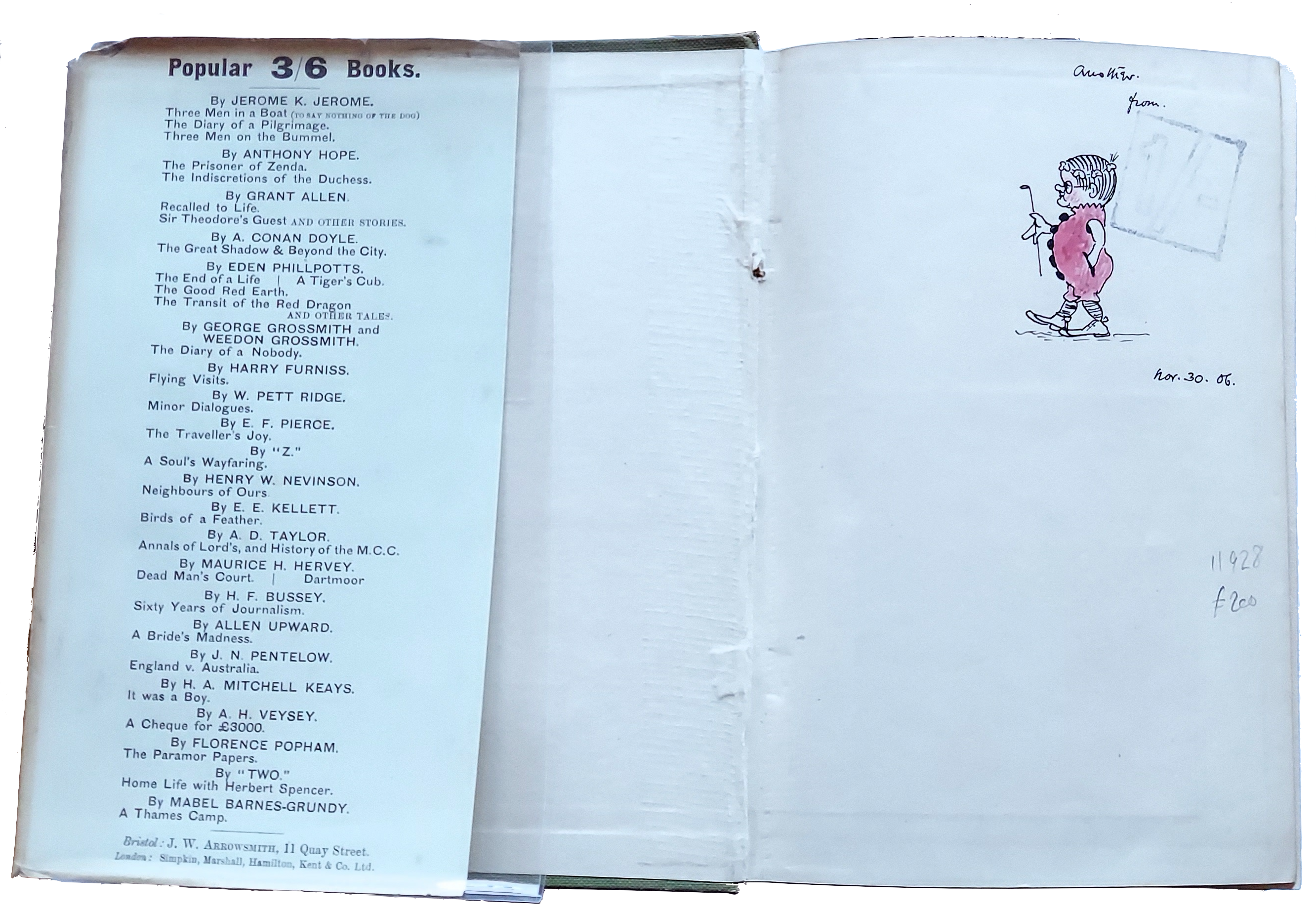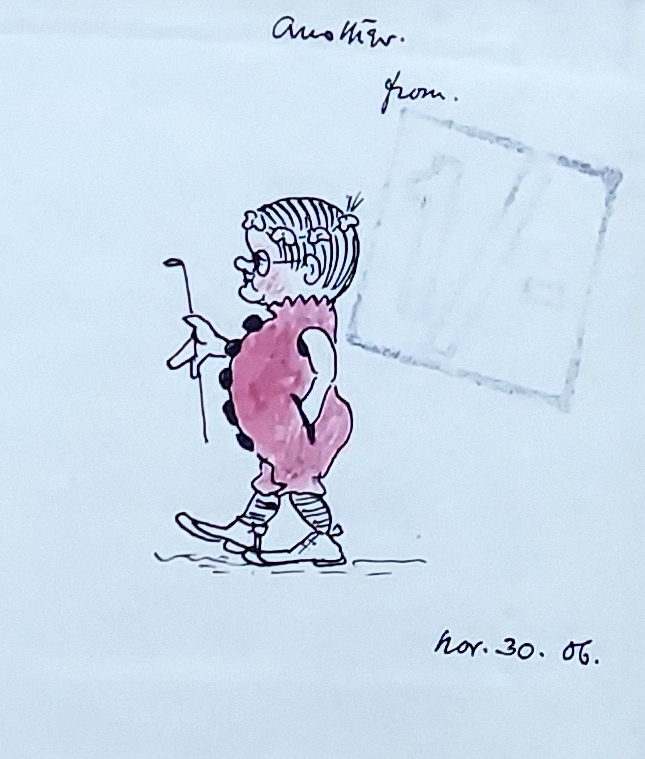
“Another from [Quilliam]. Nov. 30. 06.” Reproduced from the flyleaf of The Confectioners.
Mr. J. W. Arrowsmith is publishing “The Confectioners,” by William Caine and John Fairbairn, dealing with the state of things which will exist when everything, down to the food we eat, is chemically prepared.The following day’s Western Daily Press adds to the above that Caine’s and Fairbairn’s creation “deals in a very original and humorous manner with the state of things” etc. The exemplar I purchased from Hyraxia seems to be an advance copy which Caine sent to some newspaperman he quite likely knew personally, and may or may not have been accompanied by the publisher’s publicity material from which the above notices evidently lifted their copy. And since there is only one “signature,” that is, drawing — which is a caricature of the character in The Confectioners who is a parody of the author of The Author of “Trixie” himself (Caine’s earliest published pieces were signed either Quilliam or W. Quilliam) — I take this as further evidence (the first being the book’s two competing prefaces) that Caine’s ostensible co-author, John Fairbairn, is as fictional as the character who parodies him in the book, Bertie St. John:
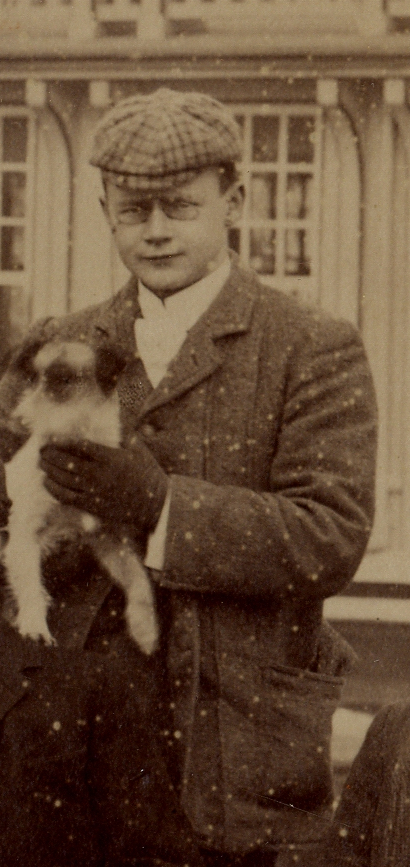
William Caine with “a little fluffy dog,” February 1895. Detail from Balliol 1st torpid, 1895, photo by Gillman & Co. Note the falling snow: “The river is not open yet, and as late as Friday it was possible to walk across from the towpath to the barges. The thickness of the ice has suggested a new idea to the photographers. The Torpids are off, as I mentioned last week, but the chosen crews have received their colours, and of course proceeded at once to be ‘shot.’ The favourite arrangement is to plant eight chairs in a line on the ice, and to seat the crew on them, with oars in their hands. The effect is refreshing, as it suggests a variation of the nursery game of ‘Horses,’ and the smile on the face of the bargeman on the raft forms a pleasing and novel background to the picture” (“’Varsity Jottings; Oxford,” The Globe, Monday, February 25, 1895, p. 3).
Coming from North Chapel, your most direct way to the top of Blackdown runs through the fields, across two roads, over Roundhurst Common, and so up one of the steepest lanes in the South of England. On this path, late in the afternoon of a fine summer day, two young men were struggling painfully. Walking was not very much in their line. The name of one was Bertie St. John. His trade was that of an Occasional Journalist, a calling which his very comfortable private circumstances permitted him to follow without loss of life. He had formed a large circle of acquaintances among sub-editors, free lances, and emergency men, and was known to the fourth estate as one who would stand lunch to the hungry or buy a man a drink at any moment. But while they lived on St. John, St. John, as far as they were concerned, lived on hope, for he had never been printed. Thanks, however, to the energy and thrift of his father, he had the rounded outlines and the rosy cheeks of a man who does not live by bread alone. His hair at thirty-two [Caine’s age in 1905] gave promise of an early calvity, and with so much he may be left for the moment.At least one early reviewer of The Confectioners had doubts about its ostensible co-authors: “we suspect them of being really one, split up for purposes of fiction.” Likewise, Bleiler (1990: 116) noted, “There is no information on Fairbairn, who may be a joking pseudonym for Caine.” Here’s the first Preface to the novel, signed “John Fairbairn:”William Quilliam, his companion, was a Failure-at-the-Bar. Though no fustilug, he was stouter even than St. John, and rejoiced in an abundance of hair, which by reason of a thin knack for verse-making and a strong dislike to the ministrations of the barber, he grew to an unwarrantable length. His nose was pug, his chin pointed and peculiar, and his front teeth were projecting. He wore spectacles, the rims of which were of a metal which resembled gold very closely, and he bit his nails. He was, over and above all this, enormously a favourite with women, for his wealth was vast.
With them was a little fluffy dog named Billy, on which Quilliam called peevishly from time to time. Of his master’s continual summonses to heel it took no notice at all. Billy was one of those dogs that do not try to learn.
The costumes of St. John and Quilliam deserve some little notice, departing as they did in so many particulars from the severe ideals of the Tailor and Cutter.
St. John was clothed in a tight-fitting magenta-coloured garment of the recently-introduced asbestos and peat fibre cloth, the dernier cri among sportsmen. […]
Quilliam had elected for comfort. The form of his dress was simple, the simplest indeed and the best that mankind has ever devised. In the bottom of a sack of pink velveteen two round holes, and higher up, in the sides, two others had been cut. Into this sack Quilliam had got ; his legs and his arms he had thrust through the proper openings ; he had pulled the neck of the sack close round his own, and, after drawing on serviceable pale blue stockings and enormous brogues of coriacine, he stood up fully clothed. All over the front of his dress he had caused to be sewed innumerable little pockets after the manner of Panurge. Hat he had none, but among his luxuriant hair he had twined two or three artificial roses of a pale green colour. A row of large black buttons down the front of his attire where no buttons were needed heightened in no small degree the pleasing effect of this rather daring ensemble.
It was Quilliam’s foible to pretend to be the most foolish young man alive. But the competition which he had to face was severe, and he did not always succeed. At the moment, however, he had some reason for self-congratulation. It was almost impossible that any existent being should be dressed in more preposterous clothes. The fact that, in itself, his costume was uncomplicated and comfortable was the only thing which might bring off the million to one chance. But Quilliam had taken this risk for the sake of the effect. And the effect was silly beyond the dreams of Bedlam (pp. 19–23).
The functions of mason and architect are distinct, yet each without the other is impotent. Lacking the laborious hands of the mason, the architect must be content to see his fair dreams unrealised. Without the inspired guidance of the architect, the mason can do no more than dress square lumps of rock. The architect has neither the time nor the physical strength to fashion freestone. The mason can only ply his saw and chisel. Thus, in a sense, mason and architect are collaborators.And here’s the second, signed “William Caine:”But to whom is the glory?
When we are in the presence of some great cathedral and we ask, “Who built this lovely thing?” do our thoughts turn to the dull slave who rough-hewed its constituent blocks, or rather to the master mind to whom the vision in all its final beauty was vouchsafed?
Yet, could we examine its stones one by one, we should discover upon each of them a mark — the private mark of its maker. It is his humble bid for immortality.
The architect can well afford this little happiness to his mason.
And so the name of Mr. Caine appears on the title page of this work.
But when I was given to understand that this young man, whom I have employed from time to time upon the crude business of drafting some of the following chapters, had expressed his wish to write the preface to our book, I was obliged, though reluctantly, to put my foot down.
An author is, like any other artist, the servant of the public, and no considerations of false modesty should permit him to connive at their deception. Had I allowed Mr. Caine to contribute this preface, I know that our readers must have gained an entirely false impression of the share of our joint work with which he must be credited.
I feel it therefore to be my duty, both to myself and to the reader, to say that, beyond the mere coarse shaping of the material (the mere stretching and preparing, one might say, of the canvas) and the suggestion of one or two foolish and unconvincing characters, Mr. Caine has done nothing towards the making of this story. I may be blamed for having permitted Mr. Caine to insist successfully upon certain matters; but in respect of these I would ask the reader to extend to me his sympathy, though he cannot give me his approval. Where I have given way I must be supposed to have had in mind the financial straits of my assistant, his delicate wife, and growing family, rather than the artistic completeness of the book itself. I do not deny that I entered upon the collaboration (against my better judgment) in the hope of lending a helping hand to a man whom I saw but ill-equipped to surmount the difficulties of authorship. But a benefaction conferred is ever the deadliest of injuries. No serpent has a sharper tooth than the viper which we nourish in our bosom; and it was only to be expected that one whom I assisted glady — because at one time I had for him a real regard — should in the end turn upon me and seek to rob me of my rightful praise. The public will therefore understand why I have forced myself to refuse to allow Mr. Caine to prejudice me in their sight by anything which he might choose to say in his meditated preface.
This tale, in spite of certain elements which may seem to indicate another intention on the part of its authors, is not to be taken as presenting a wholly unreal and fictitious picture. Had the writer been able to carry out his idea in undertaking the work without capricious — and often, it must be said, unintelligent — interference on the part of Mr. Fairbairn, with whom, under a total misapprehension of his true character, he was led to collaborate, none of the ridiculous matters which may mislead and perhaps repugnate the reader would have been incorporated in it.I need not belabor the novel’s parodic nature, amply evident in the competing prefaces — which are indeed parodies of the moralistic and mocking aspects of satire — as well as the very structure of the book, composed of, as Bleiler (1990: 116) would have it, periodic “interruptions” of the narrative in which the authors “discuss what has been written, the actual writer indulging in self-praise, his collaborator in criticism. This material might well have been omitted.” No. The omission of such “interruptions” would make The Confectioners an entirely different sort of book altogether — a mere “burlesque fiction devoted to adulteration in all its branches,” as a review in a later issue of The Western Daily Press put it — or perhaps it would still remain, according to The Spectator, a “highly humorous extravaganza” — but minus half the humor. In any case, it would not be what Punch called it: “nearly the maddest book I have ever read, and probably the most original. One of the original features of it is that at the end of every chapter the collaborators argue about the merits of the last section and the authorship of the next.” In other words, far from being the “Ersatz Chesterton” that Bleiler (1990: 116) saw, I see The Confectioners as a true humorist’s “untrained and extravagant” jewel of self-involvement with his own irony (on which see § 2). But let me contextualize my quoted adjectives:But as absolute truth is inexpressible in words, it is a compensating comfort that no definite expression is without a substratum of truth. Behind the apparently false, the discriminating reader will pick up here and there the thread of the more serious purpose which underlies this book, and, discarding the inept and the farcical, will arrive at the meaning with its lesson. Even Vespertilia (superfluous chit as the writer has always deemed her) is a paradigm premonitory.
Ore is not to be reached without delving, though most prefer to have it ready to hand in a minted form. That the metal herein should carry an admixture of dross is the writer’s sincere regret, but “force major prævalebit” as Mr. Jewel would have said, and in the “status quo” the work must go forth “tale quale.” The writer, however, conceives it to be due to his reputation and the reader’s forbearance to state that for the main incidents conveying the theme of the tale, for the delineation of the characters — he does not include mere lay figures in this category — and for the composition as a whole, with the exception of certain passages, the discrepant style of which sufficiently marks their origin, he alone is responsible, and he is glad to acknowledge the assistance afforded at the last moment by the printer’s reader in placing the actual facts of this infelicitous collaboration before the public in this place.
Mr. William Caine, the author of “The Irresistible Intruder” and many other popular works of fiction is leaving immediately for America on a pleasure trip of some weeks’ duration. He takes with him many letters of introduction and a charming American wife who, before her marriage, made a considerable reputation on the London stage as Miss Gordon Walker. Caine, himself, is one of the steadiest and soundest writers now before the public. Son of a well-known public man, the late W. S. Caine, M.P., he was educated for the bar, but found it not to his liking. He dipped into literature, therefore, with a book called “Pilkington,” and immediately found out that he had a lot to learn in a technical way before he could hope to compete successfully with his fellows. More than that he was handicapped by the possession of a singular sense of humor that had to be understood before it could be appreciated. In other words — to put it quite frankly — Caine’s early work was untrained and extravagant. It was not until “The Revolt at Roskelly’s” appeared that I, in common with many other admirers of his humorous powers, felt that Caine was going to succeed in spite of his faults. That book, with its beautiful portrait of “Father Christmas” and its delightful domestic touches, went straight to many hearts. Obviously the author had determined, when he wrote that book, to forget his brilliant powers and to concentrate his attention upon his story and the little foibles of his extraordinarily-chosen group of characters. His later books show that he is now master of his craft, possessing an almost devilish cleverness that he keeps vigorously in hand, and an understanding of the workings of the human heart which, in addition to his other qualities, is going to ensure the writing, in a very short time, of a big book. Caine is well under forty, a lover of art, a bit of a painter himself, and a traveller of wide experience. I have asked him not to write a book about America. There ought to be one literary Englishman living who hasn’t done it (J. Walter Smith, “The Book in London,” Boston Evening Transcript, Saturday, May 16, 1914, part 3, p. 11, “The Literary World at Home and Abroad”).Of course, what J. Walter Smith calls the “faults” of Caine’s early work are anything but, and his statement that Caine “had a lot to learn in a technical way before he could hope to compete successfully with his fellows […] that he was handicapped by the possession of a singular sense of humor that had to be understood before it could be appreciated,” seems to echo Fairbairn’s “lending a helping hand to a man whom I saw but ill-equipped to surmount the difficulties of authorship.” Likewise, Caine had no “growing family” in November 1906, and the actress-dancer-harpist known at that time as Miss Gordon Walker and who would become Mrs. Gordon Caine in July 1907 was not only far from delicate but was also, I believe, already supplying, for the “purposes of fiction” and under the guise of “John Fairbairn,” “the spark” (see § 7) her not-yet-husband was using to write with. Observe the following poem by Edith Gordon Walker, “Class of ’96,” published in the Arlington High School Clarion (vol. 1, no. 1, March 1897, pp. 4–5):
Ignore the young versifier’s deficits and focus instead on her interest in science and humor, her imaginative leap from fact to fabulation — using X-rays to read minds; recall also (from § 10) that, as a child, she was called “a prodigy of loveliness” because of her “sweet girlish manners […] blue eyes, golden hair and brilliant Kentucky complexion” — i.e., she was truly a “fair bairn” who lived in a town, Arlington, in a county, Middlesex, whose “courteous and affable, but at the same time strict” sheriff was called a “Friend of Newspaper Men,” an epithet which could very describe the “Occasional Journalist” (see above) who “had formed a large circle of acquaintances among sub-editors, free lances, and emergency men, and was known to the fourth estate as one who would stand lunch to the hungry or buy a man a drink at any moment:”SONG OF THE X-RAY.
Have you heard of “X rays?”
They are now all the craze;
True, science seems never to sleep,
There is naught can be hid,
Underneath any lid
These curious raylets can peep.
To produce the “X rays”
Which are now all the craze,
A vacuum tube you must own,
And current must pass
Through the heart of the glass,
E’er glimpse of the “X rays” is shown.
And these queer little rays,
Which are now all the craze,
Can excite a sensitized plate,
And picture each ill
With infinite skill,
That falls to humanity’s fate.
These wonderful rays,
Which are now all the craze,
On the medical world will bear;
What before has been dark,
By the means of their spark,
A different aspect will wear.
By the light from these rays,
Which are now all the craze,
The bones of the body are seen,
And the organs inside;
A disease cannot hide,
Its shadow falls full on the screen.
If these wonderful rays
Which are now all the craze,
Can bring hidden matter to sight,
With them we may find
The true essence of mind,
The birth of a thought bring to light.
Oh! I dreamed of “X rays,”
Which are now all the craze,
And my dream was real as the day;
Manufactured at school
In accordance with rule,
I used them in practical way.
And these curious rays,
Which are now all the craze,
I applied to a teacher’s brain,
Hoping thereby to see
Her thoughts flowing free,
A new stock of wisdom to gain.
But these wonderful rays
Seemed to dance in a maze!
A rainbow of thoughts came to view,
So swiftly they passed,
Not one could be grasped;
I mavelled [sic] at all that she knew.
But soon these “X rays”
Settled down from their maze,
And paused on the photograph glass,
Very clearly one thought
To my vision was brought:
“I hope all my pupils will pass.”
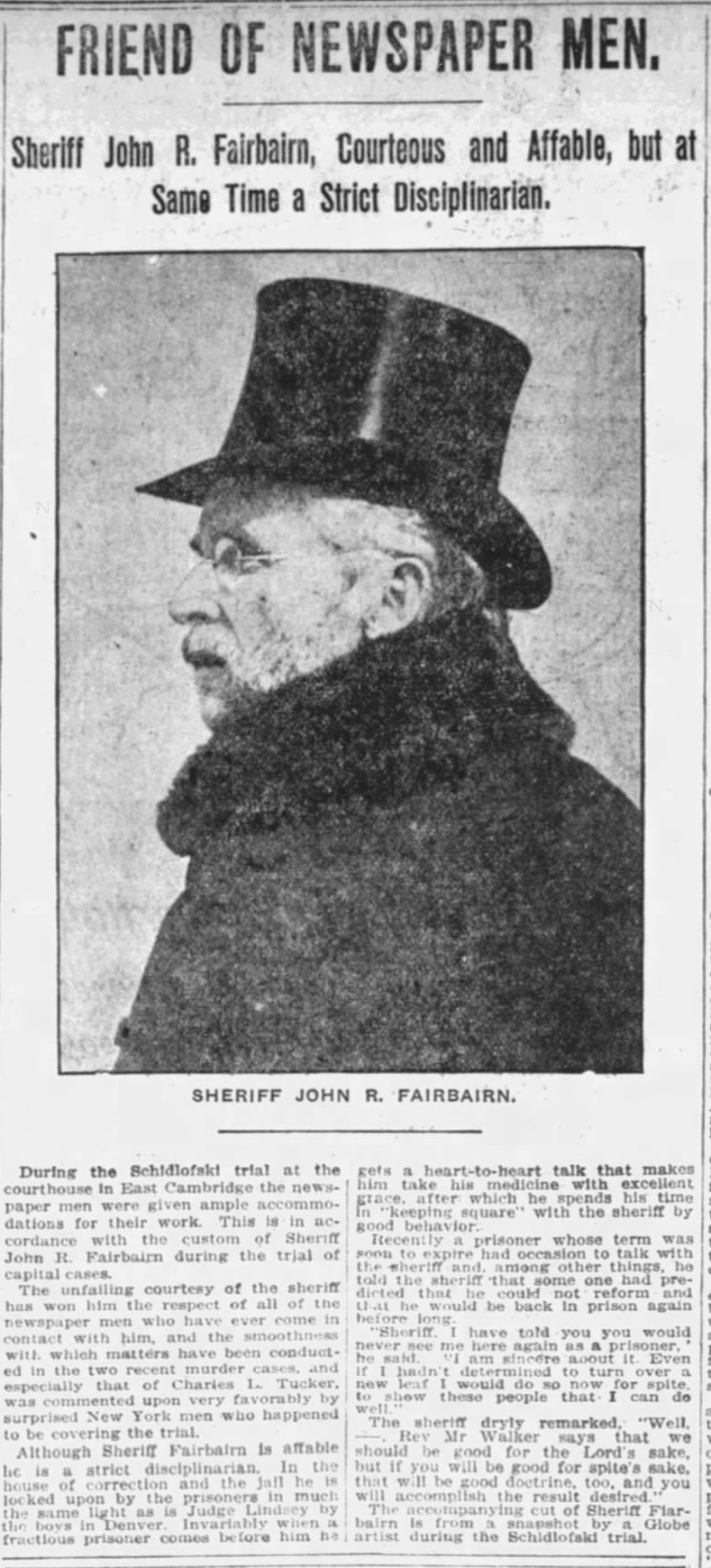
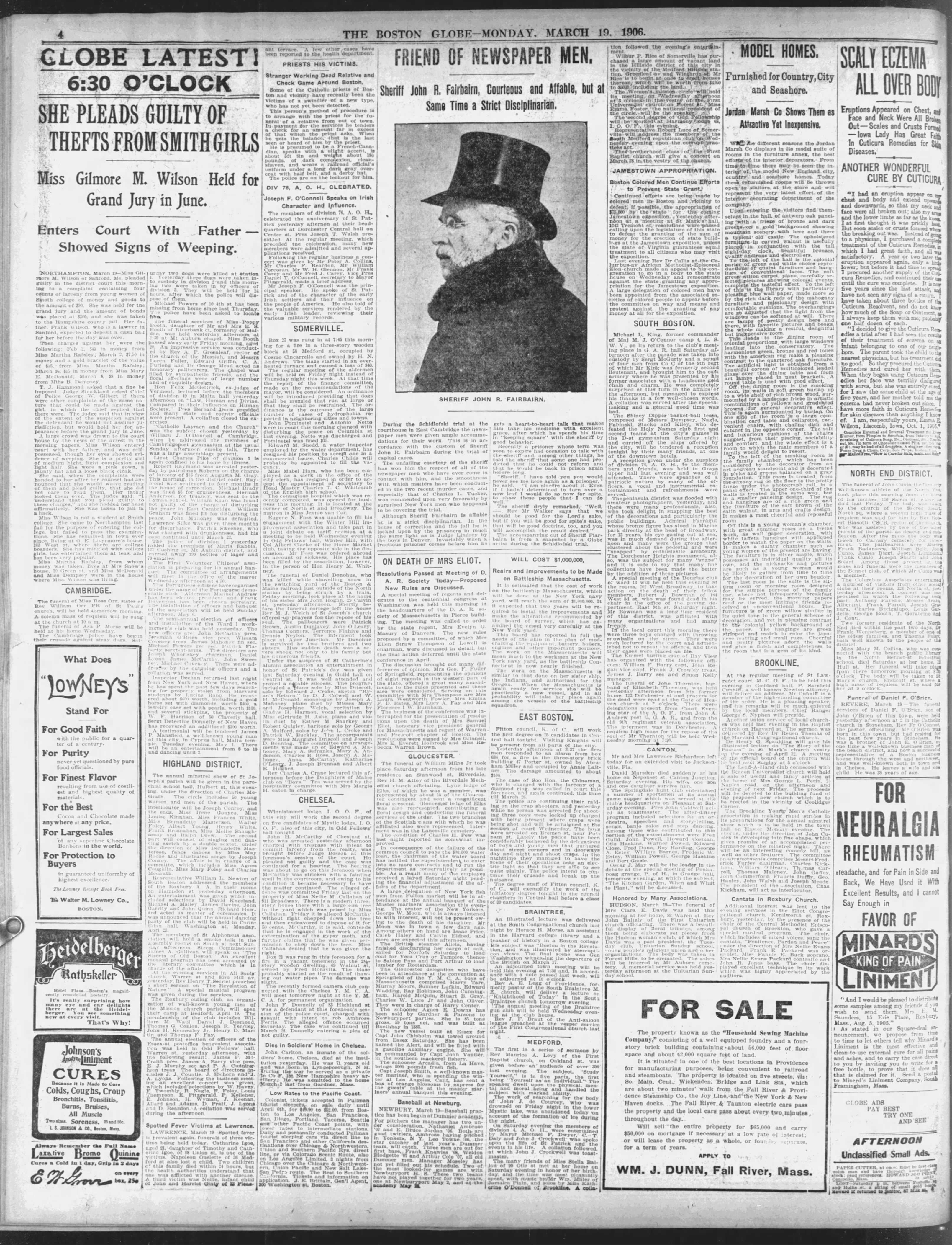
Sheriff John R. Fairbairn. Reproduced from The Boston Globe, Monday, March 19, 1906, p. 4.
During the Schidlofski trial at the courthouse in East Cambridge the newspaper men were given ample accommodations for their work. This is in accordance with the custom of Sheriff John R. Fairbairn during the trial of capital cases.The unfailing courtesy of the sheriff has won him the respect of all of the newspaper men who have ever come in contact with him, and the smoothness with which maters have been conducted in two recent murder cases, and especially that of Charles L. Tucker, was commented upon very favorably by surprised New York men who happened to be covering the trial.
Although Sheriff Fairbairn is affable he is a strict disciplinarian. In the house of correction and the jail he is looked upon by the prisoners in much the same light as is Judge Lindsey by the boys of Denver. Invariably when a fractious prisoner comes before him he gets a heart-to-heart talk that makes him take his medicine with excellent grace, after which he spends his time in “keeping square” with the sheriff by good behavior.
Recently a prisoner whose term was soon to expire had occasion to talk with the sheriff and, among other things, he told the sheriff that some one had predicted that he could not reform and that he would be back in prison again before long.
“Sheriff, I have told you you would never see me here again as a prisoner,” he said. “I am sincere about it. Even if I hadn’t determined to turn over a new leaf I would do so now for spite, to show these people that I can do well.”
The sheriff dryly remarked, “Well, —. Rev Mr Walker says that we should be good for the Lord’s sake, but if you will be good for spite’s sake, that will be good doctrine, too, and you will accomplish the result desired.”
The accompanying cut of Sheriff Fiarbairn [sic] is from a snapshot by a Globe artist during the Schidlofski trial (“Friend of Newspaper Men; Sheriff John R. Fairbairn, Courteous and Affable, but at Same Time a Strict Disciplinarian,” The Boston Globe, Monday, March 19, 1906, p. 4).
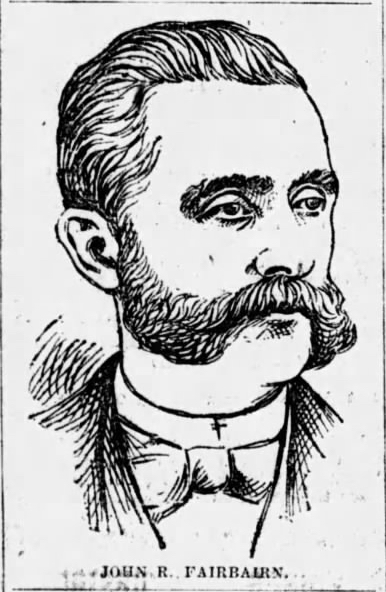
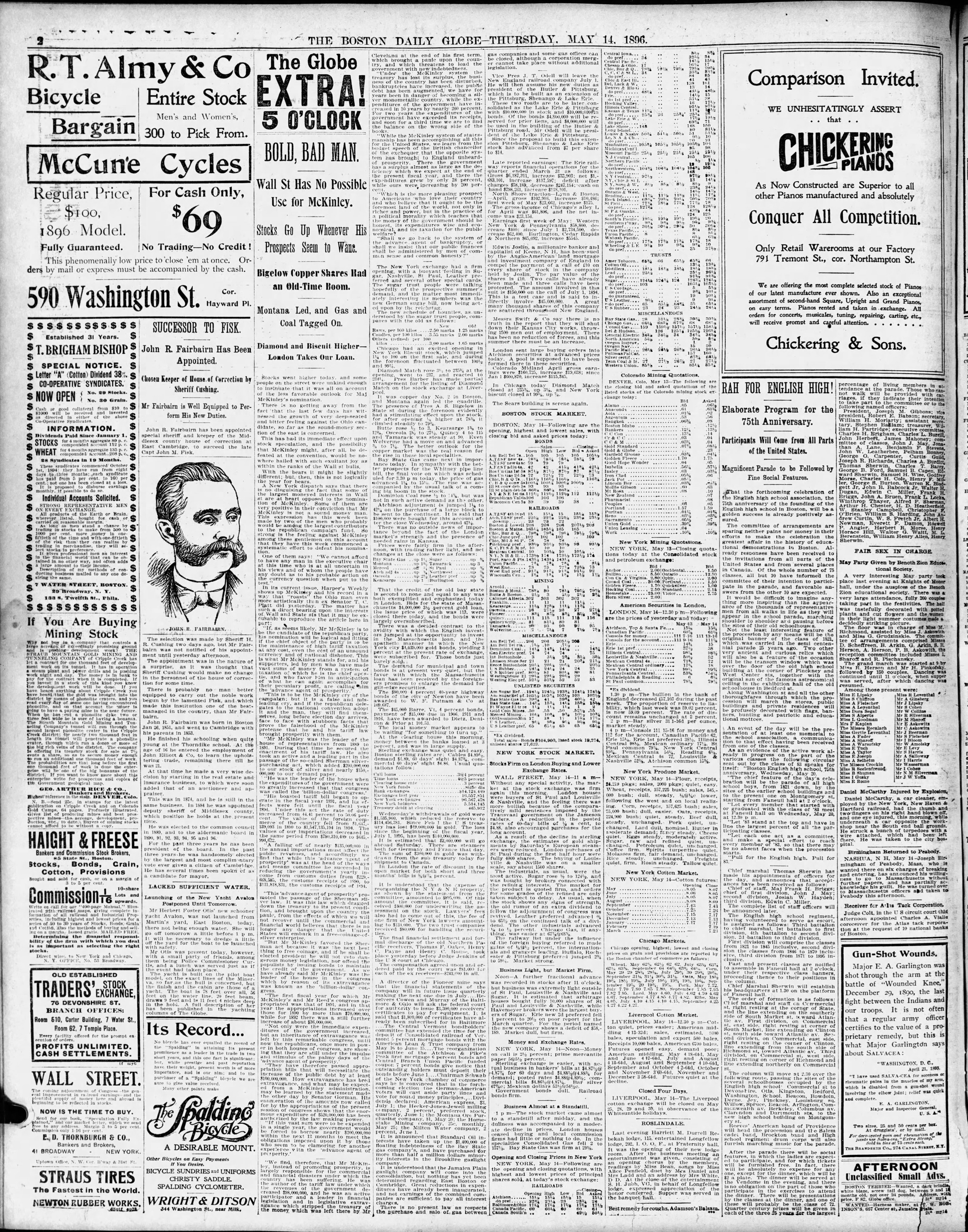
John R. Fairbairn. Reproduced from The Boston Daily Globe, Thursday Evening, May 14, 1896, p. 2.
A party of 40, including the Cambridge city government, county officials and newspaper men, were the guests of keeper John R. Fairbairn at the Middlesex county house of correction yesterday afternoon. Keeper Fairbairn was assisted in showing his visitors the institution by Deputy Master George D. Ford, Dr Utley and William H. Gray. The clean condition of everything connected with the institution was remarked by all. After the inspection the party went to the parlors of Mr Fairbairn’s house, where they were received by keeper and Mrs Fairbairn, and partook of a repast. Vocal and instrumental music was rendered by Alderman Peter B. Bleiler [!], Councilman Parry, Alderman Charles Conant and John B. Whoriskey (“Cambridge,” The Boston Daily Globe, Friday, August 28, 1896, p. 7).Two months earlier, on the evening of Friday, June 26, 1896, the future wife of the future author of The Author of “Trixie” read a poem, “The Mother of Sohrat,” as part of her high school graduation exercises at which
A large and fashionable audience was present. The hall and stage were beautifully decorated with potted plants, ferns and cut flowers, while the national colors were also handsomely displayed in the rear of the stage. Across the center of the hall was the class motto, “Loyal in Everything,” in ferns and ivy leaves. The graduating class was the largest for many years (“Largest Class for Years; Arlington H. S. Graduation Attended by a Large Audience,” The Boston Daily Globe, Saturday, June 27, 1896, p. 3).And a little more than a month after Fairbairn’s prison party, his son made his own way into a jail cell and, thus, into the notice of a newspaper man:
John E. Fairbairn, nineteen years old, son of John R. Fairbain, keeper of the House of Correction at East Cambridge, and president of the Cambridge Board of Aldermen, William Jackson and a young man named Farrell, all of Cambridge, passed the early morning hours of today in cells at Station 4. Jackson and Farrell were arrested for alleged drunkenness, while the more serious charge of assault and battery with a loaded revolver was brought against Fairbairn. It seems that about two o’clock this morning the three men were at the Chinese restaurant 38 Harrison avenue, all said to have been much under the influence of liquor. They were noisy and insulting, and Herbert O. Davis, a middle-aged Roxbury business man, who was sitting at a table near by with two women, requested them to desist from using indecent language. Fairbairn, it is alleged, jumped up and, drawing a revolver, threatened to shoot Davis.When I look at newspaper images of the elder Fairbairn, I am reminded of chapter XI of The Confectioners, where Jewel, Bean, St. John, Quilliam, Gruntle, and Meager have finished inspecting the site in Barnes of their future factory andIn the Municipal Court, this forenoon, young Fairbairn was fined $15 by Judge Dewey. His companions, who were charged with drunkenness, were released (“Three Cambridge Boys Arrested,” Boston Evening Transcript, Saturday, October 3, 1896, p. 2).
the adventurers were about to leave the scene of their expected triumphs, when two persons were observed approaching with measured tread. Their faces, wholly innocent of intelligence, expressed but one thing — a determination to do their duty. They were typical Englishmen of the official class. Badges glittered on their caps, and they seemed eminently qualified to make themselves as unpleasant as the law — ever generous to its minions in this respect — would allow (p. 164).The minions, evidently in the pay of that arch-monopolist Muddock, tell the sextet, “‘You’ve no business on this land. You’ve got to come along of us.’” As Quilliam’s vast wealth has been the means of acquiring the site for the future challengers of Muddock’s monopoly, “the adventurers” are on their own property, and so they ask the younger of the two officials — “who, from the rare fatuity of his face, was easily recognisable as the leader” (p. 164) — “‘What’s the trouble?’”
The magistrate turns out to be a certain Mr. Quirk.“We’ve had our eye on you for some time,” said the fellow. “Which your movements have aroused me and this gentleman’s suspicions. This here is a tumultuous meeting of three or more persons, assembled together to the terror of the people with the intent to assist each other in the execution of some enterprise of a private nature. I can’t rightly say if it’s a riot or a rout or an unlawful assembly, but the magistrate will decide that for us” (pp. 165–166).
Caine’s grandfather Nathaniel Caine, a native of Liverpool (though called “a Manxman” by at least one source), “was placed on the Commission of the Peace for the borough of Liverpool” in 1864, and “was subsequently made a magistrate for the county.” Some years earlier, at a time when Liverpool “teemed with casinos, cafés, singing, and supper rooms, with their corrosive influences; when law neglected to lay her heavy hand upon the doors of these dens and close them forever,” Caine’s grandfather, whose “only hatred was of vice,” established, on May 26, 1857, with himself as secretary and a certain John Cropper as president, an association “composed of highly respectable men, who are actuated by no other than kindly motives for the good of their town” — The Society for the Suppression of Vicious Practices:“My uncle!” cried Quilliam.
“Your prophetic soul, in fact,” said Jewel, with delicious humour. “Ha! ha!”
In order to explain the words of the Failure-at-the-Bar, it may be explained at this convenient breathing-space that the magistrate of the twenty-third arrondissement was, besides being the first humorist of his profession, the step-brother of Quilliam’s mother’s half-sister, a relationship which will be made perfectly clear by the following genealogical table:
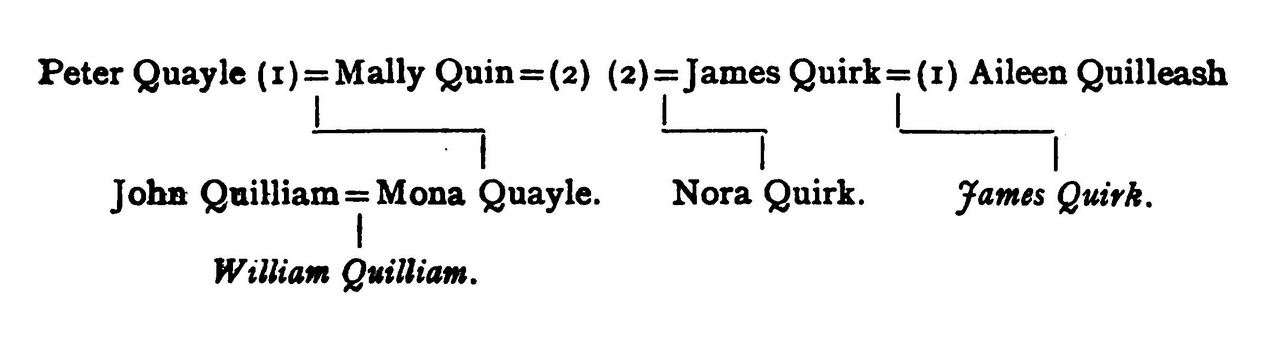
Although Quilliam had amused himself now and then by working out the connection between himself and the stipendiary to several thousand places of decimals, he had never met the old gentleman; but the party was no sooner in court than he hailed his uncle in affectionate terms and claimed the protection which one Manxman invariably accords to another. This led to a very funny exposition by Mr. Quirk, from the bench (punctuated by roars of laughter in court), of the intricate ramifications of the family tree of which uncle and nephew formed branches, and forty minutes thus passed by in the pleasantest possible manner, the only jarring note being the occasional attempts of Muddock’s minion to recall the representative of Justice to the matter in hand. But Mr. Quirk proved himself a rarely comic connoisseur in Keltic affinities, and quite refused to attend to business. The whole matter ended in his permitting the defendants to leave the court without a stain upon their characters, waggishly quashing the indictment, issuing a really side-splitting mandamus to attach the effects of the officer, committing him, with the utmost drollery, for malicious prosecution, and making a few very ironical remarks upon the conduct of the executive (pp. 166–167).
Not a stone was left unturned, and although the action of the law at that time was dilatory, they succeeded, by renewed exertions, in ridding the town of a great number of those moral cesspools, which had so long been an outrage and a disgrace to a civilised community.As for the Caine family tree, the “intricate ramifications” of which the fellow Manxmen Quirk and Quilliam joked about in court in The Confectioners may be hinted at as follows. Nathaniel Caine was the second son of Thomas Caine, who emigrated to Liverpool from the Isle of Man, where he had been born in Glenwillyn, Kirk Micael. Nathaniel Caine had three sons: William Sproston, the eldest (and father of the author of The Author of “Trixie”), Nathaniel; and Howard Thomas, the youngest. He also had four daughters: Phœbe, the eldest; Fanny; Ada; and Nora, the youngest. Phœbe married the Rev. Hugh Stowell Brown on April 26, 1865, in Liverpool; Fanny married Henry B. Murray, former captain of the 84th Regiment, on April 14, 1880, in Florence, Italy; Ada married William Barrow Turner on January 15, 1867, in Liverpool; and Nora died, unmarried, at Cannes on January 28, 1881. On March 24, 1868, William Sproston Caine married his sister-in-law Alice Brown, daughter of the Rev. Hugh Stowell Brown from his first marriage. Howard Thomas Caine married Florence Mary Gray on September 27, 1887, in London, and died, apparently childless, just five years later. I’m not sure exactly when Nathaniel Caine’s middle son Nathaniel Caine married, but he did accompany his father from the vestry of the Myrtle Street Baptist Chapel, Liverpool, when the elder gentleman married, eleven years before he died, his second wife, Helen Blackburn, on April 17, 1866. One of the sons of Nathaniel Caine the son of Nathaniel Caine was Caine’s cousin Nathaniel Caine who, though a year older than Caine, entered the University of St. Andrews the same year as Caine did, 1889 (Anderson 1905: 276; 285; 352), and went on to become a medical doctor and marry, on April 9, 1902, at St. Giles’ Cathedral, Edinburgh, Elizabeth (Lalla) Mackenzie of that city. Naturally, this marriage of a Liverpool man to a Scotswoman leads me thematically on to Caine’s fourth novel, The Victim and the Votery, “the necessary Ingénue” of which, Lalage Prendergast, wishing to plight her life’s happiness to a Scotsman, tells her father:We may briefly state the difficulties with which these gentlemen had to contend. There was opposition even on the part of the magistracy, a certain number of the justices regarding the special acts of Parliament passed to encourage the prosecution of owners of such houses as not sufficiently explicit. The same description of evidence before one magistrate frequently procured conviction, whilst before another it would result in acquittal. One of these cases was taken to the Court of Queen’s Bench, on which the point turned “Knowingly permitting to assemble,” when the judges gave their opinion that the actual disorderly conduct was not necessary to conviction, the “congregating for improper purposes” being sufficient; but such was the perversity of the stipendiary magistrate of that day that he issued an order to the police directing that no more informations should be laid against coffee-house keepers for permitting improper characters to meet and remain together.
Nothing daunted by this violent opposition, Mr. Caine and Mr. Cropper memorialised the Secretary of State for the opinion of the law officers of the Crown; the reply they received from Mr. Secretary Walpole being that such opinion was unnecessary, as “the statute,” said he, “seems quite sufficient to warrant a conviction on the facts, if they satisfy the magistrate that the meeting and remaining of the persons described are for an unlawful or immoral purpose.” These unflagging exertions were rewarded by the rescinding of the stipendiary magistrate’s order, and Mr. Caine lived to see the gradual but sure extermination of most of the haunts of vice which he had so long, so strenuously, so firmly endeavoured to crush; he lived to see our streets cleared to a great extent of perambulating vice […] (“The Late Nathaniel Caine,” The Liverpool Mercury, Monday, October 1, 1877, p. 6; “The Late Nathaniel Caine,” The Liverpool Weekly Mercury, Saturday, October 6, 1877, p. 4).
Sir Arthur Prendergast, recently retired from service in the British government at Madras, has only just returned to London. On the boat from Aden a certain Mr. Raeburn hands him a tract penned by a certain Dr. Spencer Barnes entitled, Modern Death Traps. No. 46. Beards.“Papa, I have some news for you.”
“What’s his name?” asked Sir Arthur.
“Oh!” said Lalage, “how did you know? Mama, you have told him.”
“Not a word,” said Lady Prendergast, who was not quite so much astonished by Sir Arthur’s question as her daughter. “But, Arthur, I’m sure you will like him.”
“I hope so,” said Sir Arthur. “Who is he?”
“You’ve met him,” said Lalage. “I didn’t know him very well at the time, but he asked me to introduce him to you. It was at the Foreign Office reception two years ago. You talked together for quite two minutes, and he told me he liked you awfully. Don’t you remember?”
“I’m growing old,” said Sir Arthur, “and my memory is failing. Otherwise I should certainly remember all the young men that I have met for two minutes at all the receptions that I have ever been to. Once more, his name?”
“He is of a very good family,” said Lady Prendergast, who felt panic taking possession of her, “and though he’s not very well off yet —”
“His name!” said Sir Arthur, in a tone which made further procrastination impossible.
“He is called Douglas —” began Lalage. Her voice failed her. She felt her father’s arm grow rigid.
“Douglas!” cried Sir Arthur. “A Scotchman?”
“That’s only his Christian name,” murmured Lady Prendergast, with incredible fatuity. “His other is —”
“Well,” thundered Sir Arthur, “what is it, Lydia? It might be Bugg, you’re so shy to say it.”
“Forsyth,” breathed Lady Prendergast.
“He is a Scotchman,” said Sir Arthur.
“He has no accent —” began Lalage.
“And he was at Oxford,” her mother responded.
“And he is so clever,” added Lalage.
“And such a nice fellow altogether,” antiphonized Lady Prendergast.
“And oh! so good looking,” concluded Lalage.
“You know my dislike to the Scotch,” said Sir Arthur. “Conceited, self-sufficient beggars. I will not have a Scotchman for a son-in-law, and there’s an end of it.”
Lalage removed herself to the other end of the sofa, and burst into tears (pp. 23–25).
Sir Arthur flushed an even deeper red than twenty-five years of Indian sun plus the present surrounding high temperature had been able to dye him.Thinking the abandoned pamphlet might perhaps be more diverting than the novel he had been reading before Mr. Raeburn showed up,“Is the bearing of this thing in any way personal?” he asked in a stern voice.
“Not in the slightest,” said Mr. Raeburn hurriedly. “I do but ask you to read it. I want you to give Dr. Spencer Barnes an impartial hearing, and, while you peruse his arguments, to forget that you ever had a beard. If, when you have done this, you can honestly state that you are still prepared to harbour bacteria beneath your chin, I will not say another word on the subject. I feel,” he concluded apologetically, “that I have taken a liberty; but it is done for your own good. The dangers you at present run —”
At this point Sir Arthur began to speak.
“Mr. Raeburn,” he said, “you are a Scotchman by your name —”
“Four generations back,” murmured the sanitarian, “my family lived in Pittenweem.”
“Four or forty,” cried Sir Arthur, gathering vigour as he went on, “there is one thing that never gets diluted out of Scotch blood, and that, sir, is impudence. Mr. Raeburn, I have all my life had an ineradicable dislike to your nation. You have not lessened it. You may go to the devil, sir, and carry your infernal tract with you.”
“I am very sorry,” said the other, “that you should take my well-meant remarks in this way.”
“I will take them in another way,” said Sir Arthur violently, “which will make you a good deal sorrier, if you yourself don’t take a third — and that’s down the deck.”
After this Mr. Raeburn could not remain with any kind of dignity. He left indeed with so much haste that he omitted to remove his tract. It lay on the deck, where Sir Arthur had thrown it, its title-page upwards (pp. 13–14).
After a furtive glance along the deck he stopped over his toes and pick up the tract. He began to read it, at first with a tolerant smile, later with a less assured countenance.On hearing from a shipboard acquaintance that cholera had been reported at their next stop, Suez, Sir Arthur borrows a razor from his steward and shaves off “the proud growth of fifty-seven years:”The statistics of Dr. Spencer Barnes were enough to shake the most hardened beardist. Ere he had read three pages Sir Arthur felt his flesh beginning to creep as, for the first time, he learned the incalculable number of deadly bacilli which he snuggled to his bosom. He laid Dr. Spence Barnes down with a snort of contempt, but he could not get rid of him. It cannot be denied that Dr. Barnes had a gift. His writing possessed in a marked degree the quality which is known in the advertising business as “pulling power.” In truth, as an author of “write-ups” Dr. Barnes must have made his mark in the world of commerce. He had chosen instead to adorn that of physical research.
It is rare that the poetic flame vivifies the dry bones of science, but when this happens the effect is stupendous (p. 14).
Once shaved, however, the precipitate knight had leisure to observe that so long as Mr. Raeburn should remain on board the vessel, he, Sir Arthur, was condemned to solitary confinement in his cabin. He had wholly omitted to consider this aspect of the case. In the first heat of resolve his high words with the hygienist had escaped his memory. To allow that gentleman so vast a triumph was beyond him. Had he been anything but a Scotchman, Sir Arthur would have faced it and carried it off as best he might. “But,” as he said to himself, “show myself in this condition to that sneering, pragmatical, insolent, haggis-eating Caledonian? Never, by gad!”It may be remarked by the astute reader that Mr. Raeburn had shown himself in no way sneering or pragmatical or insolent. He had certainly eaten no haggis in the presence of Sir Arthur, and Sir Arthur had not the shadow of a right to acuse him of a partiality to that barbarous but delectable meat. But to Sir Arthur all Scotchmen were pragmatical and insolent and sneering. They all ate haggis; they were all Jack lairds; they were all cocks of Highland middens. He made no distinctions. He disliked them all on instinct.
The prejudice is a strange one, but it dies hard. It never will, perhaps, so long as Scotchmen flourish where Englishmen starve (pp. 16–17).
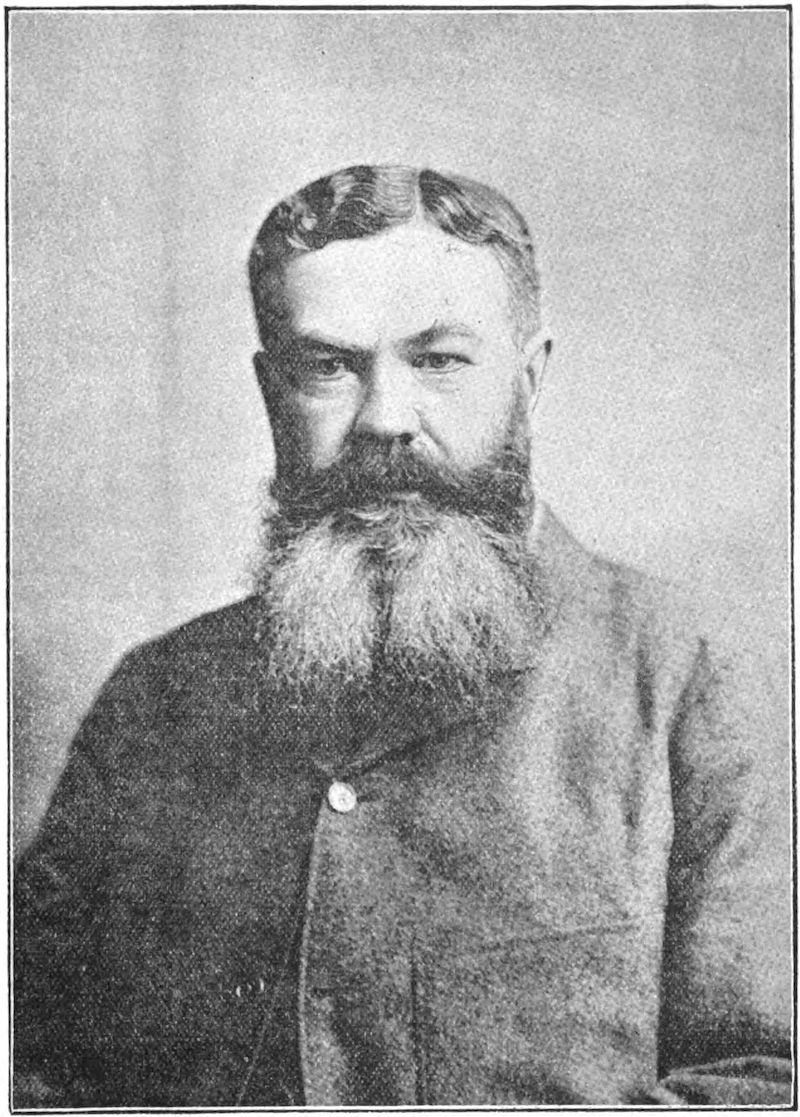
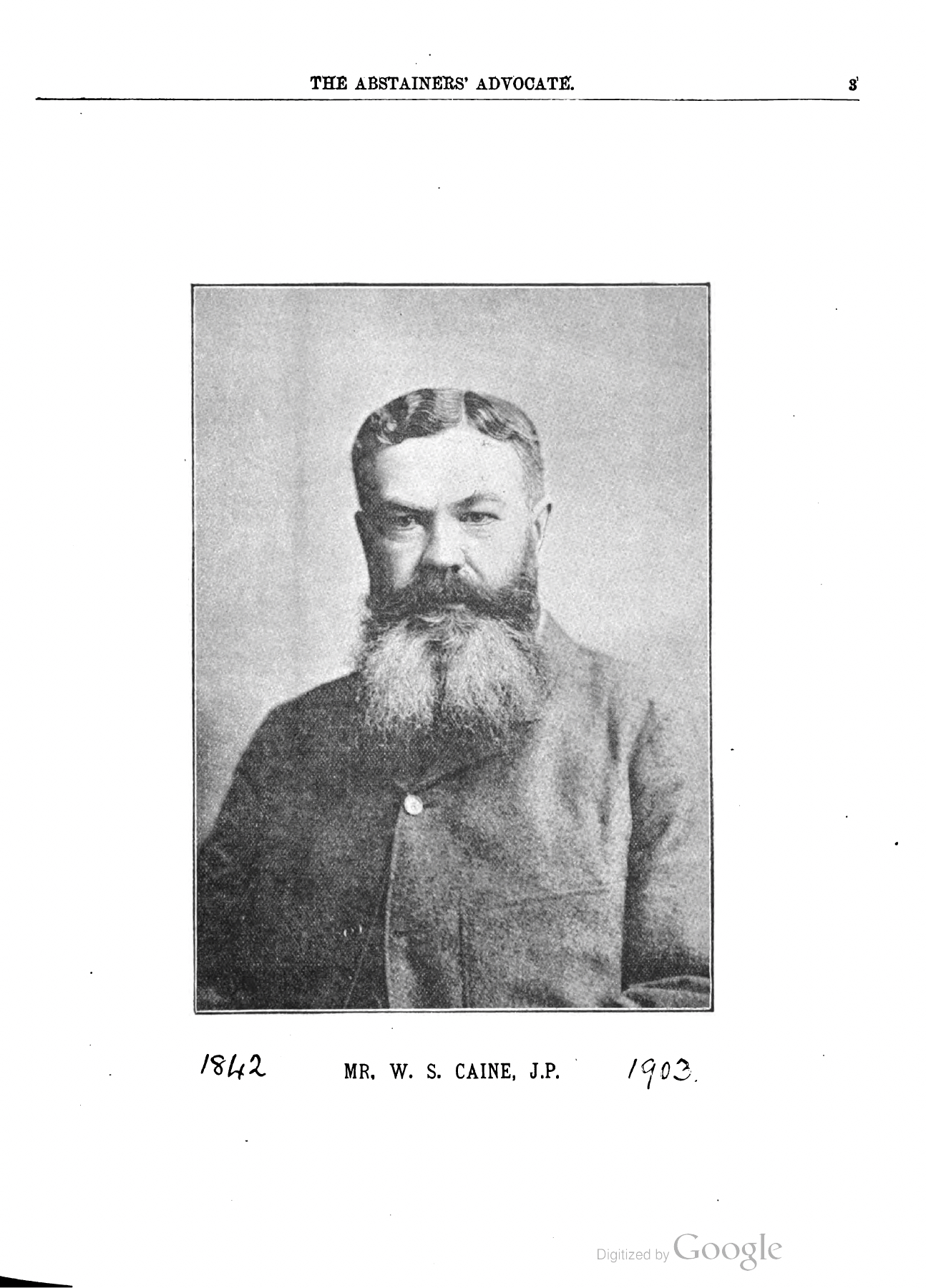
William Sproston Caine, father of the author of The Author of “Trixie”. Reproduced from The Abstainer’s Advocate, vol. 9, no. 1, January 1898, p. 3.
How Mr. Caine became a teetotaller is an interesting story. It happened in 1862, when he went to Oswestry to see a business customer. Having some time to wait, he made a haphazard purchase at a book shop, and soon found himself reading Mrs. Wightman’s “Haste to the Rescue.” Returning to his hotel, he ordered the customary half-pint of sherry, and assimilated book and sherry together. The book made such a profound impression on him that he there and then took a sheet of paper from his portfolio, wrote out a pledge, and signed it. A week or two afterwards he went to Shrewsbury, called upon Mrs, Wightman, and enrolled himself a member of her society, the same evening making his first speech on temperance at her weekly meeting. Afterwards he became president of the British Temperance League and the National Temperance Federation, and a prominent official of the United Kingdom Alliance (“Death of Mr. W. S. Caine, M.P.; A Notable Career; His Liverpool Connections,” The Liverpool Mercury, Wednesday, March 18, 1903, p. 6).Caine’s father’s biographer expands the anecdote and reduces the amount of sherry:
In his early years very slight things frequently turn the current of a man’s life, giving it a fixed and different course for the whole of his after time.Apropos of “a few impromptu words,” let me return to “the first time,” in The Victim and the Votery, “stern parent and prospective son-in-law were left alone together:”The fact that a customer upon whom Mr. Caine called at Oswestry in the spring of 1862 was out of town for a few hours, was the apparently accidental means of turning his mind to what was undoubtedly the cause closest to his heart throughout his strenuous career. […]
Sauntering down the street in Oswestry after his fruitless call, Mr. Caine, pausing opposite a bookseller’s window, saw a little book entitled “Haste to the Rescue,” by Mrs. Wightman. He knew nothing of either book or author, but judging it had some reference to mission-work, in which he was already interested, he purchased a copy, and with a glass of sherry by his side sat down in the hotel to read it. So powerfully did the book appeal to his sympathies that he tore a leaf out of his pocket-book, wrote out a temperance pledge, and signed it at once. He had drank his last glass of sherry. He always had the faculty of prompt decision and quick action, and never indulged in useless after-regrets, whatever the consequences were. This particular step he rejoiced in always.
“Haste to the Rescue,” at that date in its fourteenth thousand, is a little book of some 260 pages, which can be read through comfortably in an evening. It records in straightforward and unvarnished language the work of a clergyman’s wife among the working classes of Shrewsbury in the years 1858 and 1859. It is in the form of an appeal “to the educated classes,” in the true mid-Victorian style, to take up the total abstinence movement as the only certain way of saving the masses from their worst vices. The authoress declares that she had always hated teetotalism, and was only reconciled to it by the necessities of the case in her work among the poor. She began her labours under the stimulus of “English Hearts and English Hands,” and was guided in her methods by “Ragged Homes and How to Mend Them.”
Undoubtedly it would appeal very strongly to Mr. Caine to read passages like this which follows: “My husband, his curate, and Scripture reader in vain had cottage lectures in our parish for years. Not a man would attend them, only women did so; and now” (i.e. after the formation of Mrs. Wightman’s Total Abstinence Society) “one hundred and fifty men come, without being looked up, on Tuesday nights, and at least seventy men attend church twice every Sunday.” In spite of this experience she sorrowfully records that clergymen told her she was committing a sin, and condemned her and her work. As always, the priestly spirit is the enemy of progress and light.
Two or three days after reading the book Mr. Caine called upon Mrs. Wightman at Shrewsbury, was introduced to her weekly temperance meeting and said a few impromptu words to the members. […] (Newton 1907: 25–26).
“I’m obliged to you, Sir Arthur,” said Douglas Forsyth, “for helping me so far. I want to marry your daughter.”
“I think it right to tell you,” observed Sir Arthur, “that you may look for no further help from me on this matter. You must lay very convincing reasons before me if you wish to get my consent. I don’t — forgive my saying this, but it is best you should hear it — I don’t like Scotchmen.”
“Why?” asked Forsyth simply.
Sir Arthur’s prejudice against North Britons was wholly without logical grounds, as indeed any dislike to a whole nation must be. But it was none the less strong. He had acquired it early; he had nourished it all his life. And by this time it was rooted in him. He was even proud of it — Heaven knows why — though he could not defend it. He did not attempt to do so now.
“My reasons for disliking your countrymen,” he said, “are not germane to the matter in hand, which is your reason for supposing that you are a proper person to become my daughter’s husband. Convince me of that, Mr. Forsyth, and I will not let a well-founded distrust of your countrymen in general blind me to your individual worth.”
“To begin with,” said Forsyth, “Lalage loves me.”
“Speak of yourself, sir.”
“To speak of myself, then, I love Lalage, and I know that I can make her happy.”
“Of these matters,” replied Sir Arthur, “I cannot be a judge. I am waiting to hear your income, Mr. Forsyth.”
“I have three hundred a year of my own,” said Forsyth, “and by my writing I made something over two hundred and fifty pounds last year, and this year I am doing better still.”
Sir Arthur swallowed down his fury.
“Which amounts to, let us say, six hundred pounds a year at the outside, half of which is precariously gained,” he said, trying to speak calmly. “Do you suppose, sir, that I can let my daughter marry a man who has no more than three hundred a year assured to him?”
“Two people can live very well on three hundred a year,” said Forsyth. “The rest will be for luxuries.”
“Luxuries!” snorted Sir Arthur. “Boots and bread for the children, I suppose.” He jerked the stump of his post-prandial cigarette into the grate.
“By that time,” Forsyth rejoined easily, “I shall be better known. I have a novel which will be published next month, and I have several in manuscript in my drawer.”
“You remind me,” said Sir Arthur, “of a man who came to me once and asked for the loan of ten thousand pounds on the security of an option on a gold mine which he said was in Australia, but existed only in his imagination.”
He thrust the point of an expensive cigar between his teeth, preliminary to biting off its end.
“Ah,” said Forsyth complacently, “but my gold mine is there all right. Take it from me, Sir Arthur.”
This specimen of “damned insufferable Scotch conceit” caused Sir Arthur to wrench off the end of his cigar with such violence that he stripped away the better part of the outside leaf and was obliged to choose another.
“May I lend you a cutter?” asked Douglas civilly.
“No, sir, you may not,” said Sir Arthur. “Damned effeminate things. I beg your pardon,” he went on. “Let us try to discuss this matter calmly. No good end can be served by heat. Is there anything else that leads you to think yourself a suitable match for a Prendergast?” He lit his cigar and leaned back in his chair.
“I am a Forsyth of Lockgoram,” said Douglas. This was his trump-card. It had been impossible for either Lalage or Lady Prendergast to warn him. You cannot hint to a Highlander that his family may not be to every one’s taste.
Sir Arthur’s eye smouldered. He placed his elbows on the table and emitted a vast cloud of smoke.
“And where,” he asked deliberately, “where is Lockgoram? And who” — he blew on the point of his cigar — “who are the Forsyths?”
You will tell me that Sir Arthur in saying this proved himself to be no gentleman. I admit the questionable taste of his words, but I would remind you that he was very much annoyed with Douglas Forsyth and that hitherto Forsyth had remained perfectly cool. When an opponent refuses to lose his temper almost anything may be forgiven a man. Short of the first fumblings on the piano of infancy next door, there is nothing more exasperating to a high-spirited gentleman. The ample apology which he made in his next breath is also to be reckoned in Sir Athur’s favour.
“I beg your pardon again,” he said, as Forsyth rose to his feet with a white face. “I was carried beyond courtesy. I fear I have wounded you, and I would not do that for anything in the world. You will admit that hitherto I have tried my best to exercise self-control. Consider my words unsaid, I beg you, Mr. Forsyth, and let us endeavour to talk this matter over quietly.”
“Sir Arthur,” said Douglas, “I very earnestly want us to be friends. I am content to believe that your incredible words were not spoken. I am not so foolish to suppose that all the world knows the precise locality of my family’s country. It was your tone I resented. I will assume that the tone was one of merely polite inquiry and for your information I will tell you that Lockgoram is on the west coast of the Isle of Bhachancoolin, and that the Forsyths have been there for a thousand years.”
He sipped his port as one who had made a proper speech (pp. 27–31).
Also bring in Caine père's connection to Middlesex:
In early 1884, “under circumstances which are now obscure, the party whips suggested to Mr. Caine that he should surrender his safe seat at Scarborough, and become candidate for the undivided county of Middlesex at the next election” (Newton 1907: 101). He meanwhile continued to represent Scarborough and on November 19, 1884, accepted the appointment to become Civil Lord of the Admiralty, an appointment which spurred the Conservative party to demand another election in Caine’s constituency. He was duly re-elected, but his majority of 193 votes over the conservative opponent was far less that it had been in 1880, when it was 484. As the Derbyshire Advertiser and Journal noted, “the fact that Mr. Caine intends to retire from the representation of Scarborough at the next general election, when he will contest Middlesex, may easily account for the falling off in the number of his supporters.” That general election took place December 3, 1885, when Caine unsuccessfully contested, not “the undivided county of Middlesex,” but its Tottenham division, since a redistribution bill had in the meantime divided up that county into seven different constituencies.
Also: Chelsea (Dilke's residence and constituency) is in Middlesex county
Confectioners: general electrocution : general election
[Pilkington, The Confectioners, The Pursuit of the President; The Victim and the Votery]
[pic of Caine' mother seated at desk from Newton 1907 — already used in § 9]
Description of Miss Waugh from Pursuit of the President could be considered an amalgam of Caine’s mother and wife: “She was quite the most handsome woman (built on very large line) that I had ever seen; fair as the day, with a bright auriole of hair round her face; great, wide open, dark blue, glowing eyes with dark lashes and brows, nobly turned chin and neck, large regular teeth and a complexion like snow and rose” (pp. 51–52).
Pursuit of the President starts on the eve of the Whitsuntide holidays (p. 138); recall that Edith Gordon Walker was performing with the Ella Snyder Company as part of the Whitsuntide holiday festivities at the Kursaal in Bexhill-on-Sea, from Monday, June 12, to Saturday, June 17, 1905 (§ 5).
Caine dedicated The Victim and the Votery "To Amy," that is, to Amy Boydell, the female protagonist of his previous novel, The Pursuit of the President; and, based on the her physical description and intellectual interests (for which see § 5), as well as her not being ashamed to serve the "Cause of Sheer Frivolity" (§ 9), I believe that Amy Boydell could be said to be "modelled after," as it were, Edith Gordon Walker; there's also Miss Ethel Waugh, President of the Womanhood Suffrage League, in both books; and, in the Pursuit of the President, the housekeeper Mrs. Walker. In The Pursuit of the President, when Cattermole first meets Miss Amy Boydell, she is holding a piece of paper (cf. discussion of A Scrap of Paper in § 8).
[Include in Pursuit discussion:]
Smith’s Magazine reported that Walker’s “first chance came in the drawing-room of Baroness Battersea’s mansion at Marble Arch […] Miss Walker was invited by the baroness to entertain a company of distinguished guests, and the fact that the hostess is a daughter of the powerful family of Rothschild no doubt contributed largely to the clever débutante’s subsequent success” (quoted in full in § 4). Baroness Battersea was Constance Flower née de Rothschild. Her husband, Cyril Flower aka Baron Battersea, was a Liberal MP, 1880–1892, i.e., during the time Caine’s father was also (except for a four-year detour as a Liberal Unionist) a Liberal MP. Their London mansion in the Marble Arch area was called Surrey House, and Lady Battersea was a prominent activist in both the temperance and women’s advancement movements; her name often figures in the same newspaper reports in which those of Caine’s parents may be found. Hence, it is not unreasonable to suppose that Caine may have been in attendance at that “drawing-room of Baroness Battersea’s mansion at Marble Arch;” a supposition made even less unreasonable in light of Mr. Cyril Flowerdew’s statement in The Pursuit of the President — “We were shown into a spacious and handsomely furnished drawing-room, where we found, lying upon a sofa, the most beautiful girl that I had ever seen.” Hence, also, and especially given that Cyril Flower was apparently involved in a hushed-up “scandal of the Oscar Wilde type” in 1902 (which I will discuss in a subsequent section), rather than a simple, slightly farfetched homage to Wilde, Flowerdew is a more complex allusion to both Wilde and Lord Battersea and also, thus, Caine’s first encounter with Walker, which took place, say, in late 1904 or early 1905.
Lady Battersea on Surrey House, that salon of Gladstonianism:
let me say a few words about our life during the thirteen years he sat in the House of Commons — I would even say our home-life, because this is no attempt at a political history, over which my pen would stumble. I should like to linger a little over some of the names that meant so much to us in those old days, and that seem gradually to be fading away into the mists of the past. To begin with, I think I may here put into words what I often felt, namely, that although Cyril was deeply interested in the House of Commons, and although he was a most popular member both there and in his constituency, his special talents did not lie in political work. His were not so much the attributes of the statesman as they were those of the man of artistic taste. Thus Surrey House had to be beautiful and attractive as Chapter well as spacious, and Cyril spared no pains in its decoration, hoping that the contemplation of the glorious old marbles, fine colouring, and artistic designs would, if only for a short space of time, arouse and satisfy the sense of beauty in his many and varied guests. And varied, indeed, they were ; of this there could be no doubt. Surrey House was not only a meeting-ground for the Liberal party, but it opened its doors to musicians, artists, writers, philanthropists, as well as to many unknown to fame, and sometimes unknown to the hostess herself. Thus on one occasion, in the middle of an evening party, I was greatly puzzled by the appearance of a guest whom I could not place anywhere in my recollection, nor could any one else assist me in cataloguing the newcomer. I called my husband aside, and told him in hushed tones that I thought a burglar had crept into the house, and pointed to the individual in question. Cyril could hardly contain his amusement, but, reassuring me quickly upon the respectability of our guest, waited until the early hours of the morning to explain that the said gentleman, whom we none of us knew, had been asked at the request of a young lady with whom my husband had been riding in the Row, the lady being very anxious to meet the gentleman in the house of a third party. A proposal and an acceptance took place that very evening, followed by a happy marriage (Battersea 1922: 194-195).Was that young lady Edith Gordon Walker; and that gentleman — the author of The Author of “Trixie”??!!??
quote from Pease (1932: 254–255) about Cyril Flower: [from § 2:] on one occasion Flower won the Parliamentary Steeplechase on a horse named Home Rule :
The pursuit by motor car of the President of the Board of Enquiries into Army Scandals begins when the pursuers spot their prey from Westminster Bridge as the latter is escaping by boat across the Thames from Westminster to “the Surrey Shore,” i.e., Lambeth (I reproduce the incident in § 17). It was in Lambeth, at Christ Church on Westminster Bridge Road, that the first part of the funeral for Caine’s father took place on Thursday, March 19, 1903:
Mr. Asquith and a very large number of the Opposition came across Westminster Bridge yesterday to attend the funeral of Mr. W. S. Caine, and they were rewarded by one of the most impressive services I have ever been present at. Here, under the graceful roof which has echoed the tones of Newman Hall and F. B. Meyer, Dr. Clifford paid his tribute to the dead in faltering, at times inaudible, voice, and the great congregation which filled the church in every part appreciated his emotion. The best place on the floor of the edifice was reserved for members of Mr. Caine’s own missions, who sat in a solid body three hundred strong under the dome, and the temperance bodies turned out in great force for the occasion (“Our London Letter; Mr. Caine’s Funeral,” The Citizen [Gloucester], Friday, March 20, 1903, p. 3).The polished oak coffin with brass mountings containing the corpse of the father of the author of The Author of “Trixie” had earlier that morning been taken by glass hearse from the Caine residence at 42 Grosvenor Road (recall that Ethel Waugh, President of the Womanhood Suffrage League, resides on Grosvenor Street) to Christ Church, following the service at which it was transported by special train to Brookwood Cemetery, Woking:
Had Mr. Caine’s funeral taken place at Kensal Green or at Hampstead there would have been a large concourse of people eager to pay the last tribute of respect to one who had laboured so well for his fellows. It was evidently the wish, however, of the family that there should be no public demonstration at the graveside, for even on the special train which conveyed the remains of the deceased accommodation was limited to close relatives, and a very few intimate private friends. The arrangements of the Necropolis Company are as perfect as they well can be, and it took very little time to transfer coffin and wreaths from the hearse on their arrival at Necropolis Station, in the Westminster Bridge road, for the mourners to be shown to their carriages and the train to be on its way to Woking. By half-past two the train had arrived at Brookwood, and from thence it was shunted directly into the cemetery, where an open glass-hearse was in waiting. The coffin, with its covering of wreaths, was reverently transferred to this, and a start was made through the winding paths of the cemetery to the newly-dug grave, the little company of sorrowful mourners, about thirty in number, following. Besides the members of the family there were at the graveside Mr. Souttar, long associated with Mr. Caine in philanthropic and religious work, Mr. Millard, who has been in charge under Mr. Caine of the work at Wheatsheaf Hall, and under whom the mission will now be continued permanently, Mr. Job Jones, who is not a little proud of having been Mr. Caine’s first convert to teetotalism, Dr. Clifford, the Rev. J. Williamson, of Cardiff, and a few others. The grave is in a part of the cemetery not as yet peopled with the dead, almost a wild looking spot among the heather and the yews, far away from the gravel paths and the ordered rows of memorial stones. There seemed, as one of the mourners said, a touch of unconventionality not unwonted to the character of the man who was being, with so much regret, borne to his last resting place. The loneliness of the spot made the scene at the last more impressive. A temporary shelter had been built up by the side of the grave in case of inclement weather, but though the sky was dull and threatening, and the air chilly, there was no occasion for its use. On the coffin lay one wreath, a plain circle of laurels from the widow, and this is [sic] due course was lowered into the grave. The service was read by the Rev. Dr. Clifford, and the Rev. J. Williamson offered prayer and pronounced the Benediction. Nothing could have been simpler than the ceremony at the graveside, but all present must have felt it infinitely touching (“The Late Mr. W. S. Caine, M.P.; Funeral at Woking; At the Graveside,” The West Briton and Cornwall Advertiser [Truro], Thursday Evening, March 26, 1903, p. 7).
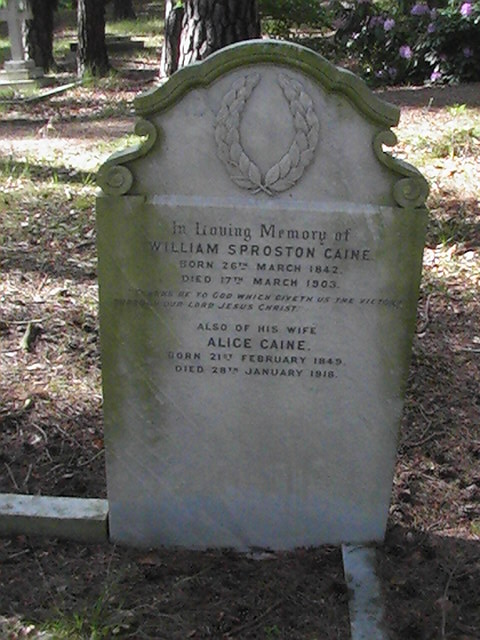
Tombstone of William Sproston Caine and Alice Caine née Brown, father and mother of the author of The Author of “Trixie”. From findagrave.com.
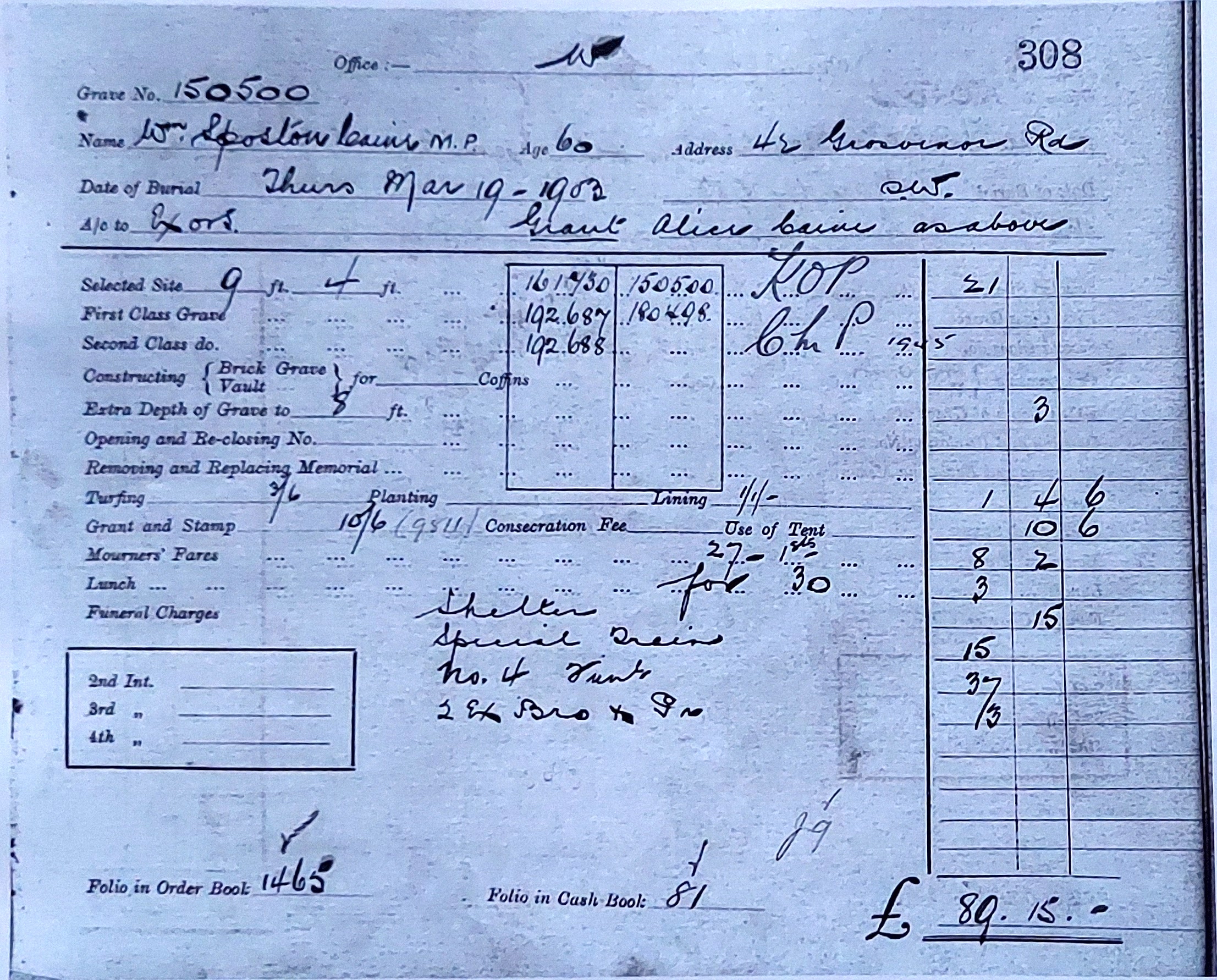
Burial document of William Sproston Caine, M.P., supplied by the Brookwood Cemetery Office, March 26, 2026. The rectangle showing the alignment of the graves in the “Allotment Caine” was obviously added much later.
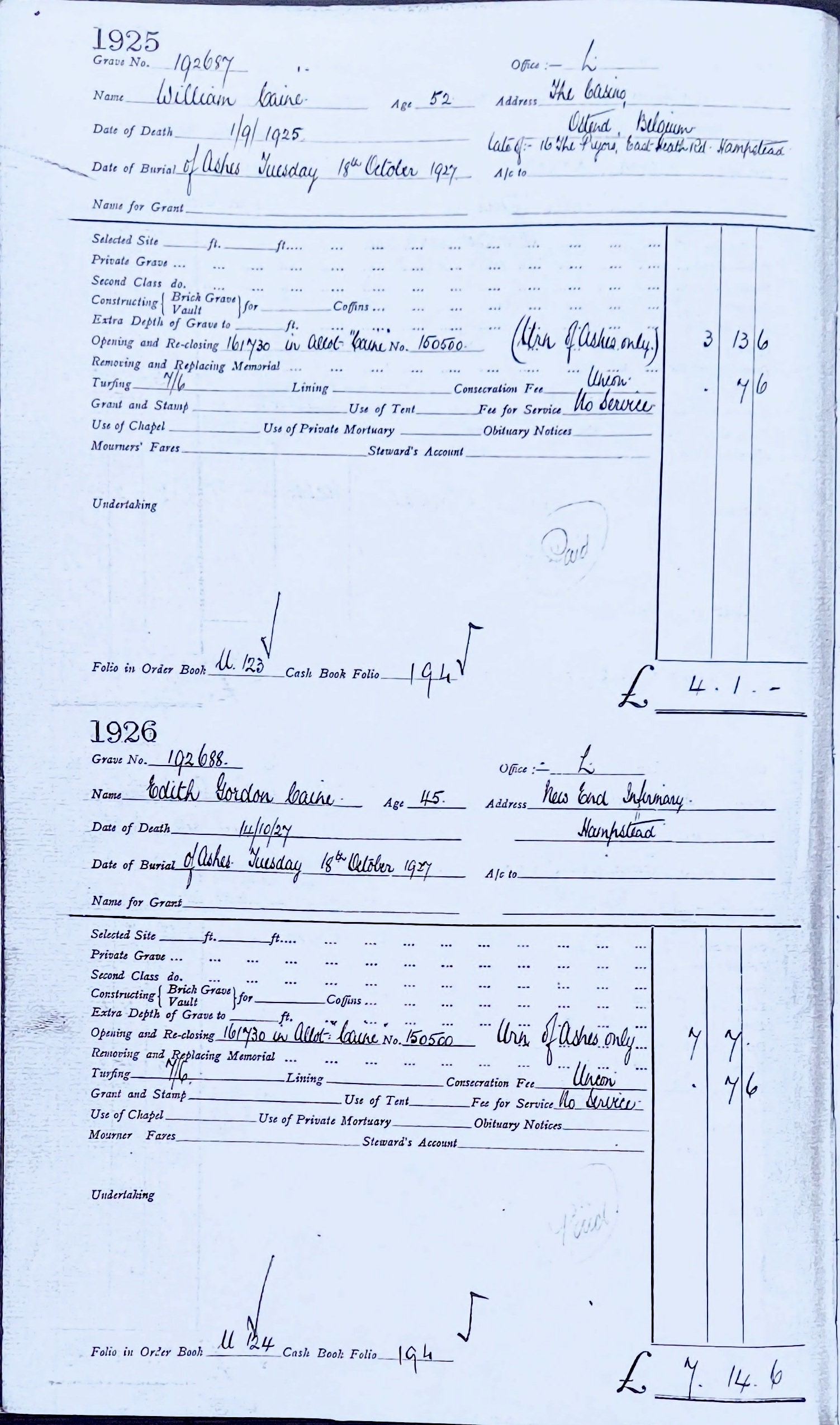
Burial document of William Caine and Edith Gordon Caine née Walker, supplied by the Brookwood Cemetery Office, March 26, 2026.
News of the tragically sudden death of Mr. William Caine in Belgium came as a great blow to his many friends and admirers. He was a novelist and artist, with a unique sense of humour, but that he had an equally powerful sense of drama was proved by his remarkable book, “The Strangeness of Noel Carton.” A genial host and a quiet benefactor of less fortunate brethren of the pen and brush, the passing of Billy Caine will be sincerely regretted by all who knew him.While that published the same day in The Evening Standard reads
Mr. William Caine, whose death at the early age of 52 is announced to-day, was known to the public as a writer with a considerable gift of humour. He was also in private life a humorous draughtsman, and the caricatures which he drew “for fun” were extremely able in their way.The cemetery document furthermore states that Edith Gordon Caine died age 45, which belies the statement carved on the tombstone, “Born September 29th, 1883,” a date which is also contradicted by the two newspaper items about “the Little Rosebud of the South” published in 1882 and reproduced in § 10 and by the item reproduced in § 5 stating that “the Rose of Arlington” was 22 in 1902. The spark which the author of The Author of “Trixie” used to write with was most likely 47 or 48 when she was extinguished forever.Mr. Caine was keenly interested in the arts. He was a great admirer of the humorous drawings of H. M. Bateman, and had a large collection of originals in his Hamstead flat, where there was also a Chinese bedroom with panels by George Sheringham. He also collected works by the draughtsman-sculptor, Vernon Hill, and I remember he showed me his particular pride, a toothbrush handle carved into a nymph by Hill during idle moments on active service.
I’m not saying that there’s any evidence of Walker’s hand in any of Caine’s books; I’m saying there’s evidence of her presence in Pilkington, The Pursuit of the President, and The Victim and the Votery, and of both her presence and her mind in The Confectioners (as her mind is also present in Caine’s books from Boom! onward; see § 10).
In an exemplar of The New Foresters sold on abebooks.com by T S Hill Books (9 Falkland Road, Dorking, RH4 3AB, U.K.), there is a presentation dated April 1924 to Edward Michael William Hearne and his wife Gladys, signed "from William & Gordon Caine" which could also be read as "from William Gordon Caine" [image in Images/NewForesters-signature.jpg]
Pilkington as dancer
Pilkington: Indian character therein; parody of writings about Thuggee: W. S. Caine's involvement with India, friendship with Naoroji; “Mr. Caine went more than once to India, and devoted himself with much zeal to the comprehension and promotion of native aims” (“News of the Day,” The Liverpool Daily Post, Wednesday, March 18, 1903, p. 4); Caine's own Indian colleagues at Balliol and Middle Temple; quote more from Newton on W. S. Caine and India
did George Augustus Pilkington (né Coombe), Liberal member for Southport, who voted with the Separatist or Gladstonian Liberals on June 8, 1886, division of the Home Rule Bill, was married to Mary Elizabeth Pilkington, daughter of James Pilkington, Liberal member for Blackburn, who was robbed and garroted (but apparently not killed) in Westminster, London, in 1862; see The Times, July 18, 1862, p. 5; in June of same year, boat named the James Pilkington, from Liverpool, was wrecked off Bombay, reported in papers in July 1862 — bring in boats named after the fathers or relatives of both Caine and Walker].
"Opium den scene" : parody of Sherlock Holmes; send-up of British Orientalist racism; quote W. S. Caine on Japan; W. S. Caine's observations, notes on opium trade
Daily News, Wed, Nov 18, 1885 ·Page 3: W. S. Caine on advocating that "the franchise should be extended to women householders" when campaigning (unsuccessfully) for the Tottenham division of Middlesex
Yorkshire Evening Argus Sat, Jun 25, 1892 ·Page 1: on W. S. Caine and women Liberals, and women's suffrage
Also: part of Caine's East Bradford platform: extension of franchise to women [in Jan. 13, 1892, issues of papers]
Cambridge Chronicle Fri, Jul 04, 1890 ·Page 4: on W. S. Caine's forgettable career as Civil Lord of the Admiralty, and boon to Unionist party on his defection from it…
¿Put in?: Magistrate Nathaniel Caine imposing an unreasonable fine on some for cutting ads out of newspapers Liverpool Weekly Courier - Saturday 21 March 1868 p. 6 (this took place a week before his son W. S. Caine married Alice Brown) Liverpool Weekly Courier - Saturday 28 March 1868 p. 5
[Cut from § 2:] In § 10 I will quote a more recent writer who calls Caine’s The Confectioners “ersatz Chesterton” (Bleiler 1990: 116). In that context I will be forced to try to read a couple of Chesterton’s books and compare them with Caine’s, in order to show how, for instance, the tone of Chesterton’s books, and his intrusive authorial I, are precisely the kind that Calvino would not want to encounter — superior, moralistic, mocking, possessing a simple answer to problems rather complicatedly expressed — while Caine’s is precisely what Calvino was looking for.
- John R. Fairbairn. — “Fairbairn Succeeds Fisk; Chosen by Sheriff Cushing as Keeper of House of Corrections,” The Boston Daily Globe, Thursday, May 14, 1896, p. 2; “Successor to Fisk; John R. Fairbairn Has Been Appointed; Chosen Keeper of House of Correctiion by Sheriff Cushing; Mr Fairbairn is Well Equipped to Perform His New Duties,” The Boston Daily Globe, Thursday Evening, May 14, 1896, p. 2; “New Sheriff of Middlesex; Capt John R. Fairbairn, Promoted Owing to Death of Sheriff Cushing, Sworn in Today,” The Boston Globe, Saturday, June 10, 1899, p. 3; “One Contains Public Bequests; Wills of Julia A. Cotting of Boston and Sheriff Cushing of Lowell Filed Yesterday,” Boston Evening Transcript, Friday, June 16, 1899, p. 10; “Not a Ballott Cast; Republicans Select Ticket by Acclamation; Middlesex County Convention of One Mine; Francis Bigelow Chosen as Commissioner; Sheriff Fairbairn Given a Renomination; Geo. A. Sanderson of Ayer Named as District Attorney,” The Boston Globe, Thursday, October 3, 1901, p. 8; “Friend of Newspaper Men; Sheriff John R. Fairbairn, Courteous and Affable, but at Same Time a Strict Disciplinarian,” The Boston Globe, Monday, March 19, 1906, p. 4; “Tucker Is Electrocuted, Meets Death Bravely; [etc.],” The Boston Globe, Tuesday, June 12, 1906, pp. 1 & 3; “Sheriff John R. Fairbairn of Middlesex County Dies,” The Boston Globe, Thursday, December 7, 1933, pp. 1 & 16.
- Nathaniel Caine. — Information culled primarily from “The Late Nathaniel Caine,” The Liverpool Mercury, Monday, October 1, 1877, p. 6; and “The Late Nathaniel Caine,” The Liverpool Weekly Mercury, Saturday, October 6, 1877, p. 4. On his being a native of Liverpool, see “Death of Mr. Nathaniel Caine,” The Liverpool Weekly Courier, Saturday, October 6, 1877, p. 5: “Liverpool was his native town, but his ancestors came from the Isle of Man.” See also the final sentence of “Liverpool Worthies; Nathaniel Caine,” The Liverpool Mercury, Monday, October 19, 1891, p. 5: “His death occurred at Broughton-in-Furness, but his body was brought to his native town and was interred at the Necropolis, his memory to live in the annals of Liverpool and in the history of that great effort by which men whose hearts were steeled against the dictates of humanity had to bow before the presence of law.” Nathaniel Caine was called “a Manxman” in “Notes 1884; Official Appointments,” The Manx Note Book, Number 1, January 1885, p. 33. On the founding of the Society for the Suppression of Vicious Practices, see “The Social Evil; Society for the Suppression of Vicious Practices,” The Liverpool Mercury, Friday, May 28, 1858, p. 7 and “Liverpool Life: Past and Present; VI. ‘The Amphi,’ and ‘The Hop,’” The Liverpool Weekly Mercury, Saturday, December 24, 1892, p. 6. On the composition of said society, see “Correspondence; The Social Evil,” The Liverpool Mercury, Thursday, June 10, 1858, p. 4 (letter dated Wavertree, May 31, 1858, from “J. H.”). On Nathaniel Caine’s offspring, his second marriage to Helen Blackburn, etc., see “The Late Nathaniel Caine,” The Liverpool Mercury, Saturday, October 6, 1877, p. 8; “Births, Marriages, and Deaths; Marriages,” The Liverpool Mercury, Thursday, April 27, 1865, p. 3; “Marriage of Nathaniel Caine, Esq.,” The Liverpool Mercury, Wednesday, April 18, 1866, p. 5; “Marriages and Deaths; Marriages,” The Manchester Weekly Times, Saturday, January 26, 1867, p. 7; “Marriages,” Bassett’s Daily Chronicle (Limerick), Thursday Morning, April 22, 1880, p. 1; “Births, Marriages, and Deaths; Deaths,” The Liverpool Mercury, Saturday, January 29, 1881, p. 6; “Marriages,” Leamington Spa Courier, October 1, 1887, p. 4; “Births, Marriages, Deaths; Marriage,” Perthshire Advertiser, April 11, 1902, p. 2. See also Newton (1907: 9; 12). Further complicating matters is that William Sproston Caine (1842–1903), the father of the author of The Author of “Trixie”, was named after William Sproston Caine (1803–1876), the former wine merchant and never-married elder brother of Nathaniel Caine (1808–1877), the father of the father of the author of The Author of “Trixie”. See “Partnerships Dissolved,” The Morning Chronicle, Saturday, January 8, 1848, p. 4: “William Sproston Caine and Nathaniel Caine, of Liverpool, iron merchants” — and “Death of Mr. Nathaniel Caine,” The Liverpool Weekly Courier, Saturday, October 6, 1877, p. 5: “his brother, who never married, being his partner.” Also, the eldest sister of the author The Author of “Trixie”, Hannah Rushton Caine (1869–1951), was named after Hannah Rushton (1812–1861), the mother of the father of the author of The Author of “Trixie”. See “Death of Mr. W. S. Caine, M.P.; Biographical Sketch,” The Western Morning News, Wednesday, March 18, 1903, p. 5 as well as the entries for “Caine, Nathaniel (1808–1877)” and “Caine, William Sproston (1842-1903)” in Cumbrian Lives: Towards a Dictionary of Cumbrian Biography [https://www.cumbrianlives.org.uk/lives-index.html].