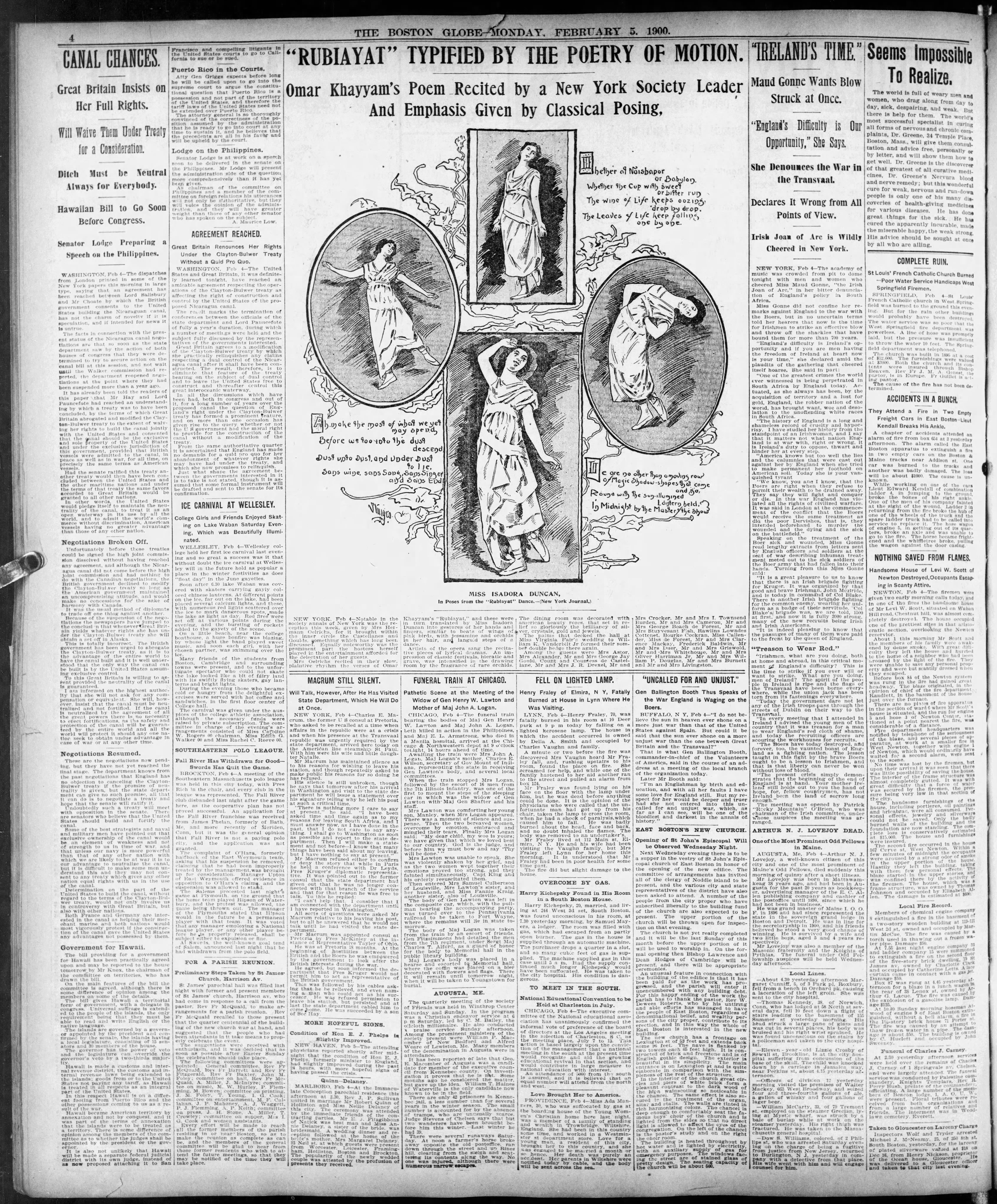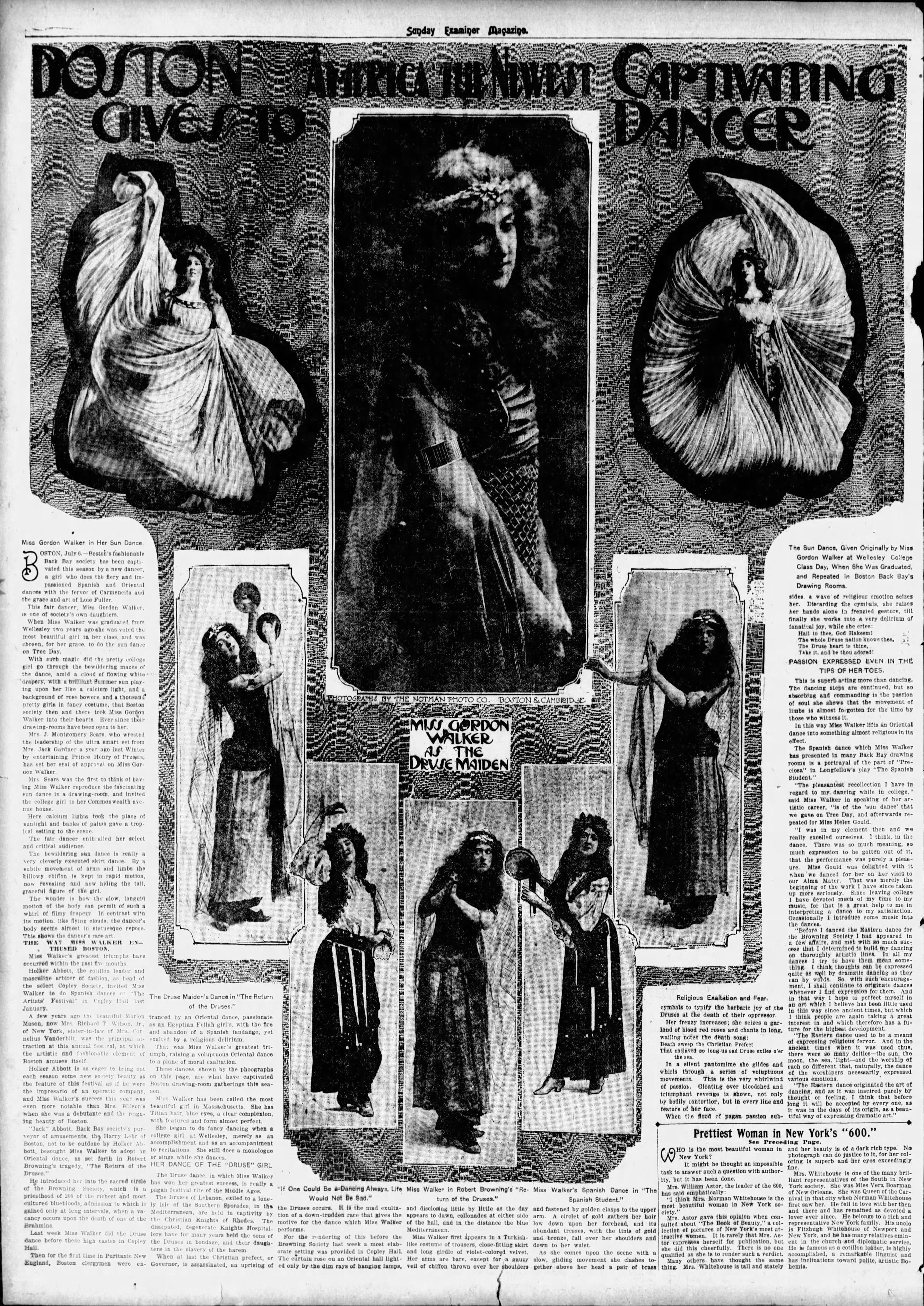
“Boston Gives to America the Newest Captivating Dancer,” American Magazine Supplement of the San Francisco Examiner, Sunday, July 19, 1903, p. 2.
Did I write you that one night when I had atropine in my eyes Hutch & Neith brought two Caines to spend the evening with me. I talked to them for hours but never saw them. Sent ’em to Stieglitz’s on the following, & then they left & to this day I don’t know what they’re like. Hutch had got them from you, & at a certain restaurant called Polly’s they had all met, along with Stephen Haweis who has what his wife calls “an honest job” over here — (it’s painting lifesized screens for a certain Mrs [Benjamin] Guinness (ale) who gives em to her friends for wedding presents signed by her.)Mr. and Mrs. Caine arrived in New York harbor on the morning of Friday, April 17, 1914, aboard the Cunard liner Lusitania, which had made the voyage from Liverpool in 5 days, 9 hours, and 53 minutes. Their visit had been announced well in advance — as had the erroneous association with Hall Caine. According to The New York Times Book Review, for instance,Mrs. Caine told me, without embarrassment (as I couldn’t see her) that she supplied the spark her husband uses to write with, also to any others who temporarily need it. “Her job was merely to inspire,” as Reed sings in the “Day in Bohemia.” But that kind of vampiring seemed to suit her very well for she seemed blooming. Husband seemed a little dissolved but still having form.
They were enjoying our current revolution — the new religions, the Free Speech Fight, & the censoring of Moving Pictures — & Stieglitz’s subsequently so you can see they had jumped right into everything (Everett 1996: 227).
William Caine, author of “Hoffman’s Chance” and “The Irresistible Intruder,” will soon visit the United States. He is a relative of Hall Caine (“In a Few Words,” The New York Times Book Review, February 8, 1914, p. 62).The Caines’ impending visit continued to be announced even after they had been in the US for some time. For instance,
William Caine, whose “The Irresistible Intruder” has just been published, will soon visit New York. Mr. Caine’s father was a member of Parliament and also a member of Gladstone’s government. Mrs. Caine, who accompanies her husband, is a Bostonian (“Over the Sea,” Los Angeles Sunday Times, Sunday Morning, May 3, 1914, part III, p. 6).And:
Mr. and Mrs. William Caine (Gordon Walker) of London, are making their first visit here since their marriage about ten years ago. They are to pass a few weeks at the North Shore. Mrs. Caine is a graduate of Wellesley, class 1900. Mr. Caine is a playwright, and the author of several books (“Personals; First Visit Here in Ten Years,” Boston Evening Transcript, Friday, June 12, 1914, p. 13).In addition to Polly’s Restaurant at 137 MacDougal Street and Mabel Dodge’s flat on the second floor (American reckoning) of the house at 23 Fifth Avenue, both in Greenwich Village, the Caines are known to have visited the offices of the Musical Courier in Midtown:
William Caine, the English novelist, author of “The Irresistible Intruder” and other works which are frequently quoted and reviewed in the American newspapers, called on the Musical Courier last week on his arrival from London. Next to playing the piano by hand, after the manner of Busoni, Godowsky, Bauer, Borwick and other manual laborers, William Caine thinks that machine made piano playing ranks high. In his early days, before he had expanded into a novelist, he wrote numerous lyrics for comic operas. Mrs. Caine, who hails from Old Kentucky and who is an expert harpist — playing the instrument by hand and not by foot in the way her husband plays the piano — is trying to impress on her British mate the importance and attractiveness of her native land. May she succeed — though we have a horrible fear that the English author will go home and write a book about us (Musical Courier, April 29, 1914, p. 20).Caine responded to the above editorial with a letter dated May 2:
It is a wonderful thing to meet at last with recognition. For years I have owned a piano-player; for years, therefore, I have known myself the equal (but for the small matter of technic) of Busoni, Godowsky, Bauer and Borwick. But no on has put my name in the same sentence with theirs until the Musical Courier’s unerring judgment decided that the time had come for this thing to be done. Everybody who plays the piano by mechanical means should now take heart. I believe that when I get back to England I shall be found neglecting fiction for five finger exercises. At present one finger is all I can control at a time on the keyboard, but with this stimulus, what may I not accomplish (“Appreciation,” Musical Courier, May 6, 1914, p. 22).William Fennell, the narrator of The Irresistible Intruder, is, like his creator, a prolific author and an aficionado of the player-piano:
No garden parties threatened my immediate future. The carrier would bring me two boxes of piano-rolls on the morrow. There were three hundred cigarettes in the house. I had done finally with the proofs of my autumn book. My spring one was settled. The next was plotted, and I knew what the next was to be. Never had a country gentleman less cause for anxiety; never was an unpopular author’s outlook more serene (p. 86).And the plots of at least two of Caine’s shorter pieces are centered around the player-piano, “Buggins Displays Tact” (London Daily Chronicle, 1924) and the posthumously published “Ingpen Makes Music” (The Windsor Magazine, June 1926) More pertinent to the aims — to retrace the Caines’ sojourn in the US and elaborate on Dodge’s statement about Mrs. Caine by retracing her premarital career as a dancer — of this section, however, is the conjecture that Caine might write a book about America. For instance, a writer for The New York Times seems to have substantiated the “horrible fear” of the Musical Courier (and corrected the paper’s earlier mistake regarding Caine’s kinship):
Reproduced from John Hubback, Russian Realities, London: John Lane The Bodley Head, New York: John Lane Company, 1915, p. 286 [back matter, p. 6].
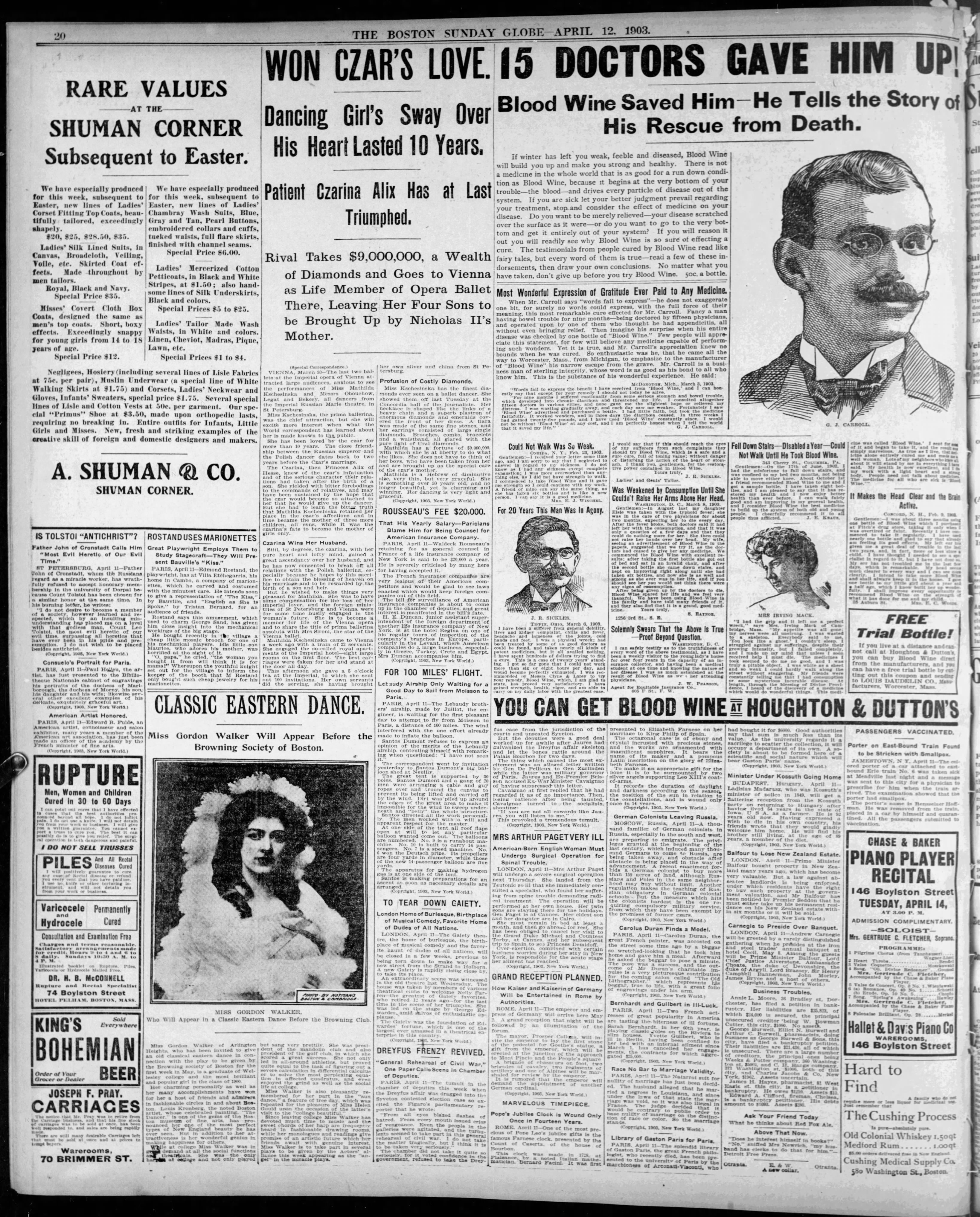
A new kind of view of America from English eyes is promised as the probable result of the visit of William Caine, who, with his wife, a native of Kentucky, will spend the Spring and Summer here. Although Mr. Caine is best known as a novelist, his “The New Foresters” has had unusual success in England. This work was the outcome of a trip which he and Mrs. Caine took in a donkey cart through some of the historic forests of England. One of the things which they purpose [sic] doing while here is to take a similar trip through out-of-the-way places. The resulting book will offer an interesting contrast to the impressions most foreigners receive during hasty journeys through the centres of civilization. Mr. Caine, who is no relation to Hall Caine, by the way, has written nearly a score of books, of which “Hoffman’s Chance” and “The Irresistible Intruder” are the best known on this side of the Atlantic. “Helpful Little Hannah,” a story about a little girl for adult readers, will be published here next Fall (“Latest Fiction; William Caine,” The New York Times Book Review, May 24, 1914, p. 246).Sometime during that summer of 1914, Caine retitled his “story about a little girl for adult readers,” But She Meant Well:
William Caine, the English novelist, who came to America this spring for his first visit, has become so infatuated with the country that he has taken a bungalow on the New England coast for the summer. Mr. Caine will remain here until the appearance in the autumn of his new novel “But She Meant Well,” a companion story of his spring success “The Irresistible Intruder” (“Men and Women; Gossip and News About Prominent Persons,” The Buffalo Commercial, Wednesday, July 29, 1914, p. 5).And that “new kind of view of America from English eyes” which Caine was supposedly working on in “a bungalow on the New England coast” never materialized in the form of a book; certain elements, however, would later appear in some of his subsequent novels, such as that published in the US in November 1917:
“Three’s a Crowd,” from the press of Houghton Mifflin company, is by William Caine, who but for the war, might have given us a book of some importance about America. He came to New York early in 1914 on his first visit to his wife’s home. For he had married in London a few years before an attractive Wellesley graduate from greater Boston, Miss Gordon Walker, and he was spending the summer with the literary colony at Scituate when the war broke out. Putting aside all his plans, with Mrs Caine he hurried back to England, where both have found much to do for Great Britain ever since. After the war, perhaps, Mr Caine will be able to finish the book of impressions of the United States that he began then. “The war put an end to it,” he says in a recent letter, adding humorously, “The war has been blamed for a good deal, but let this stand to its credit.” Mr Caine’s previous books, dealing with English country life chiefly, have been exceedingly popular for their insight and humor, and his “Three’s a Crowd” will be especially welcome here since its author has a real knowledge of life as it is lived in England as well as in America (“Boston Letters and Art,” The Springfield Daily Republican [Springfield, Mass.], Wednesday, January 2, 1918, p. 6; reprinted in The Springfield Weekly Republican, Thursday, January 10, 1918, p. 8).It seems that the author of The Author of “Trixie” and “the spark” he used “to write with” “hurried back to England” just before But She Meant Well’s official release. On the evening of Monday, October 12, 1914, Caine and (I assume) his wife attended a dinner party given by John Lane at The Players, 16 Gramercy Park, Manhattan, and less than two days later, at one in the morning on Wednesday, October 14, they departed New York aboard the same transatlantic liner they had debarked from six months earlier. Bound for Liverpool, the Lusitania arrived there six days later, at 1 am, Tuesday, October 20. Also aboard was J. M. Barrie, who was reported to have said, before sailing, that “he did not believe the stories of German atrocities as reported, and considered the German a splendid soldier.” Ironically, among the “much” that Barrie’s fellow passenger would find “to do for Great Britain” after his and his wife’s return, was to write a 46-page “account” of his encounter in London with a Belgian refugee whose “little home town of Saint Hilaire had been swallowed up within a few days by the tide of invasion” (p. 9), Monsieur Segotin’s Story (March 1918), a pamphlet whose very purpose was to refute beliefs such as Barrie’s. More likely, however, Barrie’s opinions would have been shaken well before Caine’s pamphlet was published. On May 7, 1915, a German U-boat torpedoed the Lusitania. Among the passengers who died was the original producer of Peter Pan, Charles Frohman.
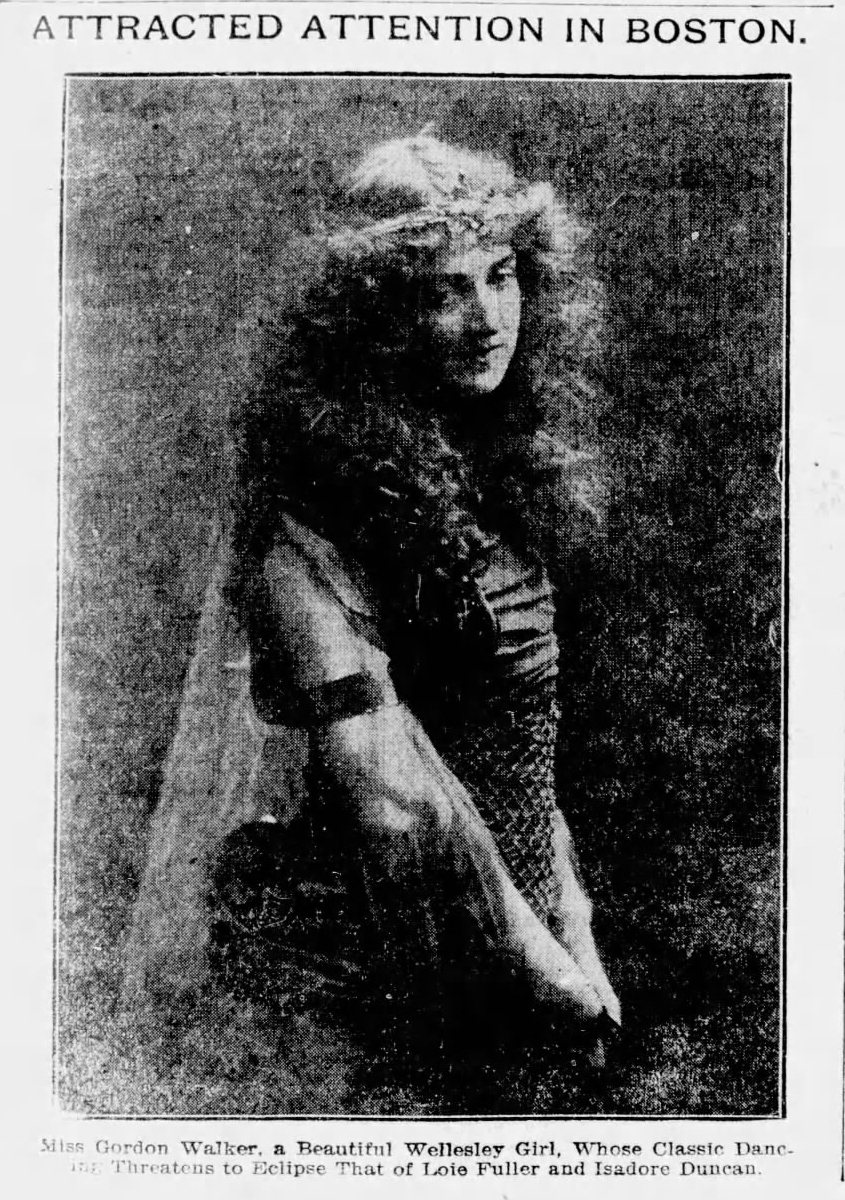
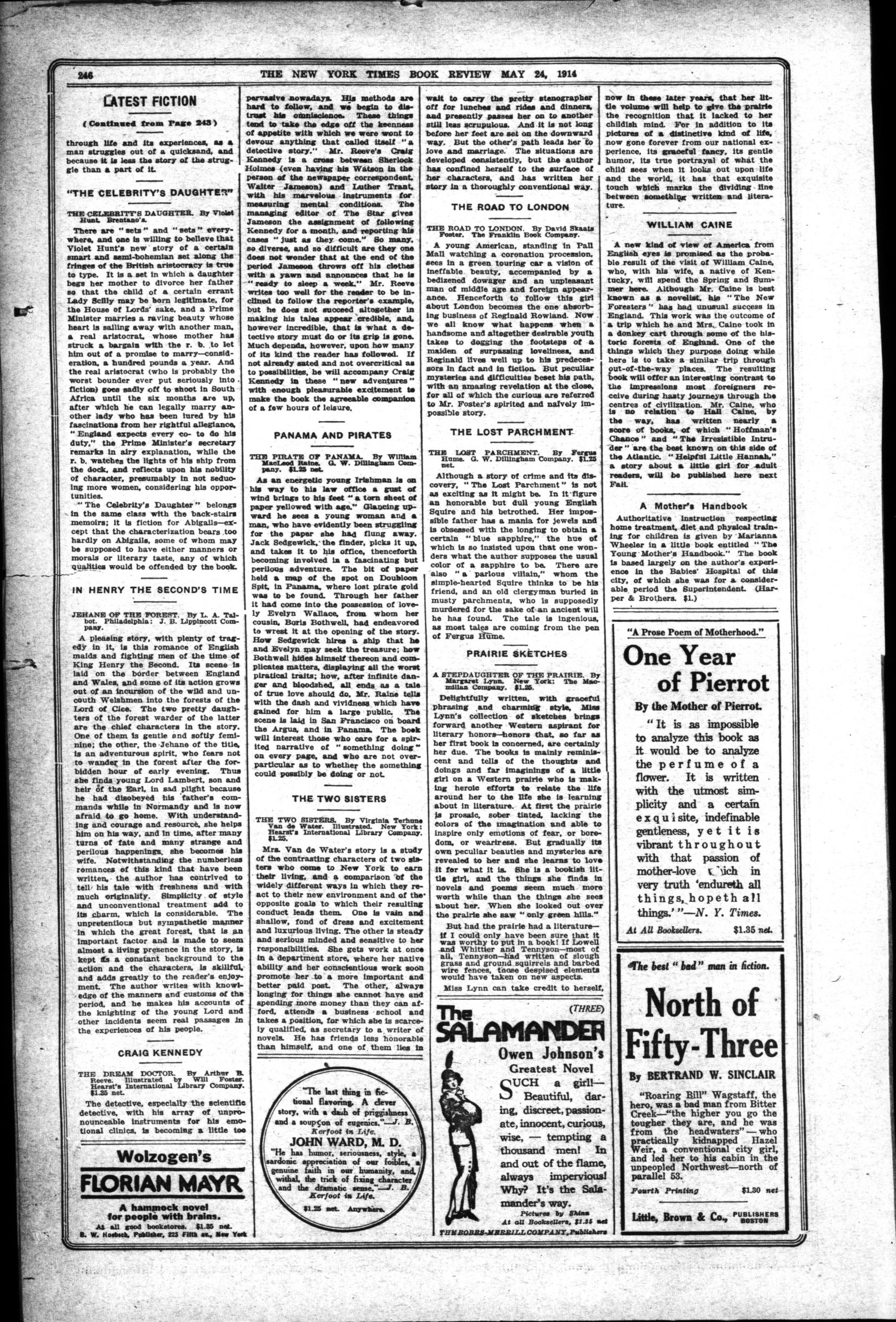
“Attracted Attention in Boston. Miss Gordon Walker, a Beautiful Wellesley Girl, Whose Classic Dancing Threatens to Eclipse That of Loie Fuller and Isadore [sic] Duncan.” Reproduced from The Plain Dealer Sunday Magazine, May 31, 1903, p. 5.
To the strains of mystical Eastern music, Miss Gordon Walker, a beautiful New England girl, recently made her debut before the Browning society of Boston in a dance beside which the cakewalk and other such acrobatic dances appear heavy and ungraceful exercises.The dance, which won the unqualified approval of the members of that most exclusive and critical New England organization, the Browning society, is entirely the conception of Miss Walker, and portrays an entire drama, while every rhythmical movement indicates a thought or an action in the play.
Miss Walker, who lives just outside Boston, at No. 99 Jason street, Arlington Hights [sic], is a very popular young society girl in the big city as well as in her own pretty town.
For some time past she has been attracting a great deal of attention by her charming dancing, and recently she was invited to dance at the annual classical play given by the Browning society.
This year Miss Walker’s wonderful talent became so widely known it was decided to ask her to give in her dance as a prelude the synopsis of the play. The undertaking was a most difficult one, but she consented, and the result of several weeks of hard work and earnest study was the highly successful and beautiful classical dance which gained the applause of the club.
The dance preceded the Greek play, “The Return of the Druses,” and in the graceful swaying figure, clad in violet and silver of the style of an eastern maiden, was told the whole drama.
The dance opened with a merrymaking procession. The Druse people have planned to return to their old home, Lebanon, and are going to decorate the place in honor of the hero who is to lead the return. With clash of cymbals and merrymaking, the dancer led the way as though a gay company of girls followed her.
Then came the second motive, that of vengeance against the prefect who for many years had held the Druses in bondage.
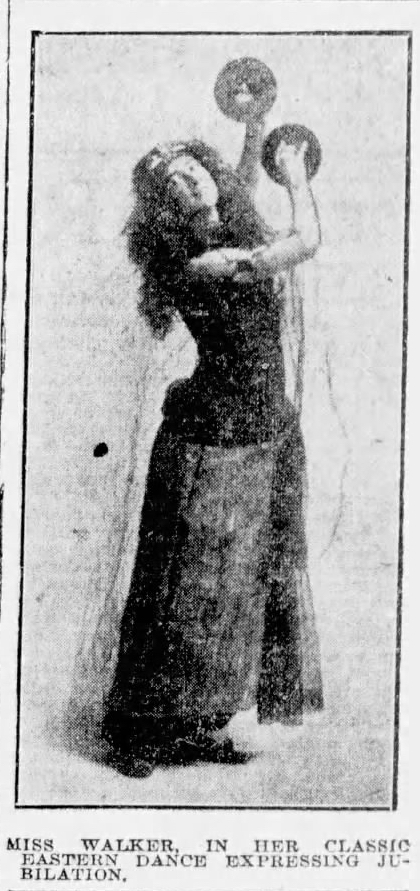
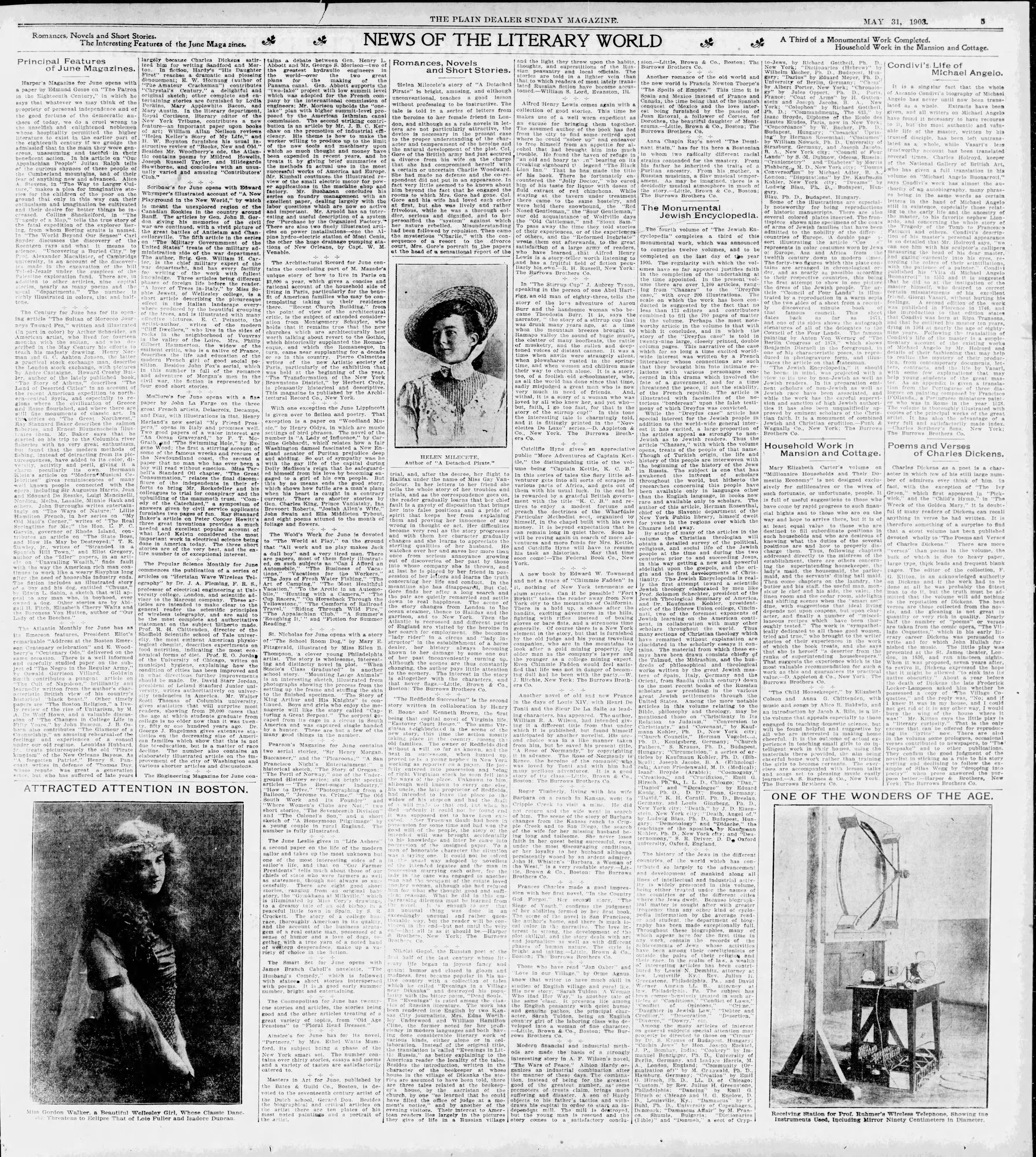
“Miss Walker, in her classic eastern dance expressing jubilation.” Reproduced from The Plain Dealer Sunday Magazine, May 31, 1903, p. 3.
In this part of the dance Miss Walker used a garland of dark red roses as a symbol of the intended murder, and finally hurled it at the prefect’s door. The last motive was one of religious fervor that the deed had been done, and that the hero was to be exalted into a god.
The whole drama was very mystical and Browningesque, and the dancing was necessarily more dramatic and intellectual than the stereotyped eastern dance, possessing at the same time, all its languid beauty.
Miss Walker understood the requirements of the dance and so vividly portrayed the entire play that her success was unreservedly acknowledged by the critical audiense [sic].
This fair daughter of the Puritans has created quite a furore in New England with her beauty as well as her graceful and fascinating dancing, and her charming personality has won for her a host of friends and admirers in fashionable circles in and about Boston.
Louis Kronberg, the noted Boston artist, whose celebrated painting, “The Dancer,” is one of the gems of the Boston Museum of Fine Arts, has pronounced her not only the most perfect type of New England beauty, but also the most graceful dancer.
Miss Walker is well fitted for the work in which she has already distinguished herself, for not only has she the captivating grace of the born dancer, but former studies have enabled her to interpret more freely and readily the meaning of the dances that she has given.
She is a graduate of Wellesley, and the most brilliant and popular girl in the class of 1900.
While at college she was constantly in demand at all the social functions and theatricals. She was the only harpist among the students, and was frequently called on to add her sweet voice and the music of her harp to the general merrymaking.
In athletics and in her studies she was not behind her chosen art. She was president of the golf club and led in all-round athletics. She proved equally proficient in the task of figuring out a severe calculation in differential calculus or solving the most perplexing equation in affected quadratics, and even enjoyed the grind as well as the social life at college.
“The pleasantest recollection I have in regard to my dancing while in college,” said Miss Walker, in speaking of her artistic career, “is of the ‘sun dance’ that we gave on tree day, and afterward repeated for Miss Helen Gould.
“I was in my element then, and we really excelled ourselves, I think, in the dance. There was so much meaning, so much expression to be got out of it, that the performance was purely a pleasure. Miss Gould was delighted with it when we danced for her on her visit to our alma mater.
“That was merely the beginning of the work that I have since taken up more seriously.
“Since leaving college I have devoted much of my time to my music, for that is great help to me in interpreting a dance to my satisfaction. Occasionally I introduce some music into the dances.
“Before I danced the eastern dance for the Browning society I had appeared in a few affairs, and met with so much success that I determined to build my dancing on thoroughly artistic lines.
“In all my dances I try to have them mean something. I think thoughts can be expressed quite as well by dramatic dancing as they can by words.
“Not long ago I appeared before the Copley society, in Boston, in a Spanish dance, which caused quite a sensation. Afterward I used it in connection with a monologue arranged from Longfellow’s ‘Spanish Student.’ The result was quite beyond my greatest hopes.
“So, with such encouragement, I shall continue to originate dances whenever I find expresson for them. And in that way I hope to perfect myself in an art which I believe has been little used in this way since ancient times, but which, I think, people are again taking a great interest in and which therefore has a future of the highest development.
“The eastern dance used to be a means of expressing religious fervor. And in the ancient times, when it was used thus, there were so many deities — the sun, the moon, the sea, the light — and the worship of each so different, that naturally, the dance of the worshippers necessarily expressed various emotions.
“I have always been very much interested in the dancing of Loie Fuller and Isadore [sic] Duncan.
“Their performances seemed to me so much more to express feeling, and to have far greater character than other dances that have been popular — the cakewalk, for instance, or conventional dances.
“But even these two wonderful dancers, I think, have not reached the highest pinnacle of the art of dancing.
“The eastern dance originated the art of dancing, and as it was inspired purely by thought or feeling, I think that before long it will be accepted by everyone, as it was in the days of its origin, as a beautiful way of expressing dramatic art” (“She Bids Fair to Outrival Loie Fuller; Arlington, Mass., Society Girl Attracted Great Attention From Boston Smart Set by Wonderful Grace and Charm in Execution of a Classic Eastern Dance,” The Plain Dealer Sunday Magazine, May 31, 1903, p. 3).
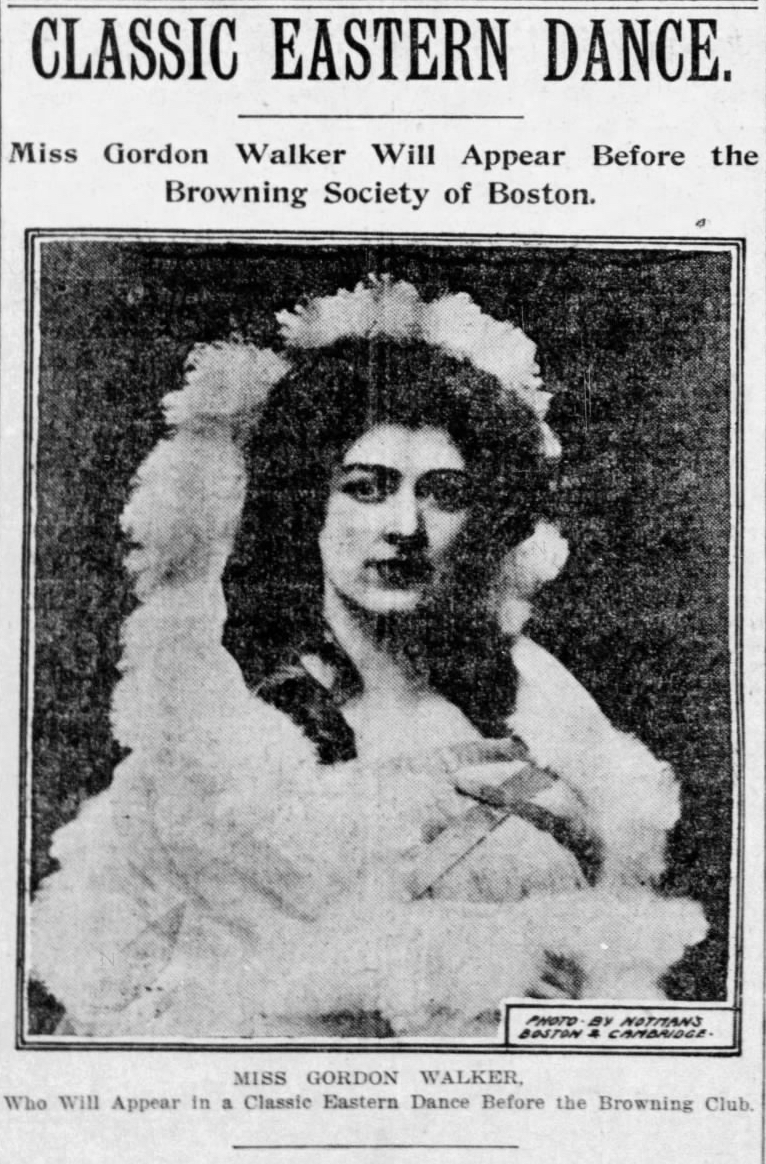
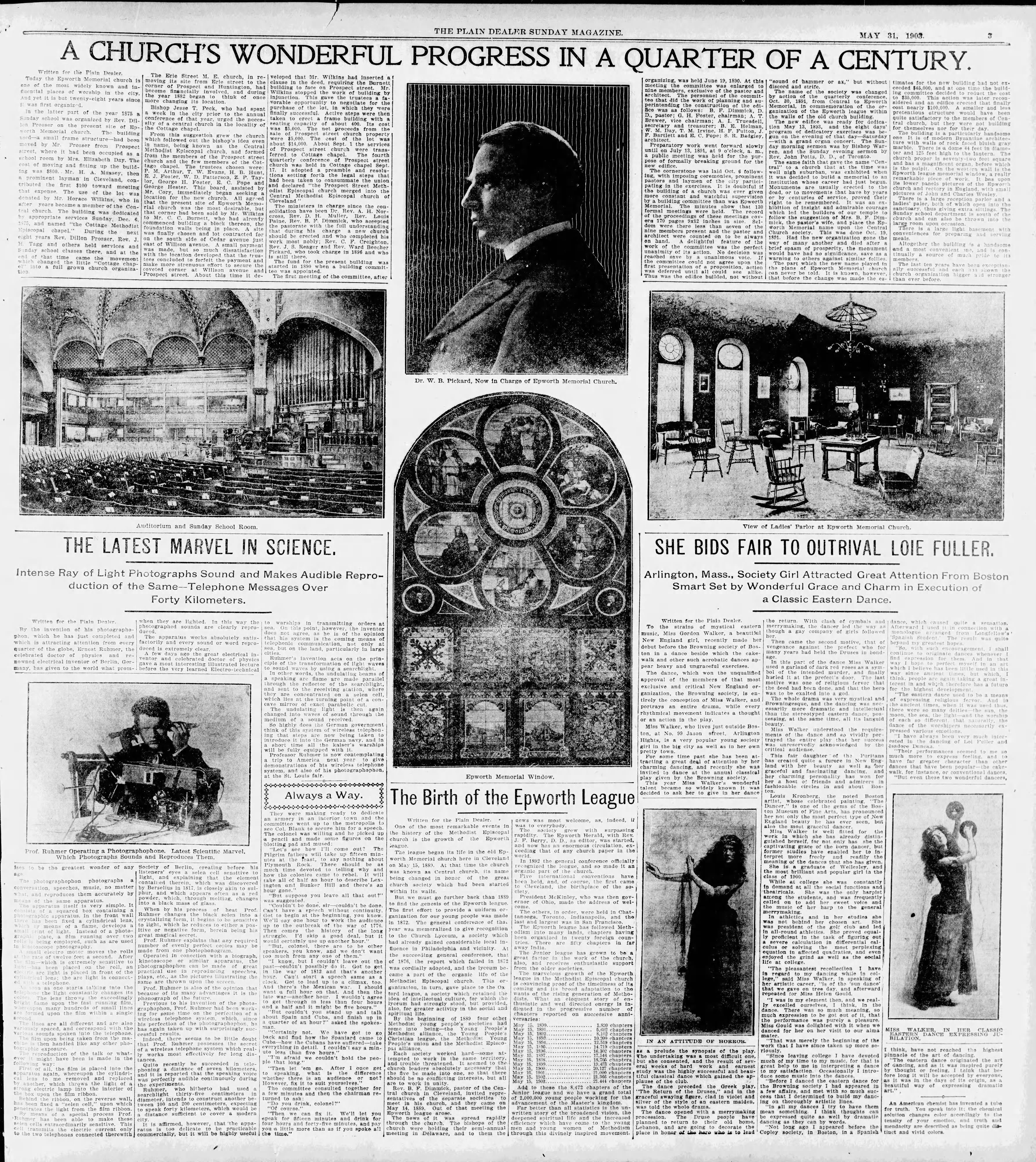
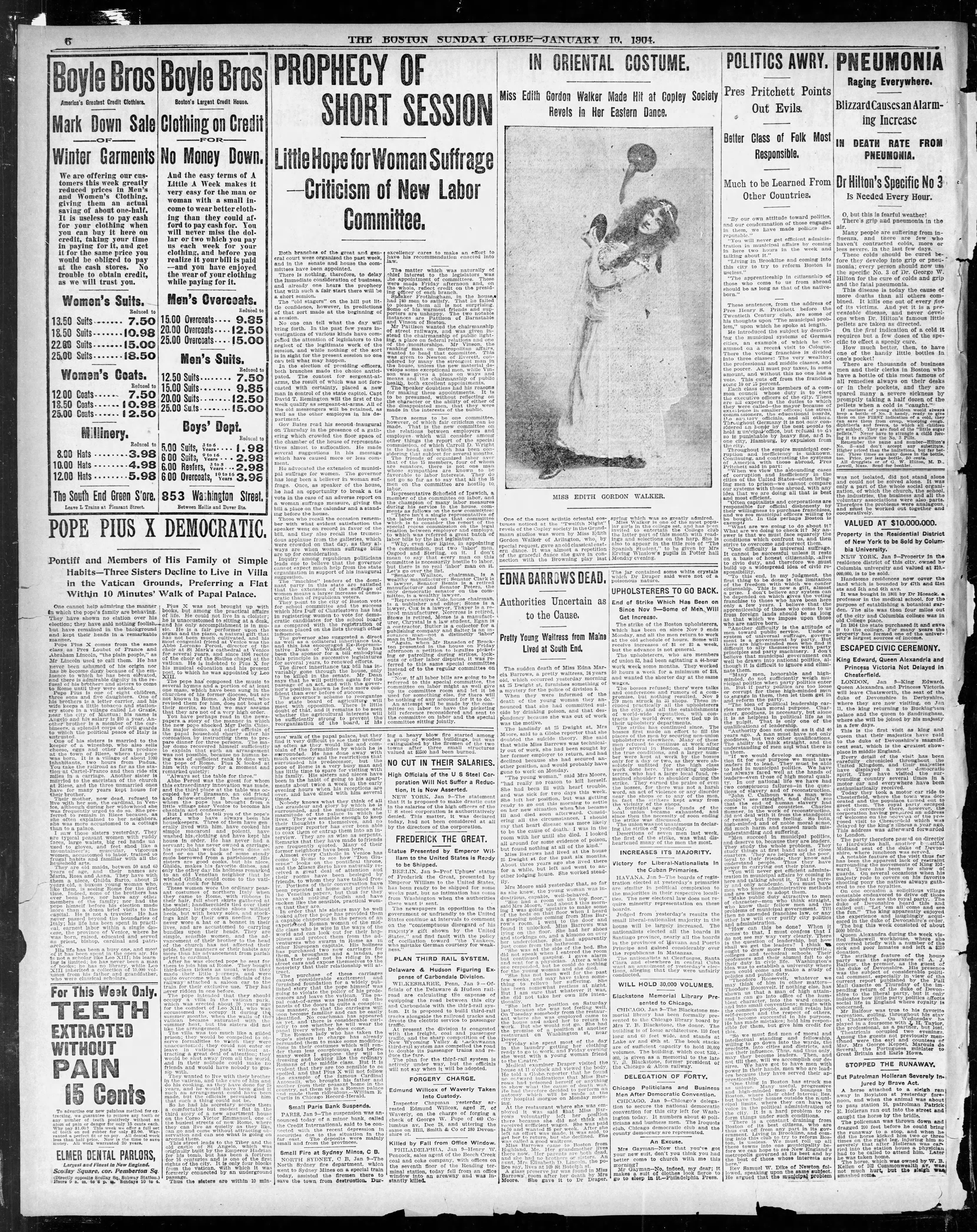
Reproduced from The Boston Sunday Globe, April 12, 1903, p. 20.
Miss Gordon Walker of Arlington Heights, who has been invited to give an old classical eastern dance in connection with the play to be given by the Browning society of Boston for the first week of May, is a graduate of Wellesley college and the most brilliant and popular girl in the class of 1900.Her charming personality as well as her many accomplishments have won for her a host of friends and admirers in fashionable circles in and about Boston. Louis Kronberg, the noted Boston artist, whose celebrated painting, “The Dancer,” is one of the gems of the Boston museum of fine arts, has pronounced her one of the most perfect types of New England beauty he has ever seen. But in addition to her attractiveness is her wonderful genius in making happiness for others.
While at college Miss Walker was in great demand at all the social functions and theatricals. She was the only harpist at college and not only played but sang very prettily. She was president of the mandolin club and also president of the golf club, in which she cored a great success. She not only led in all-around athletics, but proved quite equal to the task of figuring out a severe calculation in differential calculus or to solve the most perplexing equation in affected quadratus [sic], and even enjoyed the grind as well as the social life at college.
Miss Walker is also pleasantly remembered for her part in the “sun dance,” a feature of tree day, which was repeated for the pleasure of Miss Helen Gould upon the occasion of the latter’s visit to the “college beautiful.”
Since leaving college Miss Walker has devoted much time to music and the sweet chords of her harp are frequently heard in fashionable drawing rooms, while her monologues and readings give promise of an artistic future which her friends await with genuine interest. Miss Walker is to take part in several plays to be given by the Actor’s alliance this week appearing as the “angel” in the miracle plays (“Classic Eastern Dance; Miss Gordon Walker Will Appear Before the Browning Society of Boston,” The Boston Sunday Globe, April 12, 1903, p. 20).
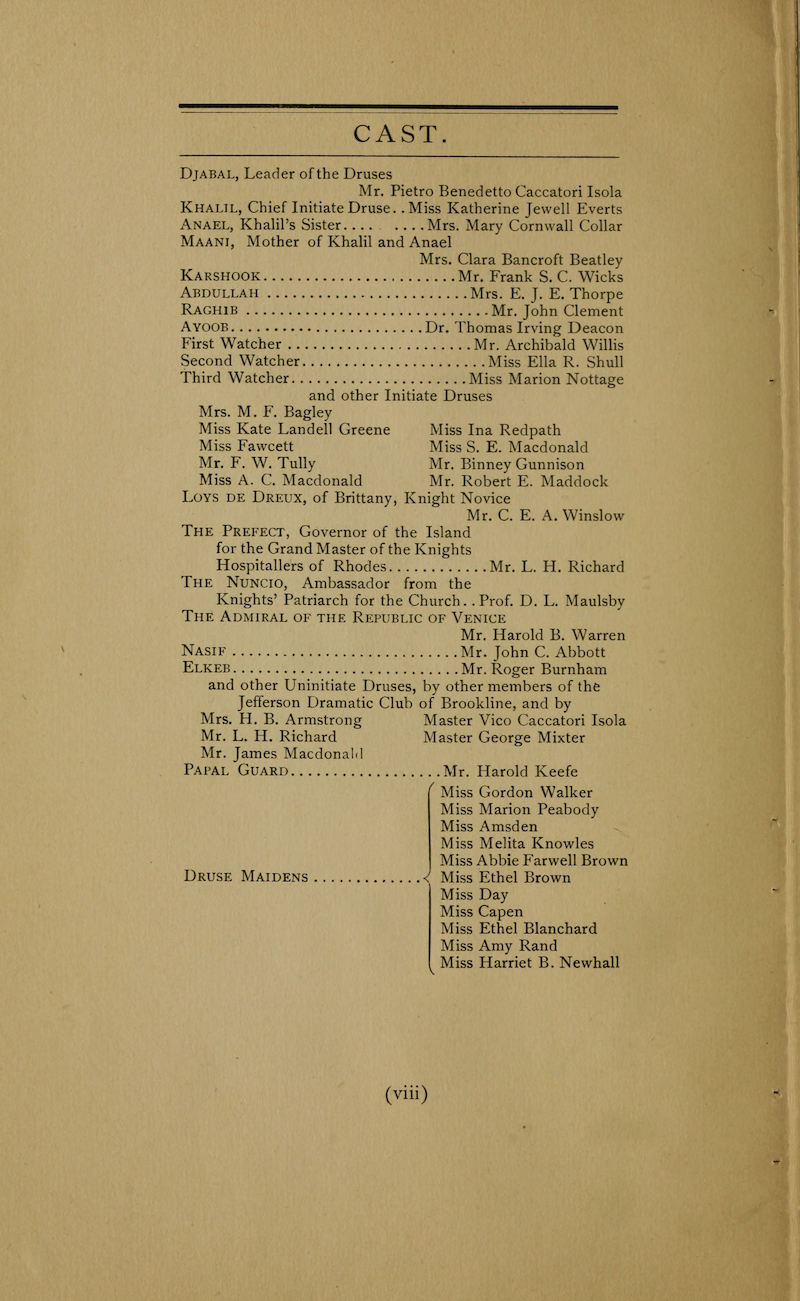
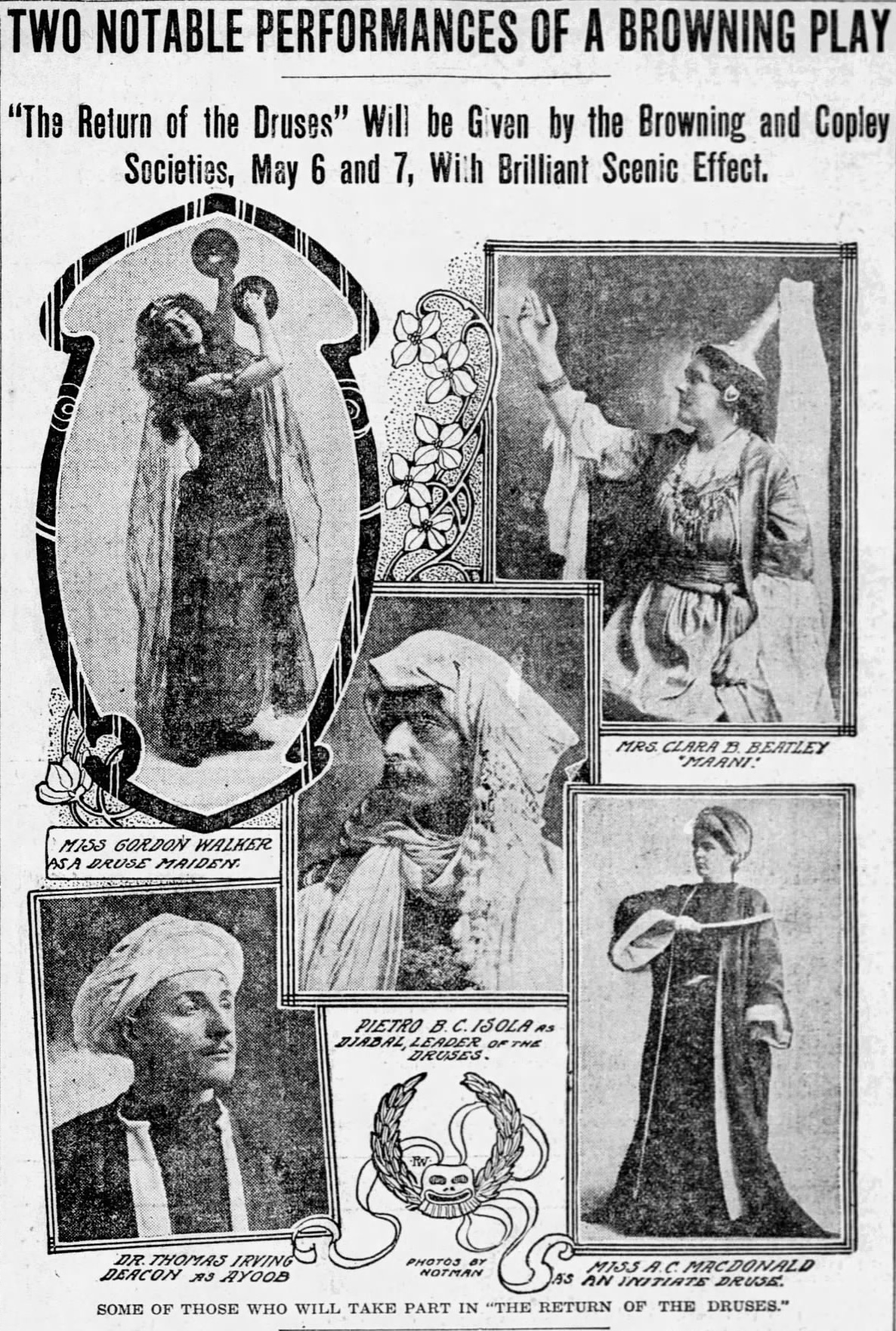
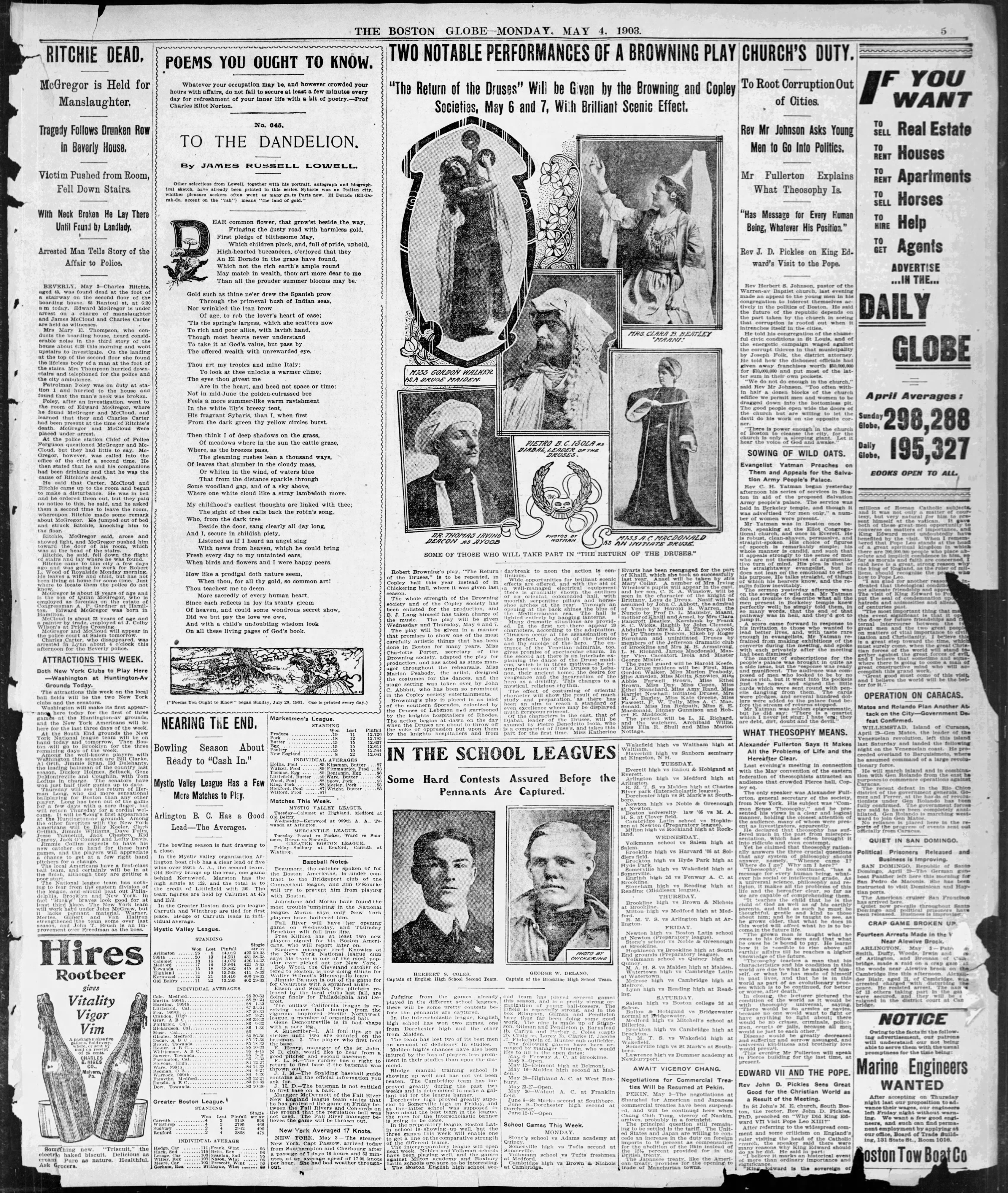
Reproduced from The Boston Globe, Monday, May 4, 1903, p. 5.
The play which the Copley society unite with the Browning society to give on the Copley stage May 6 and 7, has an interlude of processional and dancing effects which promises to be very lovely. In wondrous raiment these Druse maidens enter and dance, carrying garlands and playing on psalteries, shawns [sic] and timbrels. Prominent among them is Miss Gordon Walker and a chorus of young dancers, Miss Amsden, Miss Marion Peabody, Miss Abbie Farwell Brown and her sister, Miss Amy Rand, Miss Blanchard, Miss Newhall, Miss Capen, Miss Day and Miss Melita Knowles (“Table Gossip,” The Boston Sunday Globe, April 19, 1903, p. 38).Reviews, though positive, were subdued:The dramatic ballet of the interlude will be charmingly wrought out by Miss Gordon Walker and a choir of ten Druse maidens. The stage setting and ensemble work will be on a larger scale then before, and the play promises to be thoroughly worthy of its dramatic dignity and novelty (“Note and Comment,” Boston Evening Transcript, Saturday, April 25, 1903, p. 27).
The Dance of the Druse Maidens to the sound of the tabret and shawms is a novel and bewitching episode in the play, enhancing the dramatic effect and heightening the Syrian atmosphere. This golden-robed choir is led by Miss Gordon Walker. She is reënforced ably by Miss Amsden and Miss Marion Peabody and by Miss Melita Knowles, Miss Abbie Farwell Brown, Miss Ethel Brown, Miss Capen, Miss Ethel Blanchard, Miss Amy Rand, Miss Harriet B. Newhall. Beethoven’s music uplifts the whole, and the Steinway grand pianos rendering it are du to M. Steinert & Sons (“Music and Drama; ‘The Return of the Druses,’” Boston Evening Transcript, Monday, May 4, 1903, p. 5).
In the second act there is an interlude explaining the dance of the Druse maidens, which is in three motives — the triumphant return of the Druses to Lebanon, their ancient home; the desire for vengeance and the incarnation of the hero as a divinity. This changes to a mystical, religious rhythm.
The effect of costuming of oriental character will show the result of much study and preparation, as there has been an aim to reach a standard of even excellence where may be displayed much gorgeous raiment (“Two Notable Performances of a Browning Play; ‘The Return of the Druses’ Will be Given by the Browning and Copley Societies, May 6 and 7, With Brilliant Scenic Effect,” The Boston Globe, Monday May 4, 1903, p. 5).
Nothing seemed lacking in the success of the Browning play at Copley hall yesterday afternoon, not even the dreamy looks and undisturbed calm which one always associates with the Browning cult. It was a typical Browningite audience, not very large as to numbers and certainly not very demonstrative, who studied assiduously the red booklets containing the stage version and were too absorbed to applaud the artistic efforts of the star actors.The following week, however — even while Walker had moved on to other things, such as preparing for her May 26 concert at the Wellesley town hall (see § 5) — newspaper readers as far afield as Muncie, Indiana, learned how she had been “the embodiment of grace and abandon in her filmy attire:”It would be high treason to question the conception of certain lines and surely much easier to settle down in dignified calm prepared to dream about what somebody else thought that Browning thought when he wrote the play. And that’s what everybody did or tried to do.
A very charming feature was the dance of the Druse maidens, led by Miss Gordon Walker, all in wondrous costumes of yellow and violet, veiled with white and silver and carrying garlands, which came in the interlude between the first and second acts (“At the Browning Play; Successful Performance of ‘The Return of the Druses’ — Dreamy Looks and Great Calm Not Lacking,” The Boston Globe, Thursday, May 7, 1903, p. 2).
The production is staged and managed, as last year, worthily, and a pleasant feature is the introduction of the dance of the Druse maidens, as an interlude after the first act, for which authority is given by Khalil’s lines:
“Already are they instituting choirs
And Dances to the Khalif, as of old
’T is chronicled though had’st them.”
This dance, to Moorish music, arranged by B. J. Lang, is extremely effective. The young women, in their supple Arab costumes and with garlands of flowers, are led by Miss Gordon Walker, clashing her cymbals (discordant, though in perfect keeping) in time to the slow and dreamy melody. The dance has its dramatic and symbolic character, too, throwing a sidelight on the play (“Music and Drama; ‘Return of the Druses,’ Browning’s Tragedy Given Its Second Production in Boston,” Boston Evening Transcript, Thursday, May 7, 1903, p. 11).
The first production of Browning’s tragedy, “The Return of the Druses,” given by the Browning and Copley societies Wednesday afternoon at Copley hall, was very successful and the large audience was exceedingly interested and responsive. It was repeated on Thursday evening perhaps even in a more finished manner. The dance interlude was pantomimic and consisted of three movements, first representing exultation, second, vengeance and assassination, and third, a religious delirium, an embodiment of the “end justifying the means.” The music, which was very dramatic, was from Beethoven’s “Ruin of Athens.” The 11 young ladies, dressed in filmy costumes and bearing garlands of flowers, gave this oriental dance, which they had carefully studied with Mrs Wyman, in a most graceful manner. They were Miss Marion Peabody, Miss Newhall, Miss Knowles, Miss Abbie Farwell Brown, Miss Ethel Brown, Miss Amsden, Miss Capen, Miss Rowe, Miss Blanchard, Miss Rand and Miss Gordon Walker, the leader. Their costumes were shades of yellow to burnt orange, and Miss Walkers’ [sic] was in shades of lavender and purple (“Table Gossip,” The Boston Sunday Globe, May 10, 1903, p. 42).
Society filled Copley hall at Boston recently for the production of Browning’s famous tragedy, “The return of the Druses,” given under the auspices of the Browning society and the Copley society. The presentation was exceptionally fine and the costuming most elaborate. Fairy-like maidens with silk bodices, gauze wings and the loose, flowing Persian trousers fastened at the ankles, supported by tiny silver and god sandals and waving garlands of bright-hued flowers, dancing in honor of the leader of the Druses, made a scene of weird loveliness with an Oriental setting. The dancing of Miss Gordon Walker was particularly good, Miss Walker being the embodiment of grace and abandon in her filmy attire. Miss Marion Peabody, the artist, designed the costumes for the dances and their combination in color effect was very delicate and harmonious. Mr. John C. Abbott had charge of the stage setting and Mr. B. J. Lang of the music.It seems that the more the May 6–7 production of The Return of the Druses faded from the memories of those who had attended it and participated in it, the greater was Walker’s fame — or at least the efforts of whoever it was who was touting for her. Witness the lengthy May 31 piece from The Plain Dealer quoted above, or the following Hearst-copyrighted two-column piece entitled “Boston’s Beautiful Society Dancer” published July 12 in the Baltimore Sun:Browning’s play was adapted for the stage by Miss Charlotte Porter, secretary or [sic] the Browning society, who acted as stage manager.
The story of the play is placed on an island of the Southern Sporades, colonized by the Druses of Lebanon and garrisoned by the Knights Hospitallers of Rhodes. At dawn the Druses make ready to throw off the yoke of oppression put upon them by the Knights Hospitallers, and from daybreak to noon the rebellion continues. Climaxes occur at the assassination of the prefect, the death of the heroine and the suicide of the hero. The entrance of the Venetian admirals forms another spectacular scene (“Pretty Girls in Persian Trousers,” The Morning Star, Saturday, May 16, 1903, p. 12).
boston, July 6. — Boston’s fashionable Back Bay society has been captivated this season by a new dancer, a girl who does the fiery and impassioned Spanish and Oriental dances with the fervor of Carmencita and the grace and art of Loie Fuller.A truncated version of this piece, entitled “Eastern Society’s Latest Diversion,” was published a week later by The Courier-Journal with the following introductory copy:This fair dancer, Miss Gordon Walker, is one of society’s own daughters.
When Miss Walker was graduated from Wellesley two years ago [sic] she was voted the most beautiful girl in her class, and was chosen, for her grace, to do the sun dance on Tree Day.
With such magic did the pretty college girl go through the bewildering mazes of the dance, amid a cloud of flowing white drapery, with a brilliant summer sun playing upon her like a calcium light, and a background of rose bowers, and a thousand pretty girls in fancy costume, that Boston society then and there took Miss Gordon Walker into their hearts. Ever since their drawing rooms have been open to her.
Mrs. J. Montgomery Sears, who wrested the leadership of the ultra smart set from Mrs. Jack Gardner a year ago last winter by entertaining Prince Henry of Prussia, has set her seal of approval on Miss Gordon Walker.
Mrs. Sears was the first to think of having Miss Walker reproduce the fascinating sun dance in a drawing room, and invited the fascinating college girl to her Commonwealth avenue house.
Here calcium lights took the place sunlight and banks of palms gave a tropical setting to the scene.
The fair dancer enthralled her select and critical audience.
The bewildering sun dance is really a very cleverly executed skirt dance. By a subtle movement of arms and limbs the billowy chiffon is kept in rapid motion, now revealing and now hiding the tall, graceful figure of the girl.
The wonder is how the slow, languid motion of the body can permit of such a whirl of filmy drapery. In contrast with its motion, like flying clouds, the dancer’s body seems almost in statuesque repose. This shows the dancer’s rare art.
Miss Walker’s greatest triumphs have occurred within the past five months.
Holker Abbott, the cotillon leader and masculine arbiter of fashion, as head of the select Copley Society, invited Miss Walker to do Spanish dances at “The Artists’ Festival” at Copley Hall last January.
A few years ago the beautiful Marion Mason, now Mrs. Richard T. Wilson, Jr., of New York, sister-in-law of Mrs. Cornelius Vanderbilt, was the principal attraction at this annual festival, at which the artistic and fashionable element of Boston amuses itself.
Holker Abbott is as eager to bring out each season some new society beauty as the feature of this festival as if he were the impresario of an operatic company, and Miss Walker’s success this year was even more notable than Mrs. Wilson’s when she was a débutante and the regning [sic] beauty of Boston.
“Jack” Abbott, Back Bay society’s purveyor of amusements, the Harry Lehr of Boston, not to be outdone by Holker Abbott, besought Miss Walker to adopt and Oriental dance, as set forth in Robert Browning’s tragedy, “The Return of the Druses.”
He introduced her into the sacred circle of the Browning Society, which is a priesthood of 200 of the richest and most cultured bluebloods, admission to which is gained only at long intervals, when a vacancy occurs upon the death of one of the Brahmins.
Last week [sic] Miss Walker did the Druse dance before these high castes in Copley Hall.
Then for the first time in Puritanic New England Boston clergymen were entranced by an Oriental dance, passionate as an Egyptian Fellah girl’s, with the fire and abandon of a Spanish fandango, yet exalted by a religious delirium.
That was Miss Walker’s greatest triumph, raising a voluptuous Oriental dance to the plane of moral exaltation.
Miss Walker has been called the most beautiful girl in Massachusetts. She has Titian hair, blue eyes, a clear complexion, with features and form almost perfect.
The Druse dance, in which Miss Walker has won her greatest success, is really a pagan festival rite of the Middle Ages.
The Druses of Lebanon, exiled to a lonely island of the Southern Sporades, in the Mediterranean sea, are held in captivity by the Christian Knights of Rhodes. The dissipated, degenerate Knights Hospitallers have for many years held the sons of the Druses in bondage and their daughters in the slavery of the harem.
When at last the Christian prefect, or governor, is assassinated an uprising of the Druses occurs. It is a mad exultation of a downtrodden race that gives the motive for the dance which Miss Walker performs.
The Spanish dance which Miss Walker has presented in many Back Bay drawing rooms is a portrayal of the part of “Preciosa” in Longfellow’s play “The Spanish Student.”
Preciosa, the gypsy [sic] girl, dances before a cardinal and an archbishop, and wins the approval of the stern prelates by her subtle grace.
This is the part that Miss Walker enacts. At first the dance is secondary to the lines which she speaks and acts.
“If one could be a-dancing always,
Life would not be sad,” she sings.
There is an accompaniment in keeping with Longfellow’s lines:
The music soft and rippling
With its tinkling guitars and click of castanets,
Sets Preciosa’s heart to dancing
And her feet to beating time.
As she proceeds the spirit of dancing comes upon her and she throws her whole being into the passionate Spanish cachucha. Not since Fanny Ellsler [sic] has Boston seen such dancing.
Her movements are full of fire and abandon. It requires art to do this, and yet keep it chaste and in keeping with Longfellow’s highly moral play. But Miss Walker easily holds it up to this standard, without letting the dance lose any of the lightness and languishing grace that women of the Latin race give it (“Boston’s Beautiful Society Dancer; Miss Gordon Walker Has Captivated the Fashionable Back Bay Set by the Grace and Passion of Her Voluptuous Movements,” The Sun [Baltimore], Sunday Morning, July 12, 1903, p. 11).
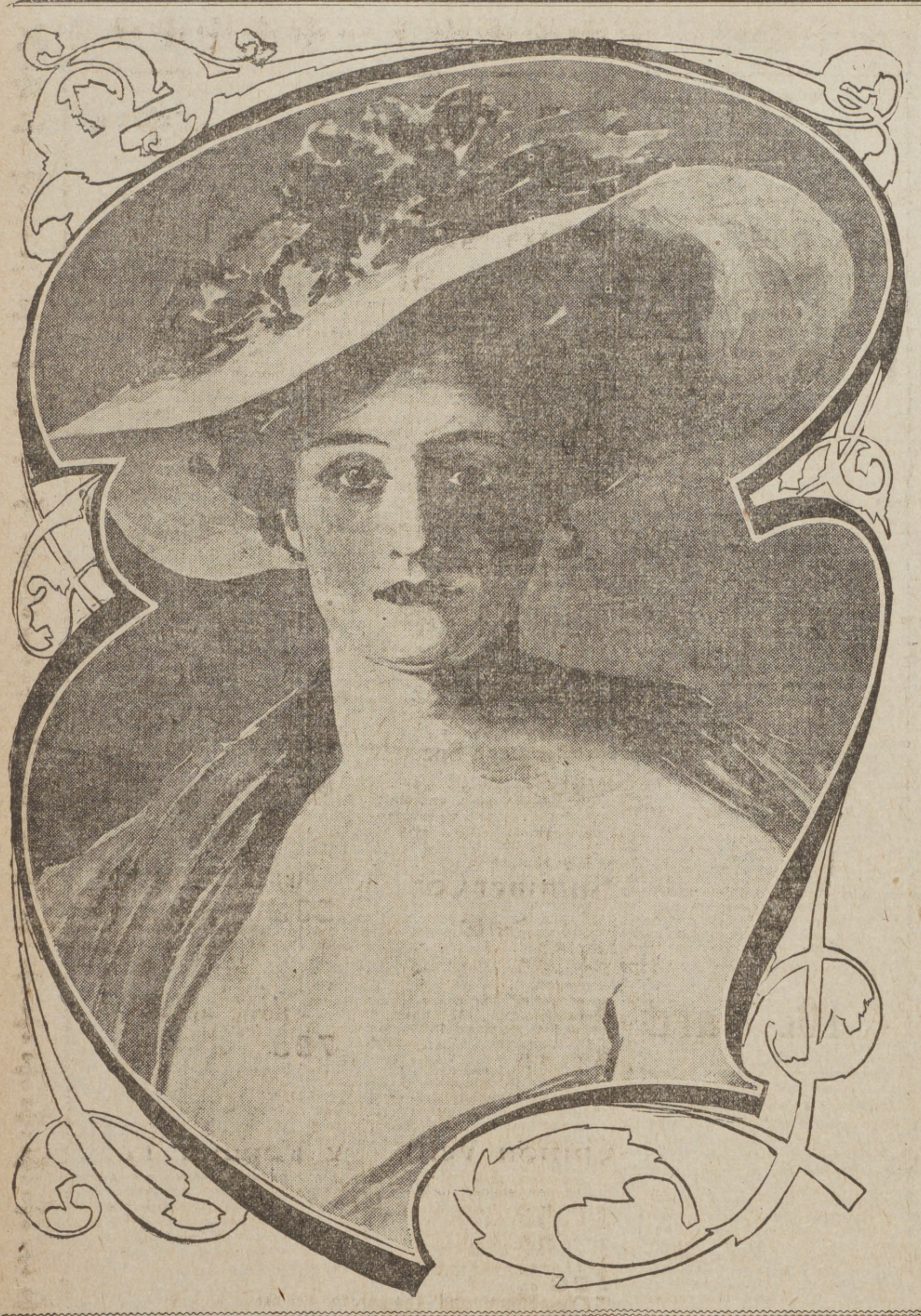
“Eastern Society’s […] latest favorite is a society girl of much beauty and grace, Miss Gordon Walker, who is now the rage in fashionable drawing rooms.” Reproduced from The Courier-Journal, Sunday Morning, July 19, 1903, sect. 2, p. 6.
Boston society has found a new diversion to introduce at receptions and other drawing-room entertainments, and to vary the monotony of the usual “giggle, gabble, gobble, git” of these functions, the ultra-fashionables now engage some attractive dancer to entertain the guests with terpsichorean “stunts” during the evening.That same day, the American Magazine Supplement of the San Francisco Examiner published a full-page feature on Walker, complete with seven images of her dancing (reproduced at the start of this section), which is a sort of hybrid of the Baltimore Sun piece and the May 31 piece, supplemented by additional descriptions of Walker’s role as a Druse Maiden:Their latest favorite is a society girl of much beauty and grace, Miss Gordon Walker, who is now the rage in fashionable drawing rooms.
The Baltimore Sun says of her: [Reprise of supra, up to and including paragraph ending with “Brahmins”] (“Eastern Society’s Latest Diversion,” The Courier-Journal, Sunday Morning, July 19, 1903, sect. 2, p. 6).
boston, July 6. — Boston’s fashionable Back Bay society has been captivated this season by a new dancer, a girl who does the fiery and impassioned Spanish and Oriental dances with the fervor of Carmencita and the grace and art of Loie Fuller.The fair dancer, Miss Gordon Walker, is one of society’s own daughters.
When Miss Walker was graduated from Wellesley two years ago [sic] she was voted the most beautiful girl in her class, and was chosen, for her grace, to do the sun dance on Tree Day.
With such magic did the pretty college girl go through the bewildering mazes of the dance, amid a cloud of flowing white drapery, with a brilliant Summer sun playing upon her like a calcium light, and a background of rose bowers, and a thousand pretty girls in fancy costume, that Boston society then and there took Miss Gordon Walker into their hearts. Ever since their drawing-rooms have been open to her.
Mrs. J. Montgomery Sears, who wrested the leadership of the ultra smart set from Mrs. Jack Gardner a year ago last Winter by entertaining Prince Henry of Prussia, has set her seal of approval on Miss Gordon Walker.
Mrs. Sears was the first to think of having Miss Walker reproduce the fascinating sun dance in a drawing-room, and invited the college girl to her Commonwealth avenue house.
Here calcium lights took the place sunlight and banks of palms gave a tropical setting to the scene.
The fair dancer enthralled her select and critical audience.
The bewildering sun dance is really a very cleverly executed skirt dance. By a subtle movement of arms and limbs the billowy chiffon is kept in rapid motion, now revealing and now hiding the tall, graceful figure of the girl.
The wonder is how the slow, languid motion of the body can permit of such a whirl of filmy drapery. In contrast with its motion, like flying clouds, the dancer’s body seems almost in statuesque repose. This shows the dancer’s rare art.
the way miss walker enthused boston.
Miss Walker’s greatest triumphs have occurred within the past five months.
Holker Abbott, the cotillon leader and masculine arbiter of fashion, as head of the select Copley Society, invited Miss Walker to do Spanish dances at “The Artists’ Festival” in Copley Hall last January.
A few years ago the beautiful Marion Mason, now Mrs. Richard T. Wilson, Jr., of New York, sister-in-law of Mrs. Cornelius Vanderbilt, was the principal attraction at the annual festival, at which the artistic and fashionable element of Boston amuses itself.
Holker Abbott is as eager to bring out each season some new society beauty as the feature of this festival as if he were the impresario of an operatic company, and Miss Walker’s success this year was even more notable than Mrs. Wilson’s when she was a debutante and the reigning beauty of Boston.
“Jack” Abbott, Back Bay society’s purveyor of amusements, the Harry Lehr of Boston, not to be outdone by Holker Abbott, besought Miss Walker to adopt and Oriental dance, as set forth in Robert Browning’s tragedy, “The Return of the Druses.”
He introduced her into the sacred circle of the Browning Society, which is a priesthood of 200 of the richest and most cultured bluebloods, admission to which is gained only at long intervals, when a vacancy occurs upon the death of one of the Brahmins.
Last week [sic] Miss Walker did the Druse dance before these high castes in Copley Hall.
Then for the first time in Puritanic New England, Boston clergymen were entranced by an Oriental dance, passionate as an Egyptian Fellah girl’s, with the fire and abandon of a Spanish fandango, yet exalted by a religious delirium.
That was Miss Walker’s greatest triumph, raising a voluptuous Oriental dance to the plane of moral exaltation.
These dances, shown by the photographs on this page, are what have captivated Boston drawing-room gatherings this season.
Miss Walker has been called the most beautiful girl in Massachusetts. She has Titian hair, blue eyes, a clear complexion, with features and form almost perfect.
She began to do fancy dancing when a college girl at Wellesley, merely as an accomplishment and as an accompaniment to recitations. She still does a monologue or sings while she dances.
her dance of the “druse” girl
The Druse dance, in which Miss Walker has won her greatest success, is really a pagan festival rite of the Middle Ages.
The Druses of Lebanon, exiled to a lonely island of the Southern Sporades, in the Mediterranean, are held in captivity by the Christian Knights of Rhodes. The dissipated, degenerate Knights Hospitallers have for many years held the sons of the Druses in bondage, and their daughters in the slavery of the harem.
When at last the Christian prefect, or Governor, is assassinated, an uprising of the Druses occurs. It is a mad exultation of a down-trodden race that gives the motive for the dance which Miss Walker performs.
For the rendering of this before the Browning Society last week [sic] a most elaborate setting was provided in Copley Hall. The curtain rose on an Oriental hall lighted only by the dim rays of hanging lamps, disclosing little by little as the day appears to dawn, collonades [sic] at either side of the hall, and in the distance the blue Mediterranean.
Miss Walker first appears in a Turkish-like costume of trousers, close-fitting skirt and long girdle of violet-colored velvet. Her arms are bare, except for a gauzy veil of chiffon thrown over her shoulders and fastened by golden clasps to the upper arm. A circlet of gold gathers her hair low down upon her forehead, and its abundant tresses, with the tints of gold and bronze, fall over her shoulders and down to her waist.
As she comes upon the scene with a slow, gliding movement she clashes together above her head a pair of brass cymbals to typify the barbaric joy of the Druses at the death of their oppressor.
Her frenzy increases; she seizes a garland of blood red roses and chants in long, wailing notes the death song:
Death sweep the Christian Prefect
That enslaved so long us sad Druse exiles o’er the sea.
In a silent pantomime she glides and whirls through a series of voluptuous movements. This is the very whirlwind of passion. Gloating over bloodshed and triumphant revenge is shown, not only by bodily contortion, but in every line and feature of her face.
When the flood of pagan passion subsides, a wave of religious emotion seizes her. Discarding the cymbals, the raises her hands alone in frenzied gesture, till finally she works into a very delirium of fanatical joy, while she cries:
Hail to thee, God Hakeem!
The whole Druse nation knows thee.
The Druse heart is thine,
Take it, and be thou adored!
passion expressed even in the tips of her toes.
This is superb acting more than dancing. The dancing steps are continued, but so absorbing and commanding is the passion of soul she shows that the movement of limbs is almost forgotten for the time by those who witness it.
In this way Miss Walker lifts an Oriental dance into something almost religious in its effect.
The Spanish dance which Miss Walker has presented in many Back Bay drawing rooms is a portrayal of the part of “Preciosa” in Longfellow’s play “The Spanish Student.”
“The pleasantest recollection I have in regard to my dancing while in college,” said Miss Walker in speaking of her artistic career, “is of the ‘sun dance’ that we gave on Tree Day, and afterwards repeated for Miss Helen Gould.
“I was in my element then and we really excelled ourselves, I think, in the dance. There was so much meaning, so much expression to be gotten out of it, that the performance was purely a pleasure. Miss Gould was delighted with it when we danced for her on her visit to our Alma Mater. That was merely the beginning of the work I have since taken up more seriously. Since leaving college I have devoted much of my time to my music, for that is a great help to me in interpreting a dance to my satisfaction. Occasionally I introduce some music into the dances.
“Before I dance the Eastern dance for the Browning Society I had appeared in a few affairs, and met with so much success that I determined to build my dancing on thoroughly artistic lines. In all my dances I try to have them mean something. I think, thoughts can be expressed quite as well by dramatic dancing as they can by words. So, with such encouragement, I shall continue to originate dances whenever I find expression for them. And in that way I hope to perfect myself in an art which I believe has been little used in this way since ancient times, but which I think people are again taking a great interest in and which therefore has a future for the highest development.
“The Eastern dance used to be a means of expressing religious fervor. And in the ancient times when it was used thus, there were so many deities — the sun, the moon, the sea, light — and the worship of each so different that, naturally, the the dance of the worshippers necessarily expressed various emotions.
“The Eastern dance originated the art of dancing, and as it was inspired purely by thought or feeling, I think that before long it will be accepted by every one, as it was in the days of its origin, as a beautiful way of expressing dramatic art” (“Boston Gives to America the Newest Captivating Dancer,” American Magazine Supplement of the San Francisco Examiner, Sunday, July 19, 1903, p. 2).
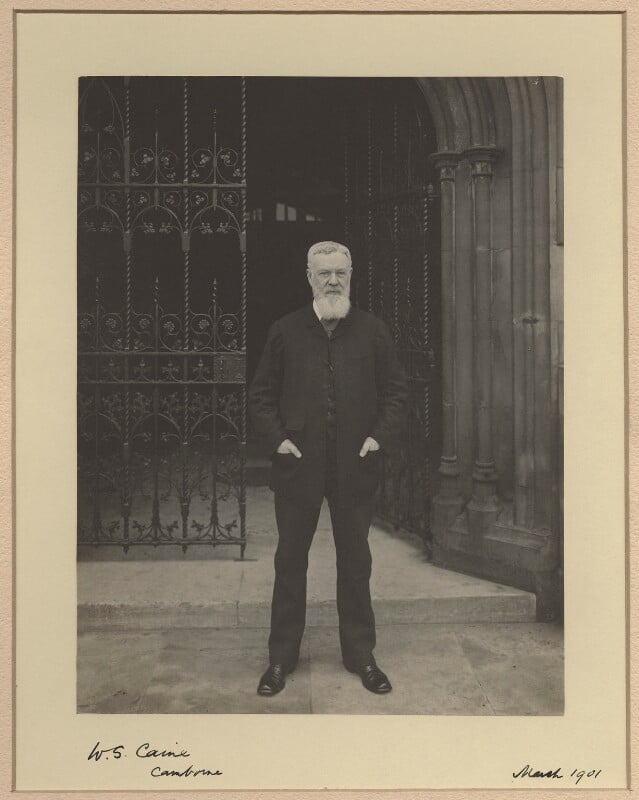
William Sproston Caine, Camborne, March 1901. Platinum print by Benjamin Stone. © National Portrait Gallery, London. [NPG x9234]. “Mr. Caine was exceedingly popular with his fellow-members in Parliament. A big, burly man who dressed negligently, his face framed in a mass of light brown hair turning to silver grey, he was one of the most picturesque figures at Westminster” (“Death of Mr. Caine, M.P.; A Champion of Temperance and Friend of India,” The Westminster Gazette, March 17, 1903, p. 7).
We regret to announce the death to-day, at his residence, 42, Grosvenor-road, London, of Mr. William Sprotson [sic] Caine, M.P. for the Camborne (or Northwestern) Division of Cornwall. Mr. Caine was a native of Liverpool, and was born on the 26th March, 1842. His grandfather was a prosperous tradesman in Lord-street, and his father, Mr. Nathaniel Caine, was an iron merchant, who took a prominent part in local affairs. Mr. W. S. Caine was educated by the Rev. R. Wall, of Birkenhead, and began his commercial career in the same line of business as his father. He subsequently became the principal partner in the Shaw’s Brow Iron Company, which was established in 1720, and which was eventually changed into the firm of Higson, Edwards, and Co., Limited, Crosshall-street. From that firm he retired several years ago, and has since devoted himself almost entirely to the public life, although he remained one of the directors of the United Kingdom General Temperance Provident Institution. Mr. Caine was above everything elseThe biographer of Caine’s father describes “the long-standing heart trouble” — “the vulnerable point in an otherwise superb physique,” as The Bradford Weekly Telegraph put it four days after the bearded one’s demise — which seems to have afflicted other Caine men as much as it did the popular and picturesque member from Camborne:A TEETOTAL ADVOCATE
and urgent worker for extreme temperance reform. He was a Baptist by religious conviction, a supporter of disestablishment, and an advanced Liberal in politics, but before them all teetotalism took its place. When the Home-rule split came he was one of the Unionists who followed Mr. Chamberlain, but his dissatisfaction with the Conservative Government and Unionist party on the temperance question led him ultimately into the Home-rule fold. His Parliamentary career was chequered. He unsuccessfully contested Liverpool in 1873 and 1874. On the former occasion he opposed Mr. John Torr when a vacancy was caused by the death of Mr. S. R. Graves, and he was defeated by 18,702 votes to 16,790. Then at the general election of 1874, when he again wooed Liverpool, he was fourth on the list, the late Mr. William Rathbone obtaining the minority seat. In 1880, Scarborough, that pickle political constituency, took a fancy for Mr. Caine’s robust politics and elected him, but its mind changed in November, 1885, and Mr. Caine was outside the walls of Parliament when Mr. Gladstone propounded his Home-rule scheme. In April, 1886, Mr. Caine, who was
AN ENTHUSIASTIC LIBERAL UNIONIST,
was elected for Barrow-in-Furness, but by June, 1890, his Unionist principles had so subsided in consequence of his temperance fervour that he resigned his seat and asked Barrow to return him as a Liberal. This the borough declined to do. In July, 1892, he again entered Parliament as the Radical representative of East Bradford, only to be thrown out of the seat at the general election of 1895. When the last general election took place (1900) he won a seat for his party in Cornwall, defeating a Liberal Unionist by 198 votes. In 1884-5 he held the subordinate position of Civil Lord to the Admiralty in Mr. Gladstone’s Administration.
Mr. Caine married in 1868 Alice, the daughter of the late Rev. Hugh Stowell Brown, of Myrtle-street Baptist Chapel, Liverpool, and his father-in-law at the same time married Miss Caine, his sister. Mr. J. Herbert Lewis, M.P., in 1897 married Mr. Caine’s daughter, Ruth. Mr. Caine was a J.P. for the North Riding of Yorkshire and for the County of London.
THE INTERMENT.
His funeral will take place on Thursday. A service will be held at Christ Church, Westminster-road, London, at 11 30, and the interment will subsequently be at Woking Cemetery (“Death of Mr. W. S. Caine, M.P.; Sketch of His Career,” Liverpool Evening Express, Tuesday, March 17, 1903, p. 5).
Early in 1902 one observed a change passing over him. He was always kind-hearted, generally full of boisterous good-humour, fond of a joke, ready to hear and tell a good story, whether for or against himself and his opinions mattered not so long as there was good humour in it. The change observable was that he was gradually becoming quieter and more gentle. A sad, pathetic look appeared in his eyes now and then, as with an unconscious appeal for help, such as one sees in the eyes of a stricken animal. The long-standing heart trouble became more acute, and his physical powers visibly waned. In the session of 1902 he was fairly regular in his attendance up to June. Hair and beard had become quite white, and he presented a striking figure on the green benches. […]On October 2, 1902, Caine père wrote from 42 Grosvenor Road to his eldest daughter Hannah, i.e., Caine fils’s eldest sister:After June his attendances became irregular. The heat of summer put a great strain on his heart, and he felt the need of rest and quiet. […]
At the end of September, after speaking at a temperance meeting at Weston-super-Mare, he went on to Exeter for the night, on his way to a series of meetings for his constituency. Here he had a bad attack of heart-failure, and after a painful night had to return to town, cancelling all engagements. When Mrs. Caine reached 42 Grosvenor Road — they had moved there in June 1901, because Mr. Caine found the night journeys to Clapham, after the House rose, too fatiguing — from Cardiff, she found him much better, and apparently only needing rest and change (Newton 1907: 300–301).
I went off to Devon and Cornwall on Tuesday. Spoke for an hour at Weston for the Women’s T.A. Union, and went on to Exeter after, arriving 11.30. The hotel where I had ordered my room did not send the bus, and there was no cab. I could not walk up a steep hill of 3/4 mile with my bag, so I had to hunt about near the station for a bed, and finally got a tidy room in a small hotel. But the heat brought on rather a sharp attack, and I had a bad night. So yesterday morning I cancelled all my engagements and came home. I am perfectly well again, and no trace of anything. G— has put me on a fortnight’s arsenic treatment [!], with absolute quiet, and I hope to be all right, so far as I am ever all right, in that time. The attack was nothing worse than I have had before, but it is clear my time has come for a period of rest, and I shall take it.Alas, it was the real article he had (and, it seems to me, the “fortnight’s arsenic treatment” would not have made it any less so):I shall go to Valparaiso and back presently in a Pacific boat from Liverpool, and have no doubt that will set me up again for two or three years at least. G— has no anxiety about me at all, and assures me that mine is not the dangerous form of angina, but what they call pseudo-angina. All I can say is, I don’t want the real article! (Newton 1907: 302).
Mr. W. S. Caine, M.P., the well-known temperance reformer, who has sat for Camborne Division of Cornwall in the Liberal interest since 1900, died at 3.30 on Tuesday morning from heart failure.Caine, thus, attended his father’s funeral, and two months later, proved his father’s will, as reported in the following news item:A later message states that Mr. Caine, whose demise took place at his residence in Kensington, returned from South America in February in much improved health, but subsequently contracted a cold, which developed rheumatism, and brought on a recurrence of heart weakness. Sir Thomas Barlow was called in on Sunday, and subsequent to this the hon. member had several acute attacks, and from one which occurred on Monday evening he never rallied.
Mr. Caine was born at Seacombe, Cheshire, on the 26th March, 1842, and was the son of Nathaniel Caine, who was connected with the iron trade in Liverpool. Mr. W. S. Caine married a daughter of the Rev. High Stowell Brown. Early in life he betrayed a keen interest in politics, and as far back as 1873 he contested Liverpool. He was elected for Scarborough in 1880, and again in 1884 on joining Mr. Gladstone’s Administration as Civil Lord of the Admiralty. He unsuccessfully contested Tottenham in 1885. Deceased was elected Liberal M.P. for Barrow in 1886, and again the same year as Unionist. He resigned in 1889 as a protest against Lord Salisbury’s Government for neglecting Irish Local Government and adopting compensation to publicans.
In 1892 he was elected a Liberal for East Bradford, but was defeated in the same constituency in 1895, when opposed by the late Mr. H. Byron Reed. The figures were: Reed, 5,843; Caine, 5,139. Mr. Caine was a member of the Royal Commissions on License Laws, and Indian Finance, hon. secretary of the Anglo-Indian Temperance Association, and President of the British Temperance League, and National Temperance Foundation, and vice-president of the United Kingdom Alliance.
He was elected for Camborne by 3,101, against 2,993 recorded for Mr. Strauss, the Liberal Unionist.
The sudden death of Mr. Caine is a sad event for the House of Commons, for he was one of the most familiar, and, indeed, household figures in its social and political life. Two of his sons-in-law are members; he was the most commanding of the band of Temperance advocates; he had latterly taken popular Indian grievances on his broad shoulders; and he was a link both with the stirring Liberalism of the eighties and with the great Unionist secession. For a little time he was Mr. Chamberlain’s right-hand man, and he actually told against the Home Rule Bill of 1886. Then when Unionism became Toryism in thin wrappings he came at once back to the Liberal ranks. He had the gift of organisation, was a born platform speaker, a preacher, and a religious worker, adding to his hard week’s work in Parliament, in which he never spared himself, the conduct of a Kennington mission. In the House the clear emphasis of his style rarely failed to tell. He grew quieter as his strength failed him, and his big frame lacked of late years the keen, strong air of earlier times. A genial soul, he had a North-countryman’s humour, with a touch of roughness, but never of unkindness, in it. Life for him was compacted of many and fine interests. Throughout, he was a good soldier of humanity, to whom public work was the habit of an untiring spirit. He took his painful and disabling ailment with the utmost fortitude, and said a day or so before his unexpected death that he had borne it for many years, and hoped to bear it for many more. Many good causes will miss him.
HIS LAST PARLIAMENTARY QUESTION.
The last question addressed by the late Mr. W. S. Caine to a minister of the Crown in Parliament appeared in the papers issued on Tuesday. He had asked the First Lord of the Treasury “if, in view of the fact that no popular boon or concession has been granted, according to ancient usage, in connection with the Delhi Durbar, His Majesty’s Government will direct the Government of India to take some early opportunity to rectify this omission.” To this Mr. Balfour, in a printed answer, replied: “I am not prepared to admit the validity of the principle upon which the question of the honourable member appears to proceed.”
A BLOW TO INDIA.
Profound and general regret has been caused in the House of Commons by the death of Mr. Caine, who for more than twenty years, with one or two brief intervals, had been a redoubtable fighter in the Parliamentary arena, and for an even longer period a familiar figure in what are called the precincts of the House of Commons. The blow will be felt with peculiar severity by the friends of India.
LONG PREPARED FOR THE WORST.
Mr. Caine had long been prepared for an abrupt termination to his wonderfully active career. He was well aware of the vulnerable point in an otherwise superb physique, and though hopeful of being spared to continue his work for many more years, the fortitude of his character had enabled him, especially within the last few months, to take due account of the uncertainty of his tenure […] (“Death of Mr. W. S. Caine, M.P.; Well-Known Temperance Reformer; and Formerly Member for East Bradford,” The Bradford Weekly Telegraph, Saturday, March 21, 1903, p. 8).
Mr. William Sproston Caine, of 42, Grosvenor Road, and the Reform Club, M.P., at various times for Barrow-in-Furness, Scarborough, Bradford, and Camborne, died on March 17th, aged sixty-one, and his will of January 23rd, 1894, with a codicil, has been proved by Mrs. Alice Caine the widow, William Caine, the son, John Herbert Roberts, M.P., of Abergele, North Wales, the son-in-law, and Cecil Edward Maples, of Cook Street, Liverpool. Under the provisions of the will of his father Mr. Nathaniel Caine, who died in December [sic], 1877, leaving property of the value of £500,000, he appoints to his wife while she remains his widow the income from fifty shares in Hodbarrow Mining Company, the income from his interest in two sums of £25,000, and four-sixteenths of the income from his share of £111,000, but should she again marry an annuity of £700 is to be paid to her. He further appoints thirty-five shares in the mining company to his daughters Hannah Rushton Roberts, Dorothea, and Ruth; forty-seven shares to his son William; and forty-eight shares to his son David Howard; and two-sixteenths of his interest in £111,000 each to his three daughters and three-sixteenths each to his sons. Subject to the interest of his wife in such funds and shares, he appoints such parts as are to be held in trust for her as to two-twelfths each to his daughters and three-twelfths each to his sons. Mr. Caine gives to his wife furniture and household effects to the value of £2,000; to his secretary, Frederick Grubb, £100; to his servants, £20 each; and to his charwoman, £20. His residuary estate is to be divided among his children in the shares of two-twelfths each to his daughters, and three-twelfths each to his sons. The value of the estate is sworn as £2,501 3s. 4d. (“The Will of the Late Mr. W. S. Caine, M.P.,” Leamington Spa Courier, May 29, 1903, p. 2).The proving of Caine père’s will was also reported as follows:
The will of Mr. William Sproston Caine, M.P., of 42, Grosvenor Road, London, has been proved in London by Mrs. Alice Caine, the widow, William Caine, barrister, the son, John Herbert Roberts, M.P., of Abergele, North Wales, and Cecil Edward Maples, of Liverpool, the gross value of the estate being £2,501. Under the will of his father, Mr. Nathaniel Caine, who died on September 28, 1877, and the value of whose property was sworn to be under £500,000, he appoints to his wife during her widowhood the income from 50 shares in the Hodbarrow Mining Company, the income from his interest in two sums of £25,000 each, and 4-16ths of the income from his share in the sum of £60,000, and in two other sums of £25,000; but should she again marry, then an annuity of £700 is to be paid to her. Subject to such interest of Mrs. Caine, he appointed 35 parts of his shares in the Hodbarrow Mines each to his daughters Hannah Rushton Roberts, Dorothea, and Ruth, 47 parts to his son William, and 48 parts to his son, David Howard, 2-16ths of his share in the sums of £60,000, £25,000, and £25,000 each to his three daughters, and 3-16ths each to his sons, and the remaining parts of such shares and funds not appointed as to 2-12ths each to his daughters and 3-12ths each to his son [sic]. Mr. Caine gives to his wife furniture, etc., of the value of £2,000. The residue of his property he leaves as to 2-12ths each to his daughters and 3-12ths each to his sons (“Will of Mr. W. S. Caine, M.P.,” The Maryport Advertiser, Saturday, May 30, 1903, p. 5).And a third version ran:
The will bears date 23rd January, 1894, with a codicil 27th May, 1902, of Mr. Wm. Sproston Caine, 42, Grosvenor-road, London, and formerly of Northside, Clapham Common, J.P., a native of Seacombe, Cheshire, and formerly an iron merchant in Liverpool, M.P. for Scarborough 1880–4, for Barrow-in-Furness 1886–9, for Bradford 1892–5, and since 1900 for the Camborne Division of Cornwall, President of the British League and the National Temperance Federation, Chairman of the United Kingdom Alliance and General Provident Institution, a director of the Cyclone Central Co., and formerly of the New River Co. and George Routledge and Sons, and joint manager of Shaw’s Brow Iron Co., who died on 17th March, aged 51 [sic] years, leaving estate of the gross value of £2,501 3s. 4d., with net personalty nil. The executrix and executors are his widow, Mrs. Alice Caine, daughter of the late Rev. Hugh Stowell Brown, and his son, Mr. William Caine, barrister, Mr. Jno. [sic] Herbert Roberts, of Abergele, M.P., and Mr. Cecil Edward Maples, of 14, Cook-street, Liverpool. The testator bequeathed his servants of five years’ service £20 each, and to his wife his household effects to the value of £2,000; and he appointed to her from his interest in the estate of his father, the late Nathaniel Caine, of Broughton-in-Furness, in the event of her remarriage £700 a year for the remainder of her life. From his income inthe interest in the Hodbarrow Mines and other sources, and subject to her interest, he left his own estate and appointed his interest in his father’s estate among his children in the proportions of three-twelfths each for his sons and two-twelfths each for his daughters (“Wills and Bequests; Mr. W. S. Caine,” The Weekly Courier (Liverpool), Saturday, May 30, 1903, p. 6).How an estate that would seem to include a portion of £500,000 inherited from Nathaniel Caine, plus quite a large number of shares of the Hodbarrow Mining Company, as well as financial interests adding up to £160,000, could be valued at only £2,501 3s. 4d., can be explained by the fact that the value of the estate would have been estimated only on the basis of the personalty (moveable property) subject to legacy duty, with the value of real estate and financial assets, especially if held in foreign banks or companies, excluded. Furthermore, it seems that, in association with the move from Clapham to 42 Grosvenor Road (at which address Caine’s mother and brother continued to reside), Caine père liquidated much of his personalty, as indicated by an advertisement for the sale by auction of
a Selection from the Library of W. S. CAINE, Esq., M.P., comprising Works on Ceramics — Fine Arts — County Histories and Local Topography — Extra-illustrated Books — Publications of Archæological and Literary Societies — First Editions of English Classics — rare Books of the Sixteenth and Seventeenth Centuries, English and Foreign — a Collection of Worcester Tradesmen’s Tickets and other Engravings by James Ross, of Worcester — Specimens of Wynkyn de Worde’s Press — Collections of Engravings, Postage Stamps, Ex-Libris, &c. (The Saturday Review, 6 July 1901, p. 28).
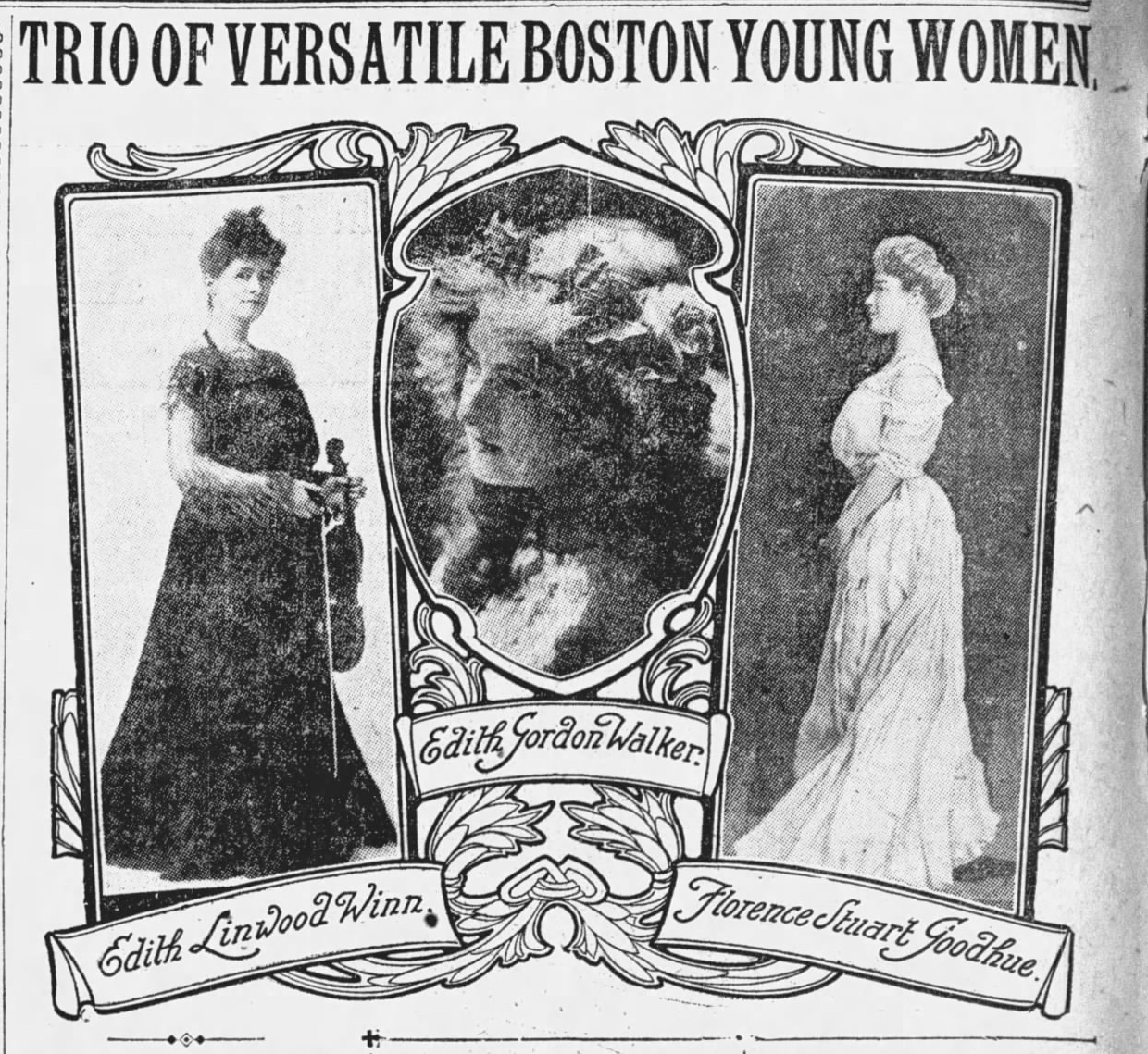
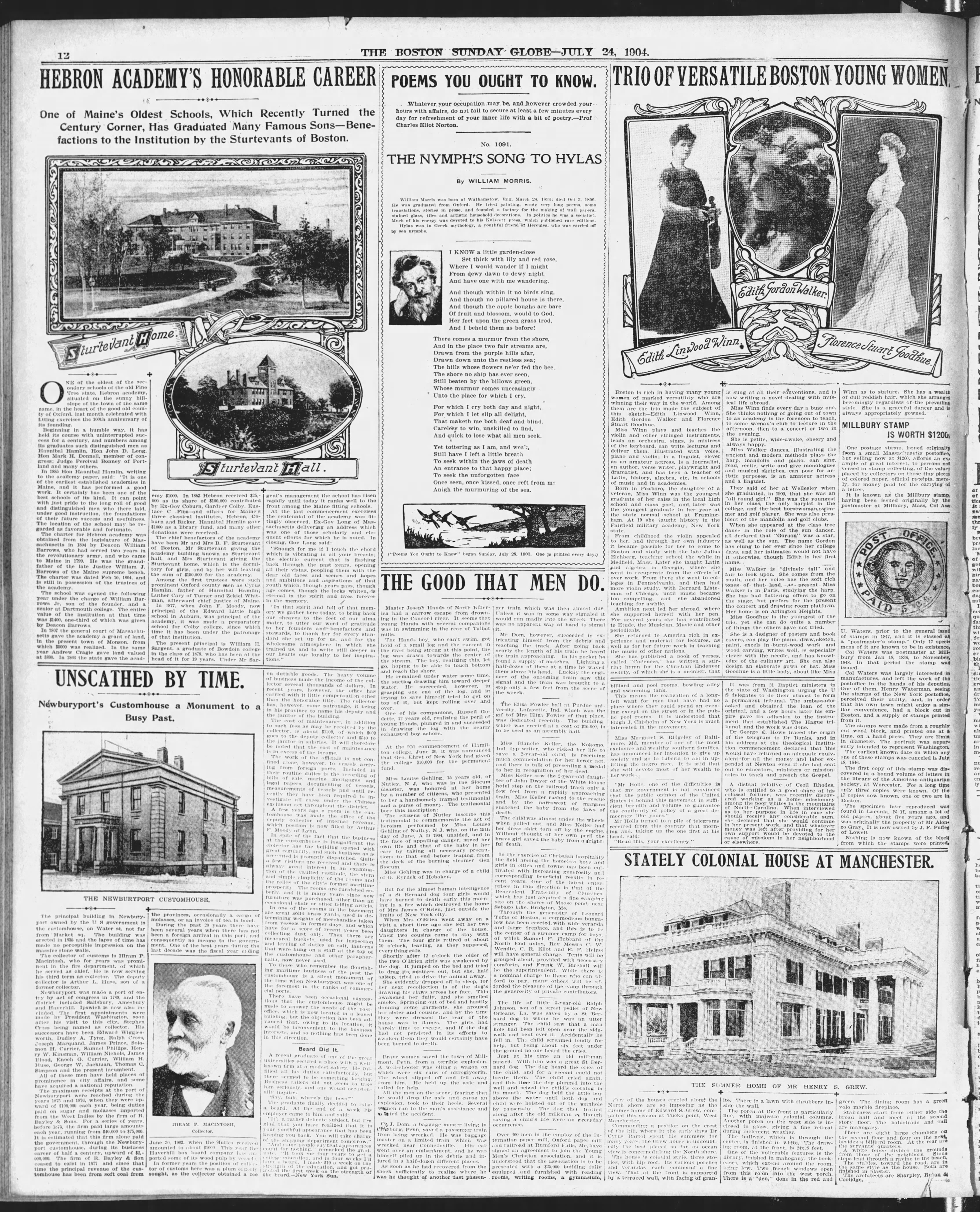
Reproduced from The Boston Sunday Globe, July 24, 1904, p. 10.
rich in having many young women of marked versatility who are winning their way in the world. Among them are the trio made the subject of this sketch — Edith Linwood Winn, Edith Gordon Walker and Florence Stuart Goodhue.The divinely tall horsewoman (recall Borges’s “amazona y altiva,” § 4) who developed into an “intellectual dancer” “illustrating the ancient and modern methods” would have started out as an ordinary social dancer. For instance, while she was still a senior at Arlington High School, she was noticed at a concert and dance at the Arlington town hall on Tuesday, December 17, 1895, where she was one of the dancers whose “flying feet” were kept “busy until after midnight, when the party ended.” And in the summer between high school graduation and the start of her freshman year at Wellesley, Caine’s future spark was one of “the young society belles of the city” who attended a high-society dance party in Gloucester, Mass.:[…]
Miss Walker dances, illustrating the ancient and modern methods[,] plays the harp, mandolin and piano, can sing, read, recite, write and give monologues and musical sketches, can pose for artistic purposes, is an amateur actress and linguist.
They said of her at Wellesley when she graduated, in 1900, that she was an “all around girl.” She was the youngest in her class, the only harpist in the college, and the best horsewoman, swimmer and golf player. She was also president of the mandolin and golf clubs.
When she appeared at the class tree dance in the role of the sun dancer, all declared that “Gordon” was a star, as well as the sun. The name Gordon has clung to her ever since her college days, and her intimates would not have it otherwise, though Edith is her first name.
Miss Walker is “divinely tall” and fair to look upon. She comes from the south, and her voice has the soft rich tones of that land. At present Miss Walker is in Paris, studying the harp. She has had flattering offers to go on the stage, but prefers for the present the concert and drawing room platform. Her home is on Arlington Heights (“Trio of Versatile Boston Young Women,” The Boston Sunday Globe, July 24, 1904, p. 12).
The two-mile trolley trip back to Gloucester from Fernwood, a summer cottage colony on the Annisquam River/Fernwood Lake in the fishing port’s western suburbs, would have taken about ten minutes. Another twelve minutes would have taken Walker the two and a half miles further east to the coastal station at Long Beach where, in the row of cottages, hotels, hostelries, and casinos along the boardwalk and not too far from other sites of seaside diversion such as beach, pavilion, dance hall, and bowling alley, her family had its summer residence. Which reminds me of a piece entitled “At the Seaside,” published in Caine’s posthumous collection What a Scream! (1927, pp. 79–89), the first few pages of which are as follows:gloucester, Aug 14 — A most enjoyable party was given by Mrs Charles H. Pew, in honor of Mr Harry G. Pew, at her elegant summer residence, Katolah cottage, Fernwood, last evening. The buildings and grounds were profusely decorated with many colored lanterns and the effect was very pleasing. Mrs Pew received the guests and made a charming hostess, and nothing was left undone for their pleasure.
A spacious open pavilion had been erected for dancing and here the assemblage enjoyed themselves for several hours. A cooling breeze blew from the river which materially added to the pleasure of the occasion.
The young men present wore the regulation summer suit, white duck trousers with dark coats, while the young society belles of the city were very prettily gowned in airy costumes.
A fine collation was served during the festivities. The guests returned to the city on the special parlor trolley car “Magnolia” (“At Katolah Cottage; Brilliant Social Function of Gloucester’s Society People Last Evening,” The Boston Daily Globe, Friday, August 14, 1896, p. 4).
There is only place for a summer holiday — the seaside. I never go near it.The transition from social to artistic dancing would have been facilitated by the fact that Walker’s dance teacher taught both, as shown by an advertisement from the period in question:I can’t afford the white trousers.
If one does not wear white trousers at the seaside one is impossible; and when I say white trousers I mean trousers that are white all over. One had better wear blue trousers, or green trousers, or no trousers, than white trousers that are not white all over. If one wears such trousers one is a pariah — simply a pariah.
Now no white trousers that I have ever put on have remained white all over for more than twenty-four minutes. If it isn’t ink, it is earth that gets on them, or tar, or marmalade, or rust, or paint, or something else. The white trousers of other men remain white all over from morning to night and from Saturday to Monday. From April to October, too, I dare say.
Mine don’t.
I never see other men wearing tarred white trousers, or rusted or painted white trousers. I can’t see why mine shouldn’t remain white all over like those of other men. But they don’t — not for more than twenty-four minutes, at any rate. It’s a mystery. But there it is. They don’t.
And so if my trousers are to remain white all over — and they must, or I am a pariah — it means that I have to change them from fifteen to twenty times a day, and my fortnight’s bill for dry-cleaning swamps me for years to come. So I keep away from the piers and the fronts, except in winter-time, when, as you know, to wear white trousers of any kind is social death.
Yet I know perfectly well that the seaside is the place where you must be during July and August, if you mean to get the best out of your holiday; particularly if, like me, you are a Londoner.
To begin with, at the seaside in summer you can always rely on finding plenty of people. That’s as it should be. There is no profounder mistake that a townsman can make than to spend his holiday in lonely spots, like remote farms on Dartmoor, or sequestered shepherds’ huts on the Fells of Cumberland, or isolated public-houses in Caithness. The change of environment is too great and too sudden. The emptiness of these wide spaces cows him, their silence stuns him, their savagery shocks him to the soul.
He can’t sleep at night for the infernal quiet. As he takes his walks abroad he sweats with fear of the large-horned animals which he encounters, loose and unattended, on the hillside. He dare not go out of sight of his quarters, for there is nobody from whom to learn his way back. Where are the police, should a robber hold him up? Where are the omnibuses, should the rain come on? Where are the shops, should he want a box of matches or the evening newspaper? Echo, his sole companion, answers — where?
At the end of his week or his fortnight he returns home a nervous wreck.
The townsman who goes to Margate, or Blackpool, or Douglas for his summer holiday has no such distressing experiences. Between the moments of his arrival and his departure he moves — in his white-all-over trousers — perpetually and comfortably amidst throngs of articulate-speaking men. For not one second of the day do the horrors of solitude assail him, and at night he drops happily asleep lulled by the reassuring tramp of ten thousand boots under his bedroom window.
When he goes forth there are named streets that will guide his confident steps in this direction and in that direction — to the pier, to the winter gardens, to the lawn tennis club, and back to his hotel; straight, solid double lines of brick and stone which compel him to remain between them and land him, with certainty and despatch, at his desired destination, not after hours of desperate wandering in a bog, or a quarry, or on the edge of a raging torrent.
Is he ever in doubt as to his road? He has but to choose his informant from among the hundreds with whom at the moment he is rubbing shoulders. Is he weary? He raises his stick and at once three cabs come charging to his side. What robber shall assail amongst all these public-spirited citizens? A policeman is, moreover, just round the corner. Does he thirst? A few steps in almost any direction will, if the hour be a lawful one, set that matter right.
Now, in the wilds — unless he is prepared to poison himself with the water of a brook — he may have to walk for a couple of hours before an inn will heave in sight — and then it will be on the horizon.
Is he bored? Fifty cinemas compete for his two-and-fourpence. Over there is the skating rink. Yonder he can dance. This is the theatre. The music hall is in the next street. Here is the aquarium, next to the menagerie. The waxworks are just opposite. A short tramride will take him to Luna Park, where endless diversion awaits him (pp. 79–82).
Miss Lilla Viles Wyman 179A Tremont St. Society, Stage and Theatrical Dancing, class and private lessons; Physical Culture classes, character, ensemble and solo dances; festivals, fêtes and carnivals arranged and conducted (“Educational; Dancing,” Boston Evening Transcript, Wednesday, December 23, 1896, p. 11).During her senior year at Wellesley, Walker was spotted at “the last of the series of subscription dancing parties of the season […] given in the Arlington town hall Wednesday evening,” February 21, 1900, and a few months after graduation she was seen at an “enjoyable social affair” described as the “dressiest of the year” given by the Arlington Golf Club on Thursday, November 29, 1900. By around this time it seems that Lilla Viles Wyman had traveled to Europe and back, adopted for herself the more reputable shield of “Mrs.,” and had moved her studio from 179A Tremont Street to 17 Boylston Place where she was teaching “Parisian and London artistic dances and novelties; class or private lessons.” Three years later there was a three-week span in which Walker’s name was mentioned in close proximity with that of Lieut. Paul E. Chamberlin of the United States Marine Corps. It seems that, in mid-October of 1903, Chamberlin assumed duties as the Marine officer aboard the decommissioned receiving ship USS Wabash berthed in the Boston Navy Yard. On Sunday, October 18, Walker, in the company of a Mr. Walker (her brother, I assume, and not her father) and another member of the Paul Jones chapter of the Daughters of the American Revolution, Florence Goodhue, visited the Wabash, on which it was announced that Walker was “to give an entertainment shortly […] for the enlisted men. She is exceptionally versatile as a monologist, harpist, singer and dancer, besides being endowed with beauty.” On Monday, October 26, at a performance of “the Revolutionary play” Captain Barrington at the Globe Theatre, Boston, Walker shared a box with her mother, Chamberlin, Chaplain Johnson McClure Bellows of the United States Navy, and “Boston’s youngest writer of note, and the Army and Navy Journal representative,” Elizabeth McCracken. The following week Walker attended “the first in a series of dances […] given by the captain and officers of the Wabash,” upon whose quarterdeck, “elaborately decorated with flags and pennants,” as the Army and Navy Journal put it, “the navy yard band was stationed.” Listed among those in attendance is Chamberlin, spelled “Chamberlain” by the Boston Sunday Post, which paper further noted, “Much regret at the yard is expressed at the near at hand departure of Lieutenant Chamberlain, who has been ordered to the new ship at Tacoma.” I can only speculate as to whether or not this latter event was also the occasion of Walker’s entertainment for the enlisted men, as well as to whether or not Walker and Chamberl(a)in had embarked on a romance which was quickly curtailed by the latter’s rather sudden transfer to Tacoma. Meanwhile, I would like to reproduce one of Caine’s early pieces, published in Punch (December 5, 1906, p. 406) and entitled “The ‘Boston,’” which, employing as it does a first-person female narrator being mansplained to bien avant la lettre, seems to me to be evidence that, some seven months before their marriage, Walker was already supplying the future author of The Author of “Trixie” with the spark he used to write with:
.... The band began to play the Blue Danube and my partner bowed before me.The Boston reappears in the dinner/dance party at the Café Riche with which Boom! (October 1909) opens:“This,” he said, “is ours, I think. It is a waltz.”
I murmured my thanks for the information.
“You Boston, of course?” said he.
I admitted that I Bostoned.
“Good!” said my partner. “I think it is a charming dance. I learned the step from some very nice Americans that I met this summer at Caux. Are you ready?” A look of tremendous determination came into his face as he gripped me, and we moved off.
“I fancy,” said I, “that I am not doing it very well.”
“You only need a little practice,” he observed, stopping and leaning me up against the wall. “Take more of a long sliding step, bringing up the second foot behind the first, as in the two-step, only with more of a glide. As the step is in 2/4 to 3/4 time, you want also to watch your time carefully. It isn’t one two three, one two three, one two three, but one two three one, two three one two, three one two three.”
“I see,” said I. “Shall we go somewhere where it is cooler?”
* * * * *
My second partner wasted no words. He assumed that I Bostoned as a matter of course. I gathered this from the fact that when, after an uneasy half-circuit of the floor, I disengaged my hand from his arm and stepped aside out of danger, he remarked: “You Boston rather differently from some Americans who taught me the step in Nova Zembla last August.”
I asked if they were aboriginals.
He looked doubtfully at me for a second and then (after assuring me that they were very nice) began to explain how it should be done.
“You begin,” he said, “with the right foot, as in the Military two-step, but you bring your left foot a little in advance at the second step, and then start off with it for the next half-turn. The time is a little difficult to keep, but that is only a matter of practice. You want to come in more on the second of the bar, thus: One two three, four one two, three four one, two three four.”
I said I would certainly do so, but just now I must have a glass, a full glass, of champagne.
* * * * *
My third partner took the opportunity of giving me some instruction before we began to dance.
“When you Boston,” he said, “you count one two three four five six seven eight nine, one two three four five six seven eight nine, making one half-turn at four and another at seven. The step itself is a sort of half-sliding polka, half-running sweet-step. It is quite easy. Now — OFF we go. One two three four five six seven eight,” he counted loudly, his voice rising high above the music.
At “nine” I made a second half-turn, which brought me up sitting on a divan.
“Don’t you like the Boston?” he asked.
I said I loved it, but I was so tired this evening.
“I am glad,” he said, “that it is be popular this winter, because some very nice Americans, that were staying in the same hotel with me at Batoum in September, taught it to me, and I feel rather ahead of the other Johnnies, you know.”
* * * * *
“What I like about this Boston,” said my fourth partner, “is that you don’t need to worry about the rotten time or tune, but just go as you please.”
With these words he placed me carefully in front of him and ran me backwards violently into a man, whose eye-glass shot out of his eye and crashed to atoms against the unnatural teeth of a lady in black some yards away, who screamed loudly and dragged her partner on to the floor, there to become the nucleus of a pile of bodies which was still increasing when I darted through the door.
“You don’t care about it, evidently,” said my partner, as he joined me on a sofa. “You should learn it. It’s lots of fun.”
He explained its attraction to me for the next five minutes, mentioning incidentally that they had danced nothing else all October up at Strathpeffer, where some very nice Americans had introduced it at a shooting lodge.
The dancing floor was packed with people all turning violently, most of them quite independently of the music, which for the matter of that was perhaps the most independent thing in the room. But nobody cared whether the band kept time or not. Hearty fellows rushed about in all direction, cannoning into each other with cheery laughs. Many of them, under the impression that they were dancing the Boston (introduced to London Society about five years before and now beginning to creep into general recognition), zig-zagged perilously hither and thither across the main stream of the traffic. The partners of these gentlemen sustained rather more damage than the other girls, but, conscious that they were doing something that marked them off from the rest of the world, they smiled through it all (p. 17).Caine expanded the foregoing into the whole of chapter XXXVI (the epigram for which is: “‘The Sanitary is the only toothpick offering the guarantees required by hygiene and cleanliness.’ — Price list of the Army and Navy Cooperative Society, Ltd.”) of The Devil in Solution (May 1911):
“My dance, I believe,” said Lord Mark.As the articles which I’ve reproduced above from the San Francisco Examiner and other newspapers indicate, the first spark of general terpsichorean recognition which the future wife of the future author of The Author of “Trixie” earned for herself — and which she pleasantly recalled in those articles as having been in her “element then” — occurred in the “sun dance” she performed at Wellesley’s Tree Day on June 8, 1900:She looked up at him shyly, a smile lurking in the corners of the arc de cupidon which formed her lips, and took his arm with a blush. The touch of the little white glove upon his coat-sleeve sent an electric shock through his frame.
The little simple familiar actions — it is these that make us choke.
The National Conservative Club was en fête. The annual Cinderella was in full swing. Union Jacks were everywhere and shining balls of green glass had been scattered lavishly among the decorations. Tonight the National Conservative was on its mettle, resolved to prove to its fair guests (for ladies had been invited) its claims to the proud title of the most Artistic Club in London. On its exclusiveness — limited in numbers as it was to a rigid fifty thousand — it did not need to insist.
Among the the throng which filled the Central Hall, the reading room (temporarily converted into a dancing room) and the coffee room where supper was served, many well-known faces were to be noticed. Nor was this wonderful.
The Conservative Party in the House of Commons was here to a man and very nearly all the Peers. Among the latter perhaps the only exceptions were those who were at present residing abroad in order to spare the process-servers of their creditors the inconvenience of pursuing them as they dashed about in their automobiles from one part of England to another. The Government was fully represented and to the leading members of the Opposition invitations had in courtesy been sent. Of these latter Bilson Venner alone had committed the mistake of accepting. He had been too ignorant to doubt the sincerity of the pleasure, which, his card told him, the President and Committee of the Club anticipated from his company. So he had come; and now, having importuned kind-hearted Lady Cerise into giving him a lancers and another lady (who saw no other prospect of dancing) into promising him the very next waltz, he had take up his position by the door, ill at ease, generally shunned, looking on at the pleasures of his political enemies, with a programme blank save for, faintly pencilled, two names.
The most delightful feature of the Athletic Parliament was the honest, whole-hearted enjoyment which it put into its dancing. Honourable Members seemed to live through every minute of the exercise.
There was no hanging back when once the music began, no waiting for some one else to start. The conductor could hardly deliver his warning rap upon his music-stand before the floor would be covered with rapidly revolving couples. And how they danced, these eager, healthy, muscular young men! That was what they had come to do and they did it with a will. Each of them seemed inspired with the very spirit of the dance. They put their whole souls into it. They danced as they played their games — for the sheer love of exertion. The music they disregarded. Waltz, two step, barn dance or Berlin polka, it was all one to them. Their partners’ methods they ignored. From the first note to the last they had but one aim in view, to cover ground. They despised the niceties, the refinements of waltzing. Being gentlemen they abhorred reversing and any cad who should have been guilty of the practice would have been instantly ejected. Slow movements made no appeal to them. The Kensington Cuddle and the Portman Crawl would have met with a warm reception on that floor. They were young and strong. Why should they crawl? They preferred to leap. They exulted in their own elasticity, in their own resilience.
Lady Cerise had never seen such dancing before. Hitherto her experience of ball-rooms had been confined to the Commemoration Entertainments of the Oxford Colleges, and though these at times afford striking displays of the Terpsichorean art, any which she had attended were utterly out-shone by this National Conservative Cinderella, wherein all the robustest and most resourceful athletes of the day vied honourably with one another for pre-eminence.
It was a surprise to her, as she reached the edge of the dense crowd by the door, to see a tall young man with red hair who guided a very stout girl in pink, run backwards about ten yards at the top of his speed, looking over his shoulder the while to make sure of his aim, and collide violently with another tall young man whose hair was black. This had the effect of causing the black-haired young man to lose his balance and fall heavily on the floor. With that presence of mind, however, which never deserts a good dancer he managed to place his partner between his own body and the planks, so that he sustained no very serious contusions, and had not the red-haired young man taken advantage of his situation to spurn his face vigorously with a flying heel, he would have come off scot-free. The red-haired young man, with a gay laugh, raced on and Lady Cerise observed him single out a third tall young man (they all seemed tall), take fresh aim and dance backwards once more in the direction of this new opponent. But another and even finer dancer, thrust out a quick foot and tripped him up with wonderful cleverness. The girl in pink remained on her fet for a second, but a debonnair giant, who was driving a way for himself and his partner through the press in a direction opposite to that which the main stream of dancers followed, took her in the back with his shoulder, and down she thundered under the very feet of an advancing couple composed of a Cambridge No. 7 and a small but solid member of the North of England Ladies’ hockey team. This pair in turn instantly collapsed, the youth putting his foot through his partner’s gown and tearing therefrom one Imperial rod, pole or perch of pure white crêpe de Chine.
Lady Cerise drew back instinctively.
Lord Mark bent to her, whispering.
“Are you afraid?” he asked.
“Oh, Mark!” she replied. “Afraid! With you!”
“Darling,” he said as he slid his arm around her. Then, standing for a moment with her right hand in his left and so beating time to the music that they might the more certainly step off on the first of the bar — “One, two, three; one, two, three; one, two three — Now!” he cried and they glided away together.
Lord Mark was a superlative dancer.
He possessed for the exercise the greatest natural advantages and he brought to bear on its study all the forces of his mighty brain. The fastest, heaviest, trickiest football forward in England was not likely to find waltzing beyond his capacity. The science and quickness which served him so well in either the Rugby or the Association game made him equally redoubtable in the ball-room. His great weight gave a terrible momentum to his course down the floor and made victory certain in every encounter when his cleverness seized the moment for provoking it. And of encounters there were many, for where bright eyes look on young manhood will not easily refuse a challenge. Couple after couple threw themselves in the way of Lord Mark and Lady Cerise, panting to bring him down. But the same fate awaited each pair. They were dashed to the floor or hurled, stunned and gasping, against the walls and Lord Mark passed on without a stagger.
The lovers were as irresistible as Nemesis.
Soon there were but three couples dancing, for every one else had retired to the side of the room, whence they could watch and admire the step of the President of the Board of Agriculture.
Commander Lord Skibbereen, the hugest officer in the Navy, and Bilson Venner were the only athletes who still held the floor. So far neither had succeeded in meeting Lord Mark in the mazes of the dance. But now, the field being clear, both might be seen edging gradually nearer and nearer to the Doggett’s Outright Holder. To intention was clear — to get within a yard or two of him and rush suddenly, before he was aware. The danger to Lord Mark was great. Lord Skibbereeen and Venner were, next to himself, the two most skilful waltzers in London and to the spectators it seemed impossible that he should successfully meet the attacks of both men. Lord Mark, to all appearance quite unconscious of their approach and wholly given up to the dreamy delirium of the waltz, was revolving gravely down the very middle of the room. Venner and Lord Skibbereen were completely deceived and stole confidently up to within a few yards of him.
And then Lord Mark deliberately shut his eyes as though the ecstasy of the motion was overpowering his senses. An involuntary groan of horror (instantly suppressed) rose from the crowded spectators. He seemed to all those eager eyes to be lost indeed. But he muttered to Lady Cerise: “They’ll go for us in a second. Pinch me when you see them coming, my own.”
Venner and Lord Skibbereen were now on either side of him. They kep level with him as he moved down the room, about two yard away, hovering near him, as it were, like a pair of hawks about to strike. Surely, surely both cold not miss.
Suddenly those who looked on knew that the decisive moment had arrived. Each man simultaneously took a firmer grip of his partner, each threw up his chin and expanded his lungs to meet the coming shock, each turned his back on Lord Mark. Every eye in the room was fixed on these three couples in the centre of the parquet. The very musicians in the gallery forgot to play and the silence was absolute. But neither Lord Skibbereen nor Venner noticed that the waltz had come to an end. Their whole souls were bent on the single purpose of downing Lord Mark.
Indeed, the cessation of the music seemed to act upon them as a signal, for with the last irresolute scrape of the fiddle, they simultaneously launched themselves to the attack.
Lady Cerise pinched Lord Mark’s arm.
Lord Mark stopped dancing, took his arm from her waist, tucked her left hand into the crook of his right elbow and swinging suddenly around on his heel led her back in the direction opposite to that from which they had come.
By this simple and masterly manœvure [sic] the space which theur bodies had occupied became empty and in obedience to the well-known law, Nature abhors a vaccum, it was instantly filled to overflowing by Lord Skibbereen, Venner and their respective partners. The two young men rushed together, back to back, with a horrible impact and the vicinity was immediately strewn with inanimate forms.
Lord Mark, so far as anyone could tell, was wholly unconscious of his victory. In a loud voice which caused every word to be distinctly audible, he said, “What admirable music!” and Lady Cerise replied: “Yes. And what a splendid floor!” So, chatting easily, the two lovers passed through the door in the direction of the buffet.
Then the applause burst forth.
In San Francisco Consols reached par (pp. 298–303).
No glimmer of doubt as to weather conditions disturbed the preparations for tree day, begun early this morning. Warm, but not too warm, with the shade of many trees and the refreshment of a steady breeze, the afternoon has been delightful for actors and audience alike.The festivities were described by The Woman’s Journal (Boston) as follows:A novel feature this year ws the music which was furnished by the Boston Cadet Band throughout the afternoon. One by one the classes came into sight, moving to this music, from the south porch around the east side to the front — seniors first, in caps and gowns worn over white dresses, next the juniors, representing their class flower, the carnation, then the sophomores, figuring as the people of Mother Goose fame, in motley costumes, and the freshmen, dressed in white gowns, with green sashes and carrying great bunches of crimson and pink roses, their class flowers.
Contrary to the usual custom of carrying out first their programme of addresses, the seniors gathered around their class tree, singing the class song, marching from there to the sophomore tree on the side hill, and thence to the junior tree, with the appropriate songs, in which all the classes joined. Then they returned across the campus to the starting point of the gold course as a gathering ground; and here Miss Hannah Hume, the senior president, gave the address of welcome. This was followed by the usual address of warning and deprecation to the undergraduates, Miss Nina F. Poor being the orator. The class poem, written by Miss Lucy V. N. Morris, was effectively given by Miss Mary Rockwell, mistress of ceremonies for the seniors, and in the poem the ensuing dances were explained.
Four years ago, when the present seniors were representing on their first tree day a mardi gras festival, their plans were interrupted by unwelcome showers. This year, in mardi-gras dances, they carried out the programme of their freshman year. Twenty seniors, in black and white dominoes, came down from the Art Building hill dragging a decked handcart which carried Miss Alice Knox, dressed in jester’s costume of red and black. Once on the campus, a variety of fantastic dances ensued. Following came the “Rain-sisters,” who drove the mardi-gras revellers away; they were dressed in long gray gowns, and carried floating scarfs which they waved about in graceful dances. Then from among the masses of flowering rhododendrons appeared a glowing figure, Miss Gordon Walker, dressed in gold-color and representing the sunlight, as as she approached the rain people were gradually driven back. A rainbow of seniors dressed in the primary colors was formed around Miss Walker, and the last figure was the springing up of nine fleur-de-lis students, gowned in short lavender and purple costumes, to typify the class flower; and the mardi-gras festival, so admirably carried out, ended with a series of quick, bright dances.
Then, forming a grand march, the procession wound its way across the campus to the wooded borders near Longfellow Pond and the freshman exercises began.
Miss Mary Loomis, freshman mistress of ceremonies, led the class orator, Miss. C. Christabel Cannon, to the station of honor, where 1903 made its maiden speech to the Wellesley world. Miss Anna E. Snyder, on behalf of the sophomores, presented the time-honored spade to Miss Alice W. Stockwell, and their addresses were full of local reflections. Misses Mirian Coste, S. Belle Ainslee, Jessica Lathrop and Clara S. Raymond served as class aids. With their long white dresses, their wreaths and baskets of roses, the freshmen in the dances which followed were charming, both in arrangement and effect. The freshman ceremonies closed with singing around their tree, and a chorus of Wellesley cheers came from the other classes.
This was the signal for the breaking up of the assembly into groups. The alumnæ gathered about their trees, the class of ’99 having the largest representation. With an abandon to the spirit of the day, the festivities are always kept up until well into the evening, music, serenades and other festivities being in order (“Wellesley’s Fete Day; ‘Free-Day’ [sic] Observed with Novel Effects and Under Ideal Weather Conditions,” Boston Evening Transcript, Friday, June 8, 1900, p. 9).
Tree day at Wellesley was celebrated with much mirth. Mother Goose brought all her old friends to the tree. Mother Goose was Miss Frances L. Hughes, ’02’s president, and she headed the procession, followed by Jack and Jill; then came Mother Hubbard and her dog. As the classes gathered on the oval before college hall they were greeted by the alumnæ with improvised yells. Led by the senior aids, the classes moved to the place chosen for the senior exercises, opposite Art building hill, and massed themselves on the sloping bank. After the addresses, a crowd of masqueraders in black and white dominoes rushed down the hill into the campus, dragging, on a gayly decorated cart, a jester, who shook his bells and added his shouts to the general uproar. The revellers pelted the spectators with confetti, leaving behind them long trails of blue and yellow paper. After a few grotesque dances, the merrymakers vanished, and in their place appeared a group of rain fairies, dressed in dull gray gauze spangled with gold. They whirled and circled till interrupted by the sun, who burst in upon them in the person of Miss E. Gordon Walker, of Arlington, a beautiful figure in sweeping yellow robes edged with gold. Encouraged by her presence, a rainbow appeared, represented by sixteen girls in gauze robes of blue, green, yellow, purple, orange, and crimson, and the rain fairies retreated. After the sun, came the flowers — dainty maidens in fluffy gowns of purple gauze, who made attractive fleur-de-lis as they nodded and fluttered to the music of the orchestra. The procession of the classes across the campus was next in order. Round and round marched the vari-colored throng till they finally reached the leafy rose-decked bower of the freshmen, where the freshmen exercises were held. Social reunions were afterwards held at different cottages (“College and Alumnæ,” The Woman’s Journal, Saturday, June 16, 1900, p. 188).On Monday, June 25, 1900, the graduating Wellesley seniors, as Walker alluded to in her interview quoted several times above, performed a reprise of their Tree Day dance for Helen Miller Gould, daughter of the famous “robber baron” Jay Gould:
A little after 4 o’clock the party adjourned to the hill in front of College Hall. HereAs briefly noted in § 5, Walker graduated from Wellesley the following day, Tuesday, June 26. It’s possible that she then traveled to Europe for the summer, as there is a “Miss Walker” and a “W. G. Walker” listed among the saloon passengers aboard the Dominion liner New England which embarked from Charlestown bound for Liverpool on Wednesday, July 18. Two months later, on Wednesday, September 19, the Leyland line’s new steamship Bohemian docked in East Boston following its stormy maiden voyage of eleven days from Liverpool. Among the passengers were “Mr. and Mrs. Walker” and “Miss Walker.”SEATS OF HONOR WERE RESERVED
for the special guests, Miss Gould being seated between Miss Hazard and Mrs. Pauline Durant, widow of the founder of the college. Near by were Miss Gould’s private secretary, Miss Anna Palen, Mrs. Palen and Miss Edwards. As on tree day, the crowd extended far up on the hill, which overlooks the campers and I heard many a regret expressed that the camera had been left at home. One could not wonder that such should be the feeling for the spectacle was one of remarkable beauty. The rolling green campus is ever Wellesley’s pride and it never looked better than on this occasion, nor was there ever a lovelier gathering of bright, pretty girls, or a more charming display of dainty, clinging gowns. There used to be a saying that Wellesley was noted for its homely girls, but if ever it was true, it certainly is not warranted today, as anyone who has been present at this week’s festivities can testify.
The dances represented 1900’s first tree day at Wellesley, when the rain ruined the bright dresses and spoiled entirely the gaieties of their Mardi Gras festival. The dances were given first on this year’s tree day, June 8, and were repeated Monday for Miss Gould’s entertainment. First appeared a Flock of Mardi Gras revellers in black and white dominoes, who danced gaily over the green, dragging in their midst a gay cart bearing the jolly little harlequin, Miss Alice Knox, who was soon on the grass dancing merrily and gracefully about, while the other revellers threw bright confetti into the crowd. The harlequin’s costume was of black and red and her exceedingly skilful performance won for her rounds of applause. In the midst of festivities a rain-cloud, consisting of a party of eighteen girls, rapidly approached from the direction of the Art Building. Nearer and nearer they came, tall, graceful dancers in filmy, flowing gowns of a misty gray, spangled with silver, each one waving before her a floating, cloud-like scarf. At the coming of the rain the revelers were drixen [sic] quickly away, and the rain dance claimed all the notice. It was beautifully done, but rain can never resist the shining of the sun, and at the appearance of the bright, radiant figure in yellow and gold, the dancers slowly withdrew to be
FOLLOWED BY THE RAINBOW.
One can not describe the beauty of this rainbow dance, executed by twelve young ladies, in pairs of six representing the beautiful red, orange, yellow, green, blue and violet which so often span the sky after a summer shower. Each dancer was clothed entirely in one color and wore a long, voluminous gown, by means of which the beautiful skirt dance effects were produced. I[t] was an exhibition of rare beauty and well merited the applause which it received. Still the sun shone on and finally even the rainbow disappeared, and the bright glow of gold was left alone. This sun was represented by Miss Gordon Walker, who executed a remarkably graceful and beautiful solitary skirt dance, after which she was joined by a merry, happy band of girls representing the fleur-de-lis, 1900’s class flower. They wore short, full dresses, of purple and lavender, green stockings and slippers and pretty flower petal hats, and to staccato music danced a merry ending to the revelries of the class.
Music for the dances was furnished by the Boston Cadet Band, the players being hidden from view behind a group of tall evergreen trees on the campus (“Seniors at Wellesley Did Themselves Proud,” The Worcester Spy, Sunday, July 1, 1900, p. 13).
Reproduced from The Boston Sunday Globe, December 23, 1900, p. 25.
All Boston society is sure to be interested in the announcement that Miss Laura C. Hills, who distinguished herself several years ago in the beautiful “Pageant of the Year,” is at work on the designs and programs for an artistic entertainment called “Fairyland,” which promises to be one of the most interesting social events of the approaching season.The event is to take the form of a woodland revel comprising pantomime and dancing, and the participation of about 300 young folk. It is to be produced under the auspices and for the benefit of the Women’s educational and industrial union of Boston.
Miss Hills’ “Pageant of the Year” was such a beautiful affair that great things are expected of this new project. Those who have been privileged to see the handsome and ingenious models are very enthusiastic over the poetic fancies, delightful harmony of coloring and dramatic effects to be brought out.
Miss Hills has already the conception in such practical shape that many of the preliminaries have been decided upon. She passed a part of the summer at her home in Newburyport, making drawings for scenes, properties and costumes complete. One could fill a volume with stories and descriptions of the wonderful artistic and mechanical properties devised and to be used in the production of “Fairyland.” Time, thought and genius have been generously bestowed to please the imagination and delight the hearts of the little ones who will witness the revel in Mechanic’s building.
But first of all one must speak of the charming scene which Miss Hills has designed for a background. It represents a fine stretch of woodland, set with great oak trees centuries old, and will be about 50 feet high and 85 feet long. Attached to it on either side are great wings carrying out the same scenic effect. Through a picturesque entrance in one of these wings will pass in one long, fantastic procession, the wonderful people and things of which one hears in fairy tales, and might possibly be expected to participate in such a wonderful woodland revel.
Of course one could not have such a thing without a magic circle, and this is to be built out beyond the wings, and carry out the idea of the bewitching woodland dell, where the fays, dryads, gnomes, sprites, moss children and fern ladies are to disport themselves before the fairy queen. In the center of the woodland will be a giant oak, with its great projecting roots covered with toadstools and other remarkable fungi, making charming little seats and nooks for the faries [sic].
The most important person of all will be the fairy queen. And Cinderella’s wonderful coach, that her fairy godmother made out of a pumpkin, quite pales in comparison with the magnificent chariot of the fairy queen of the forest. The model coach made by Miss Hills is about six inches long, and is fashioned of green gauze in the shape of oak leaves one upon another, and in this great mass of greenery are devised little seats for the numerous attendants in her train. The wheels are fashioned of the cups of acorns, and it is quite likely that this wonderful vehicle will be drawn by a number of white rabbits. But the coach to be used in the entertainment will be about eight feet high and perhaps 16 feet long. It will have to be generously proportioned in order to accommodate the queen’s attendants.
It is expected that the electrical effects will be especially brilliant, and all sorts of pretty devices are being arranged to conceal the little cells charged with light and to avoid the possibility of danger.
After the procession will come a series of dances, in which lady bugs, beetles, glow worms, lunar moths, spiders, elves and fairies will take part. There will be a witches’ dance and moonbeam waltzing and all sorts of enchanting features. Mr James H. [sic] Gilbert of Cadet fame is to direct the dancing (“Glimpse of Fairyland; Miss Laura C. Hills Plans a Charming Attraction,” The Boston Globe, Friday, September 28, 1900, p. 8).
Reproduced from Boston Evening Transcript, Wednesday, December 12, 1900, p. 26.
Preparations for the Fairyland entertainment goes on apace, and the 150 young people in and about Boston who participate in this beautiful enchantment are brimming full of enthusiasm, and a splendid holiday treat is promised the great host of people, old and young, that will crowd Mechanic’s hall at each of the three performances. […]The evening of Wednesday, December 26, saw the full dress rehearsal:“Fairyland” was composed by Miss Laura C. Hills, the artist of “The Pageant of the Year,” which was given several years ago with splendid success. Miss Hills has also designed the scenery and properties, which are very artistic and realistic. She has been assisted in this work by Mr. Robert Gannon and Mr Getz, scenic artists at the Boston theater.
At the rehearsal on Friday afternoon in Mechanic’s hall a portion of the scenery and properties were in place, and so it was possible to form some idea of the entertainment. It is a performance in pantomime and dancing, representing a night of fairy revels in honor of the fairy queen and finally the enchanting of a mortal whom the queen loves.
The dancing, as in the “Pageant of the Year,” is on the floor in the center of the hall with a border of green and light like glow worms set in it. The screen that screens the stage is painted to look like a great forest, the monstrous trunk of an oak in the middle. From a little higher than the stage to the floor is an incline modeled and painted to represent the gnarled roots of the trees. Among the roots of the oak in the center is a fiery orange fungus which is the throne of the fairy queen. All about it in irregular groups are mushrooms of different sizes but large enough for her attendant elves to sit on; and the dancer, or most of them, as their dances are finished, sit on the roots of the other trees.
At first the hall is lighted dimly while the orchestra plays a descriptive fairy overture from the “Midsummer Night’s Dream,” ending softly with only the sound of crickets and katydids. Suddenly the light becomes brighter, the orchestra plays a joyous march and the fairy queen and her train enter. Miss Florence Breed will be th efairy queen, and her costume is very beautiful, and will undoubtedly fill every child’s conception of a fairy queen, tall and slender, with long, wavy yellow hair, covered with golddust, and crowned with a circlet of rhinestones, in the front of which is an electric light. Her gown is of soft white material, embroidered with jewels, silver slippers and a wand having an electric wand [sic] at the end.
The procession is led by a June moth, which will be represented by Miss Gordon Walker. Her costume is also very effective. It is of light green draperies and large filmy green wings that fan open and shut as she walks.
Little Ona Hanson makes a capital “Puck” and little Helen Kilmurry is sure to make a bit as “Tinsel Toes.” They do not look to be more than 10 years of age and they do some very clever dancing with childish abandon and delight. Mr Eltinge as “Will o’ the Wisp” is another of the solo dancers.
Of course one could not have a fairy entertainment without a coach and this, with the magic lantern, are among the interesting features. The coach is made to look like a large curling green oak leaf, with acorn cups for wheels. High on the back is a place for two footmen, two of the smallest children dressed like lady bugs, in red with round black spots. The coach is drawn by beetles.
A number of Radcliffe girls appear in the “moonbeams” dance and young girls from the Vincent club will execute some very graceful figures. The personnel of some of the dances is a profound secret and probably their dearest friends will never recognize them in their airy, fairy costumes. […]
The dancing is under the direction of Mr M. B. Gilbert of cadet fame, and the splendid musical program which he has arranged is alone well worth the price of admission (“Fairyland’s Festive Joys; Splendid Holiday Treat in Mechanic’s Hall by the Women’s Educational and Industrial Union,” The Boston Sunday Globe, December 23, 1900, p. 25).
“Fairyland,” the great spectacular piece planned to benefit the Women’s Educational and Industrial Union, was given last night a dress rehearsal at Mechanics Hall, and a large number of parents and friends gathered by invitation to see the participants goe through their parts. They saw fairies and elves by the score, and witches, hobgoblins, frogs and rabbits, and dancing bears, fairy godmothers, and the Queen of all Fairyland with many attendant fairies, dryads, living flowers and fays, will-o’-the-wisps and gnomes, and enchanted princesses, and all the wonderful people privileged to dwell within the mystic border. For the publich performances this afternoon, Friday evening and Saturday afternoon, the big Mechanics Hall has been specially arranged. A new set of seats which reach from the floor to the rear balcony has been built. Then, in front, there is a forest, with a black depth and gigantic tree trunks, and the stage of the old hall has disappeared in it. Half of the floor in front of the wood is reserved for dancing, so “Fairyland” has plenty of room. At the back of the stage is a huge drop, also representing a forest with a great tree in the centre, against the trunk of which is the throne of the fairy queen. The side drops are woodland scenes, also, and from the stage an inclined plane leads to the floor made green like a mossy bank. The orchestra is placed in the middle of the floor. The hall was kept dark, except the calciums which flooded the bare space where the fairies danced with changing colors. The spectacle is made up entirely of dances, with an opening procession of the Fairy Queen and her court.Last night the dress rehearsal dragged a bit, and in the dances there was much stopping for coaching, for it was the first time the rehearsal had taken place in the hall or in costume. However, the dances themselves went well, and one could not fail to be impressed with the scene, and its immense possibilities for effectiveness, so that the public performances will be most attractive. To describe the various scenes would requires almost a magic pen, but they are all beautiful to behold, and it will seem a great pity if every boy and girl in Boston can’t see “Fairyland.” Those who do go, and doubtless there will be thousands of them, will enjoy a treat they are not likely to forget for many a long day, in this wealth of romantic delights such as were never seen before in a juvenile festival hereabout. The children who go to see it will be in paradise for at least two hours; and grown folk are likely to forget all worldly cares and troubles for the time.
Miss Laura C. Hills of Newburyport is the originator of the whole play and the designer of all the costumes and effects. M. N. [sic] Gilbert, who caocehd the dancers and devised the steps, has been her invaluable aid. The audience last night was patient during waits, and hearty in its applause (“Scenes from Fairyland; Dress Rehearsal of the Great Spectacle to Be Given at Mechanics Hall for the Benefit of the Woman’s [sic] Educational and Industrial Union Proves Delightful,” Boston Evening Transcript, Thursday, December 27, 1900, p. 9).
It is a great pity that every boy and girl in Boston can’t see the beautiful spectacle entitled “Fairyland,” which will be given in Mechanic’s hall this afternoon, tomorrow evening and Saturday afternoon.
Those who do go, and doubtless there will be thousands of them, will enjoy a treat they are not likely to forget for many a long day, for the full dress rehearsal, given in the hall last evening, for the benefit of the patients [sic] and friends of the 300 or more children and youth who participate in the great show, revealed a wealth of romantic delights such as were never seen before in a juvenile festival in these parts.
It is no use trying to conceal the fact that to Miss Laura Coombs Hills, the artist who, as a labor of love, planned the nature of the entertainment and designed the hundreds of charming costumes, belongs the lion’s share of the honors that are surely to be awarded by popular acclaim, when the public has had the privilege of beholding the show.
Printers’ type can give no idea of the poetic beauties of the enterprise, which, in a sense, suggests the famous annula artists’ festivals in Copley hall, and yet, while in every way as picturesque and as corect in all its details, is carried out on a far larger scale, and of course affording greater possibilities for a general public attendance to witness it.
The children who go to see it will be in paradise for at least two hours; and as for the grown folks, if they don’t forget all their worldly cares and troubles for the same space of time there must be something pretty seriously the matter with them.
The spectators do, to all intents and purposes, live in fairyland from the moment the long procession of wood nymphs, hobgoblins, rabbits, sprites, fairies and witches makes its entrance upon the floor of the hall, headed by the exquisitely dainty lunar butterfly and escorting the fairy queen, bedecked with tiny glowing electric lights, until the spectacle comes to an end with an inspiring tableau comprising every mother’s son and daughter in the show.
Everything moved along with encouraging smoothness at last evening’s rehearsal, the fairy queen sitting in the midst of the dark forest scene on the stage upon the roots of a huge oak tree, surrounded by her mystical entourage and attended by Puck, while the bands of charming creations of childhood literature disported themselves in all sorts of odd and beautiful dances, as if they were veritably “such stuff as dreams are made of” and not really flesh and blood, subject to the law of gravitation.
The white rabbits, impersonated by little boys, are so natural that many a child will be likely to stare in open-eyed wonder when told that the queer little animals are only make-believe ones.
The agile frogs, too, their green skins and great bulging eyes glistening in the moonlight as they play at leaping during the progress of their eccentric capers, are bound to make a tremendous hit.
And yet the features mentioned comprise but a mere taste of the enchanting attractions that make up the long and continuously delightful program.
Much of the dancing is more dainty and sylph-like than usually seen in the regular theaters, and as for the “make-ups” of the denizens of fairyland, nothing so thoroughly harmonious, natural and artistic, and on so large a scale, was ever sen in any theater under the sun (“Rare Treat for All; What Full Dress Rehearsal of ‘Fairyland’ Showed,” The Boston Globe, Thursday, December 27, 1900, p. 3).
Reproduced from The Boston Globe, Friday, December 28, 1900, p. 7.
In the green glade of a green wood, where thick green boughs shut out the light of day, where sunbeams cannot penetrate, but where moonbeams can filter through, the fairies met yesterday for their revels. The greenwood was Mechanics Hall, and the fairies danced as much for the Women’s Educational and Industrial Union as for their queen, who sat enthroned at the foot of a gnarled oak, with a twinkling star on a wand in her hand.An editorial in the Boston Evening Transcript lauded Fairyland as an antidote to the realism (lynchings in Ohio, dearth of public libraries in the South, Italian anarchists, women suffragists) of the day:It must have been with this magic wand that she transformed the great bare hall into fairyland, with all its soft lights, bewildering colors and startling effects. And because as many good people of Boston as possible must see them, touched all her little people with her wand and made them the size of humans, but had them dance in a forest of such colossal size that they looked as tiny as fairies really are. In a night she made great trees grow up behind the stage, with tremendous ferns at their roots, and toadstools on which perched frogs and rabbits — always the friends and boon companions of the fairies. And down a little gentle slope from the tree where sat the fairy queen was a great level galde, green bordered and swept clean, where fifty fairies could dance at once, with colored lights playing over them all the time.
Before this fairyland setting rose tier upon tier of seat as high as the balcony of Mechanics Hall, and this and the balconies were filled with men and women and children — and though children the fairies have especially in their keeping the men and women seemed the most pleased with the pageant.
The fairies came flitting in — not all at once, but in groups, each group seemingly more graceful and with more beautiful costumes than the one before it, and after its dance was finished it blended harmoniously with the others about the fairy queen, adding to the mass of moving and shifting color against the green background. It was the queen herself who came first upon the scene, drawn in a chariot by beetles, with lady-bugs and worms, elves and fays in her train. The queen — a fair-headed sovereign, dressed in white — was Miss Florence Breed of Lynn; and the graceful, green luna-moth, with fluttering wings, who led her procession, was Miss Gordon Walker. Puck, who announced the revels, was Miss Ona Hanson.
Then from out of the caves at each side of the glade came all the fairies and the friends of fairies that man or child ever dreamed about. There came the ferns and red cup moss, in whose shelter fairies take their rest; there came moths with great fluttering wings, who danced about a lantern; there came primroses, which fold up their petals to mortal eyes at sunset; and there came the evening mist, with will-o’-the-wisps flitting through it, and the moonbeams, by whose soft light fairies love to dance. All the good fairies, too, were there — the fairy godmothers, without whose presence a christening may as well not be; and all the bad fairies — the witches, in red hoods, who ride on broomsticks; the mischievous little elves who curdle the milk and play pranks on the housewives, and the goblins who trouble the sleep of the wicked with bad dreams. The enchanted princessess, too, were there; the dryads who haunt oak trees; the gnomes — little, bent over people who delve underground, and whose long beards trail in the dust; and the nixies and water-sprites, whose green, clinging robes made some of the most effective dancing costumes of the show.
Then at the end came the boy — the one human being on the greensward — running into this revel of color and beauty, but he saw only the queen. The fairies took him and bound him with their slinder [sic] cords, and changed him into a fairy prince, and led him to a place beside their queen, when the great pageant of color and music ends.
The costumes of “Fairyland,” designed by Miss Laura Coombs Hills, are revelations of daintiness and delicate splendor. They prove how much that is new and efective can be done in a purely pictorial way for the stage by a painter who applies the principles of color harmony to the problem of the spectacle. Every effect devised by Miss Hills has in it some single and central note or basis of color, around which are grouped the secondary and sustaining accents which vary and emphasize its beauty without friction or conflict. The stage picture is worked out in accordance with the laws of color composition. And how much can be done with a few yards of tarletan and a few handfuls of tinsel, provided the ingredients are mixed “with brains, sir.” Miss Hills is a genius. She has demonstrated that spectacular effects of the utmost beauty can be produced by the use of the dullest and quietest colors. The most triumphant proof of this is to be seen in the so-called “Moths to the Lantern,” the second act of the show, which is the most novel, the most graceful, and by far the most stirring part of the performance. The moths are costumed in no stronger or more vivid colors than gray and tawny brown. They have prodigious wings, which, with their accordion-pleated skirts, combine to supply an efect of amplitude of filmy drapery which is simply phenomenal: nothing like it was ever seen! And when these lithe, silent, buoyant creatures swarm and circle and tremulously swoop about the flame of the colossal lantern, it is something indescribably weird and charming — a new manifestation of the poetry of color and motion.
The usual stage pageantry is all glitter and gorgeousness, without shading, dominant motive, or contrast; and, of course, its excessiveness reacts upon itself and fatigues the senses. The great charm and distinction of Miss Hills’s successive tableaux consist in their harmony of oppositions and color reactions. In some instances these are, it must be admitted, too refined, too delicate to be altogether effective, under the conditions of the enormous Mechanics’ Hall focus. Looking down from above, one sees that great expanse of neutral brown floor as a ground for the costumes, and it is a frightful drawback for certain colors, more especially when the red lights are turned on at the wrong time. For a perfect picture, every one of the groupings and scenes should have its own proper scenery background, contrived with the same degree of care and knowledge of effect as has been devoted to the costumes. This is not feasible in the case of “Fairyland,” of course, but it would be the ideal condition. Fancy the unearthly beauty of “The Moonbeams,” for instance, with an adequate stage setting enhancing its dreamy and sensuous mystery and rhythm! It would be a vision to remember.
In the conception of such poetical and unusual “enchantments” as the Moths’ dance, the Moonbeams’ dance, and the dance of the Evening Mists about the Will-o’-the-Wisp, Miss Hills, with the collaboration of Mr. Gilbert, has developed a line of romantic effect that are original and fascinating. To vary these nocturnal visions of grace and delicacy, the illusiveness of which is so much harder to maintain in the open space of a great floor surrounded by spectators, we have, on the other hand, the whimsical and grotesque conceptions such as the Hobgoblins, the Witches, the Gnomes and the Fairy Godmothers — each marked by its own rollicking and frolicsome singularities of costume, of movement, and of grouping.
The labor, the ingenuity and the taste that have been lavished on this production are certainly worthy of great praise; and it must not be supposed that it is merely for the delectation of children. The atmosphere of the fairy world, the world of “Alice in Wonderland” and of all the classics of the subject, is as full of delight and entertainment to all properly constituted adults as it is to the credulous juvenile heart. And, in whatever spirit one approaches “Fairyland,” that atmosphere is so charged with the magnetism of the unreal, so potent with the actuality of the impossible, so eloquent with the logic of the preposterous, that the spectator promptly accepts, with a joy that is childlike and bland, the illusions and dreams of the most unrestricted imagination, the maddest and merriest fancy (“Mechanics Hall a Fairyland; Elves and Goblins, Witches and Fays, Danced in a Greenwood, for the Women’s Educational and Industrial Union; A Large Audience Views a Marvellously Beautiful Spectacle,” Boston Evening Transcript, Friday, December 28, 1900, p. 9).
Just as the big brown and gray moths fluttered from the magic circle, followed by the four very remarkable white rabbits, the great audience that nearly filled Mechanic’s hall yesterday afternoon applauded to the echo. From either side of the great auditorium and from the balconies came cries for Miss Hills. The first performance of “Fairyland, an Enchantment,” was ended, and the boxed-up enthusiasm of the spectators could no longer be contained.
Out from the bit of woodland scenery Miss Hills appeared for a moment to bow her acknowledgement. “Fairyland” was a success and it was a well deserved compliment to the artist, who, as a labor of love, planned the entertainment and whose ingenious brain designed the costumes and properties.
This splendid performance of pantomime and dancing, representing a night of fairy revels, is generally conceded to be one of the most artistic performances that has ever been seen in this city. Many of the shing lights of the cadet theatricals appear in the caste [sic], notably J. D. Eltinge, who takes the part of Will o’ the Wisp and also appears as the king. There are a group of young women from the Vincent club, which has much social prestge in Boston, and is noted for the clever entertainments given for the benefit of the Vincent hospital.
The dance in which the enchanted princess participated was a very charming feature. Several very pretty figures and some clever dancing are executed by a group of Radcliffe students, and their appearance adds interest to the personnel of the entertainment, which for the most part is a profound mystery. No names appear on the program and everybody was in a quandary as to “who was who.”
It would be difficult to imagine a more picturesque stage setting, and to describe the various scenes and exquisite coloring would require a magic pen indeed. The dancing is confined to the magic circle on the floor in the center of the hall with a border of green and lights like glow worms set in it at intervals. The stage represents a great forest, the monstrous trunk of an oak in the middle, and the other trees made so large as to dwarf the performers.
From a little higher than the stage to the floor is an incline modeled and painted to represent the gnarled roots of the trees. In the center is a fiery orange fungus which serves as a throne for the fairy queen. All about in irregular groups are mushrooms of different sizes for the attendant elves to recline upon.
As group after group of the wonderful people privileged to dwell in the mystic border are introduced, they group themselves in pretty confusion in this bit of woodland. The effect of the coloring and costuming is beautiful, and throughout the entertainment the young people on the stage are continually changing, making a series of artistic tableaux.
The entertainment began at 2.30. The hall was dimly lighted, the orchestra playing a descriptive fairy overture, Mendelssohn’s “Midsummer Night’s Dream,” ending softly with only the sound of crickets and katydids. Suddenly the light became brighter and the orchestra played a joyous march. Then came Puck, a tiny herald, to announce the revelers. Little Ona Hanson made a charming Puck, gowned in black and gray freckled costume, and won everybody’s herat with her cunning pranks.
The Fairy Queen Comes.
The coming of the fairy queen was announced by Miss Gordon Walker of Arlington, who made a very stately lunar moth in her light green draperies and large filmy wings, that fanned open and shut as she walked. Next came the glow worms in tight-fitting brown costumes, close-fitting brown caps, and each carrying two small green lights. Two black and four yellow beetles bring in the fairy coach, which is made to look like a large, curling oak leaf, with acorn cups for wheels. High on the back is a place for two footmen, who represent lady bugs. They are little Marie Wallace and Persus Blair.
Miss Florence Breed of Lynn, daughter of Mrs Alice Ives Breed, was the fairy queen. She is a tall, graceful blonde, with waving hair covered with gold dust. She wears a crown of rhinestones, with an electric light set in the front, and is gowned in fluffy white, covered with jewels. She carries a wand with an electric light in the end. Next come 10 fays, children in fluffy rainbow colored costumes, with small butterfly wings.
These are followed by the elfin attendants, 12 boys and girls, in pink and brown with acorn cup hats and carrying long spears of grass. After going once slowly around the circle they stop at the oak in the center and her fairy majesty, alighting from the coach, assisted by the lunar moth, sits on her throne, while the elves take the mushrooms, the fays the roots of the trees near the mushrooms and the coach is drawn off by the beetles. The glow worms sit at the queen’s feet and the lunar moth disappears.
Then the dances commence and a gay scene is presented in all the loveliness of costumes, pretty girls and graceful gestures. Mr M. B. Gilbert of cadet fame arranged and directed the dances and groupings and several of the solo dances were executed by his pupils.
The first dance is by the red cup moss children and the fern ladies. The children are in gray tights with red caps and they hold up in each hand a red cup. The fern ladies wear pointed caps if light green with a long fern in the front, long light green dresses with ferns stencilled on them and large flowing sleeves.
The second dance is by the moths, boys and girls in spotted gray and brown costumes with large wing-like accordion plaited draperies. A monstrous old-fashioned lantern is brought in by four dear little white rabbits and placed in the center of the circle. The moths dance in a lively step around this and at intervals all fly forward and fetch up at it with a bump.
The third dance is by the bull frogs. These are boys in bright green and black spotted tights with frog heads. This dance is partly of lively steps and jumps. The double basses in orchestra produce sounds like frogs croaking.
The Fays’ Dance.
The fourth dance is by the fays, little children in short tarletan skirts, spangled bodices, small round wings — to look like the fairies in old-fashioned fairy tales. They were heralded by Helen Kilmurray as “Tinsel Toes” in white and silver.
The fifth dance is by Will o’ the Wisp and the evening mists. Will o’ the Wisp is a slender boy in light gray tights and hood with a mask. He carries an electric light, which he can turn on or off, and he dances with long, sliding steps, with many tricks.
The sixth dance is by the Dryads. They are in deep green tarletan and green slippers. They wear wreaths of green leaves and carry long garlands of leaves. They enter from a little door cut in the trunks of the trees.
There was great fun in the seventh dance by the Hobgoblins and the bear. The bear, a man made up with a bearskin and head, is pulled in by a string of Hobgoblins — boys costumed in white tights, speckled over with patches. They were hoods with long ears. They are very funny and tease the bear, who slides about on his hind legs and waves his paws at them.
The eighth dance is by the evening primroses, boys and girls in pale yellow and green, with caps like primroses. The Lady Primrose was a perfect dream in gauze skirts, and danced to the music of Mendelssohn’s “Spring Song.”
The ninth dance is by the fairy godmothers. They wear short black gauze skirts and waists, red cloaks, shoes with large buckles, pointed hats and white ruffs. The dance has pretty figures, and they use wands with electric lights in the ends.
The nixies and water sprites were a lot of boys and girls whose costumes represented water shells. The little children who took part in the march of the gnomes entered by crawling from under the mushrooms and trunks of trees, and created lots of fun by their grotesque appearance.
Then came a burst of wild and weird music, and the witches entered in most dramatic fashion, riding their broomsticks. Around the circle they scampered, slashing their brooms right and left and performing all sorts of pranks until suddenly a howl comes from a cat, and they make a grand rush for the woodland. All the fairies were terrified and rushed into the magic circle.
After a pretty solo dance by the fairy [queen?] and the evening star came the enchanting princesses. In this dance, with Mrs Fiske Warren, Mrs Paul Thorndike and Mrs John C. Fairchild as matrons, were the following young women members of the Vincent club:
Miss Margaret Bowditch, Miss Lydia Eliot, Miss Ethel Cochran, Miss Grace Dabney, Miss Elinor Whitney, Miss Mary Sherwin, Miss Collette Dumaresque, Miss Bertha Coolidge, Miss Nellie Lyman, Miss Ruth Richardson, Miss Josephine Wilson, Miss Juliette Wilson, Miss Marion Fenno, Miss Hannah Stevenson, Miss Mary Atkinson, Miss Elizabeth Shattuck, Miss Rosamund Lang, Miss Estelle Kimball and Miss Elsie Carr.
The Final Enchantment.
The dance of the moonbeams, girls in vaporous blue with long veils bound to silver circlets on their heads, was very beautiful.
The final enchantment of the performance is when the only mortal appears, chased by 12 spiders. The only mortal is a handsome youth, who falls in love with the beautiful queen and is bewildered in his infatuation. The spiders pin about him a silver web, and he is surrounded by fairies who take the spiders away and transform him into a fairy king. He steps froward to the throne of the fairy queen, who gives him her hand, which he kisses kneeling, and she places a silver crown on his head.
Meanwhile a rosy light begins to creep into the woodland. The beetles appear with the coach, in which the king and queen take flight to worlds unknown. At this point there is a grand tableau, the lunar moth heads the procession, the glow worms coming next. After the coach come the fays, the elfin attendants and all the picturesque revelers. The light gets brighter, morning has come, and the fairies disappear (“‘Fairyland, an Enchantment,’ A Big Success; First Performance Attended by a Great Audience; One of the Rarest Sights Ever Seen in Boston,” The Boston Globe, Friday, December 28, 1900, p. 7).
In the day of realism it is well to swing off into the purest idealism, and it is encouraging to know that even practical people will respond to the will of the Fairy Godmother who offers them a glimpse of Fairyland and a momentary reprieve from things actual and conventional. Miss Laura Hills, the artist, leaving her miniatures to go to the other extreme in making pictures the size of Mechanics Hall floor, does a fine thing for the little folks in teaching them that it is well to cling to he delights of Fairyland, and for adults, too, in affording them the chance to share in the pleasures of children. More spectacles of the Fairyland order would do us all good (Boston Evening Transcript, Thursday, December 27, 1900, p. 6).The Woman’s Journal, in a brief review from which I’ve already quoted in § 5, while highlighting the charitable intent of the production, recalled Walker’s role six months earlier:
It is pleasant to see our young college women bringing their talent and taste to bear in aiding benevolent work. At the beautiful spectacle “Fairyland,” deigned by Miss Laura Hills, and given this week in Mechanics’ Hall for the benefit of the Boston Women’s Educational and Industrial Union, Miss Josephine Sherwood, who distinguished herself so greatly in the dramatics at Radcliffe College, led the “dance of the moonbeams,” and Miss Gordon Walker, who took the part of the Sun in the Wellesley tree-day dances last June, appeared as a lunar moth, in green, with glittering wings. The spectacle was most brilliant. It included a dance of the mists (girls raising and lowering gauzy white scarfs, while the will o’ the wisp danced through them), a dance of the fern ladies and the red cup-moss children, dances by water sprites, witches, gnomes, hobgoblins, the Evening Star, the bull frogs, the evening primroses, the fairy godmothers, etc., etc. Nearly three hundred persons took part, suffragists and “antis” coöpering with impartial goodwill (“College and Alumnæ,” The Woman’s Journal, Saturday, December 29, 1900, p. 416).I have lingered so long and repetitively on the above accounts not merely for their intrinsic interest, but also because of a related passage in The New Foresters which seems to indicate that, by the time he set about writing that book, Caine had been well informed by his spark as to her quondam involvement with Fairyland. The travelers first meet the pan-piping faun Charles (who will later rescue their donkey and cart from a bog; see § 1) in chapter XII, “Of a Friend that We Made:”
I said, “Let us have tea,” and began to busy myself with the unwrapping of packages.At the Twelfth Night artists festival held at Copley Hall, Boston, on Tuesday, January 20, 1903, Caine’s future spark “danced a graceful Spanish dance.” Ten months later she performed in a reprise of The Return of the Druses, and the article in the local newspaper announcing the event focused on the dance interlude as well as the costumes and music of the production:While we ate and drank my wife suddenly cocked her head. “Listen!” she said. “Music!”
“Will you hand me the sandwiches?” I asked.
“No, but,” she said, as she obliged me, “listen!” The breeze did indeed seem to bring a soft piping to my ears.
“Some boy,” I explained, “with a penny whistle.”
“That’s no penny whistle,” said my wife in a whisper. Her eyes were larger and more beautiful than I had ever seen them.
“What else should it be?” I asked as I filled my mouth with bread and jam. The soft music continued; it was close to us.
“I don’t know what it is,” she said, “and I’m going to find out.”
“Eat your tea,” I told her. “What ails you?” I cried after her as she went from me among the beech-boles.
“Don’t get lost,” I told her. I have a terror of losing her in these woods, for she never has any knowledge of where she is — least of all among trees in Spring-time. She vanished from my eyes. I got up. “Hang it all!” I said, and taking three sandwiches in my hand I followed her, chewing, for the intellectual effort of my painting had made me hungry. The music grew a little louder, more distinct.
A minute later I caught sight of her again. She stood perfectly still, her hand against a tree-bole, her body leaning forwards. She was poised on tip-toe peering round the trunk. These things told me that she had made a discovery, so I walked as softly as I could. She heard me coming, turned, put a finger on her lips and beckoned me to join her, which I did. I, too, peeped round the tree.
We had left the beech wood and were now among oaks and hollies and other trees. Thus a thick screen was between us and the little lawn into which we stared. It was a delectable little lawn, green as grass, that a trickle of water refreshed, could make it. On the side of it remote from ourselves, under a fine young chestnut, lay a great log, and perched on this log sat a young faun, about the size of a six-year-old child. His little shaggy goat’s legs were crossed in front of him, his little brown naked body leant comfortably against the stem of the chestnut, his bright little eyes were lit with enjoyment and on a small pan-pipes he discoursed music for the dancing of five young rabbits. He swayed slightly in time to his melody and the shining joints of the hornlets on his forehead (just coming through their velvet) caught the sunlight from time to time. A wreath of pussy-willows was about them.
As for the rabbits, they were clearly intoxicated with melody and their gambols were truly amazing. They had not been many days in the world and I should say that this was their very first experience of the kind. Their dancing lacked all finish but it made up for this by its vigour. They bounded like balls of furry indiarubber. The effect was something that of an eightsome reel, for one leaper was always in the centre of a fast revolving circle. The soloist sprang fifty ways at once; the circlers laid their ears to their backs and their bellies to the ground and fairly flew. They seemed at times to be nothing but one long round streak of brown and white. Next moment the circle broke, a new soloist, with a squeal, leaped to the centre and the dance proceeded faster than before. It was most exhilarating to watch.
Now neither my wife nor I had ever hitherto come across a faun, and we had always supposed this attractive creature to be extinct in England; so we were greatly pleased and stared with all our might and kept very still, only nudging one another cautiously to show that nothing of the spectacle was escaping the nudger, and to make sure that everything was seen by the nudged. Our eyes were filled with the faun and the whirling rabbits, our ears with the seductive piping of the faun, our noses with the smell of the Spring, our mouths with suppressed exclamations and our toes with the itch to dance also. This desire we crushed down firmly, for we had no wish to intrude and destroy by our large frightful presences the harmony of the occasion. We knew that these merrymakers would have no confidence in us at all, and made up our minds, sadly, to pay this penalty for man’s agelong tyranny over the lesser animals, his agelong crimes, of civilization and highly developed brain, against the people of the woods (pp. 65–68).
The costumes worn by the members of the cast in “The Return of the Druses” to morrow night were all especially designed for the play and the historically accurate [sic]. Loys, the Frank Knight (C. E. A. Winslow), wears the costume of a knight of the 15th century. The prefect, L. H. Richards, of Ithaca, N.Y., wears the costume of the Knights Hospitallers of the same century. The nuncio, Prof. D. L. Maulsby, instructor in literature at Tufts College, wears the garb of a Syrian bishop. The papal guards are dressed like the Swiss guards of the Pope, a costume designed by Michael Angelo. The costumes of the Druse maidens were designed by Miss Marion Peabody.The review of the production, which took place in Tuckerman Hall, Woman’s Club house, Worcester, Mass., on Thursday, November 5, 1903, noted,The music for the dance was selected by B. J. Lang and is very effective. The dance is highly dramatic and interprets the three main themes of the play. First, the triumph motive, betokened by the garlanding of the pillars in celebration of the national deliverance; second, the vengeance motive, signified by the onslaught with red flowers in the prefect’s alcove, in the fierce quest to assassinate the tyrant; third, the incarnation motive, suggested by a climax of whirling, rhapsodic dancing.
The dance is led by Miss Gordon Walker. She is ably re-enforced by Miss Marion Peabody, Miss Melita Knowles, Miss Abbie Farwell Brown, Miss Ethel Brown, Miss Ruth Capen, Miss Ethel Blanchard and Miss Harriet Newhall. The music for the play is as follows:
Overture, Sakuntala, Goldmark, Mrs. J. L. Brand and Mrs. C. H. Prentice; Entr’acte, dance of Druse maidens, music from Die Ruinen von Athens, Beethoven, Mrs. Brand; Entr’acte, song, Der Asra, Rubenstein, Mrs. Dorothy McTaggart Miller (“Out and About,” The Worcester Spy, Wednesday, November 4, 1903, p. 5).
Miss Gordon Walker of Boston led the dancers. She looked very beautiful.Miss Walker has long studied stage dancing but refrained from accepting professional engagements out of regard for the wishes of her parents who are among Boston’s exclusive set (“Out and About; The Return of the Druses,” The Worcester Spy, Friday, November 6, 1903, p. 5).
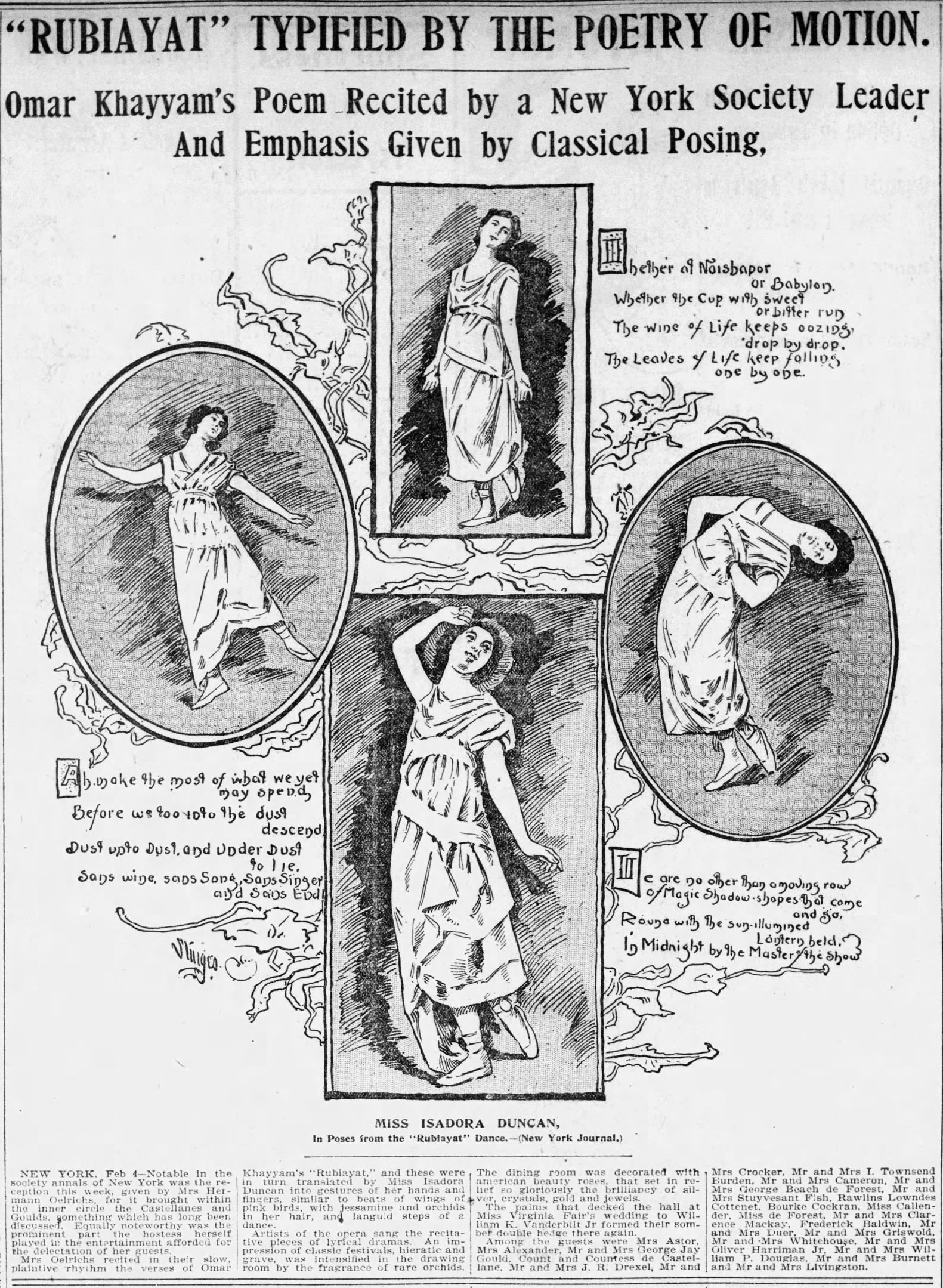
Reproduced from The Boston Globe, Monday, February 5, 1900, p. 4.
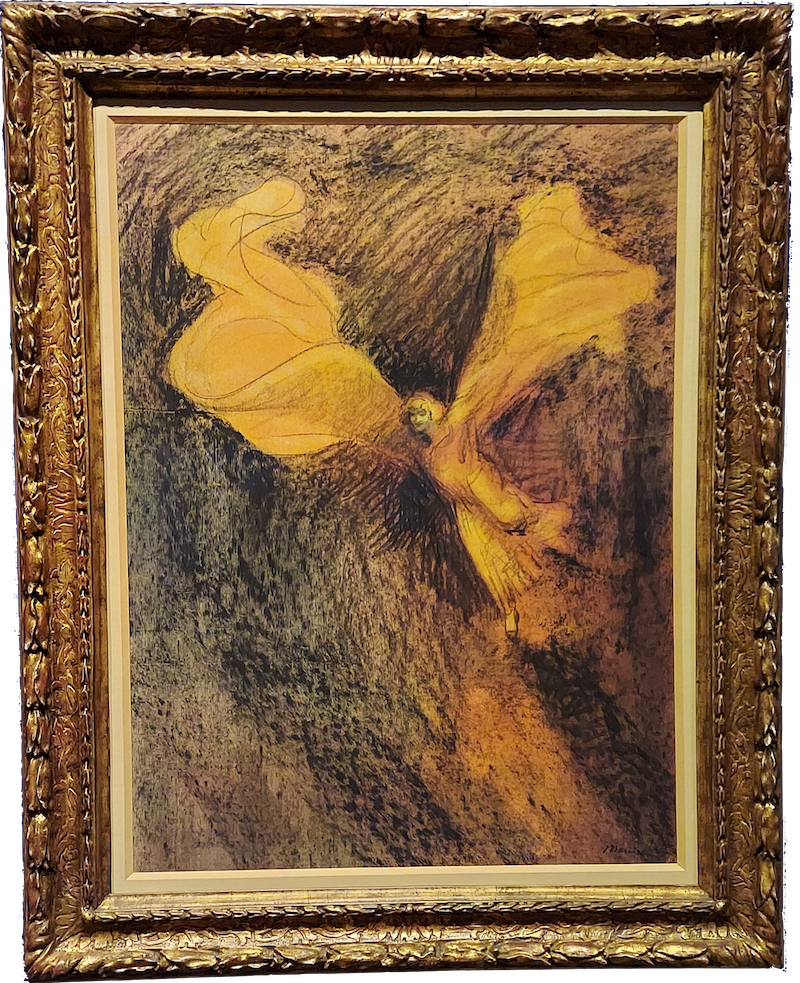
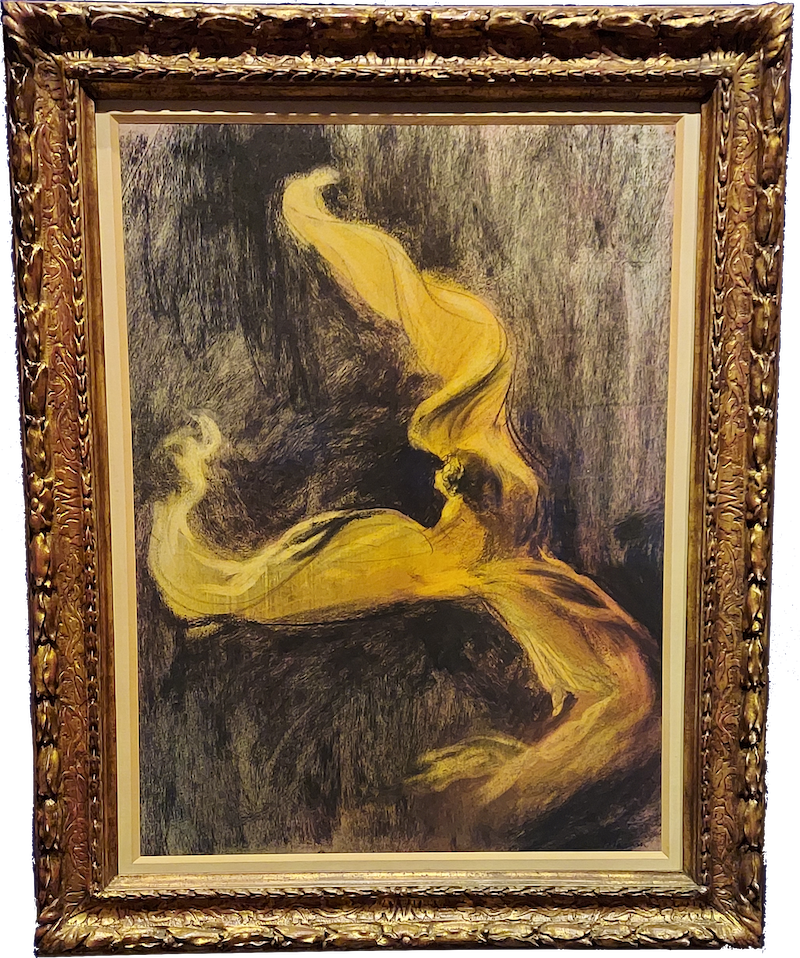
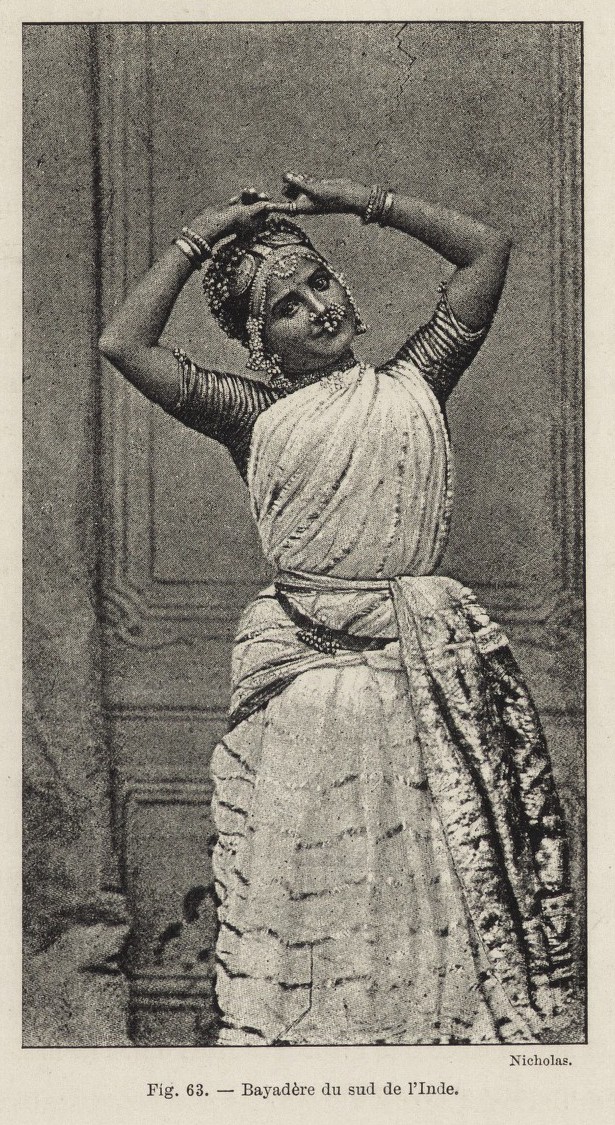
Tanjore Gnyana c. 1875. Reproduced from Le Bon (1887: 165). See also Hirschfeld (2006) and Roebert (n.d.).
Quant aux bayadères, elles font partie de toutes les cérémonies religieuses et civiles des Hindous. Les pauvres filles, médiocrement gracieuses et fort mal vêtues, qui pour une faible somme viennent danser devant les étrangers dans les salons d’hôtels ou même chez les riches particuliers, ne peuvent donner à l’Européen l’idée de ces créatures charmantes, enveloppées de gazes légères et couvertes de bijoux étincelants, dont la pantomime mystérieuse et ondulante se déroule au fond d’une pagode du sud de l’Inde, et dont la principale fonction est de danser devant les dieux (Le Bon 1887: 685–686).However, this whole comparative divagation is irrelevent so far as the primary intent of this section goes: charting Walker’s dance career which, as noted in the review from The Worcester Spy quoted above, was sociable and charitable rather than professional, and the various iterations of the dance in the works and life (and death) of her husband. For instance, on Wednesday, January 6, 1904, Walker again “danced away the Twelfth Night” at Copley Hall where she “gave a graceful Oriental dance, accompanied by Miss Eleanor Murray, and the two won several encores.” On the Sunday following this festival, The Boston Globe printed a photograph showing Walker “in Oriental costume” — gowned in flowing gauzy white, a wreath or garlanded tiara holding back her sumptuous hair, her hands vigorously poised to clang two large cymbals together. The picture was captioned as follows:
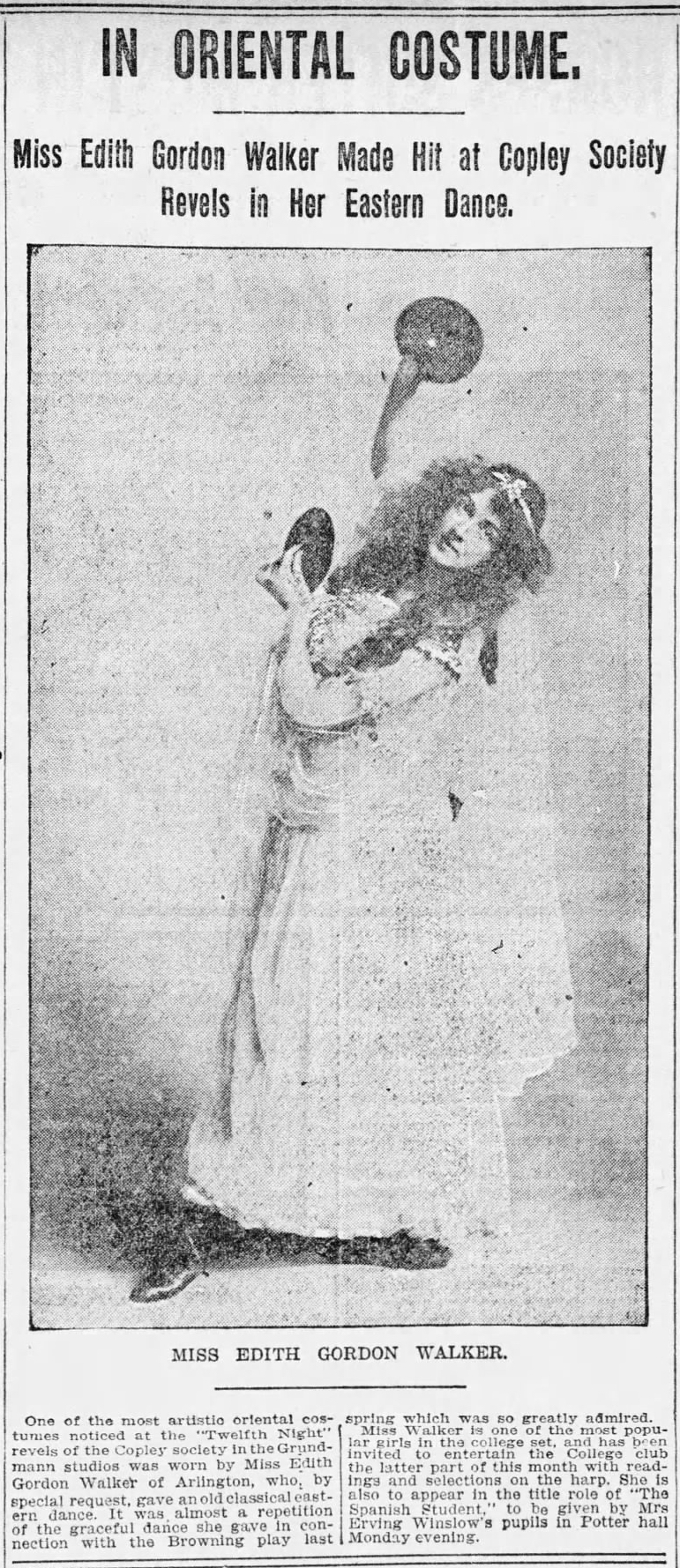
Reproduced from The Boston Sunday Globe, January 10, 1904, p. 6.
One of the most artistic oriental costumes noticed at the “Twelfth Night” revels of the Copley society in the Grundmann studios was worn by Miss Edith Gordon Walker of Arlington, who, by special request, gave an old classical eastern dance. It was almost a repetition of the graceful dance she gave in connection with the Browning play last spring which was so greatly admired.I like to think that it was this image of his spark which Caine had in mind when, for the fancy “Plebs’ Hop” at Roskelly’s Hotel, he had one of the three Watson sisters dress up as a Druse Maiden:Miss Walker is one of the most popular girls in the college set, and has been invited to entertain the College club the latter part of this month with readings and selections on the harp. She is also to appear in the title role of “The Spanish Student,” to be given by Mrs Erving Winslow’s pupils in Potter hall Monday evening (“In Oriental Costume; Miss Edith Gordon Walker Made Hit at Copley Society revels in Her Eastern Dance,” The Boston Sunday Globe, January 10, 1904, p. 6).
Of the Watson girls, Delia, festooned in laurel from the garden, represented Leafy June, Ruth was a Druse Maiden, and Maud, The White Prophet. It was here that the bath towels came in. The Prophet was distinguishable from the Maiden only by his turban (G: 182; P: 204).The White Prophet, while overtly an allusion to the 1909 novel of that title by Caine’s supposed and better known relative, is also a veiled (hah!) allusion to his wife, since the main character of The White Prophet is a colonel in the British army in Egypt named Gordon Lord whose mother was from New England. But back to The Revolt at Roskelly’s. The Plebs’ Hop is about to begin, but its sponsor lacks a costume:
As for Mr. Yule, he had been unprovided with any kind of fancy dress up to the moment when the band began to tune up. Plebs were all about him in the hall, concerned plebs, who reproached him for not taking them into his confidence, themselves for not thinking of this one essential costume. It seemed shocking to them to have the founder of their feast in plain evening dress, though it was indeed a relief to discover that he possessed the clothes of ceremony. If he had only given them a hint of his case! . . . Something could surely have been organised. They felt that they had all been inexpressibly selfish. Mrs. Bugg was ready to weep about it. Mrs. Day cast round in her mind for something which, even at this eleventh hour and fifty-ninth minute should save the situation. Mr. Yule besought them not to worry about him. It wasn’t their fault that he was so stupid that he couldn’t think out a disguise for himself. He begged them to dance and enjoy themselves, for by now Wein Weib und Gesang was calling to them from the dancing-room. But they would not go in.George Norton, the main character of The Revolt at Roskelly’s, has been well schooled in social dancing; I have no idea whether this was a trait he shared with his creator (though it is one he shares with an earlier Caine creation, Pilkington, as well as a later, Anthony Pond). George’s love interest Elizabeth Day, however, is quite the opposite of the woman who would become her author’s spark:At this moment there descended the staircase and presented themselves before Mr. Yule, a certain Druse Maiden and a certain White Prophet who, with elaborate oriental salaams, entreated his acceptance of a large fur coat, and a close-fitting seal-skin cap. The former was liberally besewn with cotton-wool snowflakes; the latter was wreathed in bright holly. “We thought that perhaps you would like to be Santa Claus,” said the Druse Maiden; and the White Prophet giggled and said, “Yes, please be Santa Claus”; and the Druse Maiden added, “It really won’t hurt your coat a bit, you know, and we’ll take it all off to-morrow.”
So Mr. Yule, for several dances, perspired in fur as the patron saint of children, thieves, and Aberdeen (G: 183–184; P: 205–206).
Among George’s half-dozen accomplishments was ball-room dancing. He was a distinguished waltzer. One look, therefore, at Elizabeth as she went round the room with Killigrew told him the worst. The top of the parson’s head revolved at one steady level, undeviating from its plane as the rotating horizontal drum of a machine, declaring him the perfect, uninspired mover to music. But the head of Elizabeth! Dear, dear! It hopped. It hopped sadly. No room for doubt. It hopped — once in each turn.On Monday, January 11, 1904, Walker appeared in a performance of Longfellow’s The Spanish Student at Potter Hall. She did not, however, take the title part, as had been announced in the January 10 issue of The Boston Sunday Globe, but rather, along with other of Mrs. Erving Winslow’s acting students, played a supporting role to Frances Dike. Twenty days later, the same newspaper announced that, as part of “one of the brilliant events of February” — the colonial costume ball to be held by the Paul Jones Chapter of the Daughters of the American Revolution in celebration of George Washington’s birthday — “Miss Gordon Walker, an associate member, is to give fancy dances, including one given at the Artists’ festival of the Copley society.” The ball took place on February 22, 1904, at the New Century building, Boston, and Walker was described as “another solo dancer […] who gave her new serpentine dance in airy, fascinating costume.” The following day, as briefly noted in § 5, Walker traveled to Buffalo, New York, to perform at the Vassar and Collegiate Alumnæ Exchange:Somehow — foolishly in a man of his experience — George had assumed that this girl was a fine dancer. Her slim, light body, her easy walk, the grace of her hands and neck and head had led his judgment astray. He knew perfectly well that these things have nothing to do with waltzing, that she who reminds one of a sausage is just as likely to dance well (or rather, ill) in a ball-room, as is she who reminds one of a lily.
Even now, with the evidence of that pretty, hopping head before him, he was unable all at once to abandon his belief. It seemed easier to refuse credit to his eyes than to understand that this girl could do anything badly. But there are limits even to the self-deception of the lover. He may see beauty where it does not exist, discover charm where there is none, wit where it is to seek, warmth in a stone. But skill, where he himself is skilful, he may not in its absence find.
“It’s not the parson,” thought George. “Good lord! she can’t dance for toffee.”
At haphazard he took out a Watson, found her movements tolerable, let himself go, and permitted Strauss for a while to soothe his disappointment.
When the next dance began he succeeded in getting to Elizabeth before any one else. She said: “I can’t dance, you know.” George said nothing. He didn’t care whether she could dance or not. They began. It was horrible. After two rounds of the room, she suddenly stopped. “This is rotten for you,” she said. “Let’s sit down.”
“On the contrary,” said George. “Let’s go on.”
“Do you mind?” she asked. “I mean, if it’s really too awful, say so. I shan’t be offended. I know I can’t do it. But I long to.”
“You shall,” he said. “It’s that jump you give at the turn.”
“Yes,” she cried. “Tell me. Tell me. I’ll be a good pupil. Don’t spare my feelings.” George asked for nothing better.
“Try to imagine,” he said, “that your head just touches the ceiling, that the ceiling is glass, that if you crack it you’ll break your neck, and that if you leave it you’ll fall down dead.”
“I will,” she said humbly.
“Glide,” said George, “that’s the word. You want to go as if it is the bit of floor you are on which is moving you about. Do you see? Now.”
They departed upon a new excursion. He held her as if he were made of iron, controlling that jump at the turn. By the end of the dance there was an improvement, perceptible, not great.
“The hall,” she said. “I must go somewhere with a high roof. This one is crushing me. That’s a frightful idea of yours, Mr. Norton.”
“It works,” he said. “Given imagination in the patient, it works every time. Until some one put it into my head, I leapt like a kangaroo.”
“I’m obliged to you,” she said, “and chiefly because you don’t lie to me. Mr. Killigrew told me I was a beautiful dancer. Think of it, and he a clergyman.”
“You see,” said George, “Killigrew don’t care whether you dance well or badly.” She said no more until they were on a sofa in the hall (G: 196–198; P: 220–223).
Miss Loie Cook [sic] and Miss Isadore [sic] Duncan, the latter of whom delighted Berlin aristocracy last winter with her graceful dances, are also a feature of the programme offered at the exchange, and this afternoon at 3 o’clock there will be a special programme, when Miss Gordon Walker will appear in a number of new and elaborate dances. Miss Walker’s harp arrived yesterday and the programme she will give will, it is said, be most novel and interesting (“Society; Calendar for Today; At the College Exchange,” The Buffalo Enquirer, Tuesday, February 23, 1904, p. 7).The day before her performance, at least two Buffalo newspapers had announced Walker as an “intellectual dancer;” thus did The Buffalo Commercial entitle its review (immediately above which, by the way, was an announcement for an upcoming high school production of A Scrap of Paper) of Walker’s “novel and interesting” program:
Miss Gordon Walker appeared yesterday at the College Exchange, the store which was opened recently by the Vassar Alumnæ and the Collegiate Alumnæ. She proved her right to be called an intellectual dancer, and surprised all by her youth and charm and versatility. She is unusually tall and graceful. Yesterday she wore a pretty gown of white crepe de chine , elaborately wrought in shirrings, and flowing sleeves. Before giving the dance, which was the last thing on the program, she gave several dramatic selections and played the harp.The closing paragraph of the above review seems to have been lifted from a press release, as it is repeated with variation in the Buffalo Enquirer’s review:In the center of the store, which is cosily arranged, a space had been cleared and the chairs were arranged on all sides. She was introduced by Mrs. Henry W. Fox, who explained that the College Exchange, which is located at No. 635 [sic] Main street, had been opened to raise funds which were to be divided between the Vassar endowment fund and the College Creche.
Miss Walker announced that she would open her program with a group of studies of child life, and gave imitations of children in “I Wisht I Was a Boy,” “His Grandmother’s Way” and a monologue written for her by Mrs. Emily Selinger. It was called “I Ain’t a Baby Any More.” Then she turned [sic?] her harp and played an old French “Song Without Words,” by Dubez, exquisitely. The scenes from “As You Like It” followed, one that in which the familiar “All the World’s a Stage” [sic]. A dialect piece came next, “Judy O’Shea Sees Hamlet.” Another harp selection followed, “A Romance,” written by Miss Harriet Shaw. In a monologue, “The Butterfly and the Pudding,” written by Evelyn Greenleaf Sutherland, she showed remarkable versatility in impersonating the young bride.
There was an intermission in the program during which tea was served and Miss Walker disappeared to returned [sic] transformed from the poster girl to a gay Spanish dancing girl, who danced to the castanets.
Miss Walker is a Boston girl, a graduate of Wellesley, and has had many offers to go on the stage. Miss Walker is a member of the Daughters of the American Revolution and on Monday evening she gave a new serpentine dance before the Paul Jones Chapter of Boston in the New Century Building. There is possibility [sic] that she may be induced to remain and give another entertainment in Buffalo. College women here and elsewhere are greatly interested in her and many of her entertainments are given under their auspices. During her stay in Buffalo, Miss Walker is the guest of Miss Grace Bissell. The College Exchange is well worth a visit, it has a very interesting collection of rare articles for sale, and a delicious luncheon is served each day at a very nominal price (“Social Register; Intellectual Dancer,” The Buffalo Commercial, Wednesday Evening, February 24, 1904, p. 14).
A delightful entertainment was that given yesterday afternoon at 3 o’clock at the College Exchange, No. 685 Main Street, by Miss Gordon Walker of Boston, designated the intellectual dancer.The Buffalo Evening News’s description of Walker’s “many-sided repertoire” seems a curious mix of superlatives and condescension, elaborating more on what she wore than on what she performed:Miss Walker is a particularly attractive girl, who is possessed of a number of accomplishments, which she is turning to good financial account.
She was introduced by Mrs. H. W. Fox, treasurer of the board of manager of the College Exchange, and then in an open space in the center of the room with the audience ranged around her in chairs, reminding one of a Moorish entertainment scene, she gave her programme.
It comprised three character child-studies written for her, one by the noted artist and wife of an artist, Mrs. Emma Selinger, an old French song without words for the harp by Dubez, two scenes from “As You Like It,” a romance for the harp, and two monologues, “An Irish Woman’s Description of Hamlet” and “The Butterfly and the Pudding,” the latter by Mrs. Evelyn Greenleaf Sutherland. She then changed her costume and gave a delightful and graceful typical Spanish dance with the castanets, which closed a most enjoyable programme.
Tea was served during the intermission.
Miss Walker is a Boston girl, a graduate of Wellesley, and has had many offers to go on the stage. She is also a member of the Daughters of the American Revolution and on Monday evening she gave a new serpentine dance before the Paul Jones Chapter of Boston in the New Century Building. She came directly from there here and was somewhat hampered by the non-arrival of some of her costumes. There is a possibility that that [sic] she may be induced to remain and give another entertainment in Buffalo. College women here and elsewhere are greatly interested in her and many of her entertainments are given under their auspices. Miss Walker while in Buffalo is the guest of Miss Grace Bissell of Linwood Avenue (“Society; Novel and Delightful Entertainment at College Exchange,” The Buffalo Enquirer, Wednesday, February 24, 1904, p. 7).
If any one imagines that a college woman sets no store by her heels and runs all to brains they are mistaken, that is if Miss Gordon Walker of the class of 1900, Wellesley, the pride of her class and the best mathematician in the school, is a fair example, for at least her performance at the College Women’s Exchange yesterday exhibited feet much better trained than the average young woman’s mind.The writer of the Society column for the Buffalo Evening Times seems to have left during the intermission:The exchange itself was charmingly inviting, and with its daily accessions of bric-a-brac, it has come to be a palace of art treasures really worth the trouble of visiting, even if one has no idea of buying, but merely the curiosity to see what others have to sell and to inspect the business methods of amateur saleswomen. Not so many as could fill the room heard Miss Walker at her debut in Buffalo yesterday, but the weather, which a well trained Englishman would call beastly, had much to do with that. Once inside the exchange, however, and Miss Walker presenting some one or another of her many-sided repertoire, the weather had no further influence, and when, at the middle of her programme, tea was served in the most informal way to the ladies in their seats, the opinion was general that college women have a charming way of entertaining their friends.
Miss Walker’s audience was not altogether strange; several college friends were present, lending the strength of a very hearty belief that she would come up to any expectation likely to be held for her, and mothers were present who, at the college commencements and proms, had met the bright young lady, and these, of course, gave her a cordial welcome. Her repertoire was varied, running the gamut of children character sketches, a modern bride dabbling at housekeeping and Shakespeare, direct, and Shakespeare as seen by others. Then there was playing on the harp, one delightful bit of French music, “Song Without Words,” and last but not least, there was dancing, and Miss Walker dances quite as well as she plays the harp or quite as well as she recites Shakespeare. In the first half of the programme she wore a fetching gown of champagne-colored crepe de chine so fashioned as to exhibit her round, graceful figure to the best advantage. A pink rose in the blonde hair was very effective. For the dances she wore a Spanish costume of maroon satin skirt, gold sequined black velvet bolero over a white blouse, and overdress of fancy colored sequined ribbons meeting in a jeweled girdle. Her hair fell loose over the shoulders, and with the castinets [sic] she danced ravishingly to a Spanish accompaniment played by Miss Lucy Olmsted.
Miss Walker arrived at 2 o’clock yesterday and while here will be the guest of her college friend, Miss Bissell of Linwood avenue. Miss Grace Jones, Miss Bissell, Miss Helen Chamberlain and other college women assisted in serving the tea yesterday (“The Social Chronicle; At the College Exchange,” Buffalo Evening News, Wednesday, February 24, 1904, p. 3).
Miss Gordon Walker of Boston delighted a large audience at the College Exchange yesterday by giving an enjoyable program of monologue and dances.I have no idea if “the bright young lady” who was to become Caine’s spark stayed in Buffalo to dance at the Saturn Club and perform by candlelight at the College Exchange, or what engagement in Boston she would have had to cancel to do so. All I know is that, as delineated in § 5, she gave a harp performance in Quincy, Mass., in April, assisted Eltinge at his or her first professional performance in May, then boarded, on June 8, 1904, the Devonian bound for Liverpool, not to return to the US until a decade later when, as Mrs. William Caine (or Mrs. Gordon Caine), she debarked in New York from the Lusitania. Some eleven years later, a piece by the husband whom Mabel Dodge had described as “a little dissolved but still having form,” was published posthumously in The Tatler, in the edition of November 11, 1925, to be exact. “The Temptation of Anthony Pond” starts out as follows:Miss Walker, who is a tall, graceful young woman, was attractively attired in a costume of white crepe de chine with heavy lace trimmings and loose, flowing sleeves. She began her afternoon program by reciting several children’s studies, among them “I Wisht I Was a Boy,” “His Grandmother’s Way,” and a monologue written for her by Mrs. Emily Selinger. It was called “I Ain’t a Baby Any More.”
An enjoyable feature was her presentation of two scenes from “As You LIke It.” Her program of monologues included “An Irish Woman’s Account of Hamlet” and the “Butterfly and the Pudding,” the latter written by Evelyn Greenleaf Sutherland. Miss Walker showed remarkable versatility in impersonating the young bride who, failing in her efforts at making a successful pudding from a cookbook recipe, fell to moralizing, the dainty sketch running the gamut from the humorous, when the cook comes in tipsy, to the intensely pathetic, when the bride sobs her grief that married life, instead of being all moonshine, is all noonday gray [?] and dust, and that lovers can turn into husbands with rasping voice.
It is possible that Miss Walker can be persuaded to give up an engagement in Boston this week and remain here till Saturday night to dance before the Saturn Club members and their women guests.
If Miss Walker remains here during the week, the college women hope to engage her for an evening entertainment to be given at the exchange by candlelight (“Society,” Buffalo Evening Times, Wednesday, February 24, 1904, p. 3).
Anthony Pond was as handsome as a stag, tall, broad, graceful, young, well-dressed, amiable, and a completely accomplished ball-room dancer. Having been educated to spend the six thousand a year which his widowed father proposed to leave him, he could read easy books, write badly, spell incorrectly, and add up a bridge score. He could also try very hard to check a bookmaker’s account.After three days, Elba proposes, saying that her father will settle a million, even two million, pounds on him once they’re married. Pond detests her, and despite his poverty, feels “that for a man to be supported by his wife is degrading, a thing not to be done” (p. 288). And so Pond’s pride wrestles with the temptation of two million pounds. On the fourth day, just as Pond is about to take a stroll on the Champs Elysées before the now customary lunch with the Hunks, Mr. Hunk accosts him in the hotel hallway:When the army threw him out, his father was ruined and dead, and the six thousand a year, which had been used to come out of Russia, had vanished. Anthony took the two thousand odd pounds which his layers had scraped together for him and repaired with it to Monte Carlo, intending to break the bank. A fortnight later he became a dancing-partner in one of the restaurants of Nice.
So handsome, so tall, so broad, so graceful, so young, so well-dressed, so amiable, and so completely accomplished a ball-room dancer — in a word, so perfectly educated to spend six thousand a year — was he, that success in the profession of his choice was assured to him from the first. In April he found himself on the salary list of the Hôtel Escoffier, Paris. He had arrived at the top of his particular tree.
When he had been employed there for about a week Miss Elba Hunk descended at the Hôtel Escoffier, changed her clothes, went into the dancing-room, sat down, saw Anthony, and became instantly enamoured of him.
Miss Hunk had been travelling without pause during the previous fortnight from Red Dog City, Wy., where she had passed every minute of the twenty-two years of her life. She had never before seen anything at all like Anthony.
“Say,” she observed to Plunk B. Hunk, her father, “that young man is mine. Him in brown with the shoe-polish hair, dancing with the fleshy blonde in Odynill. Get him quicker’n lead.”
Mr. Hunk’s name was good dog Tray. He rose without a word from his chair and waddled to the dancing-floor. Fortune favoured him. The fox-trot ended as he arrived. Anthony handed his partner to her table, bowed, and turned away. Plunk B. was there.
“Say, brother,” he remarked, “don’t you want to dance with my daughter?”
Anthony had, as we know, the very best possible manners. It was, moreover, his business to dance with partnerless ladies. Furthermore, he didn’t happen to have engaged himself for the next number. Lastly, Mr. Hunk amused him.
“Of course,” he said; “lead on.”
Mr. Hunk led on. The band resumed its awful labours. Anthony bowed to Mrs. Hunk, then to Miss Hunk.
“Say,” she said from her chair, “I don’t reckon to dance the tango any better’n a mule, so what’s the matter with you settin’ down right here now and getting acquainted with us? Meet my father and mother, Mr. and Mrs. Hunk, and my name’s Elba, and what’s yours?”
The best thing that can be said about Miss Hunk is that she was very lovely.
Her American father, scion of a long line of agricultural labourers, had married her Scandinavian mother out of a laundry, yet her lines were as fine as those of a racehorse. She had the complexion of a tea-rose and the golden hair of a cherub, and she resembled a Dana Gibson girl almost more closely than Dana Gibson girls resemble on another.
Anthony couldn’t bear her. He hated, principally, her shrill voice. He would have liked to have nothing to do with her at all. Mr. Hunk, however, was reputed to have amassed a hundred million pounds (not dollars) by owning prairie and waiting for Red Dog City to come. The management of the Hôtel Escoffier was accordingly determined to be very fond of him, and had given orders that everything was to be made as agreeable as possible for his party during its stay.
Anthony’s sense of loyalty to his employers caused him therefore to accept Miss Hunk’s invitation to sit down and get acquainted. Subsequently he danced several fox-trots with her. At the fox-trot she was much better than a mule; she danced it, indeed, prodigiously well. As she was a tall girl, she and Anthony made a marvellously fine couple, and every eye in the room was on them from their first step. Elba was very happy.
“Say,” she yelped in Anthony’s ear, “don’t you reckon we make some couple? Say., all these dubs have got somep’n to stick out their eyes at this afternoon, don’t you reckon? Say, don’t you reckon you’d better undertake to learn me the tango, Mr. Pond? I’ll be a real diligent scholar, I sure will. Say. you and me doing the tango together would just about set this old hotel on fire, I guess. Say, what’s the matter with a lesson right after this thé dansant closes down? Say, I’m just about crazy to have you learn me the tango, Mr. Pond. Say, I’m awful glad I’ve always been too lazy to care about acquiring the tango, Mr. Pond. Say, Mr. Pond…”
Anthony’s good manners enabled him to conquer his desire to sling her into the big drum. He danced on, smiling hard. It was not necessary for him to say that he would teach her the tango. She had said it (pp. 286, 288).
I’ve already said that Caine died during a thé dansant (§ 3; Appendix I). In the Foreword to his posthumous The Glutton’s Mirror (published the same month as “The Temptation of Anthony Pond”), Caine’s friend Stephen Graham (who, by the way, had traveled extensively in Russia and published several books about his experiences there) wrote,“Say,” he said, “don’t you want to come and have a quiet little talk with me, Mr. Pond?”
Anthony didn’t want to go and have a quiet little talk with Mr. Hunk, but his manners made him say that he did. Mr. Hunk led the way to a secluded table, held up two fingers at a waiter, and took a chair. Before Anthony was well-seated two Bronx cocktails had been served.
“Now, Mr. Pond,” Mr. Hunk began as he set his empty glass down and again held up two fingers, “I’d better tell you that my little girl has put me wise to what she proposes with regard to you. Now I’m not going to say as you’re just the kind of son-in-law as I reckoned to have. I’d sort of hankered after a duke or an earl at the worst. But it ain’t me that’s marrying, I guess, and I hope I’m a good enough sort of a father to put my own wishes aside where my own child’s happiness is in question. Yes, sir; what Elb says goes with her old daddy in this as in everything. Yes, sir. So I want you to know right here and now, Mr. Pond, that I’m here to do just what you want. Elb tells me she’s mentioned two million pounds; but I say, shucks, what’s two million pounds where my little girl’s happiness is in question. So, won’t you just please name the figure that seems right to you, and I’m here to say yet, and,” he paused impressively, “double it.” He poured a second cocktail into himself, and again held up two fingers.
“I’m sure, Mr. Hunk,” said Anthony, “I don’t know at all how to express my appreciation of your generosity. But the fact is —”
“Say,” said Mr. Hunk, “you can can all that appreciation stuff. I don’t want you to appreciate anything. I want you to make my little Elb happy. You do that, and I settle ten million pounds on you, or twenty if that’s how you feel about it. I want this thing fixed right up before dinner.”
Anthony steadied himself with the cocktail which waited at his elbow. Then he opened his mouth to decline quite definitely to become one of those mangy curs who allow their wives to support them. At the same moment he remembered his Great-Aunt Caroline, and thought how comfortable an old age he could assure to her if he had twenty million pounds.
Hitherto we have heard nothing of Anthony’s Great-Aunt Caroline. All the same, she existed, and though Anthony had only seen her twice in his life, and had never done a thing for her, he was aware that she was extremely ill-off, having, indeed, no more than £500 a year on which to eke out her existence.
It was quite natural for this old woman’s pathetic image to arise at this moment before Anthony’s mental eye, because she was his sole surviving relative; and when a young man or woman is wrestling with the temptation of an advantageous but loveless marriage, he or she always has to reckon with the benefit which will accrue from such a marriage to his or her indigent father, crippled little brother, imbecile elder sister, or other unfortunate and deserving relative.
The moment Anthony remembered his Great-Aunt Caroline, he knew that, however distasteful, personally, it might be to him to become one of those unmentionable cads who live at the expense of their wives, he must marry Miss Hunk. It was impossible for him to refuse to secure a comfortable old age for his Great-Aunt Caroline.
And so instead of telling Mr. Hunk that he was far too proud to marry money, even where he loved, which he didn’t here, he said, “Twenty million goes,” and drowned remorse in a third cocktail which the waiter had just produced.
After lunch he was married to Miss Hunk in the presence of the United States Ambassador to Paris.
As he came down the steps of the Embassy — if, that is to say, the United States Embassy in Paris has any steps — with his unloved, nay, his detested, wife on his arm and a settlement for twenty million pounds in his tail pocket, a telegram was handed to him. Courteously requesting Mrs. Pond’s permission, he broke the envelope, spread out the message, and read, “Your Great-Aunt Caroline passed away this morning, leaving you £500 a year.” The signature, though horribly mangled by the French post-office, was plainly recognisable as that of his family solicitor.
Anthony uttered one hard, shocking laugh. “Tricked, by Heaven,” he muttered, as he assured himself that the contents of his tail-pocket were safe (p. xxxiv).
The one exercise which seemed to do him no harm was dancing, and in 1924 on the doctor’s recommendation he took up dancing and learned all the new dances, entering into the new amusement with considerable gusto. But he knew one day his heart would fail. Last summer it happened. He came from a dance radiantly happy, and died laughing. “I have never enjoyed anything so much in my life!” he said, and in the exuberance of an exclamation his heart failed. But the smile did not fade.What was Caine’s last dance? A foxtrot, according to one writer:Sad family news had come to weigh heavily upon him. After a period of depression he had returned to the dance to regain good cheer. He was an inventor of many new steps; in his way he danced extremely well. After his last dance, coming back with his wife, his unique partner, the dancing-professor came up to compliment him, but it was unnecessary. The smile on the dead man’s face complimented a life that had been lived beautifully. And it was a happy ending (Graham 1925: 7–8).
From the circle of my personal acquaintances Death has taken two charming and talented men in Holman Clark, the actor, and William Caine, the author. Both died, as they would have wished, in harness, for while Holman Clark left the Vaudeville Theatre during the early rehearsals of Blessed Are the Rich, Caine was arranging for the publication of his latest book on the very day that he died after dancing a fox-trot with his wife at a Belgian seaside resort (The Bystander, London, September 16, 1925, p. 654, “Bystander Comments; Two Charming Men”).Graham, however, thought otherwise — “one day ten years after I first met them Gordon announced that Billie was cured and that they were sleeping together. Billie was also taking her to night clubs. Alas, that was too much. Billie fell dead while dancing a tango” (Graham 1964: 73). The discrepancy stems, perhaps, from another story by Caine, published in the month following his death, about another dancing-professor, a Russian exile who eventually becomes a colleague of Anthony Pond’s:
[…] though it had been very far from his dream to become a paid dancing-partner to idle women, we must remember that he was a very fine performer on the ball-room floor; and no man ever attains to true excellence in the art of ballroom dancing unless he is fond of it. So while Vladimir lamented the fact that instead of occupying a professorial chair he was footing it for a livelihood to the strains of fox-trot and tango bands, he could not help enjoying his work. In fact, for a time, he actually revelled in it, partly because it acted as an anodyne to his chagrins, but much more because the dancing was so good. For the music at the Rat Noceur was magnificent, and many of the ladies who came to dance there were skilful, many were handsome, and all were extremely chic (“A Dancing Philosopher,” The Tatler, October 28, 1925, p. 196).Over the course of seven years as a professional dancing-partner in Paris and some “33,600 females, mostly middle-aged and fat, around whom […] he had placed his right arm” (p. 196), Vladimir Krotkine has — just now, a little after three in the afternoon of Tuesday, March 31, 2026, in Tokyo, fourteen books stacked in front of the section of my bookshelves devoted to biographies of Nabokov came tumbling down:
Nabokov, Novels 1955–1962 (Library of America, 1996); Confession sexuelle d’un anonyme russe (Éditions Allia, 2002); Roussel, Comment j’ai écrit certains de mes livres (Lemerre, 1935); Nabokov, Lolita (Gallimard, 1959); La Nouvelle Revue Française (25e Année Nº 282, 1er Mars 1937); Nabokov, Nikolai Gogol (New Directions Paperbook, 1971, twelfth printing); Couturier, Nabokov, ou La tentation française (Gallimard, 2011); Russian Language Triquarterly (Number 3, Spring 1972); Berberova, Nabokov et sa Lolita (Actes Sud, 1996); Nabokov, Mary (Penguin, 2017); Nabokov, King, Queen, Knave (Penguin, 2017); Nabokov, The Annotated Lolita (Vintage, 1991); Roussel, Locus Solus (Pauvert, 1985); Caradec, Raymond Roussel (Fayard, 1997).As if the spectre of Nabokov, in a paroxysm of annoyance at the nexus of coincidences involving the posthumous story written by a novelist who died while dancing in Belgium about a Russian exile getting knocked unconscious while dancing in Paris and which was published the same month that a real-life Russian exile began writing his first novel in Berlin (see § 3-bis), had muscled its way out of the confines of those biographies to give me a sign — of what? encouragement? dissuasion? Rather, and much less otherworldly, an unbalanced top-heavy stack conspired with a slight earthquake. (Yet none seem to have occurred nearby; at 15:11, however, there was a 4.7 magnitude tremor 43 km northwest of Zharkent, Kazakhstan.) But back to Caine’s student of philosophy whose “collosal work treating of the art [of dance] from the metaphysical standpoint” (p. 194) at the University of Moscow had been interrupted by revolution when he was twenty-two. Now, aged twenty-eight, he has moved on, via the Coq Qui Rigole, the Porc en Bombe, and the Chien Bleu-foncé, from the Rat Noceur to the Hôtel Escoffier and has “acquired the sort of hatred for women that the people who work in sweet factories acquire for toffee and pear-drops” (p. 196).
He had begun by loathing the old and heavy women, because they wearied his arm and had to be compelled to keep the measure; but as time went on and his constitution grew more and more sapped, it was the young and vigorous whom he came the more passionately to detest. For they demanded of him pace, pep, and variety — the very things of which he was becoming drained. When a woman can only hope for three fox-trots in an afternoon, she attacks those she gets with enthusiasm, believe me; and if her partner cannot rise to her level of activity, she is very apt to be greatly discontented with him, and does not hesitate to let his employers know that they have a dud on their salary-list. A few of such complaints may pass, but if there are many the dud in question is quickly given the keys of the street. The people who maintain dancing establishments do not run them as rest cures for their professionals. It therefore behoves these young gentlemen always to be extremely brisk on their feet whenever and so long as the band plays.Sure enough, a hearty young thing appears on the scene, Dolly Peck (I’m reminded of the maiden name of the mother of Dolores Haze — Becker), “nineteen, small, dark, and bursting with vitality, of which she spent her life trying to get rid.” Despite being small and dark, Dolly is armed with a list of enthusiasms as extensive and impressive as those which the newspapers attributed to Caine’s tall rosy-haired spark:In the end, Vladimir came almost to welcome the necessity, when it arose, of partnering an elderly, easily-winded woman, since it saved him from having to urge his unwilling legs in time to the flying slippers of some hearty young thing of eighteen (p. xxii).
She played lawn tennis, hockey, golf, cricket, and football; she swam, rode, fenced, boxed, practised jiu-jitsu, and danced; and the more she exercised herself, the more appallingly vital did she become; for so it is with young people of nineteen.The effect of Dolly’s vitality on Vladimir is to transform his “sinking heart and […] hell of hatred within his soul” into a sudden burst of murderous madness:She had come to Paris with her mother in order to buy her wedding trousseau, because she was shortly to wed a lord who was enamoured of her father’s wealth, which had been made during the war out of plum-and-apple ham (p. xxii).
In the middle of the tenth fox-trot that he danced with Miss Peck he suddenly let go of her waist and her right hand and, grasping her firmly round the neck with every finger and thumb he had, began quite happily to strangle her, dancing steadily on the while and maintaining her erect, with her toes just touching the floor, by a strong upward thrust of his arms.An aside anent Nabokov’s Dolly. Towards the end of Lolita, Humbert Humbert is walking “in a sunset-ending street of Beardsley” to a concert with his captive nymphet and Eva RosenNobody present but Dolly and himself was aware of what he was doing. Those who were dancing were too busy, and those who were seated at the surrounding tables were either too sunk in misery because they weren’t themselves dancing, or else too bored with looking on while dancers danced, to be worrying about anybody but themselves. As for the band, it was playing; and when a first-rate fox-trot band is playing, it plays with a concentration which blinds it to all things else.
So it is probable that Dolly would have quickly come to the end of her vitalities had she not happened to be a young woman not only of muscle, but of mind.
The ordinary headless female who gallops about on the parquet at thés dansants, when she felt her throat gripped between the large and singularly strong hands of Vladimir, would have first endeavoured vainly to scream, and then fainted. Not so Dolly.
She simply doubled her right hand into the most workmanlike possible of fists, drew it back a little, and administered to Vladimir a six-inch jolt just below the heart, which caused his fingers and mouth to fly open simultaneously. Then she gave him one for himself with her right on the point of his chin, and down he went among the feet of the dancers, tripping up three couples, who crashed on top of him.
When these persons had been removed, there lay Vladimir, pale and very still. I think I have said that he was peculiarly handsome. Never had be looked more beautiful.
Dolly stared down upon him reflectively while she explained to those who stood about her that the poor fellow had fainted.
Till this moment she had hardly seen him, for until he had taken her by the throat she had regarded him simply as a convenient object with which to dance. He had presented himself, she had placed herself automatically in his arms, and had set forth with him upon the floor; but it had never occurred to her to ask herself what sort of a young man he might be (pp. xxii, xxiv).
and it struck me, as my automaton knees went up and down, that I simply did not know a thing about my darling’s mind and that quite possibly, behind the awful juvenile clichés, there was in her a garden and a twilight and a palace gate — dim and adorable regions which happened to be lucidly and absolutely forbidden to me, in my polluted rags and miserable convulsions (Nabokov 1958: I, § 32, 286).Back to Caine’s Vladimir as struck, and perceived, by Dolly:
Now she considered him with a new eye. He had tried to strangle her, and she had knocked him out. It was impossible for her to be any longer indifferent to him and his appearance. And she thought: “How much more intriguing it would be to be married to a glorious and temperamental young man like this, who at any moment might be inspired to slaughter one, than to a fat little poop like Budge” — she meant her lord — “who will never in all his life raise his hand against a woman save in the way of kindness” (“A Dancing Philosopher,” p. xxiv).Dolly’s “soul swelled with the joy of physical conquest” and the desire to make him her own:
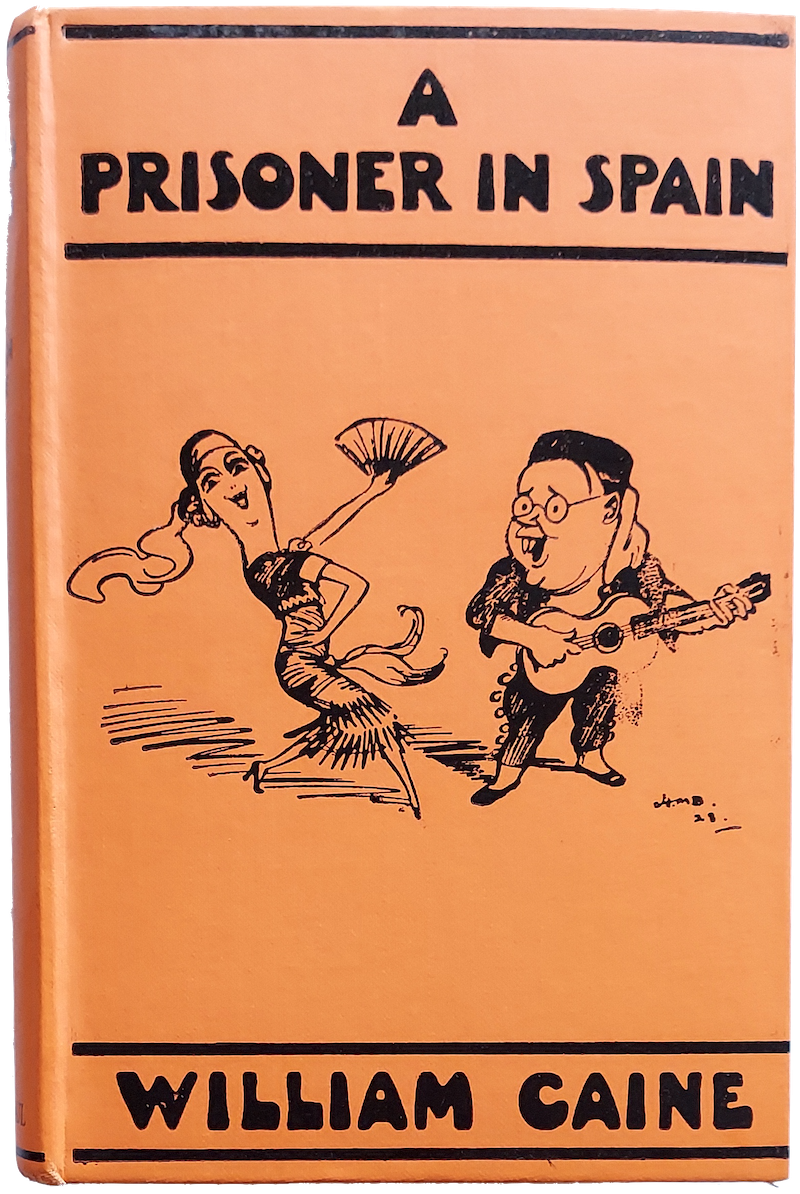
Down she went on her knees beside her prey, pushed aside somebody who was loosening his collar for him, and did it herself. Vladimir opened his eyes to find hers gazing mistily into them.In the year following the death while dancing of the author of The Author of “Trixie”, H. M. Bateman illustrated the cover for the reissue of A Prisoner in Spain. Caine, clad in a sort of matador’s outfit, is portrayed as a flamenco guitarist joyously accompanying the spark he uses to write with as she performs, in tight-fitting skirt and bolero, a graceful Spanish dance — not a “passionate cachucha” of the sort Miss Gordon Walker performed twenty-three years earlier as Preciosa in Longfellow’s “Spanish Student” — since she’s holding a fan rather than castanets — but perhaps a fiery fandango or scintillant sevillana.“It’s all right,” she said in French; “you fainted, you know.”
“Did I?” he asked. “I thought —”
“You thought wrong. You fainted; do you hear?”
“I hear,” he said, and closed his eyes wearily. He realized that, whatever he had done, this meant the sack.
And so it did.
But it is one thing to be sacked when you are without resources save a debilitated constitution and a fixed idea. It is quite another when the resolute daughter of a jam-baronet has marked you down for her own.
They were married three weeks later — that is to say, the moment Dolly was able to finish buying her trousseau.
The ignoble Budge made himself deucedly unpleasant about it, but what more could he do? Nothing.
So Vladimir is securely established in life now, and in a position to continue the prepration of his colossal work on dancing from the metaphysical point of view. Dolly lets him work at it all he will. She does her very best to keep him contented. She doesn’t want to wake up some night to find that her husband has been compressing her windpipe just long enough to render her incapable of administering her six-inch jolt.
She finds that the thought that some night she may is excessively intriguing (pp. xxiv, xxvi).
- Mabel Dodge wrote from the Hotel Chelsea. — In a footnote to this letter, Everett (1996: 227) states, “Dodge is likely referring to the same Gordon Caine and her husband, Sir Thomas Henry Caine, a writer, that Stein mentions in The Autobiography of Alice B. Toklas. According to Stein, she had met the Caines in London through John Lane who was Mr. Caine’s publisher.” Sir Thomas Henry Caine was not, of course, Gordon Caine’s husband, the “well known humorous english writer,” but rather Sir Thomas Henry Hall Caine aka Hall Caine, an even more well known (at the time) writer, none of whose books were ever published by John Lane.
- Mr. and Mrs. Caine arrived in New York. — “Passengers for Europe; Some of Those Sailing To-Day on Five Liners — The Arrivals; 14 Tugs Help Lusitania,” The New York Times, Saturday, April 18, 1914, p. 11.
- Announced well in advance. — In addition to the item in The New York Times Book Review (quoted in text), see, e.g.: “William and Hall Caine,” Newark Evening Star, Saturday, February 14, 1914, p. 2; Boston Evening Transcript, Saturday, February 21, 1914, part 3, p. 8 (no mention of Hall Caine); “Personal and General,” The Reading Times (Reading, Penn.), Thursday Morning, February 26, 1914, p. 2.
- First Visit Here in Ten Years. — This item was repeated, with the erroneous dating of the Caines’ marriage, by the Wellesley College News, Vol. XXIII, No. 1, October 1, 1914, p. 8: “1900 — Mrs. Gordon Walker Caine expects to visit this country this summer, the first time since her marriage in England ten years ago. Mr. Caine is a playwright and author of several books.” Edith Gordon Walker had indeed left the US for Europe a decade earlier; she had been Mrs. Caine for seven of those years.
- Polly’s Restaurant; Mabel Dodge’s flat. — For Polly’s Restaurant, see Churchill (1959: 34–36); “Polly’s MacDougal Street hangout” (blog post, June 23, 2008); Chelsea Dowell, “Village People: Polly Holladay” (blog post, August 9, 2016); Becoming Bohemia: Greenwich Village, 1912–1923 (Exhibition at the New York Public Library, October 12, 2014–February 1, 2025). For Mabel Dodge’s flat, see Dodge Luhan (1936: 3–6). That the Caines visited Dodge at her flat in New York and not at the Hotel Chelsea, Atlantic City, can be deduced from the following: (i) the letter immediately preceding the one I have quoted is dated “circa May 1914; 23 Fifth Avenue” (Everett 1996: 224), and (ii) later in the letter I have quoted, Dodge writes, “I have had my tonsils out & have had a bad attack of melancholia in my larynx, & am down here for a few days to get over it” (Everett 1996: 228).
- Dinner party given by John Lane. — “In a Few Words,” The New York Times Book Review, October 18, 1914, p. 450: “A dinner was given last Monday evening at the Players’ by Mr. John Lane of the John Lane Company to Prof. Stephen Leacock. Among the guests were Norman Hapgood, Cyril Harcourt, Harold Begbie, William Caine, Albert Gallatin, and J. J. Jones.” (Near identical text in: “Book Review,” Bangor Daily Commercial, Saturday, October 24, 1914, p. 16.)
- Departed New York. — “Off For Europe Today; Some of the Passengers on Two Liners,” The New York Times, Wednesday, Oct 14, 1914, p. 11 (Mr. and Mrs. William Caine listed; as is Sir James Barrie); “Boer News Stirs Barrie; Dramatist, Sailing, Sees Germans Behind Revolt,” New York Tribune, Wednesday, October 14, 1914, p. 1; “In a Few Words,” The New York Times Book Review, Sunday, October 18, 1914, p. 450: — “William Caine, the English novelist, author of ‘The Irresistible Intruder’ and ‘But She Meant Well,’ who has been spending the Summer in this country, returned to England last week on the Lusitania.” (Near identical text in: “Book Review,” Bangor Daily Commercial, Saturday, October 24, 1914, p. 16) — “Arrival of the Lusitania,” The Liverpool Echo, Tuesday, October 20, 1914, p. 6; “Other Streamship Sailings,” The Gazette (Montreal), Wednesday, October 21, 1914, p. 13.
- Charles Frohman. — See [https://en.wikipedia.org/wiki/Charles_Frohman].
- Picked up by several other newspapers. — “Tells Story in Her Dance,” The Chicago Sunday Tribune, Monday, May 31, 1903, p. 46; “Wellesley Girl Gains Reputation by Her Extraordinary Dancing,” The Courier-Journal, Sunday Morning, May 31, 1903, sect. 5, p. 5; “Browning Dance; Miss Gordon Walker, a Wellesley Graduate, and The Return of the Druses; Whole Drama in Poses,” The Illustrated Buffalo Express, Sunday, May 31, 1903, part I, p. 1; “The Classic Dance; Wonderful Interpretations of Poetry Given by a Beautiful Graduate of Wellesley,” The Pittsburg Post, Sunday Morning, May 31, 1903, third part, p. 8;
- With her harp furnished the music. — “Music and Drama; Chickering Hall: The Return of the Druses,” Boston Evening Transcript, Wednesday, March 26, 1902, p. 22. Review includes a cast list, in which Miss Gordon Walker does not appear.
- Actors’ Church Alliance charity festival. — “Boston to See a Real Miracle Play; Trio of Them Will be Features of the Actors’ Church Alliance Festival this Week,” The Boston Globe, Monday, April 6, 1903, p. 2; “Music and Drama; Two First Productions for Boston,” Boston Evening Transcript, Saturday, April 11, 1903, p. 26; “Miracle Plays Produced; Interesting Performance at Actor’s Church Alliance Festival — Fifteenth Century Revival,” Boston Evening Transcript; Wednesday, April 15, 1903, p. 9: — “The casts in all these little plays were so well balanced that it would be difficult to draw comparisons. Every actor seemed thoroughly imbued with the spirit of his part and of the whole production, this applying not only to those on the stage, but to those who made up the crowd as well.” — “Was Much Enjoyed; Entertainment Offered at Festival of Actors’ Church Alliance,” The Boston Sunday Globe, April 19, 1903, p. 2.
- Full-page feature on Walker. — An identical piece under the headline “Society Belle as an Impassioned Danseuse,” was published in The Sunday Tribune (Minneapolis, Minn.), Magazine Supplement, August 16, 1903, p. 5.
- Afflicted other Caine men. — The author of The Author of “Trixie” died at the age of 52 from coronary artery rupture (hartaderbreuk; see Appendix I). While no cause seems to have been attributed to the deaths of Caine’s grandfather, Nathaniel Caine, at the age of 69, or his great-grandfather, Thomas Caine, at 57, his uncle Howard, W. S. Caine’s youngest brother, died aged 45 of heart disease, and his cousin, the Rev. Thomas Caine, at 37. See “The Late Nathaniel Caine,” The Liverpool Mercury, Monday, October 1, 1877, p. 1; “Speen; The Late Mr. Howard Caine,” The Newbury Weekly News, Thursday, August 4, 1892, p. 5; “Death of Mr Howard Caine,” The Berkshire Chronicle (Newbury), Saturday, August 8, 1892, p. 8; “Deaths,” The Standard (London), Thursday, September 11, 1913, p. 1.
- Attended his father’s funeral. — As did his mother, sisters, brothers-in-law, uncle Nathaniel Caine, cousins or uncles on his mother’s side, and close family friend Ray Lankester, the famous evolutionary biologist. Many more, such as several members of Parliament, including those of opposing parties, attended the church service prior to the interment at Brookwood, as did representatives of various benevolent institutions with which W. S. Caine was associated, along with F. Grubb, his private secretary. Others sent floral tributes, including, it seems, Caine’s brother David Howard who, I assume, as away at university. See “Funeral of Mr. W. S. Caine,” The Standard, Friday, March 20, 1903, p. 9.
- Also reported. — See also “Recent Wills; Mr. W. S. Caine, M.P.,” The Yorkshire Post, Tuesday, May 26, 1903, p. 6; “Will of the Late Mr. W. S. Caine, M.P.,” The Millom Gazette, Friday, May 29, 1903, p. 5; “The Will of Mr. W. S. Caine, M.P.,” The Lennox Herald, May 30, 1903, p. 3. Yet another version is “Will of Mr. W. S. Caine, M.P.,” The Lancashire Daily Post, Tuesday, May 26, 1903, p. 5: “The late Mr. W. S. Caine, M.P., left property of the total value of £2,501. Probate of the will has been granted to Mrs. Caine (the widow), Mr. William Caine (son), Mr. John Herbert Roberts, M.P., and Mr. Cecil Edward Maples, of 14, Cook-street, Liverpool. The testator bequeathed his servants of five years’ service £20 each, and to his wife his household effects to the value of £2,000, and he appointed to her from his interest in the estate of his father, the late Nathaniel Caine, Broughton-in-Furness, in the event of her re-marriage £700 a year for the remainder of her life, from the income of his interest in the Hodbarrow mines and other sources, and subject to her interest in his father’s estate among his children in the proportions of three-twelfths each for his sons and two-twelfths each for his daughters.”
- Third version. — See also “Will of Mr. W. S. Caine,” The Leeds and Yorkshire Mercury, Tuesday, May 26, 1903, p. 5; “Will of the Late Mr. W. S. Caine, M.P.,” St. Austell Star and Cornish Advertiser, Thursday, May 28, 1903, p. 5.
- Estimated only on the basis of personalty. — See the article on “British Millionaires,” in The Spectator, May 19, 1883, pp. 640–642, where Nathaniel Caine’s legacy of £500,000 is listed: “These returns are based on the payments made for probate duty on personalty, and do not include land and houses, still a favourite investment in England, or the enormous masses of wealth now held abroad, which, though liable to income tax, escape legacy duty altogether” (p. 641).
- Fairly melodious character. — “New Music; (Willis Music Company),” The Daily Telegraph, Tuesday, July 14, 1903, p. 10.
- Flying feet. — “Concert and Dance; ‘Smart’ Set and Fair Harvard at Clover Lend-a-Hand Club Function,” The Boston Daily Globe, Wednesday, December 18, 1895, p. 5.
- Trolley trip. — Derrah (1899: 37). See also Procter Brothers (1896: 24; 40–41).
- Cottages, hotels, hostelries, and casinos along the boardwalk. — “At the Gloucester end of Rockport’s Long Beach a midway in miniature was so completely the creation of the local street railway that when one died, the other died too. The company in 1895 had built a trestle across the dunes behind Little Good Harbor Beach and put up a pavilion, dance hall, vaudeville theatre, Ferris wheel, photo studio and bowling alley. […] The trolleys inspired a small hotel and a long boardwalk above the tide, bordered soon by a lengthening row of small summer cottages” (Garland 1998: 178). “Another branch line to Long Beach is a favorite trip for North Shore summer residents and excursionists. Running out of the quaint old town one comes to a beautiful sandy beach, where are found, in addition to sea bathing, a pavilion and dancing hall, bowling alleys and other popular attractions” (Derrah 1899: 124–125). By the summer of 1896 there seem to have been, in East Gloucester, the Bass Rocks Casino, the Hawthorne Inn with its casino, and at least the following named hostelries or boarding houses/cottages: Fair View, Harbor View, Merrill Hall, Beachcroft, Rockaway, and Delphine; see “Cape Ann’s Strand; East Gloucester,” The Boston Sunday Globe, August 23, 1896, p. 22.
- Summer residence. — “Arlington,” The Boston Daily Globe, Monday, July 02, 1894, p. 5: “Mr Farmer R. Walker and family of Jason st have gone to their summer residence at Long Beach, near Gloucester.” — “Round the Cape; East Gloucester,” The Boston Sunday Globe, July 12, 1896, p. 15: “Farmer R. Walker and family of Arlington have arrived at their cottage at Long beach.” — “Cape Ann’s Strand; East Gloucester,” The Boston Sunday Globe, August 23, 1896, p. 22: “Farmer R. Walker of Arlington and the cottagers at Long beach held their annual picnic and clambake Friday, which, as usual, was a red letter event.” In the summer of 1895, however, the Walkers seem to have stayed at a different cottage nearby: “Farmer R. Walker and family of Arlington have arrived at their summer residence at Briar neck” (“Fried Clam Zone; Along the Shore,” The Boston Sunday Globe, July 7, 1895, p. 14).
- Subscription dancing parties; dressiest of the year. — “Table Gossip,” The Boston Sunday Globe, February 25, 1900, p. 38; “Golfers in the Mazy; Enjoyable Social Affair Given by Arlington Golf Club,” The Boston Globe, Friday, November 30, 1900, p. 3.
- To Europe and back. — See advertisements under “Dramatic,” The Boston Sunday Globe, December 9, 1900, p. 20.
- Walker’s name in proximity with Chamberlin. — “New England Notes,” Army and Navy Journal, vol. 41, no. 8, October 24, 1903, p. 198: “Lieut. Paul E. Chamberlin, U.S.M.C., enters into his new duties as Marine officer with enthusiasm, and he is a welcome addition to the Navy set at this station. Among visitors on Sunday were Miss Gordon Walker and Miss Florence Goodhue of the Paul Jones Chapter, Mr. Walker, Mrs. Pigman, wife of Captain Pigman of the ship, Miss Pigman and others. Miss Walker, a Wellesley College graduate, is to give an evening entertainment shortly on the Wabash for the enlisted men. She is exceptionally versatile as a monologist, harpist, singer and dancer, besides being endowed with beauty.” — “New England Notes,” Army and Navy Journal, vol. 41, no. 9, October 31, 1903, p. 224: “Capt. G. W. Pigman, U.S.N., and officers of the U.S.S. Wabash, have sent out invitations for a reception and dance on the ship Monday afternoon next. Chaplain Johnson McClure Bellows, U.S.N., and Lieut. Paul Chamberlin, U.S.M.C., were guests at the Globe theater Monday evening, and showed appreciation of the Revolutionary play, ‘Captain Barrington.’ They formed part of a box party consisting of Mrs. Walker, of Arlington, Miss Gordon Walker her talented daughter, Miss Elizabeth McCracken, Boston’s youngest writer of note, and the Army and Navy Journal representative, who was hostess for the evening. On the same evening about 300 members of the G.A.R. [sic? D.A.R.?] and ladies were present, and the house was decorated with the national colors profusely.” — “New England Notes,” Army and Navy Journal, vol. 41, no. 10, November 7, 1903, p. 250: “There has been considerable social gayety during the week in Army and Navy circles, beginning Monday afternoon when Capt. G. W. Pigman and the officers of the U.S.S. Wabash gave a reception and dance for a large number of invited guests. Owing to the indisposition of Mrs. Pigman, Mrs. David W. Tribou, wife of Chaplain Tribou received, assisted by Miss Pigman. The navy yard band was stationed on the quarter deck, which was elaborately decorated with flags and pennants. Refreshments were served and informal dancing enjoyed. Among those in attendance were Rear Admiral and Mrs. Mortimer L. Johnson, the Misses Johnson, Mrs. C. J. Barclay, Comdr. and Mrs. Moore, Comdr. and Mrs. E. J. Dorn, Lieut. Paul Chamberlin, U.S.M.C., Chaplains Bellows and Tribou, Mr. Harold C. Daniels of the M.V.M., Lieutenant Barry, Miss Edith Gordon Walker, Mrs. Robert Allen Blood, wife of General Blood of the Governor’s staff, Miss Helen M. Tincker, Mrs. H. Staples Potter and party, and nearly all the officers at the station who looked in individually for a part of the afternoon.” — “Dance on the Wabash,” Boston Sunday Post, November 8, 1903, p. 26: “Prominent among the festivities of the week was the first in a series of dances given Monday by the captain and officers of the Wabash to the officers and ladies of the yard and other guests. Owing to the illness of Mrs. Pigman, the captain was assisted in receiving by his daughter and by Mrs. David H. Tribou. Flags of various nations were effectively used in the scheme of decoration, and the officers looked very smart in their correct uniforms. Music was furnished by the Navy Yard Band, which was stationed on the quarter deck. Among those participating in the merrymaking were Admiral and Mrs. Johnson and daughters, Commander and Mrs. E. J. Dorn, Commander and Mrs. W. D. Moore, Paymaster Ring and family, Lieutenant Paul Chamberlain, U.S.M.C., Captain Berry, Mrs. Robert Allen Blood, Miss Helen M. Tinckner, Lietutenant-Commander Minett, Chaplain Johnson McC. Bellowes, Mrs. H. Staples Potter and party, and Miss Edith Gordon Walker. Much regret in the yard is expressed at the near at hand departure of Lieutenant Chamberlain, who has been ordered to the new ship at Tacoma.”
- New England; Bohemian. — “Not a Vacant Berth; Steamship New England’s First and Second Cabin Accommodations Taxed to Their Limit on Today’s Outward Trip,” Boston Evening Transcript, Wednesday, July 18, 1900, p. 5; “New Steamship Due Tomorrow; Bohemian of the Leyland Line Scheduled to Enter Port with Ninety-Four Saloon Passengers,” Boston Evening Transcript, Monday, September 17, 1900, p. 7; “Water Front Items; New Steamship Bohemian Makes Her First Trip from Europe,” The Boston Globe, Thursday, September 20, 1900, p. 11.
- Laura Coombs Hills. — Born in Newburyport, Mass., in 1859, Laura Coombs Hills became renowned as a painter of miniature portraits in the 1890s while continuing to work as an illustrator and designer. In the 1920s she switched to larger scale floral still lifes in pastel. See L. M., “Laura Coombs Hills,” The American Magazine of Art, vol. 7, no. 11 (September 1916), pp. 458–461 [https://www.jstor.org/stable/20559521]; Sandra Lepore, “Laura Coombs Hills: A Retrospective,” American Art Review, vol. VIII, no. 3, June–August 1996, pp. 90–95, 159, reproduced online in 2005 at [https://tfaoi.org/aa/6aa/6aa186.htm]; and [https://en.wikipedia.org/wiki/Laura_Coombs_Hills].
- Grand holiday entertainment. — “Scenes in Fairyland; These Will Be Shown in a Holiday Entertainment to Be Given Under the Auspices of the Women’s Educational and Industrial Union,” Boston Evening Transcript, Tuesday, December 4, 1900, p. 10.
- Graceful Spanish dance. — “The Artists’ Festival; Fairy Land and the Age of Fable Passed Before Father Christmas in the Hall of Lyndhurst Castle,” Boston Evening Transcript, Wednesday, January 21, 1903, p. 13. Near identical articles: “Boston in Masquerade; At the Artists’ Festival Julia Ward Howe Was Queen; Barefooted Moorish Dancer,” The Kansas City Times, Tuesday, January 27, 1903, p. 8; “A Hint for Tampa Artists; From Boston,” The Morning Tribune (Tampa), Sunday, February 8, 1903, p. 9.
- Fancy dancing. — “Table Gossip,” The Boston Sunday Globe, April 24, 1904, p. 47: “Miss Edith Gordon Walker, who enjoyed the distinction of being the only college harpist at Wellesley, and is one of the most popular young women in the class of 1900, has given several very brilliant recitals this season. Miss Walker is not only musical, but since graduating from college she has given much time to reading and fancy dancing, which is now such a fad among the younger fashionable set. Miss Walker gave a recital in Buffalo under the auspices of the College Alumnæ association for the benefit of the Day Nursery of that city, and the Wellesley club invited her to Fitchburg to repeat her success there, which assures at least one young woman an opportunity to go to Wellesley college. Another splendid success was for the benefit of the vacation schools in Melrose, arranged by the Melrose Woman’s club, who plan to extend their summer work in the vacation schools. Miss Walker’s versatility is most unusual, and her charming personality and dainty gowns of course add much to the artistic ensemble.”
- Two sketches by Charles Maurin, c. 1895. — On the left, Loie Fuller (robe orange), on the right, Loie Fuller (robe jaune), both pastel and charcoal on paper. The David E. Weisman & Jacqueline E. Michel Collection.
- Gave a graceful Oriental dance. — “Danced Away the Twelfth Night; Copley Society Has Its Annual Festival and Crowns a King and Queen in Copley Hall,” Boston Evening Transcript, Thursday, January 7, 1904, p. 10.
- Supporting role to Frances Dike. — “Music and Drama; Continued Local Attractions,” Boston Evening Transcript, Tuesday, January 12, 1904, p. 13: “Two scenes from Longfellow’s classical fragment, ‘The Spanish Student,’ served for the début of Miss Frances Dike yesterday afternoon at Potter Hall. The young actress was supported by a cast of characters drawn from the ranks of the pupils of Mrs. Erving Winslow, including Miss Gordon Walker, Mr. Courtenay Guild, Mr. John Clement, Mr. John T. Scully, Jr., Miss Ruey Burnham, Mr. John L. Crovan and Mr. William F. Slattery. Incidental to the production was a gypsy dance by Miss Anna Kimball and a Spanish masque by the Gitano Trio. Miss Dike impresses most by the sincerity and naivete of her acting. The spectator sees that she feels in her part more than she is able to express at present, but discerns the promise of a pleasing and sympathetic artist in domestic drama. The monologues which followed the two scenes from the Longfellow drama confirmed the impression of Miss Dike’s earnestness and devotion to her work.”
- Colonial costume ball. — “Table Gossip,” The Boston Sunday Globe, January 31, 1904, p. 43; “Of Olden Time; Colonial Costume Ball a Pretty One,” The Boston Globe, Tuesday, February 23, 1904, p. 5.
- Two Buffalo newspapers. — “Miss Gordon Walker,” The Buffalo Enquirer, Monday, February 22, 1904, p. 7; “Special Program; Miss Gordon Walker Will Entertain the College Exchange Patrons Tomorrow,” Buffalo Evening Times, Monday, February 22, 1904, p. 3.