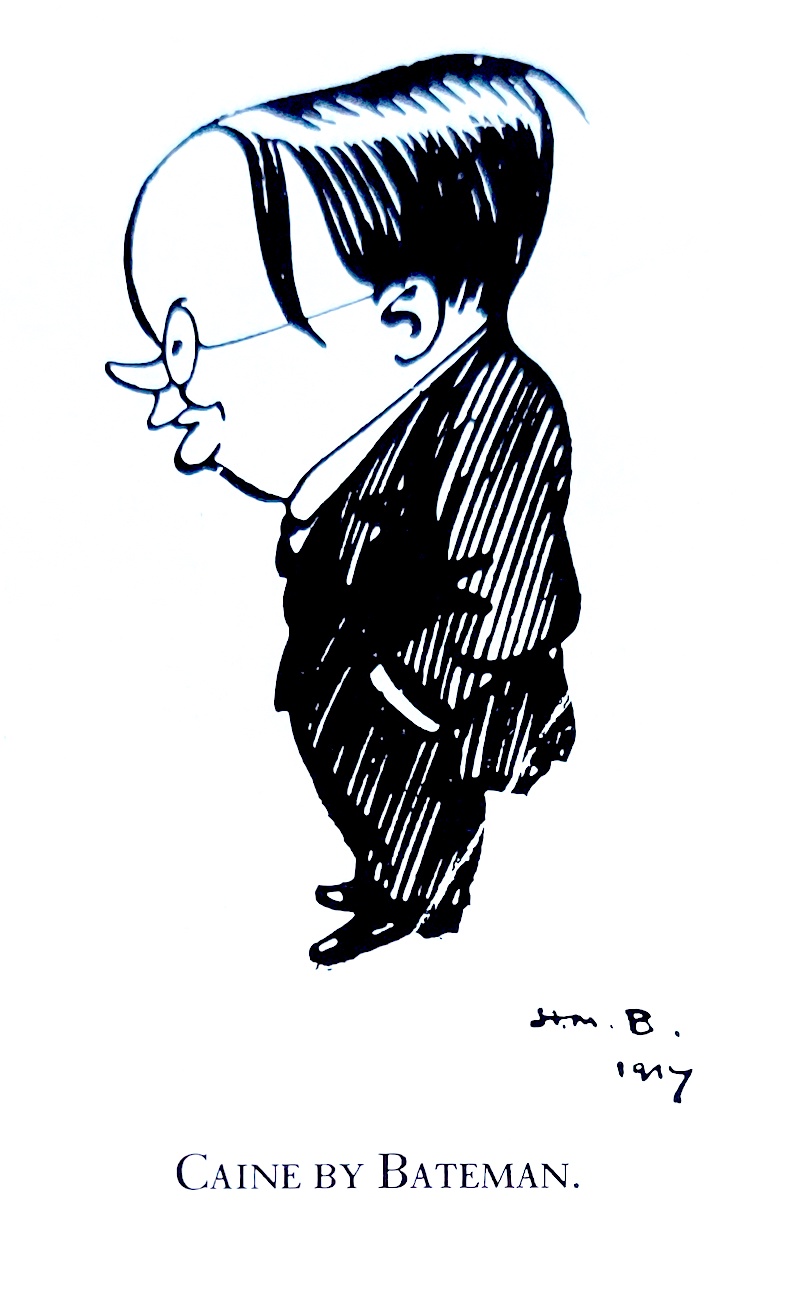
Caine, by H. M. Bateman, 1917. Reproduced from Anderson (1982: 87).
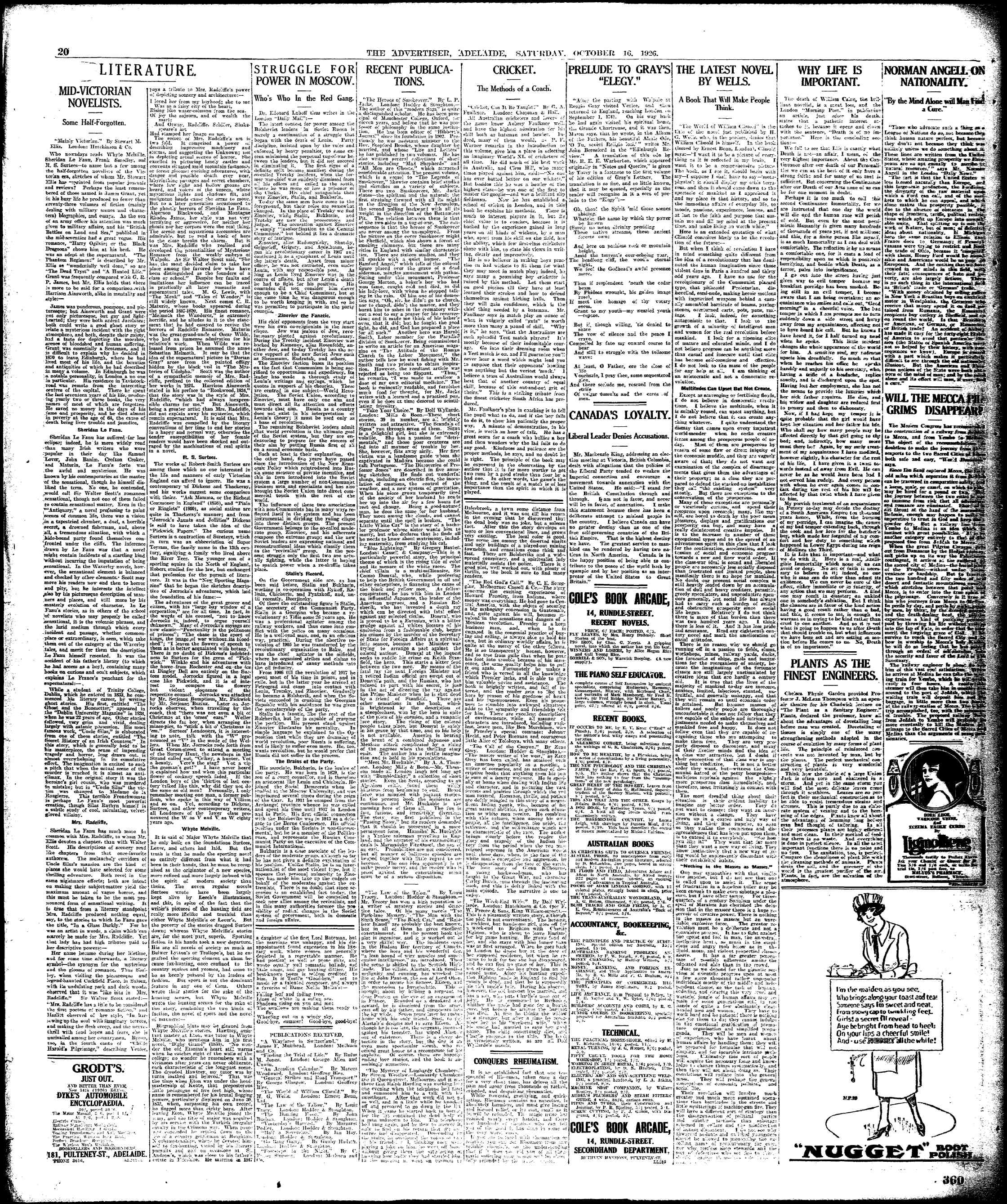
Readers of the Saturday, October 16, 1926, edition of The Advertiser of Adelaide, South Australia, might have noticed, on page 20, wedged between a review of “The Latest Novel by Wells” and “Norman Angell on Nationality,” a column entitled “Why Life Is Important:”
The death of William Caine, the brilliant novelist, is a great loss, and the London “Morning Post,” in publishing an article, just after his death, states that a pathetic interest attaches to it, because it opens and closes with the sentence, “Death is of no importance.” Here is the concluding section: —Reading this posthumous piece by Caine immediately brings to mind chapter 18 of The Real Life of Sebastian Knight, which is, in effect, a long “review” of the titular fictional writer’s last novel, The Doubtful Asphodel. The narrator of The Real Life of Sebastian Knight describes his half-brother’s novel in words that could equally well characterize Caine’s little disquisition “concerning the Continuance after our Death of our Acts:”We fail to see that Life is exactly what Death is not — an affair, I mean, of the very highest importance. About the Continuance after our death of our Personalities we can at the best of it only have a strong faith; and for many of us that is sufficient. But concerning the Continuance after our Death of our Acts none of us can be for one moment in doubt.
Perhaps it is too much to call this second Continuance Immortality, for we are instructed that one day the world will die and the human race will perish of cold. But even by the most pessimistic Humanity is given many hundreds of thousands of years yet, if not millions; and this, for a finite person like myself, is as much Immortality as I can deal with comfortably. The reflection is by no means a comfortable one, for it casts a load of responsibility upon us which is positively horrifying, and beside which Death, as a terror, pales into insignificance.
I go out into the street having just given way to evil temper because my breakfast porridge has been smoked. Being still in an evil temper, I become aware that I am being overtaken; an acquaintance who smiles and calls out, “Good morning” in a cheerful voice. The bad temper in which I am prompts me to turn suddenly down a side street and hurry away from my acquaintance, affecting not to have heard his call. But he knows I have heard it, for I half turned my head when he spoke. This little incident changes the whole appearance of the world for him. A sensitive soul, my rudeness upsets him dreadfully. So much so that when he reaches his office he speaks harshly and unjustly to his secretary, who, having a trifle of a headache, replies saucily, and is discharged upon the spot. Having lost her employment, she has not the means to provide the luxuries which her sick father requires. He dies, and his widow and daughter are reduced first to penury and then to dishonesty.
Now, if I had kept my temper it is quite probable that the girl would have kept her situation and her father his life. Who shall say how many people may be affected directly by that girl going to the bad; and, indirectly, how many more must there be? Again, by my surly treatment of my acquaintance I have modified, however slightly, his character for the rest of his life. I have given it a twist towards instead of away from Evil. He can never be as he would have been had I not served him rudely. And every person with whom he ever again comes in contact during the rest of his life will be affected by that twist which I have given him.
My peevish treatment of an acquaintance in Putney to-day may decide the destiny of a South American Empire ten thousand years hence. While, from the burning of my porridge, I can imagine the causes of my bad temper extending back, through the cook and her love for the butcher’s boy, which made her forgetful of my comfort and her duty to something which happened in Lower Egypt during the reign of Mollines the Third.
It is Life that is important — and what we do with it. Here is a real, intelligible Immortality which none of us can avoid or deny. No act of faith is necessary to believe in it; indeed, no one who is sane can do other than admit its existence. We can never be sure of the effect, either immediate or in futurity, of any action that we may perform. A kind one may result in disaster; an unkind one in somebody’s salvation. But I think the chances are in favor of the kind action having a good result rather than a bad, and this, it seems to me, is enough to warrant us in trying to be kind rather than cruel to one another. And so it is not what is going to happen to us after Death that should trouble us, but what influences we have here set and are setting in motion before He comes to us. No, Death is of no importance.
We feel that we are on the brink of some absolute truth, dazzling in its splendour and at the same time almost homely in its perfect simplicity. By an incredible feat of suggestive wording, the author makes us believe that he knows the truth about death and that he is going to tell it (Nabokov 1941, 1968: 178; Nabokov 1996a: 139).Likewise, Caine’s doubled phrase, “Death is of no importance,” as well as his, “The reflection is by no means a comfortable one, for it casts a load of responsibility upon us which is positively horrifying, and beside which Death, as a terror, pales into insignificance,” echoes the narrator of Nabokov’s novel:
And as the meaning of all things shone through their shapes, many ideas and events which had seemed of the utmost importance dwindled not to insignificance, for nothing could be insignificant now, but to the same size which other ideas and events, once denied any importance, now attained (Nabokov 1941, 1968: 179; Nabokov 1996a: 140).Furthermore, Caine’s injunction that, given the potentially infinite ramifications of our actions and that “the chances are in favor of the kind action having a good result rather than a bad,” we should try “to be kind rather than cruel to one another,” resonates neatly with the moral in Nabokov’s Afterword to Lolita:
For me a work of fiction exists only insofar as it affords me what I shall bluntly call aesthetic bliss, that is a sense of being somehow, somewhere, connected with other states of being where art (curiosity, tenderness, kindness, ecstasy) is the norm (Nabokov 1958: Afterword, 316–317).And no reader of Nabokov’s most famous novel, when reading Caine’s phrase — “and this, for a finite person like myself, is as much Immortality as I can deal with comfortably” — can fail to notice how comfortably it coincides with the final sentence of that book — “And this is the only immortality you and I may share, my Lolita” (Nabokov 1958: II, § 36, 311). Incidentally, on the day that Caine’s death was announced in the English and Belgian press — September 4, 1925 — Nabokov took a train to Constance in the Republic of Baden where he stayed at the Pension Zeiss for eight days with his wife Véra and a tutee named Alexander Sak, before returning to Berlin where, in October, he began writing his first novel, Mashenka (Машенька; published in English translation as Mary in 1970), the protagonist of which is named Ganin (Boyd 1990: 241–249). I would like to believe that Caine’s death in early September 1925 was one of the spurs that goaded Nabokov into writing his first novel, and that in Lev Glebovich Ganin he disguised the name of the author of The Author of “Trixie”. However, the brief tragic life of a Russian poet named Aleksey Alekseyevich Ganin, born July 28, 1893, and friend of the better known poet Sergei Yesenin, would seem to make any such speculation moot. The fictional Ganin, moreover, admits to Podtyagin on a bus in chapter 11 of Mary that he travels under a forged Polish passport and that his real name is not Ganin at all:
And yet perhaps my speculation is perhaps not so farfetched after all. First, the “William Caine” in the piece I reproduced in lieu of a preface, when pressed by the interviewer, admits that his name is Anson Berkley, “but of course that’s only the name I write under. My real name is Llewellyn Solomons.” Second, Nabokov’s Mary starts out with a parody of a deus ex machina in the form of a rising elevator, stalled, but which mysteriously clicks back into action; Caine’s The Author of “Trixie” ends with a similar parody involving an elevator. In Mary, Ganin is stuck in the dark in the elevator for twenty minutes with his fellow pension-mate Alfyorov, who attempts to strike up a conversation:“What do you mean, my dear fellow?” Podtyagin goggled in amazement and suddenly clutched at his hat — a strong wind was blowing.
“Well, that’s the way it was,” ruminated Ganin. “About three years ago. Partisan detachment. In Poland. And so on. Thought I’d break through to St. Petersburg and raise a rebellion. Now it’s quite convenient and rather fun having this passport” (Nabokov 1970: 81).
With a lurch the lift caught on the sill of the fourth-floor landing and stopped.The last chapter of The Author of “Trixie” takes place in the basement of the Sloane Street Safe Deposit, where Archdeacon Roach has just retrieved a dispatch-case from a strong box. Suddenly, the elevator descends and out steps the Prime Minister who sees Roach and offers him the post held by the Bishop of Pontefract, who has just died that morning. His long-cherished bishopric attained, Roach need no longer prove himself to be the veritable author of Trixie, and so he and his daughter Chloë and his son-in-law Bisham Dunkle — the ostensible author of Trixie — need no longer linger underground with selected members of the Incorporated Society of Authors, Playwrights, Musicians and Continuity Fakers who had been invited there to witness the opening of said dispatch-case:“A miracle,” Alfyorov said, grinning, as he opened the door. “I thought someone had pressed the button and brought us up, but there’s no one here. After you, Lev Glebovich.”
But Ganin, with a grimace of impatience, gave Alfyorov a slight push and, having followed him out, relieved his feelings by noisily slamming the steel door behind him. Never before had he been so irritable.
“A miracle,” Alfyorov repeated. “Up we came and yet there’s no one here” (Nabokov 1970: 4).
The three of them entered the lift and were instantly carried upwards.Third, Nabokov’s introduction to the 1970 translation of Mary contains the following interesting complex sentence:“Tell me, Venerable, won’t you,” said Chloë as they ascended, “what you’ve got in that dispatch-case of yours. Is it just some old newspapers, or what?”
“That,” said the Archdeacon, “is a question which I shall not answer, but perhaps,” he added roguishly, “perhaps your plain-clothes man, Chloë, might tell you.”
The lift stopped; they walked out and emerged into Sloane Street. Dunkle called a cab. They got in and drove to the Vicarage.
Shall we leave them there?
We shall (pp. 246–247).
The beginner’s well-known propensity for obtruding upon his own privacy, by introducing himself, or a vicar, into his first novel, owes less to the attraction of a ready theme than to the relief of getting rid of oneself, before going on to better things (Nabokov 1970: xi).I would like to think that Nabokov’s odd inclusion here of a vicar (a title which occurs nowhere else in Mary) refers to the personage of Archdeacon Roach, who lives in a vicarage with his family; that the obtrusive authorial intrusion he attributes to beginners alludes to the genial authorial intrusion characterizing all of Caine’s novels; and that “the relief of getting rid of oneself” and one’s themes “before going on to better things” bears a family resemblance (negative, in part) to a passage in chapter I, section 4 of The Author of “Trixie”:
This is a miserable beginning to what you hoped was to be a pleasant story; but I can’t help it. And there is far worse to come; far, far worse. I am very sorry, but what am I to do? Abandon my project and take another theme? Impossible! This tale is in me and has got to come out if it will. One does not abandon one’s themes, though it is a fact that now and then they abandon one — and what a relief that is! No, even if I drive you into the arms of a rival my tale must forth (pp. 16–17).
- Posthumous piece by Caine. — Part of which, of course, I’ve already quoted from (in its Adelaide Chronicle version) in § 2, where I pointed out a coincidence with a passage from Wodehouse. References to the several variants of the piece may be found there.
- Brief tragic life of a Russian poet. — A. A. Ganin was executed March 30, 1925, for belonging to the entirely imaginary “Order of Russian Fascists.” See [https://ru.wikipedia.org/wiki/Ганин_Алексей_Алексеевич] and [https://en.wikipedia.org/wiki/Sergei_Yesenin].