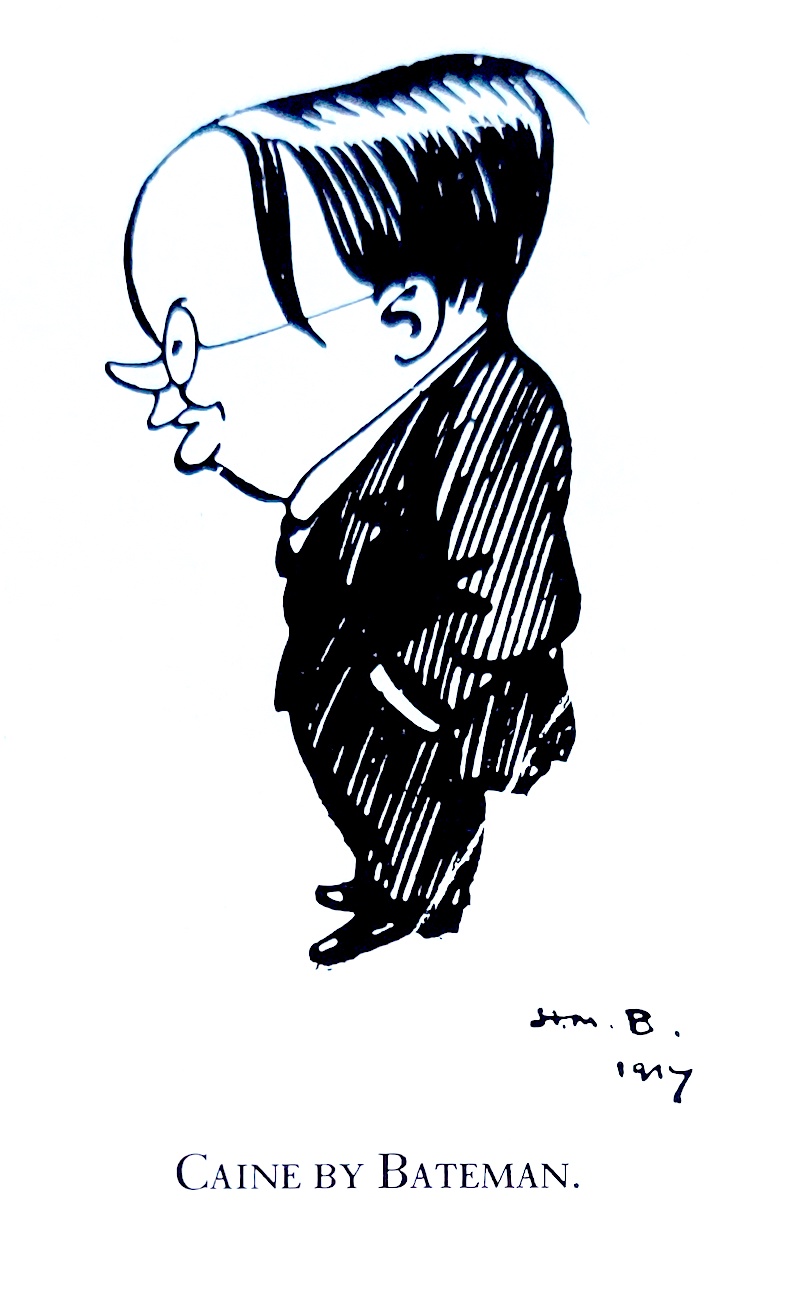
Caine by Bateman, 1914. Reproduced from Anderson (1982: 87).
Mr. Caine, the author of “The Revolt at Roskelly’s,” just published by the Putnams, was born in Liverpool thirty-eight years ago, and is the eldest son of the late William Sproston Caine, who was a well-known English politician. William Caine is descended, through his mother, from Tom Brown, the Manx poet [sic]. The author, who is distinctly, deservedly, and definitely reaching the front line of English humorists, was educated at Westminster School, later at St. Andrew’s University, and finally at Balliol College, Oxford. After leaving Oxford Mr. Caine was called to the bar and, after working at law for seven years, gave it up for literature, in which he found so much to interest and attract him. His first book was issued in 1906, and is entitled “Pilkington.” Since then Mr. Caine has published some six other volumes: “The Confectioners,” a burlesque in food adulteration (written in collaboration with John Fairbairn); “The Pursuit of the President” and “The Victim and the Votery,” two Suffrage skits; “Boom,” a satirical extravaganza upon self-advertisement; “A Prisoner in Spain,” dealing with the Spanish prisoner swindle, and “The Revolt at Roskelly’s,” a highly diverting piece of humorous and witty writing, which the reader will find irresistible.The Conscience Quartet consists of four novels published in succession by Greening in a timespan of less than two years — Boom! (October 1909), A Prisoner in Spain (April 1910), The Revolt at Roskelly’s (November 1910), and The Devil in Solution (May 1911). I call these four novels The Conscience Quartet for the simple reason that — but first, I should probably clarify that Caine cannot have been “descended, through his mother, from Tom Brown, the Manx poet” for the simple reason that the Manx theologian and poet in question, Thomas Edward Brown, was a younger brother of Alice Caine née Brown’s father Hugh Stowell Brown, i.e., the Manx poet was Caine’s great uncle on his mother’s side. Unless — but back to Caine’s Conscience Quartet, the first of which the author dedicatedMr. Caine is married and his wife was Miss Edith Gordon Walker, daughter of F. B. Walker, of Boston, Mass., where she is very well known. A point which should interest American readers is that Mr. Caine attributes a great deal of his success to the influence of Mrs. Caine.
Fishing for trout has a great attraction for Mr. Caine, as it has for many other authors. He has contributed articles on the subject to “The Field,” under the name of “W. Quilliam,” and has a book on angling appearing this autumn.
Mr. Caine has written musical comedy for the stage, but has not gone on with it, as he writes, “I seek peace rather than fortune” (“With Authors in their Literary Workshops; William Caine,” The Brooklyn Citizen, Sunday, July 23, 1911, p. 19).
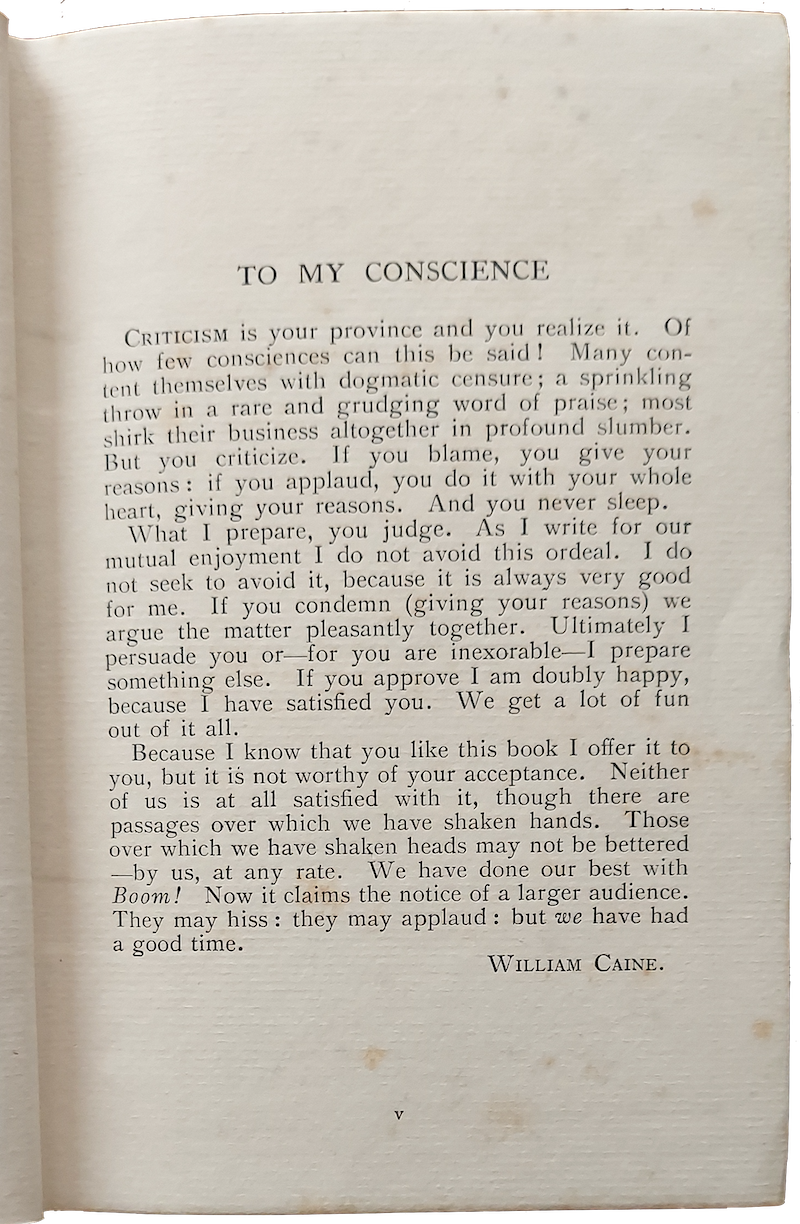
TO MY CONSCIENCE
Criticism is your province and you realize it. Of how few consciences can this be said! Many content themselves with dogmatic censure; a sprinkling throw in a rare and grudging word of praise; most shirk their business altogether in profound slumber. But you criticize. If you blame, you give your reasons: if you applaud, you do it with your whole heart, giving your reasons. And you never sleep.
What I prepare, you judge. As I write for our mutual enjoyment I do not avoid this ordeal. I do not seek to avoid it, because it is always very good for me. If you condemn (giving your reasons) we argue the matter pleasantly together. Ultimately I persuade you or — for you are inexorable — I prepare something else. If you approve, I am doubly happy, because I have satisfied you. We get a lot of fun out of it all.
Because I know that you like this book I offer it to you, but it is not worthy of your acceptance. Neither of us is at all satisfied with it, though there are passages over which we have shaken hands. Those over which we have shaken heads may not be bettered — by us, at any rate. We have done our best with Boom! Now it claims the notice of a larger audience. They may hiss: they may applaud: but we have had a good time.
William Caine.

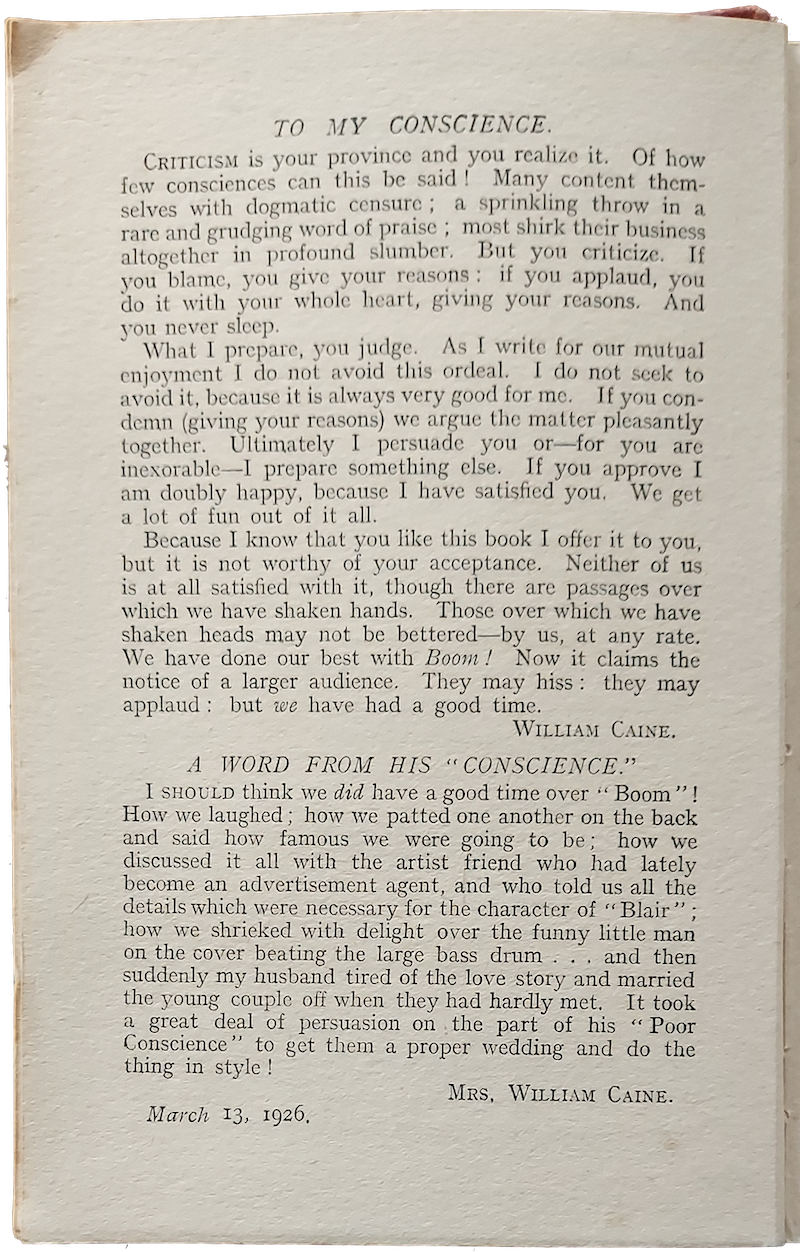
The wedding at the end Caine’s novel, far from being “proper,” is actually a sort of anticipatory plagiary of the wedding at the end of the 1967 film The Graduate. As for that “funny little man on the cover beating the large brass drum,” the 1926 edition omits the mock portentous note “Concerning the Exterior” which Caine included in the first edition:A WORD FROM HIS “CONSCIENCE.”
I should like to think we did have a good time over “Boom”! How we laughed, how we patted one another on the back and said how famous we were going to be; how we discussed it all with the artist friend who had lately become an advertisement agent, and who told us all the details which were necessary for the character of “Blair”; how we shrieked with delight over the funny little man on the cover beating the large brass drum… and then suddenly my husband tired of the love story and married the young couple off when they had hardly met. It took a great deal of persuasion on the part of his “Poor Conscience” to get them a proper wedding and do the thing in style!
Mrs. William Caine.
March 13, 1926.
Some four years after Boom! was originally published, Caine described with Baudelairean spleen in The New Foresters his chance encounter with an exemplar of what the Birmingham Gazette called, after his death, “his most famous novel:”I feel that a word is necessary to explain the wrapper of this book.
Not that its meaning is obscure. Its meaning is obvious to the lowest capacity.
But those who read it may ask, and ask fairly: “How does it happen that a book which professedly deplores the power, in these days, of Advertisement, appears figged out in orange and black and a violent picture, all of which is clearly designed to emphasize its presence among the rivals on the book-stall, thus to catch the Eye of Indifference, to attract the Hand of Curiosity, and ultimately to extort the Coin of Acquisition? Would not a more sober dress better become the denouncer of blatancy?”
These are very pertinent observations.
But let those who make them reflect for a moment and they will see that something staggering in the way of covers has been forced upon me. For I sit upon the horns of a dilemma.
Granted that I wish to proclaim an evil, to denounce the Power of Advertisement.
I wish, that is to say, to achieve an object, to achieve it surely and speedily.
But it is the wickedest folly to proclaim and denounce evils to the empty air if an audience can be secured. It is the prophet’s duty to attract attention.
Now my book is devoted to showing that, in this twentieth century, Advertisement is the surest and speediest method of attracting attention, of achieving in short any object whatever.
Either I believe what I say, or I don’t.
If I do, I am bound — if I would be consistent — to accept the help of the very evil which I denounce. But I must be consistent. For, thus, I shall be credited with the courage of my convictions. The world will respect my motives. I may have to blush for my costume, but not for myself. Any hearing that I may obtain will be respectful at least. And Respect is the mother of Credit.
If, on the other hand, I do not believe what I say I may come out in navy blue or dark green or any other decent dress, but I shall give my whole case away and only succeed in proving myself, before the public, a person who is trying to make money by false pretences. My good faith will be doubted. No one will pay any attention to me. I shall save my modesty at the expense of my reputation and I shall achieve nothing, do no good whatever.
Is it, then, better to be orange and honest or mouse-coloured and a rascal?
I have chosen orange without a moment’s hesitation — because it is honest. Shall the reflection that it is also likely to prove profitable deter me? It shall not. Reformers are always misunderstood.
William Caine.
Next morning as I came back from the Brockenhurst post office I stopped outside a bookseller’s, my eye having been attracted by a shelf of those pathetic disappointed volumes which, at reduced prices, still maintain the struggle for existence. I approached them and pityingly surveyed them. Among them was one which especially engaged my attention. The others wore modest old clothes — dark blue, maroon, olive-green — sober hues which did not misbecome their fallen state. Decayed gentlewomen, perhaps, but gentlewomen to the very jaws of the pulper. From among them the book at which I gazed started out in an indecency of dirty orange. Though obviously on her last legs she outshone with ease all her comrades in distress. She reminded me of some tawdry poor soul whom sheer hunger has driven from Piccadilly into the queue outside a soup-kitchen. Her shelf was not quite filled and she leaned drunkenly against a slim, dove-grey Bridge and How to Play It, while her feet were pressed against those of a History in rusty black and silver, the history of a scandalous court. These, her two respectably gowned neighbours, seemed to draw away from her.Some of the harm which Caine repaired by rescuing at least one copy of Boom! from “The Shelf” involves Helen (“Nelly”) Tovey, who, when the novel opens, is a chorus girl who has been performing for the last eighteen months under the stage named Helen Trimble in the Laundrymaids at the Phœbus Theatre. Helen is engaged to Edward Armstrong, an artist who goes by the name of Ned and works for an advertising firm. Helen, however, has also, at the ball thrown to celebrate the year-and-a-half run of the Laundrymaids, caught the eye of John Bunyan, self-published poet who unsuccessfully tried dancing with her, and George Deacon, “man-about-town, noted whip, and member of ten clubs, most of them disreputable. She found him rather more than usually stupid, but an admirable dancer. She gave him all the dances he asked for, and he asked for them all” (p. 20). Deacon also happens to be the son of John George Deacon, “first Baron Widnes, recently elevated to the peerage (by Mr. Dana Blair) for services to his party rendered out of the proceeds of his vast chemical business” (p. 38). Blair, the boomster, is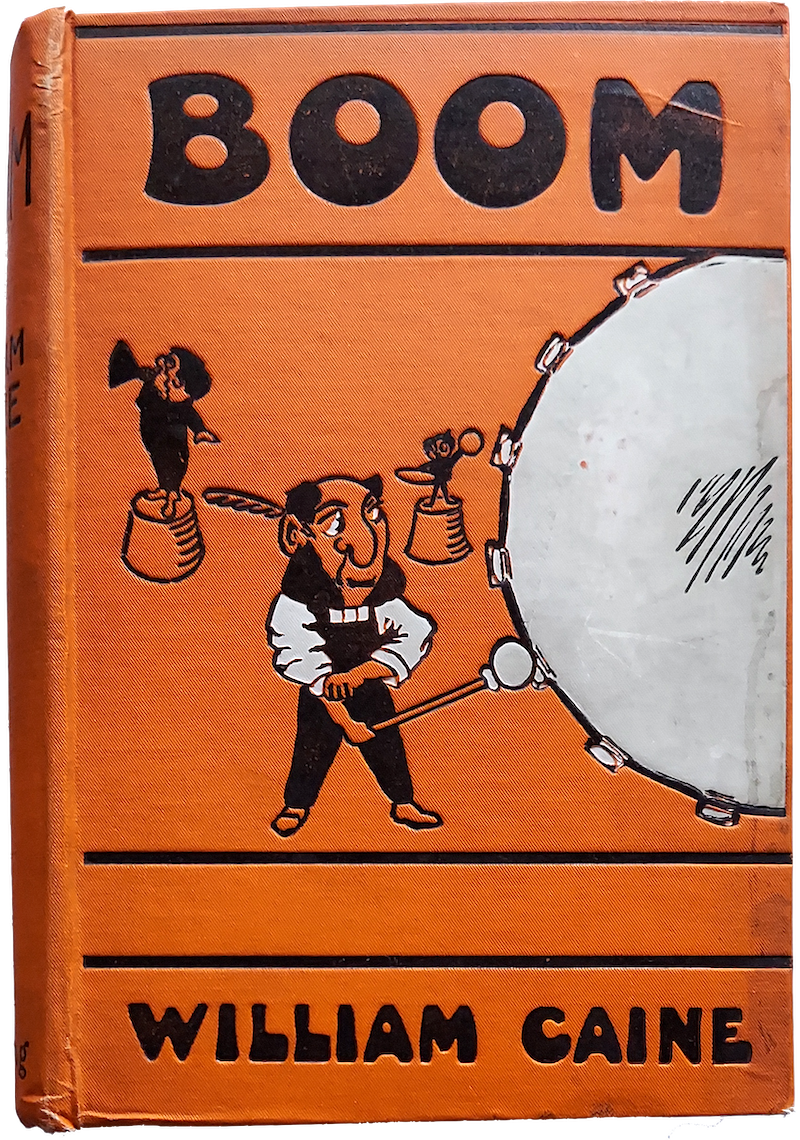
Boom! A Novel of the Century, by William Caine. Cover illustration by the author. London: Greening & Co. 314 pp., 8º. October 1909.
I had the brutality to compare her ticket with the tickets of the others. “Published at six shillings,” I read. “Offered at ninepence.” She was the cheapest thing there and fallen the furthest. Even the three-shilling-nett book on Bridge had not come below one and twopence, while the half-guinea scandalous history still bid boldly for as much as three and four. I discovered an infinite pathos in this circumstance. How desperate must be the condition of a book which, not content with so grossly underbidding her rivals, did it with so loud, so outrageous, so orange a clamour!
“Oh!” she seemed to shriek, “buy me, kind gentleman, buy me, for Goodness’ Gracious’ sake. If you think I ask too much I’ll gladly take less. Spring a tanner and I’m yours forever. Insult me with an offer of three d, and I’ll jump out of this shelf right into your arms. Only take me away out of here, where they throw my situation in my face all the time. It’s more than paper and boards can stand to have this cheap three-bob thing passing her remarks across me to this old wreck in black and tin. You wouldn’t believe the things they say — and they no better than they should be, neither! I never did any harm to anybody. If I am a bit dressy, I can’t help it. It’s the only clothes I ever had. I was young once and thought I was somebody and was going to do something. I wanted to do it as smart as I could. I thought I was worth anybody’s four and six then, and I made up my mind to be seen and bought and make a sensation. I don’t see anything wrong in that. It’s only business, isn’t it? But if I’d known I was coming here I’d have dressed in a lower tone. They’ve no mercy for anyone on The Shelf who looks as if she’s tried to cut a dash in her time. Most of ’em seem to have dressed, when they came out, with an eye to this place. I wish I had, that I do. It’s all very well to think big of oneself when one’s young and fresh, but oh! dear gentleman, it makes the drop twice as hard to bear.”
Pitying her, I took the poor thing out of her shelf and opened her. Instantly her neighbours put their heads together, whispering maliciously.
“I’d rather,” the dove-grey one was saying, “rot to pieces where I stand than descend to that sort of thing. Suffer your lot in silence, dear, that’s what I say. Keep your self-respect at any cost.”
“Yes,” said the black and silver kindly, “I’d try to do that even though I came down to one and two, dear.”
“It isn’t,” the book in my hand continued, “it isn’t that I’m afraid of being pulped — everybody’s pulped sooner or later unless you’re a Breeches Bible or something of that kind. Send me straight to the pulper’s if you please, only buy me and take me away out of this. I don’t mind starting out as clean white paper again. They can’t easily print anything worse on me than they have. I’ll take my chance of that, sir, and gladly. It would get me out of this cover at any rate, and it’s this cover that’s killing me here. If I could have my real wish I’d be made into a Warning to Novels Not to Come Out Too Gaudy; then I might be happy again. For we books don’t think. All we want to do is to sell in hundreds of thousands and lots of us fancy that a swanky cover’ll help. We’ve heard of the Competition of the Bookstall and we want to give ourselves a chance. We may have heard of The Reduced Shelf but when you’re young you think failure’s only for other people, and when, at last, you come to The Shelf the last thing that surprises you is to find yourself there. You’re so busy looking about you and seeing the reasons for the others being on it. But oh! when you wake up at last, it’s a dismal eye-opener.
“And there’s another thing — the number of disappointments you get. When you’ve got a cover like mine, people pull you out now and then. They never mean to buy you, never. All they want to do is to waste five minutes, messing the poor old books about. A person’d rather chuck his money into the gutter than spend it on the likes of us. But it amuses them to turn us over and read a page or two and sneer and put us back again.
“Well, my cover catches their eye — it does that all right — and they have me out very likely first of all, just as you’ve done. In the old days when I was new and lived in Waterloo Station, that was what I wanted them to do. I would lie open in their hands watching them read the first few paragraphs, waiting for their smile, and the ‘buying look.’ But those things never came, or if they did, I could see the brutes reflecting that they could get me at the library and that bookstall prices are iniquitous; and back I would go, while they fumbled for sixpence to buy one of these magazines.
“Yes, my cover has always caught the eye. It does so still. I suppose you’re about the tenth gentleman that’s had me out this month. I’ve been here two years now, come Midsummer, and all that time there’s hardly been a soul who’s stood in front of The Shelf but has taken me out. Look at the marks of all their dirty fingers on me. That’s another thing. If I was black they wouldn’t show. I’d still be decent. But just look at me, will you? I’m twice as dirty and pulled about as any book here, and just because I used to be three times smarter. And the others don’t let me forget it, not they!
“When I first came here I was still fairly presentable and I cost one and six; that’s top price, you know, among us of The Shelf — novels at any rate. Ever since I’ve been going down and every time twopence or a penny was knocked off me all the other books had something to say, just as they’ve something to say every time I’m put back. Oh, it’s a gaudy life for a gaudy old novel here, on the Shelf. I expect it’s hell, all right. I know all about hell because I lived next to a book on it when I came here first. But that book was mistaken. Burning would be fun to The Shelf.
“As for the man who wrote me —”
Before she could say something for which she might afterwards be sorry I had put her in my pocket and paid the ninepence by which she became mine. Surprise and joy made her dumb, but you should have heard the spiteful whispers which went round The Shelf. I believe they all turned green — those at any rate which weren’t green before; but I didn’t stop to see.
I am glad to think that this little bit of rescue-work fell my way. It’s not often that a man is allowed to do something to repair so cheaply some of the harm he has done up and down the world (The New Foresters, ch. XXXIV, “Of a Poor Old Novel,” pp. 209–213).
about forty years old. He had a thick neck, and a square chin and a bird-of-prey nose. He dressed carefully and quietly in dark blue serge. His black cravats were apt to splash over a little, but this came from his being an American and not from any wish to attract notice, which indeed it was his policy to avoid. By day he always wore on his head a black high-crowned, broad-brimmed bowler, which he called a Durby. His was an unassuming exterior. Nobody would look twice at such a man. One sees men like Blair all over the place.Other clients from whom Blair extracts his ten-percent commission include, in addition to Lord Widnes, the painter Campbell FitzStanley, who owed his fame to his picture Mother and Daughter, portraying “two young women exactly alike […] leaving it to the spectator to determine which was which” (p. 48); Henry Brand, “an unknown architect” who had “put himself under Blair’s guidance” and “painted his house in longitudinal stripes of vermilion, ultramarine and gamboge,” so that, with the aid of “a few articles by Leonard Foswick on ‘Brand and the House Beautiful,’” “the fellow found himself in request everywhere, decorating the houses of the cognoscenti from cellar to garret, and spreading his ‘Gospel of Gaiety’ from Soho to Shepherd’s Bush” (p. 49); Jebb King, the barrister who “would never have made his way if he hadn’t been inspired by Blair to make up ugly” (p. 49); and Orson,His eyes were alone remarkable. They were of a pale grey, the iris very large, the pupil very small, which gave them the effect of possessing an inner vision. You could never catch a sight of the soul which, you felt, stared so keenly at you out of those little black openings. This produced a certain mystical look which we are led to believe is to be found in the eyes of great artists. I have never met a great artist, and there is nothing of that sort in my own eyes.
But it may be so (p. 47).
the humorous novelist — how had he got on? By appointing himself the enemy of buttons and advocating the use of frogs everywhere. He had written books, short stories, articles and verse about buttons. Everything he wrote had had a strong button interest. He had never published a thing that didn’t somehow or other drag in the word buttons. He objected to the shininess and vulgarity of polished buttons; the insanitary, microbe-harboring nature of cloth buttons; the cruelty to the oyster of pearl buttons; the liability to loss, danger of being swallowed, the unnecessariness and the æsthetic disadvantages of all buttons. He classified them, gave them fantastic names, was said to have the finest collection of them in Europe, to have vowed a life-long jehad against them. He became the only authority on buttons. When Stephen Mountjoy, the New Zealand tenor, lost (by arrangement) the set of diamond waistcoat-buttons which had been given to him by Prince Constantin of Monte Carlo, Orson had been interviewed on the subject as a matter of course. Nobody could do anything with buttons without Orson being interviewed about it. Result — when anybody in England, Scotland, Ireland or America found a button missing from his shirt he would say to his wife, “I see that you are in league with Orson.” The man grew famous in no time — and (Blair’s “Orson” account testified this) rich. Deservedly; for on buttons (or anything else if he pleased) Orson could be inimitably funny (p. 50).Feeling that his son George is “going rapidly to the devil,” Lord Widnes convinces him over coffee and liqueurs after lunch at his club to fill an impending vacancy in his party and stand for election to Parliament for the constituency of Walham Rye, “one of the southern suburbs” of London, as well as one of the “strongholds” of Lord Widnes’s party (pp. 39–40). Unbeknownst to George, Lord Widnes provides “the necessary coin” — “Where my boy is concerned we need not trouble about cost,” as he says — to Blair to hatch a stunt to make George popular in the constituency and guarantee “to put him at the top of the poll” (pp. 54–59). Meanwhile, Blair’s tout Putnam has spotted Helen as a potential client — “by daylight she’s a long side better’n what I told you last night. A peach, Mr. Blair. A plum, by Jeroboam, the son of Nabat, who caused Israel to sin! A blossom fresh plucked from the tree of dainty wholesomeness” (p. 86) — and brings her to Blair to not only play a part in the stunt to boost George but also to — “By Joseph’s coat of many colours,” he tells Blair, “you’ve only got to give H. Trimble one little hoist and she’ll shoot to the summit of herself while you gather the dollars” (p. 87). Putnam shows Helen in and Blair discovers “the Trimble Smile” (p. 90). Learning also that “She wants to get on” (p. 92), he thus —
When I first read Boom!, all I knew about Edith Gordon Walker aka Mrs. William Caine, was that she was a harpist who went to Wellesley. I did not know what to make of Mr. Putnam and all the Biblical allusions that “his pious New England raising” entails. Knowing now that, though Walker was born in Kentucky, she was raised in Boston, and that she was likely a member of the Christian Association at Wellesley (see § 5), I begin to suspect that, if not a parody of (some aspect of) herself, Putnam is at least, possibly, a parody of some person(s) she would likely have encountered during her own (possibly pious) New England raising. Recall also what Caine said about the Bible in his New York Sun list of desert island books in § 1. But back to Helen Tovey aka Helen Trimble. In order “to get on,” here’s what she needs to do:“You lay hold?” cried Putnam.
“I lay hold.”
“I knew it. By Absalom’s long scented hair, I knew it! By Gideon’s fleece and Jonah’s gourd, by Jacob’s ladder and the trews of the Tishbite, by —”
“That’ll do,” said Blair. “Just you forget your pious New England raising for a spell, and ring up Verdier’s of Bond Street, and tell him to make an appointment to photograph Miss Trimble at two o’clock, and just rustle round to Glover’s the furman on Regent Street, and bring back all the ermine they’ll let out of the shop at once. Miss Trimble’s what ermine needs. It’s a pretty tolerable drug now-a-days, but I guess she can sky it some.”
“Serpent of Eden!” cried Mr. Putnam, “he lays hold. What did I tell you, Miss Trimble? And ermine! It’s miraculous. I’m a blind man. Ermine! I never saw it. Why, she was just created to wear ermine and to boost it. Just for that. The Ermine type. The Ermine girl. That’s you! And it’s at bed-rock today. Hell!” he concluded, as he darted out of the room, his pious New England raising deserting him in the extremity of his admiration (pp. 92–93).
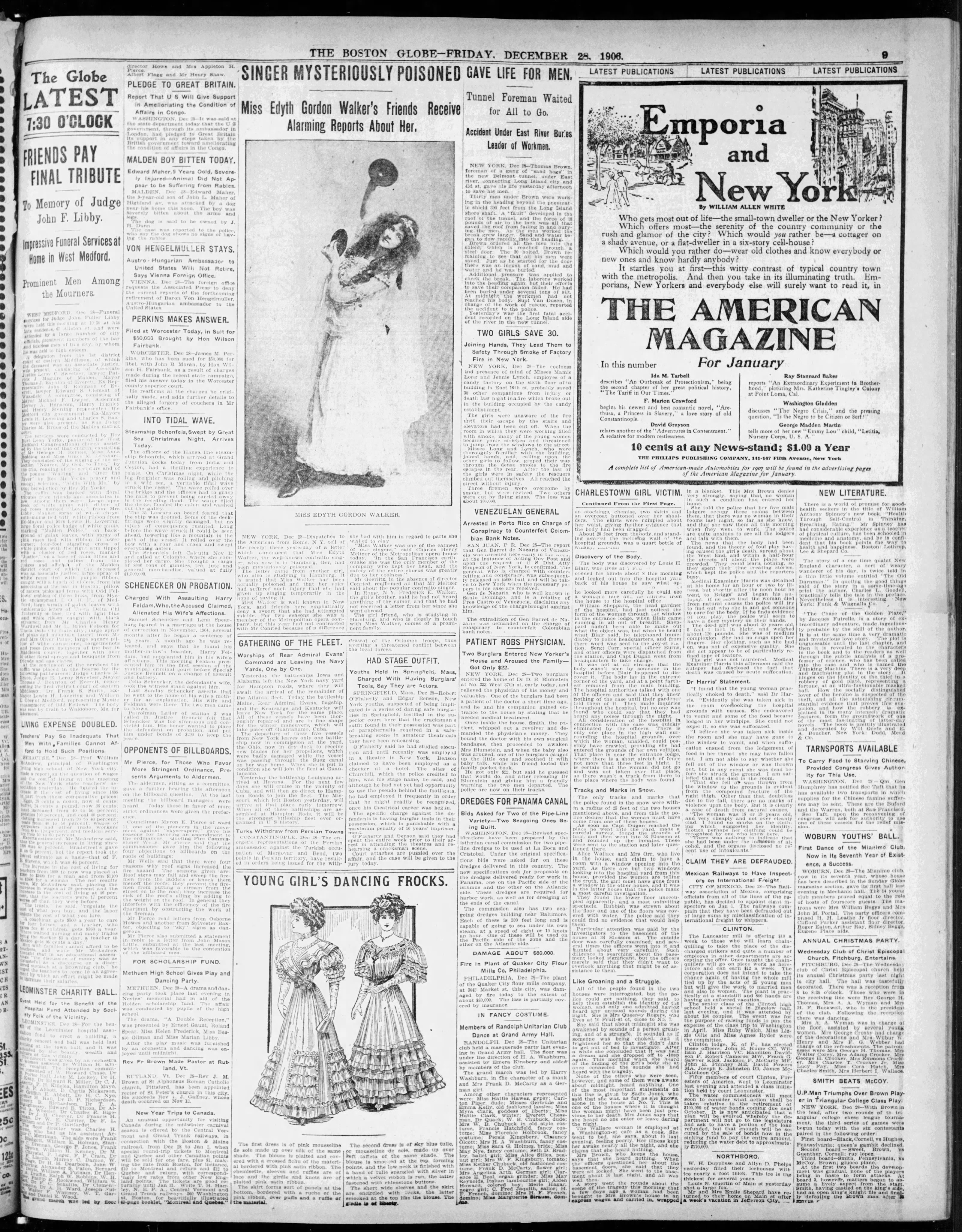
On Friday, December 28, 1906, the evening edition of The Boston Globe published, on page 9, an article entitled “Singer Mysteriously Poisoned” and accompanied by a photograph which the same newspaper had published on January 10, 1904, showing Miss Edith Gordon Walker posing in the “oriental costume” she wore to the Twelfth Night revels at Copley Hall (see § 7):“Now,” said Blair, “to arrive anywhere we’ve got to work and move ourselves. I assume that you are stationary now, planted immovably in the chorus-quag. To emerge you have got to do something, and I am going to tell you what that is.”
“Yes,” said Helen, “that would be a good way to begin.” Putnam had not concealed from her that in order to secure the support of Blair she must take a hand in some enterprise or other about which he threw a cloud of impenetrable mystery. She very much wanted to know what this was. Blair had said that he laid hold of her. So far, good. But the revelation of the part she was expected to play in the near future would tell her whether or no she was prepared to be laid hold of by him.
“I want you to attempt suicide,” said Blair, as he lit a cigar. “A client of mine —”
“You want me to do what?”
“To attempt suicide, Miss Trimble. I did not say commit it. That is a very different thing, and one to which you would probably see objection. But what I want you to do will involve nothing more lethal than the wetting of your skirt, boots and stockings — I only ask you to go in wading. The water is guaranteed shallow. The fee is ten guineas, plus glory plus fortune. But ten guineas to begin with —”
“You look as if you were serious,” said Helen, getting up. “If you are, you’re a lunatic and I’d better go away. If you aren’t I think I’ll go away just the same.”
“I am perfectly serious,” he said, “and I am not at all insane. And I shall be very, very sorry if you go away, Miss Trimble, because if you will only have one little atom of patience and will listen to me, you and I are going to do something real huge. This little suicide racket is just the necessary monkey-business to get you going. It’s the signal to all England to sit up and see what I’ve got for ’em to fall down and worship. It’s just a big little ad., Miss Trimble. Don’t you understand that? Now you sit down again, and I’ll make it as limpid as distilled dew in three minutes.”
Helen sat down again. She might as well hear what he had to propose. He didn’t seem dangerous and he might be amusing.
“Go on,” she said.
“A client of mine,” said Blair, “has occasion to perform an act of bravery. The circumstances in which he finds himself at present make it necessary for him to be a hero. He has been unjustly accused by his enemies of cowardice, and he wishes to give them the lie. His wish is perfectly legitimate, for he is as truly brave as Hannibal. Is that clear? Very well. Then here we have a gallant young gentleman burning to do a deed of prowess. But in these degenerate days deeds of prowess don’t come in the way of a gallant young gentleman except by the rarest accident. He can’t go out and do battle with another gallant young gentleman because the police would interfere and club them both senseless for committing a breach of the peace. He’s got to wait for Chance to send him a runaway horse or a mad dog, and runaway horses don’t always run his way, and mad dogs are extinct in these happy islands. Of course, if a baby falls on the rail just in front of the London express he gets a show, or if there’s a girl jumps out of a twentieth-storey window he can catch her and exhibit his mettle that way. But it don’t always happen that he’s around at the time. These incidents seem common because they all get in the papers, but they’re really very few and far between. Anyway, you may take it from me that these times are not friendly to such a young gentleman. But I guess you’ve heard of the law of compensation. It operates right here. If, on the one hand, this twentieth century offers practically no opportunity for a young fellow of spirit to do the hero act, on the other hand it offers ME. I am the Man who Does Things, Miss Trimble, and I’m here to arrange this little difficulty for our young gentleman, so I’ve got a shallow pond for him and now I want you.”
“I see,” said Helen. “He is to rescue me from drowning.”
“That is about the size of it. I won’t trouble you with the details now. It’s the general proposition I want you to grasp. Have you grasped it?”
“Yes,” said Helen. “It’s rather funny. But, f course, it’s quite out of the question for me to do anything of that kind, even for ten guineas.”
“You forget the plusses, Miss Trimble. The glory and the fortune. But don’t think I am asking you to do anything that’s unworthy of you. I’m not. You’re an actress, ain’t you? You’d be glad to play at committing suicide on the stage. Well, what’s the difference when you do it out of doors? It’s just the same dear old dern fool of a public to mystify.”
“That’s so,” said Helen reflectively. She felt that there was a fallacy in his argument, but she couldn’t detect it. It seemed all right, though she was sure it wasn’t.
“When you came into this room,” he went on, “I was prepared to make you this offer, do my deal, put you through it, give you your fee and let you go. Putnam was enthusing a lot about you, but that’s his way. I didn’t reckon to see the future Queen of Musical Comedy walk in at the door. But I did, Miss Trimble.”
He spoke with such earnestness that Helen thrilled. If it were possible! At this moment the delight of laying a great position at Ned’s feet was less present to her mind than formerly. Ambition stirred in her, came into her face. Blair saw it.
“Yes,” he said, “that’s what you’re going to be. I sized you up in five minutes. First, you have a beautiful face; secondly, a beautiful voice; thirdly, the all-compelling smile that don’t dawn on this gloomy world more than once in a hundred years. You’re booked for the top rung, as sure as if you sat there. Don’t you let a little natural shrinking from this harmless illusion cause you to forfeit a future that’s bright with limitless possibilities.” Helen considered him with shining eyes. Gradually they grew less eager. She sighed.
“No,” she said. “You’re clever, but you’re all wrong. If you want me you must get me some other way.” She could not bring herself utterly to destroy the splendid vision.
Blair took a second to think. Then, “Ah,” he said, “but there is no other way. I was wrong and Deacon was right. He said you wouldn’t do it.”
“Deacon?”
“Yes, the Honourable George. He’s the gallant young gent who’s to do the Lewis Waller act and pull you out of the jaws of death.”
“Oh, is he?” Her breathing began to trouble her. Blair went on —
“Yes, he is. Bet me an even twenty sovereigns I wouldn’t persuade you. You’ve lost me my money, Miss Trimble.”
“Did he — did he have the impudence to suggest that you should try?” Her voice told him that he had struck the right line.
“Well, not likely. Don’t I tell you he wouldn’t allow that you had the grit to do it? Putnam suggested you. He discovered you the other day. Saw you on Regent Street, tracked you to the theatre, came to me bursting about you. I’d promised him to look into your possibilities one of these days. Then this little suicide wheeze began to come along, and he set about me to launch you that way. I wasn’t for doing it. There was another girl I had in my eye. But Putnam mentioned you to Deacon. Then it came out that Deacon knew you. He said you were pretty, but of no account. Nothing to you. Declared you wouldn’t have enough confidence in yourself to take on a big situation like that. Said” (he was watching her very narrowly) “you were only an amateur actress and didn’t need to work — wouldn’t face the publicity of this thing. Said you were afraid of what your stepmother would say.” (He noted the quick flush come.) “Said you would shy off, anyway, when you heard he was the man.” (The quick bite at her lip did not escape him.) “Seems to fancy you’re afraid of him. I don’t know why you should be. He’s a harmless sort of galoot, George is. Said he didn’t want you and wouldn’t have you. Of course that put my back up. I don’t take any dictation from young Mr. Haw-Haws like George Deacon. I said I reckoned I’d let Putnam bring you along. Told George that he’d take the girl I provided or he’d not get one. He said you wouldn’t do it because you’d know you couldn’t. I told him I was the best judge of that. Then he bet me what I said, I couldn’t either buy you or bully you to do it. He pretended he relied on your not having the nerve, but I saw clearly that he built his hopes on the terror he imagines he’s inspired in your cowering soul. I gather he’s been persecuting you some to indulge in suppers after the play and that you’ve not been taking any of that sort of thing, and now he’s going round swelling out his chest and imagining he’s the snake and you’re the rabbit. Is that it?”
Helen put her elbows on the table and leaned forward.
“Tell me,” she said, “just exactly what you want me to do, Mr. Blair.”
There are other methods than bribing and bullying (pp. 93–98).
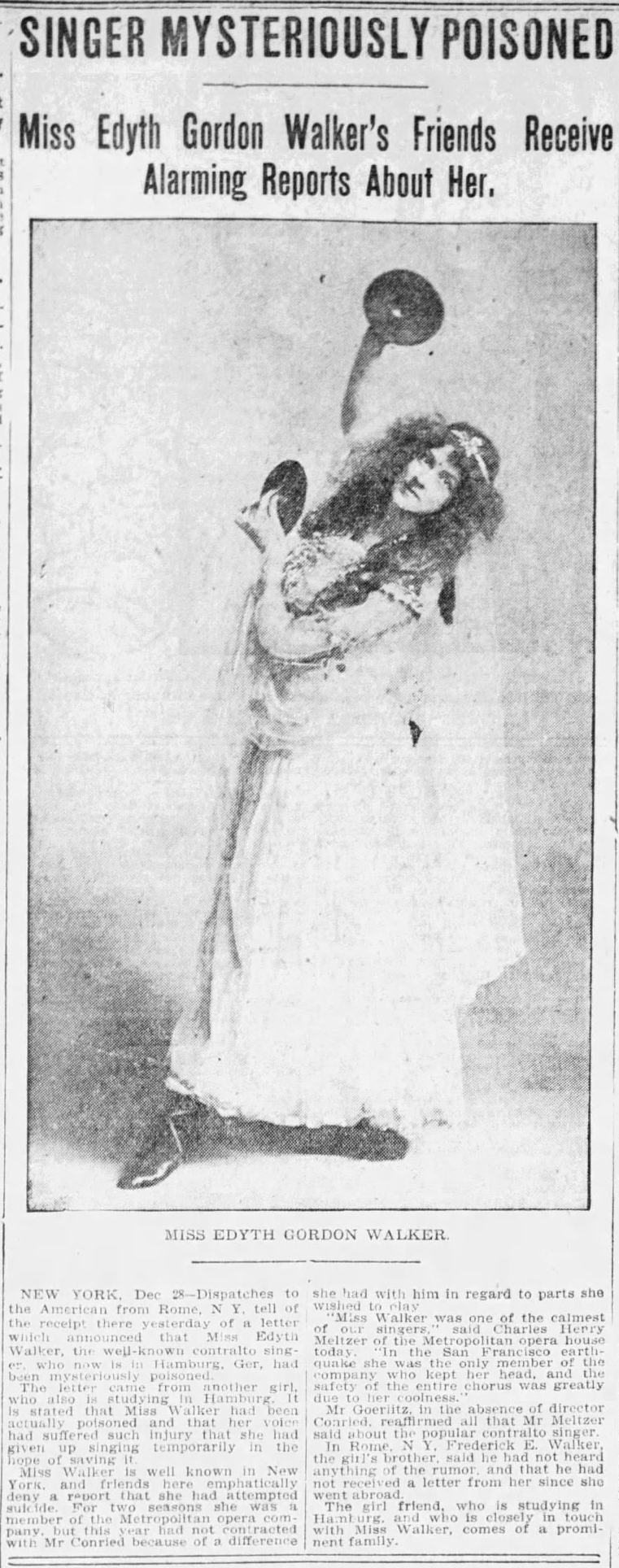
Reproduced from The Boston Globe, Friday, December 28, 1906, p. 9.
NEW YORK, Dec 28 — Dispatches to the American from Rome, N Y, tell of the receipt there yesterday of a letter which announced that Miss Edyth Walker, the well-known contralto singer, who now is in Hamburg, Ger, had been mysteriously poisoned.A small corrective item ran in the lower right corner on the first page of the same edition of the newspaper:The letter came from another girl, who also is studying in Hamburg. It is stated that Miss Walker had been actually poisoned and that her voice suffered such injury that she had given up singing temporarily in the hope of saving it.
Miss Walker is well known in New York, and friends here emphatically deny a report that she had attempted suicide. For two seasons she was a member of the Metropolitan opera company, but this year had not contracted with Mr Conried because of a difference she had with him in regard to parts she wished to play.
“Miss Walker was one of the calmest of our singers,” said Charles Henry Meltzer of the Metropolitan opera house today. “In the San Francisco earthquake she was the only member of the company who kept her head, and the safety of the entire chorus was greatly due to her coolness.”
Mr Goerlitz, in the absence of director Conried, reaffirmed all that Mr Meltzer said about the popular contralto singer.
In Rome, N Y, Frederick E. Walker, the girl’s brother, said he had not heard anything of the rumor, and that he had not received a letter from her since she went abroad.
The girl friend, who is studying in Hamburg, and who is closely in touch with Miss Walker, comes of a prominent family (“Singer Mysteriously Poisoned; Miss Edyth Gordon Walker’s Friends Receive Alarming Reports About Her,” The Boston Globe, Friday, December 28, 1906, p. 9).
ARLINGTON, Dec 29 — Mrs E. F. Gordon, grandmother of Edyth Gordon Walker, lives at 99 Jason st, this town, and was seen this afternoon in regard to the cabled rumor from Europe that her famous granddaughter had been poisoned. [T]he dispatch also contained some vague reference to attempted suicide.Another rectification printed a few days later did not fully dissipate the shimmer of errors linking the lesser known society dancer Edith Gordon Walker with the far better known opera singer Edyth Walker who, according to the New York Sun, had “just made her first appearance as Brunnhilde in ‘Die Walküre’ at Stadt Theater in Hamburg and met with great success:”Mrs Gordon was very much surprised when she learned of the dispatch concerning the mysterious poisoning, and she said she did not believe a word of it, because on Christmas day she, Mrs Gordon, had received a cable message from her granddaughter Edith, from London, Eng, which satted [sic] that she was well and happy and wishing everybody a Merry Christmas (“Happy on Christmas Day; Grandmother of Edith Gordon Walker Received Cable Message From Her to That Effect,” The Boston Globe, Friday, December 28, 1906, p. 1)
Miss Edyth Walker, who, according to a letter received at her old home in Rome, N Y, recently was mysteriously poisoned in Hamburg, Ger, has been confused by some with Miss Edith Gordon Walker of Arlington. The latter has been conspicuous in local society from her appearance in the “Twelfth Night” revels given by the Copley society and because of family connections with exclusive circles. At Wellesley she was the youngest member of the class of 1900, was prominent in musical and athletic organizations and was one of the most popular girls in the college. After graduation she became highly accomplished as a dancer at private entertainments of a high order, and when she visited Europe in 1904, she was a guest of Mrs Navarro (Mary Anderson) (“Not Arlington Girl; Young Women Poisoned in Hamburg Lived in Rome, N Y,” The Boston Globe, Wednesday, January 2, 1907, p. 3).
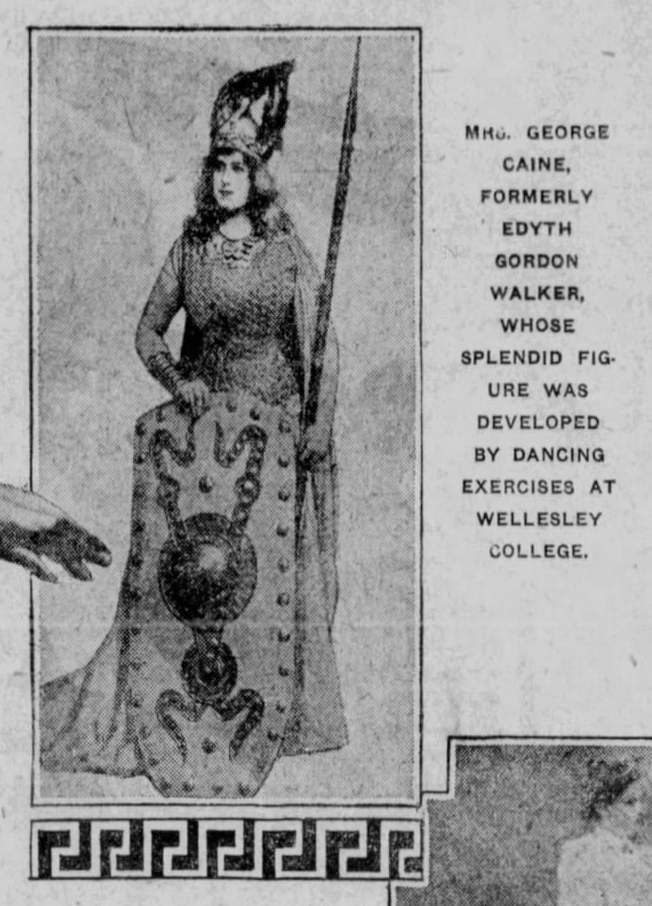
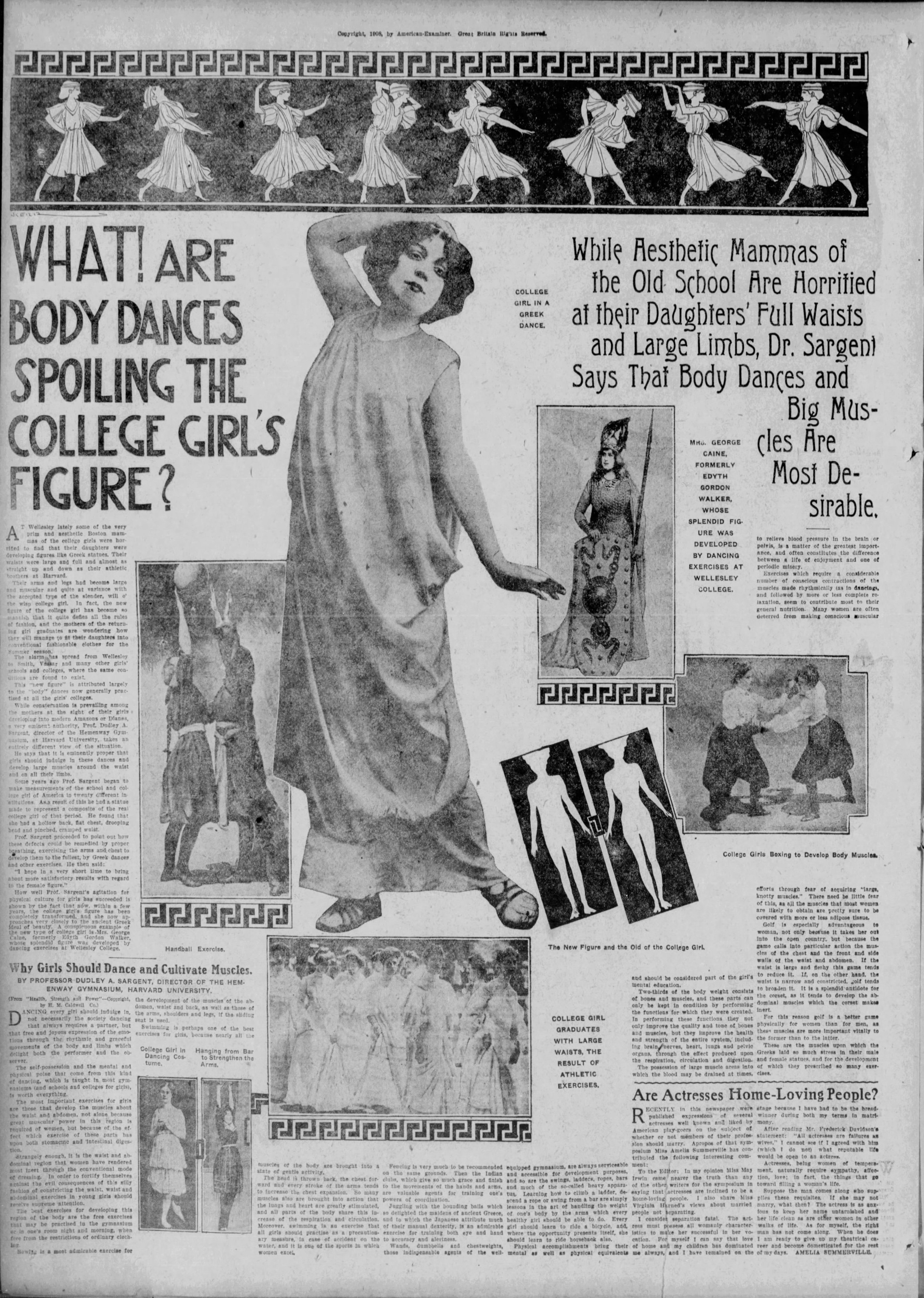
“Mrs. George Caine, formerly Edyth Gordon Walker, whose splendid figure was developed by dancing exercises at Wellesley College.” Reproduced from the American Magazine Section of the San Francisco Examiner, Sunday, June 21, 1908, p. 4.
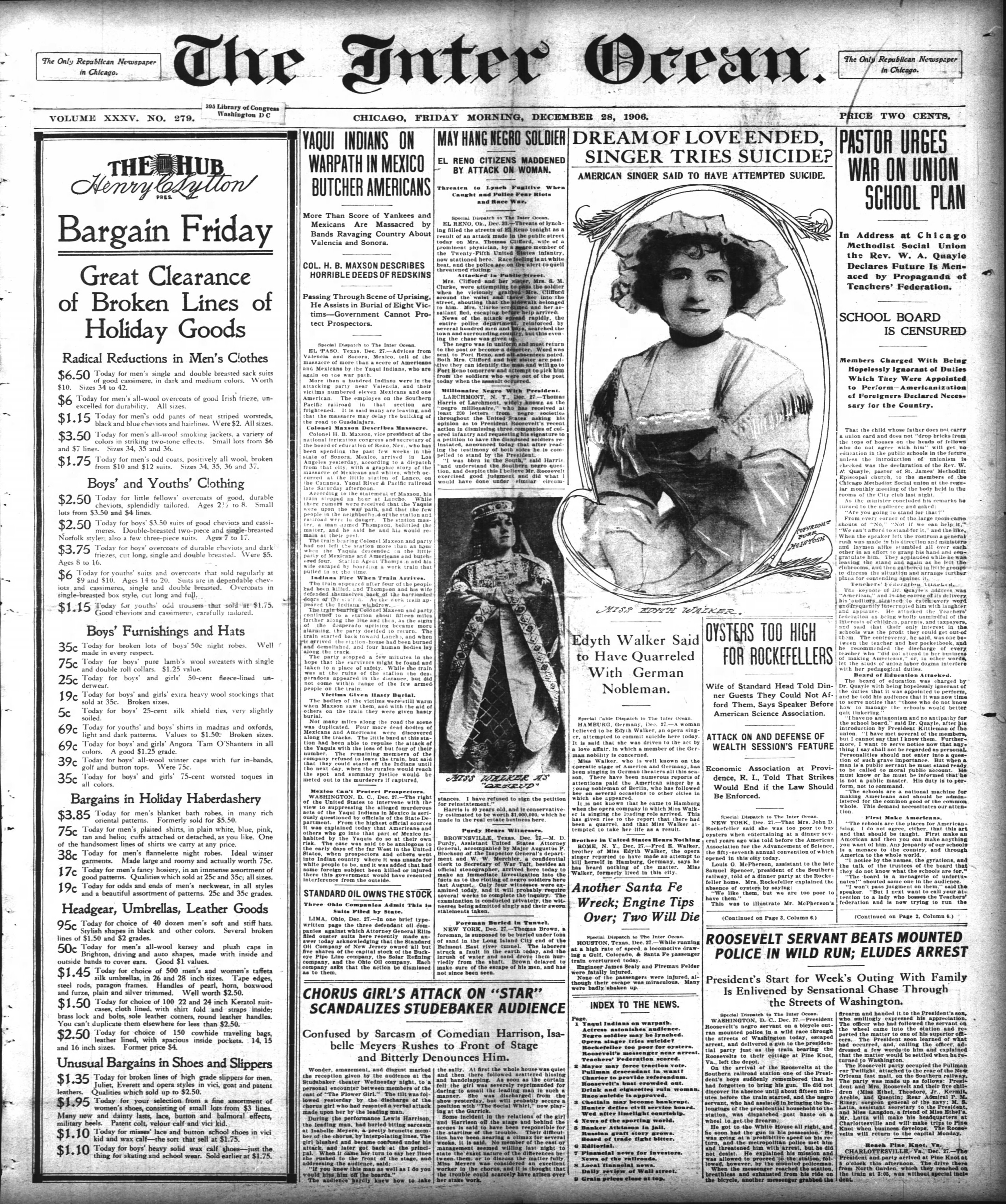
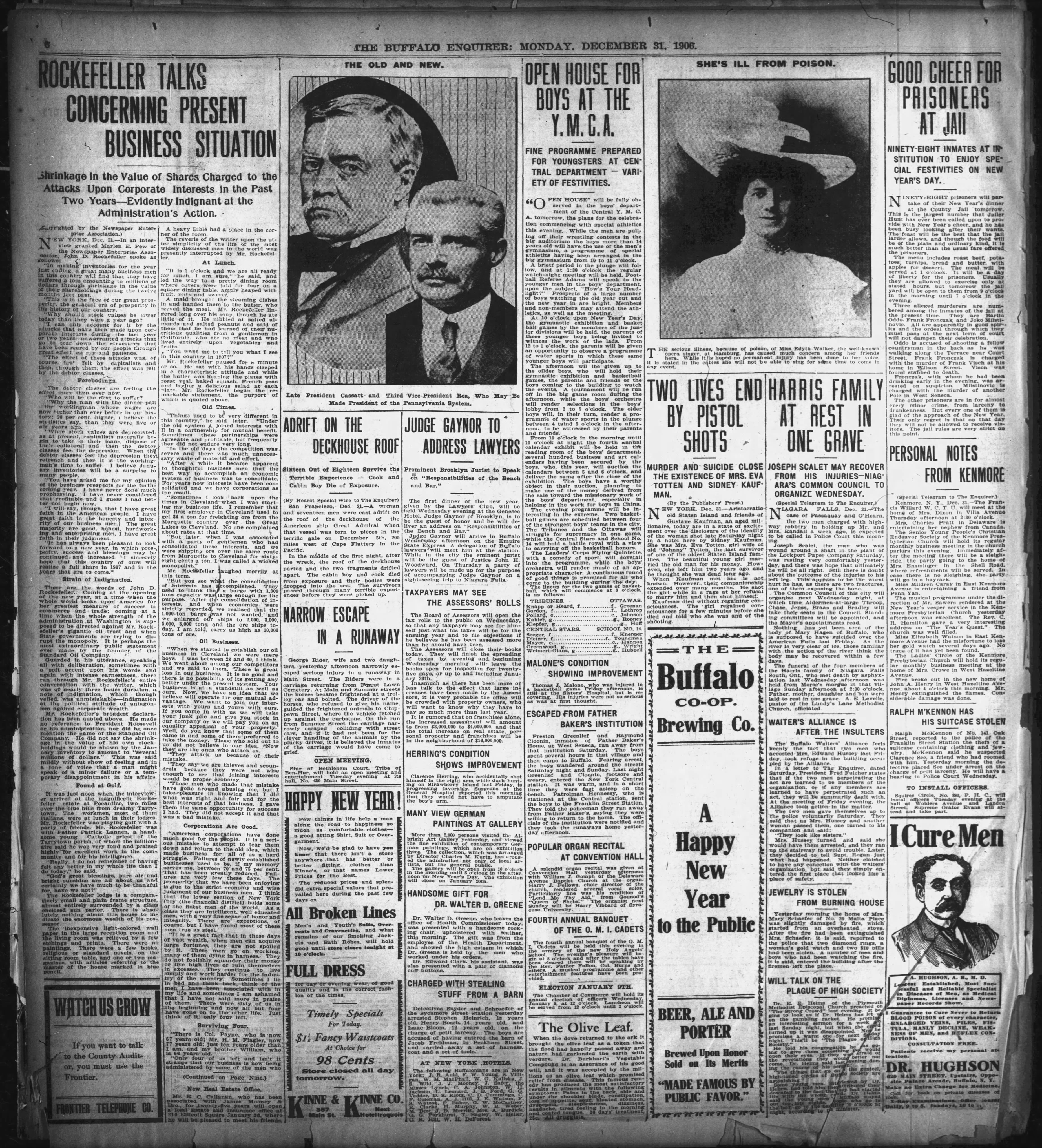
HAMBURG, Germany, Dec. 27. — A woman believed to be Edyth Walker, an opera singer, attempted to commit suicide here today. It is said that she was driven to the act by a love affair, in which a member of the German nobility is concerned.Immediately below the special cable dispatch was a paragraph stating that Walker’s brother “has heard nothing of the matter.” “News” of the singer’s poisoning persisted for a few weeks (at least in Hearst newspapers such as The Buffalo Enquirer). Walker eventually declared herself alive and well, without, however, actually denying any of the previous reports or rumors:Miss Walker, who is well known on the operatic stage of America and Germany, has been singing in German theaters all this season. There have been numerous reports of attentions paid the American singer by a young nobleman of Berlin, who has followed her on several occasions to other cities in which she appeared.
It is not known that he came to Hamburg when the opera company in which Miss Walker is singing the leading role arrived [sic]. This has given rise to the report that there had been a quarrel, and that Miss Walker attempted to take her life as a result (“Dream of Love Ended, Singer Tries Suicide? American Singer Said to Have Attempted Suicide; Edyth Walker Said to Have Quarreled With German Nobleman,” The Inter Ocean, Friday Morning, December 28, 1906, p. 1).
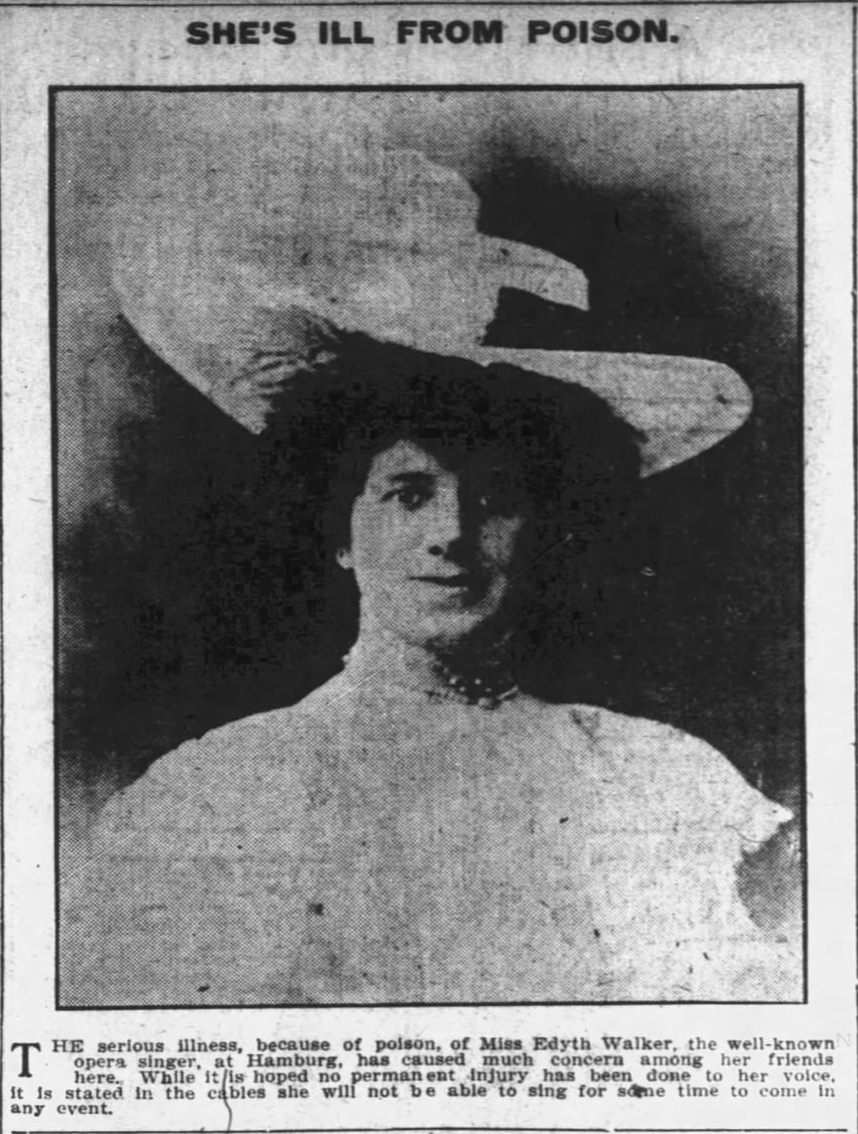
“She’s Ill From Poison. The serious illness, because of poison, of Miss Edyth Walker, the well-known opera singer, at Hamburg, has caused much concern among her friends here. While it is hoped no permanent injury has been done to her voice, it is stated in the cables she will not be able to sing for some time to come in any event.” Reproduced from The Buffalo Enquirer, Monday, December 31, 1906, p. 6.
The following from the New York Herald relating to Miss Edyth Walker the prima donna, formerly of Rome, is of interrest:Whether Edyth Walker was really poisoned, accidentally or intentionally; whether the entire matter was simply rumor and error (“illusion,” as several newspapers put it); or whether it involved some sort of publicity stunt à la Caine’s Boom!, I am unable to determine. In any case, I like to think that the mock-suicide which Blair pays Helen Trimble to play in Caine’s novel humorously recalls the time when Caine’s “Conscience” was confused with her operatic namesake’s alleged suicide attempt, a time when said Conscience was gracing the boards of the Garrick Theatre as Miss Lestrange in William J. Locke’s The Morals of Marcus (see § 10) — a time, however, which the French translator of Boom! plausibly situates some two and a half years earlier:Some little time since, the operatic gossips[,] having attended to pretty nearly everything else, decided it was about time to take up Miss Edyth Walker, who sang with the Conried opera company last season, and arrange her affairs for her. Miss Walker sailed for Germany last May, and in due course rumors of this and that about her and her doings were set going, and to give a fine old melodramatic finish to the story the gossips took her out and then and there killed her in a variety of ways, by a cup of cold poison, by this and by that, and by any old means you like. But whatever the means, the end was declared to have come, and the gossips formally declaring that the said Edyth Walker, Wagnerian prima donna, was lying dead in Germany, guaranteed her to stay dead; and wasn’t it a pity, etc.?
Just where spirit land is situated may have been debatable, but it is settled now beyond doubt. It is located in Hamburg, and whether Hamburg is the heaven of [sic?] “the other place” of spiritland depends on what you may think of that city. Anyhow, here is the letter received yesterday by the Herald from “the late” Edyth Walkr [sic], and dated Hamburg, February 21, 1907:
To the Editor of the Herald: It will certainly be very interesting to the public of America to read a letter from a dead person; therefore I write you from the other side of the shore asking you to give them this pleasure and to tell you how happy I am to have passed away to another land, in which my earthly dreams have found their fulfillment.
While I was living I had only one desire — to attain enough perfection in art that I might be able to interpret the great Wagner roles. Death has been kind and lenient to me, and allowed my dreams to become reality.
Can you wonder that I am full of joy to have expired? Only one thing, or rather circumstance, marred the beauty of this “passing over,” and that was the evident pain and sorrow which it caused my fellow artists! Console them!
With best regards to the land of the living, yours truly, Edyth Walker.
Isn’t Miss Walker rather lively for a “late lamented.?” (“From Miss Edyth Walker; She Writes to Deny Rumor That She Is Dead; Former Rome Young Woman and Noted Singer Still in the Land of the Living — However, She Caries Out Illusion with Tinge of Sarcasm,” The Rome Daily Sentinel, Saturday Evening, March 9, 1907, p. 2).
That is, Joyce’s “Bloom’s Day” is Caine’s “Boom’s Day.” Recall, however that Edith Gordon Walker debarked from the Devonian at Liverpool on Saturday, June 18, 1904 (see § 10). So, if Caine chose to set his “Painful Incident at Walham Rye” (chapters XII and XIII of Boom!) on a certain Thursday afternoon (as mentioned on p. 134; p. 196 of the French translation) in June, 1904, for a reason similar to that which induced Joyce to set Ulysses on a specific Thursday in the same month of the same year — namely, to commemorate his initial encounter with that “one woman” who saved him from the “misery and infamy” of “floundering clueless in the labyrinth of Conveyancing Law” (see § 5 and § 13) — then Caine’s Thursday could not have been the 16th, but may, possibly, have been the 23rd or 30th. Perhaps Caine and his Conscience first met on the afternoon of Thursday, June 23, 1904, at say, Sarah Bernhardt’s performance in La Dame aux Camélias at the Crystal Palace, or at the Royal Albert Hall on the last day of the Grand Nursery Rhyme Bazaar, or at Louise Dale and Hamilton Earle’s vocal recital at St. James Hall, or at the Australian Trio’s afternoon concert at Æolian Hall, or at Magdeleine’s “marvellous interpretation of Musical Themes Under Hynotism” at the Garrick Theatre, or, later in the evening on that same day, at Lucie Johnstone’s concert at Steinway Hall, or, later still, at the “celebrated Spanish Artiste” La Tortajada’s nightly number at the Palace Theatre, or at the “favourite chanteuse parisienne” Anne Dancrey’s “instantaneous success” at the Alhambra the same night… Be that as it may, what is certain is that a week after Edith Gordon Walker arrived in England, the preliminary tour of The Island of Pharos was announced (see § 11), and from his experiences of working with Osborne Roberts on that comic opera “came, very soon, that which is dearest and most helpful to me in all the world” (see § 12), and that Boom! contains descriptions of the relationship between “the future Queen of Musical Comedy” and her fiancé Mr. Edward Armstrong (“a professional boomist” [p. 72] whose work entails, for instance, “racking his brains for a new method of advertising the Rising Star boot-polish” [p. 25]) which may or may not be similar to the early phases of the romance between Caine and his Conscience, descriptions which may or may not be relevant to speculations as to why said Conscience left the stage a few months after her marriage:Une dernière remarque, qui ravira les amateurs de coïncidences. Une légitime curiosité nous a conduits à tenter de dater avec précision l’intrigue de ce roman, et notamment son acmé, le simulacre de suicide d’Helen à Walham Rye.
Reconnaissons que l’auteur nous a grandement facilité la tâche en nous livrant des indices à foison.
L’année d’abord. C’est en 1904 que fut votée la loi sur les Alcools, cette miniprohibition à l’anglaise qui échauffe tous les esprits à l’approche de l’élection à laquelle se présente l’insupportable George Deacon.
Quant au mois, il nous est dit à de nombreuses reprises que nous sommes en juin, et qu’il règne sur Londres une température accablante — ce que nous confirment les archives de la météorologie britannique.
Le jour? Le texte indique simplement que la scène de Walham Rye se déroule un jeudi après-midi.
En l’absence d’autre précision, et mus par notre sens du juste milieu, nous prétendons qu’il s’agit du jeudi 16 juin 1904 (pp. 22–23).
He had no intention of marrying on any money that Nelly might bring with her. But as his magazine work was not regular or profitable enough for a married man, he had just accepted a position with an advertising agent. In a year or two he hoped that his salary would entitle him to marry. He had a little of his own too.[…]
His resolute attitude had filled Helen at first with astonishment, then with admiration. She knew herself to be something of an heiress. Certain "rows of houses" maintained Mr. Tovey [Helen’s father; note also that Walker’s father had been “interested in real estate;” see Boston Globe obituary in § 8] in independence, if not in luxury, and Helen had no need to work for her living. This fact had always made her suspicious of men. She had indeed been suspicious of Armstrong, was not wholly unsuspicious of him when she promised to marry him. His admirable shape, his pleasant voice, his good looks and a something which differentiated him from all other young men that she had known, a something which she could not define because she did not know that it was the result of his drawing for a living instead of adding up columns of figures or retailing wares across a counter — all these things had worked together to stifle her suspicions. […]
She sought and — to her own extreme surprise — obtained a position in the chorus of the then forthcoming production at the Phœbus Theatre. […]
When Helen told Armstrong — rather fearfully — that she was going on the stage, she discovered that it was to make no difference whatever. Her stage earnings, he said, would be her own. He couldn't touch them. They must wait until he could run the house unaided.
[2 clues to Caine and his Conscience:]
[My edition of Boom! with list of titles by authors: all either female writers, some writing under pseudonym, of husband-wife writing pairs]
and, perhaps: "The geniuses came and talked to Gertrude Stein and the wives sat with me." (Stein 1933a: 105) : since both Caine and Walker sat with Stein, she considered them both "geniuses"? - or were dinners different?
"Baby enjoys her partners sexuality and her own sexual feelings and responses, visible in the texts and verses, which always have a babyish and cuddly tone. Baby does not experience orgasms but wants cuddling. For herself and Toklas, Stein coined the term 'Mr. and Mrs. Cuddle-Wuddle,' formulated in code as 'Mr. and Mrs. C.-W.'" (Dydo & Rice 2003: 51). : Mr. and Mrs. Caine, William [!?] * * * * *
[PRISONER IN SPAIN]
Caine and his conscience (who is now specified as being female) dedicated A Prisoner in Spain to his youngest sister Ruth and her husband John Herbert Lewis:

Dear J. H. L. and R. L.,Judged by the cold standard of mathematics, a hundred thousand words is handsome payment for a little foolscap, loosely over-written. But I have a conscience, and we don’t reckon by this method. If, then, we offer you this book, it is only as some tiny return for innumerable kindnesses, among them the gift of the authentic document on which the tale is founded. We don’t think we lessen our debt to you appreciably — that is your fault rather than ours — but I may tell you (in your ears) that, had not conscience stood by me valorously, this little compliment would have been a very questionable one. With her aid, I do think I have made a book for you that is not altogether beneath your acceptance, and, if I am right, how worthy of admiration is this conscience!
Always yours,
WILLIAM CAINE.
December 1909.

Caine relates the genesis of A Prisoner in Spain in the same opening chapter of An Angler at Large where he relates the travails of always traveling with a harp:A WORD FROM HIS “CONSCIENCE.”
This book was written after our first visit to Spain, which was memorable for three things. We met a real live bull-fighter; we stayed with a landlady who liked us so much she refused to accept payment for our three days’ board and lodging; and we discovered in a little side street in Seville a marvellous young dancer (the original of Mercedes), Pastoria Imperia, who afterwards became the idol of Spain. Curiously enough we met her again in Seville two years ago, when we went down there for the wonderful Easter Festivities, and we saw quite a lot of her. We used to meet daily after the solemn afternoon drive in the Park, in a little restaurant where they served delicious ices, and the thick, cinnamon-flavoured chocolate so much liked by Spaniards. One day she gave us a box for a Command Performance for some charitable function, and invited us “behind” afterwards to admire and share some of the lovely pink carnations given her by Her Majesty the Queen of Spain.... Also this book is sacred to me because it is dedicated to a beloved brother and sister-in-law, and it recalls countless happy days we spent together before my husband had to “go away.”
Mrs. William Caine.
March 13th, 1926.
There was Ottley Down on the right. By springing across the fly I was just in time to see the chimneys of Little Ottley House, and, to their left, the White Poplars at the lower end of the water. Here the horse’s head got in my way, and in order to catch my first glimpse of the Little Ottley Chalk Pit, I had to tread once more upon my wife’s feet, only as they were by this time curled up on the seat beside her, I didn’t. In taking my head in from viewing the chalk-pit, so that I might get over to where I could obtain a sight of the Hanging Wood, I knocked my hat off into the mud and the fly had to halt. I recovered my hat, sadly bewrayed, and as I climbed in, “Never mind,” said I to my wife, “I won’t want it for three months, thank Heaven!” With these words I sat down on the Spanish Jug.The cracked Spanish jug forms the kernel of two episodes in A Prisoner in Spain. At the start of Chapter XII, its liquid contents take precedence:This utensil should have been mentioned in my list. But it is too late now. I give it a place to itself.
14. A Spanish Jug.
The history of the Spanish Jug.
In the Spring of this present year my wife told me that I wished to write a novel whose theatre should be Spain. I was very glad to hear this, because I knew how much she desired to visit that country.
After an interval we were in Madrid.
Next day my wife observed a woman carrying a large earthen jug, twin-spouted, of elegant shape. My wife coveted it. After that she saw nothing but women carrying similar jugs.
Presently I began to feel an influence akin to that experienced by the hypnotic subject. I became aware of a consciousness that I desired one of these jugs. I knew that I did not really want a jug of any kind, because I dislike all jugs. But from time to time I found myself saying, in reply to a question, “ Yes, we must certainly take one of those jugs home,” or, “Yes, it would look well upon Victoria” (which is the name of our sideboard), or, “Yes, it would be the very thing to keep water in during the hot days.” After a week of this I found myself bartering coppers against a Spanish Jug, this very one upon which I sat when I got back into the fly. It was, it is, an enormous jug.
“It is fragile,” I said, as I lugged the thing back through Madrid. “And it is too large for the bag. It will only get broken on the journey. Let us give it away to somebody and increase our popularity.”
“I will take it to England,” said my wife, “if I carry it every step of the way.” This emphatic manner of speaking (for we were to travel by train and steamboat) convinced me that what she promised would happen in every particular but one, an important one.
During the journey to London my wife comforted me, whenever I complained of the Spanish Jug’s excessive weight, by drawing word-pictures of Victoria adorned with the Spanish Jug and prophesying about the great draughts of cold water which I should, during the hot days, quaff from the Spanish Jug. She said that she would never have let me burden us with the jug if I had not been so mad about it in Madrid, if I had not persuaded her, with all that about Victoria and the coldness of water kept in such jugs, to let me buy it. So, mindful of my past enthusiasm, I, sweating, carried it through innumerable railway stations and customs-houses into steamboats and omnibuses and cabs and restaurants and railway carriages and buffets. For it was too fragile for a porter’s clumsy hands.
At last I sat upon it, as I have told. But I did not crush it. It was not fragile enough for that.
Suppose I finish with the Spanish Jug now and for ever. Let me advance this narrative about twenty minutes.
While the harp and the harp-case were earning me the undying hatred of the flyman, the driver of the luggage cart, the driver of the milk-float, and the gardener at our cottage, I, passing through the dining-room, a prey to agitated thoughts, discovered my wife in the act of filling the Spanish Jug with water from a glass vessel of common shape.
“There!” she said, standing back and surveying it fondly, “now wasn’t it worth a little trouble? It will always stand here” — and she set it on a shelf — “filled, so that you will have sweet, cold water to drink whenever you want it. And there is a glass to stand beside it.” With these words she hurried off to her bedroom to unpack the American trunk.
Ten minutes later, having done my best to allay the detestation of four fellow-creatures, I returned to the dining-room. I was hot and tired. For it was not only by money that I had curried favour with those men. I had helped with the harp-case. I was, I say, hot and tired.
My eye fell upon the Spanish Jug and its attendant glass.
The words “sweet, cold water” recurred to me.
I possessed myself of the Spanish Jug.
I tilted it above its glass.
Nothing happened. I said: “The nozzle is blocked up.”
I blew into the nozzle.
A sound resembling the hollow roar of the wind in a sea-cave resulted.
Then I perceived that my hands were wet.
Then I discovered that I was standing in a large pool of water.
Then I knew that the Spanish Jug leaked.
And a great cry broke from me in my agony.
My wife appeared, pallid. “Your jug leaks,” I said.
“Tut!” said she, “so it does. What a mess! Well,” she rang the bell for sponges and cloths, “it will still look nice on Victoria. And after all that was really what made you buy it” (pp. 6–10).
In chapter XIV, Hilario uses it as a metaphor to characterize his own impotence:
And Caine's paean to his wife's harp playing in chapter ten of An Angler at Large (which I reproduced in § 5) recurs, reworked, in chapter XV of A Prisoner in Spain:
[REVOLT AT ROSKELLYS]
While dedicating the third novel in the Quartet, The Revolt at Roskelly’s, to his mother, Caine emphasizes the help and approval he has received from his female conscience:

Dearest Mother. —
I can never hope to overtake my debts to you, but at last I have an opportunity of acknowledging them before the World. You would have had a book long ago had I ever succeeded in producing one that was at all what you would care to accept. Whether this story reaches that standard is for you to judge, but in offering it I have the approval of my Conscience who declares it to be, at least, honestly wrought. And since, as always, I have had her help (without which I doubt there would have been no book to offer to you) I do not altogether despair of your being pleased. And if you and she enjoy my work, here is Success come to me with both hands full.
Always,
Wm.
London, 1910.
[DEVIL IN SOLUTION]
Newton 1907: 91: Proposal in 1881 Parliament to replace rum with cocoa in Navy; "Spirit Rations in the Royal Navy" The Times, Mon, Aug 15, 1881 ·Page 7; the proposal was rejected ("negatived")
To the fourth and last member of the Quartet, The Devil in Solution, Caine appended, not a dedication to, or in cahoots with, his conscience, but rather

A LETTER OF INTRODUCTION
My Dear N. M.
This letter will be presented by a child of mine whom you knew as quite a little fellow. Remembering that his artless petticoat-gambols seemed to please you, I venture to present him once more to your notice in the hope that though his costume has become fully matured into print and boards, his society will prove no less to your taste than it did. At the outset of a young fellow’s career a friendly welcome means a great deal, a little encouragement at that period being worth enormous quantities of posthumous praise. Make room, for him, then, by your fireside; give him a place in your home, and if possible in your heart; introduce him to such houses as you think will treat him kindly; foster his short struggle with the world, unimportant though it be to any one but himself and his parents. For we can do no more for him. And if you are pleased with him, let him succumb and perish in obscurity — we shall know that it is through no fault of ours in choosing his godfather; but if he should achieve fame — how very greatly will our pleasure be increased by the knowledge that you have had a hand in the pie.
Let me add that his mother has of late given him a thorough overhauling with a view to his encounter with your and others’ critical eyes, and this fact encourages me to hope that you will not find him wholly intolerable. I fear he is an impertinent dog, at the best of it, yet I know that he tries not to be ill-natured. But it little becomes a parent to write characters for his offspring.
To conclude, then —
(1) Because we love you,
(2) Because you once loved the presenter of this letter, and
(3) Because you woke the dog up,
The Devil in Solution is now offered to you by,
Always yours,
William Caine.
[One more allusion to Edyth Walker in The Devil in Solution, p. 60.]
The Athletic Parliament:
Article in the monthly magazine, The Cosmopolitan vol. 37, no. 2, June 1904, pp. 241-241, by Frederic Williams, entitled "An Athletic Statesman," about Sir Charles Dilke; with photo of him rowing with his son. [i.e., same month as Edith Gordon Walker sailed from Boston to Liverpool] [The Cosmopolitan, with John Brisben Walker, owner and editor (no relation to EGW, I assume), would be bought by Hearst in May 1905; see, e.g.,: The New York Times May 3, 1905, p. 11; New-York Tribune Wed, May 03, 1905 ·Page 3; The Brooklyn Daily Eagle July 3, 1905, picture section, p. 3]
-
A piece on the man who was “reaching the front line of English humorists”. — The brief biographical item published in The Brooklyn Citizen was later repeated in full in an ostensible “review” of The Revolt at Roskelly’s in The Pacific Unitarian (San Francisco), vol. 19, no. 10, August 1911, p. 316.
Earlier, The San Antonio Light, Sunday, July 9, 1911, p. 8, under “Books and Magazines,” printed the first two sentences of the piece in question.
Taking the middle ground, the New York Sun, Friday, July 14, 1911, p. 7, published, under “Authors and Their Work,” a two-paragraph variant:
William Caine, author of “The Revolt at Roskellys” [sic], just published by the Putnams, was born in Liverpool thirty-eight years ago, is a son of the late William Sproston Caine, a well known English politician, and is descended through his mother from Tom Brown, the Manx poet. After graduating from Balliol College, Oxford, Mr. Caine worked at the law for seven years before taking up literature. He has written musical comedy for the stage but gave it up, saying: “I seek peace rather than fortune.”
Another variant appeared in “Among Books and Their Authors; Literary Notes,” The Christian Science Monitor, Monday, August, 7, 1911, p. 7:Fishing for trout is a favorite pastime and he has contributed articles on the subject under the name of “W. Quilliam,” to the Field. He has a book on angling to appear in the autumn. Mr. Caine married Miss Edith Gordon Walker, daughter of F. B. Walker of Boston, and he attributes a great deal of his success to the influence of Mrs. Caine.
American women are coming to be prominent as wives of successful British authors as well as of well-known political leaders and representatives of the nobility. William Caine, who by the way is a grandson [sic] of the delightful Manx poet and letter writer, T. E. Brown, has an American wife, Miss Edith Gordon Walker of Boston, to whom he credits much of his success as the author of “The Confectioners,” “A Prisoner in Spain” and “The Revolt at Roskelly’s.”
-
As their fathers knew Charles Dickens. — “Holiday Reading; Variety and Excellence,” The Sheffield Daily Independent, Monday, 19 July, 1926, p. 7. Below is a selection of announcements from three other newspapers of the reprinted Quartet:
Novelists much less able and interesting than William Caine have been given the distinction of a cheap uniform edition, and Messrs Stanley Paul and Co. are to be congratulated upon doing justice to this writer. They now send out four of Mr Caine’s novels at half-a-crown apiece, and readers as yet unacquainted with these ought to get one or all of them. They are “Boom,” “The Devil in Solution,” “The Revolt at Roskelly’s” and “A Prisoner in Spain.” Mr Caine, who was, by the way, a student at St. Andrews, is a buoyant writer who tells a jolly and vivid story. He has a whimsical touch and is really funny, all in a way that makes his reader friendly to him. His novels are very refreshing, and their tonic properties master the dullest mood. Nothing could better help a convalescent than the reading of, say, “The Revolt at Roskelly’s” (“Books and Their Writers; The Novels of William Caine,” The Courier and Advertiser [Dundee], Friday, July 30, 1926, p. 8).
Many readers will be glad to hear that Messrs. Stanley Paul are issuing at a popular price four humorous novels, including “Boom” and “A Prisoner in Spain” by the artist-author, William Caine, who died last year. Mrs. William Caine has written a brief introduction to each volume, and two have binding designs by Mr. H. M. Bateman. The same publishers have also in preparation a collection of Caine’s drawings and humorous articles to be called “Smoke Rings.” All who went to the recent exhibition of Caine’s work at the Leicester Galleries will wish to have the book on their shelves (“Literature and the Arts; In the Library; Notes on Books & Writers,” The Northern Whig and Belfast Post, Saturday, July 3, 1926, p. 10).
True humorists are rare, and therefore we welcome with the keenest pleasure the laughter-rousing books of William Caine which Messrs Stanley Paul are issuing in a half-crown edition. Caine has a wildly fantastic humour all his own, and for a pretty wit, a pungent individuality of style, and a provocative plot, we can heartily recommend any of his books. The quartet now published are “Boom,” perhaps his best story, “A Prisoner in Spain,” “The Revolt at Roskelly’s,” and “The Devil in Solution” (“Current Literature; Holiday Reprints,” Aberdeen Press and Journal, Friday, July 16, 1926, p. 2).
- Omits the mock portentous note. — Similarly, the recent French translation of Boom! (Aux Feuillantines, 2025) not only omits Caine’s note “Concerning the Exterior,” but also his original dedication “To My Conscience” as well as his widow’s “Word from His ‘Conscience.’” Furthermore, the French translator mistakenly states (on pp. 20 and 23) that Boom! was originally published in 1907. The back fold of the wrapper promulgates another error. Here, the publisher provides a brief biography of Caine which closes with the sentence, “À l’occasion du centenaire de sa mort, nous publions Boom!, son premier roman.” While Boom! was indeed the first of Caine’s “Conscience Quartet,” far from being “son premier roman,” it was (if Pilkington be deemed a novel rather than a series of short stories) his fifth.
- His most famous novel. — “Books of the Week; Books in Brief,” Birmingham Gazette, Thursday, 15 July, 1926, p. 3: — “The late Mr. William Caine was one of the cleverest of humorous writers. Those who only know him by his most famous novel, “Boom,” will be glad to learn that both it and his three later books, “The Prisoner in Spain” [sic], “The Devil in Solution” and “The Revolt at Roskelly’s,” are now re-printed in an excellent popular edition (Stanley Paul, 2s. 6d.). Mrs. William Caine, who describes herself as her husband’s “conscience,” contributes a short note to each, telling of how it was written.”
- According to the New York Sun. — “Opera Notes from Europe,” The Sun, Sunday, December 30, 1906, third section, p. 5.
- Article about college girls cultivating their muscles. — “What! Are Body Dances Spoiling the College Girl’s Figure?” American Magazine Section of the San Francisco Examiner, Sunday, June 21, 1908, p. 4.
- Edyth Walker. — “Berlin Budget Branch,” The Musical Courier, Wednesday, December 5, 1894, pp. 9–10. See also: [https://www.encyclopedia.com/women/encyclopedias-almanacs-transcripts-and-maps/walker-edyth-1867-1950] and [https://en.wikipedia.org/wiki/Edyth_Walker].
- French translator. — Hervé Lavergne, in his “Préface; L’Angleterre édouardienne,” also erroneously states twice (pp. 20 and 23) that the novel in question was published in 1907. Furthermore, neither Caine’s dedication “To My Conscience,” nor his note “Concerning the Exterior,” nor his widow’s note to the 1926 edition, are anywhere to be found in the “traduit et adapté” version of 2025, nor are they even mentioned by the translator.
- Sarah Bernhardt’s performance […] Anne Dancrey’s “instantaneous success”. — The Daily Telegraph, Thursday, June 23, 1904, p. 1.