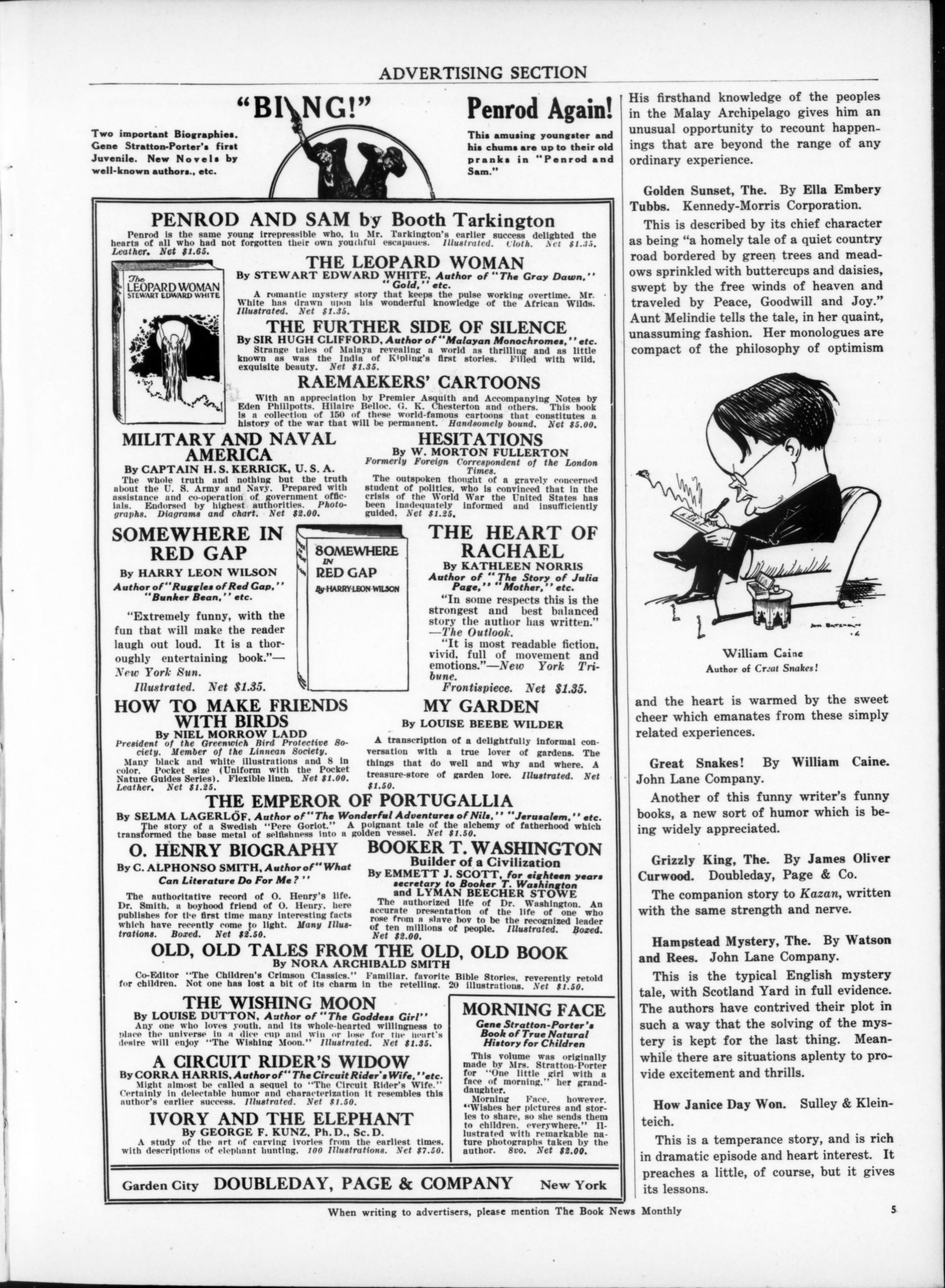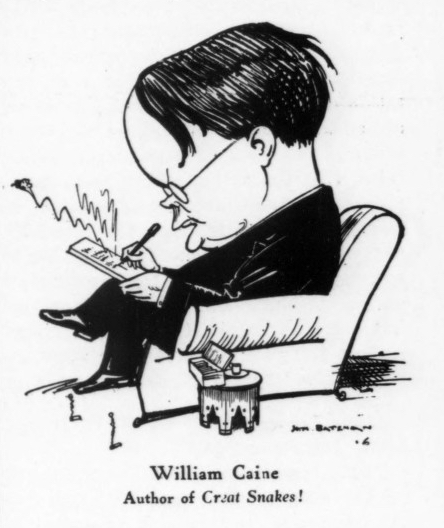
“William Caine, Author of Great Snakes!” Illustration by H. M. Bateman, 1916. Reproduced from The Book News Monthly (Philadelphia), November 1916, Advertising Section, p. 5.
There is a book called “Great Snakes,” by Mr. William Caine. In it fantasy and invention and coincidence and whimsical humour achieve results which are unique in the region of mad laughter. I would have Mr. Rendall read “Great Snakes,” and consider whether this be not the world for the exploration of his pen (“Books of the Week; ‘The London Nights of Belsize,’” The Evening News, Saturday, June 2, 1917, p. 2).Machen highlights Rendall’s opening sentence — “The large house in St. Luke’s Wood was as silent as a peak in Darien or the Member for Battersea” (Rendall 1917: 1) — as “promising.” To me, Rendall’s sentence is not at all a bringing into “close and delightful relation,” as Machen puts it, of two disparate evocations of silence, but rather a bombastic exercise in inexactitude; a pretentious double solecism. For in Keats’s poem, it is not the peak in Darien that is silent, it is Cortez and his men standing there and staring at the Pacific who are. And John Burns, “the Member for Battersea,” seems to have been, from the references I’ve found, rather loud in the various causes he advocated or opposed — unless it is to his resignation from Parliament two days before Britain declared war on Germany in 1914 to which Rendall refers. Reading — rather, trying and failing to read — Rendall, I’m reminded of the letter Sebastian Knight wrote to his editor in chapter 6 of Nabokov’s novel. There, Knight justified his having included, in his first book, The Prismatic Bezel, “an extremely comic and cruel skit upon a certain living author,” observing that “the dark secret of his success […] is to travel second-class with a third-class ticket, — or if my simile is not sufficiently clear, — to pamper the taste of the worst category of the reading public — not those who revel in detective yarns, bless their pure souls — but those who buy the worst banalities because they have been shaken up in a modern way with a dash of Freud or ‘stream of consciousness’ or whatnot” (Nabokov 1941, 1968: 54–55; Nabokov 1996a: 41–42). Ironically, The London Nights of Belsize is intended to be a detective yarn, or series of detective yarns; unfortunately, its particular pampering whatnot — turgid theosophical priggishness; a striving for multiplicity that ends up being nothing more than a humdrum mixing of pretentious metaphors — makes it very rough going. In any case, it seems, perhaps, that Machen’s injunction to Rendall was, as far as I can understand it: Be content, like Caine, to travel third-class. Or, using the words with which a later writer characterized Sebastian Knight’s first novel, choose parody over the sham:
J. L. Coleman has called it “a clown developing wings, an angel mimicking a tumbler pigeon,” and the metaphor seems to me very apt. Based cunningly on a parody of certain tricks of the literary trade, The Prismatic Bezel soars skyward. With something akin to fanatical hate Sebastian Knight was ever hunting out the things which had once been fresh and bright but which were now worn to a thread, dead things among living ones; dead things shamming life, painted and repainted, continuing to be accepted by lazy minds serenely unaware of the fraud. The decayed idea might be in itself quite innocent and it may be argued that there is not much sin in continually exploiting this or that thoroughly worn subject or style if it still pleases and amuses. But for Sebastian Knight, the merest trifle, as, say, the adopted method of a detective story, became a bloated and malodorous corpse. He did not mind in the least “penny dreadfuls” because he wasn’t concerned with ordinary morals; what annoyed him invariably was the second rate, not the third or nth-rate, because here, at the readable stage, the shamming began, and this was, in an artistic sense, immoral (Nabokov 1941, 1968: 91–92; Nabokov 1996a: 70).In the particular cunningly parodic penny dreadful of Caine’s under consideration here, Great Snakes! (which Machen had reviewed upon its publication the year before, calling it “a book for the war weary”), Wilberforce Wildbore, hurrying to catch the 10.2 from Waterloo Station to Berwick Charity,
vanished at his best pace up the slope which leads to the Main Line departure platform. His energy was rewarded. The train was just beginning to move. Mr. Wildbore hurled himself at a first-class compartment into which, regardless of the menacing shouts of three ticket-inspectors and five porters, he succeeded in penetrating. There was but one other occupant of the carriage, a gentleman in tweeds, who smoked a cigar and conned the pages of Bradshaw with the greatest apparent interest.Alas, Wildbore has mistaken, not his class, but his train. And hurled himself inadvertently into a smoking compartment to boot. He is on the ten o'clock express to Plymouth, and will have to endure two hours and twenty minutes in the cigar-smoke-filled car until he can change cars at the first stop, Salisbury. However:I may observe here that though Mr. Wildbore used omnibuses, he was in his right class in the train. A gentleman of easy fortune, he saw no reason to deny himself the comfort of first-class travelling, though his timidities rendered him averse from making use of motor-cabs and tube railways (GS-L: 30–31; GS-NY: 25–26).
After miraculously reciting from memory all the potential routes possible from Salisbury to Berwick Charity as well as the various exchange-towns with their sights (cathedral, abbey) in between, the gentleman in tweeds concludes that it is not possible to reach Berwick Charity before 5.31. Unless:“Well,” said Mr. Wildbore, “it is very important for me to be at Berwick Charity as early as possible. I’m afraid it will be a very awkward journey from Salisbury. May I borrow your guide?”
The face of the gentleman in tweeds lighted up with pleasure.
“My dear sir,” he said, “why should you trouble, when I can give you all the information you want? Let me see,” he went on, laying the Bradshaw on the seat that the miracle which he was about to perform might lose nothing in force (GS-L: 34–35; GS-NY: 29–30).
His problem apparently solved, Wildbore proceeds to sort through the papers he had stuffed pellmell into a yellow leather kitbag which he’d bought precipitously just before he rushed for the wrong train. Mr. Tremayne, dealer in portmanteaux, had seen him desperately descend from an omnibus in the wake of a bundle of documents that fell from the door and burst open on hitting the pavement, and as Wildbore was hectically chasing and gathering the disordered pages, Tremayne approached, assured of a sale. Now, in the train, Wildbore is trying to put some sort of order to the papers, a collection of “Addresses made during a Tour in India” by his wife, the well-known temperance advocate Clarinda Wildbore. Wildbore discovers that the particular address his wife wants for her speech at Berwick Abbas this evening at 7 — alcohol as “Deadly Poison” — and which she specifically asked him to bring down from London, must have been lost when he spilled the bundle. He groans and reproaches himself for having doubted his wife’s memory and untying her knot to verify that “Deadly Poison” was indeed in the bundle and retying the string with a faulty knot which ultimately slipped and caused the bundle to fall apart…“I have it,” said the gentleman in tweeds. “I absolutely have it. Are you anything of a walker?”
“I am good,” said Mr. Wildbore, “for several miles. Say three.”
“Then,” said the other, “do this. Take the 12.27 reaching Fordingbridge at one precisely. Get out there and walk to your destination across the Forest. How does that strike you?”
“Is it very far?” asked Mr. Wildbore, thinking of his burden and his elastic-sided boots.
“Great Beeches from Fordingbridge? Oh dear, no. A mile or two. Forty-five minutes walk at the outside. You will reach home by two o’clock at the latest.”
“That’s a fine suggestion,” said Mr. Wildbore gratefully. “I’ll do that” (GS-L: 36–37; GS-NY: 31–32).
He went on muttering to himself, for the gentleman in tweeds had lost interest in his troubles and was now bringing himself up to date in the matter of an obscure light-railway in Kinross-shire (GS-L: 39; GS-NY: 34).I am reminded of the bushy-eyebrowed little bald man wearing a bowler hat, Mr. Silbermann, who intrudes himself into the train compartment and solitary musings of the narrator in chapter 13 of The Real Life of Sebastian, and who turns out to be a former plainclothes policeman, able to help the narrator track down the names of four possible candidates for the woman with whom Sebastian Knight had had an affair at a hotel in Blauberg:
Then the extraordinary little man sank back in his seat, folded his arms and closed his eyes, as if clinched business had somehow put a full stop to our conversation. A fly inspected his bald brow, but he did not move. He dozed until Strasbourg. There we parted (Nabokov 1941, 1968: 130; Nabokov 1996a: 101).In Caine as in Nabokov, each node in the network of coincidence is not simply a moment of chance used by the author for the purposes of plot and comedy — Wildbore’s catching the wrong train; Silbermann’s intrusion — but is also a moment of exploitation. Mr. Tremayne exploits Wildbore’s predicament by selling him a kitbag, a moment which for Wildbore is one, not of exploitation, but of providence — Mr. Silbermann, who “seems to fit in a tradition of detectives who have a gift of producing the most unexpected information on whatever subject at the very moment that it is required” as de Vries (2016: 141; see also my § 1) put it, providentially provides the narrator with a solution to his dilemma; the gentleman in tweeds exploits Wildbore’s catching the wrong train by showing off his knowledge of the train schedules (Silbermann recounts his travels, his polyglottery, his exploits on the soccer field…) and giving helpful directions which, much to Wildbore’s eventual discomfort, turn out to be erroneous:
No doubt the gentleman in tweeds was incapable of error where the departure, arrival and connection of railway trains were concerned. But the disadvantage of his peculiar class of knowledge is this. In acquiring it, a man is apt to become impressed with the belief that the Earth consists solely of portions of permanent way, more or less intelligently joined together. He learns to ignore completely those considerable stretches of country across which no line is laid. His ideas of time, too, are distorted. He knows to a tick how long it takes him to get from one station to another in the train, and in his imaginary journeys he seldom travels at less than twenty-five miles an hour. He becomes, then, an untrustworthy guide to distances and times on the high road. In half an hour, for instance, he is accustomed to cover anything from ten to thirty miles. And if you ask him how long it will take you to walk between two lines of railway which he knows to be ten miles apart, he will, making every allowance for the pedestrian’s slow rate of progress, answer readily enough, “Oh, about twenty minutes.”In chapter 7 of Nabokov’s novel, the narrator quotes extensively from Sebastian Knight’s “most autobiographical work,” Lost Property:It is only fair to the gentleman in tweeds to remind the reader that his estimate of three-quarters of an hour for crossing the New Forest on foot was, for one of his kind, liberal in the extreme. But it was not nearly liberal enough, as Mr. Wildbore found. The old gentleman knew little or nothing of the Forest. He had driven in it and walked in it and had a well-founded idea that it was a considerable place. But he had no knowledge of its railway system (the worst, thank Heaven! in England), and when he set out from Fordingbridge Station he would have been surprised — so great was his faith in the gentleman in tweeds — to learn that he had a walk of some eleven miles before him. But as he did not ask, he was spared this distressing knowledge, and he footed it resolutely along what he understood to be the road for Berwick Charity, rejoicing in the beauty of the country and almost congratulating himself on the fortunate mischance which had enabled him to see it. Already he began to think himself near his destination. He had met nobody for an hour, and when at last he saw the figure of a man coming towards him he took the opportunity of assuring himself that he was on the right path.
“My man,” he said, “can you tell me how far it is to Berwick Charity Station?”
The forester halted and regarded this old gentleman who, with a yellow kit-bag in his hand and garbed in the conventional silk hat and frock coat of civilization, dared these solitudes. He scratched his head and reflected.
“Close by, eh?” asked Mr. Wildbore.
“That ’pen’s,” said the other slowly, “on what ’ee call close.”
“Say a mile,” said Mr. Wildbore, putting it, as he thought, at the highest possible figure.
“Say thirdeen,” replied the man, and, caught by a faint flavour of repartee in his words, grinned doubtfully. “Ah!” he said, “batter say thirdeen.” This time he felt sure that he had come out with a good thing, and throwing caution to the winds, laughed twice hoarsely.
“Thirteen?” cried Mr. Wildbore aghast. “You must be mistaken.” It was impossible for him to abandon his belief in the gentleman in tweeds without a struggle.
“Thirdeen it be,” said the man rudely. “The path ’ee’s travellin’,” he added with obvious pleasure, “it be nigher twanty.”
“Then,” said Mr. Wildbore, his wits sharpened by adversity, “I’m on the wrong road?”
“Ah!” said the other, and would have passed on.
Mr. Wildbore’s heart sank into his thin elastic-sided boots, which were already causing him some discomfort. But thirteen or thirty, he was in for it. Clarinda was waiting for her speech.
“Is there anywhere near, where I could get a conveyance?” he asked.
“A wot?” asked the man.
“A trap, a carriage, something to drive me.”
“Naw,” said the fellow, “there b’ain’t.”
“Then,” said Mr. Wildbore, his reasoning growing clearer every second, “I must walk.”
“Ah!” said the other. “Say thirdeen mile.”
“Which is the way?” asked Mr. Wildbore.
“Do ’ee see thate air clump, then, on thicky hill, then?” said the man. “Make for un, and ’ee’ll find a brook a bit way south’ard of he. Foller he till ’ee come by a big ’ornbeam. Parss he on yer right, an’ do ’ee take a gorzey ride, then, till ’ee come to a ’oller. Cross he and through a beachey corpse till ’ee do find a farm, an’ I rackon ’ee’d best ax thay-er. But if ’ee misses farm, keep sun on yer right cheek an’ ’ee cahn’t stray terrible fur. Say thirdeen,” he repeated inconsequently and, with another hideous guffaw, proceeded on his way (GS-L: 55–59; GS-NY: 47–51).
“… Knowing, as I did, the dangerous vagrancies of my consciousness I was afraid of meeting people, of hurting their feelings or making myself ridiculous in their eyes. But this same quality or defect which tormented me so, when confronted with what is called the practical side of life (though, between you and me, bookkeeping or bookselling looks singularly unreal in the starlight), became an instrument of exquisite pleasure whenever I yielded to my loneliness. I was deeply in love with the country which was my home (as far as my nature could afford the notion of home); I had my Kipling moods and my Rupert Brooke moods, and my Housman moods. The blind man’s dog near Harrods or a pavement-artist’s coloured chalks; brown leaves in a New Forest ride or a tin bath hanging outside on the black brick wall of a slum; a picture in Punch or a purple passage in Hamlet, all went to form a definite harmony, where, I, too, had the shadow of a place. My memory of the London of my youth is the memory of endless vague wanderings, of a sun-dazzled window suddenly piercing the blue morning mist or of beautiful black wires with suspended raindrops running along them. I seem to pass with intangible steps across ghostly lawns and through dancing-halls full of the whine of Hawaiian music and down dear drab little streets with pretty names, until I come to a certain warm hollow where something very like the selfest of my own self sits huddled up in the darkness” (Nabokov 1941, 1968: 68–69; Nabokov 1996a: 52–53).Three years before Great Snakes! was published, Caine had published The New Foresters, an account of his and wife’s rides in a donkey cart through the New Forest (see § 1 and § 7). Several years before that, Caine had published a few pieces in Punch, or the London Charivari (see Bibliography II). The editorial offices of several newspapers, including Punch, were located in Bouverie Street, London — a locale and association which probably every British reader of Great Snakes! would have called to mind when reading the visibly evocative and exact description of coming to from une grande beuverie with which the novel opens:
Mr. Bouverie woke, unrefreshed, and gazed vacantly about the room, blinking. For a few moments it occurred to him that he was still dreaming, for his eyes lit on none of those objects with which, on their first opening for the day, they were familiar. To begin with, this was not his bedroom. It was not, indeed, anybody’s bedroom. It was a sitting-room. The seven dozen of assorted photographs, calling cards, and invitations which fringed the mirror, the cottage piano, the solid round table in the middle of the floor, the microscope on the roll-top desk, the stuffed trout on one side of the fireplace and the case of missel thrushes on the other, the butterfly-cabinet on the what-not, the syphon and decanter on the sideboard….In addition to the locale of the offices of Punch and the French word for a bender, the name Bouverie also reminds me of one half of the titular pair who meet par hasard on a bench in Boulevard Bourdon in the novel by Flaubert which Caine included among the ten books of his desert island library (see § 1) — Bouvard. The analogue of Pécuchet is the owner of the sitting-room in which Bouverie (first name Ernest) awoke, Rudolph Leyborne, MD. Leyborne — not a total stranger, but rather a friend of a friend — had chanced upon Bouverie nearby in Kennington Lane a few hours earlier, just as the cab driver, given a wrong address by Bouverie’s drinking buddies, was about to dump the inebriate on the sidewalk. Leyborne now, on entering and finding Bouverie awake, bids him bathe, shave, put on some of his own clothes, and have some breakfast. Bouverie recounts as much as he can recall of his beuverie, then:Mr. Bouverie rose unsteadily to his feet. He suffered from a sensation of extreme nausea; his temples felt as if a piece of cord had been applied to them with a tourniquet; and the inside of his mouth was a thing of terror. No. There could be no doubt that he was awake. He found his way among the furniture to a long drink. Then he stared owlishly at the clock on the mantelpiece and noted that the hour was nearly eight — presumably, from the sun which streamed into the room, in the morning. He looked at his watch. It had stopped at three minutes past four.
“I wonder,” he muttered, “how I got here. Oh, what a night it mussa been!”
His glance flickered back to the clock, travelled a little higher and encountered that of a gentleman in full evening dress who wore on his head, jauntily enough, a lady’s hat, with nodding purple ostrich plumes, which had been secured by a red and yellow silk handkerchief knotted under the chin. From the middle of this inharmonious blaze of colour his own chalky face started out at him.
“It’s me,” he whispered. “OH, what a night it —” (GS-L: 11–12; GS-NY: 9–10).
His voice broke with emotion. “You’ve behaved like a real gentleman, Leyborne,” he went on. “You’ve fed me and clothed me and taken me in. You couldn’t have done more for me, if I’d owed you a thousand quid. Well, I’ll be toddling now.”Leyborne claims that Bouverie’s case demands more drastic action than simply going to, say, Brighton, and so prescribes that heHe rose from the table and reached an unsteady hand towards his host.
“Sit down,” said Leyborne, “I want to talk to you. Has it ever occurred to you where you’re going?”
“Oh,” said Bouverie cheerfully, “I shall find somebody knockin’ about.”
“I don’t mean where you’re going now, my gay Bohemian boy. But ultimately. If you don’t know, I’ll tell you. You’re going to the devil.”
“Not a bit of it. Only having my fling, Leyborne. You wouldn’t deny me my fling. Every man’s entitled to his fling.”
“You’ve been flinging to my certain knowledge for the last year and a half. Ring off, Bouverie, or you’ll begin to see things. I give you my word, as a medical man.”
Bouverie paled.
“I say, old man, it’s not so bad as that, is it? You don’t think I’ve been goin’ too strong, eh? No, you’re chaffin’. There’s no fear of that for me. I have myself well in hand. Haven’t I?” he added rather pitifully.
“I wouldn’t go so far,” said Leyborne, “as to threaten you with a drunkard’s grave within the year, but, as a medical man, I should earnestly advise you to give it a breeze for a time. You want rest and change of air, my boy. You go away to some nice, quiet country place for a week or two” (GS-L: 18–20; GS-NY: 16–18).
“Pack a bag and jump into a train at Waterloo for Berwick Charity. Take a fly and drive to Mulberry Farm in the middle of Great Beeches. Give Mrs. Ticbborne my name and tell her you’ve come for a fortnight. Great friend of mine, Mrs. Tichborne. I heard from her only this morning saying the Forest’s looking its best, and when did I expect to be coming to see it this summer? She has three people staying with her, she says, but it’s a large house. She can put up eight easily. You’ll find room all right. So down you go this morning, and for a fortnight live on cream and fresh eggs and chickens and home-cured ham; walk abroad in the Forest; and you’ll wonder how you could ever live in London” (GS-L: 20–21; GS-NY: 18–19).On second thought, Leyborne says that, since he hasn’t been there yet this summer, and has
“no very pressing cases at present. Yes” — he affected to consult a blank engagement book on the desk — “I can leave everything in MacGrudder’s hands. I’ll come to look after you, and prevent you from hanging yourself on all the trees in Great Beeches, one after another, as your only amusement” (GS-L: 22; GS-NY: 20).The two make preparations to catch the 10.2 from Waterloo Station to Berwick Charity. Of course, there will be a reason why they will be delayed and miss that train — Bouverie needs to stock up on cigarettes, and as he leaves the tobacconist’s, fumbling with several tins containing five hundred Calumets, Mr. Tremayne spots another assured sale of a small yellow leather kit-bag (yes, they will later, of course, be accidentally switched; a moment repeatedly exploited by Caine for comic effect, by Leyborne for his own ends, including that of gaining a certain degree of power over both Bouverie and Wildbore). During the transaction, Leyborne finds, lying in the gutter, an envelope containing the speech which Wildbore, in the ten o’clock express for Plymouth, cannot find among his wife’s papers: “Deadly Poison,” written some time before, coincidentally enough, for a fee of five guineas, by none other than he, Leyborne. He pockets the envelope, intending to send it back to Mrs. Wildbore when he gets a chance; this, too, will become a moment of exploitation for Leyborne, helping him win the good graces of the temperance advocate, and, thus, the hand of her daughter Isabel. Meanwhile, chapter V presents the circumstances enabling Leyborne, after having saved Bouverie from the dangerous vagrancies of sleeping on the sidewalk the night before, to exploit the fortunate mischance of setting off for Mulberry Farm with him this morning:
The front door of Mr. Leyborne’s house in Cranley Crescent, Kennington, was rendered illustrious above its neighbours by a brass plate which, by day, told an incurious world that its owner was a Member of the Royal College of Surgeons and a Licentiate of the Royal College of Physicians. By night a red gas lamp in the little front garden became, according to the sentiments of the passer-by, a Beacon of Hope or a Danger Signal. Nothing that a self-respecting physician may do to attract custom had been neglected, but Mr. Leyborne’s practice remained, three weeks after he had entered into possession of his house, a wholly negligible quantity.Very few of Caine’s main characters, it seems, are doctors. Aside from Rudolph Leyborne, there is Hugh Probyn from the 1915 story, “A Careful Surgeon.” There’s also the Dr. Hume of an unnamed county asylum in “A Prolific Genius” (mentioned in § 4). On the other hand, there’s a family connection with the name Leyborne, or, rather, Layborn (or Leyburn as it is spelled in some sources). On Tuesday, May 17, 1842, at St. Bride’s Church, Liverpool, Mary, the youngest sister of Caine’s father’s father (making her his great-aunt, I suppose), married Daniel Layborn, Esq., of Eske. In July 1881, their eldest son Daniel Layborn became a partner in the firm of W. S. and N. Caine, iron and tinplate merchants, after which the firm became known as Caine and Layborn. This was during Caine’s father’s stint in the House of Commons as the member for Scarborough (Newton 1907: 61–126), and the firm had been under the sole management of Caine’s uncle Nathaniel Caine since not long after the death, in September 1877, of Nathaniel Caine, the father of Caine’s father and uncle, Caine’s father having retired upon receiving his considerable inheritance. The firm went bust in August 1879, yet continued plugging along, thanks, it seems, to “a favorable liquidation” of liabilities (whatever that means) as well as to both Caine brothers, that is, Caine’s father and uncle, William Sproston and Nathaniel, paying their creditors out of said inheritance. Meanwhile, Mary and Daniel Layborn’s youngest son Henry Kirkus Layborn had become a lawyer in Liverpool engaged in the business of steamship insurance — a trade which involved him in, e.g., the liquidation of the liabilities of the stranded steamship Aristides in May 1882 — and married Harriet Mary Paterson at St. Peter’s Church in Cheshire on Thursday, July 19, 1883. He died suddenly at the age of 60 on November 23, 1915. Could the character of Rudolph Leyborne be an homage of sorts to Caine’s liquidator of a second cousin who died while, perhaps, Caine was working on Great Snakes! (published late June–early July of 1916)? Or perhaps Rudolph Leyborne is more of a hybrid homage involving also the youngest of the five Caine siblings who were “trained up in the way that they should go” (Winskill 1897: 187) — David Howard Caine — as well as their middle sister Dorothea. Recall from § 3 that, at the time of his death while hiking in Cumberland in April 1908, David Howard was a medical student living with his mother at 42 Grosvenor Road, London. According to The Morning Leader, he had been a student at St. Thomas’s Hospital medical school since October 1903 and was taking a break before preparing for his final examinations for a bachelor of medicine degree from the University of London in July. Dorothea, three years older than the author of The Author of “Trixie” and fourteen more than the ill-fated hiker, took her MB from that same university, in association with the London School of Medicine and the Royal Free Hospital, in December 1894; her MD three years later. As The Woman’s Signal (London) belatedly announced:A complete lack of occupation is not without its compensations. Though it may cause a man to starve, it leaves him at any rate with his hands untied. It gives him plenty of leisure. It enables him to take a little vacation now and then, without the intrusion upon his enjoyment of the thought that his business is going to the devil.
If Mr. Leyborne had had any patients he could not, at a moment’s notice, have left London for an indefinite period in the company of Mr. Bouverie. I have no doubt that you have thought Mr. Leyborne a singularly self-sacrificing young man. “How!” you may have cried. “Here is a rising doctor who, without a thought for his own prospects and influenced solely by a humane desire to assist a dipsomaniac with whom he has little more than an acquaintance, flings his practice to the winds and embarks upon what cannot on the face of it be an agreeable period of idleness.”
What I have said of his practice will have modified your opinion of Mr. Leyborne. I now proceed mercilessly to strip away from him the pretence of humanity.
Mr. Leyborne argued thus: “Here is a wealthy lad who shows every sign of possessing an overlarge fondness for liquor. Let me, in the name of friendship, take him in hand — however tedious the task. Who knows? I may cure him. Then it will be strange if common gratitude does not suggest to even his enfeebled mind something in the nature of a substantial reward. I am wasting my time here. It’s worth a shot, anyhow.”
Mr. Leyborne, you see, was on the make like the rest of us (GS-L: 69–71; GS-NY: 59–61).
Miss Dorothea Caine, daughter of Mr. W. S. Caine, ex-M.P., has been successful in taking the M.D. degree at London University. Dr. Caine is a staunch abstainer, and has been connected with the Young Abstainer’s Union many years; at the present time she is Vice-President of the Clapham Y.A.U. Cycling Club.Before taking her MD, she worked as house surgeon at the Victoria Hospital for Sick Children in Hull (also known as the Hull Children’s Hospital), having been appointed to that post in May 1895. Earlier, she had been one of the two “lady doctor” finalists for the post of junior medical assistant at Mullingar District Lunatic Asylum, but it seems that she withdrew her candidature in early April 1895. On November 16, 1898, she married, at Clapham Congregational Church, Grafton Square, Walter Stacy Colman, MD, FRCP, of Wimpole Street. (I note the coincidence with Nabokov’s fictional reviewer, J. L. Coleman, purely for my own amusement.) It seems that around this time the soon-to-be Mrs. Colman worked as senior resident medical officer at the New Hospital for Women, London, as well as a clinical assistant at the Royal Free Hospital and at the Evelina Hospital for Children. Around 1899–1900, she became an assistant physician to outpatients at the New Hospital for Women, as well as lecturer under the London School Board and medical inspector at Clapham High School for Girls. She later confined her medical duties to inspecting the students at this school and Maida Vale High School for Girls; later still, by 1916, that is, she added the Holborn Maternity Centre to her medical inspection round, and subtracted Maida Vale High School, keeping Clapham High School, her alma mater, until the end of her career. Dr. Dorothea Colman née Caine died at the age of 82 on June 4, 1953, at Henlow Vicarage, Bedfordshire. I have expanded here upon the little I’ve been able to find out about the two medical siblings of the author of The Author of “Trixie” not simply to honor their memory, but also to exploit a coincidence, or, if you will, manufacture a correspondence. Recall that Dr. Dorothea Caine’s first medical appointment, as far as I can tell, was as house surgeon at the Victoria Hospital for Sick Children in Hull. Recall also that Edith Gordon Walker gave, on March 7, 1905, a charity performance at the Assembly Rooms in Hull “in aid of funds of the two orphan homes” (see § 5). Chapter VII of Great Snakes! begins with an extended metaphor illustrating how Mr. Wildbore does not view “the trials which filled his life:”
Since Job’s time the righteous man has been the especial prey of the Adversary. I have it on the authority of a well-known criminal Judge and an active Poor Law Guardian of Hull that the misfortunes of the just appear to be heaped upon them in direct proportion to their saintliness. The greater the number of convictions recorded against a docker, the more confidently will his lips assert his innocence; and the better acquainted with the interiors of casual wards a tramp appears to be, the more tearfully will he lament the bitter injustice to the worker of modern economic conditions.A month or so after Great Snakes! was published, the “City Chat” columnist for the Hull Daily News had “a question to ask Mr William Caine, the novelist, who has done Hull the honour of mentioning the city.” After (mis)quoting the first paragraph (minus the opening sentence) of chapter VII, the writer from Hull proceeds to ask his or her question:Mr. Wildbore never questioned the equity of the trials which filled his life. They were all sent, he believed — even his wife — with the purpose of making him a better man. Sometimes perhaps he felt that the share of trouble which had come his way ought almost to have achieved its purpose; that his character must surely be thoroughly refined by this time in the fire of tribulation; that he was approaching a period of life when Providence might begin to take a more sanguine view of him and give him a little respite.
He had on many previous occasions drawn a certain measure of solace — not unflattering to his self-esteem — from the comfortable words of Proverbs xi. 31, and as he drove along in the station fly, with Mr. Bouverie’s bag on the seat facing him, he did so yet again. But he was slow to rebel. He condemned, rather, his own shortcomings, for he had an humble mind (GS-L: 103–104; GS-NY: 87–88).
Now, Mr Caine, answer me this: who is your informant? Not that I am going to controverse his views. They may be true, or they may not be; that doesn’t worry me. What does worry me is — who is the man, your well-known Criminal Judge and an active Poor-Law Guardian? Who is he — or who are they? — for it has occurred to me there may be two of them. Does he — or they — really exist, or have you imagined them? I know what your powers of imagination are! You might tell us a bit more about the Judge and the active Poor-Law Guardians. Perhaps you may have heard of our active Guardians. One boxed another’s ears at a Board meeting the other day. Did you know that, Mr Caine? (“City Chat; Motley Mems of Local Men and Matters; Who Is It?,” Daily News [Hull], Friday, August 4, 1916, p. 4).Instead of commenting on the foregoing case of literalgia, I will contextualize it, sort of. In addition to the “prolific genius” who has escaped from Dr. Hume’s County Asylum in Caine’s story, there is the doctor who became Caine’s brother-in-law in real life. At the time of his marriage, Dr. W. S. Colman was appointed assistant physician to St. Thomas’s Hospital. Earlier, he had been an assistant physician at both the National Hospital for the Paralysed and Epileptic, Queen Square, and the Hospital for Sick Children, Great Ormond Street, both in London. One of the projects he had worked on before his marriage was the establishment of “a colony for epileptics” at Skippings Farm, Chalfont St. Peters, Buckinghamshire. This institution followed the models of colonies established earlier at La Force near Bordeaux and Bielefeld in Westphalia, as well as the Maghull Home near Liverpool:
There are but two or three homes for epileptics in England, and these are of quite recent origin. The Maghull Home was founded in 1889, mainly through the efforts of Dr. William Alexander and the benefactions of Mr. Cox, a wealthy resident of Liverpool. The principal building of the home is an old manor house, which is situated in the midst of neat lawns and gardens, surrounded by shaded meadows, about seven miles from the city of Liverpool. The cases admitted are chiefly those in which there is a reasonable prospect of cure or amelioration. The system of treatment includes a well-ordered home life, plain diet, careful supervision and employment. This small work, undertaken as an experiment, has been so successful that an attempt is being made to extend it on a larger scale in other parts of England.The “splendid woman” of Great Snakes! (L: 165; NY: 137) whose speech on alcohol as “Deadly Poison” has been lost by her husband and fortuitously retrieved by its author, Dr. Rudolph Leyborne, does not seem to be associated with the above particular “praiseworthy movement,” but she is with several others:At Godalming, in Surrey, the Countess of Meath has lately established a home for epileptic women and girls. It has a capacity for fifty patients. The work was inspired by a visit made by this estimabie lady to Bielefeld, where she was deeply impressed with the wisdom and benevolence of the work conducted there by Pastor von Bodelschwingh.
There are two or three hospitals for the paralyzed and epileptic in London; but the largest and most important of these, the National Hospital, does not admit chronic cases, and the other two treat the ordinary epileptic only as an out-patient. The majority of the charitable institutions refuse admission to epileptics; and all charity workers, whether medical or lay, have found it next to impossible to obtain employment for those who suffer from fits, with the result that the workhouse, poor-law infirmaries, and lunatic asylums become the only places where these unfortunate people can be received.
The National Society for the Employment of Epileptics is now making an energetic effort to benefit this large class of sufferers by establishing homes where eight hundred or more sane epileptics may be provided with suitable employment under proper supervision. With this aim in view the society has just purchased a farm in Buckinghamshire, near the village of Chalfont, St. Peters, and commenced improvements upon it. The plan proposed is “to provide a home for those necessitous epileptics who are able and willing to work, but for whom their friends are unable to procure employment on account of the affliction which bars their admission into ordinary fields of industry. It is intended that the cottages shall be arranged for these, and shall each accommodate, according to their size, from ten to twenty epileptics. The sexes will be separated, as will also the children from the adults. Market gardening, spade and barrow labor, cow-keeping, dairy work, and poultry farming will be the first industries, then gardening and fruit culture, and later on will follow boot-making, carpentering, book-binding, printing, and other industries; and, for the women, laundry work, sewing, cooking, and various domestic services.” In this praiseworthy movement, from which much good is anticipated, some of the most prominent men and women in England are engaged (Letchworth 1894: 192–193).
Mrs. Wildbore descended, rustling. The vagaries of fashion she regarded with the indifference of a woman whose mental gifts are great while her bodily perfections are inconsiderable; but she always insisted on rustling. A woman who rustled, she held, may not always be in the latest mode, but no one can doubt that she is well dressed. To achieve this object, she affected much black silk. Whatever she had affected, it may be said in parenthesis, there must have been much of it, for there was a vast deal of Mrs. Wildbore.But let us not labour a description of this excellent woman.
Everybody knows Mrs. Wildbore. For twenty years her name has been inseparably connected in the public mind with every cause that makes for the Sweetening of Life and the Regeneration of Humanity. Nonconformity, that vast force which has been rightly, if confusedly, described as “the backbone of English thought,” counts in her one of its sturdiest champions. Not that she is a bigoted Dissenter. No. Whatever her views may be on the interdependence of Church and State, she is always ready to admit that the Anglicans number in their body some worthy and even able men; and she is quite prepared to join hands with the English Church in pursuing any joint attack upon the common foe. Her cousin, the Vicar of Chorlton-cum-Foswick, has frequently addressed the Temperance Society of Queen’s Square Chapel, Bayswater, of which she is Honorary Vice-President, and she herself has been known to appear on the platform at the Vicar’s own quarterly tea-meetings. But her activities are not confined to the promotion of Total Abstinence.
It is owing to Mrs. Wildbore’s efforts that the Zenanas of many unfortunate Indian gentlemen have learned the meaning of discontent, the first step towards freedom. Her name is a household word among dozens of West African negroes, who to-day go about the bush in the discomfort of red flannel, calling down blessings on her head. Among the “sunny-hearted children of the far Pacific Isles” it is as familiar as that of the late Queen Victoria, and oh, how much more beloved! Her tract against tobacco has been devoured by her dusky brothers in fourteen different dialects of Polynesia. She is President of —
The British League of Ornithophiles, whose object is to wipe away from our native millinery the horrid stain of bird-slaughter.
The Free Figure Federation, who wage their war against the corset in all its forms.
The Sensible Shoe Society, whose name speaks for itself.
The Society for the Abatement of the Smoke-nuisance in Public Places.
The Society for the Abolition of Ice-cream Shops.
The Society for the Prevention of Ball-room Dancing.
The Society for the Purification of Public Amusement, with special reference to Bare Feet and Legs.
The Society for the Regulation of Poster Advertisements.
The Society for the Promotion of Humane Food.
The Society for the Silencing of Church Bells in Cities.
The Society for the Destruction of the Turf (which is not a golf club).
The Anti-force League — in which capacity she has attended all but one Hague Convention.
The Society for the Suppression of Band Music and the Closing of Museums and Picture Galleries on Sundays.
The British Branch of the World’s Women’s Anti-jewellery League (of which she despairs).
The Metropolitan Assocation for the Extinction of Foot-binding in China.
The National Society for the Protection of the Tame Pheasant and the Carted Deer.
The High-neck Society (with which is incorporated the League for the Promotion of Womanly Modesty).
The Federation of British Esperantists (Bayswater Branch) .
The Society for the Suppression of Tip-cat, and other Games Dangerous to Pedestrians.
The societies of which she is Vice-President are as the sands of the sea.
The number of committees on which she sits is infinite.
In the art of teaching other people their business she has no peer.
She is a woman worthy of the name (GS-L: 43–47; GS-NY: 36–40).
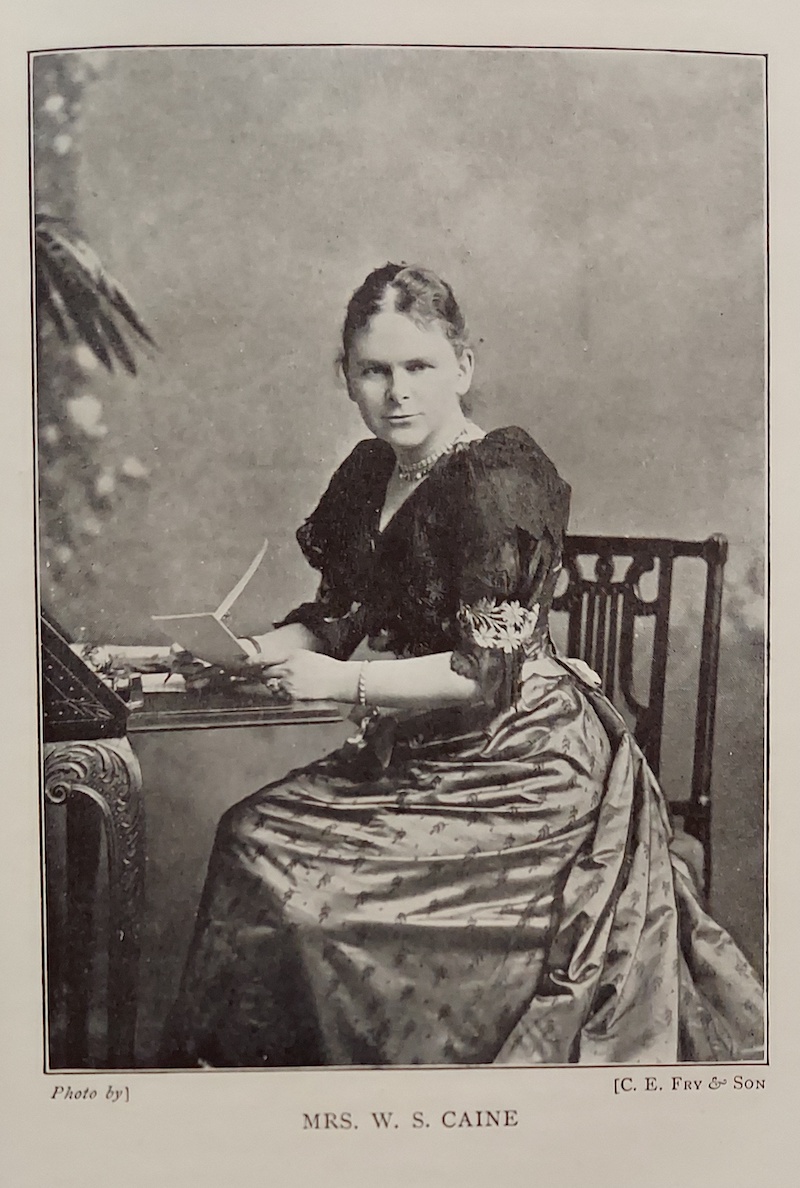
Alice Brown, aka Mrs. W. S. Caine. Photograph by C. E. Fry & Son. Reproduced from Newton (1907), facing p. 10.
On the top step was a little group of people, and in front of them stood a magnificently built woman in a terracotta teagown whom I recognised as the person who had headed the procession earlier in the morning.Caine’s mother, described as “an eloquent and powerfully pathetic speaker, intensely earnest and always interesting” (Winskill 1897: 187), seems to have been quite the opposite, oratorically speaking, of the mother of Leyborne’s love interest — unless it be the reputation of both which Caine is deflating:She was addressing the crowd passionately in a deep and beautiful voice. Her gestures were fine and free. Her sleeves had fallen away from her bare arms, and these she whiled about in a perfect frenzy of oratory. Her face was flushed with excitement and exertion, and the words poured from her lips in an uninterrupted stream. She was quite the most handsome woman (built on very large lines) that I had ever seen; fair as the day, with a bright auriole [sic] of hair round her face; great, wide open, dark blue, glowing eyes, with dark lashes and brows, nobly turned chin and neck, large regular teeth and a complexion like snow and roses (pp. 51–52).
Mrs. Wildbore was completely upset. Why?“Deadly Poison,” of course, is not in that bag. Leyborne has it safely tucked into one of his pockets, and will produce it at the opportune moment of exploitation. Likewise, he has exploited Mrs. Wildbore’s getting stung by a bee on her ear (hence the bandage and laundry blueing) both to win her favor and gain time to continue his manipulation of Bouverie and Mr. Wildbore. To wit, he uses his knowledge that there are two identical little yellow leather kitbags, each with its own contents, and which Bouverie and Mr. Wildbore have somehow switched, to exploit this latter duo’s erroneously thinking that there is only one bag:The way in which this practised speaker seemed to view the possible loss of her speeches was surely very remarkable. No doubt they were of great value to herself, as to the Cause of Temperance. The well-prepared notes of one speech are what no orator cares to lose, for of such is his stock-in-trade, and now that thirty or forty were in question, Mrs. Wildbore might be excused if she had displayed annoyance or even apprehension. But panic? No.
And she was in a panic. There could be no doubt of it. Her hands plucked nervously at the jet about the front of her gown. She had, in her distress, pulled off the bandage from her head, and the large blotch of blue on her ear showed in strong contrast to her pale face. Her very lips were white, and she babbled orders and entreaties indiscriminately to every one within earshot, with very little regard to their coherence. You would have supposed her faced with financial ruin or loss of character.
Yet nothing more formidable than a village temperance meeting menaced her.
Now a village meeting is not critical. Twenty minutes of straightforward, homely, extemporaneous talk would amply satisfy the demands and expectations of this one. The knowledge that it was Mrs. Wildbore who was addressing them would in itself make anything she chose to say extraordinary. Her name alone would be proof that the speech to which they would be listening was far above the usual. Was she not President of innumerable philanthropic societies?
But — a word in your ear. This must go no farther, as you are a gentleman. Mrs. Wildbore was incapable of twenty minutes’ extemporaneous talk, however homely — nay, of three, however straightforward.
Place her before a meeting with a full, typewritten speech (which she called her notes) in her hand, and it would flow easily from her lips. Her delivery was worthy of all praise. It was her power of connected thought when on her legs that was wanting to the poor soul. She had everything else — a far-carrying, metallic voice, a total disregard of time, an imposing presence, large, impressive gestures, a formidable reputation — which make for success on the platform. But, deprived of the written word, she was mute. Hitherto, in the whole course of her public career, she had never been caught unprepared. She was accustomed before making a speech to peruse it carefully, chiefly to refresh her memory of the marginal notes in red ink — humorously — pathetic — raise right hand — break in voice — strike table — pick up watch — indignation here — eyes up — almost whisper this, and so forth. With such an address as the famous “Deadly Poison,” which she had delivered a score of times, ten minutes was ample for this purpose. This preliminary review was not a sine qua non. But the written speech was, for, lacking confidence, she was sounding brass and a tinkling cymbal.
Unless her package of orations were placed in her hands before she rose to address her audience in the schoolroom, she must remain dumb as a fish in their presence.
Her reputation as the finest woman speaker in England was threatened with extinction. It hung on the discovery of a bag (L: 225–228; NY: 187–190).
Leyborne opened the bag and looked into it.For Bouverie, the bag contains a bottle of brandy, 500 cigarettes, and a hallucinated snake brought on by the DTs. Leyborne must maintain this illusion of hallucination so that Bouverie thinks his symptoms are more severe than they really are, and thus that he needs Leyborne to treat him. (Leyborne will later pocket the snake and put it in the bottle of brandy.) For Mr. Wildbore, the bag contains his wife’s papers minus “Deadly Poison” plus a real snake, which he was forced to buy from a snake catcher in the New Forest and which he thinks is venomous. Furthermore, since the bags were switched, he has seen that it also — mysteriously — contains a bottle of brandy and 500 cigarettes. In either case, should Clarinda — who wants her papers — get to the bag or bags first and discover its or their contents, he will be revealed as an untrustworthy and even treacherous ally of his wife and her cause. Thus, he must secretly get to the bag before Clarinda does. Bouverie, for his part, noting Mr. and Mrs. Wildbore’s desire for the bag, thinks that both in reality are “secret drinkahs.” The exploitative and parodic potentials of delusion and hypocrisy are brought out with delightful visibility and exactitude in chapter XIII, when Bouverie and Mrs. Wildbore both do, and do not, see the snake, which has escaped from the bag after Bouverie opened it:He saw a brown-paper parcel. On top of it lay, coiled up, a small snake, which he recognised instantly as a blind worm, though a white one. It is rare that a little knowledge of natural history has more usefully served its possessor. As he closed the bag his eye noted, written on the parcel, the words “Mrs. Wildbore,” followed by an address (L: 156–157; NY: 130–131).
I would like to turn now to two subtle and very slight instances of allusive multiplicity in Caine’s novel. One involves a trio of canine metaphors (the first of which is also a sly allusion to Mrs. Edith Gordon Caine née Walker); the other, an evocative parenthetical question. First, the dog. Mr. Strongi’th’arm, “a callow but enormous curate,” is first encountered in chapter III, “Mr. Strongi’th’arm is Warned off the Course,” leaning on his bicycle and gazing adoringly with “large, brown, dog-like eyes” into the face of Isabel (L: 47; NY: 40). Mendaciously claiming to have been passing by and to have “just looked in to see that” Mrs. Wildbore “quite understood about the time of our meeting tonight” (L: 48; NY: 41), he then tries to get himself invited along on their morning outing:“A snake,” said Bouverie. “It isn’t there, of course. I know that. But I wish it wouldn’t follow me about.”
“Ah!” cried the lady, “let this be a warning to you, poor dear young man. Let this —” She broke off, and turned pale. Ah!” she cried. “A snake!”
“You see it, too?” asked Bouverie. “Then you’ve got ’em. Oh, you old hypocrite!”
And now Mrs. Wildbore performed an action which can only be described as heroic. She could not doubt the evidence of her senses. A snake was certainly wiggling towards her over the carpet, and a very horrible one, too. But with a stroke of that extraordinary gift of feminine intuition, about which we read so much, she leapt in a breath to the knowledge of what she must do. Here was a young man in a pitiable condition, soil ripe for the reception of the good seed. He suffered from a delusion, not that he saw a snake which was not really there, but that he really did not see a snake which was there. How he came to imagine this did not concern her. The only vital point to remember was this. A word from her, which might destroy his belief in the creature’s unsubstantiality, would infallibly undo all the good hitherto accomplished. Let her betray her knowledge, and he would tear up the pledge and return to his abandoned courses. The fiction at all costs must be maintained. He had accused her of suffering from delirium tremens. He had called her a hypocrite. No matter. She must not resent his language. The snake was coming directly towards her. No matter. She must sit still.
She forced her feet, which had of their own accord begun to ascend towards the seat of the sofa, down to the floor.
“I see nothing,” she said firmly, as the snake headed away from her.
“Do you swear that?” he cried.
“I swear it,” she said in a less confident voice. The snake had turned her way.
“Do you deny,” whispered Bouverie, “that it isn’t going straight towards you? It’s by the rug now. Why, hang it! it’s not ten inches from your boot.”
“Nothing,” said Mrs. Wildbore faintly.
“It’s gone right past you,” he said. “I see it distinctly. Oh, Lor, what a state I’m in! I’ve never had such a go as this. I’m getting much worse. There! it’s by the window.”
“This only shows,” said Mrs. Wildbore, still breathing with some difficulty, “what a mercy it is that you came to me.”
“Haven’t got much good out of it yet,” said Bouverie ungratefully. “It’s goin’ through the window. Dash its skin, how real it is!”
Under a sudden impulse of hatred, he picked up a blotting-pad from the table (it was Mrs. Wildbore’s) and hurled it at the disappearing snake. It missed the snake, but knocked over another occasional table, whence were precipitated to the floor a stuffed bullfinch under a glass dome, a woollen mat in ten violent colours, an aneroid barometer which had been pointed to Very Stormy for the last seven years, a green glass vase filled with paper chrysanthemums, a pincushion formed by stuffing the interior of a large fresh-water mussel, an inkstand in blue glass (the contents of which had fortunately evaporated), a prism cut in one angle and painted to represent a vase of flowers, a wooden penholder with a miscroscopic photograph on glass of ten views taken in the neighbourhood of Ventnor set in the handle, an elephant, minus its trunk, six inches high and made of earthenware, another elephant in grey velvet, intended originally for pins, but now raised to the dignity of a decoration, and a brown china teapot, cracked, and bearing on its side the sound piece of advice, “Ca’ canny.”
The snake passed between the threshold of the French window and the bottom of the blind and so vanished from sight.
The relief which this circumstance occasioned in Mrs. Wildbore’s bosom was so great that she would have cared nothing though Mr. Bouverie had distributed ten times as many objects of prime inutility over the carpet of the parlour as he had; but it annoyed her that he should have laid hands upon her blotter.
“Idiot!” she exclaimed testily. “Don’t I tell you there’s nothing there. And now, see what you’ve done!”
“Yes,” said Bouverie, surveying the wreckage, “this seems to be my lucky day, doesn’t it? But the great and really important thing is that the snake’s gone. You saw it go, didn’t you? I mean, it is gone, isn’t it?”
“There was no snake,” said Mrs. Wildbore (L: 200–204; NY: 167–171).
The curate reappears in chapter VI, “Mr. Strongi’th’arm is put in his Place:”“I am very much obliged to you,” said Mrs. Wildbore, “but we must be off. We are going into Southampton to inspect the Lascars’ Home.”
“Indeed?” said the youth. “Indeed?” He felt the tyre of his front wheel. “I have never seen it.”
“Isabel, get my umbrella,” said Mrs. Wildbore.
“I am ashamed to say,” Mr. Strongi’th’arm continued, as he prodded the tyre of his back wheel, “that I have been here over two months and have never visited the Lascars’ Home.”
“Thank you, Isabel.”
“It is an institution that everybody ought to see.” He shot at her the pleading glance of a Gordon setter whose master is gnawing a grouse’s leg (L: 49; NY: 42).
The curate last appears in the penultimate chapter, XV, “Mr. Strongi’th’arm Refuses to say ‘Die.’” He is marching towards the farmhouse, leading “the Clarinda Wildbore Tent of Rechabites, in full regalia, bearing aloft their banner, of which the most prominent feature was a colossal picture of their godmother herself” (L: 231; NY: 193), and singing temperance songs:“I happened,” said Mr. Strongi’th’arm, “to be passing, and I just looked in to ask if you would care to glance over the music which I have selected.”
“I will leave that entirely to your discretion,” replied Mrs. Wildbore graciously. “Isabel, my umbrella. We were just going for a stroll, Mr. Strongi’th’arm. Till seven, then.”
“In the schoolroom,” he said. “You won’t forget?”
“Exactly,” said Mrs. Wildbore, with a grim smile. “In the schoolroom. Come, Isabel.”
“You won’t glance over the songs?” asked Mr. Strongi’th’arm desperately. He produced a book from his pocket.
“I have the utmost confidence in your judgment.”
“Forgive me,” he said, “but it would be a great pleasure — a great assistance if — I hardly dare to ask it — but — Miss Wildbore sings so beautifully. A solo from her would — eh?” He directed the appealing eye of a spaniel in disgrace towards Isabel.
“Oh,” said Isabel, “I’m not going to the meeting, you know.”
The curate’s jaw fell till it completely concealed his clerical collar. Was it for this that he had laboured? Was it for this that zeal for the Cause of Temperance had burned him up during the past week?
“My daughter,” said Mrs. Wildbore, “is not exactly delicate,” — Isabel obviously abounded in health — “but we feel that a crowded meeting — coming out into the damp night air — risk of chill, you know. I fear,” she concluded, “that we must not grant your request, Mr. Strongi’th’arm. Come, Isabel.”
They left the curate planted. As they turned the corner of the road, he was busily employed in the task of punching his back tyre (L: 98–99; NY: 84–86).
So much for the network of canine tropes with which Caine has conjured up (and punningly involved himself and his wife in (that Gordon setter, you know)) Mr. Strongi’th’arm’s infatuation; on to the evocative parenthesis — permit me first, however, a lengthy digression prompted by Mr. Strongi’th’arm’s bicycle. Recounting Caine’s father’s return to the Gladstonian fold and election to Parliament as member for Bradford in the summer of 1892 (the same year Caine transferred from St. Andrews to Oxford), the MP’s biographer writes,“Here we are,” said Mr. Strongi’th’arm, lest Mrs. Wildbore should have overlooked the fact. “If you are ready, dear lady, I will take the chair and we will proceed.”
Mrs. Wildbore lost her head. She had one chance, to say resolutely, “I am very ill and can under no circumstances address the meeting,” and to faint with all expedition. She did not take it
“But,” she faltered instead, “I thought it was arranged, was it not? — the schoolroom —”
“At seven,” said the curate. “Perfectly. But on such an evening shall we sit frowsting in the schoolroom? A crowded meeting — coming out into the damp night air. You must not run the risk, Mrs. Wildbore.”
He turned the eye of a dachshund detected in fault towards Isabel, who at this evidence of his resourcefulness almost admired him (L: 232–233; NY: 194–195).
One member of the new House, who returned after a spell of absence, Mr. Caine welcomed with peculiar pleasure, and that was Sir Charles Dilke. Mr. Caine often cycled over to Sir Charles’s country house from his fishing cottage, especially during the time that Sir Charles was out of Parliament (Newton 1907: 263).This is the lengthiest of the three cameos which Liberal politician Charles Wentworth Dilke makes in Newton’s biography; odd, given that the appreciation by Dilke announced in the book’s title turns out to be almost nebulous in its reticence:
Caine had true courage, and followed the path he thought the right one. This seems a simple matter, easy of attainment by any man. It is not so for politicians, who have peculiar liabilities to special temptations towards cowardice and compromise set all along their road. Fear of constituencies, hopes of office, and, for men styled successful, doubts how to retain (or re-attain) office, have often a paralysing and a sterilising effect. Caine did not escape the censure of some fellow-politicians; but he did not deserve it, for he had not self-interest for a guide, and his temper was never allowed to upset his principle.That “peculiar pleasure” with which one politician welcomes another “after a spell of absence;” those “peculiar liabilities to special temptations” to which politicians are prone… With what particular peculiarities, I wonder, was the friendship between W. S. Caine and C. W. Dilke so pregnant that the former’s biographer, haltingly paralleling the latter’s phrasing, would announce so little and insinuate so much? Newton does not specify whether the country house W. S. Caine “often cycled over to” was Dilke’s “summer retreat” at Dockett Eddy, “a small island on the upper reaches of the Thames near Shepperton,” or his “winter cottage at Pyrford Rough, Woking, just six miles from Dockett” (Nicholls 1995: 233–234); nor does he give the reasons why, nor for how long, Dilke was out of Parliament. Allow me. At the same general election of 1880 which saw W. S. Caine win one of the two seats for Scarborough, Dilke “re-attained” one of the two seats for Chelsea, which he had held since 1868. At the 1885 general election (for which the old two-seat borough of Chelsea had been “split up into five distinct boroughs, of which the new Chelsea [was] one,” with but one seat), Dilke again re-attained office, but with a majority of only 175 votes. At the 1886 general election (precipitated by the defeat of the second reading of Gladstone’s Irish Home Rule Bill (precipitated by W. S. Caine’s involvement in the formation of the Liberal Unionist Party [see § 4])), Dilke lost Chelsea by 176 votes to the Tory candidate he had narrowly defeated some seven months earlier, Charles Algernon Whitmore, an Eton-and-Balliol-educated “barrister going the Oxford circuit.” Dilke did not return to Parliament until 1892, as member for Forest of Dean, which he held until his death in 1911. As for why Dilke’s secure seat for Chelsea dwindled, first to narrow victory, then to narrow defeat ballooning into a six-year absence from political office: The Pall Mall Gazette for Saturday, August 8, 1885, published an article about a “Great Social Scandal:”In personal friendship he showed the same admirable qualities as in his political life, and above all, that steadfast judgment which is the most essential quality in the relation of men to one another (Newton 1907: 317).
For some days past the air of London has been thick with rumours as to a scandal affecting one of the most prominent leaders in English politics. Down to the last moment it was believed that the efforts made to hush the affair would be successful, and that the scandal would not find its way into public print. That expectation has not been fulfilled.Virginia Mary Smith, fourth daughter of Thomas Eustace Smith, married Donald Crawford at Knightsbridge, London, on Wednesday, July 27, 1881 (and not “May, 1882,” as the groom would later misremember in court; note that the date is also almost exactly 26 years before Edith Gordon Walker married the author of The Author of “Trixie”). She was some four months shy of turning nineteen; he, almost three months past forty-four. “I was never in love with him at all,” the young bride would later testify. “I married him because I was miserable at home, and because my people wanted me to marry him.” Ten days before the unhappy couple’s fourth wedding anniversary, the wife told her husband (“with a solemnity in her manner which I could not doubt,” as he would later testify), “The man who ruined me was Charles Dilke.” Twenty-three days after that confession, Reynolds’s Newspaper noted:In the records of the Probate and Divorce Division at Somerset Hous[e] there stands the following entry in the list of petitions filed in the Divorce Court: —
No. 296.
Crawford, Donald, versus Crawford, Virginia Mary, and Dilke, Sir Charles Wentworth.
The date on which the petition is entered is August 5.
The co-respondent in this case is the Right Hon. Sir Charles Dilke, Bart., member for Chelsea, and recently a prominent member of Mr. Gladstone’s Cabinet, in which he sat as President of the Local Government Board. The plaintiff, Mr. Donald Crawford, held a subordinate but important official position in the Lord Advocate for Scotland’s office, Whitehall. The respondent, a daughter of Mr. T. Eustace Smith, M.P. for Tynemouth, is a sister of Mrs. Ashton W. Dilke, widow of Mr. Ashton Dilke, formerly M.P. for Newcastle-on-Tyne, and brother of the co-respondent. Mrs. Crawford is young, not more than twenty years of age. Mr. Crawford is considerably her senior. Sir Charles Dilke is forty-two years of age and a widower. His late wife was a Miss Katherine Sheil, whom he married in 1872. She died in childbirth in 1874, and was cremated at Dresden. Their son, Charles Wentworth Dilke, is now eleven years of age.
Mr. Donald Crawford is a barrister who was for some time private secretary to Lord Young.
It is stated that Mr. Inderwick, Q.C., has been engaged for the plaintiff, and Sir Henry James for the co-respondent (“Great Social Scandal; An Ex-Cabinet Minister in the Divorce Court; Petition Filed Against Sir Charles Dilke,” The Pall Mall Gazette, August 8, 1885, p. 8).
Our readers will be quite prepared for the announcement that Sir Charles Dilke, the late President of the Local Government Board, has had a petition filed against him as a co-respondent in the Divorce Court. He was the “ex-Cabinet Minister and widower” we referred to last week as being the subject of a painful scandal. The petitioner is Mr. Donald Crawford, a gentleman of mature years, who was private secretary to Lord Young, and held a position in the Lord Advocate for Scotland’s office, Whitehall. His wife, the respondent in the present case, was the sister of Mrs. Ashton Dilke, and daughter of Mr. Eustace Smith, who, if we remember aright, once contested Dover and now sits as M.P. for Tynemouth.That same evening, the London correspondent for The Liverpool Mercury wrote:These are the facts. Additional rumours take the shape of reports that it has been attempted to compromise the matter for a large sum of money, but, as it appears, without success; that the alleged offence took place about twelve months ago, although the lady has only recently apprized her relatives of the affair; that the defence of the co-respondent will take the form of denial, coupled with the suggestion that the lady is subject to hysterical hallucinations; and that it was during one of these attacks that she made the statement which forms the basis of the present action. Another rumour mixes up the name of “a lady of title” with the unpleasant business.
It would, of course, be unfair to assume that because a man has his name filed at Somerset House as a co-respondent that he is necessarily guilty of the implied offence. It may be hoped that he has a complete defence, though the antecedent possibilities of a divorce petition, taken in the light of ordinary experience, do not allow too much confidence in such a result. If proven, the case must remove Sir Charles Dilke from active public life, for, as it stands, the charge is a particularly nauseous one. To carry dishonour into any man’s family, and ruin his home, is sufficiently villanous under the best of circumstances, but in this case, according to the allegations, there was added something like insult to the memory of a dead brother, who was himself a gifted and amiable gentleman. Under the old ecclesiastical laws defilement of this kind would have been held a serious crime calling for serious punishment, and even in these times it will be regarded as an outrage not only on the moral law, but on that family decency which even savages are known to respect.
If the case of Crawford v. Crawford and Dilke should result in relegating Sir Charles to private life and a French château, the Radical party will not be greatly the losers. He began well, but turned his coat very deliberately some years ago. Office by menas improved him. He was a fair administrator, but he seemed to have lost the old creative political force. In his absence, assuming Mr. Crawford proves his case and gets his damages, the leadership of the Radical party will fall indisputably to Mr. [Joseph] Chamberlain. It could not be in better hands, judging from the fine series of speeches Mr. Chamberlain has been delivering at Hull. He stands to-day as the foremost exponent of articulate, consistent, and courageous Radicalism.He is clear, self-respecting, independent, yet in no way unpractical (“Special Notes,” Reynolds’s Newspaper, Sunday, August 9, 1885, p. 5).
It is useless any longer to observe reticence about the great scandal which has been the subject of talk for the last fortnight, and at one time was the sole topic of conversation in the lobby. With an eagerness which it is hard to understand, and in a manner which suggests unpleasant thoughts, the news has been blazoned abroad that Sir Charles Dilke is co-respondent in a divorce suit brought by Mr. Donald Crawford against his wife. Mrs. Crawford is very young, is very pretty, and is very well known in society as the daughter of Mr. Eustace Smith, and the sister of Mrs. Ashton Dilke. The evidence is mainly derived from a sort of confession made by her under great excitement in the form of a charge against Sir Charles. He himself, I believe, knew nothing of the indictment until the scandal was the common talk of the town. When the lady understood what her statement really meant and implied, she withdrew it, and efforts were made to bring the husband to understand that he had been made the victim of the extravagance of an hysterical woman. The story that he was offered £20,000 to hush the matter up was an insult to him as a man, and is a pure (or rather impure) invention. Sir Charles Dilke has taken a consistent course. He has said simply that the story is not true; it came upon him with surprise, and caused such a shock that he was physically prostrated; for the lady, whatever may be said of the story which she first told and and then contradicted, has enjoyed with him all the freedom of a sister. Mrs. Crawford, as Mrs. Ashton Dilke’s sister, has been like one of the Dilke family, and I think I may go so far as to say that owing to the quite possibly innocent familiarity which existed it is very difficult for any disproof to be given. Mrs. Crawford’s original story contains sensationally repulsive elements which afford Sir Charles Dilke’s friends every hope that their heinousness may become evidence of their improbability. Sir Charles has put his case into the hands of the Attorney-General. He leaves his political fate in the hands of his committee at Chelsea. His immediate future cannot, of course, be other than clouded by this charge, and for the time he ceases to be an effective force in Liberalism. But I, for my part, take refuge in recalling that no single politician of high rank in my day, with, perhaps, the single exception of Mr. Bright, has wholly escaped the tongue of calumny, and may hope that in the end the honour of a great statesman may be wholly vindicated. More is not to be said upon a case which is soon to come before the courts (“Our London Correspondence; Sunday Evening,” The Liverpool Mercury, Monday, August, 10, 1885, p. 5).What was the “particularly nauseous” charge leveled at Dilke, what sort of “outrage,” what kind of “defilement” had he supposedly inflicted “on that family decency which even savages are known to respect,” the “heinousness” of the “sensationally repulsive elements” of which “may become evidence of their improbability” and which The Birmingham Daily Mail later called, “what in times of less severe public virtue would have been privately applauded and publicly winked at”? Whatever they were, Dilke’s stating (in, for instance, his letter of August 7 to the president of the Borough of Chelsea Liberal Association) that “the charge brought against me is untrue,” was, for “Montretout” of the Parisian weekly Le Grelot — who “knew Sir Charles Dilke as an arrant liar” — sufficient evidence of the member for Chelsea’s guilt:
Les scandales de Londres vont leur train.Some background to the “quelque chose” which Montretout “personally knew” about that “most insolent liar of all English statesmen past, present, and future” (who, by the way, was also, like the father of the subject of my biobibliographical examination, as well as the “heroes” of the novel under discussion in this chapter, a “temperance man”) was provided by the regular Paris correspondent of the New-York Daily Tribune, who, conveniently enough for my purposes, included a canine trope in her report:Voilà maintenant que l’ancien faux athée, l’ancien faux libéral, l’ancien faux ami de Gambetta, — sir Charles Wentworth Dilke — le plus effronté menteur de tous les hommes d’Etat anglais passés, présents et futurs, — j’en sais personellement quelque chose, — voilà, dis-je, que ce farouche baronnet va être déféré à la cour du divorce avec et contre la personne de sa belle-sœur, mistress Donald Crawford. Cette jeune femme n’a pas vingt ans. Sir Charles Dilke a quarante-deux ans. Il est veuf. Sa femme est morte en 1874 d’une suite de couches et son corps a été soumis à la crémation à Dresde.
L’ex-ministre de M. Gladstone se défend comme un beau diable contre l’accusation portée contre lui par M. Crawford, son beau-frère. Le député de Chelsea vient d’adresser une lettre à ses électeurs, lettre où il déclare « que mistress Crawford, qui est hystérique, a rêvé..[.] que jamais il n’a eu la moindre conversation criminelle (agréable euphémisme d’outre-Manche). [»]
Si c’est un rêve… comme on chantait dans la Belle Hélène, faites, ô mon Dieu! qu’il dure toujours.
Mais le mari — qui est sourd — n’entend pas de cette oreille-là. Et voilà le chaste ex-ministre obligé de se déculotter en public devant les chastes ladies de la prude Albion.
Ce procès m’amuse infiniment. Je connais sir Charles Dilke pour un fieffé menteur. Il suffit pour moi qu’il nie pour que j’en conclue qu’il est coupable.
Expliquez cela comme vous voudrez.
Dans tous les cas, l’Angleterre et la France ne se soucient guère du Ra-Dilke-alisme! (“Gazette de Montretout; Le scandale Dilke,” Le Grelot, 16 Août 1885, p. 2).
The author of the above piece was Mrs. Emily Crawford née Johnstone, “one of the best known foreign correspondents of the second half of the last century,” according to her obituary in The Times of Monday, January 3, 1916, “and a woman of exceptionally brilliant intelligence.” (Recall that Great Snakes! was published late June–early July 1916). Crawford married, in 1864, George Morland Crawford (relative of the petitioner? no? yes? I don’t know), barrister and Paris correspondent of The Daily News. “Then began what is so rarely seen in this world,” as an article in The Young Woman of March 1894 put it, “a perfect intellectual and moral union. Late and early husband and wife worked together, and more than once Mrs. Crawford was able to render inestimable service to her husband’s paper by accomplishing feats which would have been impossible for any but a member of her sex” (Shelley 2011: 48). Indeed, “in their literary partnership,” noted her obituary in The Daily Telegraph, “the wife eventually became the more active member.” The less active member died November 23, 1885, from blood poisoning after being stung by a wasp in the carotid artery (recall that she whose “name has been inseparably connected in the public mind with every cause that makes for the Sweetening of Life and the Regeneration of Humanity” has been stung by a bee on the ear); after which, the more active member became, according to The Young Woman article already quoted, “the regular daily correspondent of the Daily News and Pall Mall Gazette,” as well as “one of Mr. Labouchere’s most valued regular contributors to Truth, and twice a week her brilliant epigrammatic letters enable the readers of the New York Tribune to know as much of the Parisian notabilities of to-day as if they were living in the gay city itself, for Mrs. Crawford has exceptional sources of information, and her rare knowledge of the French language makes her often seize a point which would pass unnoticed by most of her fellow-writers on the English press” (Shelley 2011: 47). Yet, despite “her rare knowledge of the French language,” despite her being “a woman of exceptionally brilliant intelligence,” she seems not to have known (or not to have been willing to share openly what she knew with her less learned American readers) that the endroit of “the gay city” where one might often see Sir Charles strolling whenever he was in town — the Madeleine Flower Market — was (and perhaps still is) a notorious lieu de passes galantes. Perhaps her allusion to Dilke’s indulgence in his remarkable taste for flowers, as well as her statement that Mrs. Donald Crawford “was the last person whom I should have thought subject to hysterical hallucination,” was a subtle way of saying that she thought the charge against Dilke was not unfounded. After all, being tall and handsome with a “taking charm”… In any case, another arrow in Dilke’s defensive quiver arrived on August 12, 1885, in the form of a telegram from India (recall that Clarinda Wildbore will also have traveled there in the future fictional past of Great Snakes!) to the Central News Agency in London. As that city’s correspondent for the New-York Daily Tribune reported on August 19:Paris, August 15.
The Dilke-Crawford divorce affair arouses considerable interest here. Sir Charles Dilke is still, according to French ideas, young, and is to boot tall, handsome and a man of intellectual weight. He is well known in French political circles and a good deal known to the habitués of the Opera House and Opera Comique, behind the scenes of which influential Gambettists have taken him for the last six years whenever he was halting here on his journeys from London to the South of France. I do not say this to insinuate that he was at all a man of light morals. He did not pass for being such among those who had most opportunities of seeing him in France. I used to meet him often until his visits to Paris became extremely hurried. When I saw him at table I observed that he was temperate in eating and that the finest Burgundy and Bordeaux could not tempt him (metaphorically speaking) to lay aside his blue ribbon badge. Like Samuel Morley, he became a temperance man to be able with a good conscience to recommend Chelsea electors too fond of liquor to become total abstainers. Sir Charles was accused of enjoying too much the good effect of his appearance when he promenaded on the Boulevards. Among Frenchmen he looked almost a son of Anak and was reckoned handsome. Though the son of a consumptive mother and threatened by a malady which carried her off, he deserves to be classed as fine-looking. The only symptom of a morbid physical tendency that I could perceive in him is a certain hollowness of voice which strikes the distant ear pretty much as would the deep-mouthed baying of certain dogs. He only comes to Paris in winter. When here he wears a coat lined with magnificent Russian sables. It is just the sort of garment that would look admirable in a portrait by Bonnat. My impression of Sir Charles Dilke is that he has the sort of amiability which grows out of a desire to please. He is very obliging, and I know of him having often put himself in great trouble to render small courteous obligations to persons who had not any claim upon his kindness. Without being foppish, or much of a dilettante, he is fond of material elegance and is both an amateur and connoisseur of curios. He used to have a mania for Chinese pottery and arranged his place at Cap Brun, overlooking the Mediterranean, in a “Celestial” style, and owns one of the finest collections of the “pink-family” porcelain. I made his acquaintance at the table of an advanced French Republican in 1872, when he was here a newly married man, with his charming wife. She was Irish, but had lived a good deal in England and abroad, and was one of the bravest women that I ever saw. Her maiden name was Shiel. She had a fine dowry. Before she became Lady Dilke she was one of the belles of Hove (near Brighton[)] and of the Casino of Dieppe. Without being exactly beautiful she was more than pretty, had high animal spirits, piquancy and intelligence, and she completely shared the political views of her husband. At the time of her marriage they seemed considerably more advanced than they are now, Radicalism not then having made great headway in England. Before the general elections which brought Lord Beaconsfield into power Lady Dilke went to electoral meetings with Sir Charles and made no secret of her Republicanism either in London or Paris.
There was after her marriage, I heard her say to Louis Blanc, a high tide of Toryism in England. The war of 1870-’71 brought misery to France, but a great wave of prosperity to England which, making under its influence lots of money, became Conservative. A reaction was caused against advanced Liberalism by the Communal insurrection of Paris. Sir Charles Dilke, his wife said to the veteran French Socialist, had made himself obnoxious to the English Conservatives, who were not called Jingoes for two or three years later. He had also made himself obnoxious to the Court set by resisting demands for pensions for the Queen’s children, and after the fourth of September deserting from the German to the French ambulances. As Dr. Norman MacLeod preached before Her Majesty that Germany was a divinely appointed scourge to flog the French for their sins, his intimacy with Republicans here made English tufthunters think him a “bad lot.” His wife enjoyed seeing him under a social cloud. She was prone to relate the dreadful things which she heard about him. I was not present at the electoral meetings at which she sat on the platform beside Sir Charles, but heard that, on one occasion, she faced a perfect storm which roughs were engaged in getting up and in her [sic] course of which stones flew about her head. He quailed, not for his own sake but for hers. But she insisted on weathering the gale. Her only child was botn not long after. She died in giving birth to him. In obedience to a desire she often expressed her body was cremated at Coburg in Germany.
I met Sir Charles not long after he returned from that city subsequent to the incineration of his wife’s remains. In all my life I never saw a man so mentally and morally prostrate as he then was. He late brother, Ashton, who called on me on his way back from a walking tour across Central Asia, feared that the death of Lady Dilke had shaken the reason of Sir Charles. Louis Blanc, Cernuschi and other friends were of he same opinion and blamed the wife for imposing such a trial on his nerves as that of committing her body to the flames, when cremation was a novelty. By degrees, however, his interest in politics and then in society began to revive. A reaction against Toryism set in in England and the party in France with the leaders of which the Radical baronet was so intimate became all-powerful here. Gladstone thought that Dilke’s personal influence with them might help the negotiations for a renewal of the Treaty of Commerce and asked him to take the post of Under-Secretary of State for Foreign Affairs, which, Challemel Lacour informed Gambetta, the jealousy of Lord Granville rendered almost a sinecure. Sir Charles Dilke I know was very apprehensive of appearing to tread on the heels of his chief, and was very glad to quit the Foreign Department, where he was between his French political friends and Lord Granville between the anvil and the hammer. This situation he himself never complained of here, so far as I could ascertain. He excited still greater jealousy by coming over to Paris to attend the meetings of the commission appointed to discuss a commercial tariff. English diplomacy thought he should have left that to diplomatists. Gambetta was Foreign Minister and presided at the debates. Sir Charles reasoned and argued with ability, so did Mr. Joseph A. Crowe, whom he had taken from the Consulate of Leipsic to represent England and the Committee and who is now Secretary of Embassy here for British Affairs. They both forgot that Gambetta was in a way judge and party and that it would have been better to get round him than convince him. He was manœuvring for a bribe — the hand of the Princess Beatrice. The negotiators did not see than and the negotiations fell to the ground.
Sir Charles Dilke’s taste for flowers was remarkable and he indulged in it to the full. Whenever he was in Paris, one might see him looking into the windows of dealers in flowers, and strolling round the Madeleine Market. His southern home was beautified every where with bloom as well as with Chinese porcelain. I never saw anything prettier than his breakfast table and the flowery lookout that it commanded. There was not a single object there in his study or smoking room which suggested a “fast” sort of gallantry. He let fall things about different fast women — European and American — which showed that they ran after him and that he particularly avoided them. The lady whose name figures with his, as co-respondent, was educated at Orleans by a Madame Sabatier who keeps there a Protestant school, to which Mrs. Donald Crawford’s sisters, Mrs. Harrison (sister-in-law of Frederick Harrison) and Mrs. Ashton Dilke, also went. Mrs. Donald Crawford was the youngest of the three and Mrs. Ashton Dilke the best endowed, intellectually speaking. I know both ladies, and had the pleasure of introducing Gambetta at a dinner given to Mrs. Ashton Dilke in 1876 when she was a bride of eighteen. She was then a charming being, full of life and spirits, and took a deep and intelligent interest in French politics. Although so young she was in the fullest degree the intellectual companion of her husband. Ashton Dilke was, I think, one of the most reliable political men I ever knew. His ideal was lofty and he stood by it because he had faith in it, and did not care so far as his personal interests were concerned whether it became that of the majority or not. He had not the taking charm of his brother, but looked cold, grave and slightly melancholy. But a heart sensitive and kindly beat under his reserved exterior. He was very tall, bilious-looking, and had very large but white and even teeth. The disease of which his mother died took hold of him in his honeymoon tour, and after he had struggled seven years against it[, it] carried him off.
Mrs. Donald Crawford appeared to me as reserved and silent as Mrs. Ashton Dilke was expansive. She was the last person whom I should have thought subject to hysterical hallucination, or given to amorous intrigue. Her mother, Mrs. Eustace Smith, brought up all her daughters in an independent manner, and was very careful to place them in conditions to forward mental growth. She was with the late Lord and Lady Mayo, when the former, on leaving a penitentiary settlement which he had as Governor-General of India been visiting with some friends, was assassinated (“Sir Charles Dilke; His Life in France — Ashton Dilke — Mrs. Crawford,” New-York Daily Tribune, Sunday, September 6, 1885, p. 3).
A fresh turn was given to the talk by the announcement of Sir Charles Dilke’s engagement to Mrs. Mark Pattison, widow of the late Rector of Lincoln. This lady was in Madras when the charge against her future husband was first made public. She had been for some time on a visit to the Lieutenant-Governor of that Presidency, Mr. Grant Duff, and his wife. She appears to have telegraphed home at once, desiring it should be made known that she was starting for England to marry Sir Charles Dilke. This set at rest all doubts, — for some had been expressed — whether a marriage between them was really agreed on. The publication was of course meant to influence English opinion in favor of the accused, and did so. People naturally said that if Mrs. Mark Pattison were ready to marry Sir Charles there could not be much in the rumors against him. And they thought it, as the phrase goes here, very nice of her to do as she did. Some days later, the papers, not many of which printed Mrs. Pattison’s telegram, were requested to announce “officially” the forthcoming marriage; and with this request most of them complied. Neither this nor anything else can check the flood of greasy gossip which oozes through the baser sort of papers […] (“Notes from London; Sir Charles Dilke,” New-York Daily Tribune, Sunday, September 6, 1885, p. 3).Dilke married Emilia Francis Strong aka Mrs. Mark Pattison on Saturday, October 3, 1885. A paragraph in Reynolds’s Newspaper’s account of the wedding seems proof that Dilke’s gallantry was far from being of the “fast” sort indeed:
As the story goes, Sir Charles Dilke was a suitor for the lady’s hand before her marriage with the late Rev. Mark Pattison, and that gentleman, being aware of the fact, expressed a deep desire that after his death his widow should marry the man whose affections she had before her marriage won. That he was thoroughly in earnest in that desire is shown from the facts that he left to his widow a fortune of £40,000, and to his brother, Mr. Frank Pattison, the trust of seeing her through her widowhood and into second wedlock (“Marriage of Sir Charles Dilke,” Reynolds’s Newspaper, Sunday, October 4, 1885, p. 8).The polling for Chelsea in the general election of 1885 took place a day after the Paris correspondent for the New York Tribune found her husband “in the calm sleep of death, with his arm carelessly lying at his side.” In other words, one month and twenty-one days after the widow Pattison effected her “second wedlock” with the widower who had courted her before her first marriage, said widower was able, as I said earlier, to re-attain his seat by a slim margin of 175 votes. On Monday, July 5 of the following year, however, the re-married widower lost that seat by 176 votes, inducing him, according to the gossip columnist for the Liverpool Evening Express,
to take a step now that he should have taken six months ago. He feels bitterly the cut he received at Chelsea last week. Had he been wise he would have kept out of the political world until the scandal in which his name reeks had at least been forgotten. He will remain in town until the Crawford divorce case has been finally disposed of, and then he will retire to his chateau in France, and probably afterwards endeavour to bury his cares in still more remote places. Since his rejection at Chelsea he has spent several of his days by the river. Among his residences is a charming little spot called Dockett Eddy at Shepperton (“Gossip of the Day; What is Said in the Metropolis,” Evening Express (Liverpool), Wednesday, July 14, 1886, p. 3).What had meanwhile swayed the Chelsea electors against the incumbent was that, on Friday, February 12, 1886, the case of Crawford v. Crawford, and Dilke, was finally heard “in the Probate and Divorce Division of the High Court of Justice, before Mr. Justice Butt [!], sitting without a jury.” Among the audience in the courtroom was the Liberal member for Luton who had spent the day of Sunday, July 12, 1885, with Dilke at Dockett Eddy, Cyril Flower (Gwynn & Tuckwell 1917: II, 165). After three hours of argument, examination, testimony, and further argument, the judge granted the petitioner Crawford a decree nisi for divorce, and acquitted the co-respondent Dilke, whom our Parisian friend Montretout called “as much a liar in politics as in private life:”
J’ai attendu que tout le monde ait dit son mot sur la dégoutante affaire du jésuite protestant Sir Charles Dilke, avant de dire le mien.The co-respondent, “who was accompanied by his private secretary, Mr. Bodley,” did not take the stand to deny that he ever “taught” those “French vices” to the respondent; nor did the latter, who was not present in court, affirm them. The bulk of the testimony consisted of the petitioner (who, by the way, was, like the subject of this, my biobibliographical examination, a graduate of Balliol, Oxford [BA, 1860; MA, 1864]) recounting a confession which he said the respondent had made to him around 11:30 on the night of Friday, July 17, 1885. Nowhere in his testimony did he describe his wife as “hysterical.” Based largely on the petitioner’s recollection of his wife’s confession, his reading of some of her diary entries, and the recollections of the Crawfords’ parlormaid Ann Jamieson, “cette dévergondée de Thémis britannique” ruled:Je connais ce triste personnage depuis dix ans et je savais d’avance ce que valait sa parole.
Aussi menteur en politique que dans la vie privée!
Le tribunal, composé de créatures à lui, l’a acquitté, mais l’opinion publique aussi bien en France qu’en Angleterre, l’a condamné.
La belle-sœur de feu son frère Ashten [sic] Dilke a été reconnue coupable d’adultère avec une personne inconnue. Admirez l’euphémisme de cette dévergondée de Thémis britannique. Sir Charles Dilke est pourtant assez connu; aussi bien à la Sainte-Campagne, sa propriété auprès de Toulon, qu’à la Chambre des Communes de Londres.
Les vices français (sic) qu’il a enseignés à Mme Crawford qu’il faisait coucher avec sa femme de chambre, sont, sans doute, des vices. Mais que dire des abominations révélées par la Pall Mall Gazette! sont-ce là des vertus anglaises?
Quoiqu’il en soit l’affaire Sir Charles Dilke n’est pas finie. Ses électeurs entendent bien faire justice de tous ses mensonges.
Comme homme politique Sir Charles Dilke ne vaut plus un liard.
Tant mieux pour la France qui perd le plus faux de tous ses amis anglais! (“Gazette de Montretout; Pornographie ministérielle,” Le Grelot, 14 Mars 1886, p. 2).
This is one of those cases in which the Court is placed in a position of some peculiarity [my emphasis] and of some difficulty, because it is asked to find that the respondent has been guilty of adultery with the co-respondent, and at the same time to dismiss the case as against the co-respondent. That is a state of things which at first sight does not look quite reasonable, but when it comes to be considered there is nothing inconsistent in the course taken with regard to each of these cases. Dealing with the case against the co-respondent, there is not a great deal of evidence against him beyond the statement made by the petitioner, Mr. Crawford, as to the respondent’s admissions of guilt. But then these admissions of guilt are clear, distinct, and circumstantial. I cannot, without disbelieving all or nearly all that Mr. Crawford has said, refuse to find that these admissions were made. In the absence of the respondent, who might have been called to deny having made such statements, I see no reason at all for doubting the truth of Mr. Crawford’s evidence. That being so, I am compelled to come to the conclusion that the adultery was committed, and to grant a decree for the relief which the petitioner craves. With regard to the co-respondent, Sir Charles Dilke, my decision is in accordance with what I have already said — that there is no evidence, worthy of the name, as against him. Nothing can be clearer than the law on that subject, which is, that an unsworn statement of a person in the position of Mrs. Crawford is not entitled to be received, or even considered, in a court of justice as against the person with whom she is alleged to have committed adultery. That is the law, and when the matter is considered, I cannot help thinking that every one must see that it is good sense as well. It would be a most monstrous thing if any gentleman, in the position in which Sir Charles Dilke finds himself in this Court, should be assailed and condemned on charges of this nature on the statement of a person not upon oath, and the truth of whose story he has no opportunity of testing by cross-examination. If Mrs. Crawford had come into the box and sworn that the statement she made on the 17th of July to her husband was true, that would have been very good evidence against Sir Charles Dilke. But then he would have had an opportunity of testing, first of all, the state of mind in which the admission was made; secondly, such matters as sugested that she might be accusing him in order to shield her intercourse with somebody else; and further, the thousand and one things that might present themselves in answer. In common fairness these admissions as they stand ought not to be for one moment weighed against Sir Charles Dilke. No doubt counsel were well advised in the course they have induced him to take, and I have no hesitatioin in saying that the petition as against Sir Charles Dilke is dismissed, and of course dismissed with costs (“The Case of Crawford v. Dilke; Hearing and Judgment,” The Daily News, Saturday, February 13, 1886, p. 2).Those costs were paid by the petitioner. As the London correspondent of the Dublin Express said on Tuesday, February 16 (quoted in The Birmingham Daily Mail):
I understand that the Queen’s Proctor has now the Crawford-Dilke case under consideration, and he will probably intervene before the rule is made absolute. There is a clear miscarriage of justice somewhere. It is perhaps the highest flight of judicial absurdity that Mr. Crawford, the injured husband, who has been granted his divorce on the strength of his wife’s confession implicating Sir Charles Dilke, should have to pay £3,000. or £4,000. of Sir Charles Dilke’s expenses. Mr. Justice Butt has gone too far, and Sir C. Dilke’s legal friends no doubt know it. It was rumoured yesterday afternoon that there had been a scene in the Cabinet on the question of admitting Sir Charles Dilke. An office had been purposely kept open, but it is not now, it seems, to be given to him (“The Crawford-Dilke Divorce Case,” The Birmingham Daily Mail, Tuesday, February 16, 1886, p. 2).On Friday, July 16, 1886, the case of Crawford v. Crawford (Dilke’s name had been stricken from “the title of the cause célèbre” on Tuesday, July 13) was taken up again in court. Thus, on Tuesday and Wednesday, July 20–21, 1886, Mrs. Crawford did indeed “come into the box,” and swear “that the statement she made on the 17th of July [of 1885] to her husband was true,” viz.,
“The man who ruined me was Charles Dilke. […] He seduced me six months after our marriage — three and a half years ago, and I have been his mistress ever after. […] He called on me at Bailey’s Hotel, South Kensington, when we were there after our wedding trip, and he made love to me there and kissed me, but nothing more. […] I met him at a house off Tottenham-court-road […] and he seduced me there. […] If he were to come into this room just now I believe I should have to do as he liked — I should have to do whatever he pleased. […] He made me go to bed with Fanny […] a woman he had for a mistress. I did not like it at first, but I assented, because he wished it. I think I would have stood on my head in the street if he had told me to do so. He used to come to bed beside us. He taught me every French vice. He taught me all I know. He used to say that I knew more than most women at thirty. He said that he took me first because I was so like mother. He used to say when we were together, ‘Oh, how like you are to your mother just now’” (“The Case of Crawford v. Dilke; Hearing and Judgment,” The Daily News, Saturday, February 13, 1886, p. 2; “The Crawford Divorce Case,” The Standard, Saturday, February 13, 1886, p. 2).Minor variants occur in different newspapers’ accounts of the trial. For instance, The Daily News has, as does The Times (which reports in the third-person rather than direct quotes), “most women of thirty” instead of “most women at thirty;” The Morning Post provocatively omits the locative “to bed” from the phrase, “He used to come to bed beside us;” The Pall Mall Gazette telescopes Dilke’s seduction of “la belle-sœur de feu son frère” from six months to six weeks after her wedding, yet leaves out the incident with Fanny, referring instead to “some further evidence, which is not fit for publication;” The Hull Daily Mail has “all the French vices” instead of “every French vice,” while The Liverpool Echo refrains from specifying their national, linguistic, or cultural provenance at all. “Readers of Mrs. Crawford’s confession of her relations with Dilke as related by her husband,” murmurs a rogue footnote escaped, apparently, from my Nabokov's Infernos, “will notice its similarity to Lolita’s confession to Humbert anent Quilty.” I confirm in passing the Quilliamesque whiff of Dilke (whose solicitor, by the way, was a certain Mr. E. R. Humbert) in Quilty, and move on to Judge Sir James Hannen asking Mrs. Crawford, upon her being sworn into the witness box on Tuesday, July 20, 1886, “Is it true or not true that you committed adultery with Sir Charles Dilke?” To which she answered, “It is true.” Next, a few choice morsels from her examination by Mr. Henry Matthews, Q.C., subsequent to her statement, “I used to go to his house:”
I am reminded, first of all, of the opening of the little piece of “witty letterpress” with which I prefaced my project and in which interviewee asks interviewer to join him “in some supper” (see § 0):When you went to his house, at what hour did you go? — I always arrived at his house between a quarter past 11 and half-past 11.
Why did you select that hour? — It was the hour at which Sir Charles Dilke asked me to come. Mr. Crawford had to be at the Home Office at 11, and Sir Charles Dilke had not to be at the Foreign Office till 12, so it was the most convenient hour.
[…]
When you went to Sir Charles Dilke’s, who let you in? — Sometimes I was let in by the footman — it was always the same footman — and sometimes SIr Charles let me in himself. He used to tell me not to drive up to his house in a hansom, as the servants would get to hear; so I always used to come in a hansom and get out at the corner of Pond-street, which is close to his house, and walk down to his place. Sir Charles has a conservatory over his front door, and he used to stand in the conservatory when he knew I was coming. The glass is stained so that you cannot see through it, but I could just see his head above it. He used to watch until I came round the corner, and I could see if he was there, and then he used to come down and let me in without my having to ring the bell. As soon as I got onto the doorstep he used to open the door. Sometimes when I rang the bell Sir Charles Dilke would be in the dining room, and then he would come to the door and let me in himself. He always came with his hat on and with his gloves in hand to look as though he was going out in case it was not me.
You say the dining-room. Do you mean the front room or the back room? — The front room. Perhaps it ought more properly to be called the breakfast room. He used to call at the top of the staircase that it ws all right and then the servants knew that they need not come up.
[…]
When you got into the house in this way, where did you go? — I always went up to the blue-room on the staircase; but once or twice Sir Charles had not quite finished breakfast, and I sat with him in the dining-room while he finished. But I almost always went straight up into the blue-room, whether Sir Charles or the footman let me in. The footman used to take my name and show me into the blue-room.
And from the blue-room where used you to go? — Sir Charles Dilke always came to me in the blue-room.
Did you go from there to any other part of the house? — Yes, he used to take me up to his bed-room.
[…]
I suppose I need not ask you what you went up to the bedroom for? I suppose it was to commit adultery? — Yes.
[…]
How long did you stay in his bedroom on these morning visits? — It depended. It would be from a quarter of an hour to half an hour. Sometimes it might have been a little bit longer than half an hour, but not often.
Did you leave the room with him? — No, he always went first.
How did you leave? — After he left the room Sarah, the housemaid, used to come in and help me to dress, and she always used to let me out of the house. […] (“The Crawford Case,” The Daily News, Wednesday, July 21, 1886, p. 2).
I found William Caine in bed. The time was eleven o’clock in the morning.
“This is a nice hour to be still between the sheets?” I said as I opened my note-book.
He yawned till I thought his head was going to come apart. “Yes,” he said: “it is. If it wasn’t, I should be up, you fool” (SR: 125).

Virginia Mary Smith, aka Mrs. Crawford. “Mrs. Crawford was married at eighteen, and, though she is now twenty-eight or so, still looks about the age when she was first married.” “Photo by Bullingham, Harrington Road, S.W.” Reproduced from The Sketch, January 15, 1896, p. 600.
Annoyed, Nigel leaves the smoking-room and, having a quarter hour to kill before his wife shows up to take him to lunch, he takes his hat and stick and goes for a stroll:“A wench,” said General Badgworthy, “a wench, as I live by whisky!”
He set his Coke hat more firmly and a trifle more to one side on his bald skull, polished his eyeglass, re-fixed it, and glared conqueringly out through the smoking-room window. His fists were planted on his knees, knuckles down; his elbows were squared; his chin and his chest were thrust out and his white mustache stood on each side of his red nose, for he was smiling as hard as ever he could.
“Haw!” he said, clearing his throat emphatically. “Haw! A dashed fine piece of goods, eh Carter?”
Nigel, who occupied the other chair in the window, laid down The Sportsman and looked where the General was looking. A girl was walking down the further side of the street, which was Pall Mall. A tall, slim girl, carrying herself as queens are supposed to carry themselves, a girl with much golden-red hair, a girl admirably turned out, a girl to make elderly, retired Army Officers sit up. She was dressed from head to foot in white. The only note of colour in the gracious picture she made was furnished by a red-backed book in her hand.
[…]
Nigel had been rather too late to see very much of the girl’s face, but the glimpse he had got of her profile had told him that she had rare beauty. A small straight nose, a sweet and rather large mouth, a fine throat — these things he had joyfully noted. By forty a man has acquired a quick eye for this sort of thing or he will never have it. Nigel had it. He was grateful to the General. It had been a good sight. He followed the white figure with his eyes till it turned into St. James’s Square and then he lifted up his newspaper again. “As you say, General,” he observed civilly, “a lovely girl.” He prepared to dismiss the incident from his mind.
The General tapped him on a knee. “My fellow,” he said, “you and I, as two respectable married men, ought to be heartily ashamed of ourselves. But are we?” He tapped Nigel on the other knee. “We are not,” he announced. “Be damned if we are! Never, Carter, nevah shall it be said of either of us that he can look unmoved upon such a creatchah as has just gone by. Eh? Eh?”
Nigel winced as if the General had put a pin into him, but his good nature triumphed over his annoyance.
“I’m afraid,” he said seriously as he folded his newspaper for reading, “that I shall have to report this shocking business. Lady Badgworthy ought to know how you employ your mornings.”
The General favoured him with a most horrible wink and made a strange and disquieting sound, half gasp, half grunt, which was his way of chuckling.
“You tell on me,” he said, “and I’ll tell on you, you naughty knave. Haw!” (SNC-HJ: 28–31; SNC-P: 23–25).
He moved vaguely across the road. The young leaf of the trees in St. James’s Square caught his eye and invited him. He would stroll round the Square and smoke a cigarette. He turned out of Pall Mall. At the same time something impelled him to look over his shoulder at the club he had just left and he became aware that the General’s eye was upon him. So intensely did this eye gaze that it was no wonder he had felt its influence. And it was to the last degree quizzical. The General was grinning from ear to ear. Nigel understood that he was supposed to be pursuing the girl in white. The General waved him an airy “Good Luck!” Nigel bit a curse in two and passed, raging, round the corner. Old men like Badgworthy ought unquestionably to be burned alive. As for turning back, the thing was impossible. The General would take it as a confession. To hell with him!Nigel returns to the club:Nigel lit a cigarette and strolled in St. James’s Square. The sun beamed cheerily; birds sang at the tops of their voices; a pleasant breeze stirred the air. There were no generals here. Nigel began to recover his equanimity. The moment was good; he tasted it.
As he passed the door of the London Library the girl in white came out. He cast a hunted look behind him, but the General was not leering from the shelter of any of the lamp-posts. He slackened his pace and let the girl go by. He found it perfectly impossible to prevent himself from looking at her. Her beauty clutched him in the throat. A marvellous girl. The General was a swine. A swine (SNC-HJ: 32–33; SNC-P: 26–28).
He came into Pall Mall. There sat the General still in his window, still leering out upon life. As he caught sight of Nigel he began to grin, took his eyeglass out, screwed it in again, and, from a spasm which passed over his face, Nigel knew that he was choking on a chuckle. But Nigel had something else to think about than the General. Jocelyn’s landaulette stood by the curb and her chauffeur was fiddling with his engine.And, thirdly, I’m reminded of the opening of the first chapter of The Pursuit of the President:Nigel glanced at the watch on his wrist. No, he wasn’t late; it was she who had been early. He quickened his steps and reached the car as the chauffeur shut down the bonnet. A glance told him that Jocelyn was not in the car. The man, touching his cap perfunctorily, told him that Mrs. Carter had just gone into the Club to wait for him. There was a half grin on the fellow’s mug. Nigel understood that Jocelyn had not concealed her displeasure. But that was hardly to have been expected.
He mounted the steps and went into the hall. Jocelyn sat bolt upright on one of the long padded seats. She was tapping the floor with her toe and breathing hard through her nose. Not far away several members were grouped about a newsboard. The General was coming alertly out of the reading-room. He was obviously intent on further display of his peculiar [my emphasis] humour. And he didn’t know Jocelyn. He sprang towards Nigel. At the same time Jocelyn perceived that her husband was beside her.
“Really, Nigel —” she began peevishly.
“Ah, you dog, you —” cried the General.
“General,” said Nigel, “my wife. Jocelyn, General Badgworthy” (SNC-HJ: 34–35; SNC-P: 28–30).
Recall that Dilke had been President of the Local Government Board (December 1882–June 1885), and W. S. Caine, Civil Lord of the Admiralty (November 1884–June 1885). On to a few choice morsels (with variants) from Mrs. Crawford’s cross-examination by Sir Walter Phillimore, Q.C.:“Peter,” said my father when, upon a sole, two kidneys and a rasher, he had broken the back of his breakfast, “I am going to speak seriously to you. Give me an egg.”
I offered my father his choice among four that lay in the basket. He selected the largest, nipped off the top with one stroke of his knife and said:
“Hard again. That woman must be in love.”
It is Sir John’s ineradicable belief that every domestic hitch is due to the amorous propensities of some cook, housemaid, waitress, or scullery maid. Carelessness in his servants is explicable only upon one hypothesis.
“Sir,” I said, “our cook is above suspicion. What! a woman of her years!”
“They’re never too old.”
“And figure —!”
“Nor too fat.”
“And face —!”
“Nor too plain. How else in Heaven’s name could she boil these eggs” — he had uncovered a second one by this time — “to stones as she has? My breakfast,” he continued, pushing away the offending eggs, “is ruined. Cut me a slice of ham, Peter, thin and knuckly.”
I did as he requested. Among all the Presidents of Board of Enquiries into Army Scandals that England has had, my father, whatever his political (his only) enemies may say about his administrative talent, holds first place easily as a breakfast eater (PP: 15–17).
Had you any close knowledge of Sir Charles Dilke before your marriage? — No, not very close. I have known him since I was a little girl. I used to see a great deal of him when I was a child; but I saw very little of him for two or three years preceding my marriage.
Two months after your marriage did he call upon you at Bailey’s Hotel, Kensington? — Yes.
And there and then made love to you, and kissed you? — Yes.
Did you resent it? — He said to me I need not mind because of his connection with the family, and that it was all right.
What do you to mean by making love to you? — He kissed me.
Anything else? — I really cannot remember.α
Do you mean to say that it was behaviour that might be expected between a respectable man and a young married woman, being relations? — No; I do not think it was.β
Did you resent it? — Yes, I did.γ
[…]
Was it a matter of affection between you and Sir Charles Dilke? — Yes, I was very fond of Sir Charles Dilke.δ
Did you tell your husband there was no affection between you on either side? — There was none at the time I made the confession.
Was that what you meant? — Yes, that must have been what I meant.
You say there was affection on your side, and you believed affection on Sir C. Dilke’s side? — I never supposed there was not.
Were you jealous of his other mistresses? — No.
Did your affection diminish when Sir Charles Dilke told you he had been your mother’s lover? — I was much horrified to hear that, but I only got to know that by degrees.ε
Did it diminish when he told you about his other mistresses? — It did diminish when I met “Fanny” in his house.ζ
Would you have been content to go on with him after you heard “Fanny” slept with him nearly every night? — Yes (in a low tone)η (“The Crawford Case,” The Daily News, Wednesday, July 21, 1886, p. 2; “The Crawford Divorce Suit; Evidence of Mrs. Crawford,” The Standard, Wednesday, July 21, 1886, p. 2; “The Crawford Case,” The Daily News, Thursday, July 22, 1886, p. 2; “The Crawford Divorce Suit,” The Standard, Thursday, July 22, 1886, p. 2). αTranscription in [Verbatim] has: “I really can’t go into details.” βThe Standard has: “Do you mean to say that it was behaviour that might be expected between a respectable man and woman?” γThe Standard: “Did you permit it?” δThe Standard: “Yes. Because of course I was very fond of Sir C. Dilke.” εThe Standard: “Of course it did; but I did not know that all at once, He only told me that by degrees.” ζ[Verbatim] inserts “(After a pause)” between question and answer; The Standard only has, for answer, “It did.” ηThe Standard: “Did it diminish when you heard him say that Fanny had slept with him nearly every night? — Yes.” [Verbatim]: “Did you intend to go on with him […]”

Virginia Mary Smith, a “haughty horsewoman” holding a riding crop, at the time, it seems, of her marriage to Donald Crawford (note what appears to be a ring on her ungloved left hand). Reproduced from Jenkins (1965: fp. 225).
William Caine, the English novelist, tells me that when he was a student at Westminster School he frequently saw the little boys placed in the gallery to applaud the elder boys performing a Latin play. The youngsters were given signals when the applause was to be forthcoming (Lucas 1921).That is, what interested Caine when the artifice underlying convention — the theatricality which an audience shares with the performance it watches; the peculiar web of fiction known as “the law,” the effects of which are all too non-fictional — was disturbed by “scandal,” was much less the prurient details revealed and much more the comedic potentialities thereby entrained. Or, as R. H. W. wrote in his full page of “necrological piety” in The Graphic (reproduced in § 4), Caine “looked on the world with humorous wonder and drew it in words and pictures with a smile that was never wry.” I will end this digression with two snippets which surely would have amused, possibly even “influenced,” the budding young “humorous english writer” on the verge of adolescence. First, the The Daily News’s introductory description of the courtroom on the first day Mrs. Crawford entered the witness box:
Yesterday was the fourth sitting of the Divorce Court in the Crawford case, now on trial before Sir James Hannen and a Special Jury. The first three-quarters of an hour was taken up in the partial cross-examination and re-examination of Mrs. Rogerson, who had on Monday afternoon made a strong impression as a witness. This was quite irrespective of the side for which she gave evidence, and was due to her clear, emphatic, and occasionally dramatic mode of expression, no less than to the important nature of her evidence. After the trouble that had been experienced with other witnesses, it was like sailing out of rough water into smooth, to be able to hear evidence without straining the ear, and to find a witness who seldom had to be requested to repeat her answer. […] Soon after Mr. Matthews had begun, an interesting item of information was given about Captain Forster. Mrs. Rogerson stated that he was now a married man. Later on it transpired that he was in the precincts of the court on the previous day, and when the witness who succeeded Mrs. Rogerson was asked to look round to discover whether he was at that moment to be seen, the people in the court swung around and scanned every likely corner, and every possible place. Whether the gallant officer, of whom further was soon to be heard, was present did not appear. A bustle of surprise stirred the Court when, in re-examination of Mrs. Rogerson, a document, written by Mr. Stewart, her brother (the solicitor who at the table had been busily prompting Mr. Crawford’s counsel), was read by Sir Walter Phillimore, representing what would happen if she did not adhere to her original statement. Another element approaching the sensational was the suggestion in the line of cross-examination that Mrs. Rogerson was the author of the anonymous letters.Second, the verdict as reported in The Standard, to which I add, in square brackets, variants recorded in The Daily News:The old shouting across the court at inaudible witnesses was experienced for an hour or so after Mrs. Rogerson left the box. Even the judge, whose seat is but three yards from the witness-stand, had to get the official shorthand writer to repeat the answers of the first and older of the sisters who were in Mrs. Rogerson’s service, and whose evidence now was with respect to the intimacy of Mrs. Crawford and Captain Forster. Talbot’s testimony was of the same character. This witness, a typical young London footman, comical in his affability, coolness, and liberal employment of the letter “h,” enlivened the Court considerably, provoking smiles from judge and jury alike. [“Cf.,” intrudes another rogue footnote from my Nabokov’s Infernos, “that bit in chapter 10 of The Real Life of Sebastian Knight about the detective in Knight’s first novel The Prismatic Bezel, ‘a shifty fellow [who] drops his h’s, and this is meant to look as if it were meant to look quaint.’”] After him two young men, who turned out to be soldiers in mufti, and officers’ servants, continued the evidence as to Captain Forster. One of them swore to Mrs. Crawford being with Captain Forster in Dublin in the spring of last year. These witnesses were not cross-examined. Lady Dilke’s name was then called, to the surprise apparently of the spectators; but her evidence was very short, as was that of her niece, and in both cases it touched upon a date of the utmost importance in the suit. By permission of the judge a few supplementary questions were asked of Sir Charles Dilke, and the hon. baronet, with regard to letters written by him to one of the witnesses examined during the day, seemed to wish to address the judge, but his lordship with his pencil motioned a negative, whereupon Sir Charles, taking up his despatch-box, went down.
The appearance of Mrs. Crawford had been anxiously looked forward to every day, but it was not supposed that she would have been called before Mr. Matthews had made his speech. It will be read in the subjoined report how it happened that the lady was somewhat unexpectedly called before the midday adjournment. Mrs. Crawford during the trial has been and yesterday was plainly attired in a stone-coloured stuff costume dress, turned up with dark velvet, and a brown straw steeple hat, trimmed up the front with white and black satin. She gave her evidence from the first clearly and without embarrassment. Occasionally she dropped her eyes [“Cf.,” re-intrudes that same rogue footnote already quoted supra.] and played with her scent-bottle lying on the desk before her, but there was never a moment’s hesitation in answering or in volunteering confessions outside the answers put. On the contrary, very often in reply to a single question the witness delivered whole paragraphs of evidence, sentence following sentence fluently, coolly, confidently, and without a break in the continuity of the recital. After the examination had proceeded about two hours Mrs. Crawford, who is a lady of apparently robust health, suddenly sat down and seemed about to faint, the court being very hot and close. Water was administered by the usher, and for the rest of the afternoon the witness gave her evidence seated; after a pause of half a minute, Mrs. Crawford’s strength was restored. After the cross-examination began there was occasionally less readiness of reply, especially in the confessions of guilty intrigue with Captain Forster. Twice with prompt decision Mrs. Crawford looked up at the judge and appealed to him whether she was obliged to answer certain awkward questions, and in a practical way she at once accepted the position when his lordship laid it down. At such times the answers were given with lowered voice, but still with marvellously little embarrassment, considering the nature of the admissions made (“The Crawford Case,” The Daily News, Wednesday, July 21, 1886, p. 2).
The Judge concluded the summing-up at five minutes to three, and the Jury immediately retired to consider their verdict.The first trial, of course, took place February 12, 1886… Back to the promised evocative parenthetical question in Great Snakes!, which rhymes (surprise!) with one of my own above, and which occurs when Bouverie first arrives with Leyborne at Mulberry Farm and meets its owners:[The jury then retired at eight minutes to three o’clock to consider their verdict.]
The Judge retired from the Court during the absence of the Jury, and the long-sustained tension of the audience was at last relieved. The audience in the body of the court consisted chiefly of barristers, who at once rose and began to enter into an animated conversation. The superintendent of the court came out of the jury-room, and it was thought that the Jury were about to follow him. There was pause in the buzz of conversation, but he closed the door behind him, and left the court. A few minutes afterwards he again reappeared from the jury-room, and there was the same pause in the conversation, but he once more shut the door, and the Jury remained closeted. At last the door opened, and the Foreman came into Court holding a slip of paper in his hand, and he was followed by his brother Jurors into their places in the box.
The Jury returned into Court at nine minutes past three, after an absence of 14 minutes.
[They returned into court at ten minutes past three, having been absent eighteen minutes.]
Mr. G. J. Widdicombe, the clerk. — Gentlemen, do you find whether the decree nisi of the dissolution of [the] marriage of Donald Crawford, the Petitioner, and Virginia Mary Smith, the Respondent, was obtained contrary to the justice of the case by reason of material facts not having been brought to the knowledge of the Court?
The Foreman. — We find it was not obtained contrary to the justice of the case by reason of material facts not heving been brought to the knowledge of the Court.
[The Foreman. — We find that it was obtained not contrary to the justice of the case or by reason of material facts not having been brought to the knowledge of the Court.]
Mr. Mathews. — Then I have to apply that your Lordship will give judgement in this case, and that, under section 78, you will allow costs, which have been very heavy in the case.
[Mr. Matthews — I have to apply to your lordship to give judgement accordingly, and I also make application under the 2nd section of the statute of 1878 for costs. The costs of the proceedings have been very heavy.]
The Judge. — Oh, yes. You ask me to give judgement accordingly. I do not know exactly just what you mean.
Mr. Mathews. — There must be a judgment dismissing the Queen’s Proctor’s intervention. I do not exactly know the form, but I presume there must be some such decision by your Lordship.
[Mr. Inderwick — I think the usual course is to dismiss the intervention of the Queen’s Proctor, and then the decree would be made absolute when the time expires.]
The Judge. — I do not know the exact form.
Mr. Mathews. — I presume it is like a judgment upon a rule or motion.
The Judge. — However, whatever the form may be, on the substance of it I pronounce a decree, and I dismiss the Queen’s Proctor’s intervention.
[His lordship added that the jury had conveyed to him an intimation that they had been led to expect they were to receive remuneration on a higher than ordinary scale, and he thought that ought to be done.]
Mr. Mathews. — The Jury have conveyed to me an expectation that they would be remunerated on a higher scale than is usual in these cases, and I think that ought to be done.
The Judge. — It appears to me that the Queen’s Proctor ought to pay the Jury.
Sir W. Phillimore. — If that is your direction, my Lord, it shall be done.
[The Judge — That is my direction.]
The Jury were then dismissed.
Mr. Mathews. — The rule nisi, I understand, has been obtained just less than six months [ago].
[The Judge — That was what I thought you had in your mind.
Mr. Matthews — No; I was going to make a special application for leave to apply in chambers.
The Judge — Has not the six months elapsed?
Mr. Matthews — No, my lord; not until the 13th or 14th of August, which would be in the vacation. The first trial began on the 13th of February.
The Judge — Then I would anticipate the six months, unless any objection is made. The application will be made in chambers.
Mr. Inderwick — Perhaps I may move that the decree be made absolute on the last day of your lordship sitting in chambers.
The Judge — Yes.]
The Judge. — Yes; certainly.
When the verdict was delivered, Sir Charles Dilke remained for a moment with his head bent. He then rose, and, having shaken hands with one or two friends, left the court.
Outside the entrance to the Law Courts in the Strand a large crowd assembled nearly all the afternoon, in the expectation of hearing what was the verdict of the Jury, and the hope of seeing the principal parties to the case. When the result of the trial became known, it was received without any special manifestation of feeling, though a few admirers of sir Charles Dilke called for cheer for the right hon. Baronet, which were not responded to. Mrs. Crawford and Mrs. Ashon Dilke were not in court at anytime of the day, and Sir Charles Dilke left unobserved by one of the private entrances. When Mr. Crawford drove away from the court a loud cheer was given by a number of persons in the crowd, and when a gentleman supposed to be the Queen’s Proctor left he was loudly groaned (“The Crawford Divorce Suit; Summing-up and Verdict,” The Standard, Saturday, July 24, 1886, p. 2; [“The Crawford Case; The Summing-up and Verdict,” The Daily News, Saturday, July 24, 1886, p. 2]).
Bouverie seemed with an unsteady hand to clear cobwebs from in front of his eyes.“If you’ll excuse me,” he said, “I think I’ll go and lie down, old boy. Rathah jolted up, you know, by — you know what. If — Mrs. Tichborne, isn’t it? (Relative of claimant? No?) Well, if Mrs. Tichborne’ll show me my room I’ll have a bit of a nap, if I can” (GS-L: 171; GS-NY: 143).
“Historia Universal de la Infamia: El Impostor Inverosímil Tom Castro.” Por Jorge Luis Borges. Ilustración de Parpagnoli. Critica (Buenos Aires), Año 1, No. 8, Setiembre 30 de 1933, p. 1.
Tichborne era un esbelto caballero de aire envainado, con los rasgos agudos, la tez morena, el pelo negro y lacio, los ojos vivos y la palabra de una precisión ya molesta; Orton era un palurdo desbordante, de vasto abdomen, rasgos de una infinita vaguedad, cutis que tiraba a pecoso, pelo ensortijado castaño, ojos dormilones y conversación ausente o borrosa. Bogle inventó que el deber de Orton era embarcarse en el primer vapor par Europa ye satisfacer la esperanza de Lady Tichborne, declarando ser su hijo. El proyecto era de una insensata ingeniosidad. Busco un fácil ejemplo. Si un impostor hacia 1914, hubiera pretendido hacerse pasar por el Emperador de Alemania, lo primero que habría falsificado eran los bigotes ascendentes, el brazo muerto, el entrecejo autoritario, la capa gris, el ilustre pecho condecorado ye el alto yelmo. Bogle era más sutil: hubiera presentado un kaiser lampiño, ajeno de atributos militares y de águilas honrosas ye con el brazo izquierdo en un estado de indudable salud. No precisamos la metáfora: nos consta que presentó un Tichborne fofo, con sonrisa amable de imbécil, pelo castaño y una ignorancia inmejorable del idioma francés. Bogle sabia que un facsimil perfecto del anhelado Roger Charles Tichborne era de imposible obtención. Sabia también que todas las similitudes logradas no harían otra cosa que destacar ciertas diferencias inevitables. Renunció, pues, a todo parecido. Intuyó que la enorme ineptitud de la pretensión sería una convincente prueba de que no se trataba de un fraude, que nunca hubiera descuidado de ese modo flagrante los rasgos más sencillos de convicción. No hay que olvidar tampoco ka colaboración todopoderosa del tiempo: catorce años de hemisferio austral y de azar pueden cambiar un hombre (Borges 1933: 1).“El Impostor Inverosímil Tom Castro,” by the way, contains Borges’s famous definition of destiny (or fate) as “a convenient name we apply to the incessant infinite operation of thousands of entangled causes | un conveniente nombre que aplicamos a la infinita operación incesante de millares de causas entreveradas” — a concept which accords well with that expressed in Caine’s posthumous piece variously entitled “Why Life Is Important” or “The Immortality of Actions” and which I’ve already quoted from in § 2:
My peevish treatment of an acquaintance in Putney to-day may decide the destiny of a South American Empire ten thousand years hence. While, from the burning of my porridge, I can imagine the causes of my bad temper extending back, through the cook and her love for the butcher’s boy, which made her forgetful of my comfort and her duty to something which happened in Lower Egypt during the reign of Mollines the Third.In December 1920, Hepworth Picture Plays released a screen version of Great Snakes! The silent movie was produced and directed in October and November of that year by actor-producer Gerald Ames and director Gaston Quiribet. The cast included Eileen Dennes, Gladys Homphrey (or Humphries), John MacAndrews, Hugh Clifton, John Beresford, and, in the role of Mr. Wildbore, it seems, Frank Stanmore. That Ames and Quiribet knew Caine’s novel quite well is evident in the following slightly confusing description of Stanmore’s “perplexity” and “comic capacity” during filming:
Following closely upon “Once Aboard the Lugger,” Gerald Ames, the actor-producer, is now busy on the direction of a screen version of William Caine’s book, “Great Snakes.”Apparently two real snakes, named Perlmutter and Potash, were used in the production; alas, Perlmutter died during filming. Caine’s book fared no better, as the following anecdote from 1922 shows:While staying in the heart of the New Forest, where some exterior scenes were being taken, Frank Stanmore, the well-known comedian, who was a member of the party, appeared to be very perplexed at the extraordinary amount of attention paid to him at the hotel.
Whether it was due to an enviable reputation, or to the fact that he ws attired (for the part) in an old frock-coat, top hat, and spring-side boots, and carried a little bag, he could not decide.
Why They Were Anxious to Help.
His curiosity was heightened when he observed that the proprietor, the waiter, the boots, and the maids were all so anxious to do things for him.
He had occasion to pick up a cheese knife one day in the dining-room, whereupon all the waiters huddled up in a corner.
Stanmore, all unsuspecting, but true to his comic capacity, was evidently trying to destroy any vestige of respectability Gerald Ames and the others had succeeded in creating.
When they were leaving the hotel, inquiring faces were glued to the window, and the proprietor approached Mr. Ames with the remark: “I hope the little gentleman is all the better for his stay.”
On the homeward journey Stanmore learned, to his intense disgust, that the hotel people had been informed that he was “a very sad mental case,” and that Gerald Ames and Gaston Quiribet, the assistant producer, were his “mental advisers” (Edward Eve, “The Talk of the Screen; The Perplexity of Frank Stanmore,” The Globe, Saturday, November 6, 1920, p. 3).
Our universities are said to live in the past, but one would at least expect that a leading novelist like William Caine would at least be known by name and that his works would have acquired some reputation. From this true story it would seem otherwise. An undergraduate walked into a well-known booksellers in Cambridge and asked, “Have you a copy of ‘Great Snakes’ by William Caine?” After a lengthy search the assistant returned and said, “I’m sorry that we haven’t a copy, sir; but we have Borradaile’s Manual of Zoology” (“In Lighter Vein,” by Casual, The Civil & Military Gazette (Lahore), Friday, May 5, 1922, p. 12).Nor did the film version survive much longer, due quite likely to the bankruptcy of Hepworth Picture Plays in 1924, the sale of its film studios, and the destruction of most of its stock:
The sale of the negatives — all of the negatives we had issued in twenty-four years — was another blow. They were sold to a man who did not know how to use them and eventually resold them to be melted down for ‘dope’ for aeroplane wings. And with them he was given, thrown in, the rights of such copyright subjects as Alf’s Button (Hepworth 1951: 196).As far as bibliophily goes, however — and to return to the comparison with which I began this section — it seems that Rendall’s book has fared much better than the book Machen urged him to emulate. As I write this (May 5, 2025), there are two exemplars of first editions of The London Nights of Belsize for sale via the internet, one for £300 (about $410), the other for £375 ($512). Obviously, the exchange value of a book is utterly independent of the fact that, for instance, a reviewer for that eminent weekly put out on Bouverie Street called its author “somewhat lacking in humour” as well as “lack[ing] the true imagination that makes the unreal seem real — a very different thing from the imagination which merely clothes realities in a garment of mystery.” Conversely, or, perhaps, accordingly, first editions of Caine’s entangled tale of “fantasy and invention and coincidence and whimsical humour” — published a year earlier by the same publisher as Rendall’s book: John Lane, The Bodley Head — go for $20 to $30. Apropos of coincidence. The September 17, 1909, edition of The Oxford Chronicle includes an item which seems to me to be exactly the kind of fortunate mischance which the author of The Author of “Trixie” would have exploited:
William Cain, who gave the address of 11, Tennyson’s Street, York Road, London, S.E., was summoned for riding on the G.W.R. without paying fare on Sept. 5th. — Defendant did not appear.A later account of the same case in The Oxfordshire Weekly News slightly clarifies matters:Mr. Maples, from the solicitors’ office, Paddington, appeared to prosecute.
James Frederick Warren, a travelling ticket collector, said he travelled on the 4.2 from Oxford to Didcot on Sept. 5th. He was on the platform on the arrival of the 3.30 from Paddington. Several men got out of the last compartment of the corridor and inquired about the trains for Oxford. When the train started witness got in and asked for the tickets. He overheard some conversation between the men, one of whom asked another where he came from. One of them said, “I have only just got in; I have been staying in this town.” Witness asked defendant for his ticket, and he asked him to make one out to Oxford. Witness asked if he had a ticket to Didcot, and defendant said he had been staying a few days at that town, and had only just got in the train. Witness remarked that he would be surprised to hear it was not a town, but a row of railway men’s houses. He pointed out that defendant was in the train when it arrived, and as it was an express he must have come from London or Reading. Defendant denied this, but subsequently admitted he had come from London, and asked what the fare was. Witness told him he had given him an opportunity of paying before, and he would now have to take his name and address. Defendant gave him an address which proved to be incorrect.
Arthur Castle, G.W.R. inspector, said he went to the address given by prisoner and found he was not known there.
Defendant was fined 40s., and 8s. costs, or a month’s hard labour (“Oxford City Police Court; Tuesday; Travelling Without a Ticket,” The Oxford Chronicle, Friday, September 17, 1909, p. 3).
William Cain, who gave the address, 11, Tennyson’s-street, York-road, London, E.C., was summoned for riding on the Great Western Railway from Paddington to Oxford, without paying his fare, on September 5th. He did not appear. — Mr. Maples, solicitor, of Paddington, appeared to prosecute. — Ticket Collector Warren said on September 5th he travelled by the 4.2 from Oxford to Didcot. He arrived there about 4.30 and was on the platform when he train from Paddington arrived. He saw about eight passengers in a carriage at the end of the train, all apparently travelling to Oxford for St. Giles’ Fair. He examined the tickets, and witness then overheard a conversation which aroused his suspicions. The defendant then attempted to leave the carriage, and when witness called to him, he asked him to make out a ticket to Oxford. He further said he had stayed the night in Didcot, but witness informed him that there was no town to stay at. He subsequently admitted that he had travelled from Paddington, and gave an incorrect address. — Inspector Arthur Castle deposed that he called at the address given by the defendant, and found that he did not reside there. — Fined 40s. and 8s. costs, or one month (“Oxford City Court — Tuesday; Nonpayment of Fare,” The Oxfordshire Weekly News, Wednesday, September 22, 1909, p. 6).In chapter X of The Author of “Trixie”, Mr. Pankhurst, a parody of a private detective (which de Vries apparently failed to recognize as a parody; see § 1), reading from his agency’s dossier on Archdeacon Roach of Cricklewood, cites the item which Chloë decides is that which “puts him on toast” for her and her husband (and also ties him, for me, to the “dark secret” of the success of “a certain living author” in Sebastian Knight’s The Prismatic Bezel):
Aged forty-one, found travelling first-class with a third-class ticket on the Great Western Railway between Pangbourne and Paddington. Gave false name and address, and so escaped the consequences of his offence (AT: 156–157).Caine expands upon a similar incident in But She Meant Well. Much of the second half of the first chapter of that novel from 1914 recounts, largely from the perspective of its five-year-old protagonist Hannah, the travails of a sleepy drunken fat man in producing and showing his train ticket. After failing to find it in any of his sixteen pockets, he finally remembers that it is in the lining of his hat, triumphantly shows it to the ticket inspector, and falls asleep:
Time passed — pleasantly for Hannah, nervously for the young woman with the basket, instructively for the curick, stupidly for the old woman with an immovable eye (for she had nothing to read and almost nothing to do), unnoticed for the fat man and Hannah’s mother.Hannah goes out into the corridor where she encounters a boy from whom she catches whooping cough (which, for the purposes of the plot, takes roughly two weeks to incubate), plays with him a while, then returns to her compartment and falls asleep. The commotion which ensues when a new ticket inspector appears in the doorway fails to wake Hannah. Unable to produce a ticket, the fat man “swore vehemently to the man in the door that he had had a ticket, that he had already shown a ticket, and that he was going to have several dreadful things done to him if he was going to pay a second fare to any bearded blighter in burrons” (BSMW: 25). None of the other passengers “speak up for the fat man. They all felt that he was a wicked person whom they would be extremely pleased to see taken away from them” (BSMW: 25). The ticket inspector’s nose is soon “bleeding freely,” and when the train stops at the next station, “The fat man vanished in a little cloud of porters, protesting and foaming at the mouth and calling Hell to witness that he had had a ticket, that he had already shown a ticket, and much more” (BSMW: 26). The train continues, arriving eventually at the station where Hannah and her mother are to get out.At last the fingers of the fat man’s hand opened and the ticket fell from them to the floor of the carriage. At the moment the young woman was looking into her basket, the old one was gazing out of the window with the eye that moved, and the curick was deep in his newspaper.
Hannah’s vigilance alone was aroused.
Now Hannah knew perfectly well what a ticket was; many times had her mother confided such things to her care on tram- and omnibus-journeys. Hannah understood that the fat man ought not to be allowed to lose his ticket. Tickets were things to be guarded carefully, to be held tight until the man came round and asked for them. Then they were to be produced with pride, shown and returned. Hannah knew all about tickets.
Her first idea was to tell her mother what the fat man had done; but her mother was asleep. Hannah knew better than to wake her mother. Her grandmother had told her that it was unkind to wake people — even to ask them questions.
So Hannah gave up the idea of waking her mother.
Nor must the poor fat man be waked, for clearly he was very, very tired. Hannah glanced anxiously towards the young woman and the old woman, but neither of them looked as if a communication would be welcome. The young woman buried herself in a magazine; the old woman made a face at Hannah and turned to stare out of the window. The curick went on reading. There was no help.
Hannah slipped gently to the floor and picked up the ticket of the poor fat man. Since he couldn’t take care of it himself, she would take care of it for him. She was quite accustomed to taking care of tickets and knew just what to do. She slipped it into the pocket of her new overcoat. Now it was safe (BSMW: 20–21).
About three months later Hannah found the fat man’s ticket in the bottom of her pocket. She tried for a few minutes to remember where she had got it, and after a time she gave up trying.If she had been able to read she might have discovered, for the trial of the fat man was reported in at least four newspapers. In case you would like to know (for some people want to know everything) I may tell you that he was acquitted of trying to travel free, but that he was convicted of assault and condemned to pay a fine or go to prison; but which he did I forget. I am sorry (BSMW: 26–27).
- Machen had reviewed. — “A Book for the War Weary; Diverting History of a Pink Snake, a Bottle of Brandy, and Some Temperance Speeches,” The Evening News, Saturday, July 1, 1916, p. 4. This review is erroneously omitted from Goldstone and Sweetser (1965).
- Layborn. — “Marriages, Births, and Deaths; Married,” The Liverpool Mercury, May 20, 1842, p. 7; “Miscellaneous,” The Liverpool Mercury, Monday, August 1, 1881, p. 8; “Our English Letter; W. S. & N. Caine’s Failure,” The Iron Age (New York), September 18, 1879, p. 20; “Legal Notices,” The Liverpool Mercury, Thursday, May 18, 1882, p. 4; “The Stranding of the Steamship Aristides,” The Liverpool Daily Post, Saturday, December 3, 1881, p. 8; “Births, Marriages, and Deaths; Marriages,” The Liverpool Mercury, Friday, July 20, 1883, p. 7; “Sudden Death of a Liverpool Broker; Mr. Henry Kirkus Layborn,” The Liverpool Daily Post and Mercury, Wednesday, November 24, 1915, p. 7. For the spelling of Layborn as Leyburn, see, e.g., “The Will of the Late Mr. Nathaniel Caine,” The Liverpool Weekly Mercury, Saturday, October 13, 1877, p. 4.
- Dorothea. — Dorothea Caine was born Tuesday, July 19, 1870, in Seacombe, Cheshire (“Births, Marriages, and Deaths; Births,” The Daily Courier [Liverpool], Thursday, July 21, 1870, p. 4; “Births, Marriages, and Deaths; Births,” The Albion [Liverpool], July 25, 1870, p. 3; Newton 1907: 13). On her education, see “University Intelligence; London, Nov. 22,” The Daily Chronicle (London), Friday, November 23, 1894, p. 3; “Universities and Colleges; University of London; M.B. Examination: Pass List; Second Division,” The British Medical Journal, November 24, 1894, p. 1210; “University Intelligence; University of London; M.D. Examination; Pass List, “ The Daily News (London), Monday, December 27, 1897, p. 8; “Medical News; University of London,” The Lancet, January 1, 1898, p. 73; Winskill (1897: 187); The Woman’s Signal, August 11, 1898, p. 87; and Colman (n.d.: 11). On her marriage: “Births, Marriages, and Deaths; Marriages,” The Lancet, November 19, 1898, p. 1377, as well as Rees (2015: 109). On her career: “A Lady Doctor for Mullingar,” The Midland Counties Advertiser, Thursday, April 11, 1895, p. 3; “‘Mail’ Mems, The Daily Mail (Hull), Tuesday, May 7, 1895, p. 3; “List of Appointments held and Work being done by Past Students of College Hall,” Seventeenth Annual Report, College Hall, London, November 28, 1899, p. 13; Janes (1900: 117); “Work done or being done by Past Students of College Hall,” Twenty-Second Annual Report, College Hall, London, December 12, 1904, p. 13; “Work done or being done by Past Students of College Hall,” Twenty-Fourth Annual Report, College Hall, London, December 3, 1906, p. 12; “Medical News; The Holborn Maternity Centre and Invalid Kitchen…” The Lancet, April 8, 1916, p. 802; “Work Done or being Done by some Past Students of College Hall,” Thirty-Fourth Annual Report, College Hall, University of London, January 22, 1917, p. 16. Her death: “Medical News; Births, Marriages, and Deaths; Deaths,” British Medical Journal, July 4, 1953, p. 54.
- Dr. W. S. Colman. — “Local & District News; A Colony for Epileptics at Work in Buckinghamshire” (From the Times), The Bucks Herald (Aylesbury), Saturday, February 9, 1895, p. 6; “Hospital News,” St. Thomas’s Hospital Gazette, vol. VIII, no. 9, December 1898, p. 175; “Further Remarks on Colour Hearing,” The Lancet, January 1, 1898, pp. 22–24; “A Clinical Lecture on A Case of Syringomyelia,” The Lancet, May 6, 1899, pp. 1205–1209.
- Cameos. — W. S. Caine makes none at all in biographies of Dilke: Gwynn & Tuckwell (1917); Jenkins (1965); Nicholls (1995).
- Charles Wentworth Dilke. — For the elections: “This Evening’s News; The General Election,” The Pall Mall Gazette, April 3, 1880, p. 7; “The First Swing of the Pendulum,” The Pall Mall Gazette, Tuesday, November 24, 1885, p. 1; “The General Election; State of the Poll,” The Pall Mall Gazette, November 25, 1885, p. 8; “The General Election; Results Known up to Monday Night, with ‘Mems.’ About the New Members,” The Pall Mall Gazette, July 6, 1886, p. 11. For the scandal, as well as Dilke’s marriage to Mrs. Pattison (in order of appearance in text): “Great Social Scandal; An Ex-Cabinet Minister in the Divorce Court; Petition Filed Against Sir Charles Dilke,” The Pall Mall Gazette, August 8, 1885, p. 8; “The Case of Crawford v. Dilke; Hearing and Judgment,” The Daily News, Saturday, February 13, 1886, p. 2; “The Crawford Case,” The Daily News, Wednesday, July 21, 1886, p. 2; “Special Notes,” Reynolds’s Newspaper, Sunday, August 9, 1885, p. 5; “Our London Correspondence; Sunday Evening,” The Liverpool Mercury, Monday, August, 10, 1885, p. 5; “The Crawford-Dilke Divorce Case,” The Birmingham Daily Mail, Tuesday, February 16, 1886, p. 2; “Sir Charles Dilke and the Representation of Chelsea” [letter to Mr. G. W. Osborn[e], the president of the Borough of Chelsea Liberal Association], The Pall Mall Gazette, August 10, 1885, p. 7; “Gazette de Montretout; Le scandale Dilke,” Le Grelot, 16 Août 1885, p. 2; “Sir Charles Dilke; His Life in France — Ashton Dilke — Mrs. Crawford,” New-York Daily Tribune, Sunday, September 6, 1885, p. 3; “Sir Charles Dilke,” The Daily News, Thursday, August 13, 1885, p. 5; “Notes from London; Sir Charles Dilke,” New-York Daily Tribune, Sunday, September 6, 1885, p. 3; “Marriage of Sir Charles Dilke,” Reynolds’s Newspaper, Sunday, October 4, 1885, p. 8; “Gossip of the Day; What is Said in the Metropolis,” Evening Express (Liverpool), Wednesday, July 14, 1886, p. 3; “Gazette de Montretout; Pornographie ministérielle,” Le Grelot, 14 Mars 1886, p. 2; “The Crawford Divorce Case,” The Standard, February 13, 1886, p. 2; “The Crawford and Dilke Divorce Suit,” The Times, Saturday, February 13, 1886, p. 12; “The Crawford-Dilke Divorce Cause; Evidence and Judgment,” The Morning Post, Saturday, February 13, 1886, p. 2; “The Crawford Case; The Wife’s Confession,” The Pall Mall Gazette, February 13, 1886, pp. 13–14; “Special Edition; The Dilke Divorce Case,” Hull Daily Mail, Friday, February 12, 1886, p. 4; “The Crawford v. Dilke Divorce Suit,” The Liverpool Echo, Friday, February 12, 1886, p. 4; “The Crawford Divorce Suit; Evidence of Mrs. Crawford,” The Standard, Wednesday, July 21, 1886, p. 2; “The Crawford Case,” The Daily News, Thursday, July 22, 1886, p. 2; “The Crawford Divorce Suit,” The Standard, Thursday, July 22, 1886, p. 2; “The Crawford Divorce Suit; Summing-up and Verdict,” The Standard, Saturday, July 24, 1886, p. 2; “The Crawford Case; The Summing-up and Verdict,” The Daily News, Saturday, July 24, 1886, p. 2.
- Virginia Mary Smith; Donald Crawford. — In addition to the above: “Births, Marriages, and Deaths; Marriages,” The Observer (London), July 31, 1881, p. 7; and Hilliard (1914: 71); see also the relevant Wikipedia articles.
- Mrs. Emily Crawford. — “The Late Mr. G. M. Crawford,” The Daily News, Thursday, November 26, 1885, p. 3; “A Famous Lady Journalist; A Chat with Mrs. Emily Crawford,” The Young Woman, March 1894, pp. 183–185 [reproduced in Shelley 2011: 47–49]; “Mrs. Emily Crawford; Fifty Years of Paris Correspondence,” The Times, Monday, January 3, 1916, p. 8; “Obituary; Mrs. Emily Crawford,” The Daily Telegraph, Tuesday, January 4, 1916, p. 11.
- Screen version. — “Round About Filmland; Another Comedy Coming,” The Era, October 20, 1920, p. 18; “British Studios; Peeps Behind the Screens; Another Comedy Coming,” Kinematograph Weekly, November 18, 1920, p. 67. See also: [https://it.wikipedia.org/wiki/Great_Snakes] and [https://www.imdb.com/title/tt0203539/].
- Perlmutter died. — Edward Eve, “The Talk of the Screen; Flashes and Flickers from Everywhere,” The Globe, Saturday, November 6, 1920, p. 3.
- Bankruptcy of Hepworth Picture Plays. — “Gossip and Opinions; On Men and Things That Matter,” by “Projector,” The Bioscope, July 3, 1924, p. 30; “British Studio News and Gossip; Receiver for Hepworths,” Kinematograph Weekly, July 3, 1924, p. 66; “Auctions,” Kinematograph Weekly, October 30, 1924, p. 110; “British Studios; Producers and Players; Walton Studios,” Kinematograph Weekly, November 13, 1924, p. 66. See also: Hepworth (1951: 186–197); [https://en.wikipedia.org/wiki/Cecil_Hepworth] and [https://en.wikipedia.org/wiki/Hepworth_Pictures].
- Reviewer for that eminent weekly. — “Our Booking-Office,” Punch, or the London Charivari, June 20, 1917, p. 408.